Trump is expected to apply particular pressure to the IRGC, which has been accused of human rights abuses. The IRGC’s activities, like many other Iranian offenses, did not fall under the provisions laid out by the Obama administration in the nuclear agreement.
**********************************
The Trump administration announced a “new strategy” for dealing with Iran that involves cracking down on aggressions that fall outside of the “myopic” nuclear agreement, the White House said Friday ahead of Trump’s announcement of his plan for the deal.
That strategy will focus on Iran’s ballistic missile testing, destabilizing activities throughout the region in countries like Yemen and Syria, and the violence of the Islamic Revolutionary Guard Corps, an arm of the Iranian military, the administration said.
“The Trump administration’s Iran policy will address the totality of these threats from and malign activities by the Government of Iran and will seek to bring about a change in the Iranian’s regime’s behavior,” the White House said Friday.
The plan runs the risk of antagonizing Iran to the point at which it could decide to declare the nuclear agreement has been violated. But Trump said Iran’s destabilizing activities need to be checked.
“It is time for the entire world to join us in demanding that Iran’s government end its pursuit of death and destruction,” Trump said in a statement announcing the plan.
Trump is expected to apply particular pressure to the IRGC, which has been accused of human rights abuses. The IRGC’s activities, like many other Iranian offenses, did not fall under the provisions laid out by the Obama administration in the nuclear agreement.
“We will work to deny the Iranian regime — and especially the Islamic Revolutionary Guard Corps (IRGC) — funding for its malign activities, and oppose IRGC activities that extort the wealth of the Iranian people,” the White House said. “We will rally the international community to condemn the IRGC’s gross violations of human rights and its unjust detention of American citizens and other foreigners on specious charges.”
“Most importantly, we will deny the Iranian regime all paths to a nuclear weapon,” it added.
Trump is expected to decline to certify the Iran nuclear deal during a speech on Friday, although he is not expected to scrap the deal altogether.
The president has previously described the agreement as an “embarrassment” to the U.S. and the “worst deal ever negotiated.”
As one Israeli military commentator recently wrote, “If the Israeli diplomatic move fails to bear fruit, we [Israel] are headed toward a conflict with the Iranians.” That conclusion, and the Iranian moves that make it a growing possibility should be on the minds of Trump administration officials as they contemplate a new policy toward Iran’s ceaseless drive for power in the Middle East.
********************************
In the United States, discussions of Iran have for the last few years been mostly about the Joint Comprehensive Plan of Action – the nuclear deal negotiated by former President Barack Obama. In the Middle East, things are different.
This is because while we have been debating, Iran has been acting. And Israel has been reacting. Israel has struck weapon convoys in Syria a hundred times in the last five years, bombing when it saw an Iranian effort to move advanced weapons to Hezbollah in Lebanon. Last month Israel bombed the so-called Scientific Studies and Researchers Center in Masyaf, a city in central Syria, a military site where chemical weapons and precision bombs were said to be produced.
Now, there are reports that Iran is planning to build a military airfield near Damascus, where the Revolutionary Guards could build up their presence and operate; that Iran and President Bashar Assad’s regime are negotiating giving Iran its own naval pier in the port of Tartus; and that Iran may actually deploy a division of soldiers in Syria.
Such developments would be unacceptable to Israel, and it will convey this message to Russia and to the United States. Russian Defense Minister Sergei Shoigu is scheduled to visit Israel soon, after which Israeli Defense Minister Avigdor Lieberman will visit Washington. Previous Israeli efforts (during Netanyahu’s four visits to Moscow in the last year) to get Russian President Vladimir Putin to stop Iran have failed, which suggests that Israel will need to do so itself, alone – unless the new Iran policy being debated by the Trump administration leads the United States to seek ways to stop the steady expansion of Iran’s military presence and influence in the Middle East.
That remains to be seen. Rumors suggest that the Trump administration may label the IRGC a terrorist group, which could open the door to using counterterrorism authorities to stop its expansion. Whatever the debate over the JCPOA, there may well be a broader consensus in the administration that Iran’s growing military role in Iraq, Syria, Lebanon and elsewhere in the region must be countered.
Whatever the American conclusion, if Iran does indeed plan to establish a large and permanent military footprint in Syria – complete with permanent naval and air bases and a major ground force – Israel will have fateful decisions to make. Such an Iranian presence in the Mediterranean and on Israel’s border would change the military balance in the region and fundamentally change Israel’s security situation. And under the JCPOA as agreed by Obama, remember, limits on Iran’s nuclear program begin to end in only eight years, Iran may now perfect its intercontinental ballistic missile program, and there are no inspections of military sites where further nuclear weapons research may be underway.
As Senator Tom Cotton said recently, “If Iran doesn’t have a covert nuclear program today, it would be the first time in a generation.” Israel could be a decade away from a situation where Iran has nuclear weapons and has bases in Syria – and could logically therefore even place nuclear weapons in Syria, just miles from Israel’s border.
As one Israeli military commentator recently wrote, “If the Israeli diplomatic move fails to bear fruit, we [Israel] are headed toward a conflict with the Iranians.” That conclusion, and the Iranian moves that make it a growing possibility should be on the minds of Trump administration officials as they contemplate a new policy toward Iran’s ceaseless drive for power in the Middle East.
Elliott Abrams is a senior fellow for Middle East Studies at the Council on Foreign Relations. This piece is reprinted with permission and can be found on Abrams’ blog “Pressure Points.”
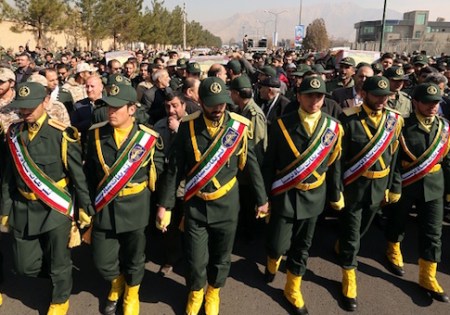
Members of the Iran’s Revolutionary Guard Corps / Getty Images
Trump last week signed new sanctions legislation mandating that the United States extend a terror designation to the IRGC, marking the first time in U.S. history a foreign country’s military branch would be hit with such a designation.
However, the State and Treasury Departments would not confirm Wednesday that the administration intends to make good on this law, which was approved by Congress with bipartisan support.
***********************************
The Trump administration will not commit to designating the Islamic Revolutionary Guard Corps, or IRGC, Iran’s elite fighting force, as terrorists, despite a congressional mandate to do so by the end of the month, according to multiple U.S. officials and other administration insiders who told the Washington Free Beacon that holdovers from the Obama administration are working to stymie the effort.
While President Donald Trump is expected to announce this week that he will not certify Iran as in compliance with the landmark nuclear deal, it remains unclear if he will follow through with congressionally approved plans to extend a terror designation to the IRGC, a move that has prompted Iran to threaten greater attacks on U.S. forces in the Middle East.
The IRGC is responsible for numerous terror attacks on American troops over the years and has played a key role in interfering with U.S. operations in Syria. A bipartisan consensus in Congress has already backed such a designation, but key Obama-era holdovers and top national security officials who have the president’s ear are urging him to refrain, according to multiple sources who spoke to the Free Beacon.
Top lawmakers and insiders who spoke to the Free Beacon about the growing uncertainty over how best to hold Iran accountable for its terror activities expressed frustration over what they view as the administration’s inability to follow through with its foreign policy promises, particularly as they relate to Iran, which has increasingly targeted U.S. forces with military action.
New reports emerged Wednesday afternoon that Trump’s planned speech on Iran may be scaled back and not take place until Friday, if it does at all.
Trump last week signed new sanctions legislation mandating that the United States extend a terror designation to the IRGC, marking the first time in U.S. history a foreign country’s military branch would be hit with such a designation.
However, the State and Treasury Departments would not confirm Wednesday that the administration intends to make good on this law, which was approved by Congress with bipartisan support.
The administration may be getting cold feet due to the objections of key U.S. officials and those in the Treasury Department who view such a designation as harmful to American companies that have business interests in Iran, where the IRGC controls a majority of the economy, sources said.
“The IRGC is responsible for wreaking havoc throughout the Middle East and, through its Quds Force, for killing hundreds of American troops in Iraq,” Rep. Ron DeSantis (R., Fla.), a member of the House Foreign Affairs Committee and chair of its National Security Subcommittee, told the Free Beacon.
“The IRGC represents a quintessential terrorist group and should be designated as such,” DeSantis said. “Whereas the Obama administration flew pallets of cash to the IRGC, the Trump administration should act to hold the IRGC accountable. Designating it as a terrorist group is a good first step.”
Neither the State Department or White House would confirm to the Free Beacon plans to follow through with this designation, prompting speculation that the process may be held up over objections by Obama-era holdovers in the Trump administration who view the move as a shot at dismantling the former president’s nuclear deal.
“Congress didn’t ask the president to designate the full IRGC,” according to one veteran Middle East policy advisor who lobbies Congress on Iran sanctions. “They told the president to do it by veto proof majorities. Obama holdover lawyers and his establishment staffers are telling him he can use loopholes to just go after some entities and circumvent Congress.”
These same voices are continuing to advise Trump against decertifying Iranian compliance with the deal, despite the president’s personal belief that the Islamic Republic has flagrantly violated what he has repeatedly described as a bad deal.
“These are the same people advising him to certify the nuclear deal, which was also rejected by bipartisan majorities in Congress,” the source said. “They’re wrong and if they stay wrong, lawmakers will eventually make it an oversight issue.”
A State Department official declined repeated requests for clarification on what the administration intends to do about the IRGC, but told the Free Beacon officials remain “deeply troubled by Iran’s longstanding provocative activities including its support for terrorism and destabilizing activities in the region.”
“We are committed to holding Iran accountable for its behavior,” the official said. “The United States retains the authority to respond to Iran’s support for terrorism, human rights abuses, and destabilizing activities. The U.S. government constantly reviews information, through an interagency process, to evaluate potential sanctions violators for targeting under existing sanctions authorities.”
A Treasury Department official did not respond to a request for comment on the matter.
Iranian officials vowed last week to strike U.S. forces and bases in the region if the Trump administration moves forward with extending a terror designation to the IRGC.
Rep. Sean Duffy (R., Wis.), a vocal opponent of the Iran deal, told the Free Beacon that Iran would be wise to back down from its threats.
“President Obama’s terrible Iran deal predictably emboldened the Iranian regime to build up their military and antagonize the region,” Duffy said. “Iran may have been able to bully our previous president, but the American people elected President Trump to stand up for the United States on the world stage.”
“The Iranian regime is already on notice for being the world’s largest state-sponsor of terror, and it would be wise for them to back down from their belligerent posture,” Duffy added.
Experience has shown that soft rhetoric and so-called “smart diplomacy” have served only to enable North Korea and Iran to produce more nuclear weapons and better ballistic missiles.
Not only has the International Atomic Energy Agency (IAEA) been prevented from monitoring Iranian compliance, but it is not pushing the issue for fear that “Washington would use an Iranian refusal as an excuse to abandon the JCPOA.”
During his first press conference after taking office in January 1981, US President Ronald Reagan called détente a “one-way street that the Soviet Union has used to pursue its own aims.” Echoing this remark while addressing reporters later the same day, Secretary of State Alexander Haig said that the Soviets were the source of much support for international terrorism, especially in Latin and Central America.
The following day, both Reagan and Haig were criticized for their remarks, with members of the media describing the president’s words as “reminiscent of the chilliest days of the Cold War,” and appalled that the administration’s top diplomat was accusing the Russians of backing terrorist activities.
Nearly four decades later, in spite of the successful defeat of the Soviet empire, the White House is still frowned upon when it adopts a tough stance towards America’s enemies. Today’s outrage is directed at President Donald Trump’s warnings about — and to — North Korea and Iran. The Washington Post called his recent “fire and fury” threats to Pyongyang a “rhetorical grenade,” for example, echoing top Democrats’ attacks on his remarks for being “reckless” and “irresponsible.”
Critics of Trump’s attitude towards Tehran go equally far, describing his opposition to the Joint Comprehensive Plan of Action (JCPOA) — the nuclear deal with Iran — as “rushing headlong into war.”
Trump’s detractors, however, are just as wrong as those who berated Reagan in 1981. Experience has shown that soft rhetoric and so-called “smart diplomacy” have served only to enable North Korea and Iran to produce more nuclear weapons and better ballistic missiles.
Although the JCPOA stipulates that Iran is not permitted to produce more than a certain quantity of enriched uranium or to enrich uranium beyond a certain level, not only has the International Atomic Energy Agency (IAEA) been prevented from monitoring Iranian compliance, but it is not pushing the issue for fear that “Washington would use an Iranian refusal as an excuse to abandon the JCPOA.”
Furthermore, among its many other flaws, the JCPOA does not address Iran’s ballistic-missile capabilities or financing of global terrorism.
Nevertheless, it is the administration’s rhetoric that is under attack. Isn’t it high time for the media and foreign-policy establishment to wake up to the reality that seeing regimes as they are, rather than as we wish them to be, is the only way to confront our enemies effectively, and with the least number of casualties?
Peter Huessy is president of GeoStrategic Analysis, a defense consulting firm he founded in 1981
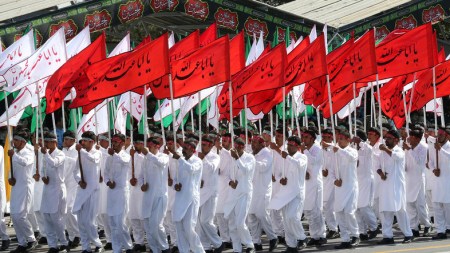
Members of Iranian armed forces march during a parade in Tehran, Iran, September 22, 2017. President.ir/Handout via REUTERS.
The new mentality sought by Washington is to address all of Iran’s belligerence and not allow its nuclear program and the JCPOA devour all of the international community’s attention.
The new US response, including blacklisting Iran’s notorious Revolutionary Guards, to be announced by Trump is said to cover missile tests, support for terrorism and proxy groups checkered across the Middle East, hopefully human rights violations at home, and cyberattacks.
Iran has a history of resorting to such measures, including targeting Saudi oil interests. Raising the stakes for Iran, Trump described a meeting with his top military brass on Thursday evening as “the calm before the storm.” Neither the US President nor the White House provided further details, yet rest assured Tehran received the message.
**************************
All eyes are on US President Donald Trump and his upcoming Iran speech later this week to clarify his decision to certify or decertify Tehran’s compliance with a nuclear agreement, officially known as the Joint Comprehensive Plan of Action (JCPOA), designed to curb the regime’s controversial atomic drive.
This has Iran’s regime on its toes, as senior elite in Tehran understand fully how the US can lead the international community in adopting strong measures against its broad scope of malign activities. Expected to be addressed is also a wide range of concerns over Iran’s dangerous policies in relation to its ballistic missile advances, meddling in Middle East states and supporting terrorist proxy groups as explained in a new video.
‘Iran’s unacceptable behavior’
Iran’s rogue behavior, currently imposing its influence on four major regional capitals of Baghdad, Beirut, Damascus and Sanaa, are the result of the Obama administration’s “overly lenient foreign policy, which sought to promote America’s priorities through consensus, rather than through the frank display of power,” as put by a recent The New Yorker piece.
“Lifting the sanctions as required under the terms of the JCPOA has enabled Iran’s unacceptable behavior,” US Secretary of State Rex Tillerson said in a late September meeting with his P5+1 counterparts and Iran’s top diplomat Mohammad Javad Zarif.
The Trump administration is also deeply concerned over Iran’s proxies mining the strategic Bab el-Mandeb Strait waterway, aiming its indigenous missiles from Yemen towards cities in Saudi Arabia and other Gulf countries, and from southern Lebanon towards Israel. This is Tehran in action with the objective of taking advantage of the destruction left behind by ISIS across the region, especially in Syria and Iraq.
“The Iranian regime supports terrorism and exports violence, bloodshed and chaos across the Middle East,” Trump told reporters before a Thursday evening meeting with senior military leaders at the White House. “That is why we must put an end to Iran’s continued aggression and nuclear ambitions,” he said. “They have not lived up to the spirit of their agreement.”
Trump has put Iran “on notice” over charges that Tehran violated a nuclear deal with the West by test-firing a ballistic missile. (Reuters)
Joint effort
Parallel to the White House there are voices on Capitol Hill advocating the new approach weighed by the administration.
“The president should decline to certify, not primarily on grounds related to Iran’s technical compliance, but rather based on the long catalog of the regime’s crimes and perfidy against the United States, as well as the deal’s inherent weakness,” Senator Tom Cotton said last week at a speech in the Council on Foreign Relations.
As the Trump administration seeks to place necessary focus on Iran’s illicit Middle East ambitions and actions, talks are also ongoing as we speak over how to amend the JCPOA’s restrictions.
“Sunset clauses,” Iran’s ballistic missile development and testing, and an inspections regime lacking the bite to gain necessary access into the regime’s controversial military sites. Under the current framework Iran can easily conduct nuclear weapons research and development in military sites and claim such locations do not fall under the JCPOA jurisdiction.
While it is expected of Trump to decertify Iran, he most likely will not go the distance to completely pull America out of the nuclear agreement. Obama refused to send the JCPOA to Congress for discussion and approval. Trump, however, seems set to place the decision to impose further sanctions on Iran upon the shoulders of US lawmakers.
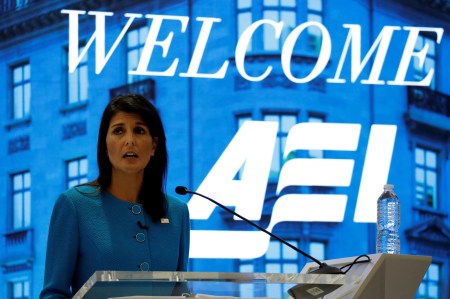
US Ambassador to the United Nations Nikki Haley speaks about the Iran nuclear deal at the American Enterprise Institute in Washington, on September 5, 2017. (Reuters)
More than ‘one piece’
The new mentality sought by Washington is to address all of Iran’s belligerence and not allow its nuclear program and the JCPOA devour all of the international community’s attention.
The new US response, including blacklisting Iran’s notorious Revolutionary Guards, to be announced by Trump is said to cover missile tests, support for terrorism and proxy groups checkered across the Middle East, hopefully human rights violations at home, and cyberattacks.
Iran has a history of resorting to such measures, including targeting Saudi oil interests. Raising the stakes for Iran, Trump described a meeting with his top military brass on Thursday evening as “the calm before the storm.” Neither the US President nor the White House provided further details, yet rest assured Tehran received the message.
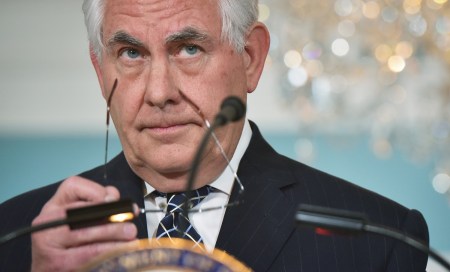
US Secretary of State Rex Tillerson delivering a statement on Iran in the Treaty Room of the State Department in Washington, DC, on April 19, 2017. (AFP)
Fear renders contradiction
Sensing an increasingly escalating tone from Washington, Tehran signaled its first sign of fear by expressing readiness to discuss its ballistic missile program, according to Reuters. And yet less than 24 hours later, Iranian officials said no offers were made to negotiate such restrictions.
“Iran regards defensive missile programs as its absolute right and will definitely continue them within the framework of its defensive, conventional and specified plans and strategies,” Iranian Foreign Ministry spokesman Bahram Qassemi said, according state media.
Iranian President Hassan Rouhani also felt the need to make remarks to save face before the regime’s already depleting social base. “In the nuclear negotiations and agreement we reached issues and benefits that are not reversible. No one can turn that back, not Mr. Trump or anyone else,” Rouhani said at a recent Tehran University ceremony, according to state media.
Of course, we all remember how prior to the JCPOA signing in 2015 senior Iranian officials went the limits in describing any “retreat” regarding their nuclear program as a “red line.” To make a long story short, Tehran is comprehending how the times are changing at a high velocity, endangering its domestic, regional and international interests. And unlike the Obama years, its actions will not go unanswered.
Senator Cotton made this crystal clear at his speech: “Congress and the President, working together, should lay out how the deal must change and, if it doesn’t, the consequences Iran will face.”
(The chances of renegotiating the JCPOA to make it less harmful to America appear to be close to zero. — DM)
[T]he deal’s acolytes are actively obscuring this central issue, arguing that it is too arduous and too complex to withdraw cleanly. They have seized instead on a statutory requirement that every 90 days the president must certify, among other things, that adhering to the agreement is in America’s national-security interest. They argue the president should stay in the deal but not make the next certification, due in October.
This morganatic strategy is a poorly concealed ploy to block withdrawal, limp through Mr. Trump’s presidency, and resurrect the deal later. Paradoxically, supporters are not now asserting that the deal is beneficial. Instead, they concede its innumerable faults but argue that it can be made tougher, more verifiable and more strictly enforced. Or, if you want more, it can be extended, kicked to Congress, or deferred during the North Korea crisis. Whatever.
The only sure way to resume economic pressure on Iran is for President Trump to stop waiving the sanctions, as he did a few weeks ago. The power to act is in executive hands, as it should be.
*********************************
“Cut, and cut cleanly,” Sen. Paul Laxalt advised Ferdinand Marcos in 1986, urging the Philippine president to resign and flee Manila because of widespread civil unrest. The Nevada Republican, Ronald Reagan’s best friend in Congress, knew what his president wanted, and he made the point with customary Western directness.
President Trump could profitably follow Mr. Laxalt’s advice today regarding Barack Obama’s 2015 deal with Iran. The ayatollahs are using Mr. Obama’s handiwork to legitimize their terrorist state, facilitate (and conceal) their continuing nuclear-weapons and ballistic-missile programs, and acquire valuable resources from gullible negotiating partners.
Mr. Trump’s real decision is whether to fulfill his campaign promise to extricate America from this strategic debacle. Last month at the United Nations General Assembly, he lacerated the deal as an “embarrassment,” “one of the worst and most one-sided transactions the United States has ever entered into.”
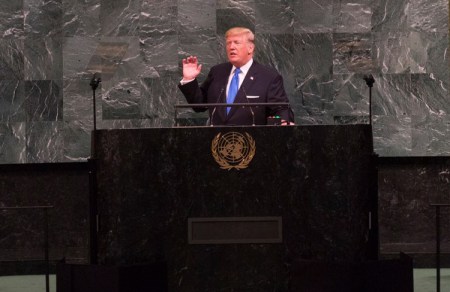
Last month at the United Nations General Assembly, President Donald Trump lacerated the Iran nuclear deal as an “embarrassment,” “one of the worst and most one-sided transactions the United States has ever entered into.” (Image source: The White House)
Fearing the worst, however, the deal’s acolytes are actively obscuring this central issue, arguing that it is too arduous and too complex to withdraw cleanly. They have seized instead on a statutory requirement that every 90 days the president must certify, among other things, that adhering to the agreement is in America’s national-security interest. They argue the president should stay in the deal but not make the next certification, due in October.
This morganatic strategy is a poorly concealed ploy to block withdrawal, limp through Mr. Trump’s presidency, and resurrect the deal later. Paradoxically, supporters are not now asserting that the deal is beneficial. Instead, they concede its innumerable faults but argue that it can be made tougher, more verifiable and more strictly enforced. Or, if you want more, it can be extended, kicked to Congress, or deferred during the North Korea crisis. Whatever.
As Richard Nixon said during Watergate: “I want you to stonewall it, let them plead the Fifth Amendment, cover up, or anything else if it’ll save it — save the plan.”
Mr. Trump should not be deceived. The issue is not certification. The issue is whether we will protect U.S. interests and shatter the illusion that Mr. Obama’s deal is achieving its stated goals, or instead timidly hope for the best while trading with the enemy, as the Europeans are doing. It is too cute by half to employ pettifoggery to evade this reality.
U.N. Security Council Resolution 2231 embodies the deal and includes two annexes: the Joint Comprehensive Plan of Action itself, and a statement by the other negotiating parties on “transparency… creating an atmosphere conducive” to full JCPOA implementation. Resolution 2231, the JCPOA and the statement were all crafted word-for-word with Iran (with Russia and China acting as Tehran’s scriveners on the statement), as was the cash-for-hostages swap Mr. Obama sought desperately to conceal. This packaging is more than a diplomatic nicety. It means Iran’s ballistic-missile program is integral to the deal — fittingly, since Iran’s missiles would deliver its nuclear warheads.
The ayatollahs have neither the desire nor the incentive to renegotiate even a comma of the agreement. Why should they, when it is entirely to their advantage? Both Resolution 2231 and the statement, for example, “call upon” Iran to forgo activity regarding “ballistic missiles designed to be capable of delivering nuclear weapons.” The U.N. secretary-general recently reported that Iran is violating this provision and implicitly lying about it. But the deal’s language allows Iran to claim solemnly that its missiles are not “designed” to carry nuclear warheads, an assertion whose verification would require polygraphs and psychologists, not weapons inspectors. This is one of many textual loopholes.
If the deal is vitiated, Tehran would not be freer than it is now to pursue nuclear weapons and ballistic missiles. Not only is the international compliance regime a far cry from Mr. Obama’s promised “anytime, anywhere” inspections, crucial language is vague and ambiguous. Mr. Obama’s negotiators crippled real international verification by pre-emptively surrendering on what were delicately termed “possible military dimensions” of Iran’s nuclear program.
Moreover, simple economic logic suggests that Tehran’s scientists are probably enjoying Pyongyang’s hospitality, well beyond the International Atomic Energy Agency’s limited capability to detect. Even U.S. intelligence could be in the dark if Iran is renting a uranium enrichment facility under a North Korean mountain. It is specious to assert that the North Korean nuclear crisis should lead to deferring action on the Iran deal. The conclusion should be precisely the opposite: Failure to act decisively on Iran now worsens the global proliferation threat.
The IAEA has interpreted Mr. Obama’s possible-military-dimension concession as requiring new evidence before it attempts to visit Tehran’s military bases, where the real work on weaponization and missiles is taking place—if not under mountains in North Korea. Mr. Obama acquiesced in this emasculation of the IAEA’s will to inspect, making the agency today like the drunk looking for his car keys under a street lamp because the light is better there. This is a sorry caricature of a robust, Reaganesque “trust but verify” regime.
Perhaps the most inane argument is that Congress should decide the deal’s fate and whether to reimpose U.S. sanctions. If a president is unwilling to solve this kind of problem, he shouldn’t have applied for the job. Watching what has happened on failed legislative efforts to repeal and replace ObamaCare, can anyone doubt that Senate Democrats (joined by Rand Paul) would filibuster any legislative effort to renew sanctions? The only sure way to resume economic pressure on Iran is for President Trump to stop waiving the sanctions, as he did a few weeks ago. The power to act is in executive hands, as it should be.
Mr. Trump knows his mind on Iran. And as Mr. Laxalt said to Marcos, “the time has come” to act decisively.
John R. Bolton, former U.S. Ambassador to the United Nations, is Chairman of Gatestone Institute, a senior fellow at the American Enterprise Institute, and author of “Surrender Is Not an Option: Defending America at the United Nations and Abroad”.
This article first appeared in The Wall Street Journal and is reprinted here with the kind permission of the author.
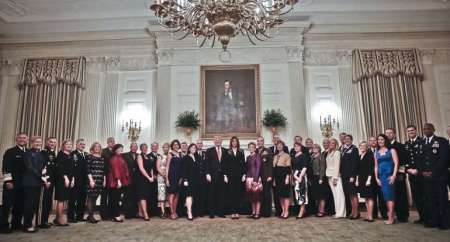
President Donald Trump and first lady Melania Trump, center, poses for a group photo with Senior Military leaders and spouses in the State Dining Room of the White House on Oct. 5, 2017. (AP Photo/Pablo Martinez Monsivais)
The first priority for any president inheriting this virulent global mess should be to try as far as possible to reclaim America’s credibility; to persuade America’s enemies that the bargain sale on U.S. interests is over, and America will, if necessary, wield its full military might to defend itself, its allies and interests. That is vital to deterrence, which — if genuinely effective — is vastly preferable to war.
The conundrum is how America can regain the credibility needed for deterrence, without having to resort to war in order to prove the point. For instance, unless Kim Jong Un truly believes that the U.S. might actually attack North Korea despite the potential horrific cost, why should he back down? Why should he worry about U.S. warships and submarines in the region? It’s an impressive show of military hardware, but is it a credible threat?
For an American president faced with this problem, one move worth attempting would be to gather America’s top military commanders for a meeting at the White House, followed by a dinner with their spouses, and invite the press to come witness and report on this conclave. If, in the midst of this genial scene, the president mentions that this is the calm before the storm, it may be baffling and frustrating to reporters — whose job includes nailing down details. But in capitals such as Moscow, Beijing, Tehran and Pyongyang, it might just help prompt a rethink about the assumption — gleaned from their success in rogue ventures during the tenure of Obama — that America is a hamstrung giant.
There’s always the possibility that it was more than a broad warning — that perhaps Trump is indeed about to launch a specific military action. But to whatever extent this cliffhanger helps concentrate minds in Moscow, Beijing, Tehran and Pyongyang on just how unpleasant it could be to provoke an American storm, it was an important message. Quite possibly a bid to avert a war, rather than start one. Worth the kerfuffle in the press.
***********************************
With the phrase “the calm before the storm,” President Trump on Thursday evening kicked off one of the biggest media kerfuffles since his late-night tweet in May about “the constant negative press covfefe.” That mysterious locution produced a spate of stories speculating sardonically on what the president meant. We’re now hearing a similar round of mockery. But this was no late-night typo in a tweet, and while offended members of the media default to derision, it’s worth considering that the president quite likely sent a useful message to an audience that extends way beyond the White House press corps.
The setting was a dinner for top U.S. military commanders and their spouses, hosted by Trump in the White House State Dining Room. Trump invited reporters in for a brief photo-op. Flanked by military officials who have dedicated themselves to defending America and winning its wars, all gathered with their spouses under a big portrait of President Lincoln. Trump asked the reporters, “You guys know what this represents?”
“Tell us, sir,” said one of the reporters.
“Maybe it’s the calm before the storm,” said Trump. A reporter asked, “What storm?” Trump gave the oblique reply, “We have the world’s greatest military people in this room, I will tell you that.” A reporter asked, again, “What storm?” Trump said, “You’ll find out.”
The entire exchange lasted about 30 seconds. The reporters were thanked and dismissed. The media were left to speculate on whether the “storm” referred to impending military action again North Korea, or maybe plans to back away from President Obama’s Iran nuclear deal, or something else, or nothing at all. Asked again by reporters on Friday what he meant by “the calm before the storm,” Trump again declined to clarify, saying again, “You’ll find out.”
This has been playing as a crazy-Trump story. CNN came out with the headline: “Trump is treating a potential war like a reality show cliffhanger,” and warned, “This is no reality show… His words — whether he means them as a tease, a threat or something in between — can have very real consequences.” Esquire called Trump “Our Reality TV President” and asked, “Will the season finale involve nuclear war with North Korea?” The New York Times called Trump’s comment “ominous.” NBC called it “provocative.” Politico called it “unprompted.” The Huffington Post, in a headline, called it “Bizarre.”
I’d call it smart. We don’t know precisely what the president had in mind. But we do know — or we ought to know — this: In world politics, there is a gathering storm that threatens America and our allies. There is a rising network of tyrannies hostile to American interests and values, including most prominently Russia, China, Iran and North Korea. The U.S. superpower can face down any one of these actors if it must, but the disturbing trajectory is that for years now — whatever their differences — they have effectively been making common cause against America and the requirements of a free and peaceful world order. They do illicit business together; they often back each other diplomatically, and they learn from each other just how much it is possible to get away with. Russia and China have been carrying out joint military maneuvers. North Korea, longtime weapons dealer to Iran, is cultivating an arsenal of nuclear missiles. The threats compound.
This trend accelerated dramatically during the years of America’s policies of retreat, appeasement, and surrender under President Obama. China, as part of its military buildup, sped up its construction of artificial islands topped with military bases clearly designed to threaten freedom of navigation along vital shipping routes in Southeast Asia. Russia snatched Crimea from Ukraine, and got away with it. Terrorist-sponsoring Iran extended its reach in the Middle East, and is currently benefitting from a rotten nuclear deal that paves its way to the bomb, accessorized with ballistic missiles. Syria disintegrated into war, which opened the way for both the rise of ISIS and military inroads by Vladimir Putin’s Russia into the Middle East. Libya, with America leading-from-behind, disintegrated into terrorist-infested chaos.
And North Korea, which had carried out one nuclear test in 2006 on the watch of President Bush, conducted four more tests during the tenure of Obama, along with scores of ballistic missile tests, while Kim Jong Un consolidated his hold on the totalitarian throne inherited in 2011 from his father. Taking advantage of Obama’s “strategic patience” to ramp up a rogue nuclear program, Kim Jong Un’s regime was ready to greet the Trump administration with an arsenal that by now appears quite convincingly to include long-range missiles, miniaturized warheads and the hydrogen bomb.
None of this is a figment of Trump’s imagination. Neither is it a prop on some reality TV show. It is real.
This is not of Trump’s making. But given the rate at which the threats and crises have been compounding, it falls to him to cope with a greatly emboldened group of increasingly well armed and predatory powers. This has been made all the more difficult by the enormous amount of U.S. credibility that was squandered by Obama — who gutted the U.S. military, bore passive “witness” to upheaval in Iran, erased his own red line over chemical weapons in Syria, threw away the hard-won progress in Iraq, bungled Afghanistan and Libya, promised (and delivered) flexibility to Putin, deferred to China, embraced Cuba, shrugged off the rising nuclear threat of North Korea, and assured the American public that the tide of war was receding.
The first priority for any president inheriting this virulent global mess should be to try as far as possible to reclaim America’s credibility; to persuade America’s enemies that the bargain sale on U.S. interests is over, and America will, if necessary, wield its full military might to defend itself, its allies and interests. That is vital to deterrence, which — if genuinely effective — is vastly preferable to war.
The conundrum is how America can regain the credibility needed for deterrence, without having to resort to war in order to prove the point. For instance, unless Kim Jong Un truly believes that the U.S. might actually attack North Korea despite the potential horrific cost, why should he back down? Why should he worry about U.S. warships and submarines in the region? It’s an impressive show of military hardware, but is it a credible threat?
For an American president faced with this problem, one move worth attempting would be to gather America’s top military commanders for a meeting at the White House, followed by a dinner with their spouses, and invite the press to come witness and report on this conclave. If, in the midst of this genial scene, the president mentions that this is the calm before the storm, it may be baffling and frustrating to reporters — whose job includes nailing down details. But in capitals such as Moscow, Beijing, Tehran and Pyongyang, it might just help prompt a rethink about the assumption — gleaned from their success in rogue ventures during the tenure of Obama — that America is a hamstrung giant.
Whether that was Trump’s intention, I don’t know. It sure looked that way. In the phrase that so alarmed CNN and Esquire, there was a useful ambiguity. Trump didn’t guarantee a storm; he merely suggested it could happen. Surrounded by his top military commanders, in the seat of American power that is the White House, the commander-in-chief prefaced his statement about “the calm before the storm” with “maybe.” It was, in a genteel and peaceful setting, a warning not to mess with America.
There’s always the possibility that it was more than a broad warning — that perhaps Trump is indeed about to launch a specific military action. But to whatever extent this cliffhanger helps concentrate minds in Moscow, Beijing, Tehran and Pyongyang on just how unpleasant it could be to provoke an American storm, it was an important message. Quite possibly a bid to avert a war, rather than start one. Worth the kerfuffle in the press.
(President Trump has two options: (1) he can certify that Iran is not developing nukes and is also in compliance with the JCPOA in all other respects or (2) he can decline to do so. In view of the acknowledged inability of the IAEA to conduct meaningful inspections of military and other non-designated sites, President Trump has no way to determine that Iran is not developing nukes. In the absence of even minimal evidence that Iran is not developing nukes, it seems very unlikely that he will certify compliance.
President Trump does not need to go so far as to certify that Iran is not in compliance, as he should perhaps explain to Tillerson, Mattis et al. Any belief held by Tillerson, Mattis et al that, regardless of the lack of evidence of Iranian compliance, the Iran scam is a “good deal” for America is irrelevant. — DM)
Mideast Iran Nuclear Deal
Last week IAEA [International Atomic Energy Agency] chief Amano revealed the IAEA has been unable to verify Iran is fully implementing the nuclear deal, specifically Section T which prohibits certain activities related to “the design and development of a nuclear explosive device,” because Iran has barred inspectors from military sites where those activities would be occurring . . . .
*************************************
For all the talk of “morons” Wednesday — did Rex Tillerson call Donald Trump a moron and what does that mean, if anything — the real issue for those not transfixed by media gotcha games is the certification, or not, of something truly moronic: the Iran Nuclear Deal (JCPOA).
In normal times, devoid of mass murderers and endless natural disasters, the looming October 15 certification decision on this deal would be front and center in the national consciousness. It still should be because, ultimately, it is even more important than hurricanes and psychopathic killers. It’s about nuclear war.
The biggest mistake of the Obama years was not the Affordable Care Act — that can be fixed eventually — but the Iran deal, which has already resulted in massive catastrophe, causing irreparable damage. Iran, financially enriched by the agreement, has been able to play a growing and truly evil role throughout the Middle East (and even South America), but especially in the unending Syrian civil war through its brutal own Revolutionary Guard and its bloodthirsty Hezbollah cutouts. This war has undoubtedly changed the character of Europe forever by creating millions of refugees. Every one of our lives has been or will be affected by it, directly or indirectly. (Reminder: One of the Paris Bataclan theatre terrorists who slaughtered 130, more than twice Las Vegas, held a Syrian refugee passport.) Even now, as ISIS is being pushed back, Iran, not us or our allies, is moving in to take control of their territory. We can be sure the mullahs will use it to build children’s hospitals and cancer research institutes — either that or murder thousands more in the name of the Twelfth Imam.
Obama’s motivation to make this deal, to choose the mullahs’ side in the more than thousand-year-old Shiite-Sunni blood feud that comes to us as a horrifying ghost from the pre-Middle Ages, remains one of the great mysteries of our time. It was the kind of agreement only State Department bureaucrats could love or, for that matter, see. In that sense, the Iran Deal is a perfect “Swamp” agreement. Nobody really knows what’s in it, deliberately so — just like the Affordable Care Act, actually. Only in this instance, Nancy Pelosi did not have to tell us to sign it to know what’s in it, because it was never signed in the first place — nor intended to be. It was simply put in place — Constitution be damned — over the heads of an impotent Congress by Obama and his claque of unwise wise men and women.
But that was then and this is now. According to The Free Beacon’s Adam Kredo:
The Trump administration is expected to announce next week that it will not formally certify Iran as in compliance with the landmark nuclear agreement, a move that could kill the agreement and set the stage for Congress to reimpose harsh economic sanctions on the Islamic Republic, according to multiple U.S. officials and sources familiar with the situation.
While some senior Trump administration officials—including Secretary of State Rex Tillerson and Secretary of Defense James Mattis—are pushing for President Donald Trump to preserve the deal, it has become increasingly clear the president is frustrated with Iran’s continued tests of ballistic missile technology and rogue operations targeting U.S. forces in the region, according to these sources.
Let’s hope that Tillerson and Mattis won’t prevail if that really is still their opinion. You would think given Kim Jung-un getting almost as much media attention for his missiles as Stephen Paddock for his guns, and the longtime documented alliance on military matters of Iran and North Korea, they would be ready for another strategy. After all, looked at from afar (actually not that far) the JCPOA mirrors the approach many administrations took to North Korea. There are minor differences, but they all came down to “give them some money so they play nice.” How did that turn out? Perhaps I’m naive, but getting tough with tough guys for a change just might be worth a try.
It seems that Trump gets this. According to Eli Lake: “The centerpiece of Trump’s new Iran strategy will be the designation of Iran’s Revolutionary Guard Corps as a terrorist organization, placing it in the same category as al Qaeda and the Islamic State.”
The Revolutionary Guard is responsible for approximately 15 percent of Iranian GNP. Designating them a terror organization, which they indubitably are, would result in a substantial financial hit to the mullahs. The Swamp, of course, will object. That’s not how the game is played. But the truth is, the Swamp game is destructive to our country and the West, not mention factually absurd.
Omri Ceren, whose ongoing reporting on this “deal” has been invaluable (as has the work of the Foundation for Defense of Democracies’ Mark Dubowitz), explained why in a recent email:
Last week IAEA [International Atomic Energy Agency] chief Amano revealed the IAEA has been unable to verify Iran is fully implementing the nuclear deal, specifically Section T which prohibits certain activities related to “the design and development of a nuclear explosive device,” because Iran has barred inspectors from military sites where those activites would be occurring,
At least, Israel has a more sympathetic ear in the Trump administration than it did in the Obama administration for raising its concerns about Iran’s growing threat, not only to Israel but to U.S. interests in the region and beyond. President Trump’s sharp denunciation of the Iranian regime during his address to the UN General Assembly represented a welcome departure from the Obama administration’s milquetoast approach to Iran.
As the U.S.-led coalition continues to drive ISIS from its bases of operation in Syria, the Trump administration has proclaimed its intention not to allow Iran to turn Syria into its own satellite, as Iran has essentially done in Iraq. National Security Adviser H.R. McMaster said that the “so called liberation of areas by Assad’s forces and Iranian proxies could actually accelerate the cycle of violence and perpetuate conflict rather than get us to a sustainable outcome.” He claimed that the Trump administration’s “objectives are to weaken Iranian influence across the region broadly,” without discussing the means to accomplish those objectives.
***************************
Despite Israel’s repeated warnings, Barack Obama’s reckless appeasement of the Iranian regime has enabled its rise as a hegemonic threat in the Middle East region as well as a threat to international peace and security. In 2009, Obama turned his back on millions of dissidents in the streets of Tehran and other Iranian cities, who were peacefully protesting the rigged election of Mahmoud Ahmadinejad as president. In 2011, Obama precipitously removed the remaining U.S. combat troops from Iraq, giving rise to ISIS’s re-emergence in Iraq from its bases in Syria. The radical Shiite Iranian regime purported to come to the “rescue” of both countries from the Sunni terrorists, turning Iraq into a virtual vassal state of the largest state sponsor of terrorism in the process. Obama’s disastrous nuclear deal with Iran legitimized Iran’s path to eventually becoming a nuclear-armed state, while immediately filling its coffers with billions of dollars to fund its aggression.
Meanwhile, Syria has become ground zero for Iran’s execution of its regional ambitions, which is to establish its Shiite Crescent connecting with its allies, including Iraq, Syria and Lebanon. This plan has included the establishment of a land route that Iranian-backed militias secured in June, beginning on Iran’s border with Iraq and running across Iraq and Syria all the way to Syria’s Mediterranean coast. This road makes Iran’s job easier in supplying arms by land, as well as by air and sea, to prop up Syrian President Bashar al-Assad’s regime and to equip Iran’s own forces fighting inside of Syria in support of Assad. This helps explain why Iran has placed so much importance on helping the Syrian regime establish control over the Deir ez-Zor area in eastern Syria, near the Iraqi border.
“Everything depends now on the Americans’ willingness to stop this,” said an Iraqi Kurdish official who was quoted in a New Yorker article. However, U.S.-led coalition forces apparently have done next to nothing to stop this major advance in Iran’s Shiite Crescent expansion. “Obama ran down our options in Syria so thoroughly, by the time this administration took over,” said Andrew Tabler, senior fellow at the Washington Institute for Near East Policy. “The Iranian influence is spreading because they are so heavily involved in regime activities,” Tabler added. “It’s a new monster.”
Furthermore, Iran has funded and armed its terrorist proxy Hezbollah, which has sent its militia from its home base of Lebanon to fight alongside Assad’s forces. And Iran has used Syria as a transit point for shipment of sophisticated rockets to Hezbollah in Lebanon for future use against Israeli population centers. Despite the fact that Hezbollah has American blood on its hands, the U.S.-led coalition has chosen not to do anything about Hezbollah’s presence in Syria, bought and paid for by Iran.
While Israel chose not to take sides in Syria’s civil war with military intervention of its own, it has bombed weapons storage facilities and convoys inside Syria for its own protection. Just recently, on September 7th, Israeli jets struck a Syrian weapons facility near Masyaf, which was reported to have been used for the production of chemical weapons and the storage of missiles. Israel will also do what is necessary to repel Iranian-backed forces if they edge too close to areas near the Golan Heights, shrinking the buffer between Israel and Iranian controlled territories.
However, such tactical measures may not be enough to thwart Iran’s larger ambitions. In light of intelligence reports that Assad may be ready to invite Iran to set up military bases in Syria, Israeli leaders have concluded that they cannot wait until the Trump administration decides to deal more forcefully with Iran’s growing use of Syria as a staging area for carrying out its expansionist Shiite Crescent strategy. “Their overriding concern in Syria is the free reign that all the major players there seem willing to afford Iran and its various proxies in the country,” wrote Jonathan Spyer in an article for Foreign Policy. As long as nobody else is addressing the concern Iran’s growing control raises in a satisfactory manner, “Israel is determined to continue addressing it on its own.”
At least, Israel has a more sympathetic ear in the Trump administration than it did in the Obama administration for raising its concerns about Iran’s growing threat, not only to Israel but to U.S. interests in the region and beyond. President Trump’s sharp denunciation of the Iranian regime during his address to the UN General Assembly represented a welcome departure from the Obama administration’s milquetoast approach to Iran.
As the U.S.-led coalition continues to drive ISIS from its bases of operation in Syria, the Trump administration has proclaimed its intention not to allow Iran to turn Syria into its own satellite, as Iran has essentially done in Iraq. National Security Adviser H.R. McMaster said that the “so called liberation of areas by Assad’s forces and Iranian proxies could actually accelerate the cycle of violence and perpetuate conflict rather than get us to a sustainable outcome.” He claimed that the Trump administration’s “objectives are to weaken Iranian influence across the region broadly,” without discussing the means to accomplish those objectives.
Whether the Trump administration follows through remains to be seen. In the meantime, Israel will have to deal with the fallout of Iran’s ambitions in Syria itself.
(Please see also, Omni Ceren: Decertification Approaches and How to Get Out of the Iran Nuclear Deal by Amb. Bolton. Iran has already received lots of money from Obama’s America and may well have made significant progress on making nukes and the missiles to deliver them. Would Iran forego further nuke-related technological advances to renegotiate the JCPOA with America and her allies? That seems highly unlikely if we withdraw, and even more unlikely if we remain, as McMaster and Tillerson apparently desire. — DM
Now, with the president reportedly determined to “decertify,” Tillerson, McMaster and others who oppose a U.S. withdrawal have shifted gears. They have intensified their criticism of the Iran deal as deeply flawed and are proposing the president not certify but remain a party to the deal to fix it later. In addition, they are calling for the JCPOA be sent to Congress for it to impose more sanctions.
Ambassador John Bolton has a far better and more honest option: a clean withdrawal implementing a comprehensive strategy with America’s allies – including Israel – that addresses the full range of threats posed by Iran.
***********************
There’s a pitched rhetorical battle underway right now in Washington as an October 15 deadline approaches for President Trump to certify to Congress that the 2015 nuclear deal with Iran (the JCPOA) is in the national interests of the United States and that Iran is in compliance. Although the president said last week he has made his decision, backers and opponents of the agreement are working overtime to convince him to adopt their recommendations.
President Trump has been highly critical of the JCPOA, calling it “the worst deal ever” during the presidential campaign and “an embarrassment to the United States” during his speech to the UN General Assembly on Sept. 19.
However, the president reluctantly certified the nuclear deal to Congress twice this year due to heavy pressure from his top national security advisers, especially Secretary of State Rex Tillerson and National Security Adviser H.R. McMaster. After a heated discussion with his advisers, Mr Trump made the last certification in July but indicated he did not plan to do so again.
A few months ago, Tillerson, McMaster and other advisers were telling President Trump he had no choice but to certify the JCPOA because Iran was in compliance and any violations were “not material.” Many disagreed, including Senators Tom Cotton, R-Ark., Ted Cruz, R-Texas, David Perdue, R-Ga., and Marco Rubio, R-Fla., who spelled out major instances of Iranian noncompliance and cheating in a July 11, 2017 letter to Secretary of State Rex Tillerson.
But the main argument Trump advisers made to certify the Iran deal was that if America withdrew it would alienate European leaders.
Now, with the president reportedly determined to “decertify,” Tillerson, McMaster and others who oppose a U.S. withdrawal have shifted gears. They have intensified their criticism of the Iran deal as deeply flawed and are proposing the president not certify but remain a party to the deal to fix it later. In addition, they are calling for the JCPOA be sent to Congress for it to impose more sanctions.
This supposed middle-ground option would allow President Trump to give a tough-sounding speech lashing out at the JCPOA and demanding major changes. But Iran has made it clear that it will never agree to alter the agreement and Congressional Democrats are certain to filibuster any sanctions legislation that would kill the deal. As a result, the “decertify but remain in the deal” option is actually a clever ploy to ensure the U.S. never withdraws from the nuclear deal.
Ambassador John Bolton has a far better and more honest option: a clean withdrawal implementing a comprehensive strategy with America’s allies – including Israel – that addresses the full range of threats posed by Iran.
Bolton was tasked to write a plan to do this by former Trump Chief Strategist Steve Bannon in response to the president’s request last July for a policy option to withdraw from the Iran deal. Worried that the Bolton plan could sway Mr. Trump, senior Trump officials have blocked Bolton from meeting with the president. Bolton therefore published his “Iran Deal Exit Strategy” in National Review on August 28.
Bolton’s plan has not received a lot of media coverage because senior Trump officials – especially McMaster – have been aggressively working with the press to promote the “decertify but remain in the deal” option. However, the Bolton plan received a huge boost last week when 45 national security experts sent a letter to President Trump urging him to withdraw from the JCPOA using Bolton’s strategy.
The letter’s signatories included many leading experts in arms control and nuclear nonproliferation such as former Director of Sandia National Laboratory Paul Robinson, former Under Secretary of State for Arms Control Robert Joseph; former Under Secretary of Defense for Policy Douglas Feith; former Under Secretary of Defense for Intelligence Gen. William Boykin and dozens of other former State and Defense Department officials.
The proposal being advanced by McMaster, Tillerson and others — that President Trump keep the United States in the JCPOA but not certify to Congress that it is in our national security interests — is absurd, especially after the president called the agreement an embarrassment to the United States. This option will ensure that this dangerous agreement continues as is and will undermine Mr. Trump’s credibility with the American people and the world.
As the 45 experts said in their letter to President Trump, “It is time to move beyond President Obama’s appeasement of Iran and to begin work on a comprehensive new approach that fully addresses the menace that the Iranian regime increasingly poses to American and international security.” President Trump should do this by implementing a clean withdrawal from the fraudulent Iran nuclear deal using the plan drafted by Ambassador Bolton.




 anneinpt
 artaxes
 danmillerinpanama
 davidking1530
 Peter Hofman
 Joseph Wouk
 Peter
Peter Louisiana Steve
 WarSclerotic
Recent Comments