Archive for the ‘Trump and Iran scam’ category

Former ‘Al-Sharq Al-Awsat’ Editor ‘Abd Al-Rahman Al-Rashed: ‘Which Muslims Are Against Trump?’

December 14, 2016

Former ‘Al-Sharq Al-Awsat’ Editor ‘Abd Al-Rahman Al-Rashed: ‘Which Muslims Are Against Trump?’ MEMRI, December 14, 2016

In his December 13, 2016 column in Al-Arabiya, titled “Which Muslims Are Against Trump?” senior Saudi journalist ‘Abd Al-Rahman Al-Rashed, former editor of the London-based Saudi daily Al-Sharq Al-Awsat and also former director of Al-Arabiya TV, expressed satisfaction that U.S. President-elect Donald Trump is putting together an administration that is aware of the Iranian danger. It is “Iran, Al-Qaeda, and Islamic groups like the Muslim Brotherhood” that object to Trump’s choice of top officials, and that seek to depict him as anti-Muslim, he wrote, adding that the Muslim Brotherhood was angered by Trump’s friendly stance towards Egyptian President Al-Sisi. He underlined that Trump’s national security advisor pick, Lt.-Gen. Michael Flynn, is only saying “what we ourselves say – that there is a dangerous virus inside Islamic society called extremism.”

The following is his column, in the original English: [1]

al-rashedAl-Rashed (source: Alarabiya.net)

“We must understand the motives behind the groups that launch incitement campaigns against the new American administration. Iran knows that two of the appointed generals know it through expertise and personal experience. ISIS knows that the phase of truce will end with President Barack Obama’s exit. The Muslim Brotherhood, which enjoyed Obama’s support and bet on Clinton’s election as president, is now before a new phase that may not be in its interest.

************************

“Extremist powers in our region have declared war against President-elect Donald Trump under the excuse that he has a project to fight Islam and Muslims. They are trying to incite around one billion Muslims against the new U.S. administration and against the U.S. Those performing this task are doing so through religious and media platforms affiliated with extremist Islamic parties, including the Muslim Brotherhood and the Iranian regime.

“Is Trump really hostile to Muslims in general? Do his secretaries of state [sic] really have hostile stances against Islam as a religion?

“Ever since Trump announced the appointments of major secretaries of state [sic], many in our region spoke out against them, claiming Washington was willing to launch war on one billion Muslims. General James Mattis, whom Trump chose as secretary of defense, has in fact clearly and frankly voiced hostility – but against terrorist organizations like Al-Qaeda. He also has frank stances against what Iran is doing in Iraq, Syria and Lebanon.

“General Michael Flynn, Trump’s new national security advisor, has also made outspoken speeches against extremist Islamic groups. Many have used these speeches to indicate that he is hostile against Islam and Muslims. Truth be told, what General Flynn said is what we ourselves say, that there is a dangerous virus inside Islamic society called extremism that has killed Muslims and threatened them everywhere and harmed them more than it even harmed the West and followers of other religions.

“The ‘Dangerous Disease’

“Doesn’t this dangerous disease exist in Muslims’ societies across the world? It certainly exists. Look at what happened in Turkey and Egypt during the past few days and what had happened in Saudi Arabia, Morocco and Jordan. Hideous crimes were committed by extremist groups – the same ones which Flynn and Mattis call for confronting. Mike Pompeo, whom Trump chose to manage the most important foreign security institution, the CIA, has the same opinions about the necessity of confronting extremism and he’s aware of Iran’s sabotaging role in the region and the world.

“If we realize that those who are angered by these three appointments are Iran, Al-Qaeda, and Islamic groups, like the Muslim Brotherhood, we can understand that the problem is not in Trump’s choices, but in these men’s project to confront terrorism which the former parties sponsor or at least benefit from. The majority of Islamic countries agree with these state secretaries’ proposals and vision of the crisis that threatens the entire world. We, as Muslims, have for a decade and half now been engaged in a war against extremism and extremists, as an ideology and groups, and want the world to differentiate between Muslims and not put them all in one category and to stand with the majority of peaceful Muslims against this evil minority. It’s in our interest to deter regimes like Iran that supports terrorist groups, be it Sunni or Shi’ite, and allies with them and engages in regional wars under dishonest slogans such as defending Islam or standing against the West.

“We understand that Hillary Clinton’s defeat in the elections angered the Muslim Brotherhood. What fueled the latter’s anger was how Trump received Egyptian President Abdel-Fattah Al-Sisi in New York earlier this year. It’s on this basis that they try to picture Trump’s administration as racist and as an enemy of Islam and Muslims. They want to establish a popular bloc that exerts pressure to confront the new American government in order to intimidate it and force it to alter its stances and they are doing so by entrenching themselves behind Islam and Muslims.

“Iran’s Leadership Of Extremists

“However, the Muslim Brotherhood must realize that we don’t agree with them and don’t care about their aspirations for power and don’t want to stand with them. At the same time, we support any government in the world that’s willing to ally with us against extremism and terrorism as this has always been our desire, even before Trump entered the political arena. These groups must realize the threat of media, political and religious incitation against Trump and the West and how it will cause new waves of violence under false justifications.

“For 40 years now, Iran has led extremist groups, whether armed or politicized or Sunni or Shiite, in Lebanon, Palestine and the Gulf, and it continues to do so. It’s currently guilty when it comes to Iraq and the sectarian chaos across it and it’s responsible for the rivers of blood in Syria. It’s for the first time that we see Washington officials who realize the facts on the ground and frankly declare that they will not accept blackmail or keep silent over extremist and terrorist regimes’ and groups’ practices.

“We must understand the motives behind the groups that launch incitement campaigns against the new American administration. Iran knows that two of the appointed generals know it through expertise and personal experience. ISIS knows that the phase of truce will end with President Barack Obama’s exit. The Muslim Brotherhood, which enjoyed Obama’s support and bet on Clinton’s election as president, is now before a new phase that may not be in its interest.

“These are the reasons behind the anger and quick judgments against the new American administration, and they reflect the stance of all three groups, i.e. Iran, ISIS and the Muslim Brotherhood, and those who sympathize with them. Meanwhile, the majority of Islamic countries will be very happy if he who arrives to the White House desires to fight extremism and terrorism.”


[1] English.alarabiya.net, December 13, 2016.

Obama Admin Staking Iran Deal Legacy on Doomed Bid to Sell Tehran Aircraft

December 12, 2016

Obama Admin Staking Iran Deal Legacy on Doomed Bid to Sell Tehran Aircraft, Washington Free Beacon, , December 12, 2016

kerry-zarifJohn Kerry, Javad Zarif / AP

The Obama administration is locked in a last minute bid to save last year’s nuclear deal with Iran by promoting the delivery of airliners to the Islamic Republic, despite mass opposition in Congress that has moved the administration to engage in a series of public relations maneuvers and backroom deals meant to secure the multi-billion dollar sale, according to multiple sources familiar with the administration’s thinking who spoke to the Washington Free Beacon.

The Obama administration has been scrambling for weeks to provide Iran with assurances the United States will continue to grant Iran vast relief from economic sanctions and help push through deals with Boeing and AirBus, American and French airplane manufacturers, respectively. The effort comes as the nuclear deal hangs in the balance following a flood of Iranian threats and the election of Donald Trump, a vocal opponent of the deal, as well as several new moves by Congress to increase pressure on Tehran’s global terror operations.

Boeing confirmed Monday it sealed a $16 billion deal to sell Iran 80 jetliners, an announcement that sources told the Free Beacon was meant to provide momentum to the nuclear deal and stop Tehran from walking away.

Multiple sources familiar with the situation told the Free Beacon the administration is promoting a false prognosis and that the pact is likely to collapse by next year, when President-elect Trump assumes control of the White House and is partnered with a Congress that is more than willing to put a kibosh on the sale, which lawmakers say will embolden Iran’s terrorist forces.

“The Obama administration oversold the deal to the Iranians by secretly promising to relieve a range of sanctions that Congress was never going to agree to,” said one senior congressional adviser apprised of the White House’s thinking on the matter.

“The administration then did everything it could do unilaterally, including lifting restrictions on military assets and ballistic missile banks, to try to make good on those secret promises,” the source said. “But Congress was never going to allow Iran to steamroll across the Middle East, even if the Obama administration was willing to look the other way, and so the deal was always going to collapse under its own weight.”

The State Department would not provide more details about the deal, including how it is being financed, by press time.

Tehran has a long history of using its national air carrier, Iran Air, to ferry weapons and support to terror groups across the region, including in Lebanon and Syria. Despite these concerns, the Obama administration has fast tracked special licenses permitting Boeing and AirBus to move forward with the sales without violating sanctions barring such agreements.

Experts have repeatedly warned that Iran Air could easily resell these planes to other Iranian airline companies still targeted by sanctions for their illicit activities.

David Pasch, a spokesman for Rep. Peter Roskam (R., Ill.), who has worked to block the plane sales to Iran, told the Free Beacon that Congress will have an easy time killing the deal next year.

“We will aggressively fight this deal next Congress, though we probably won’t even need new legislation to do it,” Pasch said. “The incoming appointees at Treasury and State will no longer report to a White House willing to bend over backwards and ignore national security concerns to keep Iran from walking away from the nuclear deal.”

One senior congressional aide who works on the issue told the Free Beacon that the flurry of recent news stories casting the deal as a lock is part of a public relations campaign by the White House meant to given the appearance the deal is set in stone, despite multiple obstacles standing in the way.

“The administration is creating a facade of false assurances to assuage Iranian concerns about completing these sales,” the source told the Free Beacon. “They want, in essence, to make this a fait accompli. In reality, there are a number of obstacles in the way of completing this deal. For example, the House has already passed legislation to cut off Ex-Im [export-import] financing for aircraft sales to Iran. I think with a Trump administration we can reasonably expect renewed movement in Congress to block these dangerous deals.”

The planes are not set to be delivered to Iran until 2018, meaning that Congress and the next administration have a couple years to disassemble the deal. There also remain questions about how these Western companies will get financing to seal the deal with Iran, which remains a safe haven for terrorist financing.

These obstacles are expected to grow more daunting under a Trump administration, which has discussed increased transparency for companies willing to deal with regimes that sponsor terrorism such as Iran.

Another issue of top concern to opponents of the sale is a carve out guaranteeing Boeing engineers work with Iran to provide spare parts and technical know-how, a move that immunizes Tehran from future sanctions targeting the airline sector.

“The Obama administration created a fantasy world in which it’s safe to sell airplanes to Iran, then pulled Boeing into that fantasy world,” said the congressional adviser quoted above. “But it’s not safe to sell airplanes to Iran, because the Iranians use their airplanes for all sorts of illegal things, including arming Syria’s war machine. That’s why the sale stalled, because no one wanted to touch it. But the administration is desperate to make it look like the sale was moving forward, so that when it collapses they can blame it on Trump.”

Israel’s First Project with Trump

December 9, 2016

Israel’s First Project with Trump, Front Page MagazineCaroline Glick, December 9, 2016

firstproject

Originally published by the Jerusalem Post

[R]ecently Hezbollah commander Hassan Nasrallah bragged, “We’re open about the fact that Hezbollah’s budget, its income, its expenses, everything it eats and drinks, its weapons and rockets are from the Islamic Republic of Iran.”

******************************

Israeli officials are thrilled with the national security team that US President-elect Donald Trump is assembling. And they are right to be.

The question now is how Israel should respond to the opportunity it presents us with.

The one issue that brings together all of the top officials Trump has named so far to his national security team is Iran.

Gen. (ret.) John Kelly, whom Trump appointed Wednesday to serve as his secretary of homeland security, warned about Iran’s infiltration of the US from Mexico and about Iran’s growing presence in Central and South America when he served as commander of the US’s Southern Command.

Gen. (ret.) James Mattis, Trump’s pick to serve as defense secretary, and Lt.-Gen. (ret.) Michael Flynn, whom he has tapped to serve as his national security adviser, were both fired by outgoing President Barack Obama for their opposition to his nuclear diplomacy with Iran.

During his video address before the Saban Forum last weekend, Prime Minister Binyamin Netanyahu said that he looks forward to discussing Obama’s nuclear Iran nuclear deal with Trump after his inauguration next month. Given that Netanyahu views the Iranian regime’s nuclear program – which the nuclear deal guaranteed would be operational in 14 years at most – as the most serious strategic threat facing Israel, it makes sense that he wishes to discuss the issue first.

But Netanyahu may be better advised to first address the conventional threat Iran poses to Israel, the US and the rest of the region in the aftermath of the nuclear deal.

There are two reasons to start with Iran’s conventional threat, rather than its nuclear program.

First, Trump’s generals are reportedly more concerned about the strategic threat posed by Iran’s regional rise than by its nuclear program – at least in the immediate term.

Israel has a critical interest in aligning its priorities with those of the incoming Trump administration.

The new administration presents Israel with the first chance it has had in 50 years to reshape its alliance with the US on firmer footing than it has stood on to date. The more Israel is able to develop joint strategies with the US for dealing with common threats, the firmer its alliance with the US and the stronger its regional posture will become.

The second reason it makes sense for Israel to begin its strategic discussions with the Trump administration by addressing Iran’s growing regional posture is because Iran’s hegemonic rise is a strategic threat to Israel. And at present, Israel lacks a strategy for dealing with it.

Our leaders today still describe Hezbollah with the same terms they used to describe it a decade ago during the Second Lebanon War. They discuss Hezbollah’s massive missile and rocket arsenal.

With 150,000 projectiles pointed at Israel, in a way it makes sense that Israel does this.

Just this week Israel reinforced the sense that Hezbollah is more or less the same organization it was 10 years ago when – according to Syrian and Hezbollah reports – on Tuesday Israel bombed Syrian military installations outside Damascus.

Following the alleged bombing, Defense Minister Avigdor Liberman told EU ambassadors that Israel is committed to preventing Hezbollah from transferring advanced weapons, including weapons of mass destruction, from Syria to Lebanon.

The underlying message is that having those weapons in Syria is not viewed as a direct threat to Israel.

Statements like Liberman’s also send the message that other than the prospect of weapons of mass destruction or precision missiles being stockpiled in Lebanon, Israel isn’t particularly concerned about what is happening in Lebanon.

These statements are unhelpful because they obfuscate the fact that Hezbollah is not the guerrilla organization it was a decade ago.

Hezbollah has changed in four basic ways since the last war.

First, Hezbollah is no longer coy about the fact that it is an Iranian, rather than Lebanese, organization.

Since Iran’s Revolutionary Guards founded Hezbollah in Lebanon in 1983, the Iranians and Hezbollah terrorists alike have insisted that Hezbollah is an independent organization that simply enjoys warm relations with Iran.

But today, with Hezbollah forming the backbone of Iran’s operations in Syria, and increasingly prominent in Afghanistan and Iraq, neither side cares if the true nature of their relationship is recognized.

For instance, recently Hezbollah commander Hassan Nasrallah bragged, “We’re open about the fact that Hezbollah’s budget, its income, its expenses, everything it eats and drinks, its weapons and rockets are from the Islamic Republic of Iran.”

What our enemies’ new openness tells us is that Israel must cease discussing Hezbollah and Iran as separate entities. Israel’s next war in Lebanon will not be with Hezbollah, or even with Lebanon. It will be with Iran.

This is not a semantic distinction. It is a strategic one. Making it will have a positive impact on how both Israel and the rest of the world understand the regional strategic reality facing Israel, the US and the rest of the nations of the Middle East.

The second way that Hezbollah is different today is that it is no longer a guerrilla force. It is a regular army with a guerrilla arm and a regional presence. Its arsenal is as deep as Iran’s arsenal.

And at present at least, it operates under the protection of the Russian Air Force and air defense systems.

Hezbollah has deployed at least a thousand fighters to Iraq where they are fighting alongside Iranian forces and Shi’ite militia, which Hezbollah trains. Recent photographs of a Hezbollah column around Mosul showed that in addition to its advanced missiles, Hezbollah also fields an armored corps. Its armored platforms include M1A1 Abrams tanks and M-113 armored personnel carriers.

The footage from Iraq, along with footage from the military parade Hezbollah held last month in Syria, where its forces also showed off their M-113s, makes clear that Hezbollah’s US platform- based maneuver force is not an aberration.

The significance of Hezbollah’s vastly expanded capabilities is clear. Nasrallah’s claims in recent years that in the next war his forces will stage a ground invasion of the Galilee and seek to seize Israeli border towns was not idle talk. Even worse, the open collaboration between Russia and Iran-Hezbollah in Syria, and their recent victories in Aleppo, mean that there is no reason for Israel to assume that Hezbollah will only attack from Lebanon. There is a growing likelihood that Hezbollah will make its move from Syrian territory.

The third major change from 2006 is that like Iran, Hezbollah today is much richer than it was before Obama concluded the nuclear deal with the ayatollahs last year. The deal, which canceled economic and trade sanctions on Iran, has given the mullahs a massive infusion of cash.

Shortly after the sanctions were canceled, the Iranians announced that they were increasing their military budget by 90%. Since Hezbollah officially received $200 million per year before sanctions were canceled, the budget increase means that Hezbollah is now receiving some $400m. per year from Iran.

The final insight that Israel needs to base its strategic planning on is that a month and a half ago, Hezbollah-Iran swallowed Lebanon.

In late October, after a two-and-a-half-year fight, Saad Hariri and his Future Movement caved to Iran and Hezbollah and agreed to support their puppet Michel Aoun in his bid for the Lebanese presidency.

True, Hariri was also elected to serve as prime minister. But his position is now devoid of power.

Hariri cannot raise a finger without Nasrallah’s permission.

Aoun’s election doesn’t merely signal that Hariri caved. It signals that Saudi Arabia – which used the fight over Lebanon’s presidency as a way to block Iran’s completion of its takeover of the country – has lost the influence game to Iran.

Taken together with Saudi ally Egyptian President Abdel Fattah al-Sisi’s announcement last week that he supports Syrian President Bashar Assad’s remaining in power, Aoun’s presidency shows that the Sunnis have accepted that Iran is now the dominant power in Iraq, Syria and Lebanon.

This brings us back to Hezbollah’s tank corps and the reconstruction of the US-Israel alliance.

After the photos of the US-made armored vehicles in Hezbollah’s military columns were posted online, both Hezbollah and the Lebanese Armed Forces insisted that the weapons didn’t come from the LAF.

But there is no reason to believe them.

In 2006, the LAF provided Hezbollah with targeting information for its missiles and intelligence support. Today it must be assumed that in the next war, the LAF, and its entire arsenal will be placed at Hezbollah-Iran’s disposal. In 2016 alone, the US provided the LAF with $216m. in military assistance.

From Israel’s perspective, the most strategically significant aspect of Hezbollah-Iran’s uncontested dominance over all aspects of the Lebanese state is that while they control the country, they are not responsible for it.

Israeli commanders and politicians often insist that the IDF has deterred Hezbollah from attacking Israel. Israel’s deterrence, they claim, is based on the credibility of our pledge to bomb the civilian buildings now housing Hezbollah rockets and missiles in the opening moments of the next conflict.

These claims are untrue, though. Since Hezbollah- Iran are not responsible for Lebanon despite the fact that they control it through their puppet government, Iranian and Hezbollah leaders won’t be held accountable if Israel razes south Lebanon in the next war. They will open the next war not to secure Lebanon, but to harm Israel. If Lebanon burns to the ground, it will be no sweat off their back.

The reason a war hasn’t begun has nothing to do with the credibility of Israel’s threats. It has to do with Iran’s assessment of its interests. So long as the fighting goes on in Syria, it is hard to see Iran ordering Hezbollah to attack Israel. But as soon as it feels comfortable committing Hezbollah forces to a war with Israel, Iran will order it to open fire.

This then brings us back to the incoming Trump administration, and its assessment of the Iranian threat.

Trump’s national security appointments tell us that the 45th president intends to deal with the threat that Iran poses to the US and its interests.

Israel must take advantage of this strategic opening to deal with the most dangerous conventional threat we face.

In our leaders’ conversations with Trump’s team they must make clear that the Iranian conventional threat stretches from Afghanistan to Israel and on to Latin America and Michigan. Whereas Israel will not fight Iran in Iraq and Afghanistan, or in the Americas, it doesn’t expect the US to fight Iran in Lebanon. But at the same time, as both allies begin to roll back the Iranian threat, they should be operating from a joint strategic vision that secures the world from Iran’s conventional threat.

And once that it accomplished, the US and Israel can work together to deal with Iran’s nuclear program.

Trump Assembling Team of Fierce Iran Deal Opponents

December 5, 2016

Trump Assembling Team of Fierce Iran Deal Opponents, Washinton Free Beacon, December 5, 2016

President-elect Donald Trump gestures as he speaks during a "USA Thank You" tour event, Thursday, Dec. 1, 2016, in Cincinnati. (AP Photo/Evan Vucci)President-elect Donald Trump gestures as he speaks during a “USA Thank You” tour event, Thursday, Dec. 1, 2016, in Cincinnati. (AP)

President-elect Donald Trump has been assembling a national security team stacked with fierce opponents of last year’s comprehensive nuclear deal with Iran, signaling what is expected to be a major departure from the Obama administration’s final bid to preserve the deal before leaving office, according to multiple sources familiar with Trump’s transition plans.

Trump has been installing well-known opponents of the deal to key national security posts for the incoming administration, including at the White House National Security Council, the CIA, and the Department of Defense.

This includes his selection of retired Marine Gen. James Mattis as secretary of defense, Rep. Mike Pompeo (R., Kan.) as CIA director, and retired Army Lt. Gen. Michael Flynn as national security adviser, picks that have won plaudits for their vocal opposition to the nuclear deal.

“It’s no secret that Flynn considers Iran to be the linchpin of a global alliance of hostile rivals seeking to undermine American interests,” said once source familiar with the backroom talks about future national security picks. “He was in the Middle East during the Iraq war and knows first-hand how Iranian proxies killed hundreds of American troops, and he has seen the intelligence showing that they’ve targeted Americans around the world.”

“As long as Iran keeps acting like an enemy of the United States, his NSC will accurately convey that to the president, and he’s building a staff that will make sure of that,” the source added.

Other recent national security picks include KT McFarland, a longtime national security analyst and commentator who has vocally criticized Iran and the nuclear deal, and Yleem Poblete, who served for nearly two decades as a senior staffer for the House Committee on Foreign Affairs.

A senior congressional aide familiar with Poblete’s work on key national security matters told the Washington Free Beacon that Trump’s picks would not back down from a showdown with Iran as it continues to fund terrorism across the Middle East.

“It’s apparent that President-elect Trump is taking a fundamentally different approach to national security and foreign policy than the current administration,” the source said. “Selecting Rep. Pompeo to head up the CIA, General Flynn as national security adviser, and General Mattis as defense secretary shows that the new administration will not recede from the world stage as the current administration has done, but is willing to reestablish America as a global leader.”

The source said that Trump’s selection of Poblete is a sign that the next president is serious about rewriting America’s policy approach to Iran and other rogue regimes.

Selecting Poblete for the NSC landing team sends a clear signal that the next administration is looking to reverse some of the damage that President Obama has inflicted when it comes to Iran and Cuba and will legitimize and improve the totality of Trump’s foreign policy agenda,” the source said.

Poblete played a key role in crafting sanctions against Iran and was the senior staffer on the Foreign Affairs Committee when they were initially signed into law.

“Poblete is a tough negotiator with the policy chops to advance U.S. national security interests; her vast experience of being one of the main architects of the current sanctions against Iran, her advocacy for freedom and democracy in Cuba, her ardent promotion of transparency and reform at the UN, and her vast experience and expertise with the Middle East will no doubt help strengthen our relationship with Israel,” the source explained.

Trump’s selection of these foreign policy heavyweights comes as Congress overwhelmingly voted last week to extend economic sanctions on Iran for 10 years, a move that elicited an angry response from Tehran.

With Poblete, Flynn, and others steering the ship, the Trump administration is expected to go even further with new sanctions on Iran for its behavior, which includes testing advanced ballistic missiles and threatening actions in the Persian Gulf.

The next administration will likely have to unwind the Obama administration’s final push to provide Iran with continued sanctions relief and cash payouts.

“The Obama administration has 48 days to try and nail down the deal to make it more difficult for the Trump administration to negotiate a follow on agreement that addresses the fatal flaws of the Obama nuclear deal,” Mark Dubowitz, executive director of the Foundation for Defense of Democracies, told the Free Beacon. “Anything they try to do will be at the top of the chopping block when the new administration gets into their seats.”

Threadbare Iran appeasement policy to be rescued with propaganda

December 2, 2016

Threadbare Iran appeasement policy to be rescued with propaganda, Iran Focus, December 2, 2016

(Please see also, Giuliani’s Ties to Iranian Resistance Group MEK Should be Viewed as a Valuable Contribution. — DM)

rajavi-700-if

London, 2 Dec – Now that the end is in sight for the Obama administration, the Iranian regime, Iran apologists and Iranian regime lobbies are concerned about the continuation of the appeasement policy. Amir Basiri, an Iranian human rights activist, said in the Washington Examiner that those wanting rapprochement with Tehran are setting propaganda in motion.

This propaganda is in the form of inaccurate and “lopsided reports” and “hastily scribbled op-eds with enticing titles on highly viewed media outlets”. They are attempting to dissuade Trump from selecting anyone with a vocal criticism of the brutal Iranian regime for his cabinet.

One such op-ed was in the Washington Post. In this article Josh Rogin said that Rudy Giuliani has been involved with a dubious group. He was referring to the main opposition to the Iranian regime, the People’s Mojahedin Organization of Iran (PMOI/MEK). This is not the first time he has attacked the PMOI, and he is known for using quotes from the Tehran lobbies in his work. In the op-ed in the Washington Post he called the PMOI “a shady Iranian dissident group”.

Last month, Politico published an article entitled “Giuliani Took Money From a Group That Killed Americans”. This provocative article warns Trump that Giuliani is a questionable choice for his cabinet.

These articles are similar in that they ignore the truth, are based on rumours and are “obtained from sources with economic and political ties to the Iranian regime”. Basiri said that a similar, low-level of reporting can been seen in a New York Times article in which “76 so-called national security experts” call on Trump to reverse his hostility with regards to the Iran nuclear deal, as they think the threat of War in the Middle east has been reduced because of it.

Basiri points out: “The article fails to clarify that the source of the report, which it describes as a group ‘that has advocated improved relations with Iran, even while sharply criticizing Iranian leaders over human rights issues’, is in fact a well-known Tehran lobby with deep economic ties to the Iranian regime.”

The article also fails to mention that billions of dollars worth of concessions have been given to Tehran, which in turn appends it in areas that “fuel mayhem and chaos in the region”.

So this is why the lobbies are “resorting to propaganda and dishonest reporting,” said Basiri.

Who Will Blink First: Iran, or Trump?

November 30, 2016

Who Will Blink First: Iran, or Trump? PJMediaRobert Spencer,November 29, 2016

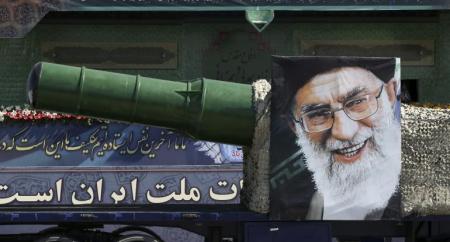
khameneigunsA portrait of Ayatollah Ali Khamenei is placed with weapons during a military parade just outside Tehran on Sept. 22, 2015. (AP Photo/Vahid Salemi)

Assuming that Hillary Clinton will not find some last-ditch bit of Clintonesque chicanery that will put her in the White House after all, Donald Trump will likely be inaugurated president come January 20, and he will have an ultimatum waiting for him.

The Ayatollah Khamenei warned the day before Thanksgiving that if the U.S. dared to extend sanctions on Iran, the Islamic Republic would retaliate. President-elect Trump, meanwhile, has vowed to cancel the deal altogether, which would almost certainly include restored and new sanctions.

Who will blink first?

The House of Representatives already set the confrontation on course last week, when it reauthorized the Iran Sanctions Act (ISA) for ten years. This was an almost entirely symbolic move, however, as the ISA will expire at the end of this year unless the Senate approves it and Barack Obama signs it — and Obama is about as likely to do that as he is to put on a Make America Great Again cap.

Indeed, Obama continues to be notoriously protective of the Iran deal. The known elements of the deal are bad enough, as I explain in my book The Complete Infidel’s Guide to Iran. But the secret codicils just keep making things worse, and administration officials continue to appear determined that they not leak out to the public.

Investigative journalist Adam Kredo reported last Tuesday:

Senior Obama administration officials in their final days in office are seeking to cover up key details of the Iran nuclear deal from Congress, according to documents and sources who spoke to the Washington Free Beacon about continued efforts by the White House to block formal investigations into secret diplomacy with Tehran that resulted in a $1.7 billion cash payment by the United States.

As far as Khamenei was concerned, Obama’s obvious anxiousness to keep the mullahs happy was all for show. He proclaimed: “The current U.S. government has breached the nuclear deal in many occasions.” In reality, Iran is the one breaching the agreement. Recently, according to Reuters, the International Atomic Energy Agency revealed:

[Iran] exceeded a soft limit on sensitive material set under its nuclear deal with major powers. … [This is the] second time Tehran has surpassed the 130 metric tonne threshold for heavy water, a material used as a moderator in reactors like Iran’s unfinished one at Arak, since the deal was put in place in January.

The Obama State Department’s response was feeble: it was all just an accident, you see. State spokesman Mark Toner put the best face on things that he could, confusing impunity with good faith:

It’s important to note that Iran made no effort to hide this, hide what it was doing from the IAEA.

This ongoing Obama administration solicitude for Iran may have fostered complacency in Iranian President Hassan Rouhani, who boasted right after the election that there was no chance of Trump rolling back the deal. Rouhani explained:

Iran’s understanding in the nuclear deal was that the accord was not concluded with one country or government but was approved by a resolution of the UN Security Council and there is no possibility that it can be changed by a single government. … The United States no longer has the capacity to create Iranophobia and to create a consensus against Iran. The constructive engagement policies of Iran towards the world, and the fact that international sanctions have been lifted, have placed the Iranian economy on a road where there is no possibility of going backwards.

Khamenei was apparently a bit less certain that it would be all smooth sailing from here on out, as he felt compelled to add a threat:

The latest is extension of sanctions for 10 years, that if it happens, would surely be against JCPOA [Joint Comprehensive Plan of Action, the official name of the Iran nuclear deal], and the Islamic Republic would definitely react to it.

It remains to be seen whether President-elect Trump will take such threats seriously enough to back off on his pledge to “rip up” the Iranian nuclear deal. It is certain, however, that if he is serious about restoring America’s national security and standing in the world, he will not be able to afford to continue Obama’s policies of ignoring Iranian breaches of the agreement and showering upon them all manner of largesse.

It will either be no deal with Iran and a secure America, or a deal with Iran and continued appeasement and weakness in response to enemies who have vowed to destroy us. This is one swamp in dire need of draining.