Archive for the ‘Trump and Iran scam’ category

Trump puts Iran back in North Korea’s corner

September 20, 2017

Trump puts Iran back in North Korea’s corner, Israel Hayom, Boaz Bismuth, September 20, 2017

In February 2016, a day after U.S. President Donald Trump’s victory in the Nevada caucuses, Trump the candidate told me how much he opposed the nuclear deal with Iran, and even spoke with me on the need to cancel it. On Tuesday, Trump told the U.N. General Assembly that “frankly, that deal is an embarrassment to the United States.”

It was surprising, up to a certain point, to watch the commentary box almost satisfyingly explain that Trump cannot cancel the deal because it is multilateral and signed by five major powers – as if the implications of the nuclear deal between Iran and the rest of the world are an internal Israeli political issue. Indeed, Trump will find it difficult to cancel this deal because former President Barack Obama, the so-called “enlightened president,” stuck us with this terrible deal, if you recall. Even a very friendly president like Trump encounters difficulty fixing Obama’s mistakes.

That being said, it is encouraging to have a president who speaks at the U.N. using a different language than what we have gotten used to over the past eight years. The 45th president of the U.S. sees the connection between North Korea and Iran as if he were an Israeli prime minister. To remind you, Iran’s status got elevated to that of a normative country at the U.N. General Assembly in recent years, during the Obama era. Trump dragged it back to the corner, where North Korea was standing alone. The Islamic revolution, which earned recognition thanks to the nuclear deal, reverted to being understood as it really is: a dangerous historic perversion that must be fought against.

Commentators spoke of Prime Minister Benjamin Netanyahu’s satisfaction at Trump’s speech as if this matter does not affect each and every one of us. Every Israeli citizen understood Tuesday night that it was not Israel that lost America, as predicted by those warning of the “political tsunami” coming at Israel, but rather Iran that lost America.

And another comment: Trump did not even say one word in his speech about the Palestinians. Has the two-state paradigm taken a rest? It seems so. Maybe in turn we should also take a rest from it.

We watched the leader of the free world on Tuesday speak about the criminal regime in Syria, the nuclear deal with Iran and the desire to see a change in the regime in Tehran. He threatened North Korea and criticized the socialist dictatorship in Venezuela. Those opposing the president call him crazy, but after eight years of the opposite sort of speeches, we should all reconsider who is crazy and who sees reality as it actually is.

New days have come to America and Israel, not to mention the world. Indeed, the people understood reality better than the commentators, not only in Israel, but also in America. Happy new year.


Bolton: Trump’s U.N. Speech the Best of His Presidency

September 19, 2017

Bolton: Trump’s U.N. Speech the Best of His Presidency, Washington Free Beacon, , September 19, 2017

Fox News contributor John Bolton called Donald Trump’s speech before the United Nations Tuesday the best of his young presidency.

Bolton, who served as U.S. Ambassador to the United Nations under President George W. Bush, praised Trump for his direct denunciation of North Korea’s nuclear ambitions and criticism of the Iran nuclear deal brokered by the Obama administration.

“This was the best speech of the Trump presidency, in my view,” Bolton said. “I think he was as clear and direct as it’s possible to be.”

Trump said the U.S. would destroy North Korea if forced to defend itself or its allies; Bolton said that was a memorable line.

“I think it’s safe to say, in the entire history of the United Nations, there has never been a more straightforward criticism of the behavior, the unacceptable behavior of other member states,” Bolton said.

In addition, he said Trump’s critiques of the nuclear deal revealed the White House would not tolerate “half-measures and compromises” that allowed Iran and North Korea to progress to the verge of having deliverable nuclear weapons.

He also praised Trump’s line, which was met with near silence at first, that the collapsing regime in Venezuela was an example of socialism being successfully implemented.

“There are a lot of people in the UN. who have never heard anything like that from an American president,” Bolton said. “I think this was an outstanding speech, and I think it will serve the president very well.”

McMaster Says Iran Has Violated Parts of Nuclear Deal: ‘They’re Crossing the Line’

September 18, 2017

McMaster Says Iran Has Violated Parts of Nuclear Deal: ‘They’re Crossing the Line’, Washinton Free Beacon, September 18, 2017

(Please see also, Trump considers ending Iran deal ahead of key deadline.– DM)

National Security Adviser H.R. McMaster said Sunday that Iran has already violated parts of the nuclear deal, adding, “They’re crossing the line at times.”

“Fox News Sunday” host Chris Wallace noted that President Donald Trump, who lambastes the deal brokered by the Obama administration, has had the opportunity to re-impose sanctions that were lifted as part of the agreement but has not yet done so.

“I know he has to recertify in October whether or not they are complying with it, all this talk about tearing up the agreement, in fact, isn’t he going to live with it and try to find other ways to confront Iran on other fronts?” Wallace asked.

Well, we have to see what live with it means, right?” McMaster said. “Live with can’t be giving this regime cover to develop a nuclear capability. And so, a lot of things have to happen immediately, rigorous enforcement of that agreement. It is under-enforced now. We know Iran has already violated parts of the agreement by—”

“But the IAEA says that they’re complying with it, sir,” Wallace said.

Well, the IAEA has identified and we’ve identified some of these breaches that Iran has then corrected,” McMaster said. “But what does that tell you about Iranian behavior? They’re not just walking up to the line on the agreement. They’re crossing the line at times.”

McMaster said there has to be far more rigorous enforcement of the Joint Comprehensive Plan of Action and recognition of its flaws.

“As the president said, it is the worst deal,” McMaster said. “It gave all these benefits to the Iranian regime up front, and these benefits now they’re using to foment this humanitarian catastrophe in the greater Middle East.”

The Washington Free Beacon reported last month that Iran was caught violating the deal by shipping soldiers to Syria on commercial flights. It has also expanded its ballistic missile technology.

Iran is the world’s largest state sponsor of terrorism, lending support to groups such as Hezbollah and Hamas. It has proxy forces in Iraq and bolsters the Bashar al-Assad regime in Syria.

Trump has reportedly been weighing a strategy to more aggressively respond to Iranian forces and its terror support.

President Barack Obama insisted the deal was the best way to stop Iran’s path to a nuclear weapon, although he acknowledged in 2015 that the theocracy’s breakout time could well be zero months when the deal’s provisions expire.

Trump considers ending Iran deal ahead of key deadline

September 18, 2017

Trump considers ending Iran deal ahead of key deadline, Washinton ExaminerSarah Westwood, September18, 2017

The October benchmark will be the first recertification to occur without Bannon and Gorka, two strong opponents of the JCPOA, on the president’s team.

Gorka said he was unsure if anybody left in the West Wing is pushing for a full decertification of the Iran deal. But he noted Trump will ultimately make his own decision, regardless of their counsel.

“I think the president is an army of one,” Gorka said. “My prediction is the president will not want to recertify.”

************************************

President Trump is weighing whether to nullify the Iran nuclear deal next month, as proponents of the agreement rally to its defense ahead of a key deadline that will force Trump to reevaluate its future.

The president faces pressure to fulfill his campaign promise to end the Iran nuclear agreement, which he has called the “worst deal ever negotiated.” Known formally as the Joint Comprehensive Plan of Action, the deal requires the State Department to certify to Congress every 90 days that Iran is still complying with the agreement under the terms ironed out by the Obama administration in 2015.

Some top Trump aides have urged the president to preserve the Iran deal at the next 90-day mark in October. H.R. McMaster, his national security adviser, and Secretary of State Rex Tillerson have cautioned Trump against scrapping the JCPOA despite his deep skepticism of the agreement, a source familiar with the talks told the Washington Examiner.

But others close to the president have urged him to follow through on his threats to dismantle the deal and have attempted to craft a new strategy for dealing with Iran in the event Trump ends the JCPOA.

Sebastian Gorka, former strategist to the president, said Trump resisted the recertification process at the most recent 90-day deadline in July, when he requested more information from his aides about how he could end the agreement.

“The president didn’t want it recertified last time,” Gorka told the Washington Examiner.

The former White House adviser, who stepped down last month, suggested Trump did not undo the Iran deal this summer only because he had not yet received from his team a set of satisfying alternatives to the agreement.

“Last time, he didn’t do it because he hadn’t been given an adequate path, the scenario hadn’t been provided to him” to decertify the deal, Gorka said.

But soon after Trump requested a draft plan to dismantle the Iran deal, Gorka said he and another top aide tasked with overseeing the creation of the plan, former White House chief strategist Steve Bannon left the West Wing and were unable to pass on their findings to the president.

“Those options were never presented to him because of Steve’s resignation and my resignation,” Gorka said.

Bannon had enlisted the help of at least one outside adviser to give Trump options should he choose to exit the Iran deal.

John Bolton, former U.S. ambassador to the United Nations, wrote in a late August memo published in National Review that Bannon had approached him shortly after the most recent recertification and asked him to prepare a “game plan” for withdrawing from the JCPOA.

“[S]taff changes at the White House have made presenting it to President Trump impossible,” Bolton wrote of his Iran deal withdrawal plan. “Although he was once kind enough to tell me ‘come in and see me any time,’ those days are now over.”

Bolton’s memo advises Trump to conduct “early, quiet consultations,” beginning with private phone calls from the president, with key allies like Israel and countries that had signed onto the deal, such as France and Germany. Those early conversations should provide a friendly warning about the decision ahead and should help those countries understand why the administration was pulling back from the agreement, Bolton wrote. Then, Bolton advised Trump to undergo an expanded diplomatic campaign aimed at rallying support around the world for new sanctions against Iran once the deal was no longer in place.

Proponents of the JCPOA argue the independent inspections Iran must undergo as a condition of the deal have so far turned up no evidence of explicit violations, proving it has been a success. The International Atomic Energy Agency, the organization that perform the inspections, reportedly conducted more than 400 site visits in 2016 and has informed the international community that Tehran remains in compliance with limits on its centrifuges and uranium enrichment.

The Trump administration has publicly given little indication of where the president plans to go with the JCPOA in the coming weeks. Trump has already recertified the deal twice, although in April, he called for a sweeping review of whether the sanctions relief Iran won as part of the deal remains in the U.S. national interest.

“We’re continuing to conduct a full review of our Iran policy. That has certainly not changed,” State Department spokeswoman Heather Nauert told reporters on Sept. 12. “During the course of the review — and I’ll say this again — that we will continue to hold Iran accountable for its malign activities.”

U.S. Ambassador to the United Nations Nikki Haley began earlier this month to make the administration’s case for breaking with the deal. Instead of focusing only on whether Iran remains within the parameters of the JCPOA, Haley argued, the U.S. should take a broader view of all Iranian provocations, including the activity of the Iranian Revolutionary Guard Corps, support for Hezbollah, and ballistic missile development, and decide on a more comprehensive Iran policy.

“The question of Iranian compliance is not as straightforward as many people believe,” Haley said during a speech to the American Enterprise Institute on Sept. 5. “It’s not just about the technical terms of the nuclear agreement. It requires a much more thorough look.”

The administration moved quickly to signal its low tolerance for Iranian aggression after Trump took office. By early February, Trump had sanctioned more than two dozen people and groups in response to a ballistic missile test Tehran conducted in late January, and his then-national security adviser, Gen. Mike Flynn, had announced that Trump planned to put Iran “on notice” over its provocations.

Trump’s State Department reissued waivers in May that continued to lift sanctions on Iran, which the Obama administration had granted in exchange for compliance with the JCPOA. But Trump also hit several Iranian individuals and entities in May with fresh sanctions related to their aggression outside the terms of the nuclear deal.

And the Trump administration issued a new round of sanctions in July aimed at IRGC-affiliated groups that had engaged in ballistic missile development, among other provocative activities.

Fred Fleitz, senior vice president for policy at the Center for Security Policy, said some critics of the deal have presented options that would keep the JCPOA in place while punishing Iran more severely for bad behavior outside of it.

“They’re trying to find a way to allow the president to do something so he can make a big announcement without pulling out,” Fleitz said of that camp, noting their overall objection for the recertification next month would be to “wrap this in a big, new, anti-Iran policy.”

“The jury is out on what the president is going to do,” Fleitz said.

But Trump has spent months excoriating the deal and blasting the Iranian regime for its aggression. Fleitz said it would make little sense for Trump to continue approving an agreement he has described as dangerous.

“I just think it’s ridiculous to say the deal’s not in our interest and stay in it,” Fleitz said.

Any effort to abrogate the JCPOA would face fierce opposition from the Iran deal’s supporters, all of whom characterize the agreement as the only thing standing between the regime and a nuclear weapon.

However, Trump would earn applause from some members of Congress for following through on his threats to Iran.

Republican lawmakers — including Sens. David Perdue, Tom Cotton, Ted Cruz, and Marco Rubio — have urged Trump to reconsider the suspension of sanctions at the heart of the Iran deal.

Less than a month before the next recertification deadline, one source close to the administration told the Washington Examiner that Trump is “leaning towards decertifying” the Iran deal.

The October benchmark will be the first recertification to occur without Bannon and Gorka, two strong opponents of the JCPOA, on the president’s team.

Gorka said he was unsure if anybody left in the West Wing is pushing for a full decertification of the Iran deal. But he noted Trump will ultimately make his own decision, regardless of their counsel.

“I think the president is an army of one,” Gorka said. “My prediction is the president will not want to recertify.”

State Department Waging “Open War” on White House

September 17, 2017

State Department Waging “Open War” on White House, Gatestone InstituteSoeren Kern, September 17, 2017

“It’s not clear to me why the Secretary of State wishes to at once usurp the powers of the Congress and then to derail his boss’s rapprochement with the Israeli government.” — Foreign policy operative, quoted in the Washington Free Beacon.

Since he was sworn in as Secretary of State on February 1, Rex Tillerson and his advisors at the State Department have made a number of statements and policy decisions that contradict President Trump’s key campaign promises on foreign policy, especially regarding Israel and Iran.

“Tillerson was supposed to clean house, but he left half of them in place and he hid the other half in powerful positions all over the building. These are career staffers committed to preventing Trump from reversing what they created.” — Veteran foreign policy analyst, quoted in the Free Beacon.

The U.S. State Department has backed away from a demand that Israel return $75 million in military aid which was allocated to it by the U.S. Congress.

The repayment demand, championed by U.S. Secretary of State Rex Tillerson, was described as an underhanded attempt by the State Department to derail a campaign pledge by U.S. President Donald J. Trump to improve relations with the Jewish state.

The dispute is the just the latest example of what appears to be a growing power struggle between the State Department and the White House over the future direction of American foreign policy.

The controversy goes back to the Obama administration’s September 2016 Memorandum of Understanding (MOU) with Israel, which pledged $38 billion in military assistance to Jerusalem over the next decade. The MOU expressly prohibits Israel from requesting additional financial aid from Congress.

Congressional leaders, who said the MOU violates the constitutional right of lawmakers to allocate U.S. aid, awarded Israel an additional $75 million in assistance in the final appropriations bill for fiscal year 2017.

Tillerson had argued that Israel should return the $75 million in order to stay within the limits established by the Obama administration. The effort provoked a strong reaction from Congress, which apparently prompted Tillerson to back down.

Sen. Tom Cotton (R-AR) “strongly warned the State Department that such action would be unwise and invite unwanted conflict with Israel,” according to the Washington Free Beacon.

Speaking to the Washington Examiner, Rep. Peter Roskam (R-IL) added:

“As Iran works to surround Israel on every border, and Hezbollah and Hamas rearm, we must work to strengthen our alliance with Israel, not strain it. Congress has the right to allocate money as it deems necessary, and security assistance to Israel is a top priority. Congress is ready to ensure Israel receives the assistance it needs to defend its citizens.”

A veteran congressional advisor told the Free Beacon:

“This is a transparent attempt by career staffers in the State Department to f*ck with the Israelis and derail the efforts of Congressional Republicans and President Trump to rebuild the US-Israel relationship. There’s no reason to push for the Israelis to return the money, unless you’re trying to drive a wedge between Israel and Congress, which is exactly what this is. It won’t work.”

Another foreign policy operative said: “It’s not clear to me why the Secretary of State wishes to at once usurp the powers of the Congress and then to derail his boss’s rapprochement with the Israeli government.”

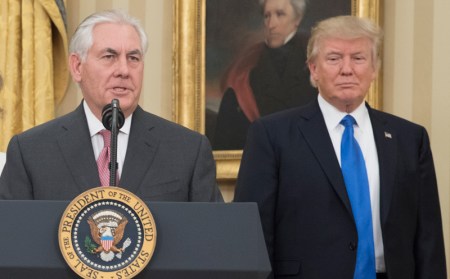
Secretary of State Rex Tillerson (left) and President Donald J. Trump (right) on February 1, 2017. (Image source: Michael Reynolds-Pool/Getty Images)

Since he was sworn in as Secretary of State on February 1, Tillerson and his advisors at the State Department have made a number of statements and policy decisions that contradict Trump’s key campaign promises on foreign policy, especially regarding Israel and Iran.

August 10. The State Department hosted representatives of the U.S. Council of Muslim Organizations (USCMO), an umbrella group established by the Muslim Brotherhood with the aim of mainstreaming political Islam in the United States. Behind closed doors, they reportedly discussed what they said was Israel’s illegal occupation of Palestine and the removal of all Israeli control of the Temple Mount and holy areas of Jerusalem. Observers said the meeting was part of larger effort by anti-Israel organizations to drive a wedge between the Trump administration and Israel. The USCMO includes a number of organizations, including American Muslims for Palestine (AMP), which promote “extreme anti-Israel views” and “anti-Zionist” propaganda, and which support boycotts of the Jewish state.

July 19. The State Department’s new “Country Reports on Terrorism 2016” blamed Israel for Palestinian Arab terrorism against Jews. It attributed Palestinian violence to: “lack of hope in achieving statehood;” “Israeli settlement construction in the West Bank;” “settler violence;” and “the perception that the Israeli government was changing the status quo on the Haram Al Sharif/Temple Mount.” The report also characterized Palestinian Authority payments to the families of so-called martyrs as “financial packages to Palestinian security prisoners…to reintegrate them into society.”

Rep. Peter Roskam (R-IL) called on the State Department to hold the PA accountable in State Department Country reports: “The State Department report includes multiple findings that are both inaccurate and harmful to combating Palestinian terrorism…. At the highest level, the Palestinian Authority (PA) leadership incites, rewards, and, in some cases, carries out terrorist attacks against innocent Israelis. In order to effectively combat terrorism, it is imperative that the United States accurately characterize its root cause — PA leadership.”

June 14. Tillerson voiced opposition to designating the Muslim Brotherhood as a terrorist organization, saying that such a classification would complicate Washington’s relations in the Middle East. During his confirmation hearings on January 11, by contrast, Tillerson lumped the Brotherhood with al-Qaeda when talking about militant threats in the region. He said:

“Eliminating ISIS would be the first step in disrupting the capabilities of other groups and individuals committed to striking our homeland and our allies. The demise of ISIS would also allow us to increase our attention on other agents of radical Islam like al-Qaeda, the Muslim Brotherhood, and certain elements within Iran.”

June 13. During testimony to the Senate Foreign Relations Committee, Tillerson said he had received reassurances from President Mahmoud Abbas that the Palestinian Authority would end the practice of paying a monthly stipend to the families of suicide bombers and other attackers, commonly referred to by Palestinians as martyrs. One day later, Palestinian officials contradicted Tillerson, saying that there are no plans to stop payments to families of Palestinians killed or wounded carrying out attacks against Israelis.

May 22. Tillerson sidestepped questions on whether the Western Wall is part of Israel, while telling reporters aboard Air Force One they were heading to “Tel Aviv, home of Judaism.” Asked directly whether he considers the Western Wall under Israeli sovereignty, Tillerson replied: “The wall is part of Jerusalem.”

May 15. In an interview with Meet the Press, Tillerson appeared publicly to renege on Trump’s campaign promise to move the American embassy in Israel from Tel Aviv to Jerusalem:

“The president, I think rightly, has taken a very deliberative approach to understanding the issue itself, listening to input from all interested parties in the region, and understanding what such a move, in the context of a peace initiative, what impact would such a move have.”

Tillerson also appeared to equate the State of Israel and the Palestinians:

“As you know, the president has recently expressed his view that he wants to put a lot of effort into seeing if we cannot advance a peace initiative between Israel and Palestine. And so I think in large measure the president is being very careful to understand how such a decision would impact a peace process.”

Critics of this stance have argued that moving the embassy to Jerusalem would, instead, advance the peace process by “shattering the Palestinian fantasy that Jerusalem is not the capital of Israel.”

March 8. The State Department confirmed that the Obama administration’s $221 million payment to the Palestinian Authority, approved just hours before Trump’s inauguration, had reached its destination. The Trump administration initially had vowed to freeze the payment.

In July 2017, the Free Beacon reported that Tillerson’s State Department was waging an “open political war” with the White House on a range of key issues, including the U.S.-Israel relationship, the Iran portfolio, and other matters:

“The tensions have fueled an outstanding power battle between the West Wing and State Department that has handicapped the administration and resulted in scores of open positions failing to be filled with Trump confidantes. This has allowed former Obama administration appointees still at the State Department to continue running the show and formulating policy, where they have increasingly clashed with the White House’s own agenda.”

A veteran foreign policy analyst interviewed by the Free Beacon laid the blame squarely on Tillerson:

“Foggy Bottom [a metonym for the State Department] is still run by the same people who designed and implemented Obama’s Middle East agenda. Tillerson was supposed to clean house, but he left half of them in place and he hid the other half in powerful positions all over the building. These are career staffers committed to preventing Trump from reversing what they created.”

Notable holdovers from the Obama administration are now driving the State Department’s Iran policy:

Michael Ratney, a top advisor to former Secretary of State John Kerry on Syria policy. Under the Trump administration, Ratney’s role at the State Department has been expanded to include Israel and Palestine issues. Ratney, who was the U.S. Consul in Jerusalem between 2012 and 2015, oversaw $465,000 in U.S. grants to wage a smear to oust Israeli Prime Minister Benjamin Netanyahu from office in 2015 parliamentary elections, according to the Senate Permanent Subcommittee on Investigations. Ratney admitted to Senate investigators that he deleted emails containing information about the Obama administration’s relationship with the group.

Thomas A. Shannon, Jr., a career foreign service officer who serves as Under Secretary of State for Political Affairs. Shannon, the State Department’s fourth-ranking official, has warned that scrapping the Iran deal would lead to a nuclear arms race in the Middle East. “Any effort to step away from the deal would reopen a Pandora’s box in that region that would be hard to close again,” he said. His statement indicates that Shannon could be expected to lead efforts to resist any attempts to renege or renegotiate the deal; critics of the deal say that Iran’s continued missile testing has given Trump one more reason to tear up his predecessor’s deal with the Islamist regime.

Chris Backemeyer is now the highest-ranking official at the State Department for Iran policy. During the Obama administration, Backemeyer made his career by selling the Iran deal by persuading multinational corporations to do business with Iran as part of an effort to conclude the Iran nuclear deal.

Ratney, Shannon and Backemeyer, along with Tillerson, reportedly prevailed upon Trump twice to recertify the Iran nuclear deal. The Jerusalem Post explained:

Washington was briefly abuzz on the afternoon of July 17 when rumors began to circulate that President Trump was eager to declare that Iran was in breach of the conditions laid out in the 2015 Iran Nuclear Agreement Review Act (INARA).

Those receptive antennas were further heightened given the previous signals sent. After all, the State Department already released talking points to reporters on the decision to recertify Iran. The Treasury Department also had a package of fresh sanctions on over a dozen Iranian individuals and entities ready to announce to appease the hawks who were eager to cut loose from the deal.

But Trump didn’t want to recertify Iran, nor did he want to the last time around in April. That evening, a longtime Middle East analyst close to senior White House officials involved in the discussions described the scene to me: “Tillerson essentially told the president, ‘we just aren’t ready with our allies to decertify.’ The president retorted, ‘Isn’t it your job to get our allies ready?’ to which Tillerson said, ‘Sorry sir, we’re just not ready.'” According to this source, Secretary Tillerson pulled the same maneuver when it came to recertification in April by waiting until the last minute before finally admitting the State Department wasn’t ready. On both occasions he simply offered something to the effect of, “We’ll get ’em next time.”

Gorka: Trump Administration Must Kill the Iran Deal

September 11, 2017

Gorka: Trump Administration Must Kill the Iran Deal, Washington Free Beacon, , September 11, 2017

(And Frau Merkel wants a deal with North Korea comparable to the Iran scam. — DM)

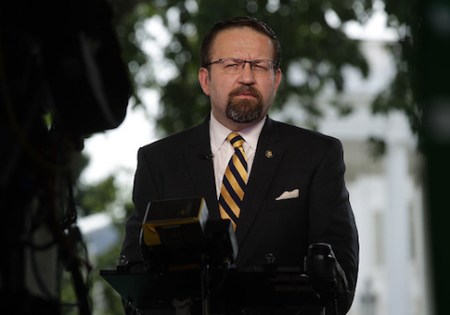
Sebastian Gorka / Getty Images

“The American government’s strategy to defeat Sunni jihadism must not play into the hands of Shia jihadism,” according to Gorka. “All the more so after the billions of dollars released by the last White House back into the coffers of Tehran.”

“A nuclear Caliphate informed by an apocalyptic vision of Islamic salvation will not succumb to the logic of nuclear deterrence and the prior stability of Mutually Assured Destruction,” Gorka states. “Action must be taken now to obviate the establishment a nuclear-capable Shia Caliphate. Recertification of the Potemkin Accord that is the JCPOA (Iran) Deal will not stop Iran acquiring nuclear weapons.”

********************************

The Trump administration must end the landmark nuclear deal with Iran, which has only empowered the Islamic Republic and aided its efforts to develop nuclear weapons, according to former senior Trump strategist Sebastian Gorka, who is set to call for an end to the deal during wide-ranging remarks Monday in Israel on the anniversary of the September 11 terror attacks.

The Washington Free Beacon obtained an advance partial copy of Gorka’s remarks, in which he notes the failure of U.S. administrations to combat the spread of global terror organizations since al Qaeda terrorists struck the Twin Towers 16 years ago.

Gorka, a veteran national security expert who served as a key adviser to President Donald Trump until his resignation late last month, noted that America has “seen more jihadist attacks and plots on U.S. soil in the last two years than any previous comparable period,” a sign that past strategies to combat this threat have failed.

“In arrests as far apart as California and New York, we see an enemy that has moved from attempting to send foreign terrorists here to America, move to recruiting and indoctrinating U.S. nationals or residents who are already in the country, such as the Boston bombers and the San Bernardino killers,” Gorka will say during a keynote address before the International Institute for Counterterrorism during its annual national security summit in Israel.

The high-profile international get together brings together senior Israeli government officials with their global counterparts. Gorka’s call to end the Iran deal at this forum is likely to generate much discussion among international officials present at the forum.

The near daily arrests by U.S. authorities of would-be jihadists “is not an improvement” in the war on terror, according to Gorka, because “‘homegrown’ terrorists are much harder for our domestic agencies to detect.”

Gorka said he has faith that the Trump administration will plot a new course that will help the United States finally end the war in Afghanistan, the longest conflict in U.S. history.

The United States is still failing to win the war against what Gorka describes as the “Global Jihadi Movement”—and international agreements such as the Iran nuclear deal have not improved the West’s chances of curbing the terror threat.

“If we use a less parochial filter, and look at what the Global Jihadi Movement has wrought globally since September 11, 2001, we cannot claim any kind of victory,” Gorka says.

A key part of the strategy to put the United States on the path to victory must focus on cancelling the Iran nuclear agreement, which has awarded the foremost global sponsor of terrorism with billions in cash.

“Iran remains the largest state sponsor of terrorism in the world today,” Gorka says. “With the rise of ISIS, the collapse and Syria, and the continued conflict in Yemen, the mullahs and the forces under their command have expanded their destabilizing actions in support of their Shia version of radical Islam.”

The Trump administration must be cautious to avoid empowering Iran, a Shia Muslim majority nation, in its efforts to defeat Sunni Muslim terror organizations.

The nuclear deal served as a particular boon to Iran’s vision for a Shia-dominated Middle East, in which the Islamic Republic can rule the region.

“The American government’s strategy to defeat Sunni jihadism must not play into the hands of Shia jihadism,” according to Gorka. “All the more so after the billions of dollars released by the last White House back into the coffers of Tehran.”

“A nuclear Caliphate informed by an apocalyptic vision of Islamic salvation will not succumb to the logic of nuclear deterrence and the prior stability of Mutually Assured Destruction,” Gorka states. “Action must be taken now to obviate the establishment a nuclear-capable Shia Caliphate. Recertification of the Potemkin Accord that is the JCPOA (Iran) Deal will not stop Iran acquiring nuclear weapons.”

Nikki Haley: Trump Has Grounds to Declare Iran in Violation of Nuclear Deal

September 5, 2017

Nikki Haley: Trump Has Grounds to Declare Iran in Violation of Nuclear Deal, Washington Free Beacon, , September 5, 2017

Ambassador to the UN Nikki Haley / Getty Images

U.S. Ambassador to the United Nations Nikki Haley on Tuesday said President Donald Trump would be justified if he denied Iranian compliance to the nuclear accord when it comes up for a quarterly review next month, though she said she does not know what Trump will decide.

In a speech at the American Enterprise Institute think tank in Washington, D.C., Haley detailed a strong case for Trump to declare Iran in violation of the agreement, warning the United States will be “dealing with the next North Korea” if the regime is left unchecked.

“We’re allowing them to have behavior that’s in violation of the resolution right in front of us,” she said. “We’re allowing them to sit there and actually tell the [International Atomic Energy Agency] that they’re not going to let them inspect military sites where we know they have had covert nuclear operations in the past. What I want the country to understand is we need to wake up.”

Haley said if Trump chooses to declare Iran in violation, it would not automatically trigger a U.S. withdrawal from the accord. Instead, she said the decision to leave the accord would be tossed to Congress, leaving room for lawmakers to keep in place U.S. sanctions relief.

The Trump administration has been weighing since April whether to scrap the deal, despite disagreement from U.S. allies in Europe who helped implement the agreement two years ago. Haley acknowledged European objections, but added: “This is about U.S. national security. This is not about European security.”

She said the international community’s unwillingness to challenge regime behavior “for fear of damaging the nuclear agreement” typifies the threat the deal poses to American national security, describing it as “too big to fail.”

U.S. law requires the president to notify Congress every 90 days on whether Iran is adhering to the accord, which aimed to limit Tehran’s nuclear activities in exchange for the lifting of sanctions related to the program. The Trump administration has twice recertified the agreement, though Trump warnedin July he would not continue to do so indefinitely. The next recertification deadline is in October.

Haley said she would not predict the president’s decision, but suggested repercussions if Iran continues to deny the IAEA access to its military sites to ensure Tehran’s compliance to the accord.

“If the president finds that he cannot certify Iranian compliance, it would be a message to Congress that the administration believes either that Iran is in violation of the deal, or that the lifting of sanctions against Iran is not appropriate and proportional to the regime’s behavior, or that the lifting of sanctions is not in the U.S. national security interest, or any combination of the three,” she said.

Haley traveled to Vienna last week to pressure UN atomic watchdogs to check Iran’s undeclared military sites to verify it is not concealing activities barred by the deal.

JCPOA Noncompliance — A Totalitarian Imperative

August 29, 2017

JCPOA Noncompliance — A Totalitarian Imperative, Center for Security Policy, Peter Pry, August 28, 2017

Originally published at Newsmax

Mr. President, don’t let Iran become another North Korea. Tear-up the JCPOA!

*****************************

Democracies have a blind faith that treaties can disarm totalitarian regimes. The notion that “peace in our time” is possible through a scrap of paper is an irrational addiction in Washington, D.C., the opioid of the U.S. State Department.

The free world is free because it has laws and contracts, and an ideological imperative to believe in the efficacy of negotiation and compromise. The totalitarian world is not free because its laws and contracts are lies, merely a propagandistic means to the end of tyranny, where the ideological imperative is to enslave.

Never the twain shall meet. But the free world never learns war cannot be outlawed by the Kellogg-Briand Pact of Aug. 27, 1928 or, just as absurdly, a world without nuclear weapons achieved by negotiating with North Korea an Agreed Framework (1994) or with Iran a Joint Comprehensive Plan Of Action (JCPOA, 2015).

Perhaps the best warning against JCPOA is the long, failed history of arms control.

True believers in JCPOA should read two books, Barton Whaley’s “Covert German Rearmament 1919-1939: Deception and Misperception” and John Jordan’s “Warships After Washington.” Both books describe cheating by Nazi Germany and Imperial Japan on the Versailles Treaty of June 28, 1919, the Washington Naval Treaty of  Feb. 6, 1922, the London Naval Treaty of April 22, 1930, and the Second London Naval Treaty of March 25, 1936.

Also read “The President’s Unclassified Report to the Congress on Soviet Noncompliance with Arms Control Agreements” (Released Feb. 1, 1985) wherein is described the USSR’s cheating on the major arms control agreements of the Cold War. The State Department is still sitting on the even more shocking classified version.

Now, Clare Lopez, a former CIA clandestine services officer who is vice president for research and analysis at the Center for Security Policy (CSP), one of the best Washington, D.C. think tanks, has written the definitive study titled “Why Trump Must Not Re-Certify Iranian JCPOA Compliance.” (Center for Security Policy, Aug. 23, 2017).

Lopez has deep expertise in the ideology of radical Islam that drives the Islamic Republic of Iran and their Islamic Revolutionary Guard to be the world’s leading sponsors of international terrorism — and why development of an Islamic Bomb is an ideological religious imperative for Iran.

The mullahs who run Iran, and the fanatical Islamic Revolutionary Guard Corps who run Iran’s nuclear and missile programs, will never betray Allah by surrendering their Islamic bomb — the most powerful weapon for material and spiritual victory in their global jihad.

Failure by the U.S. State Department to understand the ideological motives behind Iran’s nuclear missile program is repeating State’s catastrophic misunderstanding that the ideological imperatives of totalitarianism made inevitable North Korea’s cheating on former-President Bill Clinton’s Agreed Framework.

Totalitarian Iran and North Korea, despite profound ideological differences, are strategic partners in a nuclear missile “axis of evil” because the free world is even more abhorrent to Tehran and Pyongyang than each other.

Key Findings from Clare Lopez’s “Why Trump Must Not Re-Certify Iranian JCPOA Compliance”:

—”It is imperative that President Trump not recertify the Iranian regime as compliant with the provisions of the Joint Comprehensive Plan of Action (JCPOA) when the next deadline comes due in October 2017;”

— “Tehran is explicitly and demonstrably out of compliance with the JCPOA on numerous specific counts’”

— “The nature of the Iranian regime is self-avowedly jihadist per its own constitution, which   declares the objective of the regime is global conquest by an Islamic State under rule of Islamic Law (shariah) – thus, its nuclear weapons program is a means to achieve that objective;”

— “The Iranian regime is signatory to a host of international conventions and treaties but has a documented record of violations that lends little credence to its JCPOA pledges;”

— “The Iranian regime most notably violated the Nuclear Non-Proliferation Treaty (NPT) for at least 14 years before getting caught and publicly revealed with a clandestine nuclear weapons program in 2002.”

— “The International Atomic Energy Agency (IAEA) documented a long list of so-called Possible Military Dimensions (PMDs) related to the Iranian nuclear program in November 2011 that strongly suggest its assessment that Iran had an advanced nuclear weapons program and possibly nuclear warheads at that time;”

— “More recent revelations demonstrate that the Iranian regime continues to work on nuclear warheads and explosive charges to initiate the implosion sequence of a nuclear bomb at clandestine sites off-limits to IAEA inspections;”

— “Even after the July 2015 JCPOA, the Iranian regime has been confronted with credible information that it is operating more advanced centrifuges than permitted, exceeding limits on production of heavy water, and covertly procuring nuclear and missile technology outside of JCPOA-approved channels: these are all material breaches of the JCPOA;”

— “The Iranian regime’s nuclear weapon and ballistic missile ‘Joint Venture’ with North Korea dates back at least to the 1990s and continues currently with especial concern about the sharing of expertise on warhead miniaturization and Electromagnetic Pulse (EMP) technology;”

— “Denial of recertification of Iranian compliance with the JCPOA must be the first step in a complete review of the nuclear and ballistic missile threats from both Iran and North Korea.”

Mr. President, don’t let Iran become another North Korea. Tear-up the JCPOA!

READ GAC REPORT EXECUTIVE SUMMARY HERE (PDF)

Peter Vincent Pry is executive director of the Task Force on National and Homeland Security. He served in the Congressional EMP Commission, the Congressional Strategic Posture Commission, the House Armed Services Committee, and the CIA. He is author of “Blackout Wars.” 

Nuclear Agreement Under Pressure, Though Methods are Uncertain

August 29, 2017

Nuclear Agreement Under Pressure, Though Methods are Uncertain, Iran News Update, Edward Carney, August 29, 2017

(Please see also, Discussion Of Iranian Violations Of JCPOA Is Futile; The Inspection Procedure Designed By The Obama Administration Precludes Actual Inspection And Proof Of Violations. The Iran scam was never ratified by the U.S. Senate and the Iran – IAEA deals remain secret. We should exit.— DM)

As was reported last week, various Iranian officials have responded to that pressure by saying that the country could dramatically increase its levels and quantities of nuclear enrichment in a matter of days.

Although intended as a threat against decertifying Iranian compliance, these remarks may also have the effect of raising questions about how the Islamic Republic could resume nuclear activities at such a high level if it had not been engaged in undisclosed activities while the JCPOA was being enforced.

*************************************

On Monday, The Guardian reported upon the pressure supposedly being exerted on American intelligence agencies by the White House as US President Donald Trump looks forward to the October deadly for the quarter-annual report to Congress on Iranian compliance with the 2015 nuclear agreement. On the campaign trail, Trump repeatedly referred to that agreement as one of the worst deals ever negotiated, and in recent weeks he has indicated that he would have deemed Iran to be out of compliance at his earliest opportunity, thus precipitating the deal’s cancellation, if not for the intervention of his foreign policy team.

The environment in which intelligence agencies are working is one in which the president has evidently made up his mind about how to proceed, even though US Ambassador to the UN Nikki Haley made statements to the contrary last week. Haley said that the White House is examining the evidence but still maintains that the Islamic Republic is generally untrustworthy and clearly out of compliance with parallel agreements such as UN Security Council Resolution 2231, which calls upon Iran to avoid work on nuclear-capable ballistic missiles.

Haley’s comments came in the context of a visit to the International Atomic Energy Agency, which is tasked with monitoring Iran’s nuclear activities and enforcing the Joint Comprehensive Plan of Action. This visit was met with harsh criticism by Iranian officials, several of whom asserted that the actual American intention was not a neutral assessment of the IAEA’s investigations, but rather the spreading of doubt about the compliance judgments that the IAEA has already made.

The Iranian Foreign Ministry has already sent a formal letter of complaint to the head of the nuclear monitoring agency over this issue, and Daily Trust reported on Monday that the Iranians had also declared their intention to call a meeting of the nuclear negotiating parties, known as the P5+1, within the context of the larger meeting of the UN General Assembly, which is set to take place between September 12 and September 25. The announcement was made by Ali Akbar Salehi, the head of the Atomic Energy Organization of Iran, following up on his previous letter referring to “the harassing acts of the Americans” with regard to the nuclear agreement.

On Sunday, Iranian Foreign Ministry spokesman Bahram Qassemi indicated that Tehran would use the planned meeting to reinforce the notion that inspections of Iranian compliance would only be carried out within the framework of Iran’s own policies. Primarily, this signifies rejection of the idea often voiced in the US and by harsh critics of the Islamic Republic, that effective verification of Iranian compliance depends upon unqualified access to suspect sites within the country, including military sites.

It is not clear whether President Trump is personally convinced that the Islamic Republic is carrying out nuclear research or development at these sites, but The Guardian indicates that focus on military sites is one means by which the White House could precipitate the cancelation or renegotiation of the JCPOA. If the US convinces the IAEA that there is evidence of illicit activities at those sites, the international body can push for and ultimately force inspector access under the terms of the deal. But having made this issue a prominent red line in the past, the Islamic Republic might simply walk away from the deal rather than allow this procedure to proceed.

Thus, suspicious activity at military sites is one piece of intelligence that the Trump administration would very much like to get its hands on. And according to The Guardian, the White House is actively pushing for the revelation of this or any other data that might justify Trump’s decertification of Iranian compliance on the basis of something other than violations of the deal’s “spirit.”

This apparent pressure has led to numerous unfavorable comparisons to the politicization of intelligence regarding weapons of mass destruction in the run-up to the US invasion of Iraq. But The Guardian also quotes David Albright of the Institute for Science and International Security as disputing this comparison and noting that “the Obama administration downplayed and even hid violations and problems,” leaving serious questions open about the true extent of Iranian compliance.

The same report quoted Richard Nephew, a member of the JCPOA’s American negotiating team, as saying that there is a responsible way of asking intelligence analysts to sift back through information that has already been looked at and that might have been unjustifiably dismissed.

It is an open question as to whether the Trump administration is following such responsible procedures, as opposed to pushing a pre-determined narrative. But at the same time, the mere existence of pressure on this matter may be leading to the Islamic Republic unwittingly exposing itself to additional scrutiny. As was reported last week, various Iranian officials have responded to that pressure by saying that the country could dramatically increase its levels and quantities of nuclear enrichment in a matter of days.

Although intended as a threat against decertifying Iranian compliance, these remarks may also have the effect of raising questions about how the Islamic Republic could resume nuclear activities at such a high level if it had not been engaged in undisclosed activities while the JCPOA was being enforced.

How to Get Out of the Iran Nuclear Deal

August 28, 2017

How to Get Out of the Iran Nuclear Deal, National Review, John R. Bolton, August 28, 2017

(A very dispiriting article appeared at MEMRI today. It notes that

Within three months, the U.S.’s position in the Middle East has changed from one of might and deterrence against Iran to one of weakness, retreat, and being deterred by Iran. This situation, of course, in no way reflects the real balance of power between the U.S. and Iran, neither generally nor regionally. It is an image created jointly by President Trump’s policies and Iran’s offensive approach.

. . . .

It is the approach of the Trump administration – which has agreed to Iran’s regional expansion, under the cover of the war on ISIS – that has prompted this huge shift in the attitude of Iran, which also is relying on Russian backing.

It appears that some in the National Security Council and elsewhere in the Trump administration have intentionally deprived President Trump of information he needs in order to deal resolutely with Iran and Iran scam. –DM)

Although candidate Donald Trump repeatedly criticized Barack Obama’s Iran nuclear agreement, his administration has twice decided to remain in the deal. It so certified to Congress, most recently in July, as required by law. Before the second certification, Trump asked repeatedly for alternatives to acquiescing yet again in a policy he clearly abhorred. But no such options were forthcoming, despite “a sharp series of exchanges” between the president and his advisers, as the New York Times and similar press reports characterized it. 

Many outside the administration wondered how this was possible: Was Trump in control, or were his advisers? Defining a compelling rationale to exit Obama’s failed nuclear deal and elaborating a game plan to do so are quite easy. In fact, Steve Bannon asked me in late July to draw up just such a game plan for the president — the option he didn’t have — which I did.

Here it is. It is only five pages long, but like instant coffee, it can be readily expanded to a comprehensive, hundred-page playbook if the administration were to decide to leave the Iran agreement. There is no need to wait for the next certification deadline in October. Trump can and should free America from this execrable deal at the earliest opportunity.

I offer the Iran nonpaper now as a public service, since staff changes at the White House have made presenting it to President Trump impossible. Although he was once kind enough to tell me “come in and see me any time,” those days are now over.

If the president is never to see this option, so be it. But let it never be said that the option didn’t exist.

I. Background:

The Trump Administration is required to certify to Congress every 90 days that Iran is complying with the July 2015 nuclear deal (the Joint Comprehensive Plan of Action — JCPOA), and that this agreement is in the national-security interest of the United States.1 While a comprehensive Iranian policy review is currently underway, America’s Iran policy should not be frozen. The JCPOA is a threat to U.S. national-security interests, growing more serious by the day. If the President decides to abrogate the JCPOA, a comprehensive plan must be developed and executed to build domestic and international support for the new policy. Under the Iran Nuclear Agreement Review Act of 2015, the President must certify every 90 days that:

(i) Iran is transparently, verifiably, and fully implementing the agreement, including all related technical or additional agreements;

(ii)  Iran has not committed a material breach with respect to the agreement or, if Iran has committed a material breach, Iran has cured the material breach;

(iii)  Iran has not taken any action, including covert activities, that could significantly advance its nuclear weapons program; and

(iv)  Suspension of sanctions related to Iran pursuant to the agreement is – (I)  appropriate and proportionate to the specific and verifiable measures taken by Iran with respect to terminating its illicit nuclear program; and (II) vital to the national-security interests of the United States.

(I)  appropriate and proportionate to the specific and verifiable measures taken by Iran with respect to terminating its illicit nuclear program; and

(II) vital to the national-security interests of the United States.

U.S. leadership here is critical, especially through a diplomatic and public education effort to explain a decision not to certify and to abrogate the JCPOA. Like any global campaign, it must be persuasive, thorough, and accurate. Opponents, particularly those who participated in drafting and implementing the JCPOA, will argue strongly against such a decision, contending that it is reckless, ill-advised, and will have negative economic and security consequences.

Accordingly, we must explain the grave threat to the U.S. and our allies, particularly Israel. The JCPOA’s vague and ambiguous wording; its manifest imbalance in Iran’s direction; Iran’s significant violations; and its continued, indeed, increasingly, unacceptable conduct at the strategic level internationally demonstrate convincingly that the JCPOA is not in the national-security interests of the United States. We can bolster the case for abrogation by providing new, declassified information on Iran’s unacceptable behavior around the world.

But as with prior Presidential decisions, such as withdrawing from the 1972 ABM Treaty, a new “reality” will be created. We will need to assure the international community that the U.S. decision will in fact enhance international peace and security, unlike the JCPOA, the provisions of which shield Iran’s ongoing efforts to develop deliverable nuclear weapons. The Administration should announce that it is abrogating the JCPOA due to significant Iranian violations, Iran’s unacceptable international conduct more broadly, and because the JCPOA threatens American national-security interests.

The Administration’s explanation in a “white paper” should stress the many dangerous concessions made to reach this deal, such as allowing Iran to continue to enrich uranium; allowing Iran to operate a heavy-water reactor; and allowing Iran to operate and develop advanced centrifuges while the JCPOA is in effect. Utterly inadequate verification and enforcement mechanisms and Iran’s refusal to allow inspections of military sites also provide important reasons for the Administration’s decision.

Even the previous Administration knew the JCPOA was so disadvantageous to the United States that it feared to submit the agreement for Senate ratification. Moreover, key American allies in the Middle East directly affected by this agreement, especially Israel and the Gulf states, did not have their legitimate interests adequately taken into account. The explanation must also demonstrate the linkage between Iran and North Korea. We must also highlight Iran’s unacceptable behavior, such as its role as the world’s central banker for international terrorism, including its directions and control over Hezbollah and its actions in Iraq, Syria, and Lebanon. The reasons Ronald Reagan named Iran as a state sponsor of terrorism in 1984 remain fully applicable today.

We must also highlight Iran’s unacceptable behavior, such as its role as the world’s central banker for international terrorism, including its directions and control over Hezbollah and its actions in Iraq, Syria, and Lebanon. The reasons Ronald Reagan named Iran as a state sponsor of terrorism in 1984 remain fully applicable today.

II. Campaign Plan Components

There are four basic elements to the development and implementation of the campaign plan to decertify and abrogate the Iran nuclear deal: 1.     Early, quiet consultations with key players such as the U.K., France, Germany, Israel, and Saudi Arabia, to tell them we are going to abrogate the deal based on outright violations and other unacceptable Iranian

1.     Early, quiet consultations with key players such as the U.K., France, Germany, Israel, and Saudi Arabia, to tell them we are going to abrogate the deal based on outright violations and other unacceptable Iranian behavior, and seek their input. 2.     Prepare the documented strategic case for withdrawal through a detailed white paper (including declassified intelligence as appropriate) explaining why the deal is harmful to U.S. national interests, how Iran has violated it, and why Iran’s behavior more broadly has only worsened since the deal was agreed. 3.     A greatly expanded diplomatic campaign should immediately follow the announcement, especially in Europe and the Middle East, and we should ensure

2.     Prepare the documented strategic case for withdrawal through a detailed white paper (including declassified intelligence as appropriate) explaining why the deal is harmful to U.S. national interests, how Iran has violated it, and why Iran’s behavior more broadly has only worsened since the deal was agreed. 3.     A greatly expanded diplomatic campaign should immediately follow the announcement, especially in Europe and the Middle East, and we should ensure

3.     A greatly expanded diplomatic campaign should immediately follow the announcement, especially in Europe and the Middle East, and we should ensure continued emphasis on the Iran threat as a top diplomatic and strategic priority.

4.     Develop and execute Congressional and public diplomacy efforts to build domestic and foreign support.

III. Execution Concepts and Tactics

1.     Early, quiet consultations with key players It is critical that a worldwide effort be initiated to inform our allies, partners, and others about Iran’s unacceptable behavior. While this effort could well leak to the press, it is nonetheless critical that we inform and consult with our allies and partners at the earliest possible moment, and, where appropriate, build into our effort their concerns and suggestions. This quiet effort will articulate the nature and details of the violations and the type of relationship the U.S. foresees in the future, thereby laying the foundation for imposing new sanctions barring the transfer of nuclear and missile technology or dual use technology to Iran. With Israel and selected others, we will discuss military options. With others in the Gulf region, we can also discuss means to address their concerns from Iran’s menacing behavior. The advance consultations could begin with private calls by the President, followed by more extensive discussions in capitals by senior Administration envoys. Promptly elaborating a comprehensive tactical diplomatic plan should be a high priority.

2.     Prepare the documented strategic case The White House, coordinating all other relevant Federal agencies, must forcefully articulate the strong case regarding U.S. national-security interests. The effort should produce a “white paper” that will be the starting point for the diplomatic and domestic discussion of the Administration decision to abrogate the JCPOA, and why Iran must be denied access to nuclear technology indefinitely. The white paper should be an unclassified, written statement of the Administration’s case, prepared faultlessly, with scrupulous attention to accuracy and candor. It should not be limited to the inadequacies of the JCPOA as written, or Iran’s violations, but cover the entire range of Iran’s continuing unacceptable international behavior.

Although the white paper will not be issued until the announcement of the decision to abrogate the JCPOA, initiating work on drafting the document is the highest priority, and its completion will dictate the timing of the abrogation announcement.

A thorough review and declassification strategy, including both U.S. and foreign intelligence in our possession should be initiated to ensure that the public has as much information as possible about Iranian behavior that is currently classified, consistent with protecting intelligence sources and methods. We should be prepared to “name names” and expose the underbelly of the Iranian Revolutionary Guard business activities and how they are central to the efforts that undermine American and allied national interests. In particular, we should consider declassifying information related to activities such as the Iran-North Korea partnership, and how they undermine fundamental interests of our allies and partners.

3.      Greatly expanded diplomatic campaign post-announcement

The Administration, through the NSC process, should develop a tactical plan that uses all available diplomatic tools to build support for our decision, including what actions we recommend other countries to take. But America must provide the leadership. It will take substantial time and effort and will require a “full court press” by U.S. embassies worldwide and officials in Washington to drive the process forward. We should ensure that U.S. officials fully understand the decision, and its finality, to help ensure the most positive impact with their interlocutors.

Our embassies worldwide should demarche their host governments with talking points (tailored as may be necessary) and data to explain and justify abrogating JCPOA. We will need parallel efforts at the United Nations and other appropriate multilateral organizations. Our embassies should not limit themselves to delivering the demarche, however, but should undertake extensive public diplomacy as well.

After explaining and justifying the decision to abrogate the deal, the next objective should be to recreate a new counter-proliferation coalition to replace the one squandered by the previous Administration, including our European allies, Israel, and the Gulf states. In that regard, we should solicit suggestions for imposing new sanctions on Iran and other measures in response to its nuclear and ballistic-missile programs, sponsorship of terrorism, and generally belligerent behavior, including its meddling in Iraq and Syria.

Russia and China obviously warrant careful attention in the post-announcement campaign. They could be informed just prior to the public announcement as a courtesy, but should not be part of the pre-announcement diplomatic effort described above. We should welcome their full engagement to eliminate these threats, but we will move ahead with or without them.

Iran is not likely to seek further negotiations once the JCPOA is abrogated, but the Administration may wish to consider rhetorically leaving that possibility open in order to demonstrate Iran’s actual underlying intention to develop deliverable nuclear weapons, an intention that has never flagged.

In preparation for the diplomatic campaign, the NSC interagency process should review U.S. foreign-assistance programs as they might assist our efforts. The DNI should prepare a comprehensive, worldwide list of companies and activities that aid Iran’s terrorist activities.

4.      Develop and execute Congressional and public diplomacy efforts

The Administration should have a Capitol Hill plan to inform members of Congress already concerned about Iran, and develop momentum for imposing broad sanctions against Iran, far more comprehensive than the pinprick sanctions favored under prior Administrations. Strong congressional support will be critical. We should be prepared to link Iranian behavior around the world, including its relationship with North Korea, and its terrorist activities. And we should demonstrate the linkage between Iranian behavior and missile proliferation as part of the overall effort that justifies a national-security determination that U.S. interests would not be furthered with the JCPOA.

Unilateral U.S. sanctions should be imposed outside the framework of Security Council Resolution 2231 so that Iran’s defenders cannot water them down; multilateral sanctions from others who support us can follow quickly.

The Administration should also encourage discussions in Congress and in public debate for further steps that might be taken to go beyond the abrogation decision. These further steps, advanced for discussion purposes and to stimulate debate, should collectively demonstrate our resolve to limit Iran’s malicious activities and global adventurism. Some would relate directly to Iran; others would protect our allies and partners more broadly from the nuclear proliferation and terrorist threats, such as providing F-35s to Israel or THAAD resources to Japan. Other actions could include:

End all landing and docking rights for all Iranian aircraft and ships at key allied ports;

End all visas for Iranians, including so called “scholarly,” student, sports, or other exchanges;

Demand payment with a set deadline on outstanding U.S. federal-court judgments against Iran for terrorism, including 9/11;

Announce U.S. support for the democratic Iranian opposition;

Expedite delivery of bunker-buster bombs;

Announce U.S. support for Kurdish national aspirations, including Kurds in Iran, Iraq, and Syria;

Provide assistance to Balochis, Khuzestan Arabs, Kurds, and others — also to internal resistance among labor unions, students, and women’s groups; Actively organize opposition to Iranian political objectives in the U.N.

IV. Conclusion

This effort should be the Administration’s highest diplomatic priority, commanding all necessary time, attention, and resources. We can no longer wait to eliminate the threat posed by Iran. The Administration’s justification of its decision will demonstrate to the world that we understand the threat to our civilization; we must act and encourage others to meet their responsibilities as well.

___________________________

1 Although this paper will refer to “the JCPOA,” the abrogation decision should also encompass the July 14, 2015, statement by the Security Council’s five permanent members and Germany, attached as Annex B to Security Council Resolution 2231. The JCPOA is attached as Annex A to Resolution 2231.