Archive for the ‘Trump and GITMO’ category

Getting more use out of Gitmo

January 31, 2018


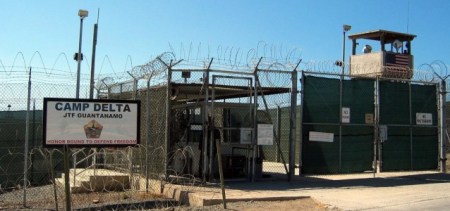
A holding area at GITMO (Photo: Petty Officer 1st class Shane T. McCoy/U.S. Navy)

By Clarion Project Wednesday, January 31, 2018

Source: Trump Keeps Gitmo Open

{Preventing radical Islamo-conversions in general prison populations. – LS}

President Trump signed an executive order rescinding Obama’s order to close the Guantanamo Bay detention camp.

Guantanamo Bay, colloquially known as Gitmo, has been used to detain terrorist suspects since 2002. Prisoners held there have frequently not been formally charged but have been deemed too dangerous to release. Although the order was issued in 2009, the camp was never closed.

“In the past, we have foolishly released hundreds of dangerous terrorists, only to meet them again on the battlefield,” Trump said during the Tuesday night State of the Union address, in which he announced the move. He told Congress he had decided “to reexamine our military detention policy, and to keep open the detention facilities at Guantanamo Bay.”

There are currently 41 detainees in Guantanamo Bay. Of these, 26 are held indefinitely under the law of war and are not due for transfer. No new inmates have been added so far under Trump’s tenure, according to Slate.

High profile Gitmo detainees include Khalid Sheikh Mohammed, the architect of 9/11.

Many Gitmo prisoners who were released resumed their terror activities. Shortly before Obama left office, he transferred 10 prisoners to Oman, prompting Senator Ted Cruz (R-TX) to introduce legislation requiring the government to declassify and publicly release information on the terrorist records of all Gitmo detainees who were released since the November 8, 2016 presidential election.

Trump’s Election Was a Win in the Fight to Keep Gitmo Open

January 5, 2017

Trump’s Election Was a Win in the Fight to Keep Gitmo Open, Center for Security Policy, Ben Lerner, January 4, 2017

gitmonow

Source: National Review

President Obama recently signed the FY 2017 National Defense Authorization Act into law. Like numerous others before it, this NDAA is a densely packed, important piece of legislation, and it contains a provision extending the prohibition on spending federal funds to transfer Guantanamo Bay detainees to the United States for any reason through December 31, 2017.

Implementing this provision before the end of the calendar year was crucial. The comparable prohibition in the FY 2016 NDAA was set to expire on December 31, 2016, so failing to extend it beyond that date technically would have left the Obama with three weeks to transfer Gitmo detainees to U.S. prisons between December 31 and January 20, his last day in office. The president and his team have expressed frustration that it is now impossible for them to fulfill his 2008 campaign pledge to close detainee operations at Gitmo, which he backed with one of the very first executive orders he signed upon taking office.

The road to this point was long and uncertain. Just months after Obama’s January 2009 executive order was issued, the administration announced that it intended to prosecute 9/11 mastermind Khalid Sheikh Mohammed and other 9/11 co-conspirators in federal court in Manhattan. Bipartisan opposition to this plan was swift and sustained, and the president was forced to abandon it. The administration had also undertaken a parallel initiative to transfer other detainees to a prison facility in Standish, Michigan, but again had to drop those plans in the face of intense opposition from the local community. A similar effort to transfer detainees to a prison facility in Thomson, Illinois was also stymied when then-attorney general Eric Holder, again facing widespread objections from those with security concerns, pledged under oath before the Senate Judiciary Committee that the Thomson facility would not be used to house Gitmo detainees.

Not long after Democrats lost their lock on the House and Senate as a result of the 2010 midterm elections, Congress passed the FY 2011 NDAA, prohibiting transfers of Gitmo detainees to the United States for any reason. Congress would pass, and the President would sign into law with objection, similar bans in subsequent NDAAs and related appropriations legislation for the next several years. Over the last two years, Obama seemed to signal a willingness to defy these bans by sending delegations to survey and report on three more possible sites for domestic transfers: Fort Leavenworth, Kansas; ADX Florence, the supermax prison in Colorado that houses the most dangerous federal inmates; and the Navy Brig in South Carolina. But these possibilities, too, were met with strong opposition from state and local authorities, and they have yet to be acted upon further.

One would have to assume that a significant reason why such domestic transfers have failed to happen since Obama first looked at the Kansas, Colorado, and South Carolina sites is that U.S. military leadership has stated publicly that the military will play no part in facilitating such transfers under current law. In November of 2015, 16 Members of Congress sent a letter to the Joint Chiefs of Staff encouraging them to seek legal counsel, in light of current bans on transferring Gitmo detainees to the United States, before implementing any orders from President Obama to the contrary. The Joint Chiefs responded to that letter in February of 2016, stating that they would not take any actions that violated the transfer ban. This was a watershed moment in the debate: Since Gitmo is a military facility, it is hard to envision a transfer of detainees to the U.S. without the cooperation of the military.

The fact that Democrats and Republicans within and outside Congress held the line for the past eight years, thwarting the president’s highly misguided plans to transfer detainees stateside, is a testament to the resonance of the arguments against those plans: It remains just as true today as it was eight years ago that bringing detainees here would pose unacceptable security and legal risks for the American people, and would do nothing to abate the jihadist threat against the United States.

That said, there are two things to keep in mind until January 20th, 2017.

First, President Obama is deeply committed to his view that Gitmo has been detrimental to America’s global reputation and has maintained that “under certain circumstances” the domestic-transfer restrictions might be unconstitutional. His signing of the last NDAA of his presidency into law, and the Joint Chiefs’ previous statement regarding military participation in any such detainee transfer, severely limit his options. But it would be a mistake to consider the matter closed until President-elect Trump, who thankfully has so far adopted a very different perspective on Gitmo, assumes office.

Second, Obama has indicated that he will continue trying to transfer remaining detainees to other countries, as he has done already with several very dangerous terrorist suspects. There is less that Congress can do to stop these transfers since they fall squarely within the executive branch’s prerogative as the primary conductor of foreign policy. The recidivism rate for former Gitmo detainees released under both presidents Bush and Obama is 30 percent. So while it remains unlikely that Obama can fulfill his desire to transfer remaining detainees to the U.S. for trial before he leaves office, he can still do grave damage to America’s national security in the few weeks he has left.

With this in mind, President-elect Trump would be well-advised to minimize such damage by 1) reiterating that in his administration, Gitmo will be kept open for detainee operations involving those still there and those who may be captured or re-captured on the battlefield; and 2) announcing that countries who accept detainees for transfer between now and January 20th would be guaranteed an extremely poor start to relations with the new administration.

How Trump Can Stop Obama from Closing Gitmo

November 18, 2016

How Trump Can Stop Obama from Closing Gitmo, American ThinkerEd Lasky, November 18, 2016

Donald Trump can stop Barack Obama from continuing to free terrorists, and the sooner he acts, the better.

Barack Obama is a lame-duck president and, empowered by his pen and a phone (the only weapons he has ever held, no doubt) is determined to continue to carve out a dubious legacy for himself. He had promised to close Guantanamo prison during his first presidential campaign and on the second day in office he issued one of his numerous executive orders to come, this one directing that the prison be closed within one year.

Terrorists were big supporters of Barack Obama. At Gitmo they were chanting “Obama! Obama! Obama!” during election night and when he won started chanting to their guards and prosecutors the refrain “Hey, hey…goodbye”

President Obama was stymied in his efforts to transfer many of them to American prisons when Republicans led an effort (joined by many Democrats) to pass a law that forbade prisoners from being moved into American prisons.  But Barack Obama has found another way to release these terrorists (or “detainees” as liberals call them) by working to depict them as less of a threat than they are and then releasing them into the custody of foreign governments.

As Stephen Hayes has written in a Weekly Standard column, “Lying About Gitmo,” Obama and his team have been lying about the backgrounds and records of these terrorists to downgrade their threats to Americans and others around the world:

Let’s begin with the conclusion: Barack Obama is releasing dangerous terrorists against the recommendations of military and intelligence professionals, he’s doing so at a time when the threat level from radical Islamists is elevated, and he is lying about it. He is lying about how many jihadists he has released and lying about their backgrounds, all part of his effort to empty the detention facility at Guantánamo Bay.

Hayes assembles quite the collection of examples of anti-American jihadists that Obama has given a get out of jail card. Included among them are the so-called Taliban Five, terror masterminds released in return for Sgt. Bowe Bergdahl. All five had worked for Al Qaeda before 9/11.

Hayes writes:

Obama has also downplayed the threats from released Guantánamo prisoners in other ways. He describes the detainees as “embittered,” as if the hatred that inspires them grows from their time in Guantánamo rather than their devotion to a murderous cause. Instead of rejoining the war, the recidivists are merely “trying to link up with their old organizations.” Perhaps most bizarre is his description of the process he’s using to determine which detainees can be transferred or set free. “The judgment that we’re continually making is: Are there individuals who are significantly more dangerous than the people who are already out there who are fighting? What do they add? Do they have special skills? Do they have special knowledge that ends up making a significant threat to the United States?”

Those are the criteria? Detainees can be released if the White House determines that they are no more dangerous than, say, the leaders of ISIS, AQAP, Boko Haram, Jabhat al Nusra, the Haqqani network, the Khorasan group? If this is actually the way the administration evaluates potential releases, it would explain why so many veteran jihadists have been freed. It’s a process that prioritizes emptying the facility over the security of the country.

Obama has been dishonest about his policy and has downplayed threats from Islamic terrorism from the first day of his presidency to the (thankfully) last days to come. Pentagon and other national security experts have decried this minimizing of threats to America. His actions have been condemned by Congressman such as Edward Royce, the Republican head of the House Foreign Affairs Committee, who accused the White House of “doubling down on policies that put American lives at risk” and “recklessness.”

Climate change is a greater threat in Obama’s mind.

Barack Obama seems laser-focused on closing Gitmo as part of his legacy. This would cause irreparable harm to the security of America: released terrorists have a very high recidivism rate (killing is what they live for, and released “detainees” have been implicated in subsequent attacks on Americans) and Gitmo has a very unique legal status that makes it absolutely crucial in our battle against terrorism. If Obama succeeds in closing Gitmo and, perhaps, turning it over to the Castro brothers (who no doubt will be glad to have more prison space for their political prisoners), it will never again be an American asset in our fight against Islamic terrorism.

Obama has justified his actions by being able to claim formally that these terrorists are not being freed; instead he has been transferring them to other nations who supposedly will monitor them to prevent their return to terrorism. In practice, this monitoring has been a farce as the various nations, some but not all of them of them Muslim nations, have looked the other way as the terrorists “go back to work.” Detainees have vanished; they have gone off the radar screen and found their ways back to join their fellow terrorists.

What can be done in the next two months to stop Obama?

Donald Trump has vowed to keep the prison open, and to “load it up with some bad dudes.” But he can’t keep his promise if Obama empties the prison and fulfills his promise to close Gitmo.

President-elect Donald Trump and a Republican Congress can put foreign nations on notice that change is coming to Washington and America in January and that nations that cooperate with Barack Obama in his terrorist release program will be scrutinized in the years to come when it comes to foreign aid, trade pacts, security cooperation and a range of other measures. Some of the nations that have taken the terrorists are oil-rich Middle Eastern nations, but others are less wealthy South American nations. Would Uruguay be willing to take any more terrorists if faced with warnings from the incoming administration that moves to take them will be “looked at with disfavor” (to be diplomatic) in the years to come? Even Arab nations, who certainly have no reason to seek to please Barack Obama, might be reluctant to displease a President Trump who they will have to engage with the next four years.

President-elect Donald Trump has a chance to do a great deal to help defend America even before he becomes Commander-in-Chief.