Archive for the ‘Trump and China’ category

Did the Syria strike push China toward action on North Korea?

April 8, 2017

Did the Syria strike push China toward action on North Korea? Hot Air, Jazz Shaw, April 8, 2017

(Kim Jong-un has been deemed “crazy” because he is unpredictable. Trump is far from crazy, but can be unpredictable when he wants to be. China does not know what Trump might do about North Korean nukes and missiles, and that is a good thing. — DM)

So the fireworks in Syria have produced all sorts of interesting results on the international diplomacy front. World leaders in western nations who have seemed at least somewhat skeptical of President Trump (to put it mildly in some cases) were suddenly praising him. The Russians, who Democrats regularly assure us are pulling Trump’s strings, are getting nervous. But perhaps the biggest potential sea change came in an unexpected area. China’s position on North Korea and their diminutive dictator may be shifting quickly. This is probably a result of leaked information about the options Trump is being presented with and considering in terms of the Korean Peninsula. NBC News is reporting that the possible moves include not only assassinating Kim Jong-un, but moving nukes back into South Korea for the first time since the end of the cold war.

The National Security Council has presented President Trump with options to respond to North Korea’s nuclear program — including putting American nukes in South Korea or killing dictator Kim Jong-un, multiple top-ranking intelligence and military officials told NBC News.

Both scenarios are part of an accelerated review of North Korea policy prepared in advance of President Donald Trump’s meeting with Chinese President Xi Jinping this week.

The White House hopes the Chinese will do more to influence Pyongyang through diplomacy and enhanced sanctions. But if that fails, and North Korea continues its development of nuclear weapons, there are other options on the table that would significantly alter U.S. policy.

Excuse me… did you say nukes? And assassinations? That got China’s attention, at least according to the Secretary of State. (Washington Examiner)

Chinese President Xi Jinping has agreed to boost cooperation with the U.S. on trying to persuade North Korea to abandon its pursuit of long-range nuclear weapons, Secretary of State Rex Tillerson said Friday.

In an off-camera briefing with reporters on the second and final day of President Trump’s summit with his Chinese counterpart, Tillerson said the two leaders recognized the imminent threat North Korea poses and agreed to respond accordingly.

Clearly, the Chinese aren’t any more worried about Kim Jong-un today than they were a few weeks ago. The guy is just as crazy as ever and his missile program remains in the same state of clunky, but still worrisome progress that it has been. But the fact that all of this Syria business was rolling out just as Trump was having dinner with Xi Jinping probably has China’s leader more worried about… Trump. After eight years of Obama foreign policy which basically boiled down to speak softly and never even pick up the stick, the rest of the world is now keenly aware that the new administration isn’t all peace, love and unicorns.

In terms of China’s attitude, fold the two stories above together. That leak reported by NBC never should have happened, obviously, but now that it has the Chinese have clearly noticed. The options under discussion, even if they are nothing more than worst case scenarios, are the stuff of nightmares for Xi Jinping. Having the United States move some nukes into South Korea would be far more than a threat to Kim in the North. It would be incredibly provocative towards both China and Russia. Keep in mind that you could basically ride a bicycle from Seoul to the Chinese border in a single day (assuming you could find a road) and Vladivostok isn’t much further up the coast. An attempt to move nukes into the area could actually provoke a showdown similar to the Cuban missile crisis and nobody really wants that.

And assassinating Kim Jong-un? While appealing in a hypothetical sense it would no doubt provoke a response which may well include a very different sort of “nuclear option.” The Chinese have got to be wondering just what sort of tiger they have by the tail in the White House right now. Obama was reliable in terms of not doing anything seriously provocative, but now Xi Jinping has had a chance to see Trump fire off nearly five dozen cruise missiles right while they were bringing out the Crème brûlée in Mar-a-Lago. He’s got to be wondering if Trump isn’t the sort of guy who’s going to wake up in a bad mood one day next week and decide to go punch Kim Jong-un in the face just to see what happens.

So now the Chinese are looking like they’re going to take Kim out behind the woodshed for a chat. Was this part of Trump’s strategy all along or just a happy bit of collateral diplomatic debris? His most ardent supporters can use this as evidence to argue that he’s playing three dimensional chess on the international front after eight years of Obama playing checkers. His detractors will call it dumb luck. Personally, I’m guessing that he was already briefed on and anticipating some benefits from the missile strike in areas which are almost totally unrelated to Syria, but it’s not the sort of thing he wanted to predict publicly because China can be fairly tough to anticipate at times.
A new age of diplomacy

April 5, 2017

A new age of diplomacy, Israel Hayom, Prof. Abraham Ben-Zv, April 5, 2017

The character of the new American diplomacy is slowly becoming clear, both in terms of style and essence, and especially as it pertains to the Middle East. We are being given the impression that U.S. President Donald Trump is trying to adopt the management style of late U.S. President Franklin D. Roosevelt, who tended to bypass his secretary of state.

Preliminary signs indicate that Trump sees his current wandering adviser and envoy, Jared Kushner, as a confidant and trustworthy emissary for sensitive diplomatic missions. This is clear from his mission to Baghdad at the beginning of the week and in his ongoing involvement in advancing the peace process in the Palestinian arena. Kushner is also expected to take part in the U.S.-China summit (set to take place in Florida this week), reflecting his role as moderating figure in the charged relationship between Trump and the Chinese leadership and indicating his growing power.

While a young and energetic Kushner hops between continents as the president’s representative, U.S. Secretary of State Rex Tillerson lags behind him, excluded and disconnected from the big decision-makers.

This gives a good idea of style. As for the essence — when it comes to the Middle East in particular, we are seeing a sort of diplomacy that is radically different than former U.S. President Barack Obama’s approach. This is especially true regarding the Trump administration’s efforts to establish a Sunni anti-Iranian axis led by Cairo and Riyadh. While the Obama administration abandoned the United States’ traditional partners on this front, and instead, worked tirelessly to reconcile with Iran, the current White House is signalling unequivocally that it is determined to at least turn over a new leaf in its relationship with these regional powers and to upgrade strategic cooperation with them in order to uproot terrorism.

While Obama’s relationship with Egyptian President Abdel-Fattah el-Sissi was characterized by coldness (in contrast to the warmth he showed to Egypt’s previous leader, Muslim Brotherhood member and sworn Hamas supporter Mohammed Morsi), Trump’s approach is quite different. El-Sissi’s state visit to Washington this week was marked by extraordinary warmth and cordiality on the part of the American president. This was an effort to erase the remnants of the recent past — especially the memory of punitive and alienating policy led by Obama against the Egyptian leader — from the Egyptian consciousness.

A similarly dramatic improvement can be seen in U.S.-Saudi relations, wherein strategic cooperation has also been upgraded recently, especially (but not only) regarding fighting on the Syrian front and in the struggle against the Houthi militias operating in Yemen with Iran’s help and support (against al-Qaida forces in the field). This follows the deep ebb in their relationship due to Obama’s tireless efforts to appease the Ayatollah regime in Iran, the sworn enemy of the Saudi royalty. Regarding Syria, in 2013, Obama abandoned the civilian population there to its fate, remaining, despite his declarations, completely passive even after Syrian President Bashar Assad crossed all the red lines by using murderous chemical weapons against masses of civilians. On Tuesday, too, Assad’s forces carried out a major chemical attack, harming many civilians, in the country’s destroyed and divided north. Based on the growing military involvement and the Trump administration’s determination to deal with the “axis of evil” there too, we can assume that the White House will have a different response to this war crime.

Finally, regarding U.S.-Israeli relations, we are witnessing the expression of exceptional support and identification, reminiscent of the golden age of late U.S. President Lyndon B. Johnson (during which time then-U.S. Ambassador to the U.N. Arthur Goldberg’s speeches reflected the strength and resilience of the “special relationship”). While the Obama administration focused on efforts to settle the conflict, which it defined as a core issue of utmost local and regional importance, the Trump administration is demonstrating a much more relaxed and relevant approach to the complex situation. On this front too, there is real change in the form and style of American diplomacy in the Trump era.

Trump, Xi and Taiwan

April 5, 2017

Trump, Xi and Taiwan, Washington Times, Lester Wolff, April 4, 2017

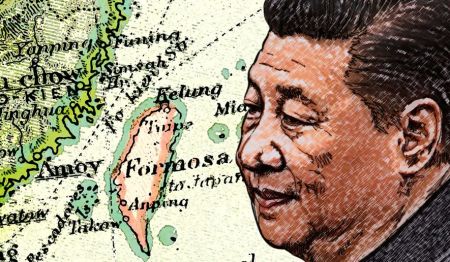
Illustration on China and Taiwan by Greg Groesch/The Washington Times

ANALYSIS/OPINION:

This week’s TrumpXi meetings are an opportunity for the president to both publicly and privately make the same important points. U.S. engagement with China is important to the peace and stability of the Asia-Pacific region, but it is also vital that the mutual interests of the United States and Taiwan should not in any way be compromised by this process.

******************************

This week, the world will witness the first meeting between U.S. President Donald Trump and Chinese President Xi Jinping. There has been much speculation on which topics their conversations will address, and it is a safe bet that Taiwan will be on the list. The U.S.-Taiwan relationship is a vital one, and it is necessary — especially in this time of change and uncertainty — to restate the reasons why.

Thirty-eight years ago this month, the Taiwan Relations Act (TRA), an important, bipartisan creation of the U.S. Congress, was signed into law. Necessitated by Washington switching its official diplomatic recognition from Taipei to Beijing, the TRA has allowed the United States to maintain its friendship and ties of cooperation with Taiwan and its people. It states that the status of Taiwan should be determined by peaceful means, and that nonpeaceful means to do so are a threat to the region and of grave concern to the United States.

At the same time, the TRA recognized, and continues to recognize, the reality of the world in which we live — one where Beijing has never renounced the use of force to take Taiwan, and where it engaged first in a massive military build-up across the Taiwan Strait, and now in the waters of the East and South China Seas. The TRA mandates that the United States “make available to Taiwan such defense articles and defense services in such quantity as may be necessary to enable Taiwan to maintain a sufficient self-defense capability,” and we have done so in the decades since with bipartisan support.

Relations between the United States and Taiwan were further bolstered through the Six Assurances made to Taiwan by President Ronald Reagan in 1982, which stipulated: the TRA would not be altered, the United States would not mediate between Taipei and Beijing, and the United States would not alter its position about Taiwan’s sovereignty or formally recognize China’s sovereignty over Taiwan.

As a result of U.S. commitments to Taiwan, an environment was created where the people of Taiwan — the population of which is now more than 23 million — built a true, functioning democracy that has experienced the peaceful transfer of power from one political party to another three times since 2000 at the presidential level, and for the first time at the legislative level last year. Americans who have visited Taiwan or worked with Taiwanese people know that the reason the relationship is so strong is because we share many of the same values — a commitment to democracy, personal freedom, individual expression and the rule of law. Taiwan has concurrently grown into a vibrant society garnering achievements in science and technology, education, the arts and popular culture that have been exported and embraced by people elsewhere in the region and around the world.

In every sense, the TRA and the relationship that has been built upon it have been successful. Just as Taiwan has benefited, so has the United States and the wider global community. Taiwan today is not only one of America’s most dependable allies in the Asia-Pacific and its 10th-largest trading partner, but it is an example for emerging democracies everywhere and a leader in providing humanitarian aid in times of need — all this in spite of the regrettably limited international space in which Taiwan is allowed to operate.

At a time when democracy appears to be in retreat in many parts of the world, Taiwan demonstrates how it can be a success. As American diplomats and foreign policy experts have pointed out time and again, the U.S. commitment to Taiwan underscores to America’s friends and foes its commitments to its allies and to democracy, and helps to maintain U.S. credibility abroad.

In the five months since the U.S. presidential election, there has been needless uncertainty regarding U.S. policy on China, Taiwan and cross-strait relations. Before his confirmation earlier this year, Secretary of State Rex Tillerson reaffirmed the TRA and the Six Assurances and said, “The U.S. commitment to Taiwan is both a legal commitment and a moral imperative.” This was a positive first step.

This week’s TrumpXi meetings are an opportunity for the president to both publicly and privately make the same important points. U.S. engagement with China is important to the peace and stability of the Asia-Pacific region, but it is also vital that the mutual interests of the United States and Taiwan should not in any way be compromised by this process.

Taiwan Receives U.S. Navy Frigates, Plans Purchase of American Fighter Jets

March 20, 2017

Taiwan Receives U.S. Navy Frigates, Plans Purchase of American Fighter Jets, Breitbart, Frances Martel, March 20, 2017

AP/Daniel Morel

The government of Taiwan is planning to request the purchase of new fighter aircraft from the United States, The Guardian reported today, just as it completes the transfer of two decommissioned U.S. Navy frigates. The move comes amid concerns that the Communist Party in Beijing is seeking to crack down on the pro-independence government of President Tsai Ing-wen.

The Guardian cites Taiwanese Defense Minister Feng Shih-kuan as alerting the nation’s legislature that his government is seeking to purchase more modern aircraft to replace its currently fleet of F-16s. Feng’s request for more modern aircraft was a response to a review of Taiwan’s defense capabilities recently released by his ministry and published every four years. The review warned that the Chinese government had significantly expanded its ability to attack Taiwan is necessary. China has invested heavily in military construction in the South China Sea, particularly in regions that are not sovereign Chinese territory but China insists has belonged to them since ancient times.”

The fighter jet purchases are part of a greater proposed defense spending increase in the year’s budget. The South China Morning Post reports that Taiwan is looking to increase its defense spending from two to three percent of its GDP in 2018, a high not seen since 1999. This would mean spending up to $11.4 billion on defense. Tsai’s predecessor, the Kuomintang Party’s Ma Jing-yeou, took a conciliatory approach to relations with Beijing.

The Guardian notes that China is proposing a seven percent increase in its defense spending to $151 billion.

The budget announcement also featured the revelation that Taiwan was now capable of launching missiles that can hit the Chinese mainland, a distance of nearly one thousand miles.

Taiwan recently expanded its naval capability by receiving two decommissioned American Oliver Hazard Perry-class frigates, who began their sail out of American port on March 9. The frigates are expected to begin active duty for the Taiwanese defense forces in May.

The Chinese government appears concerned with Taiwan’s moves to protect itself from a mainland invasion. State propaganda outlet Global Times published a column Friday warning Taipei to abandon hopes of being recognized as a sovereign nation and instead accept the status China insists it has as a rogue province. “No soldiers believe Taiwan forces are capable to defend the island if the People’s Liberation Army (PLA) launches a comprehensive offensive against Taiwan,” the column reads. “As long as the Tsai government accepts of the 1992 Consensus, the island’s security will be ensured. The eight-year-tenure of Ma Ying-Jeou is the most secure period Taiwan has enjoyed since entering the 21st century.”

“Therefore, the most important thing for Taiwan is not to provoke the one-China policy. This is the correct political way to protect the island’s security,” the column concludes.

Taiwan did just that late last year following the election of President Donald Trump in the United States. President Tsai called Trump to congratulate him on his election victory and Trump, in an unprecedented move, accepted the call, implying he understood Tsai to be a fellow head of state. The Chinese communist government condemned Tsai and insisted in assurances from Washington that the Trump administration would not abandon the “One China” policy, which demands foreign nations also deny Taiwan’s sovereignty. Trump reportedly agreed to the One China policy in a February phone call with President Xi Jinping.

Tsai, meanwhile, has insisted on respect for her nation’s self-governance. In a speech in January, Tsai condemned Beijing for “going back to the old path of dividing, coercing, and even threatening and intimidating Taiwan.” “For the sake of safeguarding regional peace and prosperity, I want to once again reiterate that our commitments will not change, and our goodwill will not change. But we will not bow to pressure, and we will of course not revert to the old path of confrontation,” she promised.

Former Ambassador John Bolton: Trump Needs to Renegotiate ‘One China’ Policy

February 27, 2017

Former Ambassador John Bolton: Trump Needs to Renegotiate ‘One China’ Policy, Washington Free Beacon, February 27, 2017

Former U.S. Ambassador to the United Nations John Bolton on Friday urged President Donald Trump to upend  four decades of precedent by renegotiating the “One China” policy that denies Taiwan’s sovereignty.

Bolton told the Washington Free Beacon in an exclusive interview that the One China policy, which was established during President Richard Nixon’s visit to China in 1972, is “ahistorical” and fails to reflect the current reality in East Asia, where natives of Taiwan overwhelmingly identify as “Taiwanese” rather than “Chinese.”

“The One China policy is inherently ambiguous,” Bolton said. “China thinks it means one thing, we think it means another.”

Beijing maintains that One China means the People’s Republic of China is the sole legitimate China, encompassing Taiwan.

But the Shanghai Communiqué agreed to by the United States and China explicitly says the United States “acknowledged” that “all Chinese” on either side of the Taiwan Straight believe “there is but one China.” The pact does not deny Taiwan’s sovereignty on its face.

“A clear relationship with both Beijing and Taipei on this would help all concern rather than [having] this phrase which means anything and nothing,” Bolton said.

Earlier in the day, Bolton told an audience at the Conservative Political Action Conference outside of Washington, D.C., that the Trump administration needs to “make clear” there will never be reunification between China and Taiwan without the “express, overwhelming consent” of those living in Taiwan.

“It’s time for constructive clarity,” Bolton said. “We support the people of Taiwan. We support their continued self-government, independent of China.”

Bolton predicted that China will be the top strategic issue facing the United States in the 21st century. He said the president needs to immediately demand that China back down in the South China Sea and the East China Sea.

Bolton also suggested the Trump administration pressure China to pursue Korean reunification to “eliminate” the North Korean regime. He urged the president to end the Iran nuclear deal “as soon as possible” and said the United States needs to renegotiate the New START nuclear arms reduction treaty with Russia so that the United States can rebuild its nuclear deterrent in the face of Moscow’s ongoing treaty violations.

“There’s only one country in the world that’s bound by this treaty—China’s not bound by it, North Korea and Iran aren’t bound by it, theoretically Russia is, but they don’t pay any attention to it,” Bolton said. “There’s only one country that can’t build intermediate-range nuclear forces and that’s us.”

Bolton is a vocal advocate of an expansive U.S. foreign policy that promotes American values abroad. He says the greatest threat to the nation is “self-induced weakness” that was characteristic during the Obama years.

The former ambassador told the Free Beacon he believes Trump would be successful in reversing many of former President Obama’s foreign policy initiatives within his first term, especially if he models his actions after the Reagan administration.

“It took Reagan a substantial amount of time to create a defense expenditure buildup to give us the kinds of military force that we needed to speak from a position of true strength, and I think Trump is going to have to go through the same process with correcting the mistakes of the eight Obama budgets,” Bolton said.

“At the same time, Reagan said right from the beginning that he was going to pursue a very different foreign policy and the political strength of his determination to do that gave us cover while we rebuilt the military and I think Trump should follow that approach too … It would’ve been a lot different if we had a Clinton administration and had not just an eight-year hole to climb out of but a 12-year hole,” he added.

Bolton was a finalist to fill the national security adviser position left open by the resignation of retired Gen. Mike Flynn.

Trump said the administration would ask Bolton to serve in a “somewhat different capacity” after it announced the selection of Lt. Gen. H.R. McMaster for national security adviser on Monday.

“John is a terrific guy. We had some really good meetings with him. Knows a lot,” Trump said from his Mar-a-Lago estate in Florida. “He had a good number of ideas that I must tell you I agree very much with. So we’ll be talking with John Bolton in a different capacity.”

Bolton did not comment on those talks.

Cadence of Conflict: Asia, February 13, 2017

February 13, 2017

Cadence of Conflict: Asia, February 13, 2017, Pacific Daily Times, February 13, 2017

(How and to what extent can the “one China policy” be ameliorated without being abandoned? What impacts should China’s military adventures in the South China Sea and its highly permissive treatment of North Korea have? — DM)

The delay itself is a message to China like a father telling the disobedient son to wait his turn while everyone else at the dinner table has first choice. To China’s “indirect-implication” culture, it was no less than a smack in the face, no matter how friendly and reportedly positive the phone call was. No doubt China feels this somewhat, though President Xi probably doesn’t take the snub as seriously as he should.

Trump knew that Beijing would jump to report the phone call to give President Xi notoriety, forgetting the deeper implication that the phone call didn’t happen for three weeks into Trump’s term. Now, the Chinese people know that Trump didn’t talk to their president until three weeks after taking office, yet he received a phone call from Taipei only days after he was elected—Beijing made sure the people knew that. When trying to control information in one’s own country, that was an oversight. If Beijing were wise to the three-week snub, no newspaper in China would be allowed to report the phone call until two months later, with the comment, “Oh, they are presidents. They talk when it suits them.”

********************************

After three weeks, President Trump finally had his phone call with Chinese President Xi. The report is that Trump will uphold the United States’ long-standing “One China” policy, in which China proper and the island of Taiwan are one country and that country’s government seat is in Beijing. The effect is that the United States does not have an “embassy” with Taiwan, but the US has an “institute” and Taiwan an “economic and cultural” office; both are still considered envoys and consulates, offering passport and visa services. While self-important voices in news and politics view the phone call as a phone call, much more is happening beneath the surface, and Beijing may only be partially aware of what all is going on.

Being a Socialist State, China’s government is itself in business, both cooperative and competitive. China’s Communist Party can directly compete with social companies like Facebook, news networks like CNN, web service companies like Google, almost any manufacturer, and, of course not in the least, construction. China’s former business associate and new “boss”, as it were, of America calls all the “important” countries in the world, except China. The delay itself is a message to China like a father telling the disobedient son to wait his turn while everyone else at the dinner table has first choice. To China’s “indirect-implication” culture, it was no less than a smack in the face, no matter how friendly and reportedly positive the phone call was. No doubt China feels this somewhat, though President Xi probably doesn’t take the snub as seriously as he should.

Even allowing State-controlled newspapers, such as Xinhua news, to let three weeks of silence be known merely by reporting the phone call shows that Trump knows how to cut through promulgated gate keeping. Knowing how his old trading partner thinks, Trump knew that Beijing would jump to report the phone call to give President Xi notoriety, forgetting the deeper implication that the phone call didn’t happen for three weeks into Trump’s term. Now, the Chinese people know that Trump didn’t talk to their president until three weeks after taking office, yet he received a phone call from Taipei only days after he was elected—Beijing made sure the people knew that. When trying to control information in one’s own country, that was an oversight. If Beijing were wise to the three-week snub, no newspaper in China would be allowed to report the phone call until two months later, with the comment, “Oh, they are presidents. They talk when it suits them.”

In social battles of implication and indirection, the Chinese have endurance and mastery, but the West has a less frequent and even more subtle way of implication that often eludes the East. It is difficult to recognize deep implication when implication is used on a daily basis for routine communication. Americans trust Trump with China more, now, knowing that he can snub them for three weeks and State-run Xinhua news will consider it a “good first step”.

There are other problems—not being able to quit while so far ahead and declare victory after 70 years of war on the books, the US selling weapons to Taiwan—but the three week snub “trumps” them all. American people have often asked themselves who China thinks they are fooling. After this three-week snub thoroughly reported under the title of a “phone call”, the American people, Democrats and Republicans alike, certainly know who is successfully fooling China.

Don’t Fall for China’s Global Baloney

January 25, 2017

Don’t Fall for China’s Global Baloney, Washington Free Beacon, January 25, 2017

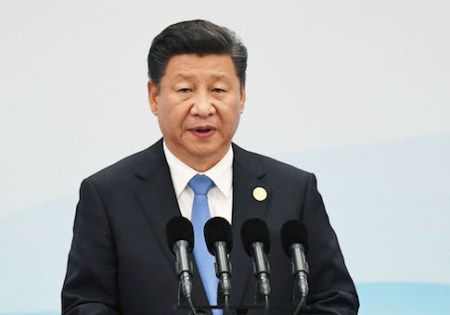
Chinese President Xi Jinping speaks before reporters after a two-day summit of the Group of 20 major economies in the Chinese city of Hangzhou on Sept. 5, 2016. (Kyodo) ==Kyodo

Chinese President Xi Jinping speaks before reporters after a two-day summit of the Group of 20 major economies in the Chinese city of Hangzhou on Sept. 5, 2016. (Kyodo)
==Kyodo

Reading the gushing coverage of this dictator’s turgid and clichéd speech, I can’t help thinking of the last time America’s liberal elite went gaga over China. “One-party autocracy certainly has its drawbacks,” Tom Friedman wrote in 2009. “But when it is led by a reasonably enlightened group of people, as China is today, it can also have great advantages.” Chief among those advantages, according to Friedman, is the Chinese Politburo’s ability to “just impose the politically difficult but critically important policies needed to move a society forward in the 21st century.” Spoken like a true apparatchik. Six months later, on Meet the Press, Friedman confessed his fantasy: “What if we could just be China for a day?”

They are therefore more sympathetic to the world Xi Jinping wants to preserve than the world Donald Trump wants to create. That democracy or self-rule plays a far larger part in Trump’s world than in Xi’s should not be forgotten, however. Least of all by people who think of themselves as liberal or progressive.

**************************

It’s rather sickening to watch self-described liberals embrace China as a responsible power. The headline on the cover of this week’s Economist, which I now read solely to find out what is not the case, is “China: the global grown-up.” The Washington Post purports to explain “Why China will be able to sell itself as the last liberal great power.” These articles, besides being wrong, have the distinction of following the line set by Beijing itself: “China may lead globalization movement,” says propaganda outlet CCTV.

How one can argue that a Communist oligarchy that practices mercantilism and industrial and diplomatic espionage, builds islands in contravention of international law, disappears lawyers and writers critical of the regime, feeds its people a steady diet of ethno-nationalist propaganda, threatens America’s allies, enables the North Korean psycho-state, recently sailed its aircraft carrier through the Taiwan Strait, massively censors the Internet, and has some of the worst air pollution in the world is “liberal” in any sense of the term is beyond me. Ironic, isn’t it, that the same press that examines every utterance of Donald Trump with Talmudic scrutiny is utterly credulous when Chinese leader Xi Jinping, who is quite self-consciously modeling himself after Mao Zedong, tells the elite assembled at Davos that he will defend free trade and—I had to laugh—immigration. How many Syrian refugees are there in China?

Credit to Xi, though, for putting one over on self-described globalists and others so eager to embrace foreign critics of Donald Trump that they are more than happy to check their belief in human rights at the door. It ought to be obvious that China’s commitment to liberalism does not exist; Xi’s rhetoric is a veneer overlaying the deeply illiberal principles that animate his regime. And that regime, it seems to me, is on the defensive for the first time in 20 years. Surprised like so many at Trump’s victory, Xi understands the danger a nationalist and protectionist America poses to Chinese stability. America’s trade deficit fuels the economic growth that (barely) contains Chinese dissent. So his appeal to the Davos crowd was defensive, an attempt to rally favor among the men and women who have benefited personally from the economic arrangements of the post-Cold War era. It worked.

Makes you wonder, though. If China is invested so heavily in the status quo, perhaps Donald Trump has something of a point when he says that that status quo hasn’t benefited the average American. I know this isn’t a zero-sum world. But Xi seems to think it is, and so does Trump, and so do the millions of U.S. voters who feel that international trade agreements privilege Chinese oligarchs over American workers. A world in which the Chinese autocracy is fat and happy is not exactly a world conducive to liberty, at least not to the traditional liberty of non-dominated peoples. The Economist might have another definition in mind.

Reading the gushing coverage of this dictator’s turgid and clichéd speech, I can’t help thinking of the last time America’s liberal elite went gaga over China. “One-party autocracy certainly has its drawbacks,” Tom Friedman wrote in 2009. “But when it is led by a reasonably enlightened group of people, as China is today, it can also have great advantages.” Chief among those advantages, according to Friedman, is the Chinese Politburo’s ability to “just impose the politically difficult but critically important policies needed to move a society forward in the 21st century.” Spoken like a true apparatchik. Six months later, on Meet the Press, Friedman confessed his fantasy: “What if we could just be China for a day?”

It’s a confusing world. Many are puzzled at the international aspect of the new nationalism, the collaboration and commonalities between nation-state populists across North America and Europe. I’m not puzzled, because the nation-state populists are reacting against elites who are internationalized as well. The Frenchman and American applauding Xi at Davos have more in common with each other than they do the mass of their countrymen, especially those who live outside the major metropolitan areas. I think they share a common understanding of liberalism as well. They take it to mean the system of privileges and prerogatives that enriches and empowers meritocratic knowledge-workers like themselves. They are therefore more sympathetic to the world Xi Jinping wants to preserve than the world Donald Trump wants to create. That democracy or self-rule plays a far larger part in Trump’s world than in Xi’s should not be forgotten, however. Least of all by people who think of themselves as liberal or progressive.

Former Senator DeMint: Russia Needs to See a ‘Strong and Determined U.S.’

January 21, 2017

Former Senator DeMint: Russia Needs to See a ‘Strong and Determined U.S.’, Washington Free Beacon, , January 21, 2017

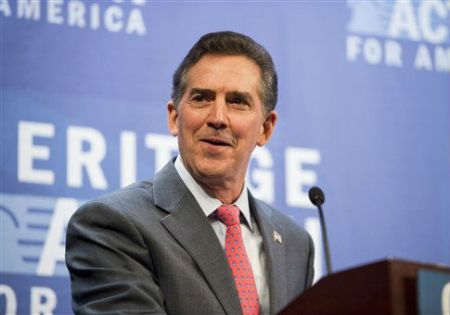
demint-1Former Sen. Jim DeMint, (R., S.C.), president of the Heritage Foundation / AP

“The implications worldwide of America being perceived as weak are huge; it’s the quickest way to draw us into some kind of conflict”

******************************************

Former Senator Jim DeMint (R., S.C.) says the United States needs to deter aggression from Russia and China by projecting strength and determination and making good on promises to its allies.

DeMint, who runs the conservative Heritage Foundation, criticized the Obama administration for not backing up its promises with force during an interview with the Washington Free Beacon, urging the Trump administration to chart a new course on projecting strength and drawing clear “lines in the sand.”

“The best way to keep peace is for us to be strong and perceived as strong, clear in what we are going to do and what we expect, and then we have to back that up,” DeMint said at the Heritage headquarters in Washington, D.C.

“We don’t want to be drawing lines in the sand that we ignore. Once Obama did that in Syria and other places, said things and didn’t follow up, the rest of the world basically knew that he wouldn’t. So, everyone has been testing us and our allies are nervous,” DeMint said.

DeMint downplayed concerns voiced about Trump’s handling of both Russia and China, saying that representatives from foreign countries with whom he has met have expressed optimism about the prospects for defense under the new administration.

“Most of the delegations—and we’ve had a lot of them since the election— that come through here are optimistic that Trump might reestablish America’s leadership position in the world and develop our strength to the point where they can count on us to keep their enemies at bay, or at least keep them honest,” DeMint said.

Trump has pledged to rebuild America’s military by reversing drawdowns of the armed forces set in motion during the Obama administration and ending sequestration that has eroded the defense budget. He has also telegraphed a willingness to pursue warmer relations with Russia, while taking a harder line on China when it comes to trade and the “one China” policy; both suggestions have drawn scrutiny from the press and critics of the Republican president.

DeMint said he suspects Trump is “toying” with Russian President Vladimir Putin and trying to “draw him in” by making positive statements about Moscow’s leader. The most recent administrations of Barack Obama and George W. Bush both tried to improve relations with Russia, to no avail. Many experts describe current tensions between Washington and Moscow as the highest since the Cold War.

“The best thing that Russia could see is a strong and determined U.S. and I think putting any missile systems all around them and convincing them that all of their development is not going to do anything because we have a missile system that could stop anything,” DeMint said, referring to the U.S. missile defense shields being deployed to Europe that have drawn ire from Moscow.

“Russia is a threat; we need to try to bring them into some kind of civilized [conversation] but we can’t be naïve in the thinking,” he said. “They want to dominate their neighborhood and keep Europe in their influence sphere, and they’re doing a good job.”

DeMint also said Trump is right to “put China on notice” as Beijing continues to build on disputed territories in the South China Sea.

“I don’t think it’s a bad thing that he’s stirring the pot a little bit with China to let them know that they cannot count on the status quo of a passive U.S.,” DeMint said. “Obviously, he has to bring that down into some clear policies, but China respects strength.”

DeMint, who has led Heritage since 2013 after serving two terms in the Senate, spoke to the Free Beacon two days before Trump’s inauguration just blocks away from the U.S. Capitol, outlining the think tank’s defense priorities for the new administration. He referenced at length Heritage’s Index of U.S. Military Strength, an annual assessment that last November shed light on the declines in American military power.

The individual service chiefs have testified before Congress about how budget cuts have compromised modernization and future readiness, agreeing that the U.S. military would not be able to defend the homeland against present and future threats if sequestration continues. Trump’s defense secretary, retired Gen. James Mattis, who was confirmed Friday afternoon, has already committed to ending sequestration.

“It’s not just about defending our country,” DeMint observed on Wednesday. “We have alliances with so many countries that depend on us that what you see now in our [analysis], it doesn’t just expose us. It’s got the rest of the world scrambling as to whether or not we could meet our commitments.”

“The implications worldwide of America being perceived as weak are huge; it’s the quickest way to draw us into some kind of conflict,” he later added.

FULL MEASURE: January 08, 2017 – China Challenge

January 11, 2017

FULL MEASURE: January 08, 2017 – China Challenge via YouTube, January 11, 2017