(Might German antisemitism be a factor? “[T]he ugly truth that many in Europe don’t want to confront is that much of the anti-Jewish animus originates with European people of Muslim background.” — DM)
German officials are tangled up in knots over Islamic State. While they recognize the threat, there has been little appetite over the years to clamp down on jihadist networks in the country. In short, Berlin’s lax policies toward terrorist groups have contributed to its Islamic State crisis.
There is a growing sense among leading German politicians that the Federal Republic’s preoccupation with the NSA surveillance scandal should not overshadow the pressing need to confront the Islamic State.
“German worry over Islamist attack eclipses spy scandal,” Bloomberg News headlined its Oct. 8 report on the issue. A new reality appears to be sinking in. Roderich Kiesewetter, a Bundestag deputy from Chancellor Angela Merkel’s Christian Democratic Union and a former army colonel, was quoted as saying, “In the German public, there is more of an awareness that our intelligence services need information to confront these terror threats.”
Some German politicians from powerful opposition parties, the Greens and the Left Party, have called for US airstrikes on Islamic State positions near the besieged city of Kobane in northern Syria. This call has come despite the Greens’ and the Left Party’s traditional anti-Americanism and hardline anti-intervention policies.
According to German authorities, an estimated 450 German Muslims have gone to fight against the Syrian regime. Most of the 450 sought membership with Islamic State. Roughly 40 women and a 13-year-old boy are among those who have departed for Syria. Die Welt provides a helpful systematic breakdown of “German Jihadists in Syria.”
A spokeswoman for Germany’s intelligence agency told this writer that the government cannot track individuals traveling to Turkey because the country does not require visas. European jihadists frequently use southern Turkey as an entry point into Syria.
Germany’s interior ministry is struggling to modernize its counterterrorism policies. On Oct. 2, Interior Minister Thomas de Maiziere acknowledged, “The situation has changed over the last few months.” Germany outlawed Islamic State activities in September. In the same month, a Frankfurt court started the trial of 20-year-old Kreshnik Berisha for membership in the Islamic State; it is the first terrorism trial of an Islamic State member in Germany. Berisha, who was born in Germany to Kosovan parents, was arrested in December 2013.
De Maiziere stressed the need for more sophisticated surveillance mechanisms to track Islamist combatants. He cited revocation of passports and identity cards as ways to combat terrorism.
German officials are tangled up in knots over Islamic State. While they recognize the threat, there has been little appetite over the years to clamp down on jihadist networks in the country. In short, Berlin’s lax policies toward terrorist groups have contributed to its Islamic State crisis.
It is worth recalling that Hezbollah’s so-called political wing is legal in the country. According to Germany’s national domestic intelligence report covering 2013, and published in June 2014, Hezbollah has 950 active members in the Federal Republic. There are also roughly 6,300 radical Islamists in Germany who are supporters of the Sunni branch of Salafism, Interior Minister de Maiziere said last week. Many of these Salafists are connected to the ideologies of al Qaeda, Shabaab, or the Islamic State.
An estimated 150 radical Islamists have returned from the Middle East war theater to Germany. In recent days, the battle for the northern Syrian town of Kobane, where Islamic State fighters are carrying out an assault on Kurdish civilians and fighters, has had repercussions in Germany. On Oct. 7, pro-Islamic State Muslims fought Kurds in the city of Hamburg, resulting in 14 people being injured and 22 arrests. The police used water cannons to disperse the street battle [see video from Online Focus].
In an eye-popping report last week, Germany’s ARD television station stated that over the years authorities allowed — and even encouraged — the travel of German Islamists to foreign countries. The policy appeared to be a kind of “export of terror” designed to reduce the risk domestically. “Persons who are dangerous and could launch attacks are brought outside of the country,” a government official said.
“Germany is on the way to be world champion in terrorism export,” one commentator wrote in Die Weltnewspaper in 2010. The author was not referencing the green light from German authorities for jihadists to leave for the Afghanistan and Pakistan war theaters, but rather the sheer number of radical German Muslims departing for conflict zones. The ARD report helps to explain why so many radical German Islamists have enjoyed unrestricted movement.
The chief destination for German jihadists now is to fight in Syria, Die Welt reported last week. German intelligence agencies also believe that jihadists who were based in terror camps in Afghanistan and Pakistan are now in Syria or on their way there. Pakistani jihadist networks — ranging from al Qaeda to the Taliban to the Islamic Movement of Uzbekistan — have attracted German Muslims to Pakistan and Afghanistan. The large number of Germans gave rise to so-called “German colonies” in the region.
According to German security information obtained by Die Welt, the German-Moroccans Yassin and Mounir Chouka and their wives, Nele Ch. and Luisa S., as well as Seynabou S. from Hamburg, along with children, relocated from Pakistan to Syria. It is unclear if the terrorists made it to Syria. Some of the group’s children were born in terror camps in Pakistan. While in Pakistan, the Choukas joined the Islamic Movement of Uzbekistan. Now, they have declared allegiance to Islamic State.
The Choukas, who are originally from the western German city of Bonn, motivated Arid Uka, a 24-year-old radical Islamist and Kosovo native who worked at Frankfurt’s airport, to murder two American airmen and wound two others in March 2011. Uka was sentenced to life in prison but Germany’s liberal judicial system may release him after 18 years of prison time.
Another German jihadist, former rapper Denis Cuspert a.k.a. singer Deso Dogg, is said to be in Syria and has been linked to both the Islamic State and al Qaeda’s Al Nusrah Front. Germany plans to submit his name for inclusion in the UN’s sanctions list, Der Spiegel reported on Oct. 5.
While issuing rhetorical support for strikes on Islamic State, the Merkel administration decided not to join US president Barack Obama’s airstrike coalition in Iraq and Syria to knock out Islamic State fighters and sites. Merkel did, however, send military arms to the Kurds and military personnel to train the Kurdish fighters.
It is unclear why President Obama chose not to twist Germany’s arm to join his anti-Islamic State airstrike coalition. Commentators in Germany believe the Merkel administration could do much more to stem Islamic State violence. In a late September commentary in Germany’s mass circulation paper Bild, the headline screamed, “All Talk, no action!”
Parallels between the current negotiations with Iran over nukes and those with North Korea and China over the end of the U.S. – U.N. “police action” in Korea should be considered in evaluating the former. That is the purpose of this article.
Among the conclusions to be drawn is that Obama’s America and the rest of the “international community” are heading down a foolishly misguided path in nuke negotiations with Iran. The path is likely to lead to results more inconclusive and substantially worse than did negotiations to end the Korean Conflict.
Korea negotiations
Negotiations looking to the end of the Korean conflict began on July 10, 1951 at Kaesong, a town occupied by North Korea. On November 25th, negotiations moved to neutral territory in Panmunjom, where they continued until July 19, 1953, just over two years after they had begun.
During the Korea negotiations — which South Korea opposed and at which North Korea and China, but not South Korea were represented — fighting continued with many casualties on all sides. The push for “peace” and political strategies to achieve it — mainly on the part of the United Nations, America and her allies — overwhelmed military considerations. Those factors pushed the casualty rate higher than it would likely have been during more normal combat operations had there been no “peace process.” (Note: much of the information provided here on the Kaesong – Panmunjom peace process and the continuing combat which accompanied it is from T. R. Fehrenbach’s excellent book titled This Kind of War, first published in 1963. During the conflict, Mr. Fehrenbach served in Korea as a U.S. Army officer.)
The resulting agreement put the geographical situation back where it had been when North Korean troops – supplied, trained and led by Stalin’s Russia — invaded the South on June 25, 1950.
Still a horridly repressive country, North Korea still remains aggressive against South Korea and now has nuclear weaponry. In contrast Japan — which we nuked to end the war in the Pacific with fewer casualties than would otherwise likely have occurred had the war continued — has become one of few reasonably free, democratic and prosperous nations in Asia. Another is South Korea, far past the days of the Japanese occupation followed by the increasingly dictatorial reign of U.S. supported Syngman Rhee.
is the key trading partner of Iran.[4]Iran’s nuclear program depends mainly upon German products and services. For example, the thousands of centrifuges used to enrich the uranium are controlled by Siemens “Simatic WinCC Step7” software.[5][6] Around 50 German firms have their own branch offices in Iran and more than 12,000 firms have their own trade representatives in Iran. Several well-known German companies are involved in major Iranian infrastructure projects, especially in the petrochemical sector, like Linde, BASF, Lurgi, Krupp, Siemens, ZF Friedrichshafen, Mercedes, Volkswagen and MAN (2008). (Emphasis added.]
Iran’s relationships with Russia and China are similar. Negotiations have continued at various venues since February of 2013 with little if any progress and have been extended through November 24, 2014. They seem likely to be extended further. By November 24th, they will have lasted one year and nine months. An extension could well prolong them beyond the two years consumed by negotiations over the Korean conflict.
Iran has benefited substantially from the amelioration of sanctions which pressed it into negotiations and which seem highly unlikely to be restored in any effective manner no matter what happens during the negotiations. Iran has very likely continued its efforts to obtain (or keep) and militarize nukes. P5 + 1 negotiators, with “guidance” from Obama, have yielded to many if not most Iranian demands pointing to that result.
Iran continues to refuse the U.N. “watchdog,” the International Atomic Energy Agency (IAEI), access to sites such as Parchin, where it is thought that Iran continues its nuclear weapons research but which the IAEI has not been permitted to inspect since 2005. According to the IAEI, it has
collected about 1,000 pages of information that point to attempts to develop such weapons.
Several meetings have resulted in little progress since Iran and the IAEA agreed late last year on a new effort to try and clear up the allegations.
The agency said Thursday that Iran presented no new proposals at the latest talks with IAEA experts. An IAEA statement gave no date for a new meeting.
The explosions at Parchin may have been workplace violence a workplace accident, sabotage or, perhaps more likely, an effort by Iran to hide its nuke developments because pressure to allow inspection by IAEI has increased significantly.
The timing of the blast is notable. On Monday night, a delegation from the IAEA landed in Tehran for a new round of talks scheduled for that Tuesday. The UN’s demand to inspect Parchin was set to be one of the top agenda items at the talks. [Emphasis added.]
Given the timing, it is certainly possible that the Iranians carried out the explosion themselves as a means of preventing the IAEA from demanding access.
The explosions at Parchin strongly suggest that Iran continues its nuclear weapons development while Obama and many others continue to live in a world of fantasy, hoping that Iran does not have, may not get and in any event will not use nukes. Obama has not declared the Islamic Republic of Iran “non-Islamic,” so evidently He fantasizes that it (unlike the “non-Islamic” Islamic State) is benign and trustworthy.
Here is an Iranian video simulation of a nuclear attack on Israel:
According to the summary posted at You Tube,
A short animated film being aired across Iran, shows the nuclear destruction of Israel and opens with the word ‘Holocaust’ appearing on the screen, underneath which a Star of David is shown, Israel’s Channel 2 reported on Tuesday.
Israel may well be the first to suffer an Iranian nuclear attack if when Iran decides to use its nukes. Why would Iran — which continues to proclaim to the West its innocence of any past, present or future desire for nuclear weapons — try to convince its denizens otherwise? Just as South Korea had the most to lose, opposed and was not represented at the Korean peace process negotiations, Israel is not represented in the P5+1 peace process. She can do little more than sit on the sidelines and urge an international community that rejects her contentions to deny Iran nukes.
As was the case during the Panmunjom peace process, the human rights abuses by Iran appear to be deemed irrelevant. Despite Iranian President Rouhani’s pre-election promises to improve Iranian human rights, its human rights record remains little if any better than that of North Korea. Indeed, far from improving, the situation under “moderate” Iranian President Rouhani has worsened.
The Iranian regime executed more people per capita than any other country, executing as many as 687 people in 2013—an increase of 165 over the prior year. In March 2014, Reuters quoted Dr. Ahmed Shaheed, the U.N. special rapporteur for human rights in Iran, as saying: “I am still at a loss to understand how a reformist president should be in office and see such a sharp rise in executions. The government hasn’t given an explanation, which I would like to hear.”
The United Nations cited an increase in the rate of executions in Iran under Rouhani’s presidency in the second half of 2013. As the Office of the United Nations High Commissioner for Human Rights (OHCHR) noted in an April 2014 report: “An escalation in executions, including of political prisoners and individuals belonging to ethnic minority groups such as Baloch, Ahwazi Arabs and Kurds, was notable in the second half of 2013. At least 500 persons are known to have been executed in 2013, including 57 in public. According to some sources, the figure may be as high as 625.”
Under Rouhani, Iranian authorities have executed more than two people per day in 2014. As Iran Human Rights reported in June 2014: “at least 320 prisoners have been executed in 2014 in Iran. Iranian official sources have announced at least 147 executions in the period between 1. January and 1. June 2014. In addition, more than 180 executions have been reported by human rights groups and not announced by the official sources. Based on these numbers, the Iranian authorities have executed in average, more than 2 people every day in the first five months of 2014. This is despite the fact that there has been a 3 week’s halt in the executions around the Iranian New Year in March.” [All emphasis is in the original.]
It also appears to be deemed inconsequential that Iran is among the world’s foremost state sponsors of Islamic terrorism, perhaps because Obama and His minions refuse to recognize the nature of Islamic terrorism. Indeed, the State Department recently
issued a tweet endorsing a manual that promotes sharia and admonishes investigators not to use terms like “jihad,” which it describes as “a noble concept” in Islam.
. . . .
Upon reading the book, Toronto Star columnist Anthony Furey observes that it frowns on “liberal values,” forbidding such things as the intermingling of the sexes in civil society and the marriage of a Muslim woman to a non-Muslim, while promoting the treatment of adultery and premarital sex as crimes for which “punishments are harsh.” [Emphasis added.]
Even if Iran does not itself use nukes against its enemies (e.g., Israel) how likely is it that it will provide nukes to its Islamic terrorist clients? It has been supplying them with conventional weapons for years.
Iranian negotiators, like the negotiators for North Korea and China, are skillful, well led and devious. They know what they want and will not accept less. “Our” negotiators? Not so much. Indefinite continuation of the Iran Scam negotiations helps rather than hurts Iran. Please see The Iran Scam continues for a summary of the problems as of January of this year. The situation has not got better and instead continues to worsen.
Summany
The Korean “police action” was a deadly mess and its results were inconclusive. Ditto the 1951 – 1953 peace process and the attenuation of military strategy and tactics for the political purpose of achieving “success” at Panmunjom. In view of Obama’s likely willingness to continue negotiations with Iran for however long it may take to get a deal – any deal that He can claim will bring peace in His time – the results are likely to be far worse than merely inconclusive.
Iran even without nukes — assuming that it does not already have them — has been and continues to be a major problem. With nukes, it will become an even greater threat to world security, including that of the United States.
While North Korea has nukes, it has not yet used them. Since North Korea (unlike the Islamic Republic of Iran) is “not Islamic,” perhaps it may eventually do so. However, North Korea has more than enough problems for now. It continues to deteriorate economically and it is not now even known for sure whether Kim Jong-un remains in power, if he ever was. As I noted here in January of 2013,
I disagree that Young Kim leads the direction in which North Korea travels and contended even prior to the death of Kim Jong-il, his father, that a regency would be needed to “guide” his steps. Kim Jong-un is only twenty-eight or so. He is simply too young, too unworldly, too untrained, and by himself too weak, to govern a nation — particularly one such as North Korea, where age is revered and poverty worse than we can imagine based on our own experiences is endemic. For those reasons, and because continuation of the Kim Dynasty was and remains necessary to prevent unfortunate events — among them the death or worse of those in Kim Jong-il’s inner circle — a regency was and remains necessary. There have been changes in the Kim Jong-un regency as central leaders have gained power and those at the periphery have lost it or been ousted. But there is still a regency and Kim Jong-un still seems to dance in step with the music it plays and directs.
Iran — with which North Korea has collaborated in nuke development — is very different. Supreme Leader Khamenei is its most powerful leader; “moderate” President Rouhani has comparatively little power. With the amelioration of sanctions, and despite Iran’s abysmal record of human rights abuses and continuing sponsorship of terrorism, Iran has grown economically as it continues to pursue nuclear weapons; its government seems more than merely stable because it has and uses forceful means to keep it so.
Conclusions
P5 +1 negotiations with the Persian rug merchants of Iran should terminate on November 24th and Iran should be told, clearly and emphatically, that any further attempt to augment its nuclear arsenal will be met with such force as may be needed to eliminate it. That of course assumes something quite unlikely, that such attempts will come to our attention. It also assumes with little basis that the “international community” will care enough to do anything substantial.
However, any Iranian attempt to use its nuclear weapons is more likely to be obvious, and the U.S., what’s left of Israel and others should respond forcefully. It can probably be done effectively even without boots on the ground.
It would be criminally insane to leave the matter up to the “international community” and the U.N. The U.N. in June of 1950, immediately following the North Korean invasion of South Korea, took several of its rare useful steps to respond to aggression. Then, however, Russia was boycotting the U.N. in its efforts to have Communist China admitted as a member. At the request of the U.N. as then very temporarily configured, members of what was then an international community of sorts sent troops and supplies to fight along with the American and South Korean troops. Had Russia been present in the Security Council, the U.N. could not and would not have taken those steps. The Russian boycott stopped soon after the initial U.N. actions and, by 1951, the U.N. and the “international community” were clamoring for an end of military conflict regardless of the outcome and its consequences. America now has far fewer friends there and the U.N. is now far worse than in June of 1950.
Hopefully, Obama will be out of office by the time that Iran uses its nuclear weapons and there may be someone in the Oval Office with sufficient courage, testicular fortitude, belief in freedom and democracy to collaborate with Israel in eliminating those weapons. That remains to be seen, but the prospects do not seem very encouraging.
(Fireman: “Chief! The firehouse is on fire. Can we hose it down” Fire Chief: “Let’s analyze this. First we need to requisition a new fire hose. The old one has holes at both ends.” Fireman: “But it needs them. Water goes in one end and out the other.” Fire Chief. “So get one closed at both ends. It will work better. Trust me on this. Wait a minute. We need to decide what color hose to requisition. We’ll need a committee for that.” Et tu, Reuters?– DM)
President Obama speaks on the phone from the Oval Office, September 10, 2014. CREDIT: REUTERS/KEVIN LAMARQUE
Decisions small as well as large are made at the White House, often with scant influence from the Pentagon and State Department and their much larger teams of analysts and advisers. Senior Cabinet officials spend long hours in meetings debating tactics, not long-term strategy, the officials said.
**********************
Throughout 2012, as signs mounted that militants in Syria were growing stronger, the debate in the White House followed a pattern. In meeting after meeting, as officials from agencies outside the executive residence advocated arming pro-Western rebels or other forms of action, President Barack Obama’s closest White House aides bluntly delivered the president’s verdict: no.
“It became clear from the people very close to the president that he had deep, deep reservations about intervening in Syria,” said Julianne Smith, who served as deputy national security advisor to Vice President Joe Biden. “And the likelihood of altering those views was low, very low.”
This summer, events overwhelmed the status quo. In June, the radical group Islamic State, after seizing wide swaths of Syria, conquered Iraq’s second largest city and threatened Baghdad as the Iraqi army collapsed. The insurgents beheaded two American journalists, increasing U.S. public support for military action. Finally, U.S. intelligence agencies detected foreign jihadists who they believe had moved to Syria to plot attacks against the United States and Europe.
The radicals had undermined the administration’s argument it had successfully ended the war in Iraq and were threatening Obama’s record of defending the homeland. The jihadists, said Smith, “turned the debate on its head.”
On September 18, Obama reversed his three-and-a-half-year opposition to military action in Syria and ordered open-ended airstrikes against militants. It wasn’t his first U-turn on Syria. In August 2012, Obama had warned President Bashar Assad that using chemical weapons was a “red line” Syria dare not cross; when evidence emerged that Damascus had gassed the rebels and civilians, Obama opted not to respond with force.
The bombing campaign, which could last for years, is a major course correction for a president with a famously cautious foreign policy.
Obama’s handling of Syria – the early about-face, the repetitive debates, the turnabout in September – is emblematic, say current and former top U.S. officials, of his highly centralized, deliberative and often reactive foreign policy.
They say Obama and his inner circle made three fundamental mistakes. The withdrawal of all American troops from neighboring Iraq and the lack of a major effort to arm Syria’s moderate rebels, they say, gave Islamic State leeway to spread. Internal debates focused on the costs of U.S. intervention in Syria, while downplaying the risks of not intervening. And the White House underestimated the damage to U.S. credibility caused by Obama’s making public threats to Assad and then failing to enforce them.
“REAL CHOKEPOINT”
This week, former Defense Secretary and CIA director Leon Panetta joined Hillary Clinton and a growing list of former cabinet members and aides who said Obama made major mistakes in the Middle East. Panetta singled out the U.S. troop withdrawal from Iraq.
“It was clear to me – and many others,” Panetta wrote in his memoir, “Worthy Battles,” “that withdrawing all our forces would endanger the fragile stability then barely holding Iraq together.”
Such arguments were rejected at the time inside the White House, where the foreign policy machine has grown dramatically in power under Obama and cabinet members and their departments have felt marginalized.
The National Security Council staff, which coordinates U.S. defense, diplomatic and intelligence policy from inside the White House, has nearly doubled in size on his watch. It has gone from about 50 under George H.W. Bush to 100 under Bill Clinton, 200 under George W. Bush and about 370 under Obama.
Decisions small as well as large are made at the White House, often with scant influence from the Pentagon and State Department and their much larger teams of analysts and advisers. Senior Cabinet officials spend long hours in meetings debating tactics, not long-term strategy, the officials said.
Robert S. Ford, the former U.S. ambassador to Damascus, recalled long meetings to debate small issues, such as which Syrian opposition members he could meet with and whether it was okay to give cell phones, media training and management classes to a local Syrian government council controlled by the opposition.
Sometimes, this more centralized White House system becomes overwhelmed.
“There’s a real choke point,” said Michele Flournoy, who served as the Under Secretary of Defense for Policy, the No. 3 Pentagon civilian, in Obama’s first term. “There’s only so much bandwidth and there’s only so much they can handle at one time. So, things start to slow down.”
Flournoy and other former officials who criticize the administration’s approach concede that the most important decisions – using military force – must ultimately be the president’s call. They argue, though, that intensified White House control has resulted in the United States being behind the curve, whether in trying to counter Russian propaganda about the Ukraine crisis or battle online recruitment by jihadists.
Syria, where the estimated death toll has topped 190,000, is cited as a prime example.
By the fall of 2012, covertly arming Syria’s rebels had been accepted by Obama’s top three national security Cabinet members – Clinton, Panetta and CIA chief David Petraeus – as the best way to slow radicalism in Syria. The president and his inner circle first rejected the advice, then mounted a small scale program to arm the rebels, and now, two years later, after Islamic State has seized swaths of Syria and Iraq, embrace the approach.
Obama’s aides say tight White House coordination is a must in an era when the United States faces threats like terrorism, which requires harnessing the capabilities of the Pentagon, the U.S. intelligence community, the State Department and other agencies. It’s the president’s duty to take ultimate responsibility for matters of war and peace, they say.
“Other than, of course, the men and women in uniform” and other officials deployed abroad, said Ben Rhodes, a White House deputy national security adviser, “only the president of the United States is assuming the risk of the cost of action.”
WHITE HOUSE CONTROL
This account of Obama’s national security decision-making is based on interviews with more than 30 current and former U.S. government officials, who have served both Democratic and Republican administrations going back to President Richard Nixon.
In some ways, Obama’s closer control and the frequent marginalization of the State and Defense departments continues a trend begun under Bill Clinton and George W. Bush.
But under Obama, the centralization has gone further. It was the White House, not the Pentagon, that decided to send two additional Special Operations troops to Yemen. The White House, not the State Department, now oversees many details of U.S. embassy security – a reaction to Republican attacks over the lethal 2012 assault on the U.S. consulate in Benghazi, Libya. A decision to extend $10 million in nonlethal aid to Ukraine also required White House vetting and approval.
On weightier issues, major decisions sometimes catch senior Cabinet officers unawares. One former senior U.S. official said Obama’s 2011 decision to abandon difficult troop negotiations with Baghdad and remove the last U.S. soldiers from Iraq surprised the Pentagon and was known only by the president and a small circle of aides.
The president, initially perceived as one of the greatest communicators of his generation, is now viewed as having done a poor job of defining and defending his foreign policy, polls indicate. A majority of Americans – 54 % – disapprove of Obama’s foreign policy performance, according to Reuters/Ipsos polling, one of the lowest ratings of his presidency.
Rhodes, one of Obama’s longest-serving national security aides, says a series of complex world crises, not policy mistakes, has driven down the president’s approval numbers. More broadly, he says, Obama has been right to be deliberative in the wake of costly wars in Iraq and Afghanistan.
“What he’s always said is that if there’s a threat against us, we will act,” Rhodes said. “But when it comes to shaping events in cultures that are foreign to the United States we have to have some degree of realism.”
Obama has had notable national security successes. His record of protecting U.S. territory from attack remains largely unblemished. Current and former officials praise his policy on nuclear talks with Iran as clear and consistent. He is building a coalition against Islamic State that includes Arab nations participating in airstrikes with the United States, Britain,France and others.
And while past presidents faced grave dangers, most notably the possibility of Cold War Armageddon, for Obama the world is very different. The decisions he must make on using U.S. military force have multiplied. This reality, supporters say, is overlooked by detractors.
Obama has launched a humanitarian military intervention in Libya; overseen counter-terrorism operations in Pakistan, Libya, Somalia, Yemen, Iraq, Afghanistan and elsewhere; moved to end his predecessor’s wars in Iraq and Afghanistan; wrestled with lethal threats to U.S. hostages and diplomatic posts; and sent the American military to West Africa to help tackle the Ebola virus and search for kidnapped Nigerian schoolgirls.
“ANALYST IN CHIEF”
Current and former officials say the globalized world of Twitter and 24-7 news creates an expectation at home and abroad that the United States will quickly take a position on any foreign policy issue. The demand for instant American positions – and American leadership – can be overwhelming.
“One of the biggest problems in Washington,” said retired General James Jones, who was Obama’s national security advisor from 2009 to 2010, “is to find the time to think strategically, not tactically. You’d wake up and there would be a new crisis and you’d be scrambling to deal with them.”
Six years of grinding partisan warfare over foreign policy (and much else) have left Obama increasingly fatalistic about his critics.
While on vacation in Martha’s Vineyard in late August, he was widely criticized for golfing after making a condolence call to the family of murdered American journalist James Foley. Minutes after declaring Foley’s murderer – Islamic State – a “cancer” that had “no place in the 21st century,” Obama teed off with a campaign contributor, an old friend and a former NBA star.
Obama later told aides the criticism was inevitable. No matter what I do, he said, my enemies will attack me.
Far from being disengaged or indecisive on foreign affairs, as he is sometimes portrayed, Obama drives decision-making, say current and former officials.
Obama prepares thoroughly for meetings, has an encyclopedic memory and methodically dissects problems, former officials who have been with him in meetings say. The former law professor dominates foreign policy sessions, from small Oval Office gatherings to formal National Security Council meetings he chairs. Obama promoted open NSC debate, asked for dissenting opinions from cabinet members and called on junior officials who traditionally don’t speak at such meetings, they said.
Some aides complained that alternative views on some subjects, such as Syria, had little impact on the thinking of the president and his inner circle. Despite the open debate, meetings involving even Cabinet secretaries were little more than “formal formalities,” with decisions made by Obama and a handful of White House aides, one former senior U.S. official said.
Obama “considers himself to be analyst in chief, in addition to Commander in Chief,” on certain issues, according to Fred Hof, a former State Department envoy on Syria. “He comes to a lot of the very fundamental judgments on his own, based on his own instincts, based on his own knowledge, based on his own biases, if you will.”
The president’s supporters say his approach is based on principle, not bias. He ran on a platform of winding down the Iraq War and made his views crystal-clear on military action in the Middle East. Obama believed that the human and financial costs of large-scale interventions weren’t worth the limited outcomes they produced. He held that U.S. force could not change the internal dynamics of countries in the region.
THE SYRIA DEBATE
In August 2011, Obama issued a 620-word statement on Syria that his aides hoped would put him on the right side of history. After weeks of pressure from Congress, Syrian-Americans and allies in the Middle East and Europe, he called for Assad to “step aside.”
“It is time for the Syrian people to determine their own destiny,” Obama said.
Ford, ambassador to Syria from 2011 to 2014, said he supported the statement, but now regrets it because Washington didn’t back up the words with action. He said the Syria case reflects a pattern in the administration of issuing public statements without developing a clear policy.
When Assad refused to relinquish power, it became clear that the administration and its allies lacked a plan – or the political will – to forcibly remove him. American and European credibility in the region suffered.
Taking the removal of Assad into their own hands, Turkey and other Arab states overtly backed – or turned a blind eye to – the emergence of jihadist groups in Syria. American officials warned the countries that it would be impossible to control the militants, according to former U.S. officials. The Turks, according to one former official, replied that with Washington itself sitting on the sidelines, they had no choice but to back certain anti-Assad radicals.
As jihadists gained strength in the Syrian opposition in 2012, members of Obama’s first-term cabinet began to support covert U.S. action in Syria.
In the summer of 2012, three senior advisors outside the White House – Clinton, Panetta and Petraeus – proposed that the CIA train and equip the relatively moderate Syrian rebels operating as the Free Syrian Army.
At about that time, Ford said, the Free Syrian Army was warning – and U.S. officials confirmed independently – that militant groups were luring away fighters with cash. The more Western-friendly rebels had few funds to counter with.
In December 2012, Obama rejected the proposal.
Eight months later, in August 2013, U.S. intelligence concluded that Assad had used poison gas against rebels and civilians in a Damascus suburb, defying Obama’s public warning against chemical attacks. For a week, Obama appeared on the verge of launching airstrikes. After a walk with Chief of Staff and longtime aide Denis McDonough on the White House grounds, Obama changed course without consulting his national security Cabinet members and announced he would seek Congress’ approval, which never materialized. Instead, Washington and Moscow agreed on a deal to remove Syria’s chemical arms.
The missile strike reversal was widely cited by officials interviewed as the clearest example of Obama not engaging in a full Cabinet-level debate before making a strategic decision.
State Department officials warned for years that extremists would benefit from a power vacuum in Syria. “We were saying this area is going to be controlled by extremists and they’ll link up with Iraq,” said Ford. Obama made the wrong decision, Ford concludes. “It’s clear, in retrospect, that they needed more help then to counter the extremism.”
Another former official involved in Syria policy defended Obama. He said that in the early years of the Syrian conflict, with the long Iraq War fresh in their minds, Obama’s senior lieutenants struggled to find any vital national interest that would merit American intervention. Warnings of terrorism were discussed, this official said. But the White House responded that there were “more efficient and cheaper ways of dealing with the threat than intervening in Syria.”
Smith, the former NSC aide, said the Obama years hold a lesson.
“The instinct is to centralize decision-making with the hope of exerting more control,” she said. “But that often limits the U.S. government’s agility and effectiveness at a time when those two traits are most needed.”
(The teachings of “international law” are amorphous; meanings depend largely on who interprets it and why. See also Humpty Dumpty: “”When I use a word,” Humpty Dumpty said, in rather a scornful tone, “it means just what I choose it to mean—neither more nor less.” “The question is,” said Alice, “whether you can make words mean so many different things.” “The question is,” said Humpty Dumpty, “which is to be master—that’s all.” — DM)
When is a war not a war? Does it matter, when a bomb is dropped or a missile launched, whether it’s called “counterterrorism,” or “armed conflict,” or “hostilities”?
Actually, it does — especially to a president who has said he wants to keep American military action within the bounds of U.S. and international law, and to administration officials who have spent countless hours in recent weeks parsing the language used to describe operations in Syria.
It matters to the American people, who have said in surveys that they favor airstrikes against Islamic State militants in both Syria and Iraq but aren’t much interested in fighting another Middle East ground war. It also matters to Congress, which has not authorized a war since World War II but may decide to approve this specific “use of military force.”
For civilians on the ground, the likelihood of being hit by a U.S. airstrike may be different under President Obama’s narrow guidelines for non-war counterterrorism than under broader international rules governing “armed conflict.” And European allies, several of which have joined U.S. air operations in Iraq, remain uncertain of the international legal justification for military action in Syria.
The administration’s definition of what it is doing has continued to evolve in recent weeks. As government lawyers struggle to provide the president with maximum flexibility under both domestic and international law, the results at times have seemed both inconsistent and confusing.
When Obama announced on Sept. 10 that he had authorized offensive U.S. military action, he emphasized the potential threat the Islamic State posed to the U.S. homeland and said his objective was to “degrade and ultimately destroy” the group. Neither the president nor White House briefers who provided additional context for his remarks mentioned a request by the government of Iraq to conduct airstrikes in Syria.
Yet that request is now cited as a key international legal underpinning for the strikes that began on Sept. 22. It is not clear when it was initially made. On Sept. 23, U.S. Ambassador to the United Nations Samantha Power referred to an Iraqi letter sent to the U.N. secretary general three days earlier reporting an appeal to the United States to “lead international efforts to strike ISIL sites and military strongholds in Syria in order to end the continuing attacks on Iraq.”
Power cited the U.N. Charter’s recognition of the legitimacy of using force for both individual and collective self-defense. She did not mention the objective of destroying the Islamic State, also known as ISIL and ISIS.
The day after Obama’s nationwide address, CNN asked Secretary of State John F. Kerry whether the United States was at war with the Islamic State. That was the “wrong terminology,” Kerry said. “What we are doing is engaging in a very significant counterterrorism operation.”
Three days later, on CBS’s “Face the Nation,” Kerry called such semantic debates “a waste of time.” But, he said, “If people need a place to land . . . yes, we’re at war with ISIL.”
Obama, who has said in the past that the United States is “at war with al-Qaeda,” seemed to disagree when asked the war question about the Islamic State on CBS’s “60 Minutes” on Sept. 28.
“This is not America against ISIL,” he said. “This is America leading the international community to assist a country [Iraq] with whom we have a security partnership with, to make sure that they are able to take care of their business.”
When reporters asked the Pentagon press secretary, Rear Adm. John F. Kirby, on Tuesday whether the U.S. military was “at war with ISIL,” his response was succinct. “Yes, yes,” Kirby said.
Administration lawyers, seeking outside advice, have discussed the Iraq and Syria operations with a number of former officials. “We have encouraged them . . . to clarify publicly their legal theories under both domestic and international law,” said a participant in some of those closed-door discussions who would only discuss a private meeting on the condition of anonymity.
‘Armed conflict’ vs. ‘war’
International law, which uses the words “armed conflict” instead of “war,” applies whether states are fighting each other or against “non-state actors,” such as terrorist groups, although terrorists by definition do not follow the rules.
The law recognizes the possibility of civilian casualties. But governments cannot intentionally target civilians, and any action putting civilians at risk must be proportionate to the importance of the military objective.
In guidelines for lethal counterterrorism action he outlined last year, Obama imposed the narrower standard of “near certainty” that there would be no civilian casualties. But “that was then and this is now,” said John B. Bellinger III, State Department legal counsel in the George W. Bush administration. “I mean that seriously. When they were coming up with all those rules a year ago, they thought the terrorist threat was heading in one direction. Now it seems to be a completely different direction.”
Amid reports of civilian casualties from U.S. strikes in Syria — which the Pentagon said it had not confirmed — administration officials said the “near certainty” standard applied only “outside areas of active hostilities,” based on “among other things, the scope and intensity of the fighting,” said a senior administration official who spoke on the condition of anonymity about legal conclusions.
“We consider Iraq and Syria to be ‘areas of active hostilities,’ based on what we are seeing on the ground right now,” the official said. “This is not the same as a determination that an armed conflict is taking place in the country at issue.” Nevertheless, the official said, the administration has chosen to comply with laws applicable to armed conflict where possible civilian casualties are concerned.
But “in international law, there is only one concept — an armed conflict, or not,” said one former senior administration official who spoke on the condition of anonymity to candidly describe the administration’s quandary. The United States, the former official said, now recognizes something in between — a new category of “a hot battlefield, or an area of active hostilities.”
The administration has also said its actions are a legal response to the threat because Syria is “unwilling or unable” to fight the Islamic State itself. Naz Modirzadeh, founding director of the Harvard Law School Program on International Law and Armed Conflict, called that concept an example of “folk international law.”
Established law, she wrote Thursday on the Lawfare blog, includes no such distinction for violations of sovereignty.
The role of Congress
Under the Vietnam-era War Powers Resolution, the president must notify Congress whenever he sends U.S. forces into “hostilities” and must withdraw them after 60 days unless lawmakers agree.
Obama observed the requirement when launching U.S. military operations in Libya in the spring of 2011 but then adopted what critics called an elastic definition in deciding that the situation did not constitute “hostilities” that put U.S. military personnel at risk, and thus was not subject to the deadline.
In Iraq and Syria, Obama sent the notifications but has said he does not need congressional approval, because U.S. actions are separately justified by the president’s constitutional authority as commander in chief and the 2001 Authorization for Use of Military Force (AUMF) against al-Qaeda and its associates.
Last year, Obama proposed narrowing, and ultimately repealing, the al-Qaeda measure as outdated in an era in which that organization’s core leadership had been “decimated” and new, independent terrorist threats were emerging. Although he pledged to consult Congress on new authorizations for new threats, and some legislation was proposed, nothing had happened by the time the Islamic State took over vast territory in both Syria and Iraq.
The Islamic State and al-Qaeda have mutually and publicly rejected any association with each other. But the administration has said the once-rejected AUMF is valid, because the Islamic State is rooted in an al-Qaeda-linked group born in Iraq a decade ago.
A country that has to hide its soldiers on its own soil and protect its Jewish schools with Military Police cannot possibly maintain that its social cohesion is intact and that it has no real problems with elements of its Muslim minority. Sadly, just like the punch-line that “IS has nothing to do with Islam,” most top government officials and politicians are still in full blown denial about the scale and deep seriousness of this social and cultural problem.
By ordering Dutch soldiers to be “invisible” in The Netherlands, what message is the government sending to it enemies, let alone its own citizens?
Jihadists now know that a few tweets from a single Dutch jihadist can fundamentally alter Dutch defense policy. It will order the personnel tasked with keeping The Netherlands safe to hide.
A country that has to hide its soldiers on its own soil and protect its Jewish schools with Military Police cannot possibly maintain that it has no real problems with elements of its Muslim minority.
The Dutch Ministry of Defense has advised its soldiers not wear their uniforms in public. Dutch vice Prime Minister Lodewijk Asscher of the Labour Party emphasized that the proposal was merely advice.
The Dutch military, however, clearly ordered — instead of advised — its personnel to hide their military professions in public.
Dutch customs officials, whose uniforms could be mistaken as military, received the same advice.
The reason for this display of woefully misplaced ‘conscientiousness’ was a series of threats by the Dutch jihadist known as Muhajiri Shaam, a member of the al-Qaeda-affiliated group Jahbat-al Nusra.
Shaam tweeted: “So, now Dutch F-16’s. Dutch people: your government just made you a target”.
In a more elaborate threat, Shaam stated: “The West offered more than 90 million lives during the first and second World War for their self-glorified democracy. So the Ummah must be prepared to sacrifice even more lives for a righteous State which rules under the laws of Allah. The world has suffered the oppressive darkness of Western capitalism for long enough. It’s time they get a taste of divine justice.”
Threats tweeted by the jihadist known as Muhajiri Shaam, pictured above, have caused the Dutch military to order its soldiers not to wear uniforms in public.
Shaam’s warnings followed in the wake of Dutch support for the military campaign against the new so-called “Islamic State” [IS].
The Dutch government last week pledged six F-16 fighter jets, two spare F-16’s, and a maximum of 130 military advisors to train forces opposing IS.
These threats are being taken very seriously. The Dutch government fears attacks on its military personnel; more specific threats against Dutch soldiers have now been voiced by Dutch jihadists. This is not the first time Dutch soldiers have been ordered to become unrecognizable as members of the military. The same order was issued during the beginning of the Iraq war in 2003 and during the release of Freedom Party leader Geert Wilders’ movie Fitna.
By ordering Dutch soldiers to become “invisible” in The Netherlands, what message is the government sending to its enemies, let alone its own citizens? Dutch-Iranian law professor Afshin Ellian rightfully asks: if Dutch soldiers aren’t safe anymore, than who is? Jihadists now know that a few tweets from a single Dutch jihadist can fundamentally alter Dutch defense policy. Dutch citizens now know that a few tweets from a single Dutch jihadist will send shivers down their government’s spine and that — instead of making sure all threats are neutralized — it will order the personnel tasked with keeping them safe, to hide.
The Dutch-Israeli psychotherapist and author Martin van Vliet voices his concern: “Are we supposed to be protected by a military that orders its soldiers to start wearing the invisibility cloak as soon as they find out combating Jihad is not a video game without risks? The Dutch would be right not to place their trust in their military.”
Such an operational transformation — due to a tweet — can only embolden Islamists to become more audacious and violent. At the same time, it can also prompt Dutch citizens to take more drastic measures to secure their own safety. Although the government was likely trying to deescalate the situation and safeguard its military personnel, its action can only work as a catalyst for further social unrest, inter-cultural tensions and overall escalation.
Fortunately, some soldiers are refusing the order. Lieutenant Colonel Willem Schoonebeek, for instance, stated: “I will not be led by the dictatorship of a loud minority. This uniform represents the organization that our Defense Department is. We provide safety in The Netherlands and beyond. It would be strange to participate in a mission in Iraq, while being too scared to advertise your profession in The Netherlands.”
In parallel to Dutch soldiers “disappearing” from the street scene, Amsterdam’s Jewish schools now have to be protected by the Royal Military Police [RMP] at the request of the City Council, the Justice Department and the police. As the RMP is a police unit, it is still allowed to be recognizable as such.
A country that has to hide its soldiers on its own soil and protect its Jewish schools with Military Police cannot possibly maintain that its social cohesion is intact and that it has no real problems with elements of its Muslim minority. Sadly, just like the punch-line that “IS has nothing to do with Islam,” most top government officials and politicians are still in full blown denial about the scale and deep seriousness of this social and cultural problem.
You might as well argue that Islam has nothing to do with Islam.
**************
Stop me if you’ve heard this story before.
A Muslim convert who recently became very religious beheads a woman while reportedly shouting Islamic phrases. The authorities rush to convince everyone in sight that it has nothing to do with Islam.
I’m not talking about Alton Nolen in Oklahoma at the end of September, but Nicholas Salvador in the UK at the beginning of September. Salvador, a Nigerian Muslim convert, beheaded an 82-year-old European woman with a foot-long blade. Nolen killed a 54-year-old American woman with a 10-inch blade.
The bios of both men are fairly similar to the beheaders of British soldier Lee Rigby. The perpetrators were Nigerian converts to Islam. Alton Nolen was a black convert to Islam. They had a history of criminal behavior followed by a conversion to Islam and the inevitable bloody ending.
On his Facebook page, Nolen posted, “Sharia law is coming!!!” The killers of Lee Rigby had chanted for Sharia law in the streets of London. That is the same Sharia law of stonings and beheadings.
It is the law of the Koran which states, “When you meet the unbelievers in Jihad smite at their necks until you have slaughtered many of them.” (Koran 47:4)
Or as Nolen quoted after posting a gory beheading photo on his Facebook page, “Thus do we find the clear precedent that explains the peculiar penchant of Islamic terrorists to behead their victims: it is merely another precedent bestowed by their Prophet.”
The quote underneath the beheading photo backed that up, “I will instill terror into the hearts of the unbelievers: smite ye above their necks and smite all their finger-tips off of them.”(Quran 8:9-13)
An unbeliever is anyone who isn’t a Muslim.
This latest “Nothing to do with Islam” atrocity follows the Islamic State’s beheading of two Americans. These acts were admired by an Oklahoma City nursing home worker who was arrested for threatening a female co-worker with an ISIS style beheading on account of her being a Christian.
Again, nothing to do with Islam. Much like the Islamic State beheadings which we have been told also have nothing to do with Islam.
This sort of “Nothing to do with Islam” beheading pops up now and again.
A decade ago Ariel Selloul was nearly decapitated in Texas by Mohammed Ali Alayed. Mo had recently gotten religion and become a devout Muslim. His victim was Jewish. Before Mohammed got serious about Islam, the two men had been friends.
Around the same time a Jewish disc jockey was murdered in Paris by a Muslim friend who announced, “I killed a Jew, I will go to paradise. Allah made me do it.”
The Muslim killer, Adel Amastaibou, had threatened a Rabbi and a pregnant Jewish woman before. Instead the authorities decided that he was mentally ill.
Nothing to do with Islam. Not a thing.
And so we have a rash of mysterious beheadings and vicious stabbings that we know nothing about except that they have nothing to do with Islam. The more they obviously seem to have something to do with Islam, the more it has to be denied that they had anything to do with Islam.
Alton and Adel, Mohammed, Mujahid and Ismail, the latter two being the Muslim names of the Lee Rigby killers, have nothing to do with Islam. Even the Islamic State has nothing to do with Islam.
And yet Alton Nolen decided that beheading had quite a lot to do with Islam. All he had to do to figure that out was open a Koran. Expecting to convince Muslims to believe that the Koran has nothing to do with Islam will be even harder than convincing them that beheadings and the Islamic State have nothing to do with Islam.
You might as well argue that Islam has nothing to do with Islam.
The CVE programs under Barack Obama keep promising to counter the Islamic narrative on Twitter, but instead Twitter is full of ISIS Jihadists displaying severed heads as trophies and quoting the appropriate verses from the Koran.
Obama denounces ISIS as un-Islamic for beheading people while leading a coalition against them which includes Muslim countries that use beheading as an Islamic punishment. The Saudis recently beheaded a man accused of sorcery. What’s the difference between the Islamic State and the Saudis? They both have lots of oil, terrorists and a penchant for beheading people, but the Saudis have better public relations.
Maybe when the Islamic State starts funding chairs at Georgetown and UCLA, and donating to the Clinton Global Initiative, it’ll start getting better press.
The Saudis can’t possibly be un-Islamic because the establishment’s official definition of Islam comes from them. Even the idea of denying that the Islamic State is Islamic is a Saudi strategy. But if Alton Nolen is un-Islamic then ISIS is un-Islamic and if ISIS is un-Islamic then Saudi Arabia is un-Islamic. And then Islam, whose holy book contains numerous verses calling for the brutal murder of non-Muslims, must also be un-Islamic.
Perhaps then there really isn’t an Islam. Or rather there are two Islams.
One is the oriental Unitarianism of the Western imagination whose practitioners are liberals with prayer rugs. The other is a grim relentless Jihad of murderous men who chant the Koran while severing heads. This is the Islam of the Arabian imagination. It is not always what it is, but to them it is the purity of what it should be.
The convert to Islam rarely becomes a liberal with a prayer rug. To become devout is to become more certain, not less certain. And that certainty ends in Jihad. It ends in a murder commanded by Allah.
The real Islam’s symbols carry powerful meanings. The beheading is the final and ultimate meaning. By killing non-Muslims in the name of Allah, its followers become Allah, they gain the power of life and death, to kill and enslave, to rob and rape; they become the murderous masters of creation.
When they say that “Allah made me do it” what they really mean is that the part of them that wants to kill, to rob and rape, to burn and kidnap, made them do it. By submitting to Allah, the Muslim becomes Allah. When he kills, it is Allah killing. His religion is reducible to his will to kill. This is ISIS. This is Islam.
It has nothing to do with the imaginary Islam of the liberal. It has everything to do with the real Islam.
If Israel did not exist it would have to be invented.– DM)
Many Europeans who would laugh at the idea of negotiating with ISIS or al-Qaeda say that Israel should negotiate with Hamas.
Almost nobody sees that the invention of the “Palestinian people” has transformed millions of Arabs into a genocidal weapon to be used against the Israelis, and even, as in Europe recently, the Jews. Transforming people into a genocidal weapon is a barbaric act.
Israel was urged to find ways to coexist peacefully with people who did not want to co-exist with it. Terrorism against Israel fast became acceptable: a “good” terrorism.
Hamas’s stated aim is the destruction of Israel. Its stated way to achieve this aim is terror attacks, called “armed struggle” by Hamas leaders. To this day the Palestinian Authority has not ceased praising and promoting terrorism.
If hatred of Israel is increasing in the U.S., it is largely confined to academics and other extreme radical circles, many of which are funding or receiving funding from Soviet-style agitprop organizations. Journalists are recruited to disseminate descriptions of “facts” as if they were real facts. Pseudo-historians rewrote the history of the Middle East. The falsified version of history replaced history.
Understanding radical Islam requires going back to its roots.
The Christian idea of rendering “unto Caesar that which is Caesar’s and unto God that which is God’s” never existed in Islam. Its absence has had consequences, including, possibly, the decline of the Muslim civilization and the feeling of humiliation that resulted.
During the late eighteenth and early nineteenth centuries, when Muslim clerics observed that that the Islamic world was not keeping pace with the West and was on the verge of collapse, they may have decided they needed answers.
Some of these clerics turned to the West, where they chose to study Western political ideas. They spoke of necessary reforms, and created secret societies and nationalist organizations.
Other clerics chose dogmatic, strict readings of the Quran. They found inspiration in the writings of Muhammad ibn Abd-al-Wahhab and in the established fundamentalist movements.
Several secret societies gained strength and came to power: the Young Ottomans staged a coup d’état in 1876; the Young Turks ruled the Ottoman Empire from 1908 to 1918.[1]
Nationalist revolts took place: Colonel Ahmed Urabi led a mutiny in Egypt in 1879. A secret society, calling Arabs to recover their “lost vitality,” was created in Beirut by Ibrahim al-Yaziji in the late 1870s.[2]
The House of Saud, led by Wahhabis, mounted military campaigns against other tribal rulers and the Ottomans in order to seize the Arabian Peninsula. From 1855-56 until his death in 1897, Sayyid Jamāl ad-Dīn al-Afghānī traveled throughout the Muslim world to call desperately for a return to the “original principles” of Islam.
But the decline did not stop and the collapse occurred. The First World War led to the dismantling of the Ottoman Empire, the emergence of modern Turkey, and the creation of kingdoms and Mandates in the Arab World.
In 1923, the Ankara-based Turkish regime, founded by Mustafa Kemal Pasha [Atatürk], became the officially secular Republic of Turkey. Arab nationalists, whom Britain had used as a weapon against the Ottoman Empire, felt betrayed when Britain and France settled on the division of Arab territories and did not satisfy Arab demands. The leader of the Arab revolt, Emir Faisal ibn Hussein, for example, asked during the 1919 Paris Peace Conference in Versailles that, “the Arabic-speaking peoples of Asia” be recognized as “independent sovereign peoples,” and that “no steps be taken inconsistent with the prospect of an eventual union” of Arab “areas under one sovereign government.”
As Arab nationalists grew bitter, pan-Arab nationalism emerged throughout the Arab world.
The House of Saud united the kingdoms of the Hejaz and Nejd, and created the Kingdom of Saudi Arabia in 1932.
Around the same time, radical Islam arose. The Muslim Brotherhood (al-Ikhwān al-Muslimūn), established in 1928, quickly became the main radical movement.[3]
Radical Islam soon took on a different color. Although it is sometimes described as a by-product of fundamentalism, it is really fundamentalism influenced by Western totalitarian dogmas: Marxism, Leninism, fascism, National-Socialism.
The borders between radical Islam, Islamic fundamentalism, and Arab Nationalism have always been porous. Fundamentalist Islam “must have power in this world. It is the true religion—the religion of God—and its truth is manifest in its power…. [I]f Muslims now return to the original Islam, they can preserve and even restore their power.”[4]
In the late 1950s, the political landscape of the Muslim world was relatively easy to describe. Saudi Arabia was fundamentalist. Some moderate kingdoms existed: Jordan, Morocco, Iran. Turkey was a secular republic. Lebanon was a “unitary confessionalist” Republic: a Republic resting on a power-sharing mechanism based on religious communities.[5] Arab nationalists had taken power in Egypt, Syria, Iraq, Tunisia, and were about to take power in Algeria.
The major Muslim countries in Asia — Pakistan and Indonesia — were not especially present in the news. Pakistan declared Islam as its state religion in 1949: most Pakistani Muslims belonged at the time to the Barelvi movement, much influenced by Sufism.[6] The Deobandi movement, inspired by Wahhabism, was not politically influential. And in Indonesia, the main Muslim groups — Nahdlatul Ulama and Muhammadiyah — advocated religious moderation.[7]
Meanwhile, radical Islam was growing in the shadows.
In the 1960s, Arab nationalism was still gaining ground: Libya and Algeria were added to the list of countries ruled by people calling themselves Nationalists.
In the 1970s, a civil war erupted in Lebanon. Palestinian militias were expelled from Jordan. They settled in South Lebanon and began fighting Christian militias. As central government authority quickly disintegrated, Shi’a militias that were beginning to form joined in the fighting.[8]
The great change occurred on April 1st 1979: Iran, with its version of radical Shi’a Islam, became an Islamic Republic.[9] From then on, radical Islam spread rapidly. In 1985, various violent Lebanese Shi’a extremist groups founded Hezbollah, apparently in the hope of establishing an Islamic State in Lebanon. Two years later, in 1987, Hamas, an offshoot of the Egyptian Muslim Brotherhood, was founded in Gaza City. Al-Qaeda, a radical Wahhabi movement calling for global jihad, was created in 1988-1989 by Osama bin Laden and Abdullah Yusuf Azzam. In Algeria, the Islamic Salvation Front started its bloody activities in 1989. Afghanistan became an Islamic State in 1992. The Taliban established the Islamic Emirate of Afghanistan in 1996. Countless more violent and deadly developments have taken place since.
Radical Islam is now present on every continent. It has many names, various appearances, and is now a global threat.
***
In the meantime, as nationalism was on the rise all over the world and the idea of national liberation filled the atmosphere, Zionism emerged as the national liberation movement of the Jewish people, urging Jews scattered all over the earth to come back to “the Land of Israel.”
The movement began during the collapse of the Muslim world. The First Aliyah [lit. “going up”] to Israel took place in 1881; the First Congress of the World Zionist organization took place in Basel, in 1897, and the Second Aliyah began in 1904.[10]
In the 1920s, as the Ottoman Empire was dismantled, and the secret societies, nationalist organizations and fundamentalist movements rose in the Muslim world, Zionism also gained strength.
In 1917, the Jewish Legion, a group of Zionist volunteers, assisted the British Army in Palestine (the name given to the land by Roman Emperor Hadrian in 135 A.D., to try to rid it of its Jewish roots). The same year, the Balfour Declaration confirmed support from the British government for “the establishment in Palestine of a national home for the Jewish people.” In 1922, the League of Nations granted Britain a mandate over Palestine to establish the “national home for the Jewish people.” The official document explicitly states that “a recognition has been given to the historical connection of the Jewish people with Palestine.”[11]
Zionism was compatible. It could coexist with moderate kingdoms, such as Morocco, with secular republics such as modern Turkey, and with republics such as Lebanon before its civil war.
Islamic fundamentalism and Arab Nationalism, however, are not compatible with Zionism. In the eyes of Islamic fundamentalists, Jews are ahl al-ḏimmah, people of the dimmah: inferiors who are allowed to survive in an Islamic-conquered land only if they accept being subjugated and deprived of any legal or human rights.
Further, in fundamentalist Islam, the entire world is divided into either the Dar al-Islam [The House of Islam] or the Dar al-Harb [The House of War], where Islam does not yet dominate. In the eyes of Islamic fundamentalists, therefore, every territory — whether Israel or Spain’s al-Andalus — that has ever been under the rule of Islam must remain irreversibly under the rule of Islam — a waqf, or religious endowment, held in trust for Allah as part of his dar al-Islam [the House of Islam].
Originally, Arab nationalists wanted to end the Ottoman domination of Arab lands; then, after the Ottoman Empire was dissolved in 1918, they wanted the end of all Western presence in the Arab world.
The Zionist project was first viewed as a continuation of this Western presence. Then the influence of Marxism and Leninism, fascism and National-Socialism led them to start describing Zionism as “imperialist” and “colonialist,” or as part of some alleged “world Jewish conspiracy” — still how they see it today.
Radical Islam is also not compatible with Zionism. Radical Muslims are outspoken about wanting to destroy all that is not radical Islam and kill all those who do not submit to it, as can be seen now in the “Islamic State” in Iraq and Syria, in the Hamas Charter and in groups such as Boko Haram.
In such conditions, Zionism would seem to have no chance of succeeding.
But succeed it did — despite unbelievable adversity and despite the cowardice and the opportunism of Western leaders. Although Britain was granted a Mandate over Palestine in 1922 with the clear objective of supporting the Jews, the British never respected the spirit and the letter of the Mandate. They gradually closed the doors to Jewish immigrants who were trying to flee Hitler’s Europe before, during and after World War II. The British government did not even try to save Jews at the time when the extermination was taking place in Auschwitz; and no member of the League of Nations issued any objection to the British behavior.[12]
In parallel, the British kept the doors wide open to Arab immigration. In 1939, the British government issued a policy paper (“White Paper of 1939“) providing for the creation of an “independent Palestine” to be governed by “Palestinian Arabs and Jews” in “proportion to their numbers in the population.” The result of the British immigration policy was that Jews were made a minority, and “Palestine” would be an Arab Muslim State.
Despite British complicity with Amin al Husseini, an Islamic nationalist, violent anti-Semite and friend of Adolf Hitler, Zionism succeeded. Husseini, thanks to the approval of the British authorities, was appointed Mufti of Jerusalem in 1921. But in order to be able to appoint him, the British High Commissioner, Sir Herbert Samuel, first had to pardon Husseini for having incited riots. The British also chose Husseini despite his having received, in the election for Mufti, the least number of votes.[13]
British authorities received the results that could be expected: Arab riots and a pogrom in Hebron in 1929; the 1936-1939 Arab revolt; hundreds of Jews killed, and a widespread atmosphere of anti-Semitic hatred in the Arab population. Ironically, in 1921 Herbert Samuel was regarded as a British Zionist leader.
Then came the abandonment of the European Jews by every Western country at the Evian conference in July 1938. Before the conference, Hitler had said that if other countries would agree to take the Jews, he would help them leave. But when the United States and Britain refused to accept Jewish refugees, other countries at the conference followed suit, and any mention of the British Mandate of “Palestine” as a possible destination for Jewish refugees was excluded from the agenda. The decision-making process which led to the “final solution to the Jewish problem” began immediately after the conference and was a direct result of it.
Despite the Holocaust, the murder of six million Jews trapped in Europe, and the complicity of Western powers with the enemies of Israel to destroy Israel the day it was established, November 29, 1947 — just a few months after the adoption of the United Nations Partition Plan for Palestine — Zionism succeeded. Although most Western countries had voted in favor of the Partition Plan, no Western country helped the newborn state. Only one country, and not a powerful one, provided weapons: Czechoslovakia.
The Arab armies that attacked Israel on the day of its birth were equipped and supplied by the British and the French. Most Western leaders did not think Israel would last long. All of them were sure that Arab armies would win and wipe out both Israel and its population.
In the 1950s, Israel had almost no allies. The British and the French temporarily signed alliances and cooperation agreements with Israel — for opportunistic reasons: as nationalists in the Arab world were choosing the side of the Soviet Union, the British and the French could only choose the other side: the United States. But the United States, apparently wanting to have good relations with Turkey and fundamentalist Saudi Arabia, were prone to appeasement. Eisenhower did not support the action of France, Britain and Israel against the nationalization of the Suez Canal in 1956; instead, he granted victory to Egypt’s President, Gamal Abdel Nasser.[14]
During the 1960s, the French — after the Algerian War of Independence from French colonization, which ended in March 1962 — switched sides again. That period was the beginning of the so called “Arab policy of France,” which later became the Arab and Muslim policy of Europe.
The British also switched sides again, strengthening their ties with Jordan and the Gulf countries. “Eurabia,” as the Egyptian writer, Bat Ye’or, has called it, took shape: “a geo-political reality envisaged in 1973 through a system of informal alliances between, on the one hand, the nine countries of the European Community (EC) which, enlarged, became the European Union (EU) in 1992, and on the other hand, the Mediterranean Arab countries.”[15]
All members of the European Community started to distance themselves from Israel and instead to align their interests with those of the Arab world.
At the same time, the United States saw that Israel could be a strategic asset in the Middle East. America started to help Israel seriously in 1967, and during the next decades, its help increased.
The alliance between Israel and the United States, however, often fluctuated; frequently Israel found itself under American pressure too heavy to resist.
When Egypt’s President, Anwar al-Sadat, for instance, decided to cut Egypt’s ties with the Soviet Union and align his country with the United States, the Carter Administration encouraged Israel in the direction of a peace treaty that could be acceptable to Sadat. In 1978, therefore, Israel’s Prime Minister, Menachem Begin, signed a text acknowledging the “legitimate rights of the Palestinian people.” Peace with Egypt is a strategic asset for Israel, but the recognition by Israel of the “legitimate rights of the Palestinian people” has had complicated consequences.
When George H.W. Bush (“Bush 41”) thought that he could establish a “new world order,” he tried to force the Israeli government to sign a peace agreement allowing the fulfillment of “Palestinian rights.” The result was the Madrid conference of 1991 from which, two years later, the Oslo Accords followed, under the presidency of William Jefferson Clinton.
The Oslo Accords, supposed to bring peace, brought anything but peace. Instead, they led to countless attacks on Israelis by Palestinians, and hundreds of injuries and deaths.
A separate peace treaty was signed with Jordan in 1994, but the price Israel had to pay was the de facto recognition of the PLO’s demand to create and take administrative control over an independent “Palestinian state” in Judea and Samaria, on the “West Bank” of the Jordan River. The Palestinian Authority [PA] was formed the same year, 1994 — the PLO acquired a “self-governing body” — but, in total contravention of the Oslo Accords, it did not renounce violence. Terrorist attacks from territories ruled by the PA stopped only a decade later when the Israelis finally built a security barrier to make it more difficult to blow up buses, hotels, cafés, and discotheques. To this day, the PA has not ceased praising and promoting terrorism.
President Clinton, although a friend of Israel, witnessed more Israelis killed by terrorist attacks under his watch than all U.S. presidents from Harry Truman to George H.W. Bush combined.
Ronald Reagan, also a friend of Israel, had as his main concern the danger posed by the Soviet Union. Even though he treated Israel as a reliable ally and fought to free Jews from the Soviet Union, in 1981 he decided temporarily to suspend the delivery of F-16 jet fighters to Israel, after an Israeli raid on a nuclear reactor in Osirak, Iraq, purchased from France by Saddam Hussein.
In 1982, Reagan announced a two-stage plan: to pull Israeli troops out of Lebanon, and to force Israel into withdrawing from the West Bank and Gaza. Israel eventually completed a full withdrawal from south Lebanon in 2000, but the second stage of the plan was killed by resistance from the Israeli government.
Under the presidency of George W. Bush (“Bush 43”), also a friend of Israel, the “peace process” that was to have emerged from the Oslo Accords had ground to a total halt.
After the attack on the World Trade Center and Pentagon on September 11, 2001, Bush understood that radical Islam was a global threat, that the mix of ideas roaming the Muslim world was dangerous, and that Arab nationalism, as well as Islamic fundamentalism and radical Islam, did not seem to be producing world peace. He tried to reshape the Middle East to prepare it for democracy and to break the backbone of radical Islam, but he was not successful.
Under his presidency, a majority of European leaders acted according to the unwritten rules of Eurabia. They placed themselves on the side of the most extreme form of Arab nationalism, such as the hellish dictatorship of Saddam Hussein, and did all they could to appease radical Islam. When they could see that Arab nationalism and Israel were not compatible, they chose Arab nationalism. When they could also see that radical Islam and Israel were not compatible, they chose radical Islam. When they could see the aims of George W. Bush, they chose to defeat him.
President Barack Obama, from the beginning of his term, adopted policies toward Israel and Islam that most Europeans were ready to love. As he seems to be basically “anti-imperialist,” he shares the fundamentals of Arab nationalism. As, according to his two books, he identifies with the history of “African Americans,” he seems to think he understands radical Islam’s vision of the world as an expression of a Muslim rage coming from the abuses committed by “American imperialism.”[16]
Obama appears to think that if the alleged abuses were corrected, and if radical Islam gained power, the world would be a more fair and friendly place. He may not have approved of Osama Bin Laden, but he very much approved of the Muslim Brotherhood in both Turkey and Egypt, and as it has infiltrated the U.S., according to U.S. “official sources.”
Obama apparently held up, as a “role model” of Muslim leadership, Turkey’s Islamist Prime Minister, Recep Tayyip Erdogan, who said, “Democracy is like a streetcar. You ride it until you arrive at your destination and then you step off,” and, quoting a poem, “Mosques are our barracks, the domes our helmets, the minarets our bayonets, the faithful our soldiers.”
In 2010, Obama issued a “Presidential Study Directive 11,” ordering an assessment of the Muslim Brotherhood and other “political Islamist” organizations; he concluded that the U.S. should shift from its policy of supporting stability in the Middle East to a policy of backing Islamic political movements. He encouraged the overthrow of Egypt’s President Hosni Mubarak in 2011 and, despite massive protests, supported President Mohamed Morsi and his government until the last moment. Obama also did his best to not support Morsi’s successor, President Abdel Fattah al-Sisi.
Obama also seems to think he understands the grievances of the Islamist regime in Tehran. If he regards Israel as an ally of “American imperialism”, he possibly considers it yet another reason for America to be embarrassed.
On June 4, 2009, in the address to the Muslim world Obama delivered in Cairo, he analogized Palestinian “daily humiliations that come with occupation” to the “humiliation of segregation” of black people in America. He has said several times that he supports a “solution” based on the Arab Peace Initiative promulgated at the 2002 Beirut Summit of the Arab League, and has called many times for Israel’s return to indefensible pre-1967 borders. He seems not to be a friend of Israel.
Meanwhile, despite the supine pro-Arab and Muslim policy of Europe; despite fluctuations in the alliance between Israel and the United States, despite Israel’s sometimes making costly concessions to yield to pressure, despite the circumstance that some American presidents were not friends of Israel, and despite the present U.S. president’s not being a friend of Israel, Zionism has continued to succeed.
It has persisted despite the pretext that Europeans have used to justify their anti-Israeli policies, and despite the so-called “Palestinian cause” which stands behind the pressure exerted by several U.S. administrations, the 1979 Camp David Accords, the Madrid Conference in 1991, the Oslo Accords in 1992, and all that followed the Oslo Accords until today.
In 1948-49, in 1967, and in 1973, the Arabs states used conventional armies to try to destroy Israel. They attacked Israel, mostly in the name of Arab nationalism, partly in the name of Islamic fundamentalism. In 1948-49, they had the implicit support of Western powers. In 1967 and in 1973, the U.S. was on the side of Israel. European powers were not, but could not come right out and say they supported the eventual destruction of Israel. In 1948-49, the “Palestinian cause” did not exist; and in 1967 and 1973, it was embryonic.
The Fatah movement, founded in 1959, remained marginal and unimportant until the creation of the Palestine Liberation Organization [PLO] in 1964 by a decision of Arab nationalist leaders in Egypt and Syria, in coordination with the Soviet Union. Its aim was to create a “national liberation struggle” and a “people” fighting for its liberation. It was only then that the “Palestinian people” and the “Palestinian cause” started their existence, but it took time for them to reach center stage.
The PLO, structured according to the codes of Arab nationalism, used the vocabulary of Arab nationalism with touches of the Soviet propaganda apparatus. Israel began to be described as a by-product of “colonialism,” and as a bridgehead of “American imperialism” in the region. A Middle Eastern, romanticized Che Guevara-type of terrorist was created: the leader of the Fatah movement, Yasser Arafat. The aim was apparently to seduce as many people as possible in the West, and many in the West were seduced.
Suddenly forgotten was that Israel had been born from a genuine national liberation movement of the Jewish people. It was now buried under the new “national liberation struggle,” presented as “more authentic”, emanating as it did from Arab Muslims, the ultimate victims of European “imperialism” and “colonialism.”
Little by little, Israel was no longer perceived as a small country threatened by 22 powerful and bloodthirsty armies, but as a “strong” power trying to “cruelly crush” a “small people” who “only” aspired to be free. European leaders found in this tale a good excuse to distance themselves from Israel and to accuse Israel of all types of crimes, whether it was guilty of them or not, such as in the non-stop accusations against Israel in the United Nations, as opposed to nations who are daily committing real violations of human rights.
Israel was pushed to sign peace treaties with leaders who were molded to make war, not to sign peace.
Israel was urged to find ways to coexist peacefully with people who did not want to coexist with it. The people Israel was asked to coexist with had been invented, literally, in order to be a weapon of war against Israel. Their entire reason for being was as a weapon of war against Israel.
Terrorism against Israel fast became acceptable: a “good” terrorism, a “resistance,” a sign of “despair.” Even attacks against children in a toy store or a restaurant were considered “comprehensible”. Every time Israel accepted a compromise and the “Palestinian leaders” said it was not enough, Israel was treated as the guilty party. The huge number of Israelis killed under Clinton’s presidency was treated as a detail.
When fewer Israelis were killed under the presidency of George W. Bush than in earlier years, he was accused of being “indifferent” to the “suffering” of the “Palestinians”.
The global rise of radical Islam in the 1980s saw the creation of Hamas. Hamas is not a nationalist Arab movement: it is an integral part of radical Islam.[17]
Hamas’s stated aim is the genocidal destruction of Israel. Its stated way to achieve this aim is terror attacks, called “armed struggle” by Hamas leaders.
For many years, European countries did not define Hamas as a terrorist organization. As Hamas was fighting for the “Palestinians,” it was considered by European leaders a “resistance movement.” Hamas only started to beconsidered a terrorist organization by the European Union in 2005. Many European leaders who would laugh at the idea of negotiating with ISIS or al-Qaeda, say that Israel should negotiate with Hamas. In other words, they are saying that Israel should negotiate with an organization dedicated to its genocidal destruction.
***
Although Zionism succeeded despite the “Palestinian cause” and its consequences, it did not lead to peaceful coexistence between Israel and the rest of the Middle East, or even the Western world. Each time Israel was attacked by Arab conventional armies, Western media generally spoke of the wars in a neutral tone. Some commentators had sympathy for Israel, but not many.
In 1948-49 and in 1967, those who had no sympathy for Israel did not explicitly say what they thought.
In 1973, those who did not like Israel and the Jews hoped that Israel would be defeated; when Israel won, most of them did not openly express their disappointment.
Then, Israel was seen as the underdog, a tiny state set upon by 22 Arab and Muslim countries trying to obliterate it. But in 1973, that perception began to change — the start of a process that has not stopped.
The first “Palestinian” terrorist attacks[18] against Israel occurred in 1968, four years after the creation of the PLO, and one year after the unexpected victory of Israel in the Six Day War.
Even though the Western media talked of “Palestinian terrorism,” the phrase did not last. From the moment that “Palestinian” terrorism was associated with the “Palestinian cause,” Palestinian terrorist acts were described as noble and brave. Terrorists were portrayed as “militants” or “activists.” Killing Israeli Jews came to be considered by more and more journalists as logical, making sense.
Terror attacks went hand in hand with diplomatic attacks and attacks of disinformation. Arab diplomats worked closely with “Palestinian” organizations. European diplomats who wished to establish economic strategic links with the Arab world worked with Arab diplomats, and warmly received leaders of “Palestinian” organizations. They adopted the Arab vision of the Middle East and the “Palestinian” vision of Israel. Most American diplomats followed suit.
Since the early 1970s, some U.S. administrations have been supportive of Israel, others not as much. All of them have said they support the rights of the “Palestinian people”.
The Soviet propaganda apparatus produced all the elements of disinformation necessary[19]: “Pro-Palestinian” movements were created, existing “pacifist” movements were mobilized and protests were organized. Journalists were recruited to disseminate elements of language and descriptions of “facts” that other journalists used as if they were real facts. Pseudo-historians rewrote the history of the Middle East. The falsified version of history replaced history.
After a few years, all Western media were using the elements of language and the descriptions of “facts” that had been disseminated, and no Western media outlet was free of bias.
Not all of them became fully hostile to Israel. But most did.
As a result, Western opinion on Israel, especially in Europe, evolved in a negative direction.
The Soviet propaganda apparatus disappeared when the Soviet Union collapsed, but what had been sown remains, and continues its momentum.
Today, Israel is wrongly described almost everywhere in the West as an “aggressor,” an “occupier,” a “colonizer” or as a country that treats its minorities badly. Few bother to compare how Israel treats Palestinians to how their own “brothers” in Arab and Muslim countries treat them. The “Palestinian people,” who officially organized in 1964, are presented as a people as old as the Jewish people, as if a country called “Palestine” had ever existed in the past and as if “Palestine” had been illegitimately and arbitrarily displaced by Israel seven decades ago. The Gaza Strip, Judea and Samaria are defined as “occupied Palestinian territories”, even though much of Judea and Samaria are ruled by the Palestinian Authority and Fatah, and every Jew was forcibly removed from the Gaza Strip by the Israelis themselves in 2005. The very existence of a Jewish people is questioned by bestselling authors[20] and the ties of the Jewish people to their historic homeland are challenged.
“Palestinian” terrorism is still almost never described as terrorism. Violence against Israel is almost never condemned. Israel’s responses in self-defense are almost always defined as “disproportionate,” “barbaric,” “criminal.”
“Zionism” has become a dirty word. Being an “anti-Zionist” and fighting to erase Israel off the map — and the Israeli Jews off the earth — has become a widely-accepted attitude. “Anti-Zionists” again spread old anti-Semitic stereotypes, in new clothes.
In every Western country today, except the United States, a majority of the people regards Israel as one of the most despicable countries in the world and has a positive view of the “Palestinians”.
In every Western country, even in the United States, almost nobody sees that the raw invention of the “Palestinian people” transformed millions of Arabs into a genocidal weapon to be used against Israelis and even, in Europe this year, the Jews. Almost nobody sees that transforming people into a genocidal weapon is essentially a barbaric act.
Terror attacks have not stopped and will not stop so long as Arab nationalism and radical Islam exist. Israel will continue to exist at the price of eternal and strict vigilance.
Diplomatic attacks have not stopped and will not stop so long as Western countries do not break with the Arab vision of the Middle East and the “Palestinian” vision of Israel.
Disinformation attacks also have not stopped and will almost certainly increase. They could stop if, and only if, Western media admitted they had lied or been lied to — not a high probability.
There is no sign that European countries will change course. No sign indicates that European media will change discourse. The Arab and Muslim policies of Europe exist.
Multiple economic ties connect European countries to Arab Muslim countries and to the Muslim world in general. The Islamic influence on Europe is growing, despite the horrors of Syria, Libya and especially the “Islamic State.” Hostility toward Jews has never really disappeared in Europe; it just adapted to new circumstances. The Jewish State now plays the role of the “collective Jew,” with European Jews treated as its “henchmen.”
There is no sign even that most American leaders, diplomats and journalists will change course and stop talking about the rights of the “Palestinian people”.
Some American leaders and journalists speak the truth: a majority of the American people do not see Israel as a despicable country, and have a deeply skeptical view of the “Palestinian cause”.
One hopes that the United States will remain an exception. Although the Soviet propaganda machine has infiltrated academia and is increasingly inciting Americans to become “anti-Zionist”, most Americans are still impressed by what Israel has accomplished despite the diplomatic, political and economic pressures on it, despite the Soviet-style propaganda cooked up against it and despite the wars inflicted on it.
The Obama Administration is the most hostile administration to Israel in history — the dismaying result of the old Soviet-style propaganda to demonize America and the values of economic freedom, decentralized government and the individual liberties it promotes.
The decline of the Muslim world started at least one century before Zionism emerged. Fundamentalism, Arab nationalism, and radical Islam were born decades before the birth of Israel. Historical and cultural trends show that a Middle East without Zionism and Israel would not have evolved very differently.
The Arab world has used — and is still using — Israel as a decoy to hide its multiple failures and to channel the frustration of Muslim populations. But these failures and frustrations are not the result of the existence of Israel. The success of Israel so nearby only highlighted the sense of failure and frustrations of authoritarian governance in the Middle East. It did not create those failures or the authoritarian governance.
Israel has no responsibility for what happened to the Muslim world or for what the Muslims have done to their own societies. Israel could not have done more to be tolerated and accepted by the Muslim world, apart from ceasing to exist altogether. Israel could not bring democracy and liberty to countries with no experience of, or appetite for, either. Israel could have created links and partnerships that allow for evolution in the Muslim world towards more democracy and liberty only if the Muslim world were not what it is. But the Muslim world is what it is.
Israel also has no responsibility for the choices that led to the policies of Europe toward Arabs and Muslim. The choices made in Europe are the result of the cynical and short-sighted political calculations of European leaders.
Israel had no oil to offer to Europe in the 1970s. Israel did not threaten to plant bombs in European cities. And as Jews are a tiny minority in every European country, their votes do not matter.
Israel also has no responsibility for the choices made by the administrations in the United States. America is a superpower and can dictate terms to smaller countries. The ability of small countries to resist has limits.
The Camp David Accords brought a peace with Egypt that is now strengthening. The Madrid Conference and the Oslo Accords were disasters that have led to many deaths, and are causing painful consequences to this day. Many Israeli politicians were naïve and enthusiastic when the agreements were signed. Others, who could see what a “Trojan Horse” Oslo was, were shouted down.
Israel has no responsibility for the emergence and the global spread of the “Palestinian cause;” the disinformation campaigns either against Israel or in support of the “Palestinians;” the demonization of Israel, or the return of anti-Semitism in Europe.
Maybe Israel could have done more to counter the disinformation campaigns or have found better ways to sound the alarm about the return of anti-Semitism in Europe. But there are limits to what a small country, beset by terrorism, constant rocketing and wars every few years can do against propaganda, especially when it is financed by petrodollars.
The main achievement is that Israel not only exists but is flourishing, open, free and independent — despite setbacks that might have crushed any of the comfortable nations now criticizing and pecking at it. Despite all the dangers, attacks, hatred, enemies and threats, Israel and the Jewish people are better than ever.
It is better than in 1921, when the Jewish Agency for Palestine was created. It is better than in 1948 when the Arab armies attacked the tiny, newborn State of Israel.
It is better than in 1956, 1967 or 1973, when Arab armies attacked Israel, and better than in the time of endless waves of suicide bombings, before the security barrier was built.
Hamas and Islamic Jihad have been trying create a small terrorist state in Gaza and use it as a base for launching missiles into Israeli territory, but Israel’s military can defend it without asking anyone from abroad to risk his life for it.
In the late eighteenth and early nineteenth centuries, the Muslim world feared collapse. Muslim clerics and scholars looked for answers. But the collapse occurred almost a century ago; we are still in the aftershocks.
Fundamentalism survives in Saudi Arabia, in Yemen, in the Gulf Emirates. Fundamentalists with their petrodollars try to buy themselves a future with investments in the West. Many of the fundamentalists help radical Islamists. But that still does not create development or growth.
Arab nationalism is dying; it survives only in countries where economies are crumbling. It has no future. Leaders such Egypt’s President al-Sisi seem to understand the immense scale of the problem.
Lebanon sits unofficially under the dictatorship of Hezbollah. The secular Republic of Turkey under Erdogan has been increasingly sliding toward radical Islamism. Moderate monarchies survive in Jordan and Morocco, but Jordan and Morocco are — and will remain — underdeveloped for years to come.
Radical Islam destroys and threatens. It is the most destructive force of the twenty first century. It brings only chaos and sterility; it is dangerous and has no future.
The only country in the Middle East that has a future is Israel. Militarily, economically, legally and technologically, Israel is strong. Even as birth-rates throughout the Muslim world, including the so called “Palestinian territories,” are going down, in Israel, they are going up.
If hatred of Israel is growing in Europe, then Israel never had any real friends in Europe to begin with. Ties connecting European countries to Arab and Muslim countries, and to the Muslim world in general, are ties connecting European countries to losing countries. Islam’s growing influence in Europe is not exactly improving the continent. Europe continues to deteriorate.
As more and more Jews leave Europe, they take with them their cultural and intellectual capital. Israeli technological innovations have been essential to the economic survival of Europe. European countries cannot cut their ties with Israel without committing suicide, but it is not sure if they will or not, either out of short-term political comfort, or even out of spite.
If hatred of Israel is increasing in the United States, it is largely confined to academics and other extreme radical circles, many of which are funding, or receiving funds from, agitprop organizations trying to increase this hatred. Israel still has many friends among Americans. Ties to Arab and Muslim countries exist but have much less of an influence on America’s economy, politics and culture than they have in Europe.
If Jews leave the United States, it is because they choose to, not because they are tormented there.
Many American companies work together with Israeli companies and have branches in Israel. Many Israeli start-ups are bought or financed by American companies. Virtually all American leaders know that Israeli technology is essential to the U.S. economy. Even in the Obama Administration, there are limits to what he can do: Congress will never pass any law that could threaten the economic and strategic ties between the U.S. and Israel. A new president will be elected in November 2016 and a new administration will be formed. It almost certainly will not choose to harm U.S.-Israel relations.
Although U.S. President Barack Obama is not one of them, Israel still has many friends among Americans. Virtually all American leaders know that Israeli technology is essential to the U.S. economy. (Image source: The White House)
Other leaders of major countries in the world — Russia, China, Brazil, India, Japan — see the economic, technological and military importance of Israel, and respect what it has brought to the world.
To too many countries, the rarity that is Israel — a democracy that constantly brings fruitful inventions to the world — is not recognized. Perhaps they are envious.
Millions of people dream of destroying Israel and killing the Jews. What Jews brought to the world — one of the earliest codes of humanitarian law, social justice and respect for education — is not acknowledged. Yet Israel is respected by most leaders of the world and feared by its enemies. Even leaders who despise Israel respect it.
As long as these views hold, and as long as Jews who are persecuted elsewhere can find refuge and be able to build full lives in Israel, those who created Israel will have achieved its goal.
[1] M. Sükrü Hanioglu, A Brief History of the Late Ottoman Empire, Princeton University Press, 2010.
[2] Kamal Salibi, A House of Many Mansions: The History of Lebanon Reconsidered, University of California Press, 1990.
[3] Cf. Carrie Rosefsky Wickham, The Muslim Brotherhood, Evolution of an Islamist Movement, Princeton University Press, 2013.
[4] Martin Kramer, “Fundamentalist Islam at Large: The Drive for Power”, Middle East Quarterly, June 1996. Also, on radical Islam, cf. Daniel Pipes, “The Western Mind of Radical Islam“, First Things, December 1995.
[6] Gregory C. Kozlowski, “Devotional Islam and Politics in British India: Ahmad Raza Khan Barelwi and His Movement”, Journal of the American Oriental Society, Oct-Dec 1999.
[7] Cf. M. C. Ricklefs, A History of Modern Indonesia, Indiana University Press, 1981.
[8] Itamar Rabinovitch, The War for Lebanon, 1970-1985, Cornell University Press, 1985.
[9] Amir Taheri, The Spirit of Allah: Khomeini and the Islamic Revolution, Adler & Adler, 1986.
[10] Cf. Walter Laqueur, A History of Zionism: From the French Revolution to the Establishment of the State of Israel, Fine Communications, 1997.
[11] Isaiah Friedman, The Question of Palestine: British-Jewish-Arab Relations 1914-1918, Transaction Publishers, 1991.
French citizen Hervé Gourdel, a mountaineering guide from Nice, shortly before his beheading in Algeria last week
Colleen Hufford was born in 1960. Life is full of grim twists and cruel vicissitudes, but in mid-20th century America it would not have occurred to anyone that one needed to worry about going to work and being beheaded by a colleague. Yet that’s what happened to Ms Hufford on Thursday: She turned up for her job at at the Vaughan Foods food processing plant in Moore, and Alton Alexander Nolen decapitated her.
*****************
Moore is a municipality that lies between Norman, where a dear friend of mine lives, and Oklahoma City, which I know reasonably well. I can’t claim to know Moore other than to drive through, but I do remember the water tower emblazoned with “Moore – Home of Toby Keith”. Can’t get more American than that, can you?
Colleen Hufford was born in 1960. Life is full of grim twists and cruel vicissitudes, but in mid-20th century America it would not have occurred to anyone that one needed to worry about going to work and being beheaded by a colleague. Yet that’s what happened to Ms Hufford on Thursday: She turned up for her job at at the Vaughan Foods food processing plant in Moore, and Alton Alexander Nolen decapitated her.
Why would he do that? Well, as the initial reports were at pains to assure us, it’s nothing to do with terrorism. That’s true, in the sense that Mr Nolen is not a card-carrying member of an officially credentialed state-recognized terrorism-provider such as ISIS or al-Qaeda. It’s true in the sense that he’s not on any official US Department of Homeland Security terror watch list, because, under the geniuses running American national security, that honor is reserved for my fellow Hillsdale cruiser Steve Hayes. And, of course, it’s also true in the sense that Mr Nolen is a recent convert to Islam and, as David Cameron and Barack Obama and many others are ever more eager to emphasize, terrorism is nothing to do with Islam. Mr Nolen had the Muslim greeting “As-salamu Alaikum” – “Peace be upon you” – tattooed upon his abdomen. And he’d tried, without success, to persuade his co-workers at Vaughan Foods to convert to Islam. So he wasn’t just mildly Islamic in the nothing-to-do-with-terrorism sense, he was super-Islamic in the really-totally-no-terrorism-to-see-here sense.
Truth is, Islam has nothing to do with it. And Christians are far from innocent.
What does his religion have to do with this tragedy???
What does his religious faith have to do with this story?
Why would you even through in anything about terrorism in this story? The writer of this story is a true DUMBASS!
I can cite plenty of instances where religion was used to justify the bombing of abortion clinics and the murder of abortion doctors.
I’ve read plenty of Christians calling for the indiscriminate murder of Muslims.
Here’s some other examples of Christian terrorists, since you can’t find it on Youtube.
The Centennial Olympic Park bombing, July 27, 1996 Planned Parenthood bombing, Brookline, Massachusetts, 1994 Suicide attack on IRS building in Austin, Texas, Feb. 18, 2010 Timothy McVeigh and the Oklahoma City bombing, April 19, 1995
Seems Christians prefer to bomb more then beheading, since that’s so archaic
Inquisition anyone?
Perhaps we wouldn’t have these issues if the United States and Great Britain hadn’t supported a coup in Iran in 1953 against a secular, democratically-elected leader who did not kiss our nation’s rear and then reinstalled the Shah,
If he was converting to Christianity would you say that??
It seems many western heads have too little up there to be worth chopping off. Whether or not Ms Hufford’s beheading is anything to do with Islam, the frantic insistence that Islam is no more prone to beheading than Buddhists or Episcopalians starts to sound like a psychosis. Asked “Who ya gonna believe – the multiculti pap or your lyin’ eyes?”, many Americans cheerily answer, “Mossadeq and Planned Parenthood.”
~Colleen Hufford was not the first western woman beheaded this month. In Edmonton, north London, 82-year-old Palmira Silva, an Italian immigrant, was beheaded by Nicholas Salvadore, also a convert to Islam. Miss Silva’s executioner was reported to have been “inspired” by recent Isis beheadings of westerners. As we know from President Obama, that’s nothing to do with Islam, too. “Nothing to do with Islam” is not yet the leading cause of death in developed nations, but it’s making impressive strides.
~In a muchmocked column, grizzled leftie Rick Salutin considers the fate of Mohamud Mohamed Mohamud, amusingly known as Mo3, a “Canadian” who died fighting for ISIS in Syria. You’ll be relieved to hear from Rick that Mo3 was just a typical Canuck going through adolescence:
He was 20. He’d been a bright kid, on student council, got involved in religion, then politics. Sounds familiar. Oh wait, that would be me in high school and the years after. These young people aren’t monsters and haven’t had their brains or bodies snatched. They’re going through adolescence. It’s dicey.
Or in the ISIS lads’ case it’s slice’n’dicey. As I say, Salutin’s column was met with near universal derision, but he’s stumbling around in the vicinity of a kind of point. As I wrote all those years ago in America Alone (personally autographed copies of which are exclusively available, etc, etc), Islam is “the ultimate global gang”. In Oklahoma, Mr Nolen had a rap sheet as long as his knife. In London, Mr Salvatore was a not dissimilar type. All that’s happened in the years since I first made that observation is that ISIS has supplanted al-Qaeda as the brand leader of the sharp end of Islam, and made the gang aesthetic even more explicit. As for Mo3’s comrades, if you’re a Canuck or Aussie or Frenchman or American having fun chopping heads off in Syria and Iraq, how much more fun it would be to go “home” and chop heads off in Toronto or Sydney,Toulouse or Minneapolis. Western leaders may insist that that’s nothing to do with Islam, but, as the “reversions” of Messrs Nolen and Salvadore suggest, not all potential Muslims are willing to defer to Obama and Cameron’s doubtless extensive Islamic scholarship. In the years to come, there will be more beheading, by more “reverts”.
~Judging from the various comments sections, many westerners are willing to live with a certain amount of decapitation rather than abandon the multiculti pieties. It is not a pleasant way to die, in part because it requires more expertise than you might think. A decade ago, a young lady in my employ emailed a backgrounder on the subject to me in my room at the Grand Hyatt in Amman the night before I set off on my motoring tour of Iraq. If you’re lucky, your killer will insert the knife from the side, the sharp edge pointing to your front. One skilled thrust forward will cut the jugular, the carotid artery, the esophagus – and it will all be over in seconds. On the evidence of their social media videos, the ISIS boys are not that good: They go in from the front, blade facing backward, sawing back and forth for minutes on end. As I said in America Alone:
Writing about the collapse of nations such as Somalia, The Atlantic Monthly’s Robert D Kaplan referred to the “citizens” of such “states” as “re-primitivized man”. When lifelong Torontonians are hot for decapitation, when Yorkshiremen born and bred and into fish’n’chips and cricket and lousy English pop music self-detonate on the London Tube, it would seem that the phenomenon of “re-primitivized man” is being successfully exported around the planet.


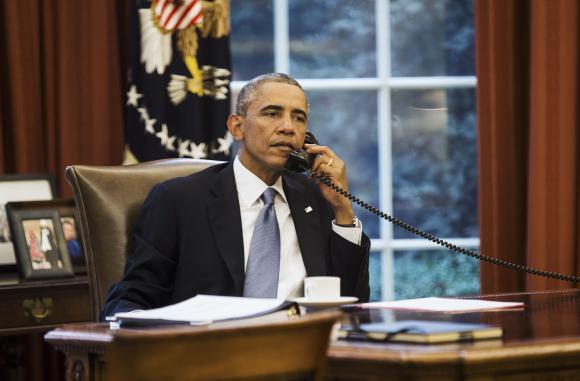
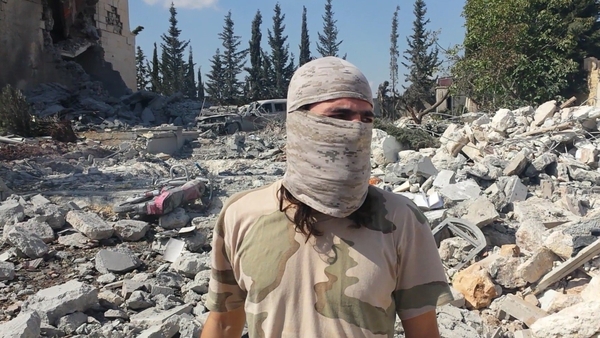

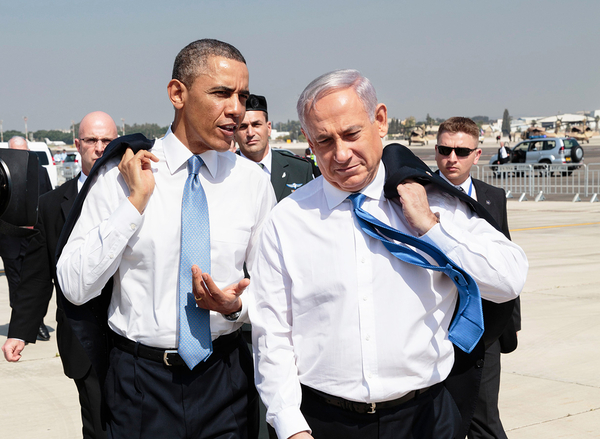





 anneinpt
 artaxes
 danmillerinpanama
 davidking1530
 Peter Hofman
 Joseph Wouk
 Peter
Peter Louisiana Steve
 WarSclerotic
Recent Comments