Archive for the ‘Terrorism’ category

Israelis prepare to vote; Palestinians prepare to fight

March 17, 2015

Israelis prepare to vote; Palestinians prepare to fight, The Gatestone InstituteKhaled Abu Toameh, March 16, 2015

For some Palestinians, the election is not about removing Netanyahu from power. Rather, it is about removing Israel from the face of the earth and replacing it with an Islamist empire.

Kerry’s statement about the revival of the peace process shows that he remains oblivious to the reality in the Middle East, particularly with regards to the Palestinians.

Kerry is ignoring the fact that the Palestinians are today divided into two camps; one that wants to destroy Israel through terrorism and jihad and another that is working hard to delegitimize and isolate Israel with the hope of forcing it to its knees.

As Kerry was talking about the revival of the peace process, Hamas announced that it has completed preparations for the next confrontation with Israel.

Abbas will come to the talks with the same demands he and his predecessor have made over the past two decades, namely a full Israeli withdrawal to the pre-1967 lines. And when Israel does not accept all his demands, he will again walk out and demand international intervention to impose a solution on Israel.

Talk about the resumption of the peace process is nothing but a silly joke.

As Israeli voters head to the ballot boxes to elect their new representatives, Palestinians say they are preparing for another war with Israel.

The preparations came even as US Secretary of State John Kerry and some Israeli candidates, especially Zionist Camp leaders Isaac Herzog and Tzipi Livni, continue to talk about the need to revive the Israeli-Palestinian peace process after the election.

For some Palestinians, the election is not about removing Likud leader Binyamin Netanyahu from power. Rather, it is about removing Israel from the face of the earth and replacing it with an Islamist empire.

The next Israeli government will face a two-pronged attack on the Palestinian front — one from the Gaza Strip, where Hamas and Islamic Jihad say they have just completed preparations for the next conflict with Israel, and another from the West Bank, where the Palestinian Authority (PA) says it is determined to pursue its “diplomatic war” against Israel in the international arena.

On the eve of the election, Kerry expressed hope that Israelis will elect a government that “meets the hope for peace.”

Kerry’s statement about the revival of the peace process shows that he remains oblivious to the reality in the Middle East, particularly with regards to the Palestinians.

Kerry is ignoring the fact that the Palestinians are today divided into two camps; one that wants to destroy Israel through terrorism and jihad, and another that is working hard to delegitimize and isolate Israel in the international community with the hope of forcing it to its knees.

Hamas and Islamic Jihad continue to scoff at Kerry’s talk about the resumption of the peace process. The two groups, which control the 1.7 million Palestinians of the Gaza Strip, actually have other plans for the post-election era. Their main plans center around preparing for the next war with Israel.

983Israel’s Prime Minister Binyamin Netanyahu (left) and Hamas leader Ismail Haniyeh (right, in blue shirt).

As Kerry was talking about the revival of the peace process, Hamas’ armed wing, Izaddin al-Qassam, announced that it has completed preparations for the next confrontation with Israel.

These preparations, according to the group, include the reconstruction of Hamas military bases and training centers that were destroyed during the last war, known as Operation Protective Edge. The group says that it has not only rebuilt the destroyed sites, but has also set up new military posts, especially along the border with Israel.

Of course, when Hamas talks about “military bases,” it is also referring to the underground tunnels that it is hoping to use in the next conflict to infiltrate Israel.

Some of the bases are located only a few hundred meters away from the border with Israel, such as the Yarmouk and Palestine posts. Hamas says that the decision to build the military bases so close to the Israeli border is aimed at sending a message of defiance to Israel.

Islamic Jihad also does not seem to be impressed with the recent talk about the resumption of the peace process between Palestinians and Israelis.

Earlier this month, Islamic Jihad too unveiled its preparations for war, by inviting journalists on a tour of its tunnels inside the Gaza Strip.

“We’re on our highest level of alert to counter any attack. We’re used to the occupation breaking its ceasefires,” senior Islamic Jihad commander Abu al-Bara told Agence France Press. “It’s a war that never ends. We’re ready to go to another level against the Zionist occupation and carry out actions we’ve never done before.”

Meanwhile, the Palestinian Authority is also preparing for a confrontation with Israel, albeit one of a different nature.

The PA says it is determined to pursue its effort to seek worldwide support for imposing a solution on Israel. It is hoping to do so with the help of the United Nations, the European Union, the Obama Administration and some Arab countries.

In order to achieve its goal, the Palestinian Authority is currently waging a massive campaign in the international arena whose goal is to delegitimize, isolate and weaken Israel to a point where it would be forced to succumb and make far-reaching concessions, such as a full withdrawal to the pre-1967 lines.

PA President Mahmoud Abbas will find it almost impossible to return to the negotiating table with Israel now that he has told his people that the Palestinians’ next step is to file “war crime” charges against Israel with the International Criminal Court (ICC). Abbas’s aides have even set a date for the filing of the first anti-Israel case with the ICC: April 1.

Even if Abbas does return to the negotiating table — under heavy pressure from the Americans and Europeans — he would be doing so not in order to achieve an agreement with Israel, but to try to show the world that Israel does not want peace.

Abbas will come to the talks with the same demands he and his predecessor have made over the past two decades, namely a full Israeli withdrawal to the pre-1967 lines. When Israel does not accept all his demands, he will again walk out and demand international intervention to impose a solution on Israel. And while he would be waging his diplomatic campaign, Hamas and Islamic Jihad would resume their terror attacks against Israel from the Gaza Strip.

Under the current circumstances, where some Palestinians continue to seek the destruction of Israel and others are unable to make any concessions for peace, any talk about the resumption of the peace process is nothing but a silly joke.

Book review: The Islamic War

March 16, 2015

The Islamic War: Book review, Dan Miller’s Blog, March 16, 2015

(The views expressed in this article are mine and do not necessarily reflect those of Warsclerotic or its other editors. — DM)

The Islamic War, Martin Archer, 2014

The novel begins with a terror attack on a residential area in Israel, resulting in multiple causalities. It may, or may not, have involved members of the Iranian Revolutionary Guard. Menachem Begin is the Israeli Prime Minister and Ariel Sharon is the Defense Minister. The story begins immediately after the (postponed?) end of the Iran – Iraq war in 1988.

A massive armor, infantry, artillery and air attack on Israeli positions in the Golan follows the terrorist attack. The Israelis are outnumbered and suffer many thousands of casualties.

Israel had anticipated a simultaneous attack via Jordan, so most Israeli tank, infantry and air resources are deployed there, rather than in the Golan, to conceal themselves and await the arrival of Iranian, Iraqi and Syrian forces. They come and are defeated, most killed or fleeing. The Israeli forces then move into Syria and have similar successes there as well.

As the story evolves, it becomes evident that Israel must have known that the Iran – Iraq war had been allowed to fester to permit Iran, Iraq and Syria to develop a well coordinated plan to dispose of Israel, in hopes that a surprise attack could be made as soon as the Iran – Iraq war ended. Other events also suggest that Israel had prior notice:

Nuclear facilities of several hostile nations explode mysteriously.

The Israeli Navy had managed to infiltrate Iranian oil ports — apparently before the attack on the Golan — without being noticed. Then, at a propitious moment near the end of the fighting elsewhere, they destroyed all oil tankers in, entering or leaving port, along with all Iranian oil storage facilities.

The Israel Navy, which had suffered no losses, then moved to Saudi Arabia to protect her oil ports and ships coming to buy her oil and leaving.

As these events unfold, Israel, Egypt, Jordan, Saudi Arabia and Turkey* are negotiating a united front against Iran, Iraq and Syria, much to the displeasure of the U.S. Secretary of State, who wants a cease fire and return to the status quo ante. Fortunately, the U.S. President favors Israel and her coalition and generally ignores his SecState.

I won’t spoil the story by relating what happens at the end, but it’s very good for Israel, Egypt, Jordan, Saudi Arabia, Turkey and the Kurds, and very bad for Iran, Iraq and Syria. The novel is well worth reading, perhaps twice.

_____________

*Historical note: Turkey in 1988 was reasonably secular and also in other ways quite different from now. Egypt under President Al-Sisi is, in some but not all respects, similar to Egypt in 1988 under President Mubarak. Beyond a good relationship with Israel, Al-Sisi is working to modernize and reform Islam by turning it away from the violent jihad which drives both the Islamic State (Sunni) and the Islamic Republic of Iran (Shiite). Egypt remains under fire from the Obama administration due to the “coup” which ousted President Morsi, who had made Egypt essentially an arm of the Muslim Brotherhood. Egypt now helps to protect Israel with her military presence in the Sinai to oppose Hamas and Muslim Brotherhood activities there. Saudi Arabia and Jordan, like most countries in the Middle East, look out for the interests of their rulers first and are quite concerned about both the Islamic State and Iran.

UPDATE: US intel report scrapped Iran from list of terror threats

March 16, 2015

US intel report scrapped Iran from list of terror threats, Times of Israel, March 16, 2015

(This is to clarify and expand upon an earlier article on the same subject, also posted today. — DM)

An annual report delivered recently to the US Senate by James Clapper, the director of National Intelligence, removed Iran and Hezbollah from its list of terrorism threats, after years in which they featured in similar reports.

The unclassified version of the Worldwide Threat Assessment of the US Intelligence Communities, dated February 26, 2015 (PDF), noted Iran’s efforts to combat Sunni extremists, including those of the ultra-radical Islamic State group, who were perceived to constitute the preeminent terrorist threat to American interests worldwide.

In describing Iran’s regional role, the report noted the Islamic Republic’s “intentions to dampen sectarianism, build responsive partners, and deescalate tensions with Saudi Arabia,” but cautioned that “Iranian leaders—particularly within the security services—are pursuing policies with negative secondary consequences for regional stability and potentially for Iran.

“Iran’s actions to protect and empower Shia communities are fueling growing fears and sectarian responses,” it said.

The United States and other Western nations, along with a coalition of regional allies, both Sunni and Shiite, has been launching attacks against Islamic State targets in Iraq and Syria in recent months. The Sunni group, also known by its acronyms IS, ISIS and ISIL, is an offshoot of al-Qaeda that has carved out a self-proclaimed caliphate across large swaths of Syria and Iraq, both of whose governments are allied with Iran’s.

The Shiite Lebanese group Hezbollah, which is funded and mentored by Tehran, has been fighting the Islamic State, independently of the American-led campaign, both in Syria and Iraq.

Meanwhile, the US has been engaged in marathon talks with Iran in an effort to reach an agreement on its nuclear program. Tehran, according to the National Intelligence threat assessment, has “overarching strategic goals of enhancing its security, prestige, and regional influence [that] have led it to pursue capabilities to meet its civilian goals and give it the ability to build missile-deliverable nuclear weapons, if it chooses to do so.”

The report said that it was unclear whether or not Iran would eventually decide to build nuclear weapons, but noted that should the Iranian government decide to pursue such a course, it would face no “insurmountable technical barriers to producing a nuclear weapon.” It lingered on Iran’s pursuit of intercontinental ballistic missile technology as a likely delivery system for a nuclear weapon, and delineated Iranian threats in the realms of counterintelligence and cyber warfare.

According to one Israeli think tank, the removal of Iran and its proxy Hezbollah from the list of terror threats, where they featured in previous years, was directly linked to the campaign against the Islamic State.

063_464519556-e1425017740218-305x172Director of National Intelligence James Clapper in Washington, DC, February 26, 2015 (photo credit: Evy Mages/Getty Images/AFP)
 

“We believe that this results from a combination of diplomatic interests (the United States’ talks with Iran about a nuclear deal) with the idea that Iran could assist in the battle against the Islamic State in Syria and Iraq and maybe even in the battle against jihadist terrorism in other countries,” the Meir Amit Intelligence and Terrorism Information Center said in an analysis of the report (Hebrew PDF). It also noted the Iran and Hezbollah were both listed as terrorism threats in the assessment of another American body, the Defense Intelligence Agency.

“Islamic Revolutionary Guard Corps-Qods Force (IRGC-QF) and Lebanese Hezbollah are instruments of Iran’s foreign policy and its ability to project power in Iraq, Syria, and beyond,” that assessment, also submitted to the Senate of February 26, said in its section on terrorism. “Hezbollah continues to support the Syrian regime, pro-regime militants and Iraqi Shia militants in Syria. Hezbollah trainers and advisors in Iraq assist Iranian and Iraqi Shia militias fighting Sunni extremists there. Select Iraqi Shia militant groups also warned of their willingness to fight US forces returning to Iraq.”

Israel, as well as Sunni allies of the US, has often warned that Iran, through Hezbollah and other proxies, has been sowing instability in the region. An escalating dispute between Jerusalem and Washington over the terms of an eventual agreement on Iran’s nuclear program has seen Israeli official rail against the relatively conciliatory tone adopted by US officials toward Iran, in light of the shared interest in combating the Islamic State.

In a polarizing speech before a joint session of Congress on March 3, Prime Minister Benjamin Netanyahu sought to persuade American lawmakers of the folly of signing an agreement with Iran, and, comparing its leaders to those of the Nazi regime of World War II, cautioned that it “poses a grave threat, not only to Israel, but also [to] the peace of the entire world.”

Iran has made bellicose statements toward Israel, threatening to destroy the Jewish state, often citing Israeli talk of attacking its nuclear facilities, which it maintains are for peaceful purposes.

Hezbollah, which is based to Israel’s north in Lebanon and the Syrian Golan Heights, has largely refrained from attacking Israeli targets since the bloody Second Lebanon War of 2006, although there have been skirmishes along the border.

In one recent confrontation, Israel struck first, purportedly destroying a Hezbollah unit near the front line of the Golan Heights. Among the seven dead on January 18 were an Iranian general, a top Hezbollah commander and the son of another former commander in chief. Some two weeks later, Hezbollah took revenge, killing two Israeli soldiers and wounding seven in a cross-border attack.


US intel. scraps Iran, Hezbollah from terrorist threats list

March 16, 2015

US intel. scraps Iran, Hezbollah from terrorist threats list, Iran Daily, March 16, 2015

(True or false? I have seen nothing to confirm the report in the “legitimate media,” but that’s not surprising. Here, thanks LS, is a link to the cited report. Iran appears to remain on the list (at page 14). Hezbollah appears, but as a victim of Sunni “extremists” in Lebanon.– DM)

image_650_365

The US National Intelligence has removed Iran and the Lebanese resistance movement, Hezbollah, from its list of “terrorist threats.”

US Director of National Intelligence James Clapper scrapped Iran and Hezbollah from the list in an annual report recently delivered to the US Senate, citing their efforts in fighting terrorists, including the ISIL Takfiri group, Press TV reported.

The unclassified version of the report titled “Worldwide Threat Assessment of the US Intelligence Communities,” which was released on February 26, 2015, noted Iran’s efforts to battle extremists, including those of the ISIL terrorist group, who were perceived to constitute the greatest terrorist threat to American interests worldwide.

Highlighting Iran’s regional role, the report pointed to the Islamic Republic’s “intentions to dampen sectarianism, build responsive partners, and deescalate tensions with Saudi Arabia.”

Iran has “overarching strategic goals of enhancing its security, prestige, and regional influence [that] have led it to pursue capabilities to meet its civilian goals,” the report said.

The report also said that Hezbollah is countering ISIL Takfiri terrorists in Syria and Iraq.

The ISIL Takfiri terrorists have taken control of swathes of territory in Iraq and Syria since last year.

Iran has repeatedly stressed that it will not interfere militarily in Iraq and Syria, but the Islamic Republic continues to provide support to both countries against ISIL in the form of defense consultation and humanitarian aid.

Activist Ayaan Hirsi Ali Denounces Anti-Semitism on Campuses as New Film Debuts

March 15, 2015

Activist Ayaan Hirsi Ali Denounces Anti-Semitism on Campuses as New Film Debuts, Breitbart, Dr. Susan Berry, via Counter Jihad Report, March 14, 2015

(Please see also, Column One: Israel’s next 22 months. To what extent do Obama’s relations with Israel reflect the anti-Israel views noted in the two video clips? To what extent will the anti-Israel views noted in the video clips become increasingly pervasive as our college kids get older and come to hold positions of power?– DM)

ayaan-hirsi-ali-ap

Somali-born free speech and women’s rights activist Ayaan Hirsi Ali gave the keynote address at a sold-out event in Boston Wednesday that centered on rising anti-Semitism on college campuses in North America.


Hirsi Ali’s address, and a panel featuring a rabbi and three student activists, followed the premiere of a new Jerusalem U film titled Crossing the Line 2: The New Face of Anti-Semitism on Campus, which can be viewed in its entirety online. The film demonstrates how anti-Israel activities on college and university campuses are being organized to alienate and intimidate those who support Israel, and how reasonable criticism of Israel “crosses the line” into anti-Semitism.

As a press release about the Boston event notes, Hirsi Ali said the film demonstrates how students are being “misled.” Denouncing “virulent anti-Semitism” on college campuses, she asserted, “The least we can do is boycott, divest, and sanction campuses that compromise academic freedom.”

Excerpts of Hirsi Ali’s address are as follows:

It is appalling that only seventy years from the Holocaust, crowds in Europe chant, “Hamas, Hamas, Jews to the gas.” It is even more appalling that 10,000 soldiers in Paris are needed to protect Jewish sites. That is the continent that promised never again. The men and women who were in the concentration camps, who are tattooed, some are still here. And it is happening again.

Watching Crossing the Line 2: the New Face of Anti-Semitism on Campus was like having a bucket of ice water being poured over my head. I saw the film last week. And I watched it again last night. And I couldn’t sleep. The more we pretend that this is happening somewhere far away, the more hopeless and helpless we feel. But this is not happening far away. This is happening on American campuses, British campuses, Canadian campuses. The filmmakers who made this film made it because it is important that we listen to this message while it is at a smaller stage.

I have a different acronym for BDS. They call themselves Boycott, Divestment, and Sanctions. I call them Bully, Deceive, and Sabotage. Bully, Deceive, and Sabotage the only society that is free in the Middle East. BDS. On campus, if you care about issues like justice and injustice, we really need to show it. You need to do it. Where is the BDS movement against the Islamic State? Where on campuses is the BDS movement against Saudi Arabia? The Iranian regime, who for decades have promised to wipe Israel off the map, who are developing a bomb. And there’s no BDS movement against them on campus. Why? Last year in Nigeria, 200 girls were kidnapped. They were sold into slavery. There was no BDS movement against Boko Haram.

“Anti-Israel activities on campus cause students today to feel embarrassed to be pro-Israel, or could even lead them to hold negative opinions about Israel” said Amy Holtz, president of Jerusalem U, in a statement in the press release. “Raising awareness of this growing problem is crucial. We made this film in order to give students the knowledge to differentiate between education and intimidation, debate and hate. They must be able to identify when it is ‘Crossing the Line.’”

Do Israelis Really Think the U.S. Will Come to Their Aid? (They Will Be in for a Shock)

March 15, 2015

Do Israelis Really Think the U.S. Will Come to Their Aid? (They Will Be in for a Shock), The Gatestone InstituteBassam Tawil, March 15, 2015

Many Israelis seem to think that if Iran does acquire nuclear weapons, if Israel could just offer up a more friendly face, the current U.S. Administration would, in a crisis, come to their help. They could not be more wrong.

Many Israelis seem to be counting on some deeply wished-for love from the current U.S. Administration. What they may not want to see is that their unrequited love for the U.S. runs far deeper than any disagreement with Israel’s current prime minister. Just ask Syria, ask Iraq, ask Yemen, ask Libya, ask Saudi Arabia, ask Kuwait, ask Egypt. The current U.S. Administration does not even send weapons; it sends meals-ready-to-eat. Israel and the rest of us in the region — as Iran has already encircled all the oil fields and is now taking over Iraq — have no more to look forward to than that.

Hard as it may be for Israelis to believe it, Israel’s survival most likely does not figure into the current U.S. Administration’s calculations at all. No matter who wins the election this week, the U.S. will grant Iran its nuclear weapons. If they end up turned on Israel, no matter who is prime minister, so be it.

No matter who wins the election this week in Israel, if and when Iran has a nuclear bomb, there is not a thing the current U.S. Administration will do to help Israel. To the current U.S. leadership, Israel is just the next Sudetenland. The Israelis will have only themselves to rely on.

There is about to be a mistake. The only country in the region of which all the other countries are envious — for opportunity, equal justice under law, freedom to speak without the 2 a.m. knock on the door — has an election this week. Its citizens are tired of war — right on schedule for its enemies’ plans to destroy it. The Israelis are meant to be tired of war; that is why it is called “a war of attrition.”

Many Israelis seem to be counting on some deeply wished-for love from the current U.S. Administration. What they may not want to see is that their unrequited love for the U.S. runs far deeper than any disagreement with Israel’s current prime minister. Just ask Syria, ask Iraq, ask Yemen, ask Libya, ask Saudi Arabia, ask the Emirates, ask Kuwait, ask Egypt. The current U.S. Administration does not even send weapons to help; it sends meals-ready-to-eat, perhaps with the occasional unserious bombing, and tells others to do any serious work themselves. Israel and the rest of us in the region — as Iran has already encircled all the oil fields and is now taking over Iraq — have no more to look forward to than that.

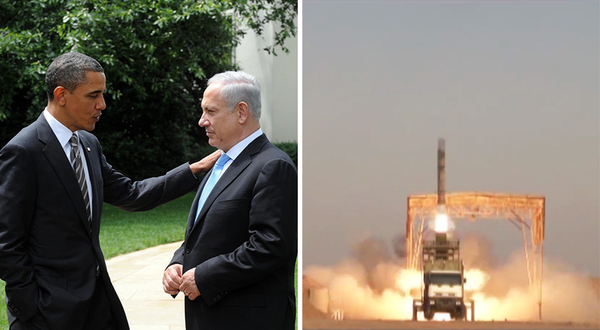
982Bassam Tawil writes that if and when Iran has a nuclear bomb, there is not a thing the current U.S. Administration will do to help Israel. (Image sources: Israel PM office, PressTV video screenshot)

The Israelis may be conning themselves into thinking that if they could just stay friendly with America, America will not “let Israel down” — whatever that is supposed to mean. Perhaps they think that the U.S. will not let Iran acquire a nuclear weapons capability — as the U.S. has been promising for twenty years. But the U.S. has already made clear that it will fast-track, or slow-track, Iran to nuclear weapons capability.

Or maybe it means that many Israelis think that if Iran does acquire nuclear weapons, if Israel could just offer up a more friendly face, the U.S. would, in a crisis, come to Israel’s help.

They could not be more wrong.

Sadly, the current administration in Washington has reportedly already sabotaged several efforts by Israel to address its Iran problem. The current U.S. Administration seems to care about only one thing: making just about any deal with Iran. It does not even care about America, or it would never have enabled Iran to get as far along as it is now.

From some apparent self-infatuated fantasy of “landing a big one” — luring the world’s most medieval, genocidal, terror-promoting state to be a responsible member of the “family of nations” — the current U.S. Administration will help exactly no one.

Hard as it may be for Israelis to believe, Israel’s survival most likely does not figure into the current U.S. Administration’s calculations at all. Israel was excluded from the P5+1 negotiations — they might actually have insisted on not handing Iran a nuclear weapons capability, and ruined the current U.S. Administration’s dream of turning the deadliest enemy of the “Big Satan” into its new-found friend — like the wish of turning a prostitute into a doting wife.

The Israelis, of course, will vote for whomever they wish, but if they are voting with the thought that a new Prime Minister will save their country from being turned onto roadkill by the current U.S. Administration — the world’s next Sudetenland — and that their current prime minister has been the problem, they have a nasty surprise coming. Everyone else has been lied to, misled, double-crossed, and tossed over the cliff – especially the American people themselves. The problem is not in whoever is Israel’s Prime Minister. The problem is three thousand miles away, in a leadership that cares only about following in the footsteps of Neville Chamberlain returning from Munich: waving around a dangerous, illusory, non-existent “peace in our time.” To the current U.S. leadership, Israel is just the next Sudetenland.

For its own fantasy of turning a voracious, extremist Islamic regime into the “stripper who becomes the girl next door,” the current U.S. Administration will grant Iran its nuclear weapons. If they end up turned on Israel, so be it. No matter who wins the election this week in Israel, if and when Iran has a nuclear bomb, there is not a thing the current U.S. Administration will do to help Israel. The Israelis will have only themselves to rely on.

Hamas’ revamped naval commandos could pose a problem for Israel

March 14, 2015

Hamas’ revamped naval commandos could pose a problem for Israel, Ynet News, Alex Fishman, March 14, 2015

Although all unit members were killed during last summer’s infiltration attempt at Zikkim, Hamas viewed this as a massive achievement and subsequently trained a new force whose role will be to carry out mass attacks on the Israeli home front.

Palestinian Islamist organization Hamas has completed the reconstruction of its naval commando force, consisting of dozens of trained divers, in order to hit strategic sites, Israeli and others’, in the Mediterranean Sea.

With the development of its underwater unit, Hamas aims to compensate for the failure of the offensive tunnels from the Gaza Strip, which it rules, which were supposed to reach into Israel. From just a handful, the force has grown into many dozens of fighters trained to strike the Israeli home front via abductions and killings.

Hamas’s operational approach sees the naval commandos as one long “tunnel”, extending from Gaza in Israel’s south to Rosh Hanikra in the north, through which it could hit any target along the entire Israeli coast. These could be strategic objectives such as power plants, coal terminals, gas rigs and so on. However, using Operation Protective Edge as a model, it seems that Hamas is training its commandos to create a continuous shockwave for Israeli society through the mass murder of civilians and soldiers.

Hamas diversHamas’ infiltration attempt at Zikim during Protective Edge (Photo: IDF)

The Israeli defense establishment sees the strengthening of Hamas’ underwater activity – through the establishment of a large and professional commando unit – as one of the main lessons Hamas took from last summer’s conflict.

The Hamas commandos’ successful penetration a kilometer deep within Israeli territory, near Kibbutz Zikkim, is one of the organization’s major achievements during the 50 days of fighting, as this was the only time when Hamas special unit members managed to infiltrate Israel. If not for Israeli intelligence, it is likely the commando unit would have been able to penetrate the community or a nearby IDF base and carry out the mass murder it wanted.

Earlier this week, Egyptian newspaper “Al-Akhbar” reported that the creation of the naval commando unit was intended to harm Egypt’s facilities in the Mediterranean. The Egyptians, who have signed a gas deal with Israel, are worried about damage to the Tethys Sea group’s installation, while accusing Hamas of conducting sea-based attacks on Egyptian naval forces.

In November 2014, an Egyptian patrol boat was attacked as it conducted an operation against smuggling from the Gaza Strip. The attack was carried out by three rubber boats in the Egyptian Delta, near the port of Damietta. The perpetrators seized control of the ship, killed 13 Egyptian soldiers and hoisted the Islamic State flag.

The Egyptians blamed Hamas for supporting and being party to attacks of this kind, and significantly changed the security measures on their ships. Even the commands to open fire have changed, and the Egyptians shoot to destroy Gazan fishing boats that approach them without prior coordination.

In light of the accusations, Hamas leader Mahmoud Zahar was quick to issue a denial in the Al-Quds newspaper, saying that Hamas was not planning to wave underwater warfare in the area.

It was until Operation Pillar of Defense in November 2012 that the Hamas naval force was viewed as amateurish. But since that operation, Hamas was been working on setting up a large professional unit – its people were sent abroad for training, most likely to Iran, and it procured military-grade diving equipment.

During last summer’s infiltration at Zikkim, Israel registered the use of military standard systems, which prevent bubbles from surfacing during a dive. Hamas also has a small underwater craft, known as a “scooter”, for individual divers, and has even published pictures of them for propaganda purposes. It appears that following the collapse of diving tourism in Sinai, the club owners were happy to sell some advanced diving equipment.

The training of the reinvigorated commando unit is largely reminiscent of the training for elite units in conventional armies, including the ability to withstand physical and mental pressure that is customary within professional naval commando units in the region.

The defense establishment and the IDF are preparing for an increased threat from this underwater force. It should be noted that during Protective Edge, this unit only sustained partial damage, and in any future conflict its infiltration efforts will be a force to be reckoned with for Israel.

Iran Declares Pre-emptive Victory in Nuke Talks

March 11, 2015

Iran Declares Pre-emptive Victory in Nuke Talks, Washington Free Beacon, March 11, 2015

(Unfortunately, he appears to be correct. Iran seems to have improved her arsenal substantially since November of 2013 and the sanctions relief, used to get Iran to “negotiate,” doubtless helped it to do so. Please see also Iran is an empire, Iraq is our capital.

What will Obama do if Iran declines even his “extremely reasonable” deal because Iran doesn’t want one? Blame it on the recent letter sent by Republican members of the Congress? — DM)

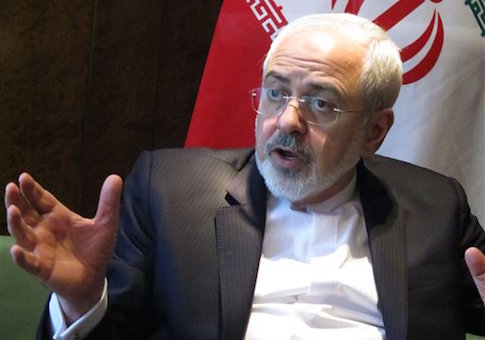
Iran minister says sanctions must be lifted before nuclear agreementIranian Foreign Minister Mohammad Javad Zarif / AP

Iran’s foreign minister and chief negotiator in nuclear talks with the West declared victory for his country, stating that no matter how the negotiations end, Tehran has come out “the winner,” according to remarks made on Tuesday and presented in the country’s state-run press.

Javad Zarif, the Islamic Republic’s foreign minister, stated in remarks before the country’s powerful Assembly of Experts, which recently installed a hardline new cleric as its leader, that the nuclear negotiations have established Tehran as a global power broker.

“We are the winner whether the [nuclear] negotiations yield results or not,” Zarif was quoted as saying before the assembly by the Tasnim News Agency. “The capital we have obtained over the years is dignity and self-esteem, a capital that could not be retaken.”

Zarif’s comments were accompanied by a host of bold military displays by Tehran in recent weeks, including the announcement of one new weapon that Iranian military leaders have described as a “very special” missile.

As the United States and Iran rush to hash out a final nuclear agreement ahead of a self-imposed July deadline, Zarif also lashed out at congressional Republicans who have expressed skepticism over the Obama administration’s diplomacy and have fought to exert control over the implementation of any deal.

Zarif dismissed as a “propaganda ploy” a recent letter signed by 47 Senate Republicans that warned Tehran against placing too much stock in a weak deal agreed to by the Obama administration.

Meanwhile, Iran’s military continues to unveil a range of new strategic missiles and advanced weapons meant to project strength throughout the region.

Iran disclosed during military drills late in February that it is developing a missile capable of being fired from a submerged submarine. Top Iranian military leaders have described the missile as a “very special weapon,” according to IHS Jane’s, a defense industry news source.

“I believe that this weapon is a strategic weapon,”Admiral Ali Fadavi, the naval commander of the Iranian Revolutionary Guard Corps (IRGC), said on state television, according to Jane’s. “It has special characteristics.”

Fadavi declined to provide additional details about the missile. “I would like to keep this information for the future. It is a very special weapon and the Americans cannot even surmise how strong and effective this weapon is.”

On Tuesday morning, the commander of Iran’s navy previewed the unveiling of “advanced surface and subsurface vessels” that will soon be incorporated into the country’s fleet, according to the state-run Fars News Agency.

Iran has put great stock in its navy, investing significant resources to bolster the force and make it a principal player in key global shipping lanes, including around the Strait of Hormuz, the Gulf of Oman, and the Caspian Sea.

Sea-based weapons were a major focus of recent high-level meetings between Iranian and Russian officials, who agreed to a new arms pact.

Earlier this week, Iran initiated into its fleet a new destroyer ship that is “armed with advanced anti-surface and anti-subsurface weapons and air defense systems,” according to military leaders quoted by Fars.

The ship was immediately deployed to the Caspian Sea, an area Iran views as critical to its interests.

Admiral Kordad Hakimi, a top Iranian navy official, told the country’s press that Iran is prepared to use force in the region.

“We have no security problem in the Caspian Sea today, [but] … the Navy is fully prepared to confront any threat,” he was quoted as saying.

Iranian officials have also bragged about being in full control of five out of nine major international waterways.

Abdel Fattah el-Sisi Fox News. Egypt’s president discusses America’s role in fighting terror

March 10, 2015

Abdel Fattah el-Sisi Fox News. Egypt’s president discusses America’s role in fighting terror, March 9, 2015


Ron Dermer and Dore Gold on Fox

March 8, 2015

Ron Dermer and Dore Gold on Fox, via You Tube, March 8, 2015

(Giving Iran years to pursue its ambition of obliterating the U.S. and Israel, with few or no remaining sanctions as Iran continues its efforts to control the Middle East, and no significant progress in allowing the IAEA to pursue its investigations of Iran’s past and future progress in nuclear weaponry strikes me as worse than merely absurd.– DM)