Archive for the ‘Syrian rebels’ category

Obama hands Syria over to Putin

September 10, 2016

Obama hands Syria over to Putin, DEBKAfile, September 10, 2016
putin_obama_g-20_china-1

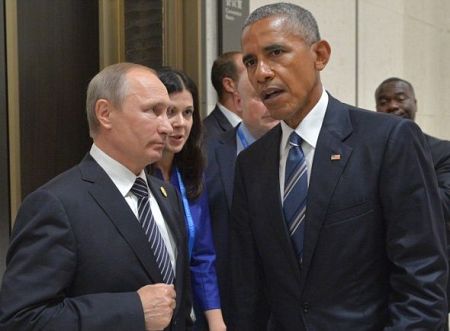
The Syrian cease-fire agreement that US Secretary of State John Kerry and Russian Foreign Minister Sergey Lavrov announced Friday night, September 9, in Geneva hands Syrian affairs over to Russia’s President Vladimir Putin and the country’s military.

The accord marked a sharp reversal for Washington. In his meeting with Putin in China last week, US President Barack Obama did not agree to those steps for the simple reason that such an agreement would be in line with the policy and stance of Republican presidential nominee Donald Trump, not those of the Democratic nominee Hillary Clinton.

Trump suggested several months ago that the US should let Putin finish the war in Syria, asserting that the Russian leader would be able to do it better.

Under the current situation it is no wonder that Kerry and Lavrov agreed not to release the details of the agreement.

Publication of the details would reveal that the rebels in the Aleppo area, and perhaps in all of Syria, have been abandoned.

The Syrian rebels now find themselves trapped by both the Russian-Turkish agreement and the Russian-US agreement, with a noose seemingly closing around them.

Meanwhile, on Friday, DEBKAfile released the following report:

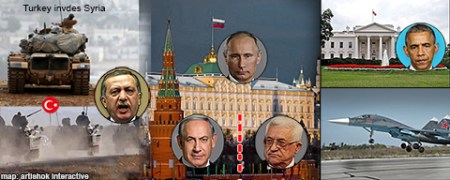
The fledgling “initiatives” reverberating this week in Washington, Moscow, Ankara, Jerusalem and the G20 summit were nothing but distractions from the quiet deals struck by two lead players, Russia and Turkey to seize control of the region’s affairs. Recep Tayyip Erdogan knew nothing would come of his offer on the G20 sidelines to US President Barack Obama to team up for a joint operation to evict ISIS from Raqqa. And, although Moscow was keen on hosting the first handshake in almost a decade between Israeli Prime Minister Binyamin Netanyahu and the Palestinian leader Mahmoud Abbas (Abu Mazen), neither were known to be ready for the last step toward a meeting.

But the game-changing events to watch out for took place in Hangzhou without fanfare – namely, the Obama-Putin talks and the far more fruitful encounter between Putin and Erdogan.

According to DEBKAfile’s intelligence and Mid East sources, Putin virtually shut the door on further cooperation with the United States in Syria. He highhandedly informed Obama that he now holds all the high cards for controlling the Syrian conflict, whereas Washington was just about out of the game.

Putin picked up the last cards, our sources disclose, in a secret deal with Erdogan for Russian-Turkish collaboration in charting the next steps in the Middle East.

The G20 therefore, instead of promoting new US-Russian understanding, gave the impetus to a new Russian-Turkish partnership.

Erdogan raked in instant winnings: Before he left China, he had pocketed Putin’s nod to grab a nice, 4,000-sq.km slice of northern Syria, as a “security zone” under the control of the Turkish army and air force, with Russian non-interference guaranteed.

This Turkish zone would include the Syrian towns of Jarablus, Manjib, Azaz and Al-Bab.

Ankara would reciprocate by withdrawing its support from the pro-US and pro-Saudi rebel groups fighting the Assad army and its allies in the area north of Aleppo.

Turkey’s concession gave Putin a selling-point to buy the Syrian ruler assent to Erdogan’s project. Ankara’s selling-point to the West was that the planned security zone would provide a safe haven for Syrian refugees and draw off some of the outflow perturbing Europe.
kremlinwhitehouse480-1

It now turns out that, just as the Americans sold the Syrian Kurds down the river to Turkey (when Vice President Joe Biden last month ordered them to withdraw from their lands to the eastern bank of the Euphrates River or lose US support), so too are the Turks now dropping the Syrian rebels they supported in the mud by re-branding them as “terrorists.”

The head of this NATO nation has moreover gone behind America’s back for a deal with the Russian ruler on how to proceed with the next steps of the Syrian conflict.

Therefore, when US Secretary of State John Kerry met Russian Foreign Minister Sergei Lavrov in Geneva Thursday and Friday, Sept. 8-9, for their sixth and seventh abortive sit-downs on the Syrian issue, there was not much left for them to discuss, aside from continuing to coordinate their air traffic over Syria and the eastern Mediterranean.

Washington and Moscow are alike fearful of an accidental collision in the sky in the current inflammable state of relations between the two powers.

As a gesture of warning, a Russian SU-25 fighter jet Tuesday, Sept 6, intercepted a US Navy P8 plane flying on an international route over the Black Sea. When the Russian jet came as close as 12 feet, the US pilots sent out emergency signals – in vain, because the Russian plane’s transponder was switched off. The American plane ended up changing course.

Amid these anomalies, Moscow pressed ahead with preparations to set up a meeting between the Israeli and Palestinian leaders, as the Russian Foreign Ministry announced Thursday.

Putin is keen to succeed where the Obama administration failed. John Kerry abandoned his last effort at peacemaking as a flop two years ago.  But it is hard to see Netanyahu or Abu Mazen rushing to play along with the Russian leader’s plan to demean the US president in the last months of his tenure – especially when no one can tell who will win the November 8 presidential election – Hillary Clinton or Donald Trump – or what policies either will pursue.

All the region’s actors will no doubt be watching closely to see how Turkey’s “Russian track” plays out and how long the inveterate opportunists can hang together.
Putin-Erdogan deal deadlocks Aleppo, Manjib frays

August 13, 2016

Putin-Erdogan deal deadlocks Aleppo, Manjib frays. DEBKAfile, August 13, 2016

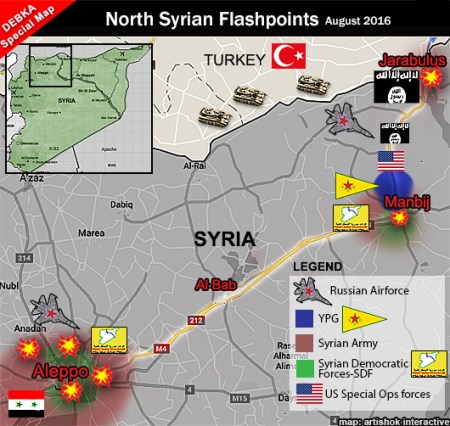
n syria flashpoints

This hopeless standoff is the result of Moscow’s refusal to provide the Syrian army and its allies with enough air support to pull ahead, in the wake of President Vladimir Putin talks with Turkish President Reccep Tayyip Erdogan in St. Petersburg Tuesday, Aug. 9.

*********************

All day Friday and Saturday, Aug.11-12, fighters of Hizballah’s elite Radwan Force – 3,000 in all – streamed to the pivotal Aleppo battlefield from all parts of Lebanon and Syria. DEBKAfile’s military and intelligence sources disclose that they were following the orders of their leader Hassan Nasrallah, who was warned by Tehran that the pro-Assad army fighting for Syria’s second city was flagging in the face of rebel assaults.

The Radwan Force was called in as the only military capable of saving the day for Assad and his allies. This step had been carefully avoided by Nasrallah was required in view of the heavy losses his organization had already suffered for backing the Syrian army – some 1,500 dead in three years – and intense fallout at home.

He has now been forced to sacrifice his last remaining military asset to fight in one of the bloodiest battles ever fought in recent times in the Middle East, even though it promises a swelling procession of Hizballah coffins returning to Lebanon.

According to our military sources, the battle to wrest Aleppo from rebel control, now in its second month, has claimed some 2,000 war dead and 4,000 injured on both sides – not counting the masses of civilians.

Some units have lost more than a quarter of their combatants and dropped out.

Nasrallah knows exactly what is happening in this critical arena. He also understands that a unit which loses 30 percent of its combatants is deemed in military terms unfit to continue fighting and that the battle for Aleppo will be drawn out and bloody. Yet he is willing to commit his entire deck of military resources to keep Bashar Assad’s fighting in Aleppo.

There is no hope of an early resolution in Aleppo, because stalemate between the combatants is exceptionally complicated and thankless. Whenever one side captures terrain, it quickly discovers it was drawn into a trap and under siege.

This hopeless standoff is the result of Moscow’s refusal to provide the Syrian army and its allies with enough air support to pull ahead, in the wake of President Vladimir Putin talks with Turkish President Reccep Tayyip Erdogan in St. Petersburg Tuesday, Aug. 9.

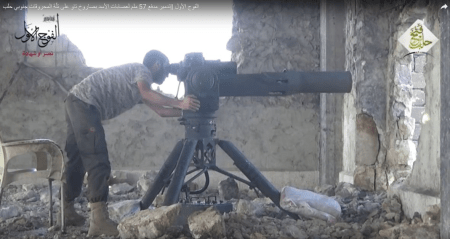
Aleppo_Rebels_ATGM-firings

Erdogan explained that if Assad’s army, along with Hizballah and Iran, defeated the Turkish-backed rebel forces holding Aleppo, he would suffer a serious knock to his prestige and setback for Syrian policy. This was more than he could sustain in the troubled atmosphere in Turkey in the wake of the failed coup against him.

He therefore asked the Russian president to abandon his Bashar Assad, Iran and Hizballah to their fate in Aleppo.

Erdogan was backed up in his request to Putin by a large Turkish military and intelligence delegation which arrived in St. Petersburg the next day to work with their Russian counterparts on setting up a joint military control center in Turkey.

DEBKAfile’s sources disclose the first two tasks assigned the new war room:

1. Russian aerial bombardments over Aleppo would not go beyond keeping the rebels from defeating Syrian and allied forces in Aleppo, but would refrain from supporting offensive action by the latter for routing the former.

2. Turkish air and ground forces would remain in a state of preparedness to ensure that rebel Syrian Democratic Forces (SDF) and the Kurdish YPG militia never moved out of the town of Manjib, from most parts of which they ousted ISIS, to the town of Jarabulus on the Turkish border.I

ISIS had used Manjib as its primary way station for supplies from Turkey 30km to the north. (See attached map). But to drive the jihadists completely out of the Syrian-Turkish border region, the combined rebel forcesmust advance on Jarabulus and expel ISIS from there too.

However, Turkish officers in the joint command center with Russia made it clear that any Kurdish forces allowed to reach that border would come under Turkish army attack.

The Russian president complied with Erdogan’s wishes on the Manjib-Jarabulus front as well as Alepp

Aleppo battle seesaws: pro-Assad siege in place

August 8, 2016

Aleppo battle seesaws: pro-Assad siege in place, DEBKAfile, August 8, 2016

(Please see also, Jihadists and other rebels claim to have broken through siege of Aleppo. — DM)

Aleppo_A_6.8._2016

The battle for Aleppo was locked in a draw Monday, Aug. 8 – contrary to the claims of Syrian rebel forces to have broken through the weeks-long government siege on the city and seized key positions from Assad’s army and its allies, Hizballah and pro-Iranian Shiite militias.

DEBKAfile’s military sources report that the rebels had not yet secured control of the roads linking western and eastern Aleppo. Neither was there any sign of the heavy Russian air strikes claimed by the rebels Sunday afternoon to have been launched in an effort to halt their advance.

According to our sources, intensive air strikes are indeed being conducted in the Aleppo theater – but only by the Syrian air force. There is no Russian presence in the skies over city. Their air force is active in the last few days in only one arena, Idlib in northern Syria. Its absence accounts for the Syrian rebel militias’ partial gains in the battle for Aleppo, and the Pro-Assad forces’ difficulties in holding them back.

Had the Russians provided solid air support for the Syrian army and its allies, our military analysts assert that the rebels would have been pushed back.

It is being withheld, according to our intelligence sources, because Moscow wishes to keep the door ajar for dialogue to continue with the Obama administration. The Russians are interested in particular in setting up with the Americans a joint military and intelligence coordination mechanism in Syria for fighting Islamist forces.

the division of tasks is conceived in Moscow, the Americans would provide intelligence for the Russian air force to undertake the bombardment of targets to be marked by US intelligence.

An agreement in principle on this deal would necessitate direct communication lines to operate between their two active war rooms for Syria: the US-Jordanian and Russian-Jordanian joint command centers operating in Amman.

Kremlin fears that Russian aerial intervention in the Aleppo fighting would put paid to the talks with Washington on this broad collaboration.

So long as those talks are underway,, neither the Russians nor the Americans are likely to step in to determine the military situation in the battle for Aleppo – which was once Syria’s commercial center. The fighting will  continue to seesaw inconclusively between the warning sides.

Jihadists and other rebels claim to have broken through siege of Aleppo

August 8, 2016

Jihadists and other rebels claim to have broken through siege of Aleppo, Long War Journal, August 7, 2016

Shortly after Al Nusrah Front announced on July 28 that it was relaunching its operations under the name Jabhat Fath Al Sham (“Conquest of the Levant Front”), jihadists, Islamists and other Sunni rebel groups began an offensive to break the siege of Aleppo.

Bashar al Assad’s forces and their Iranian allies, backed by Russia, had been squeezing the rebel held part of the city since earlier this year. The Syrian regime and its partners cut off a key supply road in the north during fighting in June and July, thereby encircling their opponents.

The insurgents orchestrated an offensive to break the blockade focusing on areas in the southern part of Aleppo, including the Ramousa district, which houses key military installations. The insurgents’ offensive is one of their largest undertakings since the beginning of the Syrian war, drawing together the resources of more than 20 factions and organizations. It obviously required extensive planning to coordinate the actions of so many groups.

On Aug. 6, just over one week after the battle began, the opposition to Assad claimed to have broken through the defensive positions manned by the Syrian regime and allied paramilitary forces. According to the Syrian Observatory for Human Rights (SOHR), however, the fighting continues and Russia is bombing the area in an attempt to prevent the insurgents from consolidating their gains.

The effort to break the siege has been led by two coalitions: Jaysh al Fath (“Army of Conquest”) and Fatah Halab (“Aleppo Conquest”). Many of the constituent groups in each alliance streamed videos and released photos from the fighting on their social media pages.

Jaysh al Fath (“Army of Conquest”) and allied jihadist groups

Jaysh-al-Fath-Logo-300x300

Jaysh al Fath was formed by Al Nusrah, Ahrar al Sham, and other organizations in early 2015. The coalition quickly swept through the city of Idlib and the surrounding areas in a matter of weeks. Jaysh al Fath has led multiple other battlesthroughout Syria, with Al Nusrah (now Jabhat Fath Al Sham, or “JFS”) and Ahrar al Sham always leading the charge. Ahrar al Sham models itself after the Taliban and has its own links to al Qaeda.

Suicide bombers dispatched by JFS played a key role in the fight for southern Aleppo. Early on in the battle, JFS launched two “martyrdom” operations using vehicle borne improvised explosive devices (VBIEDs) at a location identified as Al Hikmah school. The official Twitter feed for JFS reported on July 31 that the VBIEDs targeted Assad’s loyalists. The jihadists quickly swarmed the area, claiming to have captured it.

JFS continued to launch suicide operations in the days that followed. On Aug. 5, a “martyr” identified as Abu al Baraa struck another location. JFS released a short of video of Abu al Baraa discussing his dedication to the cause, followed by footage of him driving his vehicle to the scene of the attack. On Aug. 6, JFS Twitter feeds advertised still another “martyr,” Abu Yaqub al Shami, who drove his VBIED into a Shiite-held location in Ramousa.

Jaysh al Fath’s member organizations, including JFS and Ahrar al Sham, celebrated their capture of a series of Syrian military colleges that were used as fortified bases in Ramousa. Jaysh al Fath’s battle plan was divided into several phases, with the phase focusing on the military academies known as the “Battle of Ibrahim al Youssef.” On June 16, 1979, Youssef massacred Alawite cadets at the artillery school in Ramousa. The slayings were blamed on the Syrian Muslim Brotherhood, or an offshoot of the Islamist organization.

Other groups belonging to Jaysh al Fath include Jaysh al Sunna, Ajnad al Sham and Katibat al Tawhid wal Jihad (KTJ), all of which participated in the offensive. Jaysh al Sunna and Ajnad al Sham announced the end of the strike on Aug. 6, with Ajnad al Sham thanking Allah for freeing “our brothers trapped in Aleppo.” The KTJ is a predominately Uzbek group that formally pledged allegiance to Al Nusrah last September.

Jihadists closely allied with Jaysh al Fath took part in the fighting. The Syrian arm of the Turkistan Islamic Party (TIP), which is comprised mainly of Uighurs and is part of al Qaeda’s international network, produced a video trumpeting the beginning of campaign. It is not clear if the TIP is a named member of Jaysh al Fath, but in practice it does not matter. The TIP’s men have been integrated into Jaysh al Fath’s battle plans for more than one year.

Other jihadist organizations tied to the al Qaeda network, such as Ansar al Din and Ansar al Islam, sent fighters to the battlefields in the southern part of Aleppo city as well.

Fatah Halab (“Aleppo Conquest”)

Fatah-Halab

The Fatah Halab coalition in Aleppo was formed in 2015. It was established by more than two dozen rebel organizations, including the Nur al-Din al-Zanki Movement, the Levant Front, other Islamist groups and Free Syrian Army (FSA) brigades. Faylaq al Sham (“Sham Legion”), which is an Islamist organization, fought alongside Fatah Halab, but also joined Jaysh al Fath’s operations in both Idlib and Aleppo.

At its founding, Fatah Halab explicitly excluded Al Nusrah. But some of Fatah Halab’s constituent groups, including Nur al-Din al-Zanki Movement, have long workedwith Nusrah.

Many of Fatah Halab’s constituent groups have posted propaganda from the fighting in Aleppo.

The 1st Regiment, which is a FSA unit, seemingly played a important role. On Aug. 2, the group’s fighters detonated a massive bomb in a tunnel underneath a facility controlled by Assad’s forces. The tunnel bomb paved the way for allied forces to rush into the district. Other photos show the 1st Regiment using guided missiles to destroy a vehiclebelonging to Hezbollah and attack positions held by the Syrian regime.

On its official Twitter feed, the Fastaqem Union (FKO Union) describes itself as “one of the most effective factions in Syria,” aiming “to topple Al-Assad Regime and build free and democratic state for all Syrians.” A FKO Union video tweeted on Aug. 3 purportedly shows a “whole group of Hezbollah” members being killed in a TOW missile strike. Two days later, on Aug. 5, the FKO Union claimed to repel an attack by Iranian troops and allied militias that were trying to relieve the front lines.

The FKO Union isn’t the only group to fire TOW missiles during the battle. On Aug. 2, Jaysh al Nasr (“Army of Victory”) released a video of one of its fighters launching a TOWat enemies perched atop a building in Aleppo.

Other units, such as the Central Division, the Authenticity and Development Front, theNorthern Division, Division 13, Sokoor al Jabal Brigade and the “101st Infantry” all posted images from the battle. The 101st Infantry tweeted a photo of its menmanufacturing mortars and grenades to be used in the offensive.

Still another powerful rebel group, Jaysh al Islam, sent forces into the battle for Aleppo as well.

The coming days will prove whether the offensive was as successful as the parties responsible claim.

Iranians and Walid suicide units on Golan border

July 8, 2016

Iranians & Walid suicide units on Golan border, DEBKAfile, July 8, 2016

GolanIsrael_military

A flurry of false Hizballah claims amid rising military tension this week was designed to cover up a direct Israeli hit of the Iranian Revolutionary Guards HQ in South Syria, DEBKAfile military and intelligence sources disclose.

Whereas Hizballah reported on July 5 that Israeli helicopters had attacked Syrian army positions near the Golan town of Quneitra, in fact, one of the two Israeli “Tamuz” IDF rockets fired on July 4, in response to stray cross-border Syrian army mortar shells, struck the Syrian Ministry of Finance building near Quneitra, which housed Iranian Guards and Hizballah regional headquarters. An unknown number of Iranian officers were killed as a result.

On July 6, Hizballah sources reported a high level of tension at its east Lebanese outposts in Hasbaya, al-Qarqoub and Mount Hermon, indicating possible preparations to retaliate for the Iranian casualties.

The mortar shells that occasionally stray into Israel are aimed by the Syrian forces in Quneitra at Syrian rebel engineering units, which are digging an anti-tank trench on the town’s southern edge to prevent Syrian tanks from mounting an all-out assault against them (See attached map).

These skirmishes are put in the shade by the dangerous gains by Islamist terrorists in southern Syria.

Both ISIS and al-Qaeda’s Nusra Front have overrun the entire Syrian strip bordering on Israel and Jordan – a distance of 106km from Daraa up to the Druze villages of Mount Hermon.

The Islamists have seized control of this strategic borderland by taking advantage of the fighting between Syrian army and Syrian rebel forces in southern Syria.

Israel and Jordan were also remiss. The IDF and the Jordanian Army were so busy trying to prevent the Syrian army, the Iranian Revolutionary Guards and Hizballah from encroaching on their northern defense lines in northern Jordan and the Golan that they failed to notice the Islamic terrorists creeping up on their borders.

The terrorist presence which Israel finds most alarming is that of the “Khaled Bin Al-Walid Army” – a militia linked to both ISIS and al-Qaeda, which now controls a 36km band bordering on central and southern Golan from south Quneitra to the Jordan-Israel-Syria tri-border area – opposite Hamat Gader and Shaar HaGolan (See map).

The Khaled Bin Al-Walid Army was spawned by a union between the Islamist Liwa Shouada Yarmouk and Mouthana Islamic Movement militias. Its commander is Abu Abdullah al-Madani,  a Palestinian from Damascus, who is one of al-Qaeda’s veteran fighters. Close to Osama Bin-Laden, he fought with hhimagainst the Americans when they invaded Afghanistan 15 years ago. Ten years ago, he moved to Iraq, still fighting Americans, now alongside the al-Qaeda commander Abu Musab al-Zarqawi.

When al-Qaeda was defeated in Iraq, al-Madani moved to Syria.

DEBKAfile counter terror sources report that this veteran of Islamist terrorism, who is believed to be in touch wit Bin Laden’s successor Ayman al Zawahri, is active in three areas:

1. He is purchasing and stockpiling chemical weapons – a high priced commodity frequently traded among various Syrian rebel organizations.

2. Abu Abdullah al-Madani is recruiting from his militia suicide units for which he is personally training for operations inside Israel. DEBKAfile sources say that his plan is being taken very seriously by Israel security chiefs.

3. He is maintaining operational ties with Al Nusra commanders in the border region, possibly seeking access to the Israeli border through their turf for his chemical weapons and suicide units.

ISIS routs new US-backed Syrian force at Abu Kemal

July 1, 2016

ISIS routs new US-backed Syrian force at Abu Kemal, DEBKAfile, July 1, 2016

2

A battle on June 29 between ISIS and a pro-American Syrian rebel force near the Syria-Iraq border will go down as one of the most striking defeats ever suffered by an American-backed Syrian force trained in Jordan in the annals of the war on terror.

It was not the first, say DEBKAfile’s military and intelligence sources. In August 2015, a force from Al Qaeda’s affiliate Nusra Front destroyed a similar rebel force called Division 30. And 12 hours earlier, on June 28, ISIS suicide bombers murdered 44 people in a bloodbath at Ataturk international airport in Istanbul.

The following timeline of events is instructive:

1. In March and April of this year, military instructors from the CIA, together with Jordanian intelligence officers and special operations units, established a new militia to fight ISIS called the New Syria Army. Most of the recruits were from Syrian refugee camps. The US furnished the militia with funds and advanced weapons.

2. They were trained by US and Jordanian military instructors at Jordan’s al-Rukban base in the Berm area on the Syrian border.

3. In May, American commanders in Jordan decided that the militia would launch its first mission in eastern Syria near the border with Iraq.

4. In June, it became clear to the Americans and the Jordanians that the time had come for the new force to go into action.

There were five reasons:

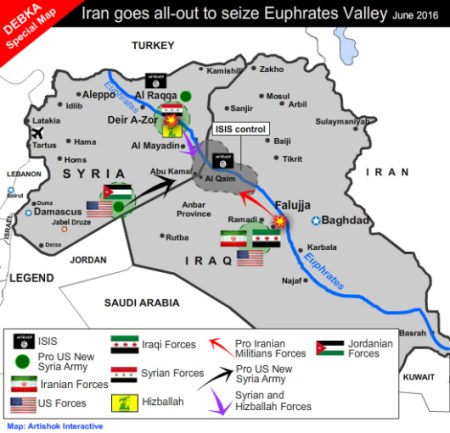
A. After the capture of the Iraqi city of Fallujah from ISIS, the pro-Iranian Shiite militias that participated in the campaign, namely the Popular Mobilization Forces and the Badar Forces, had started moving west toward the Iraq-Syria border (see map).

B. Syrian army and Hizballah forces had embarked on a parallel eastward movement from the vicinity of Deir ez-Zor toward the Iraqi border (see map). Their goal was to link up with the Iraqi Shiite militias on the Syrian-Iraqi border and create a land bridge for the use of all pro-Iranian forces in the two countries.

C. Washington and Amman regarded this development as dangerous and resolved to preempt it.

D. To that end, the New Syria Army was to be sent into action to take the town of Abu Kamal near the border.

E. The commanders assumed that the loss of Abu Kamal would deal a blow to ISIS forces in eastern Syria and plant a pro-American wedge against the linkup of the two pro-Iranian forces and so foil their projected land bridge athwart Iraq and Syria. .

5. On June 21, an ISIS suicide bomber driving a stolen Jordanian military truck blew himself up in the area of Jordan’s al-Rukban base on the Syrian border, in an attempt to avert the coming Abu Kemal attack by inflicting heavy losses on the new militia.  Most of those killed were Jordanian border guards.

6. After the attack, US and Jordanian helicopters airlifted the new militia combatants to a forward base set up at al-Tanf inside Iraq, 230 kilometers from Abu Kamal. They were attacked twice by Russian air strikes in an effort to thwart the pro-US militia’s return to Syria.

7. On June 29, the new Syrian force nonetheless launched its attack, under the direction of Jordanian special operations and military intelligence officers, and the supervision of American elite forces officers at the US-Jordanian war room north of Amman.

8. However, the new Syrian militia was speedily ambushed by ISIS, which apparently was tipped off about the impending attack and its routes of approach. Dozens of Syrian militiamen were killed or wounded, and the force fled from the battlefield. Those unable to flee were shot dead or decapitated.

9. The Jordanian officers who commanded the force were among those who fled.

10. ISIS videos of the battle showed that advanced US military equipment provided the militiamen had fallen into the terrorist organization’s hands, recalling the sights from Iraq of two years ago, when ISIS captured as booty masses of American military hardware from fleeing troops.

The US and Jordan once again failed to establish a Syrian force capable of fighting ISIS. They also lost the chance to gain control of the situation in eastern and southern Syria.

No official in Washington was ready to comment on the battle.

Al-Qaeda Leader Ayman Al-Zawahiri: The Mujahideen In Syria Must Unite; Syrians Must Beware Both Saudi And ‘Crusader’ Plots

May 9, 2016

Al-Qaeda Leader Ayman Al-Zawahiri: The Mujahideen In Syria Must Unite; Syrians Must Beware Both Saudi And ‘Crusader’ Plots, MEMRI, May 9, 2016

(Does Al-Zawahiri show strength or weakness? — DM)

The following report is now a complimentary offering from MEMRI’s Jihad and Terrorism Threat Monitor (JTTM). For JTTM subscription information, click here.

On May 8, 2016, Al-Qaeda issued a new audio message from its leader, Ayman Al-Zawahiri, after several month of silence. In the message, Al-Zawahiri calls on the jihad groups in Syria to unite because this is a matter of life and death for them. He urges the Muslims of Syria to reject the initiatives of Saudi Arabia and its allies in the region, and assures them that the jihadis will defeat “the Eastern and Western Crusaders war machine” – i.e., both Russia and America – as well as their allies, the Syrian regime and Iran. Addressing the relationship between Al-Qaeda and its affiliate in Syria, Jabhat Al-Nusra (JN), he hints that the ties between them are strong and that they should remain so, for the world will not accept JN as legitimate in any case, unless it completely changes its nature to suit the superpowers.

The following are excerpts from the message:

zawah90

“Syria today is the hope of the Islamic nation, for [its revolution] is the only Arab Spring revolution that is taking the correct path – the path of da’wa and jihad for the sake of strengthening the shar’ia and enacting [its laws], and for the sake of striving to establish a righteous caliphate, not the caliphate of Ibrahim Al-Badri [i.e., Abu Bakr Al-Baghdadi]…

“This is why the world’s arch-criminals [i.e., the superpowers and the international community] have come together to prevent the establishment of a jihadi state in Syria… and have hatched [various] plots and [exerted various] pressures… However, Allah willed it that there should remain one jihad-fighting group [i.e., JN and its allies], comprising the best of theansar [local fighters] and muhajiroun [foreign fighters], which cleaves to the truth and does not stray from it. The Muslims in Syria rallied around this group, seeing the difference between its correct path and the false path of the extremist Khawarij, the new takfiris [i.e., ISIS]…

“My brothers the mujahideen everywhere, our duty today is to defend the jihad in Syria against the plots being hatched against it, plots which are directed by the pampered daughter of Britain and proxy of the U.S., the state of the Sa’ud [royal] family [namely Saudi Arabia] and its lackeys in the region. The aim of all these plots is to establish a regime in Syria that will present itself as Islamic but will be based on a false Islam that coexists in harmony with secularism and with the concept of the nation-state, with extremist nationalism and with the regime of the international arch-criminals. [This regime] will sacrifice the lives of the hundreds of thousands who took to the streets to call out the natural slogan: ‘[the Prophet] Muhammad is our commander and our lord forever.’

“The greatest problem facing the world order and our apostate leaders and their governments [today] is that the mujahideen in Syria are standing on the borders of Palestine and threatening what they call ‘the state of Israel,’ [which is actually] the 51st American state and the largest military base outside America. Therefore, these criminals are compelled to cooperate in order to fight this jihad, kill it while it is still small, and divert it from its path [towards the path] of nationalism, secularism and capitulation to the world order of [these] arch-criminals. This is why they hatch one plot after another: Geneva, Riyadh, ceasefires, resolutions by the arch-criminals’ Security Council– an endless series of deceptions, lies and duplicities.

“Our duty today is to support the jihad in Syria with all our might and rally around it, all of us, [both] light and heavy.[1]Our duty today is to call for unity among the muhajideen in Syria until it is liberated from the secularist Nusairi [i.e., Alawite] regime, its partners, the rawafid Safavis [i.e., Shi’ite Persians, referring to Iran], and their allies, the Russians and the Western Crusaders – until a righteous, jihadi Islamic entity is established in this land.

“My brothers the mujahideen in Syria, who come from all over the world, today unity is a matter of life and death for you. You can unite and live a life of honor, or you can stay divided and be devoured, one by one.”

Al-Zawahiri then moves on to address the issue of the organizational ties between Al-Qaeda and JN: “There remains an open question that is dealt with extensively in an attempt to distract the Muslims in Syria from their true enemies, namely [the question of] the ties between Al-Qaeda and the dear, honorable and glorious Jabhat Al-Nusra, with whom we are proud to have relations and pray to Allah that he enhance its success and steadfastness. Let me say briefly and clearly: We have said time and again that, if and when the heroic people of Syria establish an Islamic government and choose for themselves a leader, whoever they choose will be acceptable to us. We are not power-hungry. We do not want to rule over the Muslims; we want the shari’a to rule and we want to be ruled as Muslims according to Islam. We call for unity among the mujahedeen in Syria, and urge them to agree on the establishment of a jihad-fighting and righteous Islamic government… that will wage jihad, liberate the lands, and strive to liberate Al-Aqsa and establish a caliphate in the path of prophecy. JN’s organizational affiliation will never pose an obstacle to these great objectives that we, as part of the Islamic nation, hope for. [Unlike ISIS] we do not presume to be the patrons [of the Islamic nation], nor do we pounce upon it, demanding to that it swear loyalty to unknown people and to a caliph of surprises.

“Besides, would the arch-criminals accept JN if it left Al-Qaeda? Or will they obligate it to conduct negotiations with the criminal murderers, and then compel it to obey the agreements of abasement and shame and then capitulate to the governments of corruption and subordination… We in Al-Qaeda do not accept a pledge of loyalty unless it is voluntary. We do not force anyone to swear loyalty to us. We do not threaten to blow up or behead [our opponents]. We do not brand anyone fighting against us an apostate, as do the new Khawrij [ISIS], who make baseless claims.

“Al-Zawahiri concludes with an appeal to the Muslims in Syria: “We are part of you. Though we come from different countries, religion and faith unite us. We are with you, waging one war on many fronts against the  Crusader arch-criminals and their apostate partners. Your victory is our victory, your dignity is our dignity, and your strength is our strength. Stand fast, oh servants of Allah, against the savage attack of the Crusaders from East and West [the Russians and Americans], who have forged an alliance with the secular Nusairis and the criminal rawafids. Stand fast and fight. Do not let the Crusader war machine intimidate you.” Citing former Taliban leader Mullah Muhammad Omar, Al-Zawahiri states that “Allah promised us victory,” and adds: “It was trust in Allah alone that shattered this Eastern and Western [i.e., Russian and American] Crusader war machine in Afghanistan and later in Iraq, and it is [faith in Allah] that will shatter it in Syria, Allah willing. Beware the seductions of the traitorous and subordinate apostate governments, which will not give you either freedom or dignity, because one who lacks something [himself] cannot provide it [to others]. Your deeds must justify your words when you say: ‘death and not abasement.'”

_________________________________

[1] Koran 9:41: ” Go forth, whether light or heavy, and strive with your wealth and your lives in the cause of Allah.”


US, Russia aim to ‘decapitate’ Syrian military

May 7, 2016

US, Russia aim to ‘decapitate’ Syrian military, DEBKAfile, May 7, 2016

Assad_dressed_in_military_uniform10.12

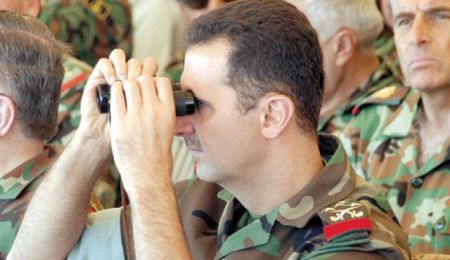
The US, Russia and the Syrian rebels started discussions this weekend over the composition of a list of Syrian generals who will be dishonorably discharged over war crimes they committed during the country’s civil war, DEBKAfile’s military and intelligence sources say in an exclusive report.

The generals will not face trial at an international tribunal over their war crimes. They will be able to leave Syria along with their families and their possessions, just like President Bashar Assad and his clan.

Our sources add that atop the list are the commanders of the Syrian air force who carried out the majority of the Assad regime’s attacks on the rebels over the past five years, including the atrocities of the past few days.

The sources say that the Americans and the Russians intend to “decapitate” the command but leave the military’s structure in its current form while integrating rebel fighters and commanders into its units. The rebel commanders are to receive ranks equivalent to their current ones in the new Syrian army.

DEBKAfile’s exclusive report on Wednesday, May 4, that Russia is ready to discuss the terms for Assad’s ouster surprised and stunned the political and military hierarchy in Tehran. In urgent consultations held the same day, it was decided to dispatch Iran’s deputy foreign minister for Arab and African affairs, Hossein Amir-Abdollahian, to Moscow without delay in order to determine whether the report was accurate.

The senior Iranian diplomat arrived in the Russian capital the following day and met with Deputy Foreign Minister Mikhail Bogdanov, the chief strategist of Russia’s Middle East policy.

Immediately after the meeting, Amir-Abdollahian said Iran will continue supporting Assad and the Syrian people in fighting terrorism, and make efforts to achieve success at intra-Syrian talks, namely the negotiations in Geneva between the Assad regime and the Syrian opposition. The Iranian diplomat did not say a single word about Assad’s future.

However, Moscow was one step ahead of Tehran. Shortly before Amir-Abdollahian deplaned in the Russian capital, Russian Foreign Minister Sergei Lavrov made a bombshell statement, saying “Assad is not our ally, by the way. Yes, we support him in the fight against terrorism and in preserving the Syrian state. But he is not an ally like Turkey is the ally of the United States.”

Our sources said it was a put-down for both Washington and Ankara, whose relationship has deteriorated recently.

DEBKAfile’s military sources report that Assad has not failed to notice the latest developments, and he continues to use Syrian, Iranian and Hizballah forces to attack the rebels in the parts of Aleppo that they control. This comes despite the announcement on Saturday, May 7, by Moscow and the Russian military in Syria that the ceasefire in the northwestern city had been extended by 72 hours.

Assad is keeping the Syrian army in reserve to defend his region against the US-Russian plan to depose him.

GCC leaders reject Obama’s Middle East policy

April 23, 2016

GCC leaders reject Obama’s Middle East policy, DEBKAfile, April 23, 2016

Big Bomber


DEBKAfile’s intelligence sources and its sources in the Gulf report exclusively that US President Barack Obama failed to convince the leaders of the six Gulf Cooperation Council member states, during their April 22 summit in Riyadh, to support his Middle East policy and cooperate with Washington.

Our sources also report that Saudi Arabia, with Turkey’s help, and the US carried out separate military operations several hours before the start of the summit that showed the extent of their differences.

The US on Thursday started to use its giant B-52 bombers against ISIS in an attempt to show Gulf leaders that it is determined to quash the terrorist organization’s threat to Gulf states. The bombers deployed at Qatar’s Al Udeid airbase attacked targets around Mosul in northern Iraq, but the targets were not identified.

Meanwhile, Saudi Arabia and Turkey, which recently established a bloc along with Egypt and Jordan to oppose Obama’s Middle East policy, started to infiltrate a force of 3,500 rebels back into Syria.

The force has been trained and financed by the Saudis at special camps in Turkey and Jordan. Members of the force are now fighting alongside other rebels north of Aleppo, but they are being bombed heavily by the Russian and Syrian air forces.

Riyadh sent the rebels into Syria to demonstrate to Obama that the Saudi royal family opposes the policy of diplomatic and military cooperation between the US and Russia regarding Syria that enables President Bashar Assad to remain in power in Damascus.

Since the war in Syria began in 2011, Obama has promised countless times that Washington would train and arm Syrian rebel forces outside the country, and then deploy them in Syria in order to strengthen rebel forces.

However, it has not done so except for one instance in 2015. The US infiltrated a small force consisting of no more than several dozen fighters, but it was destroyed by the Nusra Front, an affiliate of Al Qaeda, shortly after it crossed the border. The terrorist group had apparently been tipped off about the arrival of the pro-American force.

All of Washington’s efforts to recruit and train Syrian fighters, which have cost close to $1 billion, have failed.

DEBKAfile’s sources report exclusively that the leaders of the six GCC member states put their previous differences aside and presented Obama with four requests aimed at building a new joint policy regarding the region. According to our sources, these requests were:

1. Action by Washington to strengthen the Sunni majority in Iraq and facilitate representation of the Sunnis in the central government in Baghdad. The Gulf rulers told Obama that his policy of trying to win the support of Iraqi Prime MinisterHaider al-Abadi is mistaken.

They also pointed out reports by their intelligence services that al-Abadi is likely to be deposed and be replaced by a pro-Iranian prIme minister in the near future.

Obama rejected the request and said he refuses to change his Iraq policy.

2. Imposition of new US sanctions on Iran over its continuing ballistic missile tests.

On April 19, several hours before Obama’s departure for Riyadh, Iran carried out its latest act of defiance by attempting to launch a satellite into orbit using one of its “Simorgh” intercontinental ballistic missiles. The missile failed to leave the Earth’s atmosphere, fell to earth and crashed along with the satellite.

Obama turned down the Gulf leaders on new sanctions as well.

3. Provision of US-made F-35 fighter-bombers to Saudi Arabia and the UAE so they can take action against the Iranian missile threat. The US president declined the request.

4. Abandonment of Washington’s cooperation with Russia and the UN for political solution in Syria, and instead cooperate with Gulf states and Turkey to end the war and depose President Bashar Assad. Obama refused.

In other words, the summit in Riyadh, Obama’s final meeting with GCC leaders before he leaves the White House next January, ended without a single agreement.

Saudis ready to give Syrian rebels missiles against Russian warplanes and tanks

March 4, 2016

Saudis ready to give Syrian rebels missiles against Russian warplanes and tanks, DEBKAfile, March 4, 2016

Saudi def minSaudi Defense Minister Prince Mohammed bin Salman

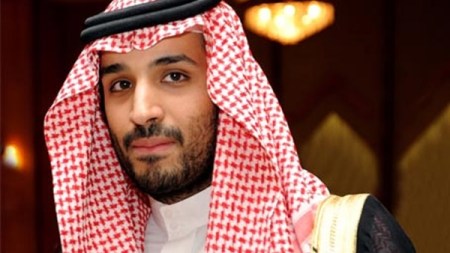
For the first time in the five-year Syrian conflict, Saudi Arabia is preparing to supply Syrian rebel groups with anti-air and anti-tank missiles in an attempt to stall Russia’s military efforts to extend Bashar Assad’s days in power. Deputy Crown Prince Mohammed bin Salman, the defense minister, is choreographing this escalated Saudi intervention in the Syrian war. He plans to arm Syrian rebels militias with missiles capable of striking the new Russian T-90 tanks, which DEBKAfile’s intelligence sources disclose were shipped directly to the Syrian army’s armed divisions in the last two weeks from the Russian Black Sea base of Novorossiysk.

The big Russian landing craft Novocherkassk, which unloaded a further supply of tanks at Tartus port on Thursday, Thursday, March 3, also delivered a consignment of MLRS rocket launchers.

A second Russian vessel is heading for Syria with more hardware.

This is in line with Moscow’s decision to upgrade the Syrian army’s armaments and rebuild the units severely ravaged by five years of combat. For Riyadh, this is tantamount to the indefinite and unacceptable prolongation of Assad’s days in power.

Most Western and Middle East observers think the Saudis may be bluffing about their plan to arm Syrian rebels with missiles, as a ploy to get Washington and Moscow to treat them seriously as a player on the Syrian stage and take their interests into account. Ideally, Riyadh would hope to break up American cooperation with Iran in Iraq and Russian cooperation with Iran in Syria.

The Saudis have so far pitched into this endlessly complex scenario with two tangible steps:

1. The deployment last week of four Saudi Air Force F-15 bomber fighters at the Turkish base of Incirlik near the Syrian border, to be followed by a contingent of ground troops for operations in Syria.

2. A direct challenge to Iran’s fighting arm in Syria, the Lebanese Hizballah and its leader Hassan Nasrallah,  by cancelling the $4 billion defense package Riyadh had pledged for the rehabilitation of Lebanon’s armed forces. The Lebanese high command is collaborating increasingly with Hizballah and a large slice of Saudi assistance funds would most certainly have reached its hands.

According to a high-ranking Saudi source, the decision to arm Syrian rebels with missiles is final. He said, “The Syrian opposition might soon acquire surface-to-air missiles, which will raise the wrath of Russia and Iran.” He added:: “No Saudi official will own up to these consignments but, just as 30 years ago, Saudi Arabia was not deterred from intervening in Afghanistan against the Russian army – and we came out the winners” – we will not hesitate to take on the Russian army in Syria too.

DEBKAfile’s military sources point out that in the Afghan war, the Saudis acted with the full support of the United States, whereas in Syria, the Americans are solidly opposed to any Saudi intervention. That is a huge difference between the two cases.

The introduction of Saudi missiles in support of the anti-Assad opposition would create a new situation in the Syrian conflict, whereby Riyadh also has a say – not just Washington, Moscow and Tehran. And that is exactly what Defense Minister Mohammed was after. Saudi willingness to give the rebels missiles takes the oil kingdom’s intervention in the Syrian conflict a lot farther than Israel, the Gulf emirates, Jordan or Turkey have been ready to go until now.