Archive for the ‘Syria’ category

The Kobani Precedent

March 25, 2015

The Kobani Precedent, [Bary] Rubin Center, March 25, 2015

(Whose side are “we” on in Iraq? Not the Kurds. Why not? Do “we” prefer an Iranian theocracy with nukes?– DM)
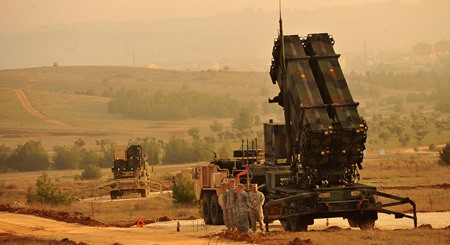
???????????????????U.S. Service members stand by a Patriot missile battery in Gaziantep, Turkey, Feb. 4, 2013, during a visit from U.S. Deputy Secretary of Defense Ashton B. Carter, not shown. U.S. and NATO Patriot missile batteries and personnel deployed to Turkey in support of NATO’s commitment to defending Turkey’s security during a period of regional instability. (DoD photo by Glenn Fawcett)

Unlike in Syria . . . in Iraq the US relates to the official government, mistakenly, as an ally.  This is leading to a potentially disastrous situation  whereby US air power is currently partnering with Iran-supported Shia militias against the Islamic State.

The most powerful of these militias have a presence in the government of Iraq. But they do not act under the orders of the elected Baghdad government, but rather in coordination with their sponsors in the Qods Force of the Iranian Revolutionary Guards Corps.

The Kurds, because of the existence among them of a secular, pro-western nationalist politics with real popular appeal, have unsurprisingly emerged as the only reliable partner.    On both the Shia and the Sunni sides, the strongest and prevailing forces are anti-western.

This reality is denied both by advocates for rapprochement with Iran, and by wishful-thinking supporters of the Syrian rebellion.  But it remains so.

*****************

Recently,  I attempted to undertake a reporting trip into the Kurdish Kobani enclave in northern Syria.  It would not have been my first visit, neither to Syria nor to Kobani.  For the first time, however, I found myself unable to enter.  Instead, I spent a frustrating but, as it turns out, instructive four days waiting in the border town of Suruc in south-east Turkey before running out of time and going home.

The episode was instructive because of what it indicated regarding the extent to which Kurdish control in the enclaves established in mid 2012 is now a fact acknowledged by all neighboring players, including the enemies of the Kurds.  This in itself has larger lessons regarding US and western policy in Syria and Iraq.

But I am getting ahead of myself.  First, let me complete the account of the episode on the border.    My intention had been to enter Kobani ‘illegally’ with the help of the Kurdish YPG and local smugglers.  This sounds more exciting than it is.    I have entered Syria in a similar way half a dozen times over the last two years, to the extent that it has become a not very pleasant but mundane procedure. This time, however, something was different.  I was placed in a local center with a number of other westerners waiting to make the trip. Then, it seemed, we were forgotten.

The westerners themselves were  an interesting bunch, whose varied presence was an indication of the curious pattern by which the Syrian Kurdish cause has entered public awareness in the west.

There was a group of European radical leftists, mainly Italians, who had come after being inspired by stories of the ‘Rojava revolution.’  A little noted element of the control by the Syrian franchise of the PKK of de facto sovereign areas of Syria has been the interest that this has generated in the circles of the western radical left.  These circles are ever on the lookout for something which allows their politics to encounter reality, in a way that does not bring immediate and obvious disaster.  As of now, ‘Rojava,’ given the leftist credentials of the PKK, is playing this role.  So the Europeans in question  wanted to ‘contribute’ to what they called the ‘revolution.’

Unfortunately, their preferred mode of support was leading to a situation of complete mutual bewilderment between themselves and the local Kurds.   Offered military training by their hosts, the radical leftists demurred.  They would not hold a gun for Rojava before they had seen it and been persuaded that it did indeed represent the peoples’ revolution that they hoped for.

Instead, they had a plan for the rebuilding of Kobani along sustainable and environmentally friendly lines, using natural materials  In addition, the health crisis and shortage of medicines in the devastated enclave led the radicals to believe that this might offer an appropriate context for popularizing various items of alternative and naturopathic medicine about which they themselves were enthusiastic.  (I’m not making any of this up).

All this had elicited the predictable reaction from the Kurds, who were trying to manage a humanitarian disaster and a determined attempt by murderous jihadis to destroy  them.  ‘Perhaps you could do the military training first and then we could talk about the other stuff?’ suggested Fawzia, the nice and helpful representative of the PYD who was responsible for us.  This led to further impassioned and theatrical responses from the Italians.

Apart from this crowd, there was a seasoned Chilean war reporter who looked on the leftists with impatience.  He was looking to get down to the frontlines south of Kobani, where the YPG was trying to cut the road from Raqqa to Aleppo at an important point close to the Euphrates.

Also, there was a polite and friendly lone American, a Baptist Christian, who had come to volunteer his services to the YPG.  That was us.

But as the days passed, it became clear that none of us appeared to be getting anywhere near Kobani any time soon.

The reasons given for the delay were plentiful, and unconvincing.  ‘It is the weather,’ Fawzia would say vaguely, ‘too much mud.’  But the presence of mud on the border in February was hardly a new development, so this couldn’t be the reason.

Finally, frustrated at the lack of information, I called a PKK friend based in Europe and asked for his help in finding out why we weren’t  moving.  He got back to me a little later.  ‘It seems the Turkish army is all over the border, more than usual. That’s the reason,’ he told me.

This was more plausible, if disappointing.  After four days on the border, I was out of time and set off back for Gaziantep and then home.  The Italians went to Diyarbakir to take part in a demonstration.  The Chilean and the American volunteer stayed and waited.

When I got back to Jerusalem, all rapidly became clear.  News reports were coming in about a large operation conducted by the Turkish army through Kobani and into Syria.  The operation involved the evacuation of the Turkish garrison at the tomb of Suleiman Shah, south of the enclave.  The American volunteer sent me a picture of the Turkish tanks on tank transporters driving though Suruc at the conclusion of the operation.

This operation was astonishing on a number of levels.

Despite stern Turkish denials, it could only have been carried out on the basis of full cooperation between the Turkish armed forces and the Kurdish fighters of the YPG in Kobani.  Obviously, any unauthorized entry of Turkish troops into the Kurdish canton would have meant an armed battle.

During the fight for Kobani last year, the Turkish government was very clearly quite content for the enclave to fall.  The Turkish army waited on the border, as the prospect of a generalized slaughter of the Kurds in Kobani came close to realization.

But of course, the slaughter didn’t happen.  In the end, the partnering of US air power with the competent and determined forces of the YPG on the ground delivered the first real defeat to the forces of the Islamic State in Syria.

This effective partnering has continued, and has now become the main military element in northern Syria in the battle against IS.

The combination of the YPG and the USAF is now nudging up to a second strategic achievement against the jihadis – namely, the cutting of the road from Tel Hamis to the town of al-Houl on the Iraqi border.   This road forms one of the main transport arteries linking the Islamic State’s conquests in Iraq to its heartland in the Syrian province of Raqqa.  If the links are cut, the prospect opens for the splitting of the Islamic State into a series of dis-connected enclaves.

The YPG-US partnership is particularly noteworthy, given that the YPG is neither more nor less than the Syrian representative of the PKK.  The latter, meanwhile, is a veteran presence on the US and EU lists of terror organizations.  Despite a faltering peace process, the PKK remains in conflict with Turkey, a member of NATO.

But the reality of the Kurdish-US alliance in northern Syria has clearly now been accepted by the Turks as an unarguable fait accompli, to the extent that they are now evidently willing to work together with the armed Syrian Kurds, where their interests require it.

It is an astonishing turnabout in the fortunes of the Kurds of Syria, who before 2011 constituted one of the region’s most brutally oppressed, and most forgotten minority populations.

This raises the question as to why this reversal of fortune has taken place.

Why is the YPG the chosen partner of the Americans in northern Syria, just as the Kurdish Pesh Merga further east is one of the preferred partners on the ground in Iraq?

The answer to this is clear, but not encouraging.  It is because in both countries, the only reliable, pro-western and militarily effective element on the ground is that of the Kurds.

Consider:  in northern Syria, other than the forces of the Islamic State, there are three other elements of real military and political import.  These are the forces of the Assad regime, the al-Qaeda affiliated Jabhat al-Nusra and the YPG.

In addition, there are a bewildering variety of disparate rebel battalions, with loyalties ranging from Salafi Islamism to Muslim Brotherhood style Islamism, to non-political opposition to the Assad regime.  Some of these groups operate independently.  Others are gathered in local alliances such as the Aleppo based Jabhat al-Shamiya (Levant Front), or the Syria-wide Islamic Front, which unites Salafi factions.

Despite the reported existence of a US staffed military operations room in Turkey, the latter two movements are either too weak, or too politically suspect (because of their Islamist nature), to form a potential partner for the US in northern Syria.

Nusra is for obvious reasons not a potential partner for the US in the fight against the Islamic State.  And the US continues to hold to its stated  goal that Bashar Assad should step down.  So the prospect of an overt alliance between the regime and the US against the Islamic State is not on the cards (despite the de facto American alliance with Assad’s  Iran-supported Shia Islamist allies in Iraq).

This leaves the Kurds, and only the Kurds, to work with.  And the un-stated alliance is sufficiently tight for it to begin to have effects also on Turkish-Kurdish relations in Syria, as seen in the Suleiman Shah operation.

But what are the broader implications of this absence of any other coherent partner on the ground?

The stark clarity of the northern Syria situation is replicated in all essentials in Iraq, though a more determined attempt by the US to deny this reality is under way in that country.

In Iraq, there is a clear and stated enemy of the US (the Islamic State), a clear and stated Kurdish ally of the west (the Kurdish Regional Government and its Pesh Merga) and an Iran-supported government which controls the capital and part of the territory of the country.

Unlike in Syria, however, in Iraq the US relates to the official government, mistakenly, as an ally.  This is leading to a potentially disastrous situation  whereby US air power is currently partnering with Iran-supported Shia militias against the Islamic State.

The most powerful of these militias have a presence in the government of Iraq. But they do not act under the orders of the elected Baghdad government, but rather in coordination with their sponsors in the Qods Force of the Iranian Revolutionary Guards Corps.

It is possible that the current partnering with Shia Islamist forces in Iraq is the result of a general US attempt now under way to achieve a historic rapprochement with Iran, as suggested by Michael Doran in a recent essay.  Or it may be that this reality has emerged as a result of poor analysis of the realities of the Levant and Iraq, resulting in a confused and flailing policy.  But either way, the result is an astonishing mess.

In northern Syria, the obvious absence of any partners other than the Kurds has produced a momentary tactical clarity.  But as the larger example of Iraq shows, this clarity is buried in a much larger strategic confusion.

This confusion, at root, derives from a failure to grasp what is taking place in Syria and in Iraq.

In both countries, the removal or weakening of powerful dictatorships has resulted in the emergence of conflict based on older, sub-state ethnic and sectarian identities.  The strength and persistence of these identities is testimony to the profound failure of the states of Syria and Iraq to develop anything resembling a sustainable national identity.  In both Syria and Iraq, the resultant conflict is essentially three-sided.  Sunni Arabs, Shia/Alawi Arabs and Kurds are fighting over the ruins of the state.

Because of the lamentable nature of Arab politics at the present time, the form that both Arab sides are taking is that of political Islam.   On the Shia side, the powerful Iranian structures dedicated to the creation and sponsorship of proxy movements are closely engaged with the clients in both countries (and in neighboring Lebanon.)

On the Sunni Arab side, a bewildering tangle of support from different regional and western states to various militias has emerged.  But two main formations may be discerned. These are the Islamic State, which has no overt state sponsor, and Jabhat al-Nusra, which has close links to Qatar.

In southern Syria, a western attempt to maintain armed forces linked to conservative and western-aligned Arab states (Jordan, Saudi Arabia) has proved somewhat more successful because of the close physical proximity of Jordan and the differing tribal and clan structures in this area when compared with the north.  Even here, however, Nusra is a powerful presence, and Islamic State itself recently appeared in the south Damascus area.

The Kurds, because of the existence among them of a secular, pro-western nationalist politics with real popular appeal, have unsurprisingly emerged as the only reliable partner.    On both the Shia and the Sunni sides, the strongest and prevailing forces are anti-western.

This reality is denied  both by advocates for rapprochement with Iran, and by wishful-thinking supporters of the Syrian rebellion.  But it remains so.  What are its implications for western policy?

Firstly, if the goal is to degrade the Islamic State, reduce it, split it, impoverish it, this can probably be achieved through the alliance of US air power and Kurdish ground forces.  But if the desire, genuinely, is to destroy the Islamic State, this can only be achieved through the employment of western boots on the ground.  This is the choice which is presented by reality.

Secondly, the desire to avoid this choice is leading to the disastrous partnering with Iraqi Shia forces loyal to Iran.  The winner from all this will be, unsurprisingly,  Iran. Neither Teheran nor its Shia militias are the moral superiors to Islamic State. The partnering with them is absurd both from a political and an ethical point of view.

Thirdly, the determination to maintain the territorial integrity of ‘Syria’ and ‘Iraq’ is one of the midwives of the current confusion.  Were it to be acknowledged that Humpty cannot be put back together again, it would then be possible to accurately ascertain which local players the west can partner with, and which it can not.

As of now, the determination to consider these areas as coherent states is leading to absurdities including the failure by the US to directly arm the pro-US Pesh Merga because the pro-Iranians in Baghdad object to this, the failure to revive relations with and directly supply Iraqi Sunni tribal elements in IS controlled areas for the same reason,  and the insistence on relating to all forces ostensibly acting on behalf of Baghdad as legitimate.

Ultimately, the mess in the former Syria and Iraq derives from a very western form of wishful thinking that is common to various sides of the debate in the west.  This is the refusal to accept that political Islam, of both Shia and Sunni varieties, has an unparalleled power of political mobilization among Arab populations in the Middle East at the present time, and that political Islam is a genuinely anti-western force, with genuinely murderous intentions.

For as long as that stark reality is denied, western policy will resemble our Italian leftist friends on the border, baffled and bewildered as they go about proposing ideas and notions utterly alien to and irrelevant to the local situation.

The reality of this situation means that the available partners for the west are minority nationalist projects  such as that of the Kurds (or the Jews,) and traditional, non-ideological conservative elites – such as the Egyptian military, the Hashemite monarchs, and in a more partial and problematic way, the Gulf monarchs.  Attempts to move beyond this limited but considerable array of potential allies will result in the strengthening of destructive, anti-western Islamist forces in the region, of either Sunni or Shia coloration.

As for the Syrian Kurds, they deserve their partnership with US air power, and the greater security it is bringing them.

The American Baptist volunteer, to conclude the story, made it across the border and is now training with the YPG.  He, at least, has a clear sense of who is who in the Middle East.  Hopefully, this sense will eventually percolate up to the policymaking community too.
Book review: The Islamic War

March 16, 2015

The Islamic War: Book review, Dan Miller’s Blog, March 16, 2015

(The views expressed in this article are mine and do not necessarily reflect those of Warsclerotic or its other editors. — DM)

The Islamic War, Martin Archer, 2014

The novel begins with a terror attack on a residential area in Israel, resulting in multiple causalities. It may, or may not, have involved members of the Iranian Revolutionary Guard. Menachem Begin is the Israeli Prime Minister and Ariel Sharon is the Defense Minister. The story begins immediately after the (postponed?) end of the Iran – Iraq war in 1988.

A massive armor, infantry, artillery and air attack on Israeli positions in the Golan follows the terrorist attack. The Israelis are outnumbered and suffer many thousands of casualties.

Israel had anticipated a simultaneous attack via Jordan, so most Israeli tank, infantry and air resources are deployed there, rather than in the Golan, to conceal themselves and await the arrival of Iranian, Iraqi and Syrian forces. They come and are defeated, most killed or fleeing. The Israeli forces then move into Syria and have similar successes there as well.

As the story evolves, it becomes evident that Israel must have known that the Iran – Iraq war had been allowed to fester to permit Iran, Iraq and Syria to develop a well coordinated plan to dispose of Israel, in hopes that a surprise attack could be made as soon as the Iran – Iraq war ended. Other events also suggest that Israel had prior notice:

Nuclear facilities of several hostile nations explode mysteriously.

The Israeli Navy had managed to infiltrate Iranian oil ports — apparently before the attack on the Golan — without being noticed. Then, at a propitious moment near the end of the fighting elsewhere, they destroyed all oil tankers in, entering or leaving port, along with all Iranian oil storage facilities.

The Israel Navy, which had suffered no losses, then moved to Saudi Arabia to protect her oil ports and ships coming to buy her oil and leaving.

As these events unfold, Israel, Egypt, Jordan, Saudi Arabia and Turkey* are negotiating a united front against Iran, Iraq and Syria, much to the displeasure of the U.S. Secretary of State, who wants a cease fire and return to the status quo ante. Fortunately, the U.S. President favors Israel and her coalition and generally ignores his SecState.

I won’t spoil the story by relating what happens at the end, but it’s very good for Israel, Egypt, Jordan, Saudi Arabia, Turkey and the Kurds, and very bad for Iran, Iraq and Syria. The novel is well worth reading, perhaps twice.

_____________

*Historical note: Turkey in 1988 was reasonably secular and also in other ways quite different from now. Egypt under President Al-Sisi is, in some but not all respects, similar to Egypt in 1988 under President Mubarak. Beyond a good relationship with Israel, Al-Sisi is working to modernize and reform Islam by turning it away from the violent jihad which drives both the Islamic State (Sunni) and the Islamic Republic of Iran (Shiite). Egypt remains under fire from the Obama administration due to the “coup” which ousted President Morsi, who had made Egypt essentially an arm of the Muslim Brotherhood. Egypt now helps to protect Israel with her military presence in the Sinai to oppose Hamas and Muslim Brotherhood activities there. Saudi Arabia and Jordan, like most countries in the Middle East, look out for the interests of their rulers first and are quite concerned about both the Islamic State and Iran.

Iran’s advances create alarm in Saudi Arabia and the Gulf

March 14, 2015

Iran’s advances create alarm in Saudi Arabia and the Gulf, the Guardian,  March 13, 2015

Arabs believe Baghdad, Damascus, Beirut and Sana’a are in effect under Iranian control – and power may shift further if US sanctions are eased.

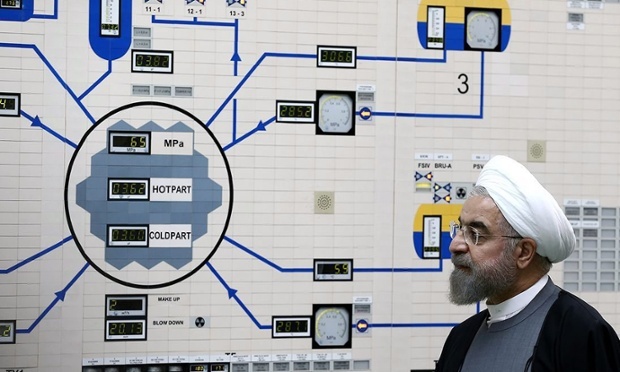
c0ac3569-93da-4ae8-8b51-29dc6991ee13-620x372 Hassan Rouhani, the Iranian president, visiting Bushehr nuclear power plant in southern Iran this year. Photograph: Presidential official handout/EPA

Iran’s great advantage, suggests Emile Hokayem, an analyst, is its commitment and competence, in Syria and beyond. “The expertise, experience and strategic patience it deployed in support of the Syrian regime to a great extent facilitated Assad’s recovery from serious setbacks in 2012. In contrast, the war in Syria has exposed not only the political and operational limitations of the Gulf states, but also the rivalries among them.”

*********************

The commanders of Iran’s Islamic Revolutionary Guard Corps (IRGC) have been working overtime recently, flaunting their achievements across the Middle East and flexing muscles as international negotiations over the country’s nuclear programme enter their critical and perhaps final phase.

On Wednesday it was the turn of Major-General Mohammad Ali Jafari, the IRGC’s most senior officer. “The Islamic revolution is advancing with good speed, its example being the ever-increasing export of the revolution,” he declared. “Not only Palestine and Lebanon acknowledge the influential role of the Islamic Republic but so do the people of Iraq and Syria. They appreciate the nation of Iran.”

Last month a similarly boastful message was delivered by General Qassem Suleimani, who leads the IRGC’s elite Quds force — and who is regularly photographed leading the fightback of Iraqi Shia miltias against the Sunni jihadis of the Islamic State (Isis) as well as against western and Arab-backed rebels fighting Bashar al-Assad in southern Syria. “Imperialists and Zionists have admitted defeat at the hands of the Islamic Republic and the resistance movement,” Suleimani said.

Iran’s advances are fuelling alarm in Saudi Arabia and the Gulf, where Tehran has been a strategic rival since the days of the Shah, and which now, it is said with dismay, in effect controls four Arab capitals – Baghdad, Damascus and Beirut and in the last month Sana’a in Yemen – which is uncomfortably close to home.

Iran’s regional position has certainly improved. Its high-profile role fighting Isis in Iraq, Assad’s retention of control in Syria with the help of its Lebanese ally Hezbollah, and the Houthi rebel takeover in Yemen have all been deeply discomfiting for the Saudis. Anti-government protests in Shia-majority Bahrain are also often blamed on Tehran — though that ignores the domestic roots of the unrest.

In Riyadh King Salman has dropped his preoccupation with the Muslim Brotherhood in favour of building a united Sunni Arab front to confront the Iranians, diplomats say, though translating that strategy into action is another matter. The message from Saudi Arabia and the United Arab Emirates is that whatever the outcome of the nuclear talks, Iran is bent on expanding its power and influence. “The Iranians have scored major victories but only where there are Shia minorities,” a senior Gulf official told the Guardian. “Our concern is that the nuclear issue will become a tool of their foreign policy.”

Arab alarm is shared by Israel. Binyamin Netanyahu used identical arguments in his recent speech to the US Congress, timed to influence next week’s nuclear endgame in Geneva. “The Saudis will be incredibly worried that we are getting close to a point where the Iranians will be players because of the nuclear issue and the way the Americans have effectively ended up on the same side as the Iranians in Iraq,” said one veteran Saudi-watcher. “But the noise they are making is in inverse proportion to their ability to do anything about it.”

Arab governments are not reassured by the promises of John Kerry, the US secretary of state, that Washington is not seeking a “grand bargain” with Tehran that will allow it to “destabilise” the Middle East, bolstered by the easing of economic sanctions. Saud Al Faisal, the Saudi foreign minister, warned of Tehran’s “hegemonic” ambitions as the IRGC supported the military operation to retake the Iraqi town of Tikrit from Isis. In Gulf capitals Hassan Rouhani, the emollient Iranian president, is seen as less important than the hardline supreme leader, Ayatollah Ali Khamenei.

It is hard to disentangle propaganda from reality. But independent analysts argue that Iran is inflating its gains for both foreign and domestic consumption. “If you listen to Suleimani there is a degree of exaggeration,” argues Ali Ansari of St Andrews University. “It’s rhetorical reassurance. He is saying to Iranians: ‘We are powerful and and everyone is worried about this’ – partly to make the point that they are not really under pressure. People outside can see what Iran’s strengths and weaknesses are. But there is this belief that you need to negotiate from a position of strength and that if you are weak you will be trampled on.”

Iran-watcher Hossein Rassam also detects a domestic calculation in the IRGC statements. “Critics of Rouhani’s policy of rapprochement with the international community inside Iran can turn to the supreme leader and say there wasn’t really much need for that softer tone because now we have more bargaining chips in our hands. Iran is the only power in the region which can actually fight Isis and the west needs us for that.”

Meir Litvak, an Israeli expert on Iran, sees both genuine belief and posturing in Tehran’s stance. “The Iranians believe they have been able to save the Assad regime from total collapse and there is at least stalemate in Syria,” he said. “That means they have been able to maintain the link with Hezbollah and maybe open a second front by proxy against Israel on the Golan Heights. The Houthi rebellion in Yemen was initially a genuinely domestic affair but the Iranian regime saw it as an opportunity. And it has become a bonus for it – even if they are not that active inYemen. But if the Saudis are scared that’s a plus for the Iranians.”

Arab diplomatic sources say they expect to see an IRGC and Hezbollah presence in Yemen, helped by a new agreement on regular flights between Tehran and Sana’a.

Iran’s role in Bahrain, where the Shia majority remains locked in confrontation with the Saudi-backed Sunni monarchy, is more about scoring propaganda points than material support – despite claims in Manama about Iran’s sinister role.

Still, in the heartlands of Iranian influence, Iraq and Syria, there have been significant costs as well as benefits, including the deaths of two senior IRGC commanders. Continuing sanctions and low oil prices – seen in Tehran as a deliberate strategy by the Saudis – have also made it harder to shell out billions of dollars to subsidise the Assad regime.

Iran’s great advantage, suggests Emile Hokayem, an analyst, is its commitment and competence, in Syria and beyond. “The expertise, experience and strategic patience it deployed in support of the Syrian regime to a great extent facilitated Assad’s recovery from serious setbacks in 2012. In contrast, the war in Syria has exposed not only the political and operational limitations of the Gulf states, but also the rivalries among them.”

Netanyahu tries to head off Iran’s machinations after Obama empowers Tehran as favored Mid East ally

March 2, 2015

Netanyahu tries to head off Iran’s machinations after Obama empowers Tehran as favored Mid East ally, DEBKAfile, March 1, 2015

Iran's Shite crescent

Netanyahu’s political rivals, while slamming him day by day, turn their gaze away from the encroaching Iranian forces taking up forward positions in Iraq, Syria and Lebanon, where they are busy fashioning a  Shiite Crescent that encircles Sunni Arab states as well as Israel.

It must be obvious that to bolster its rising status as the leading regional power, Iran must be reach the nuclear threshold – at the very least – if not nuclear armaments proper, or else how will Tehran be able to expand its territorial holdings and defend its lebensraum.

****************

Almost the last words Israeli Prime Minister Binyamin Netanyahu heard Sunday, March 1, as he took off for Washington to address Congress on Iran, was in effect “Don’t do it!” They came from a group of 180 senior ex-IDF military officers. After the personal abuse is weeded out of their message, what remains is that Netanyahu’s speech to a joint session of the US Congress Tuesday, March 3, was not worth making because it would damage relations with the US.

Maj. Gen. Amiram Levin, former Northern Command chief and ex-Deputy Director of the Mossad, put it this way: “Bibi, you are making an error in navigation; the target is Tehran not Washington.” He went on to say: “[Instead] of working hand in hand with the president,,, you go there and poke a finger in his eye.”

DEBKAfile’s analysts maintain that the navigation error is the general’s. Before shooting his slings and arrows at the Israeli prime minister’s office, he should long ago have taken note of President Barack Obama’s Middle East record in relation to Israel’s during his six years in the White House.

It took time to catch on to Obama’s two-faced policy towards Israel because it was handled with subtlety.

On the one hand, he made sure Israel was well supplied with all its material security needs. This enabled him to boast that no US president or administration before him had done as much to safeguard Israel’s security.

But behind this façade, Obama made sure that Israel’s security stayed firmly in the technical-material-financial realm and never crossed the line into a strategic relationship.

That was because he needed to keep his hands free for the objective of transferring the role of foremost US ally in the Middle East from Israel to Iran, a process that took into account the ayatollahs’ nuclear aspirations.

This process unfolding over recent years has left Israel face to face with a nakedly hostile Iran empowered by the United States.

Tehran is not letting its oft-repeated threat to wipe Israel off the map hang fire until its nuclear aspirations are assured of consummation under the negotiations continuing later this week in the Swiss town of Montreux between US Secretary John Kerry and Iranian Foreign Minsiter Mohammed Javad Zarif. In the meantime, without President Obama lifting a finger in defense of “Israel’s security,” Iran’s Revolutionary Guards Corps officers are drawing Israel into a military stranglehold on the ground.

Netanyahu’s political rivals, while slamming him day by day, turn their gaze away from the encroaching Iranian forces taking up forward positions in Iraq, Syria and Lebanon, where they are busy fashioning a  Shiite Crescent that encircles Sunni Arab states as well as Israel.

It must be obvious that to bolster its rising status as the leading regional power, Iran must be reach the nuclear threshold – at the very least – if not nuclear armaments proper, or else how will Tehran be able to expand its territorial holdings and defend its lebensraum.

This is not something that Barack Obama or his National Security Adviser Susan Rice are prepared to admit. They are not about to confirm intelligence reports, which expose the military collaboration between the Obama administration and Iran’s supreme leader Aytatollah Ali Khamenei as being piped through the office of Iraq’s Shiite Prime Minister Haider al-Abadi.

Washington denies that there is any such collaboration – or any suggestion that the White House had reviewed recommendations and assessments of an option for the Iranian Revolutionary Guards’ Al Qods Brigades to take over the ground war on the Islamic State in Iraq and Syria as American contractors.

Al Qods chief Gen. Qassem Soleimani is frequently spotted these days flitting between Baghdad, Damascus and Beirut, while his intelligence and liaison officers file reports to the Obama administration, through the Iraqi prime minister’s office, on their forthcoming military steps and wait for Washington’s approval.

America understandably lacks the will to have its ground forces embroiled in another Middle East war. Washington is therefore not about to turn away a regional power offering to undertake this task – even though it may be unleasing a bloody conflagration between Shiite and Sunni Muslims that would be hard to extinguish

Egypt, Saudi Arabia, the rest of the Gulf are as dismayed as Israel by Obama’s regional strategy, which, stripped of its diplomatic veneer, boils down to a straight trade: The US will allow Iran to reach the status of a pre-nuclear power and regional hegemon, while Tehran, in return, will send its officers and ground troops to fight in Iraq, Syria and even Afghanistan.

The 180 ex-IDF officers and Israel’s opposition leaders, Yitzhak Herzog and Tzipi Livni, were right when they argued that Israel’s bond with the US presidency is too valuable to jeopardize. But it is the Obama White House which is trifling with that bond – not Netanyahu, whose mission in Washington is no more than a tardy attempt to check Iran’s malignant machinations which go forward without restraint.

Israeli fighter jets stage warning passes against Syrian air force intruders over Golan. Air tension high

February 24, 2015

Israeli fighter jets stage warning passes against Syrian air force intruders over Golan. Air tension high, DEBKAfile, February 24, 2015

Barrel-bombs-Qunitra_23.2.15Syrian barrel bombs dropped on Quneitra

Israeli fighter jets flew passes over the Golan Monday, Feb. 23 as a warning to Syrian helicopters and fighter planes to stop encroaching on the no-fly zone, in violation of standing Israeli-Syrian armistice agreements. This is reported by DEBKAfile’s military sources.

The Syrian warplanes planes came over Quneitra Monday to drop barrel bombs on Syrian rebel forces holding the town. Spotters on Israeli Golan counted at least 30 bombs dropped by helicopters under cover of Syrian air force jets. Their crews took no notice of the Israeli fighter jets and drones present at the time and continued their attacks regardless.

At the end of the Syrian operation, Israeli aircraft conducted its warning passes over the Golan town.

Our sources report that this was the second day in a row that the Syrian air force had bombed the same sector. Sunday, they struck rebel positions in the Tel Al-Harra area 6-8 km from the Israeli Golan border. Israel’s inaction then encouraged Damascus to move its warplanes closer to the border the next day and fly into the no-fly zone.

This time, Israeli avoided a direct clash, but broadcast a warning that a confrontation was possible if the Syrians returned for a repeat. Western and Middle East military sources interpret the Israeli flights over Quneitra Monday as a clear warning to Damascus that Israel will not tolerate Syrian air raids close to its Golan lines or any incursions in airspace banned by their armistice agreements.

Six months ago, on Sept. 23, an Israeli Patriot air defense battery downed a Syrian Sukhoi-24 which ventured into its air space. The plane crashed just inside the Syrian border. The IDF claimed at the time that the Syrian plane had strayed across the border by mistake – and so the incident ended. However, Israeli commanders were certain that there was no mistake and that the Syrians were testing the alertness of Israel’s air defenses and gauging its readiness to deploy its air might for challenging aerial incursions.


Hero of the Middle East: Abdel Fattah el-Sisi

February 23, 2015

Hero of the Middle East: Abdel Fattah el-Sisi, The Gatestone InstituteBassam Tawil, February 23, 2015

(Please see also Obama kept reform Muslims out of summit on extremism. — DM)

The courageous, historic speech yesterday by the Grand Imam of al-Azhar University, the seat of Sunni Islam, calling for the reform of Islam, was the result of the even more courageous, historic speech delivered a few weeks ago by Egypt’s devoutly Muslim President, Abdel Fattah El-Sisi.

The Muslim Brotherhood, the current American administration’s great friend, is the poison tree whose fruit is the Islamist terrorism embodied by the ISIS, Al-Qaeda, Hamas, Palestinian Islamic Jihad, Al-Nusra Front, Boko Haram and others.

Apparently some of the Sunni Arab States have not yet realized that their own national security, and ability to withstand Iran, depend on how strong Egypt is.

It is possible, in fact, that U.S. policy is to weaken the Sunni world seeking to unite under el-Sisi’s flag of modernity. With European complicity, the U.S. Administration is trying to defraud the Arabs and turn the Israel-Palestine conflict into a center of Middle Eastern chaos, in order to hide the nuclear deal they are concocting with Iran.

The treachery of the U.S. Administration is the reason why Egypt’s faith in the United States, which is supposed to defend the Arabs against a nuclear Iran, has effectively evaporated.

And now the greatest American insanity of all time: America and Turkey are arming and training Islamist terrorist operatives in Turkey, on the ground that they are “moderates” opposed to Bashar Assad’s regime in Syria. They either ignore or are unaware that there is no such thing as a moderate Islamist terrorist. The other name of the “moderates” opposing Assad is ISIS.

The Muslim Brotherhood, in effect, runs Turkey. According to recent rumors, Turkey is also planning to build a nuclear reactor, “for research and peaceful purposes.”

Sheikh Dr. Ahmed al-Tayyeb, the Grand Imam of Cairo’s Al-Azhar University, the seat of Sunni Islam, yesterday delivered a courageous, historic speech in Mecca, Saudi Arabia, urging reform in religious education to curb extremism in Islam. Al-Tayyeb’s address was the result of an even more courageous and historic speech, delivered a few weeks ago by Egypt’s devoutly Muslim President, Abdel Fattah el-Sisi, at Al-Azhar University.

El-Sisi’s monumental statement, truly worthy of a Nobel Prize, is having a seismic result. Al-Sisi directed his remarks, about the ills of Islam to Islamic clerics in Egypt and around the world. It was enormously brave of him. He did not single out radical Islam, but he did call on all Muslims to examine themselves, carry out a religious revolution and renew their faith.

El-Sisi, a man of monumental courage, urged Muslims not to behave according to the ancient, destructive interpretations of the Qur’an and Islam that make the rest of the world hate them, destroy Islam’s reputation and put Muslim immigrants to Western countries in the position of having to fight their hosts. He claimed that it is illogical for over a billion Muslims to aspire to conquer and subdue six billion non-Muslims.

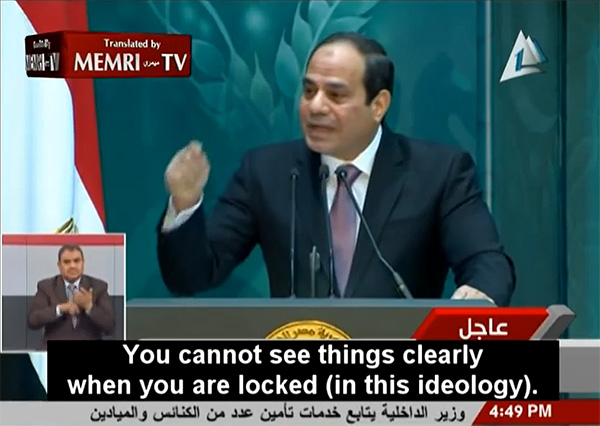
949 (1)Egypt’s President, Abdel Fattah el-Sisi, delivered a historic speech to top Islamic scholars and clergy at Al-Azhar University in Cairo, December 28, 2014. (Image source: MEMRI)

Islam deals in depth with uniting the Muslim nation (umma) and mutual responsibility among Muslims, as though they were one entity. The Prophet Muhammad (S.A.A.W.) said that every drop of Muslim blood is more precious than the entire Kaaba. Thus the liberty ISIS took upon itself to burn alive a Jordanian pilot and 45 Egyptians, to spread terrorism throughout Syria, Iraq and Egypt and to kill other Muslims in various locations around the globe, claiming they were “infidels,” is heresy in and of itself.

The calls for the deaths of “a million shaheeds” and the killing of Jews for the sake of Al-Aqsa mosque in Jerusalem, as was done by Arafat in the past, and is being done now by his heirs in the Palestinian Authority and Hamas, are a crime; they are extremist incitement that is opposed to the forgiving and compromising spirit of Islam. The murder and terrorism carried out by terrorist organizations such as ISIS, Hamas, Palestinian Islamic Jihad [PIJ] and other Islamist organizations against Jews, Christians and other non-Muslims is contrary to the modern Islam needed in the contemporary era.

El-Sisi was correct that the Muslim Brotherhood’s Sunni ideology, which drives most of the extremist Islamist organizations around the world, preaches forced conversion of “infidels” to Islam at any price, or death. Some of the “infidels” are supposed to join Islam of their own accord(targ’ib), out of self-serving interest, and some not of their own accord (tarhib), out of fear and death threats. Such conversions are also contrary to the original Islam, which states that no one is to be forced to convert to Islam and that a calm religious dialogue should be held.

However, a few days after President el-Sisi’s speech, which attempted to unify Muslims and Christian Copts, the Muslim Brotherhood and their affiliated terrorist organizations increased their attacks on Egyptian civilians and security forces throughout Egypt and the Sinai Peninsula, as well as murdering 21 Egyptian Christian Copts in Libya. The Muslim Brotherhood knows that behind the scenes, U.S. President Obama supports the movement, especially the branch in Egypt seeking to overthrow President Sisi. This approval from the U.S. encourages the Muslim Brotherhood to be even more determined to subvert and undermine Egypt’s stability, sabotage its economic rehabilitation and destroy the el-Sisi regime.

In this atmosphere of American support, the Ansar Bayt al-Maqdis terrorist group in the Sinai Peninsula operates under Muslim Brotherhood protection. It recently changed its name to the “Sinai Province” of the Islamic State and swore allegiance to the “Caliph,” Abu Bakr al-Baghdadi. It is currently working hand-in-hand with Hamas in the Gaza Strip to weaken el-Sisi’s Egyptian forces in the Sinai Peninsula.

Other Islamist terrorist organizations also kill Egyptian civilians and security forces with bombs and assault rifles. In the name of the Muslim Brotherhood’s ideology, they indiscriminately attack people on public transport, in airports and in public places, with the intent of retaking control of Egypt.

For this reason, an Egyptian court recently designated Hamas a terrorist organization, along with its military wing, the Izz al-Din al-Qassam Brigades, and outlawed both of them. In response, Qatar, a slippery agent in the service of America but also, treacherously, in the service of Iran, allowed armed Izz al-Din al-Qassam Brigades operatives to be interviewed by its Al-Jazeera TV. The operatives called the Egyptian president a traitor to the Islamic-Arab cause and to those seeking to “liberate Palestine.”

At the same time, Qatar continues to use its Al-Jazeera TV to broadcast hate propaganda targeting the el-Sisi regime, to disseminate videos and to fabricate insulting quotes intended to cause friction between el-Sisi on one side and the leaders of the Arab world and the Gulf States on the other — and to keep them from giving hungry Egyptians economic aid.

As the date for the economic conference in Sharm el-Sheikh (in the Sinai Peninsula) nears, Al-Jazeera’s propaganda machine has moved into ever-higher gear. Apparently, some of the Sunni Arabs states have not yet realized that their own national security and ability to withstand Iran depend on how strong Egypt is.

The U.S. Administration could easily halt the subversion of Egypt, but not only does it turn a blind eye, it suffers from a peculiar form of ignorance that makes it fight ISIS while at the same time supporting the Muslim Brotherhood, the hothouse of most Islamic terrorist organizations, including ISIS. The damage done to Egypt and the cracks in the weak Sunni Muslim ranks in the Middle East will eventually harm American interests and expose the Gulf States to the increasing Iranian threat.

The Muslim Brotherhood, the current American administration’s great friend, is the poison tree whose fruit is the Islamist terrorism embodied by ISIS, Al-Qaeda, Hamas, Palestinian Islamic Jihad, Al-Nusra Front, Boko Haram and others. This linkage has become obvious to all the Arab states, while the U.S. and Europe steadfastly ignore the danger to their own survival, and refuse to outlaw them.

It is possible, in fact, that U.S. policy is to weaken the Sunni world that is seeking to unite under el-Sisi’s flag of modernity. With European complicity, the U.S. Administration is trying to defraud the Arabs and turn the Israeli-Palestinian conflict into a center of Middle Eastern chaos, in order to hide the nuclear deal they are concocting with Iran. That is why the West does not really want to rehabilitate the Palestinian refugees by settling them in the Arab states, and why the West continues to nourish false Palestinian hopes that perpetuate this conflict.

The treachery of the U.S. Administration is the reason why Egyptians’ faith in America, which is supposed to defend the Arabs against a nuclear Iran, has effectively evaporated.

In the meantime, Iran’s Houthi proxies have taken over Yemen, threatening the entire Persian Gulf from the south. The el-Sisi regime is currently in the market for new allies, such as Russian President Vladimir Putin. Putin recently paid a visit to Egypt to examine the possibilities of building a nuclear reactor, sounding the first chord of a regional nuclear arms race.

The problems of the Middle East begin in the United States: that was the claim of participants in the Al-Jazeera TV show, “From Washington.” They described American policy towards Egypt as hesitant, indecisive and undemocratic. They claimed that the U.S. Administration had not yet decided whether or not to support el-Sisi, who heralded change and the willingness to fight radical Islam (a fight America used to participate in) or to remain neutral and waffle, in view of Egypt’s presumed instability. The Americans seem to be putting their all money on the extreme Islamists, who they seem to think will eventually win the bloody conflict currently being waged in Egypt.

The Americans have forgotten that under Mubarak, the regime turned a blind eye to attacks against Israel that were carried out by the Muslim Brotherhood and their carefully fostered agents. Unfortunately, since el-Sisi was elected, Egypt itself has become a victim of radical Islamic terrorism. The U.S. Administration, however, appears clearly to hate el-Sisi, and seems to be doing its utmost to undermine him and see him thrown out.

Under ousted President Mohamed Morsi, Egypt was tolerant and patient toward the U.S. Administration’s best friends, the Muslim Brotherhood, as well as Islamist and Palestinian terrorist organizations such as Hamas, Ansar Bayt al-Maqdis, Al-Qaeda, and Palestinian Islamic Jihad, all of which set up camp in the Sinai Peninsula. These terrorist groups smuggled weapons in from Iran, Sudan, Libya and Lebanon; dug smuggling and attack tunnels; developed missiles and carried out terrorist attacks “only” against Israel, the current U.S. Administration’s other apparent enemy, even though so many American Jews foolishly voted for them.

Now those same Islamist and Palestinian terrorist organizations are striking a mortal blow to the security or Egypt, and killing its civilians and security personnel.

The Muslim Brotherhood, mindful of America’s pro-Islamist policy toward it, is deliberately indulging in a wave of terrorism in Egypt and the Sinai Peninsula. Muslim Brotherhood operatives there are targeting civilians, public transport, airports and natural gas pipelines, all to undermine Egypt’s internal security and bring down el-Sisi’s regime in favor of extremist Islamists and a nuclear-threshold Iran.

In the current international situation, the U.S. Administration has apparently finally cut a deal with Turkey — which will be flimsy and ethereal — that allows Turkey to do the only thing it really cares about: to bring down the regime of Syria’s President, Bashar al-Assad.

The U.S. is also trying to cut a deal with Qatar, which along with Turkey openly supports the Muslim Brotherhood and its terrorist proxies in Egypt, Gaza, Syria and Iraq, who in general work against Western interests.

The ironic result is that Turkey plays host to both NATO and senior Hamas figures, while it deliberately ignores the slaughter by ISIS of Kurds and other ethnic minorities in Iraq and Syria. The Muslim Brotherhood, in effect, actually rules Turkey. Turkey’s President Recep Tayyip Erdogan and his AKP party make it easy for foreign fighters to cross the Turkish border into Syria and join the ranks of ISIS. Meanwhile, the Turkish government wages a diversionary propaganda war against Israel. According to recent rumors, Turkey is also planning to build a nuclear reactor, “for research and peaceful purposes.”

Another surreal result is that Qatar hosts the U.S. military bases, while it finances and encourages terrorist organizations operating against Israel and the Egypt. It also panders to Sheikh Yusuf al-Qaradawi, the spiritual mentor of the Muslim Brotherhood, an Islamist terrorist who issues fatwas permitting the murder of civilians and approves death sentences for apostasy.

And now the greatest American insanity of all time: the U.S. and Turkey are arming and training Islamist terrorist operatives in Turkey, on the grounds that they are “moderates” opposed to Bashar Assad’s regime in Syria. They either ignore or are not aware that there is no such thing as a moderate Islamist terrorist.

The other name of the “moderates” opposing Bashar Assad is ISIS; Iran’s Supreme Leader, Ali Khamenei and Hezbollah’s Hassan Nasrallah are now even saying that the U.S. is arming ISIS.

In the meantime, the Egyptian army continues its struggle against Islamist terrorist targets in the Sinai Peninsula and Libya, unaided, and even undermined, by the U.S.

In view of the U.S. Administration’s collaboration with the Muslim Brotherhood and terrorist organizations in the Gaza Strip, I am persuaded that in the near future it will be possible to find a joint Egyptian-Israeli-Palestinian formula for eradicating the Hamas-PIJ enclave of terrorism, this time by Arabs.

Most ironically of all, in the shadow of American zigzagging, a joint Arab-Israeli front is developing against Sunni and Shi’ite radicalism, and the Palestinians can only profit from it. Thus el-Sisi, who, with towering vision and courage, dares to speak openly about the poison tree of radical Islam and its fruit, when others are afraid, is a truly great Islamic hero.

Thousands of Afghan, Pakistani Shiites in Hizballah’s advance on Golan

February 17, 2015

Thousands of Afghan, Pakistani Shiites in Hizballah’s advance on Golan, DEBKAfile, February 17, 2015

Afghan_Hazaras_fighters_South_Syria_2.15Afghan Hazara fighters in South Syria

The Iranian-backed “Operation Quneitra Martyrs named for Gen. Ali Allah Dadi” to capture the Golan brings Afghan and Pakistani Shiite fighters to an Israeli border for the first time, DEBKAfile‘s military and intelligence sources reveal that 2,000 of these fighters have joined an equal number of Hizballah troops, who are spearheading a march on the Golan from southern Syria, directly behind the Syrian tanks. They are acting on an order from the Iranian high command in Syria to integrate Shiite fighters from Afghanistan and Pakistan in combat for the Golan sector of the Syrian-Israeli border.

These fighters were recruited from two Shiite militias which the Revolutionary Guards Al Qods Brigades have established among Iran’s minority communities, notably the Hazara and Zaynubian Militias.

Hazara has been drawn from the two million Afghan Shiite refugees who escaped to Iran in flight from persecution by Taliban and al Qaeda. Zaynubian Militia is made up of Pakistani Shiites brought to Iran for military training.

From the Israeli viewpoint, the arrival of these fighters to boost Hizballah’s push in southern Syria attests to Iran’s intention to expanding the Hizballah war effort against Israel – both from Syria and from Lebanon. The injection of this new strength is designed to consolidate Israel’s besiegement from the east and the north by a strong, continuous Lebanese-Afghan-Shiite Shiite military belt under Iranian command, and teach them to fight Israel as an integrated force

Still, not everyone in top IDF and security top circles rates the combat capabilities of the Afghan-Pakistani contingents too highly. Some account for the slowdown of the Iranian-Syrian offensive at the beginning of this week by the disappointing performance of those Shiite forces and their failure to fully pull their weight as expected.

DEBKAfile’s military sources say that the truth of the matter is irrelevant, considering Tehran’s firm determination to win a foothold on the Golan willy-nilly – even if to attain this objective, it becomes necessary to import more manpower, be they Afghans or Pakistanis, as well as adding more heavy arms.

Interestingly, a small group of Hazaras had their first Syrian experience two years ago when they were thrown into the Syrian army’s battle for the town of Aleppo. They took a severe beating from Syrian rebel forces, against whom their unfamiliarity with urban guerrilla warfare and local conditions placed them at a serious disadvantage. They were pulled out and sent to Iran for extra training and reorganization and brought back to Syria at the beginning of the year.

Each of these Shiite militiamen is paid $500 per month, a sum which they may transfer to their needy families in Iran and Afghanistan.

What’s worse than no strategy?

February 11, 2015

What’s worse than no strategy? Israel Hayom, Clifford D. May, February 11, 2015

It seems like only yesterday that U.S. President Barack Obama was being criticized for having no strategy to ‎counter the jihadi threat. In fact, it was about 10 days ago. Peggy Noonan’s Feb. 1 Wall Street ‎Journal column was headlined: “America’s strategy deficit.”‎

Since then, a different perception has been taking root: Obama does indeed have a strategy — ‎a “secret strategy,” one that is alarmingly misguided. ‎

According to this theory, he believes that fighting terrorism requires accommodating the regime ‎long recognized by the U.S. government as the world’s leading sponsor of terrorism: the Islamic Republic of Iran. ‎

He may also see the Islamic republic not as a rival to the Islamic State group but as a more moderate ‎alternative — despite the fact that Iran’s Supreme Leader Ali Khamenei has repeatedly declared ‎hostility toward America the foundation of the Islamic revolution. ‎

The president appears to believe that Sunni jihadis can be countered by Shia jihadis. Last week, Islamic State demonstrated its barbarism by immolating a Jordanian pilot. That should not ‎cause us to forget that Iran’s rulers supplied militias in Iraq with improvised explosive devices used to immolate ‎American soldiers, are supporting Syrian dictator Bashar Assad who has used chemical ‎weapons to scorch the lungs of his opponents, and are continuing to illicitly develop nuclear ‎weapons capable of immolating millions.‎

Dr. Michael Doran, a senior fellow at the Hudson Institute, has not just speculated about ‎Obama’s “secret strategy.” He has painstakingly combed through the record and produced a ‎‎9,000-word report persuasively establishing that Obama, since early in his presidency, has ‎been in pursuit of a “comprehensive agreement” that would allow Iran to become what the ‎president has called “a very successful regional power.” ‎

Understand what that means: Iran would be the hegemon of the Middle East. Some states would ‎accept Tehran’s authority, striking deals and kowtowing in order to survive. Europeans would ‎accommodate Iran, based on its control of the flow of Gulf oil. Israel and Saudi Arabia, nations ‎that Iran’s rulers have threatened to wipe from the map, would be left to fend for themselves.‎

And some Sunnis would almost certainly turn to al-Qaida and Islamic State to help defend ‎them from Shia domination. Indeed, Islamic State rose in response to the extension of ‎Iranian power in Baghdad after America’s withdrawal from Iraq, coupled with ‎Obama’s decision not to support non-Islamist Syrians who had rebelled against the Assad ‎dictatorship.‎

Doran cites evidence that in the first year of Obama’s first term, there were more ‎White House meetings on Iran than any other national security concern. Detente with Iran was ‎seen as “an urgent priority,” but the president “consistently wrapped his approach to that priority ‎in exceptional layers of secrecy” because he was convinced that neither Congress nor the ‎American public would support him.‎

A year ago, Doran further reports, Benjamin Rhodes, a member of the president’s inner ‎circle, told a group of Democratic activists (unaware that he was being recorded) that a deal with ‎Iran would prove to be “probably the biggest thing President Obama will do in his second term ‎on foreign policy.” He made clear that there would be no treaty requiring the Senate’s advice and ‎consent.‎

The president believes that “the less we know about his Iran plans, the better,” Doran ‎concludes. “Yet those plans, as Rhodes stressed, are not a minor or incidental component of his ‎foreign policy. To the contrary, they are central to his administration’s strategic thinking about ‎the role of the United States in the world, and especially in the Middle East.” ‎

Those plans also explain why the president has refused to use tough sanctions, or even the threat ‎of tough sanctions, to force Supreme Leader Ali Khamenei to choose between his nuclear ‎weapons program and economic collapse. Doran writes, “For Obama, to force a confrontation ‎with Khamenei would destroy any chance of reaching an accommodation on the nuclear front ‎and put paid to his grand vision of a new Middle East order.”‎

Doran’s piece was published in the online journal Mosaic on Feb. 2. Four days later, ‎Obama released his 2015 National Security Strategy. It contained nothing about the ‎‎”secret strategy.” In fact, it contained nothing that could be called a strategy. ‎

That appraisal is widely shared. For example, David Rothkopf — who served in the Clinton ‎administration, “voted for Barack Obama twice” and now edits Foreign Policy magazine — called‎ the National Security Strategy “a brief filed by the president in defense of his record to date” and “a mishmash ‎leavened by good intentions but unintentionally spiced up by oversights, misrepresentations, and ‎a bad track record.” ‎

Last Friday, National Security Adviser Susan Rice reassured an audience at the Brookings ‎Institution that “the dangers we face … are not of the existential nature we confronted during ‎World War II or the Cold War.” But if Iran becomes nuclear-armed, other despotic regimes will ‎follow, greatly increasing the likelihood that terrorists will get their hands on nukes and, sooner ‎or later, use them.‎

Remember that American leaders of both parties similarly minimized the threat posed by al-Qaida prior to Sept. 11, 2001. Is the lesson of that day, as Rice implies, that we should ‎worry only about existential threats — confident that we can absorb lesser doses of death and ‎destruction? Or should we have learned instead to do all we can to prevent our enemies from ‎inflicting such punishment now and in the future?‎

This is a debate worth having. But it will be inhibited so long as the president insists on hiding ‎his views, leaving it to a few exceptional scholars to read between the lines. ‎

What Is the Islamic State Trying to Accomplish?

February 7, 2015

What Is the Islamic State Trying to Accomplish? National Review on line, Andrew C. McCarthy, February 7, 2015

(As soon as Obama defeats climate change, he may begin to focus on other less important problems.  — DM)

pic_giant_020715_SM_ISIS-Fighter(Image: ISIS video)

The Islamic State and al-Qaeda are our problem.

*********************

The Islamic State’s barbaric murder of Lieutenant Mouath al-Kasaebeh, the Jordanian air-force pilot the jihadists captured late last year, has naturally given rise to questions about the group’s objectives. Charles Krauthammer argues (here and here) that the Islamic State is trying to draw Jordan into a land war in Syria. It is no doubt correct that the terrorist group would like to destabilize Jordan — indeed, it is destabilizing Jordan. Its immediate aim, however, is more modest and attainable. The Islamic State wants to break up President Obama’s much trumpeted Islamic-American coalition.

As the administration proudly announced back in September, Jordan joined the U.S. coalition, along with the United Arab Emirates, Saudi Arabia, Bahrain, and Qatar. The only potential value of the coalition is symbolic: It has enabled the president to claim that Muslim countries were lining up with us against the Islamic State. Militarily, the coalition is of little use. These countries cannot defeat the Islamic State.

Moreover, even the symbolism is insignificant. Symbolism, after all, cuts both ways. As I pointed out when the administration breathlessly announced the coalition, our five Islamic partners have only been willing to conduct (extremely limited) aerial operations against the Islamic State. They would not attack al-Qaeda targets — i.e., the strongholds of al-Nusra (the local al-Qaeda franchise) and “Khorasan” (an al-Qaeda advisory council that operates within al-Nusra in Syria).

Obviously, if the relevance of the five Islamic countries’ willingness to fight the Islamic State is the implication that the Islamic State is not really Islamic, then their unwillingness to fight al-Qaeda equally implies their assessment that al-Qaeda is representative of Islam. The latter implication no doubt explains why the Saudis, Qatar, and the UAE have given so much funding over the years to al-Qaeda . . . the terror network from which the Islamic State originates and with which the Islamic State shares its sharia-supremacist ideology.

I’ll give the Saudis this: They don’t burn their prisoners alive in a cage. As previously recounted here, though, they routinely behead their prisoners. In fact, here’s another report from the British press just three weeks ago:

Authorities in Saudi Arabia have publicly beheaded a woman in Islam’s holy city of Mecca. . . . Laila Bint Abdul Muttalib Basim, a Burmese woman who resided in Saudi Arabia, was executed by sword on Monday after being dragged through the street and held down by four police officers.

She was convicted of the sexual abuse and murder of her seven-year-old step-daughter.

A video showed how it took three blows to complete the execution, while the woman screamed “I did not kill. I did not kill.” It has now been removed by YouTube as part of its policy on “shocking and disgusting content”.

There are two ways to behead people according to Mohammed al-Saeedi, a human rights activist: “One way is to inject the prisoner with painkillers to numb the pain and the other is without the painkiller. . . . This woman was beheaded without painkillers — they wanted to make the pain more powerful for her.”

The Saudi Ministry of the Interior said in a statement that it believed the sentence was warranted due to the severity of the crime.

The beheading is part of an alarming trend, which has seen the kingdom execute seven people in the first two weeks of this year. In 2014 the number of executions rose to 87, from 78 in 2013.

Would that the president of the United States were more worried about the security of the United States than about how people in such repulsive countries perceive the United States.

In any event, the Islamic State is simply trying to blow up the coalition, which would be a useful propaganda victory. And the strategy is working. It appears at this point that only Jordan is participating in the airstrikes. While all eyes were on Jordan this week for a reaction to Lieutenant al-Kasaebeh’s immolation, the administration has quietly conceded that the UAEsuspended its participation in bombing missions when the pilot was captured in December.

The explanation for this is obvious: The Islamic countries in the coalition know they can’t stop the Islamic State unless the United States joins the fight in earnest, and they know this president is not serious. The White House says the coalition has carried out a total of about 1,000 airstrikes in the last five months. In Desert Storm, we did 1,100 a day.

Seven strikes a day is not going to accomplish anything, especially with no troops on the ground, and thus no search-and-rescue capability in the event planes go down, as Lieutenant al-Kasaebeh’s did. With no prospect of winning, and with a high potential of losing pilots and agitating the rambunctious Islamists in their own populations, why would these countries continue to participate?

The Islamic State knows there is intense opposition to King Abdullah’s decision to join in the coalition. While the Islamic State’s sadistic method of killing the pilot has the king and his supporters talking tough about retaliation, millions of Jordanians are Islamist in orientation and thousands have crossed into Syria and Iraq to fight for the Islamic State and al-Qaeda. There will continue to be pressure on Jordan to withdraw. Without a real American commitment to the fight, this pressure will get harder for Abdullah to resist.

Jordan has no intention of getting into a land war the king knows he cannot win without U.S. forces leading the way. But the Islamic State does not need to lure Jordan into a land war in order to destabilize the country — it is already doing plenty of that by intensifying the Syrian refugee crisis, sending Jordanians back home from Syria as trained jihadists, and trying to assassinate Abdullah.

I will close by repeating the larger point I’ve argued several times before. We know from experience that when jihadists have safe havens, they attack the United States. They now have more safe havens than they’ve ever had before — not just because of what the Islamic State has accomplished in what used to be Syria and Iraq (the map of the Middle East needs updating) but because of what al-Qaeda has done there and in North Africa, what the Taliban and al-Qaeda are doing in Afghanistan, and so on.

If we understand, as we by now should, what these safe havens portend, then we must grasp that the Islamic State, al-Qaeda, and the global jihad constitute a threat to American national security. That they also (and more immediately) threaten Arab Islamic countries is true, but it is not close to being our top concern. Ensuring our security is a concern that could not be responsibly delegated to other countries even if they had formidable armed forces — which the “coalition” countries do not.

The Islamic State and al-Qaeda are our problem.

Egypt’s fight, America’s apathy

February 3, 2015

Egypt’s fight, America’s apathy, Israel Hayom, Dr. Reuven Berko, February 3, 2015

[M]any Arab states long ago branded the movement and its “offspring” as illegal. In the Arab states, unlike in the West, Arabic is fully understood. This fact raises the suspicion that the U.S., which is losing interest in our region, has come to terms with radical Islam’s ascension to power in the Middle East, and is sacrificing its allies in the region.

*********************

The Muslim Brotherhood in Egypt refuses to accept the verdict of the electorate and is trying, through brutal terrorism, to delegitimize President Abdel-Fattah el-Sissi. Ever since the el-Sissi government’s democratic election, Egypt has been plagued by a wave of terror perpetrated by the Brotherhood against the country’s army and security forces in Egypt proper and the Sinai Peninsula, which has damaged the economy and infrastructure.

In his most recent speech at Al-Azhar ‎University, on Jan. 1, el-Sissi tried conveying to the “sane” senior religious leaders a brave message about the need to fight terror, calling for introspection and for them to implement a “religious revolution” against terror. His call has gone unanswered.

Indeed, Egypt is fighting these days against Ansar Beit al-Maqdis, the terrorist group that has renamed itself the “Sinai Province” and has sworn allegiance to Islamic State. Over the past several months, Sinai Province terrorists have inflicted considerable damage and casualties on the Egyptian army, in a series of car bombings and shooting attacks. Last Thursday night, the group carried out four separate attacks on security forces in northern Sinai, killing at least 30 soldiers and police officers.

Egyptian sources pointed a finger at Hamas and its armed wing, the Izzedine al-Qassam Brigades, accusing the Gaza-based terrorist group of aiding Sinai Province in its violent campaign. Evidence of this aid can be found in intercepted messages between the groups. Consequently, Egypt over the weekend banned Hamas’ military wing, listing it as a terrorist organization. In light of the dozens of slain soldiers, el-Sissi called on his security forces in Sinai to avenge the blood of their fallen comrades, and said: “We are fighting a well-funded global terrorist organization. … I am not tying your hands to prevent you from taking retribution from the terrorists.” During the heartfelt speech, el-Sissi announced the establishment of a new headquarters, commanded by a general, charged with waging war on terror and retaking Sinai.

As per its custom, Al-Jazeera distorted his message. One of the network’s “analysts” argued that el-Sissi’s words constituted a call for vengeance and civil war, and that he has turned the Egyptian army into a jury and hangman.

In contrast, in an interview with the network, the editor-in-chief of the weekly Egyptian newspaper Al-Mashhad protested the consistent incitement by Al-Jazeera against Egypt. Al-Jazeera, meanwhile, continues to incite, provide Hamas with material aid, and exalt the Izzedine al-Qassam Brigades as a role model via its documentaries and programs. Within this framework, Izzedine al-Qassam Brigades member Abdel Karim Al-Hanini, in his own series broadcast on Al-Jazeera, boasts of murdering Israeli civilians and soldiers, while instructing his audience, Palestinians and Muslim Brotherhood followers in Egypt alike, on how to build bombs.

Despite the events in Egypt, the Muslim Brotherhood has yet to be outlawed in Europe and the United States. Many leaders still believe it is a legitimate political movement, despite knowing that it engages in terrorism across the globe and the “new Middle East,” and regardless of the fact that many Arab states long ago branded the movement and its “offspring” as illegal. In the Arab states, unlike in the West, Arabic is fully understood. This fact raises the suspicion that the U.S., which is losing interest in our region, has come to terms with radical Islam’s ascension to power in the Middle East, and is sacrificing its allies in the region. Its abstention from reining in Qatar, which incites and funds terrorism, testifies to the indifference of the United States to the damage this causes to Israel and to Egypt’s fight against fundamentalism, and will lead to the fall of other moderate Arab states.

It appears the Americans, who have soldiers based in the manipulative Qatar, along with the Europeans and partnered by Islamist Turkey and NATO, are implementing a policy of “after me, the deluge,” and have accepted the partition of the fading Middle East between the subversive Sunnis and the encroaching Iranians, who are establishing outposts and bridgeheads in Iraq, Syria and Lebanon, as well as in Bahrain and Yemen. Both camps, the Sunni and Shiite, are now moving toward an arms race and inevitable apocalyptic clash, simultaneous to the completion of Iran’s nuclear program, in lieu of sanctions or a deal ensuring it is scaled back.

In the meantime, the European Union is working with Arab League foreign ministers and, bizarrely, Turkey and Qatar, two countries that support these terrorist movements, to create a front against Islamist terror. The criminals have been appointed the guards, indeed.