Archive for the ‘Syria’ category

North Korea’s Serious New Nuclear Missile Threat

June 11, 2015

North Korea’s Serious New Nuclear Missile Threat, The Gatestone InstitutePeter Huessy, June 11, 2015

China . . . seems to want to curry favor with Iran because of its vast oil and gas supplies, as well as to use North Korea to sell and transfer nuclear technology to both North Korea and Iran, as well as other states such as Pakistan. As Reed again explains, “China has catered to the nuclear ambitions of the Iranian ayatollahs in a blatant attempt to secure an ongoing supply of oil”.

***********************

  • China continues to transfer, through its own territory, nuclear weapons technology involving both North Korea and Iran.
  • In April, North Korea launched a ballistic missile from a submerged platform. The North Korean underwater launch test was closely related to the further development of a missile-firing submarine capable of hitting the U.S. — “a first step,” according to Uzi Rubin, “in achieving a very serious and dangerous new military capability… it will take many years to build up the missile defenses, so we had better use the time wisely.”
  • Although the Chinese profess to be against nuclear proliferation, documented evidence illustrates just the opposite — as a means of asserting Chinese hegemony, complicating American security policy and undermining American influence.
  • Unfortunately, no matter how attractive a strategy of diplomatically ending North Korea’s nuclear program might look, it is painfully at odds with China’s established record of supporting nuclear proliferation with such collapsed or rogue states as Iran, Syria, Pakistan, North Korea and Libya.
  • China’s nuclear assistance to Pakistan did not stay just in Pakistan.

North Korea appears to have made significant progress in extending its capability as a nuclear-armed rogue nation, to where its missiles may become capable of hitting American cities with little or no warning.

What new evidence makes such a threat compelling?

North Korea claims to have nuclear warheads small enough to fit on their ballistic missiles andmissiles capable of being launched from a submerged platform such as a submarine.

Shortly after North Korea’s April 22, 2015 missile test, which heightened international concern about the military capabilities of North Korea, U.S. Secretary of State John Kerry urged China and our regional allies to restart the 2003 “six-party talks” aimed at eliminating nuclear weapons from the Korean peninsula and reining in North Korea’s expanding nuclear missile program.

There are some “experts,” however, who believe that North Korea’s threat is highly exaggerated and poses no immediate danger to the United States. Consequently, many believe that, given China’s oft-repeated support for a “nuclear weapons free” Korean peninsula, time is on America’s side to get an agreement that will guarantee just such a full de-nuclearization.

But, if North Korea’s technical advances are substantive, its missiles, armed with small nuclear weapons, might soon be able to reach the continental United States — not just Hawaii and Alaska. Further, if such missile threats were to come from submarines near the U.S., North Korea would be able to launch a surprise nuclear-armed missile attack on an American city. In this view, time is not on the side of the U.S. Submarine-launched missiles come without a “return address” to indicate what country or terrorist organization fired the missile.

The implications for American security do not stop there. As North Korea is Iran’s primary missile-development partner, whatever North Korea can do with its missiles and nuclear warheads, Iran will presumably be able to do as well. One can assume the arrangement is reciprocal.

Given recent warnings that North Korea may have upwards of 20 nuclear warheads, the United States seems to be facing a critical new danger. Would renewed negotiations with China, Japan, South Korea and North Korea really be able to address this threat?

Two years ago, Andrew Tarantola and Brian Barrett said there was “no reason to panic;” that North Korea was “a long way off” — in fact “years” — before its missiles and nuclear weapons could be “put together in any meaningful way.”

At the same time, in April 2013, an official U.S. assessment by the Defense Intelligence Agency stated the U.S. had “moderate” confidence that “North Korea had indeed developed a nuclear device small enough to mount on a ballistic missile.”

That was followed up two years later, on April 7, 2015, when the commander of Northcom, Admiral Bill Gortney, one of the nation’s leading homeland security defenders, said the threat was considerably more serious. He noted that, “North Korea has deployed its new road-mobile KN-08 intercontinental ballistic missile and was capable of mounting a miniaturized nuclear warhead on it.”[1]

At a Pentagon press briefing in April, Admiral Cecil Haney, Commander of the US Strategic Command and America’s senior military expert on nuclear deterrence and missile defense, said it was important to take seriously reports that North Korea can now make small nuclear warheads and put them on their ballistic missiles.[2]

And sure enough, in April, North Korea launched a ballistic missile from a submerged platform. Media reaction to the North Korean test has been confused. Reuters, citing the analysis of two German “experts,” claimed the North Korean test was fake — a not-too-clever manipulation of video images.

The Wall Street Journal, on May 21, 2015, echoed this view, noting: “[F]or evidence of North Korea’s bending of reality to drum up fears about its military prowess,” one need look no further than a consensus that North Korea “doctored” pictures of an alleged missile test from a submarine. This, they claimed, was proof that the “technology developments” by North Korea were nothing more than elaborately faked fairy tales.

However, Israeli missile defense expert Uzi Rubin — widely known as the “father” of Israel’s successful Arrow missile defense program — explained to this author that previous North Korean missile developments, which have often been dismissed as nothing more than mocked-up missiles made of plywood, actually turned out to be the real thing — findings confirmed by subsequent intelligence assessments.

Rubin, as well as the South Korean Defense Ministry, insist that on April 22, the North Korean military did, in fact, launch a missile from a submerged platform.[3]
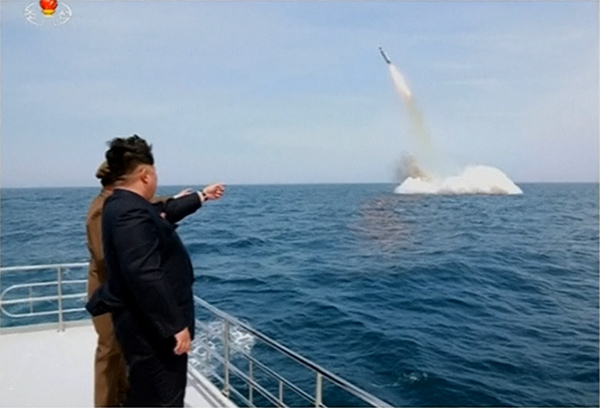
1104Kim Jong Un, the “Supreme Leader” of North Korea, supervises the April 22 test-launch of a missile from a submerged platform. (Image source: KCNA)

What gave the “faked” test story some prominence were the misunderstood remarks of the Vice Chairman of the Joint Chiefs of Staff, Admiral James Winnefeld. He had said, on May 19, that the North Korean missile launch was “not all” that North Korea said it was. He also mentioned that North Korea used clever video editors to “crop” the missile test-launch images. Apparently, that was exactly what the editors did. The Admiral, however, never claimed in his speech at the Center for Strategic and International Studies there had been no successful missile test.[4]

The same day, a high-ranking State Department official, Frank Rose — Assistant Secretary of State for Arms Control, Verification, and Compliance — told a Korean security seminar on Capitol Hill that North Korea had successfully conducted a “missile ejection” test, but from an underwater barge rather than a submarine.[5]

To confuse matters further, additional pictures were released by the South Korean media to illustrate stories about the North Korean test. Those pictures, however, were of American missiles, which use both solid and liquid propellant; as a result, one photo showed a U.S. missile with a solid propellant smoke trail and one, from a liquid propellant, without a smoke trail. These photographs apparently befuddled Reuters’ “experts,” who may have jumped to the conclusion that the photos of the North Korean test were “faked,” when they were simply of entirely different missile tests, and had been used only to “illustrate” ocean-going missile launches and not the actual North Korean test.[6]

According to Uzi Rubin, to achieve the capability to eject a missile from an underwater platform is a significant technological advancement. The accomplishment again illustrates “that rogue states such as North Korea can achieve military capabilities which pose a notable threat to the United States and its allies.”

Rubin also stated that the North Korean underwater launch test was closely related to the development of a missile-firing submarine, “a first step in achieving a very serious and dangerous new military capability.”[7]

Admiral Winnefeld and Secretary Rose, in their remarks, confirmed that the North Korean test was not the “dog and pony show” some have claimed. In other words, the U.S. government has officially confirmed that the North Koreans have made a serious step toward producing a sea-launched ballistic missile capability.

While such an operational capability may be “years away,” Rubin warns that “even many years eventually pass, and it will also take many years to build up the missile defenses, so we had better use the time wisely.”[8]

Will diplomacy succeed in stopping the North Korean threats? U.S. Secretary of State John Kerry seemed to think it worth a try; so he began the push to restart the old 2003 “six-party” talks between the United States, North Korea, Russia, China, South Korea and Japan, to bring North Korea’s nuclear weapons under some kind of international control and eventual elimination.

After all, supporters of such talks claim, similar talks with Iran appear to be leading to some kind of “deal” with Tehran, to corral its nuclear weapons program, so why not duplicate that effort and bring North Korea back into the non-nuclear fold?

What such a “deal,” if any, with Iran, will contain, is at this point unknown. Celebrations definitely seem premature. If the “deal” with North Korea is as “successful” as the P5+1’s efforts to rein in Iran’s illegal nuclear weapons program, the prognosis for the success of diplomacy could scarcely be more troubling.

Bloomberg’s defense writer, Tony Carpaccio, reflecting Washington’s conventional wisdom, recently wrote that of course China will rein in North Korea’s nuclear program: “What might be a bigger preventative will be the protestations of China, North Korea’s primary trade partner and only prominent international ally. Making China angry would put an already deeply impoverished, isolated North Korea in even more dire straits.”

Unfortunately, no matter how attractive a strategy of diplomatically ending North Korea’s nuclear program might look on the surface, it is painfully at odds with China’s established and documented track record in supporting and carrying out nuclear proliferation with such collapsed or rogue states as Iran, Syria, Pakistan, North Korea and Libya, as detailed by the 2009 book The Nuclear Express, by Tom C. Reed (former Secretary of the Air Force under President Gerald Ford and Special Assistant to the President of National Security Affairs during the Ronald Reagan administration) and Daniel Stillman (former Director of the Lawrence Livermore National Laboratory).

Far from being a potential partner in seeking a non-nuclear Korean peninsula, China, say the authors, has been and is actually actively pushing the spread of nuclear weapons to rogue states, as a means of asserting Chinese hegemony, complicating American security policy and undermining American influence.

The problem is not that China has little influence with North Korea, as China’s leadership repeatedly claims. The problem is that China has no interest in pushing North Korea away from its nuclear weapons path because the North Korean nuclear program serves China’s geostrategic purposes.

As Reed and Stillman write, “China has been using North Korea as the re-transfer point for the sale of nuclear and missile technology to Iran, Syria, Pakistan, Libya and Yemen”. They explain, “Chinese and North Korean military officers were in close communication prior to North Korea’s missile tests of 1998 and 2006”.

Thus, if China takes action to curtail North Korea’s nuclear program, China will likely be under pressure from the United States and its allies to take similar action against Iran and vice versa. China, however, seems to want to curry favor with Iran because of its vast oil and gas supplies, as well as to use North Korea to sell and transfer nuclear technology to both North Korea and Iran, as well as other states such as Pakistan. As Reed again explains, “China has catered to the nuclear ambitions of the Iranian ayatollahs in a blatant attempt to secure an ongoing supply of oil”.

North Korea is a partner with Iran in the missile and nuclear weapons development business, as Uzi Rubin has long documented. Thus, it is reasonable to believe that China may see any curtailment of North Korea’s nuclear program as also curtailing Iran’s access to the same nuclear technology being supplied by North Korea. Any curtailment would also harm the Chinese nuclear sales business to Iran and North Korea, especially if China continues to use the “North Korea to Iran route” as an indirect means of selling its own nuclear expertise and technology to Iran.

It is not as if Chinese nuclear proliferation is a recent development or a “one of a kind” activity. As far back as 1982, China gave nuclear warhead blueprints to Pakistan, according to Reed. These findings indicate that China’s nuclear weapons proliferation activities are over three decades old.[9]

Reed and Stillman also note that nearly a decade later, China tested a nuclear bomb “for Pakistan” on May 26, 1990, and that documents discovered in Libya when the George W. Bush administration shut down Libyan leader Muammar Kaddafi’s nuclear program revealed that China gave Pakistan the CHIC-4 nuclear weapon design.

Unfortunately, China’s nuclear assistance to Pakistan did not stay just in Pakistan. The nuclear technology made its way from Pakistan to North Korea. For example, high explosive craters, construction of a 50 megawatt nuclear reactor (finished in 1986) and a secret reprocessing facility begun in 1987 all were done in North Korea with major Pakistani help from the A.Q. Khan “Nukes R Us” smuggling group, as Reed and Stillman document in their book.

Reed and Stillman write that when, amid disclosures in 2003 of a major Libyan nuclear weapons program, the U.S. government sought help in shutting down the Khan nuclear smuggling ring, “Chinese authorities were totally unhelpful, to the point of stonewalling any investigation into Libya’s nuclear supply network.”

More recently, Chinese companies have now twice — in 2009 and 2011 — been indicted by the Attorney for the City of New York for trying to provide Iran with nuclear weapons technology.

The indictments document that Chinese companies were selling Iran steel for nuclear centrifuges and other banned technology. A leaked State Department cable, discussing the indictments at the time, revealed “details on China’s role as a supplier of materials for Iran’s nuclear program,” and that “China helped North Korea ship goods to Iran through Chinese airports.”

And more recently, in April 2015, the Czech government interdicted additional nuclear technology destined for Iran — the origin of which remains unknown — in violation of current sanctions against Iran.

From 1982 through at least the first part of 2015, the accumulation of documentary evidence on nuclear proliferation reveals two key facts:

First, despite literally hundreds of denials by Iran that it is seeking nuclear weapons, and amid current negotiations to end Iran’s pursuit of nuclear weapons, there is solid evidence that Iran still seeks nuclear weapons technology; and that North Korea has nuclear weapons and is advancing their capability.

Second, China continues to transfer, through its own territory, nuclear weapons technology involving both North Korea and Iran.

Although the Chinese profess to be against nuclear proliferation, their track record from the documented evidence illustrates just the opposite.

In summary, it is obvious North Korea’s nuclear weapons and ballistic missiles are a serious threat to America and its allies. And China, from its proliferation record for the past three decades, is making such a threat more widespread.

In this light, is dismissing North Korea’s advances in military technology and ignoring China’s record of advancing its neighbors’ nuclear weapons technology really best for U.S. interests?

_______________________

[1] The Washington Post, May 20, 2015, Anna Fifield, “North Korea says it has technology to make mini-nuclear weapons“; and Admiral Bill Gortney, US NORAD Commander, quoted in “NORAD commander: North Korean KN-08 Missile Operational“, by Jon Harper, in “Stars and Stripes”, of April 7, 2015; the Admiral said: “Our assessment is that they have the ability to put a nuclear weapon on a KN-08 and shoot it at the homeland.” He said “Yes sir” when asked if the U.S. thinks North Korea has succeeded in the complicated task of miniaturizing a warhead for use on such a missile. North Korea has conducted three nuclear tests since 2006.

[2] Department of Defense Press Briefing by Admiral Cecil Haney, Commander, U.S. Strategic Command, March 24, 2015.

[3] Personal communication with Uzi Rubin, President of Rubincon, May 21, 2015.

[4] Admiral James Winnefeld, Remarks at the Center for Strategic and International Studies (CSIS) Briefing on Missile Defense, May 20, 2015.

[5] U.S. Department of State, Daily Digest Bulletin, Frank Rose, Remarks on “Missile Defense and the U.S. Response to the North Korean Ballistic Missile and WMD Threat”, May 20, 2015.

[6] Explanation provided by Israel missile expert Uzi Rubin, personal communication, May 20, 2015.

[7] Ibid.

[8] Ibid.

[9] According to Reed and Stillman, in “The Nuclear Express,” none of China’s nuclear help to Pakistan and Iran could have been possible without China’s transfer of the nuclear technology through Chinese airspace.

Israel’s Druze dilemma: To arm imperiled Syrian Druze community or open door to a flood of refugees

June 11, 2015

Israel’s Druze dilemma: To arm imperiled Syrian Druze community or open door to a flood of refugees, DEBKAfile, June 11, 2015

Druze_MilitiaSyrian Druze militiaman

Israel has a unique, historic commitment to its Druze citizens and so the dangers besetting more than half a million of their Syrian brethren on Jabal Druze, 88 km from its border, and 38 km from Jordan, confronts the Netanyahu government with a grave dilemma. Israeli Druze leaders are pressing the government to provide Jabal Druze towns and villages with weapons for their defense against the enemies closing in on them: The Syrian-Hizballah army; the Syrian opposition coalition including the Nusra Front – now in control of large parts of southern Syria; and the Islamic State of Iraq and the Levant – ISIS, which has sent a small force up to the eastern approaches to the mountain.

At a reception for the visiting Chairman of the Joint US Chiefs of Staff, Gen. Martin Dempsey Wednesday, June 10, President Reuven Rivlin said: What is going on just now is intimidation and threat to the very existence of half a million Druze on the Druze Mount, which is very close to the Israeli border.”

Officials in the Pentagon denied that this issue had come up in Gen. Dempsey’s talks during his farewell visit to Israel this week, although Syria had been discussed. One official remarked: “It’s the Druze who are asking everyone to arm them. The Druze in Israel have been raising it with Israel with the US, with Jordan – everyone.”

DEBKAfile’s military sources note that this dilemma is the hardest Israel has faced since the Syrian conflict began more than four years ago. Sending arms to the Syrian Druze would mean abandoning the consistent policy of abstaining from direct involvement in that war. It would moreover entail setting up new machinery for establishing, training and arming a Druze army of 20,000 to 30,000 fighting men.

But by withholding support, Israel would make itself responsible for whatever befalls the beleaguered Syrian Druze community, including possibly mass executions by Islamic extremists for their unique faith.

Also taken into account is the proposal Tehran, Damascus and Hizballah put before the Druzes this week: to build them an army and provide it with weapons, against a pledge never to raise arms against Syrian President Bashar Assad or his troops.

No other strings were tied to the offer. The Druze army would not be given any tasks other than to defend Jabal Druze and its hundreds of small towns and villages.

Druze acceptance of Tehran’s proposition would have the effect of strengthening Iran’s hold on Damascus and weakening the Syrian opposition forces fighting in the south, with no guarantees about where this equation would end up in terms of new threats to Israeli security.

Prime Minister Binyamin Netanyahu, Defense Minister Moshe Ya’alon and IDF Chief of Staff, Lt. Gen. Gady Eisenkott, are being intensely lobbied by the leaders of Israel’s Druze community, some of them high-ranking officers in IDF and Border Police units, to come to the aid of their distressed Syrian brethren. They hold up their valuable contribution to the Jewish state’s national security as deserving of Israel’s reciprocation to step up when their community is in peril.

No one is saying this, but the awareness is there that the many Druzes serving in Israeli combat units may decide to simply cross the Golan border and take up arms in defense of Jabal Druze.

The Syria community’s plight is complicated by the sharp internal division among its leaders: One group urges taking up the Iranian offer; a second would rather join forces with the Syrian rebels; and a third, wants to stick to their long-held neutrality in the Syrian arena.

The Lebanese Druze leader Walid Jumblatt, once accepted as such by the entire community, urges Jabal Druze inhabitants to throw in their lot with the rebel groups fighting to topple Assad.

Some Druze sources claim that Israel has promised admission to any fleeing Druze reaching the Golan border fence, an assurance also offered by Jordan. This is not confirmed by any official in either government.

However, it is hard to see how Israel can bar its border if thousands of Druze refugees were to stand at the fence and demand shelter – any more than Jordan could. This may still happen – even if Jerusalem and Amman were to decide to supply the Syrian Druzes with weapons.

Syria Asks IAEA for Help Converting Nuclear Reactor

June 8, 2015

Syria Asks IAEA for Help Converting Nuclear Reactor, Jewish Press, Hana Levi JulianJune 8, 2015

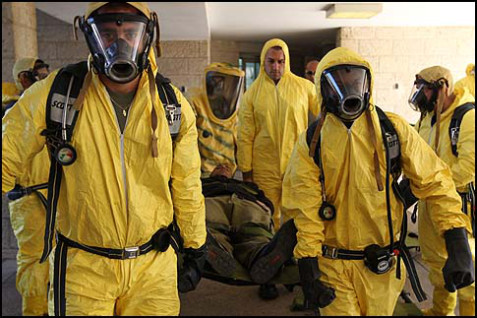
The border police run an exercise, while they train for chemical , biological or atomic. warfare. Feb 14 2011.  Photo by Nati Shohat/Flash90. *** Local Caption *** îâá éøåùìéí  àéîåï àáë çìéôåú îéâåï àéîåï úéøâåì úøâéì Israeli’s Border Police training for chemical, biological, and nuclear attacks. Photo Credit: Nati Shohat / Flash 90

IAEA head Yukiya Amano told reporters Monday that Syria has told the agency it would ship the higher-grade uranium abroad.

However, it is not clear where Syria would ship the higher-grade uranium — Iran is Syria’s closest ally – and neither is it clear what grade its uranium currently is.

**********************

The regime of Syrian President Bashar al-Assad has asked the United Nations International Atomic Energy Agency for help with a nuclear reactor near Damascus, international media agencies reported Tuesday.

The UN agency is studying the Syrian request to help convert the reactor, which currently runs on highly-enriched uranium, into one that uses lower grade nuclear fuel.

IAEA head Yukiya Amano told reporters Monday that Syria has told the agency it would ship the higher-grade uranium abroad.

However, it is not clear where Syria would ship the higher-grade uranium — Iran is Syria’s closest ally – and neither is it clear what grade its uranium currently is.

Low enriched uranium is defined as that which is enriched to less than five percent of fissile purity. Weapons quality uranium is enriched above 20 percent but that which is used to fuel an atomic bomb is enriched to 90 percent.

Amano said the IAEA is studying the request and has yet to make a decision.

Russia said abandoning Assad as Syria regime collapses further

May 31, 2015

Russia said abandoning Assad as Syria regime collapses further, YNet News, Roi Kais, May 31, 2015

The report also quoted Syrian opposition sources as saying that Hezbollah and Iranian military experts have left Assad’s war room in Damascus, along with Russian experts.

*********************

Asharq Al-Awsat says Moscow has pulled military experts from Assad’s war room in Damascus, evacuated non-essential personnel and stopped declaring there is no alternative to Assad.

Russia is pulling away from its relationship with embattled Syrian President Bashar Assad and withdrawing key personnel from Damascus, the London-based Arabic newspaper Asharq Al-Awsat reported Sunday, citing senior Gulf and Western officials.

“The Kremlin has begun to turn away from the regime,” the newspaper said.

The report also quoted Syrian opposition sources as saying that Hezbollah and Iranian military experts have left Assad’s war room in Damascus, along with Russian experts.

There have been increasing signs in recent days that the Assad regime is disintegrating, four years into the civil war that has engulfed Syria. Last week, the Syrian president lost control of another province, which comes on the heels of previous reports that Islamic State already controls more than 50% of the country.

According to the same Gulf and Western sources, the change in the Russian position takes place against the backdrop of negotiations between the Gulf states and Moscow, a Russian response to economic sanctions imposed on it due to the war in Ukraine.

Syrian opposition sources told Asharq that Russia has evacuated 100 of its senior officials and their families from Syria via the airport in Latakia. They said that those leaving include experts who worked in the war room in Damascus, along with the Iranian experts and Hezbollah officials. According to the report, they have not been replaced.

Putin and AssadPutin and Assad. Allies no more. (Photos: EPA and AFP)

On Thursday, Russia confirmed that an Ilyushin II-76 aircraft took 66 Syrian nationals from Latakia to Moscow airport, as well as a number of citizens from other countries, and at the same time delivered humanitarian aid to the war-torn country. Russia has remained silent on removal of the military experts.

According to Asharq al-Awsat, Russia has in the last three months also cut down the number of employees at its embassy in Damascus, leaving only essential staff. Opposition forces have also claimed that Russia has not been abiding by the maintenance contracts with Syria for the Sukhoi aircraft, leading to a rare visit to Tehran last month by Syrian Defense Minister Fahd Jassem al-Freij, who was forced to ask Iran to intervene with Russia on this matter.

The newspaper, which is notably supportive of the Saudi regime, also quoted an apparently surprising response by the head of the Russian delegation at a meeting last month, when asked by the Western Europe security chiefs for Moscow’s perspective on Syria’s future.

“What matters to Russia is maintaining its strategic interests and ensuring the future of the minorities, the unity of Syria and the struggle against extremists,” the delegation chief said. Western diplomatic sources at the meeting said the unprecedented statement brings to an ends years of the Russian official line that there is no alternative to Assad.

602610501001095640360noThe rebels draw closer to Latakia (Photo: Reuters)

At the same time, there have been growing Arab media reports of a more serious dialogue than ever before between Russia and the United States on an agreement regarding the crisis in Syria. The Lebanese newspaper Al-Nahar quoted diplomatic sources in Geneva on Sunday as saying that the two sides are seeking an arrangement that will take into account the interests of regional and international parties, in particular Turkey, Iran and the Gulf states.

On Thursday, senior diplomatic sources told Al-Hayat that there has been a noticeable change in the Russian position toward Syria that Moscow is for the first time willing to discuss with the Americans the exact details of a transition period for the country, and even raise the names of individual military and political officials to oversee it.

Another sign of Assad’s difficulties comes from the Turkish news agency Anatolia, which cited opposition sources as saying that after four years of war, the regime controls less than 8% percent of the country’s oil and gas fields, while Islamic State controls more than 80% percent.


Behind the Lines: Hezbollah – Born in Lebanon, dying in Syria?

May 30, 2015

Behind the Lines: Hezbollah – Born in Lebanon, dying in Syria? Jerusalem PostJonathan Spyer, May 30, 2015

(Please see also, Iran weighs turning Hizballah’s anti-Israel missiles against ISIS to save Damascus and Baghdad. — – DM)

Hezbolla1Hassan Nasrallah talks to his Lebanese and Yemeni supporters via a giant screen during a speech against US-Saudi aggression in Yemen, in Beirut’s southern suburbs on April 17.. (photo credit:REUTERS)

With the minority communities that formed the core of Assad’s support no longer willing or able to supply him with the required manpower, the burden looks set to fall yet further onto the shoulders of Assad’s Lebanese friends.

What this is likely to mean for Hezbollah is that it will be called on to deploy further and deeper into Syria than has previously been the case.

The Israeli assessment is that with its hands full in Syria, Hezbollah will be unlikely to seek renewed confrontation with Israel.

**********************

The latest reports from the Qalamoun mountain range in western Syria suggest that Hezbollah is pushing back the jihadis of Jabhat al-Nusra and Islamic State.

The movement claims to have taken 300 square kilometers from the Sunni rebels.

The broader picture for the Shi’ite Islamists that dominate Lebanon, however, is less rosy.

The Iran-led alliance of which Hezbollah is a part is better-organized and more effectively commanded than its Sunni rivals. The coalition’s ability to marshal its resources in a centralized and effective way is what has enabled it to preserve the Assad regime in Syria until now.

When President Bashar Assad was in trouble in late 2012, an increased Hezbollah mobilization into Syria and the creation by Iran of new, paramilitary formations for the regime recruited from minority communities was enough to turn the tide of war back against the rebels by mid-2013.

Now, however, the numerical advantage of the Sunnis in Syria is once more reversing the direction of the war.

With the minority communities that formed the core of Assad’s support no longer willing or able to supply him with the required manpower, the burden looks set to fall yet further onto the shoulders of Assad’s Lebanese friends.

What this is likely to mean for Hezbollah is that it will be called on to deploy further and deeper into Syria than has previously been the case.

In the past, its involvement was largely confined to areas of particular importance to the movement itself. Hezbollah fought to keep the rebels away from the Lebanese border, and to secure the highways between the western coastal areas and Damascus.

The movement’s conquest of the border town of Qusair in June 2013, for example, formed a pivotal moment in the recovery of the regime’s fortunes at that time.

But now, Hezbollah cannot assume that other pro-regime elements will hold back the rebels in areas beyond the Syria-Lebanese frontier.

This means that the limited achievement in Qalamoun will prove Pyrrhic, unless the regime’s interest can be protected further afield.

Hezbollah looks set to be drawn further and deeper into the Syrian quagmire.

Movement Secretary-General Hassan Nasrallah acknowledged this prospect in his speech last Sunday, marking 15 years since Israel’s withdrawal from southern Lebanon.

In the talk, Nasrallah broadened the definition of Hezbollah’s engagement in Syria.

Once, the involvement was expressed in limited sectarian terms (the need to protect the tomb of Sayyida Zeinab in Damascus from desecration).

This justification then gave way to the claimed need to cross the border precisely so as to seal war-torn Syria off from Lebanon and keep the Sunni takfiris (Muslims who accuse other Muslims of apostasy) at bay.

On Sunday, Nasrallah struck an altogether more ambitious tone. Hezbollah, he said, was fighting alongside its “Syrian brothers, alongside the army and the people and the popular resistance in Damascus and Aleppo and Deir al-Zor and Qusair and Hasakeh and Idlib. We are present today in many places, and we will be present in all the places in Syria that this battle requires.”

The list of locations includes areas in Syria’s remote north and east, many hundreds of kilometers from Lebanon (Hasakeh, Deir al-Zor), alongside regions previously seen as locations for the group’s involvement.

Nasrallah painted the threat of Islamic State in apocalyptic terms, describing the danger represented by the group as one “unprecedented in history, which targets humanity itself.”

This language fairly clearly appears to be preparing the ground for a larger and deeper deployment of Hezbollah fighters into Syria. Such a deployment will inevitably come at a cost to the movement; only the starkest and most urgent threats of the kind Nasrallah is now invoking could be used to justify it to Hezbollah’s own public.

The problem from Hezbollah’s point of view is that it too does not have inexhaustible sources of manpower.

The movement has lost, according to regional media reports, around 1,000 fighters in Syria since the beginning of its deployment there. At any given time, around 5,000 Hezbollah men are inside the country, with a fairly rapid rotation of manpower. Meanwhile, Hezbollah’s entire force is thought to number around 20,000 fighters.

Faced with a task of strategic magnitude and ever-growing dimensions in Syria, there are indications the movement is being forced to cast its net wider in its search for manpower.

A recent report by Myra Abdullah on the Now Lebanon website (associated with anti-Hezbollah elements in Lebanon) depicted the party offering financial inducements to youths from impoverished areas in the Lebanese Bekaa, in return for their signing up to fight for Hezbollah in Syria.

Now Lebanon quoted sums ranging from $500 to $2,000 as being offered to these young men in return for their enlistment.

Earlier this month, Hezbollah media eulogized a 15-yearold youth, Mashhur Shams al-Din, who was reported as having died while performing his “jihadi duties” (the term usually used when the movement’s men are killed in Syria).

All this suggests that Hezbollah understands a formidable task lies before it, and that it is preparing its resources and public opinion for the performance of this task.

As this takes place, Hezbollah seems keen to remind its supporters and the Lebanese public of the laurels it once wore in the days when it fought Israel.

The pro-Hezbollah newspaper As-Safir recently gained exclusive access to elements of the extensive infrastructure the movement has constructed south of the Litani River since 2006. The movement’s Al-Manar TV station ran an (apparently doctored) piece of footage this week purporting to show Hezbollah supporters filming a Merkava tank at Mount Dov. Nasrallah, in his speech, also sought to invoke the Israeli enemy, declaring Islamic State was “as evil” as Israel.

The Israeli assessment is that with its hands full in Syria, Hezbollah will be unlikely to seek renewed confrontation with Israel.

It is worth noting, nevertheless, that a series of public statements in recent weeks from former and serving Israeli security officials have delivered a similar message regarding the scope and depth of the Israeli response, should a new war between Hezbollah and Israel erupt.

Israel Air Force commander Maj.-Gen. Amir Eshel, former IAF and Military Intelligence head Maj.-Gen. (res.) Amos Yadlin, former national security adviser Maj.-Gen. (res.) Giora Eiland and other officials speaking off the record expressed themselves similarly in this regard.

Hezbollah plainly has little choice regarding its deepening involvement in Syria, Nasrallah’s exhortations notwithstanding.

The organization is part of a formidable, if now somewhat overstretched regional alliance, led by Iran.

This alliance regards the preservation of the Assad regime’s rule over at least part of Syria as a matter of primary strategic importance.

Hezbollah and the Shi’ites it is now recruiting are tools toward this end. It would be quite mistaken to underestimate the efficacy of the movement; it is gearing up for a mighty task, which it intends to achieve. Certainly, many more Hezbollah men will lose their lives before the fighting in Syria ends, however it eventually does end.

Given the stated ambitions of the movement regarding Israel and the Jews, it is fair to say this fact will be causing few cries of anguish south of the border.

Hezbollah Prepares

May 28, 2015

Hezbollah Prepares, Power LineScott Johnson, May 28, 2015

[T]he Israelis will have to mobilize massive force to shorten the duration of a future war. One of the things they’ll do is immediately is move to eliminate as much of Hezbollah’s vast arsenal as possible. Hezbollah is counting on the resulting deaths of their human shields – and they’ve guaranteed to that the body count will be significant – to turn Israel into an international pariah.

************************

There is so much bad news coming out of the Middle East that it is hard to keep up. Omri Ceren writes from The Israel Project to fill us in on a preview of coming attractions featuring the proxy forces of President Obama’s Iranian friends. Where precisely does Hezbollah fit in Obama’s vision of Iran as a friendly regional power? Too bad Jeffrey Goldberg didn’t riddle Obama that particular question.

This is Omri’s email message verbatim, complete with the URLs of footnoted stories. I thought that readers who have found Omri’s reports helpful might find this of interest as well:

Variations of this story have been bouncing around for the last few weeks. Two weeks ago there were major recent pieces in the NYT and AP articles, where journalists got to look at IDF aerial photography showing that Hezbollah has moved the vast majority of its military infrastructure into Shiite villages [1][2]. They’ve taken their arsenal – 100,000+ rockets including Burkan rockets with half-ton warheads, ballistic missiles including Scud-Ds that can hit all of Israel, supersonic advanced anti-ship cruise missiles, anti-aircraft assets, drones and mini drones, tunnels, etc. – and embedded it across hundreds of villianges and probably thousands of homes.

The Syrian war has been good for Hezbollah in that respect. They’ve cleaned out Assad’s depots and brought the goods back to Lebanon.

The Israelis can’t afford a war of attrition with Hezbollah. The Iran-backed terror group has the ability to saturation bomb Israeli civilians with 1,500 projectiles a day, every day, for over two months. They will try to bring down Tel Aviv’s skyscrapers with ballistic missiles. They will try to fly suicide drones into Israel’s nuclear reactor. They will try to detonate Israel’s off-shore energy infrastructure. They will try to destroy Israeli military and civilian runways. And – mainly but not exclusively through their tunnels – they will try to overrun Israeli towns and drag away women and children as hostages. Israeli casualties would range in the thousands to tens of thousands.

And so the Israelis will have to mobilize massive force to shorten the duration of a future war. One of the things they’ll do is immediately is move to eliminate as much of Hezbollah’s vast arsenal as possible. Hezbollah is counting on the resulting deaths of their human shields – and they’ve guaranteed to that the body count will be significant – to turn Israel into an international pariah. But the Israelis can’t let Hezbollah level their entire country with indiscriminate rocket fire and advanced missiles, just because no one in Lebanon is willing or able to expel the group from Shiite villages.

This weekend’s round of stories actually came from Hezbollah’s side. As-Safir – a Lebanese daily and a major Hezbollah mouthpiece – published a series of puff pieces about how Hezbollah has turned all of southern Lebanon into a vast military complex. I’ve pasted the full AP/TOI write-up at the bottom [omitted here, [a href=”http://www.timesofisrael.com/hezbollah-flaunts-advanced-tunnel-network-on-israeli-border/”>this is the story], but it’s what you’d expect:

According to the reports, based on a tour of Hezbollah facilities given to the newspaper, the group has built a sprawling underground array of tunnels, bunkers and surveillance outposts along the border with Israel, which it is manning at peak readiness for battle. The tunnels are said to be highly-advanced, with durable concrete, a 24-hour power supply via underground generators, a ventilation system to prevent damp from damaging military equipment and a web of secondary escape shafts in case of attack. The tunnels are said to be housing tens of thousands of rockets ready for launch, themselves wrapped in protective materials in order to preserve them.

None of this is new. In early 2013 veteran Israeli war correspondent Ron Ben-Yishai did a deep dive into Hezbollah military posture [3]. He revealed among other things that Hezbollah had given away thousands of homes to poor Shiite families, on the condition “that at least one rocket launcher would be placed in one of the house’s rooms or in the basement, along with a number of rockets, which will be fired at predetermined targets in Israel when the order is given.” Then in 2014 air force chief Major-General Amir Eshel gave a speech outlining how Hezbollah has embedded its military assets in “thousands” of residential buildings, emphasizing that Israel would have no choice but to target that infrastructure in a war. Reuters picked up the speech under the headline “Hoping to deter Hezbollah, Israel threatens Lebanese civilians” [4].

But there’s a lot of chatter in the Middle East about a summer war between Israel and Lebanon, so you’re seeing a new round of stories about what it might look like. On one hand the Israelis and Hezbollah are saying the same thing: all of southern Lebanon is now one big military compound. But only the Israelis are pointing out that Hezbollah has made sure that in that compound there are tens of thousands of civilians.

[1] http://www.nytimes.com/2015/05/13/world/middleeast/israel-says-hezbollah-positions-put-lebanese-at-risk.html
[2] http://hosted.ap.org/dynamic/stories/M/ML_ISRAEL_HEZBOLLAH?SITE=AP&SECTION=HOME&TEMPLATE=DEFAULT&CTIME=2015-05-13-14-10-05
[3] http://www.ynetnews.com/articles/0,7340,L-4343397,00.html
[4] http://www.reuters.com/article/2014/01/29/us-israel-lebanon-hezbollah-idUSBREA0S1PS20140129

Assad pulls air force out of Deir ez-Zour, the third Syrian air base surrendered to ISIS

May 27, 2015

Assad pulls air force out of Deir ez-Zour, the third Syrian air base surrendered to ISIS, DEBKAfile, May 27, 2015

ISIS__fighting__between_Homs_and_Palmyra_27.5.15ISIS in combat between Homs and Palmyra

Just a week after losing the big Palmyra air base to the Islamic State – and with it large stocks of ammo and military equipment – Syrian military and air units Wednesday, May 27, began pulling out of the big air base at Deir ez-Zour. This was Bashar Assad’s last military stronghold in eastern Syria and the last air facility for enabling fighter-bombers to strike ISIS forces in northeastern Syria and the western Iraqi province of Anbar.

His surrender of the Deir ez-Zour base is evidence that the Syrian president has run out of fighting strength for defending both his front lines and his air bases. He is also too tied down to be able to transfer reinforcements from front to front. He is therefore pulling in the remnants of his army from across the country for the defense of the capital, Damascus.

DEBKAfile’s military sources report that the Islamic State now has in its sights the Syrian army’s biggest air facility, T4 Airbase, which is located on the fast highway linking Homs with Damascus 140 km away.

It is home base for the bulk of the air force’s fighters and bombers. In its hangars are an estimated 32 MiG-25 fighters, as well as smaller numbers of MiG-25PDS interceptors, designed for combat with the Israeli air force, MiG-25RBT bombers-cum-surveillance planes; MiG-25PU trainers, which are routinely used to strike rebel forces in crowded built-up areas, and advanced MiG-29SM fighter jets.

Stationed there too are 20 advanced Su-24M2 bombers, the strategic backbone of the Syrian air force.

T4 Airbase also holds the largest Syrian stocks of guided bombs, air-to-air and air-to-ground missiles.

In the last few hours, air crews have been frantically removing these warplanes from T4 and distributing them among smaller bases in central Syria, at the cost of their operational effectiveness.

In the space of a week, therefore, Bashar Assad has lost three of his major air bases, including Palmyra, where Iranian and Russian air freights had been landing regularly with fresh supplies of ordnance and spare parts for his army.

Our military experts say that this bonanza frees ISIS to cut off the eastern, northern and central regions from the capital, and deprive the Syrian and Hizballah units battling for control of the Qalamoun Mts of air support against rebel and Islamist forces.

If they manage to take T4 as well, the Islamists will be able to prevent US jets from taking off for strikes against them in Syria, or bombing the their forces which have seized long stretches of the fast highway from Homs to Damascus.

Op-Ed: Every Day is “Opposite Day” with President Barack Obama

May 26, 2015

Op-Ed: Every Day is “Opposite Day” with President Barack Obama, Israel National News, Mark Langfan, May 26, 2015

In sum, either Obama is, at best, a Middle-east policy ignoramus or, at worst, an Iranian stooge. If Obama rolled dice to make his Middle-East decisions, he’d have a better average than his current total Middle-East failure on every issue.  So, chances are he is not intending his Middle-East policies to bring peace, but instead planning them to bring war and sow the violence, death and destruction that they have predictably brought.

**********************

Obama has done exactly the opposite of what should be done in the Middle East for his entire term. Israel had better ignore his advice.

Following Obama’s speeches is like watchingSesame Street’s “Opposite Day”, the Sesame Street episode where everything is “opposite.”  ‘Up’ is ‘down,’ ‘left’ is ‘right,’ and so on and so forth.  It’s like Berra saying “It’s deja vu all over again.”

With Obama, for the past seven years, every day is “Opposite Day.”  Everything he says sounds upside-down and backwards, and is proven, in the short-term, to be just that.  Instead of being chastened by reality, Obama blithely still talks-the-talk like he’s reading off the Holy Grail.

Take Obama’s latest upside-down and backwards ‘Opposite-Day’ statement: “I continue to believe a two-state solution is absolutely vital for not only peace between Israelis and Palestinians, but for the long-term security of Israel as a democratic and Jewish state.”  Given Obama’s 0%batting average on Middle-East strategy, it safe to conclude that keeping the “West Bank” is vital for Israel’s security.

For starters, what Middle East policy has Obama gotten right in the last seven years?  Obama’s total retreat from Iraq that empowered Iranian-puppet al Maliki to castrate the Western Iraqi Sunnis that mutated into ISIS?  Obama’s bombing of Qaddafi, and setting North Africa into a ball of flames?  Obama’s toppling of Mubarak and coronation of the Muslim Brotherhood Sunni Islamic State of Egypt?  Obama’s green-lighting Iran to set Shiite Arab against Sunni Arab as he anoints Iran as a nuclear-threshold state, and gives $50 billion to further fund its Islamic “resistance” revolution?  Obama’s total protection of the genocidal Assad as he gasses Sunni Muslims to death?

Obama has made the wrong policy decision on every Middle Eastern issue, yet still speaks as if he’s the Middle-east guru.

The truth is Israel’s retention of the “West Bank” is vital not only for the peace and security of Israel, but also, most importantly, for the moderate Arabs who bathe in the warmth of Israel’s security envelope.  If Israel left the “West Bank”, forget about the resulting Hamastan that once concerned us, because the result would be an  ISIStan. Hamas will soon start asking Israel for protection from ISIS as that organization is beginning to attack it in Gaza.  And after Assad falls, and the Sunnis start really paying Hezbollah back for its genocide against the Syrian Sunnis, the Shiites of South Lebanon will have only one protector: Israel.

Was Israel’s retreat from Gaza good for Egypt?  No, it created a cancer that sent its Iranian-funded Islamic-bedlam to the Sinai, and then to Egypt-proper.  Israel’s “peace-process” regarding Gaza has enabled Hamas to turn the Palestinians of Gaza into cannon-fodder for the world press, and the World Court.  With Gaza’s failed-test-case, Obama’s claim that Israel repeat the same withdrawal from Judea and Samaria almost seems to present evidence of a malevolent intent to eradicate peace and security for Israel, and the moderate Arabs who are now protected by Israel.

And let us not forget Jordan.  Wouldn’t Jordan “love” an ISIStan state to its west?  The analogy is simple, a Hamastan Gaza is to Egypt what an ISIStan “West Bank” would be to Jordan—a formula for Jordan’s total disintegration.  As it is, Jordan’s King Abdullah is facing ISIS to the north and to the south. Jordan can be easily overrun, it hardly needs additional pressure along its western border, now protected by Israel.

In sum, either Obama is, at best, a Middle-east policy ignoramus or, at worst, an Iranian stooge. If Obama rolled dice to make his Middle-East decisions, he’d have a better average than his current total Middle-East failure on every issue.  So, chances are he is not intending his Middle-East policies to bring peace, but instead planning them to bring war and sow the violence, death and destruction that they have predictably brought.

If Obama says “up,” think “down;” and if he advises retreat from Judea and Samaria, Israel had better stay exactly where it is.

No army in Mid East is challenging ISIS. Iran regroups to defend S. Iraqi Shiites, Assad to save Damascus

May 25, 2015

No army in Mid East is challenging ISIS. Iran regroups to defend S. Iraqi Shiites, Assad to save Damascus, DEBKAfile, May 25, 2015

Baiji_22.5.15Iranian troops in fight to evict ISIS from Baiji refinery

Hassan Nasrallah Saturday, May 23, called his Lebanese Shiite Hizballah movement to the flag, because “we are faced with an existential crisis” from the rising belligerence of the Islamist State of Iraq and the Levant. His deputy, Sheik Naim Qssem, sounded even more desperate: “The Middle East is at the risk of partition” in a war with no end in sight, he said. “Solutions for Syria are suspended. We must now see what happens in Iraq.”

The price Iran’s Lebanese proxy has paid for fighting alongside Bashar Assad’s army for four years is cruel: some 1,000 dead and many times that number of wounded. Its leaders now understood that their sacrifice was in vain. ISIS has brought the Syrian civil war to a new dead end.

This week, a 15-year old boy was eulogized by Hizballah’s leaders for performing his “jihadist duty” in Syria.

Clearly, for their last throw in Syria, the group, having run out of adult combatants, is calling up young boys to reinforce the 7,000 fighting there.

The Syrian president Bashar Assad is in no better shape. He too has run dangerously short of fresh fighting manpower. Even his own Alawite community has let him down. Scarcely one-tenth of the 1.8 million Alawites have remained in Syria. Their birthrate is low, and those who stayed behind are hiding their young sons to keep them from being sent to the front lines.

Assad also failed to enlist the Syrian Druze minority to fight for his regime, just as Hizballah’s Nasrallah was rebuffed when he sought to mobilize the Lebanese army to their cause. This has left Hizballah and the Syrian ruler alone in the battlefield with dwindling strength against two rival foes:  ISIS and the radical Syrian opposition coalition calling itself Jaish al-Fatah – the Army of Conquest – which is spearheaded by Al Qaeda’s Nusra Front and backed to topple Assad by Saudi Arabia, Qatar and Turkey.

Nasrallah tried to paint a brave picture of full mobilization to expand the war to all parts of Syria. However, Sunday, May 24, a key adviser to Assad admitted that his regime and its allies were being forced to regroup.

Their forces were withdrawing from the effort to shift the Islamists from the land they have conquered – about three-quarters of Syrian territory – and concentrating on defending the cities, Damascus, Homs and Latakia, home to the bulk of the population, as well as the strategic Damascus highway to the coast and Beirut. Hizballah needed to build up the Lebanese border againest hostile access.

But Syrian cities, the Lebanese border and the highway are still under threat – from Syrian rebel forces.

The Iraqi army, for its part, has been virtually wiped out, along with the many billions of dollars the US spent on training and weapons. There is no longer any military force in Iraq, whether Sunni or Shiite, able to take on ISIS and loosen its grip on the central and western regions.

The Kurdish peshmerga army, to whom President Barack refused to provide armaments for combating the Islamists, has run out of steam. An new offensive would expose the two main towns of the semi-autonomous Kurdish Republic – the capital Irbil and the oil city of Kirkuk – to the depredations of the Islamist belligerents.

A quick scan of Shiite resources reveals that in the space between the Jordan River and the Euphrates and Tigris, Iran commands the only force still intact in Iraq – namely, the Iraqi, Afghan and Pakistani Shiite militias, who are trained and armed by the Revolutionary Guards.

This last remaining fighting force faces its acid test in the battle ongoing to recover Baiji, Iraq’s main oil refinery town. For the first time, Iranian troops are fighting in Iraq, not just their surrogates, but in the Baiji campaign they have made little headway in three weeks of combat. All they have managed to do is break through to the 100 Iraqi troops stranded in the town, but ISIS fighting strength is still not dislodged from the refinery.

The Obama administration can no longer pretend that the pro-Iranian Shiite militias are the panacea for the ISIS peril. Like Assad, Tehran too is being forced to regroup. It is abandoning the effort to uproot the Islamists from central and western Iraq and mustering all its Shiite military assets, such as the Badr Brigade, to defend the Shiite south – the shrine towns of Najef and Karbala, Babil (ancient Babylon) and Qadisiya – as well as planting an obstacle in the path of the Islamists to Iraq’s biggest oil fields and only port of Basra.

The Shiite militias flown in by Tehran from Pakistan and Afghanistan have demonstrated in Syria and Iraq alike that they are neither capable nor willing to jump into any battlefields.

The upshot of this cursory scan is that not a single competent army capable of launching all-out war on ISIS is to be found in the Middle East heartland – in the space between the 1,000km long Jordan and the Euphrates and Tigris to the east, or between Ramadi and the Saudi capital of Riyadh to the south.

By Sunday, May 24, this perception had seeped through to the West. US Defense Secretary Ashton Carter, remarked: “What apparently happened was that the Iraqi forces just showed no will to fight.” The former British army chief Lord Dannatt was more down to earth. Since the coalition air force campaign had failed to stop ISIS’s advance, he said “it was time to think the previously unthinkable” and send 5,000 ground troops to fight the Islamists in Syria and Iraq.

The next day, Monday, Tehran pointed the finger of blame for the latest debacles in Iraq at Washington. Al Qods Brigades chief Gen. Qassem Soleimani was quoted by the English language Revolutionary Guards mouthpiece Javan as commenting: “The US didn’t do a damn thing to stop the extremists’ advance on Ramadi.”

Cartoon of the day

May 25, 2015

(Tip of the hat to joopklepzeiker.– DM)

Historic sites