From Grief Over Kobane To Chaos: Istanbul’s Kurdish Riots, Vice News, October 30,2014
(Now Kurds in Turkey have a Marxist-Leninist martyr who was killed fighting the Islamic State in Kobane. — DM)
From Grief Over Kobane To Chaos: Istanbul’s Kurdish Riots, Vice News, October 30,2014
(Now Kurds in Turkey have a Marxist-Leninist martyr who was killed fighting the Islamic State in Kobane. — DM)
Time Is Running Out for Obama on Syria, Daily Beast, Jamie Dettmer, October 30, 2014
The idea that U.S.-backed Syrian rebels defeat ISIS and force Assad to the negotiating table has absolutely nothing to do with what’s happening on the ground.
Only two days ago, President Barack Obama’s envoy to the Syrian rebels, retired Marine Gen. John Allen, explained confidently that the U.S. would help to train and equip Western-backed fighters to become a credible force that would compel the Assad regime to negotiate a political deal and end the four-year-long civil war.Yeah. Right. The Obama administration’s plans have little or nothing to do with what is unfolding all too rapidly on the ground: Rebel brigades are demoralized, disintegrating, and fighting among themselves.The Americans and their allies are carrying out a desultory air campaign in Syria that appears focused on support for the Kurds. Meanwhile, President Bashar al-Assad’s forces maintain a withering air offensive of their own on rebels and civilians alike in northern Syria.
Last week in a 36-hour period, Assad’s air force launched 210 airstrikes, according to generally reliable opposition activists. That’s more than the entire American-led coalition has mounted in both Iraq and Syria since Sept. 22.
Brigades of secular fighters and relatively moderate Islamists are nearly encircled and their supply lines are threatened in the country’s second largest city, Aleppo. Assad’s forces in the northern Syrian city of Idlib, meanwhile, are moving from defense to offense. On Monday, they recaptured the governor’s mansion and police headquarters.
The rebels are squabbling among themselves as suspicions rage about American designs and intentions.
Clashes erupted this week between Islamist brigades aligned with the Syrian Revolutionaries Front and the al Qaeda affiliate Jabhat al-Nusra after the jihadists seized seven towns and villages in the Idlib countryside they previously controlled. And while U.S. officials may not shed a tear over the infighting between Islamists and jihadists—they have long urged rebel factions to distance themselves from the al Qaeda group—the infighting raises the risks that al Nusra may develop a rapprochement with rival ISIS militants, making it harder to “degrade and ultimately defeat” that group as Obama says he intends to do.
Al Nusra and ISIS, both spinoffs of al Qaeda, have been at war with each other since al Qaeda’s top leadership disavowed ISIS early this year. But there have been a series of meetings between al Nusra commanders and the leaders of other rebel groups to iron out differences, according to Abdul Rahman, a commander in the 3,000-strong Jaysh al-Mujahedeen or Army of Mujahedeen, an Islamist-leaning brigade that emerged from the villages and towns of the Aleppo countryside. “Al Nusra is particularly suspicious of the rebel brigades favored by the Americans who are getting weapons from Washington,” he says.
That includes the mainly secular Harakat Hazm (The Steadfast Movement), which has received TOW anti-tank missiles from the Obama administration. According to a senior State Department official, who spoke to The Daily Beast on condition of anonymity, it is the FSA-aligned militia most trusted by Washington.
Infighting has been a persistent problem in the FSA. In 2012 and 2013, jihadist groups emerged in northern Syria not least because their discipline attracted defections from both FSA and Islamist brigades.
In the absence of any over-arching rebel military leadership, there is no one to referee disputes before they get out of hand. The Supreme Military Command (SMC), which on paper is meant to oversee the FSA-aligned militias, is anything but supreme and rebel commanders on the ground ignore its orders.
Despite strenuous efforts by Washington and the Gulf States to try to boost the authority of the SMC, nothing has worked, much to the frustration of U.S. officials tasked with funneling aid and arms to more than 16 FSA-aligned brigades.
“We ignore the SMC,” a senior State Department official told The Daily Beast. “We would like to see a stronger SMC and a proper command structure. One that can act as a middleman on supplies so we don’t have to deal with commanders directly, which would help us to avoid being drawn into arguments.” But no such entity exists, so U.S. officials are inundated by grievances from rebel commanders, who complain this or that militia is getting more than they are.
The absence of command and control means there is only haphazard combat coordination on the ground. “There are hard-pressed commanders who are desperately in need of support and reinforcements and they can’t wait, but they don’t get help,” says the exasperated State Department official. “It’s the rebels’ job to fix this and to come to each other’s assistance promptly.”
While conceding their failure over the four-year-long civil war to fashion a coherent force, rebel commanders counter that U.S. neglect and Washington’s refusal to arm them with advanced weaponry deprived them of the leverage to discipline fighters and to keep them loyal and to halt defections to jihadist groups.
“Look,” said a commander with the Syrian Revolutionaries Front, “we don’t have shoulder-launched ground-to-air missiles, but the Islamic State does, thanks to the Iraqi army leaving them to be looted by the jihadists.”
Either way—rebel squabbling or U.S. neglect—the rebels the Obama administration wants to build up to be credible enough to force the Assad regime to the negotiating table look less convincing with each passing day.
The US War Against ISIS Is Barely Degrading, Certainly Not Destroying The Militants, International Business Times, Erin Banco , October 24, 2014
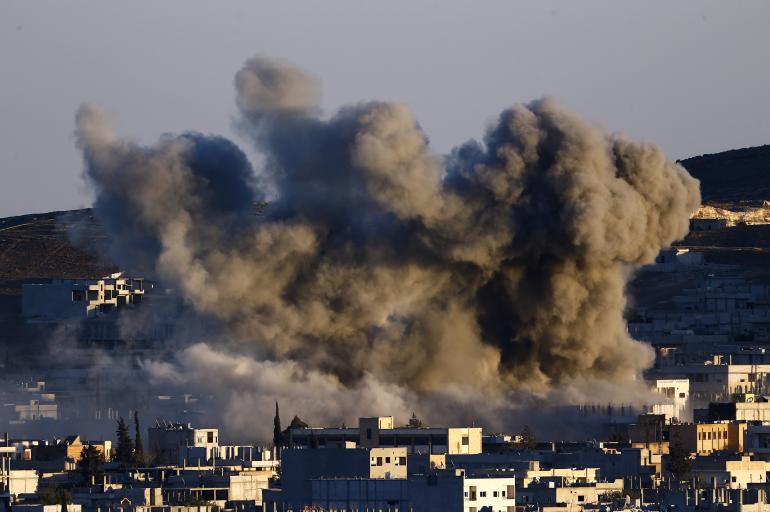 Smoke rises over Syrian town of Kobani after an airstrike, as seen from the Mursitpinar crossing on the Turkish border, Oct. 21, 2014. Reuters/Kai Pfaffenbach
The U.S.-led air campaign in Syria has killed 521 Islamic State fighters in the past month, according to the Syrian Observatory for Human Rights, a group monitoring the civil war. But the heavy death toll does not mean the United States is winning its fight to “degrade and destroy” the Sunni extremist group. Experts say that won’t happen until the group also known as ISIS loses support and its fighters begin defecting.
“Until that happens, we will not see a quantum shift in the war in Iraq and Syria,” said Wayne White, a former deputy director of the State Department’s Bureau of Intelligence and Research’s Office of Analysis for the Near East and South Asia.
Since June, ISIS has gained control of large swaths of land that stretch from Kobani on the Syrian-Turkish border to the outskirts of Baghdad. The group is currently waging campaigns in several different areas of both countries, but has focused its forces in recent weeks on capturing the Kurdish city of Kobani. As a result, the U.S.-led air campaign has targeted several ISIS convoys and strongholds in Kobani and is air-dropping weapons and other resources to the Syrian Kurds fighting there.
“Like many aerial campaigns you can cite from history, it is a gradual process,” White said. “ISIS has a finite number of heavy weapons, and they are being picked off. And ISIS is losing a lot of combatants that are not easily replaced. ISIS is driven to expand its domain, and every time it tries to expand it is putting its fighters out in the open where they can be taken out. The question is: How long will the degrading take until you get to the destruction … a long time.”
Witnesses on the ground in Kobani told International Business Times that ISIS had been pushed back from the center of the city, but that the fighting was still raging on the outskirts. Meanwhile, ISIS is making gains in other parts of Syria and in Baghdad. According to the Syrian Observatory, ISIS fighters seized Tal Shaer, a town just west of Kobani, this week. And in Baghdad, the Sunni militant group has claimed responsibility for several car and suicide bomb attacks that have killed dozens of people in the last two weeks.
The uptick in ISIS attacks since June in Iraq has not only caused hundreds of civilian deaths, but has also infiltrated the psyche of the Iraqi people, especially those living in the capital, Noof Assi, a woman from Baghdad, told the International Business Times.
At the beginning of the ISIS campaign, “Baghdad looked like a ghost city,” Assi said. “People were staying at home or fleeing, saving food and fuel.”
Now, she said, people in Baghdad are used to the ISIS insurgency. Discussions in shops, cafes and restaurants have shifted. No longer are Iraqis talking about the destruction that ISIS is inflicting on the country. Now, people are talking about how many people are beginning to support the militant group.
“There are people talking about people of Mosul,” she said of the big northern city. “Some people are saying that they betrayed Iraq and welcomed ISIS.”
The State Department and White House have both confirmed that part of the U.S. strategy to fight ISIS is to undercut its propaganda and recruitment, especially on social media. So far, though, the U.S. has not launched a successful countercampaign.
In September, the State Department produced and distributed a graphic mock Islamic State propaganda video via social media. The video, “Welcome to ISIS Land,” was published by the State Department’s Center for Strategic Counterterrorism Communications.
The mock video showed graphic images of the militant group committing war crimes that have been widely reported over the past two months and that are now being investigated by the United Nations. The video looks similar to those ISIS promotes on social media like Twitter and YouTube. Despite the counterpropaganda drive, ISIS continues to expand on social media, and more and more Western fighters, as well as Iraqi and Syrian civilians, are joining up.
While some experts say the only way the U.S. will defeat ISIS is by sending in ground troops, others say more credit should be given to the Syrian Kurdish fighters — who now seems to be only force on the ground in Iraq and Syria that is regaining territory ISIS took over in prior months.
“They are the only boots on the ground in the entire Iraqi-Syrian theater capable of standing up to ISIS,” White said. “They are absolutely fierce fighters. The Iraqi Kurds are not.”
The Poison Tree, Washington Free Beacon, Matthew Continetti, October 24, 2014
(Rather than chopping the tree down, we are watering and fertilizing it. — DM)
 Arab protesters wave Islamic flags in front of the U.S. embassy in Tel Aviv, Israel / AP
Six years into the Obama presidency, not only has the vocabulary of jihad been removed from official rhetoric and counterterrorism policy, but troops have been removed from Iraq, troops are withdrawing from Afghanistan, the administration has condemned Israeli settlement activity while coddling Hamas’ backers in Ankara and Doha, “torture” has been banned, the White House intends to close Guantanamo unilaterally, Hosni Mubarak was abandoned in favor of the Muslim Brotherhood, and the president is desperate for a partnership with the Islamic theocracy of Iran.
We must recognize the global and unitary nature of the threat. We must recognize that there is only one way to deal with a poison tree: You chop it down.
***************
Last month, addressing the U.N. General Assembly, Benjamin Netanyahu made a connection between the Islamic State and Hamas. These terrorist entities, Netanyahu said, have a lot in common. Separated by geography, they nonetheless share ideology and tactics and goals: Islamism, terrorism, the destruction of Israel, and the establishment of a global caliphate.
And yet, Netanyahu observed, the very nations now campaigning against the Islamic State treated Hamas like a legitimate combatant during last summer’s Israel-Gaza war. “They evidently don’t understand,” he said, “that ISIS and Hamas are branches of the same poisonous tree.”
The State Department dismissed Netanyahu’s metaphor. “Obviously, we’ve designated both as terrorist organizations,” said spokesman Jen Psaki. “But ISIL poses a different threat to Western interests and to the United States.”
Psaki was wrong, of course. She’s always wrong. And, after the events of the last 48 hours, there ought not to be any doubt as to just how wrong she was. As news broke that a convert to Islam had murdered a soldier and stormed the Canadian parliament, one read of another attack in Jerusalem, where a Palestinian terrorist ran his car over passengers disembarking from light rail, injuring seven, and killing 3-month-old Chaya Zissel Braun, who held a U.S. passport.
Islamic State, al Qaeda, Hamas—these awful people are literally baby killers. And yet they produce a remarkable amount of dissension, confusion, willful ignorance, and moral equivalence on the part of the men and women who conduct U.S. foreign policy. “ISIL is not ‘Islamic,’” President Obama said of the terrorist army imposing sharia law across Syria and Iraq. “Obviously, we’re shaken by it,” President Obama said of the attack in Canada. “We urge all sides to maintain calm and avoid escalating tensions in the wake of this incident,” the State Department said of the murder of a Jewish child.
“Not Islamic,” despite the fact that the Caliphate grounds its barbarous activities in Islamic law. “Shaken,” not stirred to action. “All sides,” not the side that targets civilians again and again and again. The evasions continue. They create space for the poison tree to grow.
The persistent denial of the ideological unity of Islamic terrorism—the studied avoidance of politically incorrect facts that has characterized our response to the Ft. Hood shooting, the Benghazi attack, the Boston Marathon bombing, the march of the caliphate across Syria and Iraq, and the crimes of Hamas—is not random. Behind it is a set of ideas with a long history, and with great purchase among the holders of graduate degrees who staff the Department of Justice, the National Security Council, Foggy Bottom, and the diplomatic corps. These ideas are why, in the words of John McCain, the terrorists “are winning, and we’re not.”
A report by Katherine Gorka of the Council on Global Security, “The Bad Science Behind America’s Counter-Terrorism Strategy,” analyzes the soil from which the poison tree draws strength. Since the Iranian revolution of 1979, Gorka writes, U.S. policymakers have faced a dilemma: “how to talk about Islam in a way that is instructive in dealing with Muslims who are enemies but not destructive to those who are friends.” For decades, the preferred solution has been to declare America’s friendship with Islam, and to distinguish between jihadists and everyday Muslims.
One of Gorka’s earliest examples of this policy comes from former Assistant Secretary of State Edward Djerejian, who said in 1992, “The U.S. government does not view Islam as the next ‘ism’ confronting the West or threatening world peace.” Similar assurances were uttered by officials in the Clinton administration, by Clinton himself, and by President George W. Bush. The policy was meant to delegitimize terrorism by denying the terrorists’ claim that they are acting according to religious precepts. “Policymakers believed that by tempering their language with regard to Islam, they might forestall further radicalization of moderate Muslims and indeed even potentially win moderates into the American circle of friendship.”
George W. Bush, Gorka notes, combined his rhetorical appeals to moderate Muslims with denunciations of the immorality of terrorism and illiberalism. And yet, for the government at large, downplaying the religious and ideological component to terrorist activities became an end in itself.
The Global War on Terror was renamed the “global struggle against violent extremism.” In 2008 the Department of Homeland Security published a lexicon of terrorism that said, “Our terminology must be properly calibrated to diminish the recruitment efforts of extremists who argue that the West is at war with Islam.” State Department guidelines issued in 2008 said, “Never use the terms jihadist or mujahedeen to describe a terrorist.”
Then came Obama. As a candidate, he stressed his experiences in Indonesia and Pakistan. He told Nick Kristof of the New York Times that the call of the muezzin is “one of the prettiest sounds on Earth at sunset.” In one of his first major addresses as president, he traveled to Cairo to inaugurate a new beginning with the Muslim world. His counterterrorism adviser, now director of the CIA, called jihad a “legitimate tenet of Islam,” and referred to Jerusalem as “Al Quds.”
The change in the manner in which the government treated Islamism was profound. “Whereas the 9/11 Commission report, published under the presidency of George W. Bush in July 2004 as a bipartisan product, had used the word Islam 322 times, Muslim 145 times, jihad 126 times, and jihadist 32 times,” Gorka writes, “the National Intelligence Strategy of the United States, issued by the Obama administration in August 2009, used the term Islam 0 times, Muslim 0 times, jihad 0 times.” The omission is stunning.
For Bush, terrorism consisted of immoral deeds committed by evil men animated by anti-Western ideology. Obama downplayed such judgmental language. He preferred an interpretation of terrorism as discrete acts of wrongdoing by extremists, driven by resentments and grievances such as the American failure to establish a Palestinian state, American support for secular Arab dictatorships, American forces in the Middle East, U.S. wars in Afghanistan and Iraq, the terrorist prison at Guantanamo Bay, and, infamously, an anti-Islamic YouTube video. “The logic that follows,” Gorka writes, “is that once those grievances are addressed, the extremism will subside.”
Some logic. Six years into the Obama presidency, not only has the vocabulary of jihad been removed from official rhetoric and counterterrorism policy, but troops have been removed from Iraq, troops are withdrawing from Afghanistan, the administration has condemned Israeli settlement activity while coddling Hamas’ backers in Ankara and Doha, “torture” has been banned, the White House intends to close Guantanamo unilaterally, Hosni Mubarak was abandoned in favor of the Muslim Brotherhood, and the president is desperate for a partnership with the Islamic theocracy of Iran.
The result? The Islamic State rules Mosul, threatens Baghdad, and has conquered half of Syria as Bashar Assad gasses the other half. Libya has collapsed into tribal warfare. Egypt has gone from military dictatorship to Islamic authoritarianism and back again. An Islamic strongman rules Turkey, Hamas murders with impunity, Al Jazeera broadcasts anti-American and anti-Semitic propaganda around the world, and the Taliban are biding time in Afghanistan. Not only is al Qaeda not on the run, it governs more territory than at any point since 2001. It is once again the “strong horse,” attracting jihadists to its crusade who inevitably turn their attention to the West.
“Without an ideological catalyst,” Gorka writes, “grievances remain merely grievances. They are dull and banal. They only transform into acts of transcendental violence when ignited by Sayyid Qutb or Osama bin Laden or Abu Bakr al Baghdadi. It is the narrative of Holy War that gives value to local grievances, not the other way around.” Before we can hope to “degrade and ultimately destroy” the Islamic State or the al Qaeda movement, we must recognize the poison tree of jihad for what it is. We must recognize the global and unitary nature of the threat. We must recognize that there is only one way to deal with a poison tree: You chop it down.
The War on ISIS: More Than One Battle, Wall Street Journal, Max Boot, October 22, 2014
Kobani no longer looks to be in imminent danger of falling. It is even possible that ISIS will give up the fight and pull out. If this happens, it will certainly be good news. The remaining residents of Kobani would be saved from slaughter and their relief would give a moral boost to anti-ISIS efforts. But any celebration should be muted. Winning at Kobani will be no more devastating to ISIS than was the American victory at Khe Sanh to North Vietnam.
The problem is that ISIS can readily replace the fighters it loses in Kobani, and heavy weapons are not essential to its guerrilla style of warfare. Even as ISIS is losing a little ground at Kobani, it is gaining strength elsewhere.
Only 12 U.S. advisory teams have been deployed and only at the brigade level. The other 14 Iraqi brigades identified by the U.S. as “reliable partners” have no advisers at all. None of these advisers, moreover, is allowed to accompany Iraqi troops into combat, where they can be most effective. The U.S. also is not stepping in to offer direct assistance and training to the Sunnis of Anbar Province to allow them to fight back against ISIS, as they did against al Qaeda in Iraq in 2007-08.
Through the limited application of air power—a mere handful of daily strikes—the U.S. may achieve tactical progress to blunt ISIS’s momentum. But Khe Sanh showed the limits of tactical military victories if they are not married to larger strategic gains—and those are elusive in Iraq and Syria today
********************
On Jan. 21, 1968, North Vietnamese troops attacked the U.S. Marine garrison at Khe Sanh in South Vietnam near the border with Laos. A 77-day siege ensued, with the U.S. pouring in ever more firepower. The U.S. would drop 100,000 tons of bombs because Gen. William Westmoreland was determined that Khe Sanh not become another defeat like Dien Bien Phu, which had effectively ended France’s colonial presence in Vietnam 14 years earlier.
And it didn’t. Eventually the siege was relieved and the attacking forces melted away, having suffered more than 5,000 fatalities (while the defenders lost about 350 men).
Today, no one except some veterans and military historians remembers Khe Sanh because in the end it had scant strategic significance: Even though the U.S. won the battle, it lost the war. Not long after having “liberated” Khe Sanh, the U.S. dismantled the base because it served little purpose.
This history is worth mentioning because of the parallels, limited and inexact to be sure, between Khe Sanh and Kobani, a Kurdish town in northern Syria. Jihadist forces of Islamic State, also known as ISIS, have been besieging Kobani for weeks, and the U.S. has been ramping up efforts to prevent the town from falling. U.S. airstrikes have apparently taken a heavy toll, eliminating ISIS fighters, artillery, armored vehicles and other heavy weapons. Airstrikes have now been joined by airdrops of weapons and ammunition to the Kurdish defenders. Turkey, which had hitherto not lifted a finger to save Kobani, announced Monday that it would allow Iraqi Kurdish fighters to traverse Turkish territory to join in defending the town.
Kobani no longer looks to be in imminent danger of falling. It is even possible that ISIS will give up the fight and pull out. If this happens, it will certainly be good news. The remaining residents of Kobani would be saved from slaughter and their relief would give a moral boost to anti-ISIS efforts. But any celebration should be muted. Winning at Kobani will be no more devastating to ISIS than was the American victory at Khe Sanh to North Vietnam.
The problem is that ISIS can readily replace the fighters it loses in Kobani, and heavy weapons are not essential to its guerrilla style of warfare. Even as ISIS is losing a little ground at Kobani, it is gaining strength elsewhere.
Its fighters are advancing in Anbar Province with little resistance. They are poised on the outskirts of Baghdad; soon they may be within mortar range of Baghdad International Airport, whose closure would be a disaster. On Monday alone, its car bombs and suicide bombers in Baghdad and Karbala claimed at least 33 lives, a day after a suicide bomber in Baghdad killed at least 28 people in a Shiite mosque. The pattern is reminiscent of the terrorist atrocities perpetrated in 2006 by al Qaeda in Iraq, ISIS’s predecessor, aimed at rallying Sunnis to the terrorists’ side by provoking a civil war with Shiites.
As in those dark days, Sunni extremism is provoking an equally extreme response from Iranian-backed Shiites. The replacement of Nouri al-Maliki as Iraq’s prime minister with Haidar al-Abadi, an apparently less sectarian Shiite, was a small step in the right direction for which the Obama administration deserves credit. But there is little reason to think the Iranian hold over a substantial portion of the Iraqi state has been broken.
The Iraqi Parliament has approved ministers to run the two security ministries—Interior and Defense. While the Defense pick is Sunni technocrat Khalid al-Obedi, the Interior pick is far more worrisome: Mohammed Salem al-Ghabban is a member of the Badr Organization, one of the chief Iranian-backed Shiite militias that is further destabilizing Iraq with attacks on Sunni neighborhoods. The likelihood is that Mr. Ghabban will take orders from his ultimate sponsor, Gen. Qasem Suleimani, head of Iran’s Quds Force.
This means that the Interior Ministry, in charge of Iraq’s police forces, will become, if it is not already, a wholly owned subsidiary of the Shiite militias and their Iranian string-pullers. This happened in 2006 when the Iraqi police became notorious for kidnapping and torturing Sunnis. This helped bring Iraq to the brink of all-out civil war and will do so again if not checked.
The only way to counteract the Iranian capture of the Interior Ministry is to bolster the Iraqi army as an independent fighting force, but there is little sign of this occurring. Shiite sectarians have also deeply penetrated the army and the U.S. has little ability to counteract this insidious development because President Obama will not send a large number of “embedded” advisers to work alongside army units that remain more professional and less politicized.
Only 12 U.S. advisory teams have been deployed and only at the brigade level. The other 14 Iraqi brigades identified by the U.S. as “reliable partners” have no advisers at all. None of these advisers, moreover, is allowed to accompany Iraqi troops into combat, where they can be most effective. The U.S. also is not stepping in to offer direct assistance and training to the Sunnis of Anbar Province to allow them to fight back against ISIS, as they did against al Qaeda in Iraq in 2007-08.
In Syria the U.S. is also doing little to oppose the Assad dictatorship, leaving it free to continue attacks on areas held by moderate militias affiliated with the Free Syrian Army. This, too, is feeding the radicalization of Syria and Iraq by convincing many Sunnis, rightly or wrongly, that the U.S. is acquiescing to Iranian regional domination—and that ISIS is the only reliable defender that Sunnis have. That impression will be strengthened if the Obama administration reaches a deal with Iran next month that will allow Tehran to maintain its capacity to develop a nuclear weapon.
Through the limited application of air power—a mere handful of daily strikes—the U.S. may achieve tactical progress to blunt ISIS’s momentum. But Khe Sanh showed the limits of tactical military victories if they are not married to larger strategic gains—and those are elusive in Iraq and Syria today.
What do Kobani airdrops mean for regional politics? Al-Monitor, Amberin Zaman, October 20, 2014
 Smoke and flames rise over the Syrian town of Kobani after an airstrike, as seen from the Mursitpinar crossing on the Turkish-Syrian border in the southeastern town of Suruc, Oct. 20, 2014. The United States told Turkey that a US military airdrop of arms to Syrian Kurds battling the Islamic State in Kobani was a response to a crisis situation and did not represent a change in US policy. (photo by REUTERS/Kai Pfaffenbach
The US will use its new leverage over the PYD to push the Kurds to engage with factions opposed to Syrian President Bashar al-Assad, particularly the Free Syrian Army. The YPG’s existing battleground alliance with various rebel factions will, therefore, probably expand.
****************
On Oct. 19, the US Central Command (CENTCOM) announced that it had conducted multiple airdrops near the Syrian Kurdish town of Kobani, which has remained under siege by Islamic State (IS) fighters for more than a month. CENTCOM said US C-13 cargo planes had made multiple drops of arms, ammunition, and medical supplies provided by Kurdish authorities in Iraq. The move is set to have a profound effect on regional balances between Turkey, the Kurds and the United States that will likely reverberate in Tehran and in Damascus as well.
For several weeks now, the US and its allies have been bombing IS positions around Kobani. But the delivery of weapons takes the de facto alliance between the Syrian Kurds and the United States to a new level.
Turkey, which borders Kobani, is best positioned to help the Syrian Kurds. But the country’s ruling Justice and Development (AKP) party has spurned repeated Syrian Kurdish demands to allow weapons and fighters to cross through Turkey into the Syrian Kurdish enclave. On Oct. 18, Turkish President Recep Tayyip Erdogan said that the Syrian Kurdish Democratic Union Party (PYD), whose armed wing the People’s Protection Units (YPG) is battling IS in Kobani, were “the same as the PKK. “It’s a terrorist organization. It would be very, very wrong to expect us to openly say ‘yes’ to our NATO ally America to give this kind of [armed] support [to the PYD],” Erdogan declared.
Erdogan was referring to the PYD’s close links to the Kurdistan Workers Party (PKK), which has been fighting on and off for self-rule inside Turkey since 1984. The PKK is on the State Department’s list of terrorist organizations, and until last month successive US administrations refused to have any contact either with the PKK or the PYD. But the PKK and the YPG’s effectiveness against IS both in Iraq and Syria has triggered a paradigm shift in US strategic thinking. The US and the Syrian Kurds are now allies in the war against IS.
US Secretary of State John Kerry told reporters in Jakarta, Indonesia that while the Obama administration understood Turkey’s concerns, it would have been “irresponsible” and “morally difficult” not to support the Syrian Kurds in their fight against IS.
Kerry said IS had chosen to “make this a ground battle, attacking a small group of people there who, while they are an offshoot group of the folks that our friends the Turks oppose, they are valiantly fighting ISIL and we cannot take our eye off the prize here.” Kerry stressed, however, that it was “a momentary effort” and that the US had “made it very clear” to Turkey that it “is not a shift in the policy of the United States.”
Kerry’s words came hours after US President Barack Obama spoke over the telephone with Erdogan about Kobani. News emerged soon after that Turkey would be allowing Iraqi Kurdish peshmerga fighters to cross through Turkey into Kobani carrying fresh weapons for the YPG. How in the space of 48 hours did Turkey go from calling the PYD terrorists to opening an arms corridor for them?
As analysts ponder these dizzying changes, here a few immediate factors to consider:
Turkey could have led the effort to support anti-IS forces in Kobani by letting arms and fighters through its borders weeks ago. This would have bolstered the peace process between Turkey and its own Kurds, while averting the public relations disaster caused by images of Turkish tanks and soldiers looking on as the Syrian Kurds battled IS in Kobani, thereby reinforcing claims that “Turkey supports IS.
The fact that Turkey was forced into opening a corridor to Kobani only after the US informed Ankara that it would go ahead with the airdrops anyway only increases doubts about Turkey’s commitment to working with its Western partners. It also plays into the hands of Erdogan’s domestic rivals, who will now say he is America’s poodle and that the US is using the PKK to tame Turkey.
One big question is whether the recent days’ events mean that the PYD will move away from the PKK. The likely answer is that the PKK will seek to move closer to the US. The PKK has already established a channel of communication with the US via the PYD in Syria, and is also fighting alongside US-supported Kurdish peshmerga forces in Iraq. Any attempt to drive a wedge between the PYD and the PKK is doomed to fail. Abdullah Ocalan, the imprisoned founder and leader of their PKK, commands the loyalty of Syrian and Turkish Kurds alike.
Any US-PKK dialogue would make the PKK less likely to resume violence against the Turkish army, as this would tarnish its burgeoning legitimacy. Turkey could yet turn the situation to its advantage and make goodwill gestures to the Syrian Kurds. These could include opening the sealed border with the PYD-controlled town of Serkaniye (Ras al Ain). The fact that US drones flew drone reconnaissance missions over Kobani out of the Incirlik air base has gone largely unnoticed in the media. So Turkey actually has helped, but chose not to advertise this.
The Kurds adeptly used the media and global public opinion — which depicted them as the region’s secular, pro-Western force, a space formerly occupied by Turkey — to draw the US into the battle for Kobani. The battle for Kobani then became a symbol of the contest between IS and the coalition, one that the US could no longer afford to lose. Moreover, the concentration of IS forces around Kobani allowed the US to inflict heavy losses on IS fighters.
Iraqi Kurdish President Massoud Barzani is probably unhappy about US engagement with the PYD/PKK, which he views as rivals. But, unlike Turkey, he has turned the situation to his own advantage by projecting himself as a benevolent leader who has aided fellow Kurds in their time of need.
The US will use its new leverage over the PYD to push the Kurds to engage with factions opposed to Syrian President Bashar al-Assad, particularly the Free Syrian Army. The YPG’s existing battleground alliance with various rebel factions will, therefore, probably expand.
Is the de facto non-aggression pact between the Syrian regime and the Kurds coming unstuck? It’s too early to say, because the US insists that its military intervention in Syria is limited to countering IS. The Kurds are likely to continue to hedge their bets for as long as they can.
And what of the PYD’s other primary benefactor, Iran? Will its friendship with the Americans anger the clerics? Much will depend on whether the US and Iran can reach a deal over Iran’s nuclear program. Should the talks fail, the PKK may become an instrument of US policy to be used against Iran.
Any alliance in the Middle East should never be taken for granted.
Syria tribal revolt against Islamic State ignored, fueling resentment, Washington Post, Liz Sly, October 20, 2014
(Aside from responding to anticipated domestic political pressure after the (non-Islamic) Islamic State beheaded an American, what are we doing in Iraq and Syria and why? Are we trying to win hearts and minds, to maintain the semblance of a coalition of the unwilling or merely to do “something?” — DM)
“When you see your relatives being slaughtered, you will be forced to accept compromises you would otherwise never have been prepared to accept,” he said. “And when you see the world has abandoned you, you will do nothing about it.”
******************
REYHANLI, Turkey — The cost of turning against the Islamic State was made brutally apparent in the streets of a dusty backwater town in eastern Syria in early August. Over a three-day period, vengeful fighters shelled, beheaded, crucified and shot hundreds of members of the Shaitat tribe after they dared to rise up against the extremists.
By the time the killing stopped, 700 people were dead, activists and survivors say, making this the bloodiest single atrocity committed by the Islamic State in Syria since it declared its existence 18 months ago.
The little-publicized story of this failed tribal revolt in Abu Hamam, in Syria’s eastern Deir al-Zour province, illuminates the challenges that will confront efforts to persuade those living under Islamic State rule — in Iraq as well as Syria — to join the fight against the jihadist group, something U.S. officials say is essential if the campaign against the militants is to succeed.
The Abu Hamam area has now been abandoned, and many of the bodies remain uncollected, offering a chilling reminder to residents elsewhere of the fate that awaits those who dare rebel.
Just as powerful a message for those living under the militants’ iron fist was the almost complete international silence on the bloodbath.
(Please go to the link for a video — DM)
The fiercest fighting in days shook the Syrian border town of Kobane, forcing more refugees to pour into Turkey for shelter from the violence. (Reuters)News of the massacre coincided with President Obama’s decision to order airstrikes to turn back an Islamic State advance unfolding farther east in Iraq, toward the Kurdish regional capital of Irbil, as well as humanitarian airdrops to help desperate Iraqi Yazidis trapped on a mountain by the onslaught.
Many Syrians in the opposition are starting to complain about unequal treatment.
U.S. warplanes have carried out more airstrikes on Islamic State forces besieging the Kurdish town of Kobane on Syria’s border with Turkey than on any other single location in Iraq or Syria. And Washington announced Sunday that U.S. planes had airdropped weapons and medical supplies to the beleaguered Kurdish fighters there.
Yet even now, Washington has directed little effort toward helping Sunni Arabs who want to fight the militants but lack the resources to do so, said Abu Salem, who was among the Shaitat tribesman and rebel commanders who gathered recently in an apartment in the Turkish border town of Reyhanli to recount the killings of their clansmen.
“We saw what the Americans did to help the Yazidis and the Kurds. But they have done nothing to help the Sunnis against the Islamic State,” he said.
Abu Salem and the other men said they did not so much begrudge the efforts to help Kurds as wonder why no one had helped them when their community was under attack. The carnage inflicted on the Shaitat tribe has instilled in the Abu Hamam survivors a loathing for the Islamic State and the warped brand of Islamist politics for which it stands, said Abu Siraj, another of the tribesmen. A former lawyer, he, like most of the men, asked to be identified only by his nom de guerre because he fears being tracked even to Turkey by the jihadists.
“Now we hate everyone who prays,” he said. “Now we hate even beards.”
“When you see your relatives being slaughtered, you will be forced to accept compromises you would otherwise never have been prepared to accept,” he said. “And when you see the world has abandoned you, you will do nothing about it.”
U.S. officials say the Kobane attacks were not intended to show preference for one community over another, but rather served as an opportunity to take aim at the large number of militant fighters who converged on the town to capture it. The Pentagon claims to have killed hundreds of Islamic State militants around Kobane, in keeping with the wider U.S. goal of targeting the Islamists’ infrastructure and resources in Syria to downgrade their ability to reinforce and finance their operations in Iraq.
The primary focus of the American strategy, Gen. Lloyd Austin, the U.S. Central Command leader, stressed last week, remains on Iraq, and on preventing the Islamic State from projecting power there.
“Iraq is our main effort, and it has to be,” he said at a news conference in Washington. “And the things we are doing right now in Syria are being done primarily to shape the conditions in Iraq.”
Such comments have reinforced perceptions among Syrians that the U.S.-led air war does not have their interests at heart. Differences over the purposes and direction of the war risk alienating the many rebel groups that were engaged in battling the Islamic State before the U.S. government intervened, said Steven Heydemann of the U.S. Institute of Peace.
“It’s already become an impediment,” he said. “I don’t think the administration has fully taken on board how much damage the way they’ve conducted this campaign has done to the relationships they’ve developed with some of these actors.”
The Sunni areas of Syria occupied by the Islamic State would seem to be a more likely venue for a revolt than Iraq, where the extremists’ extensive territorial gains this year were aided by local Sunni insurgents and tribes alienated by the discriminatory behavior of the Shiite-led Iraqi government.
In Syria, however, the Islamic State’s conquests came at the expense of local rebels who already had fought to eject their government and then found themselves outgunned and outmaneuvered by the newly emerging Islamist extremists.
The Shaitat tribe, along with many others in the oil-rich province of Deir al-Zour bordering Iraq, spent much of this year battling to retain control of their area against encroachments by the Islamic State, and they might have prevailed had the Islamic State not swept into the Iraqi city of Mosul in June, rebels say. The vast amounts of U.S. weaponry the Islamic State captured were trundled across the rapidly dissolving border with Syria, said Abu Salem, who commanded a rebel battalion in the area before he escaped to Turkey.
“After they took Mosul, we were finished,” he said.
Abu Hamam and a cluster of villages nearby were targeted. After the new armaments from Iraq arrived, “we realized we had no hope. We were surrounded. We wanted to save our people,” said Abu Abdullah, another of the Shaitat fighters, describing how they agreed to a truce with the militants in mid-July.
The Islamic State was permitted to enter the town and establish a garrison, but local leaders were left in charge, he said.
Relations quickly frayed. The crunch came, the tribesmen in Reyhanli said, when Islamic State fighters whipped a local man who was caught smoking a cigarette in the street, a crime under the Islamic State’s harsh interpretation of Islam. The man’s brother, incensed, shot at a passing Islamic State patrol, killing one of its fighters.
The brother was arrested and publicly beheaded, triggering an outpouring of rage. Residents marched on the Islamic State’s headquarters, forcing its fighters to flee. The militants then brought in reinforcements and began shelling the town, using artillery they had captured the previous month in Iraq.
After a three-day barrage, the Islamic State militants moved in. They rounded up all the surviving men and boys older than 15 they could find and set about systematically killing them, the fighters in Reyhanli said.
A photo essay on an Islamic State blog boasted of the different ways tribesmen were killed, including beheadings, mass shootings and a crucifixion. A video shows how the militants lined up scores of captives on a road, their hands bound, then set about clumsily decapitating them, one by one. The executioners, speaking in Tunisian, Egyptian and Saudi accents, taunted those not yet dead by swinging severed heads in front of their faces and telling them, “It’s your turn next.”
The tribesmen in Reyhanli, like many other rebel fighters in Deir al-Zour now living in Turkey or elsewhere in Syria, said they managed to slip away using fake identity cards or escape routes honed during their battle against the government.
They said they are plotting their return, to take revenge and fight — without counting on international support.
“We are tribal people. We will never forget to avenge,” said Abu Salem, the commander of the group. “But we will do it by ourselves, in our own way. We won’t take any help from anyone.”
U.S. Humanitarian Aid Going to ISIS, Daily Beast, Jamie Dettmer, October 19, 2014
Not only are foodstuffs, medical supplies—even clinics—going to ISIS, the distribution networks are paying ISIS ‘taxes’ and putting ISIS people on their payrolls.
While aid is still going into ISIS-controlled areas, only a little is going into Kurdish areas in northeast Syria.
***************
GAZIANTEP, Turkey — While U.S. warplanes strike at the militants of the so-called Islamic State in both Syria and Iraq, truckloads of U.S. and Western aid has been flowing into territory controlled by the jihadists, assisting them to build their terror-inspiring “Caliphate.”
The aid—mainly food and medical equipment—is meant for Syrians displaced from their hometowns, and for hungry civilians. It is funded by the U.S. Agency for International Development, European donors, and the United Nations. Whether it continues is now the subject of anguished debate among officials in Washington and European. The fear is that stopping aid would hurt innocent civilians and would be used for propaganda purposes by the militants, who would likely blame the West for added hardship.
The Bible says if your enemy is hungry, feed him, and if he is thirsty, give him something to drink—doing so will “heap burning coals” of shame on his head. But there is no evidence that the militants of the Islamic State, widely known as ISIS or ISIL, feel any sense of disgrace or indignity (and certainly not gratitude) receiving charity from their foes.
Quite the reverse, the aid convoys have to pay off ISIS emirs (leaders) for the convoys to enter the eastern Syrian extremist strongholds of Raqqa and Deir ez-Zor, providing yet another income stream for ISIS militants, who are funding themselves from oil smuggling, extortion and the sale of whatever they can loot, including rare antiquities from museums and archaeological sites.
“The convoys have to be approved by ISIS and you have to pay them: the bribes are disguised and itemized as transportation costs,” says an aid coordinator who spoke to The Daily Beast on the condition he not be identified in this article. The kickbacks are either paid by foreign or local non-governmental organizations tasked with distributing the aid, or by the Turkish or Syrian transportation companies contracted to deliver it.
And there are fears the aid itself isn’t carefully monitored enough, with some sold off on the black market or used by ISIS to win hearts and minds by feeding its fighters and its subjects. At a minimum the aid means ISIS doesn’t have to divert cash from its war budget to help feed the local population or the displaced persons, allowing it to focus its resources exclusively on fighters and war making, say critics of the aid.
One of the striking differences between ISIS and terror groups of the past is its desire to portray the territory it has conquered as a well organized and smoothly functioning state. “The soldiers of Allah do not liberate a village, town or city, only to abandon its residents and ignore their needs,” declares the latest issue of the group’s slick online magazine, “Dabiq.” Elsewhere in the publication are pictures of slaughtered Kurdish soldiers and a gruesome photograph of American journalist Steven Sotloff’s severed head resting on top of his body. But this article shows ISIS restoring electricity in Raqqah, running a home for the elderly and a cancer treatment facility in Ninawa, and cleaning streets in other towns.
Last year, a polio outbreak in Deir ez-Zor raised concerns throughout the region about the spread of an epidemic. The World Health Organization worked with the Syrian government and with opposition groups to try to carry out an immunization campaign. This has continued. In response to a query by The Daily Beast, a WHO spokesperson said, “Our information indicates that vaccination campaigns have been successfully carried out by local health workers in IS-controlled territory.”
“I am alarmed that we are providing support for ISIS governance,” says Jonathan Schanzer, a Mideast expert with the Washington D.C.-based think tank Foundation for Defense of Democracies. “By doing so we are indemnifying the militants by satisfying the core demands of local people, who could turn on ISIS if they got frustrated.”
U.S. and Western relief agencies have been caught before in an aid dilemma when it comes to the war on terror. Last December, the Overseas Development Institute, an independent British think tank focusing on international development and humanitarian issues, reported that aid agencies in Somalia had been paying militants from the al Qaeda offshoot al-Shabab for access to areas under their control during the 2011 famine.
Al-Shabab demanded from the agencies what it described as “registration fees” of up to $10,000. And in many cases al-Shabab insisted on distributing the aid, keeping much of it for itself, according to ODI. The think tank cited al-Shabab’s diversion of food aid in the town of Baidoa, where it kept between half and two-thirds of the food for its own fighters. The researchers noted the al Qaeda affiliate developed a highly sophisticated system of monitoring and co-opting the aid agencies, even setting up a “Humanitarian Co-ordination Office.”
Something similar appears to be underway now in the Syrian provinces of Raqqa and Deir ez-Zor.
Aid coordinators with NGOs partnering USAID and other Western government agencies, including Britain’s Department for International Development, say ISIS insist that the NGOs, foreign and local, employ people ISIS approves on their staffs inside Syria. “There is always at least one ISIS person on the payroll; they force people on us,” says an aid coordinator. “And when a convoy is being prepared, the negotiations go through them about whether the convoy can proceed. They contact their emirs and a price is worked out. We don’t have to wrangle with individual ISIS field commanders once approval is given to get the convoy in, as the militants are highly hierarchical.” He adds: “None of the fighters will dare touch it, if an emir has given permission.”
That isn’t the case with other Syrian rebel groups, where arguments over convoys can erupt at checkpoints at main entry points into Syria, where aid is unloaded from Turkish tractor-trailers and re-loaded into Syrian ones.
Many aid workers are uncomfortable with what’s happening. “A few months ago we delivered a mobile clinic for a USAID-funded NGO,” says one, who declined to be named. “A few of us debated the rights and wrongs of this. The clinic was earmarked for the treatment of civilians, but we all know that wounded ISIS fighters could easily be treated as well. So what are we doing here helping their fighters, who we are bombing, to be treated so they can fight again?”
What becomes even more bizarre is that while aid is still going into ISIS-controlled areas, only a little is going into Kurdish areas in northeast Syria. About every three or four months there is a convoy into the key city of Qamishli. Syrian Kurds, who are now defending Kobani with the support of U.S. warplanes, have long complained about the lack of international aid. Last November, tellingly, Syrian Kurds complained that Syria’s Kurdistan was not included in a U.N. polio vaccination campaign. U.N. agencies took the position that polio vaccines should go through the Syrian Red Crescent via Damascus when it came to the Kurds.
The origins of the aid programs pre-date President Barack Obama’s decision to “degrade and defeat” ISIS, but they have carried on without major review. The aid push was to reach anyone in need. A senior State Department official with detailed knowledge of current aid programs confirmed to The Daily Beast that U.S. government funded relief is still going into Raqqa and Deir Ez-Zor. He declined to estimate the quantity. But an aid coordinator, when asked, responded: “A lot .”
The State Department official said he, too, was conflicted about the programs. “Is this helping the militants by allowing them to divert money they would have to spend on food? If aid wasn’t going in, would they let people starve? And is it right for us to withhold assistance and punish civilians? Would the militants turn around,. as al-Shabab did when many agencies withdrew from Somalia, and blame the West for starvation and hunger? Are we helping indirectly the militants to build their Caliphate? I wrestle with this.”
Western NGO partners of USAID and other Western agencies declined to respond to Daily Beast inquiries about international relief going to ISIS areas, citing the complexity of the issue and noting its delicacy.
Mideast analyst Schanzer dismisses the notion that ISIS can use an aid shutdown as leverage in its PR campaign: “I think this is false. In areas they control everyone understands they are a brutal organization. This is their basic weakness and by pushing in aid we are curtailing the chances of an internal revolt, which is the best chance you have of bringing down ISIS.”
Fiercest fighting in days hits Syrian border town, Reuters, Humeyra Pamuk, October 19, 2014
(Islam is the religion of peace. The (non-Islamic) Islamic State recruits Islamists who then engage in violence because of Israeli intransigence when ordered to commit suicide; thus spake Ubermench Zarathustra Secretary Kerry. — DM)
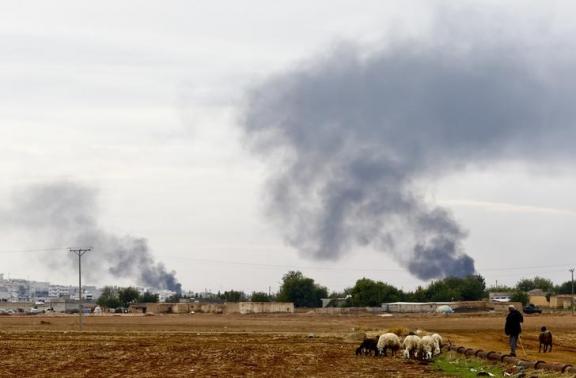 Smoke rises over the Syrian town of Kobani after an airstrike, as seen from the Turkish-Syrian border in the southeastern town of Suruc, October 19, 2014.
The fiercest fighting in days shook the Syrian border town of Kobani overnight as Islamic State fighters attacked Kurdish defenders with mortars and car bombs, sources in the town and a monitoring group said on Sunday.
Islamic State, which controls much of Syria and Iraq, fired 44 mortars at Kurdish parts of the town on Saturday and some of the shells fell inside nearby Turkey, according to the British-based Syrian Observatory for Human Rights. It said four more mortars were fired on Sunday.
The month-long battle for Kobani has ebbed and flowed. A week ago, Kurds said the town would soon fall. The United States and its coalition partners then stepped up air strikes on Islamic State, which wants to take Kobani in order to strengthen its position in northern Syria.
The coalition has been bombing Islamic State targets in Iraq since August and extended the campaign to Syria in September after Islamic State, a group that espouses a rigid interpretation of Islam and initially fought Syrian President Bashar al-Assad’s forces, made huge territorial gains.
Raids on Islamic State around Kobani have been stepped up, with the fate of the town seen as an important test for U.S. President Barack Obama’s campaign against the Islamists.
NATO member Turkey, whose forces are ranged along the border overlooking Kobani, is reluctant to intervene. It insists the allies should also confront Assad to end Syria’s civil war, which has killed close to 200,000 people since March 2011.
“We had the most intense clashes in days, perhaps a week, last night. (Islamic State) attacked from three different sides including the municipality building and the market place,” said Abdulrahman Gok, a journalist in Kobani.
“Clashes did not stop until the morning. We have had an early morning walk inside the city and have seen lots of damaged cars on the streets and unexploded mortar shells,” he said.
CAR BOMBS
The Observatory reported two Islamic State car bombs hit Kurdish positions on Saturday evening, leading to casualties. A cloud of black smoke towered over Kobani on Sunday.
A fighter from one of the female units of the main Syrian Kurdish militia in Kobani, YPG, said Kurdish fighters were able to detonate the car bombs before they reached their targets.
“Last night there were clashes all across Kobani … this morning the clashes are still ongoing,” she said, speaking on condition of anonymity.
The Observatory said 70 Islamic State fighters had been killed in the past two days, according to sources at the hospital in the nearby town of Tel Abyab, where Islamic State bodies are taken. Reuters cannot independently confirm the reports due to security restrictions.
The Observatory said some Syrian Arab fighters from the Revolutionaries of Raqqa Brigade, who are fighting alongside Kurdish fighters, had executed two Islamic State captives.
“One was a child of around 15 years old. They shot them in the head,” he said.
Islamic State have also used executions throughout their campaigns in Syria and Iraq, killing hundreds of enemy combatants and civilians who oppose their cause, according to Islamic State videos and statements.
Welat Omer, a doctor caring for the few remaining civilians in Kobani, told Reuters by telephone that he was looking after 15 patients, including children and the elderly.
“We need medicine, including antibiotics and milk for the children, and medicine for the elderly, who have heart conditions, diabetes and high blood pressure,” Omer said.
Hundreds of thousands have fled Islamic State’s advance. Turkey hosts about 1.5 million Syrian refugees, including almost 200,000 Syrian Kurds from Kobani.
Ankara has refused to rearm beleaguered Kurdish fighters, who complain they are at huge disadvantage in the face of Islamic State’s weaponry, much of it seized from the Iraqi military when the militants took the city of Mosul in June.
Turkey views the YPG with suspicion for its long-standing links with the Kurdistan Workers Party (PKK), which has waged a 30-year armed campaign for self-rule in Turkey.
President Tayyip Erdogan was quoted in the Turkish media on Sunday as saying Ankara will never arm the YPG through its political wing, the PYD.
“There has been talk of arming the PYD to establish a front here against Islamic State. For us, the PYD is the same as the PKK, it’s a terrorist organization,” he was quoted as saying.
This stance has sparked outrage among Turkey’s own Kurds, who make up about 20 percent of the population. Riots in several cities earlier this month killed left than 35 people dead.
In a call with Erdogan on Saturday night, Obama expressed appreciation for Turkey hosting over a million refugees, including thousands from Kobani.
“The two leaders pledged to continue to work closely together to strengthen cooperation against ISIL (Islamic State),” the White House said.
Obama’s approach to Islamic State has drawn fire from his political opponents at home.
“We have dropped a bomb here and a missile there, but it has been a photo-op foreign policy,” U.S. Senator Ted Cruz of Texas, a Republican and a potential presidential candidate in 2016, said on CNN’s “State of the Union” show.
He criticized Obama for delays in aiding Kurdish fighters in desperate need of weapons and assistance.




 anneinpt
 artaxes
 danmillerinpanama
 davidking1530
 Peter Hofman
 Joseph Wouk
 Peter
Peter Louisiana Steve
 WarSclerotic
Recent Comments