Archive for the ‘Syria’ category

Exclusive: ISIS Gaining Ground in Syria, Despite U.S. Strikes

January 15, 2015

Exclusive: ISIS Gaining Ground in Syria, Despite U.S. Strikes, The Daily Beast, January 15, 2015
1421322880562.cachedHosam Katan/Reuters

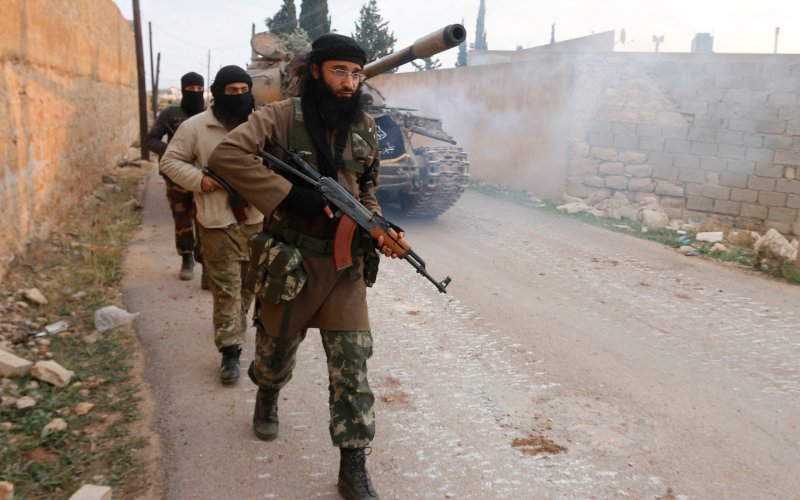
American jets are pounding Syria. But ISIS is taking key terrain—and putting more and more people under its black banners.

ISIS continues to gain substantial ground in Syria, despite nearly 800 airstrikes in the American-led campaign to break its grip there.At least one-third of the country’s territory is now under ISIS influence, with recent gains in rural areas that can serve as a conduit to major cities that the so-called Islamic State hopes to eventually claim as part of its caliphate. Meanwhile, the Islamic extremist group does not appear to have suffered any major ground losses since the strikes began. The result is a net ground gain for ISIS, according to information compiled by two groups with on-the-ground sources.In Syria, ISIS “has not any lost any key terrain,” Jennifer Cafarella, a fellow at the Washington, D.C.-based Institute for the Study of War who studies the Syrian conflict, explained to The Daily Beast.Even U.S. military officials privately conceded to The Daily Beast that ISIS has gained ground in some areas, even as the Pentagon claims its seized territory elsewhere, largely around the northern city of Kobani. That’s been the focus of the U.S.-led campaign, and ISIS has not been able to take the town, despite its best efforts.Other than that, they are short on specifics.

1421269431538.cachedClick to Enlarge (Coalition For a Democratic Syria)

“Yes, they have gained some ground. But we have stopped their momentum,” one Pentagon official told The Daily Beast.

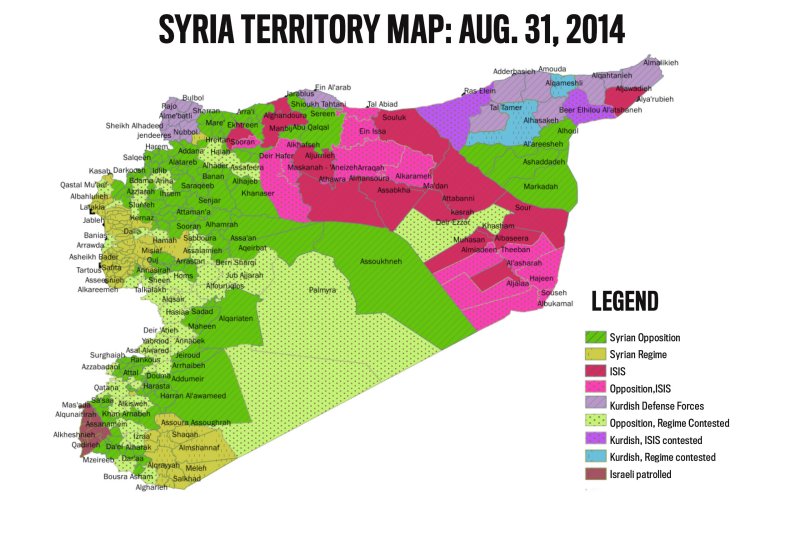
A map developed by the Coalition for a Democratic Syria (CDS), a Syrian-American opposition umbrella group, shows that ISIS has nearly doubled the amount of territory it controls since airstrikes began last year.

“Assessing the map, ISIS has almost doubled its territorial control in Syria. But more importantly, the number of people who now live under ISIS control has also increased substantially,” CDS political adviser Mouaz Moustafa said.

With the fall of that much territory into ISIS hands, Syrians who once lived in ungoverned or rebel held areas are now under ISIS’s grip. Of course, in an irregular war like this one, control of people is far more important than control of territory. In that regard, too, things appear to be going in the wrong direction.

In the first two months following American airstrikes, about a million Syrians who had previously lived in areas controlled by moderates now lived in areas controlled by extremist groups al Nusra or ISIS, according to CDS, citing conversations with European diplomats who support the Syrian opposition.

The area of ISIS’s expansion includes large segments of the Homs Desert, which begins far south of the contested northern city of Aleppo. It stretches below the presumed capital of ISIS in Syria, Raqqa, and all the way to the Iraqi border. It is largely rural and not an area that ISIS has had to fight for. Rather the group took control of uncontested parts of the countryside while skirting key regime strongholds in the area, Cafarella said.

But that does not mean that land is not valuable to ISIS. That newly acquired terrain allows ISIS troops to target and threaten more valuable areas, Cafarella said.

Since the U.S. campaign began in August, “there are little buds of ISIS control in eastern Homs, al Qalamoun [which borders northern Lebanon], and southern Damascus that do appear to be growing because of that freedom of operation that can connect those western cells to key ISIS terrains in Raqqa and Deir ez Zour” in northern and eastern Syria.

Moustafa, the CDS political adviser, blamed ISIS territorial gains on a lack of “strategic coordination between coalition strikes and moderate forces inside Syria, meaning that the Free Syrian Army and aligned groups cannot use the strikes to retake territory.” Further, Moustafa told The Daily Beast, coalition strikes have given other extremist groups sympathy for ISIS.

One frustration of the Syrian opposition groups is that the bombing campaign has been focused at the heart of ISIS controlled territory, rather than at the front lines, where ISIS territorial gains could be pushed back.

“The coalition strikes seem similar to drone campaigns in Yemen or Pakistan, targeting only leadership. The front-line strength of ISIS has undoubtedly increased even as some of these targeted strikes take out mid-level individual leaders,” Moustafa said.

As of Sunday, the U.S. and its coalition partners had conducted 790 airstrikes in Syria, according to Pentagon statistics. In all, the U.S. has spent $1.2 billion on its campaign against ISIS in Iraq and Syria.

In its public comments, the U.S. military has said repeatedly the effort against ISIS is on the right track. However it often does this by conflating its war in Iraq and Syria. Ask a question about what is happening in Syria, and U.S. officials will stress that ISIS has not gained ground in Iraq. Ask if the U.S. effort is working in Syria, and the military often points to the fact that ISIS has failed to take control of Kobani.

During a Jan. 6 press briefing, for example, when a reporter asked “where ISIS’s relative strength is right now,” Navy Rear Adm. John Kirby replied by talking exclusively about the U.S. effort in Iraq, naming cities were the military believed ISIS’s momentum has been “halted.”

When the reporter pressed for an answer on what was happening in Syria, Kirby struggled, saying, “I couldn’t give you a—a specific point at which, you know, we believe, well geez, we’ve halted their momentum. It—it’s come slowly, in various stages. But I think it’s safe to say that over the last three to four weeks, we—we’ve been confident that that momentum has largely been blunted.”

On Friday, Kirby proclaimed that ISIS had lost 700 square kilometers since the campaign began—over half the size of New York City or about four times the size of the District of Columbia. But the Pentagon spokesman could not say what percentage that area marked of total ISIS-controlled land. Nor could he say if that loss was in Iraq, Syria, or combined in both nations. As Kirby asserted: “I’m frankly not sure how relevant that is. I mean, it’s—they have less ground now than they did before. They’re trying to defend what ground that they have. They’re not going on the offense much, and they’re really trying to preserve their own oxygen.”
1421269455425.cachedClick to Enlarge (Coalition For a Democratic Syria)

The American military has not been able to take full advantage of the difficulties ISIS is facing. A worldwide drop in oil prices threatens the recently declared state’s ability to raise revenue, while declining standards in public services, distribution of aid, and provision of electricity threaten to undercut the group’s support across the territories it controls. ISIS has also not been able to follow through on its military quest to challenge the Iraqi government all the way to Baghdad.

The U.S. military stressed it is waging an “Iraq first” war, that is focused on eliminating ISIS from that country first. There, the U.S. can turn to Iraqi troops on the ground to assess its efforts. But there is no equivalent resource on the ground in Syria. Perhaps because of that, the U.S. military has offered a far more detailed assessment of the air campaign in Iraq than the one in Syria.

The Combined Joint Task Force in charge of the American air campaign refused to answer a Daily Beast query about ISIS gains in Syria, even as it striking targets there. U.S. Central Command replied, “As a matter of policy we do not discuss intelligence issues.”

Information on the maps:

The maps provided by the Coalition for a Democratic Syria show the areas controlled by moderate Syrian rebels, the Syrian regime, ISIS, Syrian al Qaeda affiliate al Nusra, as well as territories contested by these groups. The maps were developed by a field team from the Coalition for a Democratic Syria (CDS), an umbrella group of Syrian American organizations. The maps were sourced through on-the-ground networks including civilian councils, humanitarian organizations, armed actors, and media monitoring of independent Syrian channels.
Erdogan’s Egyptian Nightmare

December 30, 2014

Erdogan’s Egyptian Nightmare, The Gatestone InstituteBurak Bekdil, December 30,2014

Erdogan was happy. At least until a few days ago….

Erdogan probably did not know the Emir of Qatar’s next move on the Middle Eastern chessboard.

Turkey aspires to be a regional leader with no, little or problematic dialogue with about a dozen countries in its region.

Back in 2011, everything ostensibly was coming up roses between Turkey and Egypt. In a speech that year, then-Turkish President Abdullah Gul mentioned “…an axis of democracy of the two biggest nations in our region [Turkey and Egypt], from the north to the south, from the Black Sea down to the Nile Valley…”

In September 2011, then-Prime Minister [now President] Recep Tayyip Erdogan found an emotional hero’s welcome at Cairo’s Tahrir Square. Tens of thousands of Egyptians had flocked to the Cairo airport to welcome him. Streets were decorated with posters of Erdogan.

In early 2012, a survey by TESEV, a Turkish think-tank, found that Turkey was the most popular country for the residents of seven Arab countries, including Egypt.

But against that glittering backdrop, this author wrote in June 2011: “For Ankara, Cairo can be the new Damascus until another capital becomes the new Cairo. At that time, Syrian President Bashar al-Assad, Erdogan’s one-time best regional ally, had already become his worst regional nemesis.

The Turkish-Egyptian love affair would, in fact, be quite short-lived.

In August 2013, about a month after General Abdel Fattah el-Sisi in Egypt toppled the Muslim Brotherhood rule of President Mohammed Morsi, Erdogan appeared on TV, reading — in an unusually soft voice — a letter by the Muslim Brotherhood’s Mohamed al-Beltagy. The letter was written to Beltagy’s daughter Asmaa, a 17-year-old girl, who had been killed in Cairo when security forces stormed two protest camps occupied by supporters of the deposed president. Poor Asmaa had been shot in the chest and back.

“I believe you have been loyal to your commitment to God, and He has been to you,” her father wrote in the letter. “Otherwise, He would not have called you to His presence before me.” Erdogan’s tears were visible.

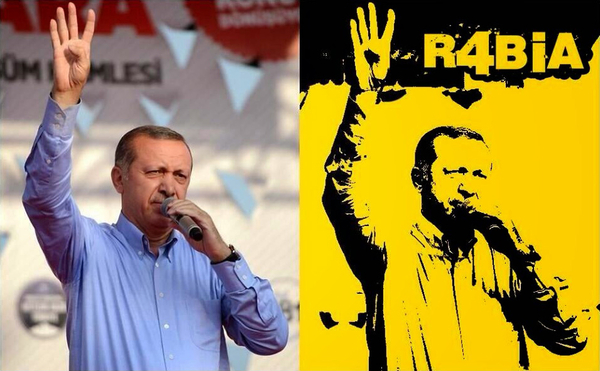
Later, Asmaa became another symbol for Turkish Islamists; Erdogan cheered party fans with the four-finger “Rabia” sign, in reference to his solidarity with the Muslim Brotherhood, and as a sign of his endearment for the unfortunate girl. Even on the playing field, a few footballers made the same sign after scoring.

859In this image, widely circulated in social media, Turkey’s then-Prime Minister [now President] Recep Tayyip Erdogan flashes the Egyptian Muslim Brotherhood’s four-fingered “Rabia” sign.

After the coup in Egypt, when el-Sisi ran for president and won the elections, Turkey’s Erdogan declared them “null and void.” And not just that. Erdogan also said that he did not view el-Sisi as “president of Egypt.” At another time, he said, “Turkey would not recognize the coup regime in Egypt.” Last July, he called el-Sisi “an illegitimate tyrant” and a “coup-maker.”

Meanwhile, neither was Erdogan a “rock star” in Cairo nor was Turkey “the most popular country.” Egyptian non-governmental organizations [NGOs] called on Egyptians and Arabs to boycott Turkish goods and soap operas. Egypt’s intellectuals, writers and businessmen were recommending a break in Egypt’s relations with Turkey because “they were disappointed.” Egypt unilaterally cancelled both visa-free travel for Turkish citizens and a transit agreement for Turkish trucks.

In the anti-el-Sisi campaign, Turkey was not alone. Its only regional ally, Qatar, fully supported Turkey against Egypt’s elected “coup leader.” Erdogan was happy. At least until a few days ago….

In Ankara, Erdogan was all smiles when he offered a red-carpet ceremony to the visiting Qatari Emir Sheikh Tamim bin Hamad al-Thani. Happy to have his best ally as a guest, Erdogan probably did not know the Emir’s next move on the Middle Eastern chessboard.

A few days after al-Thani’s merry visit to Ankara, Qatar announced its determination to thaw ties with Egypt, ending its alliance with Turkey over “Egypt’s illegitimate tyrant.”

“The security of Egypt is important for the security of Qatar … the two countries are linked by deep and fraternal ties,” ran a statement from the office of al-Thani on Dec. 21. It was a real cold shower on Ankara — and Erdogan. The statement had come one day after el-Sisi met in Cairo with a Qatari envoy, suggesting a possible thaw in relations. After the meeting, el-Sisi’s office issued a statement saying, “Egypt looks forward to a new era that ends past disagreements.” Apparently, the Egyptian-Qatari reconciliation had been brokered by Saudi Arabia and, once again, Turkey was the odd one out.

In its immediate vicinity, Turkey does not have diplomatic relations with three countries — Armenia, Cyprus and Syria — and has deeply problematic diplomatic relations with two countries: Israel and Egypt. This situation is not sustainable.

Even Deputy Prime Minister Bulent Arinc has said that Turkey should repair its relations with Egypt. But this is not an easy task. In the unlikely event of a reconciliation, Erdogan’s previous big words on el-Sisi the coup-maker will make him look like a leader shaking hands with an “illegitimate tyrant.”

On Dec. 24, Turkey’s foreign ministry spokesman said that bilateral ties with Egypt could “normalize if the country properly returns to democracy, if the Egyptian people’s free will is reflected in politics and social life.” Meaning, no normalization. The spokesman would not comment on Qatar’s policy change on Egypt.

Turkey aspires to be a regional leader with no, little or problematic dialogue with about a dozen countries in its region. Erdogan’s top advisors have found a nice euphemism for this situation: “precious loneliness.” In reality, it is rather a blend of miscalculation and over self-confidence.

ISIS capture of Jordanian pilot puts US and Jordan in conflicting dilemmas, may be pivotal to anti-terror war

December 25, 2014

ISIS capture of Jordanian pilot puts US and Jordan in conflicting dilemmas, may be pivotal to anti-terror war, DEBKAfile, December 25, 2014

F-16_down_Syria_24.12.14A Jordanian air force F-16 downed over Syria

DEBKAfile’s military and intelligence sources add that Middle East military and aviation control centers are quite sure that the Jordanian warplane was hit by an ISIS missile, while making low passes over the terrorist organization’s Syrian headquarters at Raqqa in violation of the pilot’s orders.

*****************

The US military is going to great lengths to deny any evidence that ISIS shot down the Jordanian Air Force F-16 which came down Wednesday, Dec. 24 over the northern Syrian town of Raqaa. First Lieutenant Muath al-Kasaesbeh, aged 27, was the first Arab pilot to be taken prisoner by the Islamic State. The US Central Command statement said: “We can say with certainty that it was an aircraft crash and the plane was not downed by ISIL as was claimed by the terrorist organization.”

This contradicted an earlier statement by the Jordanian Information Minister Mohammad Momani that the plane had crashed after being hit by a ground-air missile. DEBKAfile’s military and intelligence sources add that Middle East military and aviation control centers are quite sure that the Jordanian warplane was hit by an ISIS missile, while making low passes over the terrorist organization’s Syrian headquarters at Raqqa in violation of the pilot’s orders.

The Jordanians are making intense efforts to deter the jihadis from harming 1st Lt. Kasaesbeh.The Hashemite Kingdom’s armed forces warned that “IS and its supporters would be held responsible for the pilot’s safety and his life.”

The pilot belongs to the Bedouin tribe of Bararsha near Kerak in southern Jordan, which boasts several army generals. They and the tribal chiefs are bringing all their influence to bear to obtain his release.

American military is joining the effort to save the Jordanian pilot – from different motives, which are geared more to sustaining the goals and tactics pursued by the US and the coalition in the war on the Islamic State.
Thursday, Central Command chief Gen. Lloyd J. Austin, who is in charge of US and coalition operations in Iraq and Syria, released a long communiqué praising Jordan for its military actions in the battle, adding: “We will not tolerate ISIL’s attempts to misrepresent or exploit this unfortunate aircraft crash for its own purposes.”

The US general’s message was designed to reassure Jordanian Air Force pilots and dissuade them from dropping out of the coalition air campaign for fear of being shot down by an ISIS missile. The three other Arab coalition members, Saudi Arabia, Bahrain and the United Arab Emirates, must also be kept from quitting.

The share of the four Arab air forces in the war is too weighty to forfeit.

ISIS leader Abu Bakr Al Baghdadi has not doubt calculated his stake in keeping the Jordanian pilot alive and at risk to scare fellow Arab pilots from continuing to take part in US-led bombing missions against his forces.

Furthermore, the Bararsha, like other South Jordanian Bedouin tribes, is known around the region for producing fierce fighters and their relentless pursuit of blood revenge.

Al Baghdadi may opt to avoid antagonizing them for this reason, as well as in the hope of a tangible benefit: ISIS is already using the smuggling routes of southern Jordan as channels to the groups his organization has planted in Sinai, Egypt and eastern Libya. He may decide to go one better and build an alliance with those very tribes behind the backs of the Americans and Jordan’s Abdullah II.

Such an eventuality would add a new dimension to the war on the Islamist terrorists.

Bedouin Trackers on the Border: The War Next Door (Part 5)

December 23, 2014

Bedouin Trackers on the Border: The War Next Door (Part 5),  Vice News via You Tube, December 23, 2014


ISIS sneaks behind US-backed Kurdish victories in Iraq to retake Baiji refinery city

December 22, 2014

ISIS sneaks behind US-backed Kurdish victories in Iraq to retake Baiji refinery city, DEBKAfile, December 22, 2014

IraqBaiji

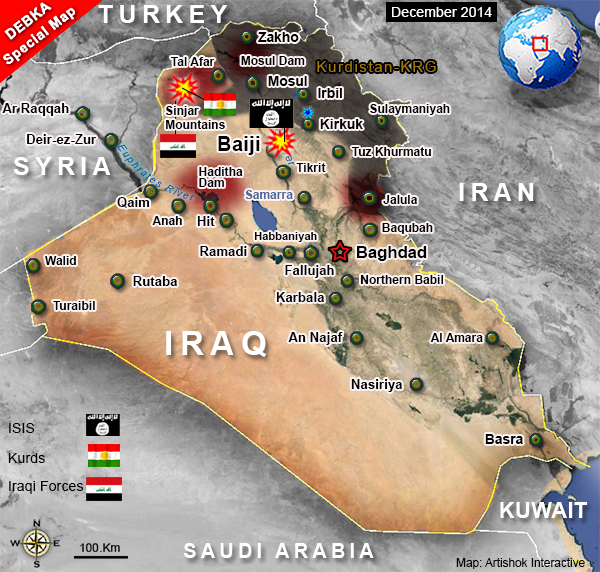
American, Kurdish and Iraqi officials have hailed as a “major victory” the release of thousands of distressed members of the Yazdi community, trapped for four months on on Mt. Sinjar in northern Iraq, since Islamic State thugs overran their town. Many more fled to Syria while Yazdi women were kidnapped.

This was a necessary rescue operation, but hardly a major victory, say DEBKAfile’s military experts. ISIS continues to maintain its grip on vast stretches of Iraq and Syria, defying the efforts of sparse US and coalition air strikes to dislodge them – beyond minor tactical withdrawals.

The town of Sinjar is not mentioned in the US and Kurdish releases, because large sections are still in jihadi hands.

Even less is heard about the situation on the northern Iraqi-Syrian border, where Abu Bakr Al-Baghdadi has achieved almost total supremacy.

But the most telling omission by the US-led allies is the fact that, while they focused on Mt. Sinjar, ISIS forces restored their siege of Baiji, Iraq’s main oil refinery center, after pushing Iraqi troops out.

This happened after a majority of the local Sunni tribes who fought alongside the Iraqi army up until November, switched sides.

The tribal chiefs complained that the Iraqi Prime Minister Haider al-Abadi, who was installed in Baghdad with Washington’s support last year, as a figure able to unite the country’s Sunni and Shiite communities for the war on ISIS, reneged on his promise of pay checks and weapons for the tribesmen who threw in their lot with the national army.

Instead, he is accused of aggravating disunity in the armed forces by firing Sunni officers and replacing them with officers loyal to Iraq’s pro-Iranian Shiite militias, who take their orders from Iranian Revolutionary Guards Corps commanders.

DEBKAfile’s military and counter-terrorism sources describe the current military state of play in Iraq as bizarre, fought on three more or less disconnected levels:

1.  In the north, a mixed Iraqi-Kurdish force, accompanied by US military advisers, is poised to attack the key town of Tal Afar, which lies 50 km west of Mosul.

Friday, Dec. 21, they took the town’s Iraqi military base that fell to ISIS in June. But, like in Sinjar, the assault force has not yet occupiedy the town.

This Tel Afar operation was a compromise in the disagreement the Iraqis and Kurds had with Washington. They asserted they were fully capable of recapturing Mosul from the Islamists, while the US military advisers disagreed and warned that this offensive was doomed to failure.

2.   While Iraqi and Kurdish peshmerga forces are concentrating their assaults on areas where ISIS forces are thin on the ground (like Mt. Sinjar), the jihadis are throwing strength into capturing and controlling the Iraqi and Syrian oil industries (like Baiji). They are by now accruing revenues running into $2 to 2.5 billion, despite falling crude prices. In fact they are dumping the looted oil for $25-30 per barrel, well below the world market prices.

3.  Washington is sparing too little attention for the ISIS outgrowths mushrooming outside Iraq and Israel – especially in Libya, Egypt and Egyptian Sinai.

Syrian rebel Yarmouk Brigades ditch US and Israel allies, defect to ISIS

December 18, 2014

Syrian rebel Yarmouk Brigades ditch US and Israel allies, defect to ISIS, DEBKAfile, December 17, 2014

SyriaGolanISIS

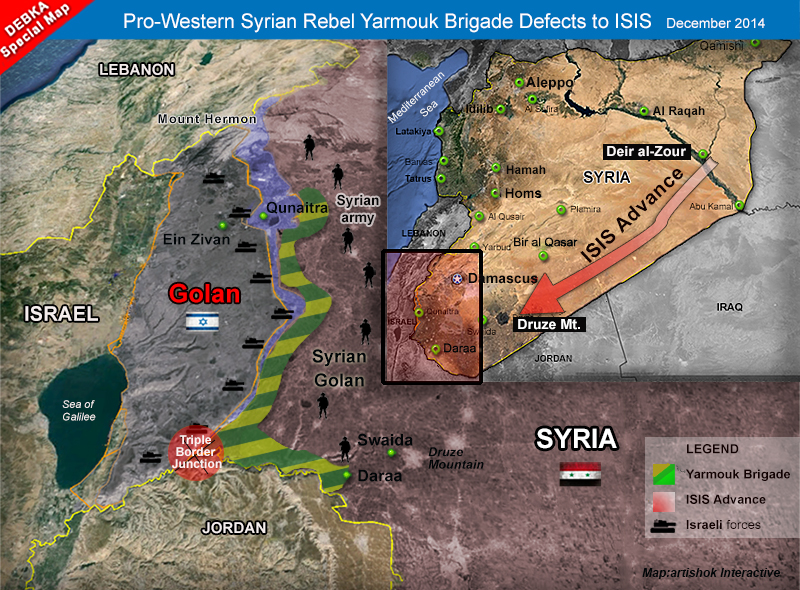
The Syrian rebel militia Al Yarmouk Shuhada Brigades, backed and trained for two years by US officers, mostly CIA experts, in Jordan, and supported by the Israeli army, has abruptly dumped these sponsors and joined up with the Islamic State in Iraq and Syria, DEBKAfile’s exclusive military and counter-terrorism sources reveal.

The sudden defection of this 2,000-strong anti-Assad force leaves IDF defense formations on the Golan, US and Jordanian deployments in the northern part of the kingdom, and pro-Western rebel conquests in southern Syria in danger of collapse.

The Brigades’ jump into the radical jihadi camp was negotiated in the last two weeks by its commander Mousab Ali Qarfan, who also goes by the name of Mousab Zaytouneh. He was in direct contact with ISIS chief Abu Baqr Al-Baghdadi, whom our sources report has recently relocated from Iraq to his northern Syrian headquarters at al-Raqqa.

Unlike the Sinai Islamists, Ansar Beit al Maqdis, the Yarmouk Brigades did not pledge allegiance to ISIS. The ir pact was forged as an operational alliance, which is just as grave a peril for the rebel militias’ abandoned allies.

For Israel, in particular, the new development is fraught with three dangers:

1. The Yarmouk Brigades are strung out along Israel’s Golan border with Syria, from the UN peacekeepers camp opposite Kibbutz Ein Zivan (see map) in the north, down to the Israeli-Syrian-Jordanian border junction in the south. The Brigades therefore sit along 45 of the total 76 kilometers of the Syrian-Israeli border. This means that a long stretch of Israel’s Golan border with Syria has fallen under the control of the Islamic State.

2.  This militia also commands sections of the Syrian-Jordanian border, as well as districts of the southern Syrian town of Deraa. Therefore, the link between Jordan and southern Syria, which served American strategic interests, is now under military threat.

3.  Islamic State forces are preparing to take advantage of their new asset with a buildup near the Druze Mountains (see map) for a rapid push south towards the town of Deraa, where they will join forces with their new ally.

Saudi Government Daily: U.S. Secretly Cooperating With Iran At Arabs’ Expense

December 15, 2014

Saudi Government Daily: U.S. Secretly Cooperating With Iran At Arabs’ Expense, MEMRI, December 14, 2014

(Fact, fiction or a mix of both? — DM)

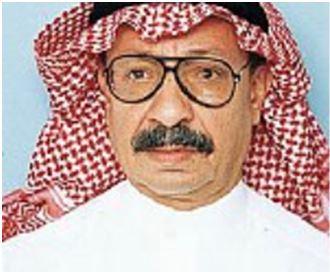
Yousuf Al-Kuwailit, who writes the editorials of the Saudi government daily Al-Rai, opined in a December 7, 2014 editorial that, despite the tension that has ostensibly prevailed between the U.S. and Iran ever since the Islamic Revolution, in practice there is secret cooperation between them. As part of this cooperation, he said, Iraq has become nothing but an arena for assuring the interests of these two countries, and Iran has been granted freedom of action in Syria and Lebanon.

Referring to the U.S.-Iran nuclear talks, he said they were a farce that would end in contracts and deals, and perhaps even an alliance, between the two countries. He therefore called on the Arabs not to regard the U.S. as a reliable ally, and warned that the U.S. may force the Gulf states to reconcile with Iran, to the detriment of their interests.

The following are excerpts from the article: [1]

21428Yousuf Al-Kuwailit

“The U.S. appointed the Shah as policeman of the Arab Gulf, turned Iran into a base for conflict with the USSR, and provided Iran with up-to-date weaponry and a nuclear reactor. [Iran, for its part] attempted to take advantage of this situation, as it saw itself as a superpower. [Only] the strength of the USSR… prevented Iran from undertaking military adventures outside its own borders. With [the rise to power of Ayatollah Ruhollah] Khomeini, despite everything that happened at the U.S. Embassy [in Tehran in 1980], when dozens of its staffers were taken hostage and [then-U.S. president Jimmy] Carter carried out a reckless and unsuccessful operation [in attempt to free them]… [despite all this] nothing spoiled the U.S.’s relationship with this country, which it considers one of its strategic and economic outposts by virtue of its location and its history. So the farce… about Iran’s nuclear reactors and non-conventional weapons has taken a clear and final direction, in the form of several deals [between the two countries]…

“Cyrus [the Great],[2] who attacked and destroyed the Arabs, is the spiritual father of the Nazi trend that has characterized Iran’s governments, whether secular or religious. Racial supremacism vis-à-vis the Arabs is a popular [Iranian] obsession. It exists and it is eternal, and even if the mullahs don black turbans [indicating that they are] descendants of the Prophet and have Arab roots, they do not really recognize these roots, but do this only in order to market their national policy to us, prior to marketing their religious school of thought [i.e. the Shi’a]. Anyone who thinks that diplomatic arrangements are aimed at anchoring coexistence between the Arabs and the Iranian ‘Aryans’ is disregarding the nature of the historical reasons [for the tension between the two sides] and its deep roots in the [Iranian] public mentality.

“In order to better understand the unfolding of events, [we need to realize that]  the U.S. and its allies set out the initial plan to divide the Arab [regions] a long time ago, and that the Sikes-Picot agreement is only the first outcome [of that plan]. [We must also realize] that handing over Iraq [to Iran], and annexing Syria and later Lebanon to it, and the [silent] agreement [between the two countries] that Iran would have a free hand in these countries – all these  are only a prelude to  more dangerous activity.

“[Accordingly], relying on the U.S. or thinking it a reliable ally without properly understanding the strategic changes and aims, place us in a situation [of self-delusion], because all the historic elements of power see how positions and policies change but interests remain. This principle will be ultimately applied to all the countries that have a relationship with the U.S., whether economic or strategic, because the Arabs are part of a geographic area whose borders are changing, including through the disappearance of the centrally[-ruled] state in favor of states [based on] sect or nationality.

“One simple event in recent days is the Iranian Air Force’s incursion into Iraq to attack ISIS positions, which the U.S. confirmed but Iran denied. At the same time, the U.S. also ignores the incursion of [Iranian] ground troops under the command of [IRGC Qods Forces commander] Qassem Soleymani into Iraq, [which has been taking place] ever since the U.S. first started managing [Iraq’s] affairs… [In fact,] U.S. Secretary of State John Kerry stated that any Iranian military attack on ISIS was positive. This exposes the significant coordination between the two countries, and belies the statements of U.S. military circles denying any cooperation or coordination [with Iran] in the war on ISIS…

“In the era of [former Iraqi prime minister Nouri] Al-Maliki, Iraq become nothing but an arena for assuring the interests of two players: Iran and the U.S. This came about as part of an agreement that began with [head of the occupational authority of Iraq after the 2003 invasion Paul] Bremer, and no Iraqi government will put an end to it, unless the Iraqis [dare to] oppose their homeland’s dependence on another country – something that is difficult and complicated to do.

“Ultimately, even if the talk about the American-Iranian hostility is true, everything points towards new contracts between the two which are likely to turn into alliance. We could possibly see catastrophic days if the U.S. forces the Gulf states to reconcile with Iran, which will end in a way that will not serve our interests. This is an outcome that should not surprise us, if the reality of [U.S.-Gulf] friendship evolves into [U.S.] dictates [to the Gulf states].”


Endnotes:

[1] Al-Riyadh  (Saudi Arabia), December 7, 2014.

[2] Cyrus the Great founded the Achaemenid Empire, circa 600 BCE.

Israel air strikes wiped out Russian hardware for thwarting US no-fly zone plan over Syria

December 10, 2014

Israel air strikes wiped out Russian hardware for thwarting US no-fly zone plan over Syria, DEBKAfile, December 8, 2014

Israeli_jets_of_bombing_two_installations_inside_Syria7.12.14Israel jets bombing Syrian targets

High-ranking American military sources revealed Monday, Dec. 8, that Israel’s air strikes near Damascus the day before wiped out newly-arrived Russian hardware including missiles that were dispatched post haste to help Syria and Hizballah frustrate a US plan for a no-fly zone over northern Syria.

The advanced weapons were sent over, as DEBKAfile reported exclusively Sunday, after Russian President Vladimir Putin learned that the Obama administration and the Erdogan government were close to a final draft on a joint effort to activate a no-fly zone that would bar Syrian air force traffic over northern Syria.

The Kremlin has repeatedly warned – of late in strong messages through back channels – that the establishment of a no-fly or buffer zone in any part of Syria would be treated as direct American intervention in the Syria war and result in Russian military intervention for defending the Assad regime.

According to the US-Turkish draft, American warplanes would be allowed to take off from the Turkish airbase of Incirlik in the south for operations against Syrian warplanes, assault helicopters or drones entering the no-go zone. Thus far, Ankara has only permitted US surveillance aircraft and drones the use of Incirlik for tracking the movements of Islamic State fighters in northern Syria.

The Obama administration was long deterred from implementing a no-fly zone plan by the wish to avoid riling Moscow or facing the hazards of Syria’s world-class air defense system.

But Washington was recently won over to the plan by a tacit deal with Damascus for American jets to be allowed entry to help Kurdish fighters defend their northern Syrian enclave of Kobani against capture by al Qaeda’s IS invaders.

However, the US administration turned down a Turkish demand to extend the no-fly zone from their border as far as Aleppo, Syria’s largest city, over which Syrian army forces are battling rebels and advancing slowly into the town.

The no-fly zone planned by US strategists would be narrow – between a kilometer and half a kilometer deep inside Syria. However Moscow is standing fast against any such plan and objects to US planes making free of Syrian airspace, a freedom they are now afforded over Kobani.

To drive this point home, the Russians delivered a supply of advanced anti-air missiles and radar, whose use by the Syrian army and transfer to Hizballah in Lebanon were thwarted by the Israeli air strikes Sunday.

Moscow reacted swiftly and angrily with a Note to the United Nations Monday accusing Israel of “aggressive action” and demanding “that such attacks should not happen again… Moscow is deeply worried by this dangerous development, the circumstances of which demand an explanation.”

The Assad regime has held back from reacting to past Israeli air raids for preventing advanced weaponry from reaching Hizballah. This time, spokesmen in Damascus warned that their government’s response would be clandestine and cause Israel “unimaginable harm.”

ISIS’s Stay-at-Home Radicals

December 9, 2014

ISIS’s Stay-at-Home Radicals, Abigail R. Esman, December 9, 2014

(Could there be some in Israel? In the United States?– DM)

1101

[A]n analysis by Italian academics of more than 2 million Arabic-language posts online found that “support for Islamic State among Arabic-speaking social media users in Belgium, Britain, France and the US is greater than in the militant group’s heartlands of Syria and Iraq.”

****************

Across Europe and America, governments and intelligence officials are struggling to address the problem of Western Muslims who join the jihad in Syria – and then come back home again. But in the process, they may be missing the bigger threat: the ones who never left.

Counterterrorism experts agree that the danger posed by returning jihadists is significant: already radicalized before they joined groups like the Al Nusra Front and the Islamic State (IS or ISIS), they are now well-trained in the practice of terrorist warfare. Unlike most Westerners, they have overcome any discomfort they may have previously felt about killing or confronting death. Chances are, they’ve already done it.

And their numbers are increasing: already an estimated 3,000 westerners have made the move to join the Islamic State and similar terrorist groups. Hence many countries, including the Netherlands and England, have determined to revoke the passports of any Syrian fighter known to carry dual nationality (many second-generation Turkish and Moroccan immigrants carry passports from their family’s land of origin. Similar bills have also been proposed in the U.S., such as one put forward by U.S. Rep. Frank Wolf, R-Va. The UK has also considered confiscating the passports of all British citizens who join the jihad, but such measures have been rejected on the basis of concerns about leaving individuals stateless.

But now some experts – and returning jihadists – say ISIS “sleeper cells” are already embedded in the West. So-called “Jihadi Hunter” Dimitri Bontinck told the UK’s Mail Online last month that “influential sources” had informed him of such cells, and warned that they were “preparing to unleash their war on Europe.” And an ISIS defector reportedly told a Scandinavian broadcaster of similar sleeper cells in Sweden which were, he said, “awaiting orders.”

The presence of these cells should not come as much of a surprise. More surprising is that Europe’s intelligence agencies hadn’t spotted them earlier. In part, this could be blamed on the intense focus on dealing with returnees, a problem that has left some intelligence and law enforcement agencies stretched thin: in June, for instance, Dutch intelligence agency AIVD admitted it “could no longer keep up” with the jihadists in the Netherlands. By October they were forced to bring in police teams to assist, especially in following the 40 or so jihadists who had returned. (An estimated 130 Dutch, including both returnees and those killed, have joined the Syrian fight.)

But if the AIVD and other intelligence agencies can barely follow the ones they know, this leaves countless other radicalized Muslims in Europe easy prey for Islamic State recruiters, who have already turned Europe’s efforts to block returnees to their advantage. With videos online and with extraordinary social media prowess, IS agents are increasingly encouraging Western supporters to work from home: spread the word, motivate others to make the trip (known as “making Hijrah”), or prepare to attack the infidel on Western soil.

And attack they have, as in the beheading of Fusilier Lee Rigby on a London street in 2013, the killing of a Canadian soldier, Cpl. Nathan Cirillo, in Ottawa on Oct. 22, and the hatchet attack on NYPD officers in Queens, N.Y. only two days later. Other assaults have been thwarted, such as the alleged plot by three British men who, prosecutors say, were inspired by ISIS calls for attacks on unbelievers. The men were arrested Nov. 6 in London on charges of planning to behead civilians.

But ISIS’s propaganda has been successful in other ways. Recruiting for jihad is on the rise in the Netherlands, according to a recent AIVD report, which further notes that “the number of Dutch jihadists traveling to Syria to join the conflict there has increased substantially since late 2012.” And overall support for the terrorist group is growing even faster – as thousands made clear during pro-ISIS demonstrations last summer. “Several thousand” people in the Netherlands alone support IS, the AIVD claims, while another recent Dutch report concluded that nearly 90 percent of Dutch Turkish youth considered IS members “heroes.” (That latter report has since come under fire, but its researchers stand by their findings.)

In Germany, ISIS support has grown so threatening that in September, the government passed a law to ban it outright. That legislation includes “a ban on activities that support the Islamic State in Iraq and Syria, including any displays of its black flag, as part of an effort to suppress the extremist group’s propaganda and recruitment work among Germans,” the New York Times reported. On Dec. 5, officials used the law to close a Bremen mosque; sermons there allegedly encouraged young Muslims to make Hijrah – to migrate – and join in the jihad.

In France, where an estimated 700 people have made Hijrah – the highest number in Europe – an ICM poll conducted last summer for Russian news agency Rosslya Segodnya found that one in six people support ISIS. Among those aged 18-24 – the age of most of the country’s Muslim population –27 percent indicated a “positive opinion” of the terrorist group.

These are not just mathematical figures. They represent people: tens of thousands of young men and women. In fact, the Guardian observes, an analysis by Italian academics of more than 2 million Arabic-language posts online found that “support for Islamic State among Arabic-speaking social media users in Belgium, Britain, France and the US is greater than in the militant group’s heartlands of Syria and Iraq.”

Why?

This is exactly the question Rotterdam Mayor Ahmed Aboutaleb –a Muslim of Moroccan origin – is asking. Despite his own hard stance against Islamic radicalization, the number of youths in Rotterdam suspected of radicalizing has increased by 50 percent over the past year. While attending the trial of one suspected jihadist, Dutch daily AD reports, Aboutaleb wondered aloud “why such youths, well-educated and full of promise commit themselves to the jihad.”

“The question is,” he is quoted as saying, “who are the people who go? Why do they make this step? Because they feel discriminated? Because they’re unemployed? Rejected by society? I don’t get that. Doubtless, that would maybe push someone over the edge, but there have to be other arguments that play a role.”

Ultimately, these are the questions everyone should be asking – intelligence and law enforcement agencies most of all. Because as the number of Western jihadists rises, and the support for ISIS grows, one thing is becoming clear: that until we have the answers to the basic queries, nothing else we do will matter.

Obama’s Christmas Gift to ISIS and Al Qaeda

December 9, 2014

Obama’s Christmas Gift to ISIS and Al Qaeda, Front Page Magazine, Daniel Greenfield, December 9, 2014

(According to an NBC News article,

Outgoing Uruguayan President José Mujica has made clear that Uruguay would not hold or restrict the six Guantanamo detainees who were recently resettled in his country.

“The first day that they want to leave, they can leave,” said Mujica in a Spanish-language interview with state television TNU.

— DM)

obama-1-419x350

Everyone likes presents; even murderous Muslim terrorists.

That must be why Obama decided to give ISIS, Hamas and Al Qaeda an early Christmas present by freeing their followers from Guantanamo Bay and dispatching them to Uruguay.

Why Uruguay? It’s one of several South American countries run by Marxist terrorists.

Uruguayan President Jose Mujica, a former Marxist terrorist, already offered to take in Syrian refugees and a number of the freed Gitmo Jihadists are Syrians who trained under the future leader of what would become ISIS. If they stay on in Uruguay, they can try to finish the job of killing the Syrian refugees resettled there. If they don’t, they can just join ISIS and kill Christian and Yazidi refugees back in Syria.

It’s a win-win situation for ISIS and Marxist terrorists; less so for their victims.

Most of the Guantanamo detainees freed by Obama were rated as presenting a high risk to America and our allies. They include a bomb maker, a trained suicide bomber, a document forger and a terrorist who had received training in everything up to RPGs and mortars.

The only thing Obama left out was the partridge in the pear tree. It probably wasn’t Halal.

These terrorists aren’t about to settle down in a country best known for its agricultural sector. There is no major demand for bomb makers to herd sheep or suicide bombers to milk cows.

Obama’s Christmas gift to Islamic terrorists includes Mohammed Tahanmatan, a Hamas terrorist who told American personnel at Gitmo that he “hates all enemies of Islam, including Americans, Jews, Christians and Muslims who do not think as he does.”

Uruguay is filled with these enemies of Islam, but so is the rest of the world. There’s no telling where Mohammed Tahanmatan will take his Jihad against Americans, Christians and Jews; he might go back to Israel or head over to Syria. Or he might just go back to Afghanistan and Pakistan to kill the American soldiers still left there.

Either way the blood of his victims will be on Obama’s hands.

And yet Mohammed Tahanmatan is the least dangerous of the terrorists freed by Barack Obama.

Ahmed Adnan Ahjam, Abd al Hadi Omar Mahmoud Faraj, Ali Husain Shaabaan and Jihad Ahmed Diyab were members of the Syrian Group which left an Assad crackdown to join Al Qaeda in Afghanistan. The Syrian Group was headed by Abu Musab al-Suri, a key ideological figure in international Jihadist circles, who was linked to multiple bombings in Europe, including one that wounded American soldiers.

The Damascus Cell of the Syrian Group was run by the uncle of Al Qaeda in Iraq leader Abu Musab Al-Zarqawi who also sat on AQIQ’s advisory council. Al Qaeda in Iraq is known today as ISIS.

Even while Obama bombs ISIS in Syria and Iraq, he releases experienced ISIS recruits from Gitmo.

Ahmed Adnan Ahjam was listed as receiving advanced training from Al Qaeda in the use of a wide range of battlefield weapons up to artillery. He will be invaluable to ISIS in its campaign in Kobani.

Obama’s present of Ahjam to ISIS will aid in genocide against the Kurds of Kobani. Ahjam was rated a “high risk” and should never have been released.

Abd al Hadi Omar Mahmoud Faraj received training at a camp run by Zarqawi providing him with an even more direct link to ISIS. He is a trained suicide bomber. ISIS will make use of him to train suicide bombers including its growing army of brainwashed and abused child soldiers.

Faraj was rated “high risk”. He should never have been released.

Ali Husain Shaabaan also trained at a Zarqawi camp. He was listed as “high risk”. Like Farj and Ahjam, there is little doubt that he will be in Syria before too long.

Jihad Ahmed Diyab is a document forger who provided documents to the Jihadist network of Abu Zubaydah linked to the bombing plot against Los Angeles International Airport, he worked with Zarqawi and associated with 9/11 terrorist recruiter Mohammed Zammar.

Jihad Diyab was not only listed as being “high risk”, but also as being of high intelligence value. He has connections to multiple Islamic terrorist groups around the world. That makes Jihad potentially the most valuable member of the Syrian Group to be released by Obama in his Christmas gift to ISIS.

ISIS will find Jihad Diyab useful for providing forged documents to smuggle its fighters into Syria and also to potentially move terrorists into Europe and America.

And yet giving this gift of Jihad to ISIS may pale next to Abdul Bin Mohammed Abis Ourgy, the final Gitmo Jihadist, who not only has many links to Muslim terrorist groups, but is a bomb maker who also trained terrorists in his explosive arts. The United States suspected that he may have even known beforehand about 9/11.

Ourgy is likely to head for North Africa and his ability to move money around will help strengthen the operations of Al Qaeda and Al Qaeda linked groups in the area. His bomb making skills will be used to train the next generation of terrorists. The blood of those they kill will be on Obama’s hands.

It goes without saying that Ourgy was listed as “high risk” and that releasing a bomb maker who will train other terrorists to build bombs is about as irresponsible as it gets.

Obama didn’t just free six more Gitmo detainees. He dumped “high risk” Jihadists with skills that make them extremely useful to ISIS and extremely dangerous to us into a country run by a former terrorist.

These terrorists are not just Al Qaeda, but the majority of them have personal links to Syria and to the network of what has become ISIS.

“We’ve offered our hospitality for human beings who have suffered a terrible kidnapping in Guantanamo,” President Jose Mujica has said, making it clear once again where his sympathies lie.

The former Marxist terrorist predictably sympathizes with the terrorists, not the terrorized. Obama might as well have given the new ISIS recruits a plane ticket directly to Istanbul. The only difference between doing that and doing what he did is plausible deniability.

As soon as the money gets wired to them from Saudi Arabia or Qatar, they’ll be at Carrasco International Airport. After a plane trip from there to Buenos Aires to Istanbul, the rest will be a jaunt across the border with a wink and a nod from friendly Turkish border guards happy that ISIS is committing the genocide that their prospective position in the European Union won’t allow them to openly carry out.

Of the terrorists released from Gitmo, 100 were confirmed as having returned to terrorism. Thanks to Obama’s Christmas present to Hamas, Al Qaeda and ISIS, that number is about to go up.