Archive for the ‘Syria war’ category

Todays Zaman: Erdoğan slams New York Times for ISIL story

September 18, 2014

Erdoğan slams New York Times for ISIL story

Erdoğan slams New York Times for ISIL story

President Recep Tayyip Erdoğan and Prime Minister Ahmet Davutoğlu leave Hacı Bayram Veli Mosque in Hacıbayram neighhborhood of Ankara after Friday prayers on Aug. 22. (Photo: Today’s Zaman, Mevlüt Karabulut)

September 17, 2014, Wednesday/ 13:17:52/ TODAYSZAMAN.COM / ISTANBUL

President Recep Tayyip Erdoğan lashed out at The New York Times on Wednesday over a report saying the Islamic State in Iraq and the Levant (ISIL) has been steadily attracting Turkish recruits, calling the report “shameless.”

The New York Times ran the story on Monday with a photo of Erdoğan and Prime Minister Ahmet Davutoğlu leaving a mosque in the Ankara neighborhood of Hacı Bayram, which the report said has become a recruitment hub for ISIL.

“A media organization in the US accuses us of supporting terror organizations by posting a photo of me and Davutoğlu,” Erdoğan told a gathering of the Chamber of Turkish Tradesmen and Craftsmen’s (TESK). “This is, in the clearest of terms, shameless, ignoble and base.”

The New York Times report focused on Hacı Bayram, where it said about 100 people have joined the ranks of ISIL, indicating that its locals tried to approach Erdoğan and Davutoğlu to raise the issue of ISIL recruitment when the two went to the historic Hacı Bayram Veli Mosque in the neighborhood.

The report said as many as 1,000 Turks have joined the ranks of the extremist group, citing local media reports and Turkish officials.

Erdoğan had just on Tuesday targeted The New York Times for a separate report it published on Saturday that said the US cannot convince Turkey to stop the flow of ISIL oil, a major source of revenue for the extremist group.

“This newspaper [The New York Times] … is very skilled at fabricating false reports. I also told [US Secretary of State John] Kerry that the US media made up false reports. These [reports] aim not to show Turkey’s real face but to harm Turkey-US ties and Turkey’s relations with other countries. These are not true. These methods are evil-minded,” he said of the Saturday report.

On Wednesday, Erdoğan again denied allegations of oil trade with ISIL. “They say Turkey buys oil [from ISIL] and they [ISIL militants] are treated in Turkey. Such things are out of the question,” Erdoğan said.

Turkey, one of the most vocal opponents of the Syrian regime, has been accused of helping the expansion of ISIL by turning a blind eye to the passage of foreign fighters transiting its territory to join ISIL in Syria in order to tip the military balance against President Bashar al-Assad’s forces. Ankara vehemently denies allegations and says Western countries where ISIS recruits come from should cooperate more closely with Turkey to stem flow of foreign fighters.

Ankara is also reluctant to publicly confront ISIL because of concerns over the fate of 49 Turks who were seized by the group in June in Mosul, Iraq.

“For us, the 49 people who are held in Mosul are more important than anything. We have responsibilities; we have to be careful in our statements,” Erdoğan said, underlining the Turkish concern for the hostages.

Erdoğan also stated that what he called the “perception operation” to create a negative image of Turkey will be taken to the United Nations General Assembly in New York.

“Turkey is a great country that cannot drop to its knees before such false reports. For us, the 49 people [46 Turkish nationals and three others] who are held in Mosul are more important than anything. We have responsibilities; we have to be careful in our statements. I regret to state that some treasonous networks that don’t have this sensitivity carry water to the mill of the others [ISIL militants]… We will tell world leaders about this ugly perception operation during the UN General Assembly on Monday,” he said.

Turkey claims that its hands are tied due to the 46 Turkish nationals who were kidnapped by ISIL from the Turkish Consulate General in Mosul over three months ago. Turkish officials have imposed a gag order on Turkish media coverage of the hostage issue, claiming that they do not want news stories to put the hostages’ lives at risk.

Turkey also refused to sign an anti-ISIL communiqué at a counterterrorism meeting in Jeddah last week. A senior Turkish official said Ankara had refrained from signing the communiqué in part due to the sensitivity of efforts to free the 46 Turkish hostages captured by ISIL fighters in Iraq. However, pro-government elements of the Turkish media have run articles expressing broader skepticism about Obama’s plans.

IS ‘mafia’ cash flow poses difficult target for West

September 18, 2014

IS ‘mafia’ cash flow poses difficult target for West

Western governments are facing an uphill battle trying to squeeze the finances of Islamic State militants, as the extremists operate like a “mafia” in territory under their control in Syria and Iraq, experts said Wednesday (Sep 17).

WASHINGTON: Western governments are facing an uphill battle trying to squeeze the finances of Islamic State militants, as the extremists operate like a “mafia” in territory under their control in Syria and Iraq, experts said Wednesday (Sep 17).

Unlike the Al-Qaeda network, which has relied almost exclusively on private donations, the IS group holds a large area in Syria and Iraq that allows it to generate cash from extortion, kidnapping and smuggling of both oil and antiquities, analysts said.

As a result, the group’s funding presents a much more difficult target for Western sanctions compared to Al-Qaeda’s finances, said Evan Jendruck, an analyst at IHS Jane’s consultancy.

A sanctions regime of more than 160 countries eventually succeeded in limiting Al-Qaeda’s ability to move funds through charities and banks, he said, but IS has its own sources of cash in areas under its grip.

“While such robust sanctions could somewhat limit the follow of funds to IS from outside Iraq and Syria, the groups organic funding inside its areas of control – oil fields, criminal networks, smuggling – are very difficult to curtail,” Jendruck told AFP.

Even conservative estimates portray IS as the world’s richest extremist organization, raking in at least a million dollars a day. US officials acknowledge the group has plenty of cash and is relentless about securing it.

“It is flush with cash from a variety of illicit activities such as extortion, kidnapping, robberies, and the like,” said a US intelligence official, who spoke on condition of anonymity.

The group is “merciless in shaking down local businesses for cash and routinely forces drivers on roads under its control to pay a tax,” the official said. “Its cash-raising activities resemble those of a mafia-like organization.”

IS has allegedly extracted multi-million dollar ransoms from some European governments after taking several reporters hostage, despite Washington’s appeals not to pay off the militants. The French government has denied making ransom payments.

Although IS is awash in cash, reports that the group got a hold of hundreds of millions of dollars from banks in Mosul are overstated and inaccurate, experts said.

OIL SMUGGLING NETWORK

The most crucial source of income for the group comes from an estimated 11 oil fields it has seized in eastern Syria and northern Iraq, allowing the militants to sell crude at cheap prices for cash or refined fuel products in neighboring countries.

The revenue from the oil sales could come to as much as US$2 million a day, according to Luay al-Khatteeb at the Brookings Doha Center.

Exploiting an area long known for smuggling, the oil is treated at rudimentary refineries, transported by truck, boat or mule to Iraq, Turkey, Iran and Jordan and sold at bargain basement prices – between US$25 to US$60 per barrel instead of the going world rate of about US$100, Khatteeb said.

“It has successfully achieved a thriving black market economy by developing an extensive network of middlemen in neighboring territories and countries to trade crude oil for cash and in kind,” Khatteeb wrote in a recent commentary.

The US Treasury Department has vowed to crack down on the group’s funding from oil smuggling, extortion and other criminal activity, without specifying how it will go about it.

Since 2003, Washington has imposed sanctions on more than 20 people affiliated with IS or its predecessor, Al-Qaeda in Iraq, and in recent months added two more names to the list, according to David Cohen, the Treasury Department’s undersecretary for terrorism and financial intelligence.

Washington also hopes to undercut IS’s access to the international financial system, Cohen said in a statement last week.

But it remains unclear if Gulf countries will fully back the effort. Qatar and Kuwait in particular have been widely accused of allowing money to be funnelled to the jihadists, despite denials from those governments.

TERRITORY HOLDS KEY

In any case, the IS does not rely heavily on rich donors, and financial sanctions hold little promise of shutting off its cash flow, said Howard Shatz, a senior economist at the RAND Corporation think tank.

Oil sales possibly could be restricted if Turkey and Jordan tightened border controls, or if middle men for the smuggling could be identified, he said.

The group is not invincible, however, and IS suffered setbacks in the past, said Shatz, who studied the ledgers of IS’s precursor organizations.

The militants started running out of money in 2009, after losing hold of territory amid an uprising by Sunni tribes and an offensive by Iraqi and US forces that killed senior leaders. “It does come down to territorial control,” Shatz said.

Why Many Arabs and Muslims Do Not Trust Obama

September 15, 2014

Why Many Arabs and Muslims Do Not Trust Obama, Gatestone InstituteKhaled Abu Toameh, September 15, 2014

Many Arabs and Muslims identify with the terrorists’ anti-Western objectives ideology; they are afraid of being dubbed traitors and U.S. agents for joining non-Muslims in a war that would result in the death of many Muslims, and they are afraid their people would rise up against them.

Many Arab and Muslim leaders view the Islamic State as a by-product of failed U.S. policies, especially the current U.S. Administration’s weak-kneed support for Iraq’s Nuri al-Maliki. Some of these leaders, such as Egypt’s Abdel Fattah al-Sisi, consider the U.S. to be a major ally of the Muslim Brotherhood. Sisi and his regime will never forgive Obama for his support for the Muslim Brotherhood.

Also, they do not seem to have much confidence in the Obama Administration, which is perceived as weak and incompetent when it comes to combating Islamists.

“Yes, this is not our war and we have nothing to do with it and we don’t need it. We don’t want to wage war on behalf of others in return for nothing and just to appease Obama. Not everything we hear and watch is correct. The best solution is for us to protect our borders and prevent Islamic State from infiltrating our country. If they come, then it will be our war.”

******************

“This is not our war and we should not be taking part in it.”

That is how many Arabs and Muslims reacted to US President Barack Obama’s plan to form an international coalition to fight the Islamic State [IS] terrorist organization, which is operating in Iraq and Syria and threatening to invade more Arab countries.

Islamic State terrorists have killed and wounded tens of thousands of Arabs and Muslims, mostly over the past few months. By contrast, Islamic State has targeted only a few Westerners, three of whom were beheaded in recent weeks.

Islamic State terrorists are also responsible for the displacement of millions of Iraqis and Syrians, and for the murder of many others.

Still, the atrocities committed by Islamic State against Arabs and Muslims, in addition to the immediate threat it poses to many of their countries, do not seem to be sufficient reason for them to declare war on the group.

While some Arabs and Muslims would prefer to see the U.S. and its Western allies fight Islamic State, others have voiced strong opposition to the new U.S.-led coalition against the group, mainly because they identify with the terrorists’ anti-Western objectives and ideology.

Arab leaders last week told U.S. Secretary of State John Kerry that they would contribute “in many aspects” to the anti-Islamic State coalition. But most are not prepared to commit ground troops to the battle against its estimated 30,000 jihadis.

The Arab leaders who want the U.S. to wage war on Islamic State are afraid of being dubbed traitors and U.S. agents for joining non-Muslims in a war on a group that seeks to establish an Islamic Caliphate. Their main fear is that their people would rise up against them once they were seen fighting alongside non-Muslims in a war that would result in the death of many Muslims.

The most these Arab leaders are prepared to do to help the emerging U.S.-led coalition is provide logistical and intelligence aid to the Americans and their Western allies in the war on Islamic State.

Jordan, for its part, has agreed to train members of Iraqi tribes to help them fight Islamic State terrorists in Iraq. Jordan and most of the Gulf countries are also reported to be opposed to serving as launching pads for airstrikes on the terrorist bases in Iraq and Syria.

Although they have formally agreed to join the U.S.-led coalition against Islamic State, it appears that Arab leaders do not trust the Obama Administration when it comes to combating Islamic fundamentalism in the Middle East.

Some of these leaders, such as Egypt’s Abdel Fattah al-Sisi, consider the U.S. Administration to be a major ally of the Muslim Brotherhood. Sisi and his regime will never forgive Obama for his support for the Muslim Brotherhood and deposed President Mohamed Morsi.

694Will Sisi ever forgive the Obama Administration for its support of the Muslim Brotherhood? Above, U.S. Secretary of State John Kerry chats with Egyptian President Abdel Fattah al-Sisi in Cairo on July 22, 2014. (Image source: U.S. State Department)

Moreover, many Arabs and Muslims view Islamic State as a by-product of failed U.S. policies in the Middle East in the aftermath of the “Arab Spring.” They say that the current U.S. Administration’s weak-kneed support for former Iraqi Prime Minister Nuri al-Maliki and his repressive measures against Sunnis paved the way for the emergence of Islamic State. They point out that Obama’s hesitance to support the moderate and secular opposition in Syria also facilitated Islamic State’s infiltration into that country.

Worse, there is no shortage of Arabs and Muslims who are convinced that Islamic State is actually an invention of Americans and “Zionists” to destroy the Arab world and tarnish the image of Islam.

The head of Egypt’s Al-Azhar University, Sunni Islam’s highest seat of learning, was recently quoted as saying that Islamic State terrorists were “colonial creations” serving a “Zionist” scheme to “destroy the Arab world.”

Many Arabs and Muslims probably do not like Islamic State and view it as a real threat. But at the same time, they also do not seem to have much confidence in the Obama Administration, which is perceived as weak and incompetent when it comes to combating Islamists. They simply do not trust the Obama Administration.

Sheikh Yusuf al Qaradawi, Chairman of the Qatari-based International Union of Muslim Scholars, who is no fan of Islamic State, has also come out against the emerging U.S.-led coalition.

“Our ideological differences with Islamic State do not mean that we agree to an American attack on the group,” al-Qaradawi explained. “America does not care about the values of Islam. It only cares about its own interests.”

If there is one Arab leader who is really concerned about the repercussions of a war on Islamic State, it is Jordan’s King Abdullah, who is facing growing domestic pressure to stay away from the U.S.-led coalition.

Ironically, this opposition comes despite Jordan clearly appearing to be the next target of the Islamic State jihadis. Some reports have even suggested that Islamic State terrorists have already succeeded in infiltrating the kingdom.

King Abdullah’s dilemma is that if he joins the U.S.-led coalition, his country would be plunged into turmoil and instability. Yet the monarch is well aware that failure to take part in the war would facilitate the jihadis’ mission of invading his kingdom.

Over the past week, many Jordanians have publicly come out against the idea of Jordan joining the new coalition. These voices are not coming only from Jordan’s Muslim Brotherhood, but also from secular individuals and groups.

Last week, 21 Jordanian parliament members wrote a letter to their government warning it against helping the Americans and their allies in the war on Islamic State.

Six Jordanian secular parties also joined the call in a statement addressed to the government: “We must resist imperialist schemes and continue to raise the motto of democracy, independence and freedom.”

Reflecting widespread skepticism over Obama’s intentions, Jordanian writer Maher Abu Tair, who is closely associated with King Abdullah, sounded an alarm: “Getting Jordan involved in the confrontation with Islamic State is a dangerous matter. If everyone is truly worried about Jordan, why not support it socially and economically instead of dragging it into a quagmire?”

Reflecting similar sentiments, another Jordanian writer, Abdel Hadi al Katamin, said: “Yes, this is not our war and we have nothing to do with it and we don’t need it. We don’t want to wage war on behalf of others in return for nothing and just to appease Obama. Not everything we hear and watch is correct. The best solution is for us to protect our borders and prevent Islamic State from infiltrating our country. If they come, then it will be our war.”

Three Choices and the Bitter Harvest of Denial: How Western denial about Islam has fueled Genocide in the Middle East

September 15, 2014

Three Choices and the Bitter Harvest of Denial: How Western denial about Islam has fueled Genocide in the Middle East, Dr. Mark Durie, September 2, 2014


Moderates


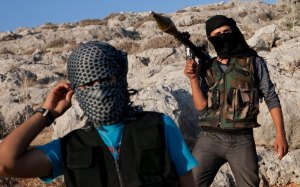
Who Are These ‘Moderate’ Syrians Obama Wants to Pit Against ISIS?

September 15, 2014

Who Are These ‘Moderate’ Syrians Obama Wants to Pit Against ISIS? Daily BeastJamie Dettmer, September 15, 2014

(Will Obama send a battalion of like minded savants, who claim that Islam is peaceful, to convince their “moderate” inferiors in Koranic wisdom that Islam really is peaceful and freedom loving? Perhaps he should accompany them.– DM)
ModeratesDaniel Leal-Olivas/AFP/Getty

Like other countries convulsed by Arab Spring insurrections, there was a mismatch between Western expectations and perceptions and the thinking and religious views of the majority involved in the fighting, and that was a year before the emergence of ISIS. The war back then was clearly becoming more sectarian and Islamic—the trajectory was obvious.

*********************

There were few modern democrats among the armed opposition to Assad two years ago. There are far fewer now. So who can Obama trust not to turn Western-supplied weapons against us later?

The young rebels and opposition activists gathered in a school to discuss how the northern Syrian town of Al Bab should be governed after the departure of Bashar al Assad’s soldiers were taken aback by the question: “Why aren’t there any women here?” It was the summer of 2012, more than 12 months into the uprising against the Syrian president, and more than a year before Abu Bakr al Baghdadi announced the formation of his al Qaeda breakaway, the Islamic State of Syria and Sham, or ISIS.

Initial surprise at my question was followed by smirks. The young men who had talked about ushering in a new era of modern democracy and freedom in Syria pushed forward a nervous young imam to explain. “It is not in our tradition for men and women to mix,” he said. “They can have their own meeting, if they want. And if we need advice on some issues, we can ask them.” There were some chuckles at this. So much for democracy, at least in its Western guise.

Later that night I sat with two local sheikhs who explained how they were forming a court to adjudicate civil disputes and rule on criminal cases. “We will use Sharia law,” said Abdulbaset Kuredy. “What else is there? After Assad, the whole country will be governed by Sharia.” Then he launched into a condemnation of the corrupt West and its acceptance of homosexuality and same-sex marriage. The sheikhs were aligned with the Free Syrian Army, the rebel group now touted in Washington as the “moderates” to support in the fight against Assad on the one hand, ISIS on the other.

There was nothing I saw in Al Bab in August 2012—still early days in the insurrection that is now halfway through its fourth year—that led me to feel that if the Syrian uprising toppled Assad, it would lead to an inclusive, minority-respecting, and more or less democratic outcome. Like other countries convulsed by Arab Spring insurrections, there was a mismatch between Western expectations and perceptions and the thinking and religious views of the majority involved in the fighting, and that was a year before the emergence of ISIS. The war back then was clearly becoming more sectarian and Islamic—the trajectory was obvious.

After two years of brutal and barbaric sectarian warfare, the Syrian rebellion has seen an even greater hardening of sectarian attitudes among Syrian opponents of Assad and his regime, which is dominated by members of the minority Alawite sect. Many secular activists from the urban areas of Damascus or Aleppo withdrew long ago, sickened by what the uprising was becoming. They were appalled at the rise of the jihadists and their cruelty, worried by the strength of Islamist factions among the rural fighters who are the backbone of the militias. The center did not hold.

A key element in President Obama’s strategy to halt the jihadist campaign of terror across the Levant involves reversing his earlier decision to refrain from fully backing so-called moderate Syrian rebels with arms and training. Exasperated by infighting among the leaders of the Syrian National Council and the Free Syrian Army, and worried by the weakening of the more secular elements, the Obama administration basically left the uprising alone. Critics like Sen. John McCain say that helped the rise of extremists like ISIS.

Now the president is asking Congress for $500 million to bolster rebels he kept at arm’s length to give them weapons and pay for training these insurgents he once derided as ineffectual “former doctors, farmers, pharmacists and so forth.”

But we shouldn’t imagine this is a change of policy in line with President George W. Bush’s “freedom agenda” or the “New Beginning” philosophy of Obama’s 2009 address in Cairo that sought to mend relations between the U.S. and the Arab world.

In his 13-minute speech last week, Obama did not mention the word “democracy” once—nor, for that matter, did “freedom” make any appearance. The arming and training of Syrian rebels is about U.S. national security interests and the rolling back of the jihadists.

But the decision to do so prompts a key question once again: Who are the moderates? Who in rebel ranks can be trusted not to turn Western-supplied weapons against the West later, or switch sides as we’ve seen in Mali and other countries racked by Islamist rebellions? Who can receive arms that won’t be shared with ISIS or the official al Qaeda affiliate in Syria, Jabhat al-Nusra? Who won’t embarrass the West by engaging in some act of egregious cruelty, torturing prisoners or executing foes?

There were not many moderates around two years ago, as I found in Al Bab then, and there are far fewer now. A year ago the town was overrun by ISIS and many of the young rebels joined the group; others who remained loyal to brigades affiliated with the FSA pulled out. The bulk of those, according to locals, hooked up with the Islamic Front, a coalition of Islamist militias who are the second largest fighting insurgent formation after ISIS. The front has close ties with al-Nusra.

The Obama administration’s frustration with the rebellion and distrust of the insurgents were overlooked briefly a year ago, when Obama’s “red line” was crossed and Assad used chemical weapons against rebels and civilians. The administration considered taking action. Under skeptical questioning by some lawmakers, Secretary of State John Kerry insisted last summer: “The opposition has increasingly become more defined by its moderation, more defined by the breadth of its membership, and more defined by its adherence to some, you know, democratic process and to an all-inclusive, minority-protecting constitution, which will be broad-based and secular with respect to the future of Syria.”

That wasn’t the case then and it isn’t now. Shortly after Kerry’s comments, a respected British defense consultancy, IHS Jane’s, released a study claiming that more than half of the rebels battling to oust Assad were either jihadists or hardline Islamists.

“There are certainly moderates remaining,” says Jonathan Schanzer, a Mideast expert with the Washington-based think tank the Foundation for the Defense of Democracies. “The problem is that they are few in number and lacking in support. They have been marginalized by U.S., European, Turkish, and Arab policies that have only served to boost the presence and capabilities of the more radical factions. It’s unclear to me how Washington’s new approach can help reverse this trend in an urgent or expeditious manner—which is what is needed.”

Most of the militias that are effective fighting formations and have scored off-and-on successes on the battlefield against ISIS are not moderate by Western standards. Most are Islamist to varying degrees and some, like Ahrar al-Sham, which lost most of its top leaders this week in a bomb attack in Idlib, are dedicated to establishing a Sunni theocracy in Syria. They don’t subscribe to transnational jihadism, but they do have strong ties to al-Nusra, which is part of the al Qaeda international franchise.

The most effective anti-ISIS fighters are with the Kurdish self-defense forces of the YPG, but because of their links with the Turkish separatist PKK, which is designated as a terrorist organization by the United States and European countries, they can’t be included in groups that receive Western backing.

According to a report issued this week by the International Crisis Group, the “mainstream” rebel opposition is caught in a desperate plight, “locked in a two-front war against the regime and IS [Islamic State or ISIS], their position is more precarious than at any time since the fighting began.”

ISIS has pressed an offensive north of Aleppo and is threatening to deliver a severe blow to rebel opposition groups by cutting off their supply lines to Turkey. If this can’t be stopped, the Crisis Group warns, the loss “would reverberate throughout the country, pushing many to give up the fight or join a more powerful militant force: IS.”

So speed is also of the essence. But not only is the Obama administration going to find it hard to select rebel groups it can work with, it will also have the problem of persuading them to focus on ISIS at the expense of their struggle against Assad, and if the regime starts making up more ground, that in turn could ignite local Sunni anger to the benefit of the jihadists.

There are already signs emerging that key Islamist groups aren’t ready to fall into line with the Obama agenda. This week a deal was struck between IS and an important Islamist coalition, the Syrian Revolutionaries Front, which is made up of about 20,000 fighters.

According to the Syrian Observatory for Human Rights, a U.K.-based Syrian opposition monitoring group, the jihadists and the Front have agreed “not to attack each other” while fighting the principal enemy, Assad.

War Coming: Nothing The Peace-At-Any-Costers Can Do About It

September 12, 2014

War Coming: Nothing The Peace-At-Any-Costers Can Do About It, IsraellicoolRyan Bellerose, September 11, 2014

isis-marching-AP-300x224

ISIS is a Muslim group. Their foundation is pretty much a strict interpretation of Sunni Islam. To claim that it is not Islamic is to ignore several important things, but the key fact is it doesn’t matter what WE think or what western Muslims think, it only matters what the asshats in ISIS think.

And what they think is they are on a holy mission to create an Islamic Caliphate. I am getting tired of reading all these western orientalists who post that “these people do not follow Islam” as though they have all studied Islam and as though Islam is a monolith.

I also grow tired of the apologists who try to marginalise the problem or claim that anyone who speaks up about this issue is a racist, bigot or Islamophobe. ISIS is NOT the same as Westboro. Westboro are asshats no doubt but they do not behead people and aren’t large enough in numbers to cause any real issue. The mainstream of Christianity doesn’t support them. ISIS, on the other hand, has the support of a LOT of Muslims, and even the ones who do not support it, are rarely vocal about that unless they are in the west.

Hamas is only fighting the expansion of ISIS because the Hamas leadership does not want to lose the cash cow they have. In fact the Hamas charter demands pretty much the same as ISIS: an islamic caliphate where everyone else is a dhimmi (not even a citizen let alone a second class citizen).

Let me be clear, if you belong to any of the following groups, you shouldn’t be supporting ISIS:

Women, Homosexuals, Christians, Jews, Natives, Muslims who are not fanatical, Atheists, Europeans, Asians, North Americans, people who believe in Humans rights……. perhaps now you get the picture. If you are not Muslim, and more specifically a specific sort of muslim, then you should not remain silent. Pretty much the only people who should support ISIS, out of self interest, are Sunni Muslims, mostly of the more legalist end of the spectrum because moderate Sunnis probably don’t want to party like its 999.

There is a war coming, and there is not a damn thing the peace-at-any-costers can do about it. This war will not always be fought openly, even now, its being fought on campuses, in the media and in other arenas of public perception. It really is going to be all the people who believe in human rights and freedom against a totalitarian ideology that believes in its supremacy and refuses to acknowledge equality.

WE do not have a choice over whether to fight, if we do not fight we will be allowing our freedoms to be taken from us. If you think I am being an “Islamophobe” I urge you to spend some time and research Islam and its core beliefs. Look at what ISIS is doing because, my friends, actions speak louder than words. Sex slavery, torture, beheadings, crucifixion: these aren’t just things from the dark ages, these are happening right now to Christians, Yazidis and Kurds.

Now that’s the bad news, the good news is we’re not alone in this fight, there are Muslims who speak up against ISIS and extremism, and they are fighting to change Islam into a more moderate religion. It is imperative that we support those people, we do not allow ourselves to become jaded and prejudiced against all Muslims, because I will be honest with you, our best chance to defeat the radicals is to work with those who want change. So take some time, educate yourself about these things because whether you like it or not we are in this fight: its just that some of us don’t know it yet.

Obama, the Islamic State and Islam, the enemy which shall not be named

September 12, 2014

Obama, the Islamic State and Islam, the enemy which shall not be named, Dan Miller’s Blog, September 11, 2014

Islam is the greatest threat to the civilized world. Obama denies that it is any threat and maintains that it is peaceful.

Obama's excellent foreign policy

Minutes into His address to the nation (full text here) on the eve of two September 11 attacks, one in 2001 and another in 2012, Obama stated:

Now let’s make two things clear: ISIL is not “Islamic.” No religion condones the killing of innocents, and the vast majority of ISIL’s victims have been Muslim. And ISIL is certainly not a state. It was formerly al Qaeda’s affiliate in Iraq, and has taken advantage of sectarian strife and Syria’s civil war to gain territory on both sides of the Iraq-Syrian border. It is recognized by no government, nor the people it subjugates. ISIL is a terrorist organization, pure and simple. And it has no vision other than the slaughter of all who stand in its way. [Emphasis added.]

In a region that has known so much bloodshed, these terrorists are unique in their brutality. They execute captured prisoners. They kill children. They enslave, rape, and force women into marriage. They threatened a religious minority with genocide. In acts of barbarism, they took the lives of two American journalists – Jim Foley and Steven Sotloff. [Emphasis added.]

Obama remains faithful to His views of Islam, as expressed during His Cairo address.

So let there be no doubt: Islam is a part of America. And I believe that America holds within her the truth that regardless of race, religion, or station in life, all of us share common aspirations – to live in peace and security; to get an education and to work with dignity; to love our families, our communities, and our God. These things we share. This is the hope of all humanity.

I have argued the characteristics of Islam and that the Islamic State has its roots in Islam in detail here, here and elsewhere; little purpose would be served by repetition. This summary should be sufficient for present purposes.

Here is a video of Israeli Prime Minister Netanyahu’s September 11th comments on Obama’s September 10th address. Keep in mind that Netanyahu is compelled to say nice things about Obama whenever he possibly can, even if to do so requires that he stretch a point or two or three. But listen to Netanyahu’s comments, quite divergent from Obama’s, on Islam and Islamist states — including Iran — which seek an Islamic caliphate for the entire world through fear and terror. The relevant differences among the Islamist states are principally on the nature of the desired caliphate. There was a master race, now there is a master faith. Islam’s master religion is at least as evil as Nazism master race. Clarity and courage are needed. Do we have them? Obama does not.

The Islamic State is at least as Islamic as Nazism was German

Winston Churchill spoke about Nazism early and often. Here is what he said during a 1934 radio broadcast:

Many of Churchill’s comments on Nazi Germany might be applied to Islam. As PM Netanyahu said, then there was a “master race.” Now, there is a “master religion.” What are we to do about it?

Was Nazism Germanic? Millions of Germans believed it to be. They were enthralled by the Chief Imam of Nazism, Hitler. Germany’s preparations for war with civilization went into full swing when Imam Hitler rose from the depths to control Germany. If Obama had been President in the mid 1930’s and had proclaimed His intention to battle Nazism, might He have said something like this?

Now let’s make two things clear: Nazism is not Germanic. German culture does not condone the killing of innocents, and the vast majority of Nazism’s victims have been German. Nazism is a terrorist organization, pure and simple. And it has no vision other than the slaughter of all who stand in its way. [Emphasis added.]

Nazi Germany’s “vision” was not merely the “slaughter of all who stand in her way.” That, along with the fear and submission its slaughter induced, was its strategy. The Nazi vision, to be achieved through its strategy, was the expansion of the “fatherland” through the “peaceful” surrender, and military conquest of Europe if necessary, for the imposition of Nazism throughout the region.

The vision of the Islamic State, its Islamic allies, cohorts and opponents, reflects their vision of Islam — the expansion of “true” Islam throughout the non-Islamic (and apostate Islamic) world and the imposition of the “true” version of Islam on non-Muslims and apostates. They differ principally in what they consider “true” Islam.

There is at least one difference between “moderate” Islamists and the Islamic State: the Islamic State does not pretend to desire peace; “moderate” Muslims do. Like “moderate” Islamists, Nazi Germany professed its peaceful nature and claimed to desire no more than to right wrongs committed against ethnic Germans in Czechoslovakia and elsewhere. Its claims of good will and a peaceful soul were accepted by Neville Obama Chamberlain and many other naive leftists in Britain and Europe.

As noted in a Washington Times editorial,

Whether by the name al Qaeda, Taliban, al-Shabab, Boko Haram, Islamic State, ISIS or ISIL, the Islamist goal is one and the same — the destruction of the West and the defining values of civilization. The only appropriate response is to crush those who would threaten those values. It’s not an occasion for dialogue, appeasement or negotiation. [Emphasis added.]

Neither is it the time to arm “moderate” Islamists on the ground that they will help to eliminate the horrors of the Islamic State.

Obama claims that He will arm and support “moderate” Islamists.

Across the border, in Syria, we have ramped up our military assistance to the Syrian opposition. Tonight, I again call on Congress to give us additional authorities and resources to train and equip these fighters. In the fight against ISIL, we cannot rely on an Assad regime that terrorizes its people; a regime that will never regain the legitimacy it has lost. Instead, we must strengthen the opposition as the best counterweight to extremists like ISIL, while pursuing the political solution necessary to solve Syria’s crisis once and for all. [Emphasis added.]

Presumably, Obama has in mind arming the “moderate” opposition to the Syrian regime. There may be some moderates, but does the Obama administration know who they are? Does it know that they are capable of resisting, successfully, the theft of their U.S. supplied armaments by non-moderates?

There are approximately 100,000 Syrian rebels,

including the al Qaeda-linked Nusra Front and the powerful Islamic Front rebel umbrella group, currently fighting the Islamic State group in Syria

Has the “vetted, moderate” Free Syrian Army been vetted and is it “moderate?”

As President Obama laid out his “strategy” last night for dealing with ISIS in Iraq and Syria, and as bipartisan leadership in Congress push to approve as much as $4 billion to arm the Syrian “rebels,” it should be noted that the keystone to his anti-Assad policy — the “vetted moderate” Free Syrian Army (FSA) — is now admitting that they, too, are working with the Islamic State. [Emphasis added.]

. . . .

On Monday, the Daily Star in Lebanon quoted a FSA brigade commander saying that his forces were working with the Islamic State and Jabhat al-Nusra, al-Qaeda’s official Syrian affiliate — both U.S.-designated terrorist organizations — near the Syrian/Lebanon border.

“We are collaborating with the Islamic State and the Nusra Front by attacking the Syrian Army’s gatherings in … Qalamoun,” said Bassel Idriss, the commander of an FSA-aligned rebel brigade.

“We have reached a point where we have to collaborate with anyone against unfairness and injustice,” confirmed Abu Khaled, another FSA commander who lives in Arsal.

“Let’s face it: The Nusra Front is the biggest power present right now in Qalamoun and we as FSA would collaborate on any mission they launch as long as it coincides with our values,” he added. [Emphasis added.]

. . . .

[T]his time last year the bipartisan conventional wisdom amongst the foreign policy establishment was that the bulk of the Syrian rebel forces were moderates, a fiction refuted by a Rand Corporation study published last September that found nearly half of the Syrian “rebels” were jihadists or hard-core Islamists. [Emphasis added.}

. . . [M]ultiple arms shipments from the U.S. to the “vetted moderate” FSA were suspiciously raided and confiscated by ISIS and Jabhat al-Nusra, prompting the Obama administration and the UK to suspend weapons shipments to the FSA last December.

In April, the Obama administration again turned on the CIA weapons spigot to the FSA, and Obama began calling for an additional $500 million for the “vetted moderate” rebels, but by July the weapons provided to the FSA were yet again being raided and captured by ISIS and other terrorist groups. Remarkably, one Syrian dissident leader reportedly told Al-Quds al-Arabi that the FSA had lost $500 million worth of arms to rival “rebel” groups, much of which ended up being sold to unknown parties in Turkey and Iraq. [Emphasis added.]

At the same time U.S.-provided FSA weapons caches were being mysteriously raided by ISIS and Jabhat al-Nusra, one of the senior FSA commanders in Eastern Syria, Saddam al-Jamal, defected to ISIS. In March, Jabhat al-Nusra joined forces with the FSA Liwa al-Ummah brigade to capture a Syrian army outpost in Idlib. Then in early July I reported on FSA brigades that had pledged allegiance to ISIS and surrendered their weapons after their announcement of the reestablishment of the caliphate. More recently, the FSA and Jabhat al-Nusra teamed up last month to capture the UN Golan Heights border crossing in Quneitra on the Syria/Israel border, taking UN peacekeepers hostage.

Obama’s coalition 

As argued at The Clarion Project,

The U.S. must also be prepared for the pro-Islamist members of its coalition against the Islamic State to predictably support Islamism. [Emphasis added.]

A cataclysmic revelation? Hardly. But does Obama consider it a problem? Most likely He does not. Might He see it as an opportunity?

Secular Syrian opposition figures complain that Qatar and Turkey are sidelining them by supporting the Muslim Brotherhood and other Islamists. When the U.S. worked with Qatar in removing the Qaddafi regime in Libya, Qatar exercised its influence to benefit the Islamist forces. Libya is experiencing bloody fighting between Islamist and secular forces today.

Qatar continues to support the Muslim Brotherhood, Hamas and the Islamic Front, specifically Ahrar al-Sham. An Ahrar al-Sham leader named Abu Khaled al-Souri had high-level Al-Qaeda ties and was killed by the Islamic State. Jabhat al-Nusra and other Al-Qaeda-linked figures see Qatar as friendly territory.

Saudi Arabia, which has agreed to help support rebels fighting the Islamic State, has already been supporting the Islamic Front, specifically Zahran Alloush’s Army of Islam (or Jaysh al-Islam). His ideology is similar to that of Al-Qaeda/Jabhat al-Nusra.

The Saudis also back a coalition named the Syrian Revolutionary Council. It condemned the United Kingdom for sentencing Islamist cleric Raed Salah for inciting terrorism. He was previously imprisoned in Israel for financing Hamas and working with an Iranian intelligence operative.

Which if any national members of Obama’s coalition support non-Islamic concepts such as freedom of religion, of the media and of speech? It is my understanding that they oppose them, even on rare occasions when they claim to accept them in modest ways.

What else is wrong with the Obama Strategy?

Here’s a taste, even from MSNBC:

Many problems with Obama’s approach to Islamic terrorism are already obvious and more will become apparent with time. As we wait, shall we prepare for Christmas?


ISIS draws U.S. into Iraq and Syria – ISIS executes 250 Syrian soldiers

August 28, 2014

.

Analysis: A new wakeup call for Israel

August 28, 2014

Analysis: A new wakeup call for Israel

The rebel takeover of the Syrian Golan shows how changing events affect Israel’s security doctrine

Twelve hours after Israelis sighed in relief as the ceasefire in the Gaza war appeared to take hold, they awoke Wednesday morning to realize that a new source of concern had emerged on their northern border. Syrian opposition forces, after fierce battles with the Syrian army, had taken over Syria’s Quneitra border crossing with Israel on the Golan Heights.

The crossing is the only official gate between Syria and Israel, manned by the United Nations Disengagement Observation Force since the end of the 1973 Arab-Israeli war. Reports that the Nusra Front – Islamists identified with al-Qaida and supported by Saudi Arabia and Qatar – were the ones who had seized control of the area only increased Israeli concern. That concern was somewhat eased hours later, when new reports suggested that the secular unit of the Free Syrian Army was in control of the crossing, rather than the fundamentalist Muslim group.

Nevertheless, the incidents in Quneitra are a wake-up call for Israel, demonstrating how the changing events in the Middle East, from the advances of the Islamic State in Iraq and Syria, to turmoil in Libya and the Gaza war, are affecting old Israeli security doctrines and stability.

For three and a-half years, Israel tried to stay away from the Syrian civil war, having one ultimate interest in mind: maintaining security and stability on the border and preserving the daily routine of Israel’s rural communities in the Golan Heights, captured from Syria in the Six Day War of June 1967. On occasion, Israel interfered in the war when its intelligence uncovered attempts by President Bashar Assad’s regime to supply weapons – mainly long-range Iranian or Syrian-made missiles – to Hezbollah as payment for the Shiite Lebanese movement’s support in fighting the rebels.

The Israeli Air Force attacked such supply convoys and weapons depots six times, but never claimed responsibility for the actions. This provided a deniability that also enabled the Syrian government to turn a blind eye to the blatant Israeli violations of its sovereignty and thus to avoid any need to retaliate.

In other instances, Israel responded with mild artillery fire whenever errant fire or mortars landed on the Israeli side of the border as a result of the clashes between opposition forces and the Syrian army. Israel believed it was thus preserving its deterrence vis-à-vis the Syrian government, without humiliating the Assad regime. But in the last year, the opposition forces – the Nusra Front and the Free Syrian Army – have taken over most of the Syrian army positions on the Golan areas bordering Israel. As of Wednesday, they control virtually all of the 100-kilometer area along the border.

In light of these evolving events, Israel has been reaching out to opposition forces to prevent them from turning hostile. It opened a field hospital on the border and has in the last year treated more than 1,000 wounded Syrian combatants and civilians. On the face of it, this is a humanitarian gesture, but it also helps Israel maintain good neighborly relations with the opposition forces in Syria, hoping to ensure that the border stays relatively calm.

Nevertheless, other hostile elements such as the Islamic State are also gaining strength in the region. These forces are small and insignificant in the parts of Syria near Israel, but hold a potential threat to the stability of what has been Israel’s quietest border for decades.

At the same time, these and other regional events in Iraq and Kurdistan also provide an opportunity for new alliances. It was revealed this week that Iran is supplying Iraqi Kurdish authorities with ammunition and weapons to repel the IS. Israel, a traditional ally of the Kurds, is also still assisting them in the security and military field. For the first time since 1979, when Iran overthrew the Shah and became an Islamic republic which termed Israel the “small Satan,” the two countries find themselves supporting the same side on one of the Middle East’s major fronts.

Israel may now be having second thoughts, too, about events in Syria and might prefer – maybe even passively support – that the Assad regime remain in power despite the fact that its long-sworn enemies, Iran and Hezbollah, are allied with Damascus.

Yossi Melman is an Israeli security and intelligence commentator and co-author of “Spies Against Armageddon: Inside Israel’s Secret Wars”.

Israel struck nine Syrian targets in response to boy’s death, and as a boost for the rebel bid for Quneitra

June 23, 2014

Israel struck nine Syrian targets in response to boy’s death, and as a boost for the rebel bid for Quneitra.

DEBKAfile Special Report June 23, 2014, 3:36 AM (IDT)
Spke guided missile system (Tamuz)

Spke guided missile system (Tamuz)

Israel carried out nine strikes against Syrian military targets after midnight Monday, June 23, in retaliation for the Kornet rocket attack which killed an Israeli boy and injured two others a few hours earlier. They were conducted by air strikes and Spike NLOS anti-tank missiles (Tamuz), against Syrian firing positions, its 90th Brigade command center in Quneitra and three battalions.

The IDF Spokesman called the strikes a direct response to ongoing cross-border aggression which culminated in Sunday’s deadly missile attack.

The deadly rocket attack was fired from a Syrian army position in the village of Ahmadiyeh outside the Golan town of Quneitra. It hit truck in which Muhammad Karaka, 12, from the Galilee village of Arraba and his father Fahmi, a defense ministry contractor working on the Golan border fence at Tel Hazaka, were sitting. The boy was killed and his father and a worker injured.

The IDF said: “We identified precise hits on the targets,” following “the gravest provocation which followed a series of terrorist attacks in recent months against Israel military positions in the border region in general and this area in particular.”

debkafile’s military sources add: Israel took the opportunity for action that would break the standoff in the two-month battle for Quneitra between Syrian rebel and army forces. The Syrian army’s 90th Brigade has been defending the town against a rebel assault, reinforced by units trained and armed in Jordan by American instructors.

Last week rebel forces managed to overcome the Assad army’s main position holding the southern Syrian Deraa-Tel Jum’a line. They are expected now to take advantage of the weakening of the 90th Brigade by for a major push to win Quneitra. Israel almost certainly checked with the US command center near Amman and the Jordanian army before staging the multiple attack.
Our sources add that a small Hizballah advance unit was attached to the Syrian Quneitra unit..