Military Upset with White House ‘Micromanagement’ of ISIS War, Daily Beast, Josh Rogin, Eli Lake, October 31, 2014
(The impatient (non-Islamic) Islamic State seems unwilling to play “dither along with us” with the Obama Administration while awaiting news that the You Tube video which caused the entire mess has been taken down and its creator suitably punished. Please see also U.S. strategy against Islamic State hits major hurdles. — DM)

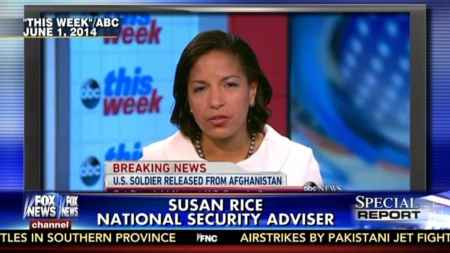
[M]ilitary officers and civilian Pentagon leaders tell The Daily Beast, is the ISIS war’s decision-making process, run by National Security Advisor Susan Rice. It’s been manic and obsessed with the tiniest of details. Officials talk of sudden and frequent meetings of the National Security Council and the so-called “Principals Committee” of top defense, intelligence, and foreign policy officials (an NSC and three PCs in one week this month); a barrage of questions from the NSC to the agencies that create mountains of paperwork for overworked staffers; and NSC insistence on deciding minor issues even at the operational level.
“We are getting a lot of micromanagement from the White House. Basic decisions that should take hours are taking days sometimes,” one senior defense official told The Daily Beast.
*****************
The Pentagon brass placed in charge of implementing Obama’s war against ISIS are getting fed up with the short leash the White House put them on.
Top military leaders in the Pentagon and in the field are growing increasingly frustrated by the tight constraints the White House has placed on the plans to fight ISIS and train a new Syrian rebel army.
As the American-led battle against ISIS stretches into its fourth month, the generals and Pentagon officials leading the air campaign and preparing to train Syrian rebels are working under strict White House orders to keep the war contained within policy limits. The National Security Council has given precise instructions on which rebels can be engaged, who can be trained, and what exactly those fighters will do when they return to Syria. Most of the rebels to be trained by the U.S. will never be sent to fight against ISIS.
Making matters worse, military officers and civilian Pentagon leaders tell The Daily Beast, is the ISIS war’s decision-making process, run by National Security Advisor Susan Rice. It’s been manic and obsessed with the tiniest of details. Officials talk of sudden and frequent meetings of the National Security Council and the so-called “Principals Committee” of top defense, intelligence, and foreign policy officials (an NSC and three PCs in one week this month); a barrage of questions from the NSC to the agencies that create mountains of paperwork for overworked staffers; and NSC insistence on deciding minor issues even at the operational level.
“We are getting a lot of micromanagement from the White House. Basic decisions that should take hours are taking days sometimes,” one senior defense official told The Daily Beast.
Other gripes among the top Pentagon and military brass are about the White House’s decision not to work with what’s left of the existing Syrian moderate opposition on the ground, which prevents intelligence sharing on fighting ISIS and prevents the military from using trained fighters to build the new rebel army that the President has said is needed to push Assad into a political negotiation to end the conflict.
The New York Times reported Wednesday that Defense Secretary Chuck Hagel himself is among the critics of Obama’s strategy in Syria. Hagel wrote a memo last week to National Security Advisor Susan Rice warning that Obama’s Syria strategy was unclear about U.S. intentions with respect to Syrian President Bashar al Assad, undermining the plan.
Hagel stood by the memo Thursday. “We owe the president and we owe the National Security Council our best thinking on this. And it has to be honest and it has to be direct,” he told reporters.
But the top uniformed military leaders in charge of the operation are also struggling to work around the White House policy constraints and micromanagement, including Joint Chiefs Chairman Gen. Martin Dempsey, Gen. Lloyd Austin, commander of CENTCOM, and Gen. Michael Nagata, the SOCOM lead official in charge of the Syrian train and equip program, according to multiple officials and persons briefed by those generals.
Nagata has been tasked to build a new rebel army from scratch but is not permitted to work with existing brigades, meaning he must find and vet new soldiers, mostly sourcing from Syrian refugee camps in Turkey, Jordan, and Lebanon. What’s more, the size of the program will produce only 5,000 fighters a year after the training begin, most of whom who will serve as “local defense forces” and not actually go after ISIS, according to two officials briefed on the plan. Of those forces, 500 would be given additional training in “counterterrorism.” That’s a small attack force to face an ISIS military that is estimated to have tens of thousands of fighters.
Dempsey told reporters Thursday that the recruiting and vetting of soldiers for the new Syrian rebel army has not yet begun, although sites for the training camps have been chosen.
“At this point we still don’t know how long it’s going to take to send in the trained guys,” a senior Defense official said. “The situation is changing so much on the ground it’s hard to plan it out.”
Dempsey has twice made public statements that seemed to reveal his dissatisfaction with the White House policy. Last month, he said it would take 12,000 to 15,000 ground troops to effectively go after ISIS in Iraq and Syria. Earlier this month, he suggested that U.S. ground troops might be necessary to fight ISIS in the future, a comment he later walked back.
Many military officials, including at CENTCOM’s headquarters in Tampa and their air base in Qatar (where the ISIS air campaign is run) are barred from even communicating with Syrian opposition representatives unless those rebels are on a White House / State Department approved list. Many Syrian opposition leaders complain that Free Syrian Army brigades fighting ISIS now are offering help in making the ISIS strikes effective, but are getting no response from the administration.
The international coalition against ISIS, led on the U.S. side by retired Gen. John Allen and State Department official Brett McGurk, is working with Sunni tribes in Iraq to coordinate against ISIS. But they are not working with the corresponding tribes on the Syrian side of the mostly non-existent Iraq-Syria border. ISIS has slaughtered hundreds of these tribesmen in Eastern Syria who refused to yield to the group’s demands.
Meanwhile, the Free Syrian Army, largely written off by the White House, has been suffering heavy losses to ISIS as well as to the al-Qaeda affiliated al Nusrah Front, which has opened up a third fighting front against the FSA in cities like Idlib. FSA brigades that have been vetted by the U.S. government, including the Syrian Revolutionaries Front and Harakat Hazm, have seen their non-aggression pact with al Nusrah disappear.
“Al Qaeda has captured a number of villages from the FSA in Idlib and the fighting continues to be intense. The FSA needs urgent Coalition support in this fight because if Al Qaeda captures Jabal al-Zawiyeh in Idlib, extremists will be positioned to cut off a critical line of supply from the Turkish border,” said Oubai Shahbandar, advisor to the Syrian National Coalition. “So the question is: Will Coalition airstrikes help the FSA fight al Qaeda or will they allow Al Qaeda to overrun moderate forces?”
NSC Spokeswoman Bernadette Meehan declined to comment on the criticisms coming from the Pentagon and military about the White House’s approach to ISIS and training the Syrian rebels. But on Wednesday, Deputy National Security Advisor Tony Blinken, who is rumored to be Obama’s choice to replace Bill Burns as Deputy Secretary of State, defended the White House strategy but said that FSA is just not a viable partner.
“For more than two years working with and supporting the moderate opposition, we’ve made some gains in making it more effective and trying to position it as a counterweight to Assad. Now we’re intensifying that support,” he said at the Carnegie Endowment for International Peace. “The coalition can do real damage to ISIL through the air. But without forces on the ground to hold territory from which ISIL has been removed, we will not be able to shrink and eventually eliminate the safe haven.”
Secretary of State John Kerry said Thursday that there is no military solution to the Syria crisis and said the U.S. is reaching out to countries like Russian and Iran to seek a new political negotiation. Syrian National Coalition President Hadi al Bahra told The Daily Beast last month that there is no genuine interest in the West for a new political process, which he described as being “in a coma.”
“There have been so many things said on Syria that were not delivered, nobody thinks the President really wants to do anything on Syria. Even currently serving officials realize that you cannot bomb your way out of this and you need to have a plan for a political solution, but we don’t have it,” said Andrew Tabler, senior fellow at the Washington Institute for Near East Policy. “There’s needs to be a fully thought out strategy with a political dimension that involves the opposition. If you don’t do that, you can’t solve this problem.”





 anneinpt
 artaxes
 danmillerinpanama
 davidking1530
 Peter Hofman
 Joseph Wouk
 Peter
Peter Louisiana Steve
 WarSclerotic
Recent Comments