Archive for the ‘Somalis in Minnesota’ category

Minneapolis: Muslims who oppose Muslim candidate threatened into silence

September 3, 2016

Minneapolis: Muslims who oppose Muslim candidate threatened into silence, Jihad Watch

Ilhan-Omar-and-brother
An update on this story. “A Community Forced Into Silence,” by Preya Samsundar, Alpha News, September 2, 2016:

MINNEAPOLIS, MN — For several weeks, Alpha News has been covering the latest developments of scandal and controversy that have rocked the campaign of DFL primary winner Ilhan Omar.

The controversy of Omar’s alleged illegal behaviors came to light following an article posted by Scott Johnson of Powerline. Details from the post alleged that Omar was not married to the man she claimed and had married her biological brother in order to bring him to the United States from the United Kingdom.

Through interviews and information gathered through investigating social media accounts, Alpha News has enough evidence to reasonably suggest that the man identified as Ahmed Nur Said Elmi, who Omar legally married in 2009, is in fact Ilhan Omar’s brother.

The latest developments in the controversy have brought troubling new details out of the Cedar-Riverside area.

A credible source from inside the Somali Community has stepped forward and provided Alpha News with information in exchange for anonymity. For the purposes of the article, we will refer to the source as Z.

Z tells Alpha News members of the Somali Community are being silenced through intimidation tactics and threats of physical violence on themselves and their families still back home in Somalia.

Z specifically mentions a man named Gulaad Hashi and identifies him as “campaign muscle”. Z tells Alpha News, “He serves as [Omar’s] muscle in the Somali community and has been leading a witch hunt to out ‘the snitch’ in the community. He has used everything from intimidation to threats to silence community members from speaking out about this, which is why no Somali has publicly come forward to state what we all know to be true.”

Alpha News obtained a screenshot of a Facebook post by Hashi with a picture of the SomaliSpot website. A member of the Somali Community has stepped forward and has translated the information for Alpha News.

According to the translation, the Facebook post states: “Somalis say those who live in glass houses shouldn’t throw stones. Who knows who owns this website Somali Spot? Who knows who posts on it? Soon I will expose all and, I promise, if you don’t stop what you’re doing we won’t stop until you have nowhere to hide.”

Alpha News has also obtained a Facebook Live Video posted by Hashi on August 18th, 2016. At 3:35, a woman Alpha News has identified as Farhio Khalif Jordan, the Associate Chair of the Somali-American Caucus speaks on the video. According to the translation, she states in plain terms that any Somali who opposes Ilhan Omar or talks about her personal life, including her marriage discrepancies, is turning on the Somali community and is an enemy of it.

At 5:00, Z identifies the man speaking as a male member of Ilhan Omar’s Somali campaign. According to the translation received, the man discusses purging the malicious individuals from the community and disposing of them when speaking about Omar’s marriage.

Sadly, this is not the first time that Alpha News has heard about these threats. Sources within the community have come forward and told Alpha News of the fear they face on a daily basis.

As one source described it, “I very much doubt any Somali will publicly come forward and speak about this story not only because of the repercussions they could face here in Minneapolis, but also because of the potential harm doing so could bring to their loved ones in Somalia. There is no rule of law there and the risk posed by blow back from this is too high. It is no coincidence that this was first exposed on an anonymous Somali forum.”…

Read the rest here.

22 Percent of Resettled Refugees in Minnesota Test Positive for Tuberculosis

May 17, 2016

22 Percent of Resettled Refugees in Minnesota Test Positive for Tuberculosis, BreitbartMichael Patrick Leahy, May 17, 2016

Somali-Minnesota-AP-640x480Jim Mone/AP

One of every five refugees resettled in Minnesota by the federal government tested positive for latent tuberculosis in 2014, according to the state’s Department of Health.

Only 4 percent of the general population in the United States tested positive for latent tuberculosis in the most recent report provided by the Centers for Disease Control.

The April 2016 edition of the Refugee Health Quarterly, published by the Minnesota Department of Health reports that:

Minnesota had 150 cases of TB in 2015, compared to 147 cases in 2014 (a 2 percent increase). The most common risk factor for TB cases in Minnesota is being from a country where TB is common.

TB screening is offered to all refugees during the domestic refugee health exam.

In 2014, 22 percent of refugees screened tested positive for LTBI (latent tuberculosis infection).

26 percent of all foreign born cases of tuberculosis in Minnesota were from people born in Somalia. Somalians almost exclusively enter the state through the refugee resettlement program.

More than 70,000 refugees have been resettled in the United States annually for the past three decades by the federal government. It’s not just tuberculosis being brought in by these resettled refugees. Measles, whooping cough, diptheria, and other diseases that were on their way to eradication are also coming in across the borders of the United States.

A recent outbreak of measles in Memphis, Tennessee, a center for refugee resettlement, began at a local mosque, as Breitbart News reported previously.

The alarming public health report from Minnesota comes on the heels of news from the Centers for Disease Control that in 2015, the incidence of tuberculosis in the United States increased.

“Data from 2015 show that the number of TB cases has increased (by 1.7 percent) nationally [in the United States] for the first time in 23 years, with a total of 9,563 TB cases reported,” the Minnesota Department of Health reports.

As the Star Tribune, Minnesota’s largest daily newspaper, reports:

The CDC is still trying to determine the reason for the uptick.

The goal set by the CDC, in 1989, of eliminating TB by 2010 — defined as less than one case in a million people — remains elusive. Even if the trend of declining cases had continued, the United States would not have eliminated TB by the end of this century, the CDC said.

“We are not yet certain why TB incidence has leveled off, but we do know it indicates the need for a new, expanded approach to TB elimination,” said Dr. Philip LoBue, director of the CDC’s Division of Tuberculosis Elimination, in an email.

A dual approach is needed: continue to find and treat cases of disease and evaluate their contacts, as well as identify and evaluate other high-risk persons for latent TB infection, he said.

There may be a positive correlation between the increase in the number of refugees resettled in the United States during this period and the sudden increase in the incidence of tuberculosis, a disease that many thought was on the path to eradication in the United States.

As the Centers for Disease Control report:

In 2014, a total of 66% of reported TB cases in the United States occurred among foreign-born persons. The case rate among foreign-born persons (15.4 cases per 100,000 persons) in 2014 was approximately 13 times higher than among U.S.-born persons (1.2 cases per 100,000 persons).

“Today four states – California, New York, Texas and Florida – have more than half the nation’s active TB cases, though they have only a third of the country’s population. The four states have the highest numbers of foreign-born residents,” according to the Star Tribune.

A person with latent tuberculosis is not infectious and does not have symptoms of the disease. A person with active tuberculosis is infectious and has symptoms of the disease.

Ten percent of those with latent tuberculosis develop active tuberculosis if not treated,according to the World Health Organization.

As the Star Tribune reports:

TB is an airborne infectious disease caused by bacteria that spreads through the air, person to person, when someone coughs or sneezes. One in three people worldwide have latent TB, according to the World Health Organization. In the United States, up to 13 million people have been exposed to TB and could develop the disease.

Every year, tuberculosis claims 1.5 million lives worldwide and 500 to 600 in this country.

“Tuberculosis (TB) has surpassed HIV as the leading cause of death from infectious disease worldwide,” the Minnesota Department of Health reports.

Tuberculosis is airborne and can be spread when a person active tuberculosis coughs, sneezes, or otherwise transmits the infection to a previously uninfected individual.

Treatment for tuberculosis is long and expensive. If caught early, it typically takes about nine months for a person with active tuberculosis to improve to latent tuberculosis. Not everyone diagnosed with active tuberculosis, however, improves. Mortality rates for those with active tuberculosis are much higher than health professionals would like, even in the United States.

According to the Star Tribune:

Treating TB patients is labor intensive. To ensure that TB patients complete the course of drugs that lasts six months or longer, Directly Observed Therapy programs require a health care worker – not a family member – to watch patients with active TB swallow every dose. If a patient cannot get to a clinic, a health care worker goes to the person’s home. The worker monitors patients for side effects and other problems.

Care also involves communication and cultural challenges. In Michigan, where the number of active TB cases rose from 105 in 2014 to 130 last year, the health department reaches out to Detroit’s large Arab and Bangladeshi populations. In other parts of the state, Burmese immigrants have different needs, said Peter Davidson, Michigan TB control manager.

“Some local health departments have strong partnerships with translation services. Some rely on a less formal mechanism – a private physician or someone on staff at the hospital who speaks the language,” Davidson said.

The cost of treating an active TB case that is susceptible or responsive to drugs averages $17,000, according to the CDC. Care of patients with drug-resistant TB, which can result from taking antibiotics prescribed before TB was properly diagnosed, costs many times more: $134,000 for a multidrug-resistant patient and $430,000 for an extensively drug-resistant one.

Minnesota public health officials point to the high treatment rate of those refugees diagnosed with latent tuberculosis as a reason for optimism.

“Eliminating TB in the U.S. will require increased attention to the diagnosis and treatment of latent TB infection (LTBI),” the April 2016 Refugee Health Quarterly reports.

“Minnesota’s LTBI treatment completion rate for refugees who start treatment is one of the highest in the nation at 86 percent in 2013,” the report adds.

An alternative public health policy–one that the United States used for decades in the latter part of the nineteenth century and early twentieth century–is to test immigrants and refugees for infectious disease before they are allowed into the country.

In that earlier era, those who tested positive were sent home. Today, however, many are welcomed in and pose a risk of infecting the rest of the American population.

(Note: Valley News Live in Fargo, North Dakota was the first broadcast outlet to report on the 22 percent incidence of latent tuberculosis among refugees in Minnesota.)

Islamophobia in one State (5)

April 14, 2016

Islamophobia in one State (5), Power LineScott Johnson, April 14, 2016

(Please see also, From Poet to Jihai: The Story of a Somali American in Minnesota. — DM)

On what seems like a daily basis, Minnesotans are lectured against the evils of “Islamophobia.” In October, Gov. Mark Dayton weirdly instructed “white, B-plus, Minnesota-born citizens” to suppress their qualms about immigrant resettlement in Minnesota, according to the St. Cloud Times. If they can’t, they should “find another state,” he added.

Andrew Luger, the United States Attorney for Minnesota is a paragon of political correctness who has inveighed against “the current wave of Islamophobia” and has stayed on the attack. Yesterday Luger and others gathered at the prestigious Minneapolis law firm Dorsey & Whitney to decry Islamophobia. Walter Mondale is of counsel at the firm and was a featured speaker at the event. The Star Tribune reports on the proceedings in “Minneapolis legal community, Somali-Americans latest to unite to confront Islamophobia.”

The Twin Cities have received more than 100,000 Somali Muslims in the past 20 years or so. Their presence is notable, yet signs of bigotry against them are virtually nil.

The star victim on display at the Dorsey & Whitney conference yesterday was Asma Jama (middle name Mohamed, by the way). Jama was assaulted by a patron at a local Applebee’s who “flew into a rage because she spoke a foreign language.” Jama speaks Swahili.

The perpetrator of the assault on Jama was one Jodie Burchard-Risch. Burchard-Risch is a nut who has probably had to push 1 for English one too many times. The Star Tribune provides no evidence for deeming her an anti-Muslim bigot. (MPR has a good account of the assault here, with photos.) So far as I can tell, “Islamphobia” had nothing to do with the assault. Indeed, I’m going to go out on a limb and guess wildly that alcohol was a substantial contributing factor to the incident. And when it comes to “Islamophobia,” this was the best they could do, so to speak.

“Islamophobia” is a concept fervently promoted since 2000 by the Organization of the Islamic Conference. It seeks to stigmatize expressions of disapproval of Islam as irrational manifestations of fear and prejudice. Implicitly, it raises the question of whether any fear of Islam is necessarily crazy. It also raises the question of whether some fear of Islam might be rational, but it instructs us to keep any unapproved answer to ourselves. It seeks to make us afraid to talk about perfectly reasonable fears. Andrew McCarthy has more on the provenance and uses of “Islamophobia” here.

Since the early 1990s, Minnesota has been flooded by waves of Somali Muslim refugees and immigrants. The number remains in doubt; official sources place it at something like 35,000. Unofficial estimates put it at well over 100,000. Whatever the number, it is large and growing.

Politicians like Dayton have proved highly effective in inhibiting public discussion of legitimate concerns about Minnesota’s Somali community. When I sat down to interview Hennepin County Sheriff Rich Stanek in his office this past November, he bristled in response to my question about security issues related to the Somali community. Why was I focusing on that community? I referred to the congressional task force report recognizing Minnesota’s responsibility for 26 percent of the American fighters joining or seeking to join the ISIS. “I just came from an FBI briefing this morning,” Stanek told me at the time. “They told me we’re 20 percent.”

OK, but that still leaves Minnesota at No. 1 in a ranking where we would like to be No. 50.

Ten Minnesota Somalis have now been charged by Luger’s office with seeking to join or support ISIS. Four have pleaded guilty. The charges represent the culmination of a 10-month FBI investigation.

Reading the criminal complaints and underlying FBI affidavits supporting the charges in these cases is an alarming experience. The young men who have responded to the call of ISIL are full of hate for Americans and for the U.S. If they choose to act it out somewhere closer to home than Syria, we will have a major problem on our hands. After the massacre in San Bernardino, Calif., you’d think it might be time to talk about it.

The 10 men present something of a case study that belies the clichés around the subject of “radicalization.” These men were “connected” to schools and jobs. Their cases demonstrate plenty of opportunity for advancement and financial support. One of the men even maxed out his federal student loan account with a $5,000 withdrawal before seeking to depart Minneapolis for Syria.

Unnamed local mosques figure prominently in the cases. Islam is, of course, a common denominator. The 10 men are all Muslims seeking to join the jihad waged by ISIL.

Hillary Clinton actually had a useful observation buried in her Minneapolis speech this past fall on the subject of terrorism. She quoted Deqa Hussen, the mother of one of the 10 Somali men charged with supporting ISIS. Addressing other parents, Hussen said: “We have to stop the denial. … We have to talk to our kids and work with the FBI.” Clinton herself added: “That’s a message we need to hear from leaders within Muslim-American communities across our country.”

Which raises a question or two: Why don’t we hear that message more often from leaders within the Somali community? For that matter, why don’t we hear more expressions of gratitude from within the Somali community for their rescue from Third World disorder by the U.S. or for opportunities afforded to them in Minnesota?

Kyle Loven is the Minneapolis FBI’s chief division counsel and media coordinator. Speaking about Somali-related law enforcement issues to the National Security Society in Richfield in October, he conceded that the community gave rise to special challenges for law enforcement. “We walk a tightrope” with this community, Loven observed. “Every time we have to indict somebody, you should see the remarks we get. … Every time we have to make an arrest, it is a setback [in our relations with the Somali community].”

Luger is nominally responsible for a pilot program to prevent “radicalization” of Somali-Minnesotans. The program goes under the name “Building Community Resilience,” a classic euphemism of the Obama era. The program is to funnel as much as $1 million to support Minnesota’s Somali community. The memorandum of understanding between Luger and Minnesota Somali leaders reflects the wariness of Somali-Minnesotans. It stipulates that the program will not be used for surveillance purposes by any law enforcement agency or by any person working for or on behalf of any law enforcement agency.

You can see why the authorities might want to shut down discussion of reasonable concerns raised by Minnesota’s Somali community. They really would prefer not to talk about them. They would prefer to sweep them under a well-worn rug.

NOTE: This post is adapted from my December Star Tribune column “Islam and Minnesota: Can we hear some straight talk for a change?” I hope that was a rhetorical question. The answer is obviously no.

From Poet to Jihai: The Story of a Somali American in Minnesota

April 10, 2016

From Poet to Jihai: The Story of a Somali American in Minnesota, Clarion Project, Meira Svirsky, April 10, 2016

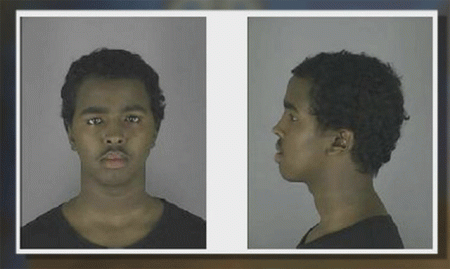
Abdirizak-Mohamed-Warsame-IPAbdirizak Mohamed Warsame

While it may be hard to understand how Warsame, with his unique background, “could have gone either way,” it is important to put into the equation Islamist groups, including CAIR, that that have a history of working against some of the counter-radicalization programs active in the Somali community, giving these kids a different message.

********************

He had everything going for him – except the will to resist a powerful and angry narrative that eventually pulled him in.

Abdirizak Mohamed Warsame, now 21, was on the path to fulfilling the American dream.  And it wasn’t a just a materialist dream, the kind that leaves feelings of emptiness upon achievement.

By the time he was a teenager, he was expressing himself as a poet and actualizing talents in art and music. He was active at a local neighborhood center and part of a local arts group. He began talking to other young Somalis about following their dreams. In a video he made as a teenager in 2011, Warsame says, “You guys are tomorrow. And all you have to have, to get anywhere you want, is determination.”

Warsame, a Somali American, came to America when he was 10 months old. One of eight children, Warsane grew up in a neighborhood called “Little Mogadishu.” His mother and cousin were prominent voices in the movement to prevent the radicalization of the next generation of Somali Americans.

Warsame himself is described as a person who was successfully taking advantages of opportunities he was offered. Post high school, he held down jobs, attended a community college and had support from his family.

Still, Warsame gravitated to negative influences, problematic friends that concerned his mother. In 2014, she sent him away from Minneapolis to Chicago to live with his father. But it wasn’t enough. Warsame began watching videos of lectures by Anwar al-Awlaki, an American Yemani imam described as the “Bin Laden of the internet.”  Awlaki, a high-level Al Qaeda operative, was killed in a U.S. drone strike in Yemen, the first U.S. citizen to be so targeted.

From a young man who had spoken out against violence, Warsame became enthralled with beheading videos. He came to conclude that as a devout Muslim, he must join the fight against the infidels. In 2014, Warsame, with a group of friends plotted to go to Syria to join the Islamic State. According to his confession to authorities, Warsame was the ”emir,” the leader of a group recruiting and encouraging other young Somalis to join the terror group.

He was arrested in December of 2015 and now faces up to 15 years in prison.

Two months earlier, his mother had lectured a group of Somali parents at a town hall meeting, “I need you guys to wake up and to tell your child, ‘Who’s recruiting you?’ Ask what happened. …. We have to stop the denial thing that we have, and we have to talk to our kids and work with the FBI.”

Yet even she was unaware of her son’s activities.

At his hearing he offered a in his defense a seemingly incomprehensible explanation, “I was always listening to one side. I didn’t see the other side of it, that innocent people were being killed.”

The Minnesota Somali communities have been the leading location in the U.S. for terror recruiting. Over the last number of year, close to 40 young Somali men have left the U.S. to fight for Islamist terror groups in Somalia and Syria.

Programs have sprung up to stem the flow, most notably Ka Joog, a community group called whose name literally means “stay away.” Ka Jooj works to build Somali youths into the next generation of American leaders and steer them away from terror recruitment, drugs and gang violence. The group was recently awarded $850,000 to establish a number of new projects, including a new job center in the Somali community where unemployment is close 19 percent, three times worse than state average.

“He was one of those kids that could’ve gone either way,” said Bob Fletcher, a former county sheriff and founder of the Center for Somalia History Studies. “To the gangs, to the radicalization, or to succeed academically with the circle of Ka Joog kids who he is close to.”

While it may be hard to understand how Warsame, with his unique background, “could have gone either way,” it is important to put into the equation Islamist groups, including CAIR, that that have a history of working against some of the counter-radicalization programs active in the Somali community, giving these kids a different message.

Abdirizak Bihi, is a Somai American who works with Ka Joog and is the director of the Somali Education and Social Advocacy Center. Bihi’s nephew was recruited by Al-Shabaab and died in Somalia, where the terror group is based.

In 2011, CAIR-MN attacked Bihi and a Muslim colleague of his, Omar Jamal, branding them as “anti-Muslim” when they participated in a seminar run by Fletcher’s center that included teaching about Al-Shabaab. CAIR-MN was upset that their session described Al-Shabaab as an “Islamic extremist terrorist organization,” saying they did not “distinguish between Islam and terrorism.”

Dr. Zuhdi Jasser, a Muslim human rights activist,writes,”Representatives of CAIR, like Dawud Walid from their Michigan chapter are on record repeatedly when discussing al-Shabaab to American Muslims telling American Muslim youth for example that “9 out of 10 times the person trying to influence you over the internet is not even real…it’s someone with the government trying to set you up.

“[Walid] even casts doubt on whether Al-Shabaab is a terrorist organization. Yet when courageous American Muslims do speak out about radicalization in some mosques and among American Muslim groups, CAIR calls them “anti-Muslim.”

Bihi says that CAIR-MN has impeded his efforts to inform the U.S. government about Islamist radicalization for years by saying that he’s bigoted and doesn’t represent the Somali community.

“They say that I am a bad person, that I am anti-Muslim, and that I don’t represent a hundred percent the Somali community. They lie about my life most of the time and try to destroy my character, my capability and my trust in the community,” says Bihi.

As early as 2009, local Somali Muslims were angered by a CAIR Minnesota campaign that urged Muslims only to talk to law enforcement with a lawyer present, sowing distrust in the Muslim community about law enforcement agencies.  Local Somali Muslims argued that CAIR’s campaign merely served to obstruct federal investigations. At the time, Bihi organized a demonstration outside a CAIR-MN event where protesters chanted, “CAIR out! Doublespeak out!”

Bihi expresses hope that Warsame can be deprogrammed and return to being an asset to the community. At his hearing, the presiding judge offered Warsame a spot in ta new program that assesses his prospects for deradicalization before sentencing.

“I can envision him going to schools, talking to young people in the community, going to mosques, working with imams. His message here could resonate in many communities,” said Bihi.