Archive for the ‘Secretary of State Tillerson’ category

Break out the champagne: State Department officials quitting over “complete and utter disdain for our expertise”

July 31, 2017

Break out the champagne: State Department officials quitting over “complete and utter disdain for our expertise” Jihad Watch

(It’s a good start, but there are many more who need to quit or be fired. — DM)

The swamp needs draining indeed. This news from the State Department, and the New York Times’ grief over it, are good signs that the U.S. is on its way back on dry land.
************************************

We can only hope that with the departure of these failed State Department officials, their failed policies will be swept out along with them. Chief among these is the almost universally held idea that poverty causes terrorism. The United States has wasted uncounted (literally, because a great deal of it was in untraceable bags full of cash) billions of dollars in Afghanistan, Iraq, Pakistan, Egypt, and other countries in the wrongheaded assumption that Muslims turn to jihad because they lack economic opportunities and education. American officials built schools and hospitals, thinking that they were winning over the hearts and minds of the locals.

Fifteen years, thousands of lives and hundreds of billions of dollars later, no significant number of hearts and minds have been won. This is partly because the premise is wrong. The New York Times reported in March that “not long after the attacks of Sept. 11, 2001…Alan B. Krueger, the Princeton economist, tested the widespread assumption that poverty was a key factor in the making of a terrorist. Mr. Krueger’s analysis of economic figures, polls, and data on suicide bombers and hate groups found no link between economic distress and terrorism.”

CNS News noted in September 2013 that “according to a Rand Corporation report on counterterrorism, prepared for the Office of the Secretary of Defense in 2009, ‘Terrorists are not particularly impoverished, uneducated, or afflicted by mental disease. Demographically, their most important characteristic is normalcy (within their environment). Terrorist leaders actually tend to come from relatively privileged backgrounds.’ One of the authors of the RAND report, Darcy Noricks, also found that according to a number of academic studies, ‘Terrorists turn out to be more rather than less educated than the general population.’”

Yet the analysis that poverty causes terrorism has been applied and reapplied and reapplied again. The swamp is in dire need of draining, and in other ways as well. From 2011 on, it was official Obama administration policy to deny any connection between Islam and terrorism. This came as a result of an October 19, 2011 letter from Farhana Khera of Muslim Advocates to John Brennan, who was then the Assistant to the President on National Security for Homeland Security and Counter Terrorism, and later served in the Obama administration as head of the CIA. The letter was signed not just by Khera, but by the leaders of virtually all the significant Islamic groups in the United States: 57 Muslim, Arab, and South Asian organizations, many with ties to Hamas and the Muslim Brotherhood, including the Council on American-Islamic Relations (CAIR), the Islamic Society of North America (ISNA), the Muslim American Society (MAS), the Islamic Circle of North America (ICNA), Islamic Relief USA; and the Muslim Public Affairs Council (MPAC).

The letter denounced what it characterized as U.S. government agencies’ “use of biased, false and highly offensive training materials about Muslims and Islam.” Despite the factual accuracy of the material about which they were complaining, the Muslim groups demanded that the task force “purge all federal government training materials of biased materials”; “implement a mandatory re-training program for FBI agents, U.S. Army officers, and all federal, state and local law enforcement who have been subjected to biased training”; and moreto ensure that all that law enforcement officials would learn about Islam and jihad would be what the signatories wanted them to learn.

Numerous books and presentations that gave a perfectly accurate view of Islam and jihad were removed from coounterterror training. Today, even with Trump as President, this entrenched policy of the U.S. government remains, and ensures that all too many jihadists simply cannot be identified as risks, since the officials are bound as a matter of policy to ignore what in saner times would be taken as warning signs. Trump and Tillerson must reverse this. Trump has spoken often about the threat from “radical Islamic terrorism”; he must follow through and remove the prohibitions on allowing agents to study and understand the motivating ideology behind the jihad threat.

The swamp needs draining indeed. This news from the State Department, and the New York Times’ grief over it, are good signs that the U.S. is on its way back on dry land.

“The Desperation of Our Diplomats,” by Roger Cohen, New York Times, July 28, 2017:

WASHINGTON — On the first Friday in May, Foreign Affairs Day, the staff gathers in the flag-bedecked C Street lobby of the State Department beside the memorial plaques for the 248 members of foreign affairs agencies who have lost their lives in the line of duty. A moment of silence is observed. As president of the American Foreign Service Association, Barbara Stephenson helps organize the annual event. This year, she was set to enter a delegates’ lounge to brief Secretary of State Rex Tillerson on its choreography before appearing alongside him. Instead, she told me, she was shoved out of the room.

Stephenson, a former ambassador to Panama, is not used to being manhandled at the State Department she has served with distinction for more than three decades. She had been inclined to give Tillerson the benefit of the doubt. Transitions between administrations are seldom smooth, and Tillerson is a Washington neophyte, unversed in diplomacy, an oilman trying to build a relationship with an erratic boss, President Trump.

Still, that shove captured the rudeness and remoteness that have undermined trust at Foggy Bottom. Stephenson began to understand the many distressed people coming to her “asking if their service is still valued.” The lack of communication between the secretary and the rest of the building has been deeply disturbing.

An exodus is underway. Those who have departed include Nancy McEldowney, the director of the Foreign Service Institute until she retired last month, who described to me “a toxic, troubled environment and organization”; Dana Shell Smith, the former ambassador to Qatar, who said what was most striking was the “complete and utter disdain for our expertise”; and Jake Walles, a former ambassador to Tunisia with some 35 years of experience. “There’s just a slow unraveling of the institution,” he told me….
The Deep State War on Trump’s Foreign Policy Agenda

July 28, 2017

The Deep State War on Trump’s Foreign Policy Agenda, Front Page MagazineJoseph Klein, July 28, 2017

(Please see also, State Dept. in ‘Open War’ With White HouseA State Department Gone Rogue on Iran and Feds Spends Millions on Failed Program to Combat Extremism in America. — DM)

The State Department’s own “deep state” is trying to sabotage President Trump’s foreign policy agenda. From the Israeli-Palestinian conflict to Iran, Qatar and climate change, the State Department, under Secretary of State Rex Tillerson, is reported to be in “open war” with the White House. Key high level positions remain vacant as Obama holdovers “continue running the show and formulating policy, where they have increasingly clashed with the White House’s own agenda,” according to the Free Beacon. Secretary Tillerson has reportedly run interference to protect the Obama holdovers from being removed, allowing resistance to President Trump’s foreign policy agenda to flourish within the State Department.

The first casualty of this internal coup by the State Department’s deep state is Israel. The shadow of the Obama administration’s anti-Israel bias was reflected in a report the State Department released on July 17, 2017 entitled Country Reports on Terrorism 2016. It praised Palestinian Authority President Mahmoud Abbas for reiterating “his commitment to nonviolence, recognition of the State of Israel, and pursuit of an independent Palestinian state through peaceful means.” The report referred to what it called “significant steps during President Abbas’ tenure (2005 to date) to ensure that official institutions in the West Bank under its control do not create or disseminate content that incites violence.”

The State Department report brushed aside clear evidence of a continuing barrage of incendiary rhetoric appearing on official Palestinian Authority and Fatah social media outlets and of inflammatory statements by Palestinian officials, including Abbas himself. Instead, it claimed that the Palestinian Authority “has made progress in reducing official rhetoric that could be considered incitement to violence.”

The State Department report conveniently skipped over the fact that Abbas remains committed to paying regular salaries to Palestinian terrorists imprisoned for killing Jews and to terrorists’ families. Their perfidiously named “Martyrs Fund” has a treasure chest of about $300 million dollars. That blood money comes in part from foreign aid to the Palestinian Authority, some of which is contributed by American taxpayers. President Trump has spoken out against the ‘pay to slay Jews’ terrorist payments, but the State Department has turned a blind eye. Obama holdover Stuart Jones, the Acting Assistant Secretary of State for Near East Affairs, is reported to have steered Secretary Tillerson into making the erroneous claim that the Palestinian Authority had ceased spending U.S. taxpayer funds to pay terrorists, according to the Free Beacon’s sources.

After reciting the litany of Palestinian terrorist attacks against Israelis, the State Department report held Israel largely responsible:

“Continued drivers of violence included a lack of hope in achieving Palestinian statehood, Israeli settlement construction in the West Bank, settler violence against Palestinians in the West Bank, the perception that the Israeli government was changing the status quo on the Haram Al Sharif/Temple Mount, and IDF tactics that the Palestinians considered overly aggressive.”

Just a few hours after three members of an Israeli family were massacred by a Palestinian terrorist, a State Department official tried to defend the report’s conclusions on the drivers of Palestinian violence. The official sounded like a clinical psychologist or a social worker, declaring that there is “no one single pathway to violence—each individual’s path to terrorism is personalized, with certain commonalities.” This is the same type of irresponsible rhetoric used by the Obama administration in discussing the supposed root causes of what it called “violent extremism.”

The State Department has also carried over the Obama administration’s soft pedaling on Iran. Instead of presenting options to President Trump supporting a refusal to re-certify that Iran has complied with all of its obligations under the disastrous Obama nuclear deal with Iran, the State Department took Iran’s side. It recommended twice that President Trump sign certifications of Iran’s compliance. Deprived by the State Department of any analysis to the contrary, as he had requested, the president reluctantly signed the certifications in April and July. However, he has reportedly decided to sidestep the State Department going forward and rely instead on a White House team to prepare the way for refusing to sign the certification the next time it is presented to him. CIA Director Mike Pompeo, senior strategist Steve Bannon, and deputy assistant to the president Sebastian Gorka opposed the State Department’s recommendation.

“The president assigned White House staffers with the task of preparing for the possibility of decertification for the 90-day review period that ends in October — a task he had previously given to Secretary Tillerson and the State Department,” a source close to the White House told Foreign Policy.

Foreign Policy quoted one senior State Department, speaking on condition of anonymity, as saying, “The White House, they see the State Department as ‘the swamp.’”

The State Department is a swamp infested with Obama holdovers such as Sahar Nowrouzzadeh, the former Iran director for Obama’s National Security Council, who helped push through the Iran deal. When she moved over to the State Department during the waning months of the Obama administration, she was assigned to oversee the Persian Gulf region policy planning portfolio, which included issues related to Iran. She continued in that high-level advisory position until April of this year, when she was re-assigned to the Office of Iranian Affairs. In other words, a strong supporter of the Iranian nuclear deal with a vested interest in its continuation was on Secretary of State Tillerson’s policy planning team. Secretary Tillerson no doubt relied on this tainted team for input into his decision to recommend the first certification signing last April. Ms. Nowrouzzadeh is still working on Iranian-related issues for the State Department where she can do some damage. However, at least she is no longer part of the Secretary of State’s brain trust.

The State Department has also sought to undercut President Trump’s sharp criticism of Qatar, a major state sponsor of Islamic terrorism. The president had tweeted that Qatar funds radical Islamists, which is demonstrably true. Nevertheless, the State Department contradicted President Trump’s observation.

“We recognize that Qatar has made some great efforts to stop financing of terror groups,” said State Department spokesperson Heather Nauert at the June 6, 2017 briefing. “Our relationship with Qatar is strong.”

Dana Shell Smith, ambassador to Qatar until she left in late June, who believes that Qatar is a “great country,” was another Obama holdover. She was still the ambassador when the row over Qatar erupted. The day before Heather Nauert’s news briefing extolling Qatar’s supposed “great efforts to stop financing of terror groups,” the U.S. embassy in Qatar, still led by Dan Shell Smith, retweeted the following, which was originally tweeted during the Obama administration: “U.S. supports #Qatar’s efforts in combating terrorism financing & appreciates its role in coalition against ISIL.”

These sentiments are in direct contradiction to the views expressed by President Trump. Indeed, Smith had little use for President Trump and was not shy about saying so. Stationed in an autocratic country ruled by sharia law, she tweeted in May while still ambassador: “Increasingly difficult to wake up overseas to news from home, knowing I will spend today explaining our democracy and institutions.” Did this Trump-hater ever once think that the very idea of democracy, religious tolerance and equal rights for women are alien concepts to begin with in a country like Qatar that she called “great”?

After Smith’s departure, the State Department continued its praise of Qatar for supposedly being a partner in the fight against terrorism. In the same Country Reports on Terrorism 2016, which praised Abbas and blamed Israel for creating the conditions that fostered Palestinian terrorism, the State Department lauded Qatar for collaborating “to foster closer regional and international cooperation on counterterrorism, law enforcement, and rule of law activities.”

Finally, there is the issue of climate change. President Trump decided to withdraw the United States from the Paris Agreement on climate change because it disadvantaged America economically. However, the Paris Agreement was the pride and joy of Secretary of State John Kerry’s State Department. Obama holdovers have remained at the State Department, in a position to do mischief to President Trump’s plans to extricate the United States from the bad climate change deal.

Within the bowels of the State Department, for example, is the Office of the Special Envoy for Climate Change, which, according to its website, is responsible for developing, implementing, and overseeing U.S. international policy on climate change. Its website still boasts how it led the way “in the negotiations in Paris at the 21st Conference of Parties to the UNFCCC (COP21).” The website goes on to praise the Paris Agreement as the “most ambitious climate accord ever negotiated.”  This website remains operational even though President Trump has reportedly decided not to name a special envoy for climate change. The United States deputy special envoy for climate change, Trigg Talley, who served as head of the U.S. delegation for negotiations under the UN Framework Convention on Climate Change, remains in office, however. The opportunity for the State Department to conduct a deep state war against the president’s climate change policies is a real threat unless the Office of the Special Envoy for Climate Change is completely shut down.

There are other potential pockets of resistance to President Trump’s climate change policies inside the State Department, such as the Office of Global Change. It too should be shut down or sharply curtailed.

President Trump, not State Department bureaucrats, was elected by the American people. He should have the final say on policy matters within his scope of executive authority, which includes the setting of foreign policy priorities. Deep state saboteurs within the State Department and other government agencies need to be rooted out at once and removed from positions of influence where they can do harm to the president’s agenda.

A State Department Gone Rogue on Iran

July 25, 2017

A State Department Gone Rogue on Iran, JerusalemPostMatthew R.J. Brodsky, July 24, 2017

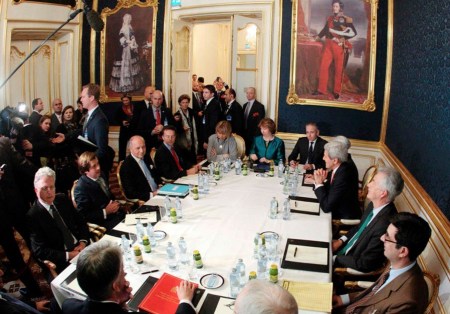
Final round of negotiations on a nuclear deal with Iran continue in Vienna November 21, 2014. (photo credit:REUTERS)

According to a recent report, the president assigned a White House team to focus on the Iran deal and sideline the State Department so that he has more options when the issue comes to the fore again in three months.

It’s not just Iran where the president sees a problem; the secretary has been actively tugging in the opposite direction when it comes to solving the Qatar crisis and on a host of issues related to Israel as well.

In many ways, the different view at the State Department should be expected, not just due to institutional issues where diplomats usually prefer finesse to force but because of personnel considerations as well.

Barack Obama holdovers are driving the State Department’s Iran policy.

****************************

For the second time during Donald Trump’s brief tenure as president, Secretary of State Rex Tillerson and the State Department won in the inter-administration battle over the fate of the nuclear deal with Iran, formally known as the Joint Comprehensive Plan of Action (JCPOA). That victory, however, may end up being short lived given the trajectory of the administration’s overall developing policy toward the regime in Tehran and the process by which the reoccurring 90-day certification of Iran took place in April and again on July 17.

The whole ordeal cast a light on the shrinking esteem in which the president seems to hold Secretary Tillerson and the crew of Obama-era holdovers upon whose guidance he relies.

Washington was briefly abuzz on the afternoon of July 17 when rumors began to circulate that President Trump was eager to declare that Iran was in breach of the conditions laid out in the 2015 Iran Nuclear Agreement Review Act (INARA).

Those receptive antennas were further heightened given the previous signals sent. After all, the State Department already released talking points to reporters on the decision to recertify Iran. The Treasury Department also had a package of fresh sanctions on over a dozen Iranian individuals and entities ready to announce to appease the hawks who were eager to cut loose from the deal.

But Trump didn’t want to recertify Iran, nor did he want to the last time around in April. That evening, a longtime Middle East analyst close to senior White House officials involved in the discussions described the scene to me: “Tillerson essentially told the president, ‘we just aren’t ready with our allies to decertify.’ The president retorted, ‘Isn’t it your job to get our allies ready?’ to which Tillerson said, ‘Sorry sir, we’re just not ready.’” According to this source, Secretary Tillerson pulled the same maneuver when it came to recertification in April by waiting until the last minute before finally admitting the State Department wasn’t ready. On both occasions he simply offered something to the effect of, “We’ll get ‘em next time.”

That for the second time, Team Tillerson forced the president to recertify Iran because they prepared no other options appears to have left a mark on Trump.

According to a recent report, the president assigned a White House team to focus on the Iran deal and sideline the State Department so that he has more options when the issue comes to the fore again in three months.

It’s not just Iran where the president sees a problem; the secretary has been actively tugging in the opposite direction when it comes to solving the Qatar crisis and on a host of issues related to Israel as well.

In many ways, the different view at the State Department should be expected, not just due to institutional issues where diplomats usually prefer finesse to force but because of personnel considerations as well.

Most pundits have pointed to the dwindling bench of the department’s roster. After all, many positions remain unfilled. When Tillerson chose Elliott Abrams to serve as deputy secretary, a well-known conservative who served under Ronald Reagan and George W. Bush, Trump even intervened to quash the appointment. The problem, however, is more about the people already in the department, rather than those yet to be appointed or hired.

Barack Obama holdovers are driving the State Department’s Iran policy.

They include Under Secretary of State for Political Affairs Thomas Shannon; Deputy Assistant Secretary for Iran in the State Department’s Bureau of Near Eastern Affairs Chris Backemeyer, who previously served as the director for Iran at the National Security Council (NSC) under Obama; and Deputy Assistant Secretary and former US special envoy for Syria Michael Ratney. The first two were directly involved in the recertification fiasco – twice. They, among others, made their careers selling the Iran deal and are dedicated to its preservation.

In April, the first draft of the language “was full of Obama-era lines” including several falsehoods promoting the utility of the JCPOA, such as the deal verifiably puts Iran a year away from a nuclear weapon, this source explained.

“There was a huge fight after they wrote it because some said it was too pro-deal and it used all kinds of Obama language.”

“The White House went ballistic,” he said, “and they forced rewrites until they had a statement that was just a few lines.”

The revised version praised neither the deal nor Iran’s actions and pointed to the NSC-led interagency review of the JCPOA – a White House victory on the language used but a State Department win on preserving the status quo in policy.

“Backemeyer and Shannon wrote the certification,” the source confirmed, “and they were closely involved in the certification process this time around.”

For an administration that otherwise sounds determined to curtail Iran’s expansionist ambitions, it’s a wonder that the same people who brought the deal across the finish line, made careers out of selling the deal and helped fill Tehran’s financial coffers are still running the show at the State Department.

What’s more, Secretary Tillerson seems supportive of that decision or oblivious to its impact.

In either case, the department is in open insubordination to the White House and neither scenario reflects well on the secretary or his team. Nevertheless, whether or not his days are numbered, the current policy of rubber stamping Iran’s certification certainly appears to be coming to an end.

The author is a senior fellow at the Security Studies Group in Washington, DC, a senior Middle East analyst at Wikistrat and a former director of policy at the Jewish Policy Center. 

Secretary of State Shills for Muslim Brotherhood, Qatar

July 25, 2017

Secretary of State Shills for Muslim Brotherhood, Qatar, Clarion ProjectRyan Mauro and Martin Mawyer, July 25, 2017

(Please see also, State Department Lawyers Removing References to ISIS ‘Genocide’ Against Christians, Other Religious Minorities. Tillerson’s affinity for the Muslim Brotherhood, Qatar and Turkey apparently cannot be blamed on Obama hold-overs. — DM)

U.S. Secretary of State Rex Tillerson (Photo: Brendan Smialowski/Getty Images)

Political analysts always say that Trump was elected because people wanted change from an outsider. Tillerson is not bringing change. When it comes to Islamism, it’s the same-old same-old. Possibly worse.

****************************

The Trump Administration still hasn’t designated the Muslim Brotherhood as a Foreign Terrorist Organization as it was expected to do. Designation falls under the purview of Secretary of State Tillerson, who has chosen the Muslim Brotherhood and its backers in Qatar and Turkey over their Arab rivals.

Tillerson recently signaled his opposition to designating the Muslim Brotherhood in mid-June. He only has negative things to say about the idea.

His main point is that the Brotherhood’s political parties have representatives in governments like those in Bahrain and Turkey. That is irrelevant. If it was such a problem, Bahrain itself wouldn’t have banned the Brotherhood and the U.S. wouldn’t be dealing with the Lebanese government that has Hezbollah in it, which is designated as a Foreign Terrorist Organization.

Tillerson also repeated the “non-violent” and “moderate” Muslim Brotherhood propaganda. He claimed that the Brotherhood’s political parties in governments “have become so by renouncing violence and terrorism.” That was false when the Obama Administration said it, and it is false now.

The disappointment in Tillerson’s position is made exponentially greater by the fact that now is an optimum time to designate the group.

The Arab world is putting unprecedented pressure on Qatar over its support of the Brotherhood and other jihadists in the Islamist swarm. Muslim foes of the Brotherhood are left wondering where the U.S.stands because Trump and Tillerson aren’t on the same page.

Counter-terrorism expert Patrick Poole goes so far as to assert that Tillerson is “sabotaging” Trump’s foreign policy and urges his departure from the administration.

While President Trump expressed his support for the Arab measures against Qatar and unequivocally described Qatar as a major terrorism-financier, Tillerson did the opposite. He described Qatar as “very reasonable” in its reaction to the Arabs’ pressure.

His spokesperson read a scripted statement accusing the Arab states of having ulterior motives, saying the U.S. is “mystified” by their complaints. The State Department even cast doubt on the credibility of the Arabs’ accusations, claiming that they haven’t provided supporting details. Qatar’s lavish sponsorship of terrorism and extremism is uncontestable.

As Poole documents, far from offering support for those Arab states opposing Qatar, Tillerson publicly made moves towards Qatar’s Turkish allies and increased criticism of Qatar’s Saudi adversaries. The Trump Administration also agreed to sell up to 36 fighter jets to Qatar right after the Arabs began their campaign.

Tillerson even signed a counter-terrorism agreement with Qatar, spitting in the faces of the Arab countries fed up with Qatar’s repeated breaking of its promises to change its behavior. Immediately after signing the deal, Qatar reiterated its firm commitment to Hamas (and therefore, the broader Muslim Brotherhoodorganization of which it is an official branch).


Tillerson’s Ties to Qatar

People are inevitably influenced by those they surround themselves with, especially if that interaction is lucrative. Perhaps Tillerson’s favoring of Qatar has something to do with the close relationship he had with the Qatari government as a businessman with ExxonMobil, which has a decades-long association with the rulers.

ExxonMobil was a founding member of the U.S.-Qatar Business Council in 1996, an entity created by the Qatari regime. Tillerson was a senior official at the time. Another listed founding member is Al-Jazeera, the jihadist-friendly propaganda network run by Qatar and the Brotherhood. One of the Arab states’ top demands is the closure of the network headquartered in Doha.

After becoming chairman and CEO of ExxonMobil, Tillerson became a member of the U.S.-Qatar Business Council’s advisory board. He apparently held this position up until when he became Secretary of State, as his name is still listed with that title on the website.

The Vice President of ExxonMobil Production’s name is currently listed as a member of the Council’s board of directors. Al-Jazeera officials also appear on the advisory board and board of directors.

The organization’s website says that the U.S.-Qatar Business Council “played a major role in the formation of Qatar Foundation International (U.S.-based).” The Qatar Foundation headquartered in Doha is a major promoter of Islamist extremism, particularly the Muslim Brotherhood, including Islamists in America.

When the Arab campaign against Qatar began, the Qataris immediately began utilizing their contacts to try to win the State Department over. It deployed its lobbyists in America and they had leverage: The West’s three biggest energy companies, including ExxonMobil, were trying to strike a deal with the Qatari government for expanding liquified natural gas production.

But Qatar isn’t the only country working aggressively to influence U.S. foreign policy in a direction favorable to the Muslim Brotherhood. Turkey’s government is also leading the Islamist charge.


Tillerson’s Ties to Turkey

ExxonMobil is a member of the U.S.-Turkish Business Council. The chairman is Ekin Alptekin, the very same Turkish businessman at the center of the controversy with President Trump’s former National Security Adviser, General Michael Flynn.

Alptekin’s company had a $600,000 contract with Flynn to promote the Erdogan government’s interests. Flynn’s firm registered as a lobbyist but did not register as a foreign agent. The Justice Department’s National Security Division began an investigation last November. Flynn registered as a foreign agent of Turkey after he was fired and replaced by General H.R. McMaster.

We do not currently know of direct dealings between Tillerson and Alptekin, but ExxonMobil’s involvement in the U.S.-Turkish Business Council highlights how his prior relationship with the Turkish government may influence his behavior.

At a time when Erdogan has few defenders, the Islamist dictator finds a supporter in Tillerson.

On July 9, Tillerson traveled to Istanbul to receive an award from the World Petroleum Congress. There, he heaped praise upon those who defended Erdogan against a coup attempt last year, going so far as to describe the Islamist government as a democracy. He said:

“Nearly a year ago, the Turkish people – brave men and women – stood up against coup plotters and defended their democracy. I take this moment to recognize their courage and honor the victims of the events of July 15, 2016. It was on that day that the Turkish people exercised their rights under the Turkish constitution, defended their place in a prosperous Turkey, and we remember those who were injured or died in that event.”

Tillerson doesn’t defend Erdogan in all circumstances, as he did condemn the Turkish security personnel who attacked protesters in Washington D.C. in May. But that’s not exactly a bold stand; it’s something that any public official would condemn.

When it comes to the tough issues, Tillerson has sided with Qatar and Turkey, even when it contradicts the commander-in-chief who picked him for secretary of state.


On designating the Muslim Brotherhood, Tillerson sides with Qatar and Turkey

When the Arab states piled unprecedented pressure on Qatar for its sponsorship of terrorism and extremism including the Brotherhood and Hamas, Tillerson sided with Qatar and Turkey.

When it comes to last year’s coup in Turkey, Tillerson sided unequivocally with Erdogan’s Islamist dictatorship. He didn’t even necessarily have to talk about it during his visit to Istanbul. He chose to.

When it comes to the Kurds, our best allies in fighting ISIS, Tillerson’s State Department sided with Turkey in criticizing the Iraqi Kurds’ referendum on independent statehood. It also implied opposition to Kurdish independence, reacting to the referendum with a statement in support of a “united” and “federal” Iraq.

Political analysts always say that Trump was elected because people wanted change from an outsider. Tillerson is not bringing change. When it comes to Islamism, it’s the same-old same-old. Possibly worse.


Trump State Dept Unsure Why Palestinian Terrorists Kill Israelis

July 22, 2017

Trump State Dept Unsure Why Palestinian Terrorists Kill Israelis, Washington Free Beacon, , July 21, 2017

(Please see also, State Dept. Blames Israel for Terrorism, Claims Palestinians Rarely Incite Attacks and State Dept. Country Reports on Terrorism 2016. I seem to have messed up in my parenthetical comments there and in the earlier article, having have read and posted the wrong State Department publication. I apologize. My only excuse is that the correct State Department publication was not linked in the original article.  I renew my suggestion that Tillerson, and the Obama hold-overs with him, must go. — DM

U.S. Secretary of State Rex Tillerson / Getty Images)

The report singling out Israel is another clear example of the State Department pursuing policies that are well out of line with the White House’s stated agenda, which the sources said has been pro-Israel. One source who advises the White House Middle East policy described the State Department’s explanation to the Free Beacon as “spectacular bull—t.”

“The State Department report includes multiple findings that are both inaccurate and harmful to combating Palestinian terrorism,” Roskam wrote in a letter sent Thursday to the State Department. “This report wrongly insinuates Israeli security measures on the Temple Mount and a stalled peace process as key forces behind terrorism.”

Officials appointed by the Obama administration still work in key State Department positions, the source noted.

“The problem is that the Obama team spent eight years filling the State Department with career staffers who think exactly like they think, and those people are still running things,” the source said. “Some really good people have tried to clean house, but every time anything got going Tillerson went to the president personally to protect the Obama holdovers. So they feel safe producing this kind of mind-numbing nonsense and sending it to Congress.” (Italic emphasis added.)

**********************************

Officials in the Trump administration’s State Department are standing by a recent report criticized by Congress that blamed Israel for terror attacks and claimed Palestinians rarely incite violence, telling the Washington Free Beacon that it remains unclear why terrorists engage in violent acts.

Rep. Peter Roskam (R., Ill.), co-chair of the House Republican Israel Caucus, criticized the State Department Thursday for releasing a report portraying Israel as the culprit in terrorism and downplaying Palestinian incitement of violent acts against the Jewish state, the Free Beacon first reported.

Roskam demanded the State Department alter its report to bring it more in line with what he believes are the facts on the ground—that Palestinian leaders routinely incite violence against Israel, which has been forced to defend itself against a growing wave of terror attacks on Jewish citizens.

A State Department official, speaking on background, defended the report’s conclusions and said that it cannot precisely pinpoint the motivations behind Palestinian terror attacks on Israel.

“We recognize that in any community, a combination of risk factors can come together to create a higher risk of radicalization to violence,” the official said. “There is no one single pathway to violence—each individual’s path to terrorism is personalized, with certain commonalities. Therefore, it is difficult to pinpoint precisely what the sources of radicalization to violence are. What could drive someone to violence in one instance could vary significantly with someone else who is similarly situated.”

The State Department’s response prompted a fierce backlash among U.S. officials and Trump administration insiders, who said the State Department under the leadership of Secretary of State Rex Tillerson has gone rogue and is out of line with the White House’s position on a range of sensitive diplomatic issues, including the Israeli-Palestinian impasse.

Sources pointed to the administration going into damage control mode last week after State Department spokeswoman Heather Nauert stated during a press briefing that the U.S. was “upgrading” its diplomatic standing with the Palestinians, a declaration that came as a surprise to those in the White House.

The report singling out Israel is another clear example of the State Department pursuing policies that are well out of line with the White House’s stated agenda, which the sources said has been pro-Israel. One source who advises the White House Middle East policy described the State Department’s explanation to the Free Beacon as “spectacular bull—t.”

“The State Department report includes multiple findings that are both inaccurate and harmful to combating Palestinian terrorism,” Roskam wrote in a letter sent Thursday to the State Department. “This report wrongly insinuates Israeli security measures on the Temple Mount and a stalled peace process as key forces behind terrorism.”

The officials additionally maintained that Israel remains one of America’s “closest counterterrorism partners,” and that it continues to work closely with the Jewish state to combat threats from ISIS, al Qaeda, and the Iranian-backed terror group Hezbollah.

“Most egregiously,” Roskam wrote in his letter calling out the report, the State Department’s finding portray “the PA as innocent peacemakers far removed from being the source of terrorist activity.”

The State Department’s defense came just hours after three Israelis were killed and another severely wounded following a terror attack by a Palestinian terrorist that was described in the press as the “worst bloodshed” in years.

The official maintained that there is “no justification for any acts of terrorism,” but said the section of the report focusing on Israel is meant to help U.S. officials understand regional tensions.

“This section of the report—which is based on input from our embassies around the world—is intended to inform our efforts to counter radicalization to violence, and to better understand what might be assessed as motivations that could drive individuals towards violence,” the official said. “But this is not intended in any way to condone these acts or to justify them. As we said, there is no justification for any act of terrorism.”

The State Department would not specifically address Roskam’s concerns about the factual inaccuracies surrounding the report’s claims that Israel is to be blamed for terrorism, as well as its claim that Palestinian calls for violence against Israel are “rare” and not tolerated by Palestinian Authority leadership.

“Explicit calls for violence against Israelis, direct exhortations against Jews, and categorical denials by the [Palestinian Authority] of the possibility of peace with Israel are rare and the leadership does not generally tolerate it,” the original report stated.

Roskam called this characterization “demonstrably false,” citing multiple instances in which Palestinian officials and state-sanctioned media organs promote violence, terrorism, and attacks against Israel and Jews.

Multiple sources who spoke to the Free Beacon, including Trump administration insiders and senior Congressional officials, expressed shock at the State Department’s response to Roskam’s letter and cited it as proof that Tillerson department is dramatically departing from the White House’s own policy on these matters.

“Palestinians hate and kill Israelis because they’re taught from a very young age to hate and kill Jews,” one veteran Middle East expert who advises the White House on Israel policy said. “Of course the Obama administration never liked to admit that, but everyone around President Trump understands it.”

Officials appointed by the Obama administration still work in key State Department positions, the source noted.

“The problem is that the Obama team spent eight years filling the State Department with career staffers who think exactly like they think, and those people are still running things,” the source said. “Some really good people have tried to clean house, but every time anything got going Tillerson went to the president personally to protect the Obama holdovers. So they feel safe producing this kind of mind-numbing nonsense and sending it to Congress.”

One senior Congressional official who works on the Middle East situation expressed shock at the State Department’s defense of its report and subsequent claims about the unknown source of terror against Israel.

“Chalking up Palestinian terrorism to anything other than deep-seated anti-Semitism is not only disgraceful, but a reinvention of history,” the source said. “Palestinians are brainwashed by their governments from birth to hate Jews and celebrate suicide bombers. Countering terrorism against Israelis first and foremost requires clarity, which the State Department evidently lacks.”

The source slammed the State Department from departing from clear policy positions outlined by President Donald Trump and the White House.

“This is not what the American people voted for when they elected President Trump, and they deserve better,” the source said. “Members of Congress and the hardworking citizens they represent will not tolerate this nonsense.”

A second source, also a senior congressional official intimately involved in the issue, said the sources of Palestinian radicalization are well established.

“Money, fame, and education are the driving factors here, let’s not kid ourselves,” the source said. “We’re dealing with a community whose government openly lauds child murderers as national heroes and rewards terrorists with large sums of cash. Our State Department needs to focus on combating the PA’s heinous policies instead of praising terrorist-supporters and philosophizing incoherently about the sources of radicalization.”

Rex Tillerson authorizes North Korea travel ban

July 21, 2017

Rex Tillerson authorizes North Korea travel ban, Washington ExaminerJoel Gehrke, July 21, 2017

The ban is due to “the serious risk of arrest and long-term detention” by the rogue regime. (AP Photo/Jacquelyn Martin)

Secretary of State Rex Tillerson has decided to ban all travel by Americans to North Korea, due to “the serious risk of arrest and long-term detention” by the rogue regime.

“Once in effect, U.S. passports will be invalid for travel to, through and in North Korea, and individuals will be required to obtain a passport with a special validation in order to travel to or within North Korea,” State Department spokeswoman Heather Nauert said Friday.

OPINION: Is the US Secretary of State on Qatar’s side?

July 12, 2017

OPINION: Is the US Secretary of State on Qatar’s side? Al ArabiyaAbdulrahman al-Rashed, July 12, 2017

(Al Arabiya is a Saudi site, but I too have occasionally wondered whose side Secretary Tillerson is on. — DM)

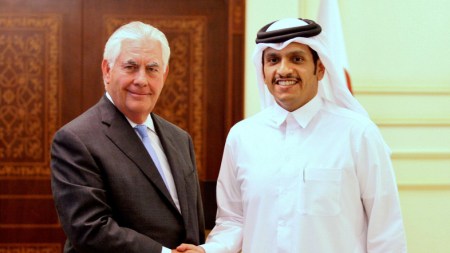
Qatar’s foreign minister Sheikh Mohammed bin Abdulrahman al-Thani (R) shakes hands with U.S. Secretary of State Rex Tillerson following a joint news conference in Doha, Qatar, July 11, 2017. REUTERS/Naseem Zeitoon TPX IMAGES OF THE DAY – RTX3B2A2

The four boycotting countries are not the only ones that want to deter Qatar as most of the region’s countries and other countries support this goal and believe Doha is responsible for chaos, extremism and terrorism. The US secretary of state can save Qatar from itself before it suffers the consequences of its malicious actions.

******************************************

US Secretary of State Rex Tillerson will meet the angry foreign ministers of the four countries which boycotted Qatar, Saudi Arabia, the United Arab Emirates, Bahrain and Egypt, in Jeddah on Wednesday. He will be confronting governments that made up their minds as they believe Doha is behind the dangerous unrest. We do not expect these countries to retreat after they made promises and took public measures to hold Doha’s authorities accountable by boycotting them.

Statements and hints made by Tillerson at the press conference in Doha do not reflect optimism as he rather simplified the problem by summing up the solution with signing an agreement in which Doha’s government pledges to fight terrorism. What an accomplishment!

Manipulation

The Qataris tried to manipulate him by confusing the real reasons behind the dispute and protesting over formal points such as revealing the secrets of their commitments in the Riyadh agreement and its annexes. They were embarrassed after they were leaked to CNN because this exposed that everything Qatar said in the international media contradicted its secret commitments. Qatar is of course to blame because it’s the one which began this war of leaks when it revealed the secrets of the four governments’ message pertaining to the Kuwaiti mediation that included 13 demands. Qatar revealed these secrets out of its desire to embarrass these four governments.

What makes Jeddah’s meeting difficult today is that Tillerson seemed inclined to Qatar. What increased suspicions is how he rushed to concluding that Qatar’s demands are reasonable before he even listened to the other involved parties. This raised eyebrows! The secretary of state can be inclined to the Qatari position, if he wants to, but he must realize that this complicates the problem, which is already complicated, and prolongs the crisis. The four boycotting countries have been harmed on the financial, political, media and security levels due to Qatar’s activities and practices, and they have made up their minds especially after recent developments that they think directly target their regimes.

Tillerson cannot impose a reconciliation. However he can narrow distances among the different parties as they are all his allies instead of being biased to one party against another, especially that Qatar is the one which made pledges several times but violated them.

Refusing to change

Tensions will rise as long as Doha’s authorities refuse to change. We know how Doha thinks and deceives others and we’re aware that it does not intend to change amid ordinary circumstances. The four boycotting countries will not back down because they believe they’re defending their existence in a region dominated by chaos, and it does not make sense to fight Iran while letting Qatar’s government threatens their existence and backstabs them. The crisis has clear goals which are deterring Qatar and eliminating its project of change. These four countries will jeopardize their existence and stability if they do not meet these goals. Egypt is launching the biggest war against terrorism in its modern history and it views Qatar as an efficient party which through its secret funding and propaganda via its media channels justifies these terrorist groups’ actions and incites people to rebel against the regime. Saudi Arabia is confronting similar threats and Qatar’s involvement has been proven. The UAE shares the same stance and it addressed this at early stages when it adopted policies that have zero tolerance with extremist groups and their ideology. Bahrain suffered more and it was all due to Qatar. How can Tillerson convince the four countries which are fighting survival wars to reconcile with the responsible party? How long will intentions be tested after Qatar failed so many times?

The four boycotting countries are not the only ones that want to deter Qatar as most of the region’s countries and other countries support this goal and believe Doha is responsible for chaos, extremism and terrorism. The US secretary of state can save Qatar from itself before it suffers the consequences of its malicious actions.

Rex Tillerson’s Tough Talk on Iran

April 20, 2017

Rex Tillerson’s Tough Talk on Iran, Power LinePaul Mirengoff, April 19, 2017

Yesterday, as we noted here, Secretary of State Rex Tillerson informed Congress that Iran is in compliance with the nuclear deal and that the administration will continue to provide relief from sanctions, as called for by the agreement. He added, however, that “Iran remains a leading state sponsor of terror through many platforms and methods.”

Today, Tillerson (1) elaborated in scathing language on Iran’s role as a leading sponsor of terrorism and on other of its misdeeds, (2) made clear that the nuclear deal is unsatisfactory, and (3) stressed that the U.S. government is engaged in a thorough review of our Iran policy.

Tillerson characterized the Iran deal as “another example of buying off a power who has nuclear ambitions.” Citing the North Korean example, Tillerson complained “we buy them off for a short period of time, and then someone has to deal with it later.” He then added that the administration does not intend to follow this course.

It is rumored that President Trump hit the roof when he saw Tillerson’s letter to Congress (or maybe the way it was reported) and demanded that he issue today’s tough statement. According to this account, the tough statement had been drafted previously, nixed by influential soft-liners in the administration, and revived in light of the Tillerson letter.

Whether or not this is what happened, I think today’s statement was much needed.

But what will come of the policy review promised in Tillerson’s statement? The Obama administration did an effective job of fencing in its successors. I discussed the future of the Iran deal under Trump in this post.

The upshot of two days of Tillerson talk about Iran seems to be that our Iran policy is up-for-grabs, like much else in the policy realm. Sharp disagreement probably exists within the administration about how to proceed and, not unlike other policy disputes, the disagreement occurs in the context of no truly good options.

You can watch Tillerson’s speech, plus a brief Q&A, below. Don’t miss Andrea Mitchell fretting that if the U.S. backs out of the Iran deal, rogue states like North Korea won’t trust us.


‘Strategic Patience’ Is Over: Tillerson Floats Military Action in North Korea

March 17, 2017

‘Strategic Patience’ Is Over: Tillerson Floats Military Action in North Korea, Breitbart, Frances Martel, March 17, 2017

(Might Secretary Tillerson also have intended to give a “hint” to The Islamic Republic of Iran? — DM)

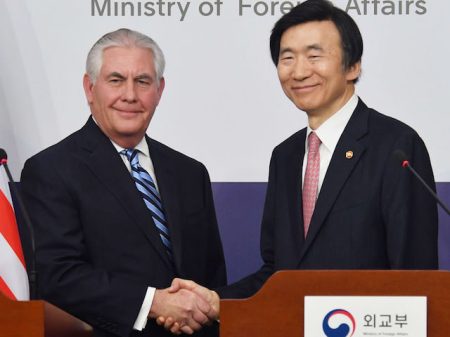
SEOUL, SOUTH KOREA – MARCH 17: (L to R) U.S. Secretary of State Rex Tillerson shakes hands with South Korean Foreign Minister Yun Byung-se during a press conference on March 17, 2017 in Seoul, South Korea. (Photo by Song Kyung-Seok-Pool/Getty Images)

U.S. Secretary of State Rex Tillerson told reporters in Seoul on Friday that the Trump administration is open to military action against North Korea as a last resort, and that the Obama-era policy of “strategic patience has ended.”

“The policy of strategic patience has ended. We are exploring a new range of diplomatic, security and economic measures. All options are on the table,” Tillerson told reporters at a press conference with South Korean Foreign Minister Yun Byung-se. “If North Korea takes actions that threaten South Korean forces or our own forces, that will be met with an appropriate response.”

“If they elevate the threats of their weapons program to the level that we believe requires action, that option is on the table,” Tillerson added. He emphasized that the United States would attempt to avoid to the extent possible any military actions against North Korea, particularly those that may put North Korean civilian lives in danger. “We hope that that will persuade North Korea to take a different course of action. That’s our desire,” Tillerson concluded.

Tillerson also took the opportunity to once again call for China to take on a larger role in containing North Korea’s escalating belligerence and objected to China cutting economic ties with South Korea over the deployment of the America Terminal High Altitude Area Defense (THAAD) missile defense system. “While we acknowledge Chinese opposition, its economic retaliation against South Korea is inappropriate and troubling. We ask China to refrain from such actions. Instead, we urge China to address the threat that makes that necessary,” Tillerson said.

Tillerson is currently in the middle of a three-nation trip to Asia, having left Japan on Thursday and scheduled to meet with leaders in China on Saturday.

The Secretary of State’s remarks regarding potential military action against North Korea follow remarks in Japan that emphasized a “different approach” to the rogue government in Pyongyang. “Part of the purpose of my visit to the region is to exchange views on a new approach,” Tillerson noted on Friday in a press conference with his Japanese counterpart, Foreign Minister Fumio Kishida.

The Trump administration has hinted at a change in America’s approach towards Pyongyang in other venues, as well. Earlier this month, UN Ambassador Nikki Haley told reporters in New York that the White House is “not ruling anything out” to keep North Korea from developing and using nuclear weapons. Haley described the THAAD system as a necessary response to Pyongyang’s insistence on violating UN sanctions with missile launches that could threaten Japan and South Korea. “We are not going to leave South Korea standing there with the threat of North Korea facing them and not help. The reason for THAAD is because of the actions of North Korea,” she said in response to Chinese and Russian opposition.

Following Tillerson’s remarks Friday, President Trump himself issued a warning to North Korea on Twitter:

Tillerson’s message towards China was also similar in Japan: as its largest trading partner, take a more prominent role in containing North Korea. “We look to China to fulfill its obligations and fully implement the sanctions called for,” he said. Anticipating Tillerson’s visit, Chinese Premier Li Keqiang told reporters Wednesday he was “optimistic about the future of China-US relations” and anticipated a positive outcome from Tillerson’s visit. President Donald Trump is reportedly working with Chinese officials to plan a U.S. visit by President Xi Jinping next month.

These statements represent a nearly complete shift away from what former Secretary of State and twice-failed presidential candidate Hillary Clinton described as “strategic patience“: a policy of waiting for the North Korean economy to implode and Pyongyang finding itself no longer able to afford to ignore UN sanctions and the rejection of the international community. This policy largely failed because China continued to trade with North Korea, providing the fellow communist regime a vital lifeline.

The response in Seoul to the new, robust U.S. policy is largely divided along partisan lines, according to the South Korean news agency Yonhap. Conservative leaders have expressed gratitude for Tillerson’s strong support for their country. “We highly appreciate his comments as he expressed a strong willingness to respond to North Korea’s reckless behavior,” Liberty Korea Party spokesman Rep. Choung Tae-ok told Yonhap.

One left-wing leader, in contrast, told Yonhap: “We are supporting the U.S.’s move to strengthen the effectiveness of sanctions against the North through cooperation with relevant countries, but we cannot help expressing concerns about the U.S. stance that there will be no dialogue until North Korea gives up (nuclear weapons).”

North Korea appears to have responded to Tillerson’s presence in the region with the publication of a “human rights white paper” condemning the United States as a serial violator of human rights, condemning the presidential election itself as a human rights violation against the American people and labeling the nation a “human rights desert.”