Saudi king upends royal succession, names son as 1st heir, Fox News, Associated Press, June 21, 2017
(Please see also, IRGC Commanders: Our Main Aim Is Global Islamic Rule. Perhaps the IRGC statement of intentions was among the king’s reasons for making bin Salman the new crown prince. — DM)
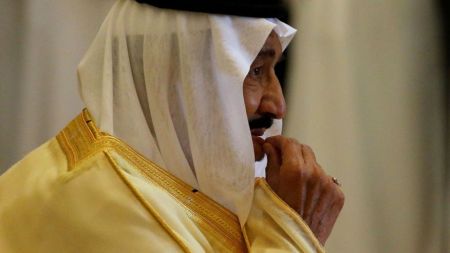 Saudi Arabia’s King Salman bin Abdulaziz Al Saud waits to greet President Trump in Riyadh (REUTERS)
In remarks aired on Saudi TV in May, Mohammed bin Salman framed the tensions with Iran in sectarian terms, saying it is Iran’s goal “to control the Islamic world” and to spread its Shiite doctrine. He also vowed to take “the battle” to Iran.
***************************
RIYADH, Saudi Arabia – Saudi Arabia’s King Salman on Wednesday appointed his 31-year-old son Mohammed bin Salman as crown prince, placing him first-in-line to the throne and removing the country’s counterterrorism czar and a figure well-known to Washington from the line of succession.
In a series of royal decrees carried on the state-run Saudi Press Agency, the monarch stripped Prince Mohammed bin Nayef from his title as crown prince and from his powerful position as the country’s interior minister overseeing security.
The all-but-certain takeover of the throne by Mohammed bin Salman awards near absolute powers to a prince who has ruled out dialogue with rival Iran, has moved to isolate neighboring Qatar for its support of Islamist groups and who has led a devastating war in Yemen that has killed thousands of civilians.
The prince already oversees a vast portfolio as defense minister. He has become popular among some of Saudi Arabia’s majority young population for pushing reforms that have opened the deeply conservative country to entertainment and greater foreign investment as part of an effort to overhaul the economy.
He had previously been second-in-line to the throne as deputy crown prince, though royal watchers had long suspected his rise to power under his father’s reign might accelerate his ascension.
The young prince was little known to Saudis and outsiders before Salman became king in January 2015. He had previously been in charge of his father’s royal court when Salman was the crown prince.
The Saudi monarch, who holds near absolute powers, quickly awarded his son expansive powers to the surprise of many within the royal family who are more senior and more experienced than Mohammed bin Salman, also known by his initials MBS.
Meanwhile, Prince Abdulaziz bin Saud, 33, was named the new interior minister tasked with counterterrorism efforts and domestic security. His father is the governor of Saudi Arabia’s vast Eastern Province, home to much of the country’s oil wealth and most of its minority Shiites. The prince is also Mohammed bin Nayef’s nephew, and previously served as an adviser to the interior and defense ministries.
The royal decree issued Wednesday stated that “a majority” of senior royal members from the so-called Allegiance Council support the recasting of the line of succession. However, that vote of support appears to have been from a past gathering of the council two years ago when Mohammed bin Salman was named second-in-line to the throne, and Mohammed bin Nayef was named the king’s successor.
The Allegiance Council is a body made up of the sons and prominent grandsons of the founder of the Saudi state, the late King Abdul-Aziz, who vote to pick the king and crown prince from among themselves. The council does not appear to have met again before Wednesday’s sudden change.
Over the weekend, the king had issued a decree restructuring Saudi Arabia’s system for prosecutions that stripped Mohammed bin Nayef of longstanding powers overseeing criminal investigations, and instead ordered that a newly-named Office of Public Prosecution and prosecutor report directly to the monarch.
The prince had appeared to be slipping from public eye and was not believed to have played a significant role in Saudi and Emirati-led efforts to isolate Qatar for its support of Islamist groups and ties with Iran.
Instead, it was his nephew, Mohammed bin Salman, who embarked on major overseas visits, including a trip to the White House to meet President Donald Trump in March. That visit to Washington helped lay the foundation for Trump’s visit to Saudi Arabia in May, which marked the president’s first overseas visit and which was promoted heavily by the kingdom as proof of its weight in the region and wider Muslim world.
Saudi-U.S. relations had cooled under the Obama administration after Washington pursued a nuclear accord with Shiite-majority Iran that the Sunni-ruled kingdom strongly opposed.
The warm ties forged between Riyadh and Washington under the Trump administration may have helped accelerate Mohammed bin Salman’s ascension as crown prince.
Despite his ambitions, which include overhauling the economy to make it less reliant on oil, the prince has faced failures and criticism for the Saudi-led war in Yemen, which he oversees as defense minister.
The war, launched more than two years ago, has failed to dislodge Iranian-allied rebels known as Houthis from the capital, Sanaa, and has had devastating effects on the impoverished country. Rights groups say Saudi forces have killed scores of civilians and have called on the U.S., as well as the U.K. and France, to halt the sale of weapons to Saudi Arabia that could be used in the Yemen war.
The U.S. already is helping the Saudis with intelligence and logistical support for the bombing campaign in Yemen, and the Trump administration has signaled it could assist with greater intelligence support to counter Iranian influence there.
The newly-minted crown prince also raised eyebrows when he ruled out any chance of dialogue with Iran. In remarks aired on Saudi TV in May, Mohammed bin Salman framed the tensions with Iran in sectarian terms, saying it is Iran’s goal “to control the Islamic world” and to spread its Shiite doctrine. He also vowed to take “the battle” to Iran.
Iran and Saudi Arabia’s rivalry has played out in proxy wars across the region. They back opposite sides in the wars in Syria and Yemen and they support political rivals in Lebanon, Bahrain and Iraq. The conflicts have deepened Sunni-Shiite enmity between hard-liners on both sides.





 anneinpt
 artaxes
 danmillerinpanama
 davidking1530
 Peter Hofman
 Joseph Wouk
 Peter
Peter Louisiana Steve
 WarSclerotic
Recent Comments