Archive for the ‘Saudi Arabia’ category

UN to jailed Islamic dissidents: “You will love it”

May 12, 2017

UN to jailed Islamic dissidents: “You will love it”  Israel National News, Giulio Meotti, May 12, 2017

Now, the favorite to succeed Irina Bokova is a Qatari politician and a Saudi will be the spokesman for the UN agency conference, while an Iranian will be the head of its executive board. They call it the “Islamic Troika”. That is the purpose of these exclusive nights at the Four Seasons Hotel in Riyadh whose slogan is: “You will love it!”. 

*****************************

Why miss a long weekend at the Four Seasons Hotel in Riyadh, where “spacious marble bathrooms boast deep soaking bathtubs” and are waiting for you?

This is what the 2,100 delegates of 400 Western non-governmental organizations thought when attending last weekend’s forum on “Youth and their Social Impact” sponsored by the United Nations. Participants of the gentle sex were asked to wear the abaya, the long caftan-like robe that veils Saudi women. Men were asked not to give their left hand, impolite under Islam. 

The event was organized by a foundation of the Saudi ruling family and was attended by, among others, Unesco’s Secretary General Irina Bokova, the founder of Wikipedia Jimmy Wales, the French intellectual Jacques Attali, and Bloomberg Media Executive, Justin Smith.

Obviously, to save face, all these humanitarian organizations had to ignore the fact that a few miles from their forum Abdullah al Attawi and Mohammed al Oteibi had been persecuted and found “guilty” of having founded a human rights organization.

The two stars of Western journalism present in Riyadh, the Wikipedia chief and Bloomberg executive, had to avoid thinking that a hero of freedom of speech and open sources of information regarding which Wikipedia pretends to be a pioner, languishes in a Saudi prison at this moment. It is Raif Badawi, a liberal blogger lashed by the Saudi rulers.

They had to silence the case of Waleed Abu al Khair, who was condemned to fifteen years in prison for comments he made on human rights. Or the journalist Alaa Brinji, sentenced to five years in prison for criticizing religious authorities and sustaining women’s rights. A year ago, the Saudis arrested all the leadership of the Saudi Civil and Political Rights Association for supporting pro-democracy reforms.

They did not have to talk about them at this forum.

One of the most courageous NGOs, UN Watch, condemned the event: “Regrettably, Unesco, the U.N. agency for education, science, and culture, mentioned nowhere at its 7th International Forum of NGO, or on the conference website, that Saudi Arabia prohibits independent NGOs and arrests, jails and even sometimes flogs human rights activists”.

The UN forum was sponsored by the wealthy MiSK foundation, a Saudi charity led by Mohammad bin Salman, the Saudi defense minister who led the Yemen bombing that killed 10,000 civilians and imposed a naval blockade on medical supplies, resulting in twenty million Yemenites who now need humanitarian assistance and seven million suffering from hunger.

But the Riyadh forum tells more. It tells us about the level of penetration of Islamic regimes in the UN human rights councils and commissions. In fact, in six months, Unesco has approved two resolutions that have cancelled the Jewish roots of Jerusalem, while the Saudis have also been able to get re-elected at the UN Commission on Women’s Rights.

Two years ago, during the same hours that medieval Saudi justice flogged Raif Badawi, a delegation from the United Nations landed at Gedda to promote an international conference on religious freedom. No, it’s not a joke. Joachim Rücker, the president of the UN Human Rights Council, was photographed smiling at the side of the guardians of the Wahhabite regime. The Obama administration also sent two envoys to the Gedda conference: the Ambassador for Religious Freedom, David Saperstein, and Arsalan Suleman, the envoy at the Organization for Islamic Cooperation.

There was also Heiner Bielefeldt, United Nations Special Envoy for Religious Freedom, a well-known scholar of Immanuel Kant, who must have seen applications of his philosophical reason in the whip that slashed the blogger.

Now, the favorite to succeed Irina Bokova is a Qatari politician and a Saudi will be the spokesman for the UN agency conference, while an Iranian will be the head of its executive board. They call it the “Islamic Troika”. That is the purpose of these exclusive nights at the Four Seasons Hotel in Riyadh whose slogan is: “You will love it!”.

Saudi Arabia’s ‘Lavish’ Gift to Indonesia: Radical Islam

April 29, 2017

Saudi Arabia’s ‘Lavish’ Gift to Indonesia: Radical Islam, Gatestone InstituteMohshin Habib, April 29, 2014

(A few days after I retired from the practice of law in 1955, my wife and I flew to Bali and stayed there for a couple of weeks. According to the article, that’s where Saudi King Salman spent six days “vacationing.” His total stay in Indonesia was nine days.

According to the 2010 Census, “83.5% of Bali’s population adhered to Balinese Hinduism,[3] followed by 13.4% Muslim, Christianity at 2.5%, and Buddhism 0.5%.[7]“. Most of the Muslims were on the southern coast and I can recall seeing none elsewhere. The Balinese Hindus we met were among the kindest and most welcoming people I have ever met. I wonder what’s happening there now. Please see also, Misogyny Meet Irony: Saudi Arabia Elected To United Nation’s Women’s Rights Commission.– DM)


Despite its pluralistic constitution, which says, “The state guarantees each and every citizen the freedom of religion and of worship in accordance with his religion and belief,” Indonesia — which declared independence in 1945 — has grown increasingly intolerant towards Christians, Hindus and Shiite Muslims.

***********************

Prior to Saudi Arabia’s attempts to spread Salafism across the Muslim world, Indonesia did not have terrorist organizations such as Hamas Indonesia, Laskar Jihad, Hizbut Tahrir, Islamic Defenders Front and Jemmah Islamiyah, to name just a few. Today, it is rife with these groups.

A mere three weeks after the Saudi king wrapped up his trip, at least 15,000 hard-line Islamist protesters took to the streets of Jakarta after Friday prayers, calling for the imprisonment of the capital city’s Christian governor, who is on trial for “blaspheming the Quran.”

In a separate crisis, crowds were demanding that Basuki Tjahaja Purnama (known familiarly as Ashok) be jailed for telling a group of fishermen that, as they are fed lies about how the Quran forbids Muslims from being governed by a kafir (infidel), he could understand why some of them might not have voted for him. If convicted, Ashok stands to serve up to five years in prison.

Accompanied by a 1,500-strong entourage, Saudi King Salman bin Abdul Aziz arrived in Indonesia on March 1 for a nine-day gala tour. He was welcomed warmly not only as the monarch of one of the world’s richest countries, but as the custodian of Islam’s two holiest cities, Mecca and Medina.

While appearing to be taking a holiday rather than embarking on an official state visit — the 81-year-old sovereign spent six days at a resort in Bali — the king had some serious business to attend to. In what was advertised as an effort to promote “social interaction” between Saudi Arabia and Indonesia — with His Majesty announcing a billion-dollar aid package, unlimited flights between the two countries and the allotment of 50,000 extra spots per year for Indonesian pilgrims to make the hajj to Mecca and Medina – it seems as if the real purpose of the trip was to promote and enhance Salafism, an extremist Sunni strain, in the world’s largest Muslim country, frequently hailed in the West as an example of a moderate Islamic society.

President Joko Widodo of Indonesia (foreground, left) meets with King Salman of Saudi Arabia (foreground, right), at Halim Perdanakusuma Airport in Indonesia. (Image source: Indonesian Presidential Palace)

Jakarta-based journalist Krithika Varagur, writing in The Atlantic on the second day of the king’s visit, describes Saudi efforts in Indonesia:

“Since 1980, Saudi Arabia has devoted millions of dollars to exporting its strict brand of Islam, Salafism, to historically tolerant and diverse Indonesia. It has built more than 150 mosques (albeit in a country that has about 800,000), a huge free university in Jakarta, and several Arabic language institutes; supplied more than 100 boarding schools with books and teachers (albeit in a country estimated to have between 13,000 and 30,000 boarding schools); brought in preachers and teachers; and disbursed thousands of scholarships for graduate study in Saudi Arabia.”

This Saudi influence has taken a serious toll on Indonesia, 90% of whose 250 million people are Sunnis. Despite its pluralistic constitution, which says, “The state guarantees each and every citizen the freedom of religion and of worship in accordance with his religion and belief,” Indonesia — which declared independence in 1945 — has grown increasingly intolerant towards Christians, Hindus and Shiite Muslims.

Prior to Saudi Arabia’s attempts to spread Salafism across the Muslim world, Indonesia did not have terrorist organizations such as Hamas Indonesia, Laskar Jihad, Hizbut Tahrir, Islamic Defenders Front and Jemmah Islamiyah, to name just a few.

Today, it is rife with these groups, which adhere strictly to Islamic sharia law, Saudi Arabia’s binding legal system, and which promote it in educational institutions. Like al-Qaeda and ISIS, they deny women equal rights, believe in death by stoning for adulterers and hand amputation for thieves, and in executing homosexuals and “apostate” Muslims.

The most recent example of the way in which this extremism has swept Indonesia took place a mere three weeks after the Saudi king wrapped up his trip. On March 31, at least 15,000 hard-line Islamist protesters took to the streets of Jakarta after Friday prayers, calling for the imprisonment of the capital city’s Christian governor, who is on trial for “blaspheming the Quran.”

This paled in comparison to the crowds — numbering about 200,000 at each violent rally — which flooded the city last November, December and February. The crowds were demanding that Basuki Tjahaja Purnama (known familiarly as Ashok) be jailed for telling a group of fishermen that, as they are fed lies about how the Quran forbids Muslims from being governed by a kafir, an infidel, he could understand why some of them might not have voted for him. If convicted, Ashok stands to serve up to five years in prison.

Sadly, such a jail term is nothing, when one considers the Islamist prison that the country as a whole has become — courtesy of King Salman and his lavish “gifts.”

More Missiles Ready to Hit Saudi Capital: Yemen’s Army Spokesman

March 20, 2017

More Missiles Ready to Hit Saudi Capital: Yemen’s Army Spokesman, Tasnim New Agency, March 20, 2017

(There were reports at Fars News Agency and other Iranian or Iranian -linked media of a successful missile attack on Riyadh on February 5th. However, according to the March 20th Tasnim article, “The Yemeni official said it was the first such attack by the Yemeni forces on the Saudi capital.” A search at the Saudi media outlet Al-Arabiya produced nothing about either the February 5th or the more recent attack. Are such reports reliable?– DM)

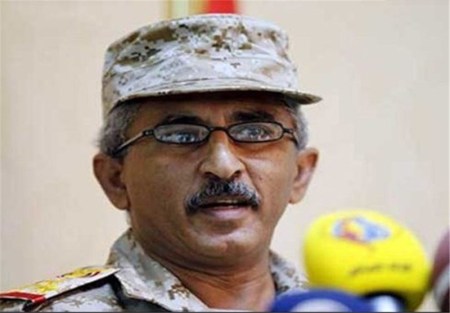
TEHRAN (Tasnim) – Yemen’s Army Spokesman Sharaf Luqman confirmed the firing of a Scud-type ballistic missile at a Saudi air base in Riyadh, saying that more missiles are ready to confront the invading regime.

“We have managed to boost our missile production capabilities and our missiles can now reach the Saudi capital,” Luqman told Lebanon’s al-Mayadeen news network on Sunday.

His remarks came after Yemeni forces on Saturday night fired a long-range ballistic missile at King Salman Air Base in the Saudi capital Riyadh, inflicting major material losses on the kingdom. The Scud-type Borkan-2 (Volcano-2) ballistic missile hit its target.

The Yemeni official said it was the first such attack by the Yemeni forces on the Saudi capital.

Luqman further said that more missiles are ready to be launched against the positions of the Saudi regime, stressing that the new missiles will change the equation of the kingdom’s war on the impoverished Arab country.

The missile attacks are in response to the aggression launched by Saudi Arabia and some of its Arab allies in March 2015.

The Saudi-led coalition has been launching deadly airstrikes against the Houthi Ansarullah movement for two years in an attempt to restore power to the fugitive former President Abd Rabbuh Mansour Hadi, a close ally of Riyadh.

Some 11,000 Yemenis, including thousands of women and children, have lost their lives in the deadly military campaign.

A new foundation for Saudi-US relations

March 18, 2017

A new foundation for Saudi-US relations, Al ArabiyaDr. Theodore Karasik, March 18, 2017

(A Saudi perspective on Trump and his policies. Saudi Arabia is a fierce opponent of Iran. To the extent that our interests align, we should cooperate. — DM)

Saudi Arabia’s support for Trump Administration’s Executive Orders is significant. Mohammed bin Salman supports Trump’s extreme vetting program calling it a “vital and urgent precaution” that Saudi Arabia does not see as discriminatory. The Deputy Crown Prince also vouched for the president himself, remarking that Trump “expressed his deep respect for the religion of Islam.” He called Trump “a true friend of Muslims” whose commitment to achieving the Muslim world’s interests is “unprecedented.” He also described negative portrayals of Trump’s posture toward Muslims as insulting.

************************

Saudi Arabia’s Deputy Crown Prince Mohammed bin Salman’s visit to meet with US President Donald Trump and his top advisors establishes a new foundation for US-Saudi relations. The visit occurred in extraordinary settings with participants from the White House to the Pentagon. The US State Department was, however, nowhere to be seen.

The visit to Washington is occurring during a full court press for Saudi Arabia’s Vision 2030 and the drivers to bring that vision, mainly next year’s Aramco IPO and the growth of the Kingdom’s Public Investment Fund (PIF), to fruition in a logical and timely manner. While King Salman is on a momentous trip to Asia focusing on energy, investment, counter-terrorism, and religion, and with Crown Prince Mohammed bin Nayef coordinating with allies against a number of internal and external extremist and state threats, the Saudi defense minister is cementing with the Trump administration a robust binary relationship to not only counter Iran and extremism but to see both Trump’s America First and MBS’s Vision 2030 succeed.

The US and Saudi Arabia agreed that the new foundation with Riyadh could create up to one million American jobs, as well as millions more indirect American jobs, and an unspecified number of jobs in the Kingdom. The Trump administration and the Saudis voiced support for creating joint working groups on energy, industry, infrastructure, and technology, with the goal of generating $200 billion in new investments by the end of Trump’s term. 2020, of course, is the end date for the National Transformation Program (NTP) so Riyadh’s investments, in theory, will boost popularity for Trump’s economic plans.

To be sure, this new US-Saudi basis is notable. The Deputy Crown Prince said that the White House meetings were a “historical turning point in relations between both countries … which had passed through a period of divergence of views on many issues.” MBS of course was referring to the wreckage of the Obama Administration’s policies towards the Middle East. Now, the Saudi Deputy Crown Prince argues, that the US and Saudi Arabia “restored issues to their right path” and signal a “change in relations” between Riyadh and Washington D.C. when it comes to “political, military, security and economic issues.”

Clearly, the Trump Administration and Saudi Arabia see that they need each other now more than ever.

Dr. Theodore Karasik

To this point, the Saudi Deputy Crown Prince, when asked about Saudi sending troops to Syria, replied: “We are ready to do anything that will eradicate terrorism without limits.”
Mohammed bin Salman’s visit to the Pentagon for a three-hour meeting between Saudi officials and a mix of Pentagon and Strategic Initiative Group (SIG) leadership was remarkable on a number of fronts. Secretary of Defense James Mattis’ comment to Saudi Foreign Minister Adel Al-Jubeir regarding his “survivability” from an Iranian assassination plot set the tone for the Pentagon meeting.

Deputy Crown Prince Mohammed bin Salman told his opposites across the table, including Senior Presidential Advisor Stephen Bannon and Jared Kuchner, thatthe Kingdom faces hostile activities as the Iranian regime supports extremists and terrorists in the region and around the world, and challenges posed by terrorist organizations. Mohammed bin Salman asserted “That’s why we need to work and cooperate with our allies. On top of the list comes the United States, the leader of the world. Today we are very optimistic under the leadership of President Trump and we believe these challenges will be easy to tackle under the leadership of the president.” The Saudi Deputy Crown Prince made very clear to his audience the view from Riyadh: Iran and its proxies, combined with terrorism, threatens the very core of the Kingdom.

The presence of both Bannon and Kushner at the Pentagon meeting with Mohammed bin Salman deserves special attention. Both senior presidential advisors represent the Strategic Initiatives Group (SIG) within the White House. The SIG is generating Executive Orders (EOs) for President Trump to sign as well as working on grand strategic vision for “American First” but also how the United States will partner with Arab allies to push back Iran and destroy ISIS. We do not know if other issues came up in the meeting such as Syria and Yemen safe zones or actual discussion on Saudi contributions to any future US-led force in the Levant. Nevertheless, for Bannon and Kushner to listen to MBS directly helps them to better understand where Saudi Arabia fits into Trump Administration’s plans and goals not only in the Middle East but also in terms of American economic nationalism and revival.

To be sure, Saudi Arabia’s support for Trump Administration’s Executive Orders is significant. Mohammed bin Salman supports Trump’s extreme vetting program calling it a “vital and urgent precaution” that Saudi Arabia does not see as discriminatory. The Deputy Crown Prince also vouched for the president himself, remarking that Trump “expressed his deep respect for the religion of Islam.” He called Trump “a true friend of Muslims” whose commitment to achieving the Muslim world’s interests is “unprecedented.” He also described negative portrayals of Trump’s posture toward Muslims as insulting.

Consequently, there is no doubt that Justice Against Sponsors of Terrorism Act (JASTA) is likely to be dismantled as a hold-over from the Obama Administration and being too litigious. Pending US congressional action on the Muslim Brotherhood and IRGC terrorist designations may now accelerate.

Clearly, the Trump Administration and Saudi Arabia see that they need each other now more than ever. From Riyadh’s perspective, the Trump administration is the perfect strategic business partner. The two meetings illustrate that both sides succeeded in a “meeting of the minds” on strategic issues affecting both countries. There is much more binary cooperation in development between Washington and Riyadh on the way.

More citizens of Saudi Arabia have joined the Islamic State than from any other country

March 11, 2017

More citizens of Saudi Arabia have joined the Islamic State than from any other country, Jihad Watch

(Saudi Arabia is a hell-hole for human rights and its ideology is congruent with that of the Islamic State. However, we have allied with other bad regimes with which we have shared common interests. Russia during WWII comes to mind. Our common interest with Saudia Arabia, beyond defeating the Islamic State, lies in diminishing Iran as a world power and, perhaps, finding common ground with other Arab nations via a vis Israel. — DM)

Saudi Arabia and the Islamic State share a history in the Wahhabi movement. “The Islamic State’s religious genealogy comes from ‘Jihadi Salafism’, a theological current that is very old in Islam that is quite literalist.” Muhammad ibn Abd al-Wahhab is the founder of Wahhabism, rooted in the Salafist tradition. He eventually connected with “the leader of the al-Saud family in 1744. That alliance had very strong and lasting effects,”: the Saudi state was and is based on Wahhabism.

President Trump’s anti-Iran coalition would bring together Saudi Arabia, the United Arab Emirates (UAE), Israel, Egypt, and Jordan.

**************************

The Sunni Islamic State (ISIS/ISIL) has boasted that key U.S. Middle East ally Saudi Arabia is the top provider of terrorists for the jihadist group in Iraq, reports Fox News, citing Iraqi military sources.

Reports of a Saudi Arabia/Islamic State alliance have been ongoing, despite the Saudi “friendship” with the West:

i) Slaves taken by the Islamic State are sold in auctions in Saudi Arabia;

ii) Saudi Arabia was caught funding Taliban forces in Afghanistan, and the Taliban’s former financial minister regularly traveled to Saudi Arabia to raise millions of dollars;

iii) A leaked intelligence report from Germany’s BfV domestic intelligence agency and Federal Intelligence Service (BND) revealed that Saudi Arabia (along with Kuwait and Qatar) was promoting and funding the growth of the jihadi Salafi ideology in Germany, where it has already attracted 10,000 followers and continues to expand.

Saudi Arabia and the Islamic State share a history in the Wahhabi movement. “The Islamic State’s religious genealogy comes from ‘Jihadi Salafism’, a theological current that is very old in Islam that is quite literalist.” Muhammad ibn Abd al-Wahhab is the founder of Wahhabism, rooted in the Salafist tradition. He eventually connected with “the leader of the al-Saud family in 1744. That alliance had very strong and lasting effects,”: the Saudi state was and is based on Wahhabism.

Al-Wahhab “would appoint teachers to educate people in his version of the faith” once a town was conquered by his jihadis. “He wrote a number of short books that were the basis for the teaching, books that are used by ISIS today.”

Saudi Arabia has denied financing the Islamic State, and the Islamic State is not happy with the Saudis, either: “ISIS claims that the Saudi state has deviated from the true beliefs of Muhammad ibn Abd al-Wahhab, and that they are the true representatives of the Salafi or Wahhabi message.” Nonetheless:

A high-ranking Iraqi intelligence officer said, “The Saudi presence in ISIS is very large. What we have left are mainly Iraqis and Saudis.”

Report: More Citizens of Saudi Arabia Have Joined Islamic State Than Any Other Country”, by Edwin Mora,  Breitbart, March 10, 2017:

The Sunni Islamic State (ISIS/ISIL) has boasted that key U.S. Middle East ally Saudi Arabia is the top provider of terrorists for the jihadist group in Iraq, reports Fox News, citing Iraqi military sources.

Sunni Saudi Arabia shares an estimated 500-mile-long border with war-ravaged Iraq.

Nevertheless, Fox News reports that the Saudi jihadists crossed into Iraq over the border the country shares with both Turkey and Syria.

The news outlet learned from unnamed Iraqi intelligence sources that jihadist from the Saudi kingdom comprise nearly one-third (up to 30 percent) of all ISIS terrorists in Iraq, adding that “Saudis comprise the largest single contingent of ISIS fighters, with Russian Chechens making up the second-largest contingent.”

Speaking to the news outlet on condition of anonymity, a high-ranking Iraqi intelligence officer said, “The Saudi presence in ISIS is very large. What we have left are mainly Iraqis and Saudis.”

“The Saudis make up a large number of suicide bombers, as they already have the ground work of radicalization installed in their minds from radical sheikhs in Saudi [Arabia]. And we’ve caught important ISIS commanders,” he added.

Fox News points out that it has seen various ISIS-linked photographs and documents showing identification and credit cards of Saudi terrorists.

The report comes nearly a month after an article by the Wall Street Journal (WSJ) revealed that President Donald Trump’s administration is considering forming a military alliance with major Middle East allies, including the Sunni Saudi kingdom, to combat Shiite Iran.

President Trump’s anti-Iran coalition would bring together Saudi Arabia, the United Arab Emirates (UAE), Israel, Egypt, and Jordan.

The Sharia law-compliant kingdom Saudi Arabia is regarded as a hotbed and top global exporter of radical Islamic thought, namely the Sunni extremist ideology of Wahhabism, adhered to by ISIS and various other jihadists groups.

Saudi Arabia imposes extremely strict Islamic laws on its citizens.

“Wahhabism was born in Saudi Arabia. Saudi is leading those extremist organizations like ISIS,” an anonymous Iraqi official told Fox News. “They have high-ranking officials and fighters among their ranks. Saudi is nothing without U.S. protection; it is only a bite for Iran to eat.”

Sunni Saudi Arabia considers Shiite Iran its regional rival. Iran exerts tremendous influence over the Shiite-led government of Iraq where militias backed by the Islamic Republic are fighting ISIS.

Saudi Arabia is part of the U.S.-led coalition against ISIS in Iraq and Syria…..

Trump’s game in Saudi Arabia

February 13, 2017

Trump’s game in Saudi Arabia, American ThinkerJames Lewis, February 13, 2017

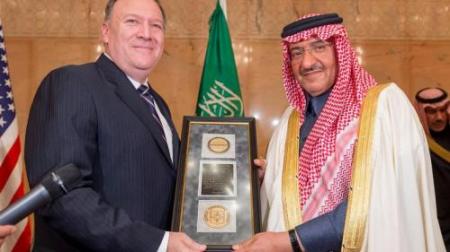
Mike Pompeo, the new CIA head, just flew to Riyadh to give a medal to the reigning son of the king (who is said to suffer from dementia).  While some conservatives regard this as a travesty (e.g., a “Not the Onion” commentary from Zero Hedge), I think this is meant to be an open signal to support the House of Saud, whose help is needed against the Iranians anyway and who support President El-Sisi against Hamas and the Muslim Brotherhood.

saudiaward

It’s not clear what the Saudis did in exchange, but they have been under the gun, fearing that Western media would expose their role in support of violent jihad.  So this looks as though the Saudis have done a lot to settle those debts.  It’s not the kind of public gesture the CIA does a lot.

The Saudis can shut down ISIS/AQ/Al Nusra, or whatever the worst gang of maniacs calls itself today.  They also have no problem with selected assassinations.  SecDef Mattis has a long record of talking about morality and immorality in warfare, and he does not like sadistic monsters.  I think the moral dimension of defensive war has been missing during the Obama years.

These moves may signal both domestic and foreign agreements to calm things down.  The Saudis know that their control of OPEC is waning, since Trump is aggressively opening up domestic traditional and shale energy production (again, something Obama never would do).  But the Saudis need to make a “soft landing,” which is not going to be easy.  So they have been talking peace with Israel, on the assumption that Israel can communicate with the U.S. – at least under Trump.

These are all calming moves in a very agitated international situation. I believe that Trump is going to move aggressively against Muslim Brotherhood infiltration, probably with Saudi backing.  The Saudis are ideologically aligned with ISIS, al-Qaeda, and the M.B.s, but tactically, they could abandon them.  Violent jihad arose with OPEC, and now that OPEC is declining, it would be smart to convince the Saudis that the jig is up.

We can see if there is a marked decrease in jihadist violence.  If not, then the hypothesis is wrong.

The possibility of public exposure of their role in 9/11 is still very real and can be used to ensure their good behavior.

This is Kremlinology, but it’s falsifiable.  There are many dangerous enemies in the world, including George Soros domestically, and the intelligence agencies can torpedo a lot of stuff.  It is smart for Trump to calm things down and focus on the hard parts first.


Are Saudi Arabia, Qatar and Kuwait Funding German Salafism?

December 21, 2016

Are Saudi Arabia Qatar and Kuwait Funding German Salafism? Gatestone InstituteGeorge Igler, December 21, 2016

(Please see also, Saudi Arabia Funding Extremist Islamist Groups in Germany? — DM)

The Sheikh Eid Bin Mohammad al-Thani Charitable Association and the Saudi Muslim World League are coordinating a “long-running strategy to exert influence” by Gulf States in Germany, according to a report authored by Germany’s security agencies.

“This is about war, about children being indoctrinated, they are only in primary school and already fantasize about how when they grow up, they want to join the jihad, kill infidels.” — Wolfgang Trusheim, Frankfurt State Security office.

“For quite some time we’ve had indications and evidence that German Salafists are getting assistance, which is approved by the governments of Saudi Arabia, Qatar and Kuwait, in the form of money, the sending of imams and the building of Koran schools and mosques.” — Rolf Mützenich, German MP and Middle East expert.

Declining to assimilate in the West continues with the apparent, religiously mandated, preference to have the host countries become Islamic.

Salafism — from salaf, “ancestors” or “predecessors” in Arabic — urges the emulation of the first three generations of the Islamic prophet Mohammad’s companions, and Mohammad himself. It is often deemed the most fundamentalist interpretation of Islam.

Security agencies in Germany claim that 9,200 such Islamic extremists currently call the country home. Another intelligence briefing cited by Süddeutsche Zeitung, warns that “the ideology already has 10,000 followers” and growing, in the country.

“Almost all of the German nationals who have travelled to Syria to fight for Islamic State became radicalized by Salafis, who target low-income Muslim youths in German cities,” wrote the Los Angeles Times, adding that it is proving increasingly challenging for German intelligence officials, “to differentiate between those who identify intellectually with Salafism and those who espouse using violence to realize a radical version of Islam.”

1360-2

Both Germany’s Federal Office for the Protection of the Constitution (BfV) and Federal Intelligence Agency (BND) “have accused Saudi Arabia and Kuwait of funding religious groups and conversion groups, as well as financing the building of mosques and backing hardline imams,” according to the Daily Express.

Following raids of their offices throughout Germany the activist group Die Wahre Religion (“The True Religion”) has already been banned in the country.

According to the German interior minister, Thomas de Mazière, “translations of the Quran are being distributed along with messages of hatred and unconstitutional ideologies … Teenagers are being radicalised with conspiracy theories.”

A radicalized 12-year old Muslim boy was recently arrested in the country; he was accused of planting bombs aimed at targeting shoppers in Germany’s famous Christmas markets.

Police raided 190 locations nationwide, affiliated with Die Wahre Religion; authorities described the group as a “collecting pool” for jihadists, which had already sent at least 140 fighters to foreign battlefields.

850 people are thought to have journeyed, “from Germany to Syria and Iraq to join extremist groups like the Islamic State as fighters,” according to the Associated Press.

In a warehouse near the western city of Cologne, authorities seized about 21,000 German-language copies of the Quran. The ban came a week after security authorities arrested five men who allegedly aided the Islamic State group in Germany by recruiting members and providing financial and logistical help.

The German interior minister stressed that the ban does not restrict the freedom of religion in Germany or the peaceful practice of Islam in any way. However, he said the group had glorified terrorism and the fight against the German constitution in videos and meetings.

Terrorism is naturally an abiding concern in Germany, yet recent comments by Wolfgang Trusheim, of Frankfurt’s State Security office, point to where much of the Salafist influence is being focused, namely, the minds of the young:

This is about war, about children being indoctrinated, they are only in primary school and already fantasize about how when they grow up, they want to join the jihad, kill infidels. They refuse to play football with infidels, they say: “I’m not allowed to play football with you, but when I’m grown up, I will kill you, because you are an infidel.”

As cited by a recent TV report by Hessischer Rundfunk:

There were instances of radical Salafist parents, who are willing to teach their children the hatred of believers of a different creed by any means. A father who puts his children in front of the TV, they are forced to watch the most cruel decapitation videos, and will be questioned, and just as they have learned, they reply that the human who has just been burnt alive or decapitated, deserves it because he is an infidel.

Salafists, according to the New York Times, “are known for aggressive proselytizing and their sympathies for the Islamic State.” Much of the recent crackdown by German government agencies is aimed at preventing such extremists from targeting the country’s swelling “refugee” population.

Germany is already experience a boom in births as a product of its “unmanageable” population influx.

“Something must be done immediately. We cannot wait any longer,” says Michael Kiefer, an Islamic Studies specialist at the government-sponsored Institute for Islamic Theology at the University of Osnabrück, about the growth of Salafism in Germany.

Such warnings, quoted in an analysis by Gatestone Institute as far back as 2014, evidently fell on deaf ears. The following year, Germany’s Chancellor, Angela Merkel, permitted over 1.5 million Muslim migrants to swell her nation’s Islamic population still further.

According to Dr. Bernd Baumann, a representative of the populist Alternative for Germany party (AfD) from Hamburg, with Germany representing less than 1% of the world’s population, in the year 2016, the European nation had accepted more “refugee” applications than the rest of the world combined:

Public Islamist recruitment drives, however, are becoming an increasingly common sight on German streets, as Die Zeit reported on November 28.

The Daily Express reported on December 15, 2016:

“The Kuwaiti Revival of Islamic Heritage Society (RIHS), a non-governmental organization (NGO) banned by the U.S. and Russia for alleged links to terrorist group Al-Qaeda, has also been blamed for the rising support for fundamentalist Salafi groups in Germany.”

Missionary groups from the Gulf States, including the Saudi Muslim World League, and Qatar’s Sheikh Eid Bin Mohammad al-Thani Charitable Association, are allegedly involved in a “long-running strategy to exert influence” on Muslims in Germany.

RIHS and the Sheikh Eid Bin Mohammad al-Thani Charitable Association have denied the allegations. The Saudi ambassador to Germany, Awwas Alawwad, also rejected the intelligence claims, saying his country has “no connection with German Salafism.”

Despite such denials, Chancellor Angela Merkel, “has confirmed plans rapidly to expand the scope and size of Germany’s intelligence services including its domestic spy agency.”

As the German MP and Middle East expert, Rolf Mützenich, has said, “The danger is real and should not be underestimated.” He added:

“For quite some time, we have had indications and evidence that German Salafists are getting assistance, which is approved by the governments of Saudi Arabia, Qatar and Kuwait, in the form of money, the sending of imams and the building of Koran schools and mosques.

“The best way of preventing refugees from being radicalised is speedy and successful integration. To achieve that, we need professional prevention and de-radicalisation programs. That means more money and resources for specialists in schools, government administration, police, youth welfare organisations, prisons and reform schools.”

Critics might argue that that there is enormous pressure in Muslims not to assimilate. The injunction begins with the Koran:

O you who have believed, do not take the Jews and the Christians as allies. They are [in fact] allies of one another. And whoever is an ally to them among you – then indeed, he is [one] of them. Indeed, Allah guides not the wrongdoing people. (Q5:51, Sahih International translation)

And:

Let not the believers take the unbelievers for friends rather than believers; and whoever does this, he shall have nothing of (the guardianship of) Allah, but you should guard yourselves against them, guarding carefully; and Allah makes you cautious of (retribution from) Himself; and to Allah is the eventual coming. (Q3:28, Shakir translation)

Declining to assimilate in the West continues with the apparent, religiously mandated, preference to have the host countries become Islamic.

With Islamist double-agents working for German intelligence services now being arrested in the country, Germany’s security challenges clearly go far deeper.

Saudi Arabia Funding Extremist Islamist Groups in Germany?

December 21, 2016

Saudi Arabia Funding Extremist Islamist Groups in Germany? Clarion Project, Codi Robertson, December 21, 2016

(Here is a recent video about Salafist indoctrination of children in Germany.

https://www.youtube.com/watch?v=M3X29ybZdiI

— DM)

A newly-leaked German intelligence report says Saudi Arabia, among several other countries, is funding extremist Islamic groups in Germany.

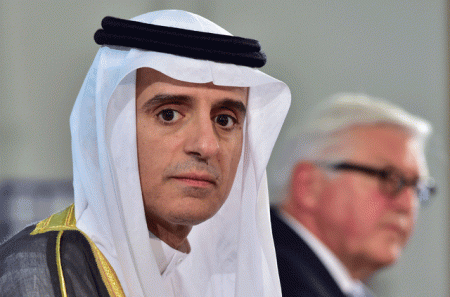
saudi-arabia-germany-foreign-ministers-john-macdougall-afp-getty-640German Foreign Minister Frank-Walter Steinmeier (R) and his Saudi counterpart Adel al-Jubeir give a joint press conferenceat the Foreign Ministry in Berlin. (Photo: © JOHN MACDOUGALL/AFP/Getty Images)

A newly-leaked German intelligence report states Saudi Arabia, Kuwait and Qatar are funding extremist Islamic groups in Germany.

The German newspaper Süddeutsche Zeitung and Northern German public radio broadcaster Norddeutscher Rundfunk saw the brief and raised concern regarding a reported increase in Salafism, an ultra-conservative movement within Sunni Islam, within Germany.

The report, compiled by German domestic intelligence agency Bft and Federal Intelligence Agency (BND) allegedly accuses Saudi Arabia and the two Gulf nations of funding various Islamic institutions including mosques and religious schools, as well as individual strict preachers and conversion, or “dawah” groups.

The three countries supported missionary groups as a “long-running strategy to exert influence,” according to the report.  More specifically, the report called out  the Saudi Muslim World League, Sheikh Eid Bin Mohammad al-Thani Charitable Association and the Kuwaiti Revival of Islamic Heritage Society (which is banned in both the U.S. and Russia for allegedly supporting al-Qaeda).

The report found that these organizations have strong ties to the governments of their home countries.

Neither of the German intelligence agencies have confirmed the accuracy of the leaked report.  There are some who say that say the leak was made intentionally so that Germany would cease controversial arm sales to Saudi Arabia.

While Germans await official word from the intelligence agencies, Saudi Arabia’s German ambassador, Awwas Alawwad, completely rejected the report, stating that his country has “no connection with German Salafism.”

Weeks before the leak, German authorities  banned the Islamic missionary group Germany Die Wahre Religion (DWR), or “The True Religion,” after officials found was “bringing jihadi Islamists together across the country under the pretext of preaching Islam.”

Germany, of course, is not new to the threat of Islamic terrorism.  An attack Monday on a Christmas market in Berlin left 12 dead and close to 50 injured. Two two attacks carried out by Islamic State supporters this past July.

Also, suspicion that Saudi Arabia is funding terrorist organizations is not new.  Especially since the recent disclosures by the Saudis that they had, in fact, funded extremism in the past.

If it is discovered that the Saudis are still funding extremist Islamic groups, it could prove devastating for the West, as Saudi Arabia has been considered one of the few Middle Eastern countries that the West can call an ally.


Shari’a Law Meets the Internet

December 8, 2016

Shari’a Law Meets the Internet, Gatestone InstituteDenis MacEoin, December 8, 2016

Shari’a councils should not have the right effectively to deny women rights they hold as British citizens under British law.

In the end, the biggest problem is that there is no system of external regulation for the councils. There is no legal requirement for them to keep full records of the cases they adjudicate on, no requirement to report to a civil authority with the right to prevent abuses, and not even a requirement for any council to register with a government agency.

The Muslim Brotherhood in the US itself listed the Fiqh Council of North America (FCNA) as one of several organizations who shared their goals, including the destruction of Western civilization and the conversion of the US into a Muslim nation.

The “minorities” jurisprudents generally favour a non-violent approach to the encounter of Islam and the West, while retaining a critical stance towards the latter and a conviction that Islam must, in the end, replace it. But on occasion, as in the Middle East, violence is sanctioned.


The UK has for several years faced problems with its growing number of shari’a councils (often misleadingly called courts). These councils operate outside British law, yet frequently give rulings on matters such as divorce, child custody, inheritance and more, which are based on Islamic law and in contradiction of the rights of individuals (usually women) under UK legislation. Many Muslim communities in cities such as Bradford, Birmingham, Luton, or boroughs such as Tower Hamlets in London are both sizeable and close-knit; individuals in them are made to live lives in accordance with Pakistani, Bangladeshi and Islamic traditional norms. This means that contact with British life at large is often restricted, with a lack of assimilation that traps many women and girls into lives very close to the lives of their sisters in Muslim countries.

Much of the concern about the “courts” has been expressed by Baroness Caroline Cox, whose bill to limit their impact on Muslim women has passed more than once through the House of Lords and, recently, into the House of Commons. Her personal determination and clear-sightedness have meant that the matter has remained for several years a focus for debate in politics and the media. Her arguments have received widespread support from women’s rights organizations, especially several concerned with the rights of Muslim women.

This year, in addition, two important academic studies of the issue have appeared. First was Machteld Zee’s “Choosing Sharia?: Multiculturalism, Islamic Fundamentalism & Sharia Councils,” which appeared in January. Zee is a Dutch political and legal scholar who carried out research in the UK, where she was given limited access to two shari’a councils, one in Birmingham and one in London. Her book devotes much time to the problems of what she calls “Essentialist Multiculturalism,” specifically the way multiculturalist theorists condemn individuals to be treated according to the culture and religion to which they belong, rather than as people who may wish to reject one or both of these.

An equally pertinent and academically sound treatise appeared in May: Elham Manea’s “Women and Shari’a Law: The Impact of Legal Pluralism in the UK.” Manea is of Yemeni origin; an Associate Professor in the Political Science Institute at the University of Zurich, a Fulbright Scholar, and a consultant for Swiss government agencies and international human rights organizations. Her book also focuses on the way in which multiculturalism undermines individual rights, especially in a chapter entitled, “A Critical Review of the Essentialist Paradigm.”

“Essentialists” demand that individuals conform to the cultural and legal norms of whatever community they are born into, and apparently prefer a multiculturalist vision of competing cultures and faith groups that maintain social distinctions. rather than mixed but well-integrated societies. The result is that restrictions are placed on the freedom of individuals to take their own path in life. In the instance of close-knit Muslim communities, the heaviest impact is on women. This involves forced and early marriage, first-cousin marriage, restriction of education for girls, rejection of appeals for divorce, denial of a woman’s right to child custody, and enforcement of the rule that women are only entitled to much lower inheritance payments than their brothers. It also means that women are limited in their freedom to work. In fundamentalist communities, their loss of that freedom means that they are forced to stay in the home to cook and look after children. This loss of freedom effectively destroys their opportunity to work (or be educated) alongside men. Women are often forbidden to adopt Western clothing norms even while living in open, Western societies. Shari’a “courts” have a deeply regressive influence on matters such as these.

Baroness Cox does not call for the abolition of the shari’a councils, given that Muslims have a right to turn to their own advisors for advice. But shari’a councils should not have the right effectively to deny women rights they hold as British citizens under British law. Many Muslim women are married purely under Islamic law and their marriages are not registered by civil registrars: this means that they can be denied their right to ask for a divorce or child custody from British courts. In the end, the biggest problem is that there is no system of external regulation for the councils. There is no legal requirement for them to keep full records of the cases they adjudicate on, no requirement to report to a civil authority with the right to prevent abuses, and not even a requirement for any council to register with a government agency — leading to the problem of how many councils exist in the country.
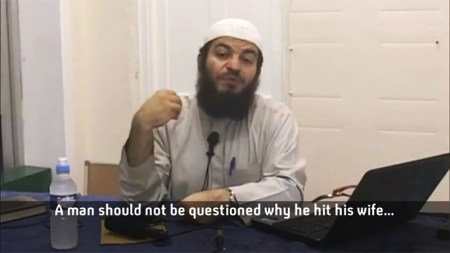
1013Haitham al-Haddad is a British shari’a council judge, and sits on the board of advisors for the Islamic Sharia Council. Regarding the handling of domestic violence cases, he stated in an interview, “A man should not be questioned why he hit his wife, because this is something between them. Leave them alone. They can sort their matters among themselves.” (Image source: Channel 4 News video screenshot)

If political reluctance to upset Muslims is not allowed to prevent Caroline Cox’s bill from becoming law, then there is hope that proper regulation will succeed the present chaos and irregularity that surround the councils as they are now operated. But even this may not be enough. Because of this absence of proper supervision, shari’a rulings impact British Muslims from three directions: through the shari’a councils, from the larger bodies to the informal “courts” that are reputed to operate from small terraced houses in Bradford, Birmingham and elsewhere; through the many online fatwa “banks” (websites) to which individuals refer themselves; and through the fatwas issued by the European Council for Fatwa and Research, based in Dublin.

These last two sources of shari’a rulings are usually ignored in studies of Islamic law in Britain, but they do, in fact, account for an undetermined number of responses to questions from individual Muslims in this country, and more formal diktats seen as binding across Europe, including the UK.

What I term “fatwa banks” are websites run either by individual muftis[1] or larger collective sites on an international scale. The sites I used in “Sharia Law or One Law for All” were Sunnipath, Ask Imam (answers from South Africa, but accessed through the Jamia Madina Mosque in Hyde), Madrasa In’aamiyyah, Darul Iftaa Leicester[2], IslamOnline.net[3], Ask the Scholar, Ask an Alim, Leicester, and the Islamic Shariah Council (Leyton in London).

Others operate out of other countries and in different languages, but can be accessed from the UK without difficulty. The most popular is IslamQ&A, which provides rulings in English and fifteen other languages. It is run from Saudi Arabia by the Salafi mufti Shaykh Muhammad Saalih al-Munajjid, and is not only one of the most popular Salafi websites, but also, according to Alexa.com, the world’s most popular website on the topic of Islam generally. The impact of its fatwas worldwide cannot be exaggerated. It includes some rulings on jihad.[4] There is no space here to reproduce these in full, but here are a few in brief that show the extent to which shari’a rulings diverge from British laws and values.

  1. Waging jihad against Americans (and other enemies of Islam) is to be encouraged.
  2. Shari’a law takes priority over secular law.
  3. A husband may prohibit his wife from leaving the house.
  4. Shari’a law can override British courts.
  5. A Muslim lawyer should not always act in accordance with UK law where it contradicts shari’a.
  6. Polygamy is acceptable even if against the law.
  7. A man may divorce his wife but keep that a secret from her.
  8. Execution or severe beating for homosexuals is correct.
  9. A wife has no property rights in case of divorce.
  10. There is no requirement to register a marriage according to the law of the country one lives in.
  11. A Muslim woman may not marry a non-Muslim man.
  12. Insurance is forbidden even if required by law.
  13. Child marriage is justified.
  14. A husband is not obliged to support a childless wife.
  15. A husband has conjugal rights over his wife. “Both partners have the right to have their physical demands met.” The only difference is that the husband may demand this, while the wife cannot.
  16. Divorce does not require a witness.
  17. Taking out insurance is forbidden.
  18. Medical insurance schemes are forbidden.
  19. If being a police officer in West contradicts shari’a, it is forbidden.
  20. Beating one’s wife is permissible (unless it harshly done).
  21. The mere intention to divorce is sufficient to make it valid, regardless of what is said.

Many of the above rulings are shocking, and by no means all websites or British shari’a councils will endorse many of them. But there they are, freely available to Muslims everywhere. If a believer tends towards strict interpretations of the sacred texts or the laws, he or she may well gravitate to fatwa banks such as these, and may well act on their basis rather than on the judgements of the nearest shari’a council. After all, what real authority do the muftis on the councils have beyond that of the other, online muftis? Shaykh Yusuf al-Qaradawi, for example, outranks pretty well all other contemporary Muslim authorities, with his TV show “Shari’a and Life” reaching an estimated 60 million viewers, and his learned essays promoting his personal views within the overall context of the Muslim Brotherhood, one of the most fundamentalist of today’s Islamic organizations.

Let us leave the British councils for a moment. There is another external source of fatwas. In many Muslim states, shari’a laws may be, and often are, imposed, often to the extent of punishing crimes from theft to murder. This means that matters that would not be crimes in Western states, such as adultery, blasphemy, or apostasy receive corporal punishments or the death penalty.

Knowing that there is no freedom in the West to criminalize these latter faults or to apply shari’a punishments for them, it became essential to come up with fatwas that would give authoritative guidance to Muslims in Western countries on how to conduct themselves in the “Land of War” (“Dar al Harb”, the opposite of the “Land of Islam”) while remaining shari’a-observant. The overall aim is to bring shari’a into Western societies by the back door. Even if Western governments like that of the UK were to find ways to register and control shari’a courts, or even abolish them, religious authorities could subvert this by presenting fatwas that would recommend certain behaviours for individuals and small communities.

The deliberations of the jurisprudents resulted in the need to adapt shari’a rulings to the situation of large-scale Muslim communities living outside enforceable Islamic jurisdictions. This endeavour has been termed Fiqh al-‘Aqalliyyat (“Jurisprudence of the minorities“). The purpose of this system — in which the classical system of Muslims ruling non-Muslims has been reversed — is to find a way to use shari’a without incurring the wrath of the indigenous legal system in secular parliamentary democracies. This has some resemblance to Muslim efforts during the colonial era to use shari’a in personal affairs in British and French colonies such as India or Algeria.

In its current form, the jurisprudence of the minorities dates back to the 1990s. It was developed by two individuals, the formerly mentioned Shaykh Yusuf al-Qaradawi and the late Shaykh Dr. Taha Jabir al-Alwani of Virginia. Al-Qaradawi is, among other things, president of the International Union of Muslim Scholars, a body founded in 2004 with its headquarters in the vastly wealthy Wahhabi state of Qatar. Its close ties to the Muslim Brotherhood have led to its designation by the United Arab Emirates as a terrorist organization. It boasts a membership of at least 90,000 Islamically-qualified scholars from around the world, representing several different sectarian positions.

Al-Alwani (d. 2016) was the founder and former chairman of the Fiqh Council of North America(FCNA), whose 18 members issue religious rulings, resolve disputes, and answer questions relating to Islamic practice. Their declared purpose:

“To consider, from a Shari’ah perspective, and offer advice on specific undertakings, transactions, contracts, projects, or proposals, guaranteeing thereby that the dealings of North American Muslims fall within the parameters of what is permitted by the Shari’ah.”

The FCNA too has close ties to the Muslim Brotherhood, which may, under a bill launched by Senator Ted Cruz, soon be designated by the US as a terrorist organization in its own right. The Muslim Brotherhood in the US itself listed the FCNA as one of several organizations who shared their goals, including the destruction of Western civilization and the conversion of the US into a Muslim nation.

The “minorities” jurisprudents generally favour a non-violent approach to the encounter of Islam and the West, while retaining a critical stance towards the latter and a conviction that Islam must, in the end, replace it. But on occasion, as in the Middle East, violence is sanctioned. When asked in an interview about Palestinian suicide bombings, al-Alwani responded, “We think that the Palestinian people have the right to defend themselves in the way they view as suitable and we will back it and support it.”[5]

That view was, until recently, shared by al-Qaradawi, who has supported terrorism, including suicide bombings.

Dr. Denis MacEoin is the author of Sharia Law or One Law for All as well as many academic books, reports, and hundreds of academic and popular articles about Islam in many dimensions. He is a Distinguished Senior Fellow at the Gatestone Institute.


[1] A mufti (a religious scholar who issues fatwas) is a learned man specializing in Islamic law; he issues judgements on cases, determining what is compliant with his law school, but the sentencing is carried out by a judge (a qadi). Sometimes, the same person performs both functions.

[2] The Darul Iftaa in Leicester was founded and run by Mufti Muhammad ibn Adam al-Kawthari, a graduate of the Deobandi Darul Uloom in Bury.

[3] This important site features a “Live Fatwa” session, where answers are given by Muhammad al-Mukhtar al-Shinqiti, director of the Islamic Center of South Plains in Lubbock, Texas. Al-Shinqiti is a prominent figure in Fiqh al-‘Aqalliyyat.

[4] Examples of fatwas from the above sites (apart from Islam Q&A, which I did not consult at that time) may be found in “Sharia Law or One Law for All,” pages 74 to 127. Unwittingly, they provide insights into the topics to which British Muslims who speak English have access: not just the archives of fatwas that they maintain, but in order to ask questions themselves on matters from oral sex to male doctors seeing female patients.

[5] Cited Fishman p. 11 from the London Arabic newspaper, Al-Sharq al-Awsat.

BREAKING: McCain and Graham Seek to Gut 9/11 Bill to Immunize Foreign Governments Funding Terrorists

December 1, 2016

BREAKING: McCain and Graham Seek to Gut 9/11 Bill to Immunize Foreign Governments Funding Terrorists, PJ MediaPatrick Poole, November 30, 2016

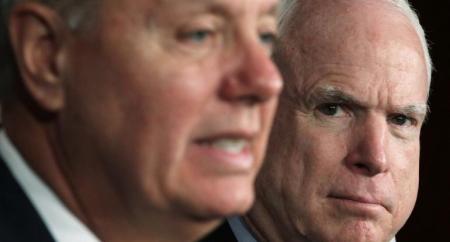
john-mccain-lindsey-graham-saudi-terror-sized-770x415xcU.S. Sen. Lindsey Graham (R-SC) (L) speaks as Sen. John McCain (R-AZ) (R)

In a Senate floor speech today, Senators John McCain and Lindsey Graham announced that they are offering an amendment to strip a key element of the recently passed Justice Against Sponsors of Terror Act (JASTA) that clarifies U.S. law for civil claims against foreign governments for funding terrorism.

JASTA was passed in the Senate in May with no objections, and passed the House of Representatives unanimously in September. President Obama promptly vetoed the bill. The Senate and House successfully voted to override the veto and the bill became law.

McCain and Graham specifically said they want to strip the “discretionary state function” provision from JASTA that creates liability for foreign governments funding terrorist groups.

According to Hill sources familiar with the McCain/Graham amendment, their intention is to immunize countries like Saudi Arabia and Qatar that have funded Sunni terrorist groups in Syria — the Syrian “rebel” effort that both McCain and Graham have publicly supported since 2011.

The McCain/Graham amendment was slammed by 9/11 family groups that fought for JASTA.

The 9/11 Families and Survivors United for Justice Against Terrorism put out the following press release this afternoon:

In a speech on the Senate floor this afternoon Senator Graham pitched this new language as a simple “caveat” but in reality he is proposing to amend JASTA to add a specific jurisdictional defense Saudi Arabia has been relying on for the last 13 years to avoid having to face the 9/11 families’ evidence on the merits.Moreover, Senator Graham and Senator McCain mischaracterized JASTA in several material respects during their speeches today. For example, Senator Graham argued that JASTA is deficient because it does not require that a foreign state have “knowingly” supported terrorism in order for liability to attach, but in fact JASTA’s liability provision expressly requires that the foreign state have “knowingly provided substantial assistance” to a designated terrorist organization in order for liability to arise. Senator Graham also suggested that adding a discretionary function provision to JASTA would protect the US from claims for drone strikes in Pakistan, which is simply incorrect given that Pakistan has made clear its view that domestic and international law prohibit those strikes.

Notably, Graham’s and McCain’s efforts come in the wake of a massive lobbying campaign by the Kingdom of Saudi Arabia which is now employing roughly a dozen Washington lobbying firms at a cost of more than $1.3 million per month.

“In April of this year, Senator Graham met with 9/11 family members from the September 11 Advocates Group and told them that he supported our cause 100%,” said Terry Strada, National Chair for the 9/11 Families and Survivors United for Justice Against Terrorism.

“Senator Graham is now stabbing the 9/11 families in the back. He and Senator McCain are seeking to torpedo JASTA by imposing changes demanded by Saudi Arabia’s lobbyists. We have reviewed the language, and it is an absolute betrayal.”

“The 9/11 Families are fortunate to have Senators John Cornyn and Chuck Schumer to block this action in the Senate, and we take comfort that President-elect Donald Trump strongly supports our cause. The President-elect has made his support for JASTA crystal-clear, and there is zero risk that he will support this kind of backroom backstabbing of the 9/11 families,” Strada concluded.

In their statements today, Senator Graham said with respect to their intentions:

We’re trying to work with Senator Schumer and Senator Cornyn, who deserve a lot of credit for trying to help the 9/11 families. Here’s what we’re asking. We’re asking that we put a caveat to the law we just passed saying that you can bring a lawsuit, but if you’re suing based on a discretionary function of a government to form an alliance with somebody or to make a military decision or a political decision, the only time that government is liable is if they knowingly engage with a terrorist organization directly or indirectly, including financing. I am okay with that because our country is not going to fall in league with terrorists and finance them to hurt other people. If we don’t make this change, here’s what I fear: That other countries will pass laws like this, and they will say that the United States is liable for engaging in drone attacks or other activity in the war on terror and haul us into court as a nation and haul the people that we give the responsibility to defend the nation into foreign courts.

McCain added:

The changes that Senator Graham and I are proposing, I think, are modest. And I think that logically, that you should not pursue or prosecute a government that did not knowingly — the word isn’t abetted or orchestrated, but knowingly — knowingly stand by and assist a terrorist group that they shouldn’t be dragged into our courts. If we don’t fix it, our ability to defend ourselves would be undermined. And I just want to emphasize one more point that the senator from South Carolina made. We have had drone strikes in many places in the world, in many countries in the world. Pakistan is another example. And all of us have supported the efforts, and many of them successful, in destroying those leaders who were responsible for the deaths of American servicemen and women. And it is a weapon in the war against terror. But sometimes, as in war, mistakes are made and innocent civilians were killed along with those terrorists. Does that mean that the United States of America, the government, is now liable? I’m afraid that some in the tort profession would view this as an opening to bring suits against the United States of America.

It appears their intention is to pass the amendments to JASTA during the lame-duck session before they lose key allies, such as Senator Kelly Ayotte, who lost her reelection bid in New Hampshire.