Archive for the ‘Russian aircraft’ category

US pilots will defend themselves as Russia threatens aircraft over Syria, Pentagon says

June 19, 2017

US pilots will defend themselves as Russia threatens aircraft over Syria, Pentagon says, Washington ExaminerJamie McIntyre, June 19, 2017

U.S. pilots over Syria will defend themselves if attacked by Russians, a Pentagon spokesman said Monday, following a report that Russia will treat U.S. or coalition aircraft as targets if they fly over areas in western Syria controlled by Russia.

The Russian Defense Ministry made the threat Monday after a U.S. F/A-18E Super Hornet shot down a Syrian Su-22 after that plane bombed U.S.-backed Syrian Democratic Forces that are working with the U.S. to defeat the Islamic State on Sunday.

“Any aircraft, including planes and drones of the international coalition, detected in the operation areas west of the Euphrates River by the Russian air forces will be followed by Russian ground-based air defense and air defense aircraft as air targets,” the Defense Ministry said.

“We are aware of the Russian statements,” Navy Capt. Jeff Davis, a Pentagon spokesman, said Monday morning. “We do not seek conflict with any party in Syria other than ISIS, but we will not hesitate to defend ourselves or our partners if threatened,” Davis said.

A spokesman for the U.S.-led coalition said the Russian statement has had no effect on the operations in support of U.S.-backed Syrian fighters moving against ISIS in Raqqa in western Syria.

“Coalition aircraft continue to conduct operations throughout Syria, targeting ISIS forces and providing air support for coalition partner forces on the ground,” said Col. Ryan Dillon, chief U.S. military spokesman in Baghdad.

He also appeared to indicate the U.S. is avoiding the parts of Syria where Russia said U.S. planes would be tracked as potential targets or providing additional airpower to counter threats.

“As a result of recent encounters involving pro-Syrian regime and Russian forces, we have taken prudent measures to reposition aircraft over Syria so as to continue targeting ISIS forces while ensuring the safety of our aircrews given known threats in the battlespace,” Dillon said.

The statement was meant as a warning, said Viktor Ozerov, a member of the Russian parliament, described the Defense Ministry’s statement as a warning.

“I’m sure that because of this neither the U.S. nor anyone else will take any actions to threaten our aircraft,” he said, according to state-owned RIA Novosti news agency. “That’s why there’s no threat of direct confrontation between Russia and American aircraft.”

Russia, beyond making the threat to treat U.S. or coalition aircraft as targets, also said its “deconfliction” line with the U.S. has been shut down. The line was established so U.S. and Russian forces could avoid bombing each other as they fight ISIS.

Both Davis and Dillon insisted the hotline remains the best way to avoid future shoot-downs.

“The coalition is always available to de-conflict with the Russians to ensure the safety of coalition aircrews and operations,” Davis said. “The de-confliction line has proven effective at mitigating strategic miscalculations and de-escalating tense situations.”

Said Dillon: “We used the de-confliction line yesterday and remain open to using it. It has proven its worth in the past to tap down tensions.”

[UPDATED] Syria moves all its fighter jets to Russian base

April 19, 2017

Syria moves all its fighter jets to Russian base, DEBKAfile, April 19, 2017

The Pentagon disclosure came ironically just hours after a senior Israeli military officer confidently informed military correspondents in Tel Aviv that the mechanism introduced for Russian-Israeli air force coordination in Syria had been successfully adopted by other nations operating in Syria, such as Turkey and the United States. He reported that the arrangement included reciprocal visits once every two months by heads of the operations divisions of the two armies.

These visits will probably go the same way now as the entire arrangement.

**********************************

Syria has moved all its fighter aircraft to the Russian Hmeimim air base in Latakia three weeks after 59 US Tomahawk cruise missiles knocked out one-fifth of its air force at the Shayrat base, in retaliation for a chemical attack on civilians in Idlib. This was reported Wednesday night, April 19, by the Pentagon. The Russian high command in Syria has its seat at that base.

DEBKAfile’s military sources report that the Syrian air force will operate henceforth under Russian protection and behind the advanced Russian S-300 and S-400 air defense shield without fear of US reprisals.

President Vladimir Putin’s response to the Trump administration’s call to distance Moscow from the Assad regime is therefore a flat rejection. He is instead fortifying Russian support for that regime.

The upsurge of Russian-US military tension places at risk the operational coordination accords prevailing between the air forces of Russia, the US and Israel in Syrian skies.

Syrian operational staff officers working in Hmeimim will now have access to the advanced Russian surveillance instruments tracking the movements of all foreign aircraft moving through Syrian air space. Syrian intelligence officers will also be close to Russian SIGINT facilities which the Russian spy agency GRU has installed there. In other words, by a single move, the Russians have substantially upgraded the Syrian air force’s operational and intelligence capabilities.

How does this affect the Syrian and Iranian air freight traffic ferrying military supplies from Iran? Where will they deliver their cargoes? Will they too be allowed to land at the Russian base in Latakia? If they are, the Israeli air force will be prevented from cutting down the flow of Iranian weapons for Hizballah. The new move more or less buries the Russian-Israeli agreements covering Syrian skies.

The Pentagon disclosure came ironically just hours after a senior Israeli military officer confidently informed military correspondents in Tel Aviv that the mechanism introduced for Russian-Israeli air force coordination in Syria had been successfully adopted by other nations operating in Syria, such as Turkey and the United States. He reported that the arrangement included reciprocal visits once every two months by heads of the operations divisions of the two armies.

These visits will probably go the same way now as the entire arrangement.

Syrian-Russian Provocations Could Spark Golan Clash

July 28, 2016

Syrian-Russian Provocations Could Spark Golan Clash, DEBKAfile, July 28, 2016

EinZivan2

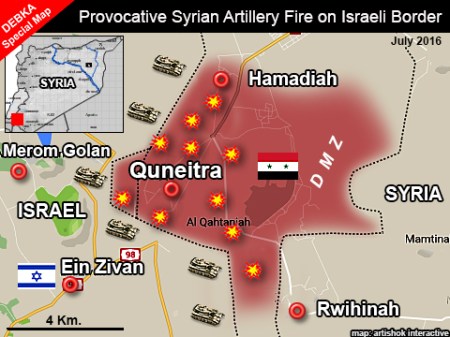
For four days since July 25, the Syrian army has been continuously firing artillery batteries – moved close to Israel’s defense lines on the Golan border – in a manner that comes dangerously close to provoking an Israeli response. This carefully orchestrated Syrian campaign goes on around the clock.

It is the first time in the six years of the Syrian war that Bashar Assad has ventured to come near to provoking Israel. But now he appears to be emboldened by his Russian ally.

The IDF is holding its fire for the moment. But Israeli military and government leaders know that the time is near for the IDF to be forced to hit back, especially since it is becoming evident that the Syrian army’s steps ae backed by Russia.

DEBKAfile’s military sources provide details of the Syrian steps:

  • The Syrian army’s 90th and 121nd battalions have been firing their artillery batteries non-stop across a 10km band along the Golan border from Hamadia, north of Quneitra, up to a point facing the Israeli village of Eyn Zivan. (See attacked map).
    This means that the Syrian army has seized the center of buffer zone between Israel and Syria and made it a firing zone.
  • This artillery fire fans out across a radius that comes a few meters short of the Israeli border and the IDF troops stationed there. It then recedes to a distance of 500 to 600 meters and sweeps across the outposts and bases of the Syrian rebel forces believed to be in touch with Israel or in receipt of Israeli medical aid.
  • The new Syrian attack appears to hold a message for Jerusalem: For six years, you supported the rebels against the Assad regime in southern Syria. That’s now over. If you continue, you will come face to face with Syrian fire.
  • Damascus is also cautioning those rebels:  For years, you fought us with Israel at your backs. But no longer. Watch us bring you under direct artillery fire, while the IDF sits on its hands.
  • On July 26, Russian media published an article revealing that Russia had delivered to the Syrian Air Force, advanced SU-24M2 front-line bombers, which is designed for attack on frontlines of battle. Israeli officials were unpleasantly taken aback by the news. Up until now, the Russians and Syrians refrained from deploying air strength in South Syria near the Israeli border. Now the Syrian air force has the means to do so.
  • DEBKAfile military sources report that the SU-24M2, following recent upgrades and modifications in Russian factories, is now capable of dropping smart bombs – ballistic bombs with a guidance system on their tails that enable them to hit targets with precision.This guidance system does not rely on US GPS satellites but rather the equivalent Russian GLONASS system which is linked to a network of 21 Russian satellites and partially encrypted for military usages.
    In addition, the SU-24M2 is equipped with a system that projects the information the pilot needs (flight details and battle details) on the plane’s windshield (head-up display) and on the pilot’s visor.
  • The Russians delivered to the Syrians two of these sophisticated airplanes this week, out of 10 that they will supply soon.

The IDF has concluded that it is only a matter of time before these planes appear in Southern Syria and so generate a new and highly combustible situation on Israel’s northern and northeastern borders.

The Russians are colluding with Damascus to inform Israel that it will no longer be allowed by either to continue backing the rebel forces in southern Syria or sustain the buffer zone which they man.

Israel may pay dear if Prime Minister Binyamin Netanyahu, Defense Minister Avigdor Lieberman, and Chief of Staff Lt. Gen. Gadi Eisenkot decide to continue to abstain from hitting back at the Syrian fire which is aimed every few hours at the vicinity of IDF posts or the impending arrival of Russian bombers. The price in store would be the weakening of the IDF’s hold on the Golan border.

Bolton: Will Obama Apologize For US Destroyer ‘Getting in Way’ of Russian Airplane?

April 15, 2016

Bolton: Will Obama Apologize For US Destroyer ‘Getting in Way’ of Russian Airplane? TownhallCortney O’Brien, April 15, 2016

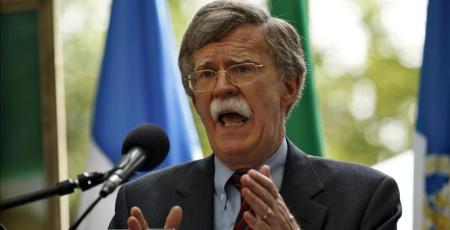
Bolton

Lt. Col. Ralph Peters (Ret.) was very blunt in his assessment of the incident in the Baltic Sea on Monday, when a Russian warplane buzzed awfully close to a U.S. Navy destroyer.

“I’m very, very worried that in the closing months of Obama’s presidency we’re gonna see American blood,” Peters said in an interview with Fox News.

It was a bold prediction, but one that former Ambassador John Bolton agrees with. During his own conversation on Fox Friday morning, Bolton predicted “there’s more” Russian aggression to come.

“If that airplane had caught a gust of wind, it could have been right up against that destroyer,” the ambassador explained.

Russia’s latest stint in the Baltic Sea signals to our NATO allies that the U.S. can’t take care of itself, he continued.

“I just hope Obama doesn’t apologize for destroyer getting in the way of that airplane.”

Based on the White House’s typical response to foreign intimidation, Bolton’s question is a fair one. Before the Russian airplane flew near our destroyer, Iran captured 10 of our American sailors and celebrated it. Secretary of State John Kerry actually thanked Iran for their compassion during the ordeal. President Obama, meanwhile, continues to defend his nuclear deal with the nation, which has basically given Iran a pass for its bad behavior. A Middle East expert who is very critical of that agreement argues it has severely damaged America’s image as a superpower.

Obama is also no stranger to apologies. He has asked for forgiveness on America’s behalf in about every corner of the globe, it seems. In Argentina last month, he noted the “early dark days” of the CIA and our country’s human rights violations. He continued to express regret over America’s human rights record in Cuba. Yes, Castros’ Cuba, where free speech is suppressed and punished.

Our adversaries are taking advantage of our president’s shows of weakness.

Iran will continue to intimidate us “indefinitely,” Bolton argued, for they know that under Obama, “they will face no consequences.”

A new report indicates that an Iranian general is in Moscow this week to discuss military options with President Putin.

Iran is “going to push the envelope” and “they’ll succeed,” Bolton warned.

Putin’s Message

April 15, 2016

Putin’s Message, Power LineScott Johnson, April 14, 2016

Vladimir Putin has a message for Barack Obama and the United States, a message he sent via Russian warplanes buzzing the Navy destroyer Donald Cook in the Baltic Sea. Yesterday the Pentagon released video of the jets flying extremely close to the ship more than 30 times over the past two days. Military Times originally reported the story yesterday here. CBS News quotes the Obama administration calling the “simulated attack” passes unsafe. The video below shows two Russian jets coming incredibly close on one of their passes.

https://www.youtube.com/watch?v=j6g_Wli7WJY

Putin’s message is that he holds Obama in the utmost contempt and that it is safe for him to show it. He knows Obama thinks him retrograde. Obama transcends concerns about national pride as a relic of the past. Putin wants to spread his message and publicize Obama’s attitude to those who take matters of national pride and humiliation seriously, even if it is redundant in both cases.