Archive for the ‘Russia’ category

Six powers agree on UN sanctions ‘snapback’ in push for Iran deal, sources say

May 31, 2015

Six powers agree on UN sanctions ‘snapback’ in push for Iran deal, sources say, Jerusalem Post, May 31, 2015

(Obviously, the tentative “deal” raises more questions than it answers, including its “non-binding” nature and whether Russia, China and even Iran would have vetoes.– DM)

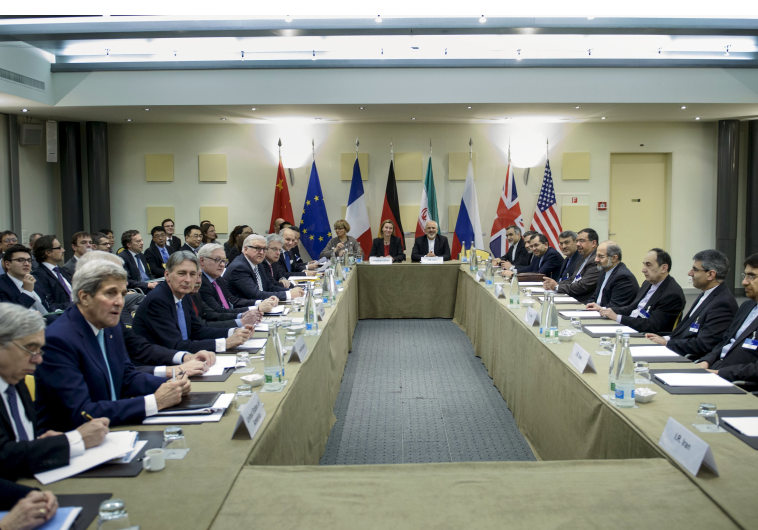
P5+1 meetingOfficials wait for a meeting with officials from P5+1, the European Union and Iran at the Beau Rivage Palace Hotel in Lausanne March 31, 2015.. (photo credit:REUTERS)

As part of the new agreement on sanctions snapback, suspected breaches by Iran would be taken up by a dispute-resolution panel, likely including the six powers and Iran, which would assess the allegations and come up with a non-binding opinion, the officials said.

As part of the new agreement on sanctions snapback, suspected breaches by Iran would be taken up by a dispute-resolution panel, likely including the six powers and Iran, which would assess the allegations and come up with a non-binding opinion, the officials said.

It was unclear exactly how the snapback mechanism would function, and the officials did not discuss the precise details. It was also unclear how the proposal would protect the United States and other permanent Council members from a possible Chinese or Russian veto on sanctions restoration.

**********************

New York, Paris, Ankara – Six world powers have agreed on a way to restore UN sanctions on Iran if the country breaks the terms of a future nuclear deal, clearing a major obstacle to an accord ahead of a June 30 deadline, Western officials told Reuters.

The new understanding on a UN sanctions “snapback” among the six powers – the United States, Britain, France, Germany, Russia and China – brings them closer to a possible deal with Iran, though other hurdles remain, including ensuring United Nations access to Iranian military sites.

The six powers and Iran struck an interim agreement on April 2 ahead of a possible final deal that would aim to block an Iranian path to a nuclear bomb in exchange for lifting sanctions. But the timing of sanctions relief, access and verification of compliance and a mechanism for restoring sanctions if Iran broke its commitments were among the most difficult topics left for further negotiations.

US and European negotiators want any easing of UN sanctions to be automatically reversible if Tehran violates a deal. Russia and China traditionally reject such automatic measures as undermining their veto power as permanent members of the UN Security Council.

As part of the new agreement on sanctions snapback, suspected breaches by Iran would be taken up by a dispute-resolution panel, likely including the six powers and Iran, which would assess the allegations and come up with a non-binding opinion, the officials said.

The International Atomic Energy Agency (IAEA) would also continue regularly reporting on Iran’s nuclear program, which would provide the six powers and the Security Council with information on Tehran’s activities to enable them to assess compliance.

If Iran was found to be in non-compliance with the terms of the deal, then UN sanctions would be restored.

The officials did not say precisely how sanctions would be restored but Western powers have been adamant that it should take place without a Security Council vote, based on provisions to be included in a new UN Security Council resolution to be adopted after a deal is struck.

“We pretty much have a solid agreement between the six on the snapback mechanism, Russians and Chinese included,” a Western official said. “But now the Iranians need to agree.”

Another senior Western official echoed his remarks, describing the agreement as “tentative” because it would depend on Iranian acceptance.

A senior Iranian diplomat said Iran was now reviewing several options for the possible “snapback” of Security Council sanctions against Tehran.

It was unclear exactly how the snapback mechanism would function, and the officials did not discuss the precise details. It was also unclear how the proposal would protect the United States and other permanent Council members from a possible Chinese or Russian veto on sanctions restoration.

US Ambassador to the United Nations Samantha Power has made it clear that Washington does not want Russia’s and China’s recent slew of vetoes on resolutions related to Syria to be repeated with an Iran nuclear agreement.

France’s Ambassador to the United States Gerard Araud said in Washington last week that, under a French idea, sanctions would be reinstated automatically in the event of non-compliance, avoiding the threat of a veto.

Under that idea, which Araud said had not to date been approved by the six powers, the onus would be on Russia or China to propose a Security Council vote not to re-impose sanctions.

Russian and Chinese officials did not respond immediately to requests for confirmation that they signed off on the snapback mechanism.

REVIEWING THE OPTIONS

US Secretary of State John Kerry met with Iranian Foreign Minister Mohammad Javad Zarif in Geneva on Saturday. They discussed progress and obstacles to an agreement in the Iran nuclear talks a month before the deadline for a deal aimed at reducing the risk of another war in the Middle East.

Restoring US and EU sanctions is less difficult than UN sanctions because there is no need for UN Security Council involvement.

For their part, Moscow, Beijing and Tehran have wanted assurances that Washington cannot unilaterally force a sanctions snapback – a risk they see rising if a Republican wins the US presidency in 2016.

A senior Iranian diplomat confirmed that discussions of specific snapback options were underway. He told Reuters Tehran was preparing its own “snapback” in the event the Western powers fail to live up to their commitments under the agreement.

“At least three or four different suggestions have been put on the table, which are being reviewed,” he said. “Iran also can immediately resume its activities if the other parties involved do not fulfill their obligations under the deal.”

He added that it was “a very sensitive issue.”

If Iran accepts the proposed snapback mechanism, there are other hurdles that must be overcome, including IAEA access to Iranian military sites and nuclear scientists and the pace of sanctions relief.

Iran says its nuclear program is entirely peaceful and rejects allegations from Western countries and their allies that it wants the capability to produce atomic weapons. It says all sanctions are illegal and works hard to circumvent them.

Russian Tank Crew Cries ‘May Day’ While Rehearsing for May Day Parade

May 7, 2015

Russian super-tank ‘stalls’ on rehearsal parade in Moscow
Via BBC News


(Sputter sputter clunk clunk pop. – LS)

Russia’s new high-tech battle tank has ground to a halt during a rehearsal for 9 May Victory parade in Moscow, prompting speculation of a breakdown.

(Gee, you think? – LS)

One of T-14 Armata tanks suddenly stopped on Red Square, and the driver raised a red flag – apparently to signal that he had problems.

(A white flag would have been more appropriate. – LS)

A tow vehicle was brought in, but the tank later managed to drive on.

(The tow vehicle did, however, run without incident. – LS)

The parade announcer said the stoppage had been planned to show how to “evacuate weaponry”.

(In a manner reminiscent of Baghdad Bob. – LS)

This prompted laughter from the crowds who gathered to watch the rehearsal in the Russian capital, Reuters reports.

(There will be no laughing when Boris Taxpayer gets the bill. – LS)

Alexei Zharich, deputy head of the Uralvagonzavod tank producing factory, later wrote on Twitter (in Russian) that the tank “was in full working order and left on its own”.

(With a driver I hope. – LS)

He also posted a video showing the vehicle leaving Red Square.

(Sure to go viral. – LS)

Russia’s military was responsible for the rehearsal, Mr Zharich added, and any questions should be addressed to it.

(As soon as their responses are approved by the Politburo. – LS)

The T-14 Armata has been the most talked-about innovation in Russia’s new armoury ahead of the 9 May World War Two Victory parade.

It has a remotely controlled cannon and offers additional protection to its crew, Russian military experts say.

And Russia’s RT news says the Armata could “evolve into a fully robotic battle vehicle”.

(Of course, Putin will have his very own joystick. – LS)

The experts also claim the tank is superior to the T-90 – the current mainstay of the Russian army – and also to all Western analogues.

(Rumored to be a bit more reliable than the Trabant. – LS)

Russia plans to bring in about 2,300 Armatas, starting in 2020.

(As soon as the check from Europe clears for all that natural gas. – LS)

News from the Russian Front: Why Russia Will Lose in Ukraine

April 29, 2015

Why Russia Will Lose in Ukraine
By Alexander J. Motyl 24 February 2015 Via The World Affairs Journal


(While the rest of the world moves forward, Putin finds it necessary to return to a cold war posture. Something is terribly wrong with Putin and his ability to deal with the rest of the world. Of course, we have our own problems here in the US with our very own lightweight so-called leader. Anyway, this article contains some interesting commentary regarding Putin’s antics. – LS)

So who’s winning the war in eastern Ukraine—Russia or Ukraine? The answer is not as simple as it might seem, because victory means different things for each side.

A Russian victory could take one of two forms: territorial expansion into large parts of southeastern Ukraine or the imposition on Ukraine of disadvantageous peace terms. Or it could take both forms. But neither has happened, and neither is likely to happen.

Anything short of such a victory amounts to a defeat for Russia. Having destroyed the Russian economy, transformed Russia into a rogue state, and alienated Russia’s allies in the “near abroad,” Vladimir Putin loses if he doesn’t win big.

In contrast, Ukraine wins as long as it does not lose big. If Ukraine can contain the aggression, it will demonstrate that it possesses the will and the military capacity to deter the Kremlin, stop Putin and his proxies, and survive as an independent democratic state.

The balance of forces could change. Russia could throw hundreds of thousands of regular troops against Ukraine in order to seize Kyiv or build a land corridor to Crimea. But this would dramatically increase Putin’s risk factor. In that case, Ukrainians would fight to the finish, a partisan war would ensue, the United States would supply weapons to Ukraine, other Eastern European countries might get involved in the fighting, Western sanctions would be ratcheted up, and Russia would be excluded from the SWIFT international banking system. Russian losses—human, financial, and material—would likely be enormous, inviting a palace coup against Putin.

Although Putin is driven by a bizarre vision of reestablishing Holy Russia’s greatness, he is enough of a realpolitik policymaker to understand that attempting to overrun Ukraine would have dire consequences for Russia and himself.

Putin is therefore likely to maintain the military pressure on Ukraine—having the separatists strike here, strike there, withdraw, regroup, make nice, and then repeat the cycle—in the hope of draining Ukraine’s economic, military, and human resources.

But that, too, won’t result in territorial expansion into large parts of southeastern Ukraine or the imposition on Ukraine of disadvantageous peace terms.

Thus far skittish about military aid, the Obama administration is coming under increasing pressure to provide Ukraine with lethal weapons and real-time intelligence. Provided that meaningful economic reforms move forward in Kyiv, chances are good that other Western states and institutions will give Ukraine significant economic assistance, especially now that the IMF has committed itself to a $40 billion aid package. And the more Western money is sunk into Ukraine, the greater the likelihood that Western states will follow with military aid, if only as a guarantee of their financial investment. Meanwhile, Ukrainian elites—prodded by the West and compelled by Putin’s threat to annihilate Ukraine—will embark on (more or less) radical economic reforms.

The Ukrainian armed forces are getting stronger and more effective by the day, inflicting high casualties on the militants and Russians and maintaining their positions. Even the retreat from the Debaltseve salient, mistakenly portrayed in the Western press as a “debacle,” was anything but. (In order to know that, however, you need to be able to read Ukrainian- and Russian-language sources.) According to one of Ukraine’s top military analysts, Yuri Biryukov, Ukraine’s losses were 179 dead and 89 missing and presumed dead in the period from January 18th to February 18th, while Russian and proxy losses amounted to 868 dead—roughly three to four times as many. And small wonder. As Ukraine’s other top military analyst, Yuri Butusov, has repeatedly argued on his Facebook page, there is simply no comparison between the Ukrainian army of today and the ragtag band of soldiers that was Ukraine’s armed forces in March of 2014, when Putin seized the Crimea. More important, Ukraine’s less than competent military command appears to be on the verge of a major change in personnel.

The situation on the front is a military stalemate that is as deleterious to the Donbas enclave’s economic viability as it is beneficial to Ukraine’s ability to survive as an independent political entity. As this blog has argued ad nauseam, a frozen conflict—which may be in the process of emerging, even though everyone denies it—would be the best thing that could possibly happen to Ukraine.

Finally, although Ukrainians are one-fourth as many as Russians, Ukrainians are fighting for their homeland. In both eastern and western Ukraine, they know this is perhaps their last chance to break free of Moscow’s imperial grip. The remarkable thing about Ukraine’s dedicated volunteer battalions is the high number of eastern Ukrainians in them. Western Ukrainians dominated in both the 2004 Orange Revolution and the 2014 Maidan Revolution. Russian-speaking eastern Ukrainians have demonstrated that, when it comes to defending their own homes, they’re more than willing to step up.

Russia can’t win big. Ukraine can’t lose big. And that means that Russia is losing and Ukraine is winning—and that Russia will lose and Ukraine will win.

The West should know that, in supporting Ukraine, it’s not just doing the right thing. It’s also betting on the winner.

Exclusive: Moscow has no S-300 air defense missiles available for Iran. Replacements under discussion

April 15, 2015

Exclusive: Moscow has no S-300 air defense missiles available for Iran. Replacements under discussion, DEBKAfile, April 15, 2015

Although Tehran celebrated President Vladimir Putin’s decision to release the S-300 missiles withheld from Iran for five years by an arms embargo, DEBKAfile reports exclusively that Iran can’t hope to take delivery of the advanced air defense systems in the foreseeable future. The Russian military industry is already way behind meeting demands for more S-300 missiles and their radar systems for the Russian army, which has none to spare for Iran. Its own needs have soared since Russia fell out with US and Europe over the Ukraine conflict.

The Russian army lately moved S-300 batteries, which are capable of downing fighter jets and missiles, to the country’s southern border with Ukraine, as air cover for the pro-Russian separatists against Ukrainian air bombardment, which has since petered out.

Additional batteries are deployed at Russian sea and air bases on the Black Sea and Crimean Peninsula.

A further batch of S-300 missiles, as well as the S-400 from the same family, has been positioned in the Russian strategic enclave of Kaliningrad on the Baltic Sea, Moscow’s forward military position against Europe.

In response to US plans to install a missile shield network in East and West European countries belonging to  NATO, the Russians advanced into Kaliningrad a number of short-range ballistic K720 Iskander (NATO-named SS-26 Stone9) missiles capable of carrying nuclear warheads.

The S-300 missile batteries are in place to defend them.

DEBKAfile’s military sources also disclose that, after five years of training one Iranian team after another in the operation of the S-300 systems, the Russians have given up on their acquiring the necessary skills.

Tehran and Moscow have still to decide, after eight years of debating, which particular missile system best suits Iran’s needs out of the S-300 family of weapons, each of whose basic six categories is designed for a particular task. Those categories employ seven types of missile, which too break down into 16-sub-types, including the S-400.

In an attempt to reach a decision, our intelligence sources in Moscow report that Iran’s National Security chief Ali Shankhani, who is currently visiting Moscow, has settled on an Iranian military delegation making an early trip to Russia, viewing the various S-300 models and returning home with recommendations. Tehran will then make its choice.

This process too could stretch out over many months. Moscow may not see eye to eye with Tehran on the type of missile to be supplied, a difficulty that would entail a fresh round of negotiations.

Given all these circumstances, it is hard to see Iran taking delivery of the first S-300 missiles any time this year, as it had hoped.
A

ll the same, although the entire transaction is in the air, the US and Israel made big play of protesting the Kremlin’s decision to end its embargo on the S-300s for Iran. When Secretary of State John Kerry talked about it to Foreign Minister Sergei Lavrov Monday, and Prime Minister Binyamin Netanyahu  phoned President Putin Tuesday, both were perfectly aware that the batteries wold not be making their way to Tehran any time in the near future.

Yemen war: Saudis prevented Russian evacuations by air, bombed Moscow’s spy center in Aden

April 7, 2015

Yemen war: Saudis prevented Russian evacuations by air, bombed Moscow’s spy center in Aden, DEBKAfile, April 7, 2015

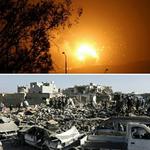
Russias_Yemen_consulate_damaged_in_Saudi-led_airstrikes_1.4.15Russia’s bombed out consulate in Aden

Saudi Arabia has gone head to head with Russia as Iran’s ally in Yemen.

Moscow claims to have evacuated hundreds of Russian nationals from Yemen by an air lift running out of Sanaa airport, but DEBKAfile’s exclusive intelligence and military sources reveal that not a single Russian plane has taken off from any Yemeni airport since March 27, when Saudi Arabia launched its military offensive against the pro-Iranian Houthi rebels.

The Saudiis warned Russia that they would not be responsible for the safety of any flights landing at a Yemeni airport or the passengers assembled there for evacuation, while their air force conducted strikes against the rebels. Having achieved control of Yemen’s skies in the early stages of their intervention, the Saudis declared its air space a no-fly zone.

This warning gained substance when, on April 1, Saudi F-15 warplanes bombed the Russian consulate in the second largest Yemeni city, Aden. A Russian witness said that not a single window was left in the building and all Russian citizens would have to leave the town.

According to DEBKAfile’s sources, the building was in fact completely demolished in order to dismantle Russia’s regional intelligence-gathering center which operated out of the consulate building and fed Iranian intelligence with data on military movements in the neighborhood.

It functioned according to the same system as Russian spy stations in Syria, which routinely keep their Iranian colleagues au fait with military activities, including Israeli army movements.

The intelligence gathered by the Aden facility was no doubt passed on by Iranian agents to the Houthi commanders, certainly after Al Qods Brigades chief Gen. Qassem Soleimani arrived in Sanaa to direct the rebel offensive after the Saudi offensive was launched.

In normal times, the Russian spy facility would have been responsible for surveillance over navigation through the Bab el-Mandeb Strait and the warships sailing between Red Sea, the Gulf of Aden and the Indian Ocean.

The next chapter of the Russian evacuation story unfolded on Thursday, April 2, the day after the consulate was razed: The Russians tried activating their connections in Cairo to obtain Saudi permission to land a plane in Sanaa, where hundreds of Russians had crowded to await passage to safety.

The Saudis relayed their refusal to Moscow through Cairo.

Then, on Friday, April 3, a flight landed at Moscow’s Chkalovsky Airport carrying Russian evacuees from Yemen, followed by a second flight which landed at an unnamed Russian military airport.

DEBKAfile’s sources report that neither of those planes were actually permitted to take off from Sanaa, but flew in from Cairo. After the Saudi ban on flights through Yemeni airports, Moscow had no choice but to rescue its nationals from the embattled country by sea aboard ships that carried them to Egypt.


The World Bows to Iranian Regional Hegemony

March 4, 2015

The World Bows to Iranian Regional Hegemony, Asia Times Online via Middle East Forum, David P. Goldman, March 4, 2015. Originally published under the title, “World Bows to Iran’s Hegemony.”

1025The looming nuclear agreement is a dark cloud for countries within range of Iranian ballistic missiles.

The powers of the world hope to delay, but not deter, Iran’s eventual acquisition of nuclear weapons.

The US has tacitly accepted the guiding role of Iranian commanders in Iraq’s military operations against ISIS.

Washington destroyed the balance of power that defined the region’s politics when it pushed through majority rule in Iraq.

****************

The problem with Israeli Prime Minister Benyamin Netanyahu’s address to Congress March 3 was not the risk of offending Washington, but rather Washington’s receding relevance. President Barack Obama is not the only leader who wants to acknowledge what is already a fact in the ground, namely that “Iran has become the preeminent strategic player in West Asia to the increasing disadvantage of the US and its regional allies,” as a former Indian ambassador to Oman wrote this week.

For differing reasons, the powers of the world have elected to legitimize Iran’s dominant position, hoping to delay but not deter its eventual acquisition of nuclear weapons. Except for Israel and the Sunni Arab states, the world has no desire to confront Iran. Short of an American military strike, which is unthinkable for this administration, there may be little that Washington can do to influence the course of events. Its influence has fallen catastrophically in consequence of a chain of policy.

The best that Prime Minister Netanyahu can hope for is that the US Congress will in some way disrupt the Administration’s efforts to strike a deal with Iran by provoking the Iranians. That is what the White House fears, and that explains its rage over Netanyahu’s appearance.

Tehran may overplay its hand, but I do not think it will. The Persians are not the Palestinians, who discovered that they were a people only a generation ago and never miss an opportunity to miss and opportunity; they are ancient and crafty, and know an opportunity when it presents itself.

Most of the world wants a deal, because the alternative would be war. For 10 years I have argued that war is inevitable whatever the diplomats do, and that the question is not if, but how and when. President Obama is not British prime minister Neville Chamberlain selling out to Hitler at Munich in 1938: rather, he is Lord Halifax, that is, Halifax if he had been prime minister in 1938. Unlike the unfortunate Chamberlain, who hoped to buy time for Britain to build warplanes, Halifax liked Hitler, as Obama and his camarilla admire Iran.

China is Chamberlain, hoping to placate Iran in order to buy time. China’s dependence on Middle East oil will increase during the next decade no matter what else China might do, and a war in the Persian Gulf would ruin it.

Until early 2014, China believed that the United States would guarantee the security of the Persian Gulf. After the rise of Islamic State (ISIS), it concluded that the United States no longer cared, or perhaps intended to destabilize the region for nefarious reasons. But China does not have means to replace America’s presence in the Persian Gulf. Like Chamberlain at Munich, it seeks delay.

Obama, to be sure, portrays his policy in the language of balance of power. He told the New Yorker’s David Remnick in 2014,

It would be profoundly in the interest of citizens throughout the region if Sunnis and Shias weren’t intent on killing each other. And although it would not solve the entire problem, if we were able to get Iran to operate in a responsible fashion – not funding terrorist organizations, not trying to stir up sectarian discontent in other countries, and not developing a nuclear weapon – you could see an equilibrium developing between Sunni, or predominantly Sunni, Gulf states and Iran in which there’s competition, perhaps suspicion, but not an active or proxy warfare.

That, as the old joke goes, is the demo version.

On the ground, the US has tacitly accepted the guiding role of Iranian commanders in Iraq’s military operations against ISIS. It is courting the Iran-backed Houthi rebels who just overthrow a Saudi-backed regime in Yemen. It looks the other way while its heavy arms shipments to the Lebanese army are diverted to Hezbollah.

At almost every point at which Iran has tried to assert hegemony over its neighbors, Washington has acquiesced. “In the end, peace can be achieved only by hegemony or by balance of power,” wrote Henry Kissinger. The major powers hope for peace through Iranian hegemony, although they differ in their estimate of how long this will last.

Apart from its nuclear ambitions, the broader deal envisioned by Washington would leave Iran as a de facto suzerain in Iraq. It would also make Iran the dominant power in Lebanon (via Hezbollah), Syria (via its client regime) and Yemen (through its Houthi proxies). Although Sunni Muslims outnumber Shi’ites by 6:1, Sunni populations are concentrated in North Africa, Turkey and South Asia. Iran hopes to dominate the Levant and Mesopotamia, encircling Saudi Arabia and threatening Azerbaijan.

It is grotesque for America to talk of balance of power in the Persian Gulf, because America destroyed the balance of power that defined the region’s politics from the end of the First World War until 2006, when Washington pushed through majority rule in Iraq.

The imperialist powers in their wisdom established a power balance on two levels. First, they created a Sunni-dominated state in Iraq opposite Shi’ite Iran. The two powers fought each other to a standstill during the 1980s with the covert encouragement of the Reagan administration. Nearly a million soldiers died without troubling the world around them.

Second, the Sykes-Picot agreement of 1916 created two states, Syria and Iraq, in which minorities ruled majorities – the Alawite minority in Syria, and the Sunni minority in Iraq. Tyranny of a minority may be brutal, but a minority cannot exterminate a majority.

America’s first great blunder was to force majority rule upon Iraq. As Lt General (ret.) Daniel Bolger explained in a 2014 book,

The stark facts on the ground still sat there, oozing pus and bile. With Saddam gone, any voting would install a Shiite majority. The Sunni wouldn’t run Iraq again. That, at the bottom, caused the insurgency. Absent the genocide of Sunni Arabs, it would keep it going.

Under majority Shi’ite rule, Iraq inevitably became Iran’s ally. Iranian Revolutionary Guards are now leading its campaign against the Sunni resistance, presently dominated by ISIS, and Iranian officers are leading Iraqi army regulars.

This was the work of the George W Bush administration, not Obama. In its ideological fervor for Arab democracy, the Republicans opened the door for Iran to dominate the region. Condoleezza Rice, then Bush’s National Security Advisor, proposed offering an olive branch to Iran as early as 2003. After the Republicans got trounced in the 2006 Congressional elections, defense secretary Donald Rumsfeld got a pink slip, vice president Dick Cheney got benched, and “realist” Robert Gates – the co-chairman of the 2004 Council on Foreign Relations task force that advocated a deal with Iran – took over at Defense.

China and Russia

In the past, China has sought to strike a balance between Saudi Arabia and Iran with weapons sales, among other means. One Chinese analyst observes that although China’s weapons deliveries to Iran are larger in absolute terms than its sales to Saudi Arabia, it has given the Saudis its best medium-range missiles, which constitute a “formidable deterrent” against Iran.

1026A Chinese warship arrives in Bandar Abbas, Iran in September 2014.

As China sees the matter, its overall dependency on imported oil is rising, and the proportion of that oil coming from Iran and its perceived allies is rising. Saudi Arabia may be China’s biggest provider, but Iraq and Oman account for lion’s share of the recent increase in oil imports. China doesn’t want to rock the boat with either prospective adversary.

Among the world’s powers, China is the supreme rationalist: it views the world in terms of cold self-interest and tends to assume that others also view the world this way. One of China’s most respected military strategists told me bluntly that the notion of a nuclear exchange between Israel and Iran (and by implication any regional nuclear power and Iran) was absurd: the Iranians, he argued, know that a nuclear-armed Israel could destroy them in retaliation.

Other Chinese analysts are less convinced and view Iran’s prospective acquisition of nuclear weapons with trepidation. It is not only war with Israel but with Saudi Arabia that concerns the oil-importing Chinese. For the time being, Beijing has decided to accommodate Iran. In a March 2 commentary, Xinhua explicitly rejected Israeli objections:

The US Congress will soon have a guest, Israeli Prime Minster Benjamin Netanyahu, who is expected to try to convince lawmakers that a deal with Iran on its nuclear program could threaten the very existence of the Jewish state.

Despite the upcoming pressure, policymakers in Washington should have a clear mind of the potential dangers of back-pedaling on the current promising efforts for a comprehensive deal on the Iranian nuclear issue before a March 31 deadline …

With a new round of talks in Switzerland pending, it is widely expected that the P5+1 [the five permanent members of the UN Security Council plus Germany] could succeed in reaching a deal with Iran to prevent the latter from developing a nuclear bomb, in exchange for easing sanctions on Tehran.

The momentum does not come easy and could hardly withstand any disturbances such as a surprise announcement by Washington to slap further sanctions on Tehran.

The Obama administration needs no outside reminder to know that any measures at this stage to “overwhelm” Iran will definitely cause havoc to the positive atmosphere that came after years of frustration over the issue.

While it is impossible for Washington to insulate itself from the powerful pro-Israel lobbyist this time, the US policymakers should heed that by deviating from the ongoing endeavor on Iran they may squander a hard-earned opportunity by the international community to move closer to a solution to the Iran nuclear issue, for several years to come if not forever.

Russia has taken Iran’s side explicitly, for several reasons.

First, Russia has stated bluntly that it would help Iran in retaliation for Western policy in Ukraine, as I wrote in this space January 28. Second, Russia’s own Muslim problem is Sunni rather than Shi’ite. It has reason to fear the influence of ISIS among its own Muslims. If Iran fights ISIS, it serves Russian interests. Russia, to be sure, does not like the idea of a nuclear power on its southern border, but its priorities place it squarely in Iran’s camp.

Demographic Time Bomb

The Israeli prime minister asserted that the alternative to a bad deal is not war, but a better deal. I do not think he believes that, but Americans cannot wrap their minds around the notion that West Asia will remain at war indefinitely, especially because the war arises from their own stupidity.

Balance of power in the Middle East is inherently impossible today for the same reason it failed in Europe in 1914, namely a grand demographic disequilibrium: Iran is on a course to demographic disaster, and must assert its hegemony while it still has time.

Game theorists might argue that Iran has a rational self-interest to trade its nuclear ambitions for the removal of sanctions. The solution to a multi-period game – one that takes into account Iran’s worsening demographic weakness – would have a solution in which Iran takes great risks to acquire nuclear weapons.

Between 30% and 40% of Iranians will be older than 60 by mid-century (using the UN Population Prospect’s Constant Fertility and “Low” Variants). Meanwhile, its military-age population will fall by a third to a half.

Belated efforts to promote fertility are unlikely to make a difference. The causes of Iranian infertility are baked into the cake – higher levels of female literacy, an officially-sanctioned culture of sexual license administered by the Shi’ite clergy as “temporary marriage,” epidemic levels of sexually-transmitted disease and inbreeding. Iran, in short, has an apocalyptic regime with a lot to be apocalyptic about.

Henry Kissinger is right: peace can be founded on either hegemony or balance of power. Iran cannot be a hegemon for long because it will implode economically and demographically within a generation. In the absence of either, the result is war. For the past 10 years I have argued in this space that when war is inevitable, preemption is the least damaging course of action. I had hoped that George W Bush would have the gumption to de-fang Iran, and was disappointed when he came under the influence of Condoleezza Rice and Robert Gates. Now we are back in 1938, but with Lord Halifax rather than Neville Chamberlain in charge.

Hero of the Middle East: Abdel Fattah el-Sisi

February 23, 2015

Hero of the Middle East: Abdel Fattah el-Sisi, The Gatestone InstituteBassam Tawil, February 23, 2015

(Please see also Obama kept reform Muslims out of summit on extremism. — DM)

The courageous, historic speech yesterday by the Grand Imam of al-Azhar University, the seat of Sunni Islam, calling for the reform of Islam, was the result of the even more courageous, historic speech delivered a few weeks ago by Egypt’s devoutly Muslim President, Abdel Fattah El-Sisi.

The Muslim Brotherhood, the current American administration’s great friend, is the poison tree whose fruit is the Islamist terrorism embodied by the ISIS, Al-Qaeda, Hamas, Palestinian Islamic Jihad, Al-Nusra Front, Boko Haram and others.

Apparently some of the Sunni Arab States have not yet realized that their own national security, and ability to withstand Iran, depend on how strong Egypt is.

It is possible, in fact, that U.S. policy is to weaken the Sunni world seeking to unite under el-Sisi’s flag of modernity. With European complicity, the U.S. Administration is trying to defraud the Arabs and turn the Israel-Palestine conflict into a center of Middle Eastern chaos, in order to hide the nuclear deal they are concocting with Iran.

The treachery of the U.S. Administration is the reason why Egypt’s faith in the United States, which is supposed to defend the Arabs against a nuclear Iran, has effectively evaporated.

And now the greatest American insanity of all time: America and Turkey are arming and training Islamist terrorist operatives in Turkey, on the ground that they are “moderates” opposed to Bashar Assad’s regime in Syria. They either ignore or are unaware that there is no such thing as a moderate Islamist terrorist. The other name of the “moderates” opposing Assad is ISIS.

The Muslim Brotherhood, in effect, runs Turkey. According to recent rumors, Turkey is also planning to build a nuclear reactor, “for research and peaceful purposes.”

Sheikh Dr. Ahmed al-Tayyeb, the Grand Imam of Cairo’s Al-Azhar University, the seat of Sunni Islam, yesterday delivered a courageous, historic speech in Mecca, Saudi Arabia, urging reform in religious education to curb extremism in Islam. Al-Tayyeb’s address was the result of an even more courageous and historic speech, delivered a few weeks ago by Egypt’s devoutly Muslim President, Abdel Fattah el-Sisi, at Al-Azhar University.

El-Sisi’s monumental statement, truly worthy of a Nobel Prize, is having a seismic result. Al-Sisi directed his remarks, about the ills of Islam to Islamic clerics in Egypt and around the world. It was enormously brave of him. He did not single out radical Islam, but he did call on all Muslims to examine themselves, carry out a religious revolution and renew their faith.

El-Sisi, a man of monumental courage, urged Muslims not to behave according to the ancient, destructive interpretations of the Qur’an and Islam that make the rest of the world hate them, destroy Islam’s reputation and put Muslim immigrants to Western countries in the position of having to fight their hosts. He claimed that it is illogical for over a billion Muslims to aspire to conquer and subdue six billion non-Muslims.

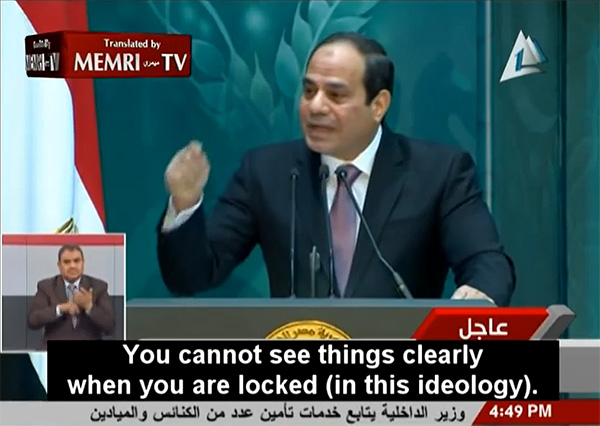
949 (1)Egypt’s President, Abdel Fattah el-Sisi, delivered a historic speech to top Islamic scholars and clergy at Al-Azhar University in Cairo, December 28, 2014. (Image source: MEMRI)

Islam deals in depth with uniting the Muslim nation (umma) and mutual responsibility among Muslims, as though they were one entity. The Prophet Muhammad (S.A.A.W.) said that every drop of Muslim blood is more precious than the entire Kaaba. Thus the liberty ISIS took upon itself to burn alive a Jordanian pilot and 45 Egyptians, to spread terrorism throughout Syria, Iraq and Egypt and to kill other Muslims in various locations around the globe, claiming they were “infidels,” is heresy in and of itself.

The calls for the deaths of “a million shaheeds” and the killing of Jews for the sake of Al-Aqsa mosque in Jerusalem, as was done by Arafat in the past, and is being done now by his heirs in the Palestinian Authority and Hamas, are a crime; they are extremist incitement that is opposed to the forgiving and compromising spirit of Islam. The murder and terrorism carried out by terrorist organizations such as ISIS, Hamas, Palestinian Islamic Jihad [PIJ] and other Islamist organizations against Jews, Christians and other non-Muslims is contrary to the modern Islam needed in the contemporary era.

El-Sisi was correct that the Muslim Brotherhood’s Sunni ideology, which drives most of the extremist Islamist organizations around the world, preaches forced conversion of “infidels” to Islam at any price, or death. Some of the “infidels” are supposed to join Islam of their own accord(targ’ib), out of self-serving interest, and some not of their own accord (tarhib), out of fear and death threats. Such conversions are also contrary to the original Islam, which states that no one is to be forced to convert to Islam and that a calm religious dialogue should be held.

However, a few days after President el-Sisi’s speech, which attempted to unify Muslims and Christian Copts, the Muslim Brotherhood and their affiliated terrorist organizations increased their attacks on Egyptian civilians and security forces throughout Egypt and the Sinai Peninsula, as well as murdering 21 Egyptian Christian Copts in Libya. The Muslim Brotherhood knows that behind the scenes, U.S. President Obama supports the movement, especially the branch in Egypt seeking to overthrow President Sisi. This approval from the U.S. encourages the Muslim Brotherhood to be even more determined to subvert and undermine Egypt’s stability, sabotage its economic rehabilitation and destroy the el-Sisi regime.

In this atmosphere of American support, the Ansar Bayt al-Maqdis terrorist group in the Sinai Peninsula operates under Muslim Brotherhood protection. It recently changed its name to the “Sinai Province” of the Islamic State and swore allegiance to the “Caliph,” Abu Bakr al-Baghdadi. It is currently working hand-in-hand with Hamas in the Gaza Strip to weaken el-Sisi’s Egyptian forces in the Sinai Peninsula.

Other Islamist terrorist organizations also kill Egyptian civilians and security forces with bombs and assault rifles. In the name of the Muslim Brotherhood’s ideology, they indiscriminately attack people on public transport, in airports and in public places, with the intent of retaking control of Egypt.

For this reason, an Egyptian court recently designated Hamas a terrorist organization, along with its military wing, the Izz al-Din al-Qassam Brigades, and outlawed both of them. In response, Qatar, a slippery agent in the service of America but also, treacherously, in the service of Iran, allowed armed Izz al-Din al-Qassam Brigades operatives to be interviewed by its Al-Jazeera TV. The operatives called the Egyptian president a traitor to the Islamic-Arab cause and to those seeking to “liberate Palestine.”

At the same time, Qatar continues to use its Al-Jazeera TV to broadcast hate propaganda targeting the el-Sisi regime, to disseminate videos and to fabricate insulting quotes intended to cause friction between el-Sisi on one side and the leaders of the Arab world and the Gulf States on the other — and to keep them from giving hungry Egyptians economic aid.

As the date for the economic conference in Sharm el-Sheikh (in the Sinai Peninsula) nears, Al-Jazeera’s propaganda machine has moved into ever-higher gear. Apparently, some of the Sunni Arabs states have not yet realized that their own national security and ability to withstand Iran depend on how strong Egypt is.

The U.S. Administration could easily halt the subversion of Egypt, but not only does it turn a blind eye, it suffers from a peculiar form of ignorance that makes it fight ISIS while at the same time supporting the Muslim Brotherhood, the hothouse of most Islamic terrorist organizations, including ISIS. The damage done to Egypt and the cracks in the weak Sunni Muslim ranks in the Middle East will eventually harm American interests and expose the Gulf States to the increasing Iranian threat.

The Muslim Brotherhood, the current American administration’s great friend, is the poison tree whose fruit is the Islamist terrorism embodied by ISIS, Al-Qaeda, Hamas, Palestinian Islamic Jihad, Al-Nusra Front, Boko Haram and others. This linkage has become obvious to all the Arab states, while the U.S. and Europe steadfastly ignore the danger to their own survival, and refuse to outlaw them.

It is possible, in fact, that U.S. policy is to weaken the Sunni world that is seeking to unite under el-Sisi’s flag of modernity. With European complicity, the U.S. Administration is trying to defraud the Arabs and turn the Israeli-Palestinian conflict into a center of Middle Eastern chaos, in order to hide the nuclear deal they are concocting with Iran. That is why the West does not really want to rehabilitate the Palestinian refugees by settling them in the Arab states, and why the West continues to nourish false Palestinian hopes that perpetuate this conflict.

The treachery of the U.S. Administration is the reason why Egyptians’ faith in America, which is supposed to defend the Arabs against a nuclear Iran, has effectively evaporated.

In the meantime, Iran’s Houthi proxies have taken over Yemen, threatening the entire Persian Gulf from the south. The el-Sisi regime is currently in the market for new allies, such as Russian President Vladimir Putin. Putin recently paid a visit to Egypt to examine the possibilities of building a nuclear reactor, sounding the first chord of a regional nuclear arms race.

The problems of the Middle East begin in the United States: that was the claim of participants in the Al-Jazeera TV show, “From Washington.” They described American policy towards Egypt as hesitant, indecisive and undemocratic. They claimed that the U.S. Administration had not yet decided whether or not to support el-Sisi, who heralded change and the willingness to fight radical Islam (a fight America used to participate in) or to remain neutral and waffle, in view of Egypt’s presumed instability. The Americans seem to be putting their all money on the extreme Islamists, who they seem to think will eventually win the bloody conflict currently being waged in Egypt.

The Americans have forgotten that under Mubarak, the regime turned a blind eye to attacks against Israel that were carried out by the Muslim Brotherhood and their carefully fostered agents. Unfortunately, since el-Sisi was elected, Egypt itself has become a victim of radical Islamic terrorism. The U.S. Administration, however, appears clearly to hate el-Sisi, and seems to be doing its utmost to undermine him and see him thrown out.

Under ousted President Mohamed Morsi, Egypt was tolerant and patient toward the U.S. Administration’s best friends, the Muslim Brotherhood, as well as Islamist and Palestinian terrorist organizations such as Hamas, Ansar Bayt al-Maqdis, Al-Qaeda, and Palestinian Islamic Jihad, all of which set up camp in the Sinai Peninsula. These terrorist groups smuggled weapons in from Iran, Sudan, Libya and Lebanon; dug smuggling and attack tunnels; developed missiles and carried out terrorist attacks “only” against Israel, the current U.S. Administration’s other apparent enemy, even though so many American Jews foolishly voted for them.

Now those same Islamist and Palestinian terrorist organizations are striking a mortal blow to the security or Egypt, and killing its civilians and security personnel.

The Muslim Brotherhood, mindful of America’s pro-Islamist policy toward it, is deliberately indulging in a wave of terrorism in Egypt and the Sinai Peninsula. Muslim Brotherhood operatives there are targeting civilians, public transport, airports and natural gas pipelines, all to undermine Egypt’s internal security and bring down el-Sisi’s regime in favor of extremist Islamists and a nuclear-threshold Iran.

In the current international situation, the U.S. Administration has apparently finally cut a deal with Turkey — which will be flimsy and ethereal — that allows Turkey to do the only thing it really cares about: to bring down the regime of Syria’s President, Bashar al-Assad.

The U.S. is also trying to cut a deal with Qatar, which along with Turkey openly supports the Muslim Brotherhood and its terrorist proxies in Egypt, Gaza, Syria and Iraq, who in general work against Western interests.

The ironic result is that Turkey plays host to both NATO and senior Hamas figures, while it deliberately ignores the slaughter by ISIS of Kurds and other ethnic minorities in Iraq and Syria. The Muslim Brotherhood, in effect, actually rules Turkey. Turkey’s President Recep Tayyip Erdogan and his AKP party make it easy for foreign fighters to cross the Turkish border into Syria and join the ranks of ISIS. Meanwhile, the Turkish government wages a diversionary propaganda war against Israel. According to recent rumors, Turkey is also planning to build a nuclear reactor, “for research and peaceful purposes.”

Another surreal result is that Qatar hosts the U.S. military bases, while it finances and encourages terrorist organizations operating against Israel and the Egypt. It also panders to Sheikh Yusuf al-Qaradawi, the spiritual mentor of the Muslim Brotherhood, an Islamist terrorist who issues fatwas permitting the murder of civilians and approves death sentences for apostasy.

And now the greatest American insanity of all time: the U.S. and Turkey are arming and training Islamist terrorist operatives in Turkey, on the grounds that they are “moderates” opposed to Bashar Assad’s regime in Syria. They either ignore or are not aware that there is no such thing as a moderate Islamist terrorist.

The other name of the “moderates” opposing Bashar Assad is ISIS; Iran’s Supreme Leader, Ali Khamenei and Hezbollah’s Hassan Nasrallah are now even saying that the U.S. is arming ISIS.

In the meantime, the Egyptian army continues its struggle against Islamist terrorist targets in the Sinai Peninsula and Libya, unaided, and even undermined, by the U.S.

In view of the U.S. Administration’s collaboration with the Muslim Brotherhood and terrorist organizations in the Gaza Strip, I am persuaded that in the near future it will be possible to find a joint Egyptian-Israeli-Palestinian formula for eradicating the Hamas-PIJ enclave of terrorism, this time by Arabs.

Most ironically of all, in the shadow of American zigzagging, a joint Arab-Israeli front is developing against Sunni and Shi’ite radicalism, and the Palestinians can only profit from it. Thus el-Sisi, who, with towering vision and courage, dares to speak openly about the poison tree of radical Islam and its fruit, when others are afraid, is a truly great Islamic hero.

Missiles and menaces in an Iran-Russia-North Korea alliance

February 13, 2015

Missiles and menaces in an Iran-Russia-North Korea alliance, The Hill, Michael Ledeen, February 13, 2015

Iranian scientists are often very good, and their missiles are excellent, but the satellite was not a product of Persian technology. According to well-informed Iranians, 70 percent of the package is Russian, 20 percent is “Asian,” (i.e., North Korean), and the rest comes from Europe. The Iranian input was gluing it together.

It’s no coincidence. Russia, Iran and North Korea are in active cahoots. They are pooling resources, including banking systems (the better to bust sanctions), intelligence and military technology, as part of an ongoing war against the West, of which the most melodramatic battlefields are in Syria/Iraq and Ukraine.

******************

At the beginning of February, Iran sent a spy satellite into orbit, the first time it had done so in three years. As you’d expect, they bragged about it, proclaiming it a triumph of national scientific know-how according to Agence France-Presse:

The satellite was locally made, said the official IRNA news agency, as was its launcher, according to [Iranian President Hassan] Rouhani, who noted that Iran’s aim is to have no reliance on foreign space technology.

“Our scientists have entered a new phase for conquering space. We will continue on this path,” Rouhani said in a short statement on state television.

Iranian scientists are often very good, and their missiles are excellent, but the satellite was not a product of Persian technology. According to well-informed Iranians, 70 percent of the package is Russian, 20 percent is “Asian,” (i.e., North Korean), and the rest comes from Europe. The Iranian input was gluing it together.

The composition of the satellite is significant, as it neatly provides us with the proper context in which to think about the world. It shows us that Tehran is part of a global alliance that stretches from Pyongyang, North Korea through Moscow, across the Middle East and into our own hemisphere, notably Havana, Cuba and Caracas, Venezuela.

I believe that the Iranians, Russians and North Koreans want us to recognize their alliance. Indeed, at the same time the Iranians were launching “their” satellite into orbit, the North Koreans were testing an anti-ship missile with Russian fingerprints all over it. In all likelihood, it’s a Russian cruise missile.

It’s no coincidence. Russia, Iran and North Korea are in active cahoots. They are pooling resources, including banking systems (the better to bust sanctions), intelligence and military technology, as part of an ongoing war against the West, of which the most melodramatic battlefields are in Syria/Iraq and Ukraine.

To judge by their language, the leaders of the three countries think the tide of world events is flowing in their favor. Iranian Supreme Leader Ali Khamenei delivered an ultimatum to the West, saying that Iran’s war against “evil” would only end with the removal of America. Russian President Vladimir Putin marches on in Ukraine, blaming the West for all the trouble, and the North Koreans are similarly bellicose.

They are singing from the same hymnal. And they aim to do us in.

Still, not all is well with our enemies. You wouldn’t expect a brutal regime to have trouble carrying out punishment against convicted criminals, but there are several documented cases in which that has occurred. Iran applies the Law of Talion — “an eye for an eye” — so that if someone is convicted for blinding another person, the punishment is to be blinded himself. Yet Iranian doctors frequently refuse to do it, insisting that it violates their oath to “do no harm,” and they have stuck to their principles, leaving the guilty parties in jail as the authorities search for a willing doctor.

This is, to be sure, an unusual form of civil disobedience, but I haven’t seen any reports of those doctors being punished for it. Which is not to suggest that human rights are improving in Iran, any more than they are in Russia or North Korea. Quite the contrary, in fact. Human Rights Watch, which is not notoriously tough on the Islamic Republic, recently published a grim analysis of the worsening treatment of the Iranian people.

Perhaps the doctors’ disobedience will carry over to broader segments of the society.

Egypt Under Al-Sisi: An Interview with Raymond Stock

February 9, 2015

Egypt Under Al-Sisi: An Interview with Raymond Stock, Middle East Forum, February 8, 2015

by Jerry Gordon
The New English Review
February 2015

The introduction to this interview has been abridged.

To discuss Egypt’s prospects under the Abdel Fattah al-Sisi government, we invited back Dr. Raymond Stock whom we had interviewed in November 2012. (See: No Blinders About Egypt Under Muslim Brotherhood ). Stock is a Shillman/Ginsburg Writing Fellow at the Middle East Forum and a former Assistant Professor of Arabic and Middle East Studies at Drew University. He spent twenty years in Egypt and was deported by the Mubarak regime in 2010. He is writing a biography of 1988 Egyptian Nobel laureate in literature Naguib Mahfouz (1911-2006) for Farrar, Straus and Giroux and is a prolific translator of his works.

……………………..

“[The Muslim Brotherhood] has deeply bonded with the highest levels of the Obama administration, which uncritically backed its creation of an elected, one-party dictatorship under Morsi.

“Unlike Morsi and the MB, who worked covertly with the terrorists in Sinai, al-Sisi wholeheartedly supports the peace with Israel.”

Egypt is now in an informal alliance with Israel, the United Arab Emirates and Bahrain to confront Iran. That alliance is compromised, however, by recent moves from Egypt’s Gulf partners to mend fences with Iran as a result of their feeling exposed by Washington’s alarming pivot toward Tehran at the expense of its traditional Sunni clients.

“Obama’s leftist, rather Edward-Saidian worldview … sees indigenous anti-Western forces such as the Islamists to be the benignly natural and legitimate consequence of American and European policies during the colonial era and the Cold War.”


********************

Jerry Gordon: Ray Stock thank you for consenting to this interview.

Raymond Stock: Thank you for inviting me back.

Jerry Gordon: Egyptian President al-Sisi started 2015 with two dramatic moves- his New Year’s speech at al-Azhar University and Christmas greetings at a Coptic church with Pope Tawadros II present. What were the messages he conveyed to Muslim clerics, Coptic Christians and the world?

Raymond Stock: At al-Azhar, President al-Sisi was saying it is not merely an extremist interpretation of Islam that is threatening the world with global jihad, but ideas that are at the core of the mainstream, orthodox understanding of the religion–and that this would require a “religious revolution” to change.

At the Coptic Cathedral, he urged Egyptians not to define themselves by their religion, be it Christian or Muslim, but by the fact that they are Egyptians–a rejection of Islamism, which defines national identity in purely religious terms.

To the world, he was saying that Islam as it is being taught and practiced by its leading religious scholars has given birth to a globally destructive ideology which is now threatening us all.

Moreover, he wants to launch a movement within Islam to save the religion from itself, that is, before it tears itself apart completely and the rest of the world destroys it in self-defense.

And he challenged the clerics to take the lead in that effort by openly re-examining their own teachings and source materials for interpreting Islam.

Gordon: Al-Sisi has cracked down on press freedoms in Egypt and brought to trial three Al Jazeera correspondents. What in your view prompted that?

Stock: Though no libertarian, it is hard to say if al-Sisi himself has had anything to do directly with the suppression of press freedom, though it is happening on his watch. Going back to Pharaonic times, Egypt’s state institutions, the oldest in the world, and its political culture, have little tradition of respecting civil liberties. Some periods have been worse than others–the worst was actually under Gamal Abdel-Nasser in the 1950s and ’60s, when many thousands of political prisoners were sent “behind the sun” to camps in the Western Desert.

Al-Sisi is still so popular, the public so widely disgusted with the unending social and political chaos since the 2011 revolution, and so alarmed by the terrorist insurgency waged by the Islamists, that probably a majority of news editors and perhaps also of reporters have decided to support him completely and to oppose his critics automatically. At this point it is hard to find any clear connection with al-Sisi himself to this consensus, enshrined in a declaration by several hundred key media figures a few months ago. However, certainly if he didn’t like it he could well speak up against it–yet he hasn’t so far.
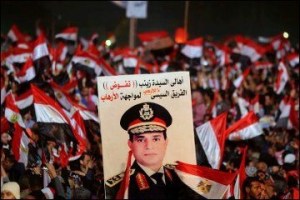
948Pro-Sisi demonstrators celebrate the third anniversary of Mubarak’s overthrow, January 2014.

Last summer he publicly regretted the imprisonment of the three Al Jazeera journalists, saying he wished they had been deported instead. Citing his belief in an independent judiciary, he refused to intervene in the legal process. Now that they are being retried after winning on appeal, we’ll see if he pardons and deports them should they be convicted again.

Gordon: Following, al-Sisi’s ouster of President Morsi and crackdown on Muslim Brotherhood leaders, what has happened to the movement in Egypt?

Stock: Though deservedly banned as a terrorist group, its top leaders in jail and the rest driven underground or abroad, it is far from dead and remains a threat to the Egyptian state and society. Its refusal to accept the June 30 popular revolution (far larger than the one that overthrew Mubarak), parental bonds to Hamas, financial support from Qatar and wealthy Gulf donors (and possibly Iran), partnership with the Salafis and ideological affinity and outreach to groups like al-Qa’ida and Islamic Jihad have served it well in retaining its base while gaining sympathy–especially internationally.

Though all these factors–plus its horrendous behavior in power–have greatly alienated the majority of Egyptians, they are for the most part also its greatest assets for the future, if they can only survive the current storm. As they have shown in several major periods of repression in the past–the most severe being under Abdel-Nasser–they only need to endure until there is successor to al-Sisi, who may decide to restore the MB to political legitimacy as a means of fighting al-Sisi’s remaining political allies. (Anwar al-Sadat, for example, freed the MB activists from prison to combat the surviving members of Abdel-Nasser’s coterie.) Such a situation could put them in striking distance of taking power again.

Meanwhile, the MB has global headquarters in Istanbul and London, is very influential in Europe, and has enormously increased its penetration at the federal, state and local levels all over the US. As part of this, it has deeply bonded with the highest levels of the Obama administration, which uncritically backed its creation of an elected, one-party dictatorship under Morsi. Obama evidently seeks to help the MB to return to power in Egypt—as shown, for example, by the State Department’s recent hosting of a conference of MB allies at Foggy Bottom, though it may take a while. Al-Sisi probably only has a year or two to turn the economy around before he risks another uprising.

The goal of the terrorist insurgency is to discourage foreign investment and stifle the stimulus provided by major government projects such as the new second channel to the Suez Canal to aid the recovery from the last four years of chaos. This, they hope, will pave the way for new popular upheaval which they hope to manipulate if not lead.

Gordon: Has the Islamic State supplanted the Salafist and Muslim Brotherhood movements?

Stock: In a sense, yes, but the situation is actually quite complex. Ideologically, IS—like al-Qa’ida–is an extension of the Salafist movement and the MB (itself established as a Salafi organization in the Salafi library in Ismailiya, Egypt in 1928). IS, because of its uncompromising Islamist purity, harshness, brutality and its dramatic seizure of so much territory in Iraq and Syria, coupled with its incredibly savvy use of social media, has largely eclipsed all of its predecessors in recruitment of fighters to the Middle East. It also outpaced all of them in its creation of lone wolves and sleeper cells in Europe, America and elsewhere.
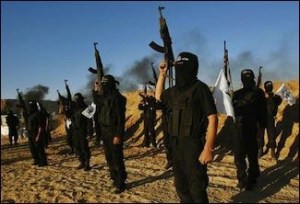
949Ansar Bayt al-Maqdis pledged allegiance to the Islamic State (IS) group last year.

That includes Egypt, where the MB-and-AQ aligned Ansar Bayt al-Maqdis (ABM) organization is responsible for most of the attacks in the country over the past two years. ABM, along with its allies controls much of North Sinai and has declared its allegiance to IS. The MB, as noted, still retains a very strong base, as does the Salafi al-Nour Party which has pragmatically allied itself with Al-Sisi. The appeal of IS may frustrate their ability to draw younger members–yet it is far from clear that IS will do any better in the long run. So have many of the Islamists in Libya, the eastern half of which IS now controls, and may soon run Tripoli as well. The stunning success of IS provides further inspiration to groups like Boko Haram, which has overrun much of northeastern Nigeria and has recently spread into Cameroon, as well as al-Shabaab in Somalia. IS also now has a presence in southern Afghanistan and beyond. Unless it is destroyed militarily in the very near future–which is virtually impossible so long as Obama is President–IS threatens every state with a significant Muslim population, as well as the West, which is its ultimate target.

Gordon: Al-Sisi has propounded a doctrine of stability for Egypt. What is it and has he succeeded since his election?

Stock: I would say that if al-Sisi truly has established such a doctrine for stability, it would consist of the following:

    1. Anti-Islamism—i.e. a more limited role for Shariah (which is nonetheless still enshrined in the new constitution, yet no longer to be interpreted by the clerics at al-Azhar, but by the government, whose authority and much of its outlook is secular, not religious;
    2. Electoral democracy though with somewhat limited civil liberties, to satisfy both the demand for popular sovereignty and for an end to the endless chaos–strikes and demonstrations (and skyrocketing crime) since the fall of Mubarak in 2011, and to limit the public role of the Islamists, who are at war with Egypt; and
    3. An independent foreign policy—one that still seeks to maintain the traditional alliance with the U.S. and the West, but is not afraid to go elsewhere as needed.

Obama’s backing of the Islamists and his cutting of aid for the past two years have driven al-Sisi to radically diversity Egypt’s sources of funding and investment from abroad, including for the first time military aid. For more than three decades, Egypt’s military assistance came almost exclusively from Washington, though that is now being surpassed by multi-billion dollar arms deals from Moscow and even to an extent from Beijing, funded by al-Sisi’s backers in the Gulf. That puts the Egyptian-American alliance and its principal benefits—the more than thirty-five year peace with Israel, our priority access to the Suez Canal (now being expanded with a second channel but without US investment), and vital cooperation on security issues—seriously at risk.

Gordon: Some analysts have said that in the wake of the Arab Spring the old order of regional autocracies has re-emerged in an alliance against the Muslim Brotherhood. What is your view and especially in the case of Egypt’s North African neighborhood?

Stock: That depends on the country: in North Africa, King Mohammed VI is still in power, but the Muslim Brotherhood has won more seats than the other parties in parliament, a situation echoing that in Jordan, though it is less precarious at present. Algeria, still recovering from the savage Islamist bloodbath after the Army’s annulment of elections in January 1992, was least affected of all the states in the region by the Arab Spring. (Perhaps the only major result there was the lifting of the State of Emergency that had prevailed for nearly two decades, in February 2011.) Tunisia, where the Arab Spring began in December 2010, threw out its MB-affiliate controlled government in a popular movement backed by the army—in a situation that rather echoed the one in Egypt, and late last year elected a new secularist plurality in parliament and a new secularist president, Béji Caїd Essebsi.

In Libya, the feeble central government that we helped install by foolishly removing the vicious, eccentric but cooperative Col. Mu’ammar al-Qaddafi has predictably collapsed. Yet a new secularist-dominated government was elected last June 25 and a pro-secularist remnant of the Qaddafi era, General Khalifa Haftar, for the past year has been at war with the Islamist militias that have been the real powers since 2011. Haftar also wants to destroy the Libyan iteration of the Muslim Brotherhood, root and branch, especially after it launched an armed uprising in eastern Libya following Morsi’s ouster in Egypt in 2013. As a result of this chaos, generated by our own needless—or at least, badly botched–intervention in the Arab Spring, the U.S. now has no effective presence in Libya. The security vacuum prompted Egypt and the United Arab Emirates to cooperate in launching air strikes near Tripoli last summer in support of Haftar’s forces. IS and other Islamist organizations are now infiltrating weapons and fighters into Egypt from Libya, threatening the country’s—and the region’s—stability.

In the Eastern Arab world, Egypt’s principal allies now are Saudi Arabia and the UAE, who together immediately pledged 12 billion dollars in aid after Morsi’s removal, and have given billions more since. All of it and more is desperately needed to compensate for the depletion of Egypt’s hard currency reserves, loss of foreign investment and near-destruction of the once lucrative tourist industry that have all continued since the January 25th Revolution against Hosni Mubarak. Both the Saudis and the Emiratis oppose the MB and Hamas, who—along with Egypt under Morsi—are clients of their Gulf rival, Qatar. America’s annual, mainly military package of $1.5 billion seems trifling in comparison (unless viewed cumulatively since it began in 1979). Still, it will be difficult to switch to mainly Russian or Chinese systems–much as the latter may be based on hacked American designs–after so many years of absorbing Yankee equipment and training.

Gordon: What is the emerging change in Egypt’s relations with Israel, both geo-political and economic?

Stock: Unlike Morsi and the MB, who worked covertly with the terrorists in Sinai, al-Sisi wholeheartedly supports the peace with Israel. He has greatly increased security cooperation with the Jewish state—which had been endangered in the 2011-12 transition and during the Morsi era—to levels exceeding those under Mubarak. Again, even more than Mubarak, who loathed them too, al-Sisi sees the MB, Hamas and their Islamist allies as threats to Egypt as well as Israel. Likewise, he sees Iran—with whom Morsi sought a rapprochement—as Egypt’s greatest strategic adversary in the region.

As a result, Egypt is now in an informal alliance with Israel, the United Arab Emirates and Bahrain to confront Iran. That alliance is compromised, however, by recent moves from Egypt’s Gulf partners to mend fences with Iran as a result of their feeling exposed by Washington’s alarming pivot toward Tehran at the expense of its traditional Sunni clients.

Meanwhile, though overall Israel-Egypt trade remains minimal (as it had through the decades of cold peace under Mubarak and afterward), energy-strapped Egypt may soon be importing natural gas from Israel’s newly-developed Tamar Reservoir in the Mediterranean. Given that Israel used to import natural gas from Egypt via a pipeline shared with Jordan (repeatedly sabotaged physically as well as assailed legally in Egypt since the fall of Mubarak), that is a remarkable turnaround indeed.

Gordon: What triggered Qatar’s re-opening of relations with Egypt despite the former’s support of Hamas and the Brotherhood?

Stock: The main factor was probably al-Sisi’s logical desire to stay in step with the policy of Egypt’s current primary foreign donors and investors, the Arab states in the Persian Gulf. After freezing relations with Qatar due to its support for Hamas and the MB, and perhaps also AQ and IS (the latter only early on?), and the universal irritant of Doha-based Al Jazeera, the members of the Gulf Cooperation Council (GCC), especially Saudi Arabia and the United Arab Emirates, decided last summer to repair the rift, apparently in face of the increasing U.S. tilt toward Iran. The U.S. tried to bypass al-Sisi by turning to Qatar and Turkey—both of whom Cairo had shunned for their support of Islamists and their criticism of Morsi’s ouster—as intermediaries with Hamas in the Gaza conflict last summer.

Ironically, that move may have done more to damage relations with Washington than with either Doha or Ankara, who probably could not be totally excluded in any case, given their closeness to Hamas. Yet those two regional rival countries’ desire to cut out Cairo, the historic mediator between the Palestinians, Israel and the West, did aggravate the Egyptians enormously, to be sure.

Qatar has taken some token steps to distance itself from the MB, like deporting several MB leaders who had taken refuge there. But Qatar apparently continues to finance them in their new home in London, and few believe the change is more than cosmetic. Thus the warming with Egypt and even within the GCC may not long endure.

Gordon: Why has the US Administration maintained an arm’s length relationship with al-Sisi subsequent to the ouster of Morsi?

Stock: It is no doubt due to Obama’s leftist, rather Edward-Saidian worldview, which sees indigenous anti-Western forces such as the Islamists to be the benignly natural and legitimate consequence of American and European policies during the colonial era and the Cold War—for which he has apologized repeatedly. He also has a positive, nostalgic view of Islam, given that he was born of a Muslim father and having apparently been raised as one by his step-father during his early childhood in Indonesia, and seems to project this image onto radical groups like the MB who cleverly pose as moderates. He is thus surrounded by numerous pro-Islamist advisers, as well as those who simply take a naïve view of groups like the MB, Hamas and Hizbollah–and even the Taliban (not a new position, but one now getting attention in the news).

It also means that he denies the common Islamist ideology of all those groups as well as AQ and IS, or even any connection of their beliefs to Islam. This, despite their being made up entirely of Muslims, that they base their ideology and tactics on the Qur’an, Hadith and other key Islamic texts, and that they have a very wide appeal in the global Islamic community. This is even more bizarre if you compare his statements and those of his aides about this question to those of al-Sisi—a Muslim leader of a majority Muslim country—at the seat of Sunni Islam’s highest authority, al-Azhar, on New Year’s Day. One of them, Obama, is willfully blind; the other, al-Sisi, with devastating clarity, identifies the problem as coming from within the very heart of Islam.

On a personal level, Obama does not take kindly to those who cross him. Just look at his relationship with Congress, and with Benjamin Netanyahu, while ignoring his own transgressions against those he thinks are transgressing against him. He regarded al-Sisi’s patriotic overthrow of Morsi–whom he had bolstered with more and more aid even as the MB leader became more and dictatorial–at the demand of more than twice as many Egyptians as those who voted for Morsi, as a personal affront as well as ideological heresy. He has since punished al-Sisi and the Egyptian people who rejected his chosen savior of their destiny accordingly. That may have softened a bit recently, due to the need to find Arab allies to fight IS, but that is not a serious effort: the default position is against al-Sisi and for the MB.

Gordon: Given your Egyptian sojourn does al-Sisi have both the domestic and international support to implement his agenda?

Stock: Domestic, yes—all but a quarter to a third of the country wants him to succeed. But internationally is another story. Al-Sisi’s greatest enemy is not the MB, or even IS, but the president of the United States. When the State Department invited key figures from the pro-MB alliance of groups to a major conference in Washington this week, he was signaling his desire (and only Obama sets our foreign policy) to overthrow al-Sisi—just as his invitation to the leaders from the banned MB to sit in the front row of his Cairo speech in 2009 signaled that he wanted to remove Mubarak. So U.S.-dependent international institutions and allies may not be too supportive of al-Sisi.

The only possible silver lining for Egypt is, ironically (given our historic alliance), really a great problem for our country, if one values its role of global leadership since World War II. That is, Obama has done so much to destroy America’s standing with the rest of the world that even our closest allies no longer fear to stray, and may yet not follow his wishes regarding al-Sisi. Tragically, on many issues, that may be better for us all until Obama leaves office. For the heading he has set leads directly to hell, a destination that many countries, thanks to in large part to his policies, have already seen (and Syria and Libya have already become)–good intentions (by his lights) notwithstanding.

Gordon: Dr. Stock many thanks for this highly informative interview.

Stock: You’re most welcome.
Russian Defense Minister in Iran for Arms Pact Talks

January 20, 2015

Russian Defense Minister in Iran for Arms Pact Talks, Washington Free Beacon, January 20, 2015

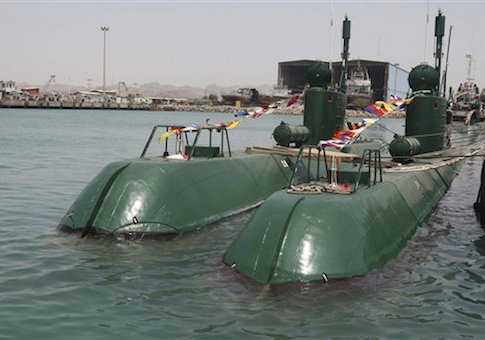
Mideast Iran Nuclear TalksIran’s Ghadir submarines / AP

Iran and Russia have been strengthening their military ties for quite some time. Moscow is largely responsible for Iran’s nuclear infrastructure and has provided the Islamic Republic with much of its missile arsenal.

“So long as we have an administration that’s not inclined to do anything in response, they’re going to keep it up. They’re going to speed ahead.”

***********************

Russian Defense Minister Sergei Shoigu is in Iran for high-level talks with Supreme Leader Ali Khamenei about boosting Tehran’s supply of submarines, torpedoes, and sea-based cruise missiles, according to Russian media reports and sources familiar with details of the talks.

Shoigu, whose trip is being kept quiet with few details being released publicly, landed in Tehran on Monday to talk with Iranian leaders about “increasing defense cooperation and arms trade with the Islamic republic,” the Moscow Times reported.

The talks will focus on Iran’s desire to purchase from Russia a slew of advanced military hardware that would significantly boost Tehran’s sea power, particularly in the Gulf of Oman, according to one source familiar with the substance of the talks.

The arms deal talks also come a day after Iranian military leaders claimed that they have the ability to sink U.S. aircraft carriers.

Iran and Russia have been strengthening their military ties for quite some time. Moscow is largely responsible for Iran’s nuclear infrastructure and has provided the Islamic Republic with much of its missile arsenal.

The latest talks are a sign that both countries aim to maintain the relationship, particularly as Russia helps Iran build several new nuclear reactors in the southern portion of the country.

“Iran gets a lot of military advice and missile equipment from the Russians,” said Michael Ledeen, an Iran expert and former consultant to the National Security Council (NSC), State Department, and Defense Department.

However, “the bulk of that stuff nowadays seems to have to do with sea power, and it’s delivered across the Caspian Sea,” said Ledeen, who has been in contact with Iranian sources familiar with the latest negotiations with Russia.

Iran is seeking to fortify its military edge in the Gulf of Oman and could employ Russian-made missiles as a deterrent to the United States and other nations present there.

In meetings with Khamenei and other Iranian leaders, Russia’s Shoigu is likely to discuss arming Tehran with new submarines, torpedoes, cruise missiles, and sea-to-sea arms, according to Ledeen, a freedom scholar for the Foundation for Defense of Democracies.

“Those are the things the Russians and Iranians will be talking about, and it’s obviously a very important meeting because [Shoigu] is scheduled to see Khamenei himself,” Ledeen said.

These talks are “very important” to both Moscow and Tehran as they seek to bolster their alliance.

“After all,” said Ledeen, “the Iranian nuclear program is basically a Russian program: Russian reactors, Russian equipment. They’re the ones who make it all possible. So Iranian military power is heavily dependent on Russia technology, Russian advisers, and Russian counsel.”

Iranian President Hassan Rouhani announced last week that Iran has begun construction on two new nuclear reactors with Russia’s assistance.

Following the announcement, the U.S. State Department told the Washington Free Beacon that Iran is permitted to pursue these nuclear reactors under the terms of an interim nuclear deal meant to curb Iran’s contested program.

The State Department’s revelation elicited harsh criticism on Capitol Hill and from other proponents of a tougher U.S. stance against Iran’s nuclear program.

Meanwhile, Iranian naval commander Ali Fadavi, a member of Iran’s Revolutionary Guard Corps (IRGC), bragged that Tehran has the ability to sink U.S. aircraft carriers.

“The U.S. military officials have admitted in their remarks that they have spent $13 [billion] for building aircraft carriers, but the IRCG can sink it with its speed boats,” Fadavi claimed.

Ledeen said these comments speak directly to Iran’s desire to boost their power in the sea.

“Their long term objective is to destroy us, and they say that all the time,” he said. “So long as we have an administration that’s not inclined to do anything in response, they’re going to keep it up. They’re going to speed ahead.”