Archive for the ‘Russia – Syrian war’ category

Russia deploys advanced anti-missile system to Syria for first time, US officials say

October 4, 2016

Russia deploys advanced anti-missile system to Syria for first time, US officials say, Fox News, October 3, 2016

The SA-23 can fire two different types of missiles. A smaller missile is used against aircraft and cruise missiles and is known by NATO as Gladiator. The larger missile is used against intermediate-range ballistic missiles and jamming aircraft and is known as Giant. Both missiles use the same type of warhead containing over 300 pounds of explosives, according to military-today.com.

**********************

EXCLUSIVE: Russia has deployed an advanced anti-missile system to Syria for the first time, three US officials tell Fox News, the latest indication that Moscow continues to ramp up its military operations in Syria in support of President Bashar al-Assad.

It comes after Russia’s actions led to the collapse of a cease-fire and the cut-off of direct talks with the U.S.

While Moscow’s motives are not certain, officials say the new weapon system could potentially counter any American cruise missile attack in Syria.

Components of the SA-23 Gladiator anti-missile and anti-aircraft system, which has a range of roughly 150 miles, arrived over the weekend “on the docks” of a Russian naval base along Syria’s Mediterranean coastal city of Tartus, two US officials said.

It is the first time Russia has deployed the SA-23 system outside its borders, according to one Western official citing a recent intelligence assessment. The missiles and associated components are still in their crates and are not yet operational, according to the officials.

The U.S. intelligence community has been observing the shipment of the SA-23 inside Russia in recent weeks, according to one official.

While the purpose is not clear, one US official asked sarcastically, “Nusra doesn’t have an air force do they?” speaking about the Al Qaeda-linked group in Syria.  The Islamic State also does not fly any manned aircraft or possess cruise missiles, in a sign that Russia is directing its actions to protect itself against any potential attack from the United States or its allies.

The SA-23 can fire two different types of missiles. A smaller missile is used against aircraft and cruise missiles and is known by NATO as Gladiator. The larger missile is used against intermediate-range ballistic missiles and jamming aircraft and is known as Giant. Both missiles use the same type of warhead containing over 300 pounds of explosives, according to military-today.com.

Three years ago, President Obama weighed military action against the Assad regime’s chemical weapons facilities as well as airbases housing the regime’s attack helicopters and jets. US Navy ships in the eastern Mediterranean were prepared to launch Tomahawk cruise missiles in a limited strike to cripple the regime.

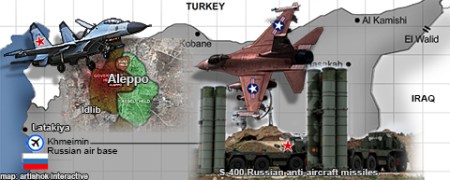
Russia deployed a separate air defense system, the S-400, to Syria after a Russian jet was shot down by a Turkish warplane last November.  Since the S-400 deployment, the U.S. military has been careful about flying  manned aircraft inside the range of the system, despite repeated pledges by the US military that its airstrikes in Syria are focused on ISIS, not the Assad regime.

Monday, the Pentagon announced it conducted an airstrike potentially killing a “prominent” al-Qaeda linked operative in Syria.  Officials said they were still assessing the strike and have not released the name of their target.

Hours after the State Department announced it was cutting off talks with Moscow, President Vladimir Putin said he had suspended a Russia-U.S. deal on the disposal of weapons-grade plutonium. Putin’s decree released by the Kremlin cited Washington’s “unfriendly actions.”

Top US officials have recently accused Russia and the Syrian regime of indiscriminant bombing in Syria using incendiary and bunker busting bombs on civilians. Two weeks ago, a UN aid convoy was bombed, killing dozens of aid workers attempting to deliver critical supplies to the more than 200,000 Aleppo residents trapped inside the eastern portion of the city, once Syria’s most populated. In the past week, hundreds of civilians, including children, have been killed, according to local reports.

Russia began its air campaign in Syria on Sept. 30, 2015 following a weeks-long buildup of fighter jets and attack aircraft.  Long-range bombers flying from Russia and Iran have also been used to attack Syrian rebels, some backed by the United States.

Days after Russian bombs started falling in Syria, President Obama predicted that Russia and Iran would find themselves mired in a “quagmire.”

“[A]n attempt by Russia and Iran to prop up Assad and try to pacify the population is just going to get them stuck in a quagmire. And it won’t work,” he told reporters in a White House press conference on Oct. 2, 2015.

On Friday, the one-year anniversary of the Russian strikes, the State Department acknowledged that Russia had succeeded in its goal of propping up the Assad regime.

“It is a grim anniversary…It is hard not to assess that they have succeeded in bolstering the regime,” said Mark Toner, a State Dept. spokesman.

US, Russia on brink of military showdown in Syria

September 30, 2016

US, Russia on brink of military showdown in Syria, DEBKAfile, September 30, 2016

5-3

The fact that President Obama instituted a secret inquiry to discover which link in the American chain of command ordered the attack pointed to his suspicion that a high-up in the Pentagon or possibly the CIA, had ordered the air strike, in order to sabotage the US-Russian military cooperation deal in Syria, which Secretary Kerry obtained after long and arduous toil.

The concessions he made to Russian Foreign Minister Lavrov in those negotiations, especially his consent for extensive sharing of intelligence, were found totally unacceptable in the US Defense Department, its military and intelligence community.

********************************

There is a sense in Washington and Moscow alike that a military showdown between the US and Russia is inevitable – direct this time, not through proxies, like the downing of a Russian warplane by Turkish jets last year. When the big powers are in direct confrontation, minor players step aside and run for cover.

When President Barack Obama Friday, Sept. 30 attended the funeral in Jerusalem of the Israeli leader Shimon Peres, he must have realized he was only 514km as the crow flies from Aleppo, the raging crux of the escalating big-power conflict.

The moment after the ceremonies ended the president and his party, including Secretary of State John Kerry and his security adviser Susan Rice, made haste to head back to Washington to navigate the crisis.

The first step toward a direct showdown was taken by the United States.

By now, it is no secret in Moscow, or indeed in any Middle East capital, that the American A-10 air strike of Sept. 17 against a Syrian military position at Jebel Tudar in the Deir ez-Zour region of eastern Syria was intentional, not accidental, as originally claimed. Scores of Syrian soldiers died in the attack.

The fact that President Obama instituted a secret inquiry to discover which link in the American chain of command ordered the attack pointed to his suspicion that a high-up in the Pentagon or possibly the CIA, had ordered the air strike, in order to sabotage the US-Russian military cooperation deal in Syria, which Secretary Kerry obtained after long and arduous toil.

The concessions he made to Russian Foreign Minister Lavrov in those negotiations, especially his consent for extensive sharing of intelligence, were found totally unacceptable in the US Defense Department, its military and intelligence community.

uspalnvsrussian480

The Russian-Syrian reprisal came two days after the A-10 strike. On Sept. 19, an emergency aid convoy was obliterated on its way to the desperate population of Aleppo. Moscow and Damascus denied responsibility for the deadly bombardment, but no other air force was present in the sky over the embattled city.

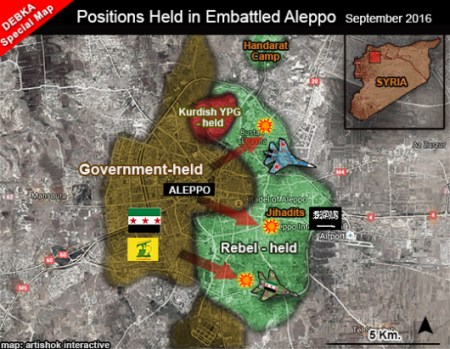
On the ground, meanwhile, an unbridled onslaught on rebel-held eastern Aleppo was launched Wednesday by the Russians, Syria, Hizballah and pro-Iranian Shiite militias under the command of Iranian Revolutionary Guards officers.

The fall of Aleppo, Syria’s second city after Damascus, would give Bashar Assad his most resounding victory in the nearly six-year civil war against his regime.

On Sept. 29, Kerry threatened Moscow that “the United States would suspend plans to coordinate anti-Islamic State counter-terrorism efforts if Moscow does not stop attacking Aleppo.”

Russia’s Deputy Foreign Minister Sergey Ryabkov answered with a sneering: “Once again there was a certain emotional breakdown yesterday against the backdrop of the Obama administration’s unwillingness to fulfill its part of the agreements.”

This was a strong hint of the knowledge in the Kremlin that someone in the US administration was holding out against the implementation in full of the cooperation deal agreed upon and was therefore responsible for its breakdown.

The United States is left with two options:

Either stand idly by in the face of the Russian-Syrian-Iranian onslaught on Aleppo, or shelve the coordination arrangements for US and Russian air operations in Syria, with the inevitable risk of a clash in the air space of Syria or over the eastern Mediterranean.

Column One: The New Middle East

September 29, 2016

Column One: The New Middle East, Jerusalem PostCaroline B. Glick, September 29, 2016

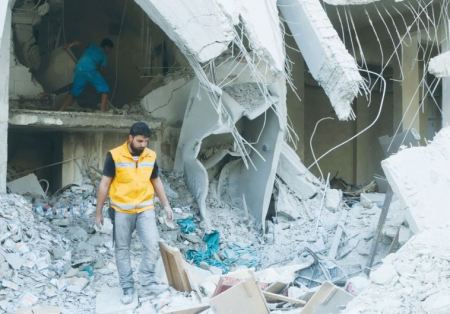
aleppo-messA RED CRESCENT aid worker inspects scattered medical supplies after an air strike on a medical depot in Aleppo on Saturday.. (photo credit:REUTERS)

So Obama let Syria burn. He let Iran and Hezbollah transform the country into their colony. And he let Putin transform the Mediterranean into a Russian lake.

A new Syria is emerging. And with it, a new Middle East and world are presenting themselves. Our new world is not a peaceful or stable one. It is a harsh place.

The new Syria is being born in the rubble of Aleppo.

The eastern side of the city, which has been under the control of US-supported rebel groups since 2012, is being bombed into the Stone Age by Russian and Syrian aircraft.

All avenues of escape have been blocked. A UN aid convoy was bombed in violation of a fantasy cease-fire.

Medical facilities and personnel are being targeted by Russia and Syrian missiles and barrel bombs to make survival impossible.

It is hard to assess how long the siege of eastern Aleppo by Russia, its Iranian and Hezbollah partners and its Syrian regime puppet will last. But what is an all but foregone conclusion now is that eastern Aleppo will fall. And with its fall, the Russian-Iranian-Hezbollah-Assad axis will consolidate its control over all of western Syria.

For four years, the Iranians, Hezbollah and Bashar Assad played a cat and mouse game with the rebel militias.

Fighting a guerrilla war with the help of the Sunni population, the anti-regime militias were able to fight from and hide from within the civilian population. Consequently, they were all but impossible to defeat.

When Russian President Vladimir Putin agreed to join the fight, he and his generals soon recognized that this manner of fighting ensured perpetual war. So they changed tactics. The new strategy involves speeding up the depopulation and ethnic cleansing of rebel-held areas. The massive refugee flows from Syria over the past year are a testament to the success of the barbaric war plan. The idea is to defeat the rebel forces by to destroying the sheltering civilian populations.

Since the Syrian war began some five years ago, half of the pre-war population of 23 million has been displaced.

Sunnis, who before the war comprised 75% of the population, are being targeted for death and exile. More than 4 million predominantly Sunni Syrians are living in Turkey, Lebanon and Jordan. More than a million have entered Europe. Millions more have been internally displaced. Assad has made clear that they will never be coming home.

At the same time, the regime and its Iranian and Hezbollah masters have been importing Shi’ites from Iran, Iraq and beyond. The process actually began before the war started. In the lead-up to the war some half million Shi’ites reportedly relocated to Syria from surrounding countries.

This means that at least as far as western Syria is concerned, once Aleppo is destroyed, and the 250,000 civilians trapped in the eastern part of what was once Syria’s commercial capital are forced from their homes and property, the Russians, Iranians, Hezbollah and their Syrian fig leaf Assad will enjoy relative peace in their areas of control.

By adopting a strategy of total war, Putin has ensured that far from becoming the quagmire that President Barack Obama warned him Syria would become, the war in Syria has instead become a means to transform Russia into the dominant superpower in the Mediterranean, at the US’s expense.

In exchange for saving Assad’s neck and enabling Iran and Hezbollah to control Syria, Russia has received the capacity to successfully challenge US power. Last month Putin brought an agreement with Assad before the Duma for ratification. The agreement permits – indeed invites – Russia to set up a permanent air base in Khmeimim, outside the civilian airport in Latakia.

Russian politicians, media and security experts have boasted that the base will be able to check the power of the US Navy’s Sixth Fleet and challenge NATO’s southern flank in the Mediterranean basin for the first time. The Russians have also decided to turn their naval station at Tartus into something approaching a fullscale naval base.

With Russia’s recent rapprochement with Turkish President Recip Erdogan, NATO’s future ability to check Russian power through the Incirlik air base is in question.

Even Israel’s ability to permit the US access to its air bases is no longer assured. Russia has deployed air assets to Syria that have canceled Israel’s regional air superiority.

Under these circumstances, in a hypothetical Russian-US confrontation, Israel may be unwilling to risk Russian retaliation for a decision to permit the US to use its air bases against Russia.

America’s loss of control over the eastern Mediterranean is a self-induced disaster.

For four years, as Putin stood on the sidelines and hedged his bets, Obama did nothing. As Iran and Hezbollah devoted massive financial and military assets to maintaining their puppet Assad in power, the Obama administration squandered chance after chance to bring down the regime and stem Iran’s regional imperial advance.

For his refusal to take action when such action could have easily been taken, Obama shares the responsibility for what Syria has become. This state of affairs is all the more infuriating because the hard truth is that it wouldn’t have been hard for the US to defeat the Iranian- Hezbollah axis. The fact that even without US help the anti-regime forces managed to hold on for four years shows how weak the challenge posed by Iran and Hezbollah actually was.

Russia only went into Syria when Putin was absolutely convinced that Obama would do nothing to stop him from dislodging America as the premier global power in the region.

As Michael Ledeen recalled earlier this week, Obama chose to stand on the sidelines in Syria because he wanted to make friends with Iran. Obama began his secret courtship of the mullahs even before he officially took office eight years ago.

After the war broke out in Syria, midway through his first term and in the following years, the Russians and the Iranians told the obsessed American president that if he took action against Assad, as strategic rationality dictated, he would get no nuclear deal, and no rapprochement with Tehran.

So Obama let Syria burn. He let Iran and Hezbollah transform the country into their colony. And he let Putin transform the Mediterranean into a Russian lake. Obama enabled the ethnic cleansing of Syria’s Sunni majority, and in turn facilitated the refugee crisis that is changing the face not only of the Middle East but of Europe as well.

And as it turns out, the deal with Iran that Obama willingly sacrificed US control of the Mediterranean to achieve has not ushered in a new era of regional moderation and stability through appeasement as Obama foresaw. It has weakened US credibility with its spurned Sunni allies. It has undermined the strategic position of Israel, the US’s only stable and reliable regional ally. It has financially and strategically fueled Iran’s hegemonic rise throughout the region. And it has facilitated Iran’s development of a nuclear arsenal.

Far from causing the Iranian to become more moderate, the nuclear deal has radicalized the regime still further.

On Wednesday Ray Takeyh wrote in The Washington Post that Supreme Leader Ali Khamenei is now grooming Ibrahim Raisi, a fanatic who makes Khamenei look moderate, to succeed him in power.

On Monday night, for the first time, Israel Air Force jets flying over Syria were shot at by Syrian anti-aircraft ordnance.

Air force sources told the media that the aircraft were never in danger and the munitions were only shot off after the aircraft had returned to Israel and were in the process off landing.

The fact that no one was hurt is of course reassuring.

But the fact that Russia targeted the planes makes clear that Putin has decided to send Israel a very clear and menacing message.

He is now the protector of the Iranian-Hezbollah colony on our northern border. If Israel decides to preemptively attack targets belong to that colony, Russia will not stand by and watch. And with the US no longer well-positioned to challenge Russian power in the region, Israel will have to deal with Russia on its own.

To face this challenge, Israel needs to look beyond its traditional reliance on air power.

There are two parts of the challenge. The first part is Iran.

As far as Israel is concerned, the problem with the Russian- Iranian takeover of Syria is not Putin.

Putin is not inherently hostile to Israel, as his Soviet predecessors were. He is an opportunist. Obama gave him the opportunity to partner with Iran in asserting Russian dominance in the Middle East and he took it. Israel is threatened by the alliance because it is threatened by Iran, not by Putin. To neutralize the alliance’s threat to its own security, Israel then needs to degrade Iran’s power, and it needs to emphasize its own.

To accomplish these goals, Israel needs to operate in two completely separate arenas. To weaken Iran, Israel should take its cue from Iran’s Revolutionary Guard Corps, and from its own past successful military ties to the Kurds of Iraq in the 1960s and 1970s.

Israel needs to deploy military trainers beyond its borders to work with other anti-Iranian forces. The goal of that cooperation must be to destabilize the regime, with the goal of overthrowing it. This may take time. But it must be done. The only way to neutralize the threat emanating from the new Syria is to change the nature of the Iranian regime that controls it.

As for Russia, Israel needs to demonstrate that it is a power that Putin can respect in its own right, and not a downgraded Washington’s sock puppet.

To this end, Israel should embark on a rapid expansion of its civilian presence along its eastern border with Syria and with Jordan. As Russia’s air base in Syria undermines Israel’s air superiority and reliance on air power, Israel needs to show that it will not be dislodged or allow its own territory to be threatened in any way. By doubling the Israeli population on the Golan Heights within five years, and vastly expanding its population in the Jordan Valley, Israel will accomplish two goals at once. It will demonstrate its independence from the US without harming US strategic interests. And it will reinforce its eastern border against expanded strategic threats from both the Golan Heights and the new Jordan with its bursting population of Syrian and Iraqi refugees.

It is ironic that the new Middle East is coming into focus as Shimon Peres, the failed visionary of a fantasy- based new Middle East, is being laid to rest. But to survive in the real new Middle East, Israel must bury Peres’s belief that peace is built by appeasing enemies along with him. The world in which we live has a place for dreamers.

But dreams, unhinged from reality, lead to Aleppo, not to peace.
Obama’s Syria Policy Explained

September 26, 2016

Obama’s Syria Policy Explained, Power Line, Paul Mirengoff, September 26, 2016

It seems likely that Obama welcomed Russia’s direct intervention since (1) it served Iran’s interests and (2) made it much easier for Obama to defend not taking military action. Indeed, Obama sees Russia as a partner in Syria.

*********************************

In writing about the pathetic efforts of John Kerry to arrange a cease fire in Syria, I’ve referred to the Secretary of State as the village idiot. But what about President Obama?

Though his intellect may be overrated, he’s anything but an idiot. Obama is, instead, a clever operator who often thinks several moves ahead of his domestic, though not his foreign, adversaries.

Why, then, has U.S. policy paved the way for Assad’s revival, Iranian and Russian success in Syria, and the massacre of up to half a million Syrians?

I’ve come to believe that the answer lies in the Iran nuclear deal. I base this view in part on the great reporting of Jay Solomon for the Wall Street Journal.

For example, Solomon revealed that in 2013, Iran told Obama that if he were to strike the regime of Bashar Assad following the latter’s chemical-weapons attack, the Iranians would end the talks over their nuclear program. Obama duly canceled the strike and later reassured Iran that the United States would not touch Assad.

In my view, Obama’s priority from Day One has been to negotiate a nuclear deal with the mullahs and use the deal as a springboard to a kind of alliance with the their regime under which Iran would “stabilize” the region and the U.S. would basically exit. This desire best explains why Obama’s Syria policy serves Iran’s interests.

My view finds powerful support in a piece in Tablet by Tony Badran of the Federation for Defense of Democracies. Having read Badrad’s piece, it seems to me that the pro-Iran tilt manifested in Obama’s Syria policy is even more pronounced than I had suspected.

Badran states his thesis this way:

America’s settled policy of standing by while half a million Syrians have been killed, millions have become refugees, and large swaths of their country have been reduced to rubble is not a simple “mistake,” as critics like Nicholas D. Kristof and Roger Cohen have lately claimed. Nor is it the product of any deeper-seated American impotence or of Vladimir Putin’s more recent aggressions.

Rather, it is a byproduct of America’s overriding desire to clinch a nuclear deal with Iran, which was meant to allow America to permanently remove itself from a war footing with that country and to shed its old allies and entanglements in the Middle East, which might also draw us into war. By allowing Iran and its allies to kill Syrians with impunity, America could demonstrate the corresponding firmness of its resolve to let Iran protect what President Barack Obama called its “equities” in Syria, which are every bit as important to Iran as pallets of cash.

Obama’s intentions should have been evident from the beginning. After all, as Badran points out, “if Obama purposefully took the Iranian regime’s side during the 2009 protests so as not to upset the prospect of rapprochement, he similarly wasn’t about to commit the United States against Iran’s longest-standing strategic ally, Assad.”

But Obama did a great job of masking his pro-Assad tilt and confusing none-too-bright media. Badran writes:

[B]y 2012, criticism of the administration’s policy had grown more vocal, and calls rose to give military support to the Syrian opposition, a proposition the president was always opposed to. As this was a fixed position for Obama, the task before the White House was, therefore, one of public relations—to quiet the calls for supporting the opposition, outside and also within the administration, without doing anything that would actually upset Assad and his patrons in Iran.

Messaging, as always, was of paramount importance to the White House. As the Wall Street Journal reported in early 2013, “White House national security meetings on Syria [in 2012] focused on what participants called ‘strategic messaging,’ how administration policy should be presented to the public.” To that end, the administration started putting out targeted talking points. The administration laid down its now-infamous mantra: There is no military solution in Syria.

Unfortunately, Assad, Iran, and Russia did not share this view — as Obama knew. Thanks to U.S. policy, Assad, Iran, and Russia appear to be right.

Not content with the “no military solution” mantra, Obama added argument that he wanted to avoid “further militarization” of the situation in Syria. Thus Jay Carney stated:

We do not believe that militarization, further militarization of the situation in Syria at this point is the right course of action. We believe that it would lead to greater chaos, greater carnage.

In light of subsequent developments, this statement is obscene, but it was always ridiculous. A no-fly zone would have prevented much of the carnage — and presumably virtually all of carnage rained down from the air — that has occurred since Carney spoke this rubbish several years ago.

But a no-fly zone would have thwarted Iran’s ambitions. Thus, argues Bedran, it was always a non-starter for Obama.

Russia’s presence in the air over Syria provided Obama with an excuse for rejecting a no-fly zone. But, as Bedran says, the administration had firmly rejected such action for years before the Russians were anywhere near Syria.

It seems likely that Obama welcomed Russia’s direct intervention since (1) it served Iran’s interests and (2) made it much easier for Obama to defend not taking military action. Indeed, Obama sees Russia as a partner in Syria. According to Bedran, “partnership with Russia is what the White House has sought after since late 2015 and throughout 2016 —with [Robert] Malley as the point man, negotiating directly with the Kremlin’s special envoy. Malley, by the way, is virulently anti-Israel.

The cynicism of Obama’s pronouncements on Syria — his “strip tease” as Bedran calls it — is encapsulated by what he and his team have said about Russian intervention in Syria. Initially, the administration’s line was that Russia had made a tragic mistake by becoming involved in a quagmire (never mind that, as we pointed out at the time, its military involvement was limited almost entirely to air strikes). Now, Team Obama argues that Russia holds all the cards in Syria and that our only option is to work with the Kremlim.

Russia and Iran hold all the cards because Obama allowed them to. Bedran makes a strong case that Obama allowed them to because because he wants Iran to prevail.

One might admire the elegance of Obama’s “strip tease,” if not for the demise of hundreds of thousands of Syrians and the triumph of our arch-enemy in Tehran.

Rockets on Golan, Pentagon flouts Obama, no truce

September 18, 2016

Rockets on Golan, Pentagon flouts Obama, no truce, DEBKAfile, September 17, 2016


syria_golankipat

The Pentagon and US army are not following the orders of their Commander-in-Chief Barack Obama in the execution of the military cooperation accord in Syria concluded by US Secretary of State John Kerry and Russian Foreign Minister Sergei Lavrov in Geneva on Sept. 12.

Five days after the truce they agreed would go into effect Monday, fighting was still raging Saturday, Sept. 17.

DEBKAfile was the only Western publication to foresee this eventuality in an article published on July 18.

It was already evident then that any military cooperation agreement between the two powers would be contingent on America exposing its intelligence-gathering methods to Russia – not just in Syria but worldwide.

As our military sources predicted, this new intelligence sharing arrangement would necessarily extend to the Syrian Air Force as a third partner.

In advance of the deal, Moscow deployed its aircraft carrier, the Admiral Kutzenov, post haste to Syrian waters, to make sure that the Joint Implementation Center set up by the Kerry-Lavrov deal for intelligence-sharing would also apply to the warplanes and cruise missiles on the carrier’s decks and its escort of missile cruisers.

This deal was perceived in Moscow as an opportunity to study the combat methods and tactics practiced by the US Navy and Air force in real battlefield conditions.

But this eventuality was far from the intentions of US security and intelligence chiefs at a time of deepening adversity between Washington and Moscow.

The remarks of State Department spokesman Mark Toner on Thursday, Sept. 5 hinted at these conflicting perceptions: “I don’t think anyone in the US government is necessarily taking at face value Russia’s – or certainly not the Syrian regime’s – commitment to this arrangement.” He went on to say: “What really matters here is that the president of the United States supports this agreement, and our system of government works in such a way that everyone follows what the president says.”

Is that really so?

The fact that Kerry’s spokesman found it necessary to emphasize that “everyone follows what the president says,” strongly indicated that not everyone in Washington was in fact obeying the president.

Such disobedience is almost unheard of and would never be admitted publicly. In this case, it is being kept carefully under wraps.

Defense Secretary Ashton Carter and Chairman of the US Chiefs of Staff Gen. Joseph F. Dunford will never on any account admit that, in the execution of military collaboration with Russia in the Syrian conflict, they are not exactly carrying out the president’s precise instructions.

syrianceasefire480

But Washington sources report that Defense Secretary Carter maintains that he can’t act against a law enacted by Congress. He was referring to the law that prohibits all military-to-military relations with Russia as a result of Moscow’s annexation of the Crimea region of Ukraine.

According to DEBKAfile’s military sources, they are simply dragging their feet in ground operations. This is driving Vladimir Putin and his generals into fits of rage.

Friday, Sept 16, Lavrov accused the US of “stalling on its promise to separate moderate rebel groups in Syria from terrorists,” adding, “US progress in delivering on the promise is slow.”

Saturday, Putin himself burst out that the rebels were “regrouping under the ceasefire.” He put the blame on those “rebels” for the failure of the agreed truce to take effect after five days.

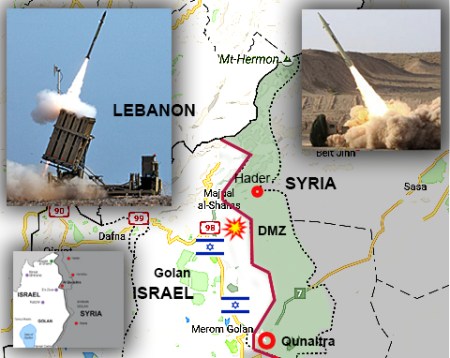
Our military and intelligence sources see a connection between Putin’s angry outburst and the rising tensions on the Syrian-Israeli border in the past week, culminating in the two Syrian rockets that were shot down Saturday over the Golan by Israel’s Iron Dome batteries.

For some time, the Russians and Syrians have made no bones about their objection to Israel’s policy of supporting a motley assortment of Syrian rebel groups in southern Syria close to its border. Among these groups is Al Qaeda’s Syrian arm Jabhat Al-Nusra (the Nusra Front) that has renamed itself Jahat Fath Al-Sham.

Whatever Assad, Iran or Hizballah may accept or reject, President Putin utterly refuses to tolerate Israel allowing the Nusra Front to control parts of this border sector.

Therefore, the rockets and missiles apparently “straying” across the border onto the Golan may well multiply in the coming days.

Yet another complication raised its head over the weekend when the US-backed rebel militia, the Free Syrian Army, vented its fury over the Kerry-Lavrov truce deal by driving away American Special Operations troops helping them in the battle for Al-Rai and abusing them as “infidels.”

The US blames the Russian leader for failing to force Bashar Assad to hold his fire and to let emergency supplies reach the beleaguered population in Aleppo, thereby undermining their ceasefire accord.

But it is becoming evident that the brutal standoff in Syria will be sustained until Putin is satisfied that the US is cooperating with Russian forces in Syria and the Mediterranean region in all spheres.

Before he decides to lean hard on Assad to cease hostilities, he will want to see the White House twisting the arms of the Pentagon and US forces to play ball in the most sensitive spheres.

Russia: Dissolve US-Arab-Israeli Syria war room

September 12, 2016

Russia: Dissolve US-Arab-Israeli Syria war room, DEBKAfile, September 12, 2016

jordan_mifkada480

In another move to grab control of the Syrian arena, the Kremlin marked the start of the US-Russian brokered ceasefire in Syria on Sept 12 with a push for the United States to dissolve the war room that has been running anti-Assad operations from a venue north of the Jordanian capital Amman. DEBKAfile’s military and intelligence sources report that the demand was handed down from the Russian presidential office and Defense Minister Sergei Shoigu.

The US Central Command Forward Command in Jordan has for three years run the command and communications functions of select rebel ground operations against Bashar Assad, especially insofar as US special operations units and air force were involved.

Jordanian, Saudi, Israeli, Qatari and United Arab Emirates officers serve alongside American commanders.

This forward command has evolved, according to our sources, into the nerve center of the military campaigns waged by this coalition against the Syrian army and its allies in southern Syria and also against the Islamic State in southeastern Syria and parts of western Iraq.

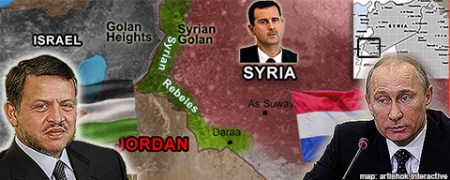
In January 2016, President Vladimir Putin had the Saudis talk King Abdullah into establishing a Russian-Jordanian forward command outside Amman alongside the American war room. His pretext was the necessity to avert accidental collisions between the Russian and Jordanian warplanes operating in Syrian air space.

But over the past months, the Russian-led command center has gradually nudged the US war room into an inferior role in the control of ongoing operations.

Last week, in the course of the marathon talks on a Syrian truce held by US Secretary of State John Kelly and Russian Foreign Minister Sergei Lavrov in Geneva, the American delegation was suddenly confronted with a demand to shut down the Centcom forward command in Jordan and reassign the US officers staffing it to the Russian-Jordanian command center.

Although taken aback, the US delegation in Geneva did not immediately reject the demand, but agreed to give it due consideration provided that the 10-day truce in Syria holds up and can be extended.

If President Barack Obama submits to Moscow’s demand, our sources point out, it would mean curtains for Israeli, Saudi, Qatar and Emirate officers participation in the Amman command. They would be sent home and their governments would find themselves out in the cold in relation to coordinated Russia-US and Jordanian operations in Syria.

According to DEBKAfile’s intelligence sources, Israel and Gulf Arab military chiefs have concluded that Moscow’s move has the opposite goal of a ceasefire, and is in fact designed to clear the way for a major Russian-Syrian operation to seize Daraa, the main town of southern Syria, and drive all anti–Assad forces out of this region.

Since most of the rebel groups in control of the South are backed by Saudi Arabia, Israel and the Emirates, their expulsion would eliminate those nations’ influence and involvement in that part of Syria and sever their operational links with the United States.

This theory gained substance from the Syria ruler’s declaration Monday at the Daraya mosque:

“The Syrian state is determined to recover every area from the terrorists,” Assad said in an interview broadcast by state media. He made no mention of the ceasefire agreement going into effect that day, but said the army would continue its work “without hesitation, regardless of any internal or external circumstances”.

Obama hands Syria over to Putin

September 10, 2016

Obama hands Syria over to Putin, DEBKAfile, September 10, 2016

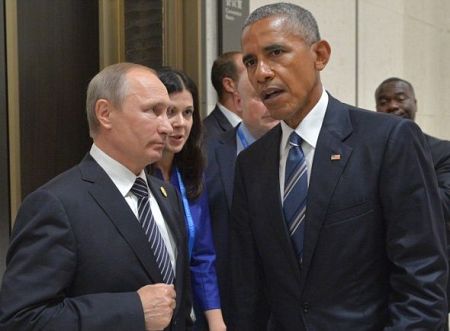
putin_obama_g-20_china-1

The Syrian cease-fire agreement that US Secretary of State John Kerry and Russian Foreign Minister Sergey Lavrov announced Friday night, September 9, in Geneva hands Syrian affairs over to Russia’s President Vladimir Putin and the country’s military.

The accord marked a sharp reversal for Washington. In his meeting with Putin in China last week, US President Barack Obama did not agree to those steps for the simple reason that such an agreement would be in line with the policy and stance of Republican presidential nominee Donald Trump, not those of the Democratic nominee Hillary Clinton.

Trump suggested several months ago that the US should let Putin finish the war in Syria, asserting that the Russian leader would be able to do it better.

Under the current situation it is no wonder that Kerry and Lavrov agreed not to release the details of the agreement.

Publication of the details would reveal that the rebels in the Aleppo area, and perhaps in all of Syria, have been abandoned.

The Syrian rebels now find themselves trapped by both the Russian-Turkish agreement and the Russian-US agreement, with a noose seemingly closing around them.

Meanwhile, on Friday, DEBKAfile released the following report:

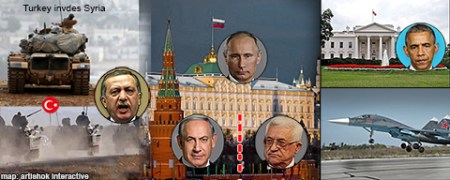
The fledgling “initiatives” reverberating this week in Washington, Moscow, Ankara, Jerusalem and the G20 summit were nothing but distractions from the quiet deals struck by two lead players, Russia and Turkey to seize control of the region’s affairs. Recep Tayyip Erdogan knew nothing would come of his offer on the G20 sidelines to US President Barack Obama to team up for a joint operation to evict ISIS from Raqqa. And, although Moscow was keen on hosting the first handshake in almost a decade between Israeli Prime Minister Binyamin Netanyahu and the Palestinian leader Mahmoud Abbas (Abu Mazen), neither were known to be ready for the last step toward a meeting.

But the game-changing events to watch out for took place in Hangzhou without fanfare – namely, the Obama-Putin talks and the far more fruitful encounter between Putin and Erdogan.

According to DEBKAfile’s intelligence and Mid East sources, Putin virtually shut the door on further cooperation with the United States in Syria. He highhandedly informed Obama that he now holds all the high cards for controlling the Syrian conflict, whereas Washington was just about out of the game.

Putin picked up the last cards, our sources disclose, in a secret deal with Erdogan for Russian-Turkish collaboration in charting the next steps in the Middle East.

The G20 therefore, instead of promoting new US-Russian understanding, gave the impetus to a new Russian-Turkish partnership.

Erdogan raked in instant winnings: Before he left China, he had pocketed Putin’s nod to grab a nice, 4,000-sq.km slice of northern Syria, as a “security zone” under the control of the Turkish army and air force, with Russian non-interference guaranteed.

This Turkish zone would include the Syrian towns of Jarablus, Manjib, Azaz and Al-Bab.

Ankara would reciprocate by withdrawing its support from the pro-US and pro-Saudi rebel groups fighting the Assad army and its allies in the area north of Aleppo.

Turkey’s concession gave Putin a selling-point to buy the Syrian ruler assent to Erdogan’s project. Ankara’s selling-point to the West was that the planned security zone would provide a safe haven for Syrian refugees and draw off some of the outflow perturbing Europe.

kremlinwhitehouse480-1

It now turns out that, just as the Americans sold the Syrian Kurds down the river to Turkey (when Vice President Joe Biden last month ordered them to withdraw from their lands to the eastern bank of the Euphrates River or lose US support), so too are the Turks now dropping the Syrian rebels they supported in the mud by re-branding them as “terrorists.”

The head of this NATO nation has moreover gone behind America’s back for a deal with the Russian ruler on how to proceed with the next steps of the Syrian conflict.

Therefore, when US Secretary of State John Kerry met Russian Foreign Minister Sergei Lavrov in Geneva Thursday and Friday, Sept. 8-9, for their sixth and seventh abortive sit-downs on the Syrian issue, there was not much left for them to discuss, aside from continuing to coordinate their air traffic over Syria and the eastern Mediterranean.

Washington and Moscow are alike fearful of an accidental collision in the sky in the current inflammable state of relations between the two powers.

As a gesture of warning, a Russian SU-25 fighter jet Tuesday, Sept 6, intercepted a US Navy P8 plane flying on an international route over the Black Sea. When the Russian jet came as close as 12 feet, the US pilots sent out emergency signals – in vain, because the Russian plane’s transponder was switched off. The American plane ended up changing course.

Amid these anomalies, Moscow pressed ahead with preparations to set up a meeting between the Israeli and Palestinian leaders, as the Russian Foreign Ministry announced Thursday.

Putin is keen to succeed where the Obama administration failed. John Kerry abandoned his last effort at peacemaking as a flop two years ago.  But it is hard to see Netanyahu or Abu Mazen rushing to play along with the Russian leader’s plan to demean the US president in the last months of his tenure – especially when no one can tell who will win the November 8 presidential election – Hillary Clinton or Donald Trump – or what policies either will pursue.

All the region’s actors will no doubt be watching closely to see how Turkey’s “Russian track” plays out and how long the inveterate opportunists can hang together.

Who killed Al-Adnani? US, Russia or maybe ISIS?

September 1, 2016

Who killed Al-Adnani? US, Russia or maybe ISIS? DEBKAfile, September 1, 2016

Adnani

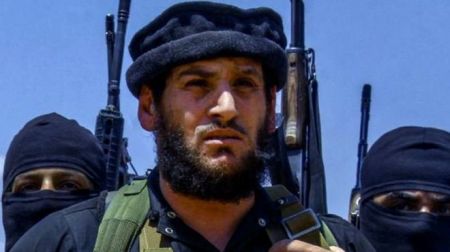
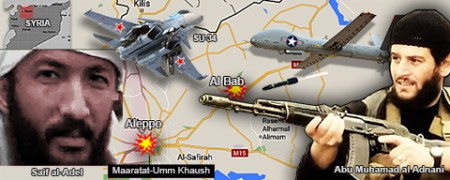
While the US has frequently claimed to have liquidated an Islamic terrorist leader, Russia put in its first claim on Aug. 31, when the defense ministry in Moscow announced for the first time that the day before, an SU-34 bomber had killed ISIS senior terrorist mastermind Mohammed Al-Adnani during a high-profile gathering at Maaratat-Umm Khaush near Aleppo.

The claim was worded so as to indicate that Russian intelligence had pulled off a major feat by a hit that took out 40 high-profile operatives.

This claim came 24 hours after a US official said that a Predator drone rocket had hit a car believed to be carrying Adnani near Al-Bab, and that the results were “being assessed” – even though ISIS itself reported that the terrorist leader, tagged as senior spokesman, “was martyred while surveying the operations to repel the military campaigns against Aleppo.”

The Pentagon sources called the Russian version “lies” and “a joke.”

The distance between al-Bab and Maaratat-Umm Khaush is only 28km, but the gap between the American and Russian claims is less immeasurable.

Fighting has escalated around the city in recent weeks, with rebels breaking a siege by government forces and Syrian and Russian warplanes bombing rebel-held areas.

The competing Russian and American claims of a successful aerial-cum-intelligence action against a high-profile ISIS founder-member break new ground in the war on Islamic terror.

Al-Adnani, who was born in 1977 in the northern Syrian town of Banash, was responsible in the past two years for orchestrating terrorist atrocities in Tunisia, Paris, Brussels, Orlando, Nice, Sinai Peninsula and Istanbul, as well as suicide bombings in Baghdad.

Far from being a joke, the cold war dividing Moscow and Washington appears to have spread to the war on Islamist terror and infected the Syrian arena.

The early collaboration between the two powers in the Syrian conflict has broken down. This was admitted on Aug. 26 in Geneva, after US Secretary of State John Kerry and Russian Foreign Minister Sergei Lavrov failed to agree on further military and intelligence cooperation.

Ironically, it is noted by DEBKAfile’s intelligence and counterterrorism sources, that both powers’ clandestine services received intelligence on their target’s movements from the same source.

IsisSpokesman480

That is another first; never before has any Islamic terrorist organization fed the same piece of intelligence to the US and Russia. If that is what happened, it could mean only one thing: that someone in ISIS had decided it was time for Al-Adani to go.

This would be par for the course in the harsh world of jihadist terror organizations, such as Al Qaeda from which ISIS sprung.

When Osama bin Laden, whom US special forces killed in 2011, felt the need to cull the Al-Qaeda leadership of high-profile operatives who had outlived their usefulness or were suffering from fatigue, he would get rid of them by arranging for US intelligence to be tipped off about their whereabouts.

In one notable instance of this purge, Khalid Sheikh Mohammed, senior planner of the 9/11 attacks on New York and Washington, was turned in to the CIA in 2003.

If this is what happened to Al-Adani, DEBKAfile’s counterterrorism sources link it to the recent reappearance on the Islamist terrorist scene in Syria three weeks ago of the veteran Al-Qaeda master-terrorist Saif al-Adel with a group of followers.

Al-Adel is rated one of the world’s most dangerous terrorists, with long experience of planning and executing mass-casualty operations stretching back to the 1980s. He is “credited” with the large-scale assaults on the East African US embassies in 1998 and a string of murderous strikes in Saudi Arabia in 2003, some of which hit US targets.

It is not yet known how Al-Adel and his gang reached Syria and for what purpose. They are only known to have crossed the border from Iraq. It is presumed by intelligence watchers of terrorist insider politics that, after deciding that Al-Adnan was a spent asset, ISIS leaders found his replacement.

Ayatollah shoots down Putin’s high-flying Tupolev

August 22, 2016

Ayatollah shoots down Putin’s high-flying Tupolev, DEBKAfile, August 22, 2016

(Please see also, Iran unveils its own version of S-300 air defense system. — DM)

putin-iran

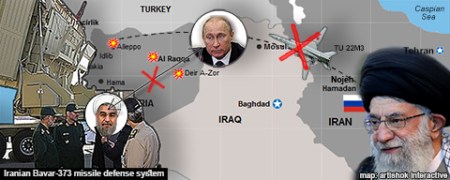
Monday, Aug. 22, just a week after the Russian defense ministry proudly released images of the first Russian bombardments in Syria to be launched from Nojeh airbase, which Tehran had granted Moscow near the Iranian town of Hamedan, the Iranian defense ministry snatched the concession back in a public rebuff for Moscow.

The Russians had presented its Iranian acquisition as the twin of the air base granted by Syria at Kmeimim near Latakia.

However, the Iranian defense ministry spokesman Bahram Ghasemi announced baldly on Monday that the Russian mission “is finished for now.” He added that the Russian air strikes in Syria were “temporary, based on a Russian request;” they were carried out with “mutual understanding and with Iran’s permission” and that the Russian mission “is finished, for now.”

Iranian sources claimed that this stinging slap to the Kremlin was prompted by mounting Iranian popular and parliamentary criticism, on the grounds that permission to a foreign power to use an Iranian base for the first time since World War II violated Article 146 of the Islamic Republic’s constitution.

Attempts by Majlis Speaker Ali Larijani and other regime officials to explain that the Russians had not been given an air base in Iran, only permission to use it to support the war Bashar Assad was waging against terrorists, an interest shared by Iran, fell on deaf ears.

A public outcry on this scale against any steps taken the ayatollahs’ regime is unusual enough to warrant exploration to uncover the hand behind it and its motives. This is all the more pressing in view of the stunning impact of the abrupt Iranian curtailment of the Russian air base venture after no more than three sorties were waged against Syrian targets: Stopped in its tracks for now – even before takeoff – is Vladimir Putin’s effort to promote his grand plan for a new and powerful Russian-Iranian-Turkish-Iraqi-Syrian pact.

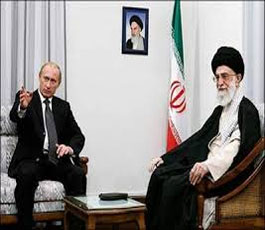
The only figure in Tehran capable of raising such a public firestorm with the clout for thwarting the Russian president is supreme leader Ayatollah Ali Khamenei, DEBKAfile’s Iranian sources report.

In handling the air base issue, Putin made the same mistake as US President Barack Obama. Both assumed that getting Iranian President Hassan Rouhani’s cooperation and sensitive diplomatic prodding would eventually win the supreme leader over.

Rouhani had hoped that by extending permission to Iran’s friend Putin for the use of the Nojeh base for air strikes against Syria, he would recover some of the standing he forfeited in Tehran by signing off on the international nuclear accord in 2015.

RussiaStopFlying480

He took a chance when, on Aug. 16, he summoned the national supreme military council and, without prior consultation with Khamenei, announced the decision to make the Nojeh air base available to the Russian air force. This was a serious miscalculation.

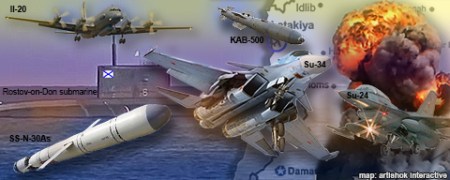
The supreme leader was further incensed by the exclusive report published by DEBKA file that day that Russian air freighters were on their way to the Hamedan base with advanced S-300 and S-400 air defense missiles for guarding the site and the Tupolev-22M3 bombers and Sukhoi-34 fighter bombers deployed there.

Khamenei interpreted this to mean that the Russians were already acting to commandeer the airspace over the base deep inside Iran.

Not content with the brush-off administered to Moscow by his spokesman, Iran’s Defense Minister Hossein Dehghan chided Moscow crudely for “showing off” over the air base in an “ungentlemanly manner” and a “betrayal of trust.”

He said: “We have not given any military base to the Russians and they are not here to stay.”

Realizing he was in hot water, the Iranian president tried to save face.

He arranged to be photographed for state media over the weekend, alongside the Bavar-373 missile defense system, declaring that having developed this system at home, Tehran can defend itself without recourse to the Russian high-altitude, long-range S-300s, because the Bavar-373 was just as good.

DEBKAfile’s military sources refute this claim. Indeed, the system on display which is based on Chinese technology is not operational.

However, the display did not save either Rouhani or Putin from Khamenei’s ire. Nojeh was shut down, a message the Iranian defense ministry spokesman underlined when he said Monday: Russia “has no base in Iran.”

US, Russia trade blows in Syria on Kurds’ backs

August 20, 2016

US, Russia trade blows in Syria on Kurds’ backs, DEBKAfile, August 20, 2016

rus us kurds

The near-clash between US and Syrian warplanes over Kurdish Hassaka in northern Syrian Friday Aug. 19 sprung out of the Obama administration’s decision the day before to try and draw the line on the growing Russian-Iranian-Turkish-Syrian collaboration in the conjoined Syrian-Iraqi arenas, DEBKAfile’s military sources report.

It occurred when US jets flew in protective formation over the Kurdish positions, the day after they were attacked by Syrian (some Middle East sources say, Russian) jets.

The US jets came within a mile of the two Syrian Su-24 fighter jets approaching the Kurdish enclave of Hassaka, and warned them off. Without responding the Syrian planes turned tail.

The US Defense Department reported that when the incident began, “coalition forces on the ground” tried reaching the Syrian jets on a “common radio frequency” but received not response. The spokesman did not specify which “coalition forces” he was referring to.

According to some Middle East sources, the Su-24s which attacked Hassaka Thursday were Russian – not Syrian.

Friday, US officials activated the US command center in Jordan for a complaint and warning to the Russian command center nearby, but they too were greeted with silence.

It may be assumed that the Russian tracking and reconnaissance systems spread across Syria and the eastern Mediterranean picked up the American communications and, had they wanted to, could have passed the US warnings on to Bashar Assad.

But the appearance Friday of another pair of Syrian jets over the Kurdish town indicated that the Russians had decided to pretend ignorance.

After the attack on Hassaka, a number of US special operations forces were pulled out of their northern Syrian positions. They were there as instructors and advisers to the Syrian Kurdish YPG militia and the Syrian Democratic Forces (SDF), with tens of US officers attached to every Kurdish platoon and SDF battalion.

It is now up to Washington to decide what happens next.

Russian President Vladimir Putin has obviously embarked on a new anti-American game based on the far-reaching deal he struck with Turkish President Tayyip Erdogan in St. Petersburg on Aug. 9. Part of that deal was a pledge by Moscow to help Turkey block all avenues for the Kurdish minority to attain full independence in Syria or Iraq, where it enjoy semi-autonomy, and allow a Kurdish state to rise from Irbil to the Mediterranean.

Iran and Syria’s Assad fully support the Turkish goal in their own interests.

The air strike against the Kurds of Hassaka therefore set a kind of foundation stone for the new Russian-Turkish-Iranian alliance in the region, whose establishmentDEBKAfile was first to uncover exclusively on Aug. 9, after the Putin-Erdogan summit.

This emerging pact has already generated strategic military dividends for Russia in the Middle East for Russia unmatched at any time since the Cold War of the mid-20thcentury.

Revolutionary Iran has made Russia the first foreign recipient of an air base on its soil near Hamedan in the west.

Erdogan’s Turkey has hustled the US into evacuating its nuclear arsenal from the southern Incirlik air base, the first time NATO was forced to give up a nuclear stockpile near the Russian frontier. And before the removal was completed, calls were raised in Moscow and Ankara to let Moscow install its warplanes at the strategic Turkish base.

It is hard to see how by sending US warplanes to shield Syrian Kurdish positions against attack, the Obama administration can put the brakes on the Russian-led tactical alignment speeding forward with Iran, Turkey and the Assad regime. To make a difference, the US president would have to interrupt his Martha’s Vineyard holiday and reach a decision he has avoided for the last six years, which is to put substantial American boots on the ground in Syria.

This step is not really on the cards three months before the presidential election and five months before he leaves the Oval Office for good.

In the near future, we are therefore likely to see the Russians and Syrians pressing ahead with their campaign against the Kurds, whereas Obama may opt to confront Putin outside the Syrian quagmire, possibly over Ukraine. Mindful of this likely scenario, Putin flew to Crimea Friday after staging war games there.