Archive for the ‘Russia – Syrian war’ category

Russian role in Aleppo’s fall impacts US politics

December 16, 2016

Russian role in Aleppo’s fall impacts US politics, DEBKAfile, December 16, 2016
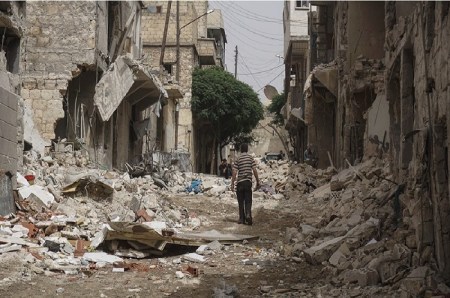
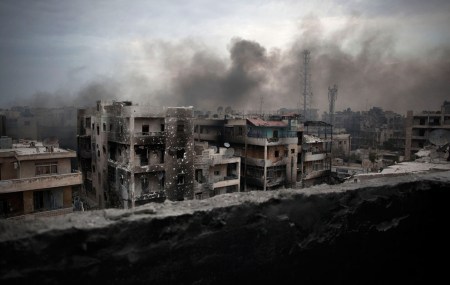
aleppo-damage_9-15

The Putin factor comes in handy for the latest tactic in a series pursued since the November 8 election, for delegitimizing Trump’s victory and negating his fitness to reach the White House.

This campaign may resonate strongly on America’s future policy and position as a world power, because it is designed to block Trump’s path to a deal with Putin for resolving the Syrian conflict. The Obama administration has no wish to see the new president succeed where it failed for nearly six years.

********************************

Aleppo’s fall to the Assad regime with the surrender Thursday, Dec. 15, of the Syrian rebel forces locked in a corner of the eastern districts was the most disastrous military and strategic setback to befall the Obama administration for two years. It started evolving in September 2015, when Russia stepped up its military intervention in the Syria war and rescued Bashar Assad.

When Aleppo succumbed to the Russian-backed government army and its allies, Iran, Hizballah and fellow Shite militias, it did not fall alone.  It brought down the entire architecture of US-backed positions in northern Syria. The US had invested in and trained local groups, such as the Syrian Kurdish militia and the rebel Free Syrian Army, as the bedrock for its policy and interests in the conflict. Those groups have melted away.

The acknowledged overlords of northern Syria today are Russian President Vladimir Putin and Turkish President Recep Tayyip Erdogan, who can claim the Aleppo victory. Bashar Assad and Iran are reduced to playing second fiddle. But whereas the Al Qods chief Iranian general Qassem Soleimani commands pro-Iranian forces in the region, America has been divested of all its military assets and has no real say in the next chapter of the horrific war.

Hence US Secretary of State John Kerry’s despairing appeal Thursday in a press briefing to bring the bloodshed and suffering to an end: “We can’t have another Srebrenica” – a reference to the Serbian slaughter of 8,000 Bosnian Serbs in 1985 – he said.

Kerry has toiled tirelessly for a diplomatic solution to the dreadful Syrian war, but his appeal falls on senses hardened by the many Srebrenicas perpetrated in more than five years of conflict. Hundreds of thousands of civilians and soldiers have been slaughtered – according to an unofficial estimate up to a million – and many subjected to chemical warfare. The secretary can’t count on the Kremlin to relent and so, even after the last Syrian rebels and their families are out of Aleppo, the killing will go on.

In Washington, 10,000 kilometers away, the Aleppo calamity is being dished up as a political tool. The claim was heard Thursday that the “same Vladimir Putin” who sponsored the atrocities in Aleppo, also interfered in the US presidential election by sending hackers to influence the results in favor of Donald Trump. The claim is touted by Obama administration spokesmen and the Democratic Party, whose candidate Hillary Clinton lost the election. It appears to be fodder for a Democratic party drive building up for the president-elect’s impeachment even before he is sworn in as president on Jan. 20.

The Putin factor comes in handy for the latest tactic in a series pursued since the November 8 election, for delegitimizing Trump’s victory and negating his fitness to reach the White House.

This campaign may resonate strongly on America’s future policy and position as a world power, because it is designed to block Trump’s path to a deal with Putin for resolving the Syrian conflict. The Obama administration has no wish to see the new president succeed where it failed for nearly six years.

Putin will have no qualms about capitalizing on Washington’s preoccupation with its internal power struggle and will build up as many gains in Syria as he can before Donald Trump takes over. Obama’s threat Friday, Dec. 12, to retaliate for Russia’s efforts to influence the presidential election will just provoke the Russian president to move faster and more determinedly in his grab for more assets in Syria.
ISIS seizes big Russian-Syrian T-4 air base

December 12, 2016

ISIS seizes big Russian-Syrian T-4 air base, DEBKAfile, December 12, 2016

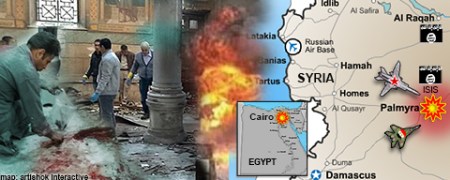
cairo_terror480

Islamic State forces pushed their assault forward to retake the central Syrian town of Palmyra Monday, Dec. 12. By evening, they had entered the big Russian-Syrian T-4 air base outside the town, carrying off substantial quantities of Russian armaments. Reporting this, DEBKAfile’s military sources add that the booty they snatched included different types of ground-to-ground missiles as well as anti-tank and anti-air rockets.

Russian forces manning the base were hurriedly evacuated from Palmyra and the T-4 base, after the worst defeat Russian armed forces had ever experienced at ISIS hands in Syria. Military circles in Moscow commented grimly that the Russian army had suffered “a major disgrace” in Palmyra.

According to our sources, long convoys of ISIS fighters backed by tanks taken booty from the Syrian army, first forced the Syrian 11th Tank Division to abandon the strategic Jhar Crossroad. After that, the way was clear for the jihadis’ column to reach the T-4 base.

DEBKAfile reported on the ISIS terrorists’ fresh momentum Sunday.

Judging from the rash of reports claiming US-Iraqi military progress in the Mosul offensive against ISIS and the extra American special operations forces personnel posted to Syria for an impending US-Kurdish operation to capture the ISIS Syrian stronghold of Raqqa, the Islamic State ought to be cowering under siege, finally defeated – or at least on the run.

But the facts tell another story. ISIS is on the offensive – so far in the Middle East. Over the weekend, Islamist terrorists accounted for dozens of deaths and injured hundreds more.

Sunday, Dec. 11, at least 25 people worshipping at the Coptic St. Peter’s and St. Paul’s church adjacent to St, Mark’s cathedral in Cairo were killed and scores injured. The Coptic pope often leads the prayers there. DEBKAfile’s counterterrorism sources reveal that the attack was carried out by Islamist terrorists from Raqqa who bided their time until they struck in the Egyptian capital. Saturday, six Egyptian troops were killed by another Islamist bomb near the Giza pyramids.

On the same day, ISIS fighters pushed back into the ancient Syrian town of Palmyra, nine months after their expulsion.

The Raqqa terrorist stronghold is clearly alive and kicking on more than one front. A number of contributing factors enable the Islamic State to unleash a fresh spate of terror.

1. The US-Iraqi-Kurdish drive has stalled without driving ISIS out of Mosul or choking off the terrorist fighters’ freedom to move between Mosul and Raqqa, their Syrian bastion.

US Defense Secretary Ashton Carter, who arrived in Baghdad Sunday, Dec. 11, was assigned by the Obama administration to make a last effort to reactivate the Mosul campaign. His chances of success are slim. The military coalition which launched the campaign two months ago has lost a vital component, the Kurdish Peshmerga, which backed out three weeks ago. The Iraqi military units which captured some of the city’s outskirts stopped short when they reached the strongest defense lines set up by the Islamic State and have been unable to break through, even with US air support.

The pro-Iranian Iraqi Shiite front which undertook to seize Tal Afar in order to sever the ISIS connecting link between Iraq and Syria are parked outside, having been warned by Turkey not to set foot in the town.

Added to these setbacks, the US CENTCOM which is running the aerial war in Iraq is at loggerheads with the Iraqi Air Force command and has practically grounded all Iraqi warplanes.

Even if Carter can wave a magic wand and resolve all these issues, the momentum and high hopes that actuated the Mosul campaign when it started have been lost and can hardly be recovered before Barack Obama leaves the White House.

At least two of the incoming president Donald Trump’s designated security advisers – Defense Secretary Gen, James Mattis and National security Adviser Gen. Michael Flynn – have criticized the operation in is current form.

2. What is happening in Raqqa doesn’t fit the designation of an offensive. At most, small Kurdish and Syrian rebel groups are mounting sporadic raids against ISIS fighters on the town’s outskirts, with the support of the Obama administration. Our military experts say that Raqqa can’t be captured from the Islamist terrorists by conventional means – mainly because it is spread over a large area of mostly empty desert. ISIS has taken advantage of this terrain to distribute knots of defenders across a vast area ranging hundreds of kilometers from northern to eastern Syria up to the winding, heavily overgrown banks of the Euphrates River.

So when Ash Carter announced Saturday that he would be sending another 200 Special Operations Forces into Syria to join the battle for Raqqa, he had no idea that he, the Russians and the Syrians were about to be caught off guard by a fresh ISIS initiative to reoccupy Palmyra, the ancient Syrian two from which they are thrown out in March.

This was a poke in the eye for Russian President Vladimir Putin who proclaimed Palmyra’s capture from ISIS as a signal coup for the Russian army in its war on Islamist terror.

3.  He might well commiserate with Egyptian President Abdel-Fatteh El-Sisi. For two years, the Egyptian armed forces have been fighting an uphill battle to crush the ISIS groups infesting the Sinai Peninsula. The jihadists constantly elude punishment with the help of supportive Bedouin tribes.

Every few months, they pose a real threat to the stability of the El-Sisi regime by striking inside Cairo, the capital, with some terrorist atrocity, for which they are aided by the Muslim Brotherhood underground and Palestinian Hamas extremists in the Gaza Strip.

The bombing of the Coptic church Saturday was unusually the work of jihadists deployed from Raqqa, Syria.  Egypt has reacted by placing extra guards at Christian sites and declaring three days of national morning for the disastrous bombing attack on Egypt’s largest minority.

The new Islamist drive is looking ominously like the onset of the Christmas-New Year holiday terror onslaught the Islamic State has threatened to unleash in the Middle East and beyond. US and European security services have been placed on high alert in the belief that returning jihadis are programmed to strike at home.

Israel jets mark go-it-alone policy on Syria

November 30, 2016

Israel jets mark go-it-alone policy on Syria, DEBKAfile, November 30, 2016

raidfire480Arab media show damage caused by air strikes to Syrian army compound in Damascus

Although Erdogan is notorious for his wildly unpredictable decision-making, it is more than likely that before going public on his radical change of heart on Assad, he was in touch with the new national security team taking shape in Washington. If that was the case, then Donald Trump was using Erdogan to notify Putin that the entire architecture of their understandings on Syria was now at risk.

If the Arab media reporting on Israeli air attacks on Syrian military and Hizballah targets in Damascus from Lebanese air space are confirmed, Jerusalem will be shown to have followed Ankara in backing away from those short-lived, understandings, opting instead for an independent policy in its own security interests with regard to Syria.

*****************************

Arab media carried conflicting reports wich described Israeli warplanes striking in and around Damascus overnight Tuesday, Nov. 29, with “four long-range Popeye” missiles fired from Lebanese air space on the government-held town of Al-Saboorah, a western suburb of Damascus, near the highway to Beirut.

A Lebanese newspaper reported that a Syrian army ammunition depot was destroyed in one of the raids, while other strikes hit and damaged a Hizballah arms convoy bound for Lebanon on the Damascus-Beirut Highway. There was also speculation, later denied, that one of the air strikes aimed at assassinating a senior Hizballah figure.

None of these reports were confirmed by Israel or any other official source.

Even so, Israel’s reported military action against enemy targets in Syria is bound to have repercussions in the next 24 hours, since, whatever took place, broke out of the secret overarching understandings on Syria reached provisionally this month between US President elect Donald Trump, Russian President Vladimir Putin and Turkey’s Recep Tayyip Erdogan.

Those understandings hinged strongly on joint US-Russian cooperation in the war on the Islamic State in Syria, supported by the coalition fighting for the Assad regime, namely, the Syrian army and its allies, the Lebanese Hizballah and foreign Shiite militias under the command of the Iranian Revolutionary Guards.

As the sub-text of the “big power” understandings, an outline was drafted between the next US administration, Moscow, Jerusalem, Amman and the UAE on arrangements for stabilizing Syria’s southern borders with Israel and Jordan.

Talks on these arrangements were first disclosed in an exclusive DEBKAfile report on Nov. 21, after they had already produced the unheralded return of the UN observers to the Golan demilitarized zone outside Quneitra.

But then, Sunday, Nov. 27, Russian warplanes staged a sudden series of airstrikes against Syrian rebel concentrations in the very region under discussion, southern Syria. After a three-month pause in these attacks, Moscow appeared to have waited for major Syrian government progress in Aleppo, to go against those understandings and send Russian jets into action over Jasim and Daraa in order to wipe out the rebel forces holding out in the South. Heavy casualties were sustained by those forces.

The Russian action was seen by the incoming Trump administration and Jerusalem as presaging the next danger-fraught step: To round out the raids, the Syrian army would come flooding into the South, along with Hizballah and other Shiite militias fighting under Iranian Revolutionary Guards command.

Tuesday saw two further ruptures in the trilateral understandings on Syria.

Assad announced he was gearing up for a decisive victory in Aleppo, notwithstanding a request from Trump’s advisers to Putin to hold back from the final step and refrain from retaking every last eastern district from rebel hands..

This was followed by an unforeseen statement by Erdogan: “The Turkish military launched its operations in Syria to end the rule of President Bashar al-Assad.”

This sentiment pivoted sharply away from the secret Trump-Putin understandings endorsed by the Turkish leader that was contingent on Assad remaining in power.

Although Erdogan is notorious for his wildly unpredictable decision-making, it is more than likely that before going public on his radical change of heart on Assad, he was in touch with the new national security team taking shape in Washington. If that was the case, then Donald Trump was using Erdogan to notify Putin that the entire architecture of their understandings on Syria was now at risk.

If the Arab media reporting on Israeli air attacks on Syrian military and Hizballah targets in Damascus from Lebanese air space are confirmed, Jerusalem will be shown to have followed Ankara in backing away from those short-lived, understandings, opting instead for an independent policy in its own security interests with regard to Syria.

Egyptian pilots flying Russian choppers in Syria

November 26, 2016

Egyptian pilots flying Russian choppers in Syria, DEBKAfile, November 26, 2016

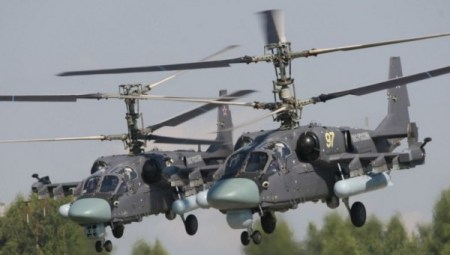
attack_ka-52_alligators

Egyptian President Abdel-Fatteh El-Sisi’s secret decision to intervene militarily in the Syrian war on the side of the Syrian President Bashar Assad is revealed here by DEBKAfile’s military and intelligence sources. The precise details of that intervention vary from source to source.

1. According to one version, a group of Egyptian helicopter pilots – 18, according to one estimate – landed secretly a few days ago at the Syrian Air Force base in Hama and were pressed at once into service for strikes against Syrian rebel forces.

Some sources describe the Egyptian flight crews as taking over the cockpits of Russian attack/reconnaissance Kamov Ka-52 helicopters, with which they were familiar, having trained on them since the end of 2015.

2. Others say that the Egyptian airmen flew those helicopters from Egypt to Syria over the eastern Mediterranean.

3. There is also a claim that their arrival was preceded by a preliminary inspection of the Syrian front lines by two major generals from the Egyptian general staff operations division, who later submitted their recommendations to the Egyptian president. It is not clear if they met the Russian commanders in Syria during that trip.

4. Others say the Egyptian generals headed a military delegation, which has set up a permanent mission in Damascus.

But every one of those sources agrees that, one way or another, Egypt has secretly entered the Syrian war in support of the Bashar regime – a development which has raised a firestorm in Arab capitals.

Saudi Arabia is particularly incensed over El-Sisi’s move. For years, Riyadh granted Cairo billions of dollars in aid, hoping this was an investment for procuring the Egyptian army as the stalwart protector of the kingdom and the Gulf emirates against Iran.

But towards the end of last year, Riyadh was affronted when the Egyptian ruler turned down an appeal for ground troops to support the Yemen campaign against Iranian-backed Houthi rebels. An eye-opener came when Egypt showed sympathy for Assad’s fight against extremist Islamist groups in the rebel movement, especially those associated with the Muslim Brotherhood, which El-Sisi has outlawed in Egypt as the sworn foe of his regime. Then, when Cairo supported Russian pro-Assad diplomacy at the United Nations, Saudi Arabia abruptly cut off financial assistance to Egypt and discontinued its oil shipments.

Donald Trump’s election this month as the next US president has already become the catalyst of a major reshuffling of Middle East alliances and stakes.

Some of its rulers, including El-Sisi, see the landscape changing and may be gambling on Trump reaching a deal with Russian President Vladimir Putin for joint military operations in Syria against the Islamic State and other Islamic terror groups, including the Al-Qaeda affiliate, the Nusra Front. The new bandwagon about to roll appears to favor Bashar Assad and his army.

The US president elect’s take on the Syrian ruler is expected to be markedly different to that of outgoing President Barack Obama, who castigated Assad, but held back from fighting him on the battlefield.

DEBKAfile reported exclusively on Nov. 21 that clandestine talks between Jerusalem, Amman and Damascus were afoot for the restoration of the demilitarized zone on the Golan and steps to stabilize their common borders in southern Syria.

Those talks are taking place with the knowledge of the Trump transition team and the Kremlin. They have already produced results in the return of UNDOF observers to their former posts on the Syrian Golan.

There are grounds to speculate now that the deployment of Egyptian aviators to Syria may be one more product of the secret inter-power diplomacy swirling in recent weeks over Syria’s bloody and intractable five-year war.

Two Hizballah brigades deployed to Aleppo

November 20, 2016

Two Hizballah brigades deployed to Aleppo, DEBKAfile, November 20, 2016

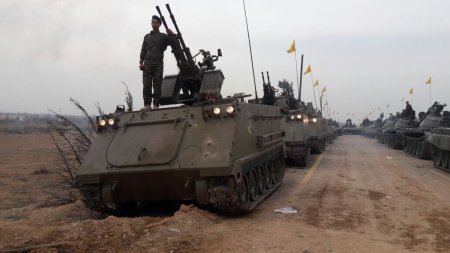
hezbollaonparade

The two Hizballah brigades carry both American and Russian weaponry. DEBKAfile’s military sources report: The motorized rifle brigade is armed with American armored personnel carriers and tanks, whereas the Light Brigade carries Russian arms. Some of the units use both American and Russian hardware, like the Russian ZPU-2 anti tank guns which are mounted on US M113 APCs.

****************************

Hizballah this week transferred two brigades of some 5,000 fighters to the Aleppo front to bolster the Assad regime’s concentrated push to finally rout the rebels who have been holding out year after year in the eastern half of the ravaged city. Indiscriminate Syrian air strikes continue.

The new spearhead is made up of Hizballah’s heavy motorized rifle brigade of tanks and heavy weapons and its light commando brigade, which is trained to operate behind enemy lines. Their arrival brings the total number of Hizballah fighters in Syria to 15,000.

Russian military sources say that, after Aleppo is won for Bashar Assad, the two Lebanese Shiite brigades will turn to Idlib province in the north, to tackle the largest concentration in the country of Al Qaeda’s Syrian arm, the Nusra Front.

The two Hizballah brigades carry both American and Russian weaponry. DEBKAfile’s military sources report: The motorized rifle brigade is armed with American armored personnel carriers and tanks, whereas the Light Brigade carries Russian arms. Some of the units use both American and Russian hardware, like the Russian ZPU-2 anti tank guns which are mounted on US M113 APCs.

Sunday, Nov. 14, on the day that Hizballah started moving the two brigades to the Aleppo front, its propaganda machine released to the Arab media images of a military parade in Qusayr, in the Qalamoun mountain range of western Syria, showing Hizballah troops marching with American hardware. The parade, according to our sources, was faked, the point being to show the world that the Iranian proxy was amply supplied with American equipment.

Assad rewarded Hizballah for capturing Qusayr three years ago by allowing the Iranian proxy to turn the ghost town into a military center. Several workshops for recycling captured weapons for reuse in battle were set up there. (In the same way, the IDF recycled the masses of Russian weapons taken booty from Arab armies in the 60s and 70s.)

Another project was the creation and arming of the Light Brigade modeled on the Iranian Revolutionary Guards special operations units. They are equipped with highly adaptable “jihad-mobiles” which are designed to move in all-terrain and all-weather conditions to take the enemy by surprise from the rear. The the battle of Aleppo sees their first operation in the Syrian war.

Like Syrian special forces units, the Hizballah Light Brigade drives Russian UAZ Patriot-SUV pickup trucks on which are mounted Kord heavy machine guns and AGS-17 grenade launchers. These vehicles are equipped with automatic filters adapted for combat in arid desert conditions to overcome difficulties in vision and breathing.

Putin’s low-key Syrian operation – a call to Trump

November 16, 2016

Putin’s low-key Syrian operation – a call to Trump, DEBKAfile, November 16, 2016

The Russian air force and navy launched a “large-scale” operation against “terrorists” in the Syrian provinces of Idlim and Homs Tuesday, Nov. 15. Bombers took off from the Hmeymim air base and the Admiral Kuznetsov aircraft carrier whle cruise missiles were fired from the Admiral Grigorovich frigate. According to Russian Defense Minister Sergey Shoigu, who addressed a meeting of Russian generals with President Vladimir Putin, the targets were positions of the Islamic State and Al Nusra.

He did not say how long the operation would go on.

DEBKAfile’s military and intelligence sources say that the proportions of the Russian operation as seen from the ground better fit the description of low key than “large scale.”

No more than 2 Sukhoi Su-33 fighters lifted off the carrier’s decks and only a few Kaliber cruise missiles were fired from the frigate. They were not aimed at Islamist terrorist positions, but at arms factories and ammunition stores. Towards evening, a third Russian air strike hit a target in the hills overlooking the coastal province of Latakia.

The timing of the Russian operation was significant. It came five days after President Barack Obama finally ordered the Pentagon to seek out and target Nusra Front leaders, after long holding out against Moscow’s demand in this regard, and 12 hours after US president elect Donald Trump and Putin held their first telephone conversation after the election.

Since the attack was too limited to change the military situation on the Syrian war’s front lines, what was its purpose? And why was its launch given world-wide exposure accompanied by a photo-op of the Russian president meeting his generals for heightened drama?

It appears that Putin sought by this maneuver to convey the impression that Trump had agreed to the operation during their initial conversation on Monday. It is far more likely, however, that the Russian leader presented the offensive to Trump in general terms and did not hear an explicit negative response. He therefore decided to go ahead with the attack, marking out Islamist terrorists – which the president elect had declared in his campaign as America’s enemy – on the assumption that he would not disagree with a Russian strike against a consensual target. By this maneuver, Putin hoped to draw the next US president into backing Russia’s strategy in the Syrian war.
It is hard to believe that Donald Trump will be so easily drawn.

IRGC commander killed on eve of Aleppo battle

October 28, 2016

IRGC commander killed on eve of Aleppo battle, Long War Journal, , October 28, 2016

While employing foreign fighters minimizes domestic political backlash in Iran, it also serves a long-term strategic objective to develop capable Shiite proxies. A retired IRGC commander who has deployed to Syria recently claimed the formation of a “Shiite liberation army,” and IRGC commanders have openly discussed a global Basij paramilitary taking shape in the laboratory of Syria, with talks of laying the groundwork for the apocalypse and the Mahdi’s arrival in more intimate quarters. The IRGC, however, has not hesitated to inject regular Iranian soldiers and mid-ranked officers during major offensives and whenever the situation has demanded it, such as the offensive in southern Aleppo in October 2015 and the assault north of Aleppo in February 2016.

********************

The Jaysh al Fath and Fath Halab coalitions and their allies launched an anticipated major offensive today west of Aleppo in another bid to break the siege of rebel-held eastern Aleppo, according to Reuters. In early September forces allied with the Syrian government backed by Russian air power repelled the opposition’s first attempt to break the siege following a month-long battle. Pro-regime forces attempted to build upon their momentum and launched major offensives in late September to tighten their grip on Aleppo. They have made slow but steady gains on the city blocks of eastern Aleppo, and have attempted to push their gains in western and southwestern Aleppo to prevent the opposition from breaking the siege again.

The pro-government coalition includes the Syrian Arab Army (SAA), the Shiite expeditionary forces led by Iran’s Islamic Revolutionary Guard Corps (IRGC), as well as Lebanese Hezbollah, Iraqi Harakat al Nujaba, Afghan Fatemiyoun Division and the Pakistani Zeynabiyoun. Furthermore, the Palestinian Quds Brigade, which has effectively become Russia’s proxy, has made gains in the northern Aleppo sector alongside the SAA.

The Russian defense minister has reportedly asked President Vladimir Putin to resume airstrikes today in Aleppo following a 10-day hiatus, citing an upsurge in opposition activities, but Putin has said that airstrikes are unnecessary for now, according to Reuters citing Interfax News Agency. The IRGC provides intelligence to Russia for airstrikes in Syria.

A high-ranking former IRGC commander was killed in Syria on Oct. 26 during an “advisory mission” in Aleppo. according to Iranian media. He was buried in Mashhad, Iran, today along with two Afghan Fatemiyoun Division combatants killed in Syria this past week. The IRGC Qods Force deputy commander Brigadier General Esmail Gha’ani, who delivered remarks at the deceased commander’s funeral, said “the blood of martyrs strengthen the foundation of the Islamic Republic system.”

Qolam-Reza Samai was a retired commander with the rank of Brigadier General or Brigadier General Second Class who had volunteered to fight Syria, and will be buried in his home province of Khorasan. A veteran of the Iran-Iraq War (1980–1988), Samai held several command posts in artillery, intelligence, and operations capacities in several provincial Ground Forces units.

The IRGC has tapped into its retired and active duty Ground Forces, and special forces officer corps to augment the efforts led by the Qods Force in Syria and Iraq. The deployment pattern of Ground Forces commanders depends on the mission need and crisis at hand. For example, there was a surge of commanders in Iraq following the incursion of the Islamic State in mid-2014, and most were called back when the IRGC-backed Shiite militias were able to better manage the situation.

The IRGC Ground Forces have been present in Syria since as early as 2011. Their numbers have increased as the war deteriorated, peaking in Oct. 2015 as Iran deployed significant numbers of its regular forces in coordination with Russia’s military intervention, before spiking again in Feb. 2016 during a major offensive north of Aleppo. More than a dozen senior Guard commanders were killed in Syriaduring the past year, with the overwhelming majority in Aleppo. Fatalities and causalities of high-ranking officers have continued as the Guard has reduced regular Iranian forces since May and has relied more on Shiite proxies. Contrary to the insistence of the IRGC, commanders are engaged in more than just advising: they design and lead operations for the Iranian-led Shiite expeditionary forces.

The high fatality rate of Iranian commanders is explained by the tactically risk-tolerant and egalitarian culture of the Guard, which values martyrdom in battle as the highest honor and takes pride in fighting on the frontline. Whereas the IRGC is tactically risk-tolerant, it is strategically risk-averse and prefers to limit Iranian exposure, as discussed in depth by Ali Alfoneh and Michael Eisenstadt in The Washington Institute. 

While employing foreign fighters minimizes domestic political backlash in Iran, it also serves a long-term strategic objective to develop capable Shiite proxies. A retired IRGC commander who has deployed to Syria recently claimed the formation of a “Shiite liberation army,” and IRGC commanders have openly discussed a global Basij paramilitary taking shape in the laboratory of Syria, with talks of laying the groundwork for the apocalypse and the Mahdi’s arrival in more intimate quarters. The IRGC, however, has not hesitated to inject regular Iranian soldiers and mid-ranked officers during major offensives and whenever the situation has demanded it, such as the offensive in southern Aleppo in October 2015 and the assault north of Aleppo in February 2016.

Article On Syrian Opposition Website: The Political Solution Is Unfeasible; We Should Ignite All-Out War

October 19, 2016

Article On Syrian Opposition Website: The Political Solution Is Unfeasible; We Should Ignite All-Out War, MEMRI, October 19, 2016

‘Ali Hamidi, a Syrian journalist opposed to the regime, called on regime opponents to abandon the political solution and ignite an all-out war in Syrian order to force the world to step in and end it. Writing on a Syrian opposition website, he said that the brutal offensive waged in recent weeks by the Assad regime and by Russia against the rebel-held eastern neighborhoods of Aleppo is nothing less than a holocaust and slaughter for its own sake. He leveled harsh criticism at the international community, headed by the U.S., for the situation in the city, saying that their failure to intervene does not stem from helplessness or a lack of influence but rather from a lack of willingness to stop Assad and Russia.

The following are excerpts from his article:[1]

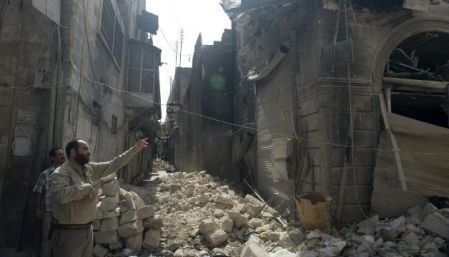
30329Devastation in Aleppo (image: Aljazeera.com)

“It would be absurd to write anything or make any comment about the all-out war of extermination currently being waged by Russia and the Assad regime against the ‘besieged neighborhoods’ of eastern Aleppo. This is [nothing less than] a holocaust; it is the ongoing indiscriminate killing of civilians without any military justification… Its objective was and is nothing but killing for its own sake. Many of us have made efforts to find definitions and reasons for this [military] action. We have heard, for example, that its objective is ethnic and sectarian cleansing; that it is an attempt to pressure the civilians in eastern Aleppo to leave or to disassociate themselves from the militants; that it is a holy war against the Sunnis, and many other analyses that are belied by the scenes of bombing and indiscriminate killing. At this point analyses and theories fail, and the main [insight] that emerges is that [it is nothing but] the killing of anyone opposed to the Assad regime…

“Can we really say today that the world is helpless? I think that would be the greatest and falsest compliment we could bestow upon this world – for the international community was not, is not and will never be helpless. It has ability and influence, if it only wanted [to use them]. But the simple [truth is] that nobody wants to stop Assad and Russia – neither the U.S. nor Europe nor anyone else…

“In the UN Security Council session on Aleppo [on September 25, 2016], UN envoy to Syria Staffan de Mistura expressed concern about the firing of ‘[gas] canisters’ from [rebel-held] eastern Aleppo into the [regime-held] western [parts of the city]. But he did not mention the kinds of missiles and mortars fired on the people [of the city], nor did he mention the over 300 victims [that are killed] every day as he delivered this miserable speech. Even more disturbing were the statements made by the representatives of the permanent Security Council members, who parrot hollow words of commiseration that are nothing but humiliating pleas [directed at] Russia, beseeching it to do its best to restrain Assad and restore the fragile ceasefire…

“Are we not being naïve when we wait for others to make their considerations, and hand them the keys to our cities [while we sit around,] waiting to be bombed? We wait for Barack Obama to [formulate] a policy [on Syria], when everyone is quite convinced that his departing administration will do nothing for those who are being killed in Aleppo and elsewhere, and that he and his team are not really doing anything to topple the Assad regime or to compete with Russia and Iran by supporting [the Syrian opposition]. If this is the position of the [world] leadership, there is no point in expecting anything from the countries it leads.

“Eastern Aleppo is in flames and its people are dying, and the entire world is party to this crime. Therefore, all the efforts that are currently being invested in renewing the dialogue with the Assad regime must be diverted to starting a war – an all-out war that will burn everyone. Then the world will hurry to stop it.

“The statements we hear, that only the political solution exists, are not realistic in the least. In fact, even the Assad regime does not accept them. Hence it would be folly to continue pinning our hopes on political [solutions] or on the ‘friendly’ countries. [Such suggestions] are tantamount to asking the people of Aleppo to surrender [just] in hope of being allowed to negotiating for the lives of those who still survive…

“To those who ask what alternative exists, [I say]: Why shouldn’t everyone who is dedicated to the cause [of saving syria] divert his efforts from the political channel to looking for weapons, even on the black market, so as to deliver them to the fighters in order to start an [all-out] war[?]”


Endnote:

[1] Orient-news.net, September 26, 2016.

Russia & Turkey carve anti-US enclaves in Syria

October 15, 2016

Russia & Turkey carve anti-US enclaves in Syria, DEBKAfile, October 15, 2016

rusturk

US President Barack Obama told Pentagon and military chiefs he met Friday, Oct. on Oct. 14, that instead of arming anti-Assad rebel groups in Syria, Washington was going back to negotiations with Moscow for cooperation in achieving a cessation of hostilities in the Syrian war.

US Secretary of State John Kerry therefore scheduled his umpteenth meeting with Russian Foreign Minister Sergey Lavrov for Saturday in Lausanne. This time, the foreign ministers of Turkey, Turkey, Iran, Saudi Arabia and possibly Qatar, tagged along.

Beyond the high words, recriminations and the unspeakable horrors attending the battle for Aleppo, Obama never seriously considered providing the anti-Syrian rebels holed up in Aleppo with the anti-air weapons they need to shoot down the Russian and Syrian warplanes blitzing them – any more than UK Foreign Secretary Boris Johnson’s statement that it was time for British military involvement in the Syrian war was for real

Above all, Britain is short of the military heft for backing up hypothetical intentions.

The options for serious Western intervention in the Syrian war are constantly diminishing for the reasons outlined here by DEBKAfile’s military sources:

1.  American missiles have no way of reaching Syrian rebel groups, certainly not those still fighting in eastern Aleppo. Neither Russia, nor Turkey, whose army now controls 5,000 sq. km of northern Syria, would let them through to that destination.

2. Had Turkish President Tayyip Erdogan chosen to do so, he could have simply ordered his army to open up a route for the supply of missiles to the rebels who are hemmed in in Aleppo by Russia, Syrian, Iranian and Hizballah forces. He is withholding that order because the military deals he concluded with President Vladimir Putin last week in Istanbul override any concerns he may have for the fate of those rebels or Aleppo’s population.

3. Those deals in a word sanctify the Turkish “security zone” in northern Syria which is covered by a no-fly zone for all but Russian and Turkish flights. They also provide for the Syrian rebels retreating from the various Syrian war zones, including Aleppo, to be taken in and absorbed in the Turkish enclave. Erdogan would thus become the senior patron of the Syrian opposition rebel movement, barring only the Al-Qaeda-affiliated Nusra Front and other Islamic extremist groups. This would enable him to steal from the United States, Saudi Arabia, Jordan and Qatar their sponsorship roles and their influence in the anti-Assad movement.

4. Ankara’s military alliance with Moscow is steadily eroding Turkey’s ties with the United States as well as NATO. Matters have gone so far that the two capitals or in advanced discussion of the supply of Russian air defense missiles to the Turkish army.

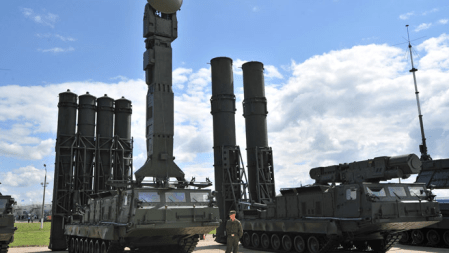
DEBKAfile’s intelligence sources reveal that under discussion is the installation in Turkey of a system of advanced Russian missiles linked to the Russian anti-air missile shield under construction in Syria.

Turkey would thus become the first member of NATO to arm itself with a Russian anti-air missile shield.

How was this allowed to happen?

According to our sources, Putin and Erdogan are moving fast to cash in on President Obama’s repugnance for military intervention in Syria and his waning powers at the tail end of his presidency.

Furthermore –

a) Neither is configuring Syrian President Bashar Assad into their calculations. They are going forward with their plans while ignoring him and his drastically diminished army as factors worth consideration.

b)  Their objectives are similar and interlocking:  Both are intent on developing their respective enclaves in northern Syria, Moscow for a long-term military presence in the country: likewise, Ankara.

Up until now, the Obama administration stood firm against the two goals, which is why Washington and Moscow were unable to achieve any real cooperation over a secession of hostilities in the war-torn country;  even when Kerry and Lavrov struck a truce accord on Sept 9, it never held up beyond a few hours.

Most recently, Putin and Erdogan tried signaling the US president that their sole ambitions with regard to Syria’s future lie in the two military enclaves now under construction.

Obama saw this as a sufficient basis to continue withholding advanced arms from Syrian rebel groups and to go for another round of diplomacy with Russia – with Turkey hitching a ride this time on the opposite side of the table..

Obama set for Mosul battle, leaves Aleppo to Putin

October 8, 2016

Obama set for Mosul battle, leaves Aleppo to Putin, DEBKAfile, October 8, 2016

(Please see also, The Obama administration is pushing Iraq into further chaos. — DM)

aleppo_destruction

Obama is brooking no distractions from his main objective, He hopes the Mosul operation will be over and done with by mid-December, so that when he exits the White House in January, he will have chalked up a major victory against the Islamic State as part of his legacy.

****************************

The warlike rhetoric heard from Washington over the plight of the stricken Syrian town of Aleppo does not represent any current Obama administration plan for military intervention to halt the ever-mounting carnage.

President Barack Obama’s mind is elsewhere.

This was discovered by his national security adviser Susan Rice every time she tried to arrange for Defense Secretary Ashton Carter and the Chairman of the Chiefs of Staff Gen. Joseph Dunford to be received by the president. After the collapse of diplomacy with Moscow for a cessation of hostilities, they had drawn up a plan for limited US military intervention in Syria that would enable essential humanitarian aid to reach the population.

Obama refused to hear what the trio had to say and the plan was shelved.

DEBKAfile’s Washington sources report that, for now, the US president’s mind is fixed exclusively on the preparations for the Oct. 19 offensive for the liberation of the Iraqi city of Mosul from ISIS occupation. US, Iraqi, Iraqi and Kurdish forces are aligned for the battle.

Obama is brooking no distractions from his main objective, He hopes the Mosul operation will be over and done with by mid-December, so that when he exits the White House in January, he will have chalked up a major victory against the Islamic State as part of his legacy.

In the process, the Democratic president intends to debunk the Republican candidate Donald Trump’s criticism of his administration as showing weakness in the face of ISIS.

Russian President Vladimir Putin is exploiting Obama’s preoccupation with the Mosul offensive to snatch a free hand for pushing the Aleppo battle to its barbaric limit. He is letting Bashar Assad and his allies conduct a scorched earth policy – even if this means reducing Syria’s second town to ruins.

Russian and Syrian jets are bombing the city, building by building, leaving the 8,000 rebels still fighting there with little hope of survival, since food, water, medicine or ammunition and anti-air missiles are out of their reach. The only form of resistance remaining to them is marksmen sniping from the rubble in an attempt to slow the advance of Syria, Iranian and Hizballah foot soldiers.

Obama, Putin and Assad are not alone in sentencing Aleppo to its doom: Turkish President Tayyip Erdogan, after grabbing 5,000 sq. km of northern Syria, is letting his army stand by idly as every attempt to bring life-saving assistance from Turkey to the beleaguered population is thrown back.

The Turkish leader is shielding himself with his secret deal with Putin, whereby his army is given a free hand in northern Syria without Russian interference, while the Aleppo arena becomes a Russian-Syrian precinct that is off-limits to Turkey.

This secret deal has also neutralized the US special operations forces deployed in northern Syria as well as the small Syrian rebel militias they trained and sponsor. Washington has therefore lost any leverage for swaying events in that part of the country. Since they are hemmed in on all sides, Obama refuses to hear of any military intervention in an area under Russian-Turkish control.

As he sees the larger picture, the northern Syrian devolution as a sphere of Turkish-Russian influence is balanced by US-Iraqi-Kurdish domination of northern Iraq

On paper, the US plans and preparations afoot for the liberation of Mosul are impressive.

Elite US troops are being pumped into the Mosul region – 600 just this week. Altogether an estimated 12,500 US servicemen are assigned for the offensive, which is due to be launched in 11 days, on Oct. 19.

This is the largest American military force to fight in Iraq since the battles against Al Qaeda during 2006-2007.

US military engineers are working overtime on the construction of bases around Mosul for the intake of US and Iraqi army units. The Kurdish Republic’s Peshmerga army is in position to the north.

Two new US facilities have just been completed. One is near the Mosul Dam, which regulates the flow of the Tigris River bisecting the targeted city. A second is located in the Bashiqa Mountains north of Mosul.

The two bases plus Kurdish army posts are designed as jumping-off points on the city from the south, east and Uninvited military forces are hovering nearby hoping to pick up a piece of the action. Among them are Turkish military units, local Iraqi militias, such as Turkmen, which the Turkish army is training for combat, and pro-Iranian Iraqi militias, such as the Badr Brigades and the Popular Mobilization Forces.

US commanders are intent on keeping these hangers-on out of the action, because their participation in the Mosul offensive would deepen the discord dividing Iraq’s Shiite, Sunni and Kurdish communities, and throw the city into chaos after the jihadists are driven out. US officers failed to check the sectarian violence that erupted in another Sunni-dominated town, Fallujah, in the wake of the battles for its recovery from ISIS in May and June.