Archive for the ‘Russia – Syrian war’ category

Israel’s red lines in Syria long crossed by Iran

August 24, 2017

Israel’s red lines in Syria long crossed by Iran, DEBKAfile, August 23, 2017

Prime Minister Binyamin Netanyahu set out for President Vladimir Putin Israel’s red lines against Iran establishing a permanent, expanded military presence in Syria. This theme dominated their three-hour conversation in Sochi on Wednesday, Aug. 23. Netanyahu stiffened his warning with a veiled threat that should Iran or Hizballah cross those lines, there would be a regional war.

It was the first time that the prime minister had publicly threatened to go to war against Iran and Hizballah. After talking to Putin, he said to reporters that what is new today is Iran’s attempt to “Lebanonize Syria.” in the same way as it seized control of Lebanon through its surrogate, Hizballah. “We are looking at Tehran’s future takeover of Syria through its Shiite militias.

If that happens, “we will not remain passive,” he said – nor if Syria becomes a link in Iran’s overland corridor via Iraq and Syria to Lebanon. And we certainly can’t accept Iranians and Hizballah close to the Golan.

“We told President Putin plainly that we won’t put up with Iran using Syria as a military base for attacking Israel.

Putin, in the part of the meeting to which reporters had access, did not address Netanyahu’s remarks about Iran’s role in Syria, nor his warning of unilateral military action. The Russian president just repeated the standard Moscow line that foreign forces would not stay in Syria at the end of the war, but offered no timetable or guarantees.

The Russian leader would clearly prefer not to see an Israel war against Iran and Hizballah breaking out in Syria, DEBKAfile’s sources say, especially since Russian special forces, naval and air force contingents are deployed there – albeit not in large numbers.

At the same time, he may well find Netanyahu’s strong words useful for boosting Russia’s clout in Syria. If Tehran believes an Israeli war against its forces and Hizballah is potential, it will be in Iran’s interest to strengthen its military ties with Russia so as to gain its military and political backing.

For Putin, this would be a welcome change from the atmosphere of acrimony prevailing for some weeks between Iranian and Russian officers in Syria. Russian colonels have been posted at the most sensitive sectors in Syria, such as Aleppo, Hama, Homs and eastern Damascus. They are taking over both the military and civilian administration there and, in effect, shouldering the Iranian officers aside.

In Iraq, the Iranians seized control of the country from within, by setting up armed militias and getting them integrated in the national army, as Trojan horses. Tehran knows how to manage this ruse on the quiet, without drawing unwanted attention from the powers on the spot.

In Syria, the problem facing Israel is quite different. If Netanyahu shared sensitive intelligence with Putin that he had not known before, he can’t help noticing that Israel’s red lines for Iran’s expansion were crossed months ago, some of them with Russian assistance.

Four instances stand out:

1. Iran and Hizballah have already set up a chain of military bases in Syria – notably in the Qalamoun Mountains on the Syrian-Lebanese border, from which missiles can be launched against Israel.

2. Iran has already won its coveted land bridge through Iraq to Syria. Bashar Assad’s army has taken over whole sections of the Syrian-Iraqi border, and opened the door for pro-Iranian Shiite militias, Hizballah and Iraqi Shiite groups to move into strategic positions on both sides of the border.

3.  Netanyahu warned of the danger of planting an extremist Shiite entity in the heart of the Sunni Muslim region. But this is already underway. On orders from Moscow, the Syrian army’s 5th Corps is in the process of absorbing the pro-Iranian Shiite militias which fought for Assad.

The prime minister did not inform Putin of any timetable for Israeli action. But the Russian leader will take it for granted that the Israeli army will not move into Syria without a nod from the Trump administration in Washington.

For now, Putin and Trump are synchronizing their operations in Syria with better results than Netanyahu’s understanding with the US administration.
Trump-Putin deal imperils Israeli, Jordan borders

August 12, 2017

Trump-Putin deal imperils Israeli, Jordan borders, DEBKAfile, August 12, 2017

Local US-backed Syrian rebel groups disbanded without a shot, went over to the Syrian government side and handed in their US-supplied weapons to Syrian army and Hizballah fighters.

Sooner or later, the Sweida model will be replicated in Quneitra. Neither the Russian troops nor UN peacekeepers will fight to stop it happening. By then, the Syrian rebel groups, in whose support Israel invested for years as a buffer against hostile Syrian, Iranian and Hizballah forces, are already falling apart. Disowned by their Saudi backers, they are being crushed by the US-Russian “de-escalation” steamroller. Israel like Jordan will soon find three hostile forces sitting pretty just across its border, far too close for safety.

******************************

The transformation of a small, strategic wedge of land between the Syrian, Israeli, Jordanian and Iraqi borders is going forward apace without arousing much interest – even in Israel, where it should cause the most concern, DEBKAfile reports.

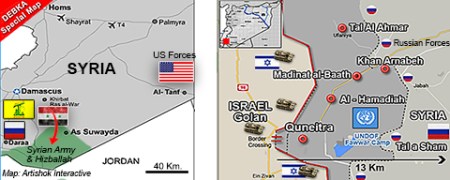
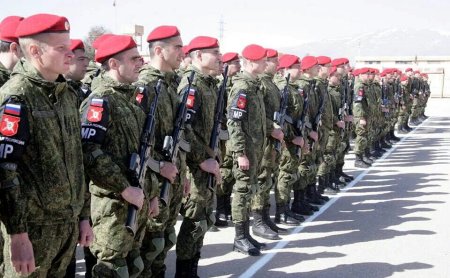
On Wednesday, Aug. 8, two Russian army companies of Ingushet troops from the northern Caucasus set up a command post in the Syrian village of Tal al-Shahm, 13km from Israel’s Golan border. Its commander, Col. Alexei Kozin, has thus taken charge of Syria’s border with Israel. As DEBKAfile reported last month, his task is to set up 10 control checkpoints along that border.

This border area was designated as one of four de-escalation zones agreed on between Presidents Donald Trump and Vladimir Putin at their meeting in Hamburg on July 7.

According to understandings reached between Washington, Moscow and Jerusalem, the UN separation force (UNDOF) will return to its Fawar base opposite Quneitra as a buffer between IDF and Russian forces. Its past history in this role between IDF and Syrian forces was never exactly impressive.

A piece of diplomacy consistent with this process was contributed by Russian foreign Minister Sergey Lavrov on Friday, Aug. 11. It was an assurance that Russia would take into account Israel’s interests in Jerusalem in the framework of Israeli-Palestinian peace talks.

It also fits in with the surprising statement from Washington on the same day, namely, that Donald Trump, although in the midst of a fearsome crisis with North Korea with military overtones, is planning to send his senior adviser, son-in-law Jared Kushner and Israel-Palestinian peace broker Jason Greenblatt, on an early visit to the Middle East to continue this mission.

To see how these disparate elements fill out the whole picture, we turn 70km east from Quneitra on the Syria Golan to the battles ongoing at Sweida in southeastern Syria opposite the Jordanian and Iraqi borders. Russian troops moved into the key town of Daraa, abutting on the Jordanian border on July 13. Like in Quneitra, a month later, they set up command posts to monitor the first de-escalation or ceasefire zone to be set up under the Hamburg accord.

The Russian troops’ assignment was to stop the fighting there and execute the withdrawal of the combatant forces, the Syrian army, Iran, and its foreign Shiite militias, including Hizballah, to a distance of 40km from the border.

But that arrangement never stood up.

Nearly four weeks later, on Wednesday night, Aug. 9, on the same night that Russian troops moved into Quneitra, the Syrian army and Hizballah launched a major offensive in Sweida province. Three days later, by Saturday, they had forced the local rebel forces to retreat into Jordan and seized 57km of Syria’s southern frontier with the Hashemite Kingdom.

Neither the Russians nor the American interfered with the Syrian-Hizballah-led push, although the Russians took responsibility for maintaining the ceasefire, and US special forces were and still are posted to the east of Sweida at Al-Tanf in the Syrian-Jordanian-Iraqi border triangle.

(See attached map)

DEBKAfile’s military sources add that the Syrian-Hizballah offensive violated the ceasefire deal. Local US-backed Syrian rebel groups disbanded without a shot, went over to the Syrian government side and handed in their US-supplied weapons to Syrian army and Hizballah fighters.

The Sweida episode demonstrated how the Syrian-Iranian-Hizballah alliance sees its way to using the Trump-Putin ceasefire zones accord as an open door for seizing control of southern Syria and grabbing the Jordanian and Israeli borders.

The Syrian rebel movement is disintegrating at an alarming rate following the “Jubeir earthquake,” as it has become known – another momentous event which Western and Israeli front pages have chosen to ignore.

Last week, Saudi Foreign Mniser Adel al-Jubeir reportedly informed a delegation of Syrian opposition leaders invited to Riyadh that his government was pulling its support from their fighting militias, in the wake of President Trump’s decision to reduce US military action in Syria solely to the war on ISIS – and therefore end US resistance to the Assad regime.

Saudi officials did not deny the report, only termed it “inaccurate.”

But meanwhile, the decisions by Riyadh and Washington to abandon the anti-Assad cause spread like wildfire among Syrian rebel groups. Many responded by laying down their arms and surrendering.

The fate of the rebel movement after six years of cruel warfare against the dictator Bashar Assad should be an object lesson to other recipients of American and Russian promises. Therefore, Lavrov’s pledge to take Israel’s interests in Jerusalem into account should be taken with a pinch of salt. He was most likely shooting a line to allay Israeli skepticism about the prospect of Russian troops keeping Syrian, Iranian and Hizballah troops at bay from its northern border – even through this pledge was underwritten by Washington.

Instead of taking the two powers at their word, Israel need only watch what is going on in the last few hours just across the border at Sweida, to appreciate the value of such promises.

Sooner or later, the Sweida model will be replicated in Quneitra. Neither the Russian troops nor UN peacekeepers will fight to stop it happening. By then, the Syrian rebel groups, in whose support Israel invested for years as a buffer against hostile Syrian, Iranian and Hizballah forces, are already falling apart. Disowned by their Saudi backers, they are being crushed by the US-Russian “de-escalation” steamroller. Israel like Jordan will soon find three hostile forces sitting pretty just across its border, far too close for safety.

Russia posts troops 8km from the Israeli Golan

July 25, 2017

Russia posts troops 8km from the Israeli Golan, DEBKAfile, July 25,2017

Most of the Russian troops were recruited in Chechnya, Dagestan and Ingushetia, republics known for their Muslim extremist activity.

DEBKAfile recalls that the Russians brought into embattled Daraa earlier this month to monitor the first ceasefire zone did not require Hizballah to withdraw. Iran’s Lebanese proxy is still there. Israel fears that Hizballah will repeat this exercise in the second ceasefire zone and establish a presence opposite the Golan without the Russians raising a finger to keep them out.

*******************************************

Russia has quietly moved troops to a point in southern Syria that is 8km from Israel’s Golan border, in the face of Israeli objections, DEBKAfile reports exclusively. Moscow used the uproar over the Temple Mount standoff and the diplomatic crisis between Israel and Jordan to cover its creeping troop deployment almost up to Syria’s borders with Israel and Jordan.

Tuesday, July 15, Prime Minister Binyamin Netanyahu, Defense Minister Avidor Lieberman and Chief of Staff Lt. Gen. Gady Eisenkott visited Bashan Division headquarters on the Golan for a rundown on the Russian deployment just opposite. (see photo)

DEBKAfile’s military sources report that some 800 Russian troops face Israel and another 400 are positioned on the border with Jordan. They have set up a roadblock east of Quneitra 8km from Israeli positions on the Golan. They have also strung an additional four to six lookout posts, some of them 13km from Israeli military positions, along the 64km Syrian-Israeli border – from Mount Hermon in the north, up to a point south of Qunetra in the south.

Most of the Russian troops were recruited in Chechnya, Dagestan and Ingushetia, republics known for their Muslim extremist activity.

Israel has repeatedly objected to the proximity of this Russian military presence, and asked the Trump administration to prevent it. But the protests from Jerusalem went unheeded in Washington and Moscow. President Donald Trump and Defense Secretary James Mattis regard the creation of US-Russian sponsored ceasefire zones in southwestern Syria as an essential component of their military cooperation in Syria and the war on ISIS.

DEBKAfile’s military sources report that, on Monday, July 24, Moscow announced the Russian deployment after the fact in messages to Washington, Jerusalem and Amman. They were all too engrossed in coping with the crises that had sprung up over Temple Mount and in relations between Jerusalem and Amman to pay much attention to this Russian fait accompli.

According to the announcement by Col.-Gen Sergey Rudskoy, Chief of the Main Operational Directorate of the Russian General Staff, the Russian units were in already in place on July 21 and 22:

“We informed our colleagues from the United States, Jordan and Israel, through military diplomatic channels in advance of the deployment of the Russian-controlled forces around the perimeter of the de-escalation zone in southern Syria,” he wrote.

DEBKAfile recalls that the Russians brought into embattled Daraa earlier this month to monitor the first ceasefire zone did not require Hizballah to withdraw. Iran’s Lebanese proxy is still there. Israel fears that Hizballah will repeat this exercise in the second ceasefire zone and establish a presence opposite the Golan without the Russians raising a finger to keep them out.

Trump ends program to arm anti-Assad jihadis in Syria

July 20, 2017

Trump ends program to arm anti-Assad jihadis in Syria, Jihad Watch

(Please see also, Trump to end lavish CIA support for ‘moderate’ anti-Assad forces in Syria. — DM)

The Washington Post casts this story as evidence that President Trump is a pawn of the Russians, which is more of the Left’s ridiculous campaign to portray the 2016 election as having been stolen by Vladimir Putin. But this is the right decision. These “rebels” are mostly jihadis; arming and aiding them is arming and aiding enemies of the United States.

“Trump ends covert CIA program to arm anti-Assad rebels in Syria, a move sought by Moscow,” by Greg Jaffe and Adam Entous, Washington Post, July 19, 2017:

President Trump has decided to end the CIA’s covert program to arm and train moderate Syrian rebels battling the government of Bashar al-Assad, a move long sought by Russia, according to U.S. officials.

The program was a central plank of a policy begun by the Obama administration in 2013 to put pressure on Assad to step aside, but even its backers have questioned its efficacy since Russia deployed forces in Syria two years later.

Officials said the phasing out of the secret program reflects Trump’s interest in finding ways to work with Russia, which saw the anti-Assad program as an assault on its interests. The shuttering of the program is also an acknowledgment of Washington’s limited leverage and desire to remove Assad from power.

Just three months ago, after the United States accused Assad of using chemical weapons, Trump launched retaliatory airstrikes against a Syrian air base. At the time, U.N. Ambassador Nikki Haley, said that “in no way do we see peace in that area with Assad at the head of the Syrian government.”

Officials said Trump made the decision to scrap the CIA program nearly a month ago, after an Oval Office meeting with CIA Director Mike Pompeo and national security adviser H.R. McMaster ahead of a July 7 meeting in Germany with Russian President Vladimir Putin.

Spokesmen for the National Security Council and the CIA declined to comment….

Russia vies with Israel over aid for Quneitra

July 19, 2017

Russia vies with Israel over aid for Quneitra, DEBKAfile, July 19, 2017

(Please see also, Operation Good Neighbor: Israel’s part in Syria.– DM)

On their arrival in Quneitra, the Russians found a population that was better fed and cared for than Syrian civilians on any other of the country’s warfronts. They are nonetheless challenging Israel for the locals’ hearts and minds.

******************************

As Russian troops began moving into the Quneitra ceasefire sector opposite Israel’s Golan border on Wednesday, July 19, they found they were in hot competition with Israel over … humanitarian aid for the sector’s rebel-held villages.

Since Israel is adamantly opposed to the Russian presence in the Quneitra demilitarized zone – although it was endorsed by the Trump administration, as DEBKAfile reported exclusively on Tuesday, July 18 – Moscow decided to take it slowly and meanwhile try and win over the Syrian rebel groups whom Israel has succored for years. The Kremlin figured that if these anti-Assad groups could be weaned away from Israel, they might be persuaded to cooperate with the Russian troops in setting up the Quneitra ceasefire zone, and the Russians would not need Israel’s compliance.

On Tuesday, therefore, a Russian military convoy drove into Jabah, a village northeast of Qunetra town and 4km from Israel’s Golan border. Officers described as belonging to the “Russian Defense Ministry’s reconciliation center” alit from the trucks and began handing out food packages to the villagers.

The civilians received necessities and were treated by Russian doctors, a Syrian officer announced. Russian and Syrian officers promised that more humanitarian aid would be delivered to “settlements across the Quneitra province” and Russian doctors would visit all the villages in the ceasefire zone.

Israel, who has been sending aid across these Syrian villages which were cut off by the civil war from basic necessities, has mostly kept its humanitarian program under wraps, except when witnesses reported what they saw to the media. On Wednesday, the IDF officers running the program asked sardonically: “Where were the Russians all these years when Israel alone helped the beleaguered villages across its border?”

After watching the Russian troops hand out packages to the people of Quneitra, the Israeli government and military chiefs decided to challenge the Russian belated propaganda move.

Up until now, Israel has supplied regular humanitarian aid to some 200,000 Syrian villagers living in 80 non-ISIS rebel-controlled villages 15km deep inside the Syrian Golan. Last year alone, Israel sent over half a million liters of heavy fuel, 360 tonnes of foodstuffs, 77 tonnes of clothing and shoes, tens of generators and water system, as well as providing them with medical treatment, including hospital care for sick and injured Syrians and a field hospital on the border.

Wednesday, Israel formalized its assistance program under the title “The Good Neighbor” and disclosed it had been administered since 2016 by a special unit of the Bashan Division which is in charge of the Golan sector.

The IDF released footage of trucks ferrying across the border supplies of medical equipment, medicines, foodstuffs and fuel, as well as pictures documenting IDF medics lifting Injured Syrians off the battlefield for treatment in Israeli hospitals.

According to IDF statistics, at least 3,000 Syrians crossed the border in the past four years for medical treatment. And Israel sent over as needed incubators, respirators and ambulances. In the same period, the IDF conducted 150 assistance operations on Syrian soil.

On their arrival in Quneitra, the Russians found a population that was better fed and cared for than Syrian civilians on any other of the country’s warfronts. They are nonetheless challenging Israel for the locals’ hearts and minds.

Russians enter Daraa, Syrians/Hizballah move out

July 12, 2017

Russians enter Daraa, Syrians/Hizballah move out, DEBKAfile, July 12, 2017

Israel has so far objected to any Russian military presence along its borders with Syria, even in the capacity of ceasefire monitors, preferring Americans to police the truce in the Qunetra region. If that proved unfeasible, then Israel would leave the Syrian rebels controlling this area in place.

**********************************

Russian troops stepped into southern Syria for the first time Wednesday, July 13, when they entered the embattled town of Daraa to start enforcing the partial ceasefire agreed by Presidents Donald Trump and Vladimir Putin in Hamburg on July 7.  DEBKAfile’s military sources report this exclusively.

The Russians, including military police and Chechen paratroopers, were sighted getting out of the vehicles of their convoy and taking up positions in the center of Daraa. As they moved into the town, our sources report that tank units of the pro-regime Syrian army’s 5th Armored Division were seen driving out, along with Hizballah.

Their withdrawal cut short the Syrian military’s Operation Big Dawn against the Syrian rebels in Daraa, which breached the ceasefire Monday, July 11 – less then 24 hours after it went into force.

The Russian deployment in a southern Syrian border town Wednesday was the first step in their posting along Syria’s Israeli and Jordanian borders, as agreed between Washington and Moscow. President Trump had assented to this arrangement to bolster the first stage of the Syrian ceasefire going into effect in the de-confliction zone of the southwest.

Jordan also assented, in the interests of de-escalating tensions on its border with Syria.

The Russian troops and Chechens in Russian military police uniforms were armed only with light weapons. On July 5, Putin’s special envoy for Syrian affairs, Alexander Levrentiev, said that the Russian troops deployed in Syrian ceasefire zones would be lightly armed for self-defense. Most would consist of Russian military police. This description was intended to cover the presence of Chechen paratroops, who were seconded to the Russian police force for this mission.

Israel has so far objected to any Russian military presence along its borders with Syria, even in the capacity of ceasefire monitors, preferring Americans to police the truce in the Qunetra region. If that proved unfeasible, then Israel would leave the Syrian rebels controlling this area in place.

But our sources predict that, after the arrival of Russian troops in Daraa to preserve the ceasefire, both Washington and Moscow will lean hard on Jerusalem to accept Russian troops at Quneitra too, that is, opposite the Golan.

Astana Peace Talks Fail over Syrian Safe Zones

July 5, 2017

Astana Peace Talks Fail over Syrian Safe Zones, DEBKAfile, July 5, 2017

DEBKAfile’s sources report that the Russians suggested that the discussion be held over for the next session. They then took the Americans by surprise by relocating the sixth session of the Astana conference to Tehran. This too was a measure of the conference’s breakdown as a peace forum. US, Jordanian and Syrian rebel opposition groups will never travel to the Iranian capital to negotiate an end to the Syrian war.

The ceasefire was supposed to be in effect until midnight on Thursday, June 6, but there is now a possibility that the fighting will resume earlier, perhaps even in the coming hours.

*****************************

The fifth round of Russian-initiated Syrian peace talks taking place Tuesday, July 4, in the Kazakh capital of Astana was designed to prepare the ground for the Trump-Putin summit Friday on the sidelines of the Hamburg G20 summit, by laying out proposals for deconfliction zones in Syria.

To support this move, Moscow twisted the Syrian ruler Bashar Assad’s arm to declare a unilateral ceasefire in southern Syria.

However, the ploy was soon aborted. The Astana conference quickly broke down when Iran and Turkey, two of the three sponsors along with Russia, rejected the formula for deconfliction zones on Syria’s borders with Iraq, Jordan and Israel, DEBKAfile’s sources report.

Present at Astana along with the three sponsors were leading Syrian opposition and rebel groups, as well as UN envoy for Syrian affairs Staffan de Minstura, US Acting Assistant Secretary of State for Near Eastern Affairs Stuart Jones, and Jordanian Foreign Ministry adviser Nawaf Uasfi Tal.

The Iranina and Turkish delegates had no objections to the two demilitarized zones proposed for the Damascus and Homs areas, but withheld their consent for the zones in eastern and southern Syria, and refused to accept the formula for forces policing the latter deconfliction zones, their identity, powers as truce monitors and the types of arms they were allowed to carry.

Iran and Turkey demanded the deployment of their own troops along with Russians in the two safe zones, which border on Israel, Jordan and Iraq, and wanted them armed for “self-defense.” The representatives of the US and Jordan refused, proposing instead that an international force be established to supervise the zones. Turkey and Iran rejected this out of hand.

DEBKAfile’s sources report that the Russians suggested that the discussion be held over for the next session. They then took the Americans by surprise by relocating the sixth session of the Astana conference to Tehran. This too was a measure of the conference’s breakdown as a peace forum. US, Jordanian and Syrian rebel opposition groups will never travel to the Iranian capital to negotiate an end to the Syrian war.

By knuckling under to Tehran on this venue, the Russians have shown their hand as supporters of Iran’s military objectives in Syria, which they have hitherto tried to disguise.

The failure of the Astana peace track calls into question the ceasefire declared on Sunday by Damascus on all the warfronts of southeastern Syria, including the battle for Daraa, 1 km from the Jordanian border, and the fighting for the Quneitra region, just 3 km from Israel’s Golan.  That front was the source of the mortar shells that strayed across the border into the Golan last week.

The ceasefire was supposed to be in effect until midnight on Thursday, June 6, but there is now a possibility that the fighting will resume earlier, perhaps even in the coming hours.

In Syria, Trump’s Red Line May be Holding

June 29, 2017

In Syria, Trump’s Red Line May be Holding, Front Page MagazineJoseph Klein, June 29, 2017

It is not only what Assad has been doing in unleashing his ghastly chemical weapons on his own people, causing horrible suffering in their wake, which demands our attention. After all, Assad has been causing such suffering with conventional weapons as well, including his use of barrel bombs, which we have repeatedly condemned but have not taken specific military action to stop. To do so would almost inevitably draw us into a wider war. What makes chemical and other weapons of mass destruction different is their potential proliferation to the very Islamic terrorists we are trying to defeat.

**************************

Secretary of Defense Jim Mattis claimed Wednesday that the Syrian regime has drawn back from plans to conduct another chemical attack, following a warning by the Trump administration of serious consequences if Syrian President Bashar al-Assad’s forces followed through with their plans. 

U.S. intelligence detected “active preparations for chemical weapons use” at the same air base from which the regime allegedly had launched its prior chemical attack last April that caused mass casualties. President Trump had responded to the April chemical attack with a barrage of cruise missiles targeting that air base. The White House issued its public warning to the Assad regime on Monday in unambiguous terms, declaring that Assad and his military would pay a “heavy price” if his regime conducted another chemical attack.

“It appears that they took the warning seriously. They didn’t do it,” Mattis told reporters.

Nikki Haley, the U.S. ambassador to the United Nations, went even further in crediting the Trump administration for stopping Assad at least for now. “I can tell you that due to the President’s actions, we did not see an incident,” Ambassador Haley claimed at a House of Representatives foreign affairs committee hearing. “I would like to think that the President saved many innocent men, women and children.”

It is difficult to prove what may have actually motivated Assad. In any case, whether Assad holds back for good remains to be seen. But we do know the Trump administration is watching constantly for any moves by the Assad regime that could signal an imminent chemical attack and has military assets in place to swiftly respond to such an attack, if not prevent one in the first place.

President Trump not only demonstrated last April that he would follow through on his threats if certain red lines of his were crossed, unlike our previous president. In addition to its warning, the Trump administration may have sent some concrete signals to the Assad regime that it means business this time as well. According to Debkafile, “Signs were gathering in Washington and the Middle East Tuesday, June 26 that the Trump administration was preparing a substantial military operation against the Syrian army and Bashar Assad’s allies, such as the foreign pro-Iranian Shiite militias and Hizballah. Some US military sources suggested that an American preemptive strike was in store in the coming hours to prevent Assad’s army from again resorting to chemical warfare against his people.”

Assad may still decide to launch another chemical attack, figuring that his key allies, particularly Russia, will continue to back him. No doubt, he took note of Russia’s stern response to the U.S.’s downing of a Syrian warplane earlier this month, including a warning from the Russian Defense Ministry that “All kinds of airborne vehicles, including aircraft and UAVs of the international coalition detected to the west of the Euphrates River will be tracked by the Russian SAM systems as air targets.” The Syrian regime had also already taken some precautions by moving most of its operational aircraft to a Russian airbase in Syria after the April missile strike. The Russian airbase is protected by fairly advanced air defense systems. An American missile strike on Syrian aircraft located at a Russian air base would in all likelihood be seen as a major escalation of the war by the Russian government, risking a direct military confrontation between U.S. and Russia that the Trump administration may be loath to risk. As if to thumb his nose at the Trump administration’s latest threats by demonstrating the strength of his military alliance with Russia, Assad was seen strutting around a Russian air baseinspecting its aircraft and defense systems. He was even photographed sitting in the cockpit of a Russian fighter jet.

Indeed, Russia appears ready to raise the stakes to bolster the Syrian dictator’s regime. Debkafile reports that Russia is “building a new base in southeastern Syria,” which would “provide Russia with a lever of control over the volatile Syrian southeast and its borders, where US-backed and Iranian-backed forces are fighting for dominance.”

As Russia raises the stakes, the U.S. must be clearer than ever as to its strategic objectives in Syria, which it is willing to back up with military force even in the face of Russian threats.  We must do all we can to prevent getting sucked into Syria’s civil war, including by undertaking any military efforts at regime change. That said, we must repel any military action by the Syrian regime or its allies that would prevent us from prosecuting the war against ISIS, which remains our number one objective until the ISIS sanctuaries, infrastructure and leadership are for all intents and purposes destroyed.

However, we also cannot ignore the threat that Assad’s chemical weapons program continues to pose. The Obama administration had thought that it had largely eliminated the threat “diplomatically,” when it reached a phony deal with Russia to oversee the removal and destruction of the Syrian regime’s declared chemical weapons. The opportunity for cheating was all too plain to see, except by Obama and his clueless Secretary of State John Kerry. We are now seeing the consequences. According to Secretary of Defense Mattis, Syria’s chemical program remains intact.

It is not only what Assad has been doing in unleashing his ghastly chemical weapons on his own people, causing horrible suffering in their wake, which demands our attention. After all, Assad has been causing such suffering with conventional weapons as well, including his use of barrel bombs, which we have repeatedly condemned but have not taken specific military action to stop. To do so would almost inevitably draw us into a wider war. What makes chemical and other weapons of mass destruction different is their potential proliferation to the very Islamic terrorists we are trying to defeat. The transfer of chemical or biological weapons to terrorist hands would represent the most dangerous outcome of the Syrian conflict to the rest of the world, including to the United States. That is why we must monitor where we believe Assad’s remaining chemical weapons and production facilities are located, prevent them from being used or even moved from known locations, do all that we can to keep them out of the hands of the terrorists and destroy the chemical weapons and production facilities when the opportunity presents itself.

US pilots will defend themselves as Russia threatens aircraft over Syria, Pentagon says

June 19, 2017

US pilots will defend themselves as Russia threatens aircraft over Syria, Pentagon says, Washington ExaminerJamie McIntyre, June 19, 2017

U.S. pilots over Syria will defend themselves if attacked by Russians, a Pentagon spokesman said Monday, following a report that Russia will treat U.S. or coalition aircraft as targets if they fly over areas in western Syria controlled by Russia.

The Russian Defense Ministry made the threat Monday after a U.S. F/A-18E Super Hornet shot down a Syrian Su-22 after that plane bombed U.S.-backed Syrian Democratic Forces that are working with the U.S. to defeat the Islamic State on Sunday.

“Any aircraft, including planes and drones of the international coalition, detected in the operation areas west of the Euphrates River by the Russian air forces will be followed by Russian ground-based air defense and air defense aircraft as air targets,” the Defense Ministry said.

“We are aware of the Russian statements,” Navy Capt. Jeff Davis, a Pentagon spokesman, said Monday morning. “We do not seek conflict with any party in Syria other than ISIS, but we will not hesitate to defend ourselves or our partners if threatened,” Davis said.

A spokesman for the U.S.-led coalition said the Russian statement has had no effect on the operations in support of U.S.-backed Syrian fighters moving against ISIS in Raqqa in western Syria.

“Coalition aircraft continue to conduct operations throughout Syria, targeting ISIS forces and providing air support for coalition partner forces on the ground,” said Col. Ryan Dillon, chief U.S. military spokesman in Baghdad.

He also appeared to indicate the U.S. is avoiding the parts of Syria where Russia said U.S. planes would be tracked as potential targets or providing additional airpower to counter threats.

“As a result of recent encounters involving pro-Syrian regime and Russian forces, we have taken prudent measures to reposition aircraft over Syria so as to continue targeting ISIS forces while ensuring the safety of our aircrews given known threats in the battlespace,” Dillon said.

The statement was meant as a warning, said Viktor Ozerov, a member of the Russian parliament, described the Defense Ministry’s statement as a warning.

“I’m sure that because of this neither the U.S. nor anyone else will take any actions to threaten our aircraft,” he said, according to state-owned RIA Novosti news agency. “That’s why there’s no threat of direct confrontation between Russia and American aircraft.”

Russia, beyond making the threat to treat U.S. or coalition aircraft as targets, also said its “deconfliction” line with the U.S. has been shut down. The line was established so U.S. and Russian forces could avoid bombing each other as they fight ISIS.

Both Davis and Dillon insisted the hotline remains the best way to avoid future shoot-downs.

“The coalition is always available to de-conflict with the Russians to ensure the safety of coalition aircrews and operations,” Davis said. “The de-confliction line has proven effective at mitigating strategic miscalculations and de-escalating tense situations.”

Said Dillon: “We used the de-confliction line yesterday and remain open to using it. It has proven its worth in the past to tap down tensions.”

How an Iranian general duped US command in Syria

June 10, 2017

How an Iranian general duped US command in Syria, DEBKAfile, June 10, 2017

Our sources cannot confirm for certain what part the Russians played in Iran’s underhand maneuver. Were they in on it, or were they hoodwinked by Soleimani like the Americans? However, the bottom line of this incident is that Syria’s neighbors, Israel and Jordan, face a new and distinctly troublesome downturn in the strategic situation on their borders. The next arena of potential US-Iranian confrontation is building up in Syria’s oil-rich Deir ez-Zor region.

********************************

The Iranian-made Syrian drone downed by US F-15 fighters in southeastern Syria on June 8 was presented by American media as a “pro-regime” drone. It was in fact, as DEBKAfile’s military sources can disclose, an Iranian Revolutionary Guards Shahed-129, which was fired as a part of a complicated ruse to dupe the US commanders while pro-Iranian forces surreptiously moved in on the Syrian-Iraqi border.

The Americans had drawn a line in the Syrian Desert sand 55 km outside the Al-Tanf border crossing embedded in the Syrian-Jordanian-Iraqi border triangle, which is under the control of US, Western and Jordanian special forces, together with a US-trained Syrian rebel group. The Secretary of Defense James Mattis and the US military command in Syria and Iraq were confident that by securing this perimeter, their forces would keep the pro-Iranian advance at bay and the border safe.

When the hostile drone flew past this line, it was shot down. But the Americans were reluctant to let the incident escalate into a major clash, while the Iranians were smarting under the Islamic State attack on Tehran’s national sites. And so they played it down. The next day, therefore, Pentagon spokesman Navy Capt. Jeff Davis reported that “hostilities between the coalition and the pro-regime forces had been avoided thanks to Russian influence. He went on to say: “The calm we see today is largely due to their efforts.”

What brought the Russians onstage?

The sequence of events which unfolded over 48 hours in the Syrian Desert is revealed her by our military sources. The drone was fired as a deliberate provocation to cross the 55-km line enclosing the US-controlled border garrison, on the orders of the Iran’s Gen. Qassem Soleimani. It was intended as a diversion from the real action.

The Russians entered the picture at this stage with an attempt to cool the situation and restore calm. While they were busy assuring the Americans that the Syrian army, Hizballah and its other pro-Iranian allies would refrain from crossing the 55-km line, Qassem moved a large-scale force up to a point just a few hundred meters from the American line.

By Friday, June 9, as Russian de-escalation diplomacy with the Americans wound down, Soleimani’s forces were found to have quietly reached new positions on both sides of the border.

1. He had moved those forces to a point 56km north of Al-Tanf to a rendezvous with pro-Iranian Shiite militias which had come from southern Iraq. That rendezvous breached the Iraqi-Syrian border and attained Iran’s strategic goal of opening up a land bridge between Iraq and Syria.

2. A second pro-Iranian force captured and cut off the roads from northern Syria to the southeastern town of Deir ez-Zor, thereby segregating US and pro-American forces in the north from the American garrison in the south.

Our sources cannot confirm for certain what part the Russians played in Iran’s underhand maneuver. Were they in on it, or were they hoodwinked by Soleimani like the Americans? However, the bottom line of this incident is that Syria’s neighbors, Israel and Jordan, face a new and distinctly troublesome downturn in the strategic situation on their borders. The next arena of potential US-Iranian confrontation is building up in Syria’s oil-rich Deir ez-Zor region.