Archive for the ‘Rocket attack’ category

Filling the Vacuum in Syria

May 28, 2015

Filling the Vacuum in Syria, The Gatestone InstituteYaakov Lappin, May 28,2015

  • The idea that, because Sunni and Shi’ite elements are locked in battle with one another today, they will not pose a threat to international security tomorrow, is little more than wishful thinking.
  • The increased Iranian-Hezbollah presence needs to be closely watched.
  • A policy of turning a blind eye to the Iran-led axis, including Syria’s Assad regime, appears to be doing more harm than good.

As the regime of Bashar Assad continues steadily to lose ground in Syria; and as Assad’s allies, Iran and Hezbollah, deploy in growing numbers to Syrian battlegrounds to try to stop the Assad regime’s collapse, the future of this war-torn, chaotic land looks set to be dominated by radical Sunni and Shi’ite forces.

The presence of fundamentalist Shi’ite and Sunni forces fighting a sectarian-religious war to the death is a sign of things to come for the region: when states break down, militant entities enter to seize control. The idea that, because Sunni and Shi’ite elements are locked in battle with one another today, they will not pose a threat to international security tomorrow, is little more than wishful thinking.

The increased presence of the radicals in Syria will have a direct impact on international security, even though the West seems more fixated on looking only at threats posed by the Islamic State (ISIS), and disregards the possibly greater threat posed by the Iranian-led axis. It is Iran that is at the center of the same axis, so prominent in entangling Syria.

The threat from ISIS in Syria and Iraq to the West is obvious: Its successful campaigns and expanding transnational territory is set to become an enormous base of jihadist international terrorist activity, a launching pad for overseas attacks, and the basis for a propaganda recruitment campaign.

It has already become a magnet for European Muslim volunteers. Their return to their homes as battle-hardened jihadists poses a clear danger to those states’ national security.

Yet the threat from the Iranian-led axis, highly active in Syria, is more severe. With Iran, a threshold nuclear regional power, as its sponsor, this axis plans to subvert and topple stable Sunni governments in the Middle East and attack Israel. Iran’s axis also has its sights set on eventually sabotaging the international order, to promote Iran’s “Islamic revolution.”

This is the axis upon which the Assad regime has become utterly dependent for its continued survival.

Today, the radical, caliphate-seeking Sunni organization, ISIS, controls half of Syria, while hardline Lebanese Shi’ite Hezbollah units can be found everywhere in Syria, together with their sponsors, Iran’s Islamic Revolutionary Guards Corps (IRGC) personnel, fighting together with the Assad regime’s beleaguered and worn-out military forces.

The increased Iranian-Hezbollah presence needs to be closely watched. According to international media reports, an IRGC-Hezbollah convoy in southern Syria, made up of senior operatives involved in the setting up of a base designed to launch attacks on the Golan Heights, was struck and destroyed by Israel earlier this year. The Hashemite Kingdom of Jordan too hasreason to be concerned.
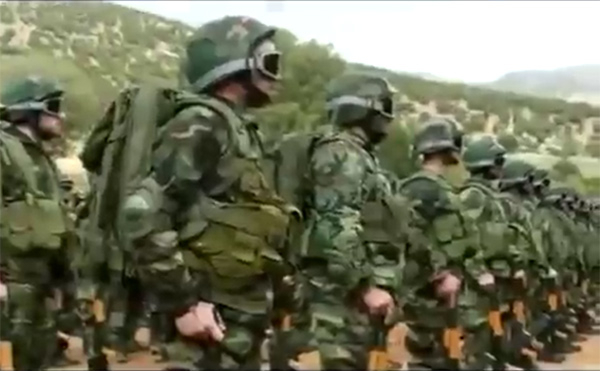
1088Lebanese Shi’ite Hezbollah fighters are deeply involved in Syria’s civil war. (Image source: Hezbollah propaganda video)

Syria has become a region into which weapons, some highly advanced, flow in ever greater numbers, allowing Hezbollah to acquire guided missiles, and allowing ISIS and the Al-Nusra Front to add to their growing stockpile of weaponry.

Other rebel organizations, some sponsored by Saudi Arabia, Turkey, and Qatar, are also wielding influence in Syria. These groups represent an effort by Sunni states to exert their own influence there.

Despite all the efforts to support it, the Assad regime suffered another recent setback when ISIS seized the ancient city Palmyra in recent days, making an ISIS advance on Damascus more feasible. To the west, near the Lebanese border, Al-Qaeda’s branch in Syria, the Al-Nursa Front, also made gains. It threatened to enter Lebanon, prompting Hezbollah to launch a counter-offensive to take back those areas.

These developments provide a blueprint for the future of Syria: A permanently divided territory, where conquests and counter-offensives continue to rage, and the scene of an ongoing humanitarian catastrophe, producing waves of millions of refugees that could destabilize Syria’s neighbors. Syria is set to remain a land controlled by warring sectarian factions, some of whom plan to spread their destructive influence far beyond Syria.

Events in Syria have shown that the notion that air power can somehow stop ISIS’s advance is a fantasy. More importantly, they have also illustrated that Washington’s policy of cooperation with Iran in a possible “grand bargain” to stabilize the region, while failing to take a firmer stance against the civilian-slaughtering Assad regime, is equally fruitless.

A policy of turning a blind eye to the Iran-led axis, including Syria’s Assad regime, appears to be doing more harm than good.


Hezbollah Prepares

May 28, 2015

Hezbollah Prepares, Power LineScott Johnson, May 28, 2015

[T]he Israelis will have to mobilize massive force to shorten the duration of a future war. One of the things they’ll do is immediately is move to eliminate as much of Hezbollah’s vast arsenal as possible. Hezbollah is counting on the resulting deaths of their human shields – and they’ve guaranteed to that the body count will be significant – to turn Israel into an international pariah.

************************

There is so much bad news coming out of the Middle East that it is hard to keep up. Omri Ceren writes from The Israel Project to fill us in on a preview of coming attractions featuring the proxy forces of President Obama’s Iranian friends. Where precisely does Hezbollah fit in Obama’s vision of Iran as a friendly regional power? Too bad Jeffrey Goldberg didn’t riddle Obama that particular question.

This is Omri’s email message verbatim, complete with the URLs of footnoted stories. I thought that readers who have found Omri’s reports helpful might find this of interest as well:

Variations of this story have been bouncing around for the last few weeks. Two weeks ago there were major recent pieces in the NYT and AP articles, where journalists got to look at IDF aerial photography showing that Hezbollah has moved the vast majority of its military infrastructure into Shiite villages [1][2]. They’ve taken their arsenal – 100,000+ rockets including Burkan rockets with half-ton warheads, ballistic missiles including Scud-Ds that can hit all of Israel, supersonic advanced anti-ship cruise missiles, anti-aircraft assets, drones and mini drones, tunnels, etc. – and embedded it across hundreds of villianges and probably thousands of homes.

The Syrian war has been good for Hezbollah in that respect. They’ve cleaned out Assad’s depots and brought the goods back to Lebanon.

The Israelis can’t afford a war of attrition with Hezbollah. The Iran-backed terror group has the ability to saturation bomb Israeli civilians with 1,500 projectiles a day, every day, for over two months. They will try to bring down Tel Aviv’s skyscrapers with ballistic missiles. They will try to fly suicide drones into Israel’s nuclear reactor. They will try to detonate Israel’s off-shore energy infrastructure. They will try to destroy Israeli military and civilian runways. And – mainly but not exclusively through their tunnels – they will try to overrun Israeli towns and drag away women and children as hostages. Israeli casualties would range in the thousands to tens of thousands.

And so the Israelis will have to mobilize massive force to shorten the duration of a future war. One of the things they’ll do is immediately is move to eliminate as much of Hezbollah’s vast arsenal as possible. Hezbollah is counting on the resulting deaths of their human shields – and they’ve guaranteed to that the body count will be significant – to turn Israel into an international pariah. But the Israelis can’t let Hezbollah level their entire country with indiscriminate rocket fire and advanced missiles, just because no one in Lebanon is willing or able to expel the group from Shiite villages.

This weekend’s round of stories actually came from Hezbollah’s side. As-Safir – a Lebanese daily and a major Hezbollah mouthpiece – published a series of puff pieces about how Hezbollah has turned all of southern Lebanon into a vast military complex. I’ve pasted the full AP/TOI write-up at the bottom [omitted here, [a href=”http://www.timesofisrael.com/hezbollah-flaunts-advanced-tunnel-network-on-israeli-border/”>this is the story], but it’s what you’d expect:

According to the reports, based on a tour of Hezbollah facilities given to the newspaper, the group has built a sprawling underground array of tunnels, bunkers and surveillance outposts along the border with Israel, which it is manning at peak readiness for battle. The tunnels are said to be highly-advanced, with durable concrete, a 24-hour power supply via underground generators, a ventilation system to prevent damp from damaging military equipment and a web of secondary escape shafts in case of attack. The tunnels are said to be housing tens of thousands of rockets ready for launch, themselves wrapped in protective materials in order to preserve them.

None of this is new. In early 2013 veteran Israeli war correspondent Ron Ben-Yishai did a deep dive into Hezbollah military posture [3]. He revealed among other things that Hezbollah had given away thousands of homes to poor Shiite families, on the condition “that at least one rocket launcher would be placed in one of the house’s rooms or in the basement, along with a number of rockets, which will be fired at predetermined targets in Israel when the order is given.” Then in 2014 air force chief Major-General Amir Eshel gave a speech outlining how Hezbollah has embedded its military assets in “thousands” of residential buildings, emphasizing that Israel would have no choice but to target that infrastructure in a war. Reuters picked up the speech under the headline “Hoping to deter Hezbollah, Israel threatens Lebanese civilians” [4].

But there’s a lot of chatter in the Middle East about a summer war between Israel and Lebanon, so you’re seeing a new round of stories about what it might look like. On one hand the Israelis and Hezbollah are saying the same thing: all of southern Lebanon is now one big military compound. But only the Israelis are pointing out that Hezbollah has made sure that in that compound there are tens of thousands of civilians.

[1] http://www.nytimes.com/2015/05/13/world/middleeast/israel-says-hezbollah-positions-put-lebanese-at-risk.html
[2] http://hosted.ap.org/dynamic/stories/M/ML_ISRAEL_HEZBOLLAH?SITE=AP&SECTION=HOME&TEMPLATE=DEFAULT&CTIME=2015-05-13-14-10-05
[3] http://www.ynetnews.com/articles/0,7340,L-4343397,00.html
[4] http://www.reuters.com/article/2014/01/29/us-israel-lebanon-hezbollah-idUSBREA0S1PS20140129

IDF Strikes in Gaza Following Rocket Attack

April 24, 2015

IDF Strikes in Gaza Following Rocket Attack, Israel National News,  Elad Benari and Kobi Finkler, April 24, 2015

img517530Israeli airstrike in Gaza  Reuters

The IDF on Thursday night, shortly before midnight, launched an airstrike which targeted a “terrorist infrastructure” in northern Gaza, the IDF Spokesperson’s Unit said in a statement.

According to the statement, the airstrike was in retaliation for an earlier rocket attack by Gaza terrorists on southern Israel.

In addition, said the IDF, the entry of worshipers from Gaza into Israel will be prevented on Friday.

“The IDF will not permit any attempt to harm the security of the citizens of Israel,” the statement said.

The IDF confirmed earlier that at least one terrorist rocket had been fired from Gaza at southern Israel.

There were no reports of physical injuries or damage. The remains of one rocket were located in an open area in the Sha’ar Hanegev region.

The last time a Color Red siren was heard in the Gaza Belt region was in late December – four months ago. In response, IAF jets attacked Hamastraining grounds in Khan Yunis, in southern Gaza.

