Archive for the ‘Republican establishment’ category

Bill Kristol: Republican Spoiler, Renegade Jew,

May 16, 2016

Bill Kristol: Republican Spoiler, Renegade Jew, Front Page Magazine, David Horowitz, May 16, 2016
wc

Reprinted from Breitbart.

While millions of Republican primary voters have chosen Donald Trump as the party’s nominee, Bill Kristol and a small but well-heeled group of Washington insiders are preparing a third party effort to block Trump’s path to the White House. Their plan is to run a candidate who could win three states and enough votes in the electoral college to deny both parties the needed majority.  This would throw the election into the House of Representatives, which would then elect a candidate the Kristol group found acceptable. The fact that this would nullify the largest vote ever registered for a Republican primary candidate, the fact that it would jeopardize the Republican majorities in both the House and Senate, and more than likely make Hillary Clinton president apparently doesn’t faze Kristol and company at all. This is to give elitism a bad name.

One would think that the Trump opponents would have substantial reasons for pursuing such a destructive course. But examination of their expressed reasons shows that one would be wrong. Their chief justification for opposing Trump is that he is not a “constitutional conservative” and in fact is “without principles” and therefore dangerous. The evidence offered is that he has supported Democrats in the past, and changed his positions on important issues. Yet in seeking a candidate to carry their standard the Kristol group has approached billionaire investor Mark Cuban a figure uncannily similar to Trump. During the presidential election year 2012, the Hollywood Reporter noted that, “in February, billionaire sports and media mogul Mark Cuban was seen hugging Barack Obama at a $30,000-a-plate fundraiser for the president’s re-election bid.” Cuban was also a visible campaigner for Obama four years earlier. A fan of Obamacare, Cuban wrote a column forHuffington Post just before the 2012 election titled, “I would vote for Gov. Romney if he were a Democrat.” Now it is true that Mark Cuban eventually had second thoughts about Obama, and perhaps even about Democrats. But what these facts show is that Kristol and his allies are willing to elect anyone but Trump and have even fewer principles than the man they hate.

A second charge against Trump is that his character is so bad (worse than Hillary’s or Bill’s?) that no right-thinking Republican could regard him as White House worthy. “I just don’t think he has the character to be president of the United States,” Kristol declared in a recent interview. “It’s beyond any particular issue I disagree with him on, or who he picks as VP or something. The man in the last five days has embraced Mike Tyson, the endorsement of a convicted rapist in Indiana…. He likes toughness, Donald Trump, that’s great, he likes rapists.” This would be fairly damning if the facts were as black and white as Kristol presents them. But as anyone familiar with the sports world would know, Mike Tyson had a dramatic change of heart following his release from prison – rejected the life he had led, repented his past, and committed himself to a course of humility and service to others.

Here is an online news summary of the transformation: “Former boxing champ Mike Tyson has dedicated the rest of his life to caring for others – because he considers himself a ‘pig’ who has ‘wasted’ so many years of his life.”  Tyson himself toldDetails Magazine: “The first stage of my life was just a whole bunch of selfishness. Just a whole bunch of gifts to myself and people who didn’t necessarily deserve it. Now I’m 44, and I realize that my whole life is just a f**king waste. ‘Greatest man on the planet’? I wasn’t half the man I thought I was.” In an autobiographical best-seller, Tyson also conducted a searing self-examination, which was condensed into a one-man Broadway performance and HBO special. Whatever one thinks of Mike Tyson before or after his conviction, one has to concede that he has made a serious self-inventory and changed the way he sees himself and others. If Kristol were serious about the politics of winning elections rather than merely pontificating about them, he would have known these facts and also recognized that Tyson is an icon to an important segment of the voting population – one that is more likely than not to offer sincere repenters a second chance. Electorally speaking, Trump’s ability to win the endorsement of an African American sports champion is no small achievement. Nor is it an isolated one. Trump has also been endorsed by Adrien Broner, a world boxing champion in four weight classes, who is also African-American.

In addition to alleging that Trump is lacking in principles and character, Kristol claims that the Republican candidate is a crackpot conspiracy theorist, a disqualifying trait. Kristol’s evidence is a remark Trump made on the eve of the Indiana primary suggesting that Ted Cruz’s father might have something to hide about his alleged acquaintance with Kennedy assassin Lee Harvey Oswald. Wrote Kristol: “Calling in to Fox and Friends, Donald Trump, as Politico summarized it, ‘alleged that Ted Cruz’s father was with John F. Kennedy’s assassin shortly before he murdered the president, parroting aNational Enquirer story claiming that Rafael Cruz was pictured with Lee Harvey Oswald handing out pro-Fidel Castro pamphlets in New Orleans in 1963.’” The liberal writers at Politico can perhaps be forgiven for reporting that the Enquireronly claimed that Oswald and the senior Cruz were pictured together. The Enquirer actually published the picture.

“Here’s Trump in his own crazed words,” Kristol continues: [Trump:] “His father was with Lee Harvey Oswald prior to Kennedy’s being — you know, shot. I mean, the whole thing is ridiculous. What is this, right prior to his being shot, and nobody even brings it up. They don’t even talk about that. That was reported, and nobody talks about it. I mean, what was he doing — what was he doing with Lee Harvey Oswald shortly before the death? Before the shooting? It’s horrible.’” Comments Kristol: “What’s horrible is a leading presidential candidate trading in crackpot conspiracy theories.”

So it might be if Trump were actually putting forward a conspiracy theory.  But what we have here, obviously, is not a theorybut some Trumpian campaign mischief – not dissimilar in form to his earlier suggestion that because Ted Cruz was born in Canada he might not be able to actually run for president even if he were to win the nomination. These were both campaign tricks – dirty tricks if you like – to throw a rival off balance and gain an advantage. Were they dirtier than publishing nude photographs of Trump’s wife during the Utah primary, or publishing a false story that Ben Carson was quitting the race on the eve of the Iowa primary, as the Cruz campaign did? Do they justify sabotaging a Republican run for the presidency and potentially electing Hillary Clinton?

Kristol is aware that his strategy risks electing an Obama loyalist, and attempts to neutralize the objection by claiming that Trump is himself an Obama clone whose policies would be no different: “[T]here is a president whose policies Donald Trump’s would in fact resemble: Barack Obama. No intervention against dictators? Check. No action to prevent mass slaughter? Check. Another reset with Putin’s Russia to break what Trump calls the ‘cycle of hostility’…? Check. ‘Getting out of the nation-building business, and instead focusing on creating stability in the world?’ Check! Trump’s agenda turns out to be Obama’s all-too-familiar agenda of national retreat masked by a rhetoric of America First bellicosity.”

This is pretty shabby stuff. Contrary to Kristol, far from being a non-interventionist, Obama conducted two interventions against dictators in Egypt and Libya with disastrous consequences. The intervention in Libya, which Kristol supported, has created two million refugees, hundreds of thousands of corpses and a terrorist state. One might suppose that a little re-thinking of interventionism would be in order. Trump’s readiness to rethink interventionism is hardly the same as Obama’s strategy of retreat and surrender. Contrary to Kristol’s assertion, Trump is not opposed to all interventions against dictators. He has promised to do what it takes to destroy ISIS, which includes bombing its oil facilities and destroying its headquarters, and is obviously only possible with interventions in Syria and Iraq. Destroying ISIS would also be an action to prevent mass slaughter, despite Kristol groundless claim. As for Trump proposing “another re-set with Putin’s Russia,” there was no re-set with Russia under Obama. Attempting a serious re-set – a re-set from strength – would seem reasonable and prudent, and would hardly be a repeat of Obama’s policies. It would be just the opposite.

“Getting out of the nation-building business and instead focusing on creating stability in the world” is hardly an Obama policy, as Kristol suggests. Obama’s intervention in Eygpt, put the Muslim Brotherhood in power; when the Egyptian military then overthrew the Brotherhood, Obama sided with the Brotherhood and alienated the most important power in the Middle East. These acts, together with Obama’s withdrawal from Iraq and waffling in Syria, created a power vacuum that spreadinstability throughout the region. “Avoiding nation-building, while focusing on creating stability” is a foreign policy any true constitutional conservative would support. Unless that conservative was driven by an irrational hatred of Trump. Finally, Trump’s promise to put American interests first and restore respect for America through rebuilding American strength can only be described as a “national retreat” by a very unprincipled – and careless – individual.

All these dishonesties and flim-flam excuses pale by comparison with the consequences Kristol and his “Never Trump” cohorts are willing to risk by splitting the Republican vote. Obama has provided America’s mortal enemy, Iran, with a path to nuclear weapons, $150 billion dollars, and the freedom to develop intercontinental ballistic missiles to deliver the lethal payloads. Trump has promised to abandon the Iran deal, while Hillary Clinton and all but a handful of Democrats have supported this treachery from start to finish. Kristol is now one of their allies. I am a Jew who has never been to Israel and has never been a Zionist in the sense of believing that Jews can rid themselves of Jew hatred by having their own nation state. But half of world Jewry now lives in Israel, and the enemies whom Obama and Hillary have empowered – Iran, the Muslim Brotherhood, Hezbollah, ISIS and Hamas – have openly sworn to exterminate the Jews. I am also an American (and an American first), whose country is threatened with destruction by the same enemies. To weaken the only party that stands between the Jews and their annihilation, and between America and the forces intent on destroying her, is a political miscalculation so great and a betrayal so profound as to not be easily forgiven.
Trump’s Moment

May 13, 2016

Trump’s Moment, Power LineSteven Hayward, May 13, 2016

[M]ight we make Trump the precedent-shattering break from historical practice? We very well might, for the simple reason that only someone who is genuinely an outsider—a way outsider in every way—like Trump stands a chance of restoring some semblance of sensible government. One can imagine a President Trump governing like “President Dave” in the movie from the mid-1990s, and saying “Why do we have 55 federal job training programs? How about eliminating at least two-thirds of them?” Rinse and repeat. In other words, what is required is a disposition much different than Ross Perot’s risible slogan of “getting under the hood and fixin’ it.”

************************

I recant none of my previous criticisms of Trump’s unsuitability to be president, but the case that he—and he alone—has an unprecedented opportunity to disrupt (in the right ways) the crisis of American government today deserves to be understood. The most sophisticated, though perhaps sophistical, case comes from our friends at the Journal of American Greatness, though even they admit that they may be reading more into Trump than is there. (And c’mon Decius, no one who uses the term “noetic heterogeneity” is going to get a job in the Trump Administration.)

I have a simpler case, and, unusual for me, it doesn’t require any classical metaphysics. I keep coming back to the curious fact that so many Bernie Sanders voters (almost half in West Virginia) say they will vote for Trump if Bernie doesn’t get the nomination. This can’t be because they think Trump is a socialist. And I doubt the dislike of Hillary sufficiently explains it either.

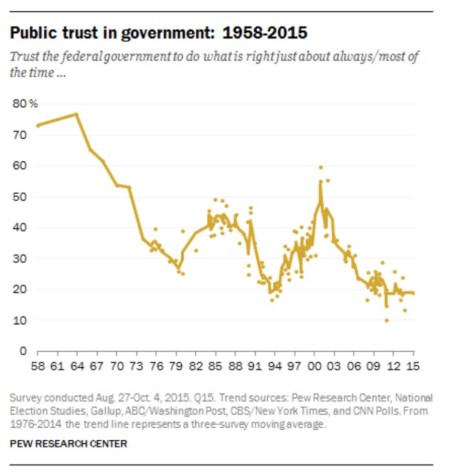
I think the explanation lies in this chart:

Public-Trust-Chart-copy

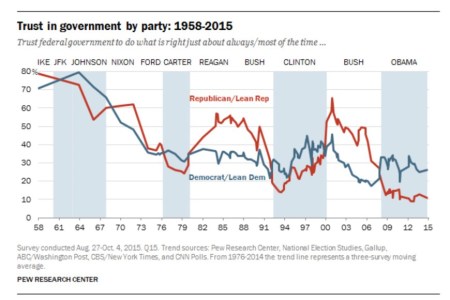
This trend is well-known among public opinion survey monkeys, and it is worth observing several things. First, the overall decline in public confidence in the competence of the federal government. Second, notice the two places where the trend reverses—during the Reagan years, and right after 9/11, when President Bush and the national government was wholly focused on its chief responsibility: defending the nation. Third, it is conspicuous that there has been no upturn at all under Obama. You’d think he could expect some bump even from a weak economy. If you break down this data by party (see next chart) you can see that Obama doesn’t even get much of a bump up from Democrats.

Trust-by-Party-copy

Finally, look at public opinion about the government from this point of view, which finds that 79 percent of Americans—four out of five—are frustrated or angry with the federal government.

Public-Frustration-copy

Some observations. First, you’ll note in the first chart that back in the early 1960s, public confidence in the federal government was fairly high, even though liberals told us that the Eisenhower years were dreadful, etc. As James Q. Wilson once pointed out, in 1960 what most people had in front of them was a government that had successfully accomplished some large things: it had won a World War in short order; it had educated millions of troops who came home from that war through the G.I. Bill; it has begun the interstate highway system, an eminently practical undertaking. California built a huge water project (for people back then—imagine that) and other things.

In those days, the government wasn’t trying to solve poverty, promote self-esteem, heal our souls, etc. It[s pretty easy to see that public confidence in the federal government began its long term decline exactly when the government became incompetent at foreign and domestic policy simultaneously. Liberalism has never recovered from this. But neither has the Republican Party ever achieved much serious reform. And the quagmire of the Iraq War under Bush deprived Republicans of an example of the one thing they were supposed to be able to do better than Democrats. (Yes, the surge worked, and we prevailed before Obama threw it away. But it cost too much and came too late to stave off the political damage to Republicans.)

Meanwhile, what do liberals want to build today? No new dams or highways, but high speed rail that no one will ride and urban transit systems (like DC’s Metro) that they can’t maintain. A health care system that remains hated by a majority of Americans. An airport security system that everyone knows is a costly joke. Need I go on? Liberals and the media would like everyone to think that people are disgusted with “gridlock” in Washington (which is only liberal code for saying conservatives should unilaterally disarm so government can do even more things). I don’t think that’s it at all. I think a majority are disgusted with an incompetent government. The mode of public conversation about the federal government is contempt, not frustration that it isn’t doing even more.

Most of the leading candidates of both parties talk about “reform,” but mostly offer mere tinkering. Republicans offer tax cuts; Democrats offer more free stuff. Neither is credible any more. Which brings us to Trump. His difference from the political class is obvious, and has been widely remarked upon, so I won’t repeat that part of the story. Bottom line: we reached a point of such bipartisan disgust with the government that someone like Trump looks like the only kind of person who could conceivably take it on.

One more key political fact, though: We have never elected someone with no prior experience in public office at all to the presidency. (I count being supreme commander of Allied armies in WWII—Eisenhower—as experience in public office. Ditto Grant, etc.) Only once has a major party ever nominated someone from the business world with no experience in public office: Wendell Willkie in 1940. He was a very credible figure, and might have won in the absence of the growing shadow of war.

So might we make Trump the precedent-shattering break from historical practice? We very well might, for the simple reason that only someone who is genuinely an outsider—a way outsider in every way—like Trump stands a chance of restoring some semblance of sensible government. One can imagine a President Trump governing like “President Dave” in the movie from the mid-1990s, and saying “Why do we have 55 federal job training programs? How about eliminating at least two-thirds of them?” Rinse and repeat. In other words, what is required is a disposition much different than Ross Perot’s risible slogan of “getting under the hood and fixin’ it.”

Does Trump understand the nature and magnitude of the problem, and thereby his extraordinary opportunity? I’m doubtful, but he just might kindof, sortof grasp it in his instinctual, elemental way. And his very brashness might be just the kind of approach to accomplishing a few things.

You can find the extensive background to the three charts shown here from the Pew Research Center.

Trump Derangement Syndrome

May 12, 2016

Trump Derangement Syndrome, Front Page MagazineDavid Horowitz, May 12, 2016

bs (1)

I don’t think I speak for myself alone when I confess utter bewilderment at the number of conservatives – among whom I count long-term friends – who seem to have lost their marbles when assessing the presidential candidacy of Donald Trump.The Wall Street Journal’s Bret Stephens, to take one example that can stand for many, is an astute analyst – in my view one of the best political commentators writing today. Yet he is the author of this opening paragraph in Monday’s paper, which leaves me scratching my head, and embarrassed for my friend: “The best hope for what’s left of a serious conservative movement in America is the election in November of a Democratic president, held in check by a Republican Congress. Conservatives can survive liberal administrations, especially those whose predictable failures lead to healthy restorations—think Carter, then Reagan.”[1]

I can’t think of anything that is right about these sentences. The president’s first business is the nation’s security. Did Reagan really repair the damage that Carter did? It is true that he pulled the nation back from Carter’s policies of appeasing our enemies and disarming our military. But he failed to retrieve Carter’s greatest foreign policy disaster. It was Carter who brought down America’s ally, the Shah of Iran, and brought the Ayatollah Khomeini back from exile, thereby transforming Iran into the first jihadist state, and America’s deadliest enemy. Neither Ronald Reagan nor both George Bushes could undo that.

Could a Republican Congress – assuming that there would be a Republican Congress if Trump lost – hold a Democratic president like Hillary Clinton “in check”? How did that work out during the destructive reign of Barack Obama? With Republican majorities in the House and Senate Obama had no real problem in becoming the first American president to build his legacy around a policy that can fairly be described as treasonous – providing a path to nuclear power and ballistic missile capability to an Iranian regime that is our nation’s mortal enemy, has already murdered thousands of Americans, and is ruled by religious fanatics who have made no secret of their determination to destroy us.

Bret Stephens and an all-too-prominent cohort of inside-the-beltway conservatives want to turn the presidency over to Hillary Clinton “to save conservatism.” What can this mean? Have they forgotten who Hillary Clinton is? As Secretary of State she was the foreign policy captain in an administration that abandoned Iraq, thereby betraying every American and Iraqi who gave his or her life to keep that benighted country out of the hands of the terrorists and Iran (not that any Republican had the temerity to say so). ISIS is as much her godchild as Barack Obama’s. In creating the vacuum that ISIS filled Hillary was only carrying on the Democratic foreign policy tradition that Jimmy Carter inaugurated of sacrificing America’s security to pie-eyed internationalist delusions. As Secretary of State Hillary Clinton supported the overthrow of an American ally in Egypt and its replacement by the Muslim Brotherhood, the fountainhead of al-Qaeda and ISIS. She colluded in the overthrow of an American ally in Libya – a country posing no threat to the United States – thereby turning it into a base for ISIS and al-Qaeda. It was Hillary who was behind the gunrunning scheme to al-Qaeda rebels in Syria that led to the Benghazi disaster. She denied Ambassador Stephens – her American pawn in Benghazi – the security he requested in order to cover Obama’s retreat in the war on terror (it was election time), and then lied about his murder and that of three American heroes to the American people, to the mothers and fathers of the dead heroes, and to the world at large. According to the official version she approved insulting the prophet Mohammed was the problem not the terrorist onslaught that she and Obama had helped to unleash. Now we have learned that she willfully violated America’s Espionage Act, resulting in tens of thousands of her emails, classified and unclassified falling into the hands of the Russians and other adversary powers, and leading to how many future American casualties we can only guess.

This is the president that Bret Stephens and Bill Kristol and George Will think would be better for conservative values and conservative concerns than Donald Trump, a man who has raised an admirable family (a character-reflecting feat his detractors always overlook) and whose patriotism in the course of a long public life has never been in question. Nonetheless, it is Hillary Clinton – this serial liar, this traducer of the nation’s trust, this corrupt taker of $600,000 speaking fees and multi-million dollar gifts from foreign governments while acting as Secretary of State –this wretched individual who in their eyes is “survivable” should she become president.

And what isn’t survivable? “What isn’t survivable is … a serial fabulist, an incorrigible self-mythologizer, a brash vulgarian, and, when it comes to his tax returns, a determined obfuscator.” I blush for my friend making these charges, first because they are sins common to most politicians (with admittedly less flair than Donald Trump) and second because of the reason he gives for why they should matter: “Endorsing Mr. Trump means permanently laying to rest any claim conservatives might ever again make on the character issue.”

The character issue! Oh yes, that vital conservative weapon. And how did the use of it actually work out when it was put before the entire nation? Approaching the end of Clinton’s second term, Republicans made a political season out of his bad character and actually managed to impeach him for abusing women and lying to a grand jury. But when it was over, there wasn’t a pundit or pollster around who didn’t think that Bill Clinton would have an odds on chance of being elected to a third term in 2000 if the 22nd Amendment had allowed him to run.

This is not serious stuff, yet it is being peddled by first-rate conservative intellects and the fate of our nation may yet hang on it. The greatest obstacle to a Republican victory in November is the fratricidal war now being waged by the “Never Trump” crowd against the only person who might prevent the disaster awaiting us if the party of Obama and Kerry and Hillary and Sharpton prevails in November.

Their Trump hysteria notwithstanding, I still have the highest regard for the intellects of Bret Stephens and George Will and their comrades-in-arms. But I am hoping against hope that they come to their senses before it is too late.

Notes:

Donald Trump, Bill Whittle and Republican Principles

May 11, 2016

Donald Trump, Bill Whittle and Republican Principles, Dan Miller’s Blog, May 11, 2016

(The views expressed in this post are mine and do not necessarily reflect those of Warsclerotic or its other editors. — DM)

In 2012, after Mitt Romney lost the presidential election, Bill Whittle delivered an address on Republican principles. The Timid Republican Party has substantially ignored those principles and is not guided by them. Party candidates nevertheless continue to mouth them at election time. Perhaps they understand what the voters want and recite their fealty to get their votes. Once safely in office, they revert to ignoring those same principles.

During the current Republican nomination process, the Establishment has chastised Donald Trump for not being a “real” Republican and not adhering to Republican principles — the principles which they themselves ignore, by which he abides and by which as our President he will continue to abide. As they cringe at his refusal to mince words and to be politically correct, they seem uncomfortable with his wealth and his decision to finance his own primary campaign. Trump is very comfortable with being rich and is rightfully proud of what he has been able to do because of it — including not being subservient to wealthy donors and donor collectives to which Establishment members are themselves subservient.

While watching the video, please ponder what Trump would say — and do — as our candidate and then as our President.

It strikes me that Trump and Whittle care more about “Republican principles” than do members of the Republican Establishment. Trump is substantially more likely to support and adhere to those principles than the Party Establishment has, and than any candidate it would prefer has or would. In recent months, the “unwashed vulgarian” Republican masses have shown that they do as well. They are right.

The Republican Party Died Long Before Trump

May 9, 2016

The Republican Party Died Long Before Trump, American ThinkerBrian C. Joondeph, May 9, 2016

(The Republican Establishment, not the Republican Party, is dead. The party is on a path leading in the direction its voters, rather than the Bush Dynasty, Romney, et al want it to go. That’s a good thing. — DM) 

Donald Trump all but clinched the Republican Party nomination after his decisive win in Indiana. The post mortems have begun. Blame, recrimination, and threats, particularly from those who failed to secure the nomination for themselves or their favored candidate.

The headline of the week has been the death of the Grand Old Party. The Atlantic proclaimed, “The Day the Republican Party Died.” Perhaps Don McLean can be plucked from the shelves of the Rock and Roll Museum, dusted off, and tasked with writing a new song. “The three men I admired most, Jeb, Ted, and Mitt, caught the last #NeverTrump train for the coast.” Mr. McLean can work on the rhyming bit.

“RIP, GOP” wrote the Boston Globe. As did the NY Daily News, pronouncing the GOP dead in 2016. You get the idea. Did the Republican Party truly drop dead on the first Tuesday of May 2016? Or has the party suffered a long, terminal illness, sustained by extraordinary life support measures for the past few years, only to have Republican voters finally pull the plug during this election cycle?

I contend that the Republican Party was diagnosed with a terminal disease way back in 1988, almost thirty years ago. One might argue that when Ronald Reagan, on his last day in office, boarded his “last train for the coast”, was the day the GOP’s “music died.”

Think of other chronic medical diseases, such as Alzheimer’s, Parkinson’s, or cancer. The mind or body slowly fail, not typically in a linear fashion, but always in a long term unrelenting downward trajectory. There are improvements along the way, providing hope to those afflicted and their loved ones, but the hope is short lived, and the disease, despite a short pause, picks up where it left off.

The first sign of illness post Reagan was George HW Bush, in his acceptance speech at the RNC convention, calling for “a kinder and gentler nation.” Kinder and gentler than what? Obviously a repudiation of Reagan’s brand of conservatism, which candidate Bush once called “voodoo economics.” Perhaps HW looked back on eight years of Reagan and said to himself, “Bad news on the doorstep, I couldn’t take one more step.”

Next was George HW Bush’s famous pledge, “Read my lips. No new taxes.” Right out of the Republican Party playbook. Music to conservative ears. Cancer in remission. Until he turned his back on his pledge and raised taxes. Kicking the Republican Party in the teeth.

This paved the way for eight years of Bill and Hillary Clinton. “While the king was looking down, the jester stole his thorny crown.” King George HW Bush looked down with contempt at the Republican base and Bubba the jester not only stole the crown, but used Bush’s “no new taxes” words against him in the 1992 presidential campaign.

The patient was not dead however. Signs of life appeared as Newt Gingrich’s Contract with America in 1994 infused the GOP with lifesaving doses of “accountability, responsibility, and opportunity.“ New life, GOP control of Congress, and hope that the demise of the Republican Party had been arrested.

Enter a new era for the Republican Party in 2002 with George W Bush and his promise of “compassionate conservatism.” Just as with his father before him, more compassionate than what? Reagan’s conservatism? Newt’s Contract with America? Did this help or hurt the Republican Party?

“I went down to the sacred store, where I’d heard the music years before. But the man there said the music wouldn’t play.” Republicans heard the music of Reagan years before but Bush proclaimed the song was over. No conservative was George W Bush. Foolhardy and misguided military follies in the Middle East. Expansion of the federal education bureaucracy with Ted Kennedy via No Child Left Behind. Medicare Part D expansion increasing government control of healthcare. Promotion of open borders via amnesty. And a massive increase in government spending.

Enough to make voters wonder whether President George W Bush was a Republican or a Democrat. Republican voters “sang dirges in the dark,” staying home in 2006, handing Congress back to the Democrats. Quite the legacy for Bush and another turn for the worse in the health of the GOP.

In 2008, “a generation lost in space” saw the Republican Party on life support and voted for President Hope and Change. And change is what we got. But not for the better. In 2010 the GOP cancer went into remission, again in 2014, with two landslide midterm elections handing control of the House and Senate back to Republicans.

Was this the road to recovery for the Republican Party or just a brief pause in the GOP death rattle? Republican voters asked their party “for some happy news, but she just smiled and turned away.” The GOP-controlled Congress turned abruptly from its campaign promises. Spending continues unabated. Obamacare and Planned Parenthood remain fully funded. The IRS remains unpunished. Executive amnesty proceeds according to Obama’s wishes. Iran got its nuke deal. Endless executive orders mocking the separation of powers. Everything playing out as if Harry Reid and Nancy Pelosi were still in charge.

The EKG showed the Republican Party with a flat line, no pulse, no blood pressure, and no brain activity. “The day the music died.”

Along came Donald Trump. Not a conservative. Not even a politician. But a pragmatist able to identify the disease killing the Republican Party, offering a brash, politically incorrect, yet popular set of solutions for injecting life back into the party.  Sixteen other candidates, all extremely accomplished in their own right, methodically destroyed and removed from the nomination race. The media and the GOP elites unable to respond or stop the Trump train. “No angel born in Hell could break that Satan’s spell.”

The candidates and the entire Republican establishment were perplexed and frustrated. “Oh and as I watched him on the stage, my hands were clenched in fists of rage.” They said #NeverTrump and promised to either vote for Hillary Clinton or sit out the presidential election entirely. The same party elites who told us to hold our noses and vote for McCain and Romney for the sake of “party unity” are now kicking sand and running home with all of their toys.

Yet they blame Donald Trump for the demise of the Republican Party, not realizing that all Trump did was act as the coroner, examining the GOP corpse, declaring it dead, and signing the death certificate. The Republican Party elites are, “Them good ole boys drinking whiskey and rye, singin’ this’ll be the day that I die.” Not realizing that they died decades ago.


The “Never Trump” Pouters

May 9, 2016

The “Never Trump” Pouters, Front Page Magazine, David Horowitz, May 8, 2016

bill-kristol_2

Reprinted from Breitbart.com.

The conservatives who have declared war on the primary victor are displaying a myopia that could be deadly in November when Trump will lead Republicans against a party that has divided the country, destroyed its borders, empowered its enemies and put 93 million Americans into dependency on the state. This reckless disregard for consequences is matched only by a blindness to what has made Trump the presumptive nominee. When he entered the Republican primaries a year ago Trump was given no chance of surviving even the first contest let alone becoming the Republican nominee. That was the view of all the experts, and especially those experts with the best records of prediction.

Trump – who had never held political office and had no experience in any political job – faced a field of sixteen tested political leaders, including nine governors and five senators from major states. Most of his political opponents were conservatives. During the primaries several hundred million dollars were spent in negative campaign ads – nastier and more personal than in any Republican primary in memory. At least 60,000 of those ads were aimed at Trump, attacking him as a fraud, a corporate predator, a not-so-closet liberal, an ally of Hillary Clinton, indistinguishable from Barack Obama, an ignoramus, and too crass to be president (Bill Clinton anyone?).

These negative ads were directed at Republican primary voters, a constituency well to the right of the party. These primary voters are a constituency that may be said to represent the heart of the conservative movement in America, and are generally more politically engaged and informed than most Republican voters. Trump won their support. He won by millions of votes – more votes from this conservative heartland than any Republican in primary history. To describe Trump as ignorant – as so many beltway intellectuals have – is merely to privilege book knowledge over real world knowledge, not an especially wise way to judge political leaders.

A chorus of detractors has attempted to dismiss Trump’s political victory as representing a mere plurality of primary voters, but how many candidates have won outright majorities among a field of seventeen, or five or even three? When the Republican primary contest was actually reduced to three, Trump beat the “true conservative,” Ted Cruz, with more than fifty percent of the votes. He did this in blue states and red states, and in virtually all precincts and among all Republican demographics. He clinched the nomination by beating Cruz with an outright majority in conservative Indiana.

In opposing the clear choice of the Republican primary electorate the “Never Trump” crowd is simply displaying their contempt for the most politically active Republican voters. This contempt was dramatically displayed during a CNN segment with Trump’s spokeswoman, Katrina Pierson, and Bill Kristol, the self-appointed guru of a Third Party movement whose only result can be to split the Republican ticket and provide Hillary with her best shot at the presidency. Pierson urged Kristol to help unify the Party behind its presumptive nominee. Kristol grinned and answered her: “You want leaders to become followers.” Could there be a more arrogant response? By what authority does Bill Kristol regard himself as a leader? Trump has the confidence of millions of highly committed and generally conservative Republican voters. That makes him a leader. Who does Bill Kristol lead except a coterie of inside-the-beltway foreign policy interventionists, who supported the fiasco in Libya that opened the door to al-Qaeda and ISIS?

I say this as someone who has written three books supporting the intervention in Iraq and who thinks Trump is dead wrong on this issue. However I also understand that the Bush administration did not defend the war the Democrats sabotaged, allowing its critics to turn it into a bad war in the eyes of the American people. Consequently, Trump’s attack on the intervention is a smart political move that will allow him to win over many Democrat, Independent and even conservative voters who think Iraq was a mistake and do not appreciate the necessity of that war or the tragedy of the Democrats’ opposition to it. You can’t reverse historical judgments in election year sound bites. Understanding this, instinctively or otherwise, makes Trump politically smarter than his Washington detractors.

Conservatives like Kristol claim to oppose Trump on principles but then turn to Mitt Romney for a Third Party run. This is the same Mitt Romney who as governor of Massachusetts was the father of Obamacare but ran against Obamacare in 2012. So much for principles.

“True conservatives” claim the Constitution as their bible. But, as everybody knows, the first principle of that document is tnat the people are sovereign. The people’s voice, expressed at the ballot box, determines who leads. The “Never Trump” conservatives don’t respect this principle. What other conclusion can be drawn from their arrogant repudiation of a candidate whose authority derives from the expressed will of the people?

The Never Trump elites claim the voters are fools because Trump is “utterly unfit to be president by temperament, values and policy preferences.” This is the phrase used by Eliot A. Cohen a former Defense and State Department official in the Bush 41 and Bush 43 administrations. It is a sentiment  common to most anti-Trump commentators.

But what can it possibly mean? During the first Republican debate, in front of a television audience of 17 million people, Jeb Bush took a pledge saying he would support whoever eventually won the Republican primaries. But as soon as the winner was declared, Bush reneged on his promise. Is telling the truth a presidential value? Or do the anti-Trumpers make allowances for politicians they support, cutting them slack that permits them to lie or change their minds when it is convenient to do so?

The anti-Trump crowd seems most concerned about the personal insults that Trump used successfully to defeat his formidable and more experienced rivals. Perhaps they are forgetting the hundred million dollars worth of personal insults and attacks that were directed at Rubio and Trump by Bush’s PAC, which the candidate himself never repudiated. Is it their view what is presidential is to have surrogates do your dirty work, while pretending to be innocent of the deed?

Trump has attempted to repair most of the insults he delivered by praising Cruz and Rubio and explaining that he was harsh on Bush because it was a competition and harsh things were being said about him in 60,000 negative ads. Moreover he would consider some of the rivals he had previously bruised to be his running mate. Trump has shown a magnanimity in victory that his antagonists are unable to show in defeat. I would call that presidential.

What about those policy preferences that allegedly disqualify Trump? In his original statement on immigration Trump should have said this. “I love Mexicans. I employ thousands of Mexicans. I want them to come here but I want them to come herelegally. If America has no borders we have no country. Here’s the problem: Millions of Mexicans are not coming here legally. Among the illegals being smuggled across our borders are 550,000 criminals who have committed rape, murder, robbery and felonies. This has to stop, and I’m going to stop it. I’m going to build a wall, and I’m going to make Mexico pay for it.

Unfortunately when Trump said words to this effect, he said them backwards. He began by saying Mexico is not sending its best people here, but sending rapists, murderers, drug dealers. It was only after that he said they are also sending good people. I love Mexicans. I employ thousands of Mexicans. I want them to come here, but legally.

Now it’s understandable that Democrats bent on sabotaging our borders should twist his words and make him sound like an anti-Mexican nativist. That’s what Democrats do. But it’s disgraceful when Republicans echo them. Similarly, Donald Trump is not against free trade, but wants the so-called free trade to be fair. Neither is Trump in favor of banning Muslim immigration. He wants a moratorium on Muslim immigration until a screening system is put in place so that we don’t simply open our doors to Muslims from a Taliban and al-Qaeda supporting nation like Pakistan who belong to a terrorist mosques and lie about their home addresses like the San Bernardino shooter. Every conservative should support that, and no conservative should join Democrats in lying about Trump’s position and calling it a permanent ban on Muslims.

Will Trump live up to the conservative promises he has made? Will he build the wall, and defend this country, and give his best effort to putting America’s interests first and making America great again? If you believe that Donald Trump takes the Trump name seriously, and wants to create a monument to his family and himself, it’s a good bet he will try to do just that. And Hillary won’t. She’ll do the opposite. And that is as much certainty about political outcomes as anyone in this life can expect.


What They Never Understood About Trump

May 5, 2016

What They Never Understood About Trump, Gingrich Productions, Newt Gingrich, May 4, 2016

As you hear many of the same people who said Trump could never be nominated prognosticate about his chances in the general election, ask yourself: have they learned enough about the American people to understand why a political revolution could seem the safer route? If not, they still don’t get it.

********************

In winning the Republican nomination on Tuesday night, Donald Trump accomplished something that virtually no one believed possible when he entered the race nearly one year ago, on June 16, 2015.

It is striking that intelligent, seasoned observers failed completely to grasp what they were witnessing, even as Trump shot to the top of the polls and drew gigantic crowds at rallies across the country.

“Our emphatic prediction is simply that Trump will not win the nomination,” Nate Silver of FiveThirtyEight wrote in August. “It’s not even clear that he’s trying to do so.”

“In my view…he won’t take this all the way to the ballot in Iowa, New Hampshire, or any of the Republican caucus or primary elections,” Stuart Stevens, the chief strategist for Mitt Romney’s 2012 campaign, wrote the same month. “Why? Because he’s Donald Trump and everything we know about him tells us he won’t do it….Donald Trump is going to put himself through a year of this meat grinder? Please. That’s absurd.”

The elites’ refusal to grapple with the reality before their eyes continued long after it was obvious Trump was no passing phenomenon. They resorted to increasingly implausible rationalizations to explain his success.

“In nearly every election cycle, there are candidates who lead national polls and sometimes even win states, but don’t come close to winning the nomination,” explained Nate Cohen of the New York Times in December. “It would be tough for Mr. Trump to prevail in a one-on-one contest against a typical mainstream Republican, much in the same way that Mr. Buchanan quickly faltered against Mr. Dole.”

Why, since Trump defined the race from the day he announced, did almost no one in the media and political elite believe that he could win the nomination–even long after it became clear he was dominating the field? What was it they failed to recognize?

The answer is simple. It wasn’t Trump that the media and political elites failed to understand. It was the American people.

The American people were dramatically more fed up with Washington–with the incompetence, the arrogance, the corruption, and the failure–than Washington could begin to understand.

Americans increasingly saw that normal politicians on both sides of the aisle could at best only manage the decline. The country was concluding that real change would require real change: someone who was different enough and daring enough to force genuine reforms. And over the course of the campaign, more and more Americans came to believe that only a personality as bold and revolutionary as Trump could, in fact, make America great again.

The elites could not (and still cannot) understand this appeal because they do not recognize the problem–namely, themselves.

For the same reason, they didn’t understand it when every single candidate with a traditional political message failed to gain traction. Nor did they understand the appeal of Trump’s greatest rival for the nomination, Ted Cruz, whose message was “defeat the Washington Cartel.” “Washington Cartel?” they wondered. “What is he talking about?”

And of course they didn’t get it. If the media and political elites had enough self-awareness to fully grasp why the American people might support Trump, Cruz–or for that matter, Sanders–the vacuum for these candidates might not have existed in the first place.

Trump’s skill and personality enabled him to become a serious candidate. But it was the American people’s desire for fundamental reform that propelled him to the nomination. It will now be up to Trump to expand on the base he built in the primary to earn the support of every American who believes we need fundamental reforms, and that the risks of predictable decline are greater than those of unpredictable renewal.

As you hear many of the same people who said Trump could never be nominated prognosticate about his chances in the general election, ask yourself: have they learned enough about the American people to understand why a political revolution could seem the safer route? If not, they still don’t get it.