Archive for the ‘Ramadi’ category

US-Iranian-Russian-Iraqi offensive launched to recover Ramadi from ISIS

December 22, 2015

US-Iranian-Russian-Iraqi offensive launched to recover Ramadi from ISIS, DEBKAfile, December 22, 2015

Ramadi_Map

Ramadi, the capital of the vast Anbar Province, was the second major Iraqi city to fall to the Islamic State after the devastating loss of Mosul. The importance of the offensive launched Tuesday, Dec. 22 for its recapture from ISIS lies chiefly in the makeup of the assault force, which is unique in contemporary Syrian and Iraqi conflicts.

DEBKAfile’s military sources name its partners as US and Russian army and air force elements, two varieties of Iraqi militia – Shiites under Iranian command and Sunnis, as well as the regular Iraqi army.

The Iraqi army is depicted as leading the assault. But this is only a sop to its lost honor for letting this Sunni city fall in the first place. The real command is in the hands of US Special Operations officers alongside Iraqi troops, and the Russian officers posted at the operational command center they established last month in Baghdad.

This Russian war room is in communication with US military headquarters in the Iraqi capital. It is from the Russian war room that the top commanders of the pro-Iranian militias send their orders. The most prominent is Abu Mahadi al-Muhandis, who heads the largest Iraqi Shiite militia known as the Popular Mobilization Committee.

Noting another first, our military sources disclose that Iranian officers liaise between the Americans and Russians on the front against ISIS. If this combination works for Ramadi, it will not doubt be transposed to the Syrian front and eventually, perhaps next summer, serve as the format for the general offensive the Americans are planning for wresting Mosul from the Islamic State.

When US Defense Secretary Ashton Carter was in Baghdad last week to review the final preparations for the Ramadi operation, US officials were still insisting that the Iraqi army was fit for the heavy lifting after being trained by American instructors.

By Tuesday, US sources were admitting that pro-Iranian militias were also part of the operation.

DEBKAfile’s military sources report on the division of tasks as follows:

Iraqi army forces are attacking the Ramadi city center from the north; Shiite militias from the south. The US air force is pounding ISIS targets inside the town in order to cripple its ability to fight off the oncoming forces. The Russian air force is standing by, ready to destroy any ISIS reinforcements attempting to cross in from Syria to aid their comrades in beleaguered Ramadi.

Experts keeping track of the offensive have no doubt that it will end in success. The jihadists holding Ramadi are few in number – 400-500 fighters at most. However, cleansing the town after victory will presents a daunting difficulty. In Tikrit and the refinery town of Baiji, ISIS split its defense structure into two levels – one on the surface and the second hidden underground.

The top level was thinly manned by fighting strength, but crawling with mines, booby-trapped trucks and IEDs detonated by remote control.

The lower level, consisting of deeply-dug interconnected tunnel systems, was where ISIS fighters hid out and jump out at night for attacks. According to the experience gained in other Iraqi battle arenas against ISIS, neither the Iraqi army nor local Shiite militias have been able to plumb and destroy these tunnel systems. And so they could never really purge the Islamic State from “liberated” towns.

Ramadi will face the same quandary.

ISIS Wins No Matter What Happens Next

May 28, 2015

ISIS Wins No Matter What Happens Next, The Daily BeastMichael Weiss, May 28, 2015

1432804506635.cachedAhmad Al-Rubaye/AFP/Getty

Usama al-Nujaifi, one of Iraq’s vice presidents and the former parliamentary speaker, pointed out that recent missteps by the militias has squandered incipient good will for Sunni reconciliation. Yesterday, during a parliamentary session, the Sunni governor of Diyala province was fired—and replaced with a Shia. “This is a real threat and a very negative message to Iraqis. This is considered a break to the rules and it contradicts what has been agreed,” Nujaifi said. “The majority in Diyala are Sunnis.”

**********************

The latest planned attack on the terror army could be playing right into their hands.

The Obama administration is being slammed from all sides for its failing strategy against ISIS—and rightly so. But amid all the scorn, one question has yet to be asked about the resiliency of the terror army, which, actually goes to the heart of its decade-old war doctrine. Namely: does ISIS actually win even when it loses?

This isn’t an academic issue. America’s allies in the ISIS war are gearing up for a major counteroffensive against the extremist group. That assault that could very well play right into ISIS’ hands.

Having superimposed its self-styled “caliphate” over a good third of Iraq’s territory, in control of two provincial capitals, ISIS is today in strongest position it has ever been for fomenting the kind of sectarian conflagration its founding father, Abu Musab al-Zarqawi, envisioned as far back as 2004.

Zarqawi’s end-game was simple: by waging merciless atrocities against Iraq’s Shia majority population (and any Sunnis seen to be conspiring with it), Zarqawi’s jihadists would have only to stand back and watch as radicalized Shia militias, many of whose members also served in various Iraqi government and security roles, conducted their own retaliatory campaigns against the country’s Sunni minority. Internecine conflict would have the knock-on effect of driving Sunnis desperately into the jihadist fold, whether or not they sympathized with the ideology of al-Qaeda in Iraq, Zarqawi’s franchise and the earliest incarnation of what we now call the Islamic State.

Indeed, in the mid-2000s, the Jordanian jihadist nearly got what he wished for by waging spectacular terror attacks against Shia civilians and holy sites, such as the Golden Mosque in Samarra, a strategy which quickened devolved Iraq’s violence from a primarily anti-American insurgency into all-out civil war. The only stopgap for a truly apocalyptic or nation-destroying result was the presence of nearly 200,000 U.S. and coalition troops. Today, however, absent such a foreign and independent military presence, the main actors left in Iraq are the same extremists —Shia militias and ISIS.

This fact was only driven home last week after thousands of U.S.-trained Iraqi Security Force personnel, including the elite counterterrorist Golden Division, fled from Ramadi, allowing the city fall to a numerically modest contingent of ISIS jihadists. Having been initially instructed by Iraq’s Prime Minister Haider al-Abadi to refrain from defending the city (no doubt at the prompting of Washington) the Hashd al-Shaabi, the umbrella organization for these Shia militias, now say they are prepping a massive counteroffensive to retake Ramadi. It promises to be a drawn-out and highly fraught counteroffensive, pitting paramilitaries—which have been accused of war crimes and atrocities by Human Rights Watch, Amnesty International and United Nations Human Rights Commission—against genocidal ISIS militants.

Many Iraqis fear, with good reason, that this counteroffensive will also extend to Sunni civilians who will now be branded “collaborators” of ISIS, as they have in previous Hashd-led operations. The result: torture, extrajudicial killing, and ethnic cleansing. Nothing would better serve the ISIS narrative or legitimate its claim to be the last custodian and safeguard of Sunni Muslims in the Middle East. Such an outcome might even precede the eventual disintegration of the modern state of Iraq into warring ethno-religious enclaves. That this was ISIS’s plan all along adds yet another grim paragraph to the obituary of American-hatched adventurism in the Middle East.

True, Hashd al-Shaabi has routed ISIS elsewhere before, namely in Amerli and Jurf al-Sakhar and Tikrit. In the aftermath, the militia was accused of committing human rights abuses, but those accusations didn’t tear the country apart.

The difference with Ramadi, however, is one of both scale and symbolism. This city of close to 200,000 is dead center in the Sunni heartland of Iraq, where ISIS has the home advantage. Ramadi was also, not coincidentally, the cynosure of the so-called “Anbar Awakening,” which saw hundreds of thousands of Sunni tribesmen rise up against ISIS’s predecessor, al-Qaeda in Iraq, in a cautious but fruitful partnership with American soldiers in the mid-2000s, a grassroots counterinsurgency whose gains were then solidified by the “surge” orchestrated by U.S. commander General David Petraeus. This time, absent any American combat forces, there are Shia Islamists who have never before tread into Ramadi. Many Iraqis dread the consequences.

“Iraq is not unified,” Iraq’s former Deputy Prime Minister Rafe Essawi, a senior Sunni political leader originally from Anbar, told The Daily Beast. “50 percent of the country belongs either to Kurds or ISIS, and 50 percent belongs to the Shia militias backed by Iran. We said too many times to our friends the Americans that we do not need to see the militias in Ramadi because this will lead to sectarian conflict.”

Yet the Americans have little on offer by way of an alternative. U.S. training efforts are still months off from fielding military units able to join the fight. With Iraq’s future resting on them, Hashd is seen as the only ready bulwark against further ISIS encroachments, though its conduct in Anbar may paradoxically purge the province of ISIS’s hard power while underwriting its soft version.

The Ramadi offensive hardly got off to a promising start. On Tuesday, Hashd spokesmen announced that the name for their Anbar offensive was, “Labeyk Ya Hussein,” a slogan roughly translated as “At your service, Hussein,” in tribute to a venerated Shia religious figure. The connotations were therefore of holy war — not exactly the multi-sectarian, pan-Iraqi message Baghdad has preferred to telegraph to international audiences.

On Wednesday, in response to criticism from U.S. officials and some Iraqi leaders—including demagogic Shiite cleric Muqtada al-Sadr (who has fallen out with Iran and has since platformed himself as a nationalist politician)—the operation’s name was changed to to more universal: “Labeyk Ya Iraq.” But the public relations rethink has not addressed underling concerns about the Hashd’s intentions, nor allayed Sunni anxieties.

“I think the careful examiner of the facts on the ground will see de facto borders are being drawn whether by design or by circumstance,” said one former Iraqi official who spoke to The Daily Beast on the condition of anonymity. “The militias have effectively cleared the Baghdad belts to the south of Sunnis, and with the Ramadi operation I expect the same will happen westward but it will entail a lot more fighting and possibly much more instability.”

This is because the war for the future Iraq isn’t being waged first and foremost by Iraqis but by their self-interested next-door neighbor, Iran, led by its elite Revolutionary Guards Corps-Quds Force, a U.S.-designated terrorist entity in its own right.

Iraq’s sectarian division, whereby Sunnis have been forced out of Shia-controlled areas under the auspices of fighting ISIS, reflects the fact that the Hashd operates more according to Tehran’s geo-strategic and ideological interests, the former official said. “I feel that Iran and some of its erstwhile allies have reached a realization that they have lost a significant ally in Syria and therefore need to buffer the ‘Shia’ zones in Iraq to protect them while paying lip service to the notion of a unified state.”

It certainly does not help matters that America’s unacknowledged ally in the anti-ISIS coalition is the IRGC-QF, whose commander, Major General Qassem Suleimani, not only blamed U.S. incompetence for the fall of Ramadi this week but labeled the United States an “accomplice” of the jihadists—a conspiratorial view of ISIS’s secret patronage widely shared amongst the Hashd rank-and-file.

The scenario described by Essawi and the ex-official is more common among the Sunni political class that either Washington or Baghdad care to acknowledge. Whether it is credible will depend on how the Hashd conducts itself on hostile terrain and whether it can break with precedence of collective punishment. If the militias act as a nationalist reserve army, under the command and control of Haider al-Abadi—something the White House has insisted as a precondition of U.S. air support—then they may be able to recruit Sunnis to their efforts, or at least earn their respect and admiration.

Essawi argues that Hashd has so far relied on coercion rather than a savvy hearts-and-minds approach for winning over Sunnis. “The Sunni tribes used to be against ISIS after [their] crimes,” he said. “Definitely there are some local supporters of ISIS, but the tribes generally speaking —almost all of them — are committed to fight. It is the government that refuses to strengthen them. So some very weak tribes have been coerced into accepting this bad choice: it’s either Hashd al-Shaabi or ISIS.”

Saleh al-Mutlaq, a Sunni deputy prime minister under Abadi, disagreed.

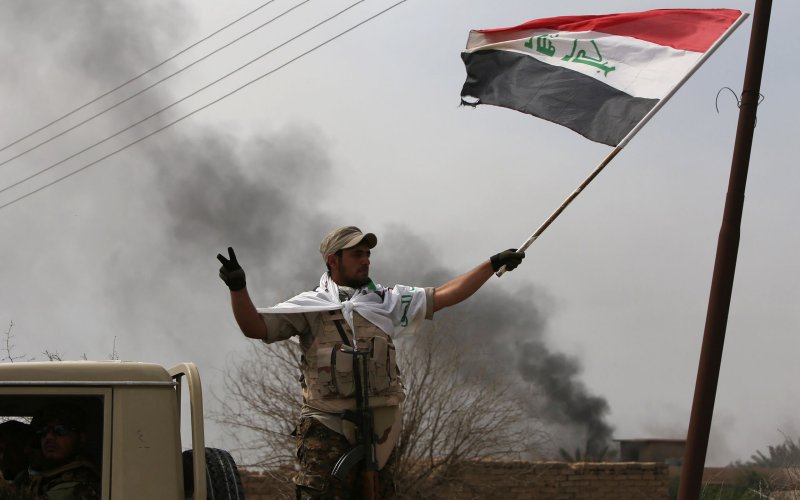
He emphasized that the Hashd should henceforth operate under the Iraqi flag rather than the host of competing standards their constituent militias currently brandish (including those bearing the images of Iranian ayatollahs Khomeini and Khamenei). But Mutlaq is hopeful of greater Sunni support for the Hashd. He pointed out that there are currently volunteer camps established near Ramadi to incorporate Sunnis volunteers and Iraqi policemen who fled the city into the broader counteroffensive.

“The government will give them training and weapons,” a statement issued by Mutlaq’s office read, without offering specifics. As for Shia sloganeering deemed alienating the Anbari support base, he doesn’t think this has had too dire an impact. “The Sunnis were conflicted about the intervention from the Hashd al-Shaabi because they were worried about reprisal attacks. But the Hashd is less harmful than ISIS. At least, these people are Iraqis and we can deal with them later on, but we can’t with ISIS.”

Nevertheless, Mutlaq wonders just what form a pro-government success may take and what happens the day after ISIS is routed from Ramadi. “His concern is whether Ramadi will undergo demographic changes,” his office said. “Will Sunnis be forced to relocate to others areas and will there will be any revenge attacks and conflicts between the Hashd and the tribes?”

Usama al-Nujaifi, one of Iraq’s vice presidents and the former parliamentary speaker, pointed out that recent missteps by the militias has squandered incipient good will for Sunni reconciliation. Yesterday, during a parliamentary session, the Sunni governor of Diyala province was fired—and replaced with a Shia. “This is a real threat and a very negative message to Iraqis. This is considered a break to the rules and it contradicts what has been agreed,” Nujaifi said. “The majority in Diyala are Sunnis.”

ISIS is counting on such political heavy-handedness to indemnify its own savagery. “It is that enemy, composed of Shiites joined by Sunni agents, who are the real danger with which we are confronted, for it is our fellow citizens, who know us better than anyone,” Zarqawi wrote in a 2004 letter, correctly foreseeing that the U.S. military occupation would be fleeting and incidental to the future of Iraq.

In other words, he wanted the Shia militias, principally the Badr Corps — now first among equals in the Hashd— to commit anti-Sunni atrocities as payback for Zarqawi’s own scorched-earth war against the Shia. “If we manage to draw them onto the terrain of partisan war, it will be possible to tear the Sunnis away from their heedlessness, for they will feel the weight of the imminence of danger and the devastating threat of death wielded by these Sabeans.”

If Iraq does fall apart, it will have been because Zarqawi’s apocalyptic plan got realized a decade after his death.

Ash Carter: Iraqis Need to Be The Ones Fighting Islamic State But Don’t Have The Will to Do So

May 24, 2015

Ash Carter: Iraqis Need to Be The Ones Fighting Islamic State But Don’t Have The Will to Do So, Washington Free Beacon via You Tube, May 24, 2015

(We can give them equipment and training. But how can we give them time — and training requires time as well as motivation on the part of the trainees — when the Islamic State gives them neither? — DM)

ISIS advances on Baghdad, faces little resistance

May 24, 2015

ISIS advances on Baghdad, faces little resistance, DEBKAfile, May 24, 2015

The Islamic State continued its push toward Baghdad and on other fronts. Saturday, the group took the Iraq-Syrian town of Husaybah on the Tigris, rounding off its control of the border and the river and gaining an easy and rapid route for transferring reinforcements between the two countries.

The Islamists closed the distance to the big Iraqi base of Habbaniyah, taking Khalidiya on the way.DEBKAfile: Claims in Baghdad that Iraqi forces are preparing to recapture Ramadi have no substance in fact. The only place the ISIS is facing resistance is at the eastern exit of Khalidiya, where pro-Iranian Shiite militias are attempting to bar their progress towards Habbaniyah whic would bring them to within 12 km from Baghdad.


Why Obama has come to regret underestimating the Islamic State

May 24, 2015

Why Obama has come to regret underestimating the Islamic State, The Telegraph, May 23, 2015


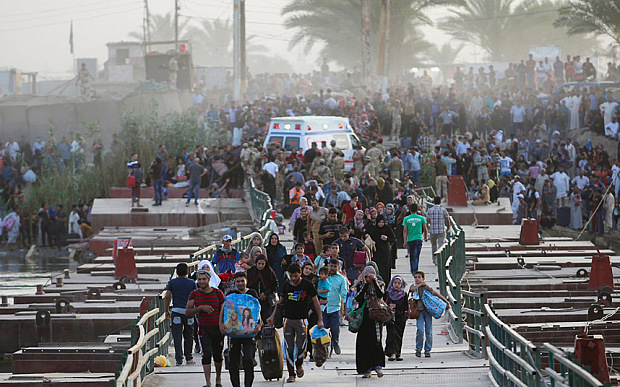
Displaced Sunni people, who fled the violence in the city of Ramadi, arrive at the outskirts of Baghdad Photo: STRINGER/IRAQ

Its strategy is essentially Maoist – the comparison has not been enough made, but now that Isil has declared itself an agent of Cultural Revolution, with its destruction of history, perhaps it will be more. Like Mao’s revolutionaries, it conquers the countryside before storming the towns.

Even now, the fact that much of its territory is rural or even desert is seen as a weakness. But it is beginning to “pick off” major towns and cities with impunity. In fact, where society is fractured, like Syria and Iraq, the “sea of revolution” panics the citizenry, making it feel “surrounded” by unseen and incomprehensible agents of doom.

********************

Have any words come back to haunt President Obama so much as his description of Islamic State of Iraq and the Levant last team as a “JV” – junior varsity – team of terrorists?

This wasn’t al-Qaeda in its 9/11 pomp, he said; just because a university second team wore Manchester United jerseys didn’t make them David Beckham.

How times change. As of this weekend, the JV team is doing a lot better than Manchester United. With its capture of Palmyra, it controls half of Syria.

Its defeat in Kobane – a town of which few non-Kurds had heard – was cheered by the world; its victory in Ramadi last Sunday gives it control of virtually all of Iraq’s largest province, one which reaches to the edge of Baghdad.

Calling itself a state, one analyst wrote, no longer looks like an exaggeration.

Senior US officials seem to agree. “Isil as an organization is better in every respect than its predecessor of Al-Qaeda in Iraq. It’s better manned, it’s better resourced, they have better fighters, they’re more experienced,” one said at a briefing to explain the loss of Ramadi. “We’ve never seen something like this.”

How did Isil manage to inflict such a humiliation on the world’s most powerful country? As with many great shock-and-awe military advances over the years, it is easier to explain in hindsight than it apparently was to prevent.

Ever since Isil emerged in its current form in 2013, military and and political analysts have been saying that its success is due to its grasp of both tactics and strategy.

Its strategy is essentially Maoist – the comparison has not been enough made, but now that Isil has declared itself an agent of Cultural Revolution, with its destruction of history, perhaps it will be more. Like Mao’s revolutionaries, it conquers the countryside before storming the towns.

Even now, the fact that much of its territory is rural or even desert is seen as a weakness. But it is beginning to “pick off” major towns and cities with impunity. In fact, where society is fractured, like Syria and Iraq, the “sea of revolution” panics the citizenry, making it feel “surrounded” by unseen and incomprehensible agents of doom.

Like Mao, Isil uses propaganda – its famed dominance of social media – to terrorise its targets mentally. Senior Iraqi policemen have recounted being sent images via their mobile phones of their decapitated fellow officers. This has a chastening effect on the fight-or-flight reflex.

It then uses actual terror to further instil chaos. Isil’s main targets have been ground down by years of car bombs and “random” attacks. It seems extraordinary, but one of the reasons given by Mosul residents for preferring Isil rule is that there are no longer so many terrorist attacks: not surprising, since the “terrorists” are in control.

Only once your enemy is weak, divided, and demoralised, do you strike.

You then do so with an awesome show of force – one which can mislead as to the actual numbers involved.

The final assault on central Ramadi, which had been fought over for almost 18 months, began with an estimated 30 car bombs. Ten were said to be individually of an equivalent size to the 1995 Oklahoma bombing, which killed 168 people.

There is nothing new in saying that both Syrian and Iraqi governments have contributed greatly to the rise of Isil by failing to offer the Sunni populations of their countries a reason to support them.

Some say that focusing on the failings and injustices of these regimes ignores the fact that militant Islamism, like Maoism, is a superficially attractive, even romantic idea to many, whether oppressed or not, and that its notions must be fought and defeated intellectually and emotionally.

That is true. But relying on Islamic extremism to burn itself out, or for its followers to be eventually persuaded of the errors of their ways, is no answer. Like financial markets, the world can stay irrational for longer than the rest of us can stay politically and militarily solvent.

Rather, the West and those it supports have to show they can exert force against force, and then create a better world, one which all Iraqis and Syrians, especially Sunnis, are prepared to fight for.

In March, an uneasy coalition of Shia militias, Iraqi soldiers, and US jets took back the town of Tikrit from Isil. It remains a wasteland, whose inhabitants have yet to return, ruled over by gunmen rather than by the rule of law.

That is not an attractive symbol, for Iraqi Sunnis, of what victory against Isil looks like. If the war against Isil is to be won, the first step is to make clear to Iraqis and Syrians alike what victory looks like, and why it will be better for them.

Strategic Failures, the US and the Fall of Ramadi

May 21, 2015

Strategic Failures, the US and the Fall of Ramadi, Clarion ProjectRyan Mauro, May 21, 2015

Islamic-State-Victory-Parade-HPIslamic State fighters celebrate their take over of Ramadi with a victory ‘parade.’ (Photo: Islamic State social media)

The U.S. must correct its strategy by sidelining Iranian-backed militias and terrorists, leveraging influence with the Iraqi government and significantly increasing assistance to the Anbar tribes, Kurds, Iraqi government and to the persecuted Christian minority that is forming its own self-defense force.

Recent history has shown that the Iraqi government will choose the U.S. over Iran if compelled.

********************

The Islamic State (ISIS) has captured Ramadi, the capital of Iraq’s Anbar Province, reportedly “terrifying” Iraqi officials who now foresee a “tsunami of international terror.” It is an important achievement for the terrorist group aimed at pre-empting a potential Sunni tribal uprising.

The Sunni tribes in Anbar Province were critical to the success of the 2007 “surge” that ousted the Islamic State’s predecessor, Al-Qaeda in Iraq. The deterioration in the relationship between these tribes and the central Iraqi government was likewise critical to the terrorists’ comeback in Iraq.

The Islamic State remembered these lessons and acted quickly as the Iraqi government began training tribal fighters and the U.S. defense budget allotted $179 million to Kurdish and Sunni tribal forces. The U.S. forgot these lessons and has long rejected Sunni and Kurdish pleas for direct aid to fight the Islamic State.

The Obama Administration is now planning to change course and directly arm and train the Iraqi Sunni tribes after the fall of Ramadi. The White House previously chose to work only through the central Iraqi government that has given the Kurds and Sunnis inadequate support.

A delegation of 11 Sunni tribal leaders, including Sheikh Ahmed Abu Risha, the President of the Anbar Awakening Council, flew to the U.S. on January 18 to plead for direct assistance. Former President George W. Bush called Abu Risha and listened to his complaints for 20 minutes and offered to help. Administration officials were less willing. One tribal official said, “I wouldn’t call it the ‘cold shoulder,’ but it certainly was a cool one.”

The Obama Administration told them that it would only work through the elected central government. Its viewpoint was that working with forces outside the government’s authority undermines the Iraqi leadership and threatens the country’s unity.

That standpoint ignores what was learned after the fall of Saddam Hussein. Nothing threatens Iraq’s unity and the government’s authority more than instability. Direct U.S. aid to the Sunni tribes helped save Iraq from disintegration into sectarian enclaves ruled by terrorists and militias.

The Islamic State struck Ramadi during a sandstorm that delayed American air support. Former U.S. Central Command advisor Ali Khedery says that a Kurdish member of parliament informed him that 6,000 Iraqi Security Forces fled when faced with a mere 150 Islamic State fighters. About 500 Iraqi security personnel and civilians died in two days. The Iraqi officials spoke straight forwardly and  admitted that the current strategy is failing.

The Pentagon says it has finished training about 7,000 Iraqi Security Forces and another 3-4,000 are in the process of training, but training won’t solve the problem of collapsing Iraqi forces. The U.S. trained the Iraqis from 2003 until the withdrawal in 2011. The strategy of waiting for the Iraqi security forces to become strong enough to stabilize the country is the same strategy that failed before the surge.

Iraqi personnel flee because they don’t want to die for a lost cause or to fight for a replacement worse than the Islamic State.

The Iraqi Security Forces face a fundamental disadvantage when battling the Islamic State: They want to live and their enemies want to die. This disadvantage is further compounded by a lack of confidence. If given the choice to die fighting in a losing battle or to flee and perhaps regroup later with better chances of victory, they will choose the latter.

An Anbar official placed the blame on the Iraqi government, telling CNN, “If 10% of the government’s promises had been implemented, Ramadi would still in our hands and the Islamic State wouldn’t dare to be anywhere near the city.”

Iraqi Sunnis are faced with a terrible choice. The Iranian-backed Shiite militias are often nicknamed “Shiite ISIS” because their crimes are comparable to ISIS but are less known by the West because they aren’t broadcasted. However, the Anbar Provincial Council is officially welcoming them now out of desperation and perhaps an awareness that their opposition will be ignored anyway.

The Shiite militias should be expected to mistreat the local Sunnis the second after the Islamic State is expelled or even during the fighting. Tribal support is far from unanimous. The son of the largest tribe’s leader is in the U.S. asking for support right now and bluntly warned that sending the Shiite militias into Anbar Province “will cause a civil war.”

The New York Times has noticed the change in American attitude towards the Shiite militias. Pentagon spokesperson Col. Steve Warren said, “As long as they’re controlled by the central Iraqi government, there’s a place for them.” Yet, only two months ago, Central Command Commander General Austin said, “I will not—and I hope we will never—coordinate or cooperate with Shiite militias.”

The U.S. must correct its strategy by sidelining Iranian-backed militias and terrorists, leveraging influence with the Iraqi government and significantly increasing assistance to the Anbar tribes, Kurds, Iraqi government and to the persecuted Christian minority that is forming its own self-defense force.

Recent history has shown that the Iraqi government will choose the U.S. over Iran if compelled.

In March, the U.S. withheld support to Iraqi forces fighting the Islamic State in Tikrit because of the involvement of Iranian-backed militias and the Revolutionary Guards Corps. The Iranian proxies stalled and could move no further, displaying the value of U.S. air support. The Iraqis chose America and the Iranians were removed from the battle. U.S. aid delivered the victory that the Iranians could not.

The Iraqis had been asking for U.S. for more help including possibly advisors on the ground since October 2013. By March 2014, the Iraqis were asking for airstrikes on the Islamic State. The Islamic State blitz into Iraq began in June.

The Iraqi ambassador complained that the U.S. had denied requests for help including Apache helicopter sales, thereby putting Iraq “in an uncomfortable position in seeking support from whoever is available on the ground.” He emphasized that the “U.S. is our strategic partner of choice.”

Iran opposed the return of U.S. soldiers on the ground in Iraq as advisors. The Iranian-backed cleric Moqtada al-Sadr threatened to attack the advisors and two other Iranian-backed militias alsoforcefully opposed U.S. involvement. The Iraqi government went ahead anyway.

Even now, Iraqi Prime Minister Haider al-Abadi is in Russia and talking to China and Iran about delivering arms that the U.S. refuses to provide.

The U.S. needs to give the Iraqi government a clear choice: Iran or us.

The Iraqi government should be put on notice. If it is willing to restrain the Shiite militias and work with us to disband them, then we will provide all necessary aid. We will help negotiate with the Sunni tribes so their local forces operate within a national framework.

If the Iraqi government chooses Iran, then we will cut our aid and redirect it towards our Sunni, Kurdish and Christian partners while maintaining contact with friendly Shiites. We will not act as the air force for Iranian proxies. If necessary, we will talk about a role for the forthcoming Arab force led by Egypt to replace yours.

It is positive news that the Obama Administration is reversing its stance and will directly help the Sunni tribes, but the anti- Islamic State strategy requires an anti-Iran strategy.

As Ramadi Falls to Islamic State Terrorists, WH Says Their Momentum Has Been ‘Blunted’

May 15, 2015

As Ramadi Falls to Islamic State Terrorists, WH Says Their Momentum Has Been ‘Blunted’,Washington Free Beacon via You Tube, May 15, 2015

(It’s not even good spin. — DM)

Key Iraqi town of Ramadi falls to ISIS, along with Jubbah next door to US training base

May 15, 2015

Key Iraqi town of Ramadi falls to ISIS, along with Jubbah next door to US training base, DEBKAfile, May 15, 2015

Al_RAMADI-ISIS_14.5.15ISIS rolls into Iraqi town of Ramadi

In the current situation prevailing in western Iraq, the Americans and Iraqis might as well forget about their plans for retaking Iraq’s second city, Mosul, from ISIS control,  this year.

*********************

Ramadi, the provincial capital of western Iraqi Anbar, fell to the Islamic State of Iraq and the Levant Friday, May 15 after its inhabitants were put to mass flight. The town, 110 km west of Baghdad, controls the traffic on the Euphrates River. Small pockets of Iraqi troops are still stranded there after taking hundreds of casualties.

The jihadists are in mid-momentum of a fresh multi-pronged offensive, which they launched shortly after they lost Tikrit last month to the biggest counter-offensive they had faced since seizing large tracts of land in Iraq nearly a year ago.

This momentum has carried the Islamists across Anbar province which touches the Syrian and Jordanian borders to capture another key location – Jubba, next door to Iraq’s biggest air base at Al-Ansar. There, hundreds of US officers and soldiers are training Iraqi troops to fight ISIS and helping the Iraqi army manage the fighting in the province.

Parts of this base have already come under Islamist gun and mortar fire.

Not far from Ramadi, ISIS is threatening the oil-producing town of Baiji where a small Iraqi army force of no more than a few hundred soldiers is surrounded by the jihadists, with slim chances of holding out much longer before they are wiped out or forced to surrender.

Yet another ISIS arm is pushing east towards Baghdad, with the object of disabling the international airport by bringing its runways within mortar range.

To conquer Ramadi, ISIS used bulldozers to knock gaps in the sand earthworks built by the Iraqi army to defend the town, then sending half a dozen bomb cars through the gaps to the Iraqi military command centers where they detonated.

Some of those bomb cars were driven by Muslims from West Europe, who had traveled through Syria to join up with ISIS in Iraq. The jihadists named one of them as “Abu Musa al-Britani.”

Just Thursday, May 14, the British police revealed that more than 700 potential terror suspects had traveled to Syria from the U.K. to fight or support extremists, and about half are believed to have returned, primed for terrorist operations on home ground.

In response to the British police statement, ISIS released a video recording of a message delivered by its leader Abu Bakr al-Baghdadi calling on supporters around the world to join the fight in Syria and Iraq or to “take up arms wherever they live.”

It was Baghdadi’s first message since a number of media reports said he was killed or critically injured, and was intended to refute claims that he was no longer in active charge of the group.

DEBKAfile’s counter-terror sources outline the common operational tactic, modus operandi, employed by the Islamist group in all its Iraq offensives.

After singling out a targeted location, their fighters first seize control of its environs. That way, they can block off in advance any incoming and outgoing movements of Iraqi troops – whether in retreat or for bringing up reinforcements. Next, their fighters storm into the core of the targeted location. Fleeing Iraqi soldiers and their local allies and civilians are summarily put to death.

This new ISIS impetus in Iraq has wiped out the military advantages the Iran-backed Shiite militias and US air force gained from the capture of the central Iraqi town of Tikrit in late March and early April. When the Shiie mlitias turned on the local Sunni populace for murder, burning and looting, the Obama administration turned to Tehran and Baghdad and demanded those militias be removed from the city.

Since the Iraqi army is incapable of recovering control and holding Tikrit after the Islamists were driven out, the town has sunk into anarchy with innumerable armed gangs battling each other for control of its quarters, some of them ISIS loyalists.

In the current situation prevailing in western Iraq, the Americans and Iraqis might as well forget about their plans for retaking Iraq’s second city, Mosul, from ISIS control,  this year.

Al Qaeda on winning streaks in Yemen and Iraq, exploiting stalemate in proxy wars

April 17, 2015

Al Qaeda on winning streaks in Yemen and Iraq, exploiting stalemate in proxy wars, DEBKAfile, April 17, 2015

Thursday and Friday, April 16-17, two branches of Al Qaeda took the lead in violent conflicts, catapulting key areas of the Middle East into greater peril than ever. In Yemen, Al Qaeda in the Arabian Peninsula (AQAP) and in Iraq, the Islamist State in Iraq and the Levant (ISIS), launched new offensives 3.050 kilometer apart.

DEBKAfile’s military sources report that both branches of the Islamist terror movement used the absence of professional adversarial troops on the ground – American and Saudi – to push forward in the two arenas. Washington and Riyadh alike had decided to trust local forces to carry the battle – Iran-backed Shiite militias alongside Iraqi troops against ISIS in Iraq, and the Yemeni army against Iran-backed Houthi rebels in Yemen.

This gave Al Qaeda a free passage to carry on, especially when offered the further benefit of contradictions in the Obama administration’s attitude toward its foe, Tehran: On the one hand, Iran was offered lead role in the region for the sake of a nuclear deal; on the other, it faced US opposition for its support of rebel forces in Yemen.

The conflict in Yemen is no longer a straight sectarian proxy war between Sunni-ruled Saudi Arabia and Shiite Iran (that also stretches to Iraq and Syria.), as a result of what happened Thursday, April 16.

AQAP embarked on a broad offensive in southern Yemen’s Hadhramaut region on the shore of the Gulf of Aden and captured the important seaport of Mukalla as well as the coatal towns of Shibam and Ash-Shirh. The group also overran Yemen’s Ryan air base in the absence of real resistance from the Yemen army’s 27th Brigade and 190th Air Defense Brigade – both of which are loyal to the escaped president Mansour Hadi.

This winning AQAP offensive was instructive in four ways:

1. For the first time in two decades, Al Qaeda in Arabia is operating on professional military lines. Its sweep across Yemen’s southern coastland showed the Islamists to be plentifully armed with antiair missiles and other air defense systems.
2.  AQAP’s smuggling rings run a large fleet of vessels which collaborate with Somali pirates. This fleet is now preparing to seize control of the strategic Socotra archipelago of four islands opposite Hadhramaut and only 80 kilometers from the Horn of Africa. Socotra sits in the bottleneck for shipping from the Arabian Sea and Persian Gulf to the Gulf of Aden and on to the Suez Canal.

On one of the Socotra islands, the US set up an air base and deployed special forces in 2011,  in readiness for an attack on Iran’s nuclear facilities. AQAP does not have enough strength to capture this island, but is capable of holding it siege and under barrage from sea and land.

3. The Arabian branch of Al Qaeda has for the first time gained control of a large sweep of territory in Yemen, a feat analogous to its fellow branch’s advances in Iraq since last June.
4. Hadramauth is bounded to the north and the east by the Saudi Arabian Rub’ al Khali or Empty Quarter, which is the world’s second largest desert region.  AQAP has therefore gained proximity to the oil kingdom through its desolate back door.

Our military sources note that Saudi Arabian and United Arab Emirate air forces have controlled Yemeni air space since March 26, supported by US intelligence assistance. They might have been expected to bomb AQAP units and stall their advance through Hadhramaut.

But they refrained from doing so for a simple reason: Both Riyadh and its Gulf ally are unwilling to throw their own ground forces into the war against the Shiite Houthi rebels. Still in proxy mode, they expect Al Qaeda’s Arabian jihadis to save them the trouble of putting their troops on the ground to vanquish the Shiite rebels.

The same principle guides Washington in Iraq – albeit with different players. There, the Americans rely increasingly on the pro-Iranian Iraqi Shiite militias, under the command of Iranian Revolutionary Guards officers, rather than the Iraq army, to cleanse the ground of ISIS conquests.

Two weeks after Western publications trumpeted the militias’ success in liberating the Iraqi town of Tikrit from its ISIS conquerors, it turns out that the fighting is still ongoing and the jihadis are still in control of some of the town’s districts.

Iraqi Prime Minister Haidar al-Abadi, while on a visit to Washington this week, told reporters that, after the Tikrit “victory,” his army was to launch an offensive to recapture the western province of Anbar on the Syrian border from the grip of ISIS.

The situation on the ground is a lot less promising. As Abadi and President Barack Obama discussed future plans for the war to rid Iraq of the Islamists, ISIS launched fresh offensives for its next goals, Ramadi, a town of half a million inhabitants 130 kilometers west of Baghdad, and the oil refinery town of Baiji

The jihadis have already moved in on Ramadi’s outskirts after the Iraqi army defenders started falling back.

ISIS attacks Ramadi: It’s way worse than we’re being told

April 17, 2015

ISIS attacks Ramadi: It’s way worse than we’re being told, Alanbwest.com, Allen West, April 17, 2015

dfre-300x180

[T]ens of thousands are fleeing Ramadi, the largest city in Anbar province of some half a million — the city lies 100 miles from Baghdad. And ISIS has also launched an attack on the major oil refinery city of Baiji, just north of Tikrit. Could it be that ISIS conducted a very well planned and executed deception plan to make Iraqi Security Forces and their Iranian allies focus on Tikrit, while they focused their offensive operations elsewhere? If so, it’s a brilliant operational level ruse.

But there is an even more important question — how did ISIS do this without any detection? How did they reposition their force — in open desert — and no one saw it? This is a direct reflection of the intelligence failure of the so-called Obama coalition.

***********************

One of the best lessons I learned in my years of service in the military is a quote often share with y’all: “the enemy has a vote.”

You can try and sell the American people — and others — a politicized line such as “al-Qaida has been decimated and destroyed” or “we have reached the framework of a deal with Iran” or “ISIS is not Islamic,” but the bad guys are not affected by empty rhetoric.

And here we go again with the Obama administration and the conflagration against Islamic terrorism. We’ve been told that ISIS has stalled. Their recruiting is low and they’re demoralized – by the way, what is up with the Ohio man just arrested after returning from Syria and training with ISIS?

The Daily Beast, not exactly a conservative outlet, reports, “ISIS is reportedly marching on the key Iraqi city of Ramadi—upending the momentum the U.S.-led military coalition seemed to have just days ago, and threatening to shatter an already delicate recent power shift that both the U.S. and Iraq hoped to exploit.

“Until Wednesday’s reports about Ramadi both U.S. and Iraqi officials were examining what effects ISIS’s recent losses could have in future battles. The officials were even talking about where they would take down ISIS next. During his visit to Washington, Iraqi Prime Minister Haider al Abadi suggested in an interview Wednesday with reporters that his troops could move on both Anbar Province—where Ramadi in the local capital—and the oil-rich city of Baiji.

But that was before, according to residents, three cities near Ramadi fell into ISIS hands. Hours later, area security forces reportedly asked for more support from the central government to retain control of the city. Pentagon officials stopped short of saying the city was on the brink of falling. But they didn’t sound confident it would hold, either.

“The situation in Ramadi remains fluid and, as with earlier assessments, the security situation in the city is contested. The ISF [Iraqi Security Forces] continue to conduct clearing operations against ISIL-held areas in the city and in the surrounding areas of Al Anbar province,” U.S. Central Command spokesman Army Major Curt Kellogg said in a statement, using the government’s preferred acronym for ISIS. The coalition continues to coordinate with ISF forces and provide operational support as requested.”

The truth is, tens of thousands are fleeing Ramadi, the largest city in Anbar province of some half a million — the city lies 100 miles from Baghdad. And ISIS has also launched an attack on the major oil refinery city of Baiji, just north of Tikrit. Could it be that ISIS conducted a very well planned and executed deception plan to make Iraqi Security Forces and their Iranian allies focus on Tikrit, while they focused their offensive operations elsewhere? If so, it’s a brilliant operational level ruse.

But there is an even more important question — how did ISIS do this without any detection? How did they reposition their force — in open desert — and no one saw it? This is a direct reflection of the intelligence failure of the so-called Obama coalition.

However, let me digress for a moment and consider the effect this is having on those brave and courageous men and women who just a decade ago bled, sacrificed, lost limbs, and died in order to drive the enemy out of Ramadi.

Can you imagine what it is doing to them to hear this news — of course it appears that President Obama cares little. His campaign promise was more important than acknowledging the enemy has a vote. His defiance would not allow him to admit that he was wrong and that our men and women who DID serve with honor and distinction defeated the enemy, al-Qaida in Iraq. The emotional scars run deep, and sadly the person inflicting the damage and reopening wounds resides at 1600 Pennsylvania Avenue.

During a Senate Armed Services hearing Chairman John McCain, a former combat fighter pilot, asked an astonishing question — which those of us in the know, knew. How many total sorties have been flown since last August when we announced the air campaign against ISIS? The answer is approximately 12,000. How many of these sorties have dropped weapons (munitions)? The answer was 3,000. When queried, the new Secretary of Defense, Ash Carter, explained that the problem is that we don’t have G-FACs (Ground- Forward Air Controllers) on the ground. As well, it appears we don’t have intelligence gathering capability. ISIS is not being pushed back. They are on the offense, and how can that be happening?

Not only in Iraq, but in Yemen, where President Obama stated last September that this was a shining example of success. Al-Qaida in the Arabian Peninsula (AQAP) has taken over a vital airfield, port, and oil facility. And if you haven’t been paying attention, Americans are fleeing the country by whatever means they can find. Right now they are escaping on boats to Dijbouti. For those of you who aren’t aware, the U.S. Marine Corps always has a regional force afloat called a Marine Expeditionary Unit (Special Operations Capable) — MEU(SOC). One of their mission sets is called NEO – Non Combatant Evacuation Order — which is where they coordinate with the local embassy to extricate Americans from a hostile country. Remember, ARG/MEU (Amphibious Ready Group/Marine Expeditionary Unit) was sitting off the coast of Yemen, but the Obama administration ordered our embassy evacuated as the Marines destroyed their weapons and flew out on Oman Air.

I know, you’re saying, why should I care? You think I’m just complaining and running my mouth. I believe the same was said of one Winston Churchill whilst the people of England were embracing Neville Chamberlain. The point is that the enemy is being emboldened and domestic prosperity means nothing when planes fly into buildings. The redistribution of wealth will mean little when someone shouts “Allahu Akhbar” and guns down American troops in America. Income inequality will not be a pressing issue if another woman is beheaded at her workplace by an Islamist — and it’s just dismissed.

We are suffering from the sickness of soundbite mentality and as the Taliban says, “you may have watches but we have the time.”

We have an administration that is lying to us and refuses to confront a very threatening enemy. The last time such a maniacal threat was disregarded — well, millions lost their lives. I pray that a catastrophic event does not have to occur to wake us up — but it seems we are on that road. This is not about bravado, it is about making a stand to defeat Islamo-fascism and its spawn, terrorism and jihadism. And let us not forget that meanwhile Vladimir Putin lurks in the dark places and China slowly extends its regional hegemony.

Remember, peace through strength.