(Surely Imam Obama will soon issue a fatwa proclaiming that the Islamic Republic of Iran is not Islamic. Right? Meanwhile the P5+1 Iran Scam continues unabated. — DM)
Hassan Rouhani / AP
Iran executed a record-shattering 411 citizens in the first half of 2014 and a total of 852 people in the last 15 months, including at least eight juveniles, according to a new United Nations report that will be introduced to the organization’s General Assembly Tuesday.
In addition to a surge in state-sanctioned killings that a U.N. official referred to as “shocking,” Iran continues to torture imprisoned individuals using techniques such as amputation, electroshock, flogging, and burnings, according to the report, which details human rights in the Islamic Republic.
Ahmed Shaheed, the U.N.’s special rapporteur for human rights in Iran, described the situation in the country as “shocking” and pushed countries such as the United States to finally speak up about it.
Iranian President Hassan Rouhani, who was hailed by the Western media as a “moderate,” has not lived up to promises to reform the judicial system, Shaheed told reporters on Monday.
Rouhani “is unable to address the issues, unable to arrest this trend, to convert his promises which spoke to arresting this trend into action,” Shaheed, who is barred from entering Iran, was quoted as telling reporters on Monday.
Executions in particular have hit record levels in Iran, according to the report.
“Between July 2013 and June 2014, at least 852 individuals were reportedly executed, representing an alarming increase in the number of executions in relation to the already-high rates of previous years,” the report states. “The government also continues to execute juvenile offenders.”
Human rights organizations have put the number of those executed during Rouhani’s term at 967, while Iranian opposition groups have claimed it surpasses 1,000.
Iranian authorities over the weekend carried out the execution of a 26-year-old female rape victim who had killed her attacker in a violent struggle.
Multiple Iranian refugees who have fled the country reported being tortured during stints in Iranian prisons, according to the report.
Many were subjected to “psychological and physical torture” meant to elicit false confessions of crimes, according to the report.
Others who spoke to the U.N. “reported torture and ill-treatment and psychological abuse, such as prolonged solitary confinement, mock executions, and the threat of rape, along with physical abuse, including severe beatings, use of suspension and pressure positions, electroshock, and burnings,” according to the report.
Prisoners also faced “amputation and corporal punishment,” such as flogging, according to the report.
Democratic rights such as freedom of expression also were reported to have led to executions in Iran, a development the report dubs “deeply troubling.”
“Members of ethnic minority groups, in particular those espousing ethnocultural, linguistic or minority religious rights, appear to be disproportionately charged with moharebeh [‘enmity against God’] and mofsed fel-arz [‘corruption on Earth’], sometimes seemingly for exercising their rights to peaceful expression and association,” the report states.
Iran is gearing up to further crack down on democratic displays.
Draft laws in existence “appear to further undermine the rights to freedom of expression” and will facilitate “discrimination against women” by rolling back protection against forced marriage and education rights, according to the report.
Women in Iran continue to face great oppression and state-sanctioned violence.
At least 66 percent of Iranian women reported being a victim of domestic violence, with the current legislative framework in the country being “insufficient to combat such violence,” according to the report.
“Laws continue to explicitly allow for non-consensual sexual relations in marriage,” the report found. “There are insufficient safe houses for women in need of refuge.”
Any Iranian women seeking to leave an abusive relationship, for instance, must “first prove that there is a significant risk of bodily harm or a threat to her life,” the report explains.
Moreover, under Iranian civil code, women seeking to obtain a divorce as a result of domestic violence must first prove that the abuse was intolerable,” the report says.
Restrictions on the Internet in Iran also continue to grow.
“Severe content restrictions” continue to be imposed and many who skirt the laws can face harsh prosecution, according the report, which put the number of blocked websites at 5 million.
When confronted by the U.N. about this, Iran maintained that it, “(like many countries) blocks all immoral websites in the arts or social groups,” according to the report.
The head of Iran’s human rights council over the weekend dismissed the U.N. report.
“Our first problem is that they should explain why [the U.N. wants to send] a special rapporteur, what has happened in Iran that they have appointed a special rapporteur and why this rapporteur is needed for Iran and not for other countries,” Javad Larijani was quoted as saying on Sunday by Iran’s semi-official Fars News Agency.
Larijani accused the United Nations of fabricating information about the country’s human rights record.
The looking-glass world of international relations in the Middle East during the Obama Administration.– AP)
Lately I have been feeling that, like Alice in Wonderland, we have stepped through the looking glass and are living in an alternative universe. Our old allies have turned against us whilst our old enemies are now siding with us and even doing our dirty work for us.
Case in point: It has been documented several times recently how petty and thin skinned is the US Administration. Last week they demonstrated this nasty characteristic once again with their juvenile and petty behaviour against Israeli Defence Minister Moshe (Bogie) Yaalon.
One meeting which did take place: Moshe Yaalon meets US Defence Secretary Chuck Hagel
The Obama administration this week refused Israel defense minister’s requests to meet several top national security aides, still miffed over negative comments he made about Secretary of State John Kerry’s Mideast peace efforts and nuclear negotiations with Iran, US officials said Friday.
While Defense Minister Moshe Ya’alon did see Defense Secretary Chuck Hagel and US Ambassador to the United Nations Samantha Power, the officials said the White House and State Department rejected Israeli proposals for meetings with Vice President Joe Biden, national security adviser Susan Rice and Kerry on his five-day trip to the United States. The administration had sought to stop Ya’alon from seeing Power but the objections were made too late to cancel the meeting, according to the officials.The officials spoke on condition of anonymity because they were not authorized to speak publicly about the snubs, which were first reported by several Israeli media outlets.
…
Earlier this year, Ya’alon infuriated officials in Washington with comments accusing the administration of being weak on Iran and questioning the U.S. commitment to Israel’s security. That followed reports that Ya’alon had criticized Kerry for being unrealistic and naive in trying to forge an Israeli-Palestinian peace deal.
The blogger Abu Yehuda has more on the pettiness of the US Administration and their stupidity in thinking that the Muslim terrorists are not out to get them too.
In another example of American duplicity, the Administration was rather upset at the killing of a Palestinian-American teenager who was shot by the IDF as he was throwing firebombs at Israeli cars. The US has demanded a full investigation. However I did not see them demand a full investigation of the Palestinian American who drove his car into a crowd of commuters, killing baby Chaya Zissel Braun.
The United States expresses its deepest condolences to the family of a US citizen minor (Orwah Hammad) who was killed by the Israeli Defence Forces during clashes in Silwad on October 24. We demand a speedy and transparent investigation into his killing.
So now it seems that any Palestinian terrorist can not only be a hero martyr to Hamas and the PA, but can also be considered an American citizen, thereby gaining the protection of the US government in addition to the UN.
All this while Israeli Jewish Americans receive little to no support from the US Administration they so sensibly left behind.
Karen Yemima Muscara HY’D, murdered in the Palestinian terrorist attack by car
Tragically the death toll from that attack has gone up as another victim died yesterday. Karen Yemima Muscara, a new immigrant from Ecuador who had converted to Judaism, was buried last night in Jerusalem.
Outrageously, her funeral had to be delayed so as to avoid riots as her terrorist murderer was buried nearby. Isn’t it amazing that when Jews are murdered and buried, they don’t go on rampages and riots?
Hundreds attended the funeral early on Monday of a woman killed in last week’s terrorist attack on a Jerusalem light rail station, including Jerusalem Mayor Nir Barkat and the Ecuadorian ambassador to Israel.
Karen Yemima Muscara was an Ecuadorian citizen in her 20s, had come to Israel to convert to Judaism after discovering she was descended from Conversos, Spanish Jews who were forcibly converted to Catholicism after 1492.
…
The funeral was postponed so as not to coincide with that of Abdel Rahman al-Shaludi, the man who drove his car into the Ammunition Hill light rail station, killing Muscara and a three-month-old baby and injuring seven others. Police shot Shaludi as he attempted to flee the scene on foot and he later died; he was buried Sunday night in the Muslim cemetery outside Jerusalem’s Old City.
Jerusalem Mayor Nir Barkat eulogized Muscara saying that she was “a delicate soul and guardian of peace who fought to be a Jew,” the NRG news site quoted him saying.
“Like many before her, she also fell in love with Jerusalem. Seven months ago she joined us and tonight, with unbelievable pain, she is parted from us,” Barkat said. “As mayor of Jerusalem I say that the situation won’t continue. It’s unacceptable that those whose live their whole lives for peace fall victim to those who glorify death.” He vowed once again to restore calm to Jerusalem.
…
Israel’s Foreign Ministry on Thursday flew in Muscara’s parents after she suffered head wounds and was seriously injured in the attack. Her mother said Sunday that her daughter’s dream had been to come to Israel and build her life here, but her life was cut short.
May Karen Yemima’s memory be for a blessing and may her parents, family and friends be comforted amongst the mourners of Zion and Jerusalem.
Egyptian President Abdel Fattah El-Sisi
Meanwhile our erstwhile enemy, and often very cold peace partner Egypt is acting more forcefully against Hamas than we could ever hope to do without world condemnation. After a deadly car bombing by Jihadi terrorists against Egyptian forces in the Sinai, killing 28 soldiers, Egypt has cancelled its attempts at reviving Israeli-Hamas peace talks, has closed down the Rafah crossing and is planning building a wall to close off Gaza:
After a terror attack on Friday killed at least 30 Egyptian soldiers in the northern Sinai, Cairo has declared a state of emergency in the area, closed down the Rafah crossing from Gaza, canceled indirect cease-fire talks between Israel and Hamas, and now says it will build a wall to block smuggling with the coastal enclave, Israel’s NRG News reported.
…
On Friday, militants mounted a complex, combined attack at an Egyptian base using what appeared to be a suicide car bomber, rocket-propelled grenades and roadside charges. Despite Hamas denying involvement, Egyptian security officials charged that attackers utilized smuggling tunnels from Gaza in perpetrating the attack, leading to the breakdown in relations.
Hamas is closely tied to the Muslim Brotherhood, which, under the rule of Mohammed Morsi, was deposed last year.
Hamas leaders warned that the strip was on the verge of an “explosion” if the passage with Egypt remained closed. Israel, meanwhile, has continued allowing humanitarian aid and construction material to enter the enclave.
One would expect that Palestinian “President” Mahmoud Abbas would be outraged at this move by the Egyptians. One would be wrong. In another topsy-turvy turn of events, Mahmoud Abbas is supporting the Egyptian move, as the Elder of Ziyon reports:
Now, this means that Egypt will once again be enforcing a blockade on Gaza. People will not be able to leave Gaza for medical, educational or professional reasons. This is what would be characterized as “collective punishment” if done by Israel..
Egypt, by any yardstick, is treating Palestinians in Gaza worse than Israel is. Israel has not closed the Erez crossings and hundred of truckloads of materials go to Gaza every weekday from Israel.
But how does Mahmoud Abbas respond to Egypt’s latest moves to enforce a crippling siege on Gaza?
He supports them!
After Sisi’s speech, Abbas said “We stand by Egypt’s leadership, government and people, and we support all measures to be taken by the Egyptian leadership in order to maintain security and stability in Egypt in the face of terrorism in the Sinai and all the Egyptian territories, because of the service of the Palestinian cause and the Arab national security.”
Abbas praised the Egyptian position as being “courageous in the face of terrorism,” saying he has great confidence that Egypt will overcome the enemy.
How’s that for hypocrisy?
He probably learned the hypocrisy from the Americans. Or taught it to them.
But now, along comes Azerbaijan—the world’s first Muslim-majority democracy, which is fast taking the place of Turkey in becoming a crucial ally of Israel in the Muslim world. It’s no surprise that of all Muslim-majority countries, Azerbaijan would fill the void. Like Turkey before Erdoğan, Azerbaijan has proudly and sometimes aggressively reinforced its secular society, banning the hijab (veil) in schools.
In a gathering with the Jewish community held in the Washington, D.C. area last month, Azerbaijan’s ambassador to the United States, Elin Suleymanov, recoiled from the criticism his country received from the U.S. and others for its tough line on maintaining its secularism. “We are criticized because our girls are not forced to wear the hijab, and this is the worst problem in the Middle East?” he said.
…
To date, Israel’s relationship with Azerbaijan has taken an almost identical trajectory as its early ties to Turkey. As it had with Ankara, Israel has steadily ratcheted up defense ties with Baku. Last month, Israeli Defense Minister Moshe Ya’alon visited Azerbaijan, one of a number of such recent defense-oriented visits.
As it had with Turkey, Israel has established a vital economic lifeline to Azerbaijan, which provides the Jewish state with 40 percent of its imported oil.
As with Israeli-Turkish relations, bilateral ties between the two countries signal Azerbaijan’s desire to strengthen its connections to the U.S. and the West. The country has become an invaluable NATO supply line to Afghanistan and has joined NATO war efforts.
When much of the rest of the world interrupted flights to Israel during the conflict with Hamas last summer, Azerbaijan continued flying.
…
Undoubtedly, Israel sees the tremendous potential in its relationship with Azerbaijan, as does Azerbaijan with Israel. American supporters of Israel must do their part to reinforce that relationship in Washington. As was discovered with Turkey, Muslim-majority allies don’t grow on trees.
Indeed. And not only Muslim-majority allies. It seems that Western liberal democratic allies not only do not grow on trees, the ones that have grown seem to be dying and falling like shrivelled leaves.
Israel needs to focus on its own interests and if an ally turns against us, we must learn to stand on our own two feet, besides finding other allies.
The Obama administration stopped shipping to Israel all defense items – and not just Hellfire missiles as previously reported – for a short time in the middle of the war against Hamas, reported Israel Defense’s Amir Rappaport, the well-informed and highly credibly editor of the website.
Makor Rishon added to that report that the US actually cut off all communications with Israel’s Ministry of Defense purchasing offices in the US for days.
In response, Israel is now looking to produce its own weapons so as not to be reliant on fair-weather friends in the future:
The Defense Ministry, now realizing it cannot always depend on the Obama administration in a time of crisis, already has decided under a “veil of secrecy,” according to Israel Defense, to manufacture a highly sensitive weapon in Israel instead of buying it from the United States.
The change in policy is a major step that would wean Israel away from dependence on the United States and which also would be a significant change in the policy of buying American-made weapons with most financial assistance from the United States.
American aid to countries, including Israel, usually is conditioned on a majority of the money being poured back into the American military-industrial complex.
“The Israeli defense establishment will reduce the production of weapon systems in the USA in the context of joint Israeli-American projects, and will rely more heavily on Israeli-made products” as a result of the punitive action taken by President Barack Obama, Rappaport wrote.
…
The ministry also is examining the possibility of using Israel-made precision guided air-to-surface munition to replace Hellfire missiles, a project that is worth hundreds of millions of dollars, if not billions.
The American decision is cutting off their nose to spite their face, since their military aid to Israel is spent mostly in the US itself, providing jobs and income. But if that’s how they want to play it, Israel too can play the game.
Except that for us it’s not a game. It’s an existential matter of life and death.
(The dear lad was Islamic, so how could he possibly have been involved in terrorism? Islam is the “religion of peace.” Or something.– DM)
The Obama administration insisted Monday that a Palestinian who was killed by the IDF while attempting to throw a Molotov cocktail at Israeli civilians is not a terrorist.
The Palestinian, a teenager with U.S. citizenship, was shot on Friday and buried this weekend wearing a green Hamas headband. The Obama administration said in a statement on Friday that it “expresses its deepest condolences to the family.”
At a State Department briefing today, Associated Press reporter Matt Lee asked spokesman Jen Psaki whether it is appropriate to offer deepest condolences to the family of someone killed while attempting to carry out an attack on civilians.
“There are reports … that [the Palestinian teenager] was throwing Molotov cocktails at cars on a highway, and I’m wondering, if that is the case, would you still have been so speedy in putting out a statement and offering your condolences to the family?” asked Lee. “The argument that is being made by some in Israel is that this kid was essentially a terrorist, and you don’t agree with that, I assume,” Lee continued.
“Correct, we don’t,” replied Psaki. Lee then asked whether the fact that the teenager was buried wearing a Hamas headband was “of concern at all.” Psaki replied, “I just don’t have any more on this particular case.”
Insanity, craziness or madness is a spectrum of behaviors characterized by certain abnormal mental or behavioral patterns.
Although the definition references “abnormal mental or behavioral patterns” [emphasis added], the behaviors here involved have become increasingly “normal.” Multicultural linguistics are part, but only part, of the problem.
Insane responses to Iran nukes, terrorism support and human rights
As the P5+1 negotiations continue under Obama’s guidance, Iran appears increasingly likely to get or keep nukes. Iran knows Obama.
The Iranian president’s senior advisor has called President Barack Obama “the weakest of U.S. presidents” and described the U.S. leader’s tenure in office as “humiliating,” according to a translation of the highly candid comments provided to the Free Beacon. [Emphasis added.]
. . . .
And with the deadline quickly approaching on talks between the U.S. and Iran over its contested nuclear program, Younesi’s denigrating views of Obama could be a sign that the regime in Tehran has no intent of conceding to America’s demands.
. . . .
“Americans witnessed their greatest defeats in Obama’s era: Terrorism expanded, [the] U.S. had huge defeats under Obama [and] that is why they want to compromise with Iran,” Younesi said.
. . . .
“We [the Islamic Republic] have to use this opportunity [of Democrats being in power in the U.S.], because if this opportunity is lost, in future we may not have such an opportunity again,” Younesi said. [Emphasis added.]
. . . .
The criticism of Obama echoes comments made recently by other world leaders and even former members of the president’s own staff, such as Former Defense Secretary Robert Gates.
Do enough of us, and of perhaps greater importance enough of our “leaders,” know Him as well as Iran does?
The P5+1 negotiations were a scam from the beginning and the scam continues, enhanced by perceived needs to work with the (Shiite) Islamic Republic of Iran to degrade the Sunni (but “non-Islamic”) Islamic State and otherwise to “degrade” terrorism.
The Iranian government is well known for its funding of terrorism. The U. S. Government has long been well aware of it.
The United States State Department describes Iran as an “active state sponsor of terrorism.”[2]US Secretary of StateCondoleezza Rice elaborated stating, “Iran has been the country that has been in many ways a kind of central banker for terrorism in important regions like Lebanon through Hezbollah in the Middle East, in the Palestinian Territories, and we have deep concerns about what Iran is doing in the south of Iraq.”[1]
So is the Obama Administration.
In July 2012, the United States State Department released a report on terrorism around the world in 2011. The report states that “Iran remained an active state sponsor of terrorism in 2011 and increased its terrorist-related activity” and that “Iran also continued to provide financial, material, and logistical support for terrorist and militant groups throughout the Middle East and Central Asia.” The report states that Iran has continued to provide “lethal support, including weapons, training, funding, and guidance, to Iraqi Shia militant groups targeting U.S. and Iraqi forces, as well as civilians,” despite pledging to support the stabilization of Iraq, and that the Qods Force provided training to the Taliban in Afghanistan on “small unit tactics, small arms, explosives, and indirect fire weapons, such as mortars, artillery, and rockets.” The report further states that Iran has provided weapons and training to the Assad regime in Syria which has launched a brutal crackdown on Syrian rebels, as well as providing weapons, training, and funding to Hamas, Palestinian Islamic Jihad, and the Popular Front for the Liberation of Palestine-General Command, among others, and has assisted in rearming Hizballah. [Emphasis added.]
Iran is also remarkable for its failure to provide even minimal human rights. For example, it has been reported that Iran executed more than four hundred people during the first half of 2014. That’s more than two per day.
Despite Iran’s state anti-Semitism, the recent arrest of U.S. journalists, and the continued oppression of women, the Obama administration has been attempting a rapprochement with the Iranian regime. Fending off Iran hawks in Congress and the D.C. punditocracy, the administration has argued for a policy of constructive engagement, pursuing diplomacy over military action to halt Iran’s nuclear program. The execution of two gay men, while it may not be surprising, certainly doesn’t make that “engagement” any easier.
Iran’s cooperation also is seen as essential to managing the chaos in Iraq and the Islamic State. With U.S. airstrikes against the Sunni militants, on-off (now definitely off) support of Iraq’s Shiite (ex-) Prime Minister Nouri al-Maliki, and the possible disintegration of Iraq, this cooperation—or at least not overt opposition—is surely of more strategic importance than the latest human rights abuse. [Emphasis added.]
Iran’s support for terrorism, abysmal violation of even the most basic human rights — and what these Iranian characteristics suggest that Iran is likely to do with its nukes — appear to be deemed of no importance by the P5+1 negotiators.
Domestic terrorism
Terrorism is often labeled “workplace violence,” a “traffic accident“ or just about anything but Islamic. This is from Jihad Watch:
A traffic incident in Jerusalem. Another traffic incident in Canada just a few days ago. Odd coincidence: both drivers were devout Muslims who killed Infidels “in the name of Allah” (as the Canadian bad driver put it). Meanwhile, also in Canada, a mentally ill man shoots up the Parliament building and murders a soldier. And in New York City, a man wielding a hatchet injures several police officers. Another odd coincidence: both the Canadian mentally ill man and the New York hatchet-wielder were also devout Muslims. The father of the former waged jihad in Libya, and the latter called for armed revolt in the U.S. But you must put all of these odd coincidences out of your mind right now. We know that none of this can have anything to do with Islam, and that greasy Islamophobes are the only ones who think otherwise.
“Memo from US Consulate refers to Jerusalem terror attack as ‘traffic incident,’” by Itamar Eichner, Ynet News, October 24, 2014 (thanks to Hamish):
Hours after a Palestinian terrorist drove his car into a crowd waiting at a light rail station in Jerusalem, the US consulate in the city issued a memo referring to the attack as a “traffic incident”.
A three-month-old baby was killed and seven other people were wounded when Abdel Rahman a-Shaludi drove his car across incoming traffic to strike the people waiting at the station. The baby girl, Chaya Zissel Braun, had American citizenship.
The memo was sent to employees of the American consulate, which is based in East Jerusalem. It asks staff to report “any emergency.”
AnneinPT (Israel) provides an actual Associated Press news headline about the “traffic accident.” “Israeli police shoot man in east Jerusalem.”
Here’s how the AP, consistently with its customary reporting on things Israeli, might treat Palestinian rockets thwarted by Israel’s Iron Dome defense system: “Palestinian rockets damaged beyond repair by Israeli counter-measures.”
“Lone wolf” Islamic terrorists are exceedingly rare.
[N]umerous examples show that terrorist actors are almost always part of a network who were involved in recruiting and tasking terrorist activity. As Max Abrahms at Northeastern University has observed:
Since the advent of international terrorism in 1970, none of the 40 most lethal terrorist attacks has been committed by a person unaffiliated with some terrorist group, according to publicly available data from the National Consortium for the Study of Terrorism and Responses to Terrorism, which is funded by the Department of Homeland Security and stored at the University of Maryland. In fact, lone wolves have carried out just two of the 1,900 most deadly terrorist incidents over the last four decades.
So why “lone wolf”? Simply, it was a mechanism promulgated by the CVE [countering violent extremism] industry, with willing cooperation from law enforcement and intelligence officials, to exonerate themselves when a terrorist attack happened. At its core is terror agnosticism: “There is possibly no way to predict who will turn to terrorism, so therefore we can’t be held responsible when it happens. Oh, and give us more money so we can better improve how we won’t be able to predict terror attacks.” [Insert added.]
It’s Islamic terrorism all the way down:
Yet there has been great reluctance to associate terrorist attacks with the “religion of peace.” Here are examples of media and official reactions to the recent terrorist attacks in Canada: “CBC’s Derek Stoffel tweeted: ‘Amid the speculation in the #OttawaShooting in #Canada, it’s important to remember #ISIS hasn’t shown interest in attacks abroad.’” However,
Stoffel should have known that in late September, the Islamic State’s spokesman, Abu Muhammad Al-Adnani, urged Muslims to murder non-Muslims in the West. “Rely upon Allah,” he thundered, “and kill him in any manner or way however it may be. Do not ask for anyone’s advice and do not seek anyone’s verdict.
“The hard-Left Vox reacted to the revelation that Zehaf-Bibeau was a Muslim by dismissing the fact as irrelevant.”
Not to be outdone in multicultural empathy,
In the wake of the shootings in Ottawa, the police chiefs of Toronto and Ottawa wrote to local Muslim leaders, assuring them of their good will and urging Muslims to contact them in case of a “backlash.” These politically correct cops appear to have learned their lesson well: after every jihad attack, Muslims are the victims, and need special reassurances.
Eventually, the Canadian terrorist attacks were labeled “terrorism.” Even the White House called them “despicable terrorist attacks,” without mentioning the words “Islam” or “Islamist.”
In 2008 we the people elected Obama as “our” President. We did it again in 2012. He was viewed by many as the one for whom they had been waiting.
He was seen as the “God of all things.”
Fortunately, some seem to be recovering from their dementia.
However, all too many are still infected with insanity and continue to be contagious. Here’s a video of James O’Keefe talking with college students about vote fraud:
Vote fraud is apparently good when done for a “good” purpose.
When Obama spoke about Democrats running for reelection appearing to desert but really supporting him, he said
“So this isn’t about my feelings being hurt. These are folks who are strong allies and supporters of me. And I tell them, I said, ‘You know what, you do what you need to win. I will be responsible for making sure that our voters turn out.'” [Emphasis added.]
He may not have intended to encourage voter fraud, but “you do what you need to win” may well have been taken seriously by Obamabots. It has, as a minimum, an unpleasant odor.
How many non-citizens participate in U.S. elections? More than 14 percent of non-citizens in both the 2008 and 2010 samples indicated that they were registered to vote. Furthermore, some of these non-citizens voted. Our best guess, based upon extrapolations from the portion of the sample with a verified vote, is that 6.4 percent of non-citizens voted in 2008 and 2.2 percent of non-citizens voted in 2010. [Emphasis added.]
. . . .
Because non-citizens tended to favor Democrats (Obama won more than 80 percent of the votes of non-citizens in the 2008 CCES sample), we find that this participation was large enough to plausibly account for Democratic victories in a few close elections. Non-citizen votes could have given Senate Democrats the pivotal 60th vote needed to overcome filibusters in order to pass health-care reform and other Obama administration priorities in the 111th Congress. Sen. Al Franken (D-Minn.) won election in 2008 with a victory margin of 312 votes. Votes cast by just 0.65 percent of Minnesota non-citizens could account for this margin. It is also possible that non-citizen votes were responsible for Obama’s 2008 victory in North Carolina. Obama won the state by 14,177 votes, so a turnout by 5.1 percent of North Carolina’s adult non-citizens would have provided this victory margin.
. . . .
We also find that one of the favorite policies advocated by conservatives to prevent voter fraud appears strikingly ineffective. Nearly three quarters of the non-citizens who indicated they were asked to provide photo identification at the polls claimed to have subsequently voted. [Emphasis added.]
With early voting starting Thursday, North Carolina’s election board found 154 ineligible voters on its poll lists — and officials are examining thousands more questionable registrations.
The State Board of Elections said late Tuesday that more than 9,000 additional voters’ names are being checked for legal status. They do not expect to finish checking before early voting starts Thursday.
It’s necessary for Republicans to win outside the “margin of fraud,” and there have already been signs of voter fraud. In Arizona,
A Republican party official in the largest county in Arizona says surveillance tape shows a progressive Hispanic activist blatantly and openly engaging in vote fraud.
. . . .
Between 12:54 and 1:04, LaFaro said, he observed a man wearing a “Citizens for a Better Arizona” T-shirt loudly drop a box containing hundreds of early-voting ballots on a table.
Citizens for a Better Arizona is a progressive group.
The man then began “stuffing the ballot box,” LaFaro said. “I watched in amazement.”
In Chicago, Republican state representative candidate Jim Moynihan’s votes for Republican candidates, including for himself, were registered as having been cast for Democrats. He noticed the problem before pulling the ultimate lever and it was determined that the machine had been “improperly calibrated.” There is no indication in the linked article whether other machines were also “improperly calibrated” or whether any of them were examined to find out. Obviously, voters need to check for whom the machines say they have voted before pulling the lever. How many will bother to do so?
Since voter fraud may be insufficient, President Obama has diligently prevented voters from understanding what He intends to do about immigration soon after the election. Jonathan Turley, Esq., a “liberal” in the old fashioned sense rather than a leftist, wrote this about Obama’s refusal to disclose or even discuss His post-election plans for immigration “reform.”
[Y]esterday [October 23d] White House CBS reporter Major Garrett broke from the mainstream pack and pressed White House Press Secretary Josh Earnest on a report that the Administration has order material for a “surge” of immigration IDs of up to 9 million in one year. Ernest called the questions “crazy” and encouraged everyone not to speculate . . . before the election obviously. [Emphasis added.]
[T]his Administration is openly withholding any information in its plans for unilateral presidential action despite the President’s pledge to take action after the election and before the New Year — only a matter of weeks. It is a cynical decision to prevent voters from being fully informed of the plans in a major policy area. Regardless of how one feels about immigration policies, it should be condemned by people across the political spectrum. [Emphasis added.]
More importantly, the media has to show some independence from the White House in this and other stories. Garrett is one of the few such reporters to press the point. His extraordinary exchange however was not covered by the mainstream press and, once again, the stonewalling on the issue was again dropped. I expect given the record of the White House corp, such questioning from Garrett does seem “crazy.” After all, disclosure of such plans might harm the White House in the upcoming election and only a “crazy” reporter would pursue such a story. [Emphasis added.]
Get your excuses for not voting prepared if you like the status quo:
If you don’t like the status quo, vote and remind your friends to do so as well.
Conclusions
From the P5+1 negotiations with Iran and the failure of our “leaders” even to pause on their path to Iranian nukes due to Iran’s abysmal human rights record, its support for terrorism and the dangers Iran already poses for what’s left of the free and democratic world — and will pose in even greater measure with nukes — to rampant antisemitism to Islamic attacks on and persecution of Christians qua Christians, to domestic Islamic terrorism to voting fraud, far too many are either insane or extraordinarily devious. Those who appear to be insane either do not recognize the nature of our enemies or do not care. Some are perhaps complicit.
As this insidious form of insanity spreads we seem to have no antidote more powerful than reason and common sense, both increasingly rare. Will our enemies have to provide a more effective antidote in the form of an attack on the United States so severe, clear and obvious that insanity can no longer be ignored even by our lunatics?
Smoke rises over Syrian town of Kobani after an airstrike, as seen from the Mursitpinar crossing on the Turkish border, Oct. 21, 2014. Reuters/Kai Pfaffenbach
The U.S.-led air campaign in Syria has killed 521 Islamic State fighters in the past month, according to the Syrian Observatory for Human Rights, a group monitoring the civil war. But the heavy death toll does not mean the United States is winning its fight to “degrade and destroy” the Sunni extremist group. Experts say that won’t happen until the group also known as ISIS loses support and its fighters begin defecting.
“Until that happens, we will not see a quantum shift in the war in Iraq and Syria,” said Wayne White, a former deputy director of the State Department’s Bureau of Intelligence and Research’s Office of Analysis for the Near East and South Asia.
Since June, ISIS has gained control of large swaths of land that stretch from Kobani on the Syrian-Turkish border to the outskirts of Baghdad. The group is currently waging campaigns in several different areas of both countries, but has focused its forces in recent weeks on capturing the Kurdish city of Kobani. As a result, the U.S.-led air campaign has targeted several ISIS convoys and strongholds in Kobani and is air-dropping weapons and other resources to the Syrian Kurds fighting there.
“Like many aerial campaigns you can cite from history, it is a gradual process,” White said. “ISIS has a finite number of heavy weapons, and they are being picked off. And ISIS is losing a lot of combatants that are not easily replaced. ISIS is driven to expand its domain, and every time it tries to expand it is putting its fighters out in the open where they can be taken out. The question is: How long will the degrading take until you get to the destruction … a long time.”
Witnesses on the ground in Kobani told International Business Times that ISIS had been pushed back from the center of the city, but that the fighting was still raging on the outskirts. Meanwhile, ISIS is making gains in other parts of Syria and in Baghdad. According to the Syrian Observatory, ISIS fighters seized Tal Shaer, a town just west of Kobani, this week. And in Baghdad, the Sunni militant group has claimed responsibility for several car and suicide bomb attacks that have killed dozens of people in the last two weeks.
The uptick in ISIS attacks since June in Iraq has not only caused hundreds of civilian deaths, but has also infiltrated the psyche of the Iraqi people, especially those living in the capital, Noof Assi, a woman from Baghdad, told the International Business Times.
At the beginning of the ISIS campaign, “Baghdad looked like a ghost city,” Assi said. “People were staying at home or fleeing, saving food and fuel.”
Now, she said, people in Baghdad are used to the ISIS insurgency. Discussions in shops, cafes and restaurants have shifted. No longer are Iraqis talking about the destruction that ISIS is inflicting on the country. Now, people are talking about how many people are beginning to support the militant group.
“There are people talking about people of Mosul,” she said of the big northern city. “Some people are saying that they betrayed Iraq and welcomed ISIS.”
The State Department and White House have both confirmed that part of the U.S. strategy to fight ISIS is to undercut its propaganda and recruitment, especially on social media. So far, though, the U.S. has not launched a successful countercampaign.
The mock video showed graphic images of the militant group committing war crimes that have been widely reported over the past two months and that are now being investigated by the United Nations. The video looks similar to those ISIS promotes on social media like Twitter and YouTube. Despite the counterpropaganda drive, ISIS continues to expand on social media, and more and more Western fighters, as well as Iraqi and Syrian civilians, are joining up.
While some experts say the only way the U.S. will defeat ISIS is by sending in ground troops, others say more credit should be given to the Syrian Kurdish fighters — who now seems to be only force on the ground in Iraq and Syria that is regaining territory ISIS took over in prior months.
“They are the only boots on the ground in the entire Iraqi-Syrian theater capable of standing up to ISIS,” White said. “They are absolutely fierce fighters. The Iraqi Kurds are not.”
(Rather than chopping the tree down, we are watering and fertilizing it. — DM)
Arab protesters wave Islamic flags in front of the U.S. embassy in Tel Aviv, Israel / AP
Six years into the Obama presidency, not only has the vocabulary of jihad been removed from official rhetoric and counterterrorism policy, but troops have been removed from Iraq, troops are withdrawing from Afghanistan, the administration has condemned Israeli settlement activity while coddling Hamas’ backers in Ankara and Doha, “torture” has been banned, the White House intends to close Guantanamo unilaterally, Hosni Mubarak was abandoned in favor of the Muslim Brotherhood, and the president is desperate for a partnership with the Islamic theocracy of Iran.
We must recognize the global and unitary nature of the threat. We must recognize that there is only one way to deal with a poison tree: You chop it down.
***************
Last month, addressing the U.N. General Assembly, Benjamin Netanyahu made a connection between the Islamic State and Hamas. These terrorist entities, Netanyahu said, have a lot in common. Separated by geography, they nonetheless share ideology and tactics and goals: Islamism, terrorism, the destruction of Israel, and the establishment of a global caliphate.
And yet, Netanyahu observed, the very nations now campaigning against the Islamic State treated Hamas like a legitimate combatant during last summer’s Israel-Gaza war. “They evidently don’t understand,” he said, “that ISIS and Hamas are branches of the same poisonous tree.”
The State Department dismissed Netanyahu’s metaphor. “Obviously, we’ve designated both as terrorist organizations,” said spokesman Jen Psaki. “But ISIL poses a different threat to Western interests and to the United States.”
Psaki was wrong, of course. She’s always wrong. And, after the events of the last 48 hours, there ought not to be any doubt as to just how wrong she was. As news broke that a convert to Islam had murdered a soldier and stormed the Canadian parliament, one read of another attack in Jerusalem, where a Palestinian terrorist ran his car over passengers disembarking from light rail, injuring seven, and killing 3-month-old Chaya Zissel Braun, who held a U.S. passport.
Islamic State, al Qaeda, Hamas—these awful people are literally baby killers. And yet they produce a remarkable amount of dissension, confusion, willful ignorance, and moral equivalence on the part of the men and women who conduct U.S. foreign policy. “ISIL is not ‘Islamic,’” President Obama said of the terrorist army imposing sharia law across Syria and Iraq. “Obviously, we’re shaken by it,” President Obama said of the attack in Canada. “We urge all sides to maintain calm and avoid escalating tensions in the wake of this incident,” the State Department said of the murder of a Jewish child.
“Not Islamic,” despite the fact that the Caliphate grounds its barbarous activities in Islamic law. “Shaken,” not stirred to action. “All sides,” not the side that targets civilians again and again and again. The evasions continue. They create space for the poison tree to grow.
The persistent denial of the ideological unity of Islamic terrorism—the studied avoidance of politically incorrect facts that has characterized our response to the Ft. Hood shooting, the Benghazi attack, the Boston Marathon bombing, the march of the caliphate across Syria and Iraq, and the crimes of Hamas—is not random. Behind it is a set of ideas with a long history, and with great purchase among the holders of graduate degrees who staff the Department of Justice, the National Security Council, Foggy Bottom, and the diplomatic corps. These ideas are why, in the words of John McCain, the terrorists “are winning, and we’re not.”
A report by Katherine Gorka of the Council on Global Security, “The Bad Science Behind America’s Counter-Terrorism Strategy,” analyzes the soil from which the poison tree draws strength. Since the Iranian revolution of 1979, Gorka writes, U.S. policymakers have faced a dilemma: “how to talk about Islam in a way that is instructive in dealing with Muslims who are enemies but not destructive to those who are friends.” For decades, the preferred solution has been to declare America’s friendship with Islam, and to distinguish between jihadists and everyday Muslims.
One of Gorka’s earliest examples of this policy comes from former Assistant Secretary of State Edward Djerejian, who said in 1992, “The U.S. government does not view Islam as the next ‘ism’ confronting the West or threatening world peace.” Similar assurances were uttered by officials in the Clinton administration, by Clinton himself, and by President George W. Bush. The policy was meant to delegitimize terrorism by denying the terrorists’ claim that they are acting according to religious precepts. “Policymakers believed that by tempering their language with regard to Islam, they might forestall further radicalization of moderate Muslims and indeed even potentially win moderates into the American circle of friendship.”
George W. Bush, Gorka notes, combined his rhetorical appeals to moderate Muslims with denunciations of the immorality of terrorism and illiberalism. And yet, for the government at large, downplaying the religious and ideological component to terrorist activities became an end in itself.
The Global War on Terror was renamed the “global struggle against violent extremism.” In 2008 the Department of Homeland Security published a lexicon of terrorism that said, “Our terminology must be properly calibrated to diminish the recruitment efforts of extremists who argue that the West is at war with Islam.” State Department guidelines issued in 2008 said, “Never use the terms jihadist or mujahedeen to describe a terrorist.”
Then came Obama. As a candidate, he stressed his experiences in Indonesia and Pakistan. He told Nick Kristof of the New York Times that the call of the muezzin is “one of the prettiest sounds on Earth at sunset.” In one of his first major addresses as president, he traveled to Cairo to inaugurate a new beginning with the Muslim world. His counterterrorism adviser, now director of the CIA, called jihad a “legitimate tenet of Islam,” and referred to Jerusalem as “Al Quds.”
The change in the manner in which the government treated Islamism was profound. “Whereas the 9/11 Commission report, published under the presidency of George W. Bush in July 2004 as a bipartisan product, had used the word Islam 322 times, Muslim 145 times, jihad 126 times, and jihadist 32 times,” Gorka writes, “the National Intelligence Strategy of the United States, issued by the Obama administration in August 2009, used the term Islam 0 times, Muslim 0 times, jihad 0 times.” The omission is stunning.
For Bush, terrorism consisted of immoral deeds committed by evil men animated by anti-Western ideology. Obama downplayed such judgmental language. He preferred an interpretation of terrorism as discrete acts of wrongdoing by extremists, driven by resentments and grievances such as the American failure to establish a Palestinian state, American support for secular Arab dictatorships, American forces in the Middle East, U.S. wars in Afghanistan and Iraq, the terrorist prison at Guantanamo Bay, and, infamously, an anti-Islamic YouTube video. “The logic that follows,” Gorka writes, “is that once those grievances are addressed, the extremism will subside.”
Some logic. Six years into the Obama presidency, not only has the vocabulary of jihad been removed from official rhetoric and counterterrorism policy, but troops have been removed from Iraq, troops are withdrawing from Afghanistan, the administration has condemned Israeli settlement activity while coddling Hamas’ backers in Ankara and Doha, “torture” has been banned, the White House intends to close Guantanamo unilaterally, Hosni Mubarak was abandoned in favor of the Muslim Brotherhood, and the president is desperate for a partnership with the Islamic theocracy of Iran.
The result? The Islamic State rules Mosul, threatens Baghdad, and has conquered half of Syria as Bashar Assad gasses the other half. Libya has collapsed into tribal warfare. Egypt has gone from military dictatorship to Islamic authoritarianism and back again. An Islamic strongman rules Turkey, Hamas murders with impunity, Al Jazeera broadcasts anti-American and anti-Semitic propaganda around the world, and the Taliban are biding time in Afghanistan. Not only is al Qaeda not on the run, it governs more territory than at any point since 2001. It is once again the “strong horse,” attracting jihadists to its crusade who inevitably turn their attention to the West.
“Without an ideological catalyst,” Gorka writes, “grievances remain merely grievances. They are dull and banal. They only transform into acts of transcendental violence when ignited by Sayyid Qutb or Osama bin Laden or Abu Bakr al Baghdadi. It is the narrative of Holy War that gives value to local grievances, not the other way around.” Before we can hope to “degrade and ultimately destroy” the Islamic State or the al Qaeda movement, we must recognize the poison tree of jihad for what it is. We must recognize the global and unitary nature of the threat. We must recognize that there is only one way to deal with a poison tree: You chop it down.
Adviser to Iranian president mocks Obama’s ‘humiliating’ presidency (UPDATED)
The candid comments by Rouhani’s right-hand-man could provide a window into the regime’s mindset as nuclear talks wind to a close.
The Obama administration has maintained for months that it will not permit Congress to have final say over the deal, which many worry will permit Iran to continue enriching uranium, the key component in a nuclear weapon.
*****************
The Iranian president’s senior advisor has called President Barack Obama “the weakest of U.S. presidents” and described the U.S. leader’s tenure in office as “humiliating,” according to a translation of the highly candid comments provided to the Free Beacon.
The comments by Ali Younesi, senior advisor to Iranian President Hassan Rouhani, come as Iran continues to buck U.S. attempts to woo it into the international coalition currently battling the Islamic State (IS, ISIL, or ISIS).
And with the deadline quickly approaching on talks between the U.S. and Iran over its contested nuclear program, Younesi’s denigrating views of Obama could be a sign that the regime in Tehran has no intent of conceding to America’s demands.
“Obama is the weakest of U.S. presidents, he had humiliating defeats in the region. Under him the Islamic awakening happened,” Younesi said in a Farsi language interview with Iran’s semi-official Fars News Agency.
“Americans witnessed their greatest defeats in Obama’s era: Terrorism expanded, [the] U.S. had huge defeats under Obama [and] that is why they want to compromise with Iran,” Younesi said.
The criticism of Obama echoes comments made recently by other world leaders and even former members of the president’s own staff, such as Former Defense Secretary Robert Gates.
Younesi, a former minister of intelligence in the country, also had some harsh comments about U.S. conservatives and the state of Israel.
“Conservatives are war mongers, they cannot tolerate powers like Iran,” he said. “If conservatives were in power they would go to war with us because they follow Israel and they want to portray Iran as the main threat and not ISIS.”
Younesi took a more conciliatory view towards U.S. Democrats, who he praised for viewing Iran as “no threat.”
“We [the Islamic Republic] have to use this opportunity [of Democrats being in power in the U.S.], because if this opportunity is lost, in future we may not have such an opportunity again,” Younesi said.
The candid comments by Rouhani’s right-hand-man could provide a window into the regime’s mindset as nuclear talks wind to a close.
The Obama administration has maintained for months that it will not permit Congress to have final say over the deal, which many worry will permit Iran to continue enriching uranium, the key component in a nuclear weapon.
About the potential for a nuclear deal, Youseni said, “I am not optimistic so much, but the two sides are willing to reach results,” according to an official translation posted online by Fars News.
Lawmakers on both sides of the aisle have adopted a much more pessimistic view of Iran’s negotiating tactics, which many on the Hill maintain are meant to stall for time as Tehran completes its nuclear weapon.
Rep. Ileana Ros-Lehtinen (R., Fla.), for instance, wrote a letter to the White House this week to tell Obama his desire to skirt Congress is unacceptable.
“Congress cannot and will not sit idly by if the Administration intends on taking unilateral action to provide sanctions relief to Iran for a nuclear deal we perceive to be weak and dangerous for our national security, the security of the region, and poses a threat to the U.S. and our ally, the democratic Jewish State of Israel,” Ros-Lehtinen wrote.
“If the Administration opts to act in a manner that directly contradicts Congress’ intent, then Congress must take all necessary measures to either reverse the executive, unilateral action, or to strengthen and enhance current sanctions law,” she told the president.
“President Obama does believe that by rewarding Iran and permitting it to do whatever it wants in the region, the mullahs in Tehran will be convinced to compromise,” said Saeed Ghasseminejad, an Iranian dissident and associate fellow at the Foundation for Defense of Democracies (FDD).
However, “the result has been disastrous: Iran controls 3 Arab capitals (Damascus, Beirut, and Baghdad) and its allies just captured the fourth one (Sana in Yemen) and Iran’s economy has significantly improved,” Ghasseminejad explained.
“Unfortunately, it does not seem that the mullahs reached the conclusion desired by the administration,” he said. “Iranians believe this administration is weak, it has lost its economic leverage over Iran and there is no credible military option on the table. Iran has been rewarded upfront, they now ask for more while are determined to keep their nuclear program intact.”
Kobani no longer looks to be in imminent danger of falling. It is even possible that ISIS will give up the fight and pull out. If this happens, it will certainly be good news. The remaining residents of Kobani would be saved from slaughter and their relief would give a moral boost to anti-ISIS efforts. But any celebration should be muted. Winning at Kobani will be no more devastating to ISIS than was the American victory at Khe Sanh to North Vietnam.
The problem is that ISIS can readily replace the fighters it loses in Kobani, and heavy weapons are not essential to its guerrilla style of warfare. Even as ISIS is losing a little ground at Kobani, it is gaining strength elsewhere.
Only 12 U.S. advisory teams have been deployed and only at the brigade level. The other 14 Iraqi brigades identified by the U.S. as “reliable partners” have no advisers at all. None of these advisers, moreover, is allowed to accompany Iraqi troops into combat, where they can be most effective. The U.S. also is not stepping in to offer direct assistance and training to the Sunnis of Anbar Province to allow them to fight back against ISIS, as they did against al Qaeda in Iraq in 2007-08.
Through the limited application of air power—a mere handful of daily strikes—the U.S. may achieve tactical progress to blunt ISIS’s momentum. But Khe Sanh showed the limits of tactical military victories if they are not married to larger strategic gains—and those are elusive in Iraq and Syria today
********************
On Jan. 21, 1968, North Vietnamese troops attacked the U.S. Marine garrison at Khe Sanh in South Vietnam near the border with Laos. A 77-day siege ensued, with the U.S. pouring in ever more firepower. The U.S. would drop 100,000 tons of bombs because Gen. William Westmoreland was determined that Khe Sanh not become another defeat like Dien Bien Phu, which had effectively ended France’s colonial presence in Vietnam 14 years earlier.
And it didn’t. Eventually the siege was relieved and the attacking forces melted away, having suffered more than 5,000 fatalities (while the defenders lost about 350 men).
Today, no one except some veterans and military historians remembers Khe Sanh because in the end it had scant strategic significance: Even though the U.S. won the battle, it lost the war. Not long after having “liberated” Khe Sanh, the U.S. dismantled the base because it served little purpose.
This history is worth mentioning because of the parallels, limited and inexact to be sure, between Khe Sanh and Kobani, a Kurdish town in northern Syria. Jihadist forces of Islamic State, also known as ISIS, have been besieging Kobani for weeks, and the U.S. has been ramping up efforts to prevent the town from falling. U.S. airstrikes have apparently taken a heavy toll, eliminating ISIS fighters, artillery, armored vehicles and other heavy weapons. Airstrikes have now been joined by airdrops of weapons and ammunition to the Kurdish defenders. Turkey, which had hitherto not lifted a finger to save Kobani, announced Monday that it would allow Iraqi Kurdish fighters to traverse Turkish territory to join in defending the town.
Kobani no longer looks to be in imminent danger of falling. It is even possible that ISIS will give up the fight and pull out. If this happens, it will certainly be good news. The remaining residents of Kobani would be saved from slaughter and their relief would give a moral boost to anti-ISIS efforts. But any celebration should be muted. Winning at Kobani will be no more devastating to ISIS than was the American victory at Khe Sanh to North Vietnam.
The problem is that ISIS can readily replace the fighters it loses in Kobani, and heavy weapons are not essential to its guerrilla style of warfare. Even as ISIS is losing a little ground at Kobani, it is gaining strength elsewhere.
Its fighters are advancing in Anbar Province with little resistance. They are poised on the outskirts of Baghdad; soon they may be within mortar range of Baghdad International Airport, whose closure would be a disaster. On Monday alone, its car bombs and suicide bombers in Baghdad and Karbala claimed at least 33 lives, a day after a suicide bomber in Baghdad killed at least 28 people in a Shiite mosque. The pattern is reminiscent of the terrorist atrocities perpetrated in 2006 by al Qaeda in Iraq, ISIS’s predecessor, aimed at rallying Sunnis to the terrorists’ side by provoking a civil war with Shiites.
As in those dark days, Sunni extremism is provoking an equally extreme response from Iranian-backed Shiites. The replacement of Nouri al-Maliki as Iraq’s prime minister with Haidar al-Abadi, an apparently less sectarian Shiite, was a small step in the right direction for which the Obama administration deserves credit. But there is little reason to think the Iranian hold over a substantial portion of the Iraqi state has been broken.
The Iraqi Parliament has approved ministers to run the two security ministries—Interior and Defense. While the Defense pick is Sunni technocrat Khalid al-Obedi, the Interior pick is far more worrisome: Mohammed Salem al-Ghabban is a member of the Badr Organization, one of the chief Iranian-backed Shiite militias that is further destabilizing Iraq with attacks on Sunni neighborhoods. The likelihood is that Mr. Ghabban will take orders from his ultimate sponsor, Gen. Qasem Suleimani, head of Iran’s Quds Force.
This means that the Interior Ministry, in charge of Iraq’s police forces, will become, if it is not already, a wholly owned subsidiary of the Shiite militias and their Iranian string-pullers. This happened in 2006 when the Iraqi police became notorious for kidnapping and torturing Sunnis. This helped bring Iraq to the brink of all-out civil war and will do so again if not checked.
The only way to counteract the Iranian capture of the Interior Ministry is to bolster the Iraqi army as an independent fighting force, but there is little sign of this occurring. Shiite sectarians have also deeply penetrated the army and the U.S. has little ability to counteract this insidious development because President Obama will not send a large number of “embedded” advisers to work alongside army units that remain more professional and less politicized.
Only 12 U.S. advisory teams have been deployed and only at the brigade level. The other 14 Iraqi brigades identified by the U.S. as “reliable partners” have no advisers at all. None of these advisers, moreover, is allowed to accompany Iraqi troops into combat, where they can be most effective. The U.S. also is not stepping in to offer direct assistance and training to the Sunnis of Anbar Province to allow them to fight back against ISIS, as they did against al Qaeda in Iraq in 2007-08.
In Syria the U.S. is also doing little to oppose the Assad dictatorship, leaving it free to continue attacks on areas held by moderate militias affiliated with the Free Syrian Army. This, too, is feeding the radicalization of Syria and Iraq by convincing many Sunnis, rightly or wrongly, that the U.S. is acquiescing to Iranian regional domination—and that ISIS is the only reliable defender that Sunnis have. That impression will be strengthened if the Obama administration reaches a deal with Iran next month that will allow Tehran to maintain its capacity to develop a nuclear weapon.
Through the limited application of air power—a mere handful of daily strikes—the U.S. may achieve tactical progress to blunt ISIS’s momentum. But Khe Sanh showed the limits of tactical military victories if they are not married to larger strategic gains—and those are elusive in Iraq and Syria today.
Would General Allen — or any other general today — recommend contracting out his country’s defenses if it were his country at stake? Of course not.
The Iranian regime remains dedicated to undermining and ultimately destroying the State of Israel. The Islamic State also has Israel in its sights and would certainly use the West Bank as a point from which to attack, if it were open to them.
There can be no two-state solution and no sovereign Palestinian Arab state west of the Jordan, however desirable those things might be. The stark military reality is that Israel cannot withdraw its forces from the West Bank.
Fatah leaders ally themselves with the terrorists of Hamas, and, like Hamas, they continue to reject the every existence of the State of Israel.
If Western leaders actually want to help, they should use all diplomatic and economic means to make it clear to the Palestinians that they will never achieve an independent and sovereign state while they remain set on the destruction of the State of Israel.
When in 1942 American General Douglas MacArthur took command of the defense of Australia against imminent Japanese invasion, one of the plans he rejected was to withdraw and fight behind the Brisbane line, a move that would have given large swathes of territory to the Japanese.
Instead, he adopted a policy of forward defense: advancing northwards out of Australia to attack the Japanese on the island of New Guinea. MacArthur then went on to play a pivotal role in the defeat of the Japanese empire.
At the end of last year, during the Israeli-Palestinian negotiations involving U.S. Secretary of State John Kerry, another extremely able and widely respected American General, John Allen, drew up a plan progressively to withdraw Israeli forces from the West Bank and hand over Israel’s forward defense to a combination of Palestinian Arab forces, international monitors and technology.
Given the range of existential threats emanating from, or through, the West Bank today, known and unknown threats that will develop tomorrow, and the exceptional geographical vulnerability of the State of Israel, such a proposal is blatantly untenable. No other country would take risks with the lives of its people and the integrity of its territory by contracting out their defenses in this way — nor should it.
General Douglas MacArthur (left) strongly believed in forward defense. General John Allen (right) also believes in forward defense — but for U.S. forces only, not for the Israel’s military defending its borders.
Britain, for example, where no such existential threats exist, even refuses to adopt the EU’s Schengen arrangements, which would hand over the security of UK borders to Poland, Slovakia, Hungary, Spain, Italy and its other European neighbors. It is a long-standing opt-out that looks wiser by the day as international jihadist aggression against the West increases.
General MacArthur would never have recommended the “Allen Plan.” MacArthur, however, was not then under the same political pressure as General Allen. If he had been, he would have repulsed it. In 1934, as Army Chief of Staff, he argued against President Franklin D. Roosevelt’s intention to cut drastically the Army’s budget with such vehemence that he vomited on the steps of the White House as he was leaving.
Would General Allen – or any other general today – recommend a similar plan to his own president, if it were not Israel’s security, but the security of the United States, that was at stake? Of course he would not.
Indeed, U.S. generals unsuccessfully argued the opposite course of action when U.S. President Barack Obama decided on a total withdrawal of US forces from Iraq in 2011, a move that made inevitable the resurgence of large-scale violent jihad.
General Allen is now leading the American and allied forward defensive operations against the Islamic State in Syria and Iraq [ISIS]. In the face of what he has defined as a “clear and present danger to the US,” he is not recommending withdrawal of American forces back into the continental United States and reliance on Arab forces, peacekeepers and technology to protect U.S. interests. The reverse, in fact, is true.
The reverse is also true for the forward defensive operations of the U.S. and its Western allies against violent jihad in Yemen, Pakistan, Afghanistan, Mali, Somalia and elsewhere. All are significant threats to the West, yet none is as immediate and dangerous as the threat to Israel from an undefended West Bank.
Despite the determination of so many in the West erroneously to view the Israel-Palestine conflict as a mere territorial dispute that could be settled if only the so-called “occupation” ended, the forward defensive measures necessary for other Western nations are necessary for Israel as well. The stark military reality is that Israel cannot withdraw its forces from the West Bank — either now or at any point in the foreseeable future.
For those willing to see with clarity and speak with honesty, that conclusion has been obvious for many years. It is even more obvious, perhaps, for leaders with direct responsibility — such as General MacArthur had in Australia in 1942 — than for those who do not have to live with the consequences of their actions — such as General Allen in Israel in 2013.
Recent events have made this reality even more certain. Through incessant rocket fire and the construction of a sophisticated tunnel system to abduct and massacre Israeli civilians on a large scale, Hamas has just delivered another powerful object lesson in the consequences of IDF withdrawal.
Fatah leaders may take a somewhat different stance for international consumption, but they ally themselves with the proscribed terrorists of Hamas. And, like Hamas, in reality they continue to reject the very existence of the State of Israel. They apparently continue to want only a one-state solution: Arab rule from the river to the sea, with the ethnic cleansing of the Jews that would follow.
They are consistently encouraged in this intent, both wittingly and unwittingly, by Western nations, particularly in Europe. Not least by Sweden’s commitment in September to support a unilateral Palestinian state, the UK Parliament’s recent vote for the same thing, and similar moves across Europe that are likely in the coming weeks and months.
Especially with such encouragement, there is no possibility that Palestinian Arab political leaders’ rejection of the Jewish State will modify in the foreseeable future. The launch pad that an IDF-free West Bank would provide for attacks against Israel is so dangerous it makes even Gaza look about as threatening as Switzerland.
The external threats are at least as serious as those from within the West Bank. Despite the wishful thinking of many Western leaders and the alluring grins from Tehran, the Iranian regime remains dedicated to undermining and ultimately destroying the State of Israel. By funding and fomenting violence, Iran’s leadership will continue to exploit the Palestinian Arab populations in both Gaza and the West Bank to these ends.
Those who are currently arguing for Israeli military withdrawal from the West Bank and the establishment of a sovereign state must have missed the war General Allen is fighting against the Islamic State [IS] and their jihadist bedfellows across the border in Syria. The Islamic State also has Israel in its sights and would certainly use the West Bank as a point from which to attack, if it were open to them. In the hands of international monitors and Palestinian Arab forces, the West Bank would be wide open to them.
We have only to look at the reaction to aggression of almost all international peacekeepers over the decades to know they would not last five minutes. And we have only to look at the performance of the battle-hardened Syrian and Iraqi armies when confronted by Islamic State fighters to know how long Palestinian Arab forces would withstand such aggression, whether by infiltration or frontal assault.
Whatever happens to the Islamic State in the future, this resurgent Islamist belligerence is not a flash in the pan. On the contrary, it has been building for decades, and President Obama, UK Prime Minister David Cameron and other world leaders acknowledge it as a generational struggle.
This means that for Israel, as far as the West Bank is concerned, both the enemy within and the enemy without are here to stay. And if the IDF has no choice but to remain in the West Bank to defend Israel, there can be no two state solution and no sovereign Palestinian Arab state west of the Jordan, however desirable those things might be.
Nor can there be a one-state solution with democratic rights for all because that would spell the end of the one and only democratic and Jewish state and the beginning of a new autocracy and the next exodus of the Jews.
For those who do not want that to happen, the harsh reality is continuation of the status quo. But the status quo can be significantly improved, by gradual and progressive increases to PA autonomy in the West Bank, to the point where a state exists in virtually all aspects other than military security. That progress can only be achieved through low-key bilateral negotiations with concessions from both sides. It cannot be achieved by Kerry-like peace processes that demand big sweeping strokes to deliver groundbreaking, legacy-delivering announcements.
Nor can such progress be achieved in the face of a Western world that reflexively condemns every move Israel makes and encourages the Palestinian Arabs to believe that the fantasy of a two-state solution or a one-state solution on their terms can become a reality in the foreseeable future.
As so often in the paradoxical world of geopolitics, the well-meaning actions and words of national leaders and international organizations have unintended consequences. For the Israel-Palestine situation, the unintended consequences of Western actions are to deprive Palestinian Arabs of increased freedom and prosperity and to undermine the security of the only stable, liberal democratic state in the Middle East. If the West actually wants to help, its leaders need to face up to this unpalatable truth rather than continue to delude the Palestinian people as well as themselves.
Instead, Western leaders should use all available diplomatic and economic means to make it clear to the Palestinians that they will never achieve an independent and sovereign state while they remain set on the destruction of the State of Israel and while they continue to brainwash future generations to believe in that goal.
An Israeli soldier stands guard at a checkpoint near the Lebanese-Israeli border, Oct. 8, 2014. (photo by REUTERS/Baz Ratner
This assessment is based on the possibility that Iran will indeed reach an agreement with the West by November or January — an agreement that’s good for Tehran, allowing it to preserve its nuclear capability as well as the potential for a fast break — within a matter of months — toward a bomb. Such an agreement, the senior minister told me, will set Iran free from all the shackles and brakes that have restrained it thus far. We think that it might consider siccing Hezbollah on Israel.
***********************
Stirring the pot of threats Israel is facing from Iran’s nuclear program began with a speech Prime Minister Benjamin Netanyahu delivered Oct. 19 at a dedication ceremony of a new road named after the late Prime Minister Yitzhak Shamir. The next day, Minister for Intelligence Affairs Yuval Steinitz published his own statement, which came out a day after The New York Times published his op-ed. He was joined by Foreign Minister Avigdor Liberman, who evoked the cliche, “If you want to shoot, shoot; don’t talk.”
At the same time, the Israeli media (Yedioth Ahronoth) addressed this matter with questions raised by security officials who wondered “what awoke Netanyahu in terms of the Iranian issue.” The queries were raised on behalf of top Israel Defense Forces (IDF) officials who did not quite agree with the pessimistic forecasts provided by Netanyahu and his senior ministers to the effect that the world powers, chief among them the United States, were about to reach a “capitulation agreement” with Tehran on its nuclear program.
The New York Times later published an article answering this question: It reported that US President Barack Obama was contemplating reaching an agreement with Iran that would not consist of totally lifting the sanctions but only suspending them. Such a move, the newspaper said, lies within the president’s purviews, allowing him not to seek the approval of the Congress (as opposed to lifting the sanctions). Thus, the president will be able to bypass the intractable Congress, which may or may not endorse a “bad” deal with Iran. It is believed that this information reached Israeli intelligence officials before being published in the Times, which is what set off Netanyahu, Liberman and Steinitz.
Following a talk I held Oct. 20 with a senior minister from the diplomatic-security Cabinet, further details came to light. As we discussed the possibility of early elections in Israel, the minister made a surprising comment, noting that a war in the north was more likely to break out before new elections were held. Some of Israel’s top Cabinet ministers estimate that Hezbollah and Iran are fast approaching a fateful watershed, which might prompt them to drag Israel into another confrontation, far broader than the previous ones. This assessment is based on the possibility that Iran will indeed reach an agreement with the West by November or January — an agreement that’s good for Tehran, allowing it to preserve its nuclear capability as well as the potential for a fast break — within a matter of months — toward a bomb. Such an agreement, the senior minister told me, will set Iran free from all the shackles and brakes that have restrained it thus far. We think that it might consider siccing Hezbollah on Israel.
This information comes amid many previous reports regarding the marked change in Hezbollah policy in terms of its conduct along the confrontation line with Israel — to wit, the Israeli-Lebanese border as well as the Golan Heights sector, into which Hezbollah has been infiltrating little by little. Lately, the Lebanese Shiite organization has claimed responsibly for attempted terrorist attacks in the Golan Heights, for the first time in many years. Hezbollah no longer hides behind proxy “subcontractors.” It is no longer ambiguous nor does it try to go under the radar. On the contrary, it operates openly against Israel, publicly acknowledging its responsibility. It seems to have gained a great deal of confidence and is no longer apprehensive of an unexpected conflagration vis-a-vis the IDF.
What this means is that the era of Israel’s deterrence in the north is over. Achieved after the Second Lebanon War in 2006, this deterrence lasted more than eight years. Its remnants remain noticeable on the ground, but according to all indications Hezbollah has lost its brakes and its restraint and has started looking for a confrontation instead of running away from one. Until lately, most Israeli intelligence elements estimated that Hezbollah was unready to open a second front against Israel, given that it is up to its neck in the war in Syria and now in the fighting in north Lebanon. While this assessment has yet to be officially scrapped, the voices coming from top political officials in Jerusalem nevertheless point to a plausible possibility of another war with Hezbollah in the coming months.
The organization’s militants openly carry out patrols along the border. Its presence in friction-prone areas has been beefed up considerably. It is now engaged in planning and executing micro-guerrilla warfare against the IDF also on the Golan sector, while setting new rules of deterrence: Any Israeli activity that crosses Hezbollah’s “red line” will be met by an appropriate response.
As for the question whether the heavy fighting in Lebanon has not burned out Hezbollah capabilities, the senior minister told me: “On the contrary; it has gained confidence and operational experience. Now it can fight like any other state military, employing forces on a division scale or even broader, relying on intel, airborne vehicles, etc.” And there’s something else: The Israeli performance during Operation Protective Edge apparently did not impress Hezbollah. Even the threats made in recent weeks by senior Israeli officials such as chief of staff Benny Gantz and Defense Minister Moshe Ya’alon, namely that “Israel will knock Lebanon back 70 or 80 years” in the event of a confrontation with the IDF, make no special impression on Hezbollah.
Are we on the way to an all-out confrontation in the north? There’s no need to scurry for shelter just yet. Such a confrontation would result in casualties and devastation at proportions we have never witnessed to date. This time around, Israel, too, will sustain heavy casualties and great devastation in view of the fact that Hezbollah’s rocket capabilities are much more improved than those of Hamas. The Iron Dome missile defense system will not provide an effective and complete response to curb the rocket offensive on Tel Aviv and its environs. The last thing the blazing Middle East needs right now is an Armageddon between Israel and Hezbollah, which might also draw Syria, and possibly Iran, either overtly or covertly.
We must also bear in mind that there is another possibility, whereby Jerusalem is trying to create a warmongering spin to heat up the atmosphere, to wield pressure on the world powers to toughen their positions vis-a-vis Iran. Or maybe Jerusalem just wants to scare Israelis who are starting to move toward a socioeconomic agenda, thus making it harder for Netanyahu to get re-elected.
The truth could be composed of a colorful mosaic consisting of all the existing possibilities. In every truth there is a grain of spin, and vice versa. And yet, the possibility of a very hot winter in the north exists more than it has.
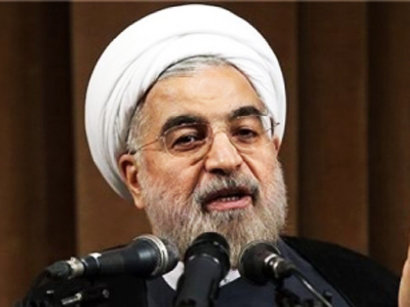 Hassan Rouhani / AP


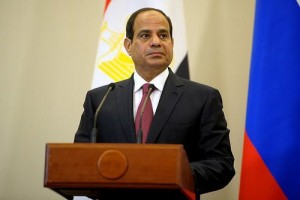


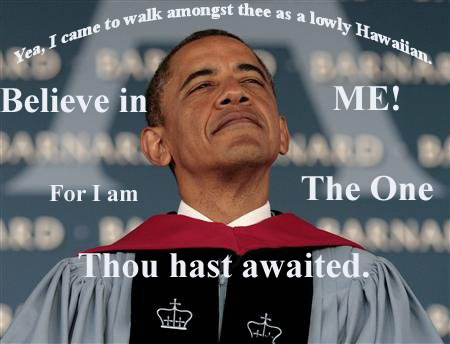


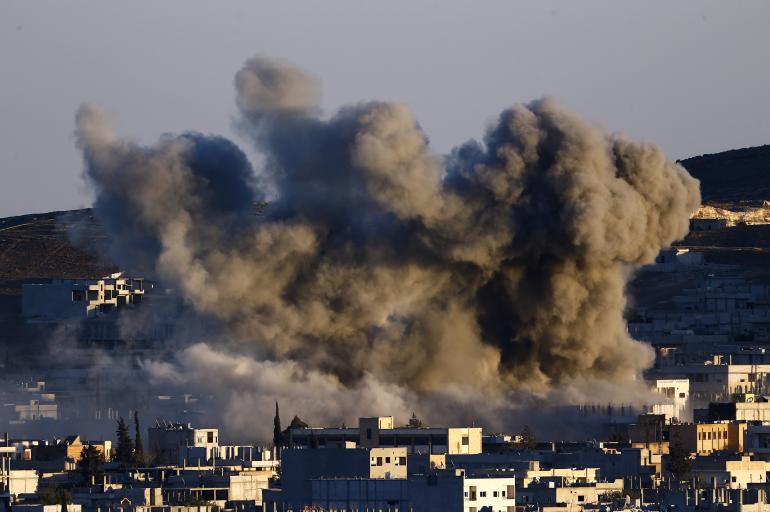

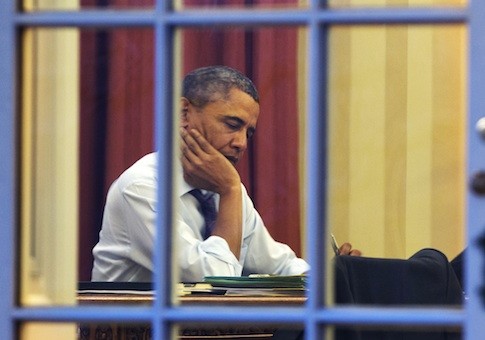

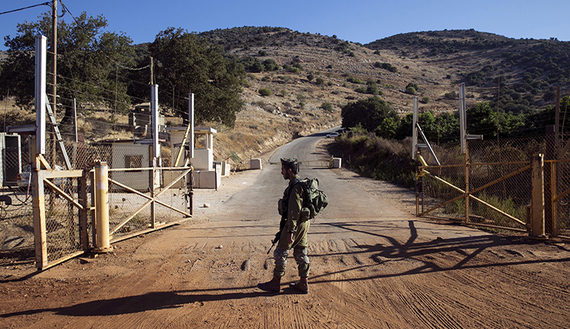




 anneinpt
 artaxes
 danmillerinpanama
 davidking1530
 Peter Hofman
 Joseph Wouk
 Peter
Peter Louisiana Steve
 WarSclerotic
Recent Comments