Archive for the ‘Obama’ category

Free Fire Zone- Iranian Nuclear Poker

November 11, 2014

Free Fire Zone- Iranian Nuclear Poker, Blackfive, , November 10, 2014

There is almost zero chance that any deal struck will actually stop Iran from pursuing what it sees as its destiny to become a nuclear power, and I don’t mean the kind that makes electricity.

******************

There is a deadline looming in the talks with Iran about their nuclear power weapons program.

US and Iranian negotiators are preparing to enter the intense endgame in the Iran nuclear deal talks, amid mixed assessments of prospects for completing the deal by the self-imposed Nov. 24 deadline, just under a month away.“This is the time to finish the job,” lead US negotiator Undersecretary of State Wendy Sherman told the Maxwell School of Public Affairs on Oct. 23 in rare public remarks about the sensitive Iran nuclear negotiations.

There is almost zero chance that any deal struck will actually stop Iran from pursuing what it sees as its destiny to become a nuclear power, and I don’t mean the kind that makes electricity. Our President is currently stuck with only the giant fail of ObamaCare as his legacy, so he really, really wants a deal that he can put on the shelf with his Nobel. That makes him a grave danger to give away the farm. The only upside is that the Iranians are just bullheaded enough to walk away without taking all his lunch money. Bottom line is in the high stakes poker game going on, we have a guy who doesn’t even understand the game.

Obama: OK, I agree to whatever deal YOU want

November 9, 2014

Obama: OK, I agree to whatever deal YOU want, Dan Miller’s Blog, November 9, 2014
No, not with His domestic enemies in the next Congress. He desperately wants a deal, any deal, with Iran.

Obama intends to grant Royal amnesty for millions of illegals currently present in our nation, regardless of the adverse economic and social impacts and Republican warnings. I opined here on what He will likely do and on the unfortunately poor prospects for any Republican efforts to thwart it.

voting

Remember “Leg Tingles?” The tingle has gone, at least temporarily

So much for deal making with the opposition.

However, Obama is anxious to have a deal — any deal — with Iran very soon.

legacy

Although He will not make a deal with His domestic enemies whose voters rejected Him and His policies on November 4th, Obama is apparently so infatuated with His need for a legacy that He continues to push for a nuke deal with Iran. Any deal will do, no matter how disastrous it will be. Obama’s protestations to the contrary are consistent with “if you like your doctor, you can keep your doctor,” “if you like your medical insurance policy you can keep it,” “My administration will be the most transparent in history” and a multitude of others.

A deal with Iran needs to be signed, sealed and delivered well before the next Congress convenes in January. Hence the importance of meeting the November 24th deadline or extending it for the minimum time needed for Iran to demand, and for Him to make, more concessions.

Iran continues to hang tough and Obama continues to seek accommodation from Iran so that He can have a legacy. Obama dispatched a letter to Iran’s Supreme Leader Ayatollah Ali Khamenei last month.

The Wall Street Journal reported Thursday that, according to people briefed on the letter, Obama wrote to Khamenei in the middle of last month and stressed that any cooperation on dealing with the Islamic State, or ISIS, was tied to Iran striking a deal over its nuclear program. The U.S., Iran and other negotiators are facing a Nov. 24 deadline for such a deal. [Emphasis added.]

. . . .

Asked about the reported letter, White House Press Secretary Josh Earnest would not confirm the report.

“I’m not in a position to discuss private correspondence between the president and any world leader,” he said.

However, he said the U.S. policy toward Iran “remains unchanged.”

a1  Obama and Kahameni -building a toaster

In an article at Commentary Magazine titled White House Ignores Khamenei Response to Letters, Michael Rubin wrote that contrary to reports that Khamenei did not respond,

Actually, Khamenei did respond. On the 30th anniversary of the seizure of the U.S. Embassy, he said this, in a mocking tone which is even more apparent in the Persian version of this speech:

The new US President made some beautiful comments. He also repeatedly asked us in writing and orally to turn a new page and help him change the present situation. He asked us to cooperate with him to solve global issues. He went as far as that.

Now, Khamenei continued to say he gave Obama a chance, but Obama didn’t come around. Khamenei then gloated about the strength of the Islamic Republic, a perception which Obama’s groveling tone has bolstered:

I wonder why they do not learn a lesson from what has happened. I do not understand why they are not prepared to get to know our nation. Do they not know that this nation is the one that resisted and brought the two superpowers – that is, the Soviet Union and America – to their knees? When there were two superpowers in the world, they were opposed to one another in almost all areas except in their enmity towards the Islamic Republic. This enmity was the only thing these two superpowers had in common. Why do you not learn your lesson? Today you are not even as powerful as you used to be. The Islamic Republic is several times more powerful today than those days, and yet you are speaking with the same tone? That is arrogance – talking to a nation arrogantly and using threats to get what they want. They threaten us. And our nation says it will resist.

Khamenei then warned the United States not to put its hope in reformers, as Obama seems keen to do:

Just because a handful of naïve or malevolent individuals have confronted the Islamic Republic does not mean that they can roll out the red carpet for Americans in our country. These individuals either had ulterior motives or had naively misunderstood the events without having very bad intentions – I do not want to be judgmental about their malevolence. Americans should know that the nation is resisting firmly.

Despite the very substantial concessions which Obama has already granted, Khamenei’s remarks seem to amount to this: give me whatever else I demand or shove your legacy up your scrawny apostate ass.

It was reported on November 8th that

Ali Akbar Velayati, longtime foreign policy adviser to Khamenei and a former Iranian foreign minister, may join the talks between US Secretary of State John Kerry, Iran’s Foreign Minister Mohammad Javad Zarif and European Union negotiator Catherine Ashton, in a signal that the Supreme Leader may be preparing to sign off on a deal, sources told Al-Monitor on condition of anonymity. [Emphasis added.]

. . . .

The meeting between Kerry, Zarif and Ashton is due to get underway Nov. 9 in Muscat, Oman, which hosted secret US-Iran talks that helped lead to reaching the interim Iran nuclear deal last year. Following the two-day US/Iran/EU trilateral meeting Nov. 9-10, negotiators from the rest of the P5+1 — the five permanent members of the UN Security Council plus Germany — are supposed to join the talks in Oman for a Nov. 11 meeting. Another, possibly final, round of P5+1 Iran talks is due to be held in Vienna from Nov. 18 to 24.

US, Iranian and Russian negotiators say there is still more work to be done, but are expressing increasing, albeit cautious, optimism that a deal is within reach.

The November 24, 2013 P5+1 Interim deal was and remains a scam

In January of this year, I wrote about Obama’s Iran Scam, structured from the beginning in Iran’s favor by legitimizing Iran’s Uranium enrichment and effectively eliminating consideration by the P5+1 negotiators of Iran’s past and continuing efforts to militarize nuclear weapons. The January 16, 2014 White House Summary of the arrangement states,

Iran committed in the Joint Plan of Action to provide increased and unprecedented transparency into its nuclear program, including through more frequent and intrusive inspections as well as expanded provision of information to the IAEA. [Emphasis added.]

Will Iran’s “unprecedented transparency” be similar to that which Obama claimed for His administration? Or the versions of transparency He delivered?

Continuing with the White House Summary,

The Iranian enrichment facilities at Natanz and Fordow will now be subject to daily IAEA inspector access as set out in the Joint Plan of Action (as opposed to every few weeks).  The IAEA and Iran are working to update procedures, which will permit IAEA inspectors to review surveillance information on a daily basis to shorten detection time for any Iranian non-compliance.  In addition, these facilities will continue to be subjected to a variety of other physical inspections, including scheduled and unannounced inspections.

The Arak reactor and associated facilities will be subject to at least monthly IAEA inspections – an increase from the current inspection schedule permitting IAEA access approximately once every three months or longer.

Iran has also agreed to provide for the first time:

  • Long-sought design information on the Arak reactor;
  • Figures to verify that centrifuge production will be dedicated to the replacement of damaged machines; and
  • Information to enable managed access at centrifuge assembly workshops, centrifuge rotor production workshops and storage facilities, and uranium mines and mills.

These enhanced monitoring measures will enable the IAEA to provide monthly updates to the Joint Commission on the status of Iran’s implementation of its commitments and enable the international community to more quickly detect breakout or the diversion of materials to a secret program.

With respect to centrifuges, the U.S. has caved several times on the numbers and types that Iran can have and use and will very likely continue to do so. As of late September,  The U.S.

is considering softening present demands that Iran gut its uranium enrichment program in favor of a new proposal that would allow Tehran to keep nearly half of the project intact while placing other constraints on its possible use as a path to nuclear weapons, diplomats told The Associated Press.

The U.S., which fears Tehran may enrich to weapons-grade level used to arm nuclear warheads, ideally wants no more than 1,500 centrifuges left operating. Iran insists it wants to use the technology only to make reactor fuel and for other peaceful purposes and insists it be allowed to run at least the present 9,400 machines.

The tentative new U.S. offer attempts to meet the Iranians close to half way on numbers, said two diplomats who demanded anonymity because their information is confidential. They said it envisages letting Iran keep up to 4,500 centrifuges but would reduce the stock of uranium gas fed into the machines to the point where it would take more than a year of enrichment to create enough material for a nuclear warhead. [Emphasis added.]

Now, it appears that Iran has sped up Uranium enrichment and may also have violated the interim agreement.

Iran has stepped up efforts to develop a process that could enrich uranium at a much quicker pace, thereby violating the interim nuclear agreement reached with world powers last year, according to the Washington-based Institute for Science and International Security, or ISIS.

“Iran may have violated [the interim deal] by starting to feed [natural uranium gas] into one of its advanced centrifuges, namely the IR-5 centrifuge,” ISIS wrote in an analysis of the confidential IAEA report issued Friday to member states, according to Reuters. “Under the interim deal, this centrifuge should not have been fed with [gas] as reported in this safeguards report.”

. . . .

Iran has also reportedly sped up its low-grade uranium enrichment over the past two months, growing its stockpile by 8% to 8.4 tons.

The issue of advanced enrichment is sensitive because Iran could potentially produce a nuclear weapon if it processes the material further, a main concern for the West.

Perhaps Obama’s willingness to cave is why, as noted above, “the Supreme Leader may be preparing to sign off on a deal.”

Moreover, as I noted here, here and here, the interim agreement and the White House Summary omit any mention of Iran’s military-nuclear sites, such as Parchin, where the IAEA had reason to think that there had been implosion testing in 2011 but was refused access to inspect. They also fail to mention

Development and construction of rocketry capable of delivering nuclear warheads; and

Development and testing of nuclear warheads.

If Iran’s continuing development of militarized nukes is of no consequence, what (besides a legacy for Obama) is the purpose of a deal? Might this happy language in the White House Summary be meaningless?

The Joint Plan of Action marks the first time in nearly a decade that the Islamic Republic of Iran has agreed to specific actions that stop the advance of its nuclear program, roll back key aspects of the program, and include unprecedented access for international inspectors. [Emphasis added.]

The farce continues apace. As the Daily Beast pointed out on November 7th,

Iran continues to refuse to disclose its nuclear activity, and experts do not anticipate the country will become more transparent in the future. That’s the assessment released Friday from the International Atomic Energy Agency. “The agency is not in a position to provide credible assurance about the absence of undeclared nuclear material and activities in Iran, and therefore to conclude that all nuclear material in Iran is in peaceful activities,” said the report, which was also pessimistic about the chance that Iran will be forthright with its nuclear activities in the future. [Emphasis added.]

Scott Johnson at Power Line posted an article on November 7th titled How to understand Obama’s Iran diplomacy. It’s a very good article, so please read the whole thing. He wrote, in the lead paragraph,

I think the easiest way to understand Obama’s diplomacy is this. Assume that Obama believes Iran should have nuclear weapons and would like to facilitate the mullahs’ nuclear weapons program. This assumption is the Occam’s Razor that clarifies what might otherwise be obscure. The assumption may not be correct, but it should prove a handy guide to coming attractions. [Emphasis added.]

Mr. Johnson may well be correct. Or perhaps Obama cares less about whether Iran gets (or keeps) nukes than He cares about securing a legacy. Either way, it’s bad for much of the Middle East and also for the United States.

Iran’s human rights record and support for terrorism

Nor was there any mention in the P5+1 interim deal, or the White House Summary, of Iran’s horrendous and worsening human rights record. According to an article titled Iran Amputating Limbs, Burning Political Opponents,

Iran executed a record-shattering 411 citizens in the first half of 2014 and a total of 852 people in the last 15 months, including at least eight juveniles, according to a new United Nations report that will be introduced to the organization’s General Assembly Tuesday.

In addition to a surge in state-sanctioned killings that a U.N. official referred to as “shocking,” Iran continues to torture imprisoned individuals using techniques such as amputation, electroshock, flogging, and burnings, according to the report, which details human rights in the Islamic Republic.

As noted at the Daily Beast.

While Secretary of State Kerry has referred on occasion to Iran’s human rights record as “abysmal,” the Obama administration has done precious little to pressure Iran on this front. In fact, the rare tough talk of American diplomats has become outpaced by growing references to their blossoming friendship with Iranian regime officials. “It’s reached a level of we know each other well enough to make jokes,” a senior U.S. official recently gushed to reporters. [Emphasis added.]

What do they joke about? Obama? Human rights? Terror? Nukes? Israel?

What does our desperation to get a nuclear deal at all costs say to the modern-day Iranian Solzhenitsyns rotting in Evin prison? Or to the young social-media savvy generation who took to the streets in 2009 after Mahmoud Ahmadinejad’s fraudulent reelection? [Emphasis added.]

Iran hangings by crane

Rayhaneh Jabbari, executed

Rayhaneh Jabbari, executed by Iran

The interim deal as well as the White House Summary also suggest that P5+1 discussions will take no account of Iran’s already massive support for terrorism, for which it will have even more funds as sanctions continue to disappear.

Conclusions

For a major supporter of international terrorism, with a worsening human rights record that makes even that of North Korea seem relatively tame, to have and to be in a position to use nukes will be worse than merely shameful.

What will be Iran’s first nuclear target? Over the weekend the Supreme Leader repeated, for the nth time, his views on Israel:

Supreme Leader Ayatollah Ali Khamenei called for the destruction of Israel over the weekend, stating that the “barbaric” Jewish state “has no cure but to be annihilated.

Will this, transformed from a simulation into reality, be part of Obama’s legacy?

RAMclr-110514-netanyahu-WS-wide.gif.cms_

Who will be next? The Great Satan, perhaps?

Nuke attack hide

A good deal for Iran is also bad for the decreasingly free “free world” for a different reason: since the Obama Nation won’t stand up, effectively, for democracy with freedom — including even the most basic of human rights — who will? Formerly Great Britain?

Continuing and largely successful efforts to sanitize Islam through multicultural political correctness and its necessary ally, repression of what was once free speech, may well mean that no nation will do more than make bland and ineffective shows of standing for even the most basic of human rights.

Top aide to Iran Supreme Leader may join Oman talks with John Kerry

November 9, 2014

Top aide to Iran Supreme Leader may join Oman talks with John Kerry, Al-MonitorLaura Rozen, November 8, 2014

Ali Akbar Velayati, foreign policy adviser to Iran’s Supreme Leader Khamenei, may join nuclear talks between the United States and Iran in Oman this week, in a sign a deal may be moving closer.

**************

A top adviser to Iran’s Supreme Leader Ayatollah Ali Khamenei may join talks in Oman between the United States and Iran in the coming days, in a sign that a breakthrough may be imminent in reaching a nuclear deal, Al-Monitor has learned.

Ali Akbar Velayati, longtime foreign policy adviser to Khamenei and a former Iranian foreign minister, may join the talks between US Secretary of State John Kerry, Iran’s Foreign Minister Mohammad Javad Zarif and European Union negotiator Catherine Ashton, in a signal that the Supreme Leader may be preparing to sign off on a deal, sources told Al-Monitor on condition of anonymity.

US and Iranian officials did not immediately respond to queries from Al-Monitor about the prospect that Velayati might join the Oman talks.

Velayati, speaking at a meeting with Norway’s foreign minister in Tehran last week, praised the role of Oman in hosting the upcoming trilateral talks, and said Iran seeks to reach a final nuclear deal quickly.

“We want for the talks to resolve as soon as possible, and arrive at an agreement like the one we did in Geneva last year,” Velayati said Nov. 2., Iran’s Mehr news agency reported. “But the agreement must meet Iran’s interests.”

Velayati also praised Oman as having always demonstrated “good intentions toward its relations with Iran.”

The meeting between Kerry, Zarif and Ashton is due to get underway Nov. 9 in Muscat, Oman, which hosted secret US-Iran talks that helped lead to reaching the interim Iran nuclear deal last year. Following the two-day US/Iran/EU trilateral meeting Nov. 9-10, negotiators from the rest of the P5+1 — the five permanent members of the UN Security Council plus Germany — are supposed to join the talks in Oman for a Nov. 11 meeting. Another, possibly final, round of P5+1 Iran talks is due to be held in Vienna from Nov. 18 to 24.

US, Iranian and Russian negotiators say there is still more work to be done, but are expressing increasing, albeit cautious, optimism that a deal is within reach.

“We are hopeful that over the course of the next weeks, it will be possible to close real gaps that still exist in order to be able to reach an agreement,” Kerry said following a meeting with Russian Foreign Minister Sergey Lavrov in China on Nov. 7. “But I’m not going to stand here and predict at this point in time what the odds of that are.”

The next few days of meetings in Oman will be critical to see if the sides will be able to overcome remaining, if narrowed, gaps on the issues of enrichment capacity and sanctions relief to finalize the deal, US and Iranian officials said.

“No one wants to return to the way things were before the Geneva Agreement. That would be too risky a scenario,” Iran Deputy Foreign Minister Abbas Araghchi told Iran’s IRNA news agency Nov. 8, before he and the Iran nuclear negotiating team traveled to Oman, Reuters reported.

“Both sides are aware of this, which is why I think a deal is within reach,” Araghchi said. “We are serious and I can see the same resolve on the other side.”

Russia’s top negotiator, speaking to Russian media following a coordination meeting of P5+1 political directors in Vienna Nov. 7, also voiced determination to finish the deal.

“All participants voiced additional proposals” at the Nov. 7 Vienna meeting, Russian Deputy Foreign Minister Sergey Ryabkov told Russia’s Ria Novosti news agency. “We are determined to put it all together in such a way that key compromises could be reached before the [Nov. 24] deadline.”

Iranian journalists, responding to Al-Monitor’s report, suggested Velayati might be coming to Oman to bring a message from Khamenei to Kerry. President Obama reportedly wrote Khamenei a letter in October, the Wall Street Journal reported Nov. 3. The letter was described as saying that the nuclear deal being offered adhered to Khamenei’s expressed desire to prove to the world Iran is not seeking a nuclear weapon, while allowing Iran to have a robust civil nuclear energy program, and that such a deal could benefit the United States’ and Iran’s common regional interest in fighting the Islamic State, reports said.

Kerry, when asked about the US message to Iran Nov. 8, stressed that there is no linkage between the Iran nuclear talks and regional issues.

“There is no linkage whatsoever of the nuclear discussions with any other issue, and I want to make that absolutely clear,” Kerry told reporters in China, Reuters reported. “The nuclear negotiations are on their own.”


How to understand Obama’s Iran diplomacy

November 8, 2014

How to understand Obama’s Iran diplomacy, Power LineScott Johnson, November 7, 2014

I think the easiest way to understand Obama’s diplomacy is this. Assume that Obama believes Iran should have nuclear weapons and would like to facilitate the mullahs’ nuclear weapons program. This assumption is the Occam’s Razor that clarifies what might otherwise be obscure. The assumption may not be correct, but it should prove a handy guide to coming attractions.

Obama bids against himself chasing after the mullahs. You can say that he doesn’t know how to negotiate, and it’s a plausible hypothesis. As Michael Rubin explains, “Desperation is not a good negotiating position” (unless you want to give it away).

But how explain Obama’s vehement opposition in the past to the imposition of sanctions against Iran by Congress, or the threat of such sanctions in the future in the case no final deal were to be reached?

How explain his concession up front (in the P5+1 interim agreement with Iran) to Iran’s nuclear enrichment?

How explain the offer to agree to an ever increasing number of centrifuges for enrichment?

How explain the apparent acceptance of a prospective deal without proof that Iran’s nuclear program is peaceful in nature, which is in itself an absurd and unbelievable proposition?

And so on, and so on.

When Obama makes the famously false promise that he is from the government and he is here to help, he means it in the case of the mullahs.

Today’s page-one story in the Wall Street Journal reveals Obama’s fourth secret letter to the mullahs in search of a deal. He is pleading with them. He will not take no for an answer. See Michael Rubin, “White House ignores Khameni response to letters.”

Obama’s most recent letter is already yesterday’s news. Today’s news comes via the IAEA. Omri Ceren summarizes it as follows in an email message this morning:

The new IAEA report went online about two hours ago. No changes from last time: not only are the Iranians continuing to block the Agency’s work, but they’re refusing to offer new ways of moving forward. Zero progress during the reporting period, and no sign that the next one will be any better.

The report is here The key lines are:

“The Agency is not in a position to provide credible assurances about the absence of undeclared nuclear material and activities in Iran, and therefore to conclude that all nuclear material in Iran is in peaceful activities”

“Iran has not provided any explanations that enable the Agency to clarify the outstanding practical measures, nor has it proposed any new practical measures in the next step of the Framework for cooperation”

The Iranians seem to be betting that the West will eventually drop the demand that Tehran come clean about the possible military dimensions (PMDs) of its nuclear program. Negotiations will come down to the wire, all of the other issues will have been massaged, and Iranian negotiators will look up and say the equivalent of ‘you’re not really going to blow up this whole deal over something we did in the past, are you?’ Under that scenario the message will be echoed by a few advocates in the nonproliferation world, the P5+1 will latch on to the reasoning, and that’ll be that.

The problem is that the PMD issue has very little to do with the past and everything to do with future verification. Unless the Iranians disclose what they’ve been doing on the nuclear front – including whatever the military is doing to surreptitiously enrich and store uranium – there’s no way to verify that they’ve stopped doing those things.

Remember how we got here. The P5+1 was supposed to be working with Iran on uranium, plutonium, and ballitsic missiles. Underneath all of those issues, the IAEA was supposed to be working on getting Iran to come clean on the full scope of its program: both the civilian and the military aspects (i.e. the PMDs).

People often talk and write about the PMD issue as if it’s just about weapons work – suspected Iranian experiments with detonators, warheads, etc. Those things matter but the issue is much broader. The IAEA wants access to all the places where the Iranian military had its hand in any atomic work – uranium mining, centrifuge construction, enrichment, and so on. The goal is to get a full picture of everything the Iranians are doing, so that the IAEA can confirm that they’ve stopped.

When the Iranians jam the IAEA up on PMDs, it’s not just another fourth core issue that can be negotiated alongside uranium, plutonium, and ballistic missiles. Transparency is the prerequisite to creating any robust verification scheme on those other three issues. It’s not possible for Western negotiators to say something like: ‘ok, we’ll give you a little on PMDs, but you have to give us something back on centrifuges.’ Without disclosure, there’s no way to verify that the Iranians are actually living up to their half of the trade.

Isn’t this obviously true? That’s where my Occam’s Razor cuts through the fog to help us understand what is happening now and what will in all likelihood be happening soon.

In related news, see Adam Kredo, “Report: Iran nuclear program more advanced than previously believed” and “Pentagon: Iran giving ‘lethal aid to the Taliban’ to fight US.”

UPDATE: Omri Ceren writes to update his message with news of today’s State Department briefing:

The issue came up in today’s State Department press briefing between the AP’s Matt Lee and State spox Jen Psaki. It actually came up twice, with [AP State Department reporter] Matt [Lee] circling back to it….The [short] version is that Jen left open the possibility that the US will take a deal with Iran even if the Iranians continue to obstruct the IAEA, i.e. even if they refuse to come clean on their past nuclear activity including military atomic work. If that happens it would mark another erosion in the US position, alongside reported walkbacks in the other three core areas: uranium, plutonium, and ballistic missiles. More problematically, letting Iran slide on IAEA inspections now risks gutting any verification regime set up later.

It is “problematic,” however, only if your (our) goal is to prevent Iran from obtaining nuclear weapons.

Obama deploys 1,500 more U.S. troops to Iraq

November 8, 2014

Obama deploys 1,500 more U.S. troops to Iraq, Washington TimesDave Boyer and Maggie Ybarra, November 7, 2014

(Will they be permitted to wear combat boots? — DM)

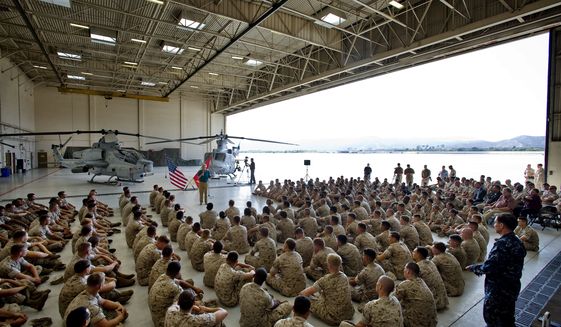
united-states-iraq-advisersjpeg-05ad1_c0-176-4256-2656_s561x327A group of selected Marines representing Camp Pendleton listen as Secretary of Defense Chuck Hagel answers their questions during his short visit to the base Tuesday Aug. 12, 2014. Hagel announced the deployment of another 130 U.S. troops to Iraq in remarks to Marines at this Southern California base on the final stop of a weeklong, around-the-world trip that also took him to India, Germany and Australia. (AP Photo/The Orange County Register, Paul Rodriguez)

“The president also authorized U.S. personnel to conduct these integral missions at Iraqi military facilities located outside Baghdad and Erbil,” the statement said. “U.S. troops will not be in combat, but they will be better positioned to support Iraqi Security Forces as they take the fight to ISIL.”

***********

President Obama is sending up to 1,500 more U.S. military personnel to Iraq to serve as non-combat advisers in the fight against Islamic State terrorists, the White House said Friday.

The troops will “train, advise, and assist Iraqi Security Forces, including Kurdish forces,” the White House said.

“The president also authorized U.S. personnel to conduct these integral missions at Iraqi military facilities located outside Baghdad and Erbil,” the statement said. “U.S. troops will not be in combat, but they will be better positioned to support Iraqi Security Forces as they take the fight to ISIL.”

It’s the latest escalation of U.S. military personnel in Mr. Obama’s fight to rescue the besieged government in Baghdad, where the president withdrew all U.S. forces in 2011. Since August, the U.S. has been conducting hundreds of airstrikes against the Islamic State in Iraq, and more recently in Syria.

The surge in military advisers will more than double the number of U.S. personnel in Iraq, which currently totals about 1,400.

U.S. troops will be asked to train nine Iraqi brigades and three Kurdish fighter brigades, said Pentagon spokesman Rear Adm. John Kirby.

“These sites will be located in northern, western, and southern Iraq,” Adm. Kirby said. “Coalition partners will join U.S. personnel at these locations to help build Iraqi capacity and capability. The training will be funded through the request for an Iraq train-and-equip fund that the administration will submit to Congress as well as from the government of Iraq.”

The White House said the Iraqi government requested the additional forces, and Defense Secretary Chuck Hagel agreed.

White House press secretary Josh Earnest said the Islamic State “has suffered a series of defeats in Iraq against the Iraqi Security Forces and Peshmerga, with the support of U.S. and coalition airstrikes and Intelligence, Surveillance and Reconnaissance, and as well as U.S. military advice.”

“The United States and its coalition partners will continue to confront the threat of [the Islamic State] with strength and resolve as we seek to degrade and ultimately defeat” the terrorist group,” he said.

Shaun Donovan, director of the White House Office of Management and Budget, said the administration is sending a request to Congress for $5.6 billion to pay for the military operations.

The request includes $1.6 billion to establish the Iraq train-and-equip fund to develop and support Iraqi security forces, including Kurdish forces.

“This funding will help reconstitute the Iraqi army and strengthen the capability and capacity of our Iraqi partners to go on the offensive against” the Islamic State, Mr. Donovan said.


IAEA: No Progress on Iranian Nukes

November 8, 2014

IAEA: No Progress on Iranian Nukes, Daily Beast, November 7, 2014

(Don’t bother P5+1 with irrelevant details. The deal has to be based on mutual trust! — DM)

1415378700600.cached
Iran continues to refuse to disclose its nuclear activity, and experts do not anticipate the country will become more transparent in the future. That’s the assessment released Friday from the International Atomic Energy Agency. “The agency is not in a position to provide credible assurance about the absence of undeclared nuclear material and activities in Iran, and therefore to conclude that all nuclear material in Iran is in peaceful activities,” said the report, which was also pessimistic about the chance that Iran will be forthright with its nuclear activities in the future. The report notes that Iran has not “proposed any new practical measures in the next step of the Framework for cooperation.” President Obama recently wrote a letter to Iran’s supreme leader asking for help fighting ISIS in exchange for a deal to resolve the nuclear standoff. [Emphasis added.]

Read it at IAEA Report

Iran Nuclear Talks and North Korean Flashbacks

November 7, 2014

Iran Nuclear Talks and North Korean Flashbacks, ForbesClaudia Rosett, November 7, 2014

(During Clinton’s efforts to achieve detente with North Korea, Wendy Sherman found hope for change — for the better —  in every hostile utterance from NK leaders. Now she is Obama’s boot on the ground in the P5+1 negotiations with Iran. What can possibly go right wrong? — DM)

Now, in the Obama administration’s increasingly desperate quest for an Iran deal, comes news that President Obama is proposing to Iran’s Khamenei, ruler of the world’s leading terror-sponsoring state, that Iran and the U.S. cooperate to fight the terrorists of ISIS. This has a familiar ring. Back in 2000, the visit of North Korea’s Vice Marshal Jo to the White House was preceded, shortly beforehand, by a “Joint U.S.-D.P.R.K. Statement on International Terrorism,” in which both the U.S. and North Korea agreed that “international terrorism poses an unacceptable threat to global peace and security.” Apparently this was all part of the negotiating process of finding common ground. What could go wrong? Not that anyone should pin all this on Wendy Sherman, who is just one particularly active cog in the Washington negotiating machine. But there’s a familiar script playing out here. It does not end well.

*****************

With the Iran nuclear talks nearing a Nov. 24 deadline for a deal, U.S. chief negotiator Wendy Sherman is under pressure to bring almost a year of bargaining to fruition. While U.S. policy rests ultimately with President Obama, and the most prominent American face in these talks is now that of Secretary of State John Kerry, the hands-on haggling has been the domain of Sherman. On the ground, she has been chief choreographer of the U.S. negotiating team. The President has been pleased enough with her performance to promote her last week from Under Secretary to Acting Deputy Secretary of State.

The talks themselves have been doing far less well, marked by Iranian demands and U.S. concessions. This summer the U.S. and its negotiating partners agreed to extend the original July deadline until November. Tehran’s regime, while enjoying substantial relief from sanctions, is refusing to give up its ballistic missile program and insisting on what Tehran’s officials have called their country’s “inalienable right” to enrich uranium.

The Obama administration badly wants a deal. This week The Wall Street Journal reported that last month Obama wrote a secret letter to Iran’s Supreme Leader Ali Khamenei, which “appeared aimed both at buttressing the campaign against Islamic State and nudging Iran’s religious leader closer to a nuclear deal.” Speaking to reporters in Paris this week about the Iran nuclear negotiations, Kerry said “We believe it is imperative for a lot of different reasons to get this done.”

So, now that crunch time has arrived, what might we expect? If precedent is any guide, it’s worth revisiting Sherman’s record from her previous bout as a lead negotiator, toward the end of the second term of the Clinton administration. Back then, Sherman was trying to clinch an anti-proliferation missile deal with another rogue despotism, North Korea.

That attempt failed, but only after then-Secretary of State Madeleine Albright, together with Sherman, had dignified North Korean tyrant Kim Jong Il with a visit to Pyongyang in late October, 2000. These American top diplomats brought Kim the gift of a basketball signed by one of his favorite players, Michael Jordan. Kim entertained them with a stadium display in which tens of thousands of North Koreans used flip cards to depict the launch of a long-range missile.

Less well remembered was the encounter shortly before Albright’s trip to Pyongyang, in which the State Department hosted a visit to Washington, Oct. 9-12 of 2000, by one of the highest ranking military officials in North Korea, Vice Marshal Jo Myong Rok. The centerpiece of Jo’s trip was a 45-minute face-to-face meeting at the White House, in the Oval Office, with President Clinton. It was historic, it was the first time an American president had met with an official of North Korea’s totalitarian state.

And it was a deft piece of extortion by North Korea, which had parlayed its missile program — including its missile trafficking to the Middle East, and its 1998 test-launch of a missile over Japan — into this lofty encounter in which the U.S. superpower was pulling out all the stops in hope of cutting a deal before Clinton’s second term expired in Jan., 2001. By 2000 (or, by some accounts, earlier) the Clinton administration was also seeing signs that North Korea was cheating on a 1994 denuclearization arrangement known as the Agreed Framework. Eight months before Jo arrived in Washington, Clinton had been unable to confirm to Congress that North Korea had abandoned its pursuit of a nuclear weapons program. Nonetheless, Jo’s visit rolled ahead, with Sherman enthusing in advance to the press that “Chairman Kim Jong Il has clearly made a decision — personally — to send a special Envoy to the United States to improve relations with us.”

Officially, Jo was hosted in Washington by Albright. But it was Sherman, then the Special Advisor to the President and Secretary of State for North Korea Policy, who orchestrated the events, squired Jo around Washington and briefed the press. It was Sherman who had helped prepare the way while accompanying her predecessor, the previous North Korea policy coordinator and former defense secretary, William Perry, on a trip to North Korea in 1999.

Jo arrived in Washington on Oct. 9, staying at the venerable Mayflower Hotel, where Sherman went to greet him. The next morning Jo and his delegation began their rounds with a courtesy call on Albright at the State Department. Then, before heading to the White House, Jo engaged in a symbolically freighted act. According to an account published some years later in the Washington Post by the senior State Department Korean language interpreter, Tong Kim, who was present for the occasion: “The marshal arrived in Washington in a well-tailored suit, but before going to the White House, he asked for a room at the State Department, where he changed into his mustard-colored military uniform, with lines of heavy medals hanging on the jacket, and donned an impressive military hat with a thick gold band.” Perhaps it did not occur to anyone at the State Department that North Korea was still a hostile power, a brutal rogue state fielding one of the world’s largest standing armies, and that this donning of the uniform on State premises was not just a convenience, but an implied threat. Or perhaps the zealous hospitality of the occasion just over-rode any thought at all. In any event, it was in his uniform that Jo went from the State Department to the White House.

Following those meetings, Sherman briefed the press. She made a point of mentioning that Jo had worn a business suit to the State Department. but changed into full military uniform for his meeting with the President of the United States. Sherman chose to interpret Jo’s wardrobe change as happy evidence of North Korean diversity under Dear Leader Kim: “We think this is very important for American citizens to know that all segments of North Korea society, obviously led by Chairman Kim Chong-Il in sending this Special Envoy, are working to improve the relationship between the United States and North Korea and this is obviously an important message to the citizens of North Korea as well.”

Actually, there were substantial segments of North Korean society whose chief preoccupation was finding enough food to stay alive, toward the end of a 1990s famine in which an estimated one million or so had died — forbidden by Kim’s totalitarian state to enjoy even a hint of the freedom that had by then allowed their brethren in South Korea to join the developed world. This was known at the time, but did not figure in Sherman’s public remarks.

On the second evening of Jo’s Washington visit, Albright hosted a banquet for him and his delegation at the State Department. She welcomed the “distinguished group” to the “historic meeting,” and invited everyone to relax and get better acquainted. There was laughter and applause. Jo made a toast — a disturbing toast — in which he said there could be “friendship and cooperation and goodwill, if and when the Democratic People’s Republic of Korea and our leadership is assured, is given the strong and concrete security assurances from the United States for the state sovereignty and the territorial integrity of the Democratic People’s Republic of Korea.”

If the State Department’s chief North Korea policy coordinator, Wendy Sherman, noticed a problem with that toast, and its mention of territorial integrity, it seems she did nothing to alert the assembled American dignitaries. The crowd clapped and raised a toast to North Korea’s envoy. It was left to outside observers, such as American Enterprise Institute scholar and North Korea expert Nicholas Eberstadt, to point out, as Eberstadt stressed at an AEI forum in 2008, that North Korea lays claim to the entire Korean peninsula, including South Korea. “Take a look at the maps; take a look at the preamble to the Workers’ Party charter,” said Eberstadt; the real message is, “We can be friends with North Korea if we are willing to subsidize North Korean government behavior and throw South Korea into the bargain too, but that is a pretty high opening bid.”

Jo’s visit ended with a U.S.-D.P.R.K Joint Communique, full of talk about peace, security, transparency and access. There was no missile deal. Kim Jong Il wanted Clinton, leader of the free world, to come parley over missiles in totalitarian, nuclear-cheating Pyongyang. Clinton demurred. In late October, Albright and Sherman went instead. As the clock ticked down on the final weeks of the Clinton administration, Sherman reportedly traveled to Africa with a bag of cold-weather clothes, to be ready in the event of a last-minute summons to North Korea.

In 2001, President Bush was inaugurated. Sherman left the State Department, and soon afterward she wrote an Op-ed for The New York Times, headlined “Talking to the North Koreans.” Sherman noted that “Some are understandably concerned that a summit with President Bush would only legitimize the North Korean leader” — nonetheless, she urged Bush to try it. Bush tried confrontation in 2002 over North Korea’s nuclear cheating, followed by years of Sherman-style Six-Party Talks, including two agreements, in 2005 and 2007, which North Korea punctuated in 2006 with its first nuclear test, and has followed during Obama’s presidency with two more nuclear tests, in 2009 and 2013.

Vice-Marshal Jo died in 2010. Kim Jong Il died in 2011, and was succeeded by his son, current North Korean tyrant Kim Jong Un, whose regime carried out the 2013 nuclear test, and threatened earlier this year to conduct another. Wendy Sherman rejoined the State Department under Obama, and has moved on from wooing North Korea to the bigger and potentially far deadlier project of negotiating a nuclear deal with Iran. Considerable secrecy has surrounded many specifics of these talks, while Americans have been asked to trust that this is all for their own good. In a talk last month at Washington’s Center for Strategic and International Studies, Sherman said: “As Madeleine Albright once observed — a wonderful Secretary of State, a dear friend, and a business partner to boot at one point in my life — negotiations are like mushrooms, and often they do best in the dark.”

Now, in the Obama administration’s increasingly desperate quest for an Iran deal, comes news that President Obama is proposing to Iran’s Khamenei, ruler of the world’s leading terror-sponsoring state, that Iran and the U.S. cooperate to fight the terrorists of ISIS. This has a familiar ring. Back in 2000, the visit of North Korea’s Vice Marshal Jo to the White House was preceded, shortly beforehand, by a “Joint U.S.-D.P.R.K. Statement on International Terrorism,” in which both the U.S. and North Korea agreed that “international terrorism poses an unacceptable threat to global peace and security.” Apparently this was all part of the negotiating process of finding common ground. What could go wrong? Not that anyone should pin all this on Wendy Sherman, who is just one particularly active cog in the Washington negotiating machine. But there’s a familiar script playing out here. It does not end well.

Iran’s Ideological Camp Fears The Possibility Of A Nuclear Agreement Between Iran And The P5+1, Warns Rohani Government

November 7, 2014

Iran’s Ideological Camp Fears The Possibility Of A Nuclear Agreement Between Iran And The P5+1, Warns Rohani Government, MEMRI, A. Savyon, Y. Mansharof, and E. Kharrazi, November 6, 2014

(What might Obama and Kerry give the “ideologues” to encourage them to board their ship of State, the BHO Titanic? — DM)

Kayhan: “In Negotiations That Could Take Place In 2024, Iran Will Undoubtedly Come To The Negotiating Table With Tens Of Thousands Of Centrifuges That Are More Advanced Than Those It Has Today”; The Nuclear Mushroom Yields Results Once In A Decade

“Under Section 125 of our constitution, international commitments must be approved by the Majlis. But unfortunately, the Majlis members are not being updated at all in the nuclear negotiations issue… Government actions that disregard Majlis opinion will cause future problems, and will cause [the Majlis] to reject agreements that are against the interest of the people – which will have direct repercussions for the negotiating team.”

Democrats in the White House will try to turn their defeat in the elections to their diplomatic advantage. Obama is like a gambler who has lost everything, and he is sending his representatives to the [negotiating] table with empty pockets…

****************

Introduction

Both the U.S. administration and Iran’s pragmatic camp were last week preparing public opinion in their respective countries for the possibility that a nuclear agreement will be reached between Iran and the P5+1 by the November 24, 2014 deadline.[1] According to the emerging contours of the agreement, Tehran will apparently be allowed to operate 4,000 to 6,000 first-generation centrifuges,[2] and in return, in a move that will not require Congressional approval, the U.S. administration will suspend American sanctions.

The pragmatic camp in Iran, headed by Hashemi Rafsanjani and his proxy President Hassan Rohani, is pressuring the White House to reach an agreement with Iran right now, and identifying President Obama as “the weakest American president.”[3] At the same time, this camp’s leaders are laying the groundwork for obtaining Iranian approval for an agreement.

On October 22, 2014, President Rohani emphasized the need for engaging and negotiating with the enemy, framing doing so as the lesson that should be taken from the Shi’ite legend of Karbala – in contrast to the interpretation of these events commonly accepted in Iran.[4] On October 27, the pragmatic camp’s main organ, the Jomhouri-ye Eslami daily, called on the ideological camp not to sabotage the emerging agreement, stressed that the agreement was within the red lines set out by Iranian Supreme Leader Ali Khamenei, and warned the Khamenei camp that it must not cause Iran to miss this golden opportunity.

Furthermore, on November 2, 2014, two days before the nation marked the anniversary of the 1979 seizure of the U.S. Embassy and capture of its staff in Tehran, which this year coincides with Iran’s Ashura rituals, Ali Khorram, senior advisor to Iranian Foreign Minister Javad Zarif, told the reformist pro-Rohani newspaper Shargh that U.S.-Iran relations are now no longer hostile, and are even “friendly.” He claimed there had been a change for the better in U.S. policy, that the two countries need not wait for Judgment Day to trust each other, and that the time had come for them to end the hostility between them. He also said that they had common interests in Iraq and Syria, and that the Americans considered the U.S. Embassy takeover an “old wound.”[5]

In contrast, the ideological camp is alarmed at the prospect of an imminent nuclear deal, voicing its apprehensions that the national interests of the regime would be damaged and that there would be a U.S.-Iran rapprochement. On October 28, 2014, the day after Jomhouri-ye Eslami called on the ideological camp to refrain from sabotaging the agreement, Majlis member Ali Reza Zakani urged the Iranian security apparatuses to intervene, and warned the negotiating team that it would bear responsibility for a “bad agreement” that both crossed the regime’s red lines and failed to completely lift the sanctions.

At the same time, the daily Kayhan, which is close to Khamenei, attacked the emerging agreement from two angles: First, the agreement crosses Khamenei’s red lines and fails to immediately lift all anti-Iran sanctions, and second, following the defeat for U.S. President Barack Obama in the November 4 midterm elections, Iran could, in another decade, according to the newspaper, come to a possible negotiating table as a nuclear power with tens of thousands of advanced-generation centrifuges. It urged the negotiating team not only to not be deterred by White House threats that once the newly elected Republicans take office the sanctions will be increased and thus Iran should sign an agreement now, but also that Iran must give the U.S. an ultimatum. The newspaper also warned of plots and of an organized scheme led by “the men of fitna” past and present – hinting at collaboration among pragmatic camp leaders Rafsanjani and Rohani and Green Movement leaders and former presidential candidates Mir Hossein Mousavi and Mehdi Karroubi, both of whom have been under house arrest for several years for what the regime alleges was their role in the unrest of the 2009 presidential election. He was also hinting at coordination between them and the West, in order to anesthetize the public and Iran’s elites into inaction so that a nuclear agreement could be attained “no matter what the cost.” The paper also warned President Rohani to follow the orders issued by Khamenei on the nuclear negotiations, and even to refrain from talking with the U.S.

The website Afsaran, which is close to security circles, also expressed fears that Iranian negotiating team chief and Foreign Minister Mohammad Javad Zarif – and by allusion his entire camp – is seeking to depose Khamenei by securing a nuclear deal with the U.S.

This paper will review the reaction of Iran’s ideological camp to the possibility of an Iran-P5+1 nuclear agreement:

The Pragmatic Camp: Laying The Groundwork For An Agreement, Urging Ideologues To Accept It

Rohani: From Imam Hussein And The Legend Of Karbala, We Learn We Must Engage And Negotiate

In his October 22, 2014 speech in Zanjan, in northwest Iran, Rohani called on the ideological camp to accept his camp’s policy of engaging the U.S., depicting the legend of Imam Hussein’s martyrdom at Karbala as a paradigm justifying negotiating with the enemy, rather than its customary interpretation of promoting martydom. He said: “The lesson and message of Imam Hussein is brotherhood, unity, forgiveness, [and] accepting the other’s side’s repentance. The lesson of Karbala is one of constructive engagement and negotiation, as part of the logic and the instructions [of the religion or the leader].”[6]

This statement provoked considerable criticism from the ideological camp, especially from Khamenei’s close associate and the editor of Kayhan, Hossein Shariatmadari. Shariatmadari accused Rohani of distorting the Karbala legend, stressing that that the only way to follow its example was to hold fast and to resist the oppressive enemies, even at the price of martyrdom in following God’s path.[7]

Jomhouri-ye Eslami: The Agreement’s Opponents Must Not Make Iran Miss This Chance To Resolve The Nuclear Issue

On October 27, 2014, Jomhouri-ye Eslami wrote: “For over a week, there have been positive reports from both within and without [Iran] about the progress in the Iran-P5+1 nuclear negotiations – within Iran, from statements [by officials from] President Rohani himself to the foreign minister and members of the negotiating team, and outside Iran from senior Russian, Chinese, German, French and American officials. All have emphasized the imminence of a comprehensive nuclear agreement signed by November 25…

“While it is true that there may be some changes in the decision before all members of the P5+1 sign the agreement, it is clear – and this must be noted – that there is practically zero disagreement [among the parties]. Thus, in contrast to what is depicted in the Iranian media, all the parties are more optimistic than ever that the agreement will be signed by November 25. Under the agreement, Iran is satisfied with regard to [what is agreed about] the sanctions, the centrifuges, the [uranium] enrichment, and the nuclear facilities; according to some conservative leaders, the agreement is a victory for Iran…

“Those within [Iran] who oppose the nuclear agreement must be aware of reality – this opportunity to resolve the issue must not be missed. This is because the agreement was drafted within the framework of [Iran’s] national interests and is within the red lines that were set out; also, as senior members of the negotiating team and President Rohani himself have emphasized several times, Iran will not back down one single inch from its [nuclear] right. Additionally, the entire Iranian nation desires to reach an agreement that [both] includes the nation’s right and conclusively resolves the nuclear issue. Therefore, everyone must work for the success of the negotiating team and must refrain from taking measures and from [disseminating] propaganda that will cause problems on this path.[8]

In Ideological Camp, Great Fear Of The Emerging Agreement

Majlis Member Zakani: The Agreement Crosses The Regime’s Red Lines; I Am Asking The Security Apparatuses To Act; The Negotiating Team Will Be Held Responsible

In an October 28, 2014 Majlis speech, Majlis member Ali Reza Zakani warned: “News is coming in that an agreement has been reached between Iran and America. According to this information, red lines set out by the Islamic regime are crossed in it. I hereby warn the foreign minister on the issue of the nuclear boundaries [i.e. red lines]…

“The silence of the country’s diplomatic apparatus in the face of the babbling of the American negotiation representative [Wendy Sherman] – [babbling that] constitutes a reiteration of their exaggerated declarations – is leading to impudence, greed, and nonsensical statements on the part of ‘the Great Satan,’ America.

“I see the campaign promoted by those connected to the nuclear dossier [i.e. Foreign Minister Zarif] that is called ‘any bad agreement is preferable to none at all’ as a humiliation, and I vigorously condemn it. I am asking the security apparatuses to clarify to the Iranian nation what is behind this.

“The news coming in attests that the red lines set out by the Islamic regime have been crossed in the agreement; this will undoubtedly lead to the loss of the Iranian nation’s rights and to the trampling of its nuclear achievements. Accepting the oppressive demands of the American side regarding cutbacks in our [uranium] enrichment, transforming the very essence of parts of our nuclear industry, in return for the lifting of a small part of the sanctions, is unacceptable to the Iranian nation, and will harm the national interests and the interests of the Islamic Revolution.

“Under Section 125 of our constitution, international commitments must be approved by the Majlis. But unfortunately, the Majlis members are not being updated at all in the nuclear negotiations issue… Government actions that disregard Majlis opinion will cause future problems, and will cause [the Majlis] to reject agreements that are against the interest of the people – which will have direct repercussions for the negotiating team.”[9]
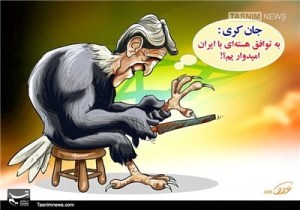
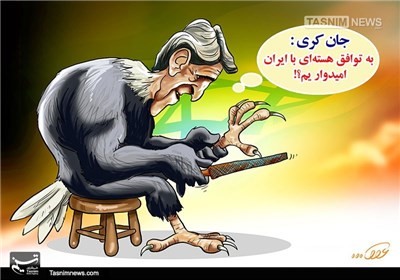
21114November 2, 2014 on Tasnimnews.com, which is close to Iran’s Islamic Revolutionary Guards Corps (IRGC): “Kerry’s Greedy Declarations.” U.S. Secretary of State Kerry the eagle, who is sharpening his talons against the backdrop of an Israeli flag, says: “I am optimistic with regard to the nuclear agreement with Iran.”

Kayhan: “In Negotiations That Could Take Place In 2024, Iran Will Undoubtedly Come To The Negotiating Table With Tens Of Thousands Of Centrifuges That Are More Advanced Than Those It Has Today”; The Nuclear Mushroom Yields Results Once In A Decade

On November 6, 2014, two days after the Republicans swept the U.S. midterm elections, Kayhan wrote: “Obama is now at his lowest point of popularity since he was elected… At the last nuclear negotiating venue [in Oman, at the level of Foreign Minister Zarif, U.S. Secretary of State Kerry, and EU High Representative on Foreign Policy Catherine Ashton, November 9-10, 2014], the Democrats in the White House will try to turn their defeat in the elections to their diplomatic advantage. Obama is like a gambler who has lost everything, and he is sending his representatives to the [negotiating] table with empty pockets… Apparently, the White House emissaries will recommend to the Iranian team to sign the nuclear agreement as soon as possible, since if they do not, Congress will enter the arena with a stick, threats, and sanctions…

“The [negotiating] venue in Oman must be the place where the [Iranian team] gives the Americans a final ultimatum, instead of listening to their boasts… Recently, American negotiating team leader Wendy Sherman quoted former U.S. secretary of state Madeleine Albright as saying that negotiations are ‘like a mushroom that grows best in the dark.’ Soon the result of the[se] negotiations, which have been conducted in the dark for over a year, will become clear.

“The last time that Western [officials] tried to feed Iran this poison mushroom and to force it to submit to the American greed was a decade ago. Undoubtedly, the 2014 mushroom will contain poison that was concocted in 2003. This is because at that point in the negotiations [i.e. in 2003], Iran was operating very few centrifuges, while today it has some 20,000 centrifuges. The Americans need to know that in the most optimal situation [for them], the nuclear mushroom yields results once in a decade… In negotiations that could take place in 2024, Iran will undoubtedly come to the negotiating table with tens of thousands of centrifuges that are more advanced than those it has today.”[10]

Kayhan: Rafsanjani And Rohani Are Bringing Up Various Issues To Distract The Elites From The Upcoming Agreement

On October 28, 2014, Kayhan wrote: “In the Geneva agreements, we put on the table [i.e. we were forced to give up] the product of three years of [uranium] enrichment to 20%, and [agreed to accept] a freeze on activity at the Fordow [enrichment facility] and a halt to the operations to complete the Arak [heavy water] facility, in return for the release of some $7 billion in Iranian funds…

“During the four-month extension [of the Geneva document] we expanded this give-and-take – and now America covets another part of Iran’s assets, saying ‘close Fordow or turn it into a research center; cut back your reserves of enriched [material] to 3.5%, to a quantity that we will tell [you], and remove [it] from Iran; [and] shut down 5,400 of your9,400 operating centrifuges, etc., etc. In return, we will examine your intentions for a period of seven to 20 years, [so that we can ascertain] whether or not we can trust you, or for example, [in return for] our promise not to impose new sanctions.’ This is truly a win-win game and constructive engagement [a jibe at President Rohani].

“The question is, to what point and from what assets does the government intend to pay for this extension of the negotiations and the incremental freeze [on Iran’s nuclear activity]?… When [Iran’s] nuclear technology peaked, Rafsanjani, Rohani, and even [Mir Hossein] Mousavi, and others, saw themselves as major shareholders in this progress. However when the [P5+1] began to impose its impediments, a green light was given for [Iranian] concessions based on a freeze on a small or large part of the [nuclear] program. Rafsanjani even announced his satisfaction with the Geneva negotiations, [saying], ‘Thanks to the negotiations, the taboo [on engagement] with America has been broken.’

“The negotiations apparently had two objectives: The first was to preserve the nuclear program, from the standpoint of [Iran’s right to] enrich [uranium]; the second was to get the sanctions lifted. If some political figures do not attach the requisite importance to the first, they undoubtedly need to explain the second. Therefore, [they must be asked] why not a single sanction was lifted after [Iran] made all these concessions [in the negotiations] – but the sanctions were only made harsher?…

“The acceptance of the West’s demands is the same mistake in judgment that has repeatedly led to an impasse, to the squandering [of Iran’s] strategic assets, [and] to defaming and labelling the critics [of the government] who support [the regime] in an effort to render them passive. The storm surrounding the law to preserve the hijab and modesty, the support for the modesty police, the accusations that the Majlis removed the science minister due to the scholarships scandal[11]… the exploitation of the crime of the acid attacks [against women in Isfahan by claiming that the ideological camp was behind them] – all these are taken from the script and from the organized attempt by the men of fitna and their supporters outside [Iran], with the aim of stirring up marginal scandals within Iran so that [the main issues] are ignored.

“The West sees that Iran’s irreplaceable role has redrawn the map of western Asia and the Middle East, [adding] the qualities of resistance and Islamic awakening in Iraq, Syria, Lebanon, Yemen,l and Bahrain, [and says] ‘Iran must be stopped from playing this role.’

“The men of fitna and the bankrupt extremists… believe that the only way to rebuild their organizations is by dealing with marginal issues and [news-grabbing] explosions that make a huge splash. A group of them… is operating based on a plan given to them, and their media and statesmen are moving ahead in coordination with the Western scheme.

“This hypocritical combination stands out clearly in the government [of Rohani] – revolutionary national enthusiasm [combined with] whispers aimed at trapping critics of the government into dealing with marginal issues to render them passive… to the point where neither the elites nor the people will ask why the negotiations are at an impasse, so that in the atmosphere of passivity and obliviousness it will be possible to reach an agreement, no matter what the cost. [Therefore], by the time the elites and the people wake up and ask what happened, what we gave, and what we got, it will be all over [that is, the deal will be signed]. Most statesmen oppose this harmful approach.

“The government and the president have already learned from the experience acquired in their 14 months in office. They are now at a point of evaluation and course correction. It is always beneficial to prevent damage and dangerous conduct. The leader [Khamenei]… said that the American regime, which stands with Israel, is the exception to Iran’s foreign policy of engagement. The accuracy of his declaration [that we cannot talk to either the U.S. or Israel] was revealed to all over time. Obeying this instruction is the path that will benefit the government and bring it honor. Otherwise, [the Rohani government] will owe a debt to the arrogant ones outside [Iran] and to the seekers of fitna within [Iran], who are skilled in this matter; in this way [i.e. if it talks to the U.S., Iran] will gain  no victory and no prestige…”[12]

Website Affiliated With Ideological Camp: The Pragmatists Are Trying To Remove Khamenei

On October 29, 2014, Afsaran.ir, which is close to Iranian security circles, published an article titled “What Is The Real Objective Of The Line Of Obliviousness [i.e. the pragmatic camp] – Taking The Majlis Or Replacing The Supreme Leader?” The article hinted that Foreign Minister Zarif is party to a Western plot to depose Khamenei, using the pragmatic camp’s strategy for dealing with the Americans, saying that if no agreement is reached, then the ideological stream that opposes rapprochement with the West will seize key political positions in Iran.[13]

The article stated: “Although America’s hostility towards the leader of the revolution [Khamenei] is nothing new, and they have acknowledged this a number of times… the [Americans’] attacks [against Iran] since the New York negotiations… [including] Under Secretary of State Wendy Sherman’s interview on the Voice of America in Persian and [Foreign Minister Javad Zarif’s] entreaties before America’s Council of Foreign Relations have colored it a different hue. Besides the abovementioned incidents, [the Iranian-American academic] Vali Nasr and other American senior officials and influential figures have mentioned Iranian leader Khamenei as the main reason why no agreement has been reached, going so far as to consider replacing him.

“Nasr said: In December 2015, elections will be held in Iran for the Iranian Assembly of Experts, which will appoint Iran’s next leader. He also said: The next [Assembly of Experts] election can change the political direction in Iran.’

“Therefore, it must be asked: Who are the people [in Iran] who directed the policymakers of the enemy [i.e. the U.S.] towards supporting this strategy of deposing the leader Khamenei during direct negotiations with America?

“After consulting with which Iranians does America now consider the nuclear negotiations as an obstacle to its realization of its objectives, and as fertile ground for changing the course of the [Islamic] Revolution [i.e. the regime]?

“In all honesty, is the foreign minister really aiming, in his request to the American Congress to cooperate with the line of obliviousness [i.e. the pragmatic camp], to [obtain American] help so that they [i.e. the pragmatic camp] can win the Majlis elections? Or is he, like Nasr, really referring to a change in the makeup of the Iranian Assembly of Experts [so that it will remove or replace Khamenei]?

“Maybe some within Iran are not yet speaking as frankly as Nasr.”[14]

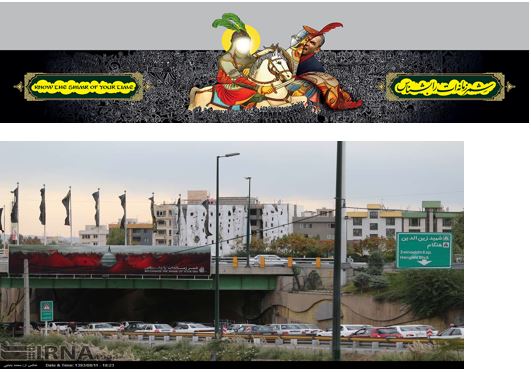
Basij Posts Signs In Iranian Cities Saying ‘Know The Shimr Of Our Time’

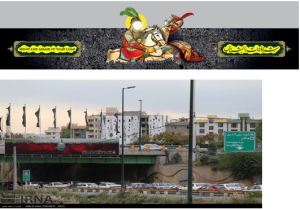
Also, the Basij has recently posted signs in Tehran and Shiraz stating, “Know The Shimr [who in Shi’ite legend murdered Imam Hussein] Of Our Time”; the signs clearly depict President Obama and the dome of the U.S. Capitol.[15]
21115

Endnotes:

[1] See October 23, 2014 statement by U.S. Under Secretary for Political Affairs Wendy Sherman, State.gov/p/us/rm/2014/233306.htm.

[2] Most reports refer to 4,000; however, two Iranian sources have referred to at least 6,000. Majlis Nuclear Committee head Ebrahim Karkhanehi reported that P5+1 had agreed to approve the operation of 6,000 to 9,000 centrifuges. Tasnim, Iran, November 2, 2014.

[3] See MEMRI Inquiry & Analysis No. 1127, Iran’s Pragmatic Camp Calls For Exploiting Obama’s Weakness To Attain Comprehensive Nuclear Agreement On Tehran’s Terms, October 26, 2014.

[4]  The Shi’ite legend of Karbala underpins Iranian culture, particularly political culture, in post-Islamic Revolution Iran; it tells of the first Shi’ite martyr, Imam Hussein Ibn Ali, the grandson of the Prophet, at Karbala in 680 CE, after he demanded power and refused to accept the authority of Umayyad caliph Yazid ibn Mu’awiyah.

[5] Shargh (Iran), November 2, 2014. An anonymous party familiar with dealings in the Foreign Ministry told Tabnak in an interview that Khorram is not an advisor to Foreign Minister Zarif, and that his views do not represent the negotiating team or the foreign ministry. Tabnak, Iran, November 4, 2014.

[6] President.ir, October 22, 2014.

[7] Kayhan (Iran), October 23, 2014.

[8] Jomhouri-ye Eslami, (Iran), October 27, 2014.

[9] Tasnim (Iran), October 28, 2014.

[10] Kayhan (Iran), November 6, 2014.

[11] Recently, the ideological camp succeeded in removing Rohani’s science minister for having a record as a reformist.

[12] Kayhan (Iran), October 28, 2014.

[13] See MEMRI Inquiry & Analysis No. 1127, Iran’s Pragmatic Camp Calls For Exploiting Obama’s Weakness To Attain Comprehensive Nuclear Agreement On Tehran’s Terms, October 26, 2014.

[14] Afsaran.ir, October 29, 2014.

[15] IRNA (Iran) November 2, 2014; Tasnim, October 30, 2014.

Is Ahmadinejad making a comeback?

November 7, 2014

Is Ahmadinejad making a comeback? Al-MonitorArash Azizi, November 5, 2014

(Since it now appears that a nuke deal may well be signed by the November 24th deadline — well before the new U.S. Republican Congress takes over in January — what difference does it make now? In any event, with the Supreme Leader in charge regardless of whether Iran’s President is a “moderate” or an “extremist,” what difference does it make, ever? Even a “good” deal can and will be violated with impunity. — DM)

Iran's President Mahmoud Ahmadinejad meets with Iraq's Vice President Khudair al-Khuzaie during his visit in BaghdadMahmoud Ahmadinejad (C) meets with Iraqi Vice President Khudair al-Khuzaie (not seen) during a visit in Baghdad when Ahmadinejad was still president of Iran, July 18, 2013. (photo by REUTERS/Hadi Mizban)

The media activities and meetings of former Iranian President Mahmoud Ahmadinejad signal that he is keeping his name before the public and trying to forge new alliances for his political comeback.

A three-story building in a quiet one-way alley in northern Tehran is the headquarters of an unlikely campaign that opposes both the administration of President Hassan Rouhani and many of the Islamic Republic’s establishment figures.

The Velenjak building is the base of activities for former President Mahmoud Ahmadinejad, who has his offices on its third floor.

Ahmadinejad has been relatively quiet since the ascendance of the moderate Rouhani, but the Iranian Labor News Agency (ILNA) is only one of many outlets that have reported on his desire to make a comeback.

According to Amir Mohebbian, a leading political analyst, Ahmadinejad’s attempt to return to power is obvious as he “quietly awaits favorable conditions and occasionally tests the waters.”

The provincial trips that the former hard-line president makes are one indication.

In addition to making many trips to southern and northern Iran, Ahmadinejad celebrated the end of Ramadan by visiting Taleqan with the family members of four celebrated Iran-Iraq war “martyrs” in a trip that, according to ILNA, was coordinated by the Quds Force, the formidable international arm of Iran’s Islamic Revolutionary Guards Corps.

In April, Ahmadinejad ruled out a return to politics but many of his supporters beg to differ.

They are tirelessly organizing and insist on his return. These are an unlikely bunch. Their young cadre runs many blogs and social media accounts. They draw controversy by their occasionally unconventional mixing of Islamism with an anti-wealthy and anti-establishment discourse, and many have spent time in jail for their activities. Their targets are not only the Reformists but many of the traditional conservatives.

Take Ahmad Shariat, who heads the Internet committee of an Ahmadinejad organization. In his blog, he attacked the policy of backing Syrian President Bashar al-Assad, called for a boycott of the last Majles elections in 2012 (because many Ahmadinejad forces were barred), attacked establishment religious figures such as Ayatollah Mesbah Yazdi and, finally, dared to criticize Supreme Leader Ayatollah Ali Khamenei himself (the latter, in early 2013, led to the closing of Shariat’s blog and his arrest).

These supporters leave no doubt as to their allegiance to the ex-president. One name they go by is “Homa,” a Persian acronym for “Supporters of Mahmoud Ahmadinejad.” An online newspaper with the same name (Homa Daily) opened last week on the occasion of Ahmadinejad’s 58th birthday. (“Square 72” is another outlet, named after Ahmadinejad’s neighborhood in northeastern Tehran).

Abdolreza Davari — who was a vice-president of IRNA, the national news agency for the administration under Ahmadinejad — is a leading organizer of Homa. A controversial figure who was fired from a teaching post for “political activities,” Davari was reported by ILNA as one of the top three media campaigners attempting an Ahmadinejad comeback.

“As an Iranian, I hope for the return of Mr. Ahmadinejad to politics,” Davari told Al-Monitor, before adding that he thinks the ex-president is currently focused on “scientific” activities.

To my question about the regular meetings of Homa in the Velenjak building, Davari says that such meetings are not organized but that “all kinds of people, commentators, students or ordinary people come to meet and talk to Dr. Ahmadinejad.”

Davari also denies that Homa is attempting to organize for next year’s Majles elections. Ahmadinejad’s return to power needs no less than “changes in the current relation of forces,” Davari says, seeming to imply that many of the establishment figures wouldn’t want the ex-president back. Many such figures are especially opposed to Ahmadinejad’s entourage.

Enter Esfandiar Rahim Mashaei, Ahmadinejad’s chief of staff, who was openly rebuked by Khamenei for his maverick mixing of Shiite millennialism, Persian nationalism and leftist language. Despite Khamenei’s personal rejection and the sustained attacks of many who accused Mashaei of leading a “deviationist current,” the ex-president has continued backing his close friend (whose daughter married Ahmadinejad’s eldest son) even after the Guardian Council rejected Mashaei’s candidacy in last year’s presidential elections.

Mashaei’s offices are on the second level of the Velenjak building, and he is known to take part in Homa meetings.

Homa Daily ran Mashaei’s picture in the first page of its first issue, while reprinting his most controversial interview, where he had defended the necessity of “friendship with the Israeli people” — an interview personally criticized and attacked by Khamenei.

Davari says Mashaei doesn’t want to return to politics due to his “cultural and spiritual sentiment.” Taking a note from Mashaei’s book, he says Ahmadinejad’s concept of the Islamic Revolution and his belief in the coming of the hidden Imam is not “meant for a specific geography or religion as the hidden Imam’s global message is aimed at all nations and groups.”

“Freedom-loving and justice-seeking fighters” like Fidel Castro, Che Guevara, Djamila Boupacha, Bobby Sands, Hassan Nasrallah and Hugo Chavez belong to the same global front as Ahmadinejad, Davari insists.

Acolytes of Mashaei seem to have especially targeted Iran’s nuclear negotiations. A group called the “the National Movement for Iran’s Independence” (NAMA, for its Persian acronym) was formed with the declared goal of fighting any compromise with the West. Its unusual name (not mentioning Islam) has the Mashaie imprint.

Mashaei’s presence has always driven away many of Ahmadinejad’s backers. One of them is Mohammadreza Etemadian, a trade adviser to the ex-president. Etemadian told Al-Monitor that he would like to see Ahmadinejad back, but he has always told him to keep Mashaei away since “he is not on good terms with the supreme leader and is a deviant.”

Etemadian is a leading member of the Islamic Coalition Party, the traditional organization of Bazari Islamists and an important part of the establishment. Its leaders seem to detest the populist excesses of Ahmadinejad.

Sensing this, the ever-adventurous Ahmadinejad has been trying to find new allies, even if among the Reformists. He met with Hassan Khomeini, the 40-year-old grandson of the founder of the Islamic Republic, known for his proximity to the Reformists. The ex-president boldly asked Khomeini to lead a group of young clerics to contest the next year’s election of the Assembly of Experts, the body that chooses the supreme leader.

He has also reportedly tried to meet the Reformist ex-President Mohammad Khatami and Ambassador Sadeq Kharazi, an influential diplomat from a key political family.

Meanwhile, it was reported that Gholam-Hossein Elham, the spokesman of Ahmadinejad’s government, has started campaigning for the ex-president and last week met with the governors-generals of the previous government to organize. Elham, however, spoke with the pro-Ahmadinejad “Square 72” website to deny this news.

Unceremoniously bowing out after the disqualification of the candidate he supported in the 2013 presidential elections, Ahmadinejad seems to be busy plotting a comeback.


Losses in Midterms for Candidates Who Supported Islamists

November 5, 2014

Losses in Midterms for Candidates Who Supported Islamists, Clarion ProjectRyan Mauro, November 5, 2014

(That’s good, but is there a significant causal relationship and will it impact Obama’s foreign policy? I doubt it. — DM)

Rick-Snyder-Opposed-by-Islamists-HP_1Michigan Governor Rick Snyder (l) was opposed by prominent Islamists Omar Suleiman (upper right), Zahra Billoo (bottom right) and Hatem Bazian for comments the governor made at an Islamists conference in support of Israel.

Yesterday’s congressional elections resulted in losses for numerous candidates who have supported American Islamists. The biggest defeat came in the form of the re-election of Michigan Governor Rick Snyder, who became the Islamists’ top target after he briefly endorsed Israel’s right-to-exist at a major Islamist conference.


Failure to Stop Michigan Governor’s Re-Election

In August, the Clarion Project reported on Governor Snyder’s decision to speak at the annual conference of the Islamic Society of North America (ISNA), a U.S. Muslim Brotherhood entity whose events are full of radical speakers.

Snyder had resisted pressure to drop his speaking engagement and his office unbelievably defended ISNA as a moderate organization that accepts Israel’s existence. At the event, Snyder praised the Islamist-filled speaker lineup.

However, one sentence the governor uttered triggered a ferocious blowback: “I’m a strong supporter of Israel and believe in its right to exist.” Islamists close to ISNA blasted him as anti-Muslim and disrespectful. ISNA itself then issued an action alert calling on Muslims to contact his office.

Despite the Islamist backlash against him, Snyder was re-elected.


Illinois Governor’s Re-Election Bid Fails

A second blow to Islamist political influence was delivered with the defeat of Illinois Governor Pat Quinn.

Quinn had praised the Chicago chapter of the Council on American-Islamic Relations (CAIR), a U.S. Muslim Brotherhood entity with documented links to Hamas. CAIR’s executive director recentlyendorsed sharia governance and rebuilding a caliphate.

In December 2013, Quinn was the keynote speaker for the radical convention of the Islamic Circle of North America and the Muslim American Society, two groups with extensive histories of radicalism.

When Quinn was introduced, the speaker recalled meeting him at the Hamas-linked Mosque Foundation and declared, “This is the kind of governor that we support and that we like.”


Race for Maryland Governorship

A third defeat for the Islamists was the loss by of Lieutenant-Governor Anthony Brown in his bid to be Maryland’governor.

Brown spoke for a CAIR event in May even though official FBI policy prohibits participation in CAIR fundraisers due to its Hamas links.

Maryland’s current governor, Martin O’Malley, is a possible presidential candidate and CAIR has used O’Malley/Brown officialsfor fundraising, including even their attorney general.

The O’Malley-Brown administration also endorsed a $100-million mega-mosque project in Maryland supported by the Islamist government of Turkey. The project is also backed by ICNA and ISNA leaders.

O’Malley was also the chairman of the Department of Homeland Security’s Working Group on Violent Extremism that reviewed counter-terrorism training. The committee included officials from these same Islamist groups and produced Islamist-friendly guidelines.


Scott Brown Fails to Win Senate Seat

Former Massachusetts Senator Scott Brown failed to win his race for senator in New Hampshire.

In the summer of 2012, Brown was one of the Republican leaders who questioned the integrity of the five members of Congress who asked for investigations into the influence on the U.S. government of Muslim Brotherhood-linked individuals and activists.

At the time, Brown said accusations about Huma Abedin, who has documented Islamist ties and was then Secretary of State Clinton’s Deputy Chief of Staff, were “out-of-line” and have “no place in our public discourse.”


Crist Loses Bid for Florida Governorship

Charlie Crist, who was the governor of Florida from 2007-2011, failed yesterday in a very tight race to return to that office.

As reported by counter-terrorism expert Patrick Poole, an Islamist cleric, Muhammad Musri of the Islamic Society of Central Florida, was on Governor Crist’s Faith-Based and Communications Advisory Council and on his 2010 Sunshine Consensus Committee.

Musri helped fundraise for the Hamas-linked Viva Palestina group, which is led by anti-American British activist George Galloway.

Crist also received $1,404 from three CAIR sources in 2010 for his failed Senate bid.


Possible Defeat of Virginia Senator Mark Warner

At press time, Virginia Senator Mark Warner leads by about half of one percent in a race that was written off as a shoe-in for him. There will almost certainly be a recount and a legal battle that will decide the election’s result.

In September 2011, Senator Warner sent a videotaped message of support to an event in Virginia that honored prominent Islamist Jamal Barinji, who was instrumental in setting up the U.S. Muslim Brotherhood network.

Barzinji was identified as a Muslim Brotherhood member by an FBI informant in 1987. He was a leader of the Brotherhood’s main American fronts. He was the president of the Muslim Students Association in 1972, a founder of the North American Islamic Trustand a senior leader of ISNA.

He was also the vice president of the International Institute of Islamic Thought and helped establish the radical Dar al-Hijrah Islamic Center. In 2003, Barzinji’s home was raided as part of a terrorism-financing investigation.

Special Agent David Kane said in a sworn affidavit that Barzinji is closely linked to the Palestinian Islamic Jihad and Hamas terrorist groups. The affidavit  says he held seven positions in other organizations under investigation and is close to Sami al-Arian, who was convicted of being a secret Palestinian Islamic Jihad leader.

The planned prosecution of Barzinji was dropped under the Obama Administration.


Recipients of Islamist Donations

The Clarion Project listed 11 candidates who received donations from Islamists this election cycle based on data compiled by the Islamist Money in Politics project.

The candidates mentioned have not all supported CAIR or other Islamists, nor is there proof of each one’s knowledge of the transaction or source. Nonetheless, the small donations are relevant facts that must be mentioned because Islamists don’t donate to every candidate. These donations had a purpose.

As we previously wrote, four candidates that received donations from Islamist officials lost in their primaries.

The candidates who received small donations from Islamists and lost yesterday were:

  • Arkansas Senator Mark Pryor;
  • Michigan candidate Terri Lynn Land (whose opponent also had Islamist donations);
  • Michigan candidate Bobby McKenzie;
  • Minnesota candidate Mike Obermueller;
  • West Virginia Rep. Nick Rahall;
  • Florida Rep. Joe Garcia

The candidates who received Islamist donations and were victorious yesterday include:

  • Minnesota Rep. Keith Ellison;
  • Indiana Rep. Andre Carson;
  • Virginia Rep. Gerry Connolly;
  • New York Rep. Charles Rangel;
  • Michigan Rep. Gary Peters (for Senate);
  • Florida Rep. Gwen Graham;
  • New Jersey Rep. Bill Pascrell;
  • Arizona Rep. Kyrsten Sinema;
  • Maryland Rep. Chris Van Hollen;
  • Michigan Rep. Daniel Kildee;
  • Pennsylvania Rep. Mike Doyle;
  • Illinois Rep. Adam Kinzinger;
  • Kansas Senator Pat Roberts;
  • Minnesota Senator Al Franken
  • New Jersey Senator Cory Booker.

At press time, it was unknown if California Rep. Mike Honda has won re-election, but victory is anticipated.


Conclusion

Candidates do not need to be Islamists themselves to be influenced by them. In some cases, they may not even know the extremist backgrounds of the Islamists courting them.

By appearing as “moderates” only interested in responsible civic activism, leaders from groups like CAIR are able to fly under the officials’ radar and influence policy and arrange mutually beneficial praises and photo-ops.

Of course, promises of donations, political support or positive media coverage add extra incentives.

It is our responsibility to inform these officials and candidates of their backgrounds. Those who don’t change course must be shown that that there is a political price to pay for their inattentiveness, selfishness and narrow-mindedness.