Archive for the ‘Obama’ category

Why is Israel blamed for evil while Islamic nations are not?

December 21, 2014

Why is Israel blamed for evil while Islamic nations are not? Dan Miller’s Blog, December 21, 2014

Blaming Israel for evil, rather than her many Islamic neighbors and enemies is, despite the views of Obama and His colleagues, contrary to American values. Doing so is based on Jew hatred, envy of success, and the multicultural absurdity that no culture or religion is better or worse than any other.

As I argued most recently here and here, Israel is fighting for her survival against regimes that want her to cease to exist because she is Jewish, not Islamic, and her government is free and democratic, not dictatorial. She is, therefore, an outsider in the Middle East.

This video identifies many of the reasons why Israel is viewed harshly by other Western civilizations while Islamic nations, which are neither free nor democratic, are viewed favorably.

I suspect that Dr. Ben Carson, who recently visited Israel and was much impressed, would agree with the points made in the video.

Although the U.S. remains Israel’s closest and most important ally, Obama and Israeli Prime Minister Benjamin Netanyahu have little personal chemistry and have frequently clashed. The U.S. has been outspoken in its criticism of Israeli settlement construction in the West Bank and east Jerusalem — captured areas claimed by the Palestinians as parts of a future state. At the same time, U.S. Secretary of State John Kerry has made numerous trips to the region and elsewhere to try to broker a peace deal.

Carson said the criticism of the settlements has been exaggerated, and he asserted that Palestinian hostility toward Israel is what is preventing peace in the region. Of Netanyahu, Carson said, “I think he’s a great leader in a difficult time.” [Emphasis added.]

Imperialism, Obama style

December 20, 2014

Imperialism, Obama style, Dan Miller’s Blog, December 20, 2014

Obama condemns “wicked” U.S. imperialism for supporting American values such as freedom and democracy abroad. Simultaneously, he tries to precipitate “regime change” in Israel so that she will support His values and those of Palestinians rather than American and Israeli values of freedom and democracy.

The Palestinians have placed before the United Nations Security Council a “peace proposal” intended to force Israel to agree to creation of a Palestinian state and “an Israeli withdrawal to the pre-1967 lines” by the end of 2017. Secretary Kerry has argued that the matter should not be considered until after the Israeli Knesset elections in March. According to an article in Foreign Policy,

Speaking at an annual luncheon with the 28 European Union ambassadors, Kerry cautioned that any action by the U.N. Security Council would strengthen the hands of Israeli hardliners who oppose the peace process. . . . [Emphasis added.]

“Kerry has been very, very clear that for the United States it was not an option to discuss whatever text before the end of the Israeli election,” according to a European diplomat.

The diplomat, who spoke on condition of anonymity because the luncheon was confidential, said that Kerry explained that Israel’s liberal political leaders, Shimon Peres and Tipzi Livni, had expressed concern that a Security Council move to pressure Israel on the eve of election would only strengthen the hands of Israeli hardliners, including Prime Minister Benjamin Netanyahu, and Naftali Bennett, an implacable foe of a Palestinian state and leader of the right-wing Jewish Home party. Netanyahu is also fiercely opposed to the Palestinians effort to secure Security Council backing for its statehood drive. [Emphasis added.]

Kerry said Livni had “told him that such a text imposed by the international community would reinforce Benjamin Netanyahu and the hardliners in Israel,” as well as the hardliners in Palestine, according to the European diplomat.

The message, said another European diplomat, was that U.N. action would “give more impetus to more right-wing parties, that there was a risk this could further embolden the more right-wing forces along the Israeli political spectrum.” [Emphasis added.]

Kerry’s remarks highlight the Obama administration’s delicate balancing act when it comes to its tense relationship with the Israeli government. On the one hand, senior  administration officials make little attempt to hide the personal dislike between Netanyahu and President Barack Obama or their sharp disagreements on issues ranging from the peace process to Iran. On the other hand, Kerry and other top policymakers have tried to avoid saying or doing anything that could be seen as meddling in the Israeli election in an effort to oust Netanyahu and replace him with a more centrist prime minister. [Emphasis added.]

On an open microphone in March of 2012, Obama

told Dmitry Medvedev that he would have more flexibility after November’s election to deal with contentious issues such as missile defence. . . .

Obama’s candid remark was considered a gaffe because He made it assuming that the microphone had been turned off and that no one other than Medvedev would hear Him. Kerry, however, candidly but intentionally told twenty-eight European Union ambassadors that it is U.S. policy to encourage the Israeli left, to diminish the Israeli right and to make it more difficult for Prime Minister Netanyahu to remain in office. Aside from his incredible naivete, why did Kerry do that?

For Obama and European leaders, Israel is reducible to the peace process. And the Israeli left depends on the support of foreign governments for its network of foreign funded non-profit organizations. The Israeli left can’t let go of its exploding version of ObamaCare [Palestine] because the left is becoming a foreign organization with limited domestic support. Its electorate isn’t in Israel; it’s in Brussels. [Emphasis and bracketed insert added.]

. . . .

Escalating a crisis in relations has been the traditional way for US administrations to force Israeli governments out of office. Bill Clinton did it to Netanyahu and as Israeli elections appear on the horizon Obama would love to do it all over again.

There’s only one problem.

The United States is popular in Israel, but Obama isn’t. Obama’s spats with Netanyahu ended up making the Israeli leader more popular. The plan was for Obama to gaslight Israelis by maintaining a positive image in Israel while lashing out at the Jewish State so that the blame would fall on Netanyahu. [Emphasis added.]

Kerry’s remarks — covered by Israeli media — seem, contrary to his intentions, likely to enhance the chances of Israeli “hardliners” on the “right,” to hurt the chances of those on the left and hence to increase PM Netanyahu’s chances of remaining in office. Even leaving that aside, how will Kerry’s remarks favoring regime change be viewed by other increasingly reluctant U.S. allies in the Middle East?

Israeli “hardliners” have already yielded to the Palestinians as much as, if not more than, they can without greatly endangering the security of Israel because there is no Palestinian entity with which peace can be made other than through Israel’s suicide.

The remarks of the Islamic preacher at the mosque in Jerusalem reflect a general Palestinian view.

Interestingly, the speaker doesn’t mention the longing for Palestinian statehood or independence. Instead, he talks of the establishment of the “Islamic Caliphate.” “Oh Allah’” he states, “Hasten the establishment of the State of the Islamic Caliphate,” and further rants, “Oh Allah hasten the pledge of allegiance to the Muslim Caliph.” He spews forth the latter statement three times to chants of “Amen!” from the large, approving crowd congregating around him.

These comments, which would register horror and revulsion in the West (at least in some quarters) are almost banal among Palestinians. In fact, a similar video featuring a different speaker some days earlier at the same venue, conveyed identical sentiment, expressing admiration for the Islamic State and calling for murder of Jews and annihilation of America. [Emphasis added.]

Here’s the other video referenced in the article:

Guttural anti-Semitism is ingrained and interwoven in the fabric of Palestinian society. Despite their minuscule numbers, 78% of Palestinians believe that Jews are responsible for most of the world’s wars while a whopping 88% believe that Jews control the global media and still more believe that Jews wield too much power in the business world. [Emphasis added.]

Much of the blame for this can be placed squarely on the doorstep of Mahmoud Abbas’s Palestinian Authority, which subjects the Palestinian population to a steady diet of hate-filled, Judeophobic rhetoric through state-controlled media and educational institutions. It is so well entrenched that the process of deprogramming, if it were ever attempted, would take generations to reverse. [Emphasis added.]

As noted in the Wall Street Journal article linked in the quote immediately above,

To understand why peace in Palestine is years if not decades away, consider the Palestinian celebrations after Tuesday’s murder in a Jerusalem synagogue of five Israelis, including three with joint U.S. citizenship. Two Palestinian cousins armed with meat cleavers and a gun attacked worshipers during morning prayers, and the response was jubilation in the streets.

The Popular Front for the Liberation of Palestine claimed responsibility, while Hamas praised the murders as a “response to continued Israeli crimes.” The main obstacle to peace isn’t Jewish settlements in the multireligious city of Jerusalem. The barrier is the culture of hatred against Jews that is nurtured by Palestinian leaders. [Emphasis added.]

Palestinian Prime Minister Mahmoud Abbas condemned the killings, but not without calling for Israel to halt what he called “invasions” of the holy Al Aqsa Mosque in Jerusalem. Mr. Abbas has previously said the Temple Mount was being “contaminated” by Jews, despite assurances by Prime Minister Benjamin Netanyahu that the Dome of the Rock and Al Aqsa Mosque are for Muslim worship only. The Memri news service reports that the Oct. 29 issue of the Palestinian daily Al-Hayat Al-Jadida was full of false accusations that Israel is damaging Jerusalem’s holy sites. [Emphasis added.]

Moreover,

An overwhelming majority of Palestinian Arabs support the recent spate of terrorist attacks against Israelis, an opinion poll released Tuesday finds, according to The Associated Press (AP).[Emphasis added.]

The poll also found that more than half of Palestinian Arabs support a new “intifada” (uprising) against Israel, and that Hamas would win presidential elections if they were held today. [Emphasis added.]

Palestinian Arab pollster Khalil Shikaki said the results reflected anger over Israeli statements about Jerusalem, as well as a loss of hope following the collapse of U.S.-brokered peace talks and Israel’s recent war with Hamas in Gaza.

Shikaki heads the Palestinian Center for Policy and Survey Research, which interviewed 1,270 people in the Palestinian Authority-assigned areas of Judea and Samaria and Gaza last week. The poll had an error margin of 3 percentage points.

“There is an environment in which violence is becoming a dominant issue,” Shikaki told AP. “This seems to be one of the most important driving forces.”

Hamas is, if possible, even worse than Abbas’ Palestinian Authority.

Both Hamas and Abbas’ Palestinian Authority seek the death of Israeli Jews and the destruction of Israel, the only democratic and free nation in the Middle East. Kerry’s ill-conceived efforts to assist them at the expense of Israel, most recently by actively seeking to promote Israel’s left wing, to diminish its right wing and hence to empower Palestinians intent upon the death of Israel, may well fail. Succeed or fail, those efforts are consistent with Obama’s preference for Islamic dictators over democracy coupled with freedom.

Barack Mitsvah

Off Topic: Awed by Israel, 2016 Republican hopeful Ben Carson pledges support

December 20, 2014

Awed by Israel, 2016 Republican hopeful Ben Carson pledges support, Times of IsraelJOSEF FEDERMAN, December 20, 2014

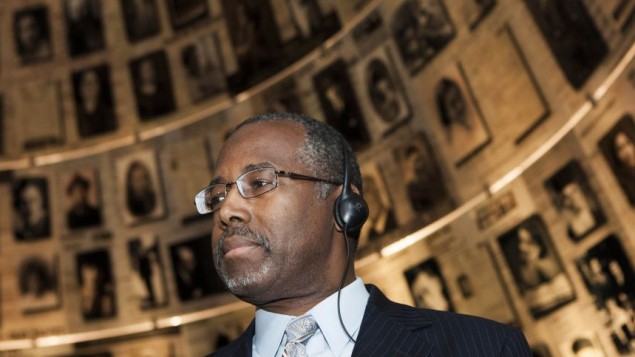
Mideast-Israel-Carson_Horo-e1419086784255-635x357Ben Carson visits Yad Vashem Holocaust memorial in Jerusalem on December 18, 2014. Carson, 63, a retired African-American neurosurgeon best known for his groundbreaking work in separating conjoined twins, has not yet declared his candidacy for the Republican Presidential nomination, saying that he is “strongly considering” a bid. (photo credit: AP Photo/Dan Balilty)

Carson said the criticism of the settlements has been exaggerated, and he asserted that Palestinian hostility toward Israel is what is preventing peace in the region. Of Netanyahu, Carson said, “I think he’s a great leader in a difficult time.”

**************

JERUSALEM (AP) — In his first visit to Israel, prospective Republican presidential candidate Ben Carson said he is in awe of the Jewish state, inspired by its ancient holy sites, impressed by the resilience of people living in a perpetual conflict zone — and deeply disappointed in President Barack Obama.

“I do not believe that Obama has been one to cultivate the relationship,” said Dr. Carson, a retired neurosurgeon who has emerged as a favorite of some conservatives in the early field of possible GOP candidates.

“I would make it very clear that Israel and the United States have a long, cordial relationship, and I don’t think we should ever leave the Israelis in a position of wondering whether we support them,” Carson said in an hour long interview with The Associated Press in Jerusalem. “And that certainly is a question now.”

Carson, 63, perhaps best known for his groundbreaking work in separating conjoined twins, is largely unknown to most Americans. But he’s earned hero status among conservative activists thanks to his outspoken criticism of Obama’s health care law.

His rags-to-riches story — he had a hardscrabble childhood in inner-city Detroit — and his deep Christian faith also appeal to potential voters. While Carson has said he is “strongly considering” a bid, supporters have already opened offices in the early voting states of Iowa and New Hampshire.

He is one of more than a dozen Republicans eyeing the presidency, and those with little international experience, such as Carson, are working to strengthen their resumes before formally announcing their 2016 plans.

Carson at Israeli hospitalBen Carson visits in Hadassah Hospital in Jerusalem, December 18, 2014. (photo credit: AP Photo/Dan Balilty)

Speaking to the AP, Carson expressed views that are common among Israel’s nationalist right wing. He showed sympathy for Israel’s much-maligned settlement movement and questioned the desire among Palestinians for peace. He even suggested that instead of Israel relinquishing captured land to make way for a Palestinian state, neighboring countries such as Egypt should provide the space for a future Palestine.

“That’s one possibility,” he said.

Carson is visiting Israel as a guest of “The Face of Israel,” a private group that sponsors trips for “influential decision makers” to promote a positive image of the country and counter “threats to Israel’s international legitimacy.” The trip has included visits to Israel’s northern front with Syria and the southern border with Gaza, and meetings with military officials and everyday people.

Although the U.S. remains Israel’s closest and most important ally, Obama and Israeli Prime Minister Benjamin Netanyahu have little personal chemistry and have frequently clashed. The U.S. has been outspoken in its criticism of Israeli settlement construction in the West Bank and east Jerusalem — captured areas claimed by the Palestinians as parts of a future state. At the same time, U.S. Secretary of State John Kerry has made numerous trips to the region and elsewhere to try to broker a peace deal.

Carson said the criticism of the settlements has been exaggerated, and he asserted that Palestinian hostility toward Israel is what is preventing peace in the region. Of Netanyahu, Carson said, “I think he’s a great leader in a difficult time.”

While he expressed sympathy for the plight of Palestinians, Carson said Israeli security concerns were more important in the short term, noting that after Israel’s withdrawal of troops and settlers from the Gaza Strip in 2005, the territory was overrun by Hamas militants. An Israeli withdrawal from the West Bank, he said, would be even riskier, given its proximity to major Israeli cities.

“Until such time as their neighbors are no longer desirous of their elimination,” he said, Israel’s continued control of the West Bank “makes perfectly good sense.”

There is little disagreement among the GOP’s top prospects on American policy toward Israel, given religious conservatives’ overwhelming support for the Jewish state and the influence of conservative donors like billionaire casino mogul Sheldon Adelson, an outspoken Israel supporter who donated more to Republicans in the last presidential contest than anyone else.

Carson said he expects to make a decision on seeking the presidency by May. If he wins the job, he promised a different approach toward Israel.

“I would make sure that Israel knew that we had their back,” he said. “Because if their neighbors know that we’re backing them up, they’re not going to be anywhere near as aggressive.”


The Palestinians’ UN Charade Collapses

December 19, 2014

The Palestinians’ UN Charade Collapses, Commentary Magazine, December 19, 2014

[T]he endless quarrels between Obama and Netanyahu over the peace process are so pointless. No matter how much Obama tilts the diplomatic playing field in the Palestinians’ direction or how often he and his supporters prattle on about time running out for Israel, Abbas has no intention of signing a peace agreement. The negotiations as well as their maneuverings at the UN and elsewhere are nothing but a charade for the PA and nothing Netanyahu could do, including offering dangerous concessions, would change that. The sooner Western leaders stop playing along with their game, the better it will be for the Palestinian people who continue to be exploited by their leaders.

*****************

In the end, there wasn’t much suspense about the Obama administration’s decision whether to support a United Nations Security Council resolution endorsing a Palestinian state. After weeks of pointless negotiations over proposed texts, including a compromise endorsed by the French and other European nations, the wording of the proposal that the Palestinians persuaded Arab nations to put forward was so outrageous that even President Obama couldn’t even think about letting it pass because it would undermine his own policies. And the rest of the international community is just as unenthusiastic about it. In a very real sense this episode is the history of the Arab-Israeli conflict in a nutshell: the world wants to do something for the Palestinians but their leaders are more interested in pointless shows than in actually negotiating peace or doing something to improve the lives of their people.

The resolution that was presented to the Security Council was so extreme that Jordan, the sole Arab nation that is currently a member, didn’t want anything to do with it. But, after intense lobbying by the Palestinian Authority representative, the rest of the Arab nations prevailed upon Jordan and they put it forward where it will almost certainly languish indefinitely without a vote since its fate is preordained.

The terms it put forward were of Israeli surrender and nothing more. The Jewish state would be given one year to withdraw from all of the territory it won in a defensive war of survival in 1967 where a Palestinian state would be created. That state would not be demilitarized nor would there be any guarantees of security for Israel which would not be granted mutual recognition as the nation state of the Jewish people, a clear sign that the Palestinians are not ready to give up their century-long war against Zionism even inside the pre-1967 lines.

This is a diktat, not a peace proposal, since there would be nothing for Israel to negotiate about during the 12-month period of preparation. Of course, even if the Palestinians had accepted the slightly more reasonable terms proposed by the French, that would have also been true. But that measure would have at least given the appearance of a mutual cessation of hostilities and an acceptance of the principle of coexistence. But even those concessions, let alone a renunciation of the “right of return,” was not possible for a PA that is rightly fearful of being supplanted by Hamas. So long as Palestinian nationalism remains wedded to rejection of a Jewish state, no matter where its borders might be drawn, no one should expect the PA to end the conflict or actually make peace.

Though many of us have been understandably focused on the question of how far President Obama might go to vent his spleen at Israeli Prime Minister Netanyahu and his government, that petty drama is, as it has always been, a sideshow distraction from the real problem at the core of the Middle East peace process: Palestinian rejectionism.

Though the administration has tirelessly praised PA leader Mahmoud Abbas as a champion of peace in order to encourage him to live up to that reputation, he had other priorities. Rather than negotiate in good faith with the Israelis, Abbas blew up the talks last year by signing a unity pact with Hamas that he never had any intention of keeping. The purpose of that stunt, like the current UN drama, isn’t to make a Palestinian state more likely or even to increase Abbas’s leverage in the talks. Rather, it is merely a delaying tactic, and a gimmick intended to waste time, avoid negotiations, and to deflect any pressure on the PA to either sign an agreement with Israel or to turn it down.

That’s not just because the Palestinians wrongly believe that time is on their side in the conflict, a dubious assumption that some on the Israeli left also believe. The reason for these tactics is that Abbas is as incapable of making peace as he is of making war.

This is not just another case of the Palestinians “never missing an opportunity to miss an opportunity,” in Abba Eban’s immortal and quite accurate summary of their actions over the years. It’s that they are so wedded to unrealistic expectations about Israel’s decline that it would be inconceivable for them to take advantage of any opening to peace. That is why they turned down Israeli offers of statehood, including control of Gaza, almost all of the West Bank, and a share of Jerusalem, three times and refused to deal seriously with a fourth such negotiation with Netanyahu last year.

And it’s why the endless quarrels between Obama and Netanyahu over the peace process are so pointless. No matter how much Obama tilts the diplomatic playing field in the Palestinians’ direction or how often he and his supporters prattle on about time running out for Israel, Abbas has no intention of signing a peace agreement. The negotiations as well as their maneuverings at the UN and elsewhere are nothing but a charade for the PA and nothing Netanyahu could do, including offering dangerous concessions, would change that. The sooner Western leaders stop playing along with their game, the better it will be for the Palestinian people who continue to be exploited by their leaders.

Iranian Desire to Lift Sanctions Dominates Agenda at Geneva Nuclear Talks

December 17, 2014

Iranian Desire to Lift Sanctions Dominates Agenda at Geneva Nuclear Talks, Algemeiner, Ben Cohen, December 16, 2014

Back where they startedBack where they started: Iranian and American negotiators in Geneva this week. Photo: Twitter

Rouhani’s determination to lift the sanctions has worried some analysts, who posit that the Obama Administration may back down on key verification demands in order to boost the regime’s “moderate” faction.

“[W]e are down to just discussions on how to remove sanctions in exchange for a short term enhanced inspection arrangement that cannot possibly be relied upon to discover undeclared facilities,” Ottolenghi said. “Unfortunately, the Obama Administration is trading long term security for a short term diplomatic victory.”

**************

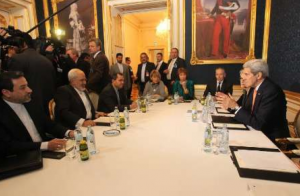
As nuclear talks between international negotiators and Iranian representatives got underway in Geneva today following two days of direct US-Iranian bilateral negotiations, the Tehran regime again stressed the importance of lifting sanctions against it, leading some analysts to express concern that sanctions relief may be applied even in the absence of a deal that satisfies western powers.

Iranian chief negotiator and deputy foreign minister Abbas Araghchi described the atmosphere at the bilateral negotiations as having “proceeded in a good ambience.” Aragchi stressed that “there were elaborate discussions on all topics, especially sanctions” – the issue that the Iranian regime is most concerned about.

A New York Times report today portrayed the sanctions issue as the dividing line between Iranian conservatives who reject a deal and the putative moderates, led by President Hasan Rouhani, who see a nuclear deal and the lifting of sanctions as the price to pay for Iran’s full participation in international affairs.

“Mr. Rouhani came to office this year promising not just to strike a nuclear deal that would lift economic sanctions but to end Iran’s isolation from the world economy and to promote individual freedoms,” The Timesobserved.

Rouhani’s determination to lift the sanctions has worried some analysts, who posit that the Obama Administration may back down on key verification demands in order to boost the regime’s “moderate” faction.

“Iranian officials have a vested interest in presenting the talks as proceeding according to their list of desiderata,” Michael Doran, a former deputy assistant secretary of defense in the George W. Bush Administration who now works for the Hudson Institute think-tank in Washington DC,  told The Algemeiner. “That said, the Obama administration has shown a disturbing tendency to back away from previous red lines, of which forcing Iran to divulge the possible military dimensions (PMD) of its nuclear program is one of the most important – precisely because it is a prerequisite for effective monitoring.”

Any deal that offered sanctions relief before Iran has satisfied the International Atomic Energy Agency’s (IAEA) concerns about the military aspects of its nuclear program “is a very bad deal,” Doran said.

Emanuele Ottolenghi, a Senior Fellow at the Foundation for Defense of Democracies, told The Algemeinerthat Iran had persuaded the P5+1 – the five permanent members of the UN Security Council plus Germany –”that neither its missile program nor the possible military dimensions of it nuclear research should be part of a final deal.”

“Instead, we are down to just discussions on how to remove sanctions in exchange for a short term enhanced inspection arrangement that cannot possibly be relied upon to discover undeclared facilities,” Ottolenghi said. “Unfortunately, the Obama Administration is trading long term security for a short term diplomatic victory.”

In Nuke Talks, Obama Still Iran’s Best Asset

December 16, 2014

In Nuke Talks, Obama Still Iran’s Best Asset, Commentary Magazine, December 14, 2014

President Obama’s goal is not so much to fulfill his campaign promise about the nuclear threat as it is to launch a new détente with the Iran. This is a crucial point since it not only makes him more reluctant to stick to Western demands about nuclear issues but makes it impossible for him to contemplate abandoning the negotiations.

**************

For the first time since the Iran nuclear talks were extended for the second time last month, the United States and its allies will meet again with Tehran’s negotiators in Vienna on Wednesday. To listen to public statements from the Obama administration, the allied team will be there to insist on a deal that will prevent Iran from getting a nuclear weapon. But the same factors that have tilted these negotiations in Iran’s direction throughout the process still seem to be pushing the outcome toward an agreement that will be touted as a desperately needed foreign-policy triumph for the administration. With both the French becoming more vocal about their dissatisfaction with America’s leadership in the talks and the Islamist regime making no secret of their unwillingness to make more concessions, the question facing the negotiators is not so much whether a deal is possible, but whether the U.S. is able to resist the temptation to continue giving ground to the Iranians in order to get a deal at virtually any price.

As the next round of talks begins, observers need to think back to the allies’ position prior to the signing of the interim deal to understand just how far the U.S. has retreated from its current perilous position. In 2012 when he was running for reelection, President Obama vowed during his foreign-policy debate with Mitt Romney that any deal must end Iran’s nuclear program. The allies were similarly united behind a position that Iran had no right to enrich uranium for nuclear fuel under any circumstances and that its plutonium plant at Arak must be dismantled.

Since then, the U.S. has accepted the notion that Iran has the right to a nuclear program and that its infrastructure will remain largely in place no matter what the terms of an agreement might say. It has also tacitly recognized Iran’s right to enrichment while claiming that the low levels permitted freeze its progress toward a bomb even though everyone knows these restrictions can easily be reversed. The U.S. has also given every indication it will allow Iran to keep its centrifuges as well as showing no sign that it will press Tehran to give up its plutonium option or stop producing ballistic missiles whose only purpose would be to deliver nuclear warheads. Even worse, the administration seems to be giving up any effort to find out just how much progress the Iranians have made toward weaponizing their nuclear project or to force them to admit International Atomic Energy Agency inspectors to get the answers to this vital question.

Based on the experience of the last year and a half of talking with Obama’s envoys, Iran’s negotiators know they only have to stand their ground and it’s only a matter of time until the Americans give in to their demands one by one until they get terms that will let them become a nuclear threshold power as well as lifting the economic sanctions that continue to cripple Iran’s economy.

That the Iranian people are clamoring for an end to the sanctions is clear. As the New York Times reported on Friday, anticipation of the collapse of the restrictions is the talk of Tehran. The eagerness of their would-be European trading partners is just as vocal. In theory, this desire to reconnect Iran to the global economy ought to give the U.S. the leverage to make the Iranians give up their nuclear ambitions. On top of that, the collapse of the price of oil should have Iran even more desperate and the position of the allies even stronger.

But the Iranians know whom they are dealing with. As has become increasingly clear in the last year in which the talks went into two overtime periods despite administration promises that the talks would be finite in length, President Obama’s goal is not so much to fulfill his campaign promise about the nuclear threat as it is to launch a new détente with the Iran. This is a crucial point since it not only makes him more reluctant to stick to Western demands about nuclear issues but makes it impossible for him to contemplate abandoning the negotiations. That means that the Iranians know the president isn’t even thinking, as he should be, of ratcheting up the economic pressure with tougher sanctions, or of making the Islamists fear the possibility that the U.S. would ever use force to ensure the threat is eliminated.

Under these conditions the chances of the U.S. negotiating a deal that could actually stop Iran from ever getting a bomb are slim and none. Instead, the only question remains how far the Iranians are willing to press the president to bend to their will in order to let him declare a victory and welcome this terrorist-sponsoring regime moving closer to regional hegemony as well as a nuclear weapon.

Rather than the renewed diplomacy being a signal for congressional critics from both parties of the president’s policy to pipe down, the new talks should encourage them to work harder to pass the sanctions the president claims he doesn’t need. Unless they act, the path to appeasement of Iran seems to be clear.

Saudi Government Daily: U.S. Secretly Cooperating With Iran At Arabs’ Expense

December 15, 2014

Saudi Government Daily: U.S. Secretly Cooperating With Iran At Arabs’ Expense, MEMRI, December 14, 2014

(Fact, fiction or a mix of both? — DM)

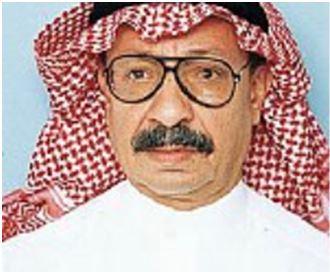
Yousuf Al-Kuwailit, who writes the editorials of the Saudi government daily Al-Rai, opined in a December 7, 2014 editorial that, despite the tension that has ostensibly prevailed between the U.S. and Iran ever since the Islamic Revolution, in practice there is secret cooperation between them. As part of this cooperation, he said, Iraq has become nothing but an arena for assuring the interests of these two countries, and Iran has been granted freedom of action in Syria and Lebanon.

Referring to the U.S.-Iran nuclear talks, he said they were a farce that would end in contracts and deals, and perhaps even an alliance, between the two countries. He therefore called on the Arabs not to regard the U.S. as a reliable ally, and warned that the U.S. may force the Gulf states to reconcile with Iran, to the detriment of their interests.

The following are excerpts from the article: [1]

21428Yousuf Al-Kuwailit

“The U.S. appointed the Shah as policeman of the Arab Gulf, turned Iran into a base for conflict with the USSR, and provided Iran with up-to-date weaponry and a nuclear reactor. [Iran, for its part] attempted to take advantage of this situation, as it saw itself as a superpower. [Only] the strength of the USSR… prevented Iran from undertaking military adventures outside its own borders. With [the rise to power of Ayatollah Ruhollah] Khomeini, despite everything that happened at the U.S. Embassy [in Tehran in 1980], when dozens of its staffers were taken hostage and [then-U.S. president Jimmy] Carter carried out a reckless and unsuccessful operation [in attempt to free them]… [despite all this] nothing spoiled the U.S.’s relationship with this country, which it considers one of its strategic and economic outposts by virtue of its location and its history. So the farce… about Iran’s nuclear reactors and non-conventional weapons has taken a clear and final direction, in the form of several deals [between the two countries]…

“Cyrus [the Great],[2] who attacked and destroyed the Arabs, is the spiritual father of the Nazi trend that has characterized Iran’s governments, whether secular or religious. Racial supremacism vis-à-vis the Arabs is a popular [Iranian] obsession. It exists and it is eternal, and even if the mullahs don black turbans [indicating that they are] descendants of the Prophet and have Arab roots, they do not really recognize these roots, but do this only in order to market their national policy to us, prior to marketing their religious school of thought [i.e. the Shi’a]. Anyone who thinks that diplomatic arrangements are aimed at anchoring coexistence between the Arabs and the Iranian ‘Aryans’ is disregarding the nature of the historical reasons [for the tension between the two sides] and its deep roots in the [Iranian] public mentality.

“In order to better understand the unfolding of events, [we need to realize that]  the U.S. and its allies set out the initial plan to divide the Arab [regions] a long time ago, and that the Sikes-Picot agreement is only the first outcome [of that plan]. [We must also realize] that handing over Iraq [to Iran], and annexing Syria and later Lebanon to it, and the [silent] agreement [between the two countries] that Iran would have a free hand in these countries – all these  are only a prelude to  more dangerous activity.

“[Accordingly], relying on the U.S. or thinking it a reliable ally without properly understanding the strategic changes and aims, place us in a situation [of self-delusion], because all the historic elements of power see how positions and policies change but interests remain. This principle will be ultimately applied to all the countries that have a relationship with the U.S., whether economic or strategic, because the Arabs are part of a geographic area whose borders are changing, including through the disappearance of the centrally[-ruled] state in favor of states [based on] sect or nationality.

“One simple event in recent days is the Iranian Air Force’s incursion into Iraq to attack ISIS positions, which the U.S. confirmed but Iran denied. At the same time, the U.S. also ignores the incursion of [Iranian] ground troops under the command of [IRGC Qods Forces commander] Qassem Soleymani into Iraq, [which has been taking place] ever since the U.S. first started managing [Iraq’s] affairs… [In fact,] U.S. Secretary of State John Kerry stated that any Iranian military attack on ISIS was positive. This exposes the significant coordination between the two countries, and belies the statements of U.S. military circles denying any cooperation or coordination [with Iran] in the war on ISIS…

“In the era of [former Iraqi prime minister Nouri] Al-Maliki, Iraq become nothing but an arena for assuring the interests of two players: Iran and the U.S. This came about as part of an agreement that began with [head of the occupational authority of Iraq after the 2003 invasion Paul] Bremer, and no Iraqi government will put an end to it, unless the Iraqis [dare to] oppose their homeland’s dependence on another country – something that is difficult and complicated to do.

“Ultimately, even if the talk about the American-Iranian hostility is true, everything points towards new contracts between the two which are likely to turn into alliance. We could possibly see catastrophic days if the U.S. forces the Gulf states to reconcile with Iran, which will end in a way that will not serve our interests. This is an outcome that should not surprise us, if the reality of [U.S.-Gulf] friendship evolves into [U.S.] dictates [to the Gulf states].”


Endnotes:

[1] Al-Riyadh  (Saudi Arabia), December 7, 2014.

[2] Cyrus the Great founded the Achaemenid Empire, circa 600 BCE.

Western Indifference to the Palestinian Culture of Hate

December 15, 2014

Western Indifference to the Palestinian Culture of Hate, Front Page Magazine, December 15, 2014

(Here is the video of the Islamic preacher.

The New York Times is by no means alone in making the “news” fit its ideological narrative. For an excellent analysis of how and why it happens, please read Sharyl Attkisson’s recent book Stonewalled.– DM)

The practice of ignoring such malevolence partly stems from the fact that the New York Times wishes to present a certain narrative at the expense of the facts and partly stems from a systematic inability of some Western media outlets to hold Arabs to a Western standard of decency and morality. Thus, Arab anti-Semitism, the same kind of anti-Semitism practiced in Europe some 75 years ago, is either ignored or attributed to mere cultural differences.

Rarely is the sort of vitriol witnessed in the videos expressed in English to Western audiences. Only the crassest among them publicly share their feelings about Jews, and the West for that matter. But behind closed doors it’s an entirely different story. Groups like MEMRI, CAMERA, Palestinian Media Watch (PMW) and many others do an excellent job in exposing the malevolence hiding just beneath the surface. The problem is no one seems to care. No one cared 75 years ago either.

*****************

palestinian-450x331

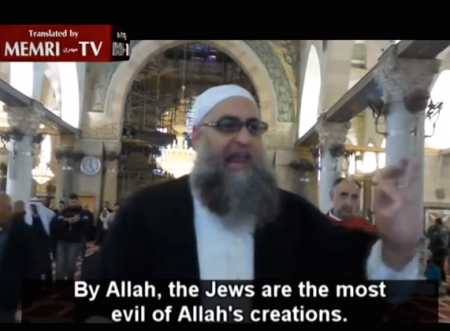
A shockingly, disturbing video has recently surfaced exposing the true and pernicious face of Palestinian extremism and xenophobia. The video, made available by Middle East Media Research Institute (MEMRI) shows a bearded sheikh giving what appears to be an impromptu sermon on the Jews. (After all, what else is there to talk about?) The venue is the Al-Aqsa Mosque, considered by those who practice the “religion of peace” to be their third holiest site after Mecca and Medina.

The speech itself is filled with gut-wrenching anti-Semitism, the kind that would even make the editors of the New York Times blush. The sheikh describes how the Jews possess the vilest of traits, how they were responsible for killing the “prophets,” how they attempted to assassinate Muhammad, how their time for “slaughter is near,” how they will be slaughtered “without mercy,” and of course there’s the perfunctory, “Jews are apes and pigs” thing.

Interestingly, the speaker doesn’t mention the longing for Palestinian statehood or independence. Instead, he talks of the establishment of the “Islamic Caliphate.” “Oh Allah’” he states, “Hasten the establishment of the State of the Islamic Caliphate,” and further rants, “Oh Allah hasten the pledge of allegiance to the Muslim Caliph.” He spews forth the latter statement three times to chants of “Amen!” from the large, approving crowd congregating around him.

These comments, which would register horror and revulsion in the West (at least in some quarters) are almost banal among Palestinians. In fact, a similar video featuring a different speaker some days earlier at the same venue, conveyed identical sentiment, expressing admiration for the Islamic State and calling for murder of Jews and annihilation of America.

Guttural anti-Semitism is ingrained and interwoven in the fabric of Palestinian society. Despite their minuscule numbers, 78% of Palestinians believe that Jews are responsible for most of the world’s wars while a whopping 88% believe that Jews control the global media and still more believe that Jews wield too much power in the business world.

Much of the blame for this can be placed squarely on the doorstep of Mahmoud Abbas’s Palestinian Authority, which subjects the Palestinian population to a steady diet of hate-filled, Judeophobic rhetoric through state-controlled media and educational institutions. It is so well entrenched that the process of deprogramming, if it were ever attempted, would take generations to reverse.

Some of the blame however, rests with the Obama administration and the European Union, which continues to fund the Palestinian Authority with an endless supply of taxpayer money without demanding any form of accountability. Western money is openly used to fund the Palestinian Authority’s hate apparatus with money flowing into institutions that propagate anti-Semitism and encourage terrorism.

Some Western media outlets are also culpable in perpetuating the Palestinian culture of hate. The New York Times for example has frequently and diligently covered so-called “price tag” vandalism attacks; a practice universally condemned by nearly all Israelis and vigorously prosecuted by Israeli authorities but rarely, if ever, covers the type of venomous hate speech witnessed in the above-noted videos.

Hate crimes inspired by this type of pernicious speech are also routinely ignored. Highlighting this point is the disturbing case of Asher Palmer, an American citizen who, along with his infant son was murdered when a rock thrown by a Palestinian crashed through the windshield of the car he was driving, hitting him flush in the face. The New York Times ignored the gruesome murders and only mentioned the incident in passing a few days later in the context of a reprisal “price tag” attack against a mosque. Under the unbelievably skewed editorial policies of the New York Times, it took an act of vandalism, ostensibly committed by Jews, to highlight the horrific murder of Asher Palmer and his infant son at the hands of Arabs.

The practice of ignoring such malevolence partly stems from the fact that the New York Times wishes to present a certain narrative at the expense of the facts and partly stems from a systematic inability of some Western media outlets to hold Arabs to a Western standard of decency and morality. Thus, Arab anti-Semitism, the same kind of anti-Semitism practiced in Europe some 75 years ago, is either ignored or attributed to mere cultural differences.

Indeed, the New York Times no longer even bothers to hide the fact that it engages in duplicitous double standards when it comes to reporting Palestinian-Arab racism and hate speech as evidenced from a telling exchange between New York Times’ opinion page staff editor, Matt Seaton and Tamar Sternthal, a director at the Committee for Accuracy in Middle East Reporting in America (CAMERA).

Rarely is the sort of vitriol witnessed in the videos expressed in English to Western audiences. Only the crassest among them publicly share their feelings about Jews, and the West for that matter. But behind closed doors it’s an entirely different story. Groups like MEMRI, CAMERA, Palestinian Media Watch (PMW) and many others do an excellent job in exposing the malevolence hiding just beneath the surface. The problem is no one seems to care. No one cared 75 years ago either.

Is Obama ready for an about-face to recognize Assad? Will Syria provide the strike force against ISIS?

December 14, 2014

Is Obama ready for an about-face to recognize Assad? Will Syria provide the strike force against ISIS?, DEBKAfile, December 14, 2014

bashar_al_assad_12.14Bashar Assad gets a new lease of life

Netanyahu will ask Washington to exercise its veto against the Palestinian motion. But the Obama administration would rather not, since it supports the Palestinians in principle.

Israel may therefore find itself this time ranged against a united US-Russian front on the Palestinian issue, Moscow’s reward for Washington lining up behind its plan for Syria.

Netanyahu told a cabinet meeting in Jerusalem Sunday, Dec. 14, that Israel would “rebuff any UN moves to set a timetable for withdrawal from territory.” He said Israel now faced a possible diplomatic offensive “to force upon us” such a withdrawal within two years.

*****************

High expectations based on unconfirmed reports swirled around Arab capitals Sunday, Dec. 14, that US President Barack Obama, in league with Moscow and Tehran, had turned his longstanding anti-Assad policy on its head. He was said to be willing to accept Bashar Assad’s rule and deem the Syrian army the backbone of the coalition force battling the Islamic State in Iraq and the Levant.

If these expectations are borne out by the Obama administration, the Middle East would face another strategic upheaval: The US and Russia would be on the same side, a step toward mending the fences between them after the profound rupture over Ukraine, and the Washington-Tehran rapprochement would be expanded.

The Lebanese Hizballah and its leader, Hassan Nasrallah would be vindicated in the key role they played in buttressing President Assad in power.

But for Saudi Arabia and Israel, an Obama turnaround on Assad would be a smack in the face.

The Saudis along with most of the Gulf emirates staked massive monetary and intelligence resources in the revolution to topple the Syrian ruler.

Israel never went all-out in its support for the Syrian uprising, but focused on creating a military buffer zone under rebel rule in southern Syria, in order to keep the hostile Syrian army, Hizballah and elements of the Iranian Revolutionary Guard Corps fighting for Assad at a distance from its northern borders with Syria and Lebanon.

If Obama goes through with accepting the Assad regime, Israel will have to write off most of its military investment in Syria. In any case, Israel’s intelligence agencies misjudged the Syrian situation from the first; until a year ago, they kept on insisting that Assad’s days were numbered.

DEBKAfile’s Arab sources single out major pointers to the approach of a reversal of Syrian policy in Washington:

1.  The resignation of Chuck Hagel as defense secretary last month. Hagel was adamant in advocating Assad’s ouster.

2.  No more than one sentence was devoted to the Syrian conflict in the Gulf Cooperation Council’s (GCC) summit’s resolutions in Doha last week, despite its centrality to inter-Arab affairs: the summit called for “a political solution” of the Syrian issue that would “ensure Syria’s security, stability and territorial integrity.”

Not a word on Assad’s removal from power.

3.  DEBKAfile’s Washington and Moscow sources report that the Syrian issue was destined to figure large in the Rome talks between US Secretary of State John Kerry and Russian Foreign Minister Sergey Lavrov Sunday, Dec. 14.

The Kremlin is making US acceptance of its plan for ending the Syrian conflict the condition for joining the US-European line on the Palestinian demand that next week’s UN Security Council session set a two-year deadline for Palestinian statehood within 1967 border. The text calls for Israeli “occupation of Palestinian territory captured in the 1967 war” to end by November 2016.

France, Britain and Germany are in efforts to draft a resolution of their own.

So any deal Kerry and Lavrov are able to finalize for a tradeoff between the Palestinian and Syria issues will be put before Israeli Prime Minister Binyamin Netanyahu when he meets the US secretary in Rome Monday, Dec. 15.

Netanyahu will ask Washington to exercise its veto against the Palestinian motion. But the Obama administration would rather not, since it supports the Palestinians in principle.

Israel may therefore find itself this time ranged against a united US-Russian front on the Palestinian issue, Moscow’s reward for Washington lining up behind its plan for Syria.

Moscow proposes that the Syrian opposition throw in the towel and both sides accept a truce – especially in the long battle for Aleppo – for the re-convening of the Geneva 2 peace conference in Moscow, with America’s support and participation. Provincial elections would then take place in Syria to bring the Assad government and opposition elements into collaborating in the various ruling institutions.

Russian Deputy Foreign Minister Mikhail Bogdanov spent two days in Damascus last week to work on the details of this blueprint with Bashar Assad, after which he commented tellingly that he was “in contact with our American partners.”

Russian officials then elaborated on their plan before Hizballah and opposition representatives in Turkey.

Even the US Senate bill calling for fresh sanctions against Moscow and the supply of $350 million worth of military aid to Ukraine under the Ukraine Freedom Support Act is unlikely to rock the Kerry-Lavrov Middle East boat.

President Obama is unlikely to affix his signature to the bill and President Vladimir Putin will take it in his stride if he sees progress in reaching an agreement with the United States on Syria.

Even the American threat to station medium-range nuclear missiles in Europe following Moscow’s refusal to endorse the Intermediate-Range Nuclear Forces Treaty failed to cast a cloud over the Kerry-Lavrov encounter.

The two top diplomats have a solid history of progress in forging diplomatic accords on thorny international issues (e.g. Iran’s nuclear program and Syria’s chemical weapons).

If they fail this time, Netanyahu’s talks with Kerry will be lighter and smoother. But if a Syria-Palestinian tradeoff is forged between the two powers, Israel may for the first time find itself on a collision course with a joint US-Russian front on the Palestinian issue.

Netanyahu told a cabinet meeting in Jerusalem Sunday, Dec. 14, that Israel would “rebuff any UN moves to set a timetable for withdrawal from territory.” He said Israel now faced a possible diplomatic offensive “to force upon us” such a withdrawal within two years.

Therefore, the Israeli air strikes against a shipment of Russian missiles for Syria for Hizballah last Monday, Dec. 8, may be seen as an act of defiance against this nascent big-power partnership. Our sources reveal that Moscow was not alone in demanding “explanations” for Israel’s “aggressive” – so too did Washington.

Israeli Ambassador: Obama “Worldview Not in Accord w/Any Israeli Government.”

December 14, 2014

Israeli Ambassador: Obama “Worldview Not in Accord w/Any Israeli Government.” Front Page Magazine, Daniel Greenfield, December 13, 2014

But it certainly is in accord with Iran.

Former ambassador Michael Oren provided a little reminder that the issue isn’t Netanyahu and that Obama’s radical politics would put him at odds with any Israeli government.

This is an administration which makes the racist claim that Jews living in Jerusalem are “settlers”, which funds terrorists and takes their side against Israel.

Michael Oren was the consummate diplomat. He was dignified, thoughtful, articulate, knowledgeable and tactful.

In a dialogue at The Plaza here last week at the annual Scholar-Statesman dinner of the Washington Institute for Near East Policy, Oren said that “this administration [in Washington] has a worldview that is not in accord with any Israeli government,” not just the current one.

Describing the Obama administration as “ideological” on the Mideast, with the president’s 2009 outreach-to-the-Arab-world Cairo speech as its source, Oren said the White House views east Jerusalem communities like Gilo, for example, as not necessarily part of the Jewish state, a position he said no Israeli government would accept.

(Gilo is over the Green Line but part of the Jerusalem municipality, with a largely Jewish population.)

After the March 17 elections, Israel’s next government “likely will move to the right,” Oren predicted, “and America may be going a different way.”

Though he said the U.S.-Israel relationship is crucial — “we [Washington and Jerusalem] have no choice but to be allies” — he asserted on several occasions that “Israel has to take responsibility for itself.”

Asked by moderator Robert Satloff, the executive director of the Washington Institute, about the West’s negotiations with Iran over its nuclear program, Oren first noted that Israel’s “margin for error is exactly zero” on this issue, given Iran’s longstanding threat to destroy the Jewish state.

Then, his voice rising, he said that if you believe that Iranian President Hassan Rouhani is indeed the moderate he claims to be, if you believe that Iran has reversed its policy of being the world’s leading exporter of terror, if you believe that its leaders have changed their long pattern of lying about the nuclear program, and if you believe the West is capable of and willing to respond militarily to prevent the production of a nuclear bomb, then yes, you should support the U.S. effort to reach an agreement with Iran.

“But if your children and grandchildren’s’ lives depended on it, you may reach a different conclusion,” he asserted, adding: “We [the Jewish people] have not come back after 2,000 years to disappear.”

And it goes without saying, that if you believe that you’ve chosen to completely ignore everything happening in the world.

I am not Oren’s biggest fan and what he is saying is simply common sense. Obama isn’t just at odds with Netanyahu or with Israel. He’s at odds with the remaining US allies in the Middle East. If Obama is at odds with Muslim allies of the US because he supports Muslim terrorists like the Muslim Brotherhood, it goes without saying that his relationship with Israel will be toxic.