Policy Ban Reversed – Iranian Students Study Nuke Science In U.S. – Fox & Friends via You Tube, March 11, 2015
Presidential Commitments Then and Now, Commentary Magazine, Rick Richman, March 11, 2015
(Please see also State Dept Describes Iran Deal as ‘Nonbinding’ — DM)
The White House “outrage” at the “open letter” to Iran signed by 47 senators, led by Sen. Tom Cotton, was reinforced by Vice President Biden’s formal statement, which intoned that “America’s influence depends on its ability to honor its commitments,” including those made by a president without a vote of Congress. Perhaps we should welcome Biden’s belated insight. As Jonathan Tobin notes, President Obama on taking office in 2009 refused to be bound by the 2004 Gaza disengagement deal in the letters exchanged between President George W. Bush and Israeli Prime Minister Ariel Sharon. His secretary of state, Hillary Clinton, announced that such commitments were “unenforceable”–that they were non-binding on the new administration. In 2009, Obama disregarded previous commitments not only to Israel but also to Poland, the Czech Republic, and Georgia; he “fundamentally transformed” America’s previous commitments, as he likes to describe the essential element of his entire presidency.
The Gaza disengagement deal was (1) approved by Congress; (2) included in the Gaza disengagement plan presented to the Israeli Knesset, and (3) relied on by Israel in withdrawing from Gaza later in 2005. The history of the deal (which the current secretary of state endorsed at the time as a U.S. “commitment”) is set forth here, and the reason Obama sought to undo it is discussed here. In 2009, the Obama administration refused at least 22 times to answer whether it considered itself bound by the deal; in 2011 it openly reneged on key aspects of it.
President Obama is currently negotiating an arms control agreement in secret, refusing to disclose the details of the offers his administration has made to Iran, a terrorist state according to his own State Department, and a self-described enemy of the United States since 1979. He has opposed not only a congressional debate before he concludes the deal but also a congressional vote afterwards. If he closes a deal with Iran on that basis, it will not be binding on any future president–at least not if that president chooses to follow the precedent Obama himself set in 2009.
If the administration is now seeking to restore the credibility of presidential commitments, the president might consider taking two steps: (1) acknowledge that the U.S. is bound by the disengagement deal negotiated by President Bush with Israel, endorsed by a vote of Congress; and (2) promise to put his prospective deal with Iran to a similar congressional vote once the deal is done. If not, perhaps a reporter at his next press conference will ask how he reconciles his position that (a) he could ignore President Bush’s congressionally approved deal with his view that (b) future presidents must honor the non-congressionally approved one he is negotiating now.
State Dept Describes Iran Deal as ‘Nonbinding’, You Tube, March 11, 2015
(Huh? Does this suggest that the State Department agrees with the “traitorous” letter from Republican members of the Congress? Would a deal also be “nonbinding” on Iran?– DM)
Iran Declares Pre-emptive Victory in Nuke Talks, Washington Free Beacon,
(Unfortunately, he appears to be correct. Iran seems to have improved her arsenal substantially since November of 2013 and the sanctions relief, used to get Iran to “negotiate,” doubtless helped it to do so. Please see also Iran is an empire, Iraq is our capital.
What will Obama do if Iran declines even his “extremely reasonable” deal because Iran doesn’t want one? Blame it on the recent letter sent by Republican members of the Congress? — DM)
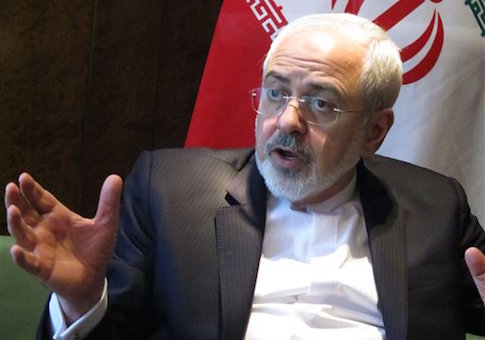 Iranian Foreign Minister Mohammad Javad Zarif / AP
Iran’s foreign minister and chief negotiator in nuclear talks with the West declared victory for his country, stating that no matter how the negotiations end, Tehran has come out “the winner,” according to remarks made on Tuesday and presented in the country’s state-run press.
Javad Zarif, the Islamic Republic’s foreign minister, stated in remarks before the country’s powerful Assembly of Experts, which recently installed a hardline new cleric as its leader, that the nuclear negotiations have established Tehran as a global power broker.
“We are the winner whether the [nuclear] negotiations yield results or not,” Zarif was quoted as saying before the assembly by the Tasnim News Agency. “The capital we have obtained over the years is dignity and self-esteem, a capital that could not be retaken.”
Zarif’s comments were accompanied by a host of bold military displays by Tehran in recent weeks, including the announcement of one new weapon that Iranian military leaders have described as a “very special” missile.
As the United States and Iran rush to hash out a final nuclear agreement ahead of a self-imposed July deadline, Zarif also lashed out at congressional Republicans who have expressed skepticism over the Obama administration’s diplomacy and have fought to exert control over the implementation of any deal.
Zarif dismissed as a “propaganda ploy” a recent letter signed by 47 Senate Republicans that warned Tehran against placing too much stock in a weak deal agreed to by the Obama administration.
Meanwhile, Iran’s military continues to unveil a range of new strategic missiles and advanced weapons meant to project strength throughout the region.
Iran disclosed during military drills late in February that it is developing a missile capable of being fired from a submerged submarine. Top Iranian military leaders have described the missile as a “very special weapon,” according to IHS Jane’s, a defense industry news source.
“I believe that this weapon is a strategic weapon,”Admiral Ali Fadavi, the naval commander of the Iranian Revolutionary Guard Corps (IRGC), said on state television, according to Jane’s. “It has special characteristics.”
Fadavi declined to provide additional details about the missile. “I would like to keep this information for the future. It is a very special weapon and the Americans cannot even surmise how strong and effective this weapon is.”
On Tuesday morning, the commander of Iran’s navy previewed the unveiling of “advanced surface and subsurface vessels” that will soon be incorporated into the country’s fleet, according to the state-run Fars News Agency.
Iran has put great stock in its navy, investing significant resources to bolster the force and make it a principal player in key global shipping lanes, including around the Strait of Hormuz, the Gulf of Oman, and the Caspian Sea.
Sea-based weapons were a major focus of recent high-level meetings between Iranian and Russian officials, who agreed to a new arms pact.
Earlier this week, Iran initiated into its fleet a new destroyer ship that is “armed with advanced anti-surface and anti-subsurface weapons and air defense systems,” according to military leaders quoted by Fars.
The ship was immediately deployed to the Caspian Sea, an area Iran views as critical to its interests.
Admiral Kordad Hakimi, a top Iranian navy official, told the country’s press that Iran is prepared to use force in the region.
“We have no security problem in the Caspian Sea today, [but] … the Navy is fully prepared to confront any threat,” he was quoted as saying.
Iranian officials have also bragged about being in full control of five out of nine major international waterways.
Supporters of Deal Are Strengthening Iran’s Negotiating Position, The Gatestone Institute, Alan M. Dershowitz, March 10, 2015
The reality is that we are in a far stronger negotiating position than advocates of the deal have asserted, but we are negotiating from weakness because we have persuaded the Iranians that we need the deal — any deal — more than they do.
*******************************
Despite repeating the mantra that “no deal is better than a bad deal” with Iran, the United States seems to be negotiating on the basis of a belief that the worst possible outcome of the current negotiations is no deal. Many supporters of the deal that is now apparently on the table are arguing that there is no realistic alternative to this deal. That sort of thinking out loud empowers the Iranian negotiators to demand more and compromise less, because they believe — and have been told by American supporters of the deal — that the United States has no alternative but to agree to a deal that is acceptable to the Iranians.
A perfect example of this mindset was Fareed Zakaria on his CNN show this past Sunday. He had a loaded panel of two experts and a journalist favoring the deal, and one journalist opposed. This followed Zakaria’s opening essay in favor of the deal. All those in favor made the same point: that this deal is better than no deal, and that any new proposal — for example, to condition the sunset provision on Iran stopping the export of terrorism and threatening to destroy Israel — is likely to be rejected by Iran, and is therefore, by definition, “irrational” or “unproductive,” because it would result in no deal.
The upshot of this position is that Iran essentially gets a veto over any proposal, but the United States does not get to make new proposals. If it were true that this deal is better than no deal, it would follow that any proposed change in this deal that Iran doesn’t like is a non-starter.
That’s why Netanyahu’s reasonable proposal that the sunset provision be conditioned on changes in Iranian actions and words has been pooh-poohed by the so-called “experts.” They haven’t tried to respond on the merits. Instead, they are satisfied to argue that Iran would never accept such conditions, and therefore the proposal should be rejected as a deal breaker.
This is the worst sort of negotiation strategy imaginable: telling the other side that any proposal that is not acceptable to them will be taken off the table, and that any leader who offers it will be attacked as a deal breaker. This approach — attacking Netanyahu without responding to his proposal on their merits — characterizes the approach of the administration and its supporters.
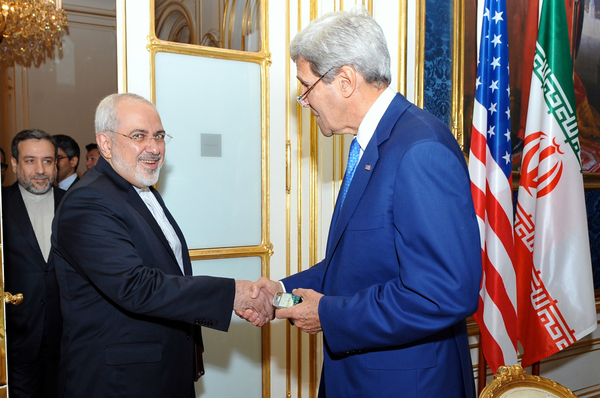 U.S. Secretary of State John Kerry shakes hands with Iranian Foreign Minister Mohammad Javad Zarif during nuclear talks in Vienna, Austria, July 14, 2014. (Image source: U.S. State Department)
We will now never know whether Iran might have accepted a conditional sunset provision, because the advocates of the current deal, both inside and outside the administration, have told Iran that if they reject this proposal, it will be withdrawn, because it endangers the deal. What incentive would the Iranians then have to consider this proposal on its merits? None!
The current mindset of the deal’s advocates is that the United States needs the deal more than the Iranians do. That is why the U.S. is constantly leaking reports that the Mullahs may be reluctant to sign even this one-sided deal, which has shifted perceptibly in favor of the Iranian position over the past several months. But the truth is that Iran, which is suffering greatly from the combination of sanctions and dropping oil prices, needs this deal — a deal that would end sanctions and allow it unconditionally to develop nuclear weapons within ten years. That doesn’t necessarily mean they will accept it. They may push for even more compromises on the part of the United States. The reality is that we are in a far stronger negotiating position than advocates of the deal have asserted, but we are negotiating from weakness because we have persuaded the Iranians that we need the deal — any deal — more than they do.
Most Israelis seem to be against the current deal, especially the unconditional sunset provision. Author David Grossman, a left-wing dove who is almost always critical of Netanyahu, has accused the United States of “criminal naiveté.” He opposes Netanyahu’s reelection, but urges the world to listen to what Netanyahu told Congress.
“But what [Netanyahu] says about Iran and the destructive part it is playing in the Middle East cannot and should not be ignored,” Grossman said. “Netanyahu is right when he says that according to the emerging deal there is nothing to prevent the Iranians from developing a nuclear bomb once the deal expires in another 10 years, and on this matter there is no difference in Israel between Left and Right.”
There are considerable differences, however, between the Obama administrations’ negotiating position and the views of most Israelis, Saudis, Emiratis, Egyptians and Jordanians — as well as most members of our own Congress. We can get a better deal, but supporters of a deal must abandon their unhelpful public claims that the current deal is the best we can get.
Iran and the Perils of One-Man Rule, Commentary Magazine, Jonathan S. Tobin, March 9, 2015
One-man rule may make sense in Tehran, but not here. This is not a question of partisanship but a defense of both the Constitution and the security of the nation. The Iranians should know that this deal is unpopular and will have no legitimacy without congressional ratification. Rather than sabotaging diplomacy, the letter is necessary pressure on the president to remember his oath to preserve the Constitution rather than to recklessly risk the country’s safety on Iranian détente.
********************
The letter sent by 47 Republican senators to Iran’s leadership is provoking predictable cries of outrage from liberals and Democrats. Obama administration supporters are decrying the missive as a blatant attempt to sabotage U.S. diplomatic efforts to end the standoff over Iran’s nuclear-weapons program. By warning Tehran that any deal approved by President Obama may be revoked by his successor after January 2017, the GOP caucus is opening itself up to charges of extending partisan warfare to foreign policy. But the letter, intended as much as a shot fired over the bow of the president as it was a lesson in the U.S. Constitution for the ayatollahs, made an important point. No matter what you think about the administration’s blatant push for détente with the Islamist regime, the president’s plans to craft an agreement that will not be submitted to Congress for approval means the senators are correct about its status in law. More importantly, they are highlighting an issue that transcends the nuclear question, even though that is a matter of life and death. A president that seeks to ignore the constitutional separation of powers cannot complain when his critics point out that his fiats cannot be expected to stand the test of time.
The impact of the letter on the Iranians is a matter of speculation. The Islamist regime needs no instructions from Republicans about how to protect their interests as they’ve been successfully stringing along Western governments for more than a decade in nuclear negotiations. In particular, they have scored a series of diplomatic triumphs at the expense of the United States as President Obama has abandoned his past insistence that Iran give up its nuclear program and instead offered concession after concession to the point where the deal that is being offered to the regime is one that will let them keep their infrastructure and will “sunset” restrictions on it. If they truly intend to take advantage of this craven retreat by the putative leader of the free world as opposed to more prevarication until the clock runs out on their march to a weapon, then nothing his Republican opponents say are likely to scare them out of it.
Moreover, the Iranians may believe that the same dynamic that has worked in their favor during the course of the negotiations may similarly ease their fears once such a bad deal is in place. Even a Republican president who has campaigned against appeasement of Iran and understands the dangers of an agreement that will make it possible for Iran to get a bomb either by cheating or, even worse, by abiding by its terms, will be hard-pressed to reverse it. America’s allies will fight tooth and nail against re-imposition of sanctions on an Iran that they want to do business with no matter what that terror-supporting regime is cooking up.
The campaign against reversal will also center on the straw-man arguments used by the president and his apologists to bolster their effort to appease Iran. We will be told that the only alternative to a deal that allows Iran to become a threshold nuclear power is war and not the return to tough sanctions and hard-headed diplomacy that President Obama jettisoned in his zeal for a deal.
But by planning to bypass Congress and treat his pact with Iran as merely an executive decision over which the legislative branch has no say, the president is steering into uncharted waters. Like his executive orders giving amnesty to millions of illegal immigrants that usurp the power of Congress to alter laws governing this issue, a nuclear deal that is not ratified by the Senate, as all treaties must be, can be treated as a presidential whim that is not binding on his successors. If it can be put into effect with only the stroke of a pen, it can just as easily be undone by a similar stroke from another president.
The difficulty of undertaking such a revision should not be underestimated. No president will lightly reverse a foreign-policy decision with such serious implications lightly. That is why an agreement that grants Western approval to Iran’s nuclear ambitions is so dangerous. That it is part of a comprehensive approach to Iran that, despite last week’s disclaimers issued by Secretary of State John Kerry, indicates that the U.S. is prepared to accept the regime’s efforts to achieve regional hegemony makes it even more perilous. Congress needs to act soon to both impose tougher sanctions on Iran and to ensure that any deal must be submitted to it for approval.
But Iran still had to be put on notice that a deal that is not approved by Congress can and should be reversed by the next president. One-man rule may make sense in Tehran, but not here. This is not a question of partisanship but a defense of both the Constitution and the security of the nation. The Iranians should know that this deal is unpopular and will have no legitimacy without congressional ratification. Rather than sabotaging diplomacy, the letter is necessary pressure on the president to remember his oath to preserve the Constitution rather than to recklessly risk the country’s safety on Iranian détente.
On March 8, 2015, Ali Younesi, advisor to Iranian President Hassan Rohani and previously intelligence minister (2000-2005) in the government of president Khatami, spoke at the “Iran, Nationalism, History, and Culture” conference in Iran; his statements were published by the Iranian ISNA news agency the same day.
According to Younesi, Iran is once again an empire, as it was in the past, and its capital, Iraq, is “the center of Iranian heritage, culture, and identity.” Delineating the borders of the Persian Empire, or, in his words, “greater Iran,” he included countries from China, the Indian subcontinent, the north and south Caucasus, and the Persian Gulf. He added that since the very dawn of its history, Iran had been an empire and a melting pot of different cultures, languages, and peoples.
Younesi stressed that despite the current obstacles to the unification of the countries in the region under Iranian leadership, Iran cannot disregard its regional influence if it wishes to preserve its national interests. Iran, he said, has been operating in this region, particularly in Iraq, with the aim of ensuring the security of the peoples there, whose connection to Iran is obvious because of history and culture. Saudi Arabia has nothing to fear from Iran’s actions, he added, because the Saudis themselves are incapable of defending the peoples of the region. He also assured the peoples of the region that Iran is operating there against Islamic extremism as embodied by ISIS, as well as against the Saudi Wahhabis, Turkey, secularists, Western rule, and Zionism.
Further emphasizing that anything that enters Iran is improved by becoming Iranian, especially Islam itself, he added that Islam in its Iranian-Shi’ite form is the pure Islam, since it has shed all traces of Arabism, racism, and any other element that divides the various Islamic groups.
Following are excerpts from Younesi’s statements:
“Every Cultural Or Ethnic Group That Arrived From Other Places To The Iranian Plateau Has In Time Become Iranian”
“The central, western, and eastern parts of the Iranian Plateau have always protected and nurtured Iranian ethnic groups, and all the people living in this expanse are ethnic Iranians. Every cultural or ethnic group that arrived from other places to the Iranian Plateau has in time become Iranian, as have their language and culture – even a language originating from somewhere else takes on a distinct Iranian flavor once it reaches the Iranian Plateau.
“The Azeris are one of the oldest tribes of the Iranian empire, and some of them spoke a Turkic language. But when this language reached the Iranian Plateau, it became Iranian and totally different from Turkic languages in other countries. The Azeris in Iran have always defended [Iran’s] national literature, language, and culture.
“A large section of the Iranian Plateau stretches in the east to the peaks of the Pamir [mountains in Tajikistan, Kyrgyzstan, Afghanistan, and Pakistan] and to the great River Sindh; in the north to the River Amu [Darya]; in the west to the peaks of the Caucasus; and in the central part to the peaks of Alborz and Zagros, overlooking the Caspian Sea, the Persian Gulf, and Oman…
“Today Iran is restricted to [only] the central plateau. Several countries have emerged from the eastern and western plateaus. The name and culture of greater Iran have always had a good reputation in the region… We cannot preserve our interests, national security, and historic identity without attention to Iran’s regional influence and borders…”
“If We Disregard The Region That Lies Within Our Sphere Of Influence, We Will Be Unable To Protect Our Interests And Security… Since Its Inception, Iran Has [Always] Had A Global [Dimension]; It Was Born An Empire”
“In essence, the greater Iran and Iranian culture, civilization, religion, and spirit are present in this expanse, and constitute a natural union in this region. While differences prevent such a union, in truth the Iranian Plateau includes countries from the borders of China and the Indian subcontinent to the north and south Caucasus and the Persian Gulf – all of which are part of this union…
“There is no dismantling our borders. Our borders have been recognized throughout history, like our territory and our culture. This region is impacted greatly by cultural and historical partnerships. If we disregard the region that lies within our sphere of influence, we will be unable to protect our interests and security.
“Since its inception, Iran has [always] had a global [dimension]; it was born an empire. Iran’s leaders, officials, and administrators have always thought in the global [dimension]…
“Of course, I do not mean that we want to take over the world again, but we need to know what our status is and must arrive at historic self-awareness – that is, thinking globally but acting as Iranians. [Israeli Prime Minister Benjamin] Netanyahu acknowledged with certainty Iran’s might and influence; he said that Iran has taken over four countries in the region. But Iran was only trying to help these [countries].”
“Iraq Is Not Merely A Sphere Of Cultural Influence For Us; It Is Also… Our Capital”
“In the current situation, Iraq is not merely a sphere of cultural influence for us; it is also our identity, our culture, our center, and our capital. This issue [of Iraq as our capital] exists today as it did in the past, because just as there is no way to divide the territory of Iran and Iraq, there is no way to divide our culture either. We must either fight each other or unite. The purpose of such a union would not be the elimination of borders; rather, that all the countries in the Iranian expanse would become closer, since their interests and security are interconnected.”
“We Are Protecting The Interests Of [All] The People In The Region –Because They Are All Iran’s People”
“Now, when Iran is defending Iraq from the extremists, our historic rivals are displeased, and in order to annoy us they are helping their own enemies – thus destabilizing the region. Today, the [Saudi] Wahhabis are angry that Iran is supporting Iraq, but their fear is misplaced, since they themselves are incapable of fighting the fossilized Islamic thought in the region [i.e. ISIS]. We [on the other hand] are protecting the interests of [all] the people in the region, because they are all Iran’s people. We will support all the people living in Iranian Plateau, and we will defend them from fossilized Islamic thought, takfirism, and atheism, from the new Ottoman regime [Turkey], from the Wahhabi regime [Saudi Arabia], from the Western regime, and from Zionism.”
“When Islam Reached Iran, It Shed Arabism, Racism, And Nationalism”
“Everything that comes into Iran is improved. When Islam reached Iran, it shed Arabism, racism, and nationalism, and Iran eventually received pure Islam. Even during the time when the Iranians were Sunnis, their Islam was mystical, as opposed to Wahhabi; now, when [Iranian] Islam is Shi’ite, it belongs to Ahl Al-Beit – the Islam of unity and friendship.
“We must try to once again spread the banner of Islamic-Iranian unity and peace in the region. Iran must bear this responsibility, as it did in the past.”
Iranian Al Qods chief on landmark visit to Amman as guest of Jordan’s national intelligence director, DEBKAfile, March 9, 2015
 Al Qods chief Gen. Soleimani welcomed in Amman
[T]he Jordanian king lately shows a different face in private conversations to his public aspect as steadfast friend of the Obama administration. In private, Abdullah is highly critical of current US policies in the region.
*************************
DEBKAfile’s military and intelligence sources reveal exclusively that Gen. Qassem Soleiman, commander of the Revolutionary Guards elite Al Qods Brigades, paid a groundbreaking visit last Thursday, March 5, to the Hashemite Kingdom of Jordan as guest of Gen. Faisal Al-Shoulbaki, director of General Intelligence and a close adviser to King Abdullah II.
The visit, encouraged by Obama administration policy, showed one of America’s oldest Sunni Arab allies, recognizing the direction of the trending regional reality to jump the lines over to Tehran. Iran’s grab for Middle East influence is now reaching from four capitals, Baghdad, Damascus, Sanaa, Beirut to a fifth, Amman.
Our sources report that Royal Jordanian Air Force fighter jets escorted the Iranian general’s armored motorcade as it drove from Baghdad to Amman through the main highway connecting the two Arab capitals.
It is not known whether the king gave Soleimani an audience, but the possibility is not ruled out.
His talks with Jordan’s intelligence and military heads ranged widely over the battles in Iraq and Syria against the Islamic State in Iraq and the Levant-ISIS. This suggests that Jordan has shown willingness to take the first step towards coordinating its policies and military operations with Tehran – not just with Washington as hitherto.
Some 12,000 American soldiers are posted to Jordan, most of them members of elite US combat units. Their primary task is to safeguard the throne against threats from Syria and Al Qaeda and its affiliates.
Interestingly, Soleimani’s landmark trip to Amman was carefully timed to take place just a day before Gen. Martin Dempsey, Chairman of the Joint US Chiefs of Staff, arrived in Baghdad, so that by the time he landed, the Iranian general, who commands his coutry’s expanding military input in the war on ISIS, had returned to the Iraqi capital from his visit to Amman.
Our sources also report that the Jordanian king lately shows a different face in private conversations to his public aspect as steadfast friend of the Obama administration. In private, Abdullah is highly critical of current US policies in the region. In meetings with US lawmakers on visits to Amman, Abdullah has voiced bitter disappointment in President Barack Obama’s tepid response to the burning alive by ISIS of the Jordanian pilot Lt. Moath al-Kasasbeh.
He was on a visit to the White House when the horrific video was released on Feb. 3.
The Jordanian king has been heard to remark that Obama’s military partnership with Iran, which has the effect of providing the Assad regime with an extra shield, cannot survive long, because the Sunni Arab world finds it intolerable and won’t accept it.
The Danger of Negotiating with Iran, Washington Free Beacon, Michael Rubin, March 9, 2015
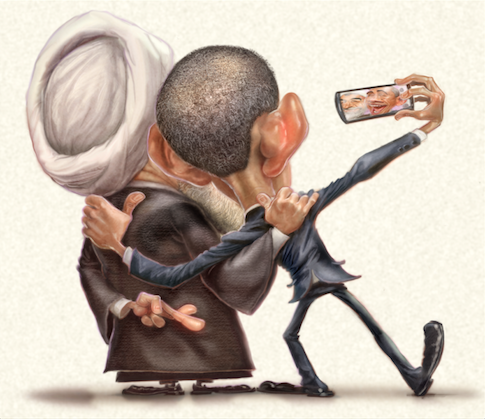
Incentivizing defiance also undercuts diplomacy. In the year before Obama blessed talks with Iran, the Iranian economy had shrunk 5.4 percent. After talks, its economy grows. In order to bring Iran to the table, Obama has released more than $11 billion to Iran. To put that in perspective, that is equivalent to the last two years’ budget of the IRGC, a group responsible for the deaths of hundreds of Americans. What Obama has done is the equivalent of giving a toddler dessert first, and then asking him to come back to eat his broccoli.
How can these past successes be replicated? Sunset clauses, multinational contracts, and sanctions relief won’t do it. Only one thing will: Forcing the regime to choose between its nuclear ambitions and its survival.
*********************
As a candidate for president, Barack Obama made diplomacy with rogue regimes a signature issue. “The notion that somehow not talking to countries is punishment to them…is ridiculous,” he declared in 2007. In both his inaugural addressand his first television interview as president, he reached out to the Islamic Republic of Iran. “If countries like Iran are willing to unclench their fist, they will find an extended hand from us,” he told Al-Arabiya. In the six years since, whether firebrand Mahmoud Ahmadinejad or reformer-by-comparison Hassan Rouhani held the Iranian presidency, Obama has been so committed to a deal on Iran’s illicit nuclear program that he hasn’t let anything stand in his way—Congress, allies, or evenfacts.
Unfortunately, when it comes to the history of high-profile diplomacy with rogue regimes, Obama’s behavior is more the rule than the exception. If every senator looks in a mirror and sees a future president, then every president looks in a mirror and sees a brilliant statesman, a man who will be Nixon in China or Reagan in Reykjavik. In reality, what most should see is a reflection of Frank B. Kellogg, Aristide Briand, or Neville Chamberlain. With very little understanding of history, Obama, alas, sees only himself.
Albert Einstein is often credited (wrongly) with the adage that insanity is doing the same thing repeatedly while expecting different results. By that definition, Foggy Bottom is Bedlam. The U.S. military, in contrast, constantly forces soldiers to confront their mistakes—that is, after all, why sergeants-major chew out soldiers. Soldiers spend more time in the classroom dissecting exercises than they do in the field. Even when deployed, they never neglect after-action reports to determine what they might have done better.
In the last half century, however, the State Department has never conducted a “lessons learned” exercise to identify what went wrong with high stakes diplomacy. Nor does the State Department have any clear metrics to measure success and failure. State Department spokesmen often make declarations of progress that declassified records of talks—with Iran, North Korea, the Palestinians, Saddam Hussein’s Iraq, Muammar Gaddafi’s Libya, Pakistan or, increasingly, Turkey and Russia—belie.
Too many American diplomats dismiss the need to consider mistakes. Instead, many are committed to the belief that talking is a cost-free, risk-free strategy. Testifying before the Senate in support of Obama’s outreach to Iran, Nicholas Burns, the second undersecretary of state for foreign affairs under George W. Bush, promised, “We will be no worse off if we try diplomacy and fail.” Richard Armitage, another veterans of Bush’s State Department, has promoted a similar argument: “We ought to have enough confidence in our ability as diplomats to go eye to eye with people—even though we disagree in the strongest possible way—and come away without losing anything.”
But Armitage was wrong to project American values onto others. Americans may not see willingness to talk as weakness, but other cultures do. On the same day in 2008 that William J. Burns, Bush’s third undersecretary of state for foreign affairs, met an Iranian delegation in Geneva—the first public high-level meeting between American and Iranian diplomats in decades—Mohammad-JafarAssadi, the ground force commander of the Islamic Revolutionary Guard Corps (IRGC) declared that, “America has no other choice but to leave the Middle East region beaten and humiliated.”
But Armitage was wrong to project American values onto others. Americans may not see willingness to talk as weakness, but other cultures do. On the same day in 2008 that William J. Burns, Bush’s third undersecretary of state for foreign affairs, met an Iranian delegation in Geneva—the first public high-level meeting between American and Iranian diplomats in decades—Mohammad-JafarAssadi, the ground force commander of the Islamic Revolutionary Guard Corps (IRGC) declared that, “America has no other choice but to leave the Middle East region beaten and humiliated.”
American diplomats genuinely want peace, but cultural equivalence can kill. So too can ignorance of an adversary’s true goals. This is why Obama’s headlong rush into a deal with Iran will be disastrous.
Obama has had no shortage of cheerleaders. Secretary of State Hillary Clinton endorsed his embrace of diplomacy with rogue regimes. “You don’t make peace with your friends,” she said, adding, “You have to be willing to engage with your enemies.” That may be true, but how you engage with rogues is important. And this is where Obama—and so many would-be statesmen before him—have gone wrong.
It is possible both to take diplomacy seriously and to remember that rogue regimes are a particular problem. There is, of course, no standard definition of “rogue,” but there is no universal definition of “terrorism” either. That doesn’t mean it doesn’t exist. In effect, rogueness is the diplomatic equivalent of pornography; attempting to define it calls to mind Justice Potter Stewart’s quip about pornography: “I can’t define it, but I know it when I see it.”
For the purposes of American policy, it wasn’t the “neocons” of the Bush administration who coined the concept, but rather the progressives within the Clinton administration. In 1993, Les Aspin, then the secretary of defense, warned that “the new nuclear danger we face is perhaps a handful of nuclear devices in the hands of rogue states or even terrorist groups.” The following year, Bill Clinton himself described Iran and Libya as “rogue states” in a speech before European officials. Secretary of State Warren Christopher, hardly a hawk, repeatedly referred to Iran as a rogue regime, and, in 1997, Madeleine Albright argued that “dealing with the rogue states is one of the great challenges of our time…because they are there with the sole purpose of destroying the system.”
Indeed, Iran checks every box for a rogue regime: It has sacked embassies at home and blown them up abroad. When, between 2000 and 2005, the European Union more than doubled its trade with Iran in the name of supporting “Dialogue of Civilizations,” Mohammad Khatami’s reformist administration poured the bulk of its hard currency windfall into nuclear and ballistic missile programs, constructing, for example, the undeclared and covert enrichment facility at Natanz. Iranian leaders have also been unapologetic about ratcheting up terrorism and support for insurgencies in proportion to their sense of the West’s diplomatic desperation. In their wildest dreams, the Iranians never imagined seeing Western acquiescence to their domination not only of Syria and Lebanon, but also of Iraq, Yemen, and perhaps the Gaza Strip. The Iranians have only grown more truculent under Obama, sending naval warships through the Suez Canaland undertaking their first naval deployment to the Pacific Ocean since the 10th century.
Of course, the Iranian people themselves bear the brunt of the Islamic regime’s tyranny. Every time Iranian leaders speak of reform to the Western audience, public executions and crackdowns on religious minorities increase: Iranians understand the message: talk of reform is for external consumption only.
That hasn’t stopped every U.S. administration from seeking to bring Iran in from the cold. Obama may have reached his hand out to Iran, but he wasn’t the first: both Bushes, Clinton, Reagan, and Jimmy Carter each tried something similar. Revolutionary leaders only had American hostages to seize because Carter was determined to keep hopes for rapprochement alive, and to keep the embassy in Tehran open whatever the risks—Khomeini’s rhetoric notwithstanding. Then, as now, the president had the media in his corner. The day before Khomeini’s revolutionary thugs seized the U.S. embassy, Steven Erlanger, the New York Times’ future chief diplomatic correspondent, published an analysis arguing that “the religious phase [of Iran’s Revolution] is drawing to a close even as it is becoming formalized.” In other words, Carter was right. The naysayers who listened to what the Iranian leaders actually promised were not sophisticated enough to understand the nuanced position of the new regime.
But Carter did not stand alone in his hope of restoring the partnership between Tehran and Washington, nor are Democrats the only party who have expected dialogue to reform rogues. The Reagan-era “Arms for Hostages” scheme began as an effort to engage Iran and cultivate a new generation who might succeed Khomeini. And it was George H.W. Bush, not Obama, who used his inauguration topromise the Iranian leadership that, “Goodwill begets goodwill. Good faith can be a spiral that endlessly moves on.” President Ali Akbar Hashemi Rafsanjani publicly suggested that he was willing to play ball, and Bush was hooked. Only when Bush had the secretary general of the United Nations send an intermediary to Tehran did he learn that Rafsanjani’s interest in peace was a ruse. Rafsanjani, whom aides to Carter, Reagan, and George H.W. Bush all called a pragmatist at various times, subsequently suggested that Iran could annihilate Israel with a single nuclear bomb while Iran’s size would enable it to withstand any retaliation.
Bill Clinton turned the other cheek to Iran’s culpability in the 1996 Khobar Towers attack in order to give diplomacy a chance. After Khatami’s term ended, his own advisors began to brag about how they had played the United States. On June 14, 2008, Abdollah Ramezanzadeh, Khatami’s press secretary, hinted about the real motivation behind Iran’s reformist rhetoric. “We should prove to the entire world that we want power plants for electricity,” he said. “Afterwards, we can proceed with other activities.” Ramezanzadeh had this to say about the purpose of dialogue: “We had an overt policy, which was one of negotiation and confidence building, and a covert policy, which was continuation of the activities.”
When Obama declared on April 5, 2009, that “All countries can access peaceful nuclear energy,” the hardline daily Resalat responded with a front-page headline, “The United States capitulates to the nuclear goals of Iran.”
If Obama were serious about ending Iran’s nuclear threat, he would consider the lessons from past diplomacy with Iran. First, taking force off the table undercuts rather than eases diplomacy. Consider the hostage crisis. According to interviews with veterans of Carter’s Iran crisis team, Gary Sick, the 39th president’s point man on Iran, leaked word that the White House had agreed to table any military response. Hostage takers have since acknowledged that, once they learned that they could expect no military consequences, they transformed their 48-hour embassy sit-in into a 444-day crisis.
Desperation for a deal also backfires. After Iran seized the hostages, Secretary of State Cyrus Vance sought to talk to any Iranian who would listen. He sought a meeting with his Iranian counterpart, Abulhassan Bani Sadr. Bani Sadr made demands, but lost his post just two and a half weeks after the meeting was held. So Vance then sought to work with Bani Sadr’s successor, Sadegh Ghotbzadeh, a former trainer for Palestinian terrorists, who proved his revolutionary credentials by augmenting earlier demands. Steering into the Iranian political maelstrom has never worked.
Western diplomats, like community organizers, pride themselves on sensitivity. Multiculturalism is their religion and moral equivalence is their mantra. They seldom understand how adversaries feign grievance to put Americans on the defensive. Take, for example, Ambassador Thomas Pickering, a vocal proponent of engagement with Iran, who warned that Iranians “bristle at the use of the phrase ‘carrots and sticks,’” because it both depicted them as donkeys and implied noncompliance would lead to a beating. What Pickering and crew never realized, however, is that Iranians often use the phrase “carrots and sticks” themselves.
Likewise, Iranians often demand apologies for grievances real and imagined. When Albright apologized for the American role in the 1953 coup against Iranian Prime Minister Mohammad Mosaddeq, Tehran demanded compensation. Alas, Albright was apologizing to America’s co-conspirators: Due to right-wing Iranian fears of communism during the Cold War, the clergy had sided with the United States and the Shah over the left-leaning populist.
Incentivizing defiance also undercuts diplomacy. In the year before Obama blessed talks with Iran, the Iranian economy had shrunk 5.4 percent. After talks, its economy grows. In order to bring Iran to the table, Obama has released more than $11 billion to Iran. To put that in perspective, that is equivalent to the last two years’ budget of the IRGC, a group responsible for the deaths of hundreds of Americans. What Obama has done is the equivalent of giving a toddler dessert first, and then asking him to come back to eat his broccoli.
Obama recently dismissed a speech by Prime Minister Benjamin Netanyahu of Israel for being devoid of any “viable alternatives.” But Netanyahu was right: leverage matters. Reagan talked to the Soviet Union, but only after a massive military build-up that allowed him to negotiate from a position of strength. He never abandoned moral clarity. Only twice in history has the Islamic Republic reversed course after swearing to a course of no compromises. The first time was about what it would take to release the American hostages, and the second about what it would take to end the Iran-Iraq War. After the hostages were released on the first day of the Reagan presidency, Carter’s associates credited the persistence of diplomacy. This is nonsense: As Peter Rodman has pointed out, Iraq’s invasion of Iran had rendered Tehran’s isolation untenable. Khomeini needed to release the hostages or his country would have crumbled. Likewise, Khomeini considered ending the Iran-Iraq War in 1982, but the IRGC pushed him to continue it until “the liberation of Jerusalem.” After six years of stalemate and another half million deaths, Khomeini reconsidered. In his radio address, he likened accepting the ceasefire to drinking from a chalice of poison, but suggested that he had no choice if Iran was to survive.
How can these past successes be replicated? Sunset clauses, multinational contracts, and sanctions relief won’t do it. Only one thing will: Forcing the regime to choose between its nuclear ambitions and its survival.




 anneinpt
 artaxes
 danmillerinpanama
 davidking1530
 Peter Hofman
 Joseph Wouk
 Peter
Peter Louisiana Steve
 WarSclerotic
Recent Comments