Archive for the ‘Obama’ category

Obama’s Iraq War

May 26, 2015

Obama’s Iraq War, Front Page Magazine, Daniel Greenfield, May 26, 2015

Obama-WC2-450x325

We all know Bush’s Iraq War, but we don’t know much about Obama’s Iraq War. Republicans fight wars. Democrats engage in police actions, impose No-Fly Zones and provide security for humanitarian missions. They don’t do anything as vulgar as fight wars. That would be warmongering.

Even by the war-shy standards of Democrats, Obama’s word games with war have been something else.

Obama’s wars are complex shell games. When he goes to war, he claims that it was at the request of a third party, which was actually fulfilling his request to file a request that it later takes back, based on a pretext that turns out to be false, to carry out a mission that turns out to be a pretext for regime change.

At least that’s how it happened in Libya.

When he inherits a war, he changes its name and announces a withdrawal while leaving a heavy military presence in place, before then actually withdrawing. If the first withdrawal doesn’t result in a disaster, because it never really took place, he can’t be blamed for the disaster that begins after the real withdrawal. After all the original withdrawal worked, so withdrawing can’t be the problem.

That’s what he did in Iraq. It’s what he plans to do in Afghanistan.

Obama’s Iraq War doesn’t exist as a distinct entity because the administration has gone to great lengths to distance itself from any appearance of being involved in it. When his original promise of withdrawing within sixteen months proved unfeasible, he declared that “By Aug. 31, 2010, America’s combat mission in Iraq would end.”

The war was renamed from Operation Iraqi Freedom to Operation New Dawn. The 50,000 soldiers became members of “Advise and Assist Brigades”. When two soldiers were killed and nine wounded on that September, they did not die as part of a combat mission. When two members of the Puerto Rico Army National Guard were killed by an IED in January, they died as advisers and assistants for New Dawn.

Five years later, America’s combat mission in Iraq is still going on. We’re still advising, assisting and bombing. And there’s no new dawn anywhere in sight.

Operation Iraqi Freedom was a name that made liberal elites turn up their noses, but it succinctly expressed a purpose and a goal. New Dawn could have been anything from a brand of soap to a cult. It was a cheerfully meaningless name and that was its purpose. It created a sense of progress without any actual progress having been made. Like everything Obama did, it was a shiny box with nothing inside.

When it came to Iraq, Obama tried to fool everyone; selling the anti-war crowd an immediate withdrawal while promising everyone else a sensible withdrawal once the mission was finished.

And he managed to lie to everyone.

When the real withdrawal came, it was followed by an onslaught of Al Qaeda car bombs. More significantly it turned Al Qaeda in Iraq into the first franchise to be able to claim to have beaten America.

Obama had been so set on withdrawal that he had paid little attention to Al Qaeda in Iraq’s resurgence. Its continued activity in Iraq combined with the withdrawal allowed the terror group to create the myth that it had defeated the United States and driven it out of Iraq. And Obama allowed the myth to grow.

Al Qaeda around the world was looking for new tactics and inspirations. While Obama insisted that Al Qaeda had to be urgently fought in Afghanistan, its presence there was light. It was much more of a threat in Yemen, a locale that would become the source of a number of terrorist attacks directed at America and Europe, and a major player in the current civil war there, as well as back in Iraq.

Obama insisted that Bush had taken his eyes off the ball by ignoring Afghanistan, but he was the one who had taken his eyes off the ball by focusing on Afghanistan and ignoring Iraq. His eagerness to get away from Iraq created a situation in which the United States could target Al Qaeda in Yemen and Pakistan, but not in Iraq where it was strongest. This policy turned Iraq into an Al Qaeda haven.

His unwillingness to confront Al Qaeda in Iraq added to the myth that it had won and that the United States was too frightened of it to fight it. The myth had some elements of truth to it.

Obama was afraid, but he wasn’t afraid of Al Qaeda. He was afraid of Iraq.

September 11 had badly panicked Democrats who suddenly saw themselves losing the post-Cold War narrative of soft power and multilateral diplomacy. Their feigned patriotism only lasted long enough for them to spot a weakness by seizing on Al Qaeda’s campaign of terror in Iraq to turn the narrative around. The last thing Obama wanted to do was risk undermining the anti-war victory of the left in Iraq.

The left needed a defeat and so it created one in Iraq. The Islamists needed a victory so they derived it from Iraq. Osama bin Laden and the Democrats were both reading texts on Vietnam and drawing the same conclusions. But the Democrats did not understand the implications of those conclusions.

By positioning Iraq as a war that America had lost, they also made it a war that Al Qaeda had won.

Al Qaeda had thrived in Afghanistan because it could claim to have beaten the USSR. Now it was thriving in Iraq because it could claim to have beaten America. The transformation of Al Qaeda in Iraq into the Islamic State would become a self-fulfilling prophecy powered by propaganda and American apathy.

Obama had made Iraq into America’s blind spot. The blindness became policy. Even as ISIS was capturing entire cities, Obama clung to the narrative that the local franchises were Jayvee teams and that the entire War on Terror could be wrapped up by withdrawing from Afghanistan.

The administration’s insistence that the Iraq War couldn’t exist made it inevitable that it would. Each denial was read by ISIS, its supporters and opponents as proof that Obama was afraid of to fight it.

Televised genocide and mass rape forced Obama back into Iraq, but with the same lack of commitment. Just as before his final withdrawal, his priority is not to win the war but to avoid the appearance of blame. Once again he is trying to fight a war without fighting it by doing as little as he can get away with.

Obama does not fear an ISIS victory. He fears Bush’s Iraq War becoming his Iraq War. He worries about having his soft power foreign policy mired in the mud of Iraq. He is afraid of losing his Nobel Prize in Baghdad.

He ignored ISIS for as long as possible. Even now he does not envision defeating it, only “degrading” it until he can go back to safely ignoring it again. The rise of ISIS has not changed his Iraq policy. It is still the same disastrous and irresponsible policy that led to the rise of the world’s first Al Qaeda nation.

The plan is to reboot New Dawn, wait a while and then forget about Iraq all over again. But ISIS isn’t making it easy.

The roots of ISIS lie in the unwillingness of many Democrats to confront what Al Qaeda actually was and their expediency in seizing on its attacks in Iraq for political gain. Obama and his party have reaped the political benefits of Al Qaeda terror only to discover that the terror won’t go away just because Bush did.

Obama may refuse to call the war by its name, but the Iraq War has not ended and it’s his war now.

Exiled Fatah Terrorist Amna Muna on PA TV: We Will Continue Until Our Entire Land is Liberated

May 26, 2015

Exiled Fatah Terrorist Amna Muna on PA TV: We Will Continue Until Our Entire Land is Liberated, MEMRI TV via You Tube, May 26, 2015

(The Palestinian Authority is Israel’s “partner for peace” and its titular leader, Abbas, can be an angel of peace according to the Pope. Some angel; some peace.– DM)

In a May 15 interview on the official Palestinian Authority TV channel, Amna Muna, a Palestinian terrorist who was freed in the Shalit prisoner swap and exiled to Turkey, said: “Nothing will break our resolve – not imprisonment, not exile, and not martyrdom… We shall continue on our path until our entire land is liberated.” Muna, who was speaking to PA TV over the Internet, was imprisoned for her involvement in the kidnapping and murder of Israeli teenager Ofir Rahum in 2001.


Op-Ed: Every Day is “Opposite Day” with President Barack Obama

May 26, 2015

Op-Ed: Every Day is “Opposite Day” with President Barack Obama, Israel National News, Mark Langfan, May 26, 2015

In sum, either Obama is, at best, a Middle-east policy ignoramus or, at worst, an Iranian stooge. If Obama rolled dice to make his Middle-East decisions, he’d have a better average than his current total Middle-East failure on every issue.  So, chances are he is not intending his Middle-East policies to bring peace, but instead planning them to bring war and sow the violence, death and destruction that they have predictably brought.

**********************

Obama has done exactly the opposite of what should be done in the Middle East for his entire term. Israel had better ignore his advice.

Following Obama’s speeches is like watchingSesame Street’s “Opposite Day”, the Sesame Street episode where everything is “opposite.”  ‘Up’ is ‘down,’ ‘left’ is ‘right,’ and so on and so forth.  It’s like Berra saying “It’s deja vu all over again.”

With Obama, for the past seven years, every day is “Opposite Day.”  Everything he says sounds upside-down and backwards, and is proven, in the short-term, to be just that.  Instead of being chastened by reality, Obama blithely still talks-the-talk like he’s reading off the Holy Grail.

Take Obama’s latest upside-down and backwards ‘Opposite-Day’ statement: “I continue to believe a two-state solution is absolutely vital for not only peace between Israelis and Palestinians, but for the long-term security of Israel as a democratic and Jewish state.”  Given Obama’s 0%batting average on Middle-East strategy, it safe to conclude that keeping the “West Bank” is vital for Israel’s security.

For starters, what Middle East policy has Obama gotten right in the last seven years?  Obama’s total retreat from Iraq that empowered Iranian-puppet al Maliki to castrate the Western Iraqi Sunnis that mutated into ISIS?  Obama’s bombing of Qaddafi, and setting North Africa into a ball of flames?  Obama’s toppling of Mubarak and coronation of the Muslim Brotherhood Sunni Islamic State of Egypt?  Obama’s green-lighting Iran to set Shiite Arab against Sunni Arab as he anoints Iran as a nuclear-threshold state, and gives $50 billion to further fund its Islamic “resistance” revolution?  Obama’s total protection of the genocidal Assad as he gasses Sunni Muslims to death?

Obama has made the wrong policy decision on every Middle Eastern issue, yet still speaks as if he’s the Middle-east guru.

The truth is Israel’s retention of the “West Bank” is vital not only for the peace and security of Israel, but also, most importantly, for the moderate Arabs who bathe in the warmth of Israel’s security envelope.  If Israel left the “West Bank”, forget about the resulting Hamastan that once concerned us, because the result would be an  ISIStan. Hamas will soon start asking Israel for protection from ISIS as that organization is beginning to attack it in Gaza.  And after Assad falls, and the Sunnis start really paying Hezbollah back for its genocide against the Syrian Sunnis, the Shiites of South Lebanon will have only one protector: Israel.

Was Israel’s retreat from Gaza good for Egypt?  No, it created a cancer that sent its Iranian-funded Islamic-bedlam to the Sinai, and then to Egypt-proper.  Israel’s “peace-process” regarding Gaza has enabled Hamas to turn the Palestinians of Gaza into cannon-fodder for the world press, and the World Court.  With Gaza’s failed-test-case, Obama’s claim that Israel repeat the same withdrawal from Judea and Samaria almost seems to present evidence of a malevolent intent to eradicate peace and security for Israel, and the moderate Arabs who are now protected by Israel.

And let us not forget Jordan.  Wouldn’t Jordan “love” an ISIStan state to its west?  The analogy is simple, a Hamastan Gaza is to Egypt what an ISIStan “West Bank” would be to Jordan—a formula for Jordan’s total disintegration.  As it is, Jordan’s King Abdullah is facing ISIS to the north and to the south. Jordan can be easily overrun, it hardly needs additional pressure along its western border, now protected by Israel.

In sum, either Obama is, at best, a Middle-east policy ignoramus or, at worst, an Iranian stooge. If Obama rolled dice to make his Middle-East decisions, he’d have a better average than his current total Middle-East failure on every issue.  So, chances are he is not intending his Middle-East policies to bring peace, but instead planning them to bring war and sow the violence, death and destruction that they have predictably brought.

If Obama says “up,” think “down;” and if he advises retreat from Judea and Samaria, Israel had better stay exactly where it is.

Cartoon of the Day

May 26, 2015

H/t Freedom is just another word.

degrade

Muslim world reacts to Obama’s latest speech

May 26, 2015

Muslim world reacts to Obama’s latest speech – IPhoneConservative, MEMRI TV via IPhoneConservative via You Tube, May 20, 2015

(Another update: Now the video is up at Front Page Magazine, with a caveat about Poe’s law.

Poe’s law is an internet adage which states that, without a clear indicator of the author’s intent, parodies of extremism are indistinguishable from sincere expressions of extremism.[1][2] Poe’s Law implies that parody will often be mistaken for sincere belief, and sincere beliefs for parody.[3]

– DM)

(UPDATE, May 27th: the subtitles were edited by IPhoneConservative. In a comment beneath the video, posted on May 26th, it was stated:

I must admit I find it fascinating that so many people commenting here are voicing their outrage at my editing of the subtitles in this clip from MEMRI. For those that don’t know who they are………..they are an invaluable site that documents and translates much of what goes on in Middle East media. This clip was from their site. Every day they post videos with leading Islamic figures and personalities making hideous statements about Jews and Christians. About killing gays and beating women. I wonder how many of those outraged by my use of the clip in this way are equally outraged by the real sentiments expressed on these program’s? Not enough I would guess.

– DM)

***********************

(Offensive? Yes. Well worth watching? Yes.– DM)

No army in Mid East is challenging ISIS. Iran regroups to defend S. Iraqi Shiites, Assad to save Damascus

May 25, 2015

No army in Mid East is challenging ISIS. Iran regroups to defend S. Iraqi Shiites, Assad to save Damascus, DEBKAfile, May 25, 2015

Baiji_22.5.15Iranian troops in fight to evict ISIS from Baiji refinery

Hassan Nasrallah Saturday, May 23, called his Lebanese Shiite Hizballah movement to the flag, because “we are faced with an existential crisis” from the rising belligerence of the Islamist State of Iraq and the Levant. His deputy, Sheik Naim Qssem, sounded even more desperate: “The Middle East is at the risk of partition” in a war with no end in sight, he said. “Solutions for Syria are suspended. We must now see what happens in Iraq.”

The price Iran’s Lebanese proxy has paid for fighting alongside Bashar Assad’s army for four years is cruel: some 1,000 dead and many times that number of wounded. Its leaders now understood that their sacrifice was in vain. ISIS has brought the Syrian civil war to a new dead end.

This week, a 15-year old boy was eulogized by Hizballah’s leaders for performing his “jihadist duty” in Syria.

Clearly, for their last throw in Syria, the group, having run out of adult combatants, is calling up young boys to reinforce the 7,000 fighting there.

The Syrian president Bashar Assad is in no better shape. He too has run dangerously short of fresh fighting manpower. Even his own Alawite community has let him down. Scarcely one-tenth of the 1.8 million Alawites have remained in Syria. Their birthrate is low, and those who stayed behind are hiding their young sons to keep them from being sent to the front lines.

Assad also failed to enlist the Syrian Druze minority to fight for his regime, just as Hizballah’s Nasrallah was rebuffed when he sought to mobilize the Lebanese army to their cause. This has left Hizballah and the Syrian ruler alone in the battlefield with dwindling strength against two rival foes:  ISIS and the radical Syrian opposition coalition calling itself Jaish al-Fatah – the Army of Conquest – which is spearheaded by Al Qaeda’s Nusra Front and backed to topple Assad by Saudi Arabia, Qatar and Turkey.

Nasrallah tried to paint a brave picture of full mobilization to expand the war to all parts of Syria. However, Sunday, May 24, a key adviser to Assad admitted that his regime and its allies were being forced to regroup.

Their forces were withdrawing from the effort to shift the Islamists from the land they have conquered – about three-quarters of Syrian territory – and concentrating on defending the cities, Damascus, Homs and Latakia, home to the bulk of the population, as well as the strategic Damascus highway to the coast and Beirut. Hizballah needed to build up the Lebanese border againest hostile access.

But Syrian cities, the Lebanese border and the highway are still under threat – from Syrian rebel forces.

The Iraqi army, for its part, has been virtually wiped out, along with the many billions of dollars the US spent on training and weapons. There is no longer any military force in Iraq, whether Sunni or Shiite, able to take on ISIS and loosen its grip on the central and western regions.

The Kurdish peshmerga army, to whom President Barack refused to provide armaments for combating the Islamists, has run out of steam. An new offensive would expose the two main towns of the semi-autonomous Kurdish Republic – the capital Irbil and the oil city of Kirkuk – to the depredations of the Islamist belligerents.

A quick scan of Shiite resources reveals that in the space between the Jordan River and the Euphrates and Tigris, Iran commands the only force still intact in Iraq – namely, the Iraqi, Afghan and Pakistani Shiite militias, who are trained and armed by the Revolutionary Guards.

This last remaining fighting force faces its acid test in the battle ongoing to recover Baiji, Iraq’s main oil refinery town. For the first time, Iranian troops are fighting in Iraq, not just their surrogates, but in the Baiji campaign they have made little headway in three weeks of combat. All they have managed to do is break through to the 100 Iraqi troops stranded in the town, but ISIS fighting strength is still not dislodged from the refinery.

The Obama administration can no longer pretend that the pro-Iranian Shiite militias are the panacea for the ISIS peril. Like Assad, Tehran too is being forced to regroup. It is abandoning the effort to uproot the Islamists from central and western Iraq and mustering all its Shiite military assets, such as the Badr Brigade, to defend the Shiite south – the shrine towns of Najef and Karbala, Babil (ancient Babylon) and Qadisiya – as well as planting an obstacle in the path of the Islamists to Iraq’s biggest oil fields and only port of Basra.

The Shiite militias flown in by Tehran from Pakistan and Afghanistan have demonstrated in Syria and Iraq alike that they are neither capable nor willing to jump into any battlefields.

The upshot of this cursory scan is that not a single competent army capable of launching all-out war on ISIS is to be found in the Middle East heartland – in the space between the 1,000km long Jordan and the Euphrates and Tigris to the east, or between Ramadi and the Saudi capital of Riyadh to the south.

By Sunday, May 24, this perception had seeped through to the West. US Defense Secretary Ashton Carter, remarked: “What apparently happened was that the Iraqi forces just showed no will to fight.” The former British army chief Lord Dannatt was more down to earth. Since the coalition air force campaign had failed to stop ISIS’s advance, he said “it was time to think the previously unthinkable” and send 5,000 ground troops to fight the Islamists in Syria and Iraq.

The next day, Monday, Tehran pointed the finger of blame for the latest debacles in Iraq at Washington. Al Qods Brigades chief Gen. Qassem Soleimani was quoted by the English language Revolutionary Guards mouthpiece Javan as commenting: “The US didn’t do a damn thing to stop the extremists’ advance on Ramadi.”

Exclusive: ISIS columns heading from Syria toward Jordan, first targeting the border crossing

May 24, 2015

Exclusive: ISIS columns heading from Syria toward Jordan, first targeting the border crossing, DEBKAfile, May 24, 2015

ISIS-Jordan_24.5.15ISIS on the march to Jordan

The Islamic State in Iraq and the Levant – ISIS – was on the move Sunday, May 24, from central Syria to the Jordanian border, DEBKAfile’s exclusive military sources report. They were advancing from the central town of Palmyra, which they seized last week, in columns of US-made tanks and armored cars taken booty in Iraq. No Syrian military force was there to block their advance on the border.

Our sources report that the initial ISIS mission is to take control of the eastern section of the border, including the meeting point between the Syrian, Jordanian and Iraqi frontiers. They are estimated to cover the 250 km from Palmyra to the Jordanian border byTuesday, May 26, passing through Deir el-Zour in the east, which they already occupy.

After the border crossing, ISIS is expected to seize villages and towns in northeastern Jordan, especially Ar Ruwayshid, where 800,000 Syrian refugees shelter.

The Jordanian army, our sources report, had the foresight earlier this month to reinforce its western frontier against a potential ISIS assault on the frontier from point where it links with the Israeli and Syrian borders and up to the Tanaf border crossing, However, the Islamists are heading for the eastern sections whic the Jordanian army did not fortify with extra troops.

It is important to note that the United States maintains in the Kingdom of Jordan 7,000 special operations troops and an air force unit to guard its northwestern border with Syria. Most are stationed at Jordanian military bases in Mafraq, opposite the central sector of the border with Syria.

By reaching Jordan’s doorstep, the Islamic State is posing a challenge to President Barack Obama and forcing him to reach a decision, avoided thus far, about sending US troops to confront the terrorists.

The ISIS approach may stir into action the clandestine cells the group maintains in the towns of central Jordan with strong local support. ISIS is popular in the kingdom, especially in the southern regions abutting on Israel and Saudi Arabia. Ma’an is seen as an Islamic State stronghold in southern Jordan.

Why Obama has come to regret underestimating the Islamic State

May 24, 2015

Why Obama has come to regret underestimating the Islamic State, The Telegraph, May 23, 2015


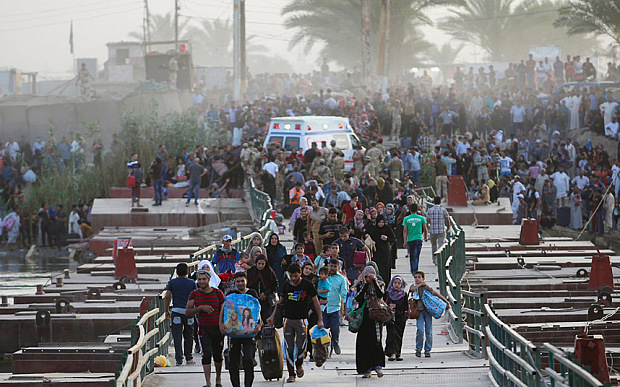
Displaced Sunni people, who fled the violence in the city of Ramadi, arrive at the outskirts of Baghdad Photo: STRINGER/IRAQ

Its strategy is essentially Maoist – the comparison has not been enough made, but now that Isil has declared itself an agent of Cultural Revolution, with its destruction of history, perhaps it will be more. Like Mao’s revolutionaries, it conquers the countryside before storming the towns.

Even now, the fact that much of its territory is rural or even desert is seen as a weakness. But it is beginning to “pick off” major towns and cities with impunity. In fact, where society is fractured, like Syria and Iraq, the “sea of revolution” panics the citizenry, making it feel “surrounded” by unseen and incomprehensible agents of doom.

********************

Have any words come back to haunt President Obama so much as his description of Islamic State of Iraq and the Levant last team as a “JV” – junior varsity – team of terrorists?

This wasn’t al-Qaeda in its 9/11 pomp, he said; just because a university second team wore Manchester United jerseys didn’t make them David Beckham.

How times change. As of this weekend, the JV team is doing a lot better than Manchester United. With its capture of Palmyra, it controls half of Syria.

Its defeat in Kobane – a town of which few non-Kurds had heard – was cheered by the world; its victory in Ramadi last Sunday gives it control of virtually all of Iraq’s largest province, one which reaches to the edge of Baghdad.

Calling itself a state, one analyst wrote, no longer looks like an exaggeration.

Senior US officials seem to agree. “Isil as an organization is better in every respect than its predecessor of Al-Qaeda in Iraq. It’s better manned, it’s better resourced, they have better fighters, they’re more experienced,” one said at a briefing to explain the loss of Ramadi. “We’ve never seen something like this.”

How did Isil manage to inflict such a humiliation on the world’s most powerful country? As with many great shock-and-awe military advances over the years, it is easier to explain in hindsight than it apparently was to prevent.

Ever since Isil emerged in its current form in 2013, military and and political analysts have been saying that its success is due to its grasp of both tactics and strategy.

Its strategy is essentially Maoist – the comparison has not been enough made, but now that Isil has declared itself an agent of Cultural Revolution, with its destruction of history, perhaps it will be more. Like Mao’s revolutionaries, it conquers the countryside before storming the towns.

Even now, the fact that much of its territory is rural or even desert is seen as a weakness. But it is beginning to “pick off” major towns and cities with impunity. In fact, where society is fractured, like Syria and Iraq, the “sea of revolution” panics the citizenry, making it feel “surrounded” by unseen and incomprehensible agents of doom.

Like Mao, Isil uses propaganda – its famed dominance of social media – to terrorise its targets mentally. Senior Iraqi policemen have recounted being sent images via their mobile phones of their decapitated fellow officers. This has a chastening effect on the fight-or-flight reflex.

It then uses actual terror to further instil chaos. Isil’s main targets have been ground down by years of car bombs and “random” attacks. It seems extraordinary, but one of the reasons given by Mosul residents for preferring Isil rule is that there are no longer so many terrorist attacks: not surprising, since the “terrorists” are in control.

Only once your enemy is weak, divided, and demoralised, do you strike.

You then do so with an awesome show of force – one which can mislead as to the actual numbers involved.

The final assault on central Ramadi, which had been fought over for almost 18 months, began with an estimated 30 car bombs. Ten were said to be individually of an equivalent size to the 1995 Oklahoma bombing, which killed 168 people.

There is nothing new in saying that both Syrian and Iraqi governments have contributed greatly to the rise of Isil by failing to offer the Sunni populations of their countries a reason to support them.

Some say that focusing on the failings and injustices of these regimes ignores the fact that militant Islamism, like Maoism, is a superficially attractive, even romantic idea to many, whether oppressed or not, and that its notions must be fought and defeated intellectually and emotionally.

That is true. But relying on Islamic extremism to burn itself out, or for its followers to be eventually persuaded of the errors of their ways, is no answer. Like financial markets, the world can stay irrational for longer than the rest of us can stay politically and militarily solvent.

Rather, the West and those it supports have to show they can exert force against force, and then create a better world, one which all Iraqis and Syrians, especially Sunnis, are prepared to fight for.

In March, an uneasy coalition of Shia militias, Iraqi soldiers, and US jets took back the town of Tikrit from Isil. It remains a wasteland, whose inhabitants have yet to return, ruled over by gunmen rather than by the rule of law.

That is not an attractive symbol, for Iraqi Sunnis, of what victory against Isil looks like. If the war against Isil is to be won, the first step is to make clear to Iraqis and Syrians alike what victory looks like, and why it will be better for them.

Cartoon of the day

May 23, 2015

(h/t joopklepzeiker — DM)

Climate terrorism

US and Hizballah coordinate spy drone flights over Qalamoun, share US combat intelligence

May 23, 2015

US and Hizballah coordinate spy drone flights over Qalamoun, share US combat intelligence, DEBKAfile, May 23, 2015

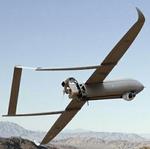
U.S._special_forces_operating_recon_drones_in_Lebanon_5.15Reconnaissance drone operated by US special forces in Lebanon

How do Obama’s repeated commitments to Israel’s security square with close US military and intelligence cooperation with an organization whose vow to destroy Israel is backed by 100,000 missiles – all pointed south?

************************

Another strange pair of bedfellows has turned up in one of the most critical Middle East battlefields: the United States is helping Hizballah, Iran’s Lebanese surrogate, in the battle for control of the strategic Qalamoun Mountains. DEBKAfile’s intelligence sources disclose that a US special operations unit, stationed at the Hamat air base on the coast of northern Lebanon, is directing unarmed Aerosonde MK 4.7 reconnaissance drone intelligence-gathering flights over the Qalamoun Mt arena, 100 km to the west.

Washington set up the base originally in line with an assurance to Beirut of military assistance for the next three years to counter any threatened invasion by extremist elements.

However, it turns out that the data the US drones pass to Lebanese army general staff in Beirut goes straight to Hizballah headquarters – and on to the Iranian officers in Syria running Bashar Assad’s war effort.

The Aerosonde MK 4.7 can stay aloft for 10 to 12 hours at a stretch at an altitude of 4.5 km. It functions day or night, equipped with an advanced laser pointer capability. It is capable of carrying ordnance but US sources say they the aircraft in Lebanon are unarmed.

Since Hizballah is also operating Ababil-3 surveillance drones of its own over Qalamoun, coordination had become necessary between the American team and the Shiite group.  The consequence is that for the first time, the US military is working directly with an internationally-designated terrorist organization – a development with earthshaking ramifications for Israel’s security. This partnership has in fact become a game-changer for the worse in terms of Israel’s security ties with the US and has caused an upheaval in its military and intelligence disposition in the region, in at least six respects:

1. To counter US-Hizballah intelligence collaboration, Israel is obliged to reshuffle the entire intelligence mechanism it maintains to protect its northern borders with Lebanon and Syria.

2.  Israel finds itself forced to monitor the progress of the US special unit’s interface with Hizballah, its avowed enemy.

3.  Israel can no longer trust American intelligence coming in from Lebanon because it is likely tainted by Hizballah sources.

4.  Hizballah is gaining firsthand insights into the operating methods of US special operations forces, which Israel’s methods strongly resemble and must therefore revamp.

5. The Hizballah terrorist group is winning much needed prestige and enhanced status in the region from its collaboration with the US.

6. Hizballah’s Ababil drones are in fact operated by the hostile Iranian Revolutionary Guards, which leaves Israel with no option but to overhaul from top to bottom the intelligence-gathering systems employed by its surveillance drones to track Iranian movements in the region.

At the Washington Adas Israel synagogue Friday, May 22, President Barack Obama wearing a kipah “forcefully” objected to suggestions that policy differences between his administration and the Israeli government signaled his lack of support for the longtime US ally.

This raises a question: How do Obama’s repeated commitments to Israel’s security square with close US military and intelligence cooperation with an organization whose vow to destroy Israel is backed by 100,000 missiles – all pointed south?