Archive for the ‘North Korean nukes’ category

How to Defuse the Crisis with North Korea

May 2, 2017

How to Defuse the Crisis with North Korea, American ThinkerHerbert E. Meyer, May 2, 2017

(There is no excellent solution and the concept behind the suggestion needs to be expanded. However, something along its lines may be the best we can do. North Korean peasants would be better off as East German clones and China would prefer the arrangement to a reunification of North and South Korea. Please see also, Krauthammer: U.S. does have cards to play against North Korea and my parenthetical comment there. — DM)

North Koreans would have far more confidence that a guarantee of sovereignty by the U.S. and South Korea would hold if China’s leaders backed it publicly, as well as privately. And if the Chinese would promise to provide the level of economic support that North Korea needs to keep it at least stable, and perhaps more prosperous than it is now, that would help encourage the generals to act. Let’s hope that President Trump at least talked about all this when he met at Mar-a-Lago last month with his new best-buddy, Chinese president Xi.

*********************

The looming crisis with North Korea provides a perfect illustration of what’s gone wrong with the way Washington works. Everyone is so eager to propose a policy, no one can be bothered to articulate an objective. So policymakers start arguing about what to do, before deciding what they want to accomplish. That’s like arguing over what route to take, before deciding where you want to go. (Which, to point out the obvious, is why we keep ending up in the middle of nowhere, or upside down in a ditch.)

Here’s one possible objective that would defuse this crisis and perhaps even bring a few decades of stability: to turn North Korea into a modern version of East Germany.

For those of you too young to remember the Cold War, during those decades after World War II Germany was divided. West Germany was free, prosperous, and an American ally. East Germany was a miserable dictatorship, not very prosperous, and a Soviet satellite. (To get a feel for what life was like in East Germany, watch the great movie The Lives of Others, and the German television seriesWeissensee.) But during all these decades, East Germany was never a threat to West Germany, or to the U.S. Its communist regime wanted only to be left alone. And in return, the West Germans and the Americans made it absolutely clear they had no intention of unifying Germany by attacking or otherwise bringing down the East.

When the Korean war ended with an armistice in 1953, that country was divided. South Korea became free, prosperous, and an American ally. North Korea became a miserable dictatorship, not very prosperous, and a sort-of satellite of China. The difference between Germany and Korea is that while East Germany wanted only to be left alone, North Korea keeps threatening to conquer South Korea and reunify the country under its control, and to fire nuclear-armed missiles at the U.S. itself.

President Trump’s Got Their Attention

But now, for the first time in its history — and thanks entirely to President Trump — North Korea faces the real possibility of a massive military attack, certainly to destroy its nuclear facilities and perhaps even to obliterate the regime itself. And there’s nothing like the looming prospect of an attack by the United States to get a government’s attention.

Simply put, it may be possible to defuse the current crisis without a war by cutting a deal along these lines: If North Korea will give up its nuclear weapons and cease threatening South Korea and the U.S., the U.S. and South Korea will guarantee North Korea’s sovereignty.

Once again, there’s an historic parallel between Korea and Germany: Adolf Hitler was crazy; a foaming-at-the-mouth, chewing-the-carpet raving lunatic. He was also a brilliant, cunning politician who not only held onto power, but who kept within his grip the total loyalty of Germany’s military leaders. These generals weren’t crazy; they were hard, practical, highly intelligent men who had fought and lost World War I and then rebuilt Germany’s war machine. They knew in their bones that another world war would devastate their country. They understood that invading Russia would end in catastrophe.

Yet the generals didn’t get rid of Hitler. While a small number were prepared to overthrow Hitler, most were caught up in appalling, fawning loyalty to him that had more to do with twisted psychology than with military strategy. The minority willing to act received no encouragement from the Western Allies. The others plunged ahead, caught in Hitler’s hypnotic spell. There’s no way to know this for sure, but it’s widely accepted among historians that if the generals had gotten rid of Hitler in 1937 or 1938, there would not have been a Second World War. (Plots to overthrow Hitler by some brave German continued after the war started, but by that time it was too late; all their efforts failed.)

We can argue all day whether Kim Jong-un is crazy, but it’s obvious he isn’t, um, normal. He’s held onto power, and he’s kept within his grip the loyalty of North Korea’s generals. These generals aren’t crazy. Crazy people cannot build weapons, organize complex programs to develop nuclear bombs — or build roads, operate electric power systems, keep the trains and buses running, assure that at least some food gets produced and distributed, operate schools and hospitals. They must be hard, practical, and highly intelligent. And while they may not be charming and fun to hang out with, they aren’t suicidal.

How to Organize a Coup d’Etat

Today, just like the German generals in the Spring of 1939, North Korea’s generals are careening toward war. But the point of studying history is to learn from it. Back in 1939 there was no serious effort in London, Paris, and Washington to try and break Hitler’s grip on his generals and to help them organize a coup d’etat. So the world plunged into war. Might it be possible to do this now? Is there some way to break Kim Jong-un’s grip on his generals — to snap them out of their hypnotic spell and help them to organize a coup before it’s too late?

For an effort like this to have even a chance of success, we’ll need answers to these questions:

Who are these guys? Presumably our intelligence service knows at least something about the two or three dozen officials who actually run North Korea. Well, which ones are most likely to abandon Kim and work with us? Who are the ones we would like to see take power?

How do we reach them? Of course, we can communicate with these generals over the airwaves, so to speak. That would involve official statements by President Trump and his national security team threatening war, and clearly offering a guarantee of regime survival in exchange for disarmament. But there must also be ways of reaching these officials individually — and very privately.

What precisely do we want them to do? We want the generals to replace Kim and his closest advisors with officials who will work with the U.S. to dismantle North Korea’s nuclear weapons program, then work with South Korea to establish the kind of sullen but stable peace that existed for decades between West and East Germany.

What help do they need? It’s possible that a serious threat to attack by President Trump, combined with the offer of regime survival in return for disarmament, will be sufficient to push at least some of the generals into taking action. But they may need more help, for instance a massive propaganda campaign to generate support for them before they act by telling the North Korean population how their lives will become immeasurably better once Kim is replaced. The generals also may need the kind of help that only a powerful intelligence service like ours can provide, for instance a covert communications system so they can be in touch with us, and with one another, without being overheard by Pyongyang’s security officials. They may even need the kind of help only the Pentagon can provide, for instance SEAL Team Six.

China’s help would vastly increase the chances of success. Beijing’s diplomatic and intelligence services probably have a better grasp of what’s actually going on in Pyongyang than ours. And they can probably provide detailed information about which generals to work with, and which to avoid — or remove. Most of all, the North Koreans would have far more confidence that a guarantee of sovereignty by the U.S. and South Korea would hold if China’s leaders backed it publicly, as well as privately. And if the Chinese would promise to provide the level of economic support that North Korea needs to keep it at least stable, and perhaps more prosperous than it is now, that would help encourage the generals to act. Let’s hope that President Trump at least talked about all this when he met at Mar-a-Lago last month with his new best-buddy, Chinese president Xi.

Don’t bother asking the usual Washington policymakers whether turning North Korea into a modern version of East Germany might actually be possible. They will reply — in unison, within two-billionths of a second — No, this is impossible! Kim Jong-un is crazy, and the North Koreans will never give up their nukes or agree to stop threatening South Korea and the U.S. Well, they may be right. On the other hand, these are mostly the same geniuses who told us, also with 100 percent confidence, that it was impossible to win the Cold War, and impossible for Donald Trump to get elected president. Impossible things sometimes do happen, even in politics — especially in politics. Given the risk we face of nuclear war, this is worth a shot.

The EMP Threat From North Korea Is Real, and Terrifying

April 26, 2017

The EMP Threat From North Korea Is Real, and Terrifying, PJ Media, John R. Moore, April 25, 2017

(“Hardening the grid” would be a good first step but would not prevent a massive disaster. Our civilization is largely based on computers — trucks and automobiles built during the last decade, aircraft, communications, medical equipment, the banking system and much more. Food delivery to stores would be very difficult and getting the little available food would be as well.  Paying for it? Credit cards could not be processed and ATMs would not function. What little food remained available would be stolen and massive rioting would likely ensue. The author states that “An EMP strike would be suicidal for North Korea. . . .” Why? How would we retaliate? Preventing an EMP attack will be very difficult, but is the only viable solution.– DM) 

North Korean military personnel visit Mansu Hill in Pyongyang to lay flowers at the bronze statues of the country’s two late leaders, Kim Il Sung and Kim Jong Il, on April 25, 2017, the 85th anniversary of the founding of its armed forces. (Kyodo) ==Kyodo

Fifty-five years ago, the U.S. tested a nuclear weapon high above the atmosphere over the Pacific. At the time, my father — a nuclear weapons engineer — was listening on our ham radio.

When the device exploded, we heard nothing in Albuquerque. But, in Honolulu, 1000 miles from the detonation, the sky turned red as streetlights and telephones went out. EMP (Electromagnetic Pulse) effects from the distant nuclear explosion had struck.

Today we hear concern that cities might be destroyed by North Korean nuclear tipped missiles, but Starfish Prime should alert us to a more imminent danger: EMP. North Korea can launch an EMP attack before it has developed nuclear missile technology, and EMP may be far more deadly.

An EMP disaster from a high-altitude blast seems like science fiction: There is a silent flash high in the sky, and everything using electricity just … stops. Cars stop, power goes out, the Internet dies, satellites quit working, landline and mobile phone systems go out, and computers are destroyed. In a moment, we are back to 1850, as was dramatized in William Forstchen’s 2009 novel One Second After.

While the total wipeout depicted in One Second After is probably exaggerated, the effects could knock out our power grid for months, and destroy critical communications and computer systems. As former CIA chief James Woolsey recently said:

If you look at the electric grid and what it’s susceptible to, we would be moving into a world with no food delivery, no water purification, no banking, no telecommunications, no medicine. All of these things depend on electricity in one way or another.

In such a situation, there simply is no way to rule out the possibility that hundreds of millions could die.

To nuke one of our cities, the North needs to master ICBM construction, nuclear weapons miniaturization, precision long-range guidance technology, atmospheric re-entry vehicles, and fusing to trigger detonation at the right time after the hazardous re-entry. In contrast, an EMP attack requires only a small, light nuclear weapon and the ability to launch it as a satellite. Once over the U.S., it is detonated.

Already, two satellites launched by North Korea cross the U.S. every day.

Do they contain nuclear weapons? Probably not, but how can we know? Nuclear weapons don’t emit much radiation until they go off, so they are hard to detect. I used to fly in a nuclear bomber with the weapon station just a few feet from my station with no shielding — no need.

Meanwhile, North Korea continues striving to miniaturize its nukes — and may have already succeeded. They have released pictures of a miniaturized bomb, although that may just be propaganda.

Starfish Prime used a thermonuclear weapon, a “hydrogen bomb,” which was very powerful but which the North is still striving to build — a difficult task. But only a fission weapon or “atomic bomb” is needed for an EMP, and North Korea has tested several. The yield would probably need to be increased over their latest test, but getting there is only a matter of time. Fusion boosting the weapon to higher yield is not a difficult step. The North recently restarted its Yongbyon reactor, which can produce the necessary tritium.

The EMP danger isn’t only from North Korea. Iran has the capability to launch missiles from ships at sea — the EMP attack depicted in Forstchen’s novel.

We currently have little defense against this threat. Our land based anti-ballistic missile systems are oriented towards warheads coming across the North Pacific, while North Korea launches satellites to the south, which later cross the U.S. from the south or north. The anti-satellite ability of the Navy’s AEGIS ships is unclear — one satellite in a very low orbit has been intercepted, and ships need to be positioned within range of the orbit. Shooting a satellite down before it reaches orbit is another possibility, but AEGIS has a very limited window for such a “boost phase” intercept.

A decision to intercept would have to be quick – within a few seconds after launch for boost phase, or before the first partial orbit is completed for a satellite intercept. Complicating the decision process is the difficulty in knowing that the launch is of a nuclear device — and any intercept is an act of war. Even if we have the capability, the knowledge, the decision time, and the will, our missile defense system is nowhere near foolproof.

If our infrastructure were better protected, at least we might survive an attack with few deaths. One estimate says $20 billion might be enough protect the power grid — a drop in the bucket of national spending. Hardening communications and computing systems would also be needed.

A recent Electric Power Research Institute study reported that the damage from the delayed “E-3” pulse of EMP probably would not be crippling, although they cannot be sure. Moreover, the “E-1” pulse was not addressed, but it would take out the control systems, and might destroy power transformers from flashover. Other critical systems — such as the internet and parts of the transportation system — are very vulnerable to both.

Because a modern state has never suffered an EMP attack, our knowledge is limited.

An EMP strike would be suicidal for North Korea, but they may see it differently, or in some crisis, not care. In any case, the threat of an EMP strike would be a powerful deterrent.

James Woolsey and Newt Gingrich are right and it is time to listen: we need a national program to counter this threat. And we need to defang North Korea and Iran — soon.

Chinese media: ‘China’s intervention not needed when only N.K.’s nuke facilities are hit’

April 24, 2017

Chinese media: ‘China’s intervention not needed when only N.K.’s nuke facilities are hit’ Dong-a Ilbo, April 24, 2017

A Chinese state-run media outlet said that if North Korea continues nuclear and missile development, China may not provide military support to China even if the U.S. launches preemptive strike on the North. China and North Korea have agreed to provide military assistance if one of them gets under military attack, and hence the latest report is construed as Beijing’s stern warning against Pyongyang.

If the U.S. launches surgical strikes on North Korea’s nuclear facilities, China will seek diplomatic deterrence but military intervention is not needed, China’s state-run Global Times said on Saturday. However, the daily repeated its previous stance that f the U.S. and South Korean militaries cross the 38th parallel to invade the North and seek to topple the North Korean regime, China should immediately start military intervention.”

With the U.S. and China stepping up pressure on North Korea, U.S. President Donald Trump held calls in succession with Japanese Prime Minister Shinzo Abe and Chinese President Xi Jinping Sunday morning, and discussed ways to resolve the North Korean nuclear issue. President Trump reportedly asked the Japanese and Chinese leaders to extend cooperation to manage the situation wherein signs of North Korea’s sixth nuclear test are mounting. Notably, in his call with Chinese President Xi, President Trump reportedly commended Beijing’s recent efforts to deter the North’s nuclear development and called on Beijing to use more specific measures to pressure the North.

In the premiere of “Born in China, a movie jointly produced by the U.S. and China held at the Chinese embassy in Washington on Friday, Chinese Ambassador to the U.S. Cui Tiankai said that President Trump will visit China in the second half of this year. After President Trump and President Xi held summit at Trump’s Mar-a-Lago estate in Florida on April 6 and 7, the two leaders agreed to President Trump’s return visit to China at the earliest date.

Krauthammer: U.S. does have cards to play against North Korea

April 21, 2017

Krauthammer: U.S. does have cards to play against North Korea, Mercury News, April 20, 2017

(Mr. Krauthammer offers a reasonable alternative to the reunification of North and South Korea.

Do present-day South Koreans really want reunification? Nearly half a century ago, when I was an Army JAG officer and spent two tours of duty in South Korea, I travelled widely and got to know many Koreans. They were generally enthusiastic about reunification. Now? Not so much, I think.

German reunification was widely embraced and cost the West about $1.9 trillion. South and North Korea have been separated about twenty years longer than East and West Germany had been. Now, younger working South Koreans — with fewer close relatives in the north than their parents and grandparents had half a century ago — would bear much of the cost of Korean reunification. Reunification gave former West Germany Frau Merkel. Korean reunification, providing a wave of unskilled, perhaps hopelessly brainwashed, North Koreans with very little to offer South Korea and needing much adaptation to South Korean democracy, would be about as useful to South Korea as a North Korean version of Frau Merkel. — DM)

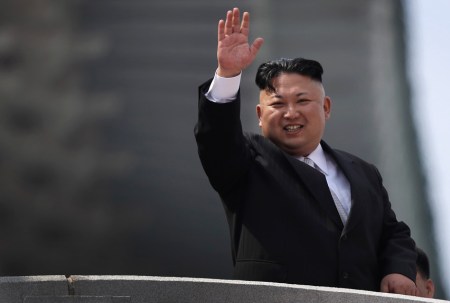
North Korean leader Kim Jong Un waves during a military parade on Saturday, April 15, 2017, in Pyongyang, North Korea (AP Photo/Wong Maye-E)

Because Beijing has such a strong interest in the current regime, we could sweeten the latter offer by abjuring Korean reunification. This would not be Germany, where the communist state was absorbed into the West. We would accept an independent, but Finlandized, North.

During the Cold War, Finland was, by agreement, independent but always pro-Russian in foreign policy. Here we would guarantee that a new North Korea would be independent but always oriented toward China. For example, the new regime would forswear ever joining any hostile alliance.

**************************

WASHINGTON — The crisis with North Korea may appear trumped up. It’s not.

Given that Pyongyang has had nuclear weapons and ballistic missiles for more than a decade, why the panic now? Because North Korea is headed for a nuclear breakout. The regime has openly declared that it is racing to develop an intercontinental ballistic missile that can reach the United States — and thus destroy an American city at a Kim Jong Un push of a button.

The North Koreans are not bluffing. They’ve made significant progress with solid-fuel rockets, which are more quickly deployable and thus more easily hidden and less subject to detection and pre-emption.

At the same time, Pyongyang has been steadily adding to its supply of nuclear weapons. Today it has an estimated 10 to 16. By 2020, it could very well have a hundred. (For context: the British are thought to have about 200.)

Hence the crisis. We simply cannot concede to Kim Jong Un the capacity to annihilate American cities.

Some will argue for deterrence. If it held off the Russians and the Chinese for all these years, why not the North Koreans? First, because deterrence, even with a rational adversary like the old Soviet Union, is never a sure thing. We came pretty close to nuclear war in October 1962.

And second, because North Korea’s regime is bizarre in the extreme, a hermit kingdom run by a weird, utterly ruthless and highly erratic god-king. You can’t count on Caligula. The regime is savage and cult-like; its people, robotic. Karen Elliott House once noted that while Saddam Hussein’s Iraq was a prison, North Korea was an ant colony.

Ant colonies do not have good checks and balances.

If not deterrence, then prevention. But how? The best hope is for China to exercise its influence and induce North Korea to give up its programs.

For years, the Chinese made gestures, but never did anything remotely decisive. They have their reasons. It’s not just that they fear a massive influx of refugees if the Kim regime disintegrates. It’s also that Pyongyang is a perpetual thorn in the side of the Americans, whereas regime collapse brings South Korea (and thus America) right up to the Yalu River.

So why would the Chinese do our bidding now?

For a variety of reasons.

• They don’t mind tension but they don’t want war. And the risk of war is rising. They know that the ICBM threat is totally unacceptable to the Americans. And that the current administration appears particularly committed to enforcing this undeclared red line.

• Chinese interests are being significantly damaged by the erection of regional missile defenses to counteract North Korea’s nukes. South Korea is racing to install a THAAD anti-missile system. Japan may follow. THAAD’s mission is to track and shoot down incoming rockets from North Korea but, like any missile shield, it necessarily reduces the power and penetration of the Chinese nuclear arsenal.

•  For China to do nothing risks the return of the American tactical nukes in South Korea, withdrawn in 1991.

• If the crisis deepens, the possibility arises of South Korea and, most importantly, Japan going nuclear themselves. The latter is the ultimate Chinese nightmare.

These are major cards America can play. Our objective should be clear. At a minimum, a testing freeze. At the maximum, regime change.

Because Beijing has such a strong interest in the current regime, we could sweeten the latter offer by abjuring Korean reunification. This would not be Germany, where the communist state was absorbed into the West. We would accept an independent, but Finlandized, North.

During the Cold War, Finland was, by agreement, independent but always pro-Russian in foreign policy. Here we would guarantee that a new North Korea would be independent but always oriented toward China. For example, the new regime would forswear ever joining any hostile alliance.

There are deals to be made. They may have to be underpinned by demonstrations of American resolve. A pre-emptive attack on North Korea’s nuclear facilities and missile sites would be too dangerous, as it would almost surely precipitate an invasion of South Korea with untold millions of casualties. We might, however, try to shoot down a North Korean missile in mid-flight to demonstrate both our capacity to defend ourselves and the futility of a North Korean missile force that can be neutralized technologically.

The Korea crisis is real and growing. But we are not helpless. We have choices. We have assets. It’s time to deploy them.

CNN: Trump’s North Korea Policy Might Just Be Working

April 19, 2017

CNN: Trump’s North Korea Policy Might Just Be Working, BreitbartJoel B. Pollak, April 19, 2017

AP Photo/Alex Brandon

Former British ambassador to North Korea John Everard writes at CNN.com on Wednesday that President Donald Trump’s assertive strategy towards the rogue nuclear power may have actually worked, despite domestic criticism.

Everard writes:

In my opinion, the most plausible explanation for this is that North Korea blinked. Although it is possible the extensive preparations around its nuclear test site were intended only to wind up the international community, it seems more likely that the North Koreans did indeed plan a nuclear test Saturday but desisted, probably because they assessed the risks of serious retaliation were too great.

The US carrier group it thought was near Korea and China’s threat on April 12 to support UN sanctions, including cutting off North Korea’s oil supply — which would have quickly brought its fragile economy to a halt — probably weighed heavily on Pyongyang as well.

Though domestic critics attacked Trump for stating that the USS Carl Vinson and an “armada” were sailing toward the Korean peninsula, when in fact the ships were far away, Everard says that Trump’s statement was a successful bluff.

The North Korean dictator thought the carrier group really was off the Korean coast, Everard writes. “Very few people outside the US administration knew the carrier group was in fact some 3,500 miles away from the Korean Peninsula.”

He concludes:

Perhaps the North Koreans calculated (rightly, it seems) that either a nuclear test or a test of an intercontinental ballistic missile — a long-range missile of the kind they would need to carry a nuclear warhead to the continental United States — was too dangerous. Instead, launching a medium-range missile would allow them to deny they were buckling under foreign pressure while not triggering a vigorous international reaction. The fact it failed doubtless also softened responses.

If this analysis is right, then the United States has, for now at least, succeeded in its long-term goal of halting the development of North Korea’s nuclear weapons and missiles.

One observer who predicted Trump’s success in the confrontation was Dilbert illustrator and author Scott Adams, who had been stating for weeks that Trump’s unpredictable military moves might scare China into reining in its client state.

CNN is rarely positive in its coverage of the 45th president, making Everard’s article particularly noteworthy.

What North Korea Should Teach Us about Iran

April 18, 2017

What North Korea Should Teach Us about Iran, Gatestone InstituteAlan M. Dershowitz, April 18, 2017

(The proposed legislation should explicitly authorise military action whenever Iran develops nukes; not merely after the Iran Scam permits their development. — DM

If we are not to make the same mistake with Iran that we made with North Korea, we must do something now – before Iran secures a weapon – to deter the mullahs from becoming a nuclear power, over which we would have little or no leverage.

Congress should now enact legislation declaring that Iran’s reaffirmation that it will never “develop or acquire nuclear weapons” is an integral part of the agreement and represents the policy of the United States. It is too late to change the words of the deal, but it is not too late for Congress to insist that Iran comply fully with all of its provisions, even those in the preamble.

Congress should authorize the President “to take military action against Iran’s nuclear weapon’s program if it were to cross the red lines….”

*****************************

We failed to prevent North Korea from developing nuclear weapons. As a result, our options to stop them from developing a delivery system capable of reaching our shores are severely limited.

The hard lesson from our failure to stop North Korea before they became a nuclear power is that we MUST stop Iran from ever developing or acquiring a nuclear arsenal. A nuclear Iran would be far more dangerous to American interests than a nuclear North Korea. Iran already has missiles capable of reaching numerous American allies. They are in the process of upgrading them and making them capable of delivering a nuclear payload to our shores. Its fundamentalist religious leaders would be willing to sacrifice millions of Iranians to destroy the “Big Satan” (United States) or the “Little Satan” (Israel). The late “moderate” leader Hashemi Rafsanjani once told an American journalist that if Iran attacked Israel with nuclear weapons, they “would kill as many as five million Jews,” and that if Israel retaliated, they would kill fifteen million Iranians, which would be “a small sacrifice from among the billion Muslims in the world.” He concluded that “it is not irrational to contemplate such an eventuality.” Recall that the Iranian mullahs were willing to sacrifice thousands of “child-soldiers” in their futile war with Iraq. There is nothing more dangerous than a “suicide regime” armed with nuclear weapons.

The deal signed by Iran in 2015 postpones Iran’s quest for a nuclear arsenal, but it doesn’t prevent it, despite Iran’s unequivocal statement in the preamble to the agreement that “Iran reaffirms that under no circumstances will Iran ever seek, develop or acquire nuclear weapons.” (Emphasis added). Recall that North Korea provided similar assurances to the Clinton Administration back in 1994, only to break them several years later — with no real consequences. The Iranian mullahs apparently regard their reaffirmation as merely hortatory and not legally binding. The body of the agreement itself — the portion Iran believes is legally binding — does not preclude Iran from developing nuclear weapons after a certain time, variously estimated as between 10 to 15 years from the signing of the agreement. Nor does it prevent Iran from perfecting its delivery systems, including nuclear tipped inter-continental ballistic missiles capable of reaching the United States.


If we are not to make the same mistake with Iran that we made with North Korea, we must do something now – before Iran secures a weapon – to deter the mullahs from becoming a nuclear power, over which we would have little or no leverage.

Congress should now enact legislation declaring that Iran’s reaffirmation that it will never “develop or acquire nuclear weapons” is an integral part of the agreement and represents the policy of the United States. It is too late to change the words of the deal, but it is not too late for Congress to insist that Iran comply fully with all of its provisions, even those in the preamble.

In order to ensure that the entirety of the agreement is carried out, including that reaffirmation, Congress should adopt the proposal made by Thomas L. Friedman on 22 July 2015 and by myself on 5 September 2013. To quite Friedman:

“Congress should pass a resolution authorizing this and future presidents to use force to prevent Iran from ever becoming a nuclear weapons state … Iran must know now that the U.S. president is authorized to destroy – without warning or negotiation – any attempt by Tehran to build a bomb.”

I put it similarly: Congress should authorize the President “to take military action against Iran’s nuclear weapon’s program if it were to cross the red lines….”

The benefits of enacting such legislation are clear: the law would underline the centrality to the deal of Iran’s reaffirmation never to acquire nuclear weapons, and would provide both a deterrent against Iran violating its reaffirmation and an enforcement authorization in the event it does.

A law based on these two elements — adopting Iran’s reaffirmation as the official American policy and authorizing a preventive military strike if Iran tried to obtain nuclear weapons — may be an alternative we can live with. But without such an alternative, the deal as currently interpreted by Iran will not prevent Iran from obtaining nuclear weapons. In all probability, it would merely postpone that catastrophe for about a decade while legitimating its occurrence. This is not an outcome we can live with, as evidenced by the crisis we are now confronting with North Korea. So let us learn from our mistake and not repeat it with Iran.

Dr. Sebastian Gorka: Trump Is Not An Interventionist Commander In Chief

April 16, 2017

Dr. Sebastian Gorka: Trump Is Not An Interventionist Commander In Chief, Fox News via YouTube, April 16, 2017

https://www.youtube.com/watch?v=_RUdLjpWu4c


Message in the MOAB

April 14, 2017

Message in the MOAB, Power LineScott Johnson, April 14, 2017

(Just for the halibut, please see also ‘March for Science’ Group Laments Trump’s Bombing Of ‘Marginalized’ ISIS Fighters. — DM)

Last week President Trump authorized a limited missile strike against the Syrian regime for its use of chemical weapons against civilians. I explicated what I thought was “the message in the missiles” (I stretched to find 10 messages). Yesterday the United States dropped the “mother of all bombs” — the most powerful conventional bomb in the American arsenal — on an Islamic State cave complex in Afghanistan on Thursday. The MOAB is the colloquial name given to the GBU-43/B Massive Ordnance Air Blast.

Here is the New York Times story on the Pentagon’s announcement. It is about as bad as one might expect under the circumstances. The Times seems mystified by the whole thing, taking it as another in an endless series of black marks against President Trump.

Like the military reprisal against the Syrian regime, the MOAB send a message or 10. Herewith, as William F. Buckley used to say, a few observations:

1. The MOAB has been around since 2002, but this is the first time it has been used in combat. It was used to achieve a specific military purpose (see notes 8 & 9 below) with respect to which the Obama administration had previously refrained. When I say “refrained,” I mean “restrained the military.” The era of Obama foreign policy is over.

2. Trump himself expanded on this point at the White House yesterday. He asserted there’s been a “tremendous difference” militarily between the Obama administration and the Trump administration. “If you look at what’s happened over the last eight weeks and compare that to really what’s happened over the last eight years, you’ll see there’s a tremendous difference,” Trump said. “And this was another very successful mission,” he added.

3. Trump elaborated. “Everybody knows exactly what happened. What I do, I authorized my military. We have given them total authorization. That’s what they’re doing.”

4. The MOAB serves as a reminder of other tools in the chest. The MOAB is not our biggest non-nuclear weapon. That is the Massive Ordnance Penetrator, or MOP. The National Interest reminds us that our Air Force also fields the GBU-57A/B Massive Ordnance Penetrator (MOP), which is a massive precision-guided 30,000lb bunker-busting weapon usually dropped from a Northrop Grumman B-2 Spirit stealth bomber.

5. The MOAB therefore sent a message to North Korea. It put an exclamation point on the military reprisal against the Syrian regime. It reiterated that the era of Obama foreign policy is over. Trump himself professed agnosticism on this point, but this was the message to North Korea: “I don’t know if this sends a message. It doesn’t make any difference if it does or not. North Korea is a problem. The problem will be taken care of.” What we see here is akin to the rhetorical device of apophysis or praeteritio.

6. Not coincidentally, NBC News reports: “U.S. may launch strike if North Korea reaches for nuclear trigger.” The use of the MOAB in Afghanistan makes the leaks here highly credible.

7. The MOAB sent a message to Iran. I can’t find a citation to support me here, but it’s obvious. What goes for North Korea goes for Iran.

8. The use of the bomb had a specific military purpose. As former intelligence officer and Army veteran Michael Pregent commented explained on FOX News last night, ISIS fighters in Afghanistan are using the massive tunnel complex that Al Qaeda used starting back in 2001 when U.S. forces were deployed to Afghanistan. “They used the same tunnel complex for bin Laden to escape to Pakistan,” Pregent said. “The Haqqani network, a terrorist organization out of Pakistan, uses it to bring in lethal aid. So you have these organizations like Al Qaeda, the Haqqani group, the Taliban and now ISIS using a tunnel complex to kill Americans in the past.” Thomas Spoehr has more to the same effect here.

9. At NRO, David French highlights what he calls “an important and painful point about our almost 16-year long war [in Afghanistan].” This is the point: “Excessive American caution has cost American lives and American limbs, and it has left families and friends of the victims with deep psychological wounds. Those wounds would be grievous enough in the best circumstances, but they’re compounded by the fact that many of the decisions not to shoot, not to use artillery, or not to drop bombs were based on a combination of rules of engagement and military misjudgments that were transparently foolish at the time.” (Please do read the whole thing.)

10. Don’t let me forget to mention that the Obama era in American foreign policy is over.

China’s nuclear get-out clause over defence of North Korea

April 13, 2017

China’s nuclear get-out clause over defence of North Korea, South China Morning PostKristin Huang, April 13, 2017

(Another “hint” from China to North Korea? — DM)

China is not obliged to help defend North Korea from military attack if the reclusive state developed nuclear weapons, according to Chinese diplomatic and military observers.

The assessment comes as senior officials in Washington warn of a strike against the Pyongyang regime.

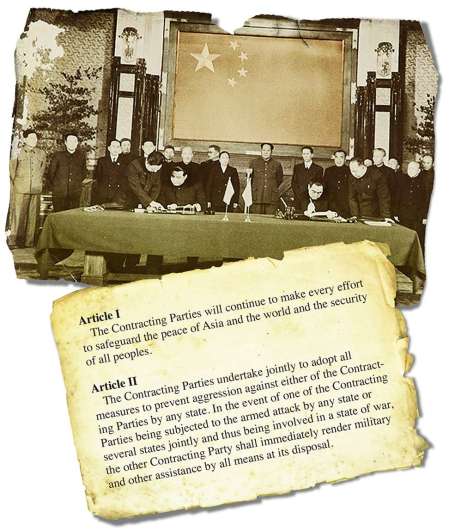
China and North Korea signed a mutual aid and cooperation treaty in 1961 as they sought to mount a united front against Western powers. It specifies that if one of the parties comes under armed attack, the other should render immediate assistance, including military support.

But the treaty also says both nations should safeguard peace and security.

For China, North Korea’s development of nuclear weapons in violation of the United Nations treaty on non-proliferation could amount to a breach of their pact, leaving Beijing with no obligation to lend a hand, observers said.


China could also have a get-out clause if any US military intervention was not deemed an armed attack.

“It’s hard to say how China would assist North Korea militarily in case of war, since North Korea is developing nuclear weapons, an act that might have already breached the treaty between the two nations,” said Li Jie, a retired Chinese naval colonel.

Shanghai-based military analyst Ni Lexiong said China would need to provide military assistance to North Korea if US land forces invaded, but Pyongyang’s violation of the UN non-proliferation treaty was a “strong reason” for Beijing to choose not to help.

Threats of military action against North Korea have grown, with US President Donald Trump saying Washington was prepared to act alone against Pyongyang.

A strike group headed by the aircraft carrier USS Carl Vinson has also been deployed to waters off the Korean peninsula.

Nevertheless, Beijing, North Korea’s economic lifeline, does have some interest in backing up its old ally. China fears the collapse of the regime in Pyongyang could lead to an influx of refugees into China and eliminate the buffer zone keeping US troops from the Chinese border.

But Ni said the possibility of a full-scale war was slim because the US was unlikely to send land forces into North Korea, preferring air strikes or missile launches instead.

“The situation would be much easier for China in this case. China would not have to mobilise its land forces to help North Korea,” he said. “China then only needs to send the North Sea Fleet or military aircraft to step up patrols of the Korean peninsula.”

Zhou Chenming, from the Knowfar Institute for Strategic and Defence Studies think tank, said war over North Korea was unlikely because all the parties involved were looking for ways to defuse tensions.

But if military conflict did erupt, China could help Pyongyang with supplies such as food and weaponry, such as old tanks.

Mission accomplished in Syria

April 12, 2017

Mission accomplished in Syria, Israel Hayom, Clifford D. May. April 12, 2017

(Accomplished or just begun? — DM)

Congress should send Trump the legislation it is now considering, seeking to impose new sanctions on Iran in reprisal for its continuing support of terrorists, its missile tests and its maintenance of more than 35,000 troops in Syria, including its own, those of its Lebanese proxy, Hezbollah, and Shiite fighters recruited from Iraq and Afghanistan. Suspending Iran’s deal with Boeing/Airbus would be useful, too. Only the willfully credulous believe that Iran’s theocrats won’t use such aircraft for illicit military purposes.

************************

If you’re still unsure about whether U.S. President Donald Trump did the right thing when he launched 59 cruise missiles at Syria’s Shayrat Air Base last week, consider the alternative.

He knew that Syrian dictator Bashar Assad had yet again used chemical weapons to murder Syrian civilians, women and children prominent among them. He knew that Iran and Russia had enabled this atrocity, as they have many others. He knew he had two choices.

He could shrug, instruct his U.N. ambassador to deliver a tearful speech calling on the “international community” to do something, and then go play a round of golf. Or he could demonstrate that the United States still has the power and the grit to stand up to tyrants and terrorists, thereby beginning to re-establish America’s deterrent capability.

In other words, this was what Sun Tzu and Carl von Clausewitz would call a no-brainer. (Well, loosely translated.) A mission was accomplished. Do harder missions lie ahead? Yes, of course. But I suspect Defense Secretary James Mattis and National Security Adviser H.R. McMaster have made that abundantly clear to the new president.

We now know for certain that Russia failed to live up to its 2013 commitment to ensure that Assad surrendered all his illegal chemical weapons under the deal it brokered. Secretary of State Rex Tillerson acerbically questioned whether that was the result of complicity or incompetence or whether Russia allowed itself to be duped by Assad.

The strike ordered by President Trump was not “unbelievably small” — then-Secretary of State John Kerry’s description of the punishment then-President Barack Obama decided not to impose in response to Assad’s earlier use of chemical weapons. It was big enough to make clear that American diplomats are again carrying big sticks. (For Obama to insist that diplomacy and force are alternatives was patently absurd.)

Conveniently, Trump was dining with Chinese President Xi Jinping when the strikes occurred. It’s fair to speculate that Xi is today thinking harder about American requests to rein in Kim Jong Un, the North Korean dictator whose drive to acquire nuclear-tipped missiles that can reach the American mainland has become what Tillerson called an “imminent” threat.

Having passed his first major national security test, Trump is now obliged to demonstrate firmness and consistency. What plans might the Pentagon have on the shelf to respond to further provocations? The next round of Tomahawk missiles could permanently ground Assad’s air force. That would make it easier to then establish no-fly zones. If such measures do not alter the calculations of Assad and his Iranian and Russian patrons, consideration could be given to leveling his defense, intelligence and command-and-control centers as well.

Another idea under discussion: setting up safe havens, or, to use a better term, “self-protection zones,” for those fleeing the Syrian regime and various jihadist forces, Sunni and Shiite alike. Israel and Jordan could help the inhabitants of such areas adjacent to their borders defend themselves. The Saudis, Emiratis and Bahrainis could contribute to the cost. Might this lead to the partition of Syria? Most likely, but it’s difficult to imagine a “political solution” that would not include such readjustments.

All this, while useful and perhaps even necessary, should be seen as insufficient. Syria is a major humanitarian catastrophe but only one piece in a much larger geopolitical puzzle. Sooner rather than later, the Trump administration needs to develop what Obama refused to contemplate: a comprehensive and coherent strategy to counter the belligerent, imperialist and supremacist forces that have emerged from the Middle East and are now spreading like weeds around the world.

The Islamic State group will of course need to be driven off the lands on which it has attempted to establish a caliphate. After that, its terrorists will have to be hunted, along with those of al-Qaida, wherever they hide (e.g., Egypt where, over the weekend, they bombed two Coptic Christian churches).

But — and this is crucial — accomplishing these missions must not serve to further empower Iran’s jihadist rulers, who dream of establishing an expanding imamate, the Shiite version of a caliphate.

Most immediately, Congress should send Trump the legislation it is now considering, seeking to impose new sanctions on Iran in reprisal for its continuing support of terrorists, its missile tests and its maintenance of more than 35,000 troops in Syria, including its own, those of its Lebanese proxy, Hezbollah, and Shiite fighters recruited from Iraq and Afghanistan. Suspending Iran’s deal with Boeing/Airbus would be useful, too. Only the willfully credulous believe that Iran’s theocrats won’t use such aircraft for illicit military purposes.

That the United States cannot solve all the world’s problems was one of Trump’s campaign themes. But the implication is not necessarily, as some of his supporters hoped, that he would turn a blind eye to all atrocities and threats not already within America’s borders.

In the last century, most Americans recognized, in some cases with enormous reluctance, that there was no good alternative to doing whatever was necessary to rout the Nazis and communists, enemies whose goal was to kill off the democratic experiment.

In this century, jihadists and Islamists harbor the same ambition. We can attempt to appease them. We can try to make ourselves inoffensive to them. We can keep our hand extended, hoping that in time they will unclench their fists. Or we can decide instead to plan for a long war that will end with the defeat of these latest enemies of America and the rest of the civilized world. If Trump has grasped that within his first 100 days, he’s not off to such a bad start.