Ultimately, the nuclear issue is just one challenge the incoming Trump administration faces in foreign policy. The U.S. needs a new strategy of realist resolution. After years of Obama’s fraying credibility with allies and foes alike, the United States must resume leading. Kim Jong-un and Iranian supreme leader Khamenei are arrogant. If given an inch, they will walk the nuclear mile. And history tells us that great power and totalitarian zealots rarely blend positively.
***********************************
How President Trump should strengthen America’s ICBM-deterrence posture. Like Big Brother in George Orwell’s Nineteen Eighty-Four, North Korean dictator Kim Jong-un holds absolute power. And Kim, the same as his father and grandfather, wants to forcibly unify the Korean peninsula under a xenophobic ideology of self-sufficiency.
Since the end of the Korean War, the Kims’ wacky “Juche” ideology has sparked Western laughter as much as fear. We have rightly assumed the Kims are deterred by their understanding that a conventional-arms conflict with America would destroy them. While the U.S. has had to occasionally reinforce this conventional deterrence, it has been sustained for 60 years.
Over the weekend, Kim Jong-un announced that the North’s development of an intercontinental ballistic missile (ICBM) is advancing rapidly. Unless America appeases him, Kim warned, he will build a “preemptive striking capacity with a main emphasis on nuclear force.” Recently successful rocket tests suggest we should take Kim at his word.
Still, it’s not just North Korea the West should be concerned about here.
Today, alongside other malevolent activities, the Islamic Revolutionary Republic’s ballistic-missile research is advancing unabated. In his wisdom, President Obama decided to exclude a ban on such research from his legacy Iran deal. He lacked the threat-of-force credibility to compel the Iranians to cease their missile development. Unfortunately, when Iran perfects ballistic-missile technology, it will break the nuclear deal. By then, sanctions relief will have made Iran tens of billions of dollars richer.
Collectively, these developments threaten not just the stability of international peace, but the civilian population of the United States. They demand a robust response in U.S. nuclear-deterrent posture. President Trump should deliver it.
First, Trump should reform the Iran nuclear deal to include prohibitions on Iranian ballistic-missile development. This is the realist compromise between scrapping the nuclear deal entirely and attempting to make it work better.
Second, Trump should enforce a new, proactive strategy to deal with North Korea’s increasingly advanced ICBM program. Whereas, in the past, the U.S. has simply monitored North Korean missile tests, stronger action is now required. North Korean ICBMs demand it. After all, the base-minimum range of an ICBM is 3,400 miles. But seeing as 1960s-era Soviet and U.S. ICBMs easily exceeded 6,200-mile ranges, we must assume North Korean ICBMs will exceed the minimum range. And with just 125 miles more than the minimum, North Korea could strike Darwin, Australia. An extra 270 miles would put Anchorage, Alaska, in range. Hawaii, a little over 4,300 miles from North Korea, would also be vulnerable.
Countering this threat, Trump should supplement the U.S military’s multi-phase missile-defense programs. He should publicly announce that if the North tests an ICBM, he will establish three North Korea focused missile-test defense sectors. Trump should be clear that any North Korean ICBM that enters or passes these sectors will be shot down. U.S. military planners would, of course, fine-tune such proposals, but here’s one example of what the defense zones might look like.
Trump could establish a northern sector — focused on protecting Alaska — off the Japanese coast in the Sea of Okhotsk. Second, a western sector — focused on protecting Hawaii and the U.S. west coast — could be set up approximately 1,000 miles west of Midway Island, at the southern tip of the Emperor seamounts. Third, a southern sector — to protect Australia — could be established south of Palau Island between Papua and Papua New Guinea. These sectors should be maintained by U.S. Navy destroyers and cruisers (and hopefully allied assets), equipped with the Aegis missile-defense system.
Next, Trump should clarify his willingness, where facing imminent nuclear attack, to use nuclear weapons in a “first strike” role. That demand is urgent because President Obama has equivocated on this fundamental precept of U.S. nuclear-deterrent posture. Namely, the understanding that U.S. nuclear weapons serve both deterrence (preventing an attack) and capability (destroying an enemy). A retained first-strike capability is necessary to prevent the loss of millions — or tens of millions . . . or hundreds of millions — of American lives in a nuclear showdown. Yes, ideally, the U.S. would be able to use conventional non-nuclear capabilities to achieve that objective. But idealism is a dangerous master. For one, U.S. military pilots might not be able to penetrate enemy air defenses in time to prevent a ballistic-missile attack. Similarly, conventional bunker-busting bombs might not destroy enemy nuclear platforms.
Fourth, Trump should aggressively confront illicit ICBM research-and-development networks. Specifically, Trump should push Pakistan, Russia, and the former Soviet states to take action against smugglers in their nations. In the case of Pakistan and the former Soviet states, such action should be tied to U.S. aid payments. A philosophical evolution of U.S. tactics is equally important here. Put simply, instead of treating nuclear smuggling as a law-enforcement matter, the U.S. must be prepared to coerce or kill those who support the illicit nuclear industry. Fear is always the best guarantor against a nuclear holocaust.
Ultimately, the nuclear issue is just one challenge the incoming Trump administration faces in foreign policy. The U.S. needs a new strategy of realist resolution. After years of Obama’s fraying credibility with allies and foes alike, the United States must resume leading. Kim Jong-un and Iranian supreme leader Khamenei are arrogant. If given an inch, they will walk the nuclear mile. And history tells us that great power and totalitarian zealots rarely blend positively.
(Does the unwritten, never-produced or otherwise verified Khamenei “fatwa” against nukes — but not against missiles to deliver them — upon which Obama, Kerry et al relied apply to North Korea? — DM)
If the silent officials of the Obama administration are confident that there has been no nuclear cooperation between Iran and North Korea, it’s time to put that assessment in writing and send it to Cruz. If, on the other hand, Clapper, Kerry, Lew or Obama himself have any information that points to nuclear collaboration, it’s past time to inform Cruz, the rest of Congress and the American public of the staggering extent of the radioactive debacle they are about to hand off to President-elect Donald Trump, under the heading of Obama’s legacy Iran nuclear deal.
************************
It’s now more than eight weeks since Senator Ted Cruz sent a letter to three senior officials of the Obama administration, detailing his concerns that North Korea and Iran might be working together on developing nuclear missiles.
In particular, Cruz had a question for Director of National Intelligence James Clapper. Referring to the period since the Iran nuclear deal took effect on Jan. 16, Cruz asked: “Has the U.S. intelligence community observed any possible nuclear collaboration between Iran and North Korea…”?
That’s one of the huge questions looming behind the Iran nuclear deal, officially titled the Joint Comprehensive Plan of Action, which President Obama has been urging President-elect Donald Trump to preserve.
It’s a question that deserves an immediate answer. If there has been any such nuclear teamwork between Tehran and rogue, nuclear-testing Pyongyang, that would be a violation by Iran that should immediately blow up the Iran deal — which the Obama White House currently touts on its web site as “The Historic Deal that Will Prevent Iran from Acquiring a Nuclear Weapon.”
Questions about possible Iran-North Korea teamwork on nuclear weapons are well-founded, as Cruz explained in his seven-page letter, referencing numerous open-source reports (including two of my own). North Korea and Iran have been strategic allies since just after Iran’s 1979 Islamic revolution. They have a long history of weapons deals, in which the usual arrangement has been that North Korea works on the weapons, oil-rich Iran pays the bills, and technicians shuttle between both countries.
While there’s been no official U.S. confirmation that this Iran-North Korea partnership extends to nuclear collaboration, there’s plenty of official U.S. documentation that it includes cooperation on developing ballistic missiles. That has long raised questions about whether the two countries are also in nuclear cahoots, because ballistic missiles are basically cost-efficient only as vehicles for delivering nuclear warheads.
And though it could be mere coincidence, it is striking that during the past year, in which Iran — to multi-billion dollar emolument — has officially relinquished any interest in nuclear weapons, cash-hungry North Korea has never been busier. North Korea has carried out two nuclear tests this year alone, in January and September, bringing its total number of nuclear tests to five since 2006, four of them during Obama’s presidency.
Over many years, North Korea and Iran have both carried out numerous ballistic missile tests, including multiple tests by both countries since the Iran nuclear deal took effect this January. That raises the question of why Iran, having promised not to make nuclear weapons, continues to pour resources into testing ballistic missiles. If not for nuclear weapons, then for what? One obvious question is whether North Korea’s nuclear program might be secretly doubling as a nuclear backshop for Iran.
Cruz, in his letter, raised specific worries about North Korea’s test this September of a powerful new rocket booster, which according to North Korean state media had a thrust of 80 tons — enough power to carry “a heavier, or less-minaturized nuclear warhead to the United States.” That happens to be exactly the same amount of thrust referenced in a Jan. 17 Treasury press release that mentioned the excursions of “Iranian missile technicians,” who “within the past several years” have “traveled to North Korea to work on an 80-ton rocket booster being developed by the North Korean government.”
Cruz asked Treasury Secretary Jack Lew to confirm that the capability of North Korea’s new rocket engine, tested in September, was the same as that of the North Korean rocket on which Iranian technicians had been working in North Korea.
Cruz also had some questions for Secretary of State John Kerry, including “What penalties do you plan to announce against Iran in light of its JCPOA violations?” He also wanted to know, “What is the United States doing to ensure that the $1.7 billion paid to Iran in cash earlier this year is not used to finance nuclear weapons research in North Korea?”
From all these Administration officials, Cruz requested answers no later than Nov. 1. To date, according to his staff, he has received no answers at all.
State and Treasury have not even extended the courtesy of acknowledging the letter. From Clapper’s office, at National Intelligence, came a message in October, saying they had received the letter, and would respond. They have not.
That’s an alarming silence. For years, Obama administration officials have dodged questions about possible Iran-North Korea nuclear teamwork by reciting the talking point that any signs of such cooperation would be cause for serious concern. Now it seems Administration officials are skirting even that customary evasion. Why?
My own queries to State, Treasury and National Intelligence, asking why they had not answered Cruz, ran into the same blank walls. State and Treasury made no response. National Intelligence emailed back on Dec. 6 only to say that they had received Cruz’s letter, and “are working to respond as soon as possible.”
Obama’s administration has racked up a record that suggests silence on Iran-related issues is not a good sign. Back in January, when Obama celebrated a $1.7 billion settlement of an old financial dispute with Iran, a number of lawmakers wrote to the Administration asking for details of this transaction, and whether it was a ransom for Iran’s release of American prisoners.
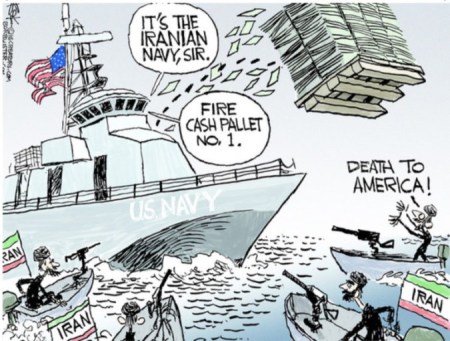
The Administration took weeks to provide even partial replies, denied paying ransom and omitted entirely the manner in which the $1.7 billion had been dispatched to Iran. It took more than six months for Congress and the press to eke out of the Administration the information that the entire $1.7 billion, converted into European hard currency, had been paid to Iran in stacks of cash — hard to trace and convenient chiefly for illicit purposes — with the first installment of $400 million conveyed, ransom-style, on the same day as the prisoner release, and held in Geneva until the airplane carrying the released American prisoners was on its way out of Iran.
For the Obama administration, invested in the Iran nuclear deal as one of Obama’s signature legacies, there is tremendous temptation to ignore or bury any evidence that Iran is cheating. There is also enormous incentive to downplay another of Obama’s legacies: the dramatic enhancement, since he took office in 2009, of the nuclear arsenal and proficiency of North Korea, now honing its increasingly powerful missiles, beefing up its stockpile of nuclear fuel, and preparing for its sixth nuclear test.
If the silent officials of the Obama administration are confident that there has been no nuclear cooperation between Iran and North Korea, it’s time to put that assessment in writing and send it to Cruz. If, on the other hand, Clapper, Kerry, Lew or Obama himself have any information that points to nuclear collaboration, it’s past time to inform Cruz, the rest of Congress and the American public of the staggering extent of the radioactive debacle they are about to hand off to President-elect Donald Trump, under the heading of Obama’s legacy Iran nuclear deal.
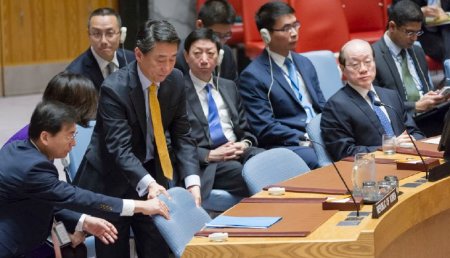
China could use sanctions as bargaining chip over missile defenses. (Rick Bajornas/United Nations via AP)
“Resolution 2321 formulates new measures, showing the resolve of the Security Council, and also points out they must avoid creating adverse consequences for North Korean civilian and humanitarian needs, and are not intended to create negative effects on normal trade,” Chinese Foreign Ministry spokesman Geng Shuang said Thursday, according to Reuters.
***********************
The State Department warned China on Thursday not to undermine a new round of United Nations sanctions against North Korea following Chinese suggestions that the crackdown won’t affect “normal trade” with the dictatorial regime.
State Department spokesman Mark Toner told reporters that China “plays an outside role in terms of the impact of these sanctions; or, rather, the impact they can have implementing these sanctions.”
China allowed a new round of sanctions to pass through the U.N. Security Council this week. But those sanctions were promptly followed by a statement that cast doubt on whether China intends to implement the sanctions in the way that the United States hopes.
“Resolution 2321 formulates new measures, showing the resolve of the Security Council, and also points out they must avoid creating adverse consequences for North Korean civilian and humanitarian needs, and are not intended to create negative effects on normal trade,” Chinese Foreign Ministry spokesman Geng Shuang said Thursday, according to Reuters.
China is a major buyer for North Korea’s coal industry, making their cooperation essential to the success of the sanctions in cutting funding for the regime. “I’m not sure what they mean or what their spokesperson meant by ‘normal trade,'” said Toner, who described the impositions as “targeted really at North Korea’s elite.”
The implementation of the sanctions could give China leverage in other negotiations with the United States, as the two countries are increasingly at odds over how China asserts itself in the Pacific region. “The real reason why China keeps the North Korean state alive economically is because it whenever Pyongyang fires off another test, Washington comes running to Beijing to help it negotiate,” Gordon Chang, author of the 2001 book The Coming Collapse of China, told the BBC.
The Chinese statement about “normal trade” was accompanied by a reiteration of China’s opposition to the U.S. plan to establish a Terminal High-Altitude Area Defense in the region of North Korea, for fear the weapons could be used to thwart Chinese ballistic missiles in the event of a conflict. “China opposes the deployment of the THAAD anti-missile on the peninsula, and urges relevant parties to immediately stop this process,” the Foreign Ministry spokesman said.
But Iran, freed of sanctions, is likely to be the spoiler.
The United Nations Security Council unanimously adopted Resolution 2321 (2016) on November 30th. It condemns the North Korean (DPRK) regime’s continued pursuit of nuclear weapons and ballistic missiles while its people continue to suffer under inhumane conditions. The resolution strengthens previous UN-imposed sanctions on the DPRK in response to its fifth nuclear test conducted on September 9, 2016.
The prior resolutions have failed to slow, much less eliminate, the DPRK’s nuclear program involving the development and testing of both nuclear device and ballistic missile capabilities. As UN Secretary General Ban Ki-moon pointed out in his remarks to the Security Council following the vote, “The Council first adopted a resolution on the DPRK nuclear issue in 1993. Twenty-three years and six sanctions resolutions later, the challenge persists.”
The new resolution is intended to put more of a financial squeeze on the DPKR regime than ever before by closing loopholes and cutting the DPRK off from sources of hard currency that can be used to fund its nuclear bomb and ballistic missile programs.
Most notably, the new resolution places tighter restrictions on the DPRK’s export of coal. There will now be an absolute cap on how much coal the DPRK can export per year, closing a loophole that had allowed an exemption from any coal export limitations so long as the transactions were determined to be exclusively for “livelihood” purposes. Member states must report all transactions promptly to the 1718 DPRK Sanctions Committee, which is directed to monitor total volumes and notify states when the allowed quantities have been reached and all procurement of coal from the DPRK must end.
The binding export cap will potentially cut the DPRK’s largest export, coal, by approximately $700 million per year from 2015 (more than 60%). Considering the fact that China is the DPRK’s principal purchaser of coal, the new restrictions agreed to by China are significant if fully implemented.
In addition, the new resolution imposes further restrictions on the sale or transfer of copper and other non-ferrous metals. It also places a ban on the supply, sale or transfer from the DPRK of statues, which has proven to be a lucrative source of hard currency needed by the regime. The resolution contains travel bans and assets freezes directed to individuals and entities not previously listed for such punitive actions, who are determined to be involved in the development, production, and financing of the DPRK’s nuclear weapons and ballistic missile programs, as well as the DPRK coal and conventional arms trade. There are more dual-use items, materials, equipment, goods and technology that will be subject to the embargo covering transfers to and from the DPRK. Strict new sanctions on the DPRK’s illicit transportation activities are imposed. Inspections of cargo transiting to and from the DPRK by rail, sea, air and road are to be expanded. And the new resolution contains further measures to isolate the DPRK from the global financial system and to prohibit financial support for trade with the DPRK in the form of export credits, guarantees, insurance and the like.
Resolution 2321 emphasizes, for the first time, a human rights dimension beyond the DPKR’s proliferation activities – the need for the DPRK to respect and ensure the inherent dignity of people in its territory. It also warns the DPRK that it is subject to being suspended from its UN rights and privileges.
U.S. Ambassador to the UN Samantha Power, who led the negotiations of the text primarily with her Chinese counterpart, heralded the new resolution. She said it “imposes unprecedented costs on the DPRK regime for defying this Council’s demands.” She admitted, however, that “No resolution in New York will likely, tomorrow, persuade Pyongyang to cease its relentless pursuit of nuclear weapons.” Ambassador Power stressed that for the resolution to have any material impact on the DPRK’s behavior “all Member States of this United Nations must fully implement the sanctions that we have adopted today.” Secretary General Ban Ki-moon, while lauding the new resolution for including “the toughest and most comprehensive sanctions regime ever imposed by the Security Council,” reinforced Ambassador Power’s admonition. He warned that “sanctions are only as effective as their implementation. It is incumbent on all Member States of the United Nations to make every effort to ensure that these sanctions are fully implemented.”
The problem with such an expectation for full implementation by all member states is Iran, which is known to have a tight collaborative relationship with the DPRK to bolster both countries’ nuclear weapons and missile programs. Iran has flouted UN Security Council resolutions in the past aimed at its own nuclear program. And despite the nuclear deal under which Iran is expected to curtail its nuclear program, it is continuing the testing and development of ballistic missiles designed to carry nuclear weapons. When I raised the concern about Iran’s relationship with the DPRK to Ambassador Power after she delivered some brief remarks to the press, she refused to answer my question and walked away. It is not surprising in this case why she ducked my question. The concessions President Obama and Secretary of State John Kerry made in order to reach agreement with Iran on the nuclear deal known as the Joint Comprehensive Plan of Action (JCPOA) have provided a huge loophole for Iran and the DPRK to exploit together.
More specifically, the JCPOA contains a long “Specially Designated Nationals” list of individuals and entities that will no longer be subject to previously instituted nuclear-related sanctions. This delisting includes entities involved in supporting Iran’s ballistic missile program, which Iran is now arguably freer to pursue thanks to other concessions offered by Obama and Kerry.
One of the entities removed from both the UN and U.S. sanctions lists is Bank Sepah, a large Iranian state-owned financial institution. Bank Sepah had been sanctioned by the U.S. Treasury Department back in 2007 for “facilitating Iran’s weapons program” and providing “support and services to designated Iranian proliferation firms.” The bank had also been listed as an entity “involved in nuclear or ballistic missile activities” in UN Security Council Resolution 1747.
In addition to supporting Iran’s own missile program, Bank Sepah has also been involved, according to the U.S. Treasury Department, in transferring large sums of money from Iran’s Aerospace Industries Organization to a North Korean firm associated with the Korea Mining Development Trading Bureau (KOMID), “a North Korean entity designated for providing Iran with missile technology.”
The DPRK’s Tanchon Commercial Bank, which has been designated by the US and the UN Security Council for sanctions due to its suspected proliferation-related activities, has served as the financial arm for KOMID. “Since 2005,” according to a statement issued several years ago by the Treasury Department, “Tanchon has maintained an active relationship with various branches of Iran’s Bank Sepah…the U.S. has reason to believe that the Tanchon-Bank Sepah relationship has been used for North Korea-Iran proliferation-related transactions.”
Bank Sepah now is no longer hobbled by sanctions as a result of the JCPOA and a follow-up Security Council resolution endorsing the JCPOA and terminating the previous UN sanctions resolutions against Iran. This means not only more funding for Iran’s missile program, which Iran is continuing to pursue without any consequences. It also means a potential source of hard currency for North Korea’s nuclear program – precisely the opposite of what Ambassador Power said was the intent of the new DPRK Security Council sanctions resolution. And this is only scratching the surface of how the unfreezing of billions of dollars of Iranian assets and removal of sanctions on Iranian entities involved in nuclear-related activities, which have had ties with North Korean entities involved in nuclear-related activities, will help accelerate the nuclear weapons and missile programs of both rogue regimes.
In short, for the Obama administration, “The one hand giveth; the other hand taketh away.” Hopefully, the new Trump administration will do a better job in connecting the dots in the dangerous collaborative relationship between Iran and the DPKR and undo the damage the Iran nuclear deal is likely to do in helping to further that relationship.
(The views expressed in this article are mine and do not necessarily reflect those of Warsclerotic or its other editors. — DM)
In an article titled North Korean Nukes, South Korea, Japan, China and Obama, posted the day after North Korea’s most recent nuke test, September 9th, I contended that China would not honor Obama’s request to make North Korea stop developing and testing nukes. China has remained a faithful ally of North Korea since the end stage of the Korean Conflict and “sees Obama, not as the representative of the world’s greatest power, but as a joke. He has no clout internationally and is a national embarrassment.” NB: I had hoped to publish this article more than a week ago, but my internet was down or at best intermittent from September 13th until September 19th.)
I was right, but it’s a bit worse than I had thought.
U.S. Defence Secretary Ashton Carter reportedly called for further pressure on the DPRK last Friday after the country carried out a new nuclear test and said China bears “responsibility” for tackling the problem. [Emphasis added.]
The essence of the Korean Peninsula nuclear issue is the conflict between the DPRK and the United States, spokesperson Hua Chunying said at a press conference. [Emphasis added.]
As a permanent member of the UN Security Council and a close neighbor of the DPRK, China has made unremitting efforts to maintain peace and stability on the Korean Peninsula and safeguard the international nuclear non-proliferation regime, Hua said.
A statement released by the Foreign Ministry of the DPRK Sunday said the United States compelled the DPRK to develop nuclear warheads, and the nuclear threat it has constantly posed to the DPRK for decades is the engine that has pushed the DPRK to this point. [Emphasis added.]
Blindly increasing the pressure and the resulting bounce-back will only make the nuclear issue on the Korean Peninsula “a firm knot,” Hua said, calling for responsibility from all relevant parties.
Hua reiterated that China will remain committed to resolving issues concerning the Peninsula through dialogue to realize long-term peace and stability.
China strongly urges all parties to speak and act cautiously with the larger picture in mind, avoid provoking each other and make genuine efforts to achieve denuclearization, peace and stability on the Korean Peninsula, Hua said.
. . . .
“We have seen the twists and turns in the situation on the Korean Peninsula since the six-party talks have stalled,” Hua said, noting that it proves that simple sanctions cannot solve the issue. [Emphasis added.]
Hua said the security concerns of parties on the Korean Peninsula must and can only be resolved in a way that serves the interests of all parties.
Any unilateral action based on one’s self-interest will lead to a dead end, and it will not help resolve one’s security concerns but will only aggravate the tension, complicate the issue, and make it more difficult to achieve relevant goals, Hua said. [Emphasis added.]
The six-party talks, involving China, the DPRK, the United States, the Republic of Korea (ROK), Russia and Japan, were a multilateral mechanism aimed at solving the Korean Peninusla nuclear issue. The talks began in 2003 and stalled in December 2008. The DPRK quit the talks in April 2009.
“Resuming the six-party talks is difficult, but we cannot give up easily ,” Hua said.
China will continue to keep close communication with relevant parties and call on them to return to the right track of solving issues related to the Korean Peninsula through dialogue and negotiation, the spokesperson said.
China clearly appears to be following the line of Kim Jong-un on why North Korea needs nukes:
The Obama administration cannot engage in successful negotiations with North Korea, for several reasons. They are, in no particular order: Obama will be gone in about four months; Kerry is Obama’s Secretary of State; The Obama-Clinton-Kerry Iran Scam gave the Islamic Republic everything it sought and, at best, left Iran on the highway to nukes. North Korea and Iran are different in at least one major respect: Iran claimed that it did not have nukes and had not tried to develop them; Supreme Leader Khamenei was claimed to have issued a fatwa against the acquisition, development and use of nukes — despite propaganda videos showing how Iran will use nukes against the “great and little Satan.” North Korea has and has tested five nukes. Kim brags about them and threatens to use them.
The nuke threat
38 North is a think tank largely devoted to obtaining and publishing reliable information about North Korea’s nuke and missile programs. An article there by Siegfried S. Hecker, published on September 12th, concludes:
What are the greatest threats from the rapidly expanding North Korean nuclear program? Left unchecked, Pyongyang will likely develop the capability to reach the continental United States with a nuclear tipped missile in a decade or so. Much more troubling for now is that its recent nuclear and missile successes may give Pyongyang a false sense of confidence and dramatically change regional security dynamics. The likely ability of the DPRK to put nuclear weapons on target anywhere in South Korea and Japan and even on some US assets in the Pacific greatly complicates the regional military picture. That situation would be exacerbated if Pyongyang decides to field tactical nuclear weapons as its arsenal expands and its confidence in its nuclear arsenal grows.
More bombs and better bombs also increase the potential of accidents and miscalculations with greater consequences as the number and sophistication of bombs increase. Rendering the nuclear enterprise safe and secure in case of internal turmoil or a chaotic transition in the North becomes more difficult. We also cannot rule out that a financially desperate leadership may risk the sale of fissile materials or other nuclear assets, perhaps to non-state actors. [Emphasis added.]
So, what to do? The latest nuclear test demonstrates conclusively that attempting to sanction the DPRK into submission and waiting for China to exert leverage over Pyongyang’s nuclear program do not work. Increasing sanctions and adding missile defenses in South Korea to that mix will also not suffice and make China even less likely to cooperate. What’s missing is diplomacy as much as Washington may find it repugnant to deal with the Kim regime.
On September 20th, North Korea announced that it had tested a new long-range rocket engine, suggesting that it “can be used for an intercontinental ballistic missile (ICBM), which is capable, in theory, of hitting targets on the U.S. mainland.” The September 9th nuke test is claimed to have involved “a miniaturized nuclear warhead that could be mounted on a ballistic missile.” How close in North Korea to being able to nuke the U.S. mainland? I don’t know and don’t want to find out by having it happen.
Can diplomacy, even if undertaken by a new administration after Obama leaves office, be successful? Continued sanctions got Iran to engage in negotiations; both Iran and Obama’s America very much wanted the sanctions lifted so that Iran would become an honorable member of the community of nations. There are few if any significant sanctions to lift on North Korea and China will not impose or enforce any; China’s role has been to help North Korea evade sanctions.
[T]he United States should rally the same sort of campaign that revved up the pressure against Iran before those nuclear talks got underway. In other words, the international community should apply sanctions not only against North Korea but also against all institutions that do business with North Korea—an action that would affect some major Chinese banks, which provide it with energy supplies, other goods, and hard currency. [Emphasis added.]
Yes, this would stir tensions in U.S.-China relations; but so do a lot of other actions, many of them instigated by China (for instance, the dodgy territorial claims in the South China Sea), and in this case, any perceptions of American aggression would be offset, to some degree, by a realization—at least by some Chinese officials—that it’s time for Beijing to face up to its problem and reassess its strategic priorities accordingly. (Longtime China-watchers say that some of Xi’s senior comrades have been advocating tougher action against Kim.)
He also suggests that if an end is put to North Korea’s nuclear ambitions and work, America should agree to terminate its no longer necessary THAAD deployments in South Korea and Japan. Further, the next president
should take steps, especially with China, to prevent Pyongyang from deploying a nuclear missile; but if that proves fruitless, he or she should make very clear that North Korea’s use of nuclear weapons—or even a conventional invasion of South Korea (which might be accompanied by a brandishing of nukes to deter anyone from coming to Seoul’s aid)—will be regarded as an attack on the United States and will be dealt with accordingly. There should be no ambiguity about this. Kim Jong-un may be crazy, but his eccentricities have always been in the service of his survival—and he should understand that he’s putting his survival on the line. Daniel Sneider, associate director of Stanford University’s Shorenstein Asia-Pacific Research Center, thinks we should deploy more nuclear-capable aircraft on U.S. bases in Asia to drive this point home fiercely.
It seems worth noting that among the reasons to expect that a Russian-assisted attack on South Korea would be successful, which Kim Il-sung suggested to Stalin in 1950, was that Secretary of State Dean Atcheson had delivered an important address in which he listed the nations to the defense of which America would come if attacked. South Korea was not on the list. As I observed here in November of 2010,
When Kim il-Sung secretly visited Moscow between March 30 and April 25, he assured Stalin that his attack would succeed in three days: there would be an uprising by some two hundred thousand party members and he was convinced that the United States would not intervene. Secretary of State Dean Acheson’s January 12, 1950 speech was persuasive evidence. There, Secretary Acheson had omitted South Korea from a list of nations which the United States would defend if attacked. Stalin gave the go-ahead.
Conclusions
China has encouraged North Korean nuclearization and wants America and her allies, principally South Korea, to cease their “provocations” against the Kim regime. Yet Kim thrives on, and encourages his supporters by, engaging in provocations far more serious and dramatic than anything thus far done by America and South Korea. It seems likely that the North Korean nuke – missile problem will continue until Kim is (a) taken out and (b) replaced with someone less narcissistic and more interested in feeding his people than his ego. Whether such a replacement will emerge is unknown. However, if a Kim clone emerges instead, he seems likely to be more concerned than Kim about his prospects for a long and happy life, even with protection from China.
A statement released by the Foreign Ministry of the DPRK Sunday said the United States compelled the DPRK to develop nuclear warheads, and the nuclear threat it has constantly posed to the DPRK for decades is the engine that has pushed the DPRK to this point.
***********************
BEIJING, Sept. 12 (Xinhua) — China urges the United States to take due responsibility for the Korean Peninsula nuclear issue and provide effective solutions, a Chinese Foreign Ministry spokesperson said on Monday.
U.S. Defence Secretary Ashton Carter reportedly called for further pressure on the DPRK last Friday after the country carried out a new nuclear test and said China bears “responsibility” for tackling the problem.
The essence of the Korean Peninsula nuclear issue is the conflict between the DPRK and the United States, spokesperson Hua Chunying said at a press conference.
As a permanent member of the UN Security Council and a close neighbor of the DPRK, China has made unremitting efforts to maintain peace and stability on the Korean Peninsula and safeguard the international nuclear non-proliferation regime, Hua said.
A statement released by the Foreign Ministry of the DPRK Sunday said the United States compelled the DPRK to develop nuclear warheads, and the nuclear threat it has constantly posed to the DPRK for decades is the engine that has pushed the DPRK to this point.
Blindly increasing the pressure and the resulting bounce-back will only make the nuclear issue on the Korean Peninsula “a firm knot,” Hua said, calling for responsibility from all relevant parties.
Hua reiterated that China will remain committed to resolving issues concerning the Peninsula through dialogue to realize long-term peace and stability.
China strongly urges all parties to speak and act cautiously with the larger picture in mind, avoid provoking each other and make genuine efforts to achieve denuclearization, peace and stability on the Korean Peninsula, Hua said.
Moscow condemns the DPRK’s nuclear tests but there should be more “creative” ways of responding to Pyongyang’s activities than simply sanctions, Russian Foreign Minister Sergei Lavrov said Saturday, adding that ways could be found to resume the six-party talks.
“We have seen the twists and turns in the situation on the Korean Peninsula since the six-party talks have stalled,” Hua said, noting that it proves that simple sanctions cannot solve the issue.
Hua said the security concerns of parties on the Korean Peninsula must and can only be resolved in a way that serves the interests of all parties.
Any unilateral action based on one’s self-interest will lead to a dead end, and it will not help resolve one’s security concerns but will only aggravate the tension, complicate the issue, and make it more difficult to achieve relevant goals, Hua said.
The six-party talks, involving China, the DPRK, the United States, the Republic of Korea (ROK), Russia and Japan, were a multilateral mechanism aimed at solving the Korean Peninusla nuclear issue. The talks began in 2003 and stalled in December 2008. The DPRK quit the talks in April 2009.
“Resuming the six-party talks is difficult, but we cannot give up easily ,” Hua said.
China will continue to keep close communication with relevant parties and call on them to return to the right track of solving issues related to the Korean Peninsula through dialogue and negotiation, the spokesperson said.
(The views expressed in this article are mine and do not necessarily reflect those of Warsclerotic or its other editors. — DM)
On September 9th, North Korea conducted its fifth nuke test, of its most powerful nuke thus far. Can Obama get China to help make North Korea stop developing and testing nukes? Nope. China sees Obama, not as the representative of the world’s greatest power, but as a joke. He has no clout internationally and is a national embarrassment.
China and North Korea – a very short history
Here’s a link to an article I posted on June 25, 2013 about the Korean conflict. To summarize, China and the Democratic People’s Republic of Korea (North Korea) have a long history of acting together. China views the Republic of Korea (South Korea), which borders North Korea to the south and is an American ally, as a threat. She does not want reunification of the Korean peninsula under a government favorable to America.
When, on June 25, 1950, North Korea invaded South Korea with Russian aircraft, weaponry, training and other substantial support, China did not assist North Korea. North Korean forces pushed the South Korean government, as well as the few American military advisers (then under the command of the Department of State), south to the Pusan perimeter. Following General MacArthur’s unexpected and successful Inchon invasion which began on September 15th, American and other United Nations forces pushed the North Korean forces back north: MacArthur sent his by then greatly augmented forces east to Wonson and eventually managed to push North Korean forces to the northern side of the Yalu River. However, Chinese forces struck back en masse and MacArthur’s forces were driven back to Seoul.
Ever since bringing to an end MacArthur’s successes in the Korean Conflict, China has supported North Korea. She has opposed, and has then declined to enforce, significant sanctions responsive to North Korean nuclear and missile development and testing. While China may acquiesce in weak UN resolutions condemning North Korean provocations, she rarely goes beyond that.
China, Japan and the two Koreas
China has a long memory and still resents, bitterly, the lengthy period prior to and during World War II when Japan occupied significant parts of China. Ditto South Korea, all of which was under Japanese occupation for a lengthy period prior to and during World War II. Although China has substantial trade with both South Korea and Japan, she is more hostile to Japan than is South Korea; the latter two have substantial mutual interests transcending trade.
Perhaps the most important current dispute between China on the one hand, and Japan-South Korea-America on the other, involves the plans of Japan and South Korea to defend against North Korean missiles by the installation of THAAD anti-missile weapons provided by America. China’s stated reason for opposition to the THAAD system is that it could be used against Chinese, as well as North Korean, missiles. Why does China assert this objection unless she hopes to fire missiles at one or both of them? If China fires missiles at Japan and/or South Korea, they have every right to destroy her missiles and to respond in kind with U.S. assistance if requested.
condemned Pyongyang’s fifth nuclear test today in the “strongest possible terms as a grave threat to regional security and to international peace and stability” as outraged lawmakers from both parties called for tougher action to stop North Korea’s nuclear program. [Emphasis added.]
That may well be all that Obama does — despite the warnings of Rep. Adam Smith (D-Wash.), the top Democrat on the House Armed Services Committee, that
we have to make it absolutely clear that if they engage in any military activity, they will be destroyed. We have to have a credible deterrent. That seems to be the only thing that will stop North Korea from engaging in military action… We have sanctioned them, and we should keep sanctioning them, but it’s not going to stop them from developing the nuclear weapons.” [Emphasis added.]
Obama won’t do that:
In a statement Friday, President Obama vowed to “take additional significant steps, including new sanctions, to demonstrate to North Korea that there are consequences to its unlawful and dangerous actions.”
Obama did not suggest what He might have in mind, beyond historically ineffective sanctions and condemnations “in the strongest possible terms,” to let North Korea know that there will be “consequences.”
A September 9th article at the New York Times provides an unpleasant analysis of the options Obama now has, and which His successor will have, in dealing with North Korea.
A hard embargo, in which Washington and its allies block all shipping into and out of North Korea and seek to paralyze its finances, risks confrontations that allies in Asia fear could quickly escalate into war. But restarting talks on the North’s terms would reward the defiance of its young leader, Kim Jong-un, with no guarantee that he will dismantle the nuclear program irrevocably.
For more than seven years, President Obama has sought to find a middle ground, adopting a policy of gradually escalating sanctions that the White House once called “strategic patience.” But the test on Friday — the North’s fifth and most powerful blast yet, perhaps with nearly twice the strength of its last one — eliminates any doubt that that approach has failed and that the North has mastered the basics of detonating a nuclear weapon.
Despite sanctions and technological backwardness, North Korea appears to have enjoyed a burst of progress in its missile program over the last decade, with experts warning that it is speeding toward a day when it will be able to threaten the West Coast of the United States and perhaps the entire country. [Emphasis added.]
. . . .
Mr. Obama has refused to negotiate with the North unless it agrees first that the ultimate objective of any talks would be a Korean Peninsula without nuclear arms. But Mr. Kim has demonstrated, at least for now, that time is on his side. And as he gets closer to an ability to threaten the United States with a nuclear attack, and stakes the credibility of his government on it, it may be even more difficult to persuade him to give up the program.
In a statement Friday, Mr. Obama condemned the North’s test and said it “follows an unprecedented campaign of ballistic missile launches, which North Korea claims are intended to serve as delivery vehicles intended to target the United States and our allies.”
“To be clear, the United States does not, and never will, accept North Korea as a nuclear state,” he said.
Many experts who have dealt with North Korea say the United States may have no choice but to do so. [Emphasis added.]
“It’s too late on the nuclear weapons program — that is not going to be reversed,” William Perry, the defense secretary under President Bill Clinton during the 1994 nuclear crisis with North Korea, said in August at a presentation in Kent, Conn. The only choice now, he argued, is to focus on limiting the missile program. [Emphasis added.]
Obama has taken no significant steps to limit Iran’s continuing missile development and testing program. How can He limit that of North Korea without Chinese cooperation?
Yet the latest effort to do that, an agreement between the United States and South Korea to deploy an advanced missile defense system in the South, has inflamed China, which argues the system is also aimed at its weapons. While American officials deny that, the issue has divided Washington and Beijing so sharply that it will be even more difficult now for them to come up with a joint strategy for dealing with the North. [Emphasis added.]
China has been so vocal with its displeasure over the deployment of the American system that Mr. Kim may have concluded he could afford to upset Beijing by conducting Friday’s test. [Emphasis added.]
Fueling that perception were reports that a North Korean envoy visited Beijing earlier this week.
“North Korea almost certainly sees this as an opportunity to take steps to enhance its nuclear and missile capabilities with little risk that China will do anything in response,” Evans J.R. Revere, a former State Department official and North Korea specialist, said in a speech in Seoul on Friday. [Emphasis added.]
The breach between China and the United States was evident during Mr. Obama’s meeting with President Xi Jinping last week. “I indicated to him that if the Thaad bothered him, particularly since it has no purpose other than defensive and does not change the strategic balance between the United States and China, that they need to work with us more effectively to change Pyongyang’s behavior,” Mr. Obama said, referring to the Terminal High Altitude Area Defense system, as the advanced missile defense project is known. [Emphasis added.]
North Korea and Iran
Iran and North Korea have a long history of cooperation in developing nukes and missiles with which to deliver them. In the past, Iranian scientists have been present at North Korean nuke tests, and vice versa. They have also assisted each other in the development of nukes and missiles.
Iran and North Korea have substantial reasons to cooperate: by virtue of the Iran scam, Iran now has lots of money but is at least minimally restricted in its nuke development. North Korea has little usable currency, needs whatever it can get, and no attempts to halt or even to limit its nuke development have worked.
Photos released by North Korea of its launch of long-range ballistic missiles are the latest proof of the close military cooperation between Pyongyang and Tehran, an Israeli expert in the field told the news site IsraelDefense on Tuesday.
According to Tal Inbar — head of Space and UAV Research Centre at the Fisher Institute for Air & Space Strategic Studies — what was new in the photos was the shape of the warheads attached to the Nodong missiles, known in Iran as the Shahab-3.
Until now, such warheads — first detected by Inbar in Iran in 2010 — have not been seen in North Korea. At the time, Inbar dubbed them NRVs (or, “new entry vehicles”), which became their nickname among missile experts around the world. [Emphasis added.]
Inbar told IsraelDefense: “The configuration that we saw [on Tuesday] is identical to what we saw in Iran six years ago. In principle, its penetrating body (warhead) is identical to that of Scud missiles, but is mounted on the Shahab-3, and creates a more stable entity than other Shahab/Nodong warheads.”
Inbar said this was the third time that something of this nature had appeared in Iran before it did in North Korea. “But we must remember that the two countries engage in close cooperation where military and space-directed missiles are concerned,” he said. “It is thus possible that both plans and technology are being transferred regularly from one to the other.” [Emphasis added.]
Are North Korea and Iran rational? According to this New York Times analysis, North Korea is.
North Korea’s actions abroad and at home, while abhorrent, appear well within its rational self-interest, according to a 2003 study by David C. Kang, a political scientist now at the University of Southern California. At home and abroad, he found, North Korean leaders shrewdly determined their interests and acted on them. (In an email, he said his conclusions still applied.) [Emphasis added.]
“All the evidence points to their ability to make sophisticated decisions and to manage palace, domestic and international politics with extreme precision,” Mr. Kang wrote. “It is not possible to argue these were irrational leaders, unable to make means-ends calculations.” [Emphasis added.]
Victor Cha, a Georgetown University professor who served as the Asian affairs director on George W. Bush’s National Security Council, has repeatedlyargued that North Korea’s leadership is rational.
I submit that the same analysis, applied to Iran, produces the same result. Iran’s leaders know what they want, and are sufficiently rational to achieve it; they did. Obama, not the leader of a dictatorial theocracy, is sufficiently irrational to believe that what he wants for the Islamic Republic of Iran is what America needs it to have. It is not.
Obama and Iran
Obama’s Iran scam would be farcical were it not potentially deadly. He did not do what would have been best for America and the free world in general — increase sanctions until Iran complied fully with UN resolutions on missile testing, ceased Uranium enrichment and disposed of the means to do it, ceased all nuke research as well as all nuke cooperation with North Korea and ceased supporting all terrorist groups, including Hezbollah and Hamas. Instead, perhaps considering Himself above such trivia, Obama sought little more than what He considered His greatest achievement — His legacy:
Conclusions
If Obama were viewed internationally as the powerful leader of the world’s most powerful nation, He might be able to get China to clamp down, severely and successfully, on North Korea’s nuke and missile development. Were China to reject His overtures, He could arrange for it to wish that it had acceded. That’s not who Obama is, as demonstrated by, among His other actions, entering into the Iran Scam deal with Iran.
Perhaps Kim Jong-un needs to dress like an Iranian mullah to convince Obama to give him a “deal” similar to the one He gave to Iran. He had better hurry: that won’t work with President Trump.
GENEVA — North Korea’s latest test of an atomic weapon leaves the United States with an uncomfortable choice: stick with a policy of incremental sanctions that has clearly failed to stop the country’s nuclear advances, or pick among alternatives that range from the highly risky to the repugnant.
A hard embargo, in which Washington and its allies block all shipping into and out of North Korea and seek to paralyze its finances, risks confrontations that allies in Asia fear could quickly escalate into war. But restarting talks on the North’s terms would reward the defiance of its young leader, Kim Jong-un, with no guarantee that he will dismantle the nuclear program irrevocably.
For more than seven years, President Obama has sought to find a middle ground, adopting a policy of gradually escalating sanctions that the White House once called “strategic patience.” But the test on Friday — the North’s fifth and most powerful blast yet, perhaps with nearly twice the strength of its last one — eliminates any doubt that that approach has failed and that the North has mastered the basics of detonating a nuclear weapon.
Despite sanctions and technological backwardness, North Korea appears to have enjoyed a burst of progress in its missile program over the last decade, with experts warning that it is speeding toward a day when it will be able to threaten the West Coast of the United States and perhaps the entire country.
“This is not a cry for negotiations,” said Victor Cha, who served in the administration of President George W. Bush and now is a North Korea expert at the Center for Strategic and International Studies in Washington. “This is very clearly a serious effort at amassing real nuclear capabilities that they can use to deter the U.S. and others.”
Mr. Cha said the usual response from Washington, Seoul and Tokyo — for another round of sanctions — was not likely to be any more successful at changing the North’s behavior than previous rounds. That means Mr. Obama’s successor will confront a nuclear and missile program far more advanced than the one Mr. Obama began grappling with in 2009.
Mr. Obama has refused to negotiate with the North unless it agrees first that the ultimate objective of any talks would be a Korean Peninsula without nuclear arms. But Mr. Kim has demonstrated, at least for now, that time is on his side. And as he gets closer to an ability to threaten the United States with a nuclear attack, and stakes the credibility of his government on it, it may be even more difficult to persuade him to give up the program.
In a statement Friday, Mr. Obama condemned the North’s test and said it “follows an unprecedented campaign of ballistic missile launches, which North Korea claims are intended to serve as delivery vehicles intended to target the United States and our allies.”
“To be clear, the United States does not, and never will, accept North Korea as a nuclear state,” he said.
Many experts who have dealt with North Korea say the United States may have no choice but to do so.
“It’s too late on the nuclear weapons program — that is not going to be reversed,” William Perry, the defense secretary under President Bill Clinton during the 1994 nuclear crisis with North Korea, said in August at a presentation in Kent, Conn. The only choice now, he argued, is to focus on limiting the missile program.
Yet the latest effort to do that, an agreement between the United States and South Korea to deploy an advanced missile defense system in the South, has inflamed China, which argues the system is also aimed at its weapons. While American officials deny that, the issue has divided Washington and Beijing so sharply that it will be even more difficult now for them to come up with a joint strategy for dealing with the North.
China has been so vocal with its displeasure over the deployment of the American system that Mr. Kim may have concluded he could afford to upset Beijing by conducting Friday’s test.
Fueling that perception were reports that a North Korean envoy visited Beijing earlier this week.
“North Korea almost certainly sees this as an opportunity to take steps to enhance its nuclear and missile capabilities with little risk that China will do anything in response,” Evans J.R. Revere, a former State Department official and North Korea specialist, said in a speech in Seoul on Friday.
The breach between China and the United States was evident during Mr. Obama’s meeting with President Xi Jinping last week. “I indicated to him that if the Thaad bothered him, particularly since it has no purpose other than defensive and does not change the strategic balance between the United States and China, that they need to work with us more effectively to change Pyongyang’s behavior,” Mr. Obama said, referring to the Terminal High Altitude Area Defense system, as the advanced missile defense project is known.
But Mr. Obama noted that sanctions had failed at having much effect. That is largely because the Chinese have left open large loopholes that have kept the North Korean economy alive and, by some measures, enjoying more trade than anytime in years.
In a recent paper, two researchers concluded that sanctions so far “have had the net effect of actually improving” North Korea’s procurement capabilities for its weapons program. To evade sanctions, the North’s state-run trading companies opened offices in China, hired more capable Chinese middlemen and paid higher fees to employ more sophisticated brokers, according to Jim Walsh and John Park, scholars at M.I.T. and Harvard respectively.
The sanctions, Mr. Cha noted, “are supposed to inflict enough pain so the regime comes back to the negotiation table, and that’s clearly not working; or it’s supposed to collapse the regime until it starves, and that’s not working either.”
“Unless China is willing to cut off everything, which they don’t appear willing to do, the sanctions may be politically the right thing to do and a requisite response, but they are not the answer to the problem,” he said.
That means the choices facing Mr. Obama’s successor will be stark. One option is to choke off all trade, in part by telling banks that conduct transactions with North Korea that they will be shut out of dealing in dollars around the world — an effective tactic against Iran before last year’s nuclear deal. But that would enrage the Chinese, and probably cut into cooperation on other issues.
At the same time, an attempt to intercept all shipping could quickly escalate into a full-blown conflict, something neither Mr. Obama nor the South Koreans and Japanese have been willing to risk.
On the other hand, reopening negotiations, which Donald J. Trump has indicated he is willing to consider, could mean paying North Korea again to freeze nuclear activities that the Bush administration and the Clinton administration had already rewarded them for stopping years ago.
The nuclear program dates back to Mr. Kim’s grandfather, Kim Il-sung, the country’s founder, who emerged from the Korean War more than 60 years ago mindful that the United States had considered using nuclear weapons in that conflict and determined to get his own arsenal.
The missile program also has a long history, mostly to deliver conventional arms. But now the two are converging, as the North races to develop a weapon small, light and durable enough to be launched into space and survive re-entry into the atmosphere.
The explosive energy unleashed during the test on Friday, estimated at 10 to 12 kilotons of TNT, was nearly twice that of the North’s last test, conducted in January, said Yoo Yong-gyu, a senior seismologist at South Korea’s National Meteorological Administration.
And the fact that North Korea’s fifth test came only eight months after its fourth is another indication that it is making fast progress toward fitting its ballistic missiles with nuclear warheads, said Choi Kang, a senior analyst at the Asan Institute. The North had waited about three years between each of its previous tests.
North Korea’s advances have unnerved its neighbors in South Korea and Japan, and Mr. Trump’s suggestion that the two nations should pay more for the United States to defend them has not helped.
In both South Korea and Japan, a small but increasingly vocal minority hasbegun to advocate developing nuclear weapons to counter the North instead of relying on the United States.
Cheong Seong-chang, a senior analyst at the Sejong Institute in Seongnam, south of Seoul, argued that a South Korean nuclear program might distract the North from its efforts to build a long-range missile capable of delivering a nuclear warhead to the mainland United States.
“If South Korea arms itself with nuclear weapons, North Korea will regard the South Korean nuclear weapons, not the distant American nukes, as the most direct threat to its security,” Mr. Cheong said.
Underwater test-fire of strategic submarine ballistic missile released by North Korea’s Korean Central News Agency on April 24, 2016 / REUTERS
SEOUL (Reuters)–North Korea fired a submarine-launched missile on Wednesday that flew about 500 km (311 miles) towards Japan, a show of improving technological capability for the isolated country that has conducted a series of launches in defiance of U.N. sanctions.
Having the ability to fire a missile from a submarine could help North Korea evade a new anti-missile system planned for South Korea and pose a threat even if nuclear-armed North Korea’s land-based arsenal was destroyed, experts said.
The ballistic missile was fired at around 5:30 a.m. (2030 GMT) from near the coastal city of Sinpo, where a submarine base is located, officials at South Korea’s Joint Chiefs of Staff and the Defense Ministry told Reuters.
The projectile reached Japan’s air defense identification zone (ADIZ) for the first time, Chief Cabinet Secretary Yoshihide Suga told a briefing, referring to an area of control designated by countries to help maintain air security.
The missile was fired at a high angle, South Korea’s Yonhap News Agency reported, an indication that its full range would be 1,000 km (620 miles) at an ordinary trajectory. The distance indicated the North’s push to develop a submarine-launched missile system was paying off, officials and experts said.
North Korea’s “SLBM (submarine-launched ballistic missile) technology appears to have progressed,” a South Korean military official told Reuters.
Jeffrey Lewis of the California-based Middlebury Institute of International Studies said the test appeared to be a success.
“We don’t know the full range, but 500 km is either full range or a full range on a lofted trajectory. Either way, that missile works.”
The launch came two days after rival South Korea and the United States began annual military exercises in the South that North Korea condemns as a preparation for invasion, and has threatened retaliation.
Beijing is Pyongyang’s main ally but has joined past U.N. Security Council resolutions against the North. It has been angered by what it views as provocative moves by the United States and South Korea, including their July decision to base the THAAD (Terminal High Altitude Area Defense) anti-missile system in South Korea.
China opposes North Korea’s nuclear and missile program as well as any words or deeds that cause tension on theKorean peninsula, its foreign minister, Wang Yi, said on Wednesday at a previously scheduled meeting with his Japanese and South Korean counterparts in Tokyo.
South Korea’s Foreign Ministry condemned the launch and warned of more sanctions and isolation for its rival that “will only speed up its self-destruction.”
“This poses a grave threat to Japan’s security, and is an unforgivable act that damages regional peace and stability markedly,” Japanese Prime Minister Shinzo Abe told reporters, adding that Japan had lodged a stern protest.
GROWING ISOLATION
North Korea has become further isolated after a January nuclear test, its fourth, and the launch of a long-range rocket in February which brought tightened UN sanctions.
It has launched numerous missiles of various types this year, including one this month that landed in or near Japanese-controlled waters.
Joshua Pollack, editor of the U.S.-based Nonproliferation Review, said claiming to have mastered SLBM technology is as much about prestige as a military breakthrough, a status enjoyed only by six countries including the United States, Russia, and China.
“I think it’s meant foremost as a demonstration of sheer technical capability and a demand for status and respect,” Pollack said.
South Korea believes the North has a fleet of more than 70 ageing, limited-range submarines–a mix of Chinese, Russian, and locally made boats. Acquiring a fleet of submarines large and quiet enough and with a longer range would be a next step for the North, experts said.
“They keep conducting nuclear tests and SLBMs together which means they are showing they can arm SLBMs with miniaturised nuclear warheads,” said Moon Keun-sik, a retired South Korean navy officer and an expert in submarine warfare.
North Korea said this year it had miniaturized a nuclear warhead to fit on a ballistic missile, but outside experts have said there is yet to be firm evidence to back up the claim.
Tensions on the Korean peninsula were exacerbated by the recent defection of North Korea’s deputy ambassador in London to South Korea, an embarrassing setback to the regime of North Korean leader Kim Jong Un.







 anneinpt
 artaxes
 danmillerinpanama
 davidking1530
 Peter Hofman
 Joseph Wouk
 Peter
Peter Louisiana Steve
 WarSclerotic
Recent Comments