Archive for the ‘North Korean missiles’ category

North Korea taps GOP analysts to better understand Trump and his messages

September 26, 2017

North Korea taps GOP analysts to better understand Trump and his messages, Washington PostAnna Fifield, September 26, 2017

Spectators listen to a television news broadcast of a statement by North Korean leader Kim Jong Un on a public television screen in Pyongyang on Friday. (Ed Jones/AFP/Getty Images)

 North Korean government officials have been quietly trying to arrange talks with Republican-linked analysts in Washington, in an apparent attempt to make sense of President Trump and his confusing messages to Kim Jong Un’s regime.

The outreach began before the current eruption of threats between the two leaders but will probably become only more urgent as Trump and Kim have descended into name-calling that, many analysts worry, sharply increases the chances of potentially catastrophic misunderstandings.

“Their number one concern is Trump. They can’t figure him out,” said one person with direct knowledge of North Korea’s approach to Asia experts with Republican connections.

There is no suggestion that the North Koreans are interested in negotiations about their nuclear program — they instead seem to want forums for insisting on being recognized as a nuclear state — and the Trump administration has made clear it is not interested in talking right now.

At a multilateral meeting here in Switzerland earlier this month, North Korea’s representatives were adamant about being recognized as a nuclear weapons state and showed no willingness to even talk about denuclearization.

(Video at the link. — DM)

But to get a better understanding of American intentions, in the absence of official diplomatic talks with the U.S. government, North Korea’s mission to the United Nations invited Bruce Klingner, a former CIA analyst who is now the Heritage Foundation’s top expert on North Korea, to visit Pyongyang for meetings.

Trump has close ties to Heritage, a conservative think tank that has influenced the president on everything from travel restrictions to defense spending, but no personal connection to Klingner.

“They’re on a new binge of reaching out to American scholars and ex-officials,” said Klingner, who declined the North Korean invitation. “While such meetings are useful, if the regime wants to send a clear message, it should reach out directly to the U.S. government.”

North Korean intermediaries have also approached Douglas Paal, who served as an Asia expert on the National Security Council under presidents Ronald Reagan and George H.W. Bush and is now vice president for studies at the Carnegie Endowment for International Peace.

They wanted Paal to arrange talks between North Korean officials and American experts with Republican ties in a neutral location such as Switzerland. He also declined the North Korean request.

“The North Koreans are clearly eager to deliver a message. But I think they’re only interested in getting some travel, in getting out of the country for a bit,” Paal said.

(Video at the link. — DM)

North Korea currently has about seven such invitations out to organizations that have hosted previous talks — a surprising number of requests for a country that is threatening to launch a nuclear strike on the United States.

Over the past two years in particular, Pyongyang has sent officials from its Foreign Ministry to hold meetings with Americans — usually former diplomats and think-tankers — in neutral places such as Geneva, Singapore and Kuala Lumpur.

They are referred to as “Track 1.5” talks because they are official (Track 1) on the North Korean side but unofficial (Track 2) on the American side, although the U.S. government is kept informed of the talks.

But since Trump’s election in November, the North Korean representatives have been predominantly interested in figuring out the unconventional president’s strategy, according to almost a dozen people involved in the discussions. All asked for anonymity to talk about the sensitive meetings.

Early in Trump’s term, the North Koreans asked broad questions: Is President Trump serious about closing American military bases in South Korea and Japan, as he said on the campaign trail? Might he really send American nuclear weapons back to the southern half of the Korean Peninsula?

But the questions have since become more specific. Why, for instance, are Trump’s top officials, notably Defense Secretary Jim Mattis and Secretary of State Rex Tillerson, directly contradicting the president so often?

“The North Koreans are reaching out through various channels and through various counterparts,” said Evans Revere, a former State Department official who dealt with North Korea and is a frequent participant in such talks. There are a number of theories about why North Korea is doing this.

“My own guess is that they are somewhat puzzled as to the direction in which the U.S. is going, so they’re trying to open up channels to take the pulse in Washington,” Revere said. “They haven’t seen the U.S. act like this before.”

Revere attended a multilateral meeting with North Korean officials in the picturesque Swiss village of Glion earlier this month, together with Ralph Cossa, chairman of the Pacific Forum of the Center for Strategic and International Studies and another frequent interlocutor with Pyongyang’s representatives.

The meeting is an annual event organized by the Geneva Centre for Security Policy, a government-linked think tank. But it took on extra significance this year due to the sudden rise in tensions between North Korea and the United States.

All the countries involved in the now-defunct six-party denuclearization talks — the United States, China, Japan, Russia, and the two Koreas — were represented, as were Mongolia, the Swiss government and the European Union. The Swiss invited the U.S. government to send an official, but it did not.

The North Koreans at the meeting displayed an “encyclopedic” knowledge of Trump’s tweets, to the extent that they were able to quote them back to the Americans present.

Pyongyang’s delegation was headed by Choe Kang Il, deputy director of the Americas division in the Foreign Ministry, and he was accompanied by three officials in their late 20s who wowed the other participants with their intellectual analysis and their perfect American-accented English. One even explained to the other delegates how the U.S. Congress works.

“They were as self-confident as I’ve ever seen them,” said Cossa. Revere added: “They may be puzzled about our intentions, but they have a very clear set of intentions of their own.”

The participants declined to divulge the contents of the discussions, as they were off the record.

But others familiar with the talks said the North Koreans completely ruled out the “freeze-for-freeze” idea being promoted by China and Russia, in which Pyongyang would freeze its nuclear and missile activities if the United States stopped conducting military exercises in South Korea. The United States, Japan and South Korea also outright reject the idea.

Participants left the day-and-a-half-long meeting with little hope for any improvement anytime soon.

“I’m very pessimistic,” said Shin Beom-chul, a North Korea expert at the South’s Institute of Foreign Affairs and National Security, after participating in the meeting in Glion. “They want to keep their nuclear weapons, and they will only return to dialogue after the United States nullifies its ‘hostile policy.’ They want the U.S. to stop all military exercises and lift all sanctions on them.”

Ken Jimbo, who teaches at Keio University in Japan and was also at the meeting, said that North Korea may still be interested in dialogue, but on terms that are unacceptable to the other side.

“North Korea wants to be recognized as a nuclear-weapons state,” Jimbo said. “But when is North Korea ready for talks? This is what I kept asking the North Koreans: How much is enough?”

 

President Trump JUST Drops Executive Order NOW Kim Jong Un Is Panicking(VIDEO)!!!

September 26, 2017

President Trump JUST Drops Executive Order NOW Kim Jong Un Is Panicking(VIDEO)!!!, Global News via YouTube, September 26, 2017

(The title seems excessively dramatic, but Dear Leader Kim will feel the new sanctions China claims to support.  The more interesting segments of the video deal with our military options. — DM)

https://www.youtube.com/watch?v=5maJZEN_fXA

The blurb beneath the video states,

President Trump drops executive order now Kim Jong Un is panicking. President Trump signed an executive order targeting North Korea’s trading partners, calling it a powerful new tool aimed at isolating the regime. Foreign banks will face a clear choice. Do business with the United States or facilitate trade with the lawless regime in North Korea.

Myths We Die By

September 25, 2017

Myths We Die By, PJ MediaMichael Ledeen, September 24, 2017

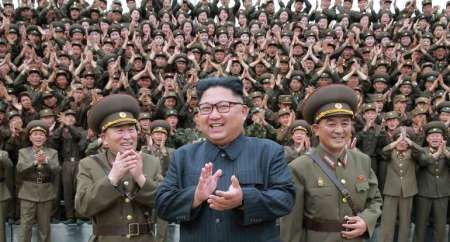
In this Aug. 14, 2017, photo distributed Tuesday, Aug. 15, 2017, by the North Korean government, North Korean leader Kim Jong Un acknowledges a welcome from the military officers during his visit to Korean People’s Army’s Strategic Forces in North Korea. The Korean Central News Agency said Tuesday that Kim during an inspection of the KPA’s Strategic Forces praised the military for drawing up a “close and careful” plan. Kim said he will give order for the missile test if the United States continues its “extremely dangerous actions” on the Korean Peninsula. Independent journalists were not given access to cover the event depicted in this image. (Korean Central News Agency/Korea News Service via AP)

[N]one of the top policy makers sees the enemy alliance as a global threat. They think case-by-case, trying to devise separate “solutions” for each enemy.

I think they are wrong in both instances. I think Kim, Khamenei and Maduro, along with Putin and Assad, are right to fear their own people. And I am convinced that revolution is more likely to advance our interests than are military surges or economic sanctions.

*********************************

It’s now two weeks since we learned that British intelligence has concluded that the North Koreans couldn’t have developed their nuclear weapons all by themselves. According to the Telegraph, “North Korean scientists are people of some ability, but clearly they’re not doing it entirely in a vacuum,” said one government minister. The two main suspects, according to the Brits, are the Iranians and the Russians.

This is not exactly breaking news. For years, I have written about the Nork/Iranian joint nuclear venture, and a long version of the story written by Gordon Changappeared in 2015, suggesting that Iran had outsourced part of its nuclear program to Pyongyang:

The relationship between the two regimes has been long-lasting. Hundreds of North Koreans have worked at about 10 nuclear and missile facilities in Iran. There were so many nuclear and missile scientists, specialists, and technicians that they took over their own coastal resort there, according to Henry Sokolski, the proliferation maven, writing in 2003.

That’s fourteen years ago. The Iran/Nork collusion is similar to an Iran/China arrangement; there are oil-producing areas of Iran under complete Chinese control.

In other words, we’re talking about an international alliance of enemies of America. Iranian and Russian assistance to the Norks’ nuclear project are a big part of that alliance, as is Russian military action, most dramatically on the Middle Eastern battlefield. As Andrew Tabler tells us in suitably ominous tones, Russian-led and -supplied forces, in conjunction with Iranian forces and proxies, just crossed the Euphrates, bringing the enemy alliance closer to conflict with our guys:

In addition, the crossing brings Iran one step closer to its stated goal of creating a land bridge between Iraq and Syria, giving the Islamic Republic another avenue through which to place troops and weapons on the borders of U.S. allies. Tehran has steadily worked toward that goal even as Israel reached a de-escalation agreement in southwestern Syria designed to keep Hezbollah and other Iranian-supported militias a few kilometers away from the Golan Heights frontier.

Remember that the Russians entered the Syrian battlefield after the Iranians begged them for help. Without Russian air power and ground forces, Iran would likely have lost, Assad would have fallen, and the Middle East would be less threatening to our interests than it is today.

Those of a certain age may recall that President George W. Bush delivered a State of the Union address after 9/11, in which he spoke of an “Axis of Evil” comprised of Iran, Saddam Hussein’s Iraq, and North Korea. Many were baffled at the Norks’ inclusion. Was it an effort at ethnic balance, or what? But we now see that W. was right; North Korea has been deeply involved in the enemy alliance all along.

Iraq has dropped out, although it is increasingly beholden to Tehran. It may yet return to full status in the Evil Axis. And, as President Trump duly noted in his UN speech, there’s also Venezuela, here in our own hemisphere.

The president did well, I thought, to stress that Iran, North Korea, and Venezuela all brutally oppress their own people, whom the Iranian, Korean and Venezuelan tyrants mortally fear. Indeed, Trump was just one small logical step away from the proper strategic conclusion: since those enemies of ours fear their own people almost as much as they fear American military power, we should actively, publicly, and creatively support the internal opposition in all three countries.

But although Trump’s words certainly point in that direction, he has neither called for us and our allies to support internal opposition, nor has he come right out and called for regime change. Why not?

First of all, because his top three national security officials—Secretary of Defense James Mattis, National Security Adviser H.R. McMaster, and Secretary of State Rex Tillerson—oppose such a policy. They are more inclined to look for either a military “solution” or to impose crushing sanctions.

Second, none of the top policy makers sees the enemy alliance as a global threat. They think case-by-case, trying to devise separate “solutions” for each enemy.

I think they are wrong in both instances. I think Kim, Khamenei and Maduro, along with Putin and Assad, are right to fear their own people. And I am convinced that revolution is more likely to advance our interests than are military surges or economic sanctions.

Trump has promised to announce a new Middle East (mostly Iran) policy shortly. Some smart people think he’s going to call for support to the oppressed people. I would be thrilled if that happened, but doubt it will.

Hold your breath.

Right Angle – A Little Advice For Kim Jong Un – 09/21/17

September 22, 2017

Right Angle – A Little Advice For Kim Jong Un – 09/21/17, Bill Whittle Channel via YouTube

(Please see also, Korea: Escalation Is A Two-Way Street, suggesting that North Korea is a bigger problem for China than for any other country. — DM)


As the blurb beneath the video states,

As North Korea grows more and more unhinged, the nuclear threat becomes more and more real. Recently, North Korea threatened to launch a nuke at the island of Guam. In light of this escalation of threats, the Right Angle team has a little advice for Kim Jong Un: Do not mess with the United States of America.

A North Korea nuclear test over the Pacific? Logical, terrifying

September 22, 2017

A North Korea nuclear test over the Pacific? Logical, terrifying, ReutersHyonhee ShinLinda Sieg, September 22, 2017

“To put a live nuclear warhead on a missile that’s only been tested a handful of times, overflying potentially populated centers. If it…doesn’t go exactly as planned….it could be a world changing event.”

If Kim’s threat materializes, it will be a “tipping point” for China, and may prompt many other countries to demand an “end to the regime,” said David Albright, founder of the non-profit Institute for Science and International Security in Washington.

“No one has tested above ground for decades and the radioactive fallout could be terrifying to many,” Albright said.

****************************

SEOUL/TOKYO (Reuters) – Detonating a nuclear-tipped missile over the Pacific Ocean would be a logical final step by North Korea to prove the success of its weapons program but would be extremely provocative and carry huge risks, arms control experts said on Friday.

North Korean Foreign Minister Ri Yong Ho suggested leader Kim Jong Un was considering testing “an unprecedented scale hydrogen bomb” over the Pacific in response to U.S. President Donald Trump’s threat at the United Nations to “totally destroy” the country.

“It may mean North Korea will fire a warhead-tipped (intermediate range) Hwasong-12 or Hwasong-14 intercontinental ballistic missile and blow it up a few hundred kilometers above the Pacific Ocean,” said Yang Uk, a senior researcher at the Korea Defence and Security Forum in Seoul.

“They may be bluffing, but there is a need for them to test their combined missile-bomb capability. They could have already prepared the plan and are now trying to use Trump’s remarks as an excuse to make it happen,” said Yang.

Such an atmospheric test would be the first globally since China detonated a device in 1980, according to the International Atomic Energy Agency.

Tests of nuclear-tipped ballistic missiles are rarer still. The United States’ only test of an operational ballistic missile with a live warhead was fired from submarine far out in the Pacific Ocean in 1962.

China was widely condemned for a similar test with a missile that exploded over its Lop Nur test site in the country’s west in 1966.

North Korea’s six nuclear tests to date have all been underground, the most recent earlier this month by far its largest.

“We have to assume they *could* do it, but it is exceedingly provocative,” said Vipin Narang, an associate professor of political science at  Massachusetts Institute of Technology.

“To put a live nuclear warhead on a missile that’s only been tested a handful of times, overflying potentially populated centers. If it…doesn’t go exactly as planned….it could be a world changing event.”

North Korea has fired two ballistic missiles over Japan’s north Hokkaido region in the past month as part of a series of tests that experts say have illustrated unexpectedly rapid advances.

“They said Pacific Ocean, which pretty much means firing a missile over Japan,” said Melissa Hanham, a senior research associate at the U.S.-based Middlebury Institute of International Studies at Monterey, California. “They want to shut us all up for doubting they could build it.”

SERIOUS FALLOUT

While a missile would be the most ideal means of delivery, it is also possible to put a bomb on a ship and detonate on the surface of the ocean or in the sea, the experts said.

Either way, the radioactive fallout could be significant, as well as the diplomatic backlash from around the world. North Korea’s recent missile launches over Japan especially drew stern rebukes from Tokyo and the international community.

Japan’s Chief Cabinet Secretary Yoshihide Suga called Pyongyang’s remarks and behavior “completely unacceptable”.

Narang said a test high enough over the ocean would limit the radioactive fallout but risks included damage from an electro-magnetic pulse, something Pyongyang has hinted it might employ on an attack on the United States or its allies.

“If it doesn’t go exactly as planned and the detonation occurs at a lower altitude we could see some EMP-like effects for anything in the area. A lot of dead fish too.”

Pyongyang has launched dozens of missiles this year as it spurs a program aimed at mastering a nuclear-tipped missile that can strike the United States, in addition to its Sept 3 nuclear test.

If Kim’s threat materializes, it will be a “tipping point” for China, and may prompt many other countries to demand an “end to the regime,” said David Albright, founder of the non-profit Institute for Science and International Security in Washington.

“No one has tested above ground for decades and the radioactive fallout could be terrifying to many,” Albright said.

Other experts said such an atmospheric nuclear test is unlikely for now due to its substantial technical and diplomatic risks.

Joshua Pollack, editor of the Washington-based Nonproliferation Review, said it would be an “end-to-end demo of everything.”

“But I would be surprised if this were their very next move. They have yet to test an ICBM at full range into the Pacific,” said Pollack. “That will probably come first.”

South Korean President: Trump’s ‘Very Strong Speech’ Will ‘Help Contain North Korea’

September 21, 2017

South Korean President: Trump’s ‘Very Strong Speech’ Will ‘Help Contain North Korea’, Washington Free Beacon , September 21, 2017

https://www.youtube.com/watch?v=lvgiC7v5Qls


South Korean President Moon Jae-in expressed his support Thursday for President Donald Trump’s stance on North Korea’s nuclear program, indicating it will be effective to help contain its Northern neighbor.

At a meeting in New York City, Trump and Moon focused on responding to the North Korean regime’s development of nuclear weapons and long-range ballistic missiles. During the discussion, the South Korean president said, through an interpreter, that he is satisfied with Trump’s firm approach toward the North Korean regime and leader Kim Jong Un.

“North Korea has continued to make provocations and this is extremely deplorable and this has angered both me and our people,” Moon said. “But the United States has responded firmly and in a very good way and because of this I also believe that we have very close coordination between Korea and the United States and because of this I am very satisfied.”

Trump joked about the interpreter using “deplorable,” a word Hillary Clinton famously used during the election to describe Trump’s supporters.

Moon specifically praised Trump’s speech at the U.N., saying it will “help contain North Korea.”

“Mr. President, in the U.N. general assembly you made a very strong speech and I believe that the strength of your speech will also help contain North Korea,” Moon said. “Thank you very much.”

Trump’s initial words emphasized his cooperation with Moon and other allies in Asia.

“We are meeting on a constant basis,” Trump said. “We’ll be meeting in a little while also with Prime Minister Abe of Japan and that will be a tri-meeting, so we will see. But, I think we’re making a lot of progress in a lot of different ways. Stay tuned.”

Trump made a point to say North Korea was the more important issue, but also referred to ongoing negotiations regarding the United State’s trade deal with South Korea.

“We are on a very friendly basis working on trade and working on trade agreements and we’ll see how that all comes out,” Trump said. Later he remarked that the current deal has been “so bad for the United States and so good for South Korea.”

“We’re going to try to straighten out the trade deal and make it fair for everybody,” Trump said shortly before going into a meeting with Moon and Abe. “But our real focus will be on the military and our relationship with South Korea, which is excellent, really excellent.”

Moon also emphasized that he has spoken with Trump regularly about the Kim regime situation. He did not address trade deals.

“Mr. President, I have met with you several times and have also had many telephone conversations with you, and because of this I am becoming more and more familiar with you,” Moon said.

Trump also announced an executive order to bring new sanctions against countries who trade with North Korea.

Korea: Escalation Is A Two-Way Street

September 19, 2017

Korea: Escalation Is A Two-Way Street, Strategy Page, September 15, 2017

(This is a lengthy article but provides very useful insights. — DM)

The latest North Korean nuclear and missile tests have caused Chinese public opinion towards North Korea to become even more hostile. According to opinion polls North Korea has, over the last few years, turned into a larger military threat to China than the U.S. or anyone else. To deal with this China has increased the number of troops and border police stationed near the North Korean border and conducted more military exercises in the area. This also addresses another Chinese fear (that gets less publicity in China) that a government collapse in North Korea would send millions of desperate, and opportunistic, North Koreans into China. There is no way China or the Chinese living along the North Korean border would tolerate that. Meanwhile China is becoming more hostile to North Koreans no matter what their legal or economic status is. Part of that is because North Korea has become a very unpleasant place for Chinese to visit or do business in.

******************************

Every nation has its priorities and for North Korea it is all about image. Most people see that in terms of North Korean nuclear weapons and ballistic missiles. But there are other equally important (to the North Korean leaders) issues that get little publicity, and that is intentional. In mid-2017 North Korea ordered its secret police to expand its operations in northeast China (the area just across the northern border) so as to suppress news about the growing number of senior and mid-level officials who are, often with their families, illegally leaving North Korea. The single incident that prompted this new secret police effort was the suicide of one of these families (all five of them). The five took poison after being arrested by Chinese police and facing repatriation to North Korea, where the entire family would probably die anyway but more slowly and painfully. The secret police were ordered to increase efforts to prevent such defections in the first place. That will be difficult because the mood among many North Korean officials can best be described as suppressed (so the secret police don’t take note) panic and increased efforts to escape from the country and get to South Korea.

Senior North Korean officials who have gotten out in the last few years all agree that Kim Jong Un is considered a failure by more and more North Koreans and that his days are numbered, even if China does not step in and take over beforehand. Yet these senior officials report that Kim Jong Un could keep his police state going into the late 2020s. But time is not on his side and the signs backing that up are increasingly obvious. Kim Jong Un has triggered a trend that will destroy him and nothing he does seems to fix the problem. He believes having workable nukes and a reliable delivery system (ballistic missiles) will enable him to extort the neighbors for enough goodies to bail him out. That is a high-risk strategy. Kim Jong Un is betting everything on this and none of the potential victims seems ready to give in and are instead planning to meet nuclear threats with force not surrender. Escalation and intimidation work both ways.

Coming Up Short

North Korea has reduced its physical standards for military service. Previously conscripts had to be 150 cm (59 inches) tall and weigh at least 48 kg (106 pounds). But that standard has been reduced over the last decade to 137 cm (54 inches) and 43 kg (95 pounds). Now the government is urging teenage boys to volunteer for service when they are 15 years old. Actually, local officials have been given quotas and are coercing families of 15 year old boys to go along with this. With all the food shortages and unemployment the government sees that as an incentive. But most teenagers prefer to try their luck with the market economy and eventually make enough money to get out of North Korea.

The government needs more soldiers because of a lower birthrate and the inability to reverse the problem. South Korea also has this problem but for different reasons. By 2010 South Korea had the lowest birth rate (1.15 children per woman, on average) in the world and held that dubious achievement for two years in a row. This is because of growing affluence over the last half century. South Korea is now one of the wealthiest nations on the planet. At the current birth rate, the South Korean population is expected to stop growing in the 2020s, after reaching about 52 million (about twice the population of the north). If the birth rate stays under 2.1, the population will then begin to shrink. In North Korea, the birth rate is 1.9, and is also declining, because of increasing poverty and famine. For example, life expectancy in the north has declined from 72.7 years in the early 1990s, to 69.3 now. That’s ten years less than in South Korea. Northerners are not only living shorter lives, they are also shorter. A study of teenagers in the north and south revealed that the northerners are 8 percent shorter, and weigh nearly 20 percent less. It’s not as bad with older adults, because they were not born during the famine (which began after Cold War Russian subsidies ended in the early 1990s).

By 2012 there was a very visible shortage of recruits for the North Korean armed forces. A lower birth rate in the 1990s, because of the famine (that killed five percent of the population back then) has reduced the number of 18 year old recruits for the army and security forces. So fewer exemptions are being allowed, and more 17 years olds are being taken. That escalated to pressuring 16 year olds to volunteer. Now the government is after 15 year olds. North Korean men serve at least six years (and up to ten) in the military, keeping them out of trouble for that time in their lives (18-24), when they are most likely to act out revolutionary fantasies. The military is really a large prison system. While the troops are trained to use weapons, they get little ammunition for training, and the weapons are locked up most of the time. Young North Koreans increasingly know how poor they are, and in greater and greater detail. The soldiers born during the great famine of the 1990s are well-aware that they are physically much smaller than their South Korean counterparts. They also know that the average South Korean lives ten years longer and lives a much more pleasant life. All the more reason to limit the time North Korean troops can handle their weapons, especially when they have ammunition (which is actually very infrequently.)

By 2017 North Korean army officers were ordered to encourage their troops to steal food during the harvest and that failure to do so could result in punishment and would definitely result in hunger. Naturally this has caused more popular anger towards the military. This is nothing new. In 2016 hungry troops grew bolder because the government made it clear they would not punish soldiers unless people are killed or badly injured during these incidents. Police are often called to catch soldiers who have robbed someone. At first this was usually troops breaking into a house seeking food and valuables. The soldiers that are caught are often arrested but must be taken back to their base where the military takes over. The soldiers are “punished” with some verbal abuse for getting caught and that is all. The government was desperate because earlier efforts to address the problem had failed. In 2015 there was a new program to expand food production by the military. Troops were allowed to raise pigs as well as the usual vegetable and grain crops. Meat has been in particularly short supply for the troops in the past few years and hungry troops often steal small livestock (chickens, ducks and pigs), kill them on the spot and carry them off to be cooked and eaten before returning to base. As more reports came in it became apparent that most military units didn’t have enough to eat, either because the food was not to be had or, as is more often the case, corruption (someone in a position of power stole it.) This led to more soldiers stealing food from civilians or selling military clothing and equipment on the black market so they could buy food. Soldiers have opportunities to steal food and sell stolen goods when they are off their base doing construction or farm work. This is how troops spend a lot of their time and they receive no extra pay or food even when the outside work requires heavy (and calorie consuming) labor. All this is illegal, but commanders were not eager to punish hungry soldiers. For commanders their troops have become profitable slaves who can be rented out with the commanders getting part of the payment. Now the government insists that disobedient slaves be executed.

Visible Signs Of Decline

Declining discipline in the police is more evident in many obvious ways. For example a growing number of North Korean women are operating openly as prostitutes (usually near border areas where there are more foreigners). These women get $20 or more per customer but get to keep less than 20 percent of that because the rest goes to bribes (for police) and “fees” to various middlemen (or women) who supervise it all. Thus it is not surprising that these young (from late teens to 30s) women will also offer to sell drugs (usually meth) to customers as well. Many of these prostitutes are married and some have children but no money to keep the kids fed and healthy.

With the growth of free markets and police getting jealous, greedy and corrupted by demanding and getting bribes, there has also developed criminal gangs. These groups often have connections (usually financial) with the security forces and of course the gangsters are all veterans. The gangs act as middlemen between donju (free market entrepreneurs) and the government but as a matter of law, the gangs do not exist. As a matter of fact the gangs are very real and one of the fastest growing sectors of the market economy.

China Chooses Sides

The latest North Korean nuclear and missile tests have caused Chinese public opinion towards North Korea to become even more hostile. According to opinion polls North Korea has, over the last few years, turned into a larger military threat to China than the U.S. or anyone else. To deal with this China has increased the number of troops and border police stationed near the North Korean border and conducted more military exercises in the area. This also addresses another Chinese fear (that gets less publicity in China) that a government collapse in North Korea would send millions of desperate, and opportunistic, North Koreans into China. There is no way China or the Chinese living along the North Korean border would tolerate that. Meanwhile China is becoming more hostile to North Koreans no matter what their legal or economic status is. Part of that is because North Korea has become a very unpleasant place for Chinese to visit or do business in.

News of the bad treatment Chinese are suffering in North Korea gets around, even when the Chinese government tries to keep the worst examples out of the news. Chinese individuals and firms doing business in North Korea complain that the North Koreans have become even more unreliable when it comes to handling foreign investments from China. In the past China could impose some degree of discipline on North Korea for abuse of Chinese investors and investments. The North Koreans are increasingly ignoring this sort of pressure and as a result Chinese investors are backing away from current and planned investments. China could order state owned firms to do business in North Korea but does not because these firms are poorly run compared to the privately owned firms and would suffer even larger losses when dealing the increasingly treacherous and unreliable neighbor.

North Korea used to be a dependable place, at least for Chinese with the right connections in the Chinese government. While corruption in China has declined in the past few years it appears to have gotten worse in North Korea, to the point where long-term deals are avoided and transactions are made carefully, usually with payment before delivery. The smugglers and various other criminal gangs in China that do business with their North Korean counterparts have been forced to operate this way as well and for the same reasons. South Korea and Japan have already learned how unreliable North Korea can be when it comes to business deals and Russia has already adopted the wary approach to economic deals with North Korea.

China has visibly increased enforcement of economic sanctions on North Korea but this has not made North Korea any more willing to negotiate. The growing number of police and secret police night patrols in areas where North Korean smugglers long operated is hard to miss, as is the fact that when North Korean smugglers are encountered they get arrested and taken away. Even higher bribes (over $3,000 to make an arrest not happen) no longer work because the Chinese cops will still demand that amount of cash before they will turn the smugglers over to North Korean officials. China never came down so hard on North Korean smuggling before.

China is also cracking down on North Korean drug production and smuggling. This is a matter of self-defense for China and is effective because North Korea make the highest profits from methamphetamine (“meth”). But this drug requires a key ingredient (phenylacetic acid, in the form of white crystals) to be smuggled in from China. Now the Chinese are cracking down on that as well as the meth coming into China. North Korea is seeking another, probably more expensive, supplier in Russia.

While Russia is still doing business with North Korea China and Russia are also cooperating with many of the new rules banning North Korean workers they long employed legally. This exported labor was outlawed by the latest round of sanctions. North Korea responded by quietly ordering overseas workers to stay where they are and work illegally (in deals arranged by their government minders). Yet in many instances the export ban on slave labor is being enforced by Russia and especially China and that is hurting North Korea economically.

The North Koreans see this as yet another challenge that can be worked around. While it is true that there are still a lot of corrupt Chinese and Russians willing to do business with North Korea if the bribe is large enough, that is not working as well as it used to in China. This is because North Korea is very unpopular with Chinese in general and a growing number of senior Chinese officials in particular. Russians are less upset with North Korea and, while having fewer economic resources than China, are more receptive to shady deals. The problem is that North Korea has become very dependent on the much larger and still expanding Chinese economy. Russia simply cannot supply a lot of what North Korea needs. It is possible to still buy the forbidden goods in China and have them shipped to a fictitious customer in Russia who will quietly send it to North Korea. That does not always work and when it does it costs a lot more than getting the goods directly from China. North Korea has less cash for the extra expenses. The Chinese know this and are quite willing to slowly squeeze until North Korean leaders are all dead or more receptive to Chinese needs (no nukes next door and fewer desperate illegal migrants). Yet there is the growing risk that North Korea will get (or thinks it has) reliable nukes and keep threatening China. That is not the desired outcome but the Chinese have quietly reminded leaders of both Koreas (and their foreign allies) that in the past China has occupied much of Korea when the Koreans become troublesome.

Meanwhile China is not happy with South Korea either, fearing the growing military power of South Korea and the recent installation of a THAAD anti-missile battery despite vigorous Chinese diplomatic and economic efforts to prevent that. The diplomatic and economic pressure continues but the South Koreans are in no mood to back off as long as the North Korean threat remains. South Korea believes China could do more to eliminate the North Korean threat. While many, if not most, Chinese and Russians agree with that the Russian and Chinese governments still see economic opportunities in North Korea and are unwilling to do anything drastic.

September 14, 2017: In coincidental, nearly simultaneous, events North Korea fired a ballistic missile over Japan while South Korea fired two Hyunmoo 2 ballistic missiles. One of these failed while the other accurately hit the target area (at sea) 250 kilometers away. The North Korean missile travelled about 2,200 kilometers and landed in the Pacific. Japan said it tracked the missile and did not try to intercept because it was obvious the missile was following a trajectory that would take it far from Japan. The identity of the North Korean missile was not known.

South Korea has developed a longer (500 kilometer) version; Hyunmoo 2C. South Korea developed a 180 kilometer range ballistic missile (Hyunmoo 1) and a 300 kilometer one (Hyunmoo 2) in the 1980s. Both are about 13 meters (40 feet) long and weigh 4-5 tons. Both of these were based on the design of the U.S. Nike-Hercules anti-aircraft missile, which South Korea used for many years.

September 13, 2017: Google and YouTube have banned videos from North Korean media, apparently because it is a source of income for North Korea and now in violation of sanctions. This reduces open source access to North Korean TV although intelligence agencies will still be able to get these.

China has restricted access to Mount Paektu, apparently for safety reasons related to the recent North Korean nuclear test, which was conducted 110 kilometers away. Mount Paektu is a dormant volcano on the Chinese border. In fact, half the volcano is in China, where it is a popular tourist destination for South Koreans. That’s because Koreans and Manchus (as in Manchuria, the native people of northeast China) both consider Mt Paektu as a sacred place where their tribes originated thousands of years ago. In 2013 North Korea put some silos for their long range (2,000-3,000 kilometers) ballistic missiles up there because that part of North Korea is a triangle, surrounded on two sides by China. This makes it difficult for the Americans to launch air attacks without entering Chinese territory and makes it easier for North Korean anti-aircraft forces to defend against cruise missile. On the down side, Paektu is a dormant volcano that is active (lava flows and the like) about once a century. The last time it erupted (throwing large quantities of rocks and dust into the atmosphere) was in 1703 and an eruption in the late 10th century blew the top off the mountain and created the current 4.5 kilometers wide crater lake. Volcanologists consider Paektu capable of another major eruption but North Korea considers that less likely than an American air attack. So the silos stay, despite the risk of destruction by lava flows and earthquakes. Before all these silos were built North Korea planned to keep its long range ballistic missiles mobile and launch them from any number of launch sites (a flat field where the missile could be fueled and the guidance system programmed before launch.) Bad weather could complicate the use of mobile launchers (washing out bridges or blocking roads with snow). The quality of North Korean roads has also declined sharply (from lack of maintenance) since the late 1990s. Then there is the increased American surveillance (from satellites, U-2s and high-altitude UAVs) that makes mobile missiles more vulnerable to air or missile attack. Silos can also be attacked from the air, but in a war the more numerous and shorter range ballistic missiles to the south would also be subject to air attack as these missiles would be aimed at the South Korean capital. North Korea apparently believes that silos protected by a sacred volcano are a worthwhile investment to ensure that some of long-range missiles will get launched during a crises. China is more concerned about nuclear radiation coming from North Korea.

September 12, 2017: Chinese radiation monitors on the North Korean border recorded levels were up seven percent since the September 3rd test and have appeared to have peaked. This data was released because the population along the border know that they face some health risks if radiation levels increase too much for too long.

September 11, 2017: The UN approved new economic sanctions against North Korea and China said it would enforce them all and repeated that it had been enforcing sanctions since March. The new sanctions limit the export of refined petroleum product to two million barrels a year and ban North Korea from importing liquefied natural gas. This followed China condemning North Korea nuclear tests openly in the UN for the first time.

Meanwhile the United States continues to call on China and Russia to do more to halt the North Korean evasion of sanctions via corrupt officials and businesses in China and Russia. China in particular does not want too much international attention focused on that corruption, which has long been quite active along the North Korean border and still is. The United States is not being diplomatic in pointing this out but it is correct in showing how Chinese enforcement of sanctions does not really work unless China effectively curbs the Chinese corruption that enables North Korea to continue doing whatever it wants. For the North Korea the increased sanctions pressure merely increases costs (larger bribes are required in China and Russia).

September 10, 2017: Chinese banks have been warning its customers to stay away from bitcoin because of the threat from North Korean hackers, who are believed to be responsible for several recent multi-million dollar thefts from bitcoin exchanges. North Korea is believed to be targeting bitcoin and other Internet based cryptocurrencies even though North Korea has used bitcoin exchanges as a substitute for sanctions that ban it from accessing the international banking system. The Chinese government fears that North Korean hackers are now going after Chinese firms, something they are not supposed to do because China is still the main source of foreign trade. This sort of irrational behavior leads China to fear that North Korea would even be foolish to become a real military threat to China.

September 9, 2017: China orders all Chinese banks (including foreign banks licensed to operate in China) to not only stop opening accounts for North Koreans but also to close any such accounts immediately. This is a very harmful economic sanction and the North Koreans respond by ignoring the new rules any way they can.

September 8, 2017: North Korea has quietly freed a Russian yacht it had seized in mid-June. A North Korean warship seized the Russian yacht when both were 80 kilometers off the coast. The yacht and the vessel towing it to Vladivostok were definitely in international waters and the Russian ambassador demanded the release of the yacht and three man crew. North Korea was not responsive until now. This was similar to a May 2016 incident where North Korean warship seized a Russian sailing yacht some 160 kilometers from the east coast of North Korea (very much in international waters). The yacht and crew of five were taken to a North Korean port. The yacht was released two days later and continued on its way to its original destination (Vladivostok) for a sailboat race. In both cases North Korea would not say why they took the yacht and then released it.

September 7, 2017: South Korea has completed deploying an entire THAAD battery to a site some 300 kilometers south of the North Korean border. The United States will share radar data generated by the high-powered radar installed as part of a THAAD anti-missile battery that began arriving in early 2017. The THAAD battery is operated by American personnel and costs $3.5 million a year to operate. The battery consists of six truck-mounted missile launchers (eight missiles per launcher), a fire control and communications unit and an AN/TPY-2 radar. Villagers living near the site of the THAAD base oppose the presence of the anti-missile battery because it will be a target for North Korean (or even Chinese) attack. Locals also fear (without any evidence) that the powerful THAAD radar will cause health problems.

September 6, 2017: A recent online opinion survey in China showed that 66 percent believed North Korea was a larger military threat to China than the United States. Only 10 percent felt the Americans were a larger threat and 15 percent believed the U.S. was no threat at all. This is consistent with earlier surveys only the degree of hostility towards North Korea keeps increasing. Chinese see North Korea has a poorly managed nation that is ungrateful towards China and unpredictable.

September 4, 2017: North Korean living near the site of the recent underground nuclear weapons test are demanding compensation for the damage done to their home by the earthquake (estimated to be 5.6 on the Richter scale) the test produced. Across the Yalu River some Chinese buildings also suffered damage from the quake and several aftershocks.

South Korea announced that its policy towards North Korea will now on “punishment” rather than negotiation.

September 3, 2017: North Korea carried out its sixth nuclear test. This one appeared to be the largest one yet indicating a yield of 100-200 tons and described as a hydrogen bomb. The first nuclear test was in 2006 (less than one kiloton) but the first one that was truly successful occurred in 2013 (6 kilotons) and despite the fact that the test was not a complete success, the nuclear bomb program continued with two tests in 2016. In late 2015 Kim Jong Un claimed that North Korea had developed a hydrogen (fusion) bomb. Foreign experts openly expressed skepticism given that North Korea didn’t really have a reliable fission type nuclear bomb yet. You need an efficient fission bomb to trigger the fusion reaction that makes the “H-Bomb” so much more destructive than a fission bomb of the same weight and size. Nuclear test number four in January 2016 was described by North Korea as a fusion (H-bomb) test when it clearly was not, or not a successful one. That would be in contrast to the 2013 test which appeared to be seven kilotons and a complete detonation. The second test was a two kiloton weapon in 2009. Western intelligence believed that the original North Korean nuclear weapon design was flawed, as the first two tests were only a fraction of what they should have been. The first one was less than a kiloton and called in the trade, a “fizzle.” The second test was less of a fizzle and apparently a modified version of the original design. Thus North Korea needed more tests to perfect their bomb design and was still years away from a useful nuclear weapon even though the second bomb appeared to be more effective. The third test in 2013 was considered overdue and that may have been because more time was spent designing and building a smaller device that could fit into a missile warhead. The second 2016 test is still something of a mystery. U.S. intelligence agencies have collected air samples (as have most other neighboring countries) from the test which can tell much about the design of the bomb. The January 2016 nuke appeared to be the same as the 2013 one. The second 2016 test in September appeared to be a better design and was about ten kilotons. North Korea insisted this was a fusion bomb. Air samples are still being collected on the test today but it will take weeks to analyze the samples and come to some useful conclusion. The sheer size of the most recent test indicated either a fusion bomb or an enhanced fission bomb. But for a yield of over 100 tons a fusion bomb is more likely. Such designs have been around and in use since the late 1940s. After the Soviet Union collapsed in 1991 a lot of Russian nuclear weapons designers and technicians were out of a job and the pensions of the retired ones were suddenly worth a lot less. The security for nuclear weapons designs, especially much older ones, became a lot more lax. There were plenty of opportunities to obtain previously unavailable tech.

August 29, 2017: North Korea fired a Hwasong-12 ballistic missile over Japan. This was the 18th North Korean ballistic missile test of 2017 and this one appeared to break into pieces before it fell into the ocean after travelling 2,700 kilometers from North Korea. This was the second successful test of the Hwasong-12.

August 28, 2017: South Korea announced its largest increase (6.9 percent for 2018) in its defense budget since 2009. This is a direct result of the increasing threat from North Korea. Next year South Korea will spend $38 billion, which is more than a third larger than the annual GDP of North Korea (which spends about a third of GDP on defense compared to less than three percent in South Korea). South Korea is in the top ten of national economies, something which annoys North Korea but is admired by the other neighbors (including China). Meanwhile Japan is also increasing its defense spending by 2.5 percent in 2018 (to $48 billion). Japan, like China and the U.S., are among the top five economies on the planet. Japan, because of the post-World War II constitution the United States insisted on (and Japan did not much object to) has been largely demilitarized considering the size of its economy. That is changing and the U.S. has dropped nearly all restrictions on what weapons it will export to South Korea and Japan and is ignoring treaties it has with both nations that restrict what types of advanced weapons (like ballistic missiles and nukes) they can develop. The Americans would still prefer that South Korea and Japan not build nukes (which both these nations could easily and quickly do). China and Russia would also prefer that Japan and South Korea remain non-nuclear weapon nations. But if North Korean military ambitions and threats (especially against South Korea and Japan) are not curbed popular opinion in South Korea and Japan is becoming more comfortable with the having their own nukes.

August 25, 2017: China banned North Korea from establishing any new businesses in China or expanding existing ones. Russia has done the same, but the Chinese are a much larger market and apparently intent on following through. Meanwhile the August 15 order for Chinese firms to halt imports of minerals and seafood cost some Chinese firms with physical operations (trucks, mines) and warehouses in North Korea to suffer losses because they were given only 24 hours to get this stuff back to China and that was not enough time. This was especially true when many North Korean officials demanded special payments before these goods could be moved.

August 24, 2017: A Russian Tu-95 bomber flew south from a base north of Korea until it got close enough to South Korea to cause South Korean F-16s to come up and investigate. Russia said it was a scheduled training flight.

Korean Peninsula Draws Range of Military Drills in Show of Force Against North Korea

September 18, 2017

Korean Peninsula Draws Range of Military Drills in Show of Force Against North Korea, Washington Free Beacon, Ben Blanchard and Hyonhee Shin, September 18, 2017

BEIJING/SEOUL (Reuters) – The U.S. military staged bombing drills with South Korea over the Korean peninsula and Russia and China began naval exercises ahead of a U.N. General Assembly meeting on Tuesday where North Korea’s nuclear threat is likely to loom large.

The flurry of military drills came after Pyongyang fired another mid-range ballistic missile over Japan on Friday and the reclusive North conducted its sixth and most powerful nuclear test on Sept. 3 in defiance of United Nations sanctions and other international pressure.

A pair of U.S. B-1B bombers and four F-35 jets flew from Guam and Japan and joined four South Korean F-15K fighters in the latest drill, South Korea’s defense ministry said.

The joint drills were being conducted “two to three times a month these days”, Defence Minister Song Young-moo told a parliamentary hearing on Monday.

In Beijing, the official Xinhua news agency said China and Russia began naval drills off the Russian far eastern port of Vladivostok, not far from the Russia-North Korea border.

Those drills were being conducted between Peter the Great Bay, near Vladivostok, and the southern part of the Sea of Okhotsk, to the north of Japan, it said.

The drills are the second part of China-Russian naval exercises this year, the first part of which was staged in the Baltic in July. Xinhua did not directly link the drills to current tension over North Korea.

China and Russia have repeatedly called for a peaceful solution and talks to resolve the issue.

On Sunday, however, U.S. Ambassador to the United Nations Nikki Haley said the U.N. Security Council had run out of options on containing North Korea’s nuclear program and the United States might have to turn the matter over to the Pentagon.

In response, Chinese Foreign Ministry spokesman Lu Kang said the most pressing task was for all parties to enforce the latest U.N. resolutions on North Korea fully, rather than “deliberately complicating the issue”.

Military threats from various parties have not promoted a resolution to the issue, he said.

“This is not beneficial to a final resolution to the peninsula nuclear issue,” Lu told a daily news briefing.

U.S. President Donald Trump has vowed that North Korea will never be able to threaten the United States with a nuclear-tipped ballistic missile.

Asked about Trump’s warning last month that the North Korean threat to the United States would be met with “fire and fury”, Haley said: “It was not an empty threat.”

Washington has also asked China to do more to rein in its neighbor and ally, while Beijing has urged the United States to refrain from making threats against the North.

FUEL PRICES SURGE

The U.N. Security Council unanimously passed a U.S.-drafted resolution a week ago mandating tougher new sanctions against Pyongyang that included banning textile imports and capping crude and petrol supply.

North Korea on Monday called the resolution “the most vicious, unethical and inhumane act of hostility to physically exterminate” its people, system and government.

“The increased moves of the U.S. and its vassal forces to impose sanctions and pressure… will only increase our pace toward the ultimate completion of the state nuclear force,” the North’s foreign ministry spokesman said in a statement carried by its official KCNA news agency.

Gasoline and diesel prices in the North have surged since the latest nuclear test in anticipation of a possible oil ban, according to market data analyzed by Reuters on Monday.

The international community must remain united and enforce sanctions against North Korea after its repeated launch of ballistic missiles, Japanese Prime Minister Shinzo Abe said in an editorial in the New York Times on Sunday.

Such tests were in violation of Security Council resolutions and showed that North Korea could now target the United States or Europe, he wrote.

Abe also said diplomacy and dialogue would not work with North Korea and concerted pressure by the entire international community was essential to tackle the threats posed by the north and its leader, Kim Jong Un.

However, the official China Daily argued on Monday that sanctions should be given time to bite and that the door must be left open to talks.

“With its Friday missile launch, Pyongyang wanted to give the impression that sanctions will not work,” it said in an editorial. “Some people have fallen for that and immediately echoed the suggestion, pointing to the failure of past sanctions to achieve their purpose.

“But that past sanctions did not work does not mean they will not. It is too early to claim failure because the latest sanctions have hardly begun to take effect. Giving the sanctions time to bite is the best way to make Pyongyang reconsider,” the newspaper said.

Pyongyang has launched dozens of missiles as it accelerates a weapons program designed to provide the ability to target the United States with a powerful, nuclear-tipped missile.

It says such programs are needed as a deterrent against invasion by the United States, which has 28,500 troops stationed in South Korea. On Saturday, it said it aimed to reach an “equilibrium” of military force with the United States.

The United States and South Korea are technically still at war with North Korea because the 1950-53 Korean conflict ended with a truce and not a peace treaty.

(Reporting by Ben Blanchard in BEIJING, Hyonhee Shin and Soyoung Kim in SEOUL; Editing by Paul Tait and Simon Cameron-Moore)

Haley: ‘North Korea Will Be Destroyed’ if the U.S. Has to Defend Itself

September 17, 2017

Haley: ‘North Korea Will Be Destroyed’ if the U.S. Has to Defend Itself, Washington Free Beacon, , September 17, 2017

(Please see also, Our Rhineland moment. — DM)


U.N. Ambassador Nikki Haley said Sunday “North Korea will be destroyed” if the U.S. is forced to defend itself against the belligerent country.

CNN host Dana Bash asked Haley on “State Of The Union” if President Donald Trump’s “fire and fury” remarks last month against dictator Kim Jong Un was an empty threat.

Haley said the threats were not empty and if the diplomatic process with North Korea doesn’t work she “would be perfectly happy to send this over to [Defense] Secretary Mattis” since he has “plenty of military options.”

“It was not an empty threat. What we were doing is being responsible. Where North Korea is being irresponsible and reckless, we were being responsible by trying to use every diplomatic possibility that we could possibly do. We’ve pretty much exhausted all the things that we could do at the security council at this point,” Haley said.

Bash followed up the original question by asking if Trump’s “fire and fury” remark meant a military option.

“By saying General Mattis will take care of it, you’re are talking about the Pentagon and you’re talking about a military option. Is that what ‘fire and fury’ meant?” Bash asked.

Haley answered firmly saying if the United States has to defend itself “North Korea will be destroyed.”

“You have to ask the president what fire and fury meant. But I think we all know that basically if North Korea keeps on with this reckless behavior, if the United States has to defend itself or defend its allies in any way, North Korea will be destroyed,” Haley said. “We all know that, and none of us want that.”

“None of us want war, but we also have to look at the fact that you’re are dealing with someone who is being reckless and irresponsible and is continuing to give threats not only to the United States but to all of their allies, so something is going to have to be done,” she added.

Our Rhineland moment

September 17, 2017

Our Rhineland moment, Israel National News, Dr. Peter Vincent Pry, September 17, 2017

Just as the Neville Chamberlains of 1939 were so paralyzed by fear of a replay of World War I that they preferred to ignore or explain away Nazi Germany’s rearmament and Imperial Japan’s naval build-up, their U.S. counterparts in 2017 are so fearful of facing a nuclear-armed North Korea that some would like to pretend a nation that has the H-Bomb cannot build a simple reentry vehicle or make an EMP attack.

Our elites cling to the fantasy that China and economic sanctions can save us, that North Korean denuclearization can be achieved peacefully.  But the evidence is now overwhelming that China and Russia have helped build the North Korean nuclear threat as part of their New Cold War to force the United States out of the Pacific and out of its role as the world policeman.

When the U.S. and its allies must seek security from North Korea by appealing for help from Beijing and Moscow, as we are doing now, the world order is already being transformed.  The Nuclear Axis seeks our acquiescence to their domination, peacefully if possible, if necessary through war.

North Korea’s nuclear Hitler has entered the technological Rhineland of H-Bombs and ICBMs.  We must strike.

*********************************

North Korea’s successful test of an H-Bomb on September 2 has been preceded by many years of denial behavior by U.S. statesmen, intelligence experts, academics and the press about the sophistication of Pyongyang’s nuclear missile program. Again?

Is the naivete and willful blindness that helped begin World War II on September 1, 1939, being repeated in the response of the U.S. and its allies to North Korea’s nuclear missile program, that apparently tested a thermonuclear H-Bomb warhead on September 2, 2017?

Parallels are striking between what psychiatrists describe as “denial behavior” by western elites that contributed to the Second World War, and “denial behavior” toward the North Korean nuclear threat.

As everyone used to know, when history was taught in schools, prior to 1939 Nazi Germany and Imperial Japan ruthlessly violated international treaties to arm themselves for a major war of conquest, that would become World War II.  Berlin and Tokyo were ineffectually opposed by the League of Nations and the western democracies, who would become their victims.

Less well known is that Nazi Germany and Imperial Japan were helped, unwittingly, by western statesmen, military experts, academics and the press, who could not believe any rational actor would risk replaying the holocaust that was World War I, still recent in many memories.  Complex rationalizations were invented to explain away the words and deeds of Adolph Hitler and Imperial Japan, including their treaty violations and aggression.

Nazi Germany and Imperial Japan’s growing military strength, when it could no longer be denied, was dismissed by confidence that the horrors of a new world war would be sufficient to deter.  Mutual Assured Destruction was an article of faith before World War II, expressed in different words, as when British Prime Minister Neville Chamberlain opined, “The bomber will always get through.”

Underestimation of German and Japanese military capabilities set up the allies for near defeat when war came.

North Korea’s successful test of an H-Bomb on September 2 has been preceded by many years of denial behavior by U.S. statesmen, intelligence experts, academics and the press about the sophistication of Pyongyang’s nuclear missile program:

–Just six months ago, most experts thought North Korea’s nuclear arsenal was primitive and tiny, perhaps as few as 6 A-Bombs.  Now the intelligence community estimates North Korea has 60 nuclear weapons.

–Just six months ago, many experts thought North Korea’s ICBMs were fake missiles, only for show, and most experts thought, if they were real, they could not strike the U.S. mainland.  Now the intelligence community estimates North Korea’s ICBMs can strike at least as far as Chicago, and probably hit anywhere in the United States.

–Just six months ago, most experts thought North Korea was many years away from developing an H-Bomb.  Now the U.S. intelligence community assesses that North Korea has the H-Bomb, with a yield tested at 140 kilotons (Japan estimates160 kilotons), about 14-16 times more powerful than the A-Bomb that destroyed Hiroshima, comparable in power to sophisticated U.S. two-stage thermonuclear weapons.

–Just six months ago, most experts claimed North Korean ICBMs could not deliver a nuclear warhead, because Pyongyang had not yet “demonstrated” it could miniaturize an A-Bomb to fit inside a reentry vehicle, or design a reentry vehicle capable of penetrating the atmosphere.  Now the intelligence community assesses North Korea has miniaturized A-Bombs and H-Bombs, and reentry vehicles for missile delivery, including by ICBMs that can strike the United States.

Perhaps the most extreme denial behavior is over North Korea’s capability to make a nuclear electromagnetic pulse (EMP) attack-that could destroy the United States with a single weapon.  The blue ribbon Congressional EMP Commission has warned for years that North Korea probably has Super-EMP weapons.

North Korea confirmed the EMP Commission’s assessment by testing an H-Bomb that could make a devastating EMP attack, and in a public statement: “The H-Bomb, the explosive power of which is adjustable from tens of kilotons to hundreds of kilotons, is a multi-functional thermonuclear weapon with great destructive power which can be detonated even at high altitudes for super-powerful EMP attack according to strategic goals.”

Pyongyang also released a technical report accurately describing a Super-EMP weapon.

Just six months ago, some academics dismissed EMP Commission warnings and even, literally, laughed on National Public Radio at the idea North Korea could make an EMP attack.

Amazingly, Sig Hecker, a respected scientist and former director of Los Alamos National Laboratory, is still in denial about the North Korean EMP threat, claiming it must be disinformation.  But since their H-Bomb is undeniably real, so too is North Korea’s EMP threat.

Amazingly, some academics are still bending over backwards to deny North Korea has miniaturized warheads, reentry vehicles, and ICBMs that can strike the U.S., inventing preposterous theories to escape reality, just like their brethren who paved the way to World War II with denial.

Just as the Neville Chamberlains of 1939 were so paralyzed by fear of a replay of World War I that they preferred to ignore or explain away Nazi Germany’s rearmament and Imperial Japan’s naval build-up, their U.S. counterparts in 2017 are so fearful of facing a nuclear-armed North Korea that some would like to pretend a nation that has the H-Bomb cannot build a simple reentry vehicle or make an EMP attack.

Another factor that helped bring on World War II was the western democracies were undergoing a civilizational crisis, as we are today.

Elites and peoples lost faith in themselves and their institutions as a result of the Great Depression and World War I.  Many believed the false narrative that the First World War resulted from a conspiracy by “merchants of death” among the industrial and political elites to become wealthy by war profiteering.  Nationalism was condemned by many as the root of war.  Globalists of the 1920s and 1930s fantasized that a Kellogg-Briand Pact and League of Nations could outlaw war, just as globalists today fantasize that the United Nations, international treaties and sanctions can achieve a world without nuclear weapons, while doubting the nationalist values and institutions that made the United States, and the Free World, great and free.

Indeed, economic sanctions against Imperial Japan, viewed as a peaceful way to stop Tokyo’s aggression against China and Manchuria, instead resulted in Japan’s surprise attack against the U.S. Navy at Pearl Harbor on December 7, 1941.

Most dangerous, the Neville Chamberlains of 1939 believed that because “the bomber will always get through” they could deter World War II.  The Neville Chamberlains of 2017 are so fearful of nuclear weapons that they are ready to surrender to the fantasy that we can learn to live with a nuclear-armed North Korea.

Those like Susan Rice, former national security advisor to President Obama, who are willing to make the world, in President Kennedy’s famous words about protecting freedom, “pay any price, bear any burden” to stop Global Warming, are all too eager to surrender our children to a future of Mutual Assured Destruction with Kim Jong-Un.

The new rationalization for doing nothing militarily is it is too late, would cost too many lives, and we can learn to live with nuclear North Korea as we did with the USSR during the Cold War.  But North Korea is not the USSR, and the nuclear-armed Caligula in Pyongyang is not  Moscow’s Politburo, dangerous as it was.  And the Cold War is no good paradigm for survival.  The world barely escaped a thermonuclear holocaust at least a dozen times. (See my book “War Scare: Russia and America on the Nuclear Brink.”)

The U.S. and allied elites have so educated themselves about the horrors of nuclear war that we are self-deterred, and will not act militarily to save ourselves.

Our elites cling to the fantasy that China and economic sanctions can save us, that North Korean denuclearization can be achieved peacefully.  But the evidence is now overwhelming that China and Russia have helped build the North Korean nuclear threat as part of their New Cold War to force the United States out of the Pacific and out of its role as the world policeman.

When the U.S. and its allies must seek security from North Korea by appealing for help from Beijing and Moscow, as we are doing now, the world order is already being transformed.  The Nuclear Axis seeks our acquiescence to their domination, peacefully if possible, if necessary through war.

If Russia and China’s North Korean nuclear gambit works in the Pacific, look next to Iran going nuclear, creating another nuclear crisis for the United States and its allies in the Middle East and Europe.  Iran’s nuclear missile program has been and is being helped by Moscow, Beijing, and Pyongyang, because Tehran is part of the Nuclear Axis waging the New Cold War against the still unwitting democracies of East and West.

U.S. abject surrender to a nuclear-armed North Korea by accepting Mutual Assured Destruction with Kim Jong-Un for ourselves and our allies, after proclaiming for 25 years that this is impossible, will destroy our credibility.  Russia, China, North Korea, and Iran will see such weakness as an invitation to aggression in Asia, the Middle East, Europe, and against the United States.

Just as the Neville Chamberlains of 1939 brought World War II on themselves, the Neville Chamberlains of 2017 are on the verge of bringing on World War III.

Most historians agree that World War II could have been prevented and 60 million lives saved if the Allies had crushed Hitler when his military was still weak in 1936, but he seized the Rhineland anyway to test their political will.

Right now, North Korea has two satellites and fewer than a dozen ICBMs that could threaten the U.S. homeland.  These the U.S. could assuredly destroy in a very limited surgical strike using conventional weapons.

Kim Jong-Un would not likely retaliate massively as his regime would remain in power and retain nearly 1,000 short and medium-range missiles armed with conventional, chemical, biological, and nuclear warheads.  Nonetheless, the U.S. should be prepared to promptly launch a large-scale disarming strike against North Korea using all means necessary-including nuclear weapons.

If Kim is so aggressive that he would bring on himself a nuclear holocaust over the loss of a dozen missiles and two satellites, we had better deal with him now, before he has 100 ICBMs.

North Korea’s nuclear Hitler has entered the technological Rhineland of H-Bombs and ICBMs.  We must strike.

Sent to Arutz Sheva by the author. A version of this piece also appeared on http://www.newsmax.com/

