Archive for the ‘North Korean missiles’ category

North Korean EMP Attack Would Cause Mass U.S. Starvation, Says Congressional Report

October 23, 2017

North Korean EMP Attack Would Cause Mass U.S. Starvation, Says Congressional Report, Forbes

(Please see also, How the electric grid has been compromised. — DM)

A new congressional report contends that a North Korean electromagnetic pulse (EMP) attack on the U.S. would ultimately wipe out 90 percent of the population.

To date, most discussion concerning the North Korean threat has been on whether the rogue state can accurately hit U.S. cities with its ICBMs. But in an EMP attack, such accuracy is not necessary because the pulse radius would be so large, says Peter Vincent Pry, who recently testified about the EMP threat before a congressional Homeland Security subcommittee. His conclusions are that such an EMP attack would wreak havoc across the whole of the continental U.S.
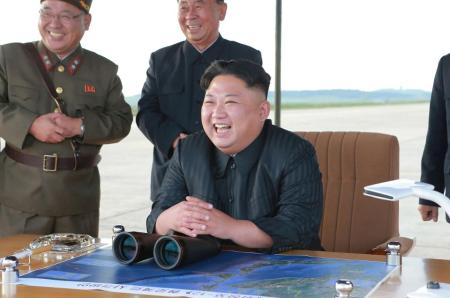
North Korean leader Kim Jong-Un (R) inspecting a launching drill of the medium-and-long range strategic ballistic rocket Hwasong-12 at an undisclosed location. Credit: STR/AFP/Getty Images

Unlike a conventional ICBM which launches and then goes into a suborbital flight before re-entering Earth’s atmosphere, an EMP warhead need not re-enter Earth’s atmosphere before exploding hundreds of kilometers above its target. Super-EMP weapons are designed to produce a high level of gamma rays, which generate the sort of high-frequency electromagnetic pulse that is most damaging to the broadest range of electronics, the report concludes.

And if the EMP device just happens to be part onboard an orbiting satellite, North Korea need only detonate the device remotely via encoded signal. Pry, Chief of Staff of the now de-funded Congressional EMP Commission, told me that at an altitude of 300 kilometers, the resulting electromagnetic pulse would affect all 48 contiguous states.

A warhead fused for an EMP in a satellite or ICBM could work on a timer, via GPS, or using an altimeter, says Pry, a nuclear strategist formerly with the CIA, who has a certificate in nuclear weapons design from the U.S. Air Force nuclear weapons lab. He says North Korea could even rig the warhead to detonate in the event that it was intercepted by our own missile defenses.

The consequences of such a detonation would be dire.

“The U.S. can sustain a population of 320 million people only because of modern technology,” said Pry. “An EMP that blacks-out the electric grid for a year would [decimate] the critical infrastructure necessary to support such a large population.”

In three days, the food supply in local grocery stores would be consumed and the 30-day national food supply in regional warehouses would begin to spoil, says Pry. In one year, he contends that up to 90 percent of the population could perish from starvation, disease, and societal collapse.

After generating gamma-rays that interact with air molecules in Earth’s stratosphere, a so-called fast pulse EMP field of tens of kilovolts would only last a few hundred nanoseconds.

But in the event of such an attack, aircraft electronics would be fried, as well as electronics in air traffic control towers, and navigation systems says Pry. “Airliners would crash killing many of the 500,000 people flying over North America at any given moment,” he said.

Pry says electro-mechanical systems which regulate the flow of gas through pipelines would spark; causing the gas to ignite and result in massive firestorms in cities and large forest fires.

There would be no water; no communications; and mass transportation would be paralyzed, says Pry. In seven days, he contends that reactors in U.S.’ nuclear power plants would essentially melt down, spreading radioactivity across most of the nation.

What could be done to ensure a quick restoration of the grid?

Some 2000 extra-high voltage (EHV) transformers make up the foundation of the U.S. grid, says Pry. But as he notes, since they each weigh hundreds of tons, they are extraordinarily hard to transport. Thus, if most are destroyed, there’s no quick fix.

So, how do we best protect against an EMP?

The U.S. should be prepared to also include limited surgical strikes to destroy North Korea’s ICBMs, says Pry. But he says the best, safest, and least provocative solution is to EMP-harden the electric grid and other critical infrastructures.

But not everyone agrees that North Korea poses a real EMP threat.

“There are legitimate concerns about EMP effects, but a non-tested system by a country with limited missile experience lowers the immediate threat,” James Clay Moltz, a professor of national security affairs at the Naval Postgraduate School in Monterey, Calif., told me.

The U.S. should work with China and South Korea on clear warnings against any such North Korean actions, says Moltz. That includes U.S. statements on the right to pre-empt or shoot down any suspected EMP weapons which, he says, would constitute nuclear attacks on the U.S.

“But predictions of mass U.S. casualties and demands for costly defenses against a [North Korean] EMP attack seem unjustified at this time,” said Moltz.


Report: North Korean Generals’ Favorite American Show Is … “Morning Joe”

October 20, 2017

Report: North Korean Generals’ Favorite American Show Is … “Morning Joe”, Hot Air, Allahpundit, October 19, 2017

Makes sense. It’s the only show more hostile to Trump than North Korea’s own propaganda is.

The funniest thing about this report is that “Morning Joe” is, relatively speaking, a hard show for most *Americans* to understand, let alone North Koreans. It’s the ultimate Beltway insider program, tailored to the tastes of political junkies. Imagine being an average guy or gal channel-surfing for some general interest news in the morning and stumbling upon an MJ colloquy between Steve Schmidt, Nicolle Wallace, and Donny Deutsch on the “dog whistles” in Trump’s latest speech on tax reform. Imagine trying to make sense of that. Now imagine a North Korean military officer, separated by geography, language, and a lot of culture, trying to make sense of it.

I take it back. The funniest thing about this is that the entire crew seems to take the report at face value instead of recognizing that the North Korea officer was just blowing smoke up the NBC correspondent’s ass about what his favorite American news shows are.

NBC News correspondent Kier Simmons landed a rare interview with a North Korean military official on Thursday and learned that officials in the communist country watch “Morning Joe” specifically for reports and discussions about their country…

“He quite plainly said he believes President Trump is mentally ill,” Simmons told “Morning Joe” co-hosts Mika Brzezinski and Joe Scarborough. “And he was unequivocal in saying he believes North Korea could win a war with America.”

“Be it no doubt that the senior officials here pay attention to what is being said in the U.S.,” Simmons added. “One telling me that he watches ‘Morning Joe’ every day specifically for the segments about North Korea.”

Everyone knows that the place to be for in-depth coverage of the crisis on the peninsula isn’t BBC World News, it’s “Morning Joe.” What?

Actually, though, I can kinda sorta see why North Koreans might be monitoring the program. It’s not for the North Korea coverage, of course, it’s because their intelligence people probably know that Scarborough and Brzezinski know Trump personally and therefore might have special insights into his thinking. The NorKs are, reportedly, confused about Trump’s intentions and eager for experts in Washington to clue them into whether Trump’s a blowhard or he really is planning a nuclear first strike. Watching “Morning Joe” would be of a piece with that. And hey, everyone enjoys political television that confirms their own intellectual biases. The NorKs think Trump is crazy and evil; Scarborough and Brzezinski call him crazy and evil pretty much every day. Someday, when the definitive historical account of the U.S./North Korean nuclear exchange of 2019 is written, we may learn that it was an especially febrile, white-knuckled attack on Trump’s mental stability on MSNBC one morning that convinced Kim Jong Un to order full release.

A frightening thought: If the NorKs are monitoring “Morning Joe” because the hosts know Trump, they’re probably monitoring “Hannity” too. They must be on the edge of their seats wondering if the Seth Rich case will ever be cracked.

How we got to a nuclear North Korea

October 16, 2017

How we got to a nuclear North Korea, Washington Times, William C. Triplett II, October 15, 2017

Illustration on the history leading up the North Korean nuclear crisis by Alexander Hunter/The Washington Times

ANALYSIS/OPINION:

President Trump and his Cabinet have said repeatedly that the present state of affairs with North Korea represents 25 years of American foreign policy failure going back over at least three presidents — Bill Clinton, George W. Bush and Barack Obama. Reviewing this disaster, there are at least three major mileposts.

The first of these would be the Dec. 1, 1994 hearing in the Senate Foreign Relations Committee on the Clinton administration’s “Agreed Framework” with North Korea. The regime had agreed to give up its nuclear weapons program and in return, the United States pledged hundreds of millions of taxpayer dollars to substitute forms of energy for Pyongyang. Late in the hearing, Sen. Larry Pressler, South Dakota Republican, was pressing the Clinton administration’s spokesman, Ambassador Robert Gallucci, over whether the agreement permitted a “go anywhere in North Korea, anytime” inspection regime. It didn’t, as he was forced to admit.

At that moment, Sen. Pressler asked me to flip open a prepared chart standing on an easel. There was an audible gasp in the room because written on the chart was this: “Based on North Korean actions to date, DIA assesses that North Korea will continue its nuclear weapons program despite any agreement to the contrary.” The statement was made by Lt. Gen. James Clapper, then the director of the Defense Intelligence Agency. At the time, Gen. Clapper had the reputation as a straight shooter and everyone in the Foreign Relations Committee hearing room knew that the emperor had no clothes: The Agreed Framework was not going to work, ever, because the Kim regime would cheat on it from the get-go.

The Clinton administration then had a choice: It could go with the judgment of Gen. Clapper and mount a worldwide diplomatic effort to shut down the North Korean nuclear program through trade sanctions and other harsh measures, or it could heed the advice of Mr. Gallucci, State Department Counselor Wendy Sherman, U.N. Ambassador and later Secretary of State Madeleine Albright and pretend that the Agreed Framework was fully clothed. Gen. Clapper lost.

The second milepost came in early October 2002. The incoming Bush ‘43 administration had learned disturbing information about North Korea, but the events of Sept. 11, 2001 had distracted top policymakers. They were just then sending out Assistant Secretary of State for East Asia and the Pacific James Kelly to Pyongyang. Mr. Kelly confronted North Korean diplomat Kang Sok-ju about accusations that North Korea was secretly building nuclear weapons. Kang was equally direct: “Not only yes, but hell yes, and you tell that to your president!”

At this point, the Bush ‘43 story gets murky. We know that strong, decisive action was not taken but not why it was not taken. We know that the North Koreans set off their first weapon in 2006 on George W. Bush’s watch. We know that the Bush administration launched new negotiations with the North Koreans under Ambassador Christopher Hill, National Security Adviser and later Secretary of State Condoleezza Rice’s old colleague from the George H.W. Bush administration. Those negotiations failed spectacularly.

Conversation among former Bush ‘43 veterans suggests that in addition to Mr. Kelly, U.N. Ambassador John Bolton and Vice President Dick Cheney’s National Security Adviser Scooter Libby also favored a get-tough policy toward North Korea before the Kim regime passed the nuclear threshold, but Mr. Bush sided with Secretary Rice and Ambassador Hill. We will have to await the opening of the Bush ‘43 files to determine what really happened, but certainly we can say that the pressure of the Iraq War sucked the air out of Bush administration policymakers on North Korea and other pressing matters.

In the case of the third milepost, the warning came from outside the U.S. government. In the early Obama administration, Stanford University professor Siegfried S. Hecker, a proponent of negotiations with North Korea, was permitted to see the inside of the North Korean nuclear weapons production facilities and he was “stunned,” he said, by what he saw. North Korea had graduated from essentially an experimental set-up to a full-scale industrial program, and they did it with outside help. As late as 2012, Mr. Hecker was ringing the alarm: “It is important, therefore, to stop Pyongyang from importing large quantities of key centrifuge materials and components to prevent it from building large additional centrifuge facilities now that it has apparently mastered the art of manufacture and operations.”

For whatever reason, neither Secretary of State Hillary Clinton nor Undersecretary of State for Political Affairs Wendy Sherman heeded his call. Nor was the State Department alert under Mrs. Clinton’s successor, John Kerry, when the North Koreans managed to obtain a supply of Soviet-era rocket engines that make a North Korean nuclear weapon deliverable to the United States.

At the end of the day, Harry Truman was right: The buck stops at the Oval Office, but in the case of the North Korean disaster, it has had a number of stops along the way.

• William C. Triplett II is the author of Rogue State (Regnery, 2004).

It’s time to deploy US ships off North Korea to knock out missiles when they’re launched

October 14, 2017

It’s time to deploy US ships off North Korea to knock out missiles when they’re launched, Fox News, Michael Fabey, October 14, 2017

(Please see also, N.K. missiles mounted on TEL being transported in 3 to 4 regions

The Ohio-class USS Michigan, an 18,000-metric ton submarine, arrived in the South Korean port of Busan Friday. The USS Ronald Reagan also arrived here in South Korea for a joint drill with South Korean military, which will be held in the East and West sea off South Korea from Oct 16 to 20, to prepare for the North’s naval provocations. As many as 40 navy vessels, including the Aegis destroyer and submarines, combat aircrafts, attack helicopters and JSTARS will be deployed for the joint drill. “The North may carry out a simultaneous launch of ICBM and IRBM within a few days in protest against the U.S.’s show of military might,” another source said.

— DM)

North Korea renewed its threat Friday to fire ballistic missiles in the direction of the American territory of Guam, following ominous earlier threats by the rogue regime to launch missiles topped with hydrogen bombs to wipe out cities on the continental United States.

We need to be prepared to defend against new North Korean missile launches – and there is a way to do this short of full-scale war.

One U.S. military option would be to deploy a special team of two or three guided-missile destroyers – ships especially equipped to target, track and shoot down ballistic missiles – to strategic locations off the North Korean coastline. The ships would be positioned outside the 12-mile internationally recognized maritime territorial limit, or at other locations that intelligence indicates would be effective.

Sources intimately familiar with the operations and deployments of those destroyers – and the vast capabilities of their top-secret ballistic missile defense systems – tell me such a plan could work. They say a similar strategy is one of the military options being considered at the Pentagon and at U.S. Pacific Command headquarters in Hawaii. At the very least, this action would increase the costs to North Korea of continuing its missile program.

Erecting what amounts to a destroyer “fence” to contain North Korean missiles and knock them out of the sky might seem like a farfetched scheme. Can a handful of small warships really perform such a huge task?

America’s ballistic missile defense warships are outfitted with systems and weapons that have been proven in rigorous testing, including SM-3 missile interceptors. Since 2002, the Aegis combat system – a powerful weapons system used by the U.S. Navy that utilizes computer and radar technology to find, track and destroy enemy targets – has recorded 35 successful ballistic-missile intercepts in 42 test attempts. And in the last dozen tests, the SM-3s have only missed once.

While U.S. tests of our missile defense system are admittedly choreographed, the characteristics of a targeted ballistic missile in a test situation closely match those of a missile that has been deployed with bad intentions.

Nearly all of the tests pit a single U.S. missile interceptor against a single ballistic missile. Against an actual launch, the Navy could send up numerous interceptors, dramatically increasing its chances for a hit.

Up to now, North Korea has failed to prove it has the capability to launch and control a sufficiently large salvo of missiles to overwhelm a single Aegis ballistic missile defense ship, let alone two or three. Some experts speculate that North Korea, slowed as it is by international economic sanctions, might not develop that capacity until near the end of the decade or beyond.

The U.S. missile destroyers that could be formed into a team and used to knock down North Korean missiles overhead would be those outfitted with the latest version of the four-decades-old Aegis combat system. The newest series of upgrades was certified in January 2015.

All U. S. Navy destroyers and cruisers possess Aegis combat systems, which were first developed to protect ships – especially aircraft carriers – against air threats such as cruise missiles and aircraft.

However, ballistic missile defense requires different sensor settings, algorithms and missiles. Only 40 percent of the U.S. Navy’s Aegis-equipped destroyers and cruisers are designed for ballistic missile defense.

The ballistic missile defense ships depend on SM-3 missile interceptors to blow apart enemy ballistic missiles relatively soon after they enter what’s called flight midcourse, at their most vulnerable point where the atmosphere ends. This starts about 400 miles above the Earth’s surface and extends out to a few thousand miles.

SM-3s have no explosive warhead. Instead they work through sheer force, colliding with the targeted missile with the power of a 10-ton truck traveling 600 miles per hour. For very short-range missiles, SM-2 interceptors can potentially be used. New interceptors, called SM-6s, are being tested that are designed to hit longer-range ballistic missiles later in flight as they descend and re-enter the atmosphere.

Every ballistic missile defense destroyer has the capacity to launch up to 96 missiles. Each ship would have to retain some Aegis capacity for self-defense and that missile number would depend on the mission.

For argument’s sake, assume a destroyer making up part of the “fence” could aim 80 interceptors at a launched North Korean missile. That would mean two ships could unleash a fusillade of 160 missiles and three ships could fire 240. If North Korea were to triple its single-day launch rate, which with sanctions seems extremely difficult, it could possibly send a dozen missiles aloft. In that case, the odds still favor the Aegis interceptors.

Recently North Korea has focused mainly on short- and medium-range missile tests. The North has yet to prove it can launch an intercontinental ballistic missile armed with a payload that can reach the United States, despite its boasts.

If Pyongyang does deploy such missiles and they break though the fence created by U.S. ships and head toward America, the U.S. Air Force could meet them with a total of 36 ground-based interceptors launched from Fort Greely in Alaska and Vandenberg Air Force Base in California. Those interceptors have hit targets in 10 of 18 tests, including the last two in June 2014 and May this year.

To execute such an aggressive plan for an Aegis-ship ballistic missile defense, some parts of which appear to be already in the works, the U.S. would have to place even greater focus on ballistic missile defense missions. American fleet commanders will need to make sure destroyer captains improve their skill in basic seamanship – a proficiency called into question after the Navy recently lost two of its valuable ballistic missile defense destroyers in collisions with commercial ships.

An important step in making the fence operational would be for the U.S. to adopt rules of engagement that allow the Navy destroyers to shoot down North Korean missiles as soon as leave the country’s airspace. Current rules only allow for tracking and monitoring.

If an SM-3 misses, there’s little concern of collateral damage. The interceptor would burn up harmlessly as it reentered the Earth’s atmosphere. Even if an interceptor collided with a nuclear warhead there would likely be no nuclear explosion, experts say.

While North Korea could be counted on to rail at the “recklessness” of an Aegis interceptor taking out one of its missiles, the hornet’s nest would be stirred up far less than in the case of a U.S. invasion of North Korea’s territory or attack on a land target.  In the latter two cases, the North Korean reprisal might be catastrophic, inflicting heavy casualties in South Korea.

If the moment for the destroyer fence to show its capability ever arrives, the U.S. Navy will have to make absolutely certain its missile-killing missiles don’t miss. North Korea would only feel emboldened if its greatest adversary seemed not up to the task of backing up its rhetoric with effective action.

Of course, a destroyer fence is only a short-term fix. North Korea will build more missiles and it’s only a matter of time before more countries acquire such weapons.

In the longer term, the Navy should consider upgrading more ships for ballistic missile defense.  The Navy should also push forward an idea broached by shipbuilder Huntington Ingalls Industries to develop a missile-defense variant of the San Antonio-class amphibious transport dock ship that can be fitted out with a massive strategic antimissile battery of more than 400 interceptors or other missiles.

Similarly, more thought should be given to accelerating testing and deployment of systems that support and enable Aegis. These include the SBX-1 – a huge golf ball-shaped radar dome mounted on an oil platform that can track ballistic missiles – and additional satellites that can be used to track intercontinental ballistic missiles as they travel through space.

With bold use of proven, off-the-shelf missile-defense technology, the U.S. can turn the tables on Pyongyang, neutralizing its strategic missile threat without launching a war. The goal would be to buy enough time for cooler heads to prevail.

N.K. missiles mounted on TEL being transported in 3 to 4 regions

October 14, 2017

N.K. missiles mounted on TEL being transported in 3 to 4 regions, Dong-A-Ilbo, October 14, 2017

South Korean and American intelligence agencies are gearing up for North Korea’s another provocation as the transport and deployment of transporter-erecter-launcher (TEL) has been spotted in three to four regions in North Korea.

According to a government source Friday, a U.S. satellite recently captured images of North Korean ballistic missiles mounted on TEL being transported out of a hangar to somewhere in areas near Pyongyang and North Pyongan Province. Korean and U.S. military officials are keeping an eye on the situation as they view this as a sign of preparation for the launch of a missile comparable to Hwasong-14 inter-continental ballistic missile (ICBM) or Hwasong-12 intermediate-range ballistic missile (IRBM). Another probability is the North might be preparing for the launch of a new Hwasong-13 ICBM (solid engine) that has a longer maximum range than Hwasong-14.

Initially, it was expected that the North will carry out provocative actions on Tuesday, celebrating the anniversary of its ruling party’s foundation. Sources claim that the North will push ahead with another missile provocation in response to the deployment of U.S. carrier strike group and nuclear-powered submarine to the Korean Peninsula.

The Ohio-class USS Michigan, an 18,000-metric ton submarine, arrived in the South Korean port of Busan Friday. The USS Ronald Reagan also arrived here in South Korea for a joint drill with South Korean military, which will be held in the East and West sea off South Korea from Oct 16 to 20, to prepare for the North’s naval provocations. As many as 40 navy vessels, including the Aegis destroyer and submarines, combat aircrafts, attack helicopters and JSTARS will be deployed for the joint drill. “The North may carry out a simultaneous launch of ICBM and IRBM within a few days in protest against the U.S.’s show of military might,” another source said.

Viewing Enemy Regimes as They Are, Not as We Wish They Were

October 10, 2017

Viewing Enemy Regimes as They Are, Not as We Wish They Were, Gatestone InstitutePeter Huessy, April 10, 2017

Experience has shown that soft rhetoric and so-called “smart diplomacy” have served only to enable North Korea and Iran to produce more nuclear weapons and better ballistic missiles.

Not only has the International Atomic Energy Agency (IAEA) been prevented from monitoring Iranian compliance, but it is not pushing the issue for fear that “Washington would use an Iranian refusal as an excuse to abandon the JCPOA.”

During his first press conference after taking office in January 1981, US President Ronald Reagan called détente a “one-way street that the Soviet Union has used to pursue its own aims.” Echoing this remark while addressing reporters later the same day, Secretary of State Alexander Haig said that the Soviets were the source of much support for international terrorism, especially in Latin and Central America.

The following day, both Reagan and Haig were criticized for their remarks, with members of the media describing the president’s words as “reminiscent of the chilliest days of the Cold War,” and appalled that the administration’s top diplomat was accusing the Russians of backing terrorist activities.

Nearly four decades later, in spite of the successful defeat of the Soviet empire, the White House is still frowned upon when it adopts a tough stance towards America’s enemies. Today’s outrage is directed at President Donald Trump’s warnings about — and to — North Korea and Iran. The Washington Post called his recent “fire and fury” threats to Pyongyang a “rhetorical grenade,” for example, echoing top Democrats’ attacks on his remarks for being “reckless” and “irresponsible.”

Critics of Trump’s attitude towards Tehran go equally far, describing his opposition to the Joint Comprehensive Plan of Action (JCPOA) — the nuclear deal with Iran — as “rushing headlong into war.”

Trump’s detractors, however, are just as wrong as those who berated Reagan in 1981. Experience has shown that soft rhetoric and so-called “smart diplomacy” have served only to enable North Korea and Iran to produce more nuclear weapons and better ballistic missiles.

Although the JCPOA stipulates that Iran is not permitted to produce more than a certain quantity of enriched uranium or to enrich uranium beyond a certain level, not only has the International Atomic Energy Agency (IAEA) been prevented from monitoring Iranian compliance, but it is not pushing the issue for fear that “Washington would use an Iranian refusal as an excuse to abandon the JCPOA.”

Furthermore, among its many other flaws, the JCPOA does not address Iran’s ballistic-missile capabilities or financing of global terrorism.

Nevertheless, it is the administration’s rhetoric that is under attack. Isn’t it high time for the media and foreign-policy establishment to wake up to the reality that seeing regimes as they are, rather than as we wish them to be, is the only way to confront our enemies effectively, and with the least number of casualties?

Peter Huessy is president of GeoStrategic Analysis, a defense consulting firm he founded in 1981

Military options strengthening Trump’s diplomatic hand with North Korea?

October 9, 2017

Military options strengthening Trump’s diplomatic hand with North Korea? Fox News via YouTube, October 9, 2017

(Please see also, Britain leaks battle planning for war North Korea. — DM)


Britain leaks battle planning for war North Korea

October 9, 2017

Britain leaks battle planning for war North Korea, American ThinkerThomas Lifson, October 9, 2017

No doubt, the few North Korean allowed to read the outside world’s media are aware that many of his political opponents, foreign and domestic, consider President Trump mean, irrational, and dangerous. This all works to his psychological advantage.

What makes this leak so important is that it indicates to Kim that Trump is not being abandoned by his allies. On the contrary, they are lining up.

I expect there to be more leaks, some of them from Japanese sources.

President Trump has ditched the old ways of dealing with Kim, all of which have failed. This horrifies the diplomatic establishment. As far as I am concerned, that is not a point against him.

********************************

Great Britain is leaking to the media that it is planning for war with North Korea, signaling Kim Jong-un that President Trump and our allies are serious about the demands to end the nuclear weapons and missile programs.

The UK Daily Mail reports:

The Armed Forces are preparing for a potential war with North Korea, sources have revealed.

Officials have been instructed to draw up plans for how Britain would respond if war broke out with Pyongyang amid heightening tensions between the West and dictator Kim Jong-Un.

One option involves deploying Britain’s new aircraft carrier – due to be handed over to the Navy later this year – to the region before she has undergone flight trials.

Details of the secret operation plan have emerged after Donald Trump warned that ‘only one thing will work’ when it comes to dealing with North Korea, which has continued nuclear and rocket tests despite widespread condemnation.

I am reasonably certain that the leaks are intentional, and that the first purpose is to ratchet the pressure up on Kim Jong-un. He knows that the US could defeat and destroy his regime if it comes to war. Should he manage to land a nuclear strike on US forces or territory, the retaliation would be devastating, a lesson to the world on the perils of using nuclear bombs against the US.

No doubt, the few North Korean allowed to read the outside world’s media are aware that many of his political opponents, foreign and domestic, consider President Trump mean, irrational, and dangerous. This all works to his psychological advantage.

What makes this leak so important is that it indicates to Kim that Trump is not being abandoned by his allies. On the contrary, they are lining up.

In the background for us, but ever-present in the mind of Koreans, north and south, is the specter of Japan arming-up with nukes and ditching its “peace constitution.”

I expect there to be more leaks, some of them from Japanese sources.

President Trump has ditched the old ways of dealing with Kim, all of which have failed. This horrifies the diplomatic establishment. As far as I am concerned, that is not a point against him.

Trump is Right, Tillerson is Wasting His Time on North Korea

October 2, 2017

Trump is Right, Tillerson is Wasting His Time on North Korea, Power LinePaul Mirengoff, October 2, 2017

(Please see also, China openly discussing collapse of North Korea. — DM)

If there is any hope of changing North Korea’s behavior, it rests not with Tillerson’s diplomacy or with the direct effect of threatening Kim Jong Un. Rather, it rests with China acting out of self-interest.

******************************

A day after Secretary of State Tillerson said he was reaching out to North Korea in hopes of starting a new dialogue, President Trump belittled the idea. He tweeted:

I told Rex Tillerson, our wonderful Secretary of State, that he is wasting his time trying to negotiate with Little Rocket Man. Save your energy Rex, we’ll do what has to be done!

Trump is right. North Korea isn’t going to negotiate away its nuclear arsenal and it’s not going to freeze its nuclear program until the program has the capacity to inflict the level of damage Kim Jong Un deems necessary to deter the U.S. — namely the capacity to hit major U.S. cities.

Michael Green, President George W. Bush’s chief Asia adviser, acknowledged that “the president is right on this one in the sense that Pyongyang is clear it will not put nuclear weapons on the negotiating table, nor will the current level of sanctions likely convince them to do so. . . .”

The incoherence of Tillerson’s approach is underscored by this incoherent statement by Sen. Bob Corker:

I think that there’s more going on than meets the eye. I think Tillerson understands that every intelligence agency we have says there’s no amount of economic pressure you can put on North Korea to get them to stop this program because they view this as their survival.

If no amount of economic pressure can induce North Korea to stop its nuclear program because of its centrality to the regime’s survival, then what are the likely outcomes of Tillerson negotiating with the regime? The likely outcomes are (1) no agreement or (2) acceptance of North Korea continuing its program, in effect on North Korean terms.

These have been the outcomes of past U.S. diplomacy with North Korea. As Trump tweeted: “Being nice to Rocket Man hasn’t worked in 25 years, why would it work now?”

The question remains, though, why did Trump publicly undercut his Secretary of State on Twitter. According to reports, the president was furious at Tillerson for contradicting his public position that now is not the time for talks. That seems like reason enough for the president’s tweeting. It may be reason enough to sack Tillerson.

Some have suggested that Trump is attempting a good cop, bad cop approach to Kim Jong Un. It seems to be true that the North Koreans are mightily confused by conflicting signals coming from Washington. According to a number of sources, they are frantically talking to American sources in an attempt to understand the true intentions of the Trump administration. And Trump has often touted the advantages of keeping our adversaries uncertain about his intentions.

It’s far from clear, however, that this is the right approach in the context of a fledgling nuclear power led by an inexperienced ruler about whom we don’t know much. My guess is that Trump’s rhetoric will unsettle North Korea, but is no more likely than Tillerson’s diplomacy to deter it from expanding its nuclear program.

At the same time, it will not prompt Kim Jong Un to start a war he otherwise doesn’t want, as Trump’s critics suggest might happen. Where’s the advantage to the regime in that?

If one is inclined to view Trump’s rhetoric as rationally calculated to achieve a positive purpose, I think that purpose would be to influence China. If China believes Trump might launch a preemptive attack on North Korea, it might apply a stranglehold on the regime, especially if it also sees South Korea and Japan possibly moving towards developing a nuclear arsenal.

If there is any hope of changing North Korea’s behavior, it rests not with Tillerson’s diplomacy or with the direct effect of threatening Kim Jong Un. Rather, it rests with China acting out of self-interest.

Remote Textile Plant May Secretly Fuel North Korea’s Weapons

September 27, 2017

Remote Textile Plant May Secretly Fuel North Korea’s Weapons, New York Times, September 27, 2017

A suspected production site for an advanced rocket fuel known as UDMH in Hamhung, North Korea. The kidney-shaped ponds near the bottom of the image appear designed to hold large amounts of wastewater, consistent with UDMH production.

Asked how North Korea could have so extensively developed this fuel without apparent outside notice, Mr. Lewis said outside analysts too often saw the country as primitive and backward.

“If you watch them in satellite photos and read their technical publications, it looks like a totally different country,” he said.

He added, sighing, “We’re in full-scale denial about North Korea’s capabilities.”

 *****************************

In the remote North Korean city of Hamhung, separated from the capital by vast, jagged mountains, an inconspicuous chemical plant may be secretly fueling the growing missile array that threatens the United States.

Researchers think that the plant is producing a specialized rocket fuel known as UDMH, which is used in the long-range missile launches that have escalated tensions between North Korea and the United States.

This would settle an esoteric but crucial debate among North Korea watchers, and not to Washington’s favor.

Some have argued that North Korea cannot produce the fuel, implying that the country imported it from Russia or China. Those countries could then be pressured to cut off exports, grounding North Korea’s missiles without firing a shot.

But the new finding, produced by the James Martin Center for Nonproliferation Studies at Middlebury University, suggests that North Korea has mastered UDMH production, closing off one of the last avenues for outside curbs on the country’s increasingly sophisticated weapons programs.

Though North Korea may have previously relied on foreign assistance in obtaining or making the fuel, as some analysts believe, it no longer appears to need the help.

A photo from North Korea’s state news agency in 2010 purporting to show Kim Jong-il, the country’s leader at the time, at the February 8 Vinalon Plant in Hamhung. The plant is suspected of making missile fuel. Korean Central News Agency, via Reuters

Short of war or the country’s collapse, he added, “There’s nothing to stop this program from becoming a monster.”

The finding is based on satellite imagery, a technical analysis of UDMH production methods, information from a North Korean official who defected, and a set of obscure North Korean technical documents.

Jeffrey Lewis, who directs the Middlebury center’s East Asia program, had been hunting for weeks for hints of UDMH production.

“There are no real, obvious signatures for it,” he said, because it can be made with common chemicals like chlorine and ammonia using a variation of a process developed in 1906. India, while quietly developing its missile program in the 1970s, had produced UDMH in an old sugar factory.

The breakthrough came when his team found and translated a set of highly technical articles in an official North Korean science journal, Chemistry and Chemical Engineering, that referred to the fuel.

The articles, which ran between 2013 and 2016, discussed mundane matters like managing highly toxic wastewater, a notorious problem in UDMH production. But they betrayed suspiciously sophisticated knowledge. One explored methods for improving purity, crucial in advanced missiles.

“They don’t read like this is a speculative or nascent endeavor,” Mr. Lewis said. “They read like this is a problem they’ve been working on for a while,” describing problems a country would encounter only after producing large quantities of the fuel.

Another state news agency photo was said to show the launch of a Hwasong-14 intercontinental ballistic missile in July. The fuel UDMH makes such long-range weapons possible. Credit Korean Central News Agency, via Associated Press

It was an odd location for a highly trained rocket fuel specialist to work. The plant normally produces vinalon, a cheap synthetic material sometimes called “juche” fiber — a reference to North Korea’s tenet of juche, or self-reliance — that is often used in North Korean textiles and uniforms.

But it had long been, Mr. Lewis said, “our No. 1 candidate for UDMH production.”

His team had initially flagged the plant after scrutinizing, in painstaking detail, satellite images of Hamhung for clues.

The remote city is not an obvious home for sensitive military sites. Sitting on the country’s eastern coast, it is exposed to airstrikes, like the American bombing missions that devastated it in the Korean War.

But Ko Chong-song, a North Korea official who defected in the early 1990s, indicated in a 2001 book that it was the center of secret military chemical work. The Central Intelligence Agency had suspected as much since at least 1969, when it published a secret assessment of chemical production in Hamhung.

Now, Mr. Lewis’s team, looking again at the plant, noticed two unusually large wastewater pools, which aligned with standard UDMH production methods — and with the paper describing wastewater challenges. And Kim Jong-un, the North Korean leader, they found, had made a series of trips to the plant, underscoring its importance.

“That’s about as clear-cut as it gets,” Mr. Lewis said.

While the finding reveals important information about the extent of North Korea’s progress, it may come too late for the United States to act.

The country has most likely already stockpiled enough fuel to fight an extended war, Mr. Lewis said. And the fuel is designed to remain potent for years. Soviet UDMH lasted so long that, after the country collapsed, the United States had to help de-fuel its ICBMs.

Asked how North Korea could have so extensively developed this fuel without apparent outside notice, Mr. Lewis said outside analysts too often saw the country as primitive and backward.

“If you watch them in satellite photos and read their technical publications, it looks like a totally different country,” he said.

He added, sighing, “We’re in full-scale denial about North Korea’s capabilities.”