Archive for the ‘North Korean H Bomb test’ category

Haley: North Korea ‘Begging For War’

September 4, 2017

Haley: North Korea ‘Begging For War’ NPR, September 4, 2017

(Finally, Kim has asked for something we can, and should, give him. — DM)

United Nations U.S. Ambassador Nikki Haley addresses a U.N. Security Council meeting on North Korea, on Monday.
Bebeto Matthews/AP

Updated at 12:05 p.m. ET

U.S. Ambassador to the United Nations Nikki Haley tells the U.N. Security Council that North Korean leader Kim Jong Un is “begging for war,” with the latest nuclear test that Pyongyang says is its first fusion device, a much more powerful weapon than it has exploded in the past.

“Enough is enough. War is never something the United States wants. We don’t want it now. But our country’s patience is not unlimited,” Haley told an emergency session of the 15-member Security Council in New York.

She said that incremental sanctions on North Korea imposed by the Security Council since 2006 had failed to stop Pyongyang’s march toward more powerful and dangerous weapons. She said Kim appeared to be “begging for war.”

“Despite our efforts the North Korea nuclear program is more advanced and more dangerous than ever,” she said.

“We must adopt the strongest possible measures,” Haley said.

As NPR’s Elise Hu reported on Sunday from Seoul, Pyongyang claims to have successfully tested a hydrogen bomb and said that it had also coupled the the new weapon with one of its long-range intercontinental ballistic missiles.

The U.S. Geological Survey says it detected a 6.3-magnitude “possible explosion” near Sungjibaegam, North Korea, Sunday afternoon that was “located near the sites where North Korea has detonated nuclear [devices] in the past.”

Shortly after the announcement out of North Korea, Defense Secretary James Mattis said President Trump wanted to be briefed on the “many” possible military options available to respond.

Part II: Tough Is Not Enough

September 4, 2017

Part II: Tough Is Not Enough, 38 North, September 4, 2017

(In what fantasy world does the author live? He states,

What sort of deployments (strategic systems, missile defense, precision strike conventional weapons, conventional land, sea, special and air forces) would be a function of both military and diplomatic would need to be hammered out in the National Security Council and with regional allies.

It is inconceivable that the UN Security Council, where each permanent member has a veto, would approve any “deployment of significant and visible assets [which] would make it clear to the DPRK that it cannot compete with the US in the nuclear field regardless of the size, scope, pace and duration of that effort.”  Even were it to happen, North Korea would be told, in advance, how to prepare for whatever America and perhaps our allies will do when North Korea again tests or uses a nuke or missile. 

Please see also, North Korea Nuclear Test Puts Pressure on China and Undercuts Xi. — DM)

North Korea Nuclear Test Puts Pressure on China and Undercuts Xi

In Part I of this seriesI argued that advocates for “getting tough on North Korea” were prone to adopt inappropriate models for a harsher sanctions regime and to ignore the risk of counterproductive North Korean reactions to such sanctions. This is not an argument for no more sanctions. Given North Korean progress on its ICBM and nuclear weapons capabilities, we remain in an ongoing cycle of actions and reactions that may lead to a major war. A very vigorous political/military effort to contain and eventually eliminate the DPRK nuclear threat is essential now before the tensions and ill-considered rhetoric once again create the risk of the US and North Korea bellowing and stumbling their way into a catastrophic conflict. But sanctions should be only one element of the effort. The final push for a stabilization[1] of the North Korean nuclear and missile issue has to include the following components.

Military Deterrence and Defense

The additional deployment of significant and visible assets would make it clear to the DPRK that it cannot compete with the US in the nuclear field regardless of the size, scope, pace and duration of that effort. What sort of deployments (strategic systems, missile defense, precision strike conventional weapons, conventional land, sea, special and air forces) would be a function of both military and diplomatic would need to be hammered out in the National Security Council and with regional allies. The purpose of these forces would be both to provide diplomatic leverage and to prevent Kim from believing a military gamble would pay off.

Sanctions and Targeted Secondary Sanctions

The sanctions campaign should begin with the enforcement of UNSCRs 2270 and 2371. The initial goal would be to get full compliance with some of the difficult-to-enforce provisions, notably the caps on joint ventures and on North Korean labor exports. To this end, the US should target secondary sanctions on Chinese and other third country entities that are violating the UN resolutions. Rather than seeking to squash every sanctions-evading gnat, it should inflict significant pain on one large and vulnerable entity to have a bracing effect on many more. And, it might well create massive ripple effects if it is a key node in North Korea’s sanctions evasion network—for example, Chinese companies outlined in the recent C4ADS report—that are clearly violating UN sanctions and making extensive use of the US banking system. The US may also wish to find a similar target outside the Chinese network of businesses—perhaps one in a friendly Middle Eastern or African country that has chosen to ignore past US efforts to cut connections to Pyongyang. The US should for now avoid steps to coerce others to accept its own definition of sanctions that go beyond the resolutions. It appears that the most recent sanctions by the US Treasury against Chinese, Russian and one Namibian entity, as well as a recent freeze on some aid to Egypt, may fit the model described above.

However, it is unlikely the UN sanctions as currently written will suffice. The US should be building the case now for significant sanctions tightening if North Korea does not shift its current direction. This should best be done in steps, perhaps starting with the change of the labor and investment caps and moving to a full ban as a first iteration with the dusted off version of UNSCR 661 as the final alternative to military conflict. As the risk of conflict moves closer, the US will have to consider when secondary sanctions as a coercive mechanism for third countries needs to be deployed more widely. This is a high-risk enterprise in an already risky situation, but when stacked up against nuclear war in Asia, surely secondary sanctions are preferable.

Many Tracks of Diplomacy

These tough military and sanctions components will do nothing but open the door to miscalculation and war if other “softer” components are ignored or—more likely—mishandled. A stabilization of the Korean nuclear and missile issue is going to require multilateral diplomacy—and only the US has the ability to be at the center of this effort. It cannot subcontract the effort primarily to China. The PRC does not have the entre with some of the players, nor could it speak for the US to the most difficult audience of all: Pyongyang. These rings of diplomatic activity have existed in one form or another for many years, but they will need to be greatly invigorated and placed in the service of a clear set of policy objectives. These rings include:

  • US-ROK and US-Japan: This ring will need to create a solid front on possible military deterrence force deployments and on a sanctions strategy in the United Nations. The Trump administration appears to be in the middle of such an effort.
  • US-PRC: This ring is key. It needs to be removed from undisciplined and uncoordinated public commentary and shifted to sustained bilateral dialogue. Washington will need to enlist Chinese assistance both to create sanctions pressure on Pyongyang and to generate multilateral negotiations and a viable US-DPRK diplomatic channel. The US cannot expect pressure without political dialogue and Beijing cannot expect dialogue without real pressure on Pyongyang. The less we hear about the content of this channel (not to mention the US-DPRK channel) in public the better.
  • UN Security Council: Iraq sanctions failed when P-5 unity in the UNSC failed. The Trump Administration deserves credit for maintaining P-5 unity with the passage of UNSCR 2371, but this will have to be the first of many efforts in the Council.
  • Six Party (US, ROK, China, Russia, Japan and DPRK): At some point this channel will have to generate the political agreements and the framework for a settlement. There is nothing sacred about this particular forum or format, but something like it will have to be active and available for the formal public structure of a diplomatic settlement.
  • A direct US-DPRK channel: With one exception in the second term of the George W. Bush administration, the most rapid and extensive progress I have seen in over 28 years of interchange with North Korea over the nuclear issue has always taken place in a US-DPRK bilateral channel. The potential causes of war lie between Washington and Pyongyang. The US would be well advised to put together a small, tight, empowered negotiating team to create a channel for bilateral discussions. If the leak-prone and undisciplined Trump administration could manage to do so without us all hearing about it, so much the better.

Orchestrating this diplomacy will be one of the most complex challenges of the past 50 years. It is unclear whether the US State Department—suffering from several levels of missing leadership, low morale and persistent and unhelpful interference from the White House—is up to the task. But a way will have to be found to perform it if there is to be success on this issue.

Clarity, Discipline and Accountability in Public Commentary

US diplomacy during the recent dust-up with North Korea over its July ICBM tests was clumsy and amateurish: the incendiary rhetoric coming out of the White House needlessly escalated tensions and the uncoordinated and incoherent public messaging sowed confusion among our allies over US goals and intentions. That said, it did signal that the United States was approaching the limit of its patience over North Korean missile developments. Nevertheless, a policy vacuum continues to exist.

The United States has not made clear to Pyongyang, the American public, or its allies how it would respond to North Korean nuclear intimidation or aggression. There may be a place for strategic ambiguity in deterrence policy under some circumstances but not strategic incoherence. As a result of the loose and imprecise US rhetoric and mixed messaging, all parties are groping for an understanding of what might trigger nuclear conflict in Korea and beyond. To end this confusion and uncertainty, an authoritative figure such as the Secretary of State or Defense should give a policy speech which lays out for the American public, our allies, the Chinese and the North Koreans what American nuclear deterrence policy is vis-a-vis North Korea—and then the White House needs to discipline itself and other agencies to hew scrupulously to this script in all their public messaging on the policy.

The speech or the press backgrounding around it should also designate a single, high level official who would be accountable for the North Korean issue; this is simply not an issue that can survive current White House tong wars, presidential pique or bureaucratic backstabbing. This speech will also be the best place to signal that toughness will be accompanied by dialogue. It needs to open the door to real negotiations with a concrete proposal. This could be done through a proposal to reopen Six Party Talks or through a prearranged signal to Pyongyang that certain words in the speech are an invitation to a private authoritative back-channel discussion.

Goals and Trade Bait

The Obama administration’s efforts on North Korea foundered on a couple of rocks. The first was its inability or unwillingness to commit political capital to an issue that was highly controversial, with a very small (or nonexistent) solution set and a timeline that was less pressing than the Iran nuclear issue. The second was that the only goal for resolving or even trying to resolve the crisis that could garner consensus support was complete DPRK denuclearization. However, given the Obama administration’s unwillingness to invest fully in the issue, the White House’s highly constrained room for political maneuvering and Pyongyang’s commitment to its nuclear strategy, the goal of denuclearization became an obstacle to even starting a process for dealing with Pyongyang’s nuclear and missile progress.

Denuclearization remains a worthy goal and it is the only one that preserves the global nonproliferation regime and the long-term security of the US and its allies. But the first goal of renewed diplomatic engagement needs to be more focused and urgent: to stabilize peace in Northeast Asia and to prevent a stumble into a nuclearized second Korean War. Achieving this goal, by definition, will require North Korea to put limits on its ICBM program, which is the essential immediate need for American security policy. There are interim steps that would be of value in preserving peace and security. The parties might wish to develop mechanisms to prevent accidental war. It might also be a worthy tactical goal to create geographic limits on North Korean missile testing targets, thus putting US territories like Guam and Japanese waters off limits. The US might, at some point, trade off a particular sanction in return for a firm ICBM testing ban or moratorium or a halt to nuclear tests.

At no point should the US take ultimate denuclearization off the table, but it is necessary first to identify immediate steps to stabilize what is a dangerous dynamic. The two great dangers to pursuing more modest, immediate goals will be the accusation the US has “accepted” a nuclear DPRK and the concessions the DPRK may want. Sanctions should be considered legitimate items to trade. Our alliances should not. Our political relationship with the DPRK—including at some point a peace treaty ending the Korean War—should be legitimate points of discussion. Tangible payments to the DPRK should not, given the unfortunate experiences the ROK and US had with such payments in past agreements.

Conclusion

In a policy with any hope of resolving US and global concerns about North Korea’s nuclear and missile threat, sanctions play an important but supporting role. The key to a successful effort to deal with the North Korean threat without war is a combination of military deterrence, sanctions, a complex diplomatic offensive with clear and realistic short-term goals, and perhaps most importantly, a disciplined, clear public elucidation of US deterrence and diplomatic policy for Korea. The “tough” part of this approach (military deterrence and sanctions) is well within the reach of the Trump administration. Whether it has the personnel, structure and capacity for discipline for the diplomatic and public components of the effort is yet unproven.


  1. [1]

    Stabilization is chosen deliberately in this sentence. Denuclearization should be the long term stated goal of the effort but that goal should be placed in the same context as “general and complete disarmament” as used in Article VI of the Nuclear Nonproliferation Treaty. It is a legitimate goal, but one that is far over the horizon. The key goal at this moment is to halt momentum towards having North Korean nuclear weapons capable of reaching the US homeland.

North Korea Nuclear Test Puts Pressure on China and Undercuts Xi

September 4, 2017

North Korea Nuclear Test Puts Pressure on China and Undercuts Xi, New York Times

(Assuming the accuracy of the analysis, it is doubtful that President Trump has much economic or other leverage with China vis a vis North Korea. — DM)

President Xi Jinping of China arriving on Sunday for the opening ceremony of a business forum in Fujian Province. Credit Pool photo by Mark Schiefelbein

The biggest concern for China’s leadership is the possibility of North Korea turning on China, the country’s only ally. “If cornered, North Korea could take military action against China, given the relationship has reached a historic low,” Mr. Zhao said.

China supplies more than 80 percent of the North’s crude oil, and suspending delivery would be the ultimate economic sanction, more far-reaching than those imposed, with China’s support, by the United Nations.

 ****************************

BEIJING — It was supposed to be Xi Jinping’s moment to bask in global prestige, as the Chinese president hosted the leaders of some of the world’s most dynamic economies at a summit meeting just weeks before a Communist Party leadership conference.

But just hours before Mr. Xi was set to address the carefully choreographed meeting on Sunday, North Korea’s leader, Kim Jong-undetonated his sixth nuclear bomb.

Mr. Kim has timed his nuclear tests and missile launches with exquisite precision, apparently trying to create maximum embarrassment for China. And on Sunday, a gathering in southeast China of leaders from Russia, Brazil, India and South Africa, members of the so-called BRICS group, was immediately overshadowed by news of the test, which shook dwellings in China and revived fears of nuclear contamination in the country’s northeast region.

This is not the first time Mr. Kim has chosen a provocative moment to flaunt his country’s weapons. In May, he launched a ballistic missile hours before Mr. Xi spoke at a gathering of world leaders in Beijing assembled to discuss China’s signature trillion dollar One Belt, One Road project.

The confluence of North Korea’s nuclear testing and Mr. Xi’s important public appearances is not a coincidence, analysts said. It is intended to show that Mr. Kim, the leader of a small, rogue neighboring state, can diminish Mr. Xi’s power and prestige as president of China, they said. In fact, some analysts contended that the latest test may have been primarily aimed at pressuring Mr. Xi, not President Trump.

“Kim knows that Xi has the real power to affect the calculus in Washington,” said Peter Hayes, the director of the Nautilus Institute, a research group that specializes in North Korea. “He’s putting pressure on China to say to Trump: ‘You have to sit down with Kim Jong-un.’”

What Mr. Kim wants most, Mr. Hayes said, is talks with Washington that the North Korean leader hopes will result in a deal to reduce American troops in South Korea and leave him with nuclear weapons. And in Mr. Kim’s calculation, China has the influence to make that negotiation happen.

While some Chinese analysts say North Korea should be made to pay a price for its contempt of China, the North’s ally and major trading partner, they were not optimistic that Sunday’s test would change Mr. Xi’s determination to remain above the fray and not get his hands sullied trying to force Mr. Kim to change his ways.

Even the North’s claim that the weapon detonated was a hydrogen bomb that could be mounted on an intercontinental ballistic missile would probably not sway Mr. Xi, they said.

“This sixth nuclear test should force China to do something radical; this will be a political test,” said Cheng Xiaohe, a nuclear expert at Renmin University. “But the mood is not moving that way.”

China’s Foreign Ministry did express “strong condemnation” of the test. But despite the North’s repeated incitements, the Chinese leadership is likely to stick to its position that a nuclear-armed North Korea is less dangerous to China than the possibility of a political collapse in the North, Mr. Cheng said. That could result in a unified Korean Peninsula under the control of the United States and its ally, South Korea.

China fears such an outcome if it uses its greatest economic leverage: cutting off the crude oil supplies that keep the North’s rudimentary economy running.

“Cutting off oil supplies could severely impact North Korean industries and undermine the regime’s stability, a solution which China and Russia have serious qualms about,” said Zhao Tong, a fellow at the Carnegie-Tsinghua Center for Global Policy in Beijing.

China has put forward a proposal that hinges on North Korea stopping its nuclear testing in exchange for an end to American military exercises around the Korean Peninsula.

But Mr. Xi is consumed at the moment with domestic matters, Chinese analysts said. The political machinations surrounding the Communist Party’s National Congress that will convene in Beijing in mid-October to select new members of the ruling elite are at the top of his agenda. Mr. Xi will be awarded his second five-year term at the meeting.

China always aims for domestic calm in the period leading up to the secretive congress, and so it is unlikely to do anything before Oct. 19, the start of the conclave, Mr. Zhao said.

The biggest concern for China’s leadership is the possibility of North Korea turning on China, the country’s only ally. “If cornered, North Korea could take military action against China, given the relationship has reached a historic low,” Mr. Zhao said.

China supplies more than 80 percent of the North’s crude oil, and suspending delivery would be the ultimate economic sanction, more far-reaching than those imposed, with China’s support, by the United Nations.

Even The Global Times, the nationalist, state-run newspaper, said several months ago that China should consider cutting off its oil supplies to North Korea if Mr. Kim detonated a sixth nuclear bomb. But with the party congress looming, the paper modified its position Sunday.

“The origin of the North Korean nuclear issue is the sense of uncertainty that is generated by the military actions of the U.S./South Korea military alliance,” the paper said. “China should not be at the front of this sharp and complicated situation.”

There were also some doubts whether severing oil supplies would make much a huge difference to the North Korean regime. “The economic effects will be substantial but not regime crippling,” said Mr. Hayes of the Nautilus Institute, which specializes in the North’s energy needs.

The hardships, he said, would be most felt by ordinary people, with less food getting to market and fewer people able to travel between cities in buses.

The North’s army has oil stockpiles for routine nonwartime use for at least a year, Mr. Hayes said. “They can last for about a month before they run out of fuel in wartime, at best; likely much earlier,” he said.

Another major concern for the Chinese government is the fears of residents in the northeast of the country about nuclear contamination from North Korea’s test site at Punggye-ri, not far from the Chinese border.

Many residents in Yanji in Jilin Province, which borders the North, said they felt their apartments shake after the test. Some posted photos of stocks of food and drinks shattered on the floors of a grocery store. At first residents believed the cause was an earthquake, they said, and only later in the day heard the news from state-run media that North Korea had detonated a nuclear bomb.

“I was in my study when the earthquake began,” said Sun Xingjie, an assistant professor at Jilin University in Changchun about 350 miles from the North Korean test site. Mr. Sun said he checked with friends on social media, and they determined from the location and the depth of the explosion that it was a nuclear test.

Even though there is no evidence of any contamination from the test reaching China, it is a worry of residents, Mr. Sun said.

“We are at the border region, so we have a sense of fear about leakage from the nuclear test,” he said.

Mattis Holds EMERGENCY Press Conference on North Korea H-Bomb Test 9/3/17

September 3, 2017

Mattis Holds EMERGENCY Press Conference on North Korea H-Bomb Test 9/3/17 via YouTube


https://www.youtube.com/watch?v=tcfiwCZSxFA

North Korea’s latest test: More diplomacy will only make matters worse, says Amb. Bolton

September 3, 2017

North Korea’s latest test: More diplomacy will only make matters worse, says Amb. Bolton, Fox Business, September 3, 2017

(Please see also, Powers may end up with Iranian model for NKorea. — DM)

Bolton said the U.S. has “fooled around” with North Korea for 25 years, and if that continues, the current situation will only worsen.

“It would be a lesson to every nuclear state in the world that if you just have patience enough you can wear the United States down. The notion that we can accept North Korea or Iran with any kind of nuclear capability just means that we will forever be at their mercy,” he said.

*****************************

Following North Korea’s announcement that it successfully tested a thermonuclear device on Sunday, former U.S. Ambassador to the United Nations John Bolton said more diplomacy will only make matters worse regarding the Hermit Kingdom’s nuclear threat to surrounding countries and America.

“I think the only diplomatic option left is to end the regime in North Korea by effectively having the South take it over,” Bolton told “Sunday Morning Futures.” “Anybody who thinks that more diplomacy with North Korea or sanctions, whether against North Korea or an effort to apply sanctions against China, is just giving North Korea more time to increase its nuclear arsenal, increase its ballistic missile capability, increase the accuracy of its guidance systems and put us, South Korea and Japan in more jeopardy.”

The artificial earthquake caused by the test was “five to six times stronger” than tremors created by previous tests; South Korean officials put the magnitude at 5.7 and the U.S. Geological Survey said it was a magnitude 6.3 Opens a New Window., according to The Associated Press.

In addition to the threat of the country launching a thermonuclear weapon, Bolton explained that the willingness of Kim Jong Un to sell anything for money is also quite worrisome.

“They could sell these weapons, ballistic missiles and the nuclear devices themselves to Iran in a heartbeat. North Korea can sell these devices to terrorist groups around the world; they could be used as electromagnetic pulse weapons (EMPs), not necessarily hitting targets, but destroying our electric grid’s capabilities,” the former ambassador said, adding that they could also be used for nuclear blackmail.

President Trump reacted to the news of the alleged test on Twitter saying, “North Korea is a rogue nation which has become a great threat and embarrassment to China, which is trying to help but with little success.”

..North Korea is a rogue nation which has become a great threat and embarrassment to China, which is trying to help but with little success.

He also criticized South Korea for not taking a tougher stand against the communist country.

South Korea is finding, as I have told them, that their talk of appeasement with North Korea will not work, they only understand one thing!


Bolton said the U.S. has “fooled around” with North Korea for 25 years, and if that continues, the current situation will only worsen.

“It would be a lesson to every nuclear state in the world that if you just have patience enough you can wear the United States down. The notion that we can accept North Korea or Iran with any kind of nuclear capability just means that we will forever be at their mercy,” he said.

Powers may end up with Iranian model for NKorea

September 3, 2017

Powers may end up with Iranian model for NKorea, DEBKAfile, September 3, 2017

(Obama’s “deal” with Iran (also known as the Iran scam) worked perfectly — for Iran. An even better deal for North Korea? Great idea. Not. Perhaps the “Israeli option” is the only realistic option available. Please see also, Germany’s Merkel: Iran deal a model for solving North Korea problem. — DM)

The only time military action was applied against a North Korean nuclear facility was on Sept. 6, 2007 when the Israeli Air Force and special forces blew up the plutonium reactor under construction by North Korea in the eastern Syrian province of Deir ez-Zour, in Operation Orchard. This plant was intended to be Iran’s main supplier of plutonium and had it been finished, would have accelerated Tehran’s advance towards a hydrogen bomb.

The North Korean leader will want much more than the deal won by Tehran, for a 10-year moratorium against a $150 billion pledge and many other rewards. Kim, whose arsenal is far more advanced, will certainly go a lot higher. His leverage for extortion is unassailable. He can either bargain for a mountain of cash or carry on looming over his Pacific neighbors and the United States, armed with advanced ballistic missiles and a nuclear bomb. He would then be faithful to the legacy of his father Kim Jong-Il, who declared in 1995 that a nuclear program was the only guarantee of his dynasty’s survival.

For now, both Iran and North Korea, long in cahoots on their weapons programs, are riding high.

*********************************

Even North Korea’s 150-kiloton hydrogen bomb and avowed ability to fit it onto an intercontinental ballistic missile, as Kim Jong-un demonstrated Sunday, Sept. 3, have so far drawn nothing more decisive from the world’s powers that words of condemnation and threats of stronger sanctions..

President Donald Trump called North Korea a rogue state whose words and actions were “hostile and dangerous to the United States” and convened a meeting with his national security team. Yet stronger sanctions are on the table, including stopping trade with countries doing business with North Korea.

Japan’s Shinzo Abe, already rattled by the North Korean missile that flew over his country, said the latest nuclear test, the most powerful thus far, “is completely unacceptable and we must lodge a strong protest.

South Korea said that its northern neighbor’s defiant sixth nuclear test should be met with the “strongest possible” response, including new UN Security Council sanctions to “completely isolate” the country.

Chinese President Xi Jinping and Russian President Vladimir Putin agreed Sunday to “appropriately deal with” the latest nuclear test by North Korea. The state news agency Xinhua said, “The two leaders agreed to stick to the goal of denuclearization on the Korean Peninsula and keep close communication and coordination to deal with the new situation.”

But still, there is no sign of all these powers getting together for tangible, effective concerted action.

Since the Kim regime’s the first underground nuclear test on Oct. 9, 2006, almost every conceivable penalty and deterrent has been tried to rein in the rogue nation’s gallop towards a nuclear weapon, barring full-blown military aggression.

None worked, mainly because they were imposed piecemeal and never fully followed through. But most of all, this was because the big powers never lined up as one and pooled all their resources at the same time for concerted action. Sanctions were never comprehensive and so were never a solution.

The only time military action was applied against a North Korean nuclear facility was on Sept. 6, 2007 when the Israeli Air Force and special forces blew up the plutonium reactor under construction by North Korea in the eastern Syrian province of Deir ez-Zour, in Operation Orchard. This plant was intended to be Iran’s main supplier of plutonium and had it been finished, would have accelerated Tehran’s advance towards a hydrogen bomb.

The Israeli example has long been set aside, mainly since it was overtaken by Obama’s pro-Iran policy. Successive governments led by Binyamin Netanyahu also set this precedent aside over heavy resistance among Israel’s politicians and some of its generals to an attack on Iran’s nuclear program before it matured.

North Korea’s latest nuclear test was estimated by experts to be five times more powerful than the WWII bomb which destroyed Nagasaki. The Vienna-based Comprehensive Nuclear-Test-Ban Treaty said it was evidence that Pyongyang’s nuclear program is “advancing rapidly.”

The leading world powers’ only real weapon against this advance is unity. But because this is so elusive, their governments – and because a military attack is seen as the worst option – those governments are apparently moving towards getting reconciled to living with a nuclear-armed Kim regime.

Against Iran, six world powers (the US, Russia, China, Britain, France and Germany), did team up and so were able to negotiate the 2015 nuclear accord with Iran, which left its weapons and missile programs intact although relatively free of effective oversight.

If a similar lineup confronted Kim front-un with a collective seven-day ultimatum to dismantle those programs or else face their destruction, he might decided to sit down and talk.. As things stand today, he is free to shoot ballistic missiles over Japan and detonate a hydrogen bomb like a child’s firecrackers, while the world begs him on bended knee to come and discuss freezing his belligerent programs on the Iranian model.

The North Korean leader will want much more than the deal won by Tehran, for a 10-year moratorium against a $150 billion pledge and many other rewards. Kim, whose arsenal is far more advanced, will certainly go a lot higher. His leverage for extortion is unassailable. He can either bargain for a mountain of cash or carry on looming over his Pacific neighbors and the United States, armed with advanced ballistic missiles and a nuclear bomb. He would then be faithful to the legacy of his father Kim Jong-Il, who declared in 1995 that a nuclear program was the only guarantee of his dynasty’s survival.

Attempts to starve his country and force the regime into submission have fallen short. Even South Korea does not dare stop sending aid to allay its compatriots’ endemic famine. For now, both Iran and North Korea, long in cahoots on their weapons programs, are riding high.

Trump says ‘appeasement’ will not work after N.Korea nuke test

September 3, 2017

Trump says ‘appeasement’ will not work after N.Korea nuke test, Breitbart, September 3, 2017

(Please see also, Getting Tough on North Korea: Iran and Other Mirages. The thrust of the linked article is that sanctions won’t work and that some form of “a broader political-military effort to stabilize the situation” is necessary.  As asked in my parenthetical comment on the article,

Do we need merely “to stabilize the situation,” or do we need to do something more drastic to change it so that North Korea will (a) cease to be a nuclear threat now and (b) be disabled from becoming one again? “

I think we need to disable North Korea from ever becoming a nuclear power again. While China urges patience, sanctions and appeasement of North Korea, China is threatening to “reunite” Taiwan with military force rather than through appeasement or sanctions. Please see also, Chinese Official Says China Might Invade Taiwan If “Peaceful Reunification Takes Too Long”. Getting rid of North Korea’s nuclear threat has already taken too long. — DM)

AFP

Washington (AFP) – US President Donald Trump declared Sunday that “appeasement with North Korea” will not work, after Pyongyang claimed it had successfully tested a missile-ready hydrogen bomb.

“North Korea has conducted a major Nuclear Test,” Trump said. “Their words and actions continue to be very hostile and dangerous to the United States.”

His comments came hours after the US Geological Survey picked up a 6.3 magnitude “explosion” in North Korea, which Pyongyang confirmed was a nuclear test, its sixth.

The isolated regime said this one was of a hydrogen bomb that could be fitted atop a ballistic missile, sharply raising the stakes in a US-North Korea confrontation.

Trump last month threatened North Korea with “fire and fury” if it continued to threaten the United States, but he refrained from direct threats in his latest tweets.

“South Korea is finding, as I have told them, that their talk of appeasement with North Korea will not work, they only understand one thing!” he said.

“North Korea is a rogue nation which has become a great threat and embarrassment to China, which is trying to help but with little success.”

When North Korea Tests a Nuke, Assume It’s Iran’s as Well

January 13, 2016

When North Korea Tests a Nuke, Assume It’s Iran’s as Well, Clarion ProjectRyan Mauro, January 13, 2016

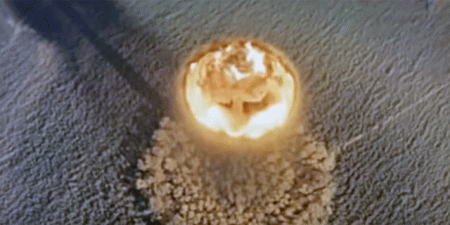
North-Korean-Nuclear-Test-HPA previous nuclear Test made by North Korea (Photo: Video screenshot)

Given the spotty record of U.S. intelligence assessments (to say the least), the West must operate under the assumption that there isn’t an Iranian WMD problem and a North Korean WMD problem, but an Iranian-North Korean WMD problem.

********************************

North Korea briefly reclaimed the global press’ attention again by claiming to have tested a hydrogen bomb. While coverage focused on whether that was an exaggeration, the press missed a much more important question: Was this test only for Kim Jong-Un or was it also for the Iranian regime?

The North Korean and Iranian nuclear and ballistic missile programs should be seen as a single entity, as should be their shared cyber warfare programs. The advance of one is an advance of the other. Differences in their activity should be seen as a common-sense division of labor. Gordon Chang, a prominent expert on Asian affairs, has written about the likelihood that this is the case.

Last May, an Iranian opposition group that has accurately identified hidden nuclear sites in the past reported that it had specific intelligence about North Korean nuclear and missile experts secretly visiting Iran. Intelligence analyst Ilana Freedman said in January 2014 that her sources said a relocation of major parts of Iran’s nuclear program to North Korea began as early as December 2012.

For Iran, it is best to let the North Koreans put the finishing touches on the most provocative nuclear and missile work. Whereas the Iranian regime does suffer from sanctions and must always keep the 2009 Green Revolution in the back of its mind, North Korea thrives off isolation and international provocation.

North Korea has nothing to lose and can only gain by such an arrangement. Kim Jong-Un’s regime has already crossed the nuclear pariah threshold, so it might as well let its Iranian allies take the lucrative deal offered by the West. It has been content to spend $1.1-$3.2 billion each year on it. Plus, the deal puts Iran in a more advantageous position  and its economic improvements can help it invest more in North Korea’s activity.

The good news is that this latest test—North Korea’s fourth— does not appear to be more powerful than its last one, indicating no significant advance in technology. RAND Corporation analyst Bruce Bennett says North Korea is still working on the “basics” of a nuclear fission bomb.

It is hard for some to accept that an Islamist theocracy like that in Iran would work with a cultish communist dictatorship like North Korea, but there is nothing in either one’s ideology that would prevent such cooperation. In fact, North Korea’s success in building a nuclear arsenal actually encourages Iran to see nuclear weapons as a key lesson for the Islamic Revolution.

“The entire world may well consider North Korea a failed state, but from the view point of [Iran], North Korea is a success story and a role model: A state which remains true to its revolutionary beliefs and defies the Global Arrogance,” Ali Alfoneh, an expert on the Iranian regime, told the Washington Free Beacon.

Given the spotty record of U.S. intelligence assessments (to say the least), the West must operate under the assumption that there isn’t an Iranian WMD problem and a North Korean WMD problem, but an Iranian-North Korean WMD problem.

Richardson: North Korea May Have Launched Nuclear Test to Get Nuclear Deal Like Iran’s

January 7, 2016

Richardson: North Korea May Have Launched Nuclear Test to Get Nuclear Deal Like Iran’s, Washington Free Beacon, January 6, 2016

(Why not? Their human rights records are comparable. — DM)

Richardson, who ran for president in 2008, endorsed Clinton for the 2016 election. Clinton, Obama’s former secretary of state, has been a vocal supporter of the Iran nuclear agreement.

**********************

Hillary Clinton supporter and former New Mexico governor Tom Richardson said North Korea’s nuclear test may have been an attempt to gain leverage for a nuclear deal similar to the one Iran struck with the Obama administration and other world powers.

North Korea claimed it successfully tested a hydrogen bomb on Tuesday, although nuclear experts doubt that was the actual device tested. CNN reported the test corresponded with a 5.1 seismic event.

CNN host Wolf Blitzer asked Richardson whether North Korean dictator Kim Jong-un was crying out for attention with this latest act of aggression.

“I think he’s trying to get attention, number one, but I think he’s also sending a message that if you want to deal with me, if you want me to curb our nuclear weapons, it’s going to be a very high price,” Richardson said. “It’s a very poor country. They need humanitarian assistance. They need energy assistance. They need all kinds of sanctions lifted. It could be that he’s preparing for a negotiation. I think he’s looking at what happened with Iran, and he says, ‘You know, maybe there’s a deal that can be struck for me,’ although we don’t know this man thinks. He’s very unpredictable.”

Richardson, who ran for president in 2008, endorsed Clinton for the 2016 election. Clinton, Obama’s former secretary of state, has been a vocal supporter of the Iran nuclear agreement.

The Iran nuclear deal made in July and championed by the Obama White House, despite numerous concessions, was met with celebration in Tehran. The world’s largest state sponsor of terrorism received billions of dollars in sanctions relief, among other sweeteners, as part of the agreement.

Examining Allegations Of Nuclear Ties Between North Korea & Iran

January 6, 2016

Examining Allegations Of Nuclear Ties Between North Korea & Iran, Fox News, January 6, 2016

(This video relates the claimed North Korean test of a miniaturised H-Bomb to previous joint Iran – North Korea nuke efforts. — DM)


https://www.youtube.com/watch?v=wjOgGKqq1PM