Archive for the ‘North Korea sanctions’ category

Hmm: China’s National Oil Firm Cuts Off North Korea

June 28, 2017

Hmm: China’s National Oil Firm Cuts Off North Korea, Hot Air, Ed Morrissey, June 28, 2017

Beijing had already cut off coal imports from North Korea, depriving Kim of income that could have been used to pay for the fuel. It looks like a squeeze, one that may be picking up in intensity, and one that sends a direct message to North Korea’s military leaders, who will understand only too well what a fuel embargo will do to their readiness posture. It won’t take much more for the situation to reach critical mass on the Korean peninsula.

***********************

Has North Korea run out of credit with China, or has Beijing finally run out of patience with Pyongyang? China’s state-run petroleum operation has cut off fuel sales to rogue nation, Reuters reports, ostensibly due to a lack of payment. However, it’s no secret that the Trump administration has put a lot of pressure on Beijing to get tougher with the Kim regime, and a fuel cutoff will hit Kim Jong-un where he’s most vulnerable:

China National Petroleum Corp has suspended sales of fuel to North Korea over concerns the state-owned oil company won’t get paid, as pressure mounts on Pyongyang to rein in its nuclear and missile programmes, three sources told Reuters.

It’s unclear how long the suspension will last. A prolonged cut would threaten critical supplies of fuel and force North Korea to find alternatives to its main supplier of diesel and gasoline, as scrutiny of China’s close commercial ties with its increasingly isolated neighbour intensifies.

North Korea needs the fuel not just for its farmers and shipping, but also for its military. That presents a particularly difficult problem for Pyongyang’s leaders, who already operate in a crisis-shortage environment. Kim can’t afford to cut back on military supplies, not with all of the saber rattling taking place at the moment, which means he’ll have to starve the rest of the country of fuel resources, which will hamper food production and distribution even further. It will ratchet up internal tension, and it might get worse if military needs can’t be satisfied.

CNPC won’t sell the fuel on credit, Reuters’ Chen Aizhu notes, which means that Pyongyang is having trouble coming up with hard currency. Aizhu’s source says the issue came up over “the last month or two,” and that timing is intriguing. Four months ago, Kim ordered a bizarre assassination of his older brother Kim Jong-nam, using VX nerve agent in the airport of Malaysia’s capital of Kuala Lumpur.  The target and especially the weapon made it clear who ordered the hit, and Malaysia — one of the few nations willing to do business with North Korea — cut off diplomatic and economic ties to Pyongyang, which set off a round of hostage-taking by the Kim regime. Malaysia had been a key partner in avoiding international sanctions and a vital link to hard currency for Pyongyang until the assassination. If North Korea has had trouble paying for diesel and gasoline over the last couple of months, it might signal that Pyongyang has no more options for avoiding sanctions and that its economic back is against the wall, so to speak.

Aizhu’s sources say that this was a “commercial decision,” but nothing’s that simple in China. Beijing had already cut off coal imports from North Korea, depriving Kim of income that could have been used to pay for the fuel. It looks like a squeeze, one that may be picking up in intensity, and one that sends a direct message to North Korea’s military leaders, who will understand only too well what a fuel embargo will do to their readiness posture. It won’t take much more for the situation to reach critical mass on the Korean peninsula.

Spotlight: China, U.S. reach consensus at high-level security dialogue

June 24, 2017

Spotlight: China, U.S. reach consensus at high-level security dialogue, XinhuaNet, June 24, 2017

(The words sound friendly, but what do we get at what cost? — DM)

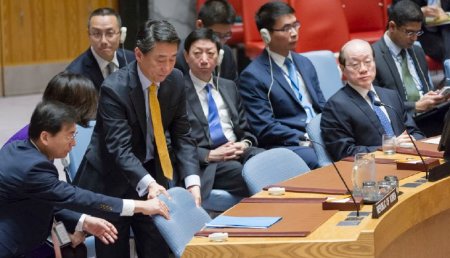
Chinese State Councilor Yang Jiechi (1st R) co-chairs a diplomatic and security dialogue with U.S. Secretary of State Rex Tillerson (1st L) and Secretary of Defense James Mattis (2nd L) as Fang Fenghui (2nd R), a member of China’s Central Military Commission (CMC) and chief of the CMC Joint Staff Department, also participates in the dialogue in Washington D.C., the United States, on June 21, 2017. China and the United States began their first diplomatic and security dialogue on Wednesday at the U.S. State Department in Washington D.C. (Xinhua/Yin bogu)

At the dialogue, China the United States agreed to work closely on the Korean Peninsula’s nuclear issue.

Both countries reaffirmed their commitment to achieving the goal of “complete, verifiable and irreversible” denuclearization on the Peninsula.

*********************

WASHINGTON, June 23 (Xinhua) — China and the United States reached an important consensus on the development of bilateral relations and security issues at a high-level dialogue held Wednesday in the U.S. capital of Washington D.C.

The First Round of China-U.S. Diplomatic and Security Dialogue, which was described by both sides as “constructive” and “fruitful,” represents a major step in implementing the consensus reached by Chinese President Xi Jinping and his U.S. counterpart Donald Trump during their meeting in Florida in April.

Looking ahead, the two sides pledged to expand mutually-beneficial cooperation and manage differences on the basis of mutual respect, all in a bid to promote the steady development of China-U.S. relations in the long term.

FREQUENT DIALOGUES

Following Wednesday’s dialogue, U.S. Secretary of State Rex Tillerson said such talks “provide an opportunity to consider how we’re going to engage and how we’re going to live with one another over the next 40 years.

“The action items we have agreed upon today have set a foundation for additional areas of cooperation and we look forward to our next interaction at this level and between our two presidents,” said the top U.S. diplomat.

Emphasizing the importance of high-level exchanges, China and the United States expressed their willingness to achieve a positive outcome for the Hamburg meeting between the two Presidents in July and Trump’s state visit to China later this year.

Meeting with Chinese State Councilor Yang Jiechi at the White House on Thursday, Trump said he looked forward to meeting with Xi in Hamburg and visiting China. He also hoped that these high-level interactions will further promote the development of U.S.-China relations.

PRODUCTIVE MILITARY RELATIONSHIP

Fang Fenghui, a member of China’s Central Military Commission (CMC) and chief of the CMC Joint Staff Department, participated in the dialogue co-chaired by Yang, Tillerson and U.S. Secretary of Defense James Mattis.

At the dialogue, China and the United States recognized that their military-to-military relationship is an important component in the bilateral ties. The two sides agreed that the relationship between the militaries of the two powers should be “constructive, pragmatic, and effective,” according to a statement released Friday.

China and the United States are committed to implementing the annual military exchange program and enhancing high-level engagements, starting with the visits between the two defense ministers and the visit of the Chairman of the U.S. Joint Chiefs of Staff to China as soon as possible.

The two sides also “reaffirm the importance of building mutual understanding, and of reducing the risk of miscalculation between our two militaries,” said the statement.

MAINTAINING COORDINATION ON KOREAN PENINSULAR ISSUE

At the dialogue, China the United States agreed to work closely on the Korean Peninsula’s nuclear issue.

Both countries reaffirmed their commitment to achieving the goal of “complete, verifiable and irreversible” denuclearization on the Peninsula.

“The two sides are ready to continue their efforts to this end, including by fully and strictly implementing relevant United Nations Security Council resolutions, and by promoting relevant dialogue and negotiation,” said the statement.

The two countries also reaffirmed their commitment to maintaining peace and stability on the Peninsula, according to the statement.

Analysts Sound New Alarms on North Korea Missile Threat

May 31, 2017

Analysts Sound New Alarms on North Korea Missile Threat, Gatestone InstitutePeter Huessy, May 31, 2017

(What about the Iran – North Korea nexus? — DM)

The news media and independent experts have pointed out that North Korea’s ICBMs could reach Alaska, Hawaii or even the Pacific Northwest. But these missiles are said to have a range of 10,000 kilometers, which means they would hit Missouri, or 40 percent of the continental United States, said Klingner. “After they did the successful launch last year, now the estimate is probably 13,000 kilometers, which is all the way down to Miami, the entire continental U.S.”

***********************************

The North Koreans now have the range capability to strike the United States with a ballistic missile. “It is a matter of physics and math.” — USAF General John Hyten, Commander of United States Strategic Command, May 9, 2017.

“A major headache for the United States is that much of the financial and technological support for North Korea’s weapons programs comes from China.” — Joseph Bosco, Senior Fellow at the ICAS Institute for Korea-American studies.

North Korea just conducted its seventh missile test launch so far this year. No one should expect this activity to cease, and no one should be surprised by North Korea’s progressively more advanced weapons capabilities, analysts said at a recent Mitchell Institute forum on Capitol Hill, hosted by the author.

“During Kim Jung Un’s five years in power he has done twice, perhaps three times, as many launches of missiles as his father did in 18 years,” said Bruce Klingner, a senior research fellow at the Heritage Foundation.

The North Korean dictator is not showing any signs of slowing down, and he is determined to push forward the country’s program to enhance the medium and long-range missiles and nuclear warheads that now threaten the United States and its allies.

Klingner estimates that North Korea has 16 to 20 nuclear weapons. “And then, of course, the question or the debate is how far along they are,” he said. “I think it is pretty clear they’ve weaponized and miniaturized the warhead, that right now the Nodong medium-range ballistic missile is already nuclear capable.” This means U.S. allies Japan and South Korea are under a nuclear threat today, he stressed. “It is not theoretical, it is not several years in the future as some analysts or experts will tell you.”

The threats posed by North Korea are wide ranging, Klingner noted. “They’ve got, we estimate, 5,000 tons of chemical warfare agents.” And it has a sophisticated army of cyber warriors. “They are, perhaps, in the top five or top three countries in the world for cyber attack capabilities.”

Missile attacks are, it seems, what worries U.S. policy makers the most. A rising concern are submarine-launched ballistic missiles because of the immediate risk they create for South Korea. “The North Korean subs can come out on the east or west coast and threaten South Korea,” Klingner said.

North Korea successfully tested a Musudan intermediate-range ballistic missile last year, and they “flew it to an unusually high trajectory,” he said. “Had they lowered the trajectory and fired it for effect, the estimates are it could have ranged Guam. So that’s a new threat to a key node for the U.S. defense of the Pacific.”

Keeping U.S. officials up at night is the possibility of an ICBM launch. North Korea has developed several systems. One of its most advanced systems is a space launch vehicle, Klingner said. “But it’s the same technologies you would need to fire off an ICBM warhead.”

As USAF General John Hyten, Commander of United States Strategic Command, said on May 9th at a Strategic Deterrent Coalition nuclear symposium, that the North Koreans now have the range capability to strike the United States with a ballistic missile. “It is a matter of physics and math” he explained.

The news media and independent experts have pointed out that North Korea’s ICBMs could reach Alaska, Hawaii or even the Pacific Northwest. But these missiles are said to have a range of 10,000 kilometers, which means they would hit Missouri, or 40 percent of the continental United States, said Klingner. “After they did the successful launch last year, now the estimate is probably 13,000 kilometers, which is all the way down to Miami, the entire continental U.S.”

Another cause for alarm is the number of rocket engine tests, he said. “They took the first stage of a solid fuel ICBM, to see if it works.” Rocket scientists, just by looking at the photos, were able to say that they’re using two engines, which are better than the ones U.S. experts thought they were using. By the size and shape and color of the exhaust plume, analysts concluded, the North Koreans are “using a much-improved propellant than we thought.”

At the same forum, Joseph Bosco, a Senior Fellow at the ICAS Institute for Korea-American studies, noted “A major headache for the United States is that much of the financial and technological support for North Korea’s weapons programs comes from China”.

“Back in the late 1980s and early 1990s,” Bosco further explained, “North Korea began its program to develop nuclear weapons. China provided the necessary startup technology through the A.Q. Khan network in Pakistan….Today China accounts for 90% of North Korean trade with the outside world. Let’s face it, China keeps the Kim regime afloat, alive and well, and capable of continuing to invest in advancing it’s nuclear and missile programs.” Bosco said. “There is significant evidence that it directly facilitates the ongoing nuclear and missile programs through China’s banking system and the use of Chinese ports and airports for the trans-shipment of prohibited North Korean parts and technologies.”

Bosco further said that Defense Secretary Leon Panetta had told the Senate Intelligence Committee in 2012 that China was irrefutably providing advanced technology for North Korea’s ballistic missile program.

“It has been clear for 60 years that the sole cause of tension and instability between the Koreas has been Pyongyang’s own bizarre and dangerous behavior. Despite substantial aid and concessions from an accommodating South Korean government, China alone has the power to change that.”

Klingner said it remains to be seen how the Trump administration deals with these foreign policy predicaments. “When I’ve talked to folks in the administration they have described the policy as a heavy emphasis on sanctions and pressure and targeted financial measures.” The administration also apparently wants to augment ballistic missile defense and has indicated a “willingness to have our diplomats talk with their diplomats,” Klingner said. “The door has always been open, but it is North Korea that repeatedly closes the door.”

As Bosco emphasized, it is China that has to come clean.

It is also evidently China that has created a neighboring Frankenstein monster that keeps escaping from its nuclear laboratory. Reining-in North Korea is possible, but without strong Chinese economic and military pressure, which the Chinese seem loath to give, the North Korean nuclear challenge may be insurmountable.

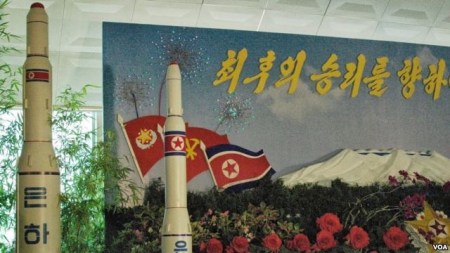
A model of the North Korean Unha-9 long-range rocket on display at a floral exhibition in Pyongyang. (Image source: Steve Herman/VOA News/Wikimedia Commons)

Dr. Peter Huessy is President of GeoStrategic Analysis, a defense consulting firm he founded in 1981, and was the senior defense consultant at the National Defense University Foundation for more than 20 years.

Waiting for North Korea’s Next Nuclear Test

May 28, 2017

Waiting for North Korea’s Next Nuclear Test, PJMedia, Claudia Rosett, May 27, 2017

(To the extent that history is a good predictor of the future, more sanctions — even if enforced briefly — won’t work. Regime change, maybe. But how can we find a suitable replacement for Kim Chi-un Kim Jong-un? Has the recent high-level defector been asked? It would be stupid to let the Norks know whether he has been and, even worse, what, if anything, he said because anyone he suggested would be killed. No matter how much the leakers and media would like to know, secrecy is absolutely necessary. –DM)
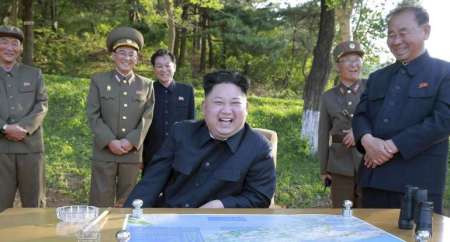
In this undated photo distributed by the North Korean government Monday, May 22, 2017, North Korean leader Kim Jong Un watches the test launch of a solid-fuel “Pukguksong-2” at an undisclosed location in North Korea. (Korean Central News Agency/Korea News Service via AP)

The threats from North Korea keep rising — not only its nuclear program, but such matters as its cyber warfare projects, plus the example Pyongyang continues to set of how a malign and predatory tyranny can survive by arming itself with the world’s most destructive weapons and threatening liberally to use them. We should have no doubt that Iran and others are taking notes.

What’s certain is this: None of this will be resolved by America writing off regime change as the real goal in Pyongyang while waiting to respond with another stack of UN sanctions, however neatly pre-negotiated, to North Korea’s next nuclear test.

******************************

Just last month, Secretary of State Rex Tillerson told the United Nations Security Council that the era of letting North Korea call the shots was over. Commenting on a record in which North Korea has carried out five nuclear tests since 2006, two of them just last year, Tillerson said: “For too long the international community has been reactive in addressing North Korea.” He added, “Those days must come to an end. Failing to act now on the most pressing security issue in the world may bring catastrophic consequences.”

Yet here we are, with Reuters reporting, based on a news conference held Friday in Beijing by senior State Department official Susan Thornton, that the U.S. is “looking at discussing with China a new Security Council resolution on pre-negotiated measures to reduce delays in any response to further nuclear tests or other provocations from the North.”

In other words, the U.S. is waiting to react to North Korea’s next nuclear test, which North Korean officials have already threatened to carry out, and for which preparations have been visibly underway.

With the variation that the diplomatic response (providing China agrees) would be “pre-negotiated,” this sounds disturbingly similar to the ritual that President Obama’s administration dolled up under the fatuous label of “strategic patience.” The result, on Obama’s watch, was that North Korea carried out four of its five nuclear tests to date, and accelerated its missile program to include over the past three years — as The Wall Street Journal reported recently — the launches of “more major missiles than in the three previous decades combined.”

The Obama ritual went like this: North Korea would carry out a forbidden nuclear test (in 2009, 2013, and two in 2016). The U.S. would turn to the UN Security Council, which after a period of closed-door wrangling would respond by approving yet another sanctions resolution, which would then be advertised by the U.S. as tough… tougher… toughest. Whatever.

Recall America’s former ambassador to the UN, Samantha Power, declaring after the passage of UN Security Council Resolution 2270 in March 2016 (in response to North Korea’s fourth nuclear test) that “this resolution is so comprehensive, there are many provisions that leave no gap, no window.” That resolution was followed last September by North Korea’s fifth nuclear test, to which the UN responded by adding to the gapless, windowless sanctions resolution #2270 the even more gapless and windowless resolution #2321.

One might reasonably ask: Why reserve all those ever tougher sanctions for North Korea’s next nuclear test, or the one after that? If gapless, windowless sanctions have yet more holes that need plugging, why not do it all now?

If I might hazard a guess, the obstacle is not solely that veto-wielding permanent Security Council members China and Russia have no serious interest in trying to throttle North Korea’s Kim regime. Even when they vote for those ever tougher UN sanctions, they have been, to put it generously, highly casual about enforcing them. On the evidence, China — despite its public expressions of disapproval and disappointment over each North Korean nuclear test — has nonetheless, for decades now, allowed North Korea to proceed. It is past time to ask quite seriously whether Beijing (never mind its public posturing) reached a quiet decision quite some years ago that China can live comfortably enough with a nuclear-armed North Korea that dedicates itself to bedeviling such leading democracies as South Korea, America and Japan.

Nor is the problem solely that sanctions, to whatever degree they are attempted, have virtually no chance of forcing North Korea into a good-faith deal to give up its long-established, deeply entrenched nuclear program. In previous talks and deals (1994, 2005, 2007, as well as President Obama’s attempted 2012 so-called Leap Day missile-freeze deal), Pyongyang racked up an unbroken record of lying, cheating, pocketing the gains and carrying on with its threats and WMD projects.

In the prime case in which sanctions did seem to get serious traction — when U.S. sanctions persuaded Macau in 2005 to freeze North Korea-linked accounts in Banco Delta Asia — North Korea went ahead in 2006 with its first nuclear test, then came to the bargaining table for a deal in 2007, and took to the cleaners the eager diplomats of President Bush’s “soft power” second term.  The antics of that era included State Department special envoy Chris Hill demanding the help of the U.S. Treasury and Federal Reserve to transfer back to North Korea, via the banking system (at North Korea’s behest), some $25 million in tainted funds that had been frozen at Banco Delta Asia in Macau; a U.S. handout of millions to pay Pyongyang for the Potemkin spectacle in 2008 of blowing up a dispensable cooling tower at North Korea’s Yongbyon nuclear complex; and the removal of North Korea from the U.S. government’s blacklist of terror-sponsoring states (a concession which to this day the State Department has yet to remedy). The 2007 deal fell apart as Bush was leaving office, and in May of 2009 North Korea welcomed Obama’s presidency by conducting its second nuclear test.

Today, with North Korea working at speed toward an ability to target the United States, the U.S. fallback is to try to pressure China, under threat of sanctions that would hurt China itself, to defang North Korea. That approach allows for plenty of employment in Washington, in the debates, design and attempts to apply such sanctions. But somewhere out there lies the question of how to sustain any such approach, on the ground (and the seas) in Asia, and where it might actually lead. Sanctions tend to erode over time, as their targets adapt. If North Korea is richly capable of the duplicities that have repeatedly foiled nuclear negotiators, China has vastly more reach and resources available for its own gambits. Even if the ever-tougher-sanctions approach leads to a deal, who or what then guarantees (the deep flaws of Obama’s Iran nuclear deal  come to mind) that once the strictures are loosened, North Korea, or China, would abide by that deal? (Forget the UN, which has to date failed abysmally to stop North Korea’s nuclear program, and which relies on individual member states to police their own enforcement of sanctions.)

The further fallback is the threat of U.S.-led military force, which is what the Trump administration is now turning to in a number of ways, including the deployment of a third aircraft carrier group as part of the “armada” Trump is sending to the Western Pacific. Part of the idea here is also to put China on notice that the U.S. is serious.

The problem here is that to be effective, military threats need to be credible. After eight years of Obama’s “patience,” following North Korea’s successes with its nuclear extortion racket going back to the early 1990s, the consistent signal from three U.S. presidents — Obama, Bush and Clinton — has been that the U.S. for all its vast firepower would rather be snookered at the bargaining table, or simply do nothing, than actually risk a military strike that could turn into a hot war with North Korea.

It doesn’t help that on May 19 Defense Secretary Jim Mattis told Pentagon reporters that any military solution to North Korea would be “tragic on an unbelievable scale,” so “our effort is to work with the U.N., work with China, work with Japan, work with South Korea to try to find a way out of this situation.” Nor does it help that on May 23, 64 Democratic lawmakers sent a public letter to Trump, asking for details of his plans for a negotiated solution of “the nuclear issue on the Korean peninsula,” and warning Trump against including in any such plans an “ill-advised military component.” If — after the agonies of the 1950-1953 Korean War, and in view of North Korea’s current military threat to Seoul and increasingly dangerous arsenal — the U.S. is not prepared to go to war again to stop North Korea, then the prudent course would be at least to keep quiet about it. Otherwise, the result is to neuter any U.S. threat of force, further emboldening North Korea.

Which brings us to the core problem, the grand dilemma looming behind all the machinations described above. There is really only one way out of this situation, only one real solution, and that is an end to the Kim regime in North Korea. On humanitarian grounds alone, the fall or overthrow of the Kim regime would be fully justified, and is long, long overdue. In view of North Korea’s rising threats to others, its growing arsenal, its record of peddling munitions to the likes of Syria and Iran, and its unbroken record of abusing any and all deals, there is no other answer. The Kim regime has to go.

But getting rid of the Kim regime is in itself risky. However it might happen, whether Kim’s regime might be destroyed by military force, throttled by sanctions, overthrown from within, or somehow shoved from power through some combination of these factors, no one knows exactly what might follow, or how things might then play out.

And so, with variations that have repeatedly failed to end the threat, one U.S. administration after another has defaulted to a “status quo” in which the effort is not to get rid of the Kim regime, but to manage it — as if it were some sort of highly unpleasant chronic medical condition.

Thus did  Tillerson tell the UN Security Council meeting last month, at its special meeting on North Korea, that “our goal is not regime change, nor do we desire to threaten the North Korean people or destabilize the Asia Pacific region.”

Newsflash: The Asia Pacific region is already being destabilized, by nuclear-arming North Korea itself, as well as China — with its own military buildup, its island-building territorial grabs offshore, and its threats to freedom of navigation. What we are witnessing is not a durable status quo, but a trajectory, in which a U.S. impulse for peace in our time keeps steering us toward cataclysm ahead. What Obama achieved with his “strategic patience” was to postpone the day of reckoning long enough to hand off a threat grown vastly worse to his successor.

How this gets resolved in any way favorable, or even remotely safe, for America and its democratic allies is a hideous conundrum. But the situation right now is very far from safe. The threats from North Korea keep rising — not only its nuclear program, but such matters as its cyber warfare projects, plus the example Pyongyang continues to set of how a malign and predatory tyranny can survive by arming itself with the world’s most destructive weapons and threatening liberally to use them. We should have no doubt that Iran and others are taking notes.

What’s certain is this: None of this will be resolved by America writing off regime change as the real goal in Pyongyang while waiting to respond with another stack of UN sanctions, however neatly pre-negotiated, to North Korea’s next nuclear test.
Further Evidence of Iran-North Korea Military Connection

May 6, 2017

Further Evidence of Iran-North Korea Military Connection, Iran Focus, May 5, 2017

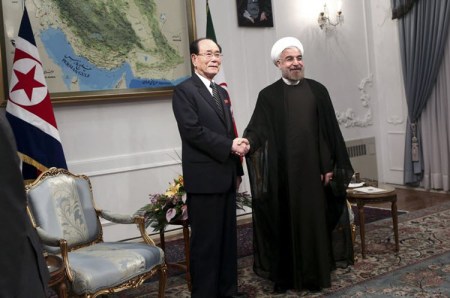
London, 5 May – Pentagon officials saw more evidence of North Korea’s assistance when Iran tried to launch a cruise missile from a midget submarine earlier this week. Intelligence reports claim the submarine was the same type that sank a South Korean warship in 2010, which was Pyongyang designed.

This was the first time Iran attempted to launch a Jask-2 cruise missile underwater, but the launch failed, according to U.S. defense officials. That North Korea and Iran are sharing expertise when it comes to their rogue missile programs has been long suspected by nonproliferation experts.

Perhaps most worrisome for the United States is that this occurred in the narrow and crowded Strait of Hormuz, where much of the world’s oil passes each day.

Jeffrey Lewis, a missile proliferation expert at the Middlebury Institute of International Studies at Monterey said, “The very first missiles we saw in Iran were simply copies of North Korean missiles, over the years, we’ve seen photographs of North Korean and Iranian officials in each other’s countries, and we’ve seen all kinds of common hardware.”

“In the past, we would see things in North Korea and they would show up in Iran. In some recent years, we’ve seen some small things appear in Iran first and then show up in North Korea and so that raises the question of whether trade — which started off as North Korea to Iran — has started to reverse,” Lewis added.

The ballistic missile Iran tested in late January was based on a North Korean design, the Pentagon said. Another missile launch conducted by Iran last summer, was similar to the most advanced missile Pyongyang has successfully tested to date, a North Korean Musudan.

North Korea’s Taepodong missile looks almost identical to Iran’s Shahab, according to defense analysts.

North Korea successfully launched a missile from a submarine for the first time in 2015, and officials believe Tehran is not far behind.

North Korea and Iran are the only countries in the world who deploy the Yono-class submarine. Midget subs are used in shallow waters, where they can hide. The 290-foot South Korean warship that sank in 2010 and killed more than 40 sailors, was ambushed in shallow water by a midget sub. However, North Korea denies involvement in the attack.

A U.S. defense official who declined to be identified stated, “When those midget subs are operating underwater, they are running on battery power—making themselves very quiet and hard to detect.”

During testimony at the House Armed Services Committee late last month, Admiral Harry Harris, the head of American forces in the Pacific said, “We are being taken to the cleaners by countries that are not signatories to the INF.” Harris warned that because the U.S. is a signatory to the Intermediate Range Nuclear Forces, or INF, treaty signed in 1987 between Russia and the United States, the United States has no land-based short range or medium range missiles. Iran and North Korea are under no such constraints.

The BM-25 Musudan ballistic missile has a maximum range of nearly 2,500 miles, and potentially puts U.S. forces in the Middle East and Israel within reach, if its problems are fixed.

It’s unclear to what extent North Korea is involved in the failed launch, apart from sharing their technology, according to officials.

Rex Tillerson, Secretary of State, tried to garner support for more United Nations sanctions against North Korea by hosting leaders from Southeast Asia in Washington on Thursday.

The White House put Iran “on notice” just days after Iran’s first ballistic missile test during the Trump administration.

Congress to Pass Fresh Sanctions on North Korea as Nuke Threat Hits Critical Stage

May 3, 2017

Congress to Pass Fresh Sanctions on North Korea as Nuke Threat Hits Critical Stage, Washington Free Beacon, , May 3, 2017

This April 15, 2017 picture released from North Korea’s official Korean Central News Agency (KCNA) on April 16, 2017 shows Korean People’s Army (KPA) soldiers marching through Kim Il-Sung square during a military parade in Pyongyang marking the 105th anniversary of the birth of late North Korean leader Kim Il-Sung.THIS PICTURE WAS MADE AVAILABLE BY A THIRD PARTY. AFP CAN NOT INDEPENDENTLY VERIFY THE AUTHENTICITY, LOCATION, DATE AND CONTENT OF THIS IMAGE. THIS PHOTO IS DISTRIBUTED EXACTLY AS RECEIVED BY AFP. / (Photo credit should read STR/AFP/Getty Images)

Congress is expected to level fresh economic sanctions on North Korea this week as the threat of the hermit nation’s capability to strike the U.S. with a nuclear missile continues to escalate, according to conversations with members of the congressional leadership who told the Washington Free Beacon that the Kim Jong Un regime could have a nuclear weapon capable of striking the United States in “only a few years.”

House Majority Leader Kevin McCarthy (R., Calif.) confirmed that he has scheduled a vote in the House on new sanctions that will target North Korea’s slave labor trade and its shipping industry, which plays a central role in ferrying illicit arms and technology to and from the country. North Korea is a major supplier of nuclear technology on the black market, particularly to Iran, which has mimicked Pyongyang’s nuclear playbook.

The new sanctions come as congressional leaders debate how to handle North Korea’s growing nuclear threat, which went largely unaddressed by the former Obama administration.

North Korea is expected to perfect a nuclear missile capable of striking the U.S. homeland in about four years time, according to congressional sources.

“The North Korean threat is escalating—in about four years, experts estimate that North Korea will have the capability to reliably hit the continental United States with a nuclear weapon,” McCarthy told the Free Beacon. “America must use every tool at our disposal to keep our nation safe and preserve peace.”

McCarthy said that new sanctions are long overdue and can more easily win approval now that former President Barack Obama is out of office.

“This week, we will vote to increase sanctions on North Korea, targeting its shipping industry as well as those who employ North Korean slave labor abroad,” the lawmaker said. “The last administration’s long-practiced policy of strategic patience has made us less safe. We must increase the pressure on the Kim regime.”

In just the past year, North Korea has conducted two nuclear weapons tests and at least 26 ballistic missile flight tests.

The new sanctions, codified under the Korean Interdiction and Modernization of Sanctions Act, has already garnered approval from the House Foreign Affairs Committee and is expected to easily pass when it comes before the full House for a vote. The bill will then be taken up for action by the Senate, which has an appetite for such a bill.

Lawmakers are moving forward with two other resolutions aimed at highlighting North Korea’s escalating nuclear progress.

One resolution formally condemns Pyongyang’s development of several intercontinental ballistic missiles, which violated multiple international laws on such behavior.

A second resolution requires the State Department to determine whether North Korea is a state sponsor of terrorism. Such a designation still has not been made, despite the country’s threatening behavior and multiple nuclear missile launches.

“It is not a matter of if, but when Kim Jong-Un will be brazen enough to attack one of our allies, or even the United States,” McCarthy said in a statement on the two resolutions. “We must be honest and forthright abroad, making clear that North Korea’s ballistic missile testing is unacceptable and that the Kim regime is worthy of sanctions as it is undoubtedly a state sponsor of terrorism.”

One senior congressional source who spoke to the Free Beacon about the issue said that the Obama administration’s policy of trying to wait out the threat has proven ineffective.

“The policy of strategic patience has allowed North Korea to charge full steam ahead in developing its nuclear program,” said the source, who requested anonymity to discuss congressional deliberations on the issue. “Doing nothing has only allowed North Korean provocations to increase. I think everyone recognizes that.”

“Now, North Korea is only a few years away from being able to hit the United States with a nuclear bomb,” the source said. “The best response is to increase pressure on the Kim regime, including with new sanctions, leaving all options on the table to preserve peace and end the threat of a nuclear North Korea.”

A Chinese State-Run Tabloid Has Warned North Korea Against More Nuclear Tests

April 12, 2017

A Chinese State-Run Tabloid Has Warned North Korea Against More Nuclear Tests, TimeReuters, April 11, 2017

(From the “for what it’s worth” department.  — DM)

The Global Times, whose stance does not equate with Chinese government policy, said that Beijing would likely react strongly to any North Korean test.

(However, The Global Times is run by the Chinese Communist Party. — DM)

The Korean Peninsula has not been so close to a “military clash” since North Korea conducted its first nuclear test in 2006, China’s influential state-run tabloid the Global Times said in an editorial.

“Not only Washington brimming with confidence and arrogance following the missile attacks on Syria, but Trump is also willing to be regarded as a man who honors his promises,” the paper, run by the ruling Communist Party’s official People’s Daily, said. [Emphasis added.]

“The U.S. is making up its mind to stop the North from conducting further nuclear tests. It doesn’t plan to co-exist with a nuclear-armed Pyongyang,” it said.

***********************

(BEIJING)—North Korea should halt any plans for nuclear and missile activities “for its own security”, a Chinese newspaper said on Wednesday, warning that the United States is making clear it doesn’t plan to “co-exist” with a nuclear-armed Pyongyang.

North Korean state media cautioned on Tuesday of a nuclear attack on the United States at any sign of American aggression, as a U.S. Navy strike group steamed toward the western Pacific—a force U.S. President Donald Trump described as an “armada”.

Trump, who has urged China to do more to rein in its impoverished ally and neighbor, said in a tweet that North Korea was “looking for trouble” and the United States would “solve the problem” with or without Beijing’s help.

The Korean Peninsula has not been so close to a “military clash” since North Korea conducted its first nuclear test in 2006, China’s influential state-run tabloid the Global Times said in an editorial.

“Not only Washington brimming with confidence and arrogance following the missile attacks on Syria, but Trump is also willing to be regarded as a man who honors his promises,” the paper, run by the ruling Communist Party’s official People’s Daily, said.

“The U.S. is making up its mind to stop the North from conducting further nuclear tests. It doesn’t plan to co-exist with a nuclear-armed Pyongyang,” it said.

“Pyongyang should avoid making mistakes at this time.”

The Global Times, whose stance does not equate with Chinese government policy, said that Beijing would likely react strongly to any North Korean test.

“If the North makes another provocative move this month, the Chinese society will be willing to see the (U.N. Security Council) adopt severe restrictive measures that have never been seen before, such as restricting oil imports to the North,” the paper said.

Beijing has signed on to U.N. sanctions against North Korea, but it has repeatedly called for a return to dialogue to resolve the tensions.

A military parade is expected in Pyongyang to mark Saturday’s 105th anniversary of the birth of Kim Il-sung, North Korea’s founding father and grandfather of the current ruler. North Korea often marks important anniversaries with tests of its nuclear or missile capabilities.

U.S. officials have previously stressed that stronger sanctions are the most likely U.S. course to press North Korea to abandon its nuclear program, though Washington has said all options—including military ones—are on the table.


Uncertain Futures: China, Trump and the Two Koreas

February 10, 2017

Uncertain Futures: China, Trump and the Two Koreas, 38 North, February 9, 2017

(Kim Jong-un may be insane. Or, like his predecessors, he may pretend to be insane to make predictions about his behavior very difficult and often impossible. China’s leaders are not insane, they are merely devious. Dealing with them has been, and will continue to be, very difficult. — DM)

China waving flag on bad day

China waving flag on bad day

At the beginning of the Trump administration, the situation on the Korean peninsula is highly uncertain and potentially volatile. During a late January research trip to Beijing, “uncertainty” and “concerns” were the keywords that best characterized how Chinese scholars and officials are feeling about Trump and the two Koreas. During his presidential campaign, Trump suggested that he would be willing to negotiate with North Korea directly. However, that scenario has become more uncertain in recent months, especially given the hawkish instincts of President Trump and his national security team. Chinese analysts nonetheless expect the US to enlist Beijing’s support on the North Korea issue and are anxiously waiting for Washington to engage so that China can bargain for its preferred outcomes. The prolonged silence from the administration is making Beijing increasingly uncertain and uncomfortable, and complicating its plans to reduce the threat that the United States and its network of alliances in Northeast Asia poses to Chinese security and strategic influence.

Between 2013 and 2016, China tested an alternative alignment strategy on the Korean peninsula. Frustrated with North Korea’s brinkmanship continuously damaging Chinese security interests, President Xi Jinping placed his hope on South Korean President Park Geun-hye to improve China’s strategic position. At the heart of this scheme was an effort to turn South Korea into China’s “pivotal” state in Northeast Asia, thereby undermining the US alliance system in the region and diminishing its threat to China. As a result of Sino-ROK rapprochement, senior-level visits soared, bilateral economic ties strengthened and many South Koreans questioned the utility and future of the US-ROK alliance. In an ideal scenario, China’s new realignment strategy would defeat the US-orchestrated “Northeast Asia NATO” based on America’s alliances with Japan and Korea, and counter the US-Japan alliance with an alignment between China and both Koreas. From the Chinese point of view, this would not only reduce China’s vulnerability vis-à-vis the US, but also lay a firm foundation for Chinese regional predominance.

However, events after the fourth North Korean nuclear test in January 2016 entirely derailed China’s scheme. Overestimating its presumed influence over Seoul, Beijing refused to adequately address South Korea’s legitimate security concerns, which eventually led to Seoul’s decision to deploy the Terminal High Altitude Area Defense (THAAD) system. China sees the THAAD deployment as a threat to strategic stability with the United States and an obstacle to its desired regional blueprint. As such, Chinese policy toward the Korean peninsula has evolved significantly in the last year, reflecting the realization that undermining the US-ROK alliance and turning South Korea into a Chinese strategic asset were both improbable in the near future and raising the prospect that Beijing might not have a choice between the two Koreas after all.

Nonetheless, while China’s ambitious efforts to transform geopolitical alignments on the Korean peninsula did not come to fruition, it still has two other key priorities. First, Beijing has not completely given up its efforts to defeat the THAAD deployment. At a minimum, it hopes that a victory for progressive forces in the upcoming South Korean presidential election, such as the Minjoo Party, could alter Seoul’s deployment plans for the system. While acknowledging that a complete reversal of the deployment decision is unlikely, Beijing hopes that a new South Korean government might delay the initial deployment or reduce the number of deployed units. China sees the propensity of the progressives to engage North Korea, to improve relations with China and to limit the scope of the US-ROK alliance as aligned with its overall strategic agenda. Although China’s ability to sway a South Korean domestic election is limited—for example, by maintaining the implicit sanctions China has imposed on South Korean companies, products and industries for the THAAD deployment—its preference and influence are expected to have an impact.

Second, China hopes to mitigate the impact that any future North Korean intercontinental ballistic missile (ICBM) test might have on its strategic position and influence on the peninsula. The conventional wisdom is that North Korea will not want to conduct the test immediately after Trump’s inauguration, as it will almost certainly block the chance for dialogue with the new US administration and boost the popularity of the conservatives in the South Korean election. However, based on North Korea’s previous pattern of behavior, Chinese experts expect to see provocations in the coming months if Trump chooses to follow Obama’s policy of strategic patience. At the same time, Chinese analysts are inclined to downplay the significance of such an ICBM test, citing the immaturity of North Korea’s long-range missile technology and its likely failure. Still, Beijing will oppose any preemptive strike by the US on the launch site, although it does not fully believe that the US would take such a risky move and jeopardize South Korean security—a fundamental assumption embedded in China’s assessment of the prospects for conflict on the Korean peninsula.

Beijing has always insisted that North Korea’s nuclear development is motivated by Pyongyang’s vulnerability and insecurity, and argued that only the US and North Korea can resolve the stalemate through a peace negotiation. Selfless as it may sound, there is a certain level of hypocrisy in that position. As it has become clear to American officials and experts that strategic patience failed to address the North Korean nuclear threat, there have been more vocal calls to resume US-DPRK dialogue in return for a decision by Pyongyang to suspend its nuclear and missile tests. For China, the danger lies in the unpredictable consequences of such a bilateral negotiation. If the United States and North Korea decide to move ahead with a deal, the improvement of relations between them and the shifting balance of power on the Korean peninsula will diminish what China perceives as its leverage and strategic influence. Therefore, if the Trump administration unilaterally initiates bilateral talks with North Korea, it will be met with suspicion rather than enthusiasm from Beijing.

China’s potential reaction to a North Korean ICBM test all comes down to one question: What does Beijing want? One thing is clear: China wishes to see denuclearization and peace dialogues, but also wants to be an indispensable party in these dialogues to monitor and influence their direction. Beijing believes that the “dual-track” approach (parallel negotiations on denuclearization and a peace treaty) it proposed in 2016 offers the best hopes for achieving its strategic and security goals. Although the Obama administration largely rejected this approach, Beijing sees a new opportunity to try it again with the Trump administration. Trump should understand, however, that China’s position on the Korean peninsula is neither objective nor neutral and that it will view all solutions primarily through the lens of its strategic competition with the United States. As a result, it is important for all the concerned parties to have realistic expectations about a grand bargain with China over North Korea and treat it with extreme caution.

The US-China relationship under Trump is undoubtedly the largest uncertainty in China’s relations with both North and South Korea. If the Trump administration, as appears to be the case, chooses a more confrontational approach towards China, soliciting Beijing’s support and assistance in pressuring North Korea will be exceedingly difficult. A more hawkish stance from the United States will make Beijing instinctively seek more policy leverage, and provocative North Korea behavior that goes unpunished militarily by the United States offers tremendous opportunities for Beijing to be wooed by Americans to rein in Pyongyang. Past experience, including the Cheonan incident, the shelling of Yeonpyeong Island and South Korea’s THAAD deployment, have demonstrated the high level of leniency Beijing will afford Pyongyang when the United States applies greater pressure on China in response to such provocations.

The application of US secondary sanctions on China, which some American officials and experts have discussed, is likely to make China less rather than more cooperative on North Korea. It is unlikely that effective sanctions could be imposed on these entities without poisoning bilateral relations and adversely affecting China’s willingness to cooperate with the US on North Korea. China opposes unilateral sanctions as a general principle, and in particular condemns those that affect Chinese companies or interests. Beijing’s cooperation on the Iran nuclear deal was not incentivized by US sanctions on the Chinese Bank of Kunlun and Zhuhai Zhenrong, but by the opportunities offered for expanding Chinese influence in the Middle East and leveraging its cooperation in overall relations with Washington. In the Chinese view, the North Korea nuclear program, unlike the Iranian case, is much more complicated and sensitive because it directly affects China’s national security, and therefore requires more comprehensive and political solutions.

If the Trump administration’s primary goal is to confront China and thwart Beijing’s regional ambitions, the most effective policy (and the worst nightmare for China) would be a unilateral improvement of relations with North Korea. Whether that is politically possible depends on how far the administration is willing to pursue diplomacy and negotiations to defuse the North Korean threat. On the contrary, pressuring China is unlikely to make it cooperate. Beijing wants a grand bargain over the future of the Korean peninsula conducive to China’s interests. Without a proper endgame to incentivize the Chinese and a policy of dialogue that allows Beijing a key seat at the table, neither pressure nor solicitation will succeed.

State Dept. warns China not to undermine North Korea sanctions

December 2, 2016

State Dept. warns China not to undermine North Korea sanctions, Washington Examiner, Joel Gehrke, December 1, 2016

chinamissiledefenseChina could use sanctions as bargaining chip over missile defenses. (Rick Bajornas/United Nations via AP)

“Resolution 2321 formulates new measures, showing the resolve of the Security Council, and also points out they must avoid creating adverse consequences for North Korean civilian and humanitarian needs, and are not intended to create negative effects on normal trade,” Chinese Foreign Ministry spokesman Geng Shuang said Thursday, according to Reuters.

***********************

The State Department warned China on Thursday not to undermine a new round of United Nations sanctions against North Korea following Chinese suggestions that the crackdown won’t affect “normal trade” with the dictatorial regime.

State Department spokesman Mark Toner told reporters that China “plays an outside role in terms of the impact of these sanctions; or, rather, the impact they can have implementing these sanctions.”

China allowed a new round of sanctions to pass through the U.N. Security Council this week. But those sanctions were promptly followed by a statement that cast doubt on whether China intends to implement the sanctions in the way that the United States hopes.

“Resolution 2321 formulates new measures, showing the resolve of the Security Council, and also points out they must avoid creating adverse consequences for North Korean civilian and humanitarian needs, and are not intended to create negative effects on normal trade,” Chinese Foreign Ministry spokesman Geng Shuang said Thursday, according to Reuters.

China is a major buyer for North Korea’s coal industry, making their cooperation essential to the success of the sanctions in cutting funding for the regime. “I’m not sure what they mean or what their spokesperson meant by ‘normal trade,'” said Toner, who described the impositions as “targeted really at North Korea’s elite.”

The implementation of the sanctions could give China leverage in other negotiations with the United States, as the two countries are increasingly at odds over how China asserts itself in the Pacific region. “The real reason why China keeps the North Korean state alive economically is because it whenever Pyongyang fires off another test, Washington comes running to Beijing to help it negotiate,” Gordon Chang, author of the 2001 book The Coming Collapse of China, told the BBC.

The Chinese statement about “normal trade” was accompanied by a reiteration of China’s opposition to the U.S. plan to establish a Terminal High-Altitude Area Defense in the region of North Korea, for fear the weapons could be used to thwart Chinese ballistic missiles in the event of a conflict. “China opposes the deployment of the THAAD anti-missile on the peninsula, and urges relevant parties to immediately stop this process,” the Foreign Ministry spokesman said.

New UN Security Council Resolution Strengthens Sanctions Against North Korea

December 1, 2016

New UN Security Council Resolution Strengthens Sanctions Against North Korea, Front Page MagazineJoseph Klein, December 1, 2016

kim

But Iran, freed of sanctions, is likely to be the spoiler.

The United Nations Security Council unanimously adopted Resolution 2321 (2016) on November 30th. It condemns the North Korean (DPRK) regime’s continued pursuit of nuclear weapons and ballistic missiles while its people continue to suffer under inhumane conditions. The resolution strengthens previous UN-imposed sanctions on the DPRK in response to its fifth nuclear test conducted on September 9, 2016.

The prior resolutions have failed to slow, much less eliminate, the DPRK’s nuclear program involving the development and testing of both nuclear device and ballistic missile capabilities. As UN Secretary General Ban Ki-moon pointed out in his remarks to the Security Council following the vote, “The Council first adopted a resolution on the DPRK nuclear issue in 1993. Twenty-three years and six sanctions resolutions later, the challenge persists.”

The new resolution is intended to put more of a financial squeeze on the DPKR regime than ever before by closing loopholes and cutting the DPRK off from sources of hard currency that can be used to fund its nuclear bomb and ballistic missile programs.

Most notably, the new resolution places tighter restrictions on the DPRK’s export of coal. There will now be an absolute cap on how much coal the DPRK can export per year, closing a loophole that had allowed an exemption from any coal export limitations so long as the transactions were determined to be exclusively for “livelihood” purposes. Member states must report all transactions promptly to the 1718 DPRK Sanctions Committee, which is directed to monitor total volumes and notify states when the allowed quantities have been reached and all procurement of coal from the DPRK must end.

The binding export cap will potentially cut the DPRK’s largest export, coal, by approximately $700 million per year from 2015 (more than 60%). Considering the fact that China is the DPRK’s principal purchaser of coal, the new restrictions agreed to by China are significant if fully implemented.

In addition, the new resolution imposes further restrictions on the sale or transfer of copper and other non-ferrous metals. It also places a ban on the supply, sale or transfer from the DPRK of statues, which has proven to be a lucrative source of hard currency needed by the regime. The resolution contains travel bans and assets freezes directed to individuals and entities not previously listed for such punitive actions, who are determined to be involved in the development, production, and financing of the DPRK’s nuclear weapons and ballistic missile programs, as well as the DPRK coal and conventional arms trade. There are more dual-use items, materials, equipment, goods and technology that will be subject to the embargo covering transfers to and from the DPRK.  Strict new sanctions on the DPRK’s illicit transportation activities are imposed.  Inspections of cargo transiting to and from the DPRK by rail, sea, air and road are to be expanded. And the new resolution contains further measures to isolate the DPRK from the global financial system and to prohibit financial support for trade with the DPRK in the form of export credits, guarantees, insurance and the like.

Resolution 2321 emphasizes, for the first time, a human rights dimension beyond the DPKR’s proliferation activities – the need for the DPRK to respect and ensure the inherent dignity of people in its territory. It also warns the DPRK that it is subject to being suspended from its UN rights and privileges.

U.S. Ambassador to the UN Samantha Power, who led the negotiations of the text primarily with her Chinese counterpart, heralded the new resolution. She said it “imposes unprecedented costs on the DPRK regime for defying this Council’s demands.” She admitted, however, that “No resolution in New York will likely, tomorrow, persuade Pyongyang to cease its relentless pursuit of nuclear weapons.” Ambassador Power stressed that for the resolution to have any material impact on the DPRK’s behavior “all Member States of this United Nations must fully implement the sanctions that we have adopted today.” Secretary General Ban Ki-moon, while lauding the new resolution for including “the toughest and most comprehensive sanctions regime ever imposed by the Security Council,” reinforced Ambassador Power’s admonition. He warned that “sanctions are only as effective as their implementation. It is incumbent on all Member States of the United Nations to make every effort to ensure that these sanctions are fully implemented.”

The problem with such an expectation for full implementation by all member states is Iran, which is known to have a tight collaborative relationship with the DPRK to bolster both countries’ nuclear weapons and missile programs. Iran has flouted UN Security Council resolutions in the past aimed at its own nuclear program. And despite the nuclear deal under which Iran is expected to curtail its nuclear program, it is continuing the testing and development of ballistic missiles designed to carry nuclear weapons. When I raised the concern about Iran’s relationship with the DPRK to Ambassador Power after she delivered some brief remarks to the press, she refused to answer my question and walked away. It is not surprising in this case why she ducked my question. The concessions President Obama and Secretary of State John Kerry made in order to reach agreement with Iran on the nuclear deal known as the Joint Comprehensive Plan of Action (JCPOA) have provided a huge loophole for Iran and the DPRK to exploit together.

More specifically, the JCPOA contains a long “Specially Designated Nationals” list of individuals and entities that will no longer be subject to previously instituted nuclear-related sanctions. This delisting includes entities involved in supporting Iran’s ballistic missile program, which Iran is now arguably freer to pursue thanks to other concessions offered by Obama and Kerry.

One of the entities removed from both the UN and U.S. sanctions lists is Bank Sepah, a large Iranian state-owned financial institution. Bank Sepah had been sanctioned by the U.S. Treasury Department back in 2007 for “facilitating Iran’s weapons program” and providing “support and services to designated Iranian proliferation firms.”   The bank had also been listed as an entity “involved in nuclear or ballistic missile activities” in UN Security Council Resolution 1747.

In addition to supporting Iran’s own missile program, Bank Sepah has also been involved, according to the U.S. Treasury Department, in transferring large sums of money from Iran’s Aerospace Industries Organization to a North Korean firm associated with the Korea Mining Development Trading Bureau (KOMID), “a North Korean entity designated for providing Iran with missile technology.”

The DPRK’s Tanchon Commercial Bank, which has been designated by the US and the UN Security Council for sanctions due to its suspected proliferation-related activities, has served as the financial arm for KOMID.  “Since 2005,” according to a statement issued several years ago by the Treasury Department, “Tanchon has maintained an active relationship with various branches of Iran’s Bank Sepah…the U.S. has reason to believe that the Tanchon-Bank Sepah relationship has been used for North Korea-Iran proliferation-related transactions.”

Bank Sepah now is no longer hobbled by sanctions as a result of the JCPOA and a follow-up Security Council resolution endorsing the JCPOA and terminating the previous UN sanctions resolutions against Iran. This means not only more funding for Iran’s missile program, which Iran is continuing to pursue without any consequences. It also means a potential source of hard currency for North Korea’s nuclear program – precisely the opposite of what Ambassador Power said was the intent of the new DPRK Security Council sanctions resolution. And this is only scratching the surface of how the unfreezing of billions of dollars of Iranian assets and removal of sanctions on Iranian entities involved in nuclear-related activities, which have had ties with North Korean entities involved in nuclear-related activities, will help accelerate the nuclear weapons and missile programs of both rogue regimes.

In short, for the Obama administration, “The one hand giveth; the other hand taketh away.” Hopefully, the new Trump administration will do a better job in connecting the dots in the dangerous collaborative relationship between Iran and the DPKR and undo the damage the Iran nuclear deal is likely to do in helping to further that relationship.