Archive for the ‘North Korea – military options’ category

Right Angle – A Little Advice For Kim Jong Un – 09/21/17

September 22, 2017

Right Angle – A Little Advice For Kim Jong Un – 09/21/17, Bill Whittle Channel via YouTube

(Please see also, Korea: Escalation Is A Two-Way Street, suggesting that North Korea is a bigger problem for China than for any other country. — DM)


As the blurb beneath the video states,

As North Korea grows more and more unhinged, the nuclear threat becomes more and more real. Recently, North Korea threatened to launch a nuke at the island of Guam. In light of this escalation of threats, the Right Angle team has a little advice for Kim Jong Un: Do not mess with the United States of America.

Korean Peninsula Draws Range of Military Drills in Show of Force Against North Korea

September 18, 2017

Korean Peninsula Draws Range of Military Drills in Show of Force Against North Korea, Washington Free Beacon, Ben Blanchard and Hyonhee Shin, September 18, 2017

BEIJING/SEOUL (Reuters) – The U.S. military staged bombing drills with South Korea over the Korean peninsula and Russia and China began naval exercises ahead of a U.N. General Assembly meeting on Tuesday where North Korea’s nuclear threat is likely to loom large.

The flurry of military drills came after Pyongyang fired another mid-range ballistic missile over Japan on Friday and the reclusive North conducted its sixth and most powerful nuclear test on Sept. 3 in defiance of United Nations sanctions and other international pressure.

A pair of U.S. B-1B bombers and four F-35 jets flew from Guam and Japan and joined four South Korean F-15K fighters in the latest drill, South Korea’s defense ministry said.

The joint drills were being conducted “two to three times a month these days”, Defence Minister Song Young-moo told a parliamentary hearing on Monday.

In Beijing, the official Xinhua news agency said China and Russia began naval drills off the Russian far eastern port of Vladivostok, not far from the Russia-North Korea border.

Those drills were being conducted between Peter the Great Bay, near Vladivostok, and the southern part of the Sea of Okhotsk, to the north of Japan, it said.

The drills are the second part of China-Russian naval exercises this year, the first part of which was staged in the Baltic in July. Xinhua did not directly link the drills to current tension over North Korea.

China and Russia have repeatedly called for a peaceful solution and talks to resolve the issue.

On Sunday, however, U.S. Ambassador to the United Nations Nikki Haley said the U.N. Security Council had run out of options on containing North Korea’s nuclear program and the United States might have to turn the matter over to the Pentagon.

In response, Chinese Foreign Ministry spokesman Lu Kang said the most pressing task was for all parties to enforce the latest U.N. resolutions on North Korea fully, rather than “deliberately complicating the issue”.

Military threats from various parties have not promoted a resolution to the issue, he said.

“This is not beneficial to a final resolution to the peninsula nuclear issue,” Lu told a daily news briefing.

U.S. President Donald Trump has vowed that North Korea will never be able to threaten the United States with a nuclear-tipped ballistic missile.

Asked about Trump’s warning last month that the North Korean threat to the United States would be met with “fire and fury”, Haley said: “It was not an empty threat.”

Washington has also asked China to do more to rein in its neighbor and ally, while Beijing has urged the United States to refrain from making threats against the North.

FUEL PRICES SURGE

The U.N. Security Council unanimously passed a U.S.-drafted resolution a week ago mandating tougher new sanctions against Pyongyang that included banning textile imports and capping crude and petrol supply.

North Korea on Monday called the resolution “the most vicious, unethical and inhumane act of hostility to physically exterminate” its people, system and government.

“The increased moves of the U.S. and its vassal forces to impose sanctions and pressure… will only increase our pace toward the ultimate completion of the state nuclear force,” the North’s foreign ministry spokesman said in a statement carried by its official KCNA news agency.

Gasoline and diesel prices in the North have surged since the latest nuclear test in anticipation of a possible oil ban, according to market data analyzed by Reuters on Monday.

The international community must remain united and enforce sanctions against North Korea after its repeated launch of ballistic missiles, Japanese Prime Minister Shinzo Abe said in an editorial in the New York Times on Sunday.

Such tests were in violation of Security Council resolutions and showed that North Korea could now target the United States or Europe, he wrote.

Abe also said diplomacy and dialogue would not work with North Korea and concerted pressure by the entire international community was essential to tackle the threats posed by the north and its leader, Kim Jong Un.

However, the official China Daily argued on Monday that sanctions should be given time to bite and that the door must be left open to talks.

“With its Friday missile launch, Pyongyang wanted to give the impression that sanctions will not work,” it said in an editorial. “Some people have fallen for that and immediately echoed the suggestion, pointing to the failure of past sanctions to achieve their purpose.

“But that past sanctions did not work does not mean they will not. It is too early to claim failure because the latest sanctions have hardly begun to take effect. Giving the sanctions time to bite is the best way to make Pyongyang reconsider,” the newspaper said.

Pyongyang has launched dozens of missiles as it accelerates a weapons program designed to provide the ability to target the United States with a powerful, nuclear-tipped missile.

It says such programs are needed as a deterrent against invasion by the United States, which has 28,500 troops stationed in South Korea. On Saturday, it said it aimed to reach an “equilibrium” of military force with the United States.

The United States and South Korea are technically still at war with North Korea because the 1950-53 Korean conflict ended with a truce and not a peace treaty.

(Reporting by Ben Blanchard in BEIJING, Hyonhee Shin and Soyoung Kim in SEOUL; Editing by Paul Tait and Simon Cameron-Moore)

Haley: ‘North Korea Will Be Destroyed’ if the U.S. Has to Defend Itself

September 17, 2017

Haley: ‘North Korea Will Be Destroyed’ if the U.S. Has to Defend Itself, Washington Free Beacon, , September 17, 2017

(Please see also, Our Rhineland moment. — DM)


U.N. Ambassador Nikki Haley said Sunday “North Korea will be destroyed” if the U.S. is forced to defend itself against the belligerent country.

CNN host Dana Bash asked Haley on “State Of The Union” if President Donald Trump’s “fire and fury” remarks last month against dictator Kim Jong Un was an empty threat.

Haley said the threats were not empty and if the diplomatic process with North Korea doesn’t work she “would be perfectly happy to send this over to [Defense] Secretary Mattis” since he has “plenty of military options.”

“It was not an empty threat. What we were doing is being responsible. Where North Korea is being irresponsible and reckless, we were being responsible by trying to use every diplomatic possibility that we could possibly do. We’ve pretty much exhausted all the things that we could do at the security council at this point,” Haley said.

Bash followed up the original question by asking if Trump’s “fire and fury” remark meant a military option.

“By saying General Mattis will take care of it, you’re are talking about the Pentagon and you’re talking about a military option. Is that what ‘fire and fury’ meant?” Bash asked.

Haley answered firmly saying if the United States has to defend itself “North Korea will be destroyed.”

“You have to ask the president what fire and fury meant. But I think we all know that basically if North Korea keeps on with this reckless behavior, if the United States has to defend itself or defend its allies in any way, North Korea will be destroyed,” Haley said. “We all know that, and none of us want that.”

“None of us want war, but we also have to look at the fact that you’re are dealing with someone who is being reckless and irresponsible and is continuing to give threats not only to the United States but to all of their allies, so something is going to have to be done,” she added.

Our Rhineland moment

September 17, 2017

Our Rhineland moment, Israel National News, Dr. Peter Vincent Pry, September 17, 2017

Just as the Neville Chamberlains of 1939 were so paralyzed by fear of a replay of World War I that they preferred to ignore or explain away Nazi Germany’s rearmament and Imperial Japan’s naval build-up, their U.S. counterparts in 2017 are so fearful of facing a nuclear-armed North Korea that some would like to pretend a nation that has the H-Bomb cannot build a simple reentry vehicle or make an EMP attack.

Our elites cling to the fantasy that China and economic sanctions can save us, that North Korean denuclearization can be achieved peacefully.  But the evidence is now overwhelming that China and Russia have helped build the North Korean nuclear threat as part of their New Cold War to force the United States out of the Pacific and out of its role as the world policeman.

When the U.S. and its allies must seek security from North Korea by appealing for help from Beijing and Moscow, as we are doing now, the world order is already being transformed.  The Nuclear Axis seeks our acquiescence to their domination, peacefully if possible, if necessary through war.

North Korea’s nuclear Hitler has entered the technological Rhineland of H-Bombs and ICBMs.  We must strike.

*********************************

North Korea’s successful test of an H-Bomb on September 2 has been preceded by many years of denial behavior by U.S. statesmen, intelligence experts, academics and the press about the sophistication of Pyongyang’s nuclear missile program. Again?

Is the naivete and willful blindness that helped begin World War II on September 1, 1939, being repeated in the response of the U.S. and its allies to North Korea’s nuclear missile program, that apparently tested a thermonuclear H-Bomb warhead on September 2, 2017?

Parallels are striking between what psychiatrists describe as “denial behavior” by western elites that contributed to the Second World War, and “denial behavior” toward the North Korean nuclear threat.

As everyone used to know, when history was taught in schools, prior to 1939 Nazi Germany and Imperial Japan ruthlessly violated international treaties to arm themselves for a major war of conquest, that would become World War II.  Berlin and Tokyo were ineffectually opposed by the League of Nations and the western democracies, who would become their victims.

Less well known is that Nazi Germany and Imperial Japan were helped, unwittingly, by western statesmen, military experts, academics and the press, who could not believe any rational actor would risk replaying the holocaust that was World War I, still recent in many memories.  Complex rationalizations were invented to explain away the words and deeds of Adolph Hitler and Imperial Japan, including their treaty violations and aggression.

Nazi Germany and Imperial Japan’s growing military strength, when it could no longer be denied, was dismissed by confidence that the horrors of a new world war would be sufficient to deter.  Mutual Assured Destruction was an article of faith before World War II, expressed in different words, as when British Prime Minister Neville Chamberlain opined, “The bomber will always get through.”

Underestimation of German and Japanese military capabilities set up the allies for near defeat when war came.

North Korea’s successful test of an H-Bomb on September 2 has been preceded by many years of denial behavior by U.S. statesmen, intelligence experts, academics and the press about the sophistication of Pyongyang’s nuclear missile program:

–Just six months ago, most experts thought North Korea’s nuclear arsenal was primitive and tiny, perhaps as few as 6 A-Bombs.  Now the intelligence community estimates North Korea has 60 nuclear weapons.

–Just six months ago, many experts thought North Korea’s ICBMs were fake missiles, only for show, and most experts thought, if they were real, they could not strike the U.S. mainland.  Now the intelligence community estimates North Korea’s ICBMs can strike at least as far as Chicago, and probably hit anywhere in the United States.

–Just six months ago, most experts thought North Korea was many years away from developing an H-Bomb.  Now the U.S. intelligence community assesses that North Korea has the H-Bomb, with a yield tested at 140 kilotons (Japan estimates160 kilotons), about 14-16 times more powerful than the A-Bomb that destroyed Hiroshima, comparable in power to sophisticated U.S. two-stage thermonuclear weapons.

–Just six months ago, most experts claimed North Korean ICBMs could not deliver a nuclear warhead, because Pyongyang had not yet “demonstrated” it could miniaturize an A-Bomb to fit inside a reentry vehicle, or design a reentry vehicle capable of penetrating the atmosphere.  Now the intelligence community assesses North Korea has miniaturized A-Bombs and H-Bombs, and reentry vehicles for missile delivery, including by ICBMs that can strike the United States.

Perhaps the most extreme denial behavior is over North Korea’s capability to make a nuclear electromagnetic pulse (EMP) attack-that could destroy the United States with a single weapon.  The blue ribbon Congressional EMP Commission has warned for years that North Korea probably has Super-EMP weapons.

North Korea confirmed the EMP Commission’s assessment by testing an H-Bomb that could make a devastating EMP attack, and in a public statement: “The H-Bomb, the explosive power of which is adjustable from tens of kilotons to hundreds of kilotons, is a multi-functional thermonuclear weapon with great destructive power which can be detonated even at high altitudes for super-powerful EMP attack according to strategic goals.”

Pyongyang also released a technical report accurately describing a Super-EMP weapon.

Just six months ago, some academics dismissed EMP Commission warnings and even, literally, laughed on National Public Radio at the idea North Korea could make an EMP attack.

Amazingly, Sig Hecker, a respected scientist and former director of Los Alamos National Laboratory, is still in denial about the North Korean EMP threat, claiming it must be disinformation.  But since their H-Bomb is undeniably real, so too is North Korea’s EMP threat.

Amazingly, some academics are still bending over backwards to deny North Korea has miniaturized warheads, reentry vehicles, and ICBMs that can strike the U.S., inventing preposterous theories to escape reality, just like their brethren who paved the way to World War II with denial.

Just as the Neville Chamberlains of 1939 were so paralyzed by fear of a replay of World War I that they preferred to ignore or explain away Nazi Germany’s rearmament and Imperial Japan’s naval build-up, their U.S. counterparts in 2017 are so fearful of facing a nuclear-armed North Korea that some would like to pretend a nation that has the H-Bomb cannot build a simple reentry vehicle or make an EMP attack.

Another factor that helped bring on World War II was the western democracies were undergoing a civilizational crisis, as we are today.

Elites and peoples lost faith in themselves and their institutions as a result of the Great Depression and World War I.  Many believed the false narrative that the First World War resulted from a conspiracy by “merchants of death” among the industrial and political elites to become wealthy by war profiteering.  Nationalism was condemned by many as the root of war.  Globalists of the 1920s and 1930s fantasized that a Kellogg-Briand Pact and League of Nations could outlaw war, just as globalists today fantasize that the United Nations, international treaties and sanctions can achieve a world without nuclear weapons, while doubting the nationalist values and institutions that made the United States, and the Free World, great and free.

Indeed, economic sanctions against Imperial Japan, viewed as a peaceful way to stop Tokyo’s aggression against China and Manchuria, instead resulted in Japan’s surprise attack against the U.S. Navy at Pearl Harbor on December 7, 1941.

Most dangerous, the Neville Chamberlains of 1939 believed that because “the bomber will always get through” they could deter World War II.  The Neville Chamberlains of 2017 are so fearful of nuclear weapons that they are ready to surrender to the fantasy that we can learn to live with a nuclear-armed North Korea.

Those like Susan Rice, former national security advisor to President Obama, who are willing to make the world, in President Kennedy’s famous words about protecting freedom, “pay any price, bear any burden” to stop Global Warming, are all too eager to surrender our children to a future of Mutual Assured Destruction with Kim Jong-Un.

The new rationalization for doing nothing militarily is it is too late, would cost too many lives, and we can learn to live with nuclear North Korea as we did with the USSR during the Cold War.  But North Korea is not the USSR, and the nuclear-armed Caligula in Pyongyang is not  Moscow’s Politburo, dangerous as it was.  And the Cold War is no good paradigm for survival.  The world barely escaped a thermonuclear holocaust at least a dozen times. (See my book “War Scare: Russia and America on the Nuclear Brink.”)

The U.S. and allied elites have so educated themselves about the horrors of nuclear war that we are self-deterred, and will not act militarily to save ourselves.

Our elites cling to the fantasy that China and economic sanctions can save us, that North Korean denuclearization can be achieved peacefully.  But the evidence is now overwhelming that China and Russia have helped build the North Korean nuclear threat as part of their New Cold War to force the United States out of the Pacific and out of its role as the world policeman.

When the U.S. and its allies must seek security from North Korea by appealing for help from Beijing and Moscow, as we are doing now, the world order is already being transformed.  The Nuclear Axis seeks our acquiescence to their domination, peacefully if possible, if necessary through war.

If Russia and China’s North Korean nuclear gambit works in the Pacific, look next to Iran going nuclear, creating another nuclear crisis for the United States and its allies in the Middle East and Europe.  Iran’s nuclear missile program has been and is being helped by Moscow, Beijing, and Pyongyang, because Tehran is part of the Nuclear Axis waging the New Cold War against the still unwitting democracies of East and West.

U.S. abject surrender to a nuclear-armed North Korea by accepting Mutual Assured Destruction with Kim Jong-Un for ourselves and our allies, after proclaiming for 25 years that this is impossible, will destroy our credibility.  Russia, China, North Korea, and Iran will see such weakness as an invitation to aggression in Asia, the Middle East, Europe, and against the United States.

Just as the Neville Chamberlains of 1939 brought World War II on themselves, the Neville Chamberlains of 2017 are on the verge of bringing on World War III.

Most historians agree that World War II could have been prevented and 60 million lives saved if the Allies had crushed Hitler when his military was still weak in 1936, but he seized the Rhineland anyway to test their political will.

Right now, North Korea has two satellites and fewer than a dozen ICBMs that could threaten the U.S. homeland.  These the U.S. could assuredly destroy in a very limited surgical strike using conventional weapons.

Kim Jong-Un would not likely retaliate massively as his regime would remain in power and retain nearly 1,000 short and medium-range missiles armed with conventional, chemical, biological, and nuclear warheads.  Nonetheless, the U.S. should be prepared to promptly launch a large-scale disarming strike against North Korea using all means necessary-including nuclear weapons.

If Kim is so aggressive that he would bring on himself a nuclear holocaust over the loss of a dozen missiles and two satellites, we had better deal with him now, before he has 100 ICBMs.

North Korea’s nuclear Hitler has entered the technological Rhineland of H-Bombs and ICBMs.  We must strike.

Sent to Arutz Sheva by the author. A version of this piece also appeared on http://www.newsmax.com/
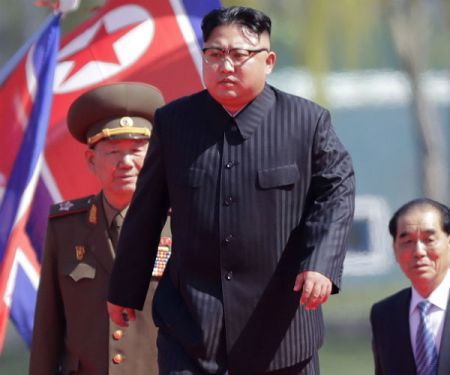
NKorea Seeks ‘Equilibrium’ With US, Says Nuclear Capability Nearly Complete

September 16, 2017

NKorea Seeks ‘Equilibrium’ With US, Says Nuclear Capability Nearly Complete, Newsmax, AP, September 16, 2017

South Korean President Moon Jae-in, a liberal who initially pushed for talks with North Korea, said its tests currently make dialogue “impossible.”

“If North Korea provokes us or our allies, we have the strength to smash the attempt at an early stage and inflict a level of damage it would be impossible to recover from,” said Moon, who ordered his military to conduct a live-fire ballistic missile drill in response to the North Korean launch.

********************************

North Korean leader Kim Jong Un said his country is nearing its goal of “equilibrium” in military force with the United States, as the United Nations Security Council strongly condemned the North’s “highly provocative” ballistic missile launch over Japan on Friday.

The North’s official Korean Central News Agency carried Kim’s comments on Saturday — a day after U.S. and South Korean militaries detected the missile launch from the North Korean capital of Pyongyang.

It traveled 3,700 kilometers (2,300 miles) as it passed over the Japanese island of Hokkaido before landing in the northern Pacific Ocean. It was the country’s longest-ever test flight of a ballistic missile.

The North has confirmed the missile as an intermediate range Hwasong-12, the same model launched over Japan on Aug. 29.

Under Kim’s watch, North Korea has maintained a torrid pace in weapons tests, including its most powerful nuclear test to date on Sept. 3 and two July flight tests of intercontinental ballistic missiles that could strike deep into the U.S. mainland when perfected.

The increasingly frequent and aggressive tests have added to outside fears that the North is closer than ever to building a military arsenal that could viably target the U.S. and its allies in Asia. The tests, which could potentially make launches over Japan an accepted norm, are also seen as North Korea’s attempt to win greater military freedom in the region and raise doubts in Seoul and Tokyo that Washington would risk the annihilation of a U.S. city to protect them.

The KCNA said Kim expressed great satisfaction over the launch, which he said verified the “combat efficiency and reliability” of the missile and the success of efforts to increase its power.

While the English version of the report was less straightforward, the Korean version quoted Kim as declaring the missile as operationally ready. He vowed to complete his nuclear weapons program in the face of strengthening international sanctions, the agency said.

Photos published by North Korea’s state media showed the missile being fired from a truck-mounted launcher and a smiling Kim clapping and raising his fist while celebrating from an observation point. It was the first time North Korea showed the missile being launched directly from a vehicle, which experts said indicated confidence about the mobility and reliability of the system. In previous tests, North Korea used trucks to transport and erect the Hwasong-12s, but moved the missiles on separate firing tables before launching them.

The U.N. Security Council accused North Korea of undermining regional peace and security by launching its latest missile over Japan and said its nuclear and missile tests “have caused grave security concerns around the world” and threaten all 193 U.N. member states.

Kim also said the country, despite “limitless” international sanctions, has nearly completed the building of its nuclear weapons force and called for “all-state efforts” to reach the goal and obtain a “capacity for nuclear counterattack the U.S. cannot cope with.”

“As recognized by the whole world, we have made all these achievements despite the U.N. sanctions that have lasted for decades,” the agency quoted Kim as saying.

Kim said the country’s final goal “is to establish the equilibrium of real force with the U.S. and make the U.S. rulers dare not talk about military option for the DPRK,” referring to North Korea’s official name, the Democratic People’s Republic of Korea.

He indicated that more missile tests would be forthcoming, saying that all future drills should be “meaningful and practical ones for increasing the combat power of the nuclear force” to establish an order in the deployment of nuclear warheads for “actual war.”

Prior to the launches over Japan, North Korea had threatened to fire a salvo of Hwasong-12s toward Guam, the U.S. Pacific island territory and military hub the North has called an “advanced base of invasion.”

The Security Council stressed in a statement after a closed-door emergency meeting that all countries must “fully, comprehensively and immediately” implement all U.N. sanctions.

Japan’s U.N. Ambassador Koro Bessho called the missile launch an “outrageous act” that is not only a threat to Japan’s security but a threat to the whole world.

Bessho and the British, French and Swedish ambassadors demanded that all sanctions be implemented.

Calling the latest launch a “terrible, egregious, illegal, provocative reckless act,” Britain’s U.N. Ambassador Matthew Rycroft said North Korea’s largest trading partners and closest links — a clear reference to China — must “demonstrate that they are doing everything in their power to implement the sanctions of the Security Council and to encourage the North Korean regime to change course.”

France’s Foreign Ministry said in a statement that the country is ready to work on tougher U.N. and EU measures to convince Pyongyang that there is no interest in an escalation, and to bring it to the negotiating table.

Friday’s launch followed North Korea’s sixth nuclear test on Sept. 3 in what it described as a detonation of a thermonuclear weapon built for its developmental ICBMs.

The Hwasong-12 and the Hwasong-14 were initially fired at highly lofted angles to reduce their range and avoid neighboring countries. The two Hwasong-12 launches over Japan indicate North Korea is moving toward using angles close to operational to evaluate whether its warheads can survive the harsh conditions of atmospheric re-entry and detonate properly.

While some experts believe North Korea would need to conduct more tests to confirm Hwasong-12’s accuracy and reliability, Kim Jong Un’s latest comments indicate the country would soon move toward mass producing the missiles for operational deployment, said Kim Dong-yub, an analyst at Seoul’s Institute for Far Eastern Studies. He also said that the North is likely planning similar test launches of its Hwasong-14 ICBM.

South Korean President Moon Jae-in, a liberal who initially pushed for talks with North Korea, said its tests currently make dialogue “impossible.”

“If North Korea provokes us or our allies, we have the strength to smash the attempt at an early stage and inflict a level of damage it would be impossible to recover from,” said Moon, who ordered his military to conduct a live-fire ballistic missile drill in response to the North Korean launch.

H.R. McMaster: ‘There is a military option’ for North Korea

September 15, 2017

H.R. McMaster: ‘There is a military option’ for North Korea, Washington ExaminerJoel Gehrke , September 15, 2017

(In other news, China has said it opposes North Korea’s new missile activity and 

the essence of the Korean Peninsula nuclear issue is a security issue and the crux is the disagreements between the DPRK and the United States.

“China is neither the focus of the Korean Peninsula nuclear issue, nor the core to resolving the issue. Neither is it the propellent of the current tensions,” she said, urging parties directly concerned to take up their due responsibilities.

Translation: It’s your problem; deal with it as you want but don’t do anything we won’t like. — DM)

President Trump’s top national security aide said Friday that there is a military option for handling North Korea’s missile and nuclear testing, even though it’s an option the Trump administration does not want to employ.

“There is a military option,” White House national security adviser H.R. McMaster said at the White House. “Now, it’s not what we would prefer to do. So, what we have to do is call on all nations, call on everyone to do everything we can to address this global problem short of war. So, that is implementing now these significant sanctions that have just now gone into place. And it is convincing everyone to do everything that they can — and that it’s in their interest to do it.”

But McMaster acknowledged that the clock is ticking with each provocative test North Korea runs.

“We’re out of time,” McMaster said. “We’ve been kicking the can down the road, and we’re out of road.”

McMaster was joined at the White House by U.S. Ambassador to the United Nations Nikki Haley, who agreed that the UN is running out of options when it comes to imposing new economic sanctions.

“There’s not a whole lot the Security Council is going to be able to do from here,” Haley said.

Haley’s comments suggest that she won’t revive an attempt to push an oil embargo through the U.N. Security Council, after China and Russia opposed the measure last week. Instead, she argued that the resolution which passed instead of the more-stringent embargo would be a strong deterrent to the regime if it is implemented effectively.

“If you look at the resolutions that have passed over the last month, the two of them, they cut 30 percent of their oil, they banned all the laborers, they based 90 percent of the exports, they banned joint ventures,” Haley said. “in the words of North Korea, we’ve strangled their economic situation at this point.”

McMaster said the sanctions will take time to have a maximum affect, but North Korea’s decision to launch yet another ballistic missile over Japan put renewed urgency in his public message. That’s an apparent warning to Russia and China, both of which oppose additional U.S. military buildups in the Asia-Pacific region.

Their comments came one day after Secretary of State Rex Tillerson called on China to implement the oil embargo unilaterally.

“China supplies essentially all of North Korea’s oil,” Tillerson told reporters in London. “I am hopeful that China — as a great country, a world power — will decide on their own and will take it upon themselves to use that very powerful tool of oil supply to persuade North Korea to reconsider its current path towards weapons development, to reconsider its approach to dialogue and negotiations in the future.”

UN Security Council passes new sanctions against North Korea

September 12, 2017

UN Security Council passes new sanctions against North Korea, Fox Business News via YouTube, September 11, 2017

As noted in the blurb beneath the video,

Lt. Col. Michael Waltz (Ret.) and Center for Security Policy President Frank Gaffney on the U.N. implementing new sanctions against North Korea.


