Archive for the ‘No fly zone’ category

Russian hands-off warning to US, Saudis, Turks amid crucial Aleppo battle

February 6, 2016

Russian hands-off warning to US, Saudis, Turks amid crucial Aleppo battle, DEBKAfile, February 6, 2016
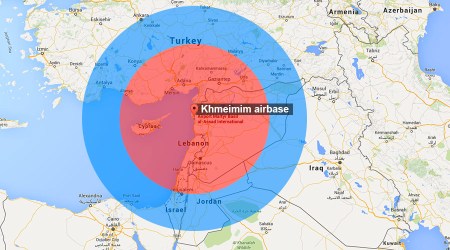
S-400_range_map_25.11.15 (1)

The five-year Syrian civil war, faces its most critical moment. Saturday, Feb. 6, a combined force of Syrian army and Hizballah troops and an Iraqi Shiite militia under Iranian officers, were led by Russian air and Spetsnaz (special forces) officers into pressing forward to encircle 35,000 rebels trapped in Aleppo, the country’s largest city. As they tightened the siege, 400,000 Syrian civilians were also trapped and forced to bear heavy Russian air bombardment and savage artillery fire from the ground forces closing in on the city.

Rebel supply routes were cut off Thursday and Friday when Syrian and Hizballah forces captured the Azaz Corridor connecting Aleppo and all of the northern province of Idlib to the Turkish border.

Tens of thousands of refugees fleeing from the beleaguered town are massing at Bab al-Salama, the last Turkish border crossing to be closed against them. This is the largest Syrian refugee exodus since the start of the civil war.

The rebels under siege are painfully short of weaponry for fighting off the massive, combined offensive, DEBKAfile’s military sources report. Their only remaining recourse is to surrender or be ground into submission as the conquering force knocks over their positions and takes over street after street.

Once the combined forces fighting with Bashar Assad’s army take Aleppo and northern Syria, the opposition will have suffered its heaviest defeat since the war began. The rebels groups’ capacity to continue fighting the regime will be gravely diminished.

Their desperate plight – and the fresh surge of Syrian refugees in unmanageable numbers – cut short the conference in Geneva for a settlement of the Syrian conflict, before it got underway – and prompted reactions from sponsors of rebel groups.

In Riyadh, Brig, Gen. Ahmed Asiri, adviser to Saudi Defense Minister Muhammed Bin Salman, announced Friday that Saudi Arabia is ready “to participate in any ground operations that the international coalition launches against ISIS.” This offer was taken as a veiled response to the SOS from the rebel stronghold in Aleppo.

In Washington, State Department circles, in a briefing to US media, said the time had come to establish a no-fly security zone in northern Syria. They said: “Once a zone were established we do not believe Russia would challenge the stronger US and NATO forces, particularly if they were operating mainly from Turkey.”

The next day, Friday, Moscow came back with a sharp response: Russian Deputy Defense Minister Anatoly Antonov said: “Russian air defense systems enable early detection of threats to Russian aircraft flying combat missions over Syria and provide adequate measures to ensure flight safety.”

This was a reminder of the sophisticated air defense S-400 and S-300 missile systems Russia installed at its Syrian air base after the Turkish air force downed a Russian warplane in November.

Syrian Foreign Minister Walid al-Moallem put it more crudely: “Any foreign troops entering Syria would return home in wooden coffins.”

He advised armed opposition groups fighting the government offensive in the area to lay down their weapons because, he said, “government advances signal that the five-year-old Syria war is nearing its end.”

Saturday, US Secretary of State John Kerry urged Russia to implement a ceasefire in Syria, saying its bombing campaign was killing women and children in large numbers and “has to stop.” He told reporters on his return from a trip to Europe: “Russia has indicated to me very directly they are prepared to do a ceasefire,” adding “The Iranians confirmed in London just a day and a half ago they will support a ceasefire now.”

DEBKAfile’s military sources have seen no sign of any ceasefire or even a slowdown in the Russian-led Syrian-Iranian Aleppo offensive.
Russian S-400 missiles turn most of Syria into no-fly zone, halt US air strikes

November 28, 2015

Russian S-400 missiles turn most of Syria into no-fly zone, halt US air strikes, DEBKAfile, November 28, 2015

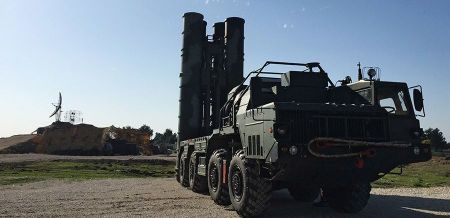
2746772 11/26/2015 An S-400 air defence missile system is deployed for a combat duty at the Hmeymim airbase to provide security of the Russian air group's flights in Syria. Dmitriy Vinogradov/Sputnik

2746772 11/26/2015 An S-400 air defence missile system is deployed for a combat duty at the Hmeymim airbase to provide security of the Russian air group’s flights in Syria. Dmitriy Vinogradov/Sputnik

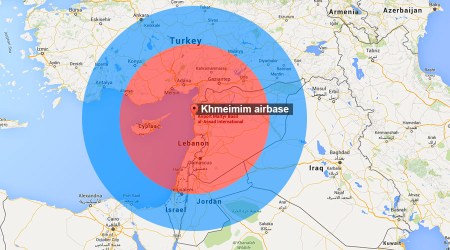
S-400_range_map_25.11.15

The deployment of the highly advanced Russian S-400 anti-air missiles at the Khmeimin base, Russia’s military enclave in Syria near Latakia, combined with Russia electronic jamming and other electronic warfare equipment, has effectively transformed most of Syria into a no-fly zone under Russian control.

Moscow deployed the missiles last Wednesday, Nov. 25, the day after Turkish warplanes downed a Russian Su-24. Since then, the US and Turkey have suspended their air strikes over Syria, including bombardments of Islamic State targets. The attacks on ISIS in Iraq continue without interruption. Turkey is now extra-careful to avoid flights anywhere near the Syrian border.

Both the US and Turkey are obviously wary of risking their planes being shot down by the S-400, so long as Russian-Turkish tensions run high over the Su-24 incident.

Friday, a US-led coalition spokesperson denied that the absence of anti-IS coalition air strikes had anything to do with the S-400 deployment in Syria. He said “The fluctuation or absence of strikes in Syria reflects the ebb and flow of battle.”

However, DEBKAfile’s military sources confirm that neither the US, Turkey or Israel have any real experience in contending with the Russian S-400, which uses multiple missile variants to shoot down stealth aircraft, UAVs, cruise missiles and sub-strategic ballistic missiles. Its operational range for aerodynamic targets is about 250 km and for ballistic targets 60 km. The S-400 can engage up to 36 targets simultaneously.

Thei range covers at least three-quarters of Syrian territory, a huge part of Turkey, all of Lebanon, Cyprus and half of Israel.

Since the downing of their warplane, the Russians have put in place additionally new electronic warfare multifunctional systems both airborne and on the ground to disrupt Turkish flights and forces, Lt. Gen. Evgeny Buzhinksy revealed Friday. Turkey has countered by installing the KORAL electronic jamming system along its southern border with Syria.

An electronic battlefield has spread over northern Syria and southern Turkey, with the Russian and Turks endeavoring to jam each other’s radar and disrupt their missiles. In this, the Russians have the advantage.

With the Americans, Russians and Turks locked in a contest over Syria, and the Israeli Air Force’s freedom of action restricted by objective conditions, some comments made at week’s end by Israeli military and security officials sounded beside the point.

Thursday, Nov. 26, a senior Air Force officer remarked that Israel is being careful to avoid friction with Russia, despite that country’s expanding military presence in Syria. “Russia is now a central player and can’t be ignored. But we each go our own way, according to our own interests,” the officer noted.

“Our policy is not to attack or down any Russian plane. Russia is not our enemy.”

The officer said that Israeli and Russian officers maintain telephone contact. “We don’t notify or ask for anything; we just do our jobs,” he said.

According to DEBKAfile’s military sources, this is not a true picture. Israel does get in touch with the Russians when their planes get too close to Israeli aircraft. There was no need to state that Israeli won’t shoot down Russian planes, as though this was self-evident, because in the current volatile situation, circumstances may change in a trice. Is it in Israel’s interest to fly into air space loaded with electronic warfare waves? But what if Russian warplanes come over the Golan as part of a blitz to destroy Syrian rebels in southern Syria, some of which are backed by Israel?

To gratify Tehran and Moscow, new US-Turkish anti-ISIS war campaign in Syria skirts Assad’s forces

July 26, 2015

To gratify Tehran and Moscow, new US-Turkish anti-ISIS war campaign in Syria skirts Assad’s forces, DEBKAfile, July 25, 2015

Tanks_face_IS_at_Syria_25.7.15

Not exactly by chance, the security zone bisects Kurdish territory and holds back Kurdish forces in their assaults on ISIS.

DEBKAfile’s military sources report that a glance at the map betrays an all-out US-Turkish effort not put up backs in Tehran by interfering with Syrian, Hizballah and pro-Iranian militia operations in critical northern Syrian war zones such as Aleppo or give the Syrian rebels a helping hand in the Idlib province.

*********************

After the second successive night of Turkish cross-border bombing attacks on the Islamic State in northern Syria, Ankara and Washington agreed Saturday, July 25, to name the “security zone” covered by a “partial no fly zone” they had declared in northern Syria the “Islamic State free zone.” Click HERE for full-size map!

This name represents a significant US-Turkish concession to Iran of immunity for its allies, Syrian President Bashar Assad and Hizballah, in order to gain Tehran’s cooperation in the campaign Turkey launched against ISIS Friday. Integral to the deal is also a promise to abstain from using the campaign to grant anti-Assad rebel groups any advantages.

This immunity did not extend to the Kurdish Workers Movement (PKK), which were targeted in the course of Turkish air and ground action in and over the new “security zone.” Those warplanes also flew missions Friday night over the PKK bases and logistical facilities in the Qandil Mountains of northern Iraq. The PKK responded Saturday with an announcement that their armistice with Ankara was over. Turkey may consequently expect a recurrence of Kurdish terrorist violence in its cities,DEBKAfile notes.

High-placed sources in Ankara disclosed details of the US-Turkish deal with Iran. US warplanes will have the use of Turkish air bases, and not just the big Incirlik facility, for staging air strikes against ISIS, so long as Syrian targets are avoided. Washington agreed to Ankara using its air and ground operations against ISIS in Syria to drive into the new “security zone” and push toward the east to continue those attacks – eve if they run up against Kurdish forces which are also fighting ISIS.

The security zone’s area covered by a no-fly zone is 90 km wide and 40km deep, running between Mere, a small town 25  km north o Aleppo in the west, to the northwestern town of Jarabulus, which is situated on the west bank of the Euphrates.

Not exactly by chance, the security zone bisects Kurdish territory and holds back Kurdish forces in their assaults on ISIS.

DEBKAfile’s military sources report that a glance at the map betrays an all-out US-Turkish effort not put up backs in Tehran by interfering with Syrian, Hizballah and pro-Iranian militia operations in critical northern Syrian war zones such as Aleppo or give the Syrian rebels a helping hand in the Idlib province.

The combined US-Turkish action moreover greatly supports the Assad-Hizballah war against ISIS gains in Syria and enhances Iranian and Russian influence in Damascus.

US Secretary of Defense Ashton Carter, in Irbil Friday, July 24, assured leaders of the semiautonomous Kurdish Republic of Iraq. “We are trying to build a force through the territory of Iraq, and someday in Syria, that can do what the peshmerga have achieved.”

At the same time, in Syria, the Kurds and their national aspirations look like losing out dramatically in the fallout from the complex US-Turkish partnership for beating ISIS back.

Israel air strikes wiped out Russian hardware for thwarting US no-fly zone plan over Syria

December 10, 2014

Israel air strikes wiped out Russian hardware for thwarting US no-fly zone plan over Syria, DEBKAfile, December 8, 2014

Israeli_jets_of_bombing_two_installations_inside_Syria7.12.14Israel jets bombing Syrian targets

High-ranking American military sources revealed Monday, Dec. 8, that Israel’s air strikes near Damascus the day before wiped out newly-arrived Russian hardware including missiles that were dispatched post haste to help Syria and Hizballah frustrate a US plan for a no-fly zone over northern Syria.

The advanced weapons were sent over, as DEBKAfile reported exclusively Sunday, after Russian President Vladimir Putin learned that the Obama administration and the Erdogan government were close to a final draft on a joint effort to activate a no-fly zone that would bar Syrian air force traffic over northern Syria.

The Kremlin has repeatedly warned – of late in strong messages through back channels – that the establishment of a no-fly or buffer zone in any part of Syria would be treated as direct American intervention in the Syria war and result in Russian military intervention for defending the Assad regime.

According to the US-Turkish draft, American warplanes would be allowed to take off from the Turkish airbase of Incirlik in the south for operations against Syrian warplanes, assault helicopters or drones entering the no-go zone. Thus far, Ankara has only permitted US surveillance aircraft and drones the use of Incirlik for tracking the movements of Islamic State fighters in northern Syria.

The Obama administration was long deterred from implementing a no-fly zone plan by the wish to avoid riling Moscow or facing the hazards of Syria’s world-class air defense system.

But Washington was recently won over to the plan by a tacit deal with Damascus for American jets to be allowed entry to help Kurdish fighters defend their northern Syrian enclave of Kobani against capture by al Qaeda’s IS invaders.

However, the US administration turned down a Turkish demand to extend the no-fly zone from their border as far as Aleppo, Syria’s largest city, over which Syrian army forces are battling rebels and advancing slowly into the town.

The no-fly zone planned by US strategists would be narrow – between a kilometer and half a kilometer deep inside Syria. However Moscow is standing fast against any such plan and objects to US planes making free of Syrian airspace, a freedom they are now afforded over Kobani.

To drive this point home, the Russians delivered a supply of advanced anti-air missiles and radar, whose use by the Syrian army and transfer to Hizballah in Lebanon were thwarted by the Israeli air strikes Sunday.

Moscow reacted swiftly and angrily with a Note to the United Nations Monday accusing Israel of “aggressive action” and demanding “that such attacks should not happen again… Moscow is deeply worried by this dangerous development, the circumstances of which demand an explanation.”

The Assad regime has held back from reacting to past Israeli air raids for preventing advanced weaponry from reaching Hizballah. This time, spokesmen in Damascus warned that their government’s response would be clandestine and cause Israel “unimaginable harm.”