Archive for the ‘Muslim Brotherhood’ category

Erdogan’s Egyptian Nightmare

December 30, 2014

Erdogan’s Egyptian Nightmare, The Gatestone InstituteBurak Bekdil, December 30,2014

Erdogan was happy. At least until a few days ago….

Erdogan probably did not know the Emir of Qatar’s next move on the Middle Eastern chessboard.

Turkey aspires to be a regional leader with no, little or problematic dialogue with about a dozen countries in its region.

Back in 2011, everything ostensibly was coming up roses between Turkey and Egypt. In a speech that year, then-Turkish President Abdullah Gul mentioned “…an axis of democracy of the two biggest nations in our region [Turkey and Egypt], from the north to the south, from the Black Sea down to the Nile Valley…”

In September 2011, then-Prime Minister [now President] Recep Tayyip Erdogan found an emotional hero’s welcome at Cairo’s Tahrir Square. Tens of thousands of Egyptians had flocked to the Cairo airport to welcome him. Streets were decorated with posters of Erdogan.

In early 2012, a survey by TESEV, a Turkish think-tank, found that Turkey was the most popular country for the residents of seven Arab countries, including Egypt.

But against that glittering backdrop, this author wrote in June 2011: “For Ankara, Cairo can be the new Damascus until another capital becomes the new Cairo. At that time, Syrian President Bashar al-Assad, Erdogan’s one-time best regional ally, had already become his worst regional nemesis.

The Turkish-Egyptian love affair would, in fact, be quite short-lived.

In August 2013, about a month after General Abdel Fattah el-Sisi in Egypt toppled the Muslim Brotherhood rule of President Mohammed Morsi, Erdogan appeared on TV, reading — in an unusually soft voice — a letter by the Muslim Brotherhood’s Mohamed al-Beltagy. The letter was written to Beltagy’s daughter Asmaa, a 17-year-old girl, who had been killed in Cairo when security forces stormed two protest camps occupied by supporters of the deposed president. Poor Asmaa had been shot in the chest and back.

“I believe you have been loyal to your commitment to God, and He has been to you,” her father wrote in the letter. “Otherwise, He would not have called you to His presence before me.” Erdogan’s tears were visible.

Later, Asmaa became another symbol for Turkish Islamists; Erdogan cheered party fans with the four-finger “Rabia” sign, in reference to his solidarity with the Muslim Brotherhood, and as a sign of his endearment for the unfortunate girl. Even on the playing field, a few footballers made the same sign after scoring.
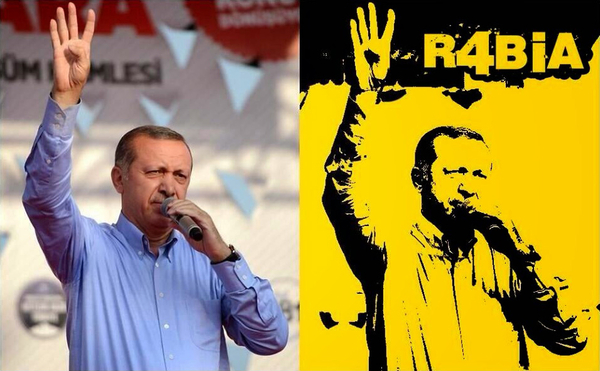
859In this image, widely circulated in social media, Turkey’s then-Prime Minister [now President] Recep Tayyip Erdogan flashes the Egyptian Muslim Brotherhood’s four-fingered “Rabia” sign.

After the coup in Egypt, when el-Sisi ran for president and won the elections, Turkey’s Erdogan declared them “null and void.” And not just that. Erdogan also said that he did not view el-Sisi as “president of Egypt.” At another time, he said, “Turkey would not recognize the coup regime in Egypt.” Last July, he called el-Sisi “an illegitimate tyrant” and a “coup-maker.”

Meanwhile, neither was Erdogan a “rock star” in Cairo nor was Turkey “the most popular country.” Egyptian non-governmental organizations [NGOs] called on Egyptians and Arabs to boycott Turkish goods and soap operas. Egypt’s intellectuals, writers and businessmen were recommending a break in Egypt’s relations with Turkey because “they were disappointed.” Egypt unilaterally cancelled both visa-free travel for Turkish citizens and a transit agreement for Turkish trucks.

In the anti-el-Sisi campaign, Turkey was not alone. Its only regional ally, Qatar, fully supported Turkey against Egypt’s elected “coup leader.” Erdogan was happy. At least until a few days ago….

In Ankara, Erdogan was all smiles when he offered a red-carpet ceremony to the visiting Qatari Emir Sheikh Tamim bin Hamad al-Thani. Happy to have his best ally as a guest, Erdogan probably did not know the Emir’s next move on the Middle Eastern chessboard.

A few days after al-Thani’s merry visit to Ankara, Qatar announced its determination to thaw ties with Egypt, ending its alliance with Turkey over “Egypt’s illegitimate tyrant.”

“The security of Egypt is important for the security of Qatar … the two countries are linked by deep and fraternal ties,” ran a statement from the office of al-Thani on Dec. 21. It was a real cold shower on Ankara — and Erdogan. The statement had come one day after el-Sisi met in Cairo with a Qatari envoy, suggesting a possible thaw in relations. After the meeting, el-Sisi’s office issued a statement saying, “Egypt looks forward to a new era that ends past disagreements.” Apparently, the Egyptian-Qatari reconciliation had been brokered by Saudi Arabia and, once again, Turkey was the odd one out.

In its immediate vicinity, Turkey does not have diplomatic relations with three countries — Armenia, Cyprus and Syria — and has deeply problematic diplomatic relations with two countries: Israel and Egypt. This situation is not sustainable.

Even Deputy Prime Minister Bulent Arinc has said that Turkey should repair its relations with Egypt. But this is not an easy task. In the unlikely event of a reconciliation, Erdogan’s previous big words on el-Sisi the coup-maker will make him look like a leader shaking hands with an “illegitimate tyrant.”

On Dec. 24, Turkey’s foreign ministry spokesman said that bilateral ties with Egypt could “normalize if the country properly returns to democracy, if the Egyptian people’s free will is reflected in politics and social life.” Meaning, no normalization. The spokesman would not comment on Qatar’s policy change on Egypt.

Turkey aspires to be a regional leader with no, little or problematic dialogue with about a dozen countries in its region. Erdogan’s top advisors have found a nice euphemism for this situation: “precious loneliness.” In reality, it is rather a blend of miscalculation and over self-confidence.
EU Gives Hamas Green Light to Attack Israel

December 22, 2014

EU Gives Hamas Green Light to Attack Israel, Gatestone InstituteKhaled Abu Toameh, December 22, 2014

Although the EU court has said that its controversial decision was “technical” and was not a reassessment of Hamas’s classification as a terrorist group, leaders of the Islamist movement believe that the move will eventually earn them legitimacy in the international arena.

The EU court’s decision represents a “severe blow to the Palestinian Authority and Egypt,” according to Palestinian political analyst Raed Abu Dayer.

Any victory for Hamas, albeit a small and symbolic one, is a victory for the Islamic State, Al-Qaeda, Islamic Jihad, the Muslim Brotherhood and other fundamentalist groups, and causes tremendous damage to those Muslims who are opposed to radical Islam.

Hours before the EU court’s decision was made public, Hamas leader Mahmoud Zahar announced that his movement would never recognize Israel, and that Hamas seeks to overthrow the Palestinian Authority and seize control of the West Bank.

The EU court’s decision also coincided with a rapprochement between Hamas and Iran. Now, the Iranians and other countries, such as Turkey and Qatar, are likely to interpret the EU court’s decision as a green light to resume financial and military aid, including rockets and missiles, to Hamas — not only to Gaza but to the West Bank as well — to support those Palestinians whose aim it is to eliminate Israel.

Less than 48 hours after a top European Union court ruled that Hamas should be removed from the bloc’s list of terrorist groups, supporters of the Palestinian Islamist movement responded by firing a rocket at Israel. The attack, which did not cause any casualties or damage, did not come as a surprise.

Buoyed by the EU court’s ruling, Hamas leaders and spokesmen see it as a “political and legal achievement” and a “big victory” for the “armed struggle” against Israel.

Musa Abu Marzouk, a top Hamas leader, issued a statement thanking the EU court for its decision. He hailed the decision to remove his movement from the terrorist list as a “victory for all those who support the Palestinian right to resistance.”

When Hamas leaders talk about “resistance,” they are referring to terrorist attacks, such as the launching of rockets and suicide bombings against Israel. In other words, Hamas has interpreted the court’s decision as a green light to carry out fresh attacks as part of its ambition to destroy Israel.

The rocket that was fired from the Gaza Strip at Israel only days after the court decision is not likely to be the last.

Although the EU court has said that its controversial decision was “technical” and was not a reassessment of Hamas’s classification as a terrorist group, leaders of the Islamist movement believe that the move will eventually earn them legitimacy in the international arena.

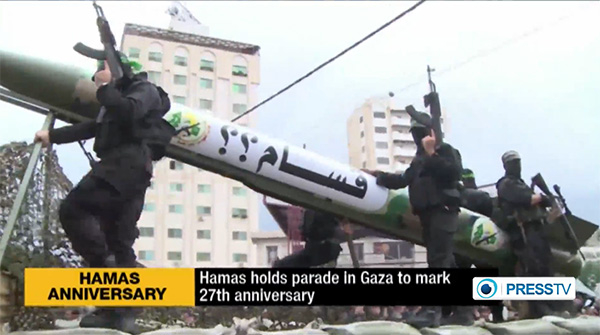
Ironically, the EU court’s decision coincided with Hamas celebrations marking the 27thanniversary of its founding. Once again, Hamas used the celebrations to remind everyone that its real goal is to destroy Israel. And, of course, Hamas used the event to display its arsenal of weapons that include various types of rockets and missiles, as well as drones.

845 (1)Thousands of armed Hamas troops showed off their military hardware at a Dec. 14, 2014 parade in Gaza, marking the organization’s 27th anniversary. (Image source: PressTV video screenshot)

Hours before the EU court decision was made public, Hamas leader Mahmoud Zahar announced that his movement would never recognize Israel. Zahar also made it clear that Hamas seeks to overthrow the Palestinian Authority [PA] regime and seize control over the West Bank.

The EU court’s decision also coincided with increased efforts to achieve rapprochement between Hamas and Iran. Recently, a senior Hamas leadership delegation visited Tehran as part of efforts to mend fences between the two sides. The main purpose of the visit was to persuade the Iranians to resume military and financial aid to Hamas. The visit, according to senior Hamas officials, appears to have been “successful.”

“There are many signs that our relations are back on the right track,” explained Hamas’s Musa Abu Marzouk. “Hamas and Iran have repaired their relations, which were strong before the Syrian crisis.” Relations between Hamas and Iran deteriorated due to the Islamist movement’s refusal to support the regime of Syrian President Bashar Assad.

Now the Iranians are likely to interpret the EU court decision to remove Hamas from the list of terrorist groups as a green light to resume financial and military aid to the movement.

Iran’s leaders recently announced that they intend to dispatch weapons not only to the Gaza Strip, but to the West Bank as well, as part of Tehran’s effort to support those Palestinians who are fighting to eliminate Israel.

Moreover, the EU court’s move will also embolden other countries that provide Hamas with political and financial aid, first and foremost Qatar and Turkey. Oil-rich Gulf countries such as Kuwait, Bahrain, Oman and Saudi Arabia will now face pressure from many Arabs and Muslims to join Qatar, Turkey and Iran in extending their support to Hamas.

The biggest losers, meanwhile, are Palestinian Authority President Mahmoud Abbas and Egypt’s President Abdel Fattah el-Sisi. Over the past few months, the two men have been doing their utmost to undermine Hamas and end its rule over the Gaza Strip.

Abbas has been fighting Hamas by blocking financial and humanitarian aid and arresting its supporters in the West Bank, while Sisi continues to tighten the blockade on the Gaza Strip and destroy dozens of smuggling tunnels along the border with Egypt.

The EU court’s decision represents a “severe blow to the Palestinian Authority and Egypt,” noted Palestinian political analyst Raed Abu Dayer. “As far is Abbas is concerned, the decision grants Hamas political legitimacy and challenges his claim to be the sole legitimate leader [of the Palestinians]. With regards to Egypt, the European court decision calls into question rulings by Egyptian courts that Hamas is a terrorist organization.”

Even if the EU court decision is reversed in the future, there’s no doubt that it has already caused tremendous damage, especially to those Muslims who are opposed to radical Islam.

Any victory for Hamas, albeit a small and symbolic one, is a victory for the Islamic State, Al-Qaeda, Islamic Jihad, the Muslim Brotherhood and other fundamentalist groups around the world.

The decision has left many Arabs and Muslims with the impression that Hamas, after all, is not a terrorist organization, especially if non-Muslims in Europe say so through one of their top courts. Even worse, the decision poses a real and immediate threat to Israel, as evident from the latest rocket attack.

If the Europeans have reached the conclusion that Hamas is not a terrorist organization, then why don’t their governments openly invite tens of thousands of Hamas members and supporters to move to London, Paris and Rome? And they should not forget to ask the Hamas members to bring along with them their arsenal of weapons.

Sisi is not Mubarak

December 4, 2014

Sisi is not Mubarak, Canada Free Press, Caroline Glick, December 4, 2014

Sisi1

Due to the events that propelled him to power, Sisi has adopted a strategic posture far different from Mubarak’s. As Sisi sees things, Sunni jihadist forces and their Iranian-led Shi’ite allies are existential threats to the Egyptian state even when their primary target is Israel. Sisi accepts that Israel’s fight against them directly impacts Egypt.

He recognized that when Israel is successful in defeating them, Egypt is more secure. When Israel is weak, the threat to Egypt rises.

The government must take every possible action, in economic and military spheres, to ensure that Sisi benefits from his actions. 

******************

The Egyptian court’s decision last Saturday to acquit former president Hosni Mubarak, his sons and associates of all remaining charges against them caused most commentators to proclaim that current Egyptian President Abdel Fattah Sisi has turned back the clock. Under his leadership, they say, Egypt has restored Mubarak’s authoritarian regime under a new dictator.

While this may be how things appear on the surface, the fact of the matter is that at least as far as Israel is concerned, nothing could be further from the truth.

During his 30-year rule, Mubarak always assessed that threats against Israel were unrelated to threats against Egypt. Due to this view, despite continuous complaints from Jerusalem, Mubarak enabled jihadists to take root in Sinai. He allowed Egypt to be used as the major path for terrorist personnel and armaments to enter Gaza. He took only minor, sporadic action against the smuggling tunnels connecting Gaza to Sinai.

By 2005, it became apparent that forces from Hamas, Hezbollah, Iran and al-Qaida were operating in the Sinai and cooperating with one another.

Despite warnings from Israel, Mubarak took no effective action to break up the emerging alliance and convergence of forces.

It was due to Mubarak’s refusal to act that the Palestinians in Gaza were able to begin and massively expand their projectile war of mortars, rockets and missiles against Israel. From the first such attacks, carried out 14 years ago, the Palestinian projectile campaigns could never have happened without Egypt’s effective collaboration.

On countless occasions, Palestinian terrorist commanders were able to escape to Sinai and avoid arrest by Israeli forces, only to return to Gaza from Sinai and continue their operations.

Mubarak believed that Israel was his safety valve.

Mubarak: Facilitating jihadist operations against Israel from Egyptian territory

By facilitating jihadist operations against Israel from Egyptian territory, he assumed that he was securing Egypt from them. As he saw things, the Muslim Brotherhood, Hamas, Hezbollah and Iran would be so satisfied with his cooperation in their jihad against the Jews that they would leave him alone.

It was only in 2009, when Egypt announced the unraveling of a terrorist ring in Sinai comprised of Iranian Revolutionary Guards, Hamas and Hezbollah operatives planning attacks against Israel and Egypt, and seeking the overthrow of the regime, that Mubarak began signaling he may have misjudged the situation. But even then, his actions against those forces were sporadic and half-hearted.

Hamas’s continued assaults against Israel in the years that followed, and the build-up of Muslim Brotherhood and al-Qaida forces in Sinai, were a clear sign that Mubarak was unwilling to contend with the unpleasant reality that the very forces attacking Israel were also seeking to overthrow his regime and destroy the Egyptian state.

In stark contrast, Sisi rose to power as those selfsame forces were poised to destroy the Egyptian state. The Muslim Brotherhood’s rise to power owed in part to the support it received from Hamas.

Sisi and his generals overthrew the Muslim Brotherhood with Saudi and UAE support in order to prevent Egypt from dissolving into a Sunni jihadist axis i

During the January 2011 rebellions against Mubarak, Hamas operatives played a key role in storming Egyptian prisons in Sinai and freeing Muslim Brotherhood leaders – including Muslim Brotherhood president Mohammed Morsi – from prison. In 2012 and 2013, Hamas forces reportedly served as shock troops to quell protests against the Muslim Brotherhood regime. Those protests arose in opposition to Morsi’s moves to seize dictatorial powers Mubarak never dreamed of exercising, and his constitutional machinations aimed at transforming Egypt into an Islamic state and hub of a future global caliphate.

Sisi and his generals overthrew the Muslim Brotherhood with Saudi and UAE support in order to prevent Egypt from dissolving into a Sunni jihadist axis in which Hamas, al-Qaida and other jihadist movements were key players, and Iran and Hezbollah were allied forces.

Due to the events that propelled him to power, Sisi has adopted a strategic posture far different from Mubarak’s. As Sisi sees things, Sunni jihadist forces and their Iranian-led Shi’ite allies are existential threats to the Egyptian state even when their primary target is Israel. Sisi accepts that Israel’s fight against them directly impacts Egypt.

He recognized that when Israel is successful in defeating them, Egypt is more secure. When Israel is weak, the threat to Egypt rises.

Like Israel, Sisi acknowledges that the ideology of the Muslim Brotherhood, which is shared by Hamas, al-Qaida and all other significant Sunni jihadist groups renders all of these groups threats to Egypt. And because of this acknowledgment, Sisi has abandoned Mubarak’s policy of enabling their war against Israel.

Not only has he abandoned Mubarak’s policy of enabling them, Sisi has acted in alliance with Israel in combating them. This is nowhere more evident than in his actions against Hamas in Gaza.

After seizing power in July 2013, Sisi immediately ordered the Egyptian military to take action to secure the border between Gaza and Sinai. To this end, for the first time, Egypt took effective, continuous steps to block the smuggling of arms and people between the two areas. These steps had a profound impact on Hamas’s regime. Hamas went to war against Israel this past summer in a bid to force Egypt and Israel to open their borders with Gaza in support of the Hamas regime and its jihadist allies.

Hamas was certain that footage of suffering in Gaza would force Egypt to oppose Israel, and so open its border with Gaza. It would also lead to US-led pressure on Israel that would make Israel succumb to Hamas’s demands.

Against all expectations, and previous precedents of Egyptian behavior under both Mubarak and Morsi, Sisi supported Israel against Hamas. Moreover, he brought both Saudi Arabia and the UAE into the unofficial alliance with Israel. The bloc he formed was powerful enough to surmount US pressure to end the war by bowing to Hamas’s demands and opening Gaza’s borders with Egypt and Israel.

Since the cease-fire came into force three months ago, Sisi has continued to seal the border. As a consequence, he has denied Hamas the ability to rebuild Gaza’s terror infrastructure. In its reduced state, Hamas is less able to facilitate the operations of its jihadist brethren in Sinai that are primarily involved in waging an insurgency against the Egyptian state.

To be sure, the most significant strategic development in recent years is the US’s strategic realignment under President Barack Obama. Under Obama the US has switched sides, supporting Iran and its allies, satellites and assets, including the Muslim Brotherhood and Hamas, against America’s Sunni allies and Israel.

But the alliance that emerged this summer between Israel and Egypt, with the participation of Saudi Arabia and the UAE , is also a highly significant strategic development. For the first time, a major regional power is basing its strategic posture on its understanding that the threats against itself and against Israel stem from the same sources and as a consequence, that the war against Israel is a war against it.

Israelis have argued this case for years to their Arab neighbors as well as to the Americans and other Western states. But for multiple reasons, no one has ever been willing to accept this basic, obvious reality.

As a consequence, everyone from the Americans to the Europeans to the Saudis long supported policies that empower jihadist forces against Israel.

Sisi became the first major leader to break with this consensus, as a result of actions Hamas took before and since his rise to power. He has brought Saudi Arabia and the UAE along on his intellectual journey.

And this reassessment has had a profound impact on regional realities generally and on Israel’s strategic posture specifically.

From Israel’s perspective, this is a watershed event.

The government must take every possible action, in economic and military spheres, to ensure that Sisi benefits from his actions.


