King Abdullah II: We’re War With “Outlaws Of Islam” – Special Report via You Tube, April 13, 2015
(He seems quite diplomatic, but what does he actually think? — DM)
King Abdullah II: We’re War With “Outlaws Of Islam” – Special Report via You Tube, April 13, 2015
(He seems quite diplomatic, but what does he actually think? — DM)
It’s Not Just Islam, It’s the Tribal Mentality, Front Page Magazine, Bruce Thornton, March 12, 2015
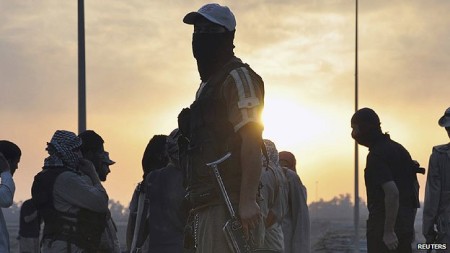
Islam in part is the “theologizing” of the tribal mentality. Islam’s important innovation was to redefine the “tribe” as the whole umma of believers, creating in effect a “super tribe” that transcends mere blood as the bonding agent. But the tribal warrior ethos persists–– in the doctrine of jihad, tribal atrocities in contemporary terror and its gruesome videos, the privileging of men in polygamy, honor killings, and social restrictions on women, the disdain for the infidel “other” in the Koranic belief that Muslims are the “best of nations,” the betrayal of alliances in the religious sanction of lying to infidels (taqiyya), and the obsession with “honor” that today we find in violent Muslim reactions to “blasphemy” against Mohammed or the Koran.
Ignoring the tribal mentality is as dangerous for our foreign policy as downplaying Islamic doctrine.
The Obama administration’s serial appeasement of Iran––currently the “strongest tribe” spreading its influence throughout the region–– has damaged our prestige among allies like Jordan, Saudi Arabia, and Egypt, who are already shopping around for a more reliable and forceful partner. If we want to destroy the jihadists, check Iran’s nuclear ambitions, and protect our interests, we must again become the “strongest tribe.”
********************
The “nothing to do with Islam” mantra took a hit recently in one of the premier organs of liberal received wisdom, The Atlantic. Many have greeted as a revelation Graeme Wood’s article on the Islamic doctrines behind ISIS’s atrocities. Regular readers of FrontPage and Jihad Watch will not be as impressed. For years they have understood the link between jihadism and Islam. In 1994 Andy McCarthy made this connection when he prosecuted the perpetrators of the first World Trade Center bombing the previous year, a connection that the FBI ignored or discounted at the time––a failure, by the way, that has become a pernicious tradition for those charged with protecting our nation’s security and interests. For everyone else who has been paying attention to the rise of modern jihadism, Wood’s article is a dog bites man story.
One can hope that perhaps now, with the truth revealed by one of the Acela corridor’s oracles, the jihad deniers will wise up, though I wouldn’t bet on it. Unexamined opinions comprise the bulk of the progressive mind, and are notoriously resistant to empirical evidence and sound argument. But the current mess in the Middle East results from more than just Islam and its traditional belligerence, supremacist pretensions, and illiberal religious laws and doctrines. These characteristics reflect variations on the mentality of the tribe, one antithetical to modernity and the principles of liberal democracy, and still powerful in the Middle East, the region once described as “tribes with flags.”
For all the differences among tribal peoples, the components of this mentality are consistent, from the ancient Gauls and Germans Caesar conquered and the Vikings terrorizing much of Europe, to the American Indians the U.S. Cavalry fought and the jihadist gangs rampaging in the Middle East.
First, there is little notion of a common humanity that transcends ethnicity or culture. Universal principles are scarce, and personal identity is found solely in the collective customs and traditions of the tribe. Outsiders are to be distrusted, plundered, or conquered when possible. Loyalty is not to principle, but to blood. Most tribal peoples consider their tribe the acme of humanity, the only genuine humans. Hence their word for “human” is usually identical to the name of their tribe. They are literally ethnocentric.
Second, violence, particularly against outsiders, is an acceptable instrument for resolving conflict and asserting tribal superiority. Not just the violence of war, but also the cruel torture and slaughter of outsiders, including women and children, are legitimate for serving the interests of the tribe. Indeed, what we call terrorism was a tactic of tribal warfare to prevent a full-scale war by so terrorizing enemies that they would give up without a fight, a phenomenon common in the various Indian wars of American history. Hence the scary face-paint, tattoos, war cries, bizarre hairstyles, tortures like scalping, mutilation of enemies, or slaughter of their women and children, all of which are meant to frighten and demoralize the enemy. The same intent explains the blustering threats, braggadocio, and insults typical of tribal warfare and diplomacy. These practices can be documented in tribal societies from the Iroquois to the ancient Gauls.
Next, loyalty in tribal societies counts only for those within the tribe. Alliances with other tribes or peoples are ad hoc and contingent on the immediate interests of the tribe. They can be abandoned or betrayed if circumstances or perceptions change. Moreover, respect for others beyond the tribe is based solely on their capacity to inflict violence on their enemies. The “strongest tribe,” a status based on its effectiveness and success in conflict, will attract allies, who will abandon the hegemon once it loses that perception of its strength. Thus during Caesar’s wars in Gaul various Gallic and Germanic tribes would ally with the Romans when they appeared dominant, and betray them in an instant if they thought them weak. Likewise during the U.S. Cavalry’s wars against the Plains Indians, many tribes victimized by the Sioux or Apache or Cheyenne would ally with the Americans if they seemed to be winning, then switch sides the moment they seemed weak.
Finally, tribal societies are centered on the male warrior and his honor. Forget the Women’s Studies fantasies of matriarchal tribal societies. Tribal cultures privilege males, for men fight, and the survival and honor of the tribe depends on martial valor. Women bear children and work, as the skeletons of pre-contact American Indian remains demonstrate. Female bones show much more damage from hard physical labor than do male. This doesn’t mean that women had no status within the tribe, or did not enjoy somewhat more equality than women in more sophisticated civilizations. But warrior males still dominated, and culture in the main centered on men and their prowess in war, which earned honor, what we call prestige, for the whole tribe.
Sound familiar? It should, for Islam in part is the “theologizing” of the tribal mentality. Islam’s important innovation was to redefine the “tribe” as the whole umma of believers, creating in effect a “super tribe” that transcends mere blood as the bonding agent. But the tribal warrior ethos persists–– in the doctrine of jihad, tribal atrocities in contemporary terror and its gruesome videos, the privileging of men in polygamy, honor killings, and social restrictions on women, the disdain for the infidel “other” in the Koranic belief that Muslims are the “best of nations,” the betrayal of alliances in the religious sanction of lying to infidels (taqiyya), and the obsession with “honor” that today we find in violent Muslim reactions to “blasphemy” against Mohammed or the Koran.
Ignoring the tribal mentality is as dangerous for our foreign policy as downplaying Islamic doctrine. The chronic disorder in northern Iraq today is not just about the Sunni-Shi’a divide, or ISIS’s dream of a caliphate. It also reflects the bewildering number of tribes and clans in the region, whose complex alliances and enmities continually shift depending on circumstances and the perceptions of which tribe is the stronger. Our ally today can instantly become our enemy tomorrow. Factions that appear “moderate” today can become jihadist terrorists tomorrow. Our “friends” will tell us what we want to hear today, and then betray their words tomorrow. Most important, anything we do that creates the perception of weakness––especially concessions, or failure to inflict revenge, or acts of mercy––will also damage our prestige as the “strongest tribe” and invite tribes to abandon us.
These tribal practices defined most peoples, including Europeans, before the advent of modernity. They have survived among Middle Eastern Muslims because they were encoded in religious doctrines that promise global power for the tribe of the faithful in this life, and paradise in the next, especially for jihadist warriors. This amalgamation in part explains the spectacular success of Muslim warriors for a 1000 years, a record of martial achievement the memory of which today fuels the resentment and anger of those Muslims who wish to restore that lost honor. It also contributes to the difficulty of many Muslim societies to reconcile with modernity, particularly liberal democracy and its cargo of human rights, confessional tolerance, and equality for women and those of other faiths.
Of course, worldwide millions of Muslims have managed to transcend tribalism and adjust their faith to modernity. But millions more haven’t, and it is they who are fomenting most of the mayhem and murder on every continent except Antarctica. Our tactics and strategies in confronting this threat must indeed be based on a correct understanding of the spiritual imperatives that motivate the jihadists. But they also must take into account the tribal mentalities that respect force and honor the strong.
The Obama administration’s serial appeasement of Iran––currently the “strongest tribe” spreading its influence throughout the region–– has damaged our prestige among allies like Jordan, Saudi Arabia, and Egypt, who are already shopping around for a more reliable and forceful partner. If we want to destroy the jihadists, check Iran’s nuclear ambitions, and protect our interests, we must again become the “strongest tribe.”
The Imaginary Islamic Radical, Front Page Magazine, Daniel Greenfield, January 28,2015
(Ask Secretary Kerry.
Please see also Muslim Brotherhood-Aligned Leaders Hosted at State Department. — DM)
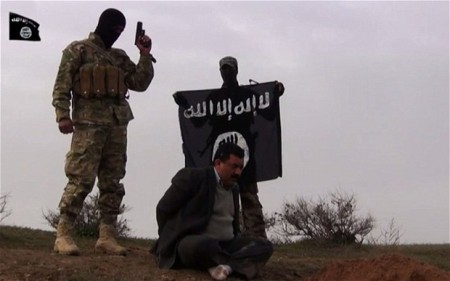
Our problem is not the Islamic radical, but the inherent radicalism of Islam. Islam is a radical religion. It radicalizes those who follow it. Every atrocity we associate with Islamic radicals is already in Islam. The Koran is not the solution to Islamic radicalism, it is the cause.
******************
The debate over Islamic terrorism has shifted so far from reality that it has now become an argument between the administration, which insists that there is nothing Islamic about ISIS, and critics who contend that a minority of Islamic extremists are the ones causing all the problems.
But what makes an Islamic radical, extremist? Where is the line between ordinary Muslim practice and its extremist dark side?
It can’t be beheading people in public.
Saudi Arabia just did that and was praised for its progressiveness by the UN Secretary General, had flags flown at half-staff in the honor of its deceased tyrant in the UK and that same tyrant was honored by Obama, in preference to such minor events as the Paris Unity March and the Auschwitz commemoration.
It can’t be terrorism either. Not when the US funds the PLO and three successive administrations invested massive amounts of political capital into turning the terrorist group into a state. While the US and the EU fund the Palestinian Authority’s homicidal kleptocracy; its media urges stabbing Jews.
Clearly that’s not Islamic extremism either. At least it’s not too extreme for Obama.
If blowing up civilians in Allah’s name isn’t extreme, what do our radicals have to do to get really radical?
Sex slavery? The Saudis only abolished it in 1962; officially. Unofficially it continues. Every few years a Saudi bigwig gets busted for it abroad. The third in line for the Saudi throne was the son of a “slave girl”.
Ethnic cleansing? Genocide? The “moderate” Islamists we backed in Syria, Libya and Egypt have been busy doing it with the weapons and support that we gave them. So that can’t be extreme either.
If terrorism, ethnic cleansing, sex slavery and beheading are just the behavior of moderate Muslims, what does a Jihadist have to do to be officially extreme? What is it that makes ISIS extreme?
Our government’s definition of moderate often hinges on a willingness to negotiate regardless of the results. The moderate Taliban were the ones willing to talk us. They just weren’t willing to make a deal. Iran’s new government is moderate because it engages in aimless negotiations while pushing its nuclear program forward and issuing violent threats, instead of just pushing and threatening without the negotiations. Nothing has come of the negotiations, but the very willingness to negotiate is moderate.
The Saudis would talk to us all day long while they continued sponsoring terrorists and setting up terror mosques in the West. That made them moderates. Qatar keeps talking to us while arming terrorists and propping up the Muslim Brotherhood. So they too are moderate. The Muslim Brotherhood talked to us even while its thugs burned churches, tortured protesters and worked with terrorist groups in the Sinai.
A radical terrorist will kill you. A moderate terrorist will talk to you and then kill someone else. And you’ll ignore it because the conversation is a sign that they’re willing to pretend to be reasonable.
From a Muslim perspective, ISIS is radical because it declared a Caliphate and is casual about declaring other Muslims infidels. That’s a serious issue for Muslims and when we distinguish between radicals and moderates based not on their treatment of people, but their treatment of Muslims, we define radicalism from the perspective of Islamic supremacism, rather than our own American values.
The position that the Muslim Brotherhood is moderate and Al Qaeda is extreme because the Brotherhood kills Christians and Jews while Al Qaeda kills Muslims is Islamic Supremacism. The idea of the moderate Muslim places the lives of Muslims over those of every other human being on earth.
Our Countering Violent Extremism program emphasizes the centrality of Islamic legal authority as the best means of fighting Islamic terrorists. Our ideological warfare slams terrorists for not accepting the proper Islamic chain of command. Our solution to Islamic terrorism is a call for Sharia submission.
That’s not an American position. It’s an Islamic position and it puts us in the strange position of arguing Islamic legalism with Islamic terrorists. Our politicians, generals and cops insist that the Islamic terrorists we’re dealing with know nothing about Islam because that is what their Saudi liaisons told them to say.
It’s as if we were fighting Marxist terrorist groups by reproving them for not accepting the authority of the USSR or the Fourth International. It’s not only stupid of us to nitpick another ideology’s fine points, especially when our leaders don’t know what they’re talking about, but our path to victory involves uniting our enemies behind one central theocracy. That’s even worse than arming and training them, which we’re also doing (but only for the moderate genocidal terrorists, not the extremists).
Secretary of State Kerry insists that ISIS are nihilists and anarchists. Nihilism is the exact opposite of the highly structured Islamic system of the Caliphate. It might be a more accurate description of Kerry. But the Saudis and the Muslim Brotherhood successfully sold the Western security establishment on the idea that the only way to defeat Islamic terrorism was by denying any Islamic links to its actions.
This was like an arsonist convincing the fire department that the best way to fight fires was to pretend that they happened randomly on their own through spontaneous combustion.
Victory through denial demands that we pretend that Islamic terrorism has nothing to do with Islam. It’s a wholly irrational position, but the alternative of a tiny minority of extremists is nearly as irrational.
If ISIS is extreme and Islam is moderate, what did ISIS do that Mohammed did not?
The answers usually have a whole lot to do with the internal structures of Islam and very little to do with such pragmatic things as not raping women or not killing non-Muslims.
Early on we decided to take sides between Islamic tyrants and Islamic terrorists, deeming the former moderate and the latter extremists. But the tyrants were backing their own terrorists. And when it came to human rights and their view of us, there wasn’t all that much of a difference between the two.
It made sense for us to put down Islamic terrorists because they often represented a more direct threat, but allowing the Islamic tyrants to convince us that they and the terrorists followed two different brands of Islam and that the only solution to Islamic terrorism lay in their theocracy was foolish of us.
We can’t win the War on Terror through their theocracy. That way lies a real Caliphate.
Our problem is not the Islamic radical, but the inherent radicalism of Islam. Islam is a radical religion. It radicalizes those who follow it. Every atrocity we associate with Islamic radicals is already in Islam. The Koran is not the solution to Islamic radicalism, it is the cause.
Our enemy is not radicalism, but a hostile civilization bearing grudges and ambitions.
We aren’t fighting nihilists or radicals. We are at war with the inheritors of an old empire seeking to reestablish its supremacy not only in the hinterlands of the east, but in the megalopolises of the west.
Exclusive: Obama Cuts Funds for the Syrian Rebels He Claims to Support, Daily Beast, January 27, 2015
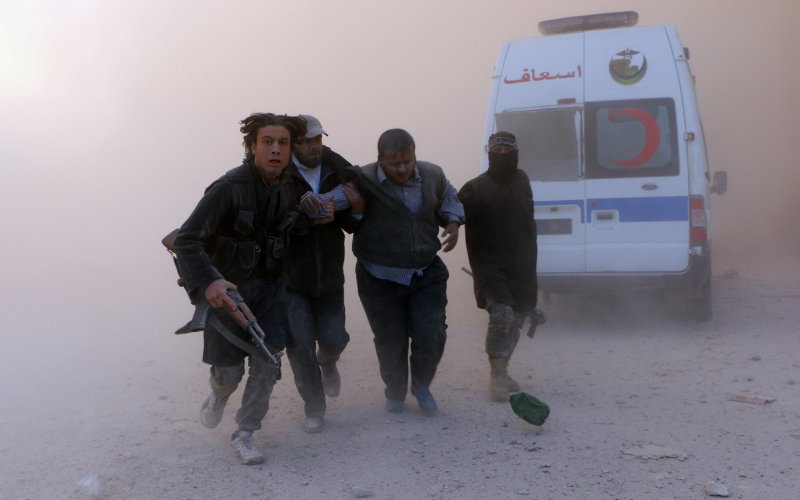 Fadi al-Halabi/AFP/Getty
LOST CAUSE?
Even the favored secular militias groomed to fight ISIS have seen their funding cut in half.
GAZIANTEP, Turkey — In the past several months many of the Syrian rebel groups previously favored by the CIA have had their money and supplies cut off or substantially reduced, even as President Obama touted the strategic importance of American support for the rebels in his State of the Union address.
The once-favored fighters are operating under a pall of confusion. In some cases, they were not even informed that money would stop flowing. In others, aid was reduced due to poor battlefield performance, compounding already miserable morale on the ground.
From afar, the U.S.-approved and partially American-armed Syrian “opposition” seems to be a single large, if rather amorphous, organization. But in fact it’s a collection of “brigades” of varying sizes and potentially shifting loyalties which have grown up around local leaders, or, if you will, local warlords. And while Washington talks about the Syrian “opposition” in general terms, the critical question for the fighters in the field and those supporting them is, “opposition to whom?” To Syrian President Assad? To the so-called Islamic State, widely known as ISIS or ISIL? To the al Qaeda affiliate, Jabhat al Nusra?
That lack of clarity is crippling the whole effort, not least because of profound suspicions among rebel groups that Washington is ready to cut some sort of deal with Assad in the short or medium term if, indeed, it has not done so already. For Washington, the concern is that the forces it supports are ineffectual, or corrupt, or will defect to ISIS or Nusra—or all of the above.
Republican lawmakers in D.C. are at their boiling point over the Obama administration’s anti-ISIS strategy, whether it is a failure to establish a no-fly zone in Syria, or unreliability with the issue of aid, or the Pentagon’s promised train and equip plan for the Syrian rebels.
“This strategy makes Pickett’s Charge appear well thought out,” said Sen. Lindsey Graham of South Carolina, referring to the poorly-planned and futile Confederate assault at Gettysburg. “We’re about to train people for certain death.”
In late October, al Qaeda’s Jabhat al Nusra routed American-backed militias in the northwest Syrian province of Idlib.
As a direct result, four of the 16 U.S.-approved brigades operating in the northern part of the country had their funding cut off and have been dropped from the list of “ratified” militias, say a State Department official and opposition sources. Since December, the remaining 12 brigades in the region have seen shortfalls or cuts in promised American assistance.
Syrian rebel sources who spoke on condition of anonymity say the 7thDivision, which is affiliated with the Syria Revolutionaries Front and aligned to the Free Syrian Army, has not received salaries from the CIA in months, although the State Department has maintained food shipments to the unit.
The secular Harakat al-Hazm, the most favored of the U.S.-backed brigades and one of the very few to be supplied with TOW anti-tank missiles, has seen a severe cutback in the monthly subsidy for its nearly 4,000 fighters. It is now receiving roughly 50 percent of the salaries it was receiving before. Weapon shipments arrived recently but commanders are nervous about whether future ones will come through. And the Farouq Brigade, a militia formed originally by moderate Islamist fighters based in the city of Homs, is getting no money for salaries at the moment.
CIA officials tell rebel commanders that unspecified “other funders” have ordered the cuts, or that Langley just doesn’t have the resources any longer. “What are the fighters meant to do?” complains one rebel commander. “They have families to feed.” Another says, “The idea that they don’t have the money is insulting. I don’t believe this—it is a political decision.”
Syrian rebel groups and their Washington, D.C. allies argue that CIA funding cuts —explained and unexplained—create relative advantages for extremist groups like al Nusra and ISIS, even as the president heralds the rebels as America’s on-the-ground-partners in the campaign to defeat the self-proclaimed Islamic State.
“It’s not just that the administration is failing to deliver on committed resources, it’s that they aren’t even communicating with formerly affiliated battalions regarding the cutoff,” says Evan Barrett, a political advisor to the Coalition for a Democratic Syria, a Syrian-American opposition umbrella group. “This puts our former allies in an incredibly vulnerable position, and ensures that groups like al Nusra will be able to take advantage of their sudden vulnerability in the field.”
The Obama administration says publicly that its support of moderate rebel brigades is not waning: the State Department continues to dispense non-lethal aid, the Pentagon supplies weapons, and the CIA pays salaries to brigades affiliated with the umbrella organization known as the Free Syrian Army. A CIA spokesman declined to comment for this story.
Privately, U.S. officials concede there have been funding changes. But American intelligence sources insist this is not a reflection of any shift in CIA strategy. They talk about “individual case-by-case shut offs” that are the consequences of brigades collapsing or failing to perform. And these sources dispute suggestions there’s an overall decrease in CIA subsidies, saying they are not giving up on the Syrian rebels—even though the Syrian rebels in the north of the country in the vicinity of the Turkish border increasingly believe this to be true. (Those in the south, near the Jordanian border and Damascus, may fare better.)
A State Department official told The Daily Beast that “the CIA has more money now than before and the State Department pie has not shrunk,” but confirms there has been some cutting off and cutting down. The official cited the “poor performance” of rebel brigades in Idlib last October as a primary reason.
When they were up against al Nusra, this official said, “they didn’t fight hard enough.” Several moderate brigades failed to come to the assistance of the Syria Revolutionaries Front, in particular, because they disapproved of its leader, who has been widely accused of corruption. The ease with which al Nusra was able to pull off its offensive angered U.S. officials—as did American-supplied equipment falling into jihadist hands.
That anger was compounded when the members of some U.S.-backed rebel groups actually defected to al Nusra during the offensive. One senior U.S. official admitted that some brigades have been “getting too close for our liking to al Nusra or other extremists.”
On Christmas Day armed groups formed an alliance for the defense of besieged rebel-held areas in Aleppo, where Assad had launched a major offensive to encircle them. Al-Jabha al-Shamiyya (Shamiyya Front), as the operational alliance is called, includes not only hardline Salafist factions from the groups known as the Islamic Front but more moderate brigades like the Muslim-Brotherhood-linked Mujahideen Army and Harakat Nour al-Din al-Zenki, which also has received TOW anti-tank missiles from Washington in the past.
Although al Nusra was not invited to join formally, it coordinates with the Shamiyya Front via the so-called Aleppo Operations Room, a joint headquarters for armed factions. It’s an arrangement that Washington does not like at all.
Aleppo-based rebels say they have no choice but to work with al Nusra and the Islamic-Front-aligned factions that are among the strongest armed groups in the war-torn city. Without them Assad’s forces would overwhelm the rebels.
“What do the Americans expect us to do?” asks a commander in the operations room. “Al Nusra is popular here. It is a perilous time for us—Assad is pushing hard.”
Syrian rebel sources who spoke on condition of anonymity say the 7th Division, which is affiliated with the Syria Revolutionaries Front and aligned to the Free Syrian Army, has not received salaries from the CIA in months, although the State Department has maintained food shipments to the unit.
The secular Harakat al-Hazm, the most favored of the U.S.-backed brigades and one of the very few to be supplied with TOW anti-tank missiles, has seen a severe cutback in the monthly subsidy for its nearly 4,000 fighters. It is now receiving roughly 50 percent of the salaries it was receiving before. Weapon shipments arrived recently but commanders are nervous about whether future ones will come through. And the Farouq Brigade, a militia formed originally by moderate Islamist fighters based in the city of Homs, is getting no money for salaries at the moment.
CIA officials tell rebel commanders that unspecified “other funders” have ordered the cuts, or that Langley just doesn’t have the resources any longer. “What are the fighters meant to do?” complains one rebel commander. “They have families to feed.” Another says, “The idea that they don’t have the money is insulting. I don’t believe this—it is a political decision.
For the Syrian rebels, uncertainties over funding changes by the CIA add doubt to already high skepticism over American policy toward the war in Syria. That skyrocketed when the Obama administration failed to enforce in 2013 its “red line” against Assad’s alleged use of chemical weapons, and the skepticism has merely grown since.
On the ground, the combatants say they suffer from the Obama administration’s inconsistency and argue that all too often they are being left out to dry, like some Syrian version of the Bay of Pigs, but much, much bloodier.
In the coffee shops of the Turkish border town Gaziantep last week, Syrians gathered on the safer side of the frontier listened incredulously as State Department spokesperson Jen Psaki insisted, “We maintain our belief that al Assad has lost all legitimacy and must go.” It was the first such inflexible anti-Assad statement for weeks from a senior U.S. official.
But that wasn’t what they’d heard from President Obama in his State of the Union address a few days before. Gone was the rhetoric of 2013 when he said he had “no doubt that the Assad regime will soon discover that the forces of change cannot be reversed, and that human dignity cannot be denied.” Instead, last Tuesday Obama spoke about the administration’s so-called train-and-equip plan to build a force that will target ISIS, and he made vague noises about helping Syria’s moderate opposition.
Those moderates are precisely the men and women on the ground who feel that bit by bit they are being abandoned.
Already, nearly four months after Secretary of State John Kerry announced the plan to train and equip Free Syrian Army units, Kurdish Peshmerga, and Iraqi Shia militiamen as anti-ISIS forces, the project appears to be facing major hurdles.
U.S. Senators emerged grim-faced last week from a classified briefing on the train-and-equip mission, with some of them predicting disaster from a Pentagon program that will train too few fighters and too slowly to make a difference.
At its best, Republican senators argue, it’s not going to work. At its worst, it will lead to the mass slaughter of the trained rebels.
“This strategy makes Pickett’s Charge appear well thought out,” said Sen. Lindsey Graham of South Carolina, referring to the brave but futile Confederate assault at Gettysburg. “We’re about to train people for certain death.”
The number of recruits required for a “strategic change in momentum is years away,” said Graham. “The concept of training an army that will be subject to slaughter by two enemies, not one, is militarily unsound,” and “if the first recruits you train get wiped out, it’s going to make it hard to recruit.”
Sen. Jeanne Shaheen, a Democrat who emerged from the same classified briefing, was tight-lipped: “I think we have a lot to do, and a lot of questions to answer.”
In Syria, few rebel fighters want to join a force focused only on ISIS. They argue that Assad is responsible for considerably more deaths among them and their extended families than ISIS, which is able to draw defectors from their ranks because it pays much higher salaries to its fighters and because it is able to exploit distrust of American intentions towards the Syrian revolution.
U.S. officials now acknowledge difficulties recruiting from insurgent ranks, conceding it is a serious challenge finding enough recruits willing to put off fighting the Assad regime.
So American officials recruiting for the train and equip mission are now hoping to fish in the pool of rebel fighters from eastern Syria who disbanded, quit the war and fled to Turkey when ISIS established control of the cities of Raqqa and Deir ez-Zor. The U.S. officials say the anti-ISIS force in Syria will have to be smaller than envisaged initially, but they are hoping early victories on the ground will convince more people to enlist.
Exclusive: ISIS Gaining Ground in Syria, Despite U.S. Strikes, The Daily Beast, January 15, 2015
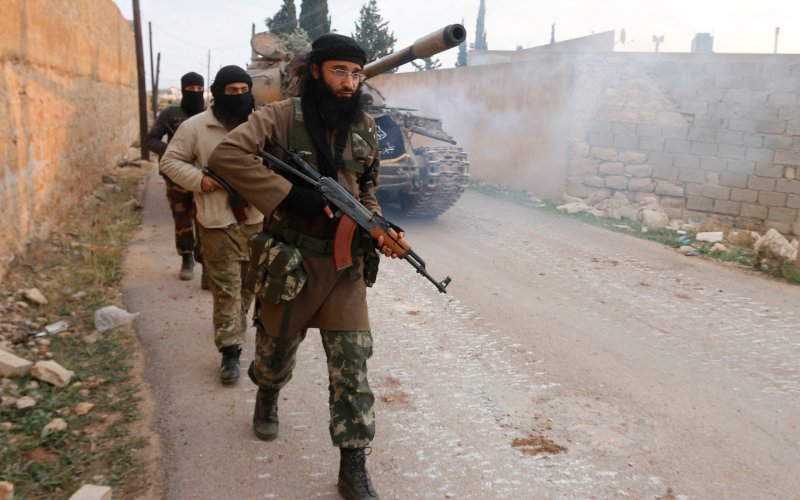 Hosam Katan/Reuters
American jets are pounding Syria. But ISIS is taking key terrain—and putting more and more people under its black banners.
ISIS continues to gain substantial ground in Syria, despite nearly 800 airstrikes in the American-led campaign to break its grip there.At least one-third of the country’s territory is now under ISIS influence, with recent gains in rural areas that can serve as a conduit to major cities that the so-called Islamic State hopes to eventually claim as part of its caliphate. Meanwhile, the Islamic extremist group does not appear to have suffered any major ground losses since the strikes began. The result is a net ground gain for ISIS, according to information compiled by two groups with on-the-ground sources.In Syria, ISIS “has not any lost any key terrain,” Jennifer Cafarella, a fellow at the Washington, D.C.-based Institute for the Study of War who studies the Syrian conflict, explained to The Daily Beast.Even U.S. military officials privately conceded to The Daily Beast that ISIS has gained ground in some areas, even as the Pentagon claims its seized territory elsewhere, largely around the northern city of Kobani. That’s been the focus of the U.S.-led campaign, and ISIS has not been able to take the town, despite its best efforts.Other than that, they are short on specifics.
 Click to Enlarge (Coalition For a Democratic Syria)
“Yes, they have gained some ground. But we have stopped their momentum,” one Pentagon official told The Daily Beast.
A map developed by the Coalition for a Democratic Syria (CDS), a Syrian-American opposition umbrella group, shows that ISIS has nearly doubled the amount of territory it controls since airstrikes began last year.
“Assessing the map, ISIS has almost doubled its territorial control in Syria. But more importantly, the number of people who now live under ISIS control has also increased substantially,” CDS political adviser Mouaz Moustafa said.
With the fall of that much territory into ISIS hands, Syrians who once lived in ungoverned or rebel held areas are now under ISIS’s grip. Of course, in an irregular war like this one, control of people is far more important than control of territory. In that regard, too, things appear to be going in the wrong direction.
In the first two months following American airstrikes, about a million Syrians who had previously lived in areas controlled by moderates now lived in areas controlled by extremist groups al Nusra or ISIS, according to CDS, citing conversations with European diplomats who support the Syrian opposition.
The area of ISIS’s expansion includes large segments of the Homs Desert, which begins far south of the contested northern city of Aleppo. It stretches below the presumed capital of ISIS in Syria, Raqqa, and all the way to the Iraqi border. It is largely rural and not an area that ISIS has had to fight for. Rather the group took control of uncontested parts of the countryside while skirting key regime strongholds in the area, Cafarella said.
But that does not mean that land is not valuable to ISIS. That newly acquired terrain allows ISIS troops to target and threaten more valuable areas, Cafarella said.
Since the U.S. campaign began in August, “there are little buds of ISIS control in eastern Homs, al Qalamoun [which borders northern Lebanon], and southern Damascus that do appear to be growing because of that freedom of operation that can connect those western cells to key ISIS terrains in Raqqa and Deir ez Zour” in northern and eastern Syria.
Moustafa, the CDS political adviser, blamed ISIS territorial gains on a lack of “strategic coordination between coalition strikes and moderate forces inside Syria, meaning that the Free Syrian Army and aligned groups cannot use the strikes to retake territory.” Further, Moustafa told The Daily Beast, coalition strikes have given other extremist groups sympathy for ISIS.
One frustration of the Syrian opposition groups is that the bombing campaign has been focused at the heart of ISIS controlled territory, rather than at the front lines, where ISIS territorial gains could be pushed back.
“The coalition strikes seem similar to drone campaigns in Yemen or Pakistan, targeting only leadership. The front-line strength of ISIS has undoubtedly increased even as some of these targeted strikes take out mid-level individual leaders,” Moustafa said.
As of Sunday, the U.S. and its coalition partners had conducted 790 airstrikes in Syria, according to Pentagon statistics. In all, the U.S. has spent $1.2 billion on its campaign against ISIS in Iraq and Syria.
In its public comments, the U.S. military has said repeatedly the effort against ISIS is on the right track. However it often does this by conflating its war in Iraq and Syria. Ask a question about what is happening in Syria, and U.S. officials will stress that ISIS has not gained ground in Iraq. Ask if the U.S. effort is working in Syria, and the military often points to the fact that ISIS has failed to take control of Kobani.
During a Jan. 6 press briefing, for example, when a reporter asked “where ISIS’s relative strength is right now,” Navy Rear Adm. John Kirby replied by talking exclusively about the U.S. effort in Iraq, naming cities were the military believed ISIS’s momentum has been “halted.”
When the reporter pressed for an answer on what was happening in Syria, Kirby struggled, saying, “I couldn’t give you a—a specific point at which, you know, we believe, well geez, we’ve halted their momentum. It—it’s come slowly, in various stages. But I think it’s safe to say that over the last three to four weeks, we—we’ve been confident that that momentum has largely been blunted.”
On Friday, Kirby proclaimed that ISIS had lost 700 square kilometers since the campaign began—over half the size of New York City or about four times the size of the District of Columbia. But the Pentagon spokesman could not say what percentage that area marked of total ISIS-controlled land. Nor could he say if that loss was in Iraq, Syria, or combined in both nations. As Kirby asserted: “I’m frankly not sure how relevant that is. I mean, it’s—they have less ground now than they did before. They’re trying to defend what ground that they have. They’re not going on the offense much, and they’re really trying to preserve their own oxygen.”
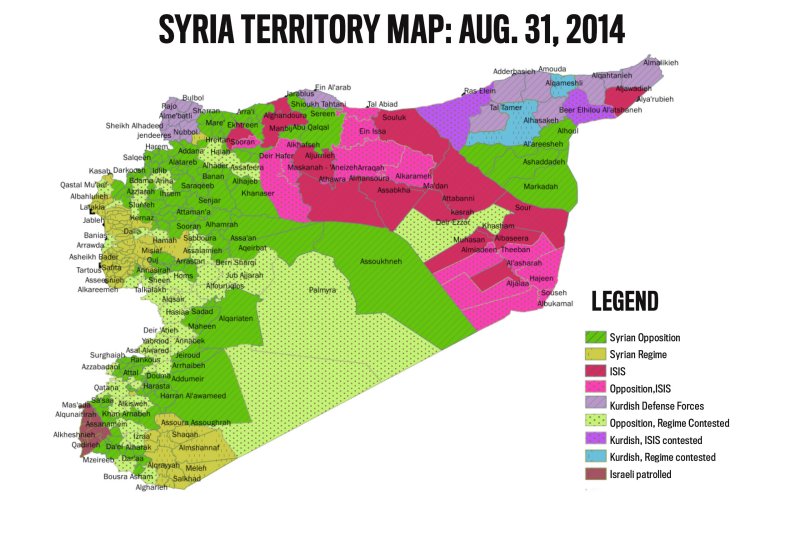 Click to Enlarge (Coalition For a Democratic Syria)
The American military has not been able to take full advantage of the difficulties ISIS is facing. A worldwide drop in oil prices threatens the recently declared state’s ability to raise revenue, while declining standards in public services, distribution of aid, and provision of electricity threaten to undercut the group’s support across the territories it controls. ISIS has also not been able to follow through on its military quest to challenge the Iraqi government all the way to Baghdad.
The U.S. military stressed it is waging an “Iraq first” war, that is focused on eliminating ISIS from that country first. There, the U.S. can turn to Iraqi troops on the ground to assess its efforts. But there is no equivalent resource on the ground in Syria. Perhaps because of that, the U.S. military has offered a far more detailed assessment of the air campaign in Iraq than the one in Syria.
The Combined Joint Task Force in charge of the American air campaign refused to answer a Daily Beast query about ISIS gains in Syria, even as it striking targets there. U.S. Central Command replied, “As a matter of policy we do not discuss intelligence issues.”
Information on the maps:
The maps provided by the Coalition for a Democratic Syria show the areas controlled by moderate Syrian rebels, the Syrian regime, ISIS, Syrian al Qaeda affiliate al Nusra, as well as territories contested by these groups. The maps were developed by a field team from the Coalition for a Democratic Syria (CDS), an umbrella group of Syrian American organizations. The maps were sourced through on-the-ground networks including civilian councils, humanitarian organizations, armed actors, and media monitoring of independent Syrian channels.
The Beltway’s Syria Fairy Tales, National Review Online,
(Please see also Inside the CIA’s Syrian Rebels Vetting Machine. — DM)
[T]he sensible thing at this point would be to concede that there are no viable moderate forces in Syria, and that it would be folly for us to continue pretending those forces either exist or will materialize anytime soon. But no, that would be honest . . . which is not the Obama way — nor, frankly, is it the Washington way — to end our willful blindness to the lack of moderation among Middle Eastern Muslims.
So if honesty is not an option, what to do? Simple: Let’s just pretend that al-Nusra — part of the al-Qaeda network we have been at war with for 13 years — is, yes, moderate!
********************
The Khorasan group, moderate rebels, and other mythical creatures
Since the outbreak of the latest Middle East war a few years back, we have been chronicling the Washington political class’s Syria Fairy Tales. In particular, there is the story line that Syria is really teeming with secular democrats and authentic moderate Muslims who would have combined forces to both overthrow Assad and fight off the jihadists if only President Obama had helped them. But his failure to act created a “vacuum” that was tragically filled by Islamist militants and gave rise to ISIS. At this point in the story, you are supposed to stay politely mum and not ask whether it makes any sense that real democrats and actual moderates would agree to be led by head-chopping, mass-murdering, freedom-stifling sharia terrorists.
In point of fact, there simply have never been enough pro-Western elements in Syria to win, no matter how much help came their way. There was never going to be a moderate, democratic Syrian state without a U.S. invasion and occupation for a decade or more, an enterprise that would be politically untenable — and, as the Iraq enterprise shows, unlikely to succeed. The “moderate rebels” had no chance against Assad unless they colluded with the Islamist militants, who are vastly superior and more numerous fighters. And they would have even less chance of both knocking off Assad and staving off the jihadists.
The Obama administration and the Beltway commentariat have done their best to obscure these brute facts. Their main tactic is to exploit the American public’s unfamiliarity with the makeup of Syria. Obama Democrats and much of the Beltway GOP continue to invoke the “moderate Syrian rebels” while steadfastly refusing to identify just who those purported “moderates” are. They hope you won’t realize that, because of the dearth of actual moderate Muslims and freedom fighters, they must count among their “moderate rebels” both the Muslim Brotherhood (which should be designated as a terrorist organization) and various other Islamist factions, including . . . wait for it . . . parts of al-Nusra — i.e., al-Qaeda’s Syrian franchise.
We’ve also noted that a new wrinkle has recently been added to the Beltway’s Syria Fairy Tales: Obama’s Khorasan Fraud. In a desperate attempt to conceal the falsity of Obama’s boasts about destroying what is actually a resurgent al-Qaeda, the administration claimed that the threat to America that impelled Obama to start bombing Syria was not ISIS (supposedly just a “regional” threat), not al-Qaeda (already defeated, right?), but a hitherto unknown terrorist organization called the “Khorasan group.”
To the contrary, the Khorasan group, to the extent it exists at all, has never been a stand-alone terrorist organization. It is an internal component of al-Qaeda — specifically, an advisory board (or, in Islamic terms, a shura council) of al-Qaeda veterans who advise and carry out directives from Ayman al-Zawahiri, al-Qaeda’s emir. During the fighting in Syria, some of these operatives were sent there by Zawahiri to conduct operations under the auspices of al-Nusra. These operations have included jihadist activity against both the United States and Assad allies, plus negotiations for a rapprochement with the Islamic State (or ISIS). The limited success of those negotiations has led to fighting among the jihadists themselves.
The ball to keep your eye on here is al-Qaeda. The al-Nusra terrorist group is just al-Qaeda in Syria. Even ISIS is just a breakaway faction of al-Qaeda. And the Khorasan group is just a top-tier group of al-Qaeda veterans doing al-Qaeda’s work in conjunction with al Nusra — i.e., al-Qaeda.
The Obama administration disingenuously emphasizes these various foreign names to confuse Americans into thinking that there are various factions with diverse agendas in Syria — that al-Qaeda is no longer a problem because Obama has already dealt with it, and what remains are sundry groups of “moderate rebels” that the administration can work with in the effort to vanquish ISIS. Meanwhile, you are supposed to refrain from noticing that Obama’s original Syrian project — remember, he wanted Assad toppled — has given way to fighting ISIS . . . the very Sunni jihadists who were empowered by Obama’s lunatic policies of (a) switching sides in Libya in order to support the jihadists against Qaddafi and (b) abetting and encouraging Sunni Muslim governments in Saudi Arabia, Qatar, and Turkey to arm Sunni militias in the fight against Assad — those militias having all along included al-Qaeda elements, some of which split off to become ISIS and now threaten to bite off the very hands that once fed them.
If you thought the Khorasan fraud was just a passing fad to get Obama through the initial stages of trying to rationalize his incoherent Syria air campaign, think again.
You see, Obama continues to have a problem. Everyone knows that ISIS, the main target of U.S. bombings in Syria and Iraq, cannot be defeated — or even stalled much — by a mere air campaign, which has been half-hearted at best anyway. Ground forces will be needed. So the administration and Washington’s foreign-policy clerisy keep telling Americans: Never fear, there is no need for U.S. ground troops, because we can rely on “moderate rebels” to fight ISIS. But the so-called “moderates” Obama backs have been colluding with al-Qaeda (i.e., al-Nusra) for years — at least when not being routed by al-Qaeda/al-Nusra.
Now, the sensible thing at this point would be to concede that there are no viable moderate forces in Syria, and that it would be folly for us to continue pretending those forces either exist or will materialize anytime soon. But no, that would be honest . . . which is not the Obama way — nor, frankly, is it the Washington way — to end our willful blindness to the lack of moderation among Middle Eastern Muslims.
So if honesty is not an option, what to do? Simple: Let’s just pretend that al-Nusra — part of the al-Qaeda network we have been at war with for 13 years — is, yes, moderate!
But wait a second? How can we possibly pull that off when we know al-Nusra/al-Qaeda is also plotting to attack the United States and the West?
Easy: That’s why we have the “Khorasan group”!
I kid you not. Even as al-Nusra/al-Qaeda mow down any “moderate rebels” who don’t join up with them, the Obama administration is telling Americans, “No, no, no: The al-Nusra guys are really good, moderate, upstanding jihadists. The real problem is that awful Khorasan group!”
Tom Joscelyn and Bill Roggio have the story at The Long War Journal:
CENTCOM draws misleading line between Al Nusrah Front and Khorasan Group
US Central Command [CENTCOM] attempted to distinguish between the Al Nusrah Front, al Qaeda’s official branch in Syria, and the so-called Khorasan Group in yesterday’s press release that detailed airstrikes in Syria.
CENTCOM, which directs the US and coalition air campaign against the Islamic State in Iraq and Syria, denied that the five airstrikes targeted “the Nusrah Front as a whole” due to its infighting with the Syrian Revolutionaries’ Front, but instead claimed the attacks were directed at the Khorasan Group.
“These strikes were not in response to the Nusrah Front’s clashes with the Syrian moderate opposition, and they did not target the Nusrah Front as a whole,” CENTCOM noted in its press release.
The CENTCOM statement goes a step further by implying that the Al Nusrah Front is fighting against the Syrian government while the Khorasan Group is hijacking the Syrian revolution to conduct attacks against the West.
“They [the US airstrikes] were directed at the Khorasan Group whose focus is not on overthrowing the Assad regime or helping the Syrian people,” CENTCOM continues. “These al Qaeda operatives are taking advantage of the Syrian conflict to advance attacks against Western interests.”
[Emphasis added.]
Read Tom and Bill’s entire report, which sheds light on the web of jihadist connections.
Understand, the Khorasan group is al-Nusra, which is al-Qaeda. The “moderate Syrian rebels” are neither moderate nor myopically focused on Assad and Syria. (Indeed, Syria does not even exist as the same country anymore, now that ISIS has eviscerated its border with Iraq while capturing much of its territory.) The overarching Islamic-supremacist strategy of al-Qaeda has never cared about Western-drawn borders. The ambition of al-Qaeda, like that of its breakaway ISIS faction, is to conquer both the “near” enemies — i.e., the Middle East territories not currently governed by its construction of sharia — and the West. Al-Qaeda (a.k.a. al-Nusra, a.k.a. the Khorasan group) wants to overthrow Assad, but it still regards the United States as its chief nemesis.
The Khorasan group exists only as an advisory group around Zawahiri. The Obama administration’s invocation of it to divert attention from al-Qaeda and launder al-Nusra into “moderate Syrian rebels” is sheer subterfuge.
Inside the CIA’s Syrian Rebels Vetting Machine, Newsweek, Jeff Stein, November 10, 2014
(The Obama administration’s vetting of “moderate” terrorists is consistent with its vetting of Iranian nuke intentions and progress. Both would be funny were the consequences not so dangerous. — DM)
 A Free Syrian Army fighter in Aleppo. Hosam Katan/Reuters
Nothing has come in for more mockery during the Obama administration’s halting steps into the Syrian civil war than its employment of “moderate” to describe the kind of rebels it is willing to back. In one of the more widely cited japes, The New Yorker’s resident humorist, Andy Borowitz, presented a “Moderate Syrian Application Form,” in which applicants were asked to describe themselves as either “A) Moderate, B) Very moderate, C) Crazy moderate or D) Other.”
After Senator John McCain unwittingly posed with Syrians “on our side” who turned out to be kidnappers, Jon Stewart cracked, “Not everyone is going to be wearing their ‘HELLO I’M A TERRORIST’ name badge.”
Behind the jokes, however, is the deadly serious responsibility of the CIA and Defense Department to vet Syrians before they receive covert American training, aid and arms. But according to U.S. counterterrorism veterans, a system that worked pretty well during four decades of the Cold War has been no match for the linguistic, cultural, tribal and political complexities of the Middle East, especially now in Syria. “We’re completely out of our league,” one former CIA vetting expert declared on condition of anonymity, reflecting the consensus of intelligence professionals with firsthand knowledge of the Syrian situation. “To be really honest, very few people know how to vet well. It’s a very specialized skill. It’s extremely difficult to do well” in the best of circumstances, the former operative said. And in Syria it has proved impossible.
Daunted by the task of fielding a 5,000-strong force virtually overnight, the Defense Department and CIA field operatives, known as case officers, have largely fallen back on the system used in Afghanistan, first during the covert campaign to rout the Soviet Red Army in the 1980s and then again after the 2001 U.S. invasion to expel Al-Qaeda: Pick a tribal leader who in turn recruits a fighting force. But these warlords have had their own agendas, including drug-running, and shifting alliances, sometimes collaborating with terrorist enemies of the United States, sometimes not.
“Vetting is a word we throw a lot around a lot, but actually very few people know what it really means,” said the former CIA operative, who had several postings in the Middle East for a decade after the 9/11 attacks. “It’s not like you’ve got a booth set up at a camp somewhere. What normally happens is that a case officer will identify a source who is a leader in one of the Free Syrian Army groups. And he’ll say, ‘Hey…can you come up with 200 [guys] you can trust?’ And of course they say yes—they always say yes. So Ahmed brings you a list and the details you need to do the traces,” the CIA’s word for background checks. “So you’re taking that guy’s word on the people he’s recruited. So we rely on a source whom we’ve done traces on to do the recruiting. Does that make sense?”
No, says former CIA operative Patrick Skinner, who still travels the region for the Soufan Group, a private intelligence organization headed by FBI, CIA and MI6 veterans. “Syria is a vetting nightmare,” he told Newsweek, “with no way to discern the loyalties of not only those being vetted but also of those bringing the people to our attention.”
A particularly vivid example was provided recently by Peter Theo Curtis, an American held hostage in Syria for two years. A U.S.-backed Free Syrian Army (FSA) unit that briefly held him hostage casually revealed how it collaborated with Al-Qaeda’s al-Nusra Front, even after being “vetted” and trained by the CIA in Jordan, he wrote in The New York Times Magazine.
“About this business of fighting Jabhat al-Nusra?” Curtis said he asked his FSA captors.
“Oh, that,” one said. “We lied to the Americans about that.”
Concerns about the CIA’s vetting system arose long before the Syrian civil war erupted in 2011, several CIA veterans told Newsweek. In Baghdad, one said, agency operatives had such thin faith in the system that they often had sweaty palms as they awaited a meeting with a newly recruited Iraqi spy—even though he had been cleared by CIA vetters—because they knew he might show up with a suicide vest under his jacket. That happened in Afghanistan on December 30, 2009, when a Jordanian physician recruited by the CIA on his claim to have access to Osama bin Laden turned out to be working for Al-Qaeda. He blew himself up at a CIA base, taking out seven agency operatives as well.
That double agent had been served up by Jordan’s General Intelligence Directorate, a longtime partner of the CIA in clandestine operations. Relying on close liaisons to vet spies might’ve worked well enough during the Cold War, when the CIA’s name files were meticulously updated by its small corps of Ivy-educated spies, but in the swirling chaos of the post-9/11 Middle East or South Asia, where Arabic (or Urdu, Farsi or Pashtun) names can be transliterated to English and back in endless varieties and where political allegiances are as blurry as the centuries-old colonial boundaries drawn up by bureaucrats in London and Paris, the CIA’s vetters are just not up to the task, say spy agency veterans with long experience in the region.
“For two years I managed a lot of those folks,” said one person not authorized to discuss the inner workings of the system. “A lot of them are contractors just coming out of college and don’t have a lot of experience under their belts—not in the Middle East, or the region or in Arabic.”
(The CIA declined comment on the vetting process. Navy commander Elissa Smith, speaking for the Defense Department, said in a statement that “the U.S. military has decades of experience screening foreign military forces for training. We also know the Syrian opposition better now than we did two years ago. While we cannot disclose the details of our sources and methods, we will screen thoroughly and conduct continuous monitoring.”)
American embassies around the world are open to just about anybody who wants to sign up for the FSA. “They fill out a form. You get their four-part name, their date of birth, and then their tribe and where they’re from and all that,” the former operative explained. “Their work history, if there is any. Then you take that and run your traces through all your databases—your HUMINT and SIGINT [agency acronyms for information from human spies and National Security Agency intercepts, called signals intelligence]. And then you take certain aspects of that information, and you sanitize it, and you send it by cable to your station in whatever country, and you ask for their traces on this individual, to see if anything comes up.
“The problem with that process,” the former operative continued, “is when you have a person sitting at a computer who doesn’t know how to standardize Arabic names.… They may translate it correctly, but the person typing it in may or may not know how to look for it with all the name variances that might already be in the system.”
When it came time to start vetting Syrian rebels, the CIA faced even more hurdles. When the Obama administration shuttered the American Embassy in Damascus in 2011, just as the civil war was exploding, the covert CIA station inside the building there was rolled up, too. The agency had to “make do,” as one former operative put it.
“The main problem with plans that arm and train the ‘moderates’—who ominously are moderate only in their fighting abilities,” said Skinner, “is that it assumes perfect knowledge, or ‘good enough’ knowledge, about the people being armed. When in fact there is nothing close to that.… The background info on these fighters is next to nothing and misleading, especially in Syria, where we don’t have a liaison relationship, and so the vast majority of even check-the-box vetting is by third parties [who are] out-of-the-country players with a stake in the game.
“As in Afghanistan, we can get scammed and misled at every stage with tragic results,” Skinner added. “One can’t simply build a loyal effective army thirdhand. It’s like running a want-ad that says, ‘Only Moderates Show Up for Free Weapons and Paid Training,’ and believing that is effective screening.”
“It’s one thing if you’re talking about a few dozen, or even a few hundred, individuals to run name checks or traces on,” agrees Martin Reardon, a former high-ranking FBI counterterrorism official. “But the first group of [Syrian] rebels to be trained [by the U.S.] is supposed to number upwards of 5,000. Assuming the administration can identify that many ‘moderate’ rebels to begin with, it would be virtually impossible to accomplish even minimal background checks with any degree of reliability.”
Another troubling lesson from the wars in Afghanistan, Iraq and now Syria is that today’s moderate can become tomorrow’s extremist. “Just because that guy may be moderate today—who may really and truly be a moderate and despise Al-Qaeda or whatever—what if that guy is seen walking into the Green Zone by his friend so-and-so at the checkpoint?” the former CIA vetting expert said. “And everybody knows those guys coming into the Green Zone are there to see the CIA, or at least that’s the assumption. So they grab his father, his son or his brother, and they take him captive. What’s to stop them from forcing him to strap a bomb to his body and walking back into the next meeting with an [improvised explosive device] on his chest?”
Or this: “What if you’re in Afghanistan and maybe you’re friends [with a contact], but tomorrow you drop a bomb on his cousin? You think he’s going to be your friend tomorrow? These things can change overnight. So this vetting idea—‘once vetted, things are all right, we’re good to go’—is crazy.”
Given such accounts, the odds of keeping loyal troops seems like panning for gold—or worse, an exercise in self-delusion. But the former CIA operative, who served in a variety of Middle Eastern posts as well as headquarters, said Obama administration officials aren’t fibbing about their faith in the system. They just may not realize it’s shot through with holes. “Most of them think they’re doing it pretty good, but they’re also not our best and brightest in terms of knowing how to vet,” this person said. “So I don’t think it’s a charade, I think it’s misguided. They don’t know how poor it actually is.”
So what? responds former senior CIA operations officer Charles Faddis, who led a covert team into Kurdistan in advance of the 2003 U.S. invasion of Iraq. He says it’s time to act, no matter how shaky the foundations of the CIA’s Syrian army. “You can’t run covert action without getting your hands dirty. We can’t sit on the sidelines and have discreet, antiseptic contacts with these guys and accomplish anything,” Faddis said. “If we’re going to do this, we need to wade in.”
Caution be damned. Hold our noses and pass the ammunition.
“We need to have people on the ground. We need to give them serious money and weaponry,” Faddis said. “Unless we do that, we are never really going to have any control over what’s going on, or any real idea who we should be in bed with.”




 anneinpt
 artaxes
 danmillerinpanama
 davidking1530
 Peter Hofman
 Joseph Wouk
 Peter
Peter Louisiana Steve
 WarSclerotic
Recent Comments