Immigration Priorities: Translators, and Victims of Genocide, Gatestone Institute, Shoshana Bryen, January 27, 2017
Secretary Kerry described his understanding that Christian women were sold as sex slaves, and both women and men were massacred in areas of Syria and Iraq controlled by ISIS. But of the 10,801 refugees accepted in fiscal 2016 from Syria, only 56 (0.5 percent) were Christian.
********************
Prioritize two groups from the Middle East: those who have worked for the U.S. military as translators (and their families); and Middle East Christians who, according to then-Secretary of State Kerry, were being subjected to genocide in Syria and Iraq.
In 2008, Congress authorized 20,000 special visas for Iraqis who served the U.S. for a year or more; and in 2009, authorized 7,500 visas over seven years for Afghan translators. The idea was to get allies who had risked their lives for American troops out as quickly as possible, but thousands have waited for years.
Iraq and Afghanistan are countries in which being tagged as helpful to the U.S. military can be, and has been, a death sentence. And worse, in July 2016, an extension of the visa program failed to make it out of the Senate.
Of the 10,801 refugees accepted in fiscal 2016 from Syria, only 56 (0.5 percent) were Christian.
Making a concerted effort to bring those two desperately threatened groups to the United States would meet our commitment to the translators, give concrete expression to our revulsion at genocide, protect the interests of the American people, and ensure that America remains hospitable to immigrants and refugees.
If you want security clearances in the United States, the government “vets” you quite thoroughly. They begin by asking you questions and then ask for a list of people to interview — family, friends, employers, etc. They take your list and ask those people for more people who will talk about you, then take that list and ask those people for more people who will talk about you — and so on until the lists have the right number and combination of names that overlap. If you have a vindictive ex-wife, watch out. They do a credit check, a criminal background check, a motor vehicle records check, and a medical records check. Psychiatrist? That too.
When discussing visas for people coming to the U.S. from countries with terrorism issues, it is useful to know what it means to “vet” and why there is no possibility of vetting (or “extreme vetting,” whatever that means) refugees and potential immigrants who have no links to their former lives. Vetting — whether for security clearances or visas — is all about your life to this point.
President Trump’s executive order halting immigration from seven countries for 30 days — for a start — is a reasonable response to the increasing understanding that people from certain countries can pose more of a security risk than people from other countries, even when all the countries are Muslim-majority. The seven are Iraq, Iran, Syria, Yemen, Sudan, Libya and Somalia; the U.S. government, under previous presidents, had cited all for terror links. Countries such as Kuwait, Egypt, Jordan, Indonesia, Oman and Tunisia and other Muslim-majority countries are not affected.
A “Muslim ban” would be racist, wrong, and a violation of deeply held American principles; but the claim by the Council on American-Islamic Relations (CAIR) that visa restrictions are tantamount to slavery and denying women the right to vote is slanderous, exaggerated, inaccurate and anti-American. Restrictions — and post-fact checks — on people who enter the United States from countries with clear links to terrorism, and to which we cannot turn for record-checks and interviews, are simply something the United States does.
In 1979, the U.S. Embassy in Tehran was occupied by radical Islamists bent on war with the United States. The Carter Administration ordered all Iranians with student visas to report physically to U.S. immigration officials or face possible deportation. Ten months later (Carter’s order had to go through the courts), the New York Times, citing an Immigration and Naturalization Service spokesman, reported that nearly 60,000 students had registered as required, about 430 had been deported, and 5,000 had left voluntarily. In the interim, Carter ordered federal officials to:
“invalidate all visas issued to Iranian citizens for future entry into the United States, effective today. We will not reissue visas, nor will we issue new visas, except for compelling and proven humanitarian reasons or where the national interest of our own country requires. This directive will be interpreted very strictly.”
Iran remains at war with the United States and al Qaeda and ISIS are no less at war simply because they lack a central government.
In 2015, the assistant secretary of state for the Bureau of Consular Affairs told a House hearing that the U.S. government had revoked more than 9,500 visas over terrorism concerns since 2001 (the number is now more than 13,000). The attacks of 9/11 were followed by more attacks and plots against symbols of American military, law, justice, and governance as well as trains, bars, and shopping centers that are symbols of everyday life. Mass-casualty attacks in San Bernardino and Orlando were only the latest catalysts for Americans’ underlying concern that have been growing for years about terrorism and the government’s ability to protect us.
If “vetting” is not possible and American security requirements are real, is there a way to bring together our historic sympathy for refugees and historic welcome of immigrants with our reasonable concerns?
Yes.
Prioritize two groups from the Middle East: those who have worked for the U.S. military as translators (and their families); and Middle East Christians who, according to then-Secretary of State Kerry, were being subjected to genocide in Syria and Iraq.
In 2008, Congress authorized 20,000 special visas for Iraqis who served the U.S. for a year or more; and in 2009, authorized 7,500 visas over seven years for Afghan translators. The idea was to get allies who had risked their lives for American troops out as quickly as possible, but thousands have waited for years. Iraq and Afghanistan veteran Spencer Case wrote early in 2016:
“State Department numbers show that an Iraqi applying for a special visa could expect to wait for 292 business days before hearing back — and hearing back may just be another delay or a denial. In Afghanistan, the average wait time is 417 business days.”
Iraq and Afghanistan are countries in which being tagged as helpful to the United States military can be, and has been, a death sentence. And worse, in July 2016, an extension of the visa program failed to make it out of the Senate.
Secretary Kerry described his understanding that Christian women were sold as sex slaves, and both women and men were massacred in areas of Syria and Iraq controlled by ISIS. But of the 10,801 refugees accepted in fiscal 2016 from Syria, only 56 (0.5 percent) were Christian.
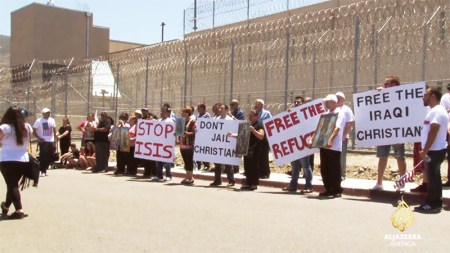 When a few persecuted Iraqi Christians crossed the border into the U.S., they were thrown in prison for several months and then sent back to the countries persecuting them, possibly to be enslaved, raped, or murdered. Pictured above: Members of California’s Iraqi Christian community and their supporters protest the months-long detention of Iraqi Christian asylum-seekers at the Otay Mesa detention center. (Image source Al Jazeera video screenshot)
Making a concerted effort to bring those two desperately threatened groups to the United States would meet our commitment to the translators, give concrete expression to our revulsion at genocide, protect the interests of the American people, and ensure that America remains hospitable to immigrants and refugees.
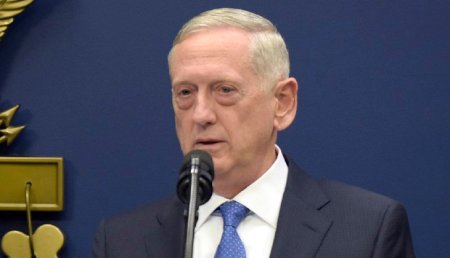 Defense Secretary Jim Mattis has requested some broad categories of Iraqis be exempted from President Trump’s 90-day travel ban. (AP Photo/Susan Walsh)




 anneinpt
 artaxes
 danmillerinpanama
 davidking1530
 Peter Hofman
 Joseph Wouk
 Peter
Peter Louisiana Steve
 WarSclerotic
Recent Comments