Archive for the ‘Kurds’ category

Kurds make grisly discoveries after retaking ISIS-held territory

October 15, 2014

Kurds make grisly discoveries after retaking ISIS-held territory, Hot Air, Noah Rothman, October 14, 2014

(How serious are we and our coalition of the unwilling about at least degrading the Islamic State? — DM)

There is mixed news from the two fronts in Iraq and Syria where coalition airpower and indigenous partner forces on the ground are fighting Islamic State militants.

Near the Syrian border city of Kobani, reports indicate that Kurdish defenders are beginning to make some gains as they continue to defend the city against the ISIS onslaught. A key hill atop which ISIS fighters famously planted their flag late last week has reportedly been retaken by Kurdish forces.

“The advance came as the US said it had conducted 21 air strikes near the town, slowing down the IS advance,” the BBC revealed. “Tall Shair hill had been captured more than 10 days ago by IS militants.”

As ISIS retreated from the front near the Syrian-Turkish border, Kurdish forces made a series of gruesome discoveries.

“Refugees in Suruc, Turkey, have told how relatives and neighbors were beheaded by [ISIS] militants, while another spoke of how he had seen ‘hundreds’ of decapitated corpses in the besieged town,” The Independent reported on Tuesday.

Amin Fajar (38) a father-of-four who left Kobane and made it across the border and into Suruc, told a British newspaper: “I have seen tens, maybe hundreds, of bodies with their heads cut off.

“Others with just their hands or legs missing. I have seen faces with their eyes or tongues cut out – I can never forget it for as long as I live.”

The Daily Telegraph confirmed The Independent’s reporting about the activities in which ISIS engaged in the areas under their control:

“I have seen tens, maybe hundreds, of bodies with their heads cut off. Others with just their hands or legs missing. I have seen faces with their eyes or tongues cut out — I can never forget it for as long as I live,” Amin Fajar, a 38-year-old father of four, told the Daily Mail about the incredible scene in Kobane.

“They put the heads on display to scare us all.”

Another resident, 13-year-old Dillyar, watched as his cousin Mohammed, 20, was captured and beheaded by the black-clad jihadis as the pair tried to flee the battle-scarred town.

“They pushed him to the ground and sawed his head off, shouting, ‘Allahu Akbar,’ ” the boy said. “I see it in my dreams every night and every morning I wake up and remember everything.”

This unconfirmed video featuring Kurdish fighters in Kobani, flagged by Jeff Gauvin, reveals the extent of the damage done to the city over the course of weeks of fighting.

While America’s partners on the ground are enjoying some successes in Syria, the dispatches from Iraq are far more grim.

There, ISIS continues its siege on Anbar province in preparation for an assault on the capital city of Baghdad. After taking control of a military training base on Monday, CNN reported that ISIS has surrounded one of the largest Iraqi airbases in the country on Tuesday and is preparing to take it.

“According to police sources,” CNN’s Ben Wedeman reported, “the Ayman Asad Airbase, which is about 110 miles to the west of Baghdad – one of the biggest bases in Anbar province – is now surrounded by ISIS fighters, and the people on the base are expecting an attack within the coming hours on that base.”

“We understand that there are Iraqi soldiers who have already fled the base,” Wedeman continued. “We were getting reports for several hours that some of the soldiers had left, shedding their uniforms, leaving their weapons behind.”

That depressing revelation should concern military advisors who believe Iraqi forces defending Baghdad can hold out against an ISIS assault on Baghdad despite outnumbering the attackers by a reported six-to-one ratio. These latest developments reinforce the position of Army Chief of Staff Gen. Raymond Odierno who said with some trepidation recently he was only “somewhat” confident Baghdad could hold out.
Kurds Left Helpless as Kobane Falls to Islamic State: Turkey’s Border Wars (Dispatch 1)

October 15, 2014

 Vice News via You Tube, October 14, 2014

(Whose side is our NATO ally, Turkey, on in Kobane? The (“non-Islamic”) Islamic State or those best able to combat it effectively? How about the Obama Nation?  — DM)

Obama’s Kobani Crossroads

October 15, 2014

Obama’s Kobani Crossroads, Algemeiner, Noah Beck, October 14, 2014

(Obama needs high profile stuff and photo ops to keep his polls from falling even more dramatically than they have. He needs help from Iran and little if anything else matters. It will be rewarded. — DM)

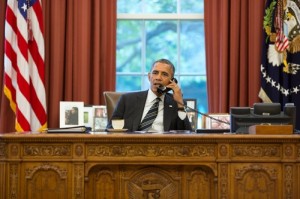
Obama on phone with RouhaniFrom the Oval Office, U.S. President Barack Obama speaks on the phone with Iranian President Hassan Rouhani on Sept. 27, 2013.

Instead of preemptively stopping ISIS from spreading into Iraq, Obama effectively waited until some high-profile beheadings forced him to focus on the danger. While such gruesome murders can reliably rally public opinion in favor of military action, the duty of the Commander-in-Chief is to lead and take military action when and how national security requires it, and not just when terrorists provoke some tardy and token airstrikes into empty buildings.

Kobani also has geostrategic importance to the Iranian nuclear threat. The more ISIS succeeds at capturing territory and recruiting fighters, a trend bolstered by Kobani’s fall, the more desperate the U.S. becomes for help from Iran, which, as leader of the Shiite world, is the natural enemy of the Sunni ISIS fighters.

[A]s Iran watches how feebly the U.S. responds to the loss of Iraq and how Obama cowers from a relatively minor fight in Kobani, the Ayatollahs can rest assured that there really is no U.S. military option to stop their nuclear program. This conclusion becomes all the more inevitable, when they look at Obama’s waning influence at home, as he enters the lame-duck period of his presidency.

*****************

President Obama has consistently disregarded the advice of his military experts on the ISIS threat. And he seems to have written off the Kurdish-Syrian town of Kobani, which may soon be overrun by ISIS.

Whatever the U.S. accomplished after about a decade of war in Iraq has, in a matter of months, deteriorated to a situation that may become unprecedented in its instability and threat to Western interests. Obama’s clumsy departure from Iraq, his military mismanagement of the mess that ensued, and his refusal to intervene in Syria – again, overruling his top security advisers – are what produced the current quagmire.

The loss of Christianity in Mosul didn’t have to happen. Obama’s tardy airstrikes managed to prevent the Mosul Dam from falling, but the city may never be the same. Similarly, why did the Yazidis have to find themselves besieged on Mount Sinjar before the U.S. took action?

Instead of preemptively stopping ISIS from spreading into Iraq, Obama effectively waited until some high-profile beheadings forced him to focus on the danger. While such gruesome murders can reliably rally public opinion in favor of military action, the duty of the Commander-in-Chief is to lead and take military action when and how national security requires it, and not just when terrorists provoke some tardy and token airstrikes into empty buildings.

As the next disaster is about to unfold on Obama’s watch, he should recognize that there is much more at stake with the fight for Kobani than just the loss to ISIS of a small town on the Syria-Turkey border.

Above all, letting Kobani fall means betraying our only ally fighting ISIS on the ground, and allowing them to be massacred while the world watches. What message does the U.S. send to Mideast partners and the world at large, if the Kurds are the only force providing the ground troops that Obama so desperately needs now, and yet Obama is unwilling to support them enough to avoid the horrific slaughter that will follow an ISIS victory in Kobani?

Kobani also has geostrategic importance to the Iranian nuclear threat. The more ISIS succeeds at capturing territory and recruiting fighters, a trend bolstered by Kobani’s fall, the more desperate the U.S. becomes for help from Iran, which, as leader of the Shiite world, is the natural enemy of the Sunni ISIS fighters. Because Iran also has one of the most powerful militaries in the region, and has – even before the ISIS crises – outmaneuvered the West in talks to curb Iranian nuclear ambitions, Iran could easily leverage the situation to secure tacit Western acceptance of its nukes. Indeed, Iran has already signaled its fight-ISIS-for-nukes strategy.

Even more important, as Iran watches how feebly the U.S. responds to the loss of Iraq and how Obama cowers from a relatively minor fight in Kobani, the Ayatollahs can rest assured that there really is no U.S. military option to stop their nuclear program. This conclusion becomes all the more inevitable, when they look at Obama’s waning influence at home, as he enters the lame-duck period of his presidency.

There is also a moral dimension to Kobani. Obama – in his 2009 and 2012 speeches on Holocaust Remembrance Day – proudly recalled how his great uncle helped to liberate a Nazi death camp. Yet Obama’s inaction in Syria has left about 200,000 dead, including many who were simply massacred, and Kobani may be where the next atrocities happen. Does the U.S. not hold itself to a higher standard than that of Turkey, which has thus far chosen just to watch the fighting a mere mile from its border?

Turkish history already includes genocides against the Armenian Christians and the Kurds (in the Dersim Massacre), so it’s no surprise that the Islamist regime of Recep Tayyip Erdoğan would let his army stand idly by, watching and waiting for ISIS to slaughter thousands of Kobani Kurds. But does the U.S. really want to be in the same camp as the Turks on this one? How much more shame will fall upon the United States, and the Obama legacy, when the Internet overflows with images of mass graves containing Kobani’s brave and abandoned fighters, along with Kurdish civilians who were too weak, infirm, or elderly to flee the approaching ISIS barbarism?

As if the above concerns weren’t enough to goad Obama into action, there is also the strategic impact of letting Kobani fall. As good as ISIS recruiting on social media already is, the popularity of this terrorist army among Islamists worldwide will surge when ISIS can boast about one more example of how even the mighty U.S. military can’t stop them.

Having foolishly telegraphed that he won’t send ground troops to confront ISIS, Obama can still try to convert his error into a feint by doing the opposite and sending troops to Kobani. At least that would restore some element of unpredictability to how ISIS regards U.S. military moves in the region.

Obama is effectively weeks away from the lame-duck portion of his presidency. If Republicans take Congress in next month’s midterm elections, then Obama will become that much more ineffectual. But the president can still try to demonstrate some leadership by changing his strategic approach to Mideast threats – if only to prevent his legacy from going into freefall. If the Middle East has only one lesson for Obama, it is that much can go terribly wrong in very little time. With Iranian nukes around the corner and ISIS on the march, two years of Mideast deterioration is a frighteningly long time to be on Obama’s watch.

Turkey ‘providing direct support’ to ISIS

October 10, 2014

Turkey ‘providing direct support’ to ISIS, World Net DailyAaron Klein, October 9, 2014

(????????????????????? — DM)

kurdish-fighter

TEL AVIV – NATO member Turkey is providing direct intelligence and logistical support to the ISIS terrorist organization, according to a senior Egyptian security official speaking to WND.

The official said Egypt has information Turkish intelligence is passing to ISIS satellite imagery and other data, with particular emphasis on exposing to ISIS jihadists the positions of Kurdish fighters and the storage locations of their weapons and munitions.

The official confirmed reports that Turkey released ISIS terrorists from jail in a sweeping deal with the jihadist organization that saw the release of 49 hostages from the Turkish embassy in Mosul who were being held by ISIS.

While some news media reports say Turkey may have released at least 180 ISIS terrorists in the deal, including two British jihadists, the Egyptian official said the number of ISIS terrorists released by Turkey was closer to 700.

Tensions between the Turkish government and its Kurdish population have been high as Kurds have sought autonomy for three decades and have faced mass ISIS attacks.

Kurdish forces have been leading a military campaign targeting ISIS in Iraq and Syria.

On Tuesday, Kurdish protesters demanding help in the fight against ISIS clashed with police in Turkey, leaving at least 14 people dead and scores injured, according to reports.

The Egyptian information about Turkey’s alleged role in providing support to ISIS seems to bolster accusations against Turkey and Arab allies made last week by Vice President Joseph Biden.

It was reported Biden last weekend apologized to Turkish President Recep Tayyip Erdogan for “any implication” that Turkey or Arab allies had intentionally supplied weapons to ISIS or helped in the growth other Islamic jihadist groups in Syria, according to the White House.

One week ago, Biden told an audience at Harvard’s Kennedy School of Government that ISIS had been inadvertently strengthened by actions taken by Turkey, the United Arab Emirates and Arab allies who were supporting the insurgency against Syrian President Bashar al-Assad.

Biden further implied Turkey, the UAE and other Arab countries were supplying weapons to al-Qaida and its offshoots in Syria, including the al-Nusra front.

“They poured hundreds of millions of dollars and thousands of tons of weapons into anyone who would fight against Assad,” Biden told students. “Except that the people who were being supplied were al-Nusra and al-Qaida and the extremist elements of jihadis coming from other parts of the world.

“We could not convince our colleagues to stop supplying them,” Biden said.

Regarding Turkey’s alleged role, Biden said, “President Erdogan told me, he’s an old friend, said, ‘You were right. We let too many people (including foreign fighters) through.’ Now they are trying to seal their border.”

Erdogan told reporters he vehemently denied making such a statement.

Bombing for show? Or for effect?

October 10, 2014

Bombing for show? Or for effect? Washington Post OpinionCharles Krauthammer, October 9, 2014

The indecisiveness and ambivalence so devastatingly described by both of Obama’s previous secretaries of defense, Leon Panetta and Bob Gates, are already beginning to characterize the Syria campaign.

The Iraqis can see it. The Kurds can feel it. The jihadists are counting on it.

*********************

During the 1944 Warsaw uprising, Stalin ordered the advancing Red Army to stop at the outskirts of the city while the Nazis, for 63 days, annihilated the non-Communist Polish partisans. Only then did Stalin take Warsaw.

No one can match Stalin for merciless cynicism, but President Recep Tayyip Erdogan of Turkey is offering a determined echo by ordering Turkish tanks massed on the Syrian border, within sight of the besieged Syrian town of Kobane, to sit and do nothing.

For almost a month, Kobane Kurds have been trying to hold off Islamic State fighters. Outgunned, outmanned and surrounded on three sides, the defending Kurds have begged Turkey to allow weapons and reinforcements through the border. Erdogan has refused even that, let alone intervening directly. Infuriated Kurds have launched demonstrations throughout Turkey protesting Erdogan’s deadly callousness. At least 29 demonstrators have been killed.

Because Turkey has its own Kurdish problem — battling a Kurdish insurgency on and off for decades — Erdogan appears to prefer letting the Islamic State destroy the Kurdish enclave on the Syrian side of the border rather than lift a finger to save it. Perhaps later he will move in to occupy the rubble.

Moreover, Erdogan entertains a larger vision: making Turkey the hegemonic power over the Sunni Arabs, as in Ottoman times. The Islamic State is too radical and uncontrollable to be an ally in that mission. But it is Sunni. And it fights Shiites, Alawites and Kurds. Erdogan’s main regional adversary is the Shiite-dominated rule of Syria’s Bashar al-Assad. Erdogan demands that the United States take the fight to Assad before Turkey will join the fight against the Islamic State.

 It took Vice President Biden to accidentally blurt out the truth when he accused our alleged allies in the region of playing a double game — supporting the jihadists in Syria and Iraq, then joining the U.S.-led coalition against them. His abject apologies to the United Arab Emirates, Saudi Arabia and Turkey notwithstanding, Biden was right.

The vaunted coalition that President Obama touts remains mostly fictional. Yes, it puts a Sunni face on the war. Which is important for show. But everyone knows that in real terms the operation remains almost exclusively American.

As designed, the outer limit of its objective is to roll back the Islamic State in Iraq and contain it in Syria. It is doing neither. Despite State Department happy talk about advances in Iraq, our side is suffering serious reverses near Baghdad and throughout Anbar province, which is reportedly near collapse. Baghdad itself is ripe for infiltration for a Tet-like offensive aimed at demoralizing both Iraq and the United States.

As for Syria, what is Obama doing? First, he gives the enemy 12 days of warning about impending air attacks. We end up hitting empty buildings and evacuated training camps.

Next, we impose rules of engagement so rigid that we can’t make tactical adjustments. Our most reliable, friendly, battle-hardened “boots on the ground” in the region are the Kurds. So what have we done to relieve Kobane? About 20 airstrikes in a little more than 10 days, says Centcom.

That’s barely two a day. On the day after the Islamic State entered Kobane, we launched five airstrikes. Result? We hit three vehicles, one artillery piece and one military “unit.” And damaged a tank. This, against perhaps 9,000 heavily armed Islamic State fighters. If this were not so tragic, it would be farcical.

No one is asking for U.S. ground troops. But even as an air campaign, this is astonishingly unserious. As former E.U. ambassador to Turkey Marc Pierini told the Wall Street Journal, “It [the siege] could have been meaningfully acted upon two weeks ago or so” — when Islamic State reinforcements were streaming in the open toward Kobane. “Now it is almost too late.”

Obama has committed the United States to war on the Islamic State. To then allow within a month an allied enclave to be overrun — and perhaps annihilated — would be a major blow.

Guerrilla war is a test of wills. Obama’s actual objectives — rollback in Iraq, containment in Syria — are not unreasonable. But they require commitment and determination. In other words, will. You can’t just make one speech declaring war, then disappear and go fundraising.

The indecisiveness and ambivalence so devastatingly described by both of Obama’s previous secretaries of defense, Leon Panetta and Bob Gates, are already beginning to characterize the Syria campaign.

The Iraqis can see it. The Kurds can feel it. The jihadists are counting on it.

Islamic State, Al-Qaeda, Islam and Iran

October 10, 2014

(Please listen to this twenty-two minute interview with Clare M. Lopez. She highlights Iran’s central involvement and the benefits it receives. — DM)


Turkey’s leaders see Kobani as opportunity, not threat

October 8, 2014

Turkey’s leaders see Kobani as opportunity, not threat, al Monitor, Amberin Zaman, October 7, 2014

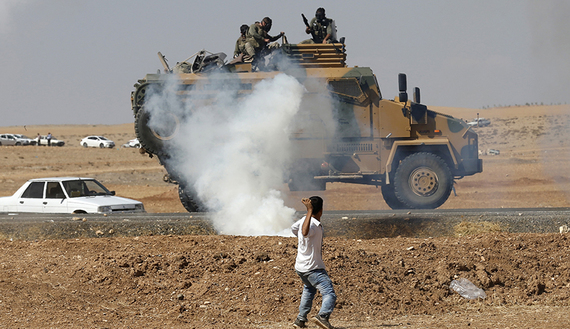
A protester throws stones at an armoured army vehicle during a pro-Kurdish demonstration, near the Mursitpinar border crossing on the Turkish-Syrian border, in SurucA protester throws stones at a Turkish armored vehicle during a pro-Kurdish demonstration in solidarity with the people of Kobani, near the Mursitpinar border crossing on the Turkish-Syrian border, Oct. 7, 2014. (photo by REUTERS/Umit Bektas)

The fall of Kobani would deal a severe blow to Kurdish independence hopes and bolster Turkey’s political goals.

The town has emerged as a symbol of Kurdish resistance.

***************

As Islamic State (IS) fighters keep up their battle to gain control over Kobani, a strategic Syrian Kurdish-controlled enclave on Turkey’s border, the effects of the conflict are being felt in Turkey itself. Thousands of Kurds took to the streets across the country on Oct. 7 to protest Turkey’s inaction against IS’ seemingly unstoppable advance. In the southeastern town of Varto, the government slapped curfews on six provinces in the mainly Kurdish southeast region after clashes between protestors and the security forces, and between rival Kurdish groups, left at least 14 people dead. Elsewhere across the country, police clashed with demonstrators, trying to push them back with pressurized water and pepper spray while the Kurds responded with Molotov cocktails in a foretaste of the violence that is likely to engulf the country should Kobani fall.

None of this comes as a surprise. Many Kurds continue to believe that Turkey is complicit in the jihadists’ onslaught against Kobani. Cemil Bayik, one of the top commanders of the Kurdistan Workers Party (PKK), repeated this claim in a Sept. 25 interview with Al-Monitor. Abdullah Ocalan, the imprisoned PKK leader, is threatening to call off peace talks with the Ankara government should there be a massacre in the enclave. Turkey denies it is siding with IS.

But it is doing little to aid the Kurds. This in turn invites the question of whether Turkey sees the Kurds as a greater threat than the jihadists, who stand to grab their third border crossing with Turkey. Turkish President Recep Tayyip Erdogan appeared to suggest that IS and the PKK were equally dangerous. “It is wrong to view them differently, we need to deal to them jointly,” he told reporters Oct. 3 in Istanbul. Erdogan’s comments hold the key to understanding Turkey’s policy on Kobani.

Turkey’s inaction over Kobani is undermining the peace process. Erdogan’s hopes of winning Kurdish support for constitutional amendments that would boost his presidential powers hang on friendship with the Kurds. A breakdown of the PKK’s 18-month-long cease-fire would likely jeopardize his ruling Justice and Development Party’s (AKP) chances in nationwide parliamentary elections scheduled for June. None of this appears to faze the Ankara government. This is because Erdogan and his AKP disciples view Kobani as an opportunity rather than a threat.

The opportunity ought to be to win the hearts and minds of Turkey’s Kurds by riding to the rescue of their brethren in Syria. Instead, Erdogan has chosen to exploit Kobani’s imminent fall to wrest maximum concessions from assorted Kurdish leaders. This was amply on display during last week’s secret meeting in Ankara between Salih Muslim, the co-chair of the Democratic Union Party (PYD), and senior Turkish officials from the Foreign Ministry and the national intelligence agency, MIT. Muslim reportedly beseeched the officials to allow the passage of arms and, most crucially, anti-tank weapons through the Mursitpinar border crossing with Kobani to enable Syrian Kurdish People’s Protection Units (YPG) fighters to fend off IS. Turkey said it would do so only if the PYD severed all its ties with the Syrian regime, joined the rebels, dissolved the PYD-dominated local governments running the enclaves, shared power with rival Syrian Kurdish parties and distanced itself from the PKK.

Muslim seems to have offered conflicting versions of what transpired, telling Al Jazeera that “agreement was reached in a number of areas” and the BBC that Turkey “did not keep its promises.” He has not responded to Al-Monitor’s repeated requests for comment. Either way, it’s hard to imagine that he yielded to Turkey’s demands or that he even has the authority to do so, because Ocalan and the PKK leadership in the Kandil Mountains call the final shots.

Turkey to its credit has offered sanctuary to more than 100,000 refugees from Kobani, and it is letting wounded YPG fighters in for treatment in hospitals. But Turkey would probably be happy to see Kobani fall. The town has emerged as a symbol of Kurdish resistance. It hosted Ocalan when he used to live in Syria under the patronage of the late Syrian President Hafez al-Assad. Kobani also has huge strategic significance. It lies between a swath of uninterrupted Kurdish-controlled towns and villages to the east collectively known as the canton of Jazeera and the Kurdish-administered town of Afrin to the southwest. The Kurds have long wanted to link the three by pushing out IS and other Syrian rebels from the areas separating them. The prospect of a Kurdish entity run by the PKK is more than Turkey, and especially its generals, can stomach.

Kobani’s fall would deal a humiliating blow to the PKK and weaken its support among Syria’s Kurds. It would also force Muslim and the PYD to patch up their differences with Massoud Barzani, the president of the Kurdistan Regional Government (KRG) in Iraq, who claims to be the “true leader” of all the Kurds. Although Barzani has spoken in defense of Kobani, he has yet to reproach Turkey over its stance.

Meanwhile, the PKK’s threats to resume its war sound like bluster to Turkish ears. Aaron Stein, a security analyst, told Al-Monitor, “The Turkish government is banking on the fact that the PKK can ill afford to open a second front against Turkey when it is battling IS in Iraq and in Syria.” Not only that, Ocalan would be loath to condemn himself to political irrelevance and spend the rest of his days rotting in prison. No matter how bitter, Kobani is a pill the Kurds will be forced to swallow. Ocalan will be forced to continue the peace talks, the pro-Kurdish People’s Democracy party (HDP) will play along and the PKK will hold its fire. This, anyway, seems to be Ankara’s thinking.

But it is fraught with risk.

The new generation of Kurds, as Bayik warned in his interview with Al-Monitor, is so radicalized that even the PKK finds it hard to keep them in line. Should Ocalan be perceived as capitulating to Turkey, he would lose his grip over them, too.

It was the fear of a PKK-dominated Kurdish statelet in Syria that propelled Turkey to resume peace talks with Ocalan in 2012 in the hope that he would keep the Syrian Kurds’ aspirations in check. The plan doesn’t seem to have worked. “The peace process began because of Syria’s Kurds,” recalls Arzu Yilmaz, a scholar of Kurdish affairs at Ankara University. “And it is because of them that it will unravel,” she concludes.

Editor’s Note: This piece has been updated since its initial publication.