Archive for the ‘Kurdish fighters’ category

Iraq’s divisions will delay counter-offensive on Islamic State

November 30, 2014

Iraq’s divisions will delay counter-offensive on Islamic State, Reuters, Dominic Evans, November 30, 2014

(Surely, fighters of the (non-Islamic) Islamic State will sit around quietly, patiently awaiting the counter-offensive. — DM)

Iraqi divisionosMembers of the Iraqi security forces and Shi’ite fighters take part during an intensive security deployment in the town of Qara Tappa in Iraq’s Diyala province November 26, 2014. REUTERS/Stringer

BAGHDAD (Reuters) – U.S. air support and pledges of weapons and training for Iraq’s army have raised expectations of a counter-offensive soon against Islamic State, but sectarian rifts will hamper efforts to forge a military strategy and may delay a full-scale assault.

The Sunni Islamists stormed through northern Iraq in a 48-hour offensive in June, charging virtually unopposed toward the outskirts of Baghdad, humiliating a U.S.-trained Iraqi army which surrendered both land and weapons as it retreated.

By contrast, even a successful effort by the Shi’ite-led government to dislodge Islamic State, also known as ISIS, from Sunni territory where it rules over millions of Iraqis would be fiercely fought and could stretch well beyond next year.

The Baghdad government relies on Shi’ite militias and Kurdish peshmerga to contain Islamic State – a dependence which underlines and may even exacerbate the sectarian rivalry which opened the door for the summer offensive.

U.S. newspapers have cited officials in Washington saying the Americans’ training mission aims to prepare Iraqi troops for a spring offensive to retake territory, including Mosul, northern Iraq’s largest city and Islamic State’s powerbase.

Hemin Hawrami, an official close to Kurdish leader Masoud Barzani, told Reuters that Iraqi forces would not be ready to take the fight to Mosul, in Iraq, until late 2015.

“There will be no spring or summer (offensive),” he said, adding that progress depended on government willingness “to reorganize the army, how quickly they can solve political issues with us and the Sunnis, (and) how quick the coalition will be in providing heavy arms to peshmerga and the Iraqi army.”

“CERTAIN VICTORY”

The army, Shi’ite militias and Kurdish fighters have made some gains against Islamic State, pushing back an advance toward Kurdish territory in August and last week recapturing towns in Diyala province, on the road from Baghdad to Iran.

The leader of the pro-Iranian Shi’ite Badr Organisation, whose fighters battled alongside peshmerga and soldiers in Diyala, said they would turn next to the Sunni provinces of Salahuddin and Anbar – north and west of Baghdad – before moving further north to Nineveh province, where Mosul lies.

“We are counting on the support of the Sunni tribal fighters. With them joining the fight, our victory is certain,” Hadi al-Amiri told Reuters by telephone from Diyala province.

Amiri said he expected to get weapons not just from the Iraqi government, which may allocate a quarter of next year’s $100 billion budget to the military, but also from the $1.6 billion of arms and training which Washington plans to deliver.

Both Amiri’s assumptions look optimistic, as Washington and the Sunni tribes are deeply wary of Shi’ite militia forces.

Iraqi authorities aim to overcome the deep rifts between Shi’ites, Sunni Arabs, Kurds and other groups by absorbing local fighters into a state-funded National Guard, but the role of that force remains undecided.

LONG WAR

Government adviser Zuhair al-Chalabi told Reuters the army was in no shape to surge north and Mosul’s mainly Sunni residents would resist a campaign by Shi’ite militias alone.

Instead, a combined force of army soldiers, Sunni tribes, Kurdish peshmerga and Shi’ite fighters must be assembled – and the open border with Islamic State territory in Syria sealed.

“There is a plan, but it can’t be implemented that quickly,” said Chalabi, who is from Mosul.

Finance Minister Hoshyar Zebari said Islamic State was still a formidable force but was losing the ability to conduct major ground combat because that exposed it to air strikes.

Zebari, a Kurd, declined to give details of the military strategies of either the Baghdad government or the semi-autonomous Kurdish authorities, but said “planning and coordination are already under way” for the battle for Mosul.

“I am really not aware of spring offensives. The offensive is on – spring, summer, winter. We countered them in autumn. This is an ongoing battle with them.”

The United States is setting up four training camps for Iraq’s 80,000-strong armed forces – two around Baghdad, one in the Kurdish city of Arbil and the fourth in Anbar.

Washington has also set out plans to provide body armor and guns to 45,000 soldiers, 15,000 Kurdish peshmerga and 5,000 Sunni tribal forces.

A senior Western diplomat in Baghdad said the training might take six months, with the first round complete in late spring.

While he argued that the tide had turned against Islamic State in northern Iraq and was moving against it elsewhere, fighting was likely to stretch into 2016.

And without control over the border, Islamic State fighters could slip away and regroup in Syria. “It’s the balloon theory. You squeeze one part and it pops up elsewhere,” he said.

Hawrami, the Kurdish official, foresaw a protracted and potentially inconclusive battle.

“In order to guarantee their defeat in Mosul we have to defeat them in Syria as well,” he said. “ISIS cannot be vanquished. ISIS can be degraded and weakened, but this process of degrading and weakening needs years.”
From Grief Over Kobane To Chaos: Istanbul’s Kurdish Riots

October 30, 2014

From Grief Over Kobane To Chaos: Istanbul’s Kurdish Riots, Vice News, October 30,2014

(Now Kurds in Turkey have a Marxist-Leninist martyr who was killed fighting the Islamic State in Kobane. — DM)

The US War Against ISIS Is Barely Degrading, Certainly Not Destroying The Militants

October 25, 2014

The US War Against ISIS Is Barely Degrading, Certainly Not Destroying The Militants, International Business Times , October 24, 2014

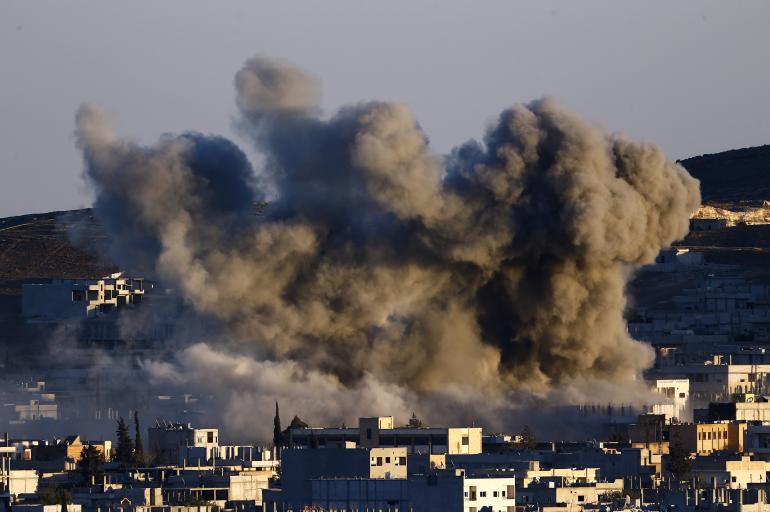
kobaneSmoke rises over Syrian town of Kobani after an airstrike, as seen from the Mursitpinar crossing on the Turkish border, Oct. 21, 2014. Reuters/Kai Pfaffenbach

The U.S.-led air campaign in Syria has killed 521 Islamic State fighters in the past month, according to the Syrian Observatory for Human Rights, a group monitoring the civil war. But the heavy death toll does not mean the United States is winning its fight to “degrade and destroy” the Sunni extremist group. Experts say that won’t happen until the group also known as ISIS loses support and its fighters begin defecting. 

“Until that happens, we will not see a quantum shift in the war in Iraq and Syria,” said Wayne White, a former deputy director of the State Department’s Bureau of Intelligence and Research’s Office of Analysis for the Near East and South Asia.

Since June, ISIS has gained control of large swaths of land that stretch from Kobani on the Syrian-Turkish border to the outskirts of Baghdad. The group is currently waging campaigns in several different areas of both countries, but has focused its forces in recent weeks on capturing the Kurdish city of Kobani. As a result, the U.S.-led air campaign has targeted several ISIS convoys and strongholds in Kobani and is air-dropping weapons and other resources to the Syrian Kurds fighting there.

“Like many aerial campaigns you can cite from history, it is a gradual process,” White said. “ISIS has a finite number of heavy weapons, and they are being picked off. And ISIS is losing a lot of combatants that are not easily replaced. ISIS is driven to expand its domain, and every time it tries to expand it is putting its fighters out in the open where they can be taken out. The question is: How long will the degrading take until you get to the destruction … a long time.”

Witnesses on the ground in Kobani told International Business Times that ISIS had been pushed back from the center of the city, but that the fighting was still raging on the outskirts. Meanwhile, ISIS is making gains in other parts of Syria and in Baghdad. According to the Syrian Observatory, ISIS fighters seized Tal Shaer, a town just west of Kobani, this week. And in Baghdad, the Sunni militant group has claimed responsibility for several car and suicide bomb attacks that have killed dozens of people in the last two weeks.

The uptick in ISIS attacks since June in Iraq has not only caused hundreds of civilian deaths, but has also infiltrated the psyche of the Iraqi people, especially those living in the capital, Noof Assi, a woman from Baghdad, told the International Business Times.

At the beginning of the ISIS campaign, “Baghdad looked like a ghost city,” Assi said. “People were staying at home or fleeing, saving food and fuel.”

Now, she said, people in Baghdad are used to the ISIS insurgency. Discussions in shops, cafes and restaurants have shifted. No longer are Iraqis talking about the destruction that ISIS is inflicting on the country. Now, people are talking about how many people are beginning to support the militant group.

“There are people talking about people of Mosul,” she said of the big northern city. “Some people are saying that they betrayed Iraq and welcomed ISIS.”

The State Department and White House have both confirmed that part of the U.S. strategy to fight ISIS is to undercut its propaganda and recruitment, especially on social media. So far, though, the U.S. has not launched a successful countercampaign.

In September, the State Department produced and distributed a graphic mock Islamic State propaganda video via social media. The video, “Welcome to ISIS Land,” was published by the State Department’s Center for Strategic Counterterrorism Communications.

The mock video showed graphic images of the militant group committing war crimes that have been widely reported over the past two months and that are now being investigated by the United Nations. The video looks similar to those ISIS promotes on social media like Twitter and YouTube. Despite the counterpropaganda drive, ISIS continues to expand on social media, and more and more Western fighters, as well as Iraqi and Syrian civilians, are joining up.

While some experts say the only way the U.S. will defeat ISIS is by sending in ground troops, others say more credit should be given to the Syrian Kurdish fighters — who now seems to be only force on the ground in Iraq and Syria that is regaining territory ISIS took over in prior months.

“They are the only boots on the ground in the entire Iraqi-Syrian theater capable of standing up to ISIS,” White said. “They are absolutely fierce fighters. The Iraqi Kurds are not.”

Uncertain Future for Kobane Prisoners: Turkey’s Border War (Dispatch 3)

October 21, 2014

Uncertain Future for Kobane Prisoners: Turkey’s Border War (Dispatch 3), You Tube, Vice News, October 20, 2014


Syria tribal revolt against Islamic State ignored, fueling resentment

October 21, 2014

Syria tribal revolt against Islamic State ignored, fueling resentment, Washington PostLiz Sly, October 20, 2014

(Aside from responding to anticipated domestic political pressure after the (non-Islamic) Islamic State beheaded an American, what are we doing in Iraq and Syria and why? Are we trying to win hearts and minds, to maintain the semblance of a coalition of the unwilling or merely to do “something?” — DM)

“When you see your relatives being slaughtered, you will be forced to accept compromises you would otherwise never have been prepared to accept,” he said. “And when you see the world has abandoned you, you will do nothing about it.”

******************

The cost of turning against the Islamic State was made brutally apparent in the streets of a dusty backwater town in eastern Syria in early August. Over a three-day period, vengeful fighters shelled, beheaded, crucified and shot hundreds of members of the Shaitat tribe after they dared to rise up against the extremists.

By the time the killing stopped, 700 people were dead, activists and survivors say, making this the bloodiest single atrocity committed by the Islamic State in Syria since it declared its existence 18 months ago.

The little-publicized story of this failed tribal revolt in Abu Hamam, in Syria’s eastern Deir al-Zour province, illuminates the challenges that will confront efforts to persuade those living under Islamic State rule — in Iraq as well as Syria — to join the fight against the jihadist group, something U.S. officials say is essential if the campaign against the militants is to succeed.

The Abu Hamam area has now been abandoned, and many of the bodies remain uncollected, offering a chilling reminder to residents elsewhere of the fate that awaits those who dare rebel.

Just as powerful a message for those living under the militants’ iron fist was the almost complete international silence on the bloodbath.

(Please go to the link for a video — DM)

The fiercest fighting in days shook the Syrian border town of Kobane, forcing more refugees to pour into Turkey for shelter from the violence. (Reuters)

News of the massacre coincided with President Obama’s decision to order airstrikes to turn back an Islamic State advance unfolding farther east in Iraq, toward the Kurdish regional capital of Irbil, as well as humanitarian airdrops to help desperate Iraqi Yazidis trapped on a mountain by the onslaught.

Many Syrians in the opposition are starting to complain about unequal treatment.

U.S. warplanes have carried out more airstrikes on Islamic State forces besieging the Kurdish town of Kobane on Syria’s border with Turkey than on any other single location in Iraq or Syria. And Washington announced Sunday that U.S. planes had airdropped weapons and medical supplies to the beleaguered Kurdish fighters there.

Yet even now, Washington has directed little effort toward helping Sunni Arabs who want to fight the militants but lack the resources to do so, said Abu Salem, who was among the Shaitat tribesman and rebel commanders who gathered recently in an apartment in the Turkish border town of Reyhanli to recount the killings of their clansmen.

“We saw what the Americans did to help the Yazidis and the Kurds. But they have done nothing to help the Sunnis against the Islamic State,” he said.

Abu Salem and the other men said they did not so much begrudge the efforts to help Kurds as wonder why no one had helped them when their community was under attack. The carnage inflicted on the Shaitat tribe has instilled in the Abu Hamam survivors a loathing for the Islamic State and the warped brand of Islamist politics for which it stands, said Abu Siraj, another of the tribesmen. A former lawyer, he, like most of the men, asked to be identified only by his nom de guerre because he fears being tracked even to Turkey by the jihadists.

“Now we hate everyone who prays,” he said. “Now we hate even beards.”

But finding support for efforts to organize against the militants is proving hard, he said, pulling out his mobile phone to show a photograph released that day of the trussed, decapitated body of a friend who had purportedly been caught attempting to throw a hand grenade against them.

“When you see your relatives being slaughtered, you will be forced to accept compromises you would otherwise never have been prepared to accept,” he said. “And when you see the world has abandoned you, you will do nothing about it.”

U.S. officials say the Kobane attacks were not intended to show preference for one community over another, but rather served as an opportunity to take aim at the large number of militant fighters who converged on the town to capture it. The Pentagon claims to have killed hundreds of Islamic State militants around Kobane, in keeping with the wider U.S. goal of targeting the Islamists’ infrastructure and resources in Syria to downgrade their ability to reinforce and finance their operations in Iraq.

The primary focus of the American strategy, Gen. Lloyd Austin, the U.S. Central Command leader, stressed last week, remains on Iraq, and on preventing the Islamic State from projecting power there.

“Iraq is our main effort, and it has to be,” he said at a news conference in Washington. “And the things we are doing right now in Syria are being done primarily to shape the conditions in Iraq.”

Such comments have reinforced perceptions among Syrians that the U.S.-led air war does not have their interests at heart. Differences over the purposes and direction of the war risk alienating the many rebel groups that were engaged in battling the Islamic State before the U.S. government intervened, said Steven Heydemann of the U.S. Institute of Peace.

“It’s already become an impediment,” he said. “I don’t think the administration has fully taken on board how much damage the way they’ve conducted this campaign has done to the relationships they’ve developed with some of these actors.”

‘We were finished’

The Sunni areas of Syria occupied by the Islamic State would seem to be a more likely venue for a revolt than Iraq, where the extremists’ extensive territorial gains this year were aided by local Sunni insurgents and tribes alienated by the discriminatory behavior of the Shiite-led Iraqi government.

In Syria, however, the Islamic State’s conquests came at the expense of local rebels who already had fought to eject their government and then found themselves outgunned and outmaneuvered by the newly emerging Islamist extremists.

The Shaitat tribe, along with many others in the oil-rich province of Deir al-Zour bordering Iraq, spent much of this year battling to retain control of their area against encroachments by the Islamic State, and they might have prevailed had the Islamic State not swept into the Iraqi city of Mosul in June, rebels say. The vast amounts of U.S. weaponry the Islamic State captured were trundled across the rapidly dissolving border with Syria, said Abu Salem, who commanded a rebel battalion in the area before he escaped to Turkey.

“After they took Mosul, we were finished,” he said.

Abu Hamam and a cluster of villages nearby were targeted. After the new armaments from Iraq arrived, “we realized we had no hope. We were surrounded. We wanted to save our people,” said Abu Abdullah, another of the Shaitat fighters, describing how they agreed to a truce with the militants in mid-July.

The Islamic State was permitted to enter the town and establish a garrison, but local leaders were left in charge, he said.

Relations quickly frayed. The crunch came, the tribesmen in Reyhanli said, when Islamic State fighters whipped a local man who was caught smoking a cigarette in the street, a crime under the Islamic State’s harsh interpretation of Islam. The man’s brother, incensed, shot at a passing Islamic State patrol, killing one of its fighters.

The brother was arrested and publicly beheaded, triggering an outpouring of rage. Residents marched on the Islamic State’s headquarters, forcing its fighters to flee. The militants then brought in reinforcements and began shelling the town, using artillery they had captured the previous month in Iraq.

After a three-day barrage, the Islamic State militants moved in. They rounded up all the surviving men and boys older than 15 they could find and set about systematically killing them, the fighters in Reyhanli said.

A photo essay on an Islamic State blog boasted of the different ways tribesmen were killed, including beheadings, mass shootings and a crucifixion. A video shows how the militants lined up scores of captives on a road, their hands bound, then set about clumsily decapitating them, one by one. The executioners, speaking in Tunisian, Egyptian and Saudi accents, taunted those not yet dead by swinging severed heads in front of their faces and telling them, “It’s your turn next.”

The tribesmen in Reyhanli, like many other rebel fighters in Deir al-Zour now living in Turkey or elsewhere in Syria, said they managed to slip away using fake identity cards or escape routes honed during their battle against the government.

They said they are plotting their return, to take revenge and fight — without counting on international support.

“We are tribal people. We will never forget to avenge,” said Abu Salem, the commander of the group. “But we will do it by ourselves, in our own way. We won’t take any help from anyone.”

Peshmerga head speaks of struggle against IS

October 18, 2014

Peshmerga head speaks of struggle against IS, Al-Monitor, Faraj Obaji, October 17, 2014

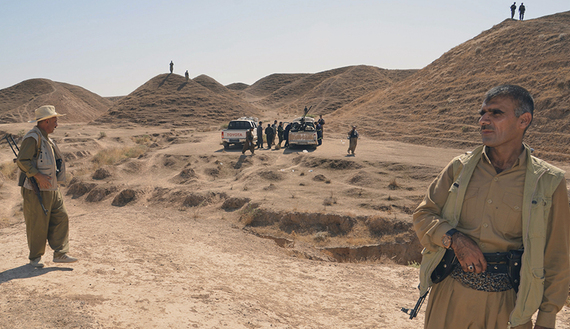
Kurdish peshmerga fighters stand guard around vehicles left behind by fleeing Islamic State militants during clashes in the al-Zerga area near Tikrit cityKurdish peshmerga fighters stand guard around vehicles with weapons and ammunition left behind by fleeing Islamic State militants during clashes in the al-Zerga area near Tikrit city in Salahuddin province, Oct. 8, 2014. (photo by REUTERS)

Commenting on the criticism of certain Kurdish parties inside Kobani, regarding the lack of support provided by KRG to the besieged city, he said, “Despite the differences with certain Kurdish political parties in the city, the KRG expressed its readiness to support our brothers in the city and we asked Washington and its allies to help the resisting Kurdish fighters.

“We helped them as much as possible, and the KRG’s president affirmed this. But, we cannot offer more. We are still waiting for international aid. The region initially includes 5 million people, add to that one and a half million displaced from Syria and the Iraqi provinces. We are helping them and taking care of them, and this is a huge burden.”

******************

Eliminating the Islamic State (IS) in Iraq does not seem to be an easy mission that will happen anytime soon; it seems rather impossible. The terrorist attacks against Iraq exposed how weak the Iraqi army is, how fragile its military structure and intelligence services are, and how it is unable to protect its country against any attack.

Some believe that the responsibility of the army’s failure to fight IS should be borne by the political authority ruling the country since 2004, which was unable to build an army based on a unified doctrine. Others consider the policies adopted by former Prime Minister Nouri al-Maliki faulty and the maliciousness allowed the terrorist group to enter the country, while the political conflicts between the central government and the Sunni leaderships provided an embracing environment for the group in Sunni provinces.

Secretary-General of the Ministry of Peshmerga Lt. Gen. Jabbar Yawar spoke to An-Nahar regarding the situation in Iraq in general, and in the Kurdistan Regional Government (KRG) in particular, in light of the IS threat, which occupied a number of Iraqi provinces, reaching the besieged Kobani.

The peshmerga harasses IS

The Kurdish military leader welcomed the international aid provided to the KRG, which is fighting a crucial battle against IS. He said, “The military aid which reached KRG saved it from falling into the hands of the terrorist group and allowed peshmerga forces to move from the negative defense position to the striker position, inflicting heavy losses on IS.”

Yawar does not hesitate to say, “The peshmerga forces’ position in the fight against IS is much better than the Iraqi army’s position. We are in a continuous fight along the 1,050-kilometer [650-mile] border of five Iraqi provinces, starting from Mosul to Erbil and passing through Kirkuk, Saladin and Diyala.”

He said, “The peshmerga forces have liberated the Mosul Dam and continues to liberate the rest of the regions that have fallen into the hands of IS, while creating plans to completely achieve this.”

The fall of Mosul and Anbar

Yawar attributed the fall of Mosul and Anbar to several reasons, most importantly, the fragility of the army in both provinces. He said, “The army in Mosul was fragile, and its six military units failed to withstand IS. There were also the political conflicts between the Sunni blocs and the government in Baghdad, which prevented these forces from fighting IS in Mosul, Saladin and parts of Kirkuk. These forces either handed over their advanced and heavy weapons to the group and fled, or joined and began to fight alongside IS.”

“The lack of a unified fighting doctrine among the army, and the shortage of air support, were all elements that contributed in the army’s quick collapse and IS’ occupation of a number of Iraqi provinces, especially the Sunni ones,” he said.

The difficulty in liberating Sunni regions

On the subject of the army’s situation in provinces in general, Yawar said that he found “a certain difficulty in liberating the Sunni-dominated regions from IS, such as Anbar, Saladin and Mosul, especially after it fell into the hands of the terrorists who took over its weapons on June 10.” He said that although they used all available means, the Iraqi forces were unable to liberate the city of Heet in Anbar and Tikrit, the center of Saladin province. “The situation on the field unfortunately proves that IS only controls the Sunni-dominated regions. We hope that our Sunni brothers, who are suffering the group’s injustice, will cooperate with the federal government and the KRG in order to eliminate this terrorist group,” he explained.

How did IS reach Erbil’s borders?

When asked how IS was able to reach KRG even though its intentions to occupy the region were obvious, Yawar answered with regret: “We knew before the group attacked Mosul on June 10 that it was up to no good in Iraq and Mosul. We were alerted by the joint committees and meetings that we used to hold in Baghdad, that there were some suspicious and dangerous movements on the borders with Syria. We were advised to strike them at an early stage, but we did not listen. The federal government and its former prime minister, Nouri al-Maliki, believed our proposals were political outbidding. Even when IS attacked Mosul, we asked them to allow us to support the federal forces there, but they told us that they were able to fight back themselves. Then Mosul fell, its residents fled and, due to Maliki’s faulty policy, IS was able to reach Baghdad’s borders.”

When asked why the terrorist group was able to reach Erbil, Yawar said, “When IS’ attack began, the peshmerga fought with all its strength, but it does not own advanced weapons such as the ones the group took from Mosul, because Maliki’s government never reinforced, trained or funded the peshmerga forces, although they are official governmental forces, according to the federal constitution.

“Despite all this, the peshmerga withstood IS from June 10 until the beginning of August. However, when we ran out of munitions and had no source of getting any, the group was able to penetrate our defense and move toward Erbil. Yet, thanks to Washington’s assistance and some of the countries participating in the international alliance, we were able to change the negative defense equation in Erbil and attack IS to liberate our lands,” he said.

Baghdad will not fall

The Kurdish leader ruled out the possibility of Baghdad falling for the time being, according to the available security data. “Until now, the Iraqi army can protect Baghdad and prevent the penetration of IS, which has spread in neighboring regions, such as Amiriya, Fallujah, Saqlawiyah and Ramadi,” he said.

We helped Kobani as much as we could

Commenting on the criticism of certain Kurdish parties inside Kobani, regarding the lack of support provided by KRG to the besieged city, he said, “Despite the differences with certain Kurdish political parties in the city, the KRG expressed its readiness to support our brothers in the city and we asked Washington and its allies to help the resisting Kurdish fighters.

“We helped them as much as possible, and the KRG’s president affirmed this. But, we cannot offer more. We are still waiting for international aid. The region initially includes 5 million people, add to that one and a half million displaced from Syria and the Iraqi provinces. We are helping them and taking care of them, and this is a huge burden.”

Yawar said, “The region has not been able to help Kobani like it should, due to its tough and complex geographic location, as it is 300 kilometers [185 miles] from the Syrian border, and it’s hard for aid to reach it. Kobani’s situation is geographically similar to Gaza or Sinjar.”

Raids

Yawar is not afraid that IS, which he believes is an extension of al-Qaeda in Afghanistan, will persist. He said, “The situation in Iraq and Syria today is similar to that of Tora Bora and Afghanistan. The airstrikes are beneficial for the peshmerga, Kobani and even for the Iraqi government, as they halt the advance of IS militants and drain them. These strikes also destroy IS warehouses and heavy weapons. But, to free these areas completely from IS, a comprehensive international operation should be put in place, like the one in Afghanistan, and there should be an actual training campaign for the Iraqi forces to defend themselves. However, I rule out the possibility of a foreign land intervention in Iraq, with the existing conflict between the ruling political parties.”

No Kurdish expansion

Political circles have been talking about a Kurdish expansion in an attempt to build the awaited state. In this regard, Yawar says, “We are part of the federal state, and neither of us expands into the other’s territories. Until now, there aren’t any official international borders between us and the federal state. We have some problems in many regions administratively. But the KRG and Baghdad are both facing IS threat. We should destroy it first, then resort to the constitution to solve the pending problems with the Baghdad government regarding the land, oil, the budget and Peshmerga.”


It’s official: U.S. will build new Syrian rebel force to battle Islamic State

October 16, 2014

It’s official: U.S. will build new Syrian rebel force to battle Islamic State, McClatchy DC, Hannah Allam, October 15, 2014

(Phase Two of “Operation We Got It Wrong Again.” Will Kurds or newbies be supplied, equipped and trained? By whom will the “moderates” be vetted and trained? By now focusing on the Syrian political opposition, will we be distancing ourselves from Assad’s supporter Iran?– DM)

Airstrike KobaniSmoke rises following an airstrike by US-led coalition aircraft in Kobani, Syria, during fighting between Syrian Kurds and the militants of Islamic State group, Oct. 9, 2014. (AP Photo/Lefteris Pitarakis)

This time, Allen said, the United States and its allies will work to strengthen the political opposition and make sure it’s tied to “a credible field force” that will have undergone an intense vetting process.

******************

— John Allen, the retired Marine general in charge of coordinating the U.S.-led coalition’s response to the Islamic State, confirmed Wednesday what Syrian rebel commanders have complained about for months – that the United States is ditching the old Free Syrian Army and building its own local ground force to use primarily in the fight against the Islamist extremists.

“At this point, there is not formal coordination with the FSA,” Allen told reporters at the State Department.

That was perhaps the bluntest answer yet to the question of how existing Syrian rebel forces might fit into the U.S. strategy to fight the Islamic State. Allen said the United States’ intent is to start from scratch in creating a home-grown, moderate counterweight to the Islamic State.

For most of the three years of the Syrian conflict, the U.S. ground game hinged on rebel militias that are loosely affiliated under the banner of the Free Syrian Army, or FSA. Their problems were no secret: a lack of cohesion, uneven fighting skills and frequent battlefield coordination with the al Qaida loyalists of the Nusra Front.

This time, Allen said, the United States and its allies will work to strengthen the political opposition and make sure it’s tied to “a credible field force” that will have undergone an intense vetting process.

“It’s not going to happen immediately,” Allen said. “We’re working to establish the training sites now, and we’ll ultimately go through a vetting process and beginning to bring the trainers and the fighters in to begin to build that force out.”

The Syrian arena is important, Allen said, but to the U.S., “the emergency in Iraq right now is foremost in our thinking.” There will be a simultaneous training-and-equipping campaign for Iraq, where the U.S.-trained military collapsed during the Islamic State’s summer offensive.

Allen said the new training program is “for those elements of the Iraqi national security forces that will have to be refurbished and then put back into the field,” with the ultimate goal of reclaiming Iraqi territories seized by the Islamic State.

Allen sounded confident that the United States and its allies could juggle two massive training efforts even as the Islamic State has shown itself to be resilient under weeks of coalition airstrikes.

“We have the capacity to do both, and there is significant coalition interest in participating in both,” Allen said of the twin force-building efforts in Iraq and Syria.

But, as he stressed repeatedly in his remarks, “it’s going to take a while.”

Ahmad Tomeh, who was just re-elected prime minister of the Syrian opposition’s interim government, told McClatchy that Allen met six leaders of the political opposition during his trip to Istanbul last week, but had no talks with any of the ground commanders, including the vetted, trained commanders the U.S. has been supporting. They asked for increased help, Tomeh said, but got no commitment.

Kurds make grisly discoveries after retaking ISIS-held territory

October 15, 2014

Kurds make grisly discoveries after retaking ISIS-held territory, Hot Air, Noah Rothman, October 14, 2014

(How serious are we and our coalition of the unwilling about at least degrading the Islamic State? — DM)

There is mixed news from the two fronts in Iraq and Syria where coalition airpower and indigenous partner forces on the ground are fighting Islamic State militants.

Near the Syrian border city of Kobani, reports indicate that Kurdish defenders are beginning to make some gains as they continue to defend the city against the ISIS onslaught. A key hill atop which ISIS fighters famously planted their flag late last week has reportedly been retaken by Kurdish forces.

“The advance came as the US said it had conducted 21 air strikes near the town, slowing down the IS advance,” the BBC revealed. “Tall Shair hill had been captured more than 10 days ago by IS militants.”

As ISIS retreated from the front near the Syrian-Turkish border, Kurdish forces made a series of gruesome discoveries.

“Refugees in Suruc, Turkey, have told how relatives and neighbors were beheaded by [ISIS] militants, while another spoke of how he had seen ‘hundreds’ of decapitated corpses in the besieged town,” The Independent reported on Tuesday.

Amin Fajar (38) a father-of-four who left Kobane and made it across the border and into Suruc, told a British newspaper: “I have seen tens, maybe hundreds, of bodies with their heads cut off.

“Others with just their hands or legs missing. I have seen faces with their eyes or tongues cut out – I can never forget it for as long as I live.”

The Daily Telegraph confirmed The Independent’s reporting about the activities in which ISIS engaged in the areas under their control:

“I have seen tens, maybe hundreds, of bodies with their heads cut off. Others with just their hands or legs missing. I have seen faces with their eyes or tongues cut out — I can never forget it for as long as I live,” Amin Fajar, a 38-year-old father of four, told the Daily Mail about the incredible scene in Kobane.

“They put the heads on display to scare us all.”

Another resident, 13-year-old Dillyar, watched as his cousin Mohammed, 20, was captured and beheaded by the black-clad jihadis as the pair tried to flee the battle-scarred town.

“They pushed him to the ground and sawed his head off, shouting, ‘Allahu Akbar,’ ” the boy said. “I see it in my dreams every night and every morning I wake up and remember everything.”

This unconfirmed video featuring Kurdish fighters in Kobani, flagged by Jeff Gauvin, reveals the extent of the damage done to the city over the course of weeks of fighting.

While America’s partners on the ground are enjoying some successes in Syria, the dispatches from Iraq are far more grim.

There, ISIS continues its siege on Anbar province in preparation for an assault on the capital city of Baghdad. After taking control of a military training base on Monday, CNN reported that ISIS has surrounded one of the largest Iraqi airbases in the country on Tuesday and is preparing to take it.

“According to police sources,” CNN’s Ben Wedeman reported, “the Ayman Asad Airbase, which is about 110 miles to the west of Baghdad – one of the biggest bases in Anbar province – is now surrounded by ISIS fighters, and the people on the base are expecting an attack within the coming hours on that base.”

“We understand that there are Iraqi soldiers who have already fled the base,” Wedeman continued. “We were getting reports for several hours that some of the soldiers had left, shedding their uniforms, leaving their weapons behind.”

That depressing revelation should concern military advisors who believe Iraqi forces defending Baghdad can hold out against an ISIS assault on Baghdad despite outnumbering the attackers by a reported six-to-one ratio. These latest developments reinforce the position of Army Chief of Staff Gen. Raymond Odierno who said with some trepidation recently he was only “somewhat” confident Baghdad could hold out.

Kurds Left Helpless as Kobane Falls to Islamic State: Turkey’s Border Wars (Dispatch 1)

October 15, 2014

 Vice News via You Tube, October 14, 2014

(Whose side is our NATO ally, Turkey, on in Kobane? The (“non-Islamic”) Islamic State or those best able to combat it effectively? How about the Obama Nation?  — DM)

Obama’s Kobani Crossroads

October 15, 2014

Obama’s Kobani Crossroads, Algemeiner, Noah Beck, October 14, 2014

(Obama needs high profile stuff and photo ops to keep his polls from falling even more dramatically than they have. He needs help from Iran and little if anything else matters. It will be rewarded. — DM)

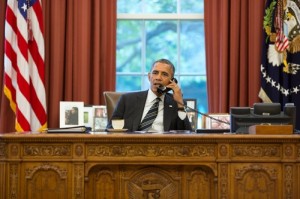
Obama on phone with RouhaniFrom the Oval Office, U.S. President Barack Obama speaks on the phone with Iranian President Hassan Rouhani on Sept. 27, 2013.

Instead of preemptively stopping ISIS from spreading into Iraq, Obama effectively waited until some high-profile beheadings forced him to focus on the danger. While such gruesome murders can reliably rally public opinion in favor of military action, the duty of the Commander-in-Chief is to lead and take military action when and how national security requires it, and not just when terrorists provoke some tardy and token airstrikes into empty buildings.

Kobani also has geostrategic importance to the Iranian nuclear threat. The more ISIS succeeds at capturing territory and recruiting fighters, a trend bolstered by Kobani’s fall, the more desperate the U.S. becomes for help from Iran, which, as leader of the Shiite world, is the natural enemy of the Sunni ISIS fighters.

[A]s Iran watches how feebly the U.S. responds to the loss of Iraq and how Obama cowers from a relatively minor fight in Kobani, the Ayatollahs can rest assured that there really is no U.S. military option to stop their nuclear program. This conclusion becomes all the more inevitable, when they look at Obama’s waning influence at home, as he enters the lame-duck period of his presidency.

*****************

President Obama has consistently disregarded the advice of his military experts on the ISIS threat. And he seems to have written off the Kurdish-Syrian town of Kobani, which may soon be overrun by ISIS.

Whatever the U.S. accomplished after about a decade of war in Iraq has, in a matter of months, deteriorated to a situation that may become unprecedented in its instability and threat to Western interests. Obama’s clumsy departure from Iraq, his military mismanagement of the mess that ensued, and his refusal to intervene in Syria – again, overruling his top security advisers – are what produced the current quagmire.

The loss of Christianity in Mosul didn’t have to happen. Obama’s tardy airstrikes managed to prevent the Mosul Dam from falling, but the city may never be the same. Similarly, why did the Yazidis have to find themselves besieged on Mount Sinjar before the U.S. took action?

Instead of preemptively stopping ISIS from spreading into Iraq, Obama effectively waited until some high-profile beheadings forced him to focus on the danger. While such gruesome murders can reliably rally public opinion in favor of military action, the duty of the Commander-in-Chief is to lead and take military action when and how national security requires it, and not just when terrorists provoke some tardy and token airstrikes into empty buildings.

As the next disaster is about to unfold on Obama’s watch, he should recognize that there is much more at stake with the fight for Kobani than just the loss to ISIS of a small town on the Syria-Turkey border.

Above all, letting Kobani fall means betraying our only ally fighting ISIS on the ground, and allowing them to be massacred while the world watches. What message does the U.S. send to Mideast partners and the world at large, if the Kurds are the only force providing the ground troops that Obama so desperately needs now, and yet Obama is unwilling to support them enough to avoid the horrific slaughter that will follow an ISIS victory in Kobani?

Kobani also has geostrategic importance to the Iranian nuclear threat. The more ISIS succeeds at capturing territory and recruiting fighters, a trend bolstered by Kobani’s fall, the more desperate the U.S. becomes for help from Iran, which, as leader of the Shiite world, is the natural enemy of the Sunni ISIS fighters. Because Iran also has one of the most powerful militaries in the region, and has – even before the ISIS crises – outmaneuvered the West in talks to curb Iranian nuclear ambitions, Iran could easily leverage the situation to secure tacit Western acceptance of its nukes. Indeed, Iran has already signaled its fight-ISIS-for-nukes strategy.

Even more important, as Iran watches how feebly the U.S. responds to the loss of Iraq and how Obama cowers from a relatively minor fight in Kobani, the Ayatollahs can rest assured that there really is no U.S. military option to stop their nuclear program. This conclusion becomes all the more inevitable, when they look at Obama’s waning influence at home, as he enters the lame-duck period of his presidency.

There is also a moral dimension to Kobani. Obama – in his 2009 and 2012 speeches on Holocaust Remembrance Day – proudly recalled how his great uncle helped to liberate a Nazi death camp. Yet Obama’s inaction in Syria has left about 200,000 dead, including many who were simply massacred, and Kobani may be where the next atrocities happen. Does the U.S. not hold itself to a higher standard than that of Turkey, which has thus far chosen just to watch the fighting a mere mile from its border?

Turkish history already includes genocides against the Armenian Christians and the Kurds (in the Dersim Massacre), so it’s no surprise that the Islamist regime of Recep Tayyip Erdoğan would let his army stand idly by, watching and waiting for ISIS to slaughter thousands of Kobani Kurds. But does the U.S. really want to be in the same camp as the Turks on this one? How much more shame will fall upon the United States, and the Obama legacy, when the Internet overflows with images of mass graves containing Kobani’s brave and abandoned fighters, along with Kurdish civilians who were too weak, infirm, or elderly to flee the approaching ISIS barbarism?

As if the above concerns weren’t enough to goad Obama into action, there is also the strategic impact of letting Kobani fall. As good as ISIS recruiting on social media already is, the popularity of this terrorist army among Islamists worldwide will surge when ISIS can boast about one more example of how even the mighty U.S. military can’t stop them.

Having foolishly telegraphed that he won’t send ground troops to confront ISIS, Obama can still try to convert his error into a feint by doing the opposite and sending troops to Kobani. At least that would restore some element of unpredictability to how ISIS regards U.S. military moves in the region.

Obama is effectively weeks away from the lame-duck portion of his presidency. If Republicans take Congress in next month’s midterm elections, then Obama will become that much more ineffectual. But the president can still try to demonstrate some leadership by changing his strategic approach to Mideast threats – if only to prevent his legacy from going into freefall. If the Middle East has only one lesson for Obama, it is that much can go terribly wrong in very little time. With Iranian nukes around the corner and ISIS on the march, two years of Mideast deterioration is a frighteningly long time to be on Obama’s watch.