Archive for the ‘Kurdish fighters’ category

Arab League Opposition to Kurds Only Fuels Iran

September 24, 2017

Arab League Opposition to Kurds Only Fuels Iran, Clarion ProjectZach Huff, September 24, 2017

A rally for Kurdish independence in Erbil ahead of the Sept.25, 2017 referendum (Photo: Chris McGrath/Getty Images)

Sunni Arab leaders have largely been silent on the September 25 Iraqi Kurdish independence referendum, but Arab League Secretary General Ahmed Abdul Gheit visited the Iraqi Kurdish capital last week to dissuade the Kurds from holding the vote.

In a recent letter to Kurdistan Region President Massoud Barzani, Ahmed described his fears of “disintegration and fragmentation,” noting in his plea that the Arab League is “strongly keen on ensuring the territorial integrity of the Arab states.”

What seems lost on Ahmed is the strategic pragmatism in allowing the Kurds to further solidify their proven bastion against Iran and successive waves of regional instability.

The Kurdistan region is an effective vanguard against Iran, the chief instigator of regional division. At the same time, it has been the Kurds who have beaten back ISIS from their other borders.

The region has also weathered simultaneously a collapse in oil prices, a total cut of support from Baghdad, the arrival of two million refugees and the onslaught of ISIS. Standing in stark contrast to their surroundings, the Kurds are the model for stability.

Tellingly, who else vehemently opposes Kurdish self-determination in Iraq and Syria? Iran and her shadow proxies.

The regional balance continues to tilt in favor of Iran’s aspirations to create a Shiite crescent from Iran to Syria to counter the Sunni world, the West and Israel, all under a nuclear umbrella and aided by Russia. Kurdish independence would stymie that.

Competing regional designs, whether pan-Arab irredentism or America’s “freedom agenda,” now lay in tatters with Iran picking up the pieces.

With Iraq, Syria, Yemen, Qatar and Lebanon now overrun with Iranian influence, and with Iran’s expansionist sights now set on unprecedented relations with Turkey, it may not be long before the remaining Gulf States meet the full brunt of Iran and her proxies. In just the last year, Iran established a new pathway to the Mediterranean and strongholds on the Red Sea.

The Arab League in 2016 likewise condemned the Syrian Kurdish federalization, again citing fears of “disunity.” What “unity” does Secretary General Ahmed hope to preserve?

In addition to untold civilian casualties, is “Syria” still the Syrian Arab Republic if it requires massive, ongoing intervention by Russian, Iranian and Hezbollah militants to “restore” this “unity”? After all, the Arab League suspended Syria in 2011 on the basis of what the league saw as government suppression of protestors.

If an Arab city such as Aleppo can be leveled, then one cannot imagine what awaits intransigent Kurdish population centers. Indeed, Syrian officials recently warned of the “price” that the Syrian Kurdish democratic administration will pay for refusing to return to the fold.

Yet, it has only been Kurdistan region President Barzani and the Syrian Kurdish forces that have declared they will not allow the Iranian-backed Popular Mobilization Units to operate in their respective areas — which the Iranian-influenced central governments of Baghdad and Damascus fully welcome, and which Ahmed is intent on defending.

Barzani has received warm welcomes in regional capitals, including Riyadh and Amman. While his desire for independence has been met with measured silence from Sunni Arab leaders, this silence is far from the vocal condemnation by the Arab League chief.

In May, Ahmed made a wise observation when he said, “Iran is enjoying what the Arab world is going through. There are those in Iran who are watching and waiting for us to destroy ourselves.”

Ahmed should consider whether he seeks a self-fulfilling prophecy by playing into Iran’s aspirations. It’s time for the Arab League to reexamine the source of this position on the “unity” of the failed states of Iraq and Syria, and whether this opinion truly reflects the strategic pragmatism and moral clarity that the region.

After years of empty U.S. promises, Trump arms Kurds fighting ISIS in Syria

May 31, 2017

After years of empty U.S. promises, Trump arms Kurds fighting ISIS in Syria, Hot Air, Andrew Malcolm, May 31, 2017

Now, Kurdish and Arab troops in Syria, working with U.S. Special Forces, will have their own armored cars, heavy machine guns, bulldozers, antitank weapons and mortars because as one Pentagon spokesman put it, the Kurds are the “only force on the ground that can successfully seize Raqqa in the near future.”

**********************

About time.

Finally, after years of dangerous dawdling the United States has actually begun arming Kurdish soldiers fighting ISIS in Syria.

Weapons supplies had been stockpiled nearby in anticipation of President Trump’s go-ahead, which came Monday. The armament distributions, which the commander-in-chief approved despite fierce opposition from NATO ally Turkey, will enable the tough Kurdish fighters to participate more aggressively in the imminent assault on the de facto ISIS capital of Raqqa.

The Obama administration talked of arming the Kurds, who also led the anti-ISIS fighting in northern Iraq, but wilted in the face of resistance from the Baghdad central government and Turkey. More than $200 million in armaments were earmarked for the Kurds and left behind in the Iraqi capital when Obama withdrew all U.S. troops in 2011. But somehow they never reached the Kurds, who were often left fighting ISIS forces that had better U.S. equipment captured from fleeing Iraqi troops.

Now, Kurdish and Arab troops in Syria, working with U.S. Special Forces, will have their own armored cars, heavy machine guns, bulldozers, antitank weapons and mortars because as one Pentagon spokesman put it, the Kurds are the “only force on the ground that can successfully seize Raqqa in the near future.”

The arming decision comes as Secy. of Defense James Mattis has ordered changes in strategy against ISIS. Mattis describes the change as moving from an “attrition strategy,” which allowed ISIS fighters to escape current battles, to an “annihilation strategy,” which involves encirclement and total destruction. Mattis has also given battlefield commanders increased leeway in decision-making, which under Obama often involved seeking time-consuming approval all the way back to the White House.

Unhappy Turkish officials were informed of Trump’s decision Monday. They regard the Kurdistan Workers Party, P.K.K., as separatist terrorists within Turkey’s borders. Indeed, the U.S. and European allies also list the PKK as a terrorist outfit. However, the U.S. recognizes the separate People’s Protection Units of the Y.P.G. as an ally with the most experienced fighters. Bottom line: The more fighting the valiant Kurds do, the less potential involvement of U.S. forces.

Turkey made its position clear last month by bombing Kurdish units fighting in Syria with the U.S., dashing hopes that President Recep Erdogan would modify his position since he’s consolidated power.

To mollify Turkish concerns, Pentagon officials said the new arms will be doled out only according to the needs of the upcoming assignments. And they said every weapon would be accounted for afterward.

Uh-huh, right.

Trump authorizes heavy weapons for Kurds fighting Raqqa

May 9, 2017

Trump authorizes heavy weapons for Kurds fighting Raqqa, DEBKAfile, May 9, 2017

US President Donald Trump has approved supplying weapons to Kurdish forces fighting the Islamic State in Syria, the Pentagon says. The Kurdish YPG leading the Syrian Democratic Forces (SDF) would be equipped to help drive ISIS from its stronghold, Raqqa, a spokeswoman said. The US was “keenly aware” of Turkey’s concerns about such a move, she added. The SDF, which comprises Kurdish and Arab militias, is already being supported by elite US forces and air strikes from a US-led coalition. The group is currently battling for control of the city of Tabqa, an ISIS command centre just 50km (30 miles) from Raqqa. The equipment would include ammunition, small arms, machine guns, heavy machine guns, construction equipment such as bulldozers and armored vehicles. The Pentagon ource added that the US would “seek to recover” the equipment afterwards.


US Marines in Syria to defend Kurds against Turkey

April 30, 2017

US Marines in Syria to defend Kurds against Turkey, DEBKAfile, April 30, 2017

Pentagon spokesman Army Capt. Jeff Davis said – President Donald Trump made a fateful choice:  In the face of Turkish President Tayyip Edrogan’s threats of all-out war on the Kurds, he decided to commit US military forces to keeping the Kurdish militia safe under the US military wing and fully focused on the main objective of defeating ISIS.

The potential of a rare military run-in between two members of NATO may now be in store for the US president. And pretty soon, there may be fireworks when he sits down opposite Erdogan at the NATO summit in Brussels on May 25.

**********************

The US has sent a group of US Marines armed with eight-wheeled Stryker armored carriers to northern Syria as a buffer between Syrian Kurds and Turkish forces, after Turkish air strikes killed 20 members of the US-backed Kurdish YPG (People’s Protection Units) militia, injured 18 and destroyed the local Kurdish command headquarters. Clashes broke out between Turkish and Kurdish forces after the air strikes.

The convoy of US armored vehicles took up positions at the village of Darbasiyah in the northeastern Hasakah province, a few hundred meters from the Turkey border.

It was the second time American armored troops had stepped in to separate Turkish and the Kurdish YPG militia that leads the Syrian Democratic Force (SDF), to which the Americans assign a major role in the offensive to capture Raqqa from ISIS. On March 17, US Marines advanced towards the northern Syrian town of Manbij when the Turkish army was on the point of fighting the Kurdish militia for control of the town.

However, on April 24, the Turkish air force went into action against the PKK (Kurdish Workers Party) base near Sinjar on Mount Karachok in Iraq, wiping out ammunition dumps and weapons store – but also against a YPG command center in northeastern Syria, claiming they were both hubs of a conjoined terrorist entity.

By its twin operation, Ankara emphasized that Turkey was very much present in the Syrian and Iraqi arenas and informed Presidents Donald Trump and Vladimir Putin that Turkey’s view of its national security interests in those arenas took precedence over helping to promote the two powers’ objectives.

The Pentagon responded Friday, April 28, that the US wants the SDF to focus on liberating the ISIS-held town of Tabqa and the ISIS capital of Raqqa “and not be drawn into conflicts elsewhere.”

The movements of Turkish jets in Syrian air space are routinely reported and coordinated in advance with Russian and American air force command centers in Syria. The YPG commanders therefore took note that neither the Russians nor the Americans chose to warn Turkey off its plans to hammer the US-aligned Kurdish militia. They feared this would happen when they threw in their lot with the American forces. But the US command in Syria promised them protection under an American ground and aerial umbrella.

After the Turkish attack, the Trump administration, seeing the Kurdish militia had one foot out of the door of the alliance versus ISIS, was forced to choose between losing the operation’s spearhead or spreading the American umbrella to avert more Turkish attacks.

By sending another contingent of marines over to Syria – “We have US forces that are there throughout the entire northern Syria that operate with our Syrian Democratic Force partners,” Pentagon spokesman Army Capt. Jeff Davis said – President Donald Trump made a fateful choice:  In the face of Turkish President Tayyip Edrogan’s threats of all-out war on the Kurds, he decided to commit US military forces to keeping the Kurdish militia safe under the US military wing and fully focused on the main objective of defeating ISIS.

The potential of a rare military run-in between two members of NATO may now be in store for the US president. And pretty soon, there may be fireworks when he sits down opposite Erdogan at the NATO summit in Brussels on May 25.

Iraqi Kurds Unite Ahead of March 21 Confrontation with Iran

March 14, 2017

Iraqi Kurds Unite Ahead of March 21 Confrontation with Iran, Clarion ProjectRyan Mauro, March 14, 2017

(What, if anything, can/will the Trump administration do to help overthrow the Mad Mullahs? Iran seems ripe for regime change, please see, e.g., From Execution to Medieval Torture: “Iran’s Mandela” Ayatollah Boroujerdi, and In Iran, A Nationwide Teachers’ Demonstration.— DM)

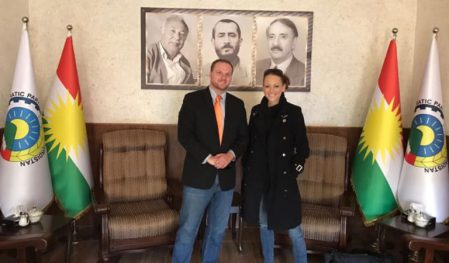
Clarion Project’s National Security Analyst Prof. Ryan Mauro & Legal Analyst Jennifer Breedon in Iraq with Hossein Yazdanpanah, the leader of the Kurdistan Freedom Party (PAK)

Its leader, Mustafa Hijri, said in a speech in Europe in October 2016 that his group was not fighting just for Iranian Kurds, but for the replacement of the current theocratic Iranian regime with a secular democracy for all. He asked the “progressive and democratic forces of the world” to support the PDKI and other Iranians seeking to topple the government.

Kurds are an oppressed minority in Iran, representing about 10 percent of the population (between 8 and 10 million people). According to the U.N., almost half of the political prisoners in Iran are Kurdish and about one-fifth of the executed prisoners last year were Kurdish.

******************************

Mark March 21 on your calendar. Six armed Kurdish parties in Iraq have united ahead of expected protests in Iran on that date. Both the Iranian regime’s Revolutionary Guards Corps and an Iranian Kurdish militia have held military exercises in preparation for expected conflict.

The six groups are preparing for protests in the Kurdish areas of Iran to celebrate the Kurdish New Year, Newroz, on March 21. Holiday events become the scene of political protests, Iranian regime repression and even clashes.

But the Kurdish alliance says this time will be different because they are unified, preparing in advance and agreed to jointly collect and share intelligence in January for a common defense against the Iranian regime.

“There always have been activities in Kurdistan for celebrating Newroz and these activities always are opportunities for people to express their resistance against the fact that they have been denied of their basic rights.

“Using symbols, songs and gatherings, youth in Newroz have always shown their anger and resentment toward the lasting oppression of Kurds in Iran,” explained the U.S. representative of the Democratic Party of Iranian Kurdistan (PDKI).

The PDKI recently held a military exercise near the border with Iran in preparation for a “full guerilla fight,” in the words of one of its officials. The Iranian Revolutionary Guards Corps likewise held a military exercise in the Kurdish-majority province of Kermanshah, where protests and clashes are expected.

PDKI has about 2,000 fighters in the border area between the autonomous Iraqi Kurdistan region and Iran. It declared the end of a 20-year ceasefire with Iran last year and openly said it was sending its Peshmerga fighters into Iranian Kurdistan, but would not fire the first shot.

The Kurdish Rudaw newspaper describes PDKI as “historically considered the most formidable Kurdish military organization opposing the Islamic Republic in Tehran.”

Clarion Project’s National Security Analyst Prof. Ryan Mauro & Legal Analyst Jennifer Breedon inside the headquarters of the Democratic Party of Iranian Kurdistan (PDKI) on a recent trip to Iraq.

Its leader, Mustafa Hijri, said in a speech in Europe in October 2016 that his group was not fighting just for Iranian Kurds, but for the replacement of the current theocratic Iranian regime with a secular democracy for all. He asked the “progressive and democratic forces of the world” to support the PDKI and other Iranians seeking to topple the government.

A Shiite political bloc within the Iraqi parliament called on the Iraqi government to kick out the Kurdish forces that fight the Iranian regime in January. The Kurdish parties attributed the move to Iranian influence, pointing out that it came after two bombings targeted the office of the PDKI in Koye, Iraq in December. Seven people died. The party blamed Iran for the attack.

Prior to the attack on the PDKI, Iranian Supreme Leader Ayatollah Khamenei accused Saudi Arabia of arming Kurdish opposition forces through its consulate in Iraqi Kurdistan. Khamenei demanded that the Kurdish Regional Government stop all opposition activity and close the Saudi consulate, neither of which happened.

The other Iraqi Kurdish parties in the alliance are the Kurdistan Democratic Party of Iran (KDPI), Khabat and three groups all bearing the name of Komala.

Another group that is likely to be active in the confrontation with Iran but is not part of the six-party alliance is the Kurdistan Freedom Party (PAK). I met their leader Hossein Yazdanpanah in January in Iraq at one of his camps near the battlefield with ISIS.

Kurds are an oppressed minority in Iran, representing about 10 percent of the population (between 8 and 10 million people). According to the U.N., almost half of the political prisoners in Iran are Kurdish and about one-fifth of the executed prisoners last year were Kurdish.

There was significant repression last year resulting in bloody clashes between the PDKI and other Kurdish militants on one side and the Iranian regime on the other. It received almost no attention from the West, a rather unsurprising development considering the U.S. turned away from Iran’s 2009 Green Revolution that could have positively changed the world.

If the Iranian Kurdish opposition in Iraq has its way, then the U.S. will have another opportunity to support the Iranian people. In my meetings with Iranian Kurds in Iraq, I was struck by how much hope they invested in the hope that, despite the U.S.’ mistakes and overlooking of their cause, the U.S. would eventually come around and support them—not only because it is in the U.S.” interest, but because America is a good country with good people.

America and the West more broadly should not repeat the mistakes of the past.

Let’s hope that when the Kurds rise up against the Iranian regime on March 21, they will be joined by a chorus of freedom-loving voices eager to see them triumph over Islamist tyranny.

US troops land in Syria to launch Raqqa operation

March 8, 2017

US troops land in Syria to launch Raqqa operation, DEBKAfile, March 8,  2017

According to our sources, President Donald Trump decided, after consulting with Defense Secretary James Mattis and National Security Adviser H.R. McMaster, that the US army would go it alone in the Raqqa offensive together with a single local force: the Kurdish-led Syrian Democratic Forces.

*************************************

EXCLUSIVE:  DEBKAfile’s military and intelligence sources disclose that elements of the 75th Ranger Regiment have arrived in Syria for the Trump administration’s first direct military operation in Syria: the long-delayed offensive to capture Raqqa from the Islamic State. The plan was put before the US, Russian and Turkish chiefs of staff who were getting together for the first time on Tuesday, March 7, in the Turkish town of Antalya, as revealed earlier on this site.

Rangers Regiment troops, which will spearhead the Raqqa attack, flew in from Fort Lewis air base, Washington, to the US air facility in Rmeilan, near the Syrian Kurdish town of Hasaka, equipped with light Striker tanks. More tanks and heavy equipment reached the Syrian base overland from Iraqi Kurdistan.

According to our sources, President Donald Trump decided, after consulting with Defense Secretary James Mattis and National Security Adviser H.R. McMaster, that the US army would go it alone in the Raqqa offensive together with a single local force: the Kurdish-led Syrian Democratic Forces.

The SDF is composed of 45,000 fighters of the Syrian Kurdish YPG militia and 10,000 Arab tribesmen, most belonging to the north Syrian branch of the Shamar.

Gen. Joseph Dunford, Chairman of the US Chiefs of Staff, Gen. Valery Gerasimov, Russian Chief of Staff, and Gen. Hulusi Akar, Turkish army chief, were conferring in Antalya when the Rangers landed in Syria.

DEBKA Weekly, which comes out on Friday, March 10, will provide the background leading up to the US president’s decision to go for Raqqa.

If you are not yet a subscriber, click here for this and other exclusive stories.

Bernard-Henri Lévy: With the Peshmerga, on the Front Line in the Battle for Mosul

October 30, 2016

Bernard-Henri Lévy: With the Peshmerga, on the Front Line in the Battle for Mosul, Algemeiner, Bernard-Henri Lévy,October 30,2016

Editor’s note: Bernard-Henri Lévy’s documentary, “Peshmerga,” was an Official Selection at the 2016 Cannes Film Festival. He and his team are back in Iraqi Kurdistan, embedded with the Peshmerga, filming a follow-up. The following is his report.

Return to Kurdistan. My first move is to go into the hills around Mount Zartak to gather my thoughts in the spot where Maghdid Harki, the young, white-haired general who was one of the heroes of Peshmerga, spent his last moments. Nothing has changed. Not the sandbags that were too flimsy to protect him. Not his bunker which, as he liked to say, was no better fortified than those of his men. Those men have kept his water bottle hanging in its place on the wall near the door, still containing the last gulp of water that he had been about to drink. The only difference is that American special forces are now using the bunker.

Through binoculars, a US soldier scans the valley in which the human bombs of ISIS may appear at any moment. Another stands behind a telescope trained 20 kilometers farther away on the outskirts of Mosul. A third, with long, blond hair and an Errol Flynn mustache, recovers a drone that has just landed at our feet in a cloud of dust. A fourth who looks like an intellectual (reminding me of Norman Mailer’s cartographer from the 112th cavalry of San Antonio) sits under a canopy deciphering the data coming in on his PC. And a fifth, the highest in rank, from Tennessee, passes on the intelligence. Who are these young Americans, oppressed by the heat and squinting at the light like blind men blinking at the dark? With Mosul a stone’s throw away, they are the leading edge of the coalition that has finally decided, in support of the Kurdish Peshmerga and the Iraqi army, to take the capital of the Islamic State.

I am in Sheikh Amir in the al-Khazir zone. Sheikh Amir is the last liberated village before the beleaguered Christian city of Qaraqosh. Three brand new Toyotas come to a screeching halt, disgorging a squad of men in mismatched black uniforms — definitely not the Peshmerga.

“What are you doing here?” demands General Hajar, with whom I’ve traveled from Erbil. “You shouldn’t be here!”

“This is our land!” answers an ill-shaven man with a nasty, menacing look who seems to be the leader of the group.

“No,” says Hajar, gesturing toward a distant stand of prefabricated shelters that, from the road, we had taken for a refugee camp. “That’s where you should be. The accords are clear: You’re not supposed to leave your camp unless you’re attacking.”

“To hell with you!” chimes in another of the men in black. “We’re home wherever we are.”

As Hajar ups the ante and the confrontation threatens to turn ugly, the leader mumbles a half-hearted apology and, after ordering his bunch back into their pickups, heads off in the direction of the camp, where we can make out three helicopters landing. It all took place very quickly. But the men in black, we now know, were among the thousands of Shi’ite militiamen that Baghdad has hastily incorporated into the Iraqi regular army. And the incident, however minor, speaks long about the tensions among the participants (the Peshmerga on the one hand; Baghdad’s majority Shi’ite army on the other) called upon to liberate the Islamic State’s Berlin.

Another sign. A few kilometers farther on, we are in the Christian village of Manguba. Here, ISIS put up little resistance. But, in retreat, it left behind explosives hidden in soda bottles, fuel cans and sometimes even Korans. And Anwar, a Christian officer in the Peshmerga, is one of very few who take the risk of going out to see what remains of his house. He arranges to rejoin us at a nearby spot, the highest in the village, which, to judge from the punctured soccer ball and the marbles mingled with spent cartridges, must have been a playground before becoming, today, the unit’s lookout post.

“It’s terrible,” he tells us on his return. “There’s nothing left of my house, and they torched the church.” Then, choking back a sob: “But there’s another problem, Mr. Lévy. These bastards have left and, God willing, they won’t come back. But then what? Who will be responsible for protecting our community? We have a Christian brigade training with the Peshmerga, but what will become of it after the victory? Under whose command will it be then?”

Egged on by questions from my friend, Gilles Hertzog, Anwar speaks his mind plainly. Neither he nor any of the Christians in the Qaraqosh region has any confidence in Iraq. He won’t bring his wife and children back, he says, unless the Kurds, and the Kurds alone, are protecting the Plain of Nineveh. In what form, we ask? As a province? An autonomous zone under Kurdish mandate? And does he think that the Iraqis or the Americans on Mount Zartak will agree to such a thing? He shrugs. For soldiers of God, life and salvation are non-negotiable.

Hassan al-Sham. Near the Christian town of Bartallah. The same landscape of charred earth, wreckage of suicide trucks, and lingering fires from torched fuel depots. And suddenly, right in front of me, a big hole. A well, I think at first. Wrong. There is a ladder in the hole, which my cameraman and I climb down behind a member of the bomb squad. Three meters down, I discover a tunnel a meter wide with an arched ceiling and cement walls interspersed with crude masonry in which a man my height can stand upright.

After walking tentatively for 100 meters by the light of the bomb technician’s flashlight, we come upon a passage perpendicular to the one we are in and similarly walled but that we do not enter because we can make out bundles of plastic explosive and contact wires. Then, on each side of the tunnel, rooms filled with a jumble of dirty mattresses. Then, again symmetrically arranged, a twin command center in which someone has left behind a pile of newspapers in Arabic. It’s a black-and-white publication of eight pages, a sort of bulletin for ISIS fighters, entitled “The News.” On the front page, under a photo of a man being beheaded, the headline: “How we identify traitors.” Inside, an article on a terrorist operation in the Sinai; an “analysis” of the “unlimited rights” of a shahid (martyr) who has rid the world of a kafir (heretic); and a report on the presence of sleeper cells in Kirkuk. On page 2, a strange roundup of the past year: “1,031 news reports, 110 infographics, 50 maps, and 112 executions of traitors.” If the enemy took the trouble to dig this tunnel in a forlorn village, what are we likely to find in Mosul? What lacework of traps and pitfalls? What secret, subterranean city for what sort of dirty war?

We are on the road again heading due north to the outskirts of Dohuk, 13 kilometers from the Mosul dam. The man whom we have come to see is Rawan Barzani, the younger brother of the prime minister of Iraqi Kurdistan and the commander of the first battalion of the Kurdish special forces. The base where he receives us is no more than 300 meters from the front line. In his bunker, furnished with a simple table and spartan bed, I observe this amazing officer who is the age of Napoleon’s generals. I listen to him explain, in perfect English and against a background of arriving and departing mortar shells, his theory of an enemy made up of (1) “loonies” (the drivers of suicide trucks); (2) “rats” (the denizens of the tunnels); and (3) “attack dogs” (whom he believes will offer fierce resistance).

How is it possible that a soldier of his rank should be so exposed, so close to the combat zone that he can grant me only a few seconds for a photo outside in the open? There is the legendary courage of the Kurdish commanders who place themselves not behind but in front of their men … There is his name, which could expose him to suspicions of nepotism if he didn’t force himself to be all the braver … But, above all, there is the following. Here, ISIS holds one of its most strategic positions. We are only a few kilometers from an immense dam that, if sabotaged, would flood the entire region extending to Mosul and on to Baghdad. Therefore, the coalition has no choice. It has no use for men in black or Sunni tribesmen hastily recruited for walk-on parts. It needs serious, solid soldiers. It needs seasoned commandos to pass behind enemy lines and carry out the boldest attacks. And, at their head, it needs a grandson of the founder of the Kurdish nation, the father of the Peshmerga, Mustafa Barzani…

An envoy from the general staff comes looking for us during the night. We are to head east toward Nawaran, where the taking of Bashiqa, the last linchpin before Mosul, is to start. The usual crush of tanks, armored vehicles, and Toyotas. Then, at the first glimmers of dawn, two drones, similar to the one that dropped a bomb two weeks ago on the French camp in Erbil: but this time the Peshmerga, in a hail of fire from Kalashnikovs and 12.7 mm caliber machine guns, destroy them before they can touch down. We slip into the last of the five armored personnel carriers that are headed for the front. We leave behind us the mounds of excavated earth where the rest of the troops will await the order to advance. We wend through a landscape of hamlets, warehouses, and ghostly houses from which we expect at any moment to see a suicide bomber emerge. A sniper! Our gunner at his turret takes him out. And another, whose shot grazes our lead cameraman who is filming from the turret next to the gunner. This one escapes, disappearing into the gloom. A spasm of anxiety at the sound of something striking our vehicle’s armor. Another when we learn through walkie-talkie exchanges with the excavators ahead of us that the road is mined and we will have to find a new route across the empty terrain to our left. We spend two hours driving nearly blind, with no other guidance but that of the local villager riding on the lead bulldozer, two hours of jolts and swerves in the dust, of bogging down, all to travel the eight kilometers that separate us from the fringes of the village of Fazlia, which the column has been ordered to retake.

Of the sequence that follows, I have the images recorded by our second cameraman, Ala Tayyeb, after operational command orders the vehicle I’m in to turn back. The personnel carriers and T55 tanks encircle the village. The men get out, are joined by an elite Zeravani unit, and advance in the open. Suddenly, shots burst forth from houses and from an olive grove that had seemed abandoned. Over his walkie-talkie, the colonel in command requests air support. The voice at the other end of the line promises it within minutes, as is the norm. But the shooting becomes more intense. The jihadists surge out of the olive grove and surround the Peshmerga on three sides. Seven Kurdish soldiers are hit. Those that their comrades haul behind the armored carriers are targeted by snipers. When two of the assailants raise a white flag and Ardalan Khasrawi, who also appeared in Peshmerga, approaches to accept their surrender, he finds another trap. The two men open fire and seriously wound Khasrawi. Orders and counterorders. Total confusion. Should the vehicles form a circle? Should they spread out? And the fact is that for the two and a half hours the ambush lasts, for the interminable minutes of hell on earth during which the Kurdish commander never stops pleading for air support and never stops hearing that it is coming, nothing comes. The unit is left to fend for itself, abandoned by the gods and by its allies. Only by their own valiance do the Kurds overcome the jihadists and liberate the village — but at what a price!

Two hours later, we are with President Barzani at his camp of Mount Zartak, which lies at the end of a winding road protected by US special forces. I had asked to see him. And, it soon becomes clear, he has messages to pass on. Yes, in the Arab villages that it is taking, his army is conducting itself in an exemplary manner. No, that army does not intend, at least for the time being, to enter Mosul proper, a job that the allied accords have reserved for the Iraqi army. Yes, again, he had a plan for the “day after,” and he deplores the fact that his partners, in their haste to be done with this before the US election, did not heed him more closely. But his face betrays nothing. The same dark eyes but devoid of their usual mischief. The commanders and dignitaries seated around the makeshift shed that serves as his HQ do not look any more overjoyed than he. He says hardly a thing when I praise the courage of his soldiers. He ducks when I ask him if he believes that the prospect that seemed to haunt him when we last talked in September, the specter of a Shi’ite corridor running through Mosul from Baghdad to Syria, has been dispelled. And, when Gilles Hertzog tells him the story of the Christians who have confidence only in the KRG, he is terse: “It will be up to them to decide and up to the international community to assume its responsibilities — or not.” The truth, which I learned a few hours later from his chief adviser, is that the president spent the hours of the battle for Fazlia in communication with the American ambassador in Iraq, demanding air support for his troops. And the reason for his mood during our interview, not to say his wrath, is that he felt abandoned by his allies — and not far from believing that he has fulfilled his part of the bargain and that, for him, the war is over.

Because why didn’t the promised air support arrive? Why, in defiance of the rules of engagement, did no aircraft take off from the bases in Erbil or Qayyarah? Why, when an Apache helicopter had, at that same moment and not far away, come to the rescue of a mortally wounded American soldier, was another not found to come to the assistance of the trapped Peshmerga fighters? Some in Washington, London and Paris will pin the tragic failure on the chain of command. Others will point to the change in itinerary, when the column realized that the road was mined and had to find another route. But here in Erbil the most widely accepted explanation is less forgiving. We are the best, the Kurds say. We were flying from one victory to another while the Iraqi regulars were managing to lose again two of the villages they had just taken. But our western allies were listening selectively. They wanted success to be equally apportioned among all parties: Kurds, the majority Shi’ite Iraqi army, and the Sunni militiamen designed to reassure the Arabs of Mosul. And, in this studied balance that they sought; in the distribution of roles testily negotiated with, in particular, Baghdad and its Iranian backers; within the framework, then, of the commitment the Americans made not to let the Peshmerga move too fast and gain an advantage that would cost too much later on — the price being the independence of Kurdistan and the supposed “destabilization” of Iraq and the region — it was not necessarily a bad thing to see our column rubbed out in Fazliya.

authorThe author with Peshmerga fighters.

That explanation is probably too simple. But I do remember one of Barack Obama’s predecessors sending the late Richard Holbrooke to warn President Izetbegovic of Bosnia that he would cease to benefit from American air cover if he persisted in his intemperate goal of entering Banja Luka. And we all remember the trouble that a certain General de Gaulle had in obtaining from another American president the right to have a Free French division enter insurgent Paris. And thus that explanation may not be too absurd to ascribe to allied capitals locked into their old sovereign schemes and ready to do nearly anything to try to please one newly rehabilitated power (Iran) or to preserve another pseudo-nation (Iraq) while not becoming overly indebted to a people who would certainly not shrink, when the time came to settle up, from claiming their fair share of the fruits of victory (the Kurdish people, who for a century have played the fall guy in our schemes). If that were the case, if that were the nature of the powers’ great game here, if one persisted in asking the Peshmerga to open the doors to Mosul but not to enter it, and if the return of the Christians to the Plain of Nineveh were to hang on such a cynical accommodation, then the battle would have gotten off to a very bad start and the moral defeat of ISIS would be much less certain than it appears.

Tehran will fight Turkey’s role in Mosul operation

October 24, 2016

Tehran will fight Turkey’s role in Mosul operation, DEBKAfile, October 24, 2016

bashiqa_b

The involvement of Turkish special operations, armored and artillery forces in support of the Kurdish Peshmerga battle to drive ISIS out of Bashiqa, 12 south of Mosul, marks a pivotal moment in the US-led coalition’s anti-ISIS offensive to free Iraq’s second city. The entire Mosul operation hangs in the balance since Turkey stepped into the fighting in Iraq, at the initiative of the US. Instead of fighting ISIS, the coalition’s partners are squaring off to fight each other.

DEBKAfile’s military sources report that Turkey was allowed to gatecrash the fighting around Mosul after US Defense Secretary Ashton Carter visited the KRG capital of Irbil Sunday, Oct. 23. He urged Kurdish leaders to bow to President Tayyip Erdogan’s demands for a role in the battle.

The Kurdish leaders succumbed to the pressure with the proviso that Turkey cease its air and artillery assaults on Syrian Kurdish militias in northern Syria.

When Ankara accepted this condition, Ashton set out for the Bashiqa arena, becoming the first US defense secretary to come that close to a battlefront against ISIS in Iraq.

He visited the Turkish military encampment outside Bashiqa and was given a briefing by their commanders. As soon as he departed, Turkish units entered the fray in support of the Peshmerga fighters

According to Turkish Prime Minister Binali Yildrim, this involvement was limited to tank and artillery support for the Kurdish forces. Our military sources report, however, that it went much further and included Turkish special operations forces and tanks. By Monday, Oct. 24, Turkish troops were still backing up the Kurdish effort to purge Bashiqa of ISIS fighters.

Tehran’s reaction to this change on the game board was extreme. Our sources report that the pro-Iranian Iraqi Shiite militias assigned to subordinate tasks in the Mosul operation were immediately put on a state of readiness. Commanders of the Bader Brigades, the Population Mobilization Force and the Hashd eal-Shaabi reported that they were standing ready to attack the Turkish forces operating at Bashiqa, whom they termed “gangs of terrorists no less dangerous than ISIS.”

The Iranian government leaned hard on Iraq’s Shiite Prime Minister Haidar Al-Abadi to make him redirect Iraqi government forces from the Mosul arena to join the Shiite forces preparing to strike the Turkish troops at Bashiqa.

Al-Abadi had in the past week demanded the removal of Turkish troops from Iraqi soil, a demand Ankara just as steadily rebuffed.

Building up at present is an imminent head-to-head fight between Turkish and Kurdish forces on the one hand and Iraqi Shiites on the other.

In an effort to prevent the long-awaited Mosul operation degenerating into an all-out conflagration among US allies, with the Islamist State no doubt cheering on, the Obama administration Monday turned to Tehran, Baghdad, Ankara and Irbil and asked them back off lest they wreck their primary mission of evicting ISIS from Mosul.

Tehran may decide to give ground on this but the price it exacts will be steep: an overhaul of the Iraqi Shiite militias’ rear position and permission for their direct intervention in the battle for Mosul, including their entry into the city. This permission the US commanders have hitherto withheld.

This would be a big prize. Mosul has been coveted by Iranian strategists as a major transit point on the land bridge they have designed to link the Islamic Republic to Syria and the Mediterranean. This prize would go by the board if the Turks and Kurds were first in the liberated city first and assumed control.

ISIS’ Kirkuk raid spreads. US air force in action

October 22, 2016

ISIS’ Kirkuk raid spreads. US air force in action, DEBKAfile, October 22, 2016

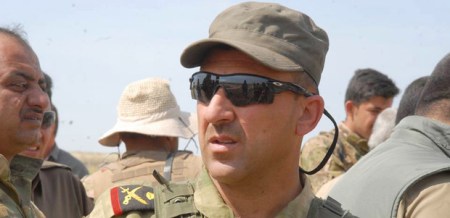
kurdish_gen-_mariwan_mohammed_21-10-16Kurdish General. Mariwan Mohammed

The raid of Iraq’s northern oil city of Kirkuk launched by the Islamic State Friday began to spread Saturday, Oct. 22 to surrounding towns. DEBKAfile’s military sources report that ISIS fighters headed south from Kirkuk in two heads. One tried to enter Laylan, a town 21 km south of the oil city, which was defended by Kurdish Peshmerga and Turkman paramilitary forces; the second seized the crossroads of Rtes 2, 3 and 24 to sever Kirkuk from Baghdad.

When Kirkuk first came under attack, the Kurdish defenders still left there appealed for US air support against the Islamist invaders. The US air force went into action late Friday. They first targeted ISIS sniper positions on the town’s highest rooftops. Then, the next day US aircraft struck twin targets: the jihadist fighters storming Laylan and the fighters heading down the roads to the south of Kirkuk.

Nonetheless, up until Saturday pm, ISIS was still in control of at least five of the oil city’s neighborhoods as well as buildings in the town center, including government offices.

Meanwhile, the Kurdish Peshmerga, according to our military sources, dispatched to Kirkuk their special counterterrorism unit to dislodge the raiders. Kurdish sources also warned that this city was only the first of a row of Iraqi towns still in ISIS sights. They added that they would not be surprised to find the Islamists heading out to strike European towns as well.

Iraqi and Kurdish sources have since Friday been throwing out high ISIS casualty figures and reporting that many were put to flight. They were attempting to play down the scale of the raid on Kirkuk.

In fact, our sources report that the Islamists found extra numbers and ammunition caches waiting for them in two places – sleeper cells in Kirkuk and local Sunni sympathizers.

The numbers of civilian casualties and refugees mounting since the onset of the Mosul operation are mounting, causing grave concern to the UN and international aid agencies.

DEBKAfile first reported on the ISIS raid of Kirkuk Friday.

No one doubted that the US-Iraqi-Kurdish offensive to liberate Mosul would be drawn out and fraught with unforeseen setbacks before the Islamic State was finally thrown out of its Iraqi capital. But on Oct. 21, five days into the Mosul operation, the ISIS terrorists landed their most severe blow, when Islamist fighters and suicide bombers suddenly hurled themselves on the Iraqi oil city of Kirkuk in a coordinated attack.

DEBKAfile’s military sources report that taking advantage of a chance to catch the US, Iraqi and Kurdish generals leading the attack on Mosul unawares, the Islamist fighters were able to open a second front to the rear of the main battle arena against ISIS.

Kirkuk is some 175km southeast of Mosul and 230km from Baghdad. By hitting this important oil city, the terrorists came close to enough to menace the autonomous Kurdish Regional Government region and its capital, Irbil, and expose the Kurdish Peshmerga troops fighting for Mosul.

Our military sources note that a large Peshmerga force of some 11,000 troops had been posted to secure the town and its oil fields, under the command of Gen. Mariwan Mohammed.

But then, on Wednesday, Oct. 19, the US-Iraqi-Kurdish joint command of the Mosul offensive decided that Kurdish reinforcements were necessary to provide the operation with greater impetus. The extra Peshmerga troops were accordingly ordered to set out from Khazar, 40 km east of Mosul, and join the coalition offensive.

However, what they missed, despite the mainly American spy satellites, drones and reconnaissance planes collecting intelligence, was an ISIS concentration clandestinely building up at Hawja, 57km east of Kirkuk. According to our military sources, some of the jihadists reported by the Western media to have turned tail on the run from Mosul had been gathering to the southeast, some 57km from Kirkuk. They stood ready to attack that town.

Their opportunity came when the large Kurdish group exited Kirkuk and headed out to Mosul. Kirkuk was left exposed without defenders.

Friday morning, the Islamic State launched its surprise attack on the defenseless oil city. Its fighters and suicide bombers slammed into four police stations, Kurdish security offices, residential neighborhoods and a power station to the north. Clashes continued during the day with unknown casualty figures on both sides.

At some point, the governor claimed control of the city was regained but residents reported the clashes continued.

ISIS said in a statement it had seized “half the city” and had also attacked the Dubiz power plant, killing all the security forces inside, but the claims were not possible to verify.

ISIS hits Kirkuk, opens a 2nd front behind Mosul

October 21, 2016

ISIS hits Kirkuk, opens a 2nd front behind Mosul, DEBKAfile, October 21, 2016

kurdgenKurdish General. Mariwan Mohammed

No one doubted that the US-Iraqi-Kurdish offensive to liberate Mosul would be drawn out and fraught with unforeseen setbacks before the Islamic State was finally thrown out of its Iraqi capital. But on Oct. 21, five days into the Mosul operation, the ISIS terrorists landed their most severe blow, when Islamist fighters and suicide bombers suddenly hurled themselves on the Iraqi oil city of Kirkuk in a coordinated attack.

DEBKAfile’s military sources report that taking advantage of a chance to catch the US, Iraqi and Kurdish generals leading the attack on Mosul unawares, the Islamist fighters were able to open a second front to the rear of the main battle arena against ISIS.

Kirkuk is some 175km southeast of Mosul and 230km from Baghdad. By hitting this important oil city, the terrorists came close to enough to menace the autonomous Kurdish Regional Government region and its capital, Irbil, and expose the Kurdish Peshmerga troops fighting for Mosul.

Our military sources note that a large Peshmerga force of some 11,000 troops had been posted to secure the town and its oil fields, under the command of Gen. Mariwan Mohammed.

But then, on Wednesday, Oct. 19, the US-Iraqi-Kurdish joint command of the Mosul offensive decided that Kurdish reinforcements were necessary to provide the operation with greater impetus. The extra Peshmerga troops were accordingly ordered to set out from Khazar, 40 km east of Mosul, and join the coalition offensive.

However, what they missed, despite the mainly American spy satellites, drones and reconnaissance planes collecting intelligence, was an ISIS concentration clandestinely building up at Hawja, 57km east of Kirkuk. According to our military sources, some of the jihadists reported by the Western media to have turned tail on the run from Mosul had been gathering to the southeast, some 57km from Kirkuk. They stood ready to attack that town.

Their opportunity came when the large Kurdish group exited Kirkuk and headed out to Mosul. Kirkuk was left exposed without defenders.

Friday morning, the Islamic State launched its surprise attack on the defenseless oil city. Its fighters and suicide bombers slammed into four police stations, Kurdish security offices, residential neighborhoods and a power station to the north. Clashes continued during the day with unknown casualty figures on both sides.

At some point, the governor claimed control of the city was regained but residents reported the clashes continued.

ISIS said in a statement it had seized “half the city” and had also attacked the Dubiz power plant, killing all the security forces inside, but the claims were not possible to verify.