Archive for the ‘Kobani’ category

Obama’s Kobani Crossroads

October 15, 2014

Obama’s Kobani Crossroads, Algemeiner, Noah Beck, October 14, 2014

(Obama needs high profile stuff and photo ops to keep his polls from falling even more dramatically than they have. He needs help from Iran and little if anything else matters. It will be rewarded. — DM)
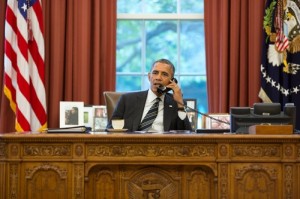
Obama on phone with RouhaniFrom the Oval Office, U.S. President Barack Obama speaks on the phone with Iranian President Hassan Rouhani on Sept. 27, 2013.

Instead of preemptively stopping ISIS from spreading into Iraq, Obama effectively waited until some high-profile beheadings forced him to focus on the danger. While such gruesome murders can reliably rally public opinion in favor of military action, the duty of the Commander-in-Chief is to lead and take military action when and how national security requires it, and not just when terrorists provoke some tardy and token airstrikes into empty buildings.

Kobani also has geostrategic importance to the Iranian nuclear threat. The more ISIS succeeds at capturing territory and recruiting fighters, a trend bolstered by Kobani’s fall, the more desperate the U.S. becomes for help from Iran, which, as leader of the Shiite world, is the natural enemy of the Sunni ISIS fighters.

[A]s Iran watches how feebly the U.S. responds to the loss of Iraq and how Obama cowers from a relatively minor fight in Kobani, the Ayatollahs can rest assured that there really is no U.S. military option to stop their nuclear program. This conclusion becomes all the more inevitable, when they look at Obama’s waning influence at home, as he enters the lame-duck period of his presidency.

*****************

President Obama has consistently disregarded the advice of his military experts on the ISIS threat. And he seems to have written off the Kurdish-Syrian town of Kobani, which may soon be overrun by ISIS.

Whatever the U.S. accomplished after about a decade of war in Iraq has, in a matter of months, deteriorated to a situation that may become unprecedented in its instability and threat to Western interests. Obama’s clumsy departure from Iraq, his military mismanagement of the mess that ensued, and his refusal to intervene in Syria – again, overruling his top security advisers – are what produced the current quagmire.

The loss of Christianity in Mosul didn’t have to happen. Obama’s tardy airstrikes managed to prevent the Mosul Dam from falling, but the city may never be the same. Similarly, why did the Yazidis have to find themselves besieged on Mount Sinjar before the U.S. took action?

Instead of preemptively stopping ISIS from spreading into Iraq, Obama effectively waited until some high-profile beheadings forced him to focus on the danger. While such gruesome murders can reliably rally public opinion in favor of military action, the duty of the Commander-in-Chief is to lead and take military action when and how national security requires it, and not just when terrorists provoke some tardy and token airstrikes into empty buildings.

As the next disaster is about to unfold on Obama’s watch, he should recognize that there is much more at stake with the fight for Kobani than just the loss to ISIS of a small town on the Syria-Turkey border.

Above all, letting Kobani fall means betraying our only ally fighting ISIS on the ground, and allowing them to be massacred while the world watches. What message does the U.S. send to Mideast partners and the world at large, if the Kurds are the only force providing the ground troops that Obama so desperately needs now, and yet Obama is unwilling to support them enough to avoid the horrific slaughter that will follow an ISIS victory in Kobani?

Kobani also has geostrategic importance to the Iranian nuclear threat. The more ISIS succeeds at capturing territory and recruiting fighters, a trend bolstered by Kobani’s fall, the more desperate the U.S. becomes for help from Iran, which, as leader of the Shiite world, is the natural enemy of the Sunni ISIS fighters. Because Iran also has one of the most powerful militaries in the region, and has – even before the ISIS crises – outmaneuvered the West in talks to curb Iranian nuclear ambitions, Iran could easily leverage the situation to secure tacit Western acceptance of its nukes. Indeed, Iran has already signaled its fight-ISIS-for-nukes strategy.

Even more important, as Iran watches how feebly the U.S. responds to the loss of Iraq and how Obama cowers from a relatively minor fight in Kobani, the Ayatollahs can rest assured that there really is no U.S. military option to stop their nuclear program. This conclusion becomes all the more inevitable, when they look at Obama’s waning influence at home, as he enters the lame-duck period of his presidency.

There is also a moral dimension to Kobani. Obama – in his 2009 and 2012 speeches on Holocaust Remembrance Day – proudly recalled how his great uncle helped to liberate a Nazi death camp. Yet Obama’s inaction in Syria has left about 200,000 dead, including many who were simply massacred, and Kobani may be where the next atrocities happen. Does the U.S. not hold itself to a higher standard than that of Turkey, which has thus far chosen just to watch the fighting a mere mile from its border?

Turkish history already includes genocides against the Armenian Christians and the Kurds (in the Dersim Massacre), so it’s no surprise that the Islamist regime of Recep Tayyip Erdoğan would let his army stand idly by, watching and waiting for ISIS to slaughter thousands of Kobani Kurds. But does the U.S. really want to be in the same camp as the Turks on this one? How much more shame will fall upon the United States, and the Obama legacy, when the Internet overflows with images of mass graves containing Kobani’s brave and abandoned fighters, along with Kurdish civilians who were too weak, infirm, or elderly to flee the approaching ISIS barbarism?

As if the above concerns weren’t enough to goad Obama into action, there is also the strategic impact of letting Kobani fall. As good as ISIS recruiting on social media already is, the popularity of this terrorist army among Islamists worldwide will surge when ISIS can boast about one more example of how even the mighty U.S. military can’t stop them.

Having foolishly telegraphed that he won’t send ground troops to confront ISIS, Obama can still try to convert his error into a feint by doing the opposite and sending troops to Kobani. At least that would restore some element of unpredictability to how ISIS regards U.S. military moves in the region.

Obama is effectively weeks away from the lame-duck portion of his presidency. If Republicans take Congress in next month’s midterm elections, then Obama will become that much more ineffectual. But the president can still try to demonstrate some leadership by changing his strategic approach to Mideast threats – if only to prevent his legacy from going into freefall. If the Middle East has only one lesson for Obama, it is that much can go terribly wrong in very little time. With Iranian nukes around the corner and ISIS on the march, two years of Mideast deterioration is a frighteningly long time to be on Obama’s watch.


Bombing for show? Or for effect?

October 10, 2014

Bombing for show? Or for effect? Washington Post OpinionCharles Krauthammer, October 9, 2014

The indecisiveness and ambivalence so devastatingly described by both of Obama’s previous secretaries of defense, Leon Panetta and Bob Gates, are already beginning to characterize the Syria campaign.

The Iraqis can see it. The Kurds can feel it. The jihadists are counting on it.

*********************

During the 1944 Warsaw uprising, Stalin ordered the advancing Red Army to stop at the outskirts of the city while the Nazis, for 63 days, annihilated the non-Communist Polish partisans. Only then did Stalin take Warsaw.

No one can match Stalin for merciless cynicism, but President Recep Tayyip Erdogan of Turkey is offering a determined echo by ordering Turkish tanks massed on the Syrian border, within sight of the besieged Syrian town of Kobane, to sit and do nothing.

For almost a month, Kobane Kurds have been trying to hold off Islamic State fighters. Outgunned, outmanned and surrounded on three sides, the defending Kurds have begged Turkey to allow weapons and reinforcements through the border. Erdogan has refused even that, let alone intervening directly. Infuriated Kurds have launched demonstrations throughout Turkey protesting Erdogan’s deadly callousness. At least 29 demonstrators have been killed.

Because Turkey has its own Kurdish problem — battling a Kurdish insurgency on and off for decades — Erdogan appears to prefer letting the Islamic State destroy the Kurdish enclave on the Syrian side of the border rather than lift a finger to save it. Perhaps later he will move in to occupy the rubble.

Moreover, Erdogan entertains a larger vision: making Turkey the hegemonic power over the Sunni Arabs, as in Ottoman times. The Islamic State is too radical and uncontrollable to be an ally in that mission. But it is Sunni. And it fights Shiites, Alawites and Kurds. Erdogan’s main regional adversary is the Shiite-dominated rule of Syria’s Bashar al-Assad. Erdogan demands that the United States take the fight to Assad before Turkey will join the fight against the Islamic State.

 It took Vice President Biden to accidentally blurt out the truth when he accused our alleged allies in the region of playing a double game — supporting the jihadists in Syria and Iraq, then joining the U.S.-led coalition against them. His abject apologies to the United Arab Emirates, Saudi Arabia and Turkey notwithstanding, Biden was right.

The vaunted coalition that President Obama touts remains mostly fictional. Yes, it puts a Sunni face on the war. Which is important for show. But everyone knows that in real terms the operation remains almost exclusively American.

As designed, the outer limit of its objective is to roll back the Islamic State in Iraq and contain it in Syria. It is doing neither. Despite State Department happy talk about advances in Iraq, our side is suffering serious reverses near Baghdad and throughout Anbar province, which is reportedly near collapse. Baghdad itself is ripe for infiltration for a Tet-like offensive aimed at demoralizing both Iraq and the United States.

As for Syria, what is Obama doing? First, he gives the enemy 12 days of warning about impending air attacks. We end up hitting empty buildings and evacuated training camps.

Next, we impose rules of engagement so rigid that we can’t make tactical adjustments. Our most reliable, friendly, battle-hardened “boots on the ground” in the region are the Kurds. So what have we done to relieve Kobane? About 20 airstrikes in a little more than 10 days, says Centcom.

That’s barely two a day. On the day after the Islamic State entered Kobane, we launched five airstrikes. Result? We hit three vehicles, one artillery piece and one military “unit.” And damaged a tank. This, against perhaps 9,000 heavily armed Islamic State fighters. If this were not so tragic, it would be farcical.

No one is asking for U.S. ground troops. But even as an air campaign, this is astonishingly unserious. As former E.U. ambassador to Turkey Marc Pierini told the Wall Street Journal, “It [the siege] could have been meaningfully acted upon two weeks ago or so” — when Islamic State reinforcements were streaming in the open toward Kobane. “Now it is almost too late.”

Obama has committed the United States to war on the Islamic State. To then allow within a month an allied enclave to be overrun — and perhaps annihilated — would be a major blow.

Guerrilla war is a test of wills. Obama’s actual objectives — rollback in Iraq, containment in Syria — are not unreasonable. But they require commitment and determination. In other words, will. You can’t just make one speech declaring war, then disappear and go fundraising.

The indecisiveness and ambivalence so devastatingly described by both of Obama’s previous secretaries of defense, Leon Panetta and Bob Gates, are already beginning to characterize the Syria campaign.

The Iraqis can see it. The Kurds can feel it. The jihadists are counting on it.

Islamic State seizes large areas of Syrian town despite air strikes

October 9, 2014

Islamic State seizes large areas of Syrian town despite air strikes, Yahoo News via Reuters, Daren Butler and Oliver Holmes, October 9, 2014

The United Nations says only a few hundred inhabitants remain in Kobani but the town’s defenders say the battle will end in a massacre if Islamic State prevails, giving it a strategic garrison on the Turkish border.

*********************

MURSITPINAR Turkey/BEIRUT (Reuters) – Islamic State fighters seized more than a third of the Syrian border town of Kobani, a monitoring group said on Thursday, as U.S.-led air strikes failed to halt their advance and Turkish forces nearby looked on without intervening.

With Washington ruling out a ground operation in Syria, Turkey described as unrealistic any expectation that it would conduct a cross-border operation unilaterally to relieve the mainly Kurdish town.

The commander of Kobani’s heavily outgunned Kurdish defenders said Islamic State controlled slightly less than a third of the town that lies within sight of Turkish territory.

However, he acknowledged that the militants had made major gains in a three-week battle that has also led to the worst streets clashes in years between police and Kurdish protesters across the frontier in southeast Turkey.

The Syrian Observatory for Human Rights said Islamic State, which is still widely known by its former acronym of ISIS, had pushed forward on Thursday.

“ISIS control more than a third of Kobani. All eastern areas, a small part of the northeast and an area in the southeast,” said Rami Abdulrahman, head of the Observatory which monitors the Syrian civil war.

Esmat al-Sheikh, leader of the militia forces in Kobani, said Islamic State had seized about a quarter of the town in the east. “The clashes are ongoing – street battles,” he told Reuters by telephone from the town.

Explosions rocked the town throughout Thursday, with black smoke visible from the Turkish border a few kilometres (miles) away. Islamic State hoisted its black flag in Kobani overnight and a stray projectile landed 3 km (2 miles) inside Turkey. The U.S.-led coalition carried out several airstrikes on Thursday and sporadic gunfire from the besieged town was audible.

The United Nations says only a few hundred inhabitants remain in Kobani but the town’s defenders say the battle will end in a massacre if Islamic State prevails, giving it a strategic garrison on the Turkish border.

They complain that the United States is giving only token support through the air strikes, while Turkish tanks sent to the frontier are looking on but doing nothing to defend the town.

Turkish Foreign Minister Mevlut Cavusoglu played down the likelihood of those forces going to the aid of Kobani.

The strikes had damaged an Islamic State training camp and destroyed one of its support buildings as well as two vehicles, CENTCOM said in a statement. They also hit one small unit and one large unit of militant fighters.

UNREALISTIC EXPECTATIONS

Despite Kurdish appeals for help, Turkey’s Foreign Minister Mevlut Cavusoglu played down the likelihood of its forces going to the aid of Kobani.

“It is not realistic to expect Turkey to conduct a ground operation on its own,” he told a joint news conference with visiting NATO chief Jens Stoltenberg. However, he added: “We are holding talks…. Once there is a common decision, Turkey will not hold back from playing its part.”

Ankara resents any suggestion from Washington that it is not pulling its weight, but wants broader joint action that also targets the forces of Syrian President Bashar al-Assad. “We strongly reject allegations of Turkish responsibility for the ISIS advance,” said a senior Ankara government source.

“Our allies, especially the U.S. administration, dragged their feet for a very long time before deciding to take action against the catastrophic events happening in Syria,” he added.

Turkey has long advocated action against Assad during the civil war, which grew out of a popular uprising in 2011. However, the United States called off air strikes on Damascus government forces at the last minute last year when Assad agreed to give up his chemical weapons.

Retired U.S. General John Allen, tasked by President Barack Obama to oversee the creation and work of the anti-Islamic State coalition, was in Ankara on Thursday and Friday for talks with the Turkish leadership.

President Tayyip Erdogan says he wants the U.S.-led alliance to enforce a “no-fly zone” to prevent Assad’s air force flying over Syrian territory near the Turkish border and create a safe area for an estimated 1.5 million Syrian refugees in Turkey to return.

But Stoltenberg said that establishing a no-fly zone or a safe zone inside Syria has not been discussed by NATO.

TURKISH CLASHES

At least 21 people died in the mainly Kurdish southeast of Turkey on Wednesday during clashes between security forces and Kurds demanding that the government do more to help Kobani. There were also clashes in Istanbul and Ankara.

The fallout from the war in Syria and Iraq has threatened to unravel Turkey’s peace process with its Kurdish community. Ankara has long been suspicious of any Kurdish assertiveness as it tries to end its own 30-year war with the outlawed Kurdistan Workers Party (PKK).

Following Wednesday’s violence in Turkey, streets have been calmer since curfews were imposed in five southeastern provinces, restrictions unseen since the 1990s when PKK forces were fighting the Turkish military in the southeast.

Erdogan said that protesters had exploited the events in Kobani as an excuse to sabotage the peace process. “Carrying out violent acts in Turkey by hiding behind the terror attacks on Kobani shows that the real intention and target is entirely different,” he said in a statement.

Selahattin Demirtas, the head of Kurdish People’s Democratic Party (HDP) which called on Turkish Kurds to take to the streets earlier this week, rejected accusations that this call had provoked the violence. Appealing for calm, he also said jailed PKK leader Abdullah Ocalan had called for talks with the government to be stepped up.

Kurdish leaders in Syria have asked Ankara to help establish a corridor which will allow aid and possibly arms and fighters to cross the border and reach Kobani, but Ankara has so far been reluctant to respond positively.

Syrian Kurds annoyed Ankara last year by setting up an interim administration in the northeast after Assad lost control of the region. Turkey wants Kurdish leaders to abandon their self-declared autonomy and has also been unhappy with their reluctance to join the wider opposition to Assad.

On the Turkish side of the frontier near Kobani, 21-year-old student Ferdi from the eastern Turkish province of Tunceli said if Kobani fell, the conflict would spread to Turkey. “In fact it already has spread here,” he said, standing with a group of several dozen people in fields watching the smoke rising from west Kobani.

Turkish police fired tear gas against protesters in the town of Suruç near the border overnight. A petrol bomb set fire to a house and the shutters on most shops in the town were kept shut in a traditional form of protest against state authorities.
