Archive for the ‘Kobani’ category

Obama: OK, I agree to whatever deal YOU want

November 9, 2014

Obama: OK, I agree to whatever deal YOU want, Dan Miller’s Blog, November 9, 2014
No, not with His domestic enemies in the next Congress. He desperately wants a deal, any deal, with Iran.

Obama intends to grant Royal amnesty for millions of illegals currently present in our nation, regardless of the adverse economic and social impacts and Republican warnings. I opined here on what He will likely do and on the unfortunately poor prospects for any Republican efforts to thwart it.

voting

Remember “Leg Tingles?” The tingle has gone, at least temporarily

So much for deal making with the opposition.

However, Obama is anxious to have a deal — any deal — with Iran very soon.

legacy

Although He will not make a deal with His domestic enemies whose voters rejected Him and His policies on November 4th, Obama is apparently so infatuated with His need for a legacy that He continues to push for a nuke deal with Iran. Any deal will do, no matter how disastrous it will be. Obama’s protestations to the contrary are consistent with “if you like your doctor, you can keep your doctor,” “if you like your medical insurance policy you can keep it,” “My administration will be the most transparent in history” and a multitude of others.

A deal with Iran needs to be signed, sealed and delivered well before the next Congress convenes in January. Hence the importance of meeting the November 24th deadline or extending it for the minimum time needed for Iran to demand, and for Him to make, more concessions.

Iran continues to hang tough and Obama continues to seek accommodation from Iran so that He can have a legacy. Obama dispatched a letter to Iran’s Supreme Leader Ayatollah Ali Khamenei last month.

The Wall Street Journal reported Thursday that, according to people briefed on the letter, Obama wrote to Khamenei in the middle of last month and stressed that any cooperation on dealing with the Islamic State, or ISIS, was tied to Iran striking a deal over its nuclear program. The U.S., Iran and other negotiators are facing a Nov. 24 deadline for such a deal. [Emphasis added.]

. . . .

Asked about the reported letter, White House Press Secretary Josh Earnest would not confirm the report.

“I’m not in a position to discuss private correspondence between the president and any world leader,” he said.

However, he said the U.S. policy toward Iran “remains unchanged.”

a1  Obama and Kahameni -building a toaster

In an article at Commentary Magazine titled White House Ignores Khamenei Response to Letters, Michael Rubin wrote that contrary to reports that Khamenei did not respond,

Actually, Khamenei did respond. On the 30th anniversary of the seizure of the U.S. Embassy, he said this, in a mocking tone which is even more apparent in the Persian version of this speech:

The new US President made some beautiful comments. He also repeatedly asked us in writing and orally to turn a new page and help him change the present situation. He asked us to cooperate with him to solve global issues. He went as far as that.

Now, Khamenei continued to say he gave Obama a chance, but Obama didn’t come around. Khamenei then gloated about the strength of the Islamic Republic, a perception which Obama’s groveling tone has bolstered:

I wonder why they do not learn a lesson from what has happened. I do not understand why they are not prepared to get to know our nation. Do they not know that this nation is the one that resisted and brought the two superpowers – that is, the Soviet Union and America – to their knees? When there were two superpowers in the world, they were opposed to one another in almost all areas except in their enmity towards the Islamic Republic. This enmity was the only thing these two superpowers had in common. Why do you not learn your lesson? Today you are not even as powerful as you used to be. The Islamic Republic is several times more powerful today than those days, and yet you are speaking with the same tone? That is arrogance – talking to a nation arrogantly and using threats to get what they want. They threaten us. And our nation says it will resist.

Khamenei then warned the United States not to put its hope in reformers, as Obama seems keen to do:

Just because a handful of naïve or malevolent individuals have confronted the Islamic Republic does not mean that they can roll out the red carpet for Americans in our country. These individuals either had ulterior motives or had naively misunderstood the events without having very bad intentions – I do not want to be judgmental about their malevolence. Americans should know that the nation is resisting firmly.

Despite the very substantial concessions which Obama has already granted, Khamenei’s remarks seem to amount to this: give me whatever else I demand or shove your legacy up your scrawny apostate ass.

It was reported on November 8th that

Ali Akbar Velayati, longtime foreign policy adviser to Khamenei and a former Iranian foreign minister, may join the talks between US Secretary of State John Kerry, Iran’s Foreign Minister Mohammad Javad Zarif and European Union negotiator Catherine Ashton, in a signal that the Supreme Leader may be preparing to sign off on a deal, sources told Al-Monitor on condition of anonymity. [Emphasis added.]

. . . .

The meeting between Kerry, Zarif and Ashton is due to get underway Nov. 9 in Muscat, Oman, which hosted secret US-Iran talks that helped lead to reaching the interim Iran nuclear deal last year. Following the two-day US/Iran/EU trilateral meeting Nov. 9-10, negotiators from the rest of the P5+1 — the five permanent members of the UN Security Council plus Germany — are supposed to join the talks in Oman for a Nov. 11 meeting. Another, possibly final, round of P5+1 Iran talks is due to be held in Vienna from Nov. 18 to 24.

US, Iranian and Russian negotiators say there is still more work to be done, but are expressing increasing, albeit cautious, optimism that a deal is within reach.

The November 24, 2013 P5+1 Interim deal was and remains a scam

In January of this year, I wrote about Obama’s Iran Scam, structured from the beginning in Iran’s favor by legitimizing Iran’s Uranium enrichment and effectively eliminating consideration by the P5+1 negotiators of Iran’s past and continuing efforts to militarize nuclear weapons. The January 16, 2014 White House Summary of the arrangement states,

Iran committed in the Joint Plan of Action to provide increased and unprecedented transparency into its nuclear program, including through more frequent and intrusive inspections as well as expanded provision of information to the IAEA. [Emphasis added.]

Will Iran’s “unprecedented transparency” be similar to that which Obama claimed for His administration? Or the versions of transparency He delivered?

Continuing with the White House Summary,

The Iranian enrichment facilities at Natanz and Fordow will now be subject to daily IAEA inspector access as set out in the Joint Plan of Action (as opposed to every few weeks).  The IAEA and Iran are working to update procedures, which will permit IAEA inspectors to review surveillance information on a daily basis to shorten detection time for any Iranian non-compliance.  In addition, these facilities will continue to be subjected to a variety of other physical inspections, including scheduled and unannounced inspections.

The Arak reactor and associated facilities will be subject to at least monthly IAEA inspections – an increase from the current inspection schedule permitting IAEA access approximately once every three months or longer.

Iran has also agreed to provide for the first time:

  • Long-sought design information on the Arak reactor;
  • Figures to verify that centrifuge production will be dedicated to the replacement of damaged machines; and
  • Information to enable managed access at centrifuge assembly workshops, centrifuge rotor production workshops and storage facilities, and uranium mines and mills.

These enhanced monitoring measures will enable the IAEA to provide monthly updates to the Joint Commission on the status of Iran’s implementation of its commitments and enable the international community to more quickly detect breakout or the diversion of materials to a secret program.

With respect to centrifuges, the U.S. has caved several times on the numbers and types that Iran can have and use and will very likely continue to do so. As of late September,  The U.S.

is considering softening present demands that Iran gut its uranium enrichment program in favor of a new proposal that would allow Tehran to keep nearly half of the project intact while placing other constraints on its possible use as a path to nuclear weapons, diplomats told The Associated Press.

The U.S., which fears Tehran may enrich to weapons-grade level used to arm nuclear warheads, ideally wants no more than 1,500 centrifuges left operating. Iran insists it wants to use the technology only to make reactor fuel and for other peaceful purposes and insists it be allowed to run at least the present 9,400 machines.

The tentative new U.S. offer attempts to meet the Iranians close to half way on numbers, said two diplomats who demanded anonymity because their information is confidential. They said it envisages letting Iran keep up to 4,500 centrifuges but would reduce the stock of uranium gas fed into the machines to the point where it would take more than a year of enrichment to create enough material for a nuclear warhead. [Emphasis added.]

Now, it appears that Iran has sped up Uranium enrichment and may also have violated the interim agreement.

Iran has stepped up efforts to develop a process that could enrich uranium at a much quicker pace, thereby violating the interim nuclear agreement reached with world powers last year, according to the Washington-based Institute for Science and International Security, or ISIS.

“Iran may have violated [the interim deal] by starting to feed [natural uranium gas] into one of its advanced centrifuges, namely the IR-5 centrifuge,” ISIS wrote in an analysis of the confidential IAEA report issued Friday to member states, according to Reuters. “Under the interim deal, this centrifuge should not have been fed with [gas] as reported in this safeguards report.”

. . . .

Iran has also reportedly sped up its low-grade uranium enrichment over the past two months, growing its stockpile by 8% to 8.4 tons.

The issue of advanced enrichment is sensitive because Iran could potentially produce a nuclear weapon if it processes the material further, a main concern for the West.

Perhaps Obama’s willingness to cave is why, as noted above, “the Supreme Leader may be preparing to sign off on a deal.”

Moreover, as I noted here, here and here, the interim agreement and the White House Summary omit any mention of Iran’s military-nuclear sites, such as Parchin, where the IAEA had reason to think that there had been implosion testing in 2011 but was refused access to inspect. They also fail to mention

Development and construction of rocketry capable of delivering nuclear warheads; and

Development and testing of nuclear warheads.

If Iran’s continuing development of militarized nukes is of no consequence, what (besides a legacy for Obama) is the purpose of a deal? Might this happy language in the White House Summary be meaningless?

The Joint Plan of Action marks the first time in nearly a decade that the Islamic Republic of Iran has agreed to specific actions that stop the advance of its nuclear program, roll back key aspects of the program, and include unprecedented access for international inspectors. [Emphasis added.]

The farce continues apace. As the Daily Beast pointed out on November 7th,

Iran continues to refuse to disclose its nuclear activity, and experts do not anticipate the country will become more transparent in the future. That’s the assessment released Friday from the International Atomic Energy Agency. “The agency is not in a position to provide credible assurance about the absence of undeclared nuclear material and activities in Iran, and therefore to conclude that all nuclear material in Iran is in peaceful activities,” said the report, which was also pessimistic about the chance that Iran will be forthright with its nuclear activities in the future. [Emphasis added.]

Scott Johnson at Power Line posted an article on November 7th titled How to understand Obama’s Iran diplomacy. It’s a very good article, so please read the whole thing. He wrote, in the lead paragraph,

I think the easiest way to understand Obama’s diplomacy is this. Assume that Obama believes Iran should have nuclear weapons and would like to facilitate the mullahs’ nuclear weapons program. This assumption is the Occam’s Razor that clarifies what might otherwise be obscure. The assumption may not be correct, but it should prove a handy guide to coming attractions. [Emphasis added.]

Mr. Johnson may well be correct. Or perhaps Obama cares less about whether Iran gets (or keeps) nukes than He cares about securing a legacy. Either way, it’s bad for much of the Middle East and also for the United States.

Iran’s human rights record and support for terrorism

Nor was there any mention in the P5+1 interim deal, or the White House Summary, of Iran’s horrendous and worsening human rights record. According to an article titled Iran Amputating Limbs, Burning Political Opponents,

Iran executed a record-shattering 411 citizens in the first half of 2014 and a total of 852 people in the last 15 months, including at least eight juveniles, according to a new United Nations report that will be introduced to the organization’s General Assembly Tuesday.

In addition to a surge in state-sanctioned killings that a U.N. official referred to as “shocking,” Iran continues to torture imprisoned individuals using techniques such as amputation, electroshock, flogging, and burnings, according to the report, which details human rights in the Islamic Republic.

As noted at the Daily Beast.

While Secretary of State Kerry has referred on occasion to Iran’s human rights record as “abysmal,” the Obama administration has done precious little to pressure Iran on this front. In fact, the rare tough talk of American diplomats has become outpaced by growing references to their blossoming friendship with Iranian regime officials. “It’s reached a level of we know each other well enough to make jokes,” a senior U.S. official recently gushed to reporters. [Emphasis added.]

What do they joke about? Obama? Human rights? Terror? Nukes? Israel?

What does our desperation to get a nuclear deal at all costs say to the modern-day Iranian Solzhenitsyns rotting in Evin prison? Or to the young social-media savvy generation who took to the streets in 2009 after Mahmoud Ahmadinejad’s fraudulent reelection? [Emphasis added.]

Iran hangings by crane

Rayhaneh Jabbari, executed

Rayhaneh Jabbari, executed by Iran

The interim deal as well as the White House Summary also suggest that P5+1 discussions will take no account of Iran’s already massive support for terrorism, for which it will have even more funds as sanctions continue to disappear.

Conclusions

For a major supporter of international terrorism, with a worsening human rights record that makes even that of North Korea seem relatively tame, to have and to be in a position to use nukes will be worse than merely shameful.

What will be Iran’s first nuclear target? Over the weekend the Supreme Leader repeated, for the nth time, his views on Israel:

Supreme Leader Ayatollah Ali Khamenei called for the destruction of Israel over the weekend, stating that the “barbaric” Jewish state “has no cure but to be annihilated.

Will this, transformed from a simulation into reality, be part of Obama’s legacy?

RAMclr-110514-netanyahu-WS-wide.gif.cms_

Who will be next? The Great Satan, perhaps?

Nuke attack hide

A good deal for Iran is also bad for the decreasingly free “free world” for a different reason: since the Obama Nation won’t stand up, effectively, for democracy with freedom — including even the most basic of human rights — who will? Formerly Great Britain?

Continuing and largely successful efforts to sanitize Islam through multicultural political correctness and its necessary ally, repression of what was once free speech, may well mean that no nation will do more than make bland and ineffective shows of standing for even the most basic of human rights.
From Grief Over Kobane To Chaos: Istanbul’s Kurdish Riots

October 30, 2014

From Grief Over Kobane To Chaos: Istanbul’s Kurdish Riots, Vice News, October 30,2014

(Now Kurds in Turkey have a Marxist-Leninist martyr who was killed fighting the Islamic State in Kobane. — DM)

Time Is Running Out for Obama on Syria

October 30, 2014

Time Is Running Out for Obama on Syria, Daily BeastJamie Dettmer, October 30, 2014

The idea that U.S.-backed Syrian rebels defeat ISIS and force Assad to the negotiating table has absolutely nothing to do with what’s happening on the ground.

Only two days ago, President Barack Obama’s envoy to the Syrian rebels, retired Marine Gen. John Allen, explained confidently that the U.S. would help to train and equip Western-backed fighters to become a credible force that would compel the Assad regime to negotiate a political deal and end the four-year-long civil war.Yeah. Right. The Obama administration’s plans have little or nothing to do with what is unfolding all too rapidly on the ground: Rebel brigades are demoralized, disintegrating, and fighting among themselves.The Americans and their allies are carrying out a desultory air campaign in Syria that appears focused on support for the Kurds. Meanwhile, President Bashar al-Assad’s forces maintain a withering air offensive of their own on rebels and civilians alike in northern Syria.

Last week in a 36-hour period, Assad’s air force launched 210 airstrikes, according to generally reliable opposition activists. That’s more than the entire American-led coalition has mounted in both Iraq and Syria since Sept. 22.

Brigades of secular fighters and relatively moderate Islamists are nearly encircled and their supply lines are threatened in the country’s second largest city, Aleppo. Assad’s forces in the northern Syrian city of Idlib, meanwhile, are moving from defense to offense. On Monday, they recaptured the governor’s mansion and police headquarters.

The rebels are squabbling among themselves as suspicions rage about American designs and intentions.

Clashes erupted this week between Islamist brigades aligned with the Syrian Revolutionaries Front and the al Qaeda affiliate Jabhat al-Nusra after the jihadists seized seven towns and villages in the Idlib countryside they previously controlled. And while U.S. officials may not shed a tear over the infighting between Islamists and jihadists—they have long urged rebel factions to distance themselves from the al Qaeda group—the infighting raises the risks that al Nusra may develop a rapprochement with rival ISIS militants, making it harder to “degrade and ultimately defeat” that group as Obama says he intends to do.

Al Nusra and ISIS, both spinoffs of al Qaeda, have been at war with each other since al Qaeda’s top leadership disavowed ISIS early this year. But there have been a series of meetings between al Nusra commanders and the leaders of other rebel groups to iron out differences, according to Abdul Rahman, a commander in the 3,000-strong Jaysh al-Mujahedeen or Army of Mujahedeen, an Islamist-leaning brigade that emerged from the villages and towns of the Aleppo countryside. “Al Nusra is particularly suspicious of the rebel brigades favored by the Americans who are getting weapons from Washington,” he says.

That includes the mainly secular Harakat Hazm (The Steadfast Movement), which has received TOW anti-tank missiles from the Obama administration. According to a senior State Department official, who spoke to The Daily Beast on condition of anonymity, it is the FSA-aligned militia most trusted by Washington.

Infighting has been a persistent problem in the FSA. In 2012 and 2013, jihadist groups emerged in northern Syria not least because their discipline attracted defections from both FSA and Islamist brigades.

In the absence of any over-arching rebel military leadership, there is no one to referee disputes before they get out of hand. The Supreme Military Command (SMC), which on paper is meant to oversee the FSA-aligned militias, is anything but supreme and rebel commanders on the ground ignore its orders.

Despite strenuous efforts by Washington and the Gulf States to try to boost the authority of the SMC, nothing has worked, much to the frustration of U.S. officials tasked with funneling aid and arms to more than 16 FSA-aligned brigades.

“We ignore the SMC,” a senior State Department official told The Daily Beast. “We would like to see a stronger SMC and a proper command structure. One that can act as a middleman on supplies so we don’t have to deal with commanders directly, which would help us to avoid being drawn into arguments.” But no such entity exists, so U.S. officials are inundated by grievances from rebel commanders, who complain this or that militia is getting more than they are.

The absence of command and control means there is only haphazard combat coordination on the ground. “There are hard-pressed commanders who are desperately in need of support and reinforcements and they can’t wait, but they don’t get help,” says the exasperated State Department official. “It’s the rebels’ job to fix this and to come to each other’s assistance promptly.”

While conceding their failure over the four-year-long civil war to fashion a coherent force, rebel commanders counter that U.S. neglect and Washington’s refusal to arm them with advanced weaponry deprived them of the leverage to discipline fighters and to keep them loyal and to halt defections to jihadist groups.

“Look,” said a commander with the Syrian Revolutionaries Front, “we don’t have shoulder-launched ground-to-air missiles, but the Islamic State does, thanks to the Iraqi army leaving them to be looted by the jihadists.”

Either way—rebel squabbling or U.S. neglect—the rebels the Obama administration wants to build up to be credible enough to force the Assad regime to the negotiating table look less convincing with each passing day.

The US War Against ISIS Is Barely Degrading, Certainly Not Destroying The Militants

October 25, 2014

The US War Against ISIS Is Barely Degrading, Certainly Not Destroying The Militants, International Business Times , October 24, 2014

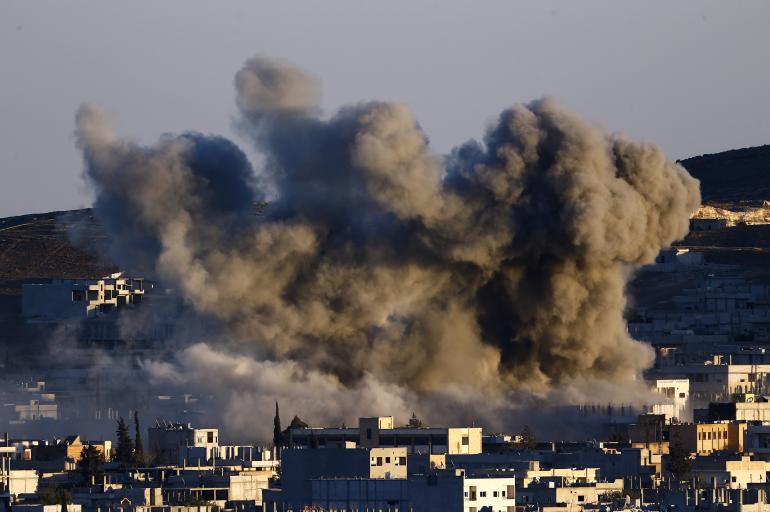
kobaneSmoke rises over Syrian town of Kobani after an airstrike, as seen from the Mursitpinar crossing on the Turkish border, Oct. 21, 2014. Reuters/Kai Pfaffenbach

The U.S.-led air campaign in Syria has killed 521 Islamic State fighters in the past month, according to the Syrian Observatory for Human Rights, a group monitoring the civil war. But the heavy death toll does not mean the United States is winning its fight to “degrade and destroy” the Sunni extremist group. Experts say that won’t happen until the group also known as ISIS loses support and its fighters begin defecting. 

“Until that happens, we will not see a quantum shift in the war in Iraq and Syria,” said Wayne White, a former deputy director of the State Department’s Bureau of Intelligence and Research’s Office of Analysis for the Near East and South Asia.

Since June, ISIS has gained control of large swaths of land that stretch from Kobani on the Syrian-Turkish border to the outskirts of Baghdad. The group is currently waging campaigns in several different areas of both countries, but has focused its forces in recent weeks on capturing the Kurdish city of Kobani. As a result, the U.S.-led air campaign has targeted several ISIS convoys and strongholds in Kobani and is air-dropping weapons and other resources to the Syrian Kurds fighting there.

“Like many aerial campaigns you can cite from history, it is a gradual process,” White said. “ISIS has a finite number of heavy weapons, and they are being picked off. And ISIS is losing a lot of combatants that are not easily replaced. ISIS is driven to expand its domain, and every time it tries to expand it is putting its fighters out in the open where they can be taken out. The question is: How long will the degrading take until you get to the destruction … a long time.”

Witnesses on the ground in Kobani told International Business Times that ISIS had been pushed back from the center of the city, but that the fighting was still raging on the outskirts. Meanwhile, ISIS is making gains in other parts of Syria and in Baghdad. According to the Syrian Observatory, ISIS fighters seized Tal Shaer, a town just west of Kobani, this week. And in Baghdad, the Sunni militant group has claimed responsibility for several car and suicide bomb attacks that have killed dozens of people in the last two weeks.

The uptick in ISIS attacks since June in Iraq has not only caused hundreds of civilian deaths, but has also infiltrated the psyche of the Iraqi people, especially those living in the capital, Noof Assi, a woman from Baghdad, told the International Business Times.

At the beginning of the ISIS campaign, “Baghdad looked like a ghost city,” Assi said. “People were staying at home or fleeing, saving food and fuel.”

Now, she said, people in Baghdad are used to the ISIS insurgency. Discussions in shops, cafes and restaurants have shifted. No longer are Iraqis talking about the destruction that ISIS is inflicting on the country. Now, people are talking about how many people are beginning to support the militant group.

“There are people talking about people of Mosul,” she said of the big northern city. “Some people are saying that they betrayed Iraq and welcomed ISIS.”

The State Department and White House have both confirmed that part of the U.S. strategy to fight ISIS is to undercut its propaganda and recruitment, especially on social media. So far, though, the U.S. has not launched a successful countercampaign.

In September, the State Department produced and distributed a graphic mock Islamic State propaganda video via social media. The video, “Welcome to ISIS Land,” was published by the State Department’s Center for Strategic Counterterrorism Communications.

The mock video showed graphic images of the militant group committing war crimes that have been widely reported over the past two months and that are now being investigated by the United Nations. The video looks similar to those ISIS promotes on social media like Twitter and YouTube. Despite the counterpropaganda drive, ISIS continues to expand on social media, and more and more Western fighters, as well as Iraqi and Syrian civilians, are joining up.

While some experts say the only way the U.S. will defeat ISIS is by sending in ground troops, others say more credit should be given to the Syrian Kurdish fighters — who now seems to be only force on the ground in Iraq and Syria that is regaining territory ISIS took over in prior months.

“They are the only boots on the ground in the entire Iraqi-Syrian theater capable of standing up to ISIS,” White said. “They are absolutely fierce fighters. The Iraqi Kurds are not.”

Uncertain Future for Kobane Prisoners: Turkey’s Border War (Dispatch 3)

October 21, 2014

Uncertain Future for Kobane Prisoners: Turkey’s Border War (Dispatch 3), You Tube, Vice News, October 20, 2014


U.S. Humanitarian Aid Going to ISIS

October 20, 2014

U.S. Humanitarian Aid Going to ISIS, Daily BeastJamie Dettmer, October 19, 2014

Not only are foodstuffs, medical supplies—even clinics—going to ISIS, the distribution networks are paying ISIS ‘taxes’ and putting ISIS people on their payrolls.

While aid is still going into ISIS-controlled areas, only a little is going into Kurdish areas in northeast Syria.

***************

GAZIANTEP, Turkey — While U.S. warplanes strike at the militants of the so-called Islamic State in both Syria and Iraq, truckloads of U.S. and Western aid has been flowing into territory controlled by the jihadists, assisting them to build their terror-inspiring “Caliphate.”

The aid—mainly food and medical equipment—is meant for Syrians displaced from their hometowns, and for hungry civilians. It is funded by the U.S. Agency for International Development, European donors, and the United Nations. Whether it continues is now the subject of anguished debate among officials in Washington and European. The fear is that stopping aid would hurt innocent civilians and would be used for propaganda purposes by the militants, who would likely blame the West for added hardship.

The Bible says if your enemy is hungry, feed him, and if he is thirsty, give him something to drink—doing so will “heap burning coals” of shame on his head. But there is no evidence that the militants of the Islamic State, widely known as ISIS or ISIL, feel any sense of disgrace or indignity (and certainly not gratitude) receiving charity from their foes.

Quite the reverse, the aid convoys have to pay off ISIS emirs (leaders) for the convoys to enter the eastern Syrian extremist strongholds of Raqqa and Deir ez-Zor, providing yet another income stream for ISIS militants, who are funding themselves from oil smuggling, extortion and the sale of whatever they can loot, including rare antiquities from museums and archaeological sites.

“The convoys have to be approved by ISIS and you have to pay them: the bribes are disguised and itemized as transportation costs,” says an aid coordinator who spoke to The Daily Beast on the condition he not be identified in this article. The kickbacks are either paid by foreign or local non-governmental organizations tasked with distributing the aid, or by the Turkish or Syrian transportation companies contracted to deliver it.

And there are fears the aid itself isn’t carefully monitored enough, with some sold off on the black market or used by ISIS to win hearts and minds by feeding its fighters and its subjects. At a minimum the aid means ISIS doesn’t have to divert cash from its war budget to help feed the local population or the displaced persons, allowing it to focus its resources exclusively on fighters and war making, say critics of the aid.

One of the striking differences between ISIS and terror groups of the past is its desire to portray the territory it has conquered as a well organized and smoothly functioning state. “The soldiers of Allah do not liberate a village, town or city, only to abandon its residents and ignore their needs,” declares the latest issue of the group’s slick online magazine, “Dabiq.” Elsewhere in the publication are pictures of slaughtered Kurdish soldiers and a gruesome photograph of American journalist Steven Sotloff’s severed head resting on top of his body. But this article shows ISIS restoring electricity in Raqqah, running a home for the elderly and a cancer treatment facility in Ninawa, and cleaning streets in other towns.

Last year, a polio outbreak in Deir ez-Zor raised concerns throughout the region about the spread of an epidemic. The World Health Organization worked with the Syrian government and with opposition groups to try to carry out an immunization campaign. This has continued. In response to a query by The Daily Beast, a WHO spokesperson said, “Our information indicates that vaccination campaigns have been successfully carried out by local health workers in IS-controlled territory.”

“I am alarmed that we are providing support for ISIS governance,” says Jonathan Schanzer, a Mideast expert with the Washington D.C.-based think tank Foundation for Defense of Democracies. “By doing so we are indemnifying the militants by satisfying the core demands of local people, who could turn on ISIS if they got frustrated.”

U.S. and Western relief agencies have been caught before in an aid dilemma when it comes to the war on terror. Last December, the Overseas Development Institute, an independent British think tank focusing on international development and humanitarian issues, reported that aid agencies in Somalia had been paying militants from the al Qaeda offshoot al-Shabab for access to areas under their control during the 2011 famine.

Al-Shabab demanded from the agencies what it described as “registration fees” of up to $10,000. And in many cases al-Shabab insisted on distributing the aid, keeping much of it for itself, according to ODI. The think tank cited al-Shabab’s diversion of food aid in the town of Baidoa, where it kept between half and two-thirds of the food for its own fighters. The researchers noted the al Qaeda affiliate developed a highly sophisticated system of monitoring and co-opting the aid agencies, even setting up a “Humanitarian Co-ordination Office.”

Something similar appears to be underway now in the Syrian provinces of Raqqa and Deir ez-Zor.

Aid coordinators with NGOs partnering USAID and other Western government agencies, including Britain’s Department for International Development, say ISIS insist that the NGOs, foreign and local, employ people ISIS approves on their staffs inside Syria. “There is always at least one ISIS person on the payroll; they force people on us,” says an aid coordinator. “And when a convoy is being prepared, the negotiations go through them about whether the convoy can proceed. They contact their emirs and a price is worked out. We don’t have to wrangle with individual ISIS field commanders once approval is given to get the convoy in, as the militants are highly hierarchical.” He adds: “None of the fighters will dare touch it, if an emir has given permission.”

That isn’t the case with other Syrian rebel groups, where arguments over convoys can erupt at checkpoints at main entry points into Syria, where aid is unloaded from Turkish tractor-trailers and re-loaded into Syrian ones.

Many aid workers are uncomfortable with what’s happening. “A few months ago we delivered a mobile clinic for a USAID-funded NGO,” says one, who declined to be named. “A few of us debated the rights and wrongs of this. The clinic was earmarked for the treatment of civilians, but we all know that wounded ISIS fighters could easily be treated as well. So what are we doing here helping their fighters, who we are bombing, to be treated so they can fight again?”

What becomes even more bizarre is that while aid is still going into ISIS-controlled areas, only a little is going into Kurdish areas in northeast Syria. About every three or four months there is a convoy into the key city of Qamishli. Syrian Kurds, who are now defending Kobani with the support of U.S. warplanes, have long complained about the lack of international aid. Last November, tellingly, Syrian Kurds complained that Syria’s Kurdistan was not included in a U.N. polio vaccination campaign. U.N. agencies took the position that polio vaccines should go through the Syrian Red Crescent via Damascus when it came to the Kurds.

The origins of the aid programs pre-date President Barack Obama’s decision to “degrade and defeat” ISIS, but they have carried on without major review. The aid push was to reach anyone in need. A senior State Department official with detailed knowledge of current aid programs confirmed to The Daily Beast that U.S. government funded relief is still going into Raqqa and Deir Ez-Zor. He declined to estimate the quantity. But an aid coordinator, when asked, responded: “A lot .”

The State Department official said he, too, was conflicted about the programs. “Is this helping the militants by allowing them to divert money they would have to spend on food? If aid wasn’t going in, would they let people starve? And is it right for us to withhold assistance and punish civilians? Would the militants turn around,. as al-Shabab did when many agencies withdrew from Somalia, and blame the West for starvation and hunger? Are we helping indirectly the militants to build their Caliphate? I wrestle with this.”

Western NGO partners of USAID and other Western agencies declined to respond to Daily Beast inquiries about international relief going to ISIS areas, citing the complexity of the issue and noting its delicacy.

Mideast analyst Schanzer dismisses the notion that ISIS can use an aid shutdown as leverage in its PR campaign: “I think this is false. In areas they control everyone understands they are a brutal organization. This is their basic weakness and by pushing in aid we are curtailing the chances of an internal revolt, which is the best chance you have of bringing down ISIS.”


Fiercest fighting in days hits Syrian border town

October 19, 2014

Fiercest fighting in days hits Syrian border town, ReutersHumeyra Pamuk, October 19, 2014

(Islam is the religion of peace. The (non-Islamic) Islamic State recruits Islamists who then engage in violence because of Israeli intransigence when ordered to commit suicide; thus spake Ubermench Zarathustra Secretary Kerry. — DM)

Smoke rises over the Syrian town of KobaniSmoke rises over the Syrian town of Kobani after an airstrike, as seen from the Turkish-Syrian border in the southeastern town of Suruc, October 19, 2014.

The fiercest fighting in days shook the Syrian border town of Kobani overnight as Islamic State fighters attacked Kurdish defenders with mortars and car bombs, sources in the town and a monitoring group said on Sunday.

Islamic State, which controls much of Syria and Iraq, fired 44 mortars at Kurdish parts of the town on Saturday and some of the shells fell inside nearby Turkey, according to the British-based Syrian Observatory for Human Rights. It said four more mortars were fired on Sunday.

The month-long battle for Kobani has ebbed and flowed. A week ago, Kurds said the town would soon fall. The United States and its coalition partners then stepped up air strikes on Islamic State, which wants to take Kobani in order to strengthen its position in northern Syria.

The coalition has been bombing Islamic State targets in Iraq since August and extended the campaign to Syria in September after Islamic State, a group that espouses a rigid interpretation of Islam and initially fought Syrian President Bashar al-Assad’s forces, made huge territorial gains.

Raids on Islamic State around Kobani have been stepped up, with the fate of the town seen as an important test for U.S. President Barack Obama’s campaign against the Islamists.

NATO member Turkey, whose forces are ranged along the border overlooking Kobani, is reluctant to intervene. It insists the allies should also confront Assad to end Syria’s civil war, which has killed close to 200,000 people since March 2011.

“We had the most intense clashes in days, perhaps a week, last night. (Islamic State) attacked from three different sides including the municipality building and the market place,” said Abdulrahman Gok, a journalist in Kobani.

“Clashes did not stop until the morning. We have had an early morning walk inside the city and have seen lots of damaged cars on the streets and unexploded mortar shells,” he said.

CAR BOMBS

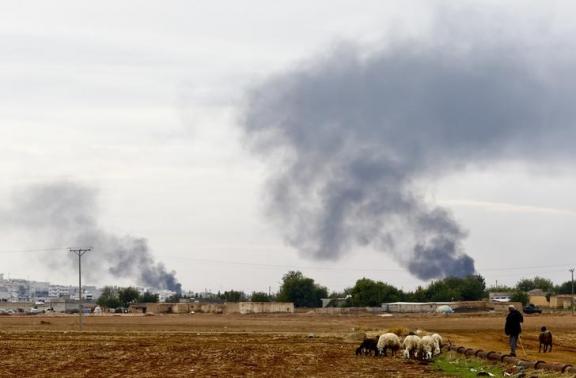
The Observatory reported two Islamic State car bombs hit Kurdish positions on Saturday evening, leading to casualties. A cloud of black smoke towered over Kobani on Sunday.

A fighter from one of the female units of the main Syrian Kurdish militia in Kobani, YPG, said Kurdish fighters were able to detonate the car bombs before they reached their targets.

“Last night there were clashes all across Kobani … this morning the clashes are still ongoing,” she said, speaking on condition of anonymity.

The Observatory said 70 Islamic State fighters had been killed in the past two days, according to sources at the hospital in the nearby town of Tel Abyab, where Islamic State bodies are taken. Reuters cannot independently confirm the reports due to security restrictions.

The Observatory said some Syrian Arab fighters from the Revolutionaries of Raqqa Brigade, who are fighting alongside Kurdish fighters, had executed two Islamic State captives.

“One was a child of around 15 years old. They shot them in the head,” he said.

Islamic State have also used executions throughout their campaigns in Syria and Iraq, killing hundreds of enemy combatants and civilians who oppose their cause, according to Islamic State videos and statements.

Welat Omer, a doctor caring for the few remaining civilians in Kobani, told Reuters by telephone that he was looking after 15 patients, including children and the elderly.

“We need medicine, including antibiotics and milk for the children, and medicine for the elderly, who have heart conditions, diabetes and high blood pressure,” Omer said.

Hundreds of thousands have fled Islamic State’s advance. Turkey hosts about 1.5 million Syrian refugees, including almost 200,000 Syrian Kurds from Kobani.

Ankara has refused to rearm beleaguered Kurdish fighters, who complain they are at huge disadvantage in the face of Islamic State’s weaponry, much of it seized from the Iraqi military when the militants took the city of Mosul in June.

Turkey views the YPG with suspicion for its long-standing links with the Kurdistan Workers Party (PKK), which has waged a 30-year armed campaign for self-rule in Turkey.

President Tayyip Erdogan was quoted in the Turkish media on Sunday as saying Ankara will never arm the YPG through its political wing, the PYD.

“There has been talk of arming the PYD to establish a front here against Islamic State. For us, the PYD is the same as the PKK, it’s a terrorist organization,” he was quoted as saying.

This stance has sparked outrage among Turkey’s own Kurds, who make up about 20 percent of the population. Riots in several cities earlier this month killed left than 35 people dead.

In a call with Erdogan on Saturday night, Obama expressed appreciation for Turkey hosting over a million refugees, including thousands from Kobani.

“The two leaders pledged to continue to work closely together to strengthen cooperation against ISIL (Islamic State),” the White House said.

Obama’s approach to Islamic State has drawn fire from his political opponents at home.

“We have dropped a bomb here and a missile there, but it has been a photo-op foreign policy,” U.S. Senator Ted Cruz of Texas, a Republican and a potential presidential candidate in 2016, said on CNN’s “State of the Union” show.

He criticized Obama for delays in aiding Kurdish fighters in desperate need of weapons and assistance.

Peshmerga head speaks of struggle against IS

October 18, 2014

Peshmerga head speaks of struggle against IS, Al-Monitor, Faraj Obaji, October 17, 2014

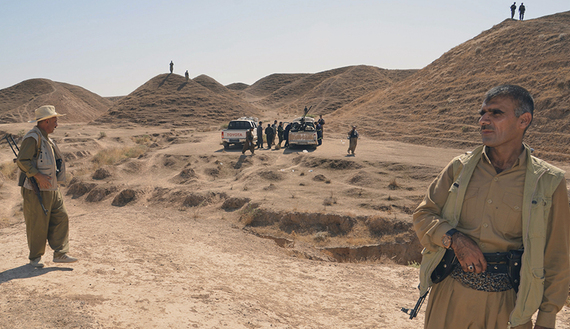
Kurdish peshmerga fighters stand guard around vehicles left behind by fleeing Islamic State militants during clashes in the al-Zerga area near Tikrit cityKurdish peshmerga fighters stand guard around vehicles with weapons and ammunition left behind by fleeing Islamic State militants during clashes in the al-Zerga area near Tikrit city in Salahuddin province, Oct. 8, 2014. (photo by REUTERS)

Commenting on the criticism of certain Kurdish parties inside Kobani, regarding the lack of support provided by KRG to the besieged city, he said, “Despite the differences with certain Kurdish political parties in the city, the KRG expressed its readiness to support our brothers in the city and we asked Washington and its allies to help the resisting Kurdish fighters.

“We helped them as much as possible, and the KRG’s president affirmed this. But, we cannot offer more. We are still waiting for international aid. The region initially includes 5 million people, add to that one and a half million displaced from Syria and the Iraqi provinces. We are helping them and taking care of them, and this is a huge burden.”

******************

Eliminating the Islamic State (IS) in Iraq does not seem to be an easy mission that will happen anytime soon; it seems rather impossible. The terrorist attacks against Iraq exposed how weak the Iraqi army is, how fragile its military structure and intelligence services are, and how it is unable to protect its country against any attack.

Some believe that the responsibility of the army’s failure to fight IS should be borne by the political authority ruling the country since 2004, which was unable to build an army based on a unified doctrine. Others consider the policies adopted by former Prime Minister Nouri al-Maliki faulty and the maliciousness allowed the terrorist group to enter the country, while the political conflicts between the central government and the Sunni leaderships provided an embracing environment for the group in Sunni provinces.

Secretary-General of the Ministry of Peshmerga Lt. Gen. Jabbar Yawar spoke to An-Nahar regarding the situation in Iraq in general, and in the Kurdistan Regional Government (KRG) in particular, in light of the IS threat, which occupied a number of Iraqi provinces, reaching the besieged Kobani.

The peshmerga harasses IS

The Kurdish military leader welcomed the international aid provided to the KRG, which is fighting a crucial battle against IS. He said, “The military aid which reached KRG saved it from falling into the hands of the terrorist group and allowed peshmerga forces to move from the negative defense position to the striker position, inflicting heavy losses on IS.”

Yawar does not hesitate to say, “The peshmerga forces’ position in the fight against IS is much better than the Iraqi army’s position. We are in a continuous fight along the 1,050-kilometer [650-mile] border of five Iraqi provinces, starting from Mosul to Erbil and passing through Kirkuk, Saladin and Diyala.”

He said, “The peshmerga forces have liberated the Mosul Dam and continues to liberate the rest of the regions that have fallen into the hands of IS, while creating plans to completely achieve this.”

The fall of Mosul and Anbar

Yawar attributed the fall of Mosul and Anbar to several reasons, most importantly, the fragility of the army in both provinces. He said, “The army in Mosul was fragile, and its six military units failed to withstand IS. There were also the political conflicts between the Sunni blocs and the government in Baghdad, which prevented these forces from fighting IS in Mosul, Saladin and parts of Kirkuk. These forces either handed over their advanced and heavy weapons to the group and fled, or joined and began to fight alongside IS.”

“The lack of a unified fighting doctrine among the army, and the shortage of air support, were all elements that contributed in the army’s quick collapse and IS’ occupation of a number of Iraqi provinces, especially the Sunni ones,” he said.

The difficulty in liberating Sunni regions

On the subject of the army’s situation in provinces in general, Yawar said that he found “a certain difficulty in liberating the Sunni-dominated regions from IS, such as Anbar, Saladin and Mosul, especially after it fell into the hands of the terrorists who took over its weapons on June 10.” He said that although they used all available means, the Iraqi forces were unable to liberate the city of Heet in Anbar and Tikrit, the center of Saladin province. “The situation on the field unfortunately proves that IS only controls the Sunni-dominated regions. We hope that our Sunni brothers, who are suffering the group’s injustice, will cooperate with the federal government and the KRG in order to eliminate this terrorist group,” he explained.

How did IS reach Erbil’s borders?

When asked how IS was able to reach KRG even though its intentions to occupy the region were obvious, Yawar answered with regret: “We knew before the group attacked Mosul on June 10 that it was up to no good in Iraq and Mosul. We were alerted by the joint committees and meetings that we used to hold in Baghdad, that there were some suspicious and dangerous movements on the borders with Syria. We were advised to strike them at an early stage, but we did not listen. The federal government and its former prime minister, Nouri al-Maliki, believed our proposals were political outbidding. Even when IS attacked Mosul, we asked them to allow us to support the federal forces there, but they told us that they were able to fight back themselves. Then Mosul fell, its residents fled and, due to Maliki’s faulty policy, IS was able to reach Baghdad’s borders.”

When asked why the terrorist group was able to reach Erbil, Yawar said, “When IS’ attack began, the peshmerga fought with all its strength, but it does not own advanced weapons such as the ones the group took from Mosul, because Maliki’s government never reinforced, trained or funded the peshmerga forces, although they are official governmental forces, according to the federal constitution.

“Despite all this, the peshmerga withstood IS from June 10 until the beginning of August. However, when we ran out of munitions and had no source of getting any, the group was able to penetrate our defense and move toward Erbil. Yet, thanks to Washington’s assistance and some of the countries participating in the international alliance, we were able to change the negative defense equation in Erbil and attack IS to liberate our lands,” he said.

Baghdad will not fall

The Kurdish leader ruled out the possibility of Baghdad falling for the time being, according to the available security data. “Until now, the Iraqi army can protect Baghdad and prevent the penetration of IS, which has spread in neighboring regions, such as Amiriya, Fallujah, Saqlawiyah and Ramadi,” he said.

We helped Kobani as much as we could

Commenting on the criticism of certain Kurdish parties inside Kobani, regarding the lack of support provided by KRG to the besieged city, he said, “Despite the differences with certain Kurdish political parties in the city, the KRG expressed its readiness to support our brothers in the city and we asked Washington and its allies to help the resisting Kurdish fighters.

“We helped them as much as possible, and the KRG’s president affirmed this. But, we cannot offer more. We are still waiting for international aid. The region initially includes 5 million people, add to that one and a half million displaced from Syria and the Iraqi provinces. We are helping them and taking care of them, and this is a huge burden.”

Yawar said, “The region has not been able to help Kobani like it should, due to its tough and complex geographic location, as it is 300 kilometers [185 miles] from the Syrian border, and it’s hard for aid to reach it. Kobani’s situation is geographically similar to Gaza or Sinjar.”

Raids

Yawar is not afraid that IS, which he believes is an extension of al-Qaeda in Afghanistan, will persist. He said, “The situation in Iraq and Syria today is similar to that of Tora Bora and Afghanistan. The airstrikes are beneficial for the peshmerga, Kobani and even for the Iraqi government, as they halt the advance of IS militants and drain them. These strikes also destroy IS warehouses and heavy weapons. But, to free these areas completely from IS, a comprehensive international operation should be put in place, like the one in Afghanistan, and there should be an actual training campaign for the Iraqi forces to defend themselves. However, I rule out the possibility of a foreign land intervention in Iraq, with the existing conflict between the ruling political parties.”

No Kurdish expansion

Political circles have been talking about a Kurdish expansion in an attempt to build the awaited state. In this regard, Yawar says, “We are part of the federal state, and neither of us expands into the other’s territories. Until now, there aren’t any official international borders between us and the federal state. We have some problems in many regions administratively. But the KRG and Baghdad are both facing IS threat. We should destroy it first, then resort to the constitution to solve the pending problems with the Baghdad government regarding the land, oil, the budget and Peshmerga.”


Kurds make grisly discoveries after retaking ISIS-held territory

October 15, 2014

Kurds make grisly discoveries after retaking ISIS-held territory, Hot Air, Noah Rothman, October 14, 2014

(How serious are we and our coalition of the unwilling about at least degrading the Islamic State? — DM)

There is mixed news from the two fronts in Iraq and Syria where coalition airpower and indigenous partner forces on the ground are fighting Islamic State militants.

Near the Syrian border city of Kobani, reports indicate that Kurdish defenders are beginning to make some gains as they continue to defend the city against the ISIS onslaught. A key hill atop which ISIS fighters famously planted their flag late last week has reportedly been retaken by Kurdish forces.

“The advance came as the US said it had conducted 21 air strikes near the town, slowing down the IS advance,” the BBC revealed. “Tall Shair hill had been captured more than 10 days ago by IS militants.”

As ISIS retreated from the front near the Syrian-Turkish border, Kurdish forces made a series of gruesome discoveries.

“Refugees in Suruc, Turkey, have told how relatives and neighbors were beheaded by [ISIS] militants, while another spoke of how he had seen ‘hundreds’ of decapitated corpses in the besieged town,” The Independent reported on Tuesday.

Amin Fajar (38) a father-of-four who left Kobane and made it across the border and into Suruc, told a British newspaper: “I have seen tens, maybe hundreds, of bodies with their heads cut off.

“Others with just their hands or legs missing. I have seen faces with their eyes or tongues cut out – I can never forget it for as long as I live.”

The Daily Telegraph confirmed The Independent’s reporting about the activities in which ISIS engaged in the areas under their control:

“I have seen tens, maybe hundreds, of bodies with their heads cut off. Others with just their hands or legs missing. I have seen faces with their eyes or tongues cut out — I can never forget it for as long as I live,” Amin Fajar, a 38-year-old father of four, told the Daily Mail about the incredible scene in Kobane.

“They put the heads on display to scare us all.”

Another resident, 13-year-old Dillyar, watched as his cousin Mohammed, 20, was captured and beheaded by the black-clad jihadis as the pair tried to flee the battle-scarred town.

“They pushed him to the ground and sawed his head off, shouting, ‘Allahu Akbar,’ ” the boy said. “I see it in my dreams every night and every morning I wake up and remember everything.”

This unconfirmed video featuring Kurdish fighters in Kobani, flagged by Jeff Gauvin, reveals the extent of the damage done to the city over the course of weeks of fighting.

While America’s partners on the ground are enjoying some successes in Syria, the dispatches from Iraq are far more grim.

There, ISIS continues its siege on Anbar province in preparation for an assault on the capital city of Baghdad. After taking control of a military training base on Monday, CNN reported that ISIS has surrounded one of the largest Iraqi airbases in the country on Tuesday and is preparing to take it.

“According to police sources,” CNN’s Ben Wedeman reported, “the Ayman Asad Airbase, which is about 110 miles to the west of Baghdad – one of the biggest bases in Anbar province – is now surrounded by ISIS fighters, and the people on the base are expecting an attack within the coming hours on that base.”

“We understand that there are Iraqi soldiers who have already fled the base,” Wedeman continued. “We were getting reports for several hours that some of the soldiers had left, shedding their uniforms, leaving their weapons behind.”

That depressing revelation should concern military advisors who believe Iraqi forces defending Baghdad can hold out against an ISIS assault on Baghdad despite outnumbering the attackers by a reported six-to-one ratio. These latest developments reinforce the position of Army Chief of Staff Gen. Raymond Odierno who said with some trepidation recently he was only “somewhat” confident Baghdad could hold out.

Kurds Left Helpless as Kobane Falls to Islamic State: Turkey’s Border Wars (Dispatch 1)

October 15, 2014

 Vice News via You Tube, October 14, 2014

(Whose side is our NATO ally, Turkey, on in Kobane? The (“non-Islamic”) Islamic State or those best able to combat it effectively? How about the Obama Nation?  — DM)