Archive for the ‘Jordan’ category

Russia air strikes seal Jebel Druze against attack and refugees

February 21, 2016

Russia air strikes seal Jebel Druze against attack and refugees, DEBKAfile, February 22, 2016

2717545 10/10/2015 Russian Su-25 attack aircraft take off from the Khmeimim airbase in Syria. Dmitriy Vinogradov/RIA Novosti

2717545 10/10/2015 Russian Su-25 attack aircraft take off from the Khmeimim airbase in Syria. Dmitriy Vinogradov/RIA Novosti

While Syrian war reporting focused over the weekend on the battles around Aleppo and along the Turkish border in the north, Russia since Saturday, Feb. 20 has ramped up its air bombardment of southern cities and towns, especially Daraa and Nawa. Thousands of fleeing rebels with their families and other civilians have meanwhile been turned away from the locked Jordanian border and are heading towards the Golan opposite the Israeli border.

The heaviest Russian air strikes seen hitherto in Syria have two strategic goals.

1. To retake the key southern town of Daraa from rebel hands and restore it to Syrian President Bashar Assad’s full control.

2. To crush rebel resistance in the South and force them to accept surrender, collapse or escape in the direction of the Jordanian or Israeli borders.

The intense Russian sorties are opening the door to Syrian, Iranian and Hizballah forces to move into the South and reach the Israeli borders. Prime Minister Binyamin Netanyahu sent Dr. Dore Gold to Moscow last week as his special emissary to explain how this affected Israel’s security. But he was unable to persuade the Russians to scale down their attacks in this sensitive border region.

Those attacks have a third goal, which is to encircle the Jebel Druze region with a “shield of fire” as protection for this ethnic minority of 750,000, most which inhabit mountain villages.

This unusual operation, the first of its kind in the Syrian war, has three objectives:

A. To shield the Druzes villages against ISIS attack from the east, namely Deir az-Zour.

B. To shut the door against fleeing rebels seeking sanctuary in the Druze enclave.

C. To show other Syrian minorities, especially the Kurds in the north, the great advantage of allying themselves with Moscow. Word of Russian protection of the Druzes has undoubtedly spread to Syria’s other minorities.

As for the rebels and refugees, Jordanian troops moved into the border crossings evacuated by Syrian rebels and closed the last crossing at Ramtha.

The exodus from southern Syria is now heading towards the Golan on Israel’s doorstep.

Israel has imposed a media blackout on this development. However, DEBKAfile’s sources warn that it will soon be impossible to keep it dark. Within a few days, many thousands of Syrian refugees will be massing at Israel’s Ein Zivan gate opposite Quneitra. Like Turkey and Jordan, Israel will have to supply large numbers of distressed Syrian refugees with tents, food, water and medicines.

Special Israeli emissary to Moscow over Russian Syria air strikes near border

February 17, 2016

Special Israeli emissary to Moscow over Russian Syria air strikes near border, DEBKAfile, February 17, 2016

Israel_near_border_16.2.16

In view of the crisis building up on the southern Syrian-Israeli border, Prime Minister Binyamin Netanyahu decided immediately on his return home from Berlin early Wednesday, Feb. 17, to send a special  emissary to Moscow to ask for clarifications. Tuesday, Intensified Russian air strikes came to within 6 km of the Israeli border, sparking a growing exodus of Syrian refugees heading towards the Qoneitra border crossing to Israel.

DEBKAfile’s sources reveal that the envoy is Dr. Dore Gold, director-general of the Foreign Ministry and one of the prime minister’s few trusted confidantes.

It was still not clear whom Gold will meet in the Russian capital, but it is assumed that it will be one of Moscow’s senior decision-makers in the loop on its military operation in Syria.

The fact that Netanyahu decided to dispatch a top diplomat rather than a senior military or intelligence officer is a sign that the prime minister is not of one mind with the IDF’s intelligence assessments of the situation on the ground.

Netanyahu’s concerns grew after after the Russian air force on Tuesday widened its massive bombing of southern Syria from the city of Daraa to the Golan town of Quneitra, in order to help the Syria army’s 7th armored division push the rebels east, so they will not attempt to cross the border and seek shelter in Israel.

DEBKAfile’s military sources report that that 12 of the 15 targets bombed by the Russian air force across from the Israeli border were new rebel positions that had not been attacked before, even by the Syrian army. Military sources monitoring the war said Tuesday night that there is no doubt that the Russians are in the process of wiping out the rebel positions along the Israeli border by means of an offensive comparable to their operations in the northern Aleppo sector.

Our sources report that Israel’s concerns grew when, as the Russians bombing raids neared the Israeli border, Syrian officials threatened Jordan with serious consequences if Amman gave the Saudi air force a base for attacking eastern or southern Syria.

The threats began Tuesday, after Jordanian forces took over the Syrian-Jordanian border crossings formerly held by Syrian rebels, as a measure to stem the volume of Syrian refugees in search of sanctuary in the Hashemite Kingdom. But this step was interpreted by the Syrians and their Russian ally as clearing the way for Saudi intervention in the Syrian conflict using Jordan as a jumping-off base.

Meanwhile, Western military sources reported a sub substantial presence Tuesday of both Russian and Israeli warplanes in the skies over and around southern Syria.

In new Syrian exodus, some 50,000 refugees head to Jordanian, Israeli borders

February 10, 2016

In new Syrian exodus, some 50,000 refugees head to Jordanian, Israeli borders, DEBKAfile, February 10, 2016

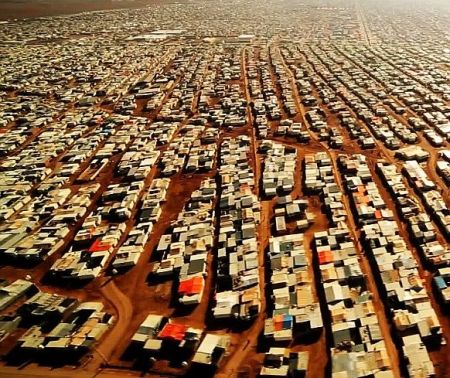
An aerial view shows the Zaatari refugee camp near the Jordanian city of Mafraq, some 8 kilometers from the Jordanian-Syrian border. 03/02/2016. BBC News

An aerial view shows the Zaatari refugee camp near the Jordanian city of Mafraq, some 8 kilometers from the Jordanian-Syrian border. 03/02/2016. BBC News

Syria’s refugee crisis in the north is now repeating itself in the south, with tens of thousands of destitute women, children and elderly people fleeing their homes – not this time from beleaguered Aleppo to the Turkish border, but from the southern region of Daraa towards the Jordanian and Israeli borders.

Unlike the broad coverage of the refugee crisis on the Syrian-Turkish border, the refugee exodus from the south has received scant media attention – even from Israeli correspondents.

With the intensification of attacks in southern Syria, about 50,000 refugees are now streaming toward Jordan and another 20,000 making tracks from Israel’s Golan border at Quneitra.

DEBKAfile’s military sources report that, since the weather has cleared and Russian air strikes resumed against the rebels holding the northern part of Daraa, tens of thousands of civilians are on the move from the South. About 15,000 to 20,000 have reached the Jordanian border, and more than 30,000 are believed heading that way; while another 20,000 refugees may be making for the Golan town of Quneitra on the Israeli border.

Jordan has taken in 650,000 Syrian refugees in previous exoduses from the five-year old war.

A desperate SOS appeared on social media Wednesday, Feb. 10, in which the rebel-controlled Daraa Provincial Council warned that tens of thousands of civilians were in flight from Russian air strikes and the barrel bombs dropped by the Syrian warplanes and helicopters.

There was no way to bring water, food or medicines to the fleeing refugees.

Military sources monitoring the situation report that the exodus was first touched off by the fall of Alaman, 3 km north of Daraa in the last few days to Syrian and Hizballah forces. They next cut off parts of Highway 5 from Daraa to Damascus. The rebels were left with only one remaining escape route, the road to the Jordanian border, but that too is under heavy fire, forcing the refugees to go round through rough country.

As in Aleppo, the Darnah district is held by hundreds of assorted rebel militias, ranging from the US-backed Free Syrian Army to groups which have sworn allegiance to ISIS. According to our intelligence sources, it is often hard to determine which groups are taking orders from whom.

Jordan has followed the Turkish policy towards the tens of thousands of refugees massing on its border  A single crossing is operating at Ramtha, but refugees are not allowed to pass through.

The Israeli government has not yet issued any statements of policy with regard to the Syrian refugees heading for the Golan.

IDF Preparing for Arrival of ISIS on Syrian Border

January 30, 2016

IDF Preparing for Arrival of ISIS on Syrian Border, Investigative Project on Terrorism, Yaakov Lappin, January 29, 2016
934

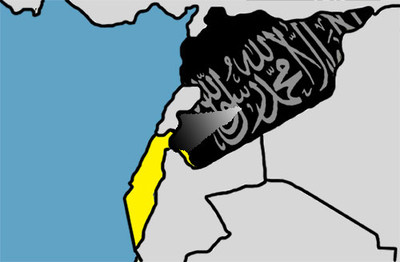
As conflict and mayhem continue to rage across Syria, the Israel Defense Forces (IDF) is preparing to encounter the threat of ISIS and al-Qaida forces right on its borders, and could encounter such threats in the coming months.

The preparations come as the Syrian civil war shows no sign of letting up. This is a conflict that has led to the violent deaths of 300,000 Syrians, and the displacement of more than 10 million others, 4.5 million of whom have fled the country.

Today, the IDF’s Military Intelligence Directorate views Syria as a former state that has broken apart into multiple ‘Syrias.’ The Assad regime controls barely 30 percent of Syria and is fully reliant on the foreign assistance of Russia, Hizballah, and Iran. Sunnis and Shi’ites wage daily war on one another.

It is worth examining the wider recent events in the multifaceted Syrian conflict, and place the IDF’s preparations in their broader regional perspective.

In Syria’s murderous kill-or-be-killed environment, Salafi-jihadist doctrines flourish, in the form of ISIS, which views Shi’ites (including the Assad regime and Hizballah) as infidels who must be destroyed.

ISIS cells have operated recently in Lebanon too, targeting Shi’ite Hizballah’s home turf of Dahiya in southern Beirut with two large bombings in November that claimed over 40 lives, while ISIS in Iraq continues to target Shi’ites.

Today, ISIS has between 30,000-50,000 members who are dedicated to expanding their caliphate and killing all those who disagree with their doctrine, including even fellow Sunni jihadi members of al-Qaida’s branch in Syria, the Al-Nusra Front, which has 8,000-12,000 members.

ISIS continues to use its territory in Syria and Iraq to plot major, mass-casualty terrorist attacks in Western cities. At the same time, its budgetary future looks uncertain, as oil funds have decreased significantly following allied air strikes on oil facilities. In the past year, 45 percent of ISIS’s $1.3 billion budget came from oil, far less than the oil revenue in 2014.

Unlike ISIS, al-Qaida believes in following a phased, slower plan in setting up a caliphate, and the two jihadist organizations have been at war with each other for more than two years in Syria.

Shi’ites led by Iran are fighting to stop the Salafi-jihadis’ spread. Under the command of Iranian Revolutionary Guard Corps (IRGC)-Quds Force unit commander, Qassem Suleimani, Iranian fighting forces and advisers moved into Syria. Iran has sustained more than 300 casualties there thus far.

Hizballah, too, is heavily involved in Syria’s battles, losing an estimated 1,300 fighters and sustaining 10,000 injuries – meaning more than half of its conscripted fighting force has been killed or wounded. Iran and its proxies are using the mayhem to try to spread their own influence in Syria.

Near Israel’s border with Syria, the Al-Yarmouk Martyrs Battalions, which is affiliated with ISIS, has set up many posts.

An estimated 600 members of the group control a population of around 40,000 Syrians. Al-Yarmouk is at war with al-Qaida’s Jabhat Al-Nusra, which maintains a few thousand members in the Syrian Golan near Israel.

Jabhat Al-Nusra’s membership is mostly derived of local Syrians, who tend to be more hesitant to start a war with Israel that would result in their areas, and relatives, being badly affected. Yet 10 to 15 percent of its membership comes from abroad, and have no commitment to the area. These foreign fighters have no qualms about precipitating attacks on Israel. At the moment, however, Jabhat Al-Nusra is bogged down by its fight with Al-Yarmouk.

ISIS has officially put Israel in its sights, and its leader, Abu Bakr Al-Baghdadi, declared his intention at the end of December to attack Israel.

The IDF is taking the threat seriously and is preparing for a range of possible attacks, including strategic terror attacks, cross-border raids, the sending of bomb-laden armored vehicles into Israel, and rocket, missile, small-arms, and mortar fire on the Israeli Golan Heights.

One possibility is that the heavily armed Al-Yarmouk group, which is facing the southern Golan Heights, might follow an Islamic State directive to attack Israel.

In 2014, Al-Yarmouk became an ISIS representative, swearing allegiance to it, though it is not fully subordinate to it.

Al-Yarmouk’s late leader, known as Al Khal (“the uncle”), was killed in November in an attack by Jabhat Al-Nusra. Before his violent end, Al Khal only partially committed himself to ISIS, and turned down ISIS requests to send fighters to Iraq.

Al-Yarmouk’s response to Jabhat Al-Nusra’s attacks came in December, when it assassinated a Jabhat Al-Nusra commander in his armored vehicle, just 400 meters from the Israeli border.

Al-Yarmouk subscribes to the Salafi jihadist ideology and has shoulder-held missiles, tanks, and other weapons looted during raids on the Assad regime military bases.

But Israel is also preparing for the possibility of encountering ISIS itself, not just an affiliate group.

ISIS proper is currently situated 40 kilometers from the Israeli border in southern Syria. One possibility is that Russian airstrikes will cause ISIS forces to ricochet southwards, towards Israel.

The IDF is gathering intelligence on all armed groups near its border, exhausting many resources to assess their capabilities, and intentions.

Israel watched as Shi’ite Hizballah came from Lebanon to block Sunni jihadist advances towards Lebanon in recent months, and as Russian airstrikes blocked the advance of the rebels northwards, to Damascus.

The IDF remains in a heightened state of alert along the Syrian border, though it is also working to avoid the creation of easy targets for the array of predatory forces on the other side.

As part of its preparations, the IDF’s Northern Command has given more autonomy to regional field commanders to enable faster responses to surprise attacks by reducing the initial chain of command during emergencies.

Inter-branch cooperation between intelligence, ground forces, and the air force has also been tightened.

Additionally, the IDF has fortified its border fence with Syria, adding electronic sensors to better be able to detect and respond to a potential attack in time.

The underlying assumption within military circles is that, sooner or later, ISIS will turn its guns on Israel, and the IDF does not intend to be caught off guard when that happens.

Russians let Hizballah into Daraa, breaking their promise to Israel

January 28, 2016

Russians let Hizballah into Daraa, breaking their promise to Israel, DEBKAfile, January 28, 2016

Syria_South

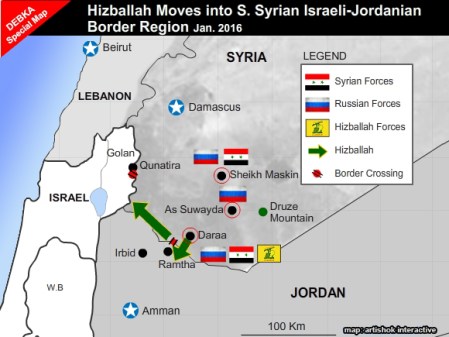
On Wednesday, Jan. 27 a large Hizballah force entered the southern Syrian town of Daraa, a critically dangerous event for Israel’s security. The way to the town, which lies near the Jordanian border and across from the Israeli Golan, was opened before Hizballah by none other than Russian forces. This was a blatant violation of President Vladimir Putin’s commitments to Prime Minister Binyamin Netanyahu and Jordanian King Abdullah not to permit Iranian and Iran-backed forces, such as Hizballah and Iraqi and Afghani Shiite militias, reach their borders in consequence of Russia’s military intervention in the Syria war.

Daraa is just 32 km from the southern Golan and 12 km from the Jordanian border. Hizballah forces in this town are therefore within easy striking distance from northern Israeli and Jordan.

What happened Wednesday was that a sizeable Hizballah contingent made it into Daraa, the day after a Syrian unit under the command of Russian officers captured the town of Sheikh Maskin, cutting off rebel forces east of Daraa from their comrades to the west.

Control of Sheikh Maskin is the key to the crossroads leading to Damascus in the north, the Druze Mountain town of es-Suwaida in the east, and Quneitra on Golan opposite Israel’s northern defenses.

The battle for Sheikh Maskin was the first in the Syrian conflict to be directly fought under Russian command. Its fall sparked accounts of Russian officers commanding Syrian troops in different parts of Syria.

So far, Israel has not reacted to the Hizballah force’s advance, notwithstanding public statements by Prime Minister Binyamin Netanyahu and Defense Minister Moshe Ya’alon that this would never be allowed to happen.

DEBKAfile’s military sources explain this reticence by a persistent misreading of the Syrian crisis in the higher ranks of the Israeli defense establishment. Military Intelligence chief Maj. Gen. Herzl Halevi, who has a good grasp of its complexities, is a lone voice against the defense minister and IDF chief of staff, Lt. Gen. Gady Eisenkot

In Amman, however, King Abdullah and his generals signified both alarm and fury. DEBKAfile’s sources report that Wednesday morning, the king shot off an urgent message to President Putin demanding an explanation for the Russian officers’ action in opening the door of Daraa to hostile Hizballah fighters.

Jordan has fought Hizballah and its conspiracies for three years, ever since its security forces seized an arms cache that Hizballah had smuggled into the kingdom for a terror cell to mount attacks in the northern province of Irbid. Amman is now concerned that Hizballah is close enough to make a grab for Al-Ramtha, the only border crossing between Syria and Jordan. That would be a feather in the cap of Iran’s Lebanese proxy, as the first Arab border crossing to fall to a Hizballah force outside Lebanon, and one, moreover, located athwart a main regional water source, the Yarmouk River.

As of Thursday morning, Jan. 28, Abdullah had not received a reply to his missive from Putin, but a message did come through to Amman from Syrian President Bashar Assad.

Using a back-door intelligence channel, he sent a notice in the name of Gen. Bahjat Suleiman, former Syrian ambassador to Jordan until he was expelled in May 2014, that King Abdullah must now face the consequences of his long support for the rebels of southern Syria.

The monarch was also advised to prepare for the influx of thousands of fleeing rebel fighters whom the combined Syrian and Hizballah forces were pushing towards the Jordanian border.

The next hours will be critical for the development of a similar crisis on the Israel-Syrian border in the Golan region.

Putin bypasses Israel, sets up joint war room for S. Syria with Jordan

January 14, 2016

Putin bypasses Israel, sets up joint war room for S. Syria with Jordan, DEBKAfile, January 14, 2016

Jordan_specail_forces

By teaming up with Jordan for a joint war room to cover operations in southern Syria, Putin has gone around Netanyahu’s back and acquired a helper for evicting Syrian rebels from southern Syria.

***************************

In a pivotal step reflecting the changeability of military and political deals in Israel’s neighborhood, Jordan has almost overnight agreed to establish a shared war room with Russia for the concerted conduct of their operations in Syria. This represents an extreme reversal of Amman’s policy. Until now, Jordan fought against Russia’s protégée Bashar Assad from a joint war room north of Amman called the US Central Command Forward-Jordan, as part of a lineup with the US, Saudi Arabia and Israel.

But this week Jordan shifted onto a new plane.

DEBKAfile’s military and intelligence sources say Jordanian King Abdullah’s decision to team up with Moscow starts a whole new ball game rolling on policy-making and intelligence-sharing. He doesn’t plan to shut down his shared command center with the US and Israel, but the center of gravity of Jordan’s military and intelligence efforts will be redirected to the new center with Russia, representing a major earthquake in those areas.

Amman is working hard to downplay the new partnership, presenting it as designed to foster better coordination between the American and Russian military efforts in Syria and the war on the Islamic State.

That picture is misleading.

With all due respect to the Jordanian monarch, his military and his intelligence services, they are not exactly qualified for the role of coordinator between the two world powers. The US and Russian presidents handle this in person. And in fact, the new Russian-Jordanian war room did come up, according to our Washington and Moscow sources, in the latest telephone conversation between the two presidents on Jan. 13.

Obama then held a quick meeting with King Abdullah at Andrews Air Force Base in Maryland and asked for an explanation.

For the various rebel militias holding out in large parts of southern Syria, including the Israeli border regions, the new Jordanian-Russian war room is bad news. Hitherto, Jordan provided the rebels with their main pipeline for fighters, weapons and funds from the US, Saudi Arabia and the UAE. The US even ran training camps in Jordan for Syrian rebel fighters.

This pipeline is now likely to be shut down or reduced to a minimum.

The Jordanians gloss over their shift, claiming it is designed to force the Syrian rebels of the South to accept a ceasefire and join peace talks with the US and Russia on Syria’s future. That is no more than diplomatic-speak for the real purpose, which is to compel them to give up the fight against Assad, and make way for Moscow to achieve its key objective, which is to restore the Assad regime’s control over the South.

Ever since his major intervention in Syria, Putin has tried to persuade Prime Minister Binyamin Netanyahu to pull the rug from under the Israeli-backed rebels in the South. They are deemed as a necessary buffer for securing Israel’s northern border and blocking the reimposition of Assad’s authority there.

The content of the exchanges between Putin and Netanyahu has only been shared with tight circles of confidants in Jerusalem and the Kremlin, so little is reliably known about their areas of agreement and dispute.

There is no doubt that the prime minister spoke firmly about Israel’s abiding concern that, once Assad regained control of the South, he would open the door up to the Israeli border and let in his allies and Israel’s arch enemies, Hizballah and the mostly-Iraqi Shiite militias fighting under the command of officers from Iran’s Revolutionary Guard Corps.

By teaming up with Jordan for a joint war room to cover operations in southern Syria, Putin has gone around Netanyahu’s back and acquired a helper for evicting Syrian rebels from southern Syria.

Israel and the Four Powers

January 9, 2016

Israel and the Four Powers, Algemeiner, Ben Cohen via JNS Org., January 8, 2016

download-4

JNS.org The rulers of the Arab Gulf states are, it seems, increasingly attentive to what Israel has to say about the balance of power in the region. As a rising Shi’a Iran faces off against a Sunni coalition led by Saudi Arabia, the core shared interest between Israel’s democracy and these conservative theocracies — countering Iran’s bid to become the dominant power and influence in the Islamic world — has rarely been as apparent.

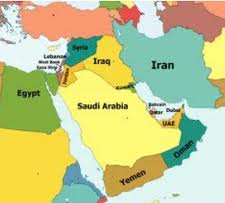
Hence the interview given by a senior IDF officer to a Saudi weekly, Elaph, which laid out how Israel analyzes the present wretched state of the Middle East. In the Israeli view, there are, the officer said, four powers that have coalesced in the region. The first power centers on Iran and its allies and proxies, such as the Bashar al-Assad dictatorship in Syria, Shi’a rebels in Yemen and Iraq, and most pertinently for Israel, Hezbollah in Lebanon. The second power contains what the officer called “moderate” states with whom Israel has “a common language” — Egypt, Jordan and the Gulf countries. The third power, one that is obviously waning, is represented in the form of the Muslim Brotherhood, now vanquished in its Egyptian heartland but still reigning in Hamas-controlled Gaza. Finally, the fourth power is another non-state actor, the combined forces of jihadi barbarism like Al-Qaeda and Islamic State.

Israel’s goal in this situation is a modest one. As the IDF officer put it, “There is a danger that the strife will reach us as well if the instability in the region continues for a long time. Therefore, we need to take advantage of the opportunity and work together with the moderate states to renew quiet in the region.”

The key phrase here, it seems to me, is “renew quiet.” Foremost for the Israelis, that means counteracting Iran and especially its Lebanese proxy Hezbollah, and then minimizing the potential for jihadi terrorists to operate on or near Israeli-controlled territory. A broader strategic vision can also be detected here: Ultimately, both Israel and the conservative Arab states share the common interests of neutralizing Iran and eliminating the jihadi groups.

The partnership between Israel and these states is already in operation, at the levels of intelligence sharing and — not for the first time — cautious exploration of trade relations. That there is a strong military dimension as well to all this is entirely conceivable. And for the time being, it seems that neither side wants to expand or contract on their public ties with each other; Israel has long had embassies in Cairo and Amman, but that doesn’t mean there’ll be an Israeli ambassador in Riyadh anytime soon, much less a film festival or trade expo.

There’s another factor that has accelerated the formation of this undeclared, look-the-other-way alliance: the shift in American Middle East policy under President Barack Obama. Some readers will remember that back in 1991, the first Bush administration pointedly left Israel out of the coalition to expel Saddam Hussein from Kuwait, so as not to antagonize the Gulf states. Now, frustration with Obama has compelled these very same states to recognize that they have an existential interest in cooperating with Israel.

You might say that the president deserves credit for bringing about a situation, in the wake of the nuclear deal with Iran, which has compelled the Gulf states to grasp the reality and permanence of Israel as never before. Still, the visions and prophecies of a Middle Eastern equivalent of the European Union, much indulged during the Oslo Accords years in the late 1990s, are not now in evidence, and that’s welcome. For their own reasons, neither Israel nor the Arab states feel obliged to articulate a sense of what their region should look like in the event that the Iranian threat is overcome.

Indeed, there’s a case that doing so would be counterproductive — it would impose political pressures upon a discreet yet strategically vital relationship that above all requires, in the parlance of the IDF officer, the “moderate” states to remain as moderate states. With the reorientation of American policy towards a rapprochement with Tehran, along with Russia’s active involvement in the Tehran-Damascus axis, Israel is the nearest reliable, not to say formidable, power that these countries can turn to.

In the present Middle Eastern context, then, the realism and discretion which has always underwritten Israeli foreign policy continues to prevail. That realism presumably extends to recognizing that regimes like Saudi Arabia and Bahrain might eventually succumb to their internal instabilities, already exacerbated by the further collapse of the price of oil.

When you consider the alternatives, the region’s architecture could be much worse for Israel than it is currently. Long an anomaly as the only open society in the region, the target of Arab military and economic warfare throughout the latter half of the last century, Israel in this century is now a partner in a regional bloc. To be sure, this is a bloc based upon interests, not common values, and is therefore necessarily limited in scope. But in the present storm, and amidst the appalling human suffering generated by the clash of these rival interests in Syria, it’s the closest thing we have to progress.

Israelis Refused Entry Into Jordan With ‘Jewish Paraphernalia’ in Luggage

December 11, 2015

Israelis Refused Entry Into Jordan With ‘Jewish Paraphernalia’ in Luggage, Algemeiner, Ruthie Blum, December 10, 2015

(Please see also, Trump’s ‘Racist’ Entry Restriction Policy Not Novel, But Response Is. — DM)

885-300x225Three of the Israeli family’s five children at the Jordanian border. The two brothers were not allowed in with their kippot. Photo: Facebook.

An Israeli family on a Hannukah vacation to Jordan was shocked to be turned away at the border, due to the skull caps (kippot) on the heads of the father and two sons, the Israeli site nrg reported on Thursday.

Tamar Gewirtz Hayardeni, the mother of the family, told nrg about the ordeal, after ranting about it on Facebook.

Tamar, a licensed tour guide who has been to Jordan in the past, described the family’s encounter with Jordanian border authorities, who were adamant that the male members of the family not enter the country with their kippot, claiming it was for their own protection.

Gewirtz Hayardeni said she explained to the border guard that the family had not intended to walk around with the kippot on their heads in any case — as a precaution. They insisted they would wear regular hats, while keeping their kippot in their luggage.

This was not sufficient for the border guard, however, according to Gewirtz Hayardeni, who said that at that point, she didn’t know what to do other than consult with her family. As they were weighing their options, their dilemma was solved, she recounted, when another Israeli was led into the room, “charged with attempting to bring tefillin into Jordan” – phylacteries that were discovered by security x-ray.

“That’s when we understood that the Jordanians might want Israelis to come, but not Jews,” she wrote on Facebook. “So we turned around and went back to Israel.”

On the Israeli side of the border, Gewirtz Hayardeni asked the guards and other people working there whether her experience was common. She was told that the Jordanians have begun forbidding all Jewish paraphernalia from entering the country.

Gewirtz Hayardeni expressed disgust and questioned what would happen if Jordanian tourists to Israel were forbidden to enter with headscarves or other Muslim “paraphernalia.”

According to an Israeli Channel 2 report on Thursday evening, Deputy Foreign Minister Tzipi Hotovely intends to investigate the phenomenon with the Jordanian authorities.

Israel and Jordan signed a peace treaty in 1994, which expanded water, tourism and trade cooperation, as well as a commitment to prevent third parties from using either country’s territory as a staging ground for military strikes.

No, the Islamic State Will Not Be Defeated — and if It Is, We Still Lose

November 25, 2015

No, the Islamic State Will Not Be Defeated — and if It Is, We Still Lose, BreitbartBen Shapiro, November 24, 2015

GettyImages-497044984-640x480

Barack Obama has now created an unwinnable war.

While all of the 2016 candidates declare their strategies for victory against ISIS, President Obama’s leading from behind has now entered the Middle East and the West into a free-for-all that cannot end any way but poorly.

The best way to understand the situation in Syria is to look at the situation and motivation of the various players. All of them have varying agendas; all of them have different preferred outcomes. Few of them are on anything approaching the same page. And Barack Obama’s failure of leadership means that there is no global power around which to center.

ISIS. ISIS has gained tremendous strength since Barack Obama’s entry to power and pullout from Iraq. They currently control northern Syria, bordering Turkey, as well as large portions of northern Iraq. Their goal: to consolidate their territorial stranglehold, and to demonstrate to their followers that they, and not other competing terrorist groups like Al Qaeda, represent the new Islamic wave. They have little interest in toppling Syrian dictator Bashar Assad for the moment. They do serve as a regional counterweight to the increasingly powerful Iranians – increasingly powerful because of President Obama’s big nuclear deal, as well as his complete abdication of responsibility in Iraq.

Iran. Iran wants to maximize its regional power. The rise of ISIS has allowed it to masquerade as a benevolent force in Iraq and Syria, even as it supports Assad’s now-routine use of chemical weapons against his adversaries, including the remnants of the Free Syrian Army (FSA). Iran has already expanded its horizons beyond Iraq and Syria and Lebanon; now it wants to make moves into heretofore non-friendly regions like Afghanistan. Their goal in Syria: keep Bashar Assad in power. Their goal in Iraq: pushing ISIS out of any resource-rich territories, but not finishing ISIS off, because that would then get rid of the global villain against which they fight.

Assad. The growth of ISIS has allowed Assad to play the wronged victim. While the FSA could provide a possible replacement for him, ISIS can’t credibly do so on the international stage. Assad knows that, and thus has little interest in completely ousting them. His main interest is in continuing to devastate the remaining FSA while pretending to fight ISIS.

Egypt/Saudi Arabia/Jordan. As you can see, ISIS, Iran, and Assad all have one shared interest: the continued existence of ISIS. The same is not true with regard to Egypt, Saudi Arabia, and Jordan, all of whom fear the rise of radical Sunni terrorist groups in their home countries. They are stuck between a rock and a hard place, however, because openly destroying ISIS on behalf of Alaouite Assad, they embolden the Shia, their enemies. Egypt, Saudi Arabia, and Jordan would all join an anti-ISIS coalition in the same way they did against Saddam Hussein in 1991, but just like Hussein in 1991, they won’t do it if there are no Sunni alternatives available. Tunisia, Saudi Arabia, and Jordan are the top three sources of foreign fighters for ISIS.

Turkey. The Turks have several goals: to stop the Syrian exodus across their borders, to prevent the rise of the Iranians, and to stop the rise of the Kurds. None of these goals involves the destruction of ISIS. Turkey is Sunni; so is ISIS. ISIS provides a regional counterweight against Iran, so long as it remains viable. It also keeps the Kurds occupied in northern Iraq, preventing any threat of Kurdish consolidation across the Iraq-Turkey border. They will accept Syrian refugees so long as those other two goals remain primary – and they’ll certainly do it if they can ship a hefty portion of those refugees into Europe and off their hands.

Russia. Russia wants to consolidate its power in the Middle East. It has done so by wooing all the players to fight against one another. Russia’s involvement in the Middle East now looks a good deal like American involvement circa the Iran-Iraq War: they’re playing both sides. Russia is building nuclear reactors in Egypt, Jordan, Turkey and Iran. They’re Bashar Assad’s air force against both the FSA and ISIS. Russia’s Vladimir Putin doesn’t have a problem with destroying ISIS so long as doing so achieves his other goal: putting everyone else in his debt. He has a secondary goal he thought he could chiefly pursue in Eastern Europe, and attempted with Ukraine: he wants to split apart the North Atlantic Treaty Organization, which he rightly sees as a counterbalance to check Russian aggression. Thanks to today’s Turkish attack on a Russian plane, and thanks to the West’s hands-off policy with regard to the conflict, Putin could theoretically use his war against ISIS as cover to bombard Turkish military targets, daring the West to get involved against him. Were he to do so, he’d set the precedent that NATO is no longer functional. Two birds, one war.

Israel. Israel’s position is the same it has always been: Israel is surrounded by radical Islamic enemies on every side. Whether Iranian-backed Hezbollah or Sunni Hamas and ISIS, Israel is the focus of hate for all of these groups. Ironically, the rise of Iran has unified Israel with its neighbors in Jordan, Egypt, and Saudi Arabia. All three of those countries, however, can’t stand firmly against ISIS.

All of which means that the only country capable of filling the vacuum would be the United States. Just as in 1991, a major Sunni power is on the move against American interests – but unlike in 1991, no viable option existed for leaving the current regime in power. And the US’ insistence upon the help of ground allies is far too vague. Who should those allies be, occupying ISIS-free ISISland?

The Kurds have no interest in a Syrian incursion. Turkish troops movements into ISIS-land will prompt Iranian intervention. Iranian intervention into ISIS-land would prompt higher levels of support for Sunni resistance. ISIS-land without ISIS is like Iraq without Saddam Hussein: in the absence of solidifying force, chaos breaks out. From that chaos, the most organized force takes power. Russia hopes that should it destroy ISIS, Assad will simply retain power; that may be the simplest solution, although it certainly will not end the war within the country. There are no good answers.

Barack Obama’s dithering for years led to this. Had he lent his support in any strong way to one side, a solution might be possible. Now, it’s not.

ISIS launches its winter terror offensive with first 274 deaths

November 13, 2015

ISIS launches its winter terror offensive with first 274 deaths, DEBKAfile, November 13, 2015

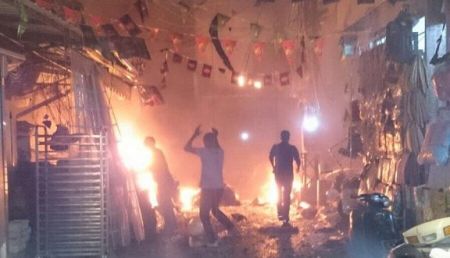
Borj_al-Barajneh12.11.15Suicide bombers strike Hizballah in Beirut
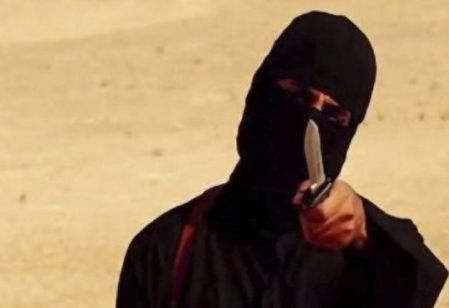
Execution of Steven Sotloff (1983 – 2014) by Jihadi John of ISIS. In August 2013, Sotloff was kidnapped in Aleppo, Syria, and held captive by militants from the Islamic State of Iraq and the Levant. Jihadi John (Mohammed Emwazi, born August 1988) a British man who is thought to be the person seen in several videos produced by the Islamic extremist group ISIL showing the beheadings of a number of captives in 2014 and 2015. (Photo by Universal History Archive/UIG via Getty Images)

Execution of Steven Sotloff (1983 – 2014) by Jihadi John of ISIS. In August 2013, Sotloff was kidnapped in Aleppo, Syria, and held captive by militants from the Islamic State of Iraq and the Levant. Jihadi John (Mohammed Emwazi, born August 1988) a British man who is thought to be the person seen in several videos produced by the Islamic extremist group ISIL showing the beheadings of a number of captives in 2014 and 2015. (Photo by Universal History Archive/UIG via Getty Images)

The US drone strike Thursday night, Nov. 11, targeting the Islamic State’s infamous executioner known as “Jihad John” in the northern Syrian town of Raqqa may or may not have hit the mark – the Pentagon says it is too soon to say. The hooded, masked terrorist with the British accent has been identified as a British Muslim born in Kuwait called Mohamed Emwazi. He appeared on videos worldwide showing the cold-blooded murders of US, British, Japanese and other hostages.

The drone attack occurred shortly after the latest ISIS atrocity: Thursday night, two or three suicide bombers blew themselves up, killing 43 people and injuring at least 240 in the Hizballah stronghold of southern Beirut opposite Burj Barajneh.

Ten days earlier, the Islamic State brought down the Russian Metrojet airliner over Sinai killing all 224 people aboard. This spectacular act of terror was apparently the first strike of the jihadist group’s winter offensive. It achieved its objectives of multiple murder; mortal damage to Egypt’s tourism industry and a blow to the prestige of its president Abdel-Fatteh El-Sisi.

The attack also punished President Vladimir Putin for bringing the Russian military into the center of the Syrian conflict.

The next Islamic State assault was aimed to undermine the credibility of Jordan’s King Abdullah and his security services: On Nov. 8,  a Jordanian police captain opened fire at a high-security US training facility outside Amman, killing two American trainers, a South African and two Jordanians. The number of US personnel injured in the attack was not released. This attack was timed to coincide with the 10thanniversary of the massive al Qaeda assault on Amman’s leading hotels, all American owned, which left 61 dead.

In northern Sinai, the murder of a family of 9 Egyptians at El Arish Thursday morning raised the total of ISIS murders in less than a month to 274.

DEBKAfile’s counterterrorism sources discern three objectives in the attack Thursday night in Beirut

1. A lesson for Tehran and Hizballah’s leader Hassan Nasrallah to show them that the Islamic State is able to reach them on their home ground, no matter how many troops they deploy to fight the jihadis in Syria (Iran and Hizballah together field an estimated 13,000 soldiers in Syria). ISIS was capable of inflicting terrible casualties both on the battlefield and in their homeland, first in Beirut and eventually in Tehran.

2.  The day before, Wednesday, Nov. 11, in a speech marking the “Day of the Shahid,” Nasrallah gloated over Hizballah’s triumph in a battle outside Aleppo. He also boasted that his domestic security shield in Lebanon presented an impenetrable barrier against ISIS or Nusra Front terrorist intrusions.

The Islamic State’s tacticians determined to blow up both claims in Nasrallah’s face. He and Iran were to be shown that they could not stop ISIS or prevent the Syrian war’s spillover into Lebanon.

3.  By blowing up the Russian airliner over Sinai, the Islamists sought to underscore this point for Moscow too. Russia might send a powerful military force to Syria, but the Islamists would hit Putin from the rear at a location of its choosing anywhere in the Middle East. Moscow may have opted to defend Bashar Assad, but what can it do to protect Hizballah and its other allies?.

DEBKAfile’s counterterrorism sources note that US and Russia have taken lead roles in the broad military effort to defeat ISIS – often by means of pinpointed operations. At the same time, under their noses, the Islamist terrorists have launched their winter campaign, striking with extreme ferocity and agility in unexpected places that are outside the regular battle fronts in which the big powers are engaged.