Archive for the ‘Jordan’ category

ISIS launches Ramadan with terror strike in Jordan

June 7, 2016

ISIS launches Ramadan with terror strike in Jordan, DEBKAfile, June 7, 2016

Jordanian mourners carry the body of intelligence corporal Omar al-Hayari, one of the five Jordanian intelligence agents killed during a gun attack at the Palestinian refugee camp of Baqaa, on June 6, 2016 during his funeral in Salt, a town west of the capital Amman. A gunman apparently acting alone killed the five Jordanian agents in a daylight "terrorist attack" on their office in a Palestinian refugee camp north of the capital. Jordan is a leading member of the US-led coalition fighting the Islamic State group in neighbouring Iraq and Syria, and has been the target of previous jihadist attacks. / AFP PHOTO / KHALIL MAZRAAWI

Jordanian mourners carry the body of intelligence corporal Omar al-Hayari, one of the five Jordanian intelligence agents killed during a gun attack at the Palestinian refugee camp of Baqaa, on June 6, 2016 during his funeral in Salt, a town west of the capital Amman./ AFP PHOTO / KHALIL MAZRAAWI

Of all the possible places braced for ISIS terror attacks when Ramadan began, the first attack on the first day of the month-long fast was launched Monday, June 6, in Jordan. Five armed men, in two cars, attacked the Jordanian General Intelligence Command in the Baqaa Palestinian camp, near the capital Amman.

Three armed men left their car, while two remained at the wheel. The three entered the command building and opened fire, killing five intelligence personnel. They then retreated to their cars and drove away.
No organization took responsibility for the attack.

DEBKAfile sources on terrorism report that this ranked as a classical terrorist operation, in which the killers appear suddenly, kill their prey and disappear without leaving traces.

For a country with advanced intelligence and counter terror agencies, which posts armed security personnel at every city corner and junction, backed by the presence of American special forces trained to fight terror targets, this attack was a grave warning.

How did they all come to be caught unawares?

But this was not just a warning for Jordan but for Israel as well.

If armed groups, consisting of Palestinians who joined ISIS, are able to move freely around Jordan, without the local intelligence and security forces catching on, there is no guarantee that killer-squads will not cross the Jordanian-Israeli security fence or infiltrate Israel through the southern Arava border for terror attacks in Israel.

Even though Jordan tries to keep its war against ISIS low profile, the kingdom tops the jihadists’ hit list, ahead even of the Euro-2016 games.

There are several reasons for this:

  1. The Jordanian intelligence’ undercover units behind the front lines of the wars in Iraq and Syria feed the Americans on-site information on ISIS. Data of this high quality is unavailable from any other source.
  2. These units mark targets for US air strikes.
  3. Jordanian intelligence officers engage Sunni tribal chiefs across Iraqi and Syrian borders to persuade them to fight against ISIS. These Jordanian officers have joined the Sunni fighters in the battle for Fallujah in Iraq.
  4. Jordan, with US assistance, is now building one of the longest security fences, 442km, and the most advanced in the Middle East along all its borders with Iraq and Syria.
  5. The westernmost segment of this Jordanian border wall will also serve Israel. It will block off corridors running through the Syria-Jordan-Israel border junction and so hold back ISIS from infiltrating the Golan and the Sea of Galilee region.
  6. Jordan is the only Arab nation to send its air force against ISIS targets in Syria and Iraq.

Just three months ago, on March, the Jordanian security forces raided the Irbid Palestinian refugee camp in northern Jordan, and tackled an ISIS cell set up in the camp, killing seven.

The recent terror attack shows that, while Jordanian intelligence and its special forces are deeply involved in the war against ISIS beyond Jordan’s borders, the terror organization is gaining strength and abilities inside the kingdom, especially among the Palestinian population.

Iran’s Chess Board

June 3, 2016

Iran’s Chess Board, Front Page MagazineCaroline Glick, June 3, 2016

official_photo_of_hassan_rouhani_7th_president_of_iran_august_2013

Even if Obama’s successor disavows his actions, by the time Obama leaves office, America’s options will be more limited than ever before. Without war, his successor will likely be unable to stem Iran’s rise on the ruins of the Arab state system.

********************

Reprinted from jpost.com.

Strategic thinking has always been Israel’s Achilles’ heel. As a small state bereft of regional ambitions, so long as regional realities remained more or less static, Israel had little reason to be concerned about the great game of the Middle East.

But the ground is shifting in the lands around us. The Arab state system, which ensured the strategic status quo for decades, has collapsed.

So for the first time in four generations, strategy is again the dominant force shaping events that will impact Israel for generations to come.

To understand why, consider two events of the past week.

Early this week it was reported that after a two-year hiatus, Iran is restoring its financial support for Islamic Jihad. Iran will give the group, which is largely a creation of the Iranian Revolutionary Guard Corps, $70 million.

On Wednesday Iranian media were the first to report on the arrest of a “reporter” for Iran’s Al-Alam news service. Bassam Safadi was arrested by Israel police in his home in Majdal Shams, the Druse village closest to the border with Syria on the Golan Heights. Safadi is suspected of inciting terrorism.

That is, he is suspected of being an Iranian agent.

There is nothing new about Iranian efforts to raise and run fronts against Israel within its territory and along its borders. Iran poses a strategic threat to Israel through its Hezbollah surrogate in Lebanon, which now reportedly controls the Lebanese Armed Forces.

In Gaza, Iran controls a vast assortment of terrorist groups, including Hamas.

In Judea and Samaria, seemingly on a weekly basis we hear about another Iranian cell whose members were arrested by the Shin Bet or the IDF.

But while we are well aware of the efforts Iran is making along our borders and even within them to threaten Israel, we have not connected these efforts to Iran’s actions in Iraq and Syria. Only when we connect Iran’s actions here with its actions in those theaters do we understand what is now happening, and how it will influence Israel’s long-term strategic environment.

The big question today is what will replace the Arab state system.

Syria, Iraq, Lebanon, Yemen and Libya no longer exist. On their detritus we see the fight whose results will likely determine the fates of the surviving Arab states, as well as of much of Europe and the rest of the world.

Israel’s strategic environment will be determined in great part by the results of Iran’s actions in Iraq and Syria. While Israel can do little to affect the shape of events in these areas, it must understand what they mean for us. Only by doing so, will we be able to develop the tools to secure our future in this new strategic arena.

Until 2003, Saddam Hussein was the chief obstacle to Iran’s rise as the regional hegemon.

US forces in Iraq replaced Hussein until they left the country in 2011. In the meantime, by installing a Shi’ite government in Baghdad, the US set the conditions for the rise of Islamic State in the Sunni heartland of Anbar province on the one hand, and for Iran’s control over Iraq’s Shi’ite-controlled government and armed forces on the other.

Today, ISIS is the only thing checking Iran’s westward advance. Ironically, the monstrous group also facilitates it. ISIS is so demonic that for Americans and other Westerners, empowering Iranian-controlled forces that fight ISIS seems a small price to pay to rid the world of the fanatical scourge.

As former US naval intelligence analyst J.E. Dyer explained this week in an alarming analysis of Iran’s recent moves in Iraq published on the Liberty Unyielding website, once Iranian- controlled forces defeat ISIS in Anbar province, they will be well placed to threaten Jordan and Israel from the east. This is particularly the case given that ISIS is serving inadvertently as an advance guard for Iran.

In Syria, Iran already controls wide swaths of the country directly and through its surrogates, the Syrian army, Hezbollah and Shi’ite militias it has fielded in the country.

Since the start of the war in Syria, Israel has repeatedly taken action to block those forces from gaining and holding control over the border zone on the Golan Heights.

Prime Minister Benjamin Netanyahu’s surprising recent announcement that Israel will never relinquish control over the Golan came in response to his concern that in exchange for a cease-fire in Syria, the US would place that control on the international diplomatic chopping block.

A week and a half ago, Iran began its move on Anbar province.

On May 22, Iraqi forces trained by the US military led Iraq’s offensive to wrest control over Fallujah and Mosul from ISIS, which has controlled the Sunni cities since 2014. Despite the fact that the lead forces are US-trained, the main forces involved in the offensive are trained, equipped and directed by Iran.

As Iraqi forces surrounded Fallujah in the weeks before the offensive began, Qassem Soleimani, the commander of the Revolutionary Guards’ Quds forces, paid a public visit to the troops to demonstrate Iran’s dominant role.

The battle for Fallujah is a clear indication that Iran, rather than the US, is calling the shots in Iraq. According to media reports, the Pentagon wanted and expected for the forces to be concentrated in Mosul. But at the last minute, due to Soleimani’s intervention, the Iraqi government decided to make Fallujah the offensive’s center of gravity.

The Americans had no choice but to go along with the Iranian plan because, as Dyer noted, Iran is increasingly outflanking the US in Iraq. If things follow their current course, in the near future, Iran is liable to be in a position to force the US to choose between going to war or ceasing all air operations in Iraq.

On May 7, Asharq al-Awsat reported that the Revolutionary Guards is building a missile base in Suleimaniyah province, in Iraqi Kurdistan.

A senior IRGC general has made repeated visits to the area in recent weeks, signaling that the regime views this as an important project. The report further stated that Iran is renewing tunnel networks in the region, built during the 1980-88 Iran-Iraq War.

Dyer warned that depending on the type of missiles Iran deploys – or has deployed – to the base, it may threaten all US air operations in Iraq. And the US has no easy means to block Iran’s actions.

To date, commentators have more or less agreed that US operations in Iraq and Syria make no sense. They are significant enough to endanger US forces, but they aren’t significant enough to determine the outcome of the war in either territory.

But there may be logic to this seemingly irrational deployment that is concealed from view. A close reading of David Samuels’s profile of President Barack Obama’s Deputy National Security Adviser Ben Rhodes published last month in The New York Times, points to such a conclusion.

Samuels described Rhodes as second only to Obama in his influence over US foreign and defense policy. Rhodes boasted to Samuels that Obama’s moves toward Iran were determined by a strategic course he embraced before he entered office.

A fiction writer by training, Rhodes’s first “national security” job was as the chief note taker for the Iraq Study Group.

Then-president George W. Bush appointed the group, jointly chaired by former secretary of state James Baker and former congressman Lee Hamilton, in 2006, to advise him on how to extricate the US from the war in Iraq.

In late 2006, the ISG published its recommendations.

Among other things, the ISG recommended withdrawing US forces from Iraq as quickly as possible. The retreat was to be enacted in cooperation with Iran and Syria – the principle sponsors of the insurgency.

The ISG argued that if given the proper incentives, Syria and Iran would fight al-Qaida in Iraq in place of the US. For such action, the ISG recommended that the US end its attempts to curb Iran’s nuclear program.

Responsibility for handling the threat, the ISG recommended, should be transferred to the US Security Council.

So, too, the ISG recommended that Bush pressure Israel to withdraw from the Golan Heights, Jerusalem and Judea and Samaria in the framework of a “peace process.”

Such action too would serve to convince Iran and Syria that they could trust the US and agree to serve as its heirs in Iraq.

Bush of course, rejected the ISG’s recommendations.

He decided instead to sue for victory in Iraq. Bush announced the surge in US forces shortly after the ISG published its report.

But now we see, that through Rhodes the Iraq Study Group’s recommendation became the blueprint for a new US strategy of retreat and Iranian ascendance in Iraq and throughout the Middle East.

The chief components of that strategy have already been implemented. The US withdrawal from Iraq in 2011 left Iran as the new power broker in the country. The nuclear pact with Iran facilitated Iran’s transformation into the regional hegemon.

Against this strategic shift, the US’s minimalist campaigns in Iraq and Syria against ISIS make sense.

The US forces aren’t there to defeat ISIS, but to conceal Iran’s rise.

When ISIS is defeated in Anbar and in Raqqa in Syria, its forces are liable to turn west, to Jordan.

The US is currently helping Jordan to complete a border fence along its border with Iraq. But then ISIS is already active in Jordan.

And if events in Iraq and Syria are any guide, where ISIS leads, Iran will follow.

Iran’s strategic game, as well as America’s, requires Israel to become a strategic player.

We must recognize that what is happening in Iraq is connected to what is happening here.

We need to understand the implications of the working alliance Obama has built with Iran.

Even if Obama’s successor disavows his actions, by the time Obama leaves office, America’s options will be more limited than ever before. Without war, his successor will likely be unable to stem Iran’s rise on the ruins of the Arab state system.

In this new strategic environment, Israel must stop viewing Gaza, Judea and Samaria, the Golan Heights and Lebanon as standalone battlefields. We must not be taken in by “regional peace plans” that would curtail our maneuver room. And we must bear in mind these new conditions as we negotiate a new US military assistance package.

The name of the game today is chess. The entire Middle East is one great board. When a pawn moves in Gaza, it affects the queen in Tehran.

And when a knight moves in Fallujah, it threatens the queen in Jerusalem.

What is happening in Jordan?

June 2, 2016

What is happening in Jordan? Israel Hayom, Mudar Zahran, June 2, 2016

Days ago, King Abdullah II‎ of Jordan dissolved the parliament and appointed a new prime minister.

This came ‎weeks after the king amended the constitution to expand his already swollen authority as the sole ‎ruler, and has launched a wave of speculation in the Western and Israeli media. The media are puzzled and rather clueless about what exactly is happening in my country, Jordan. Some, including respected publications, jumped to the convenient conclusion ‎that the king has “appointed a pro-Israel prime minister” and even that “Israel has a new friend ‎in the Middle East, Jordan’s prime minister.” These statements by ‎themselves are irrelevant to the status quo and the situation in Jordan is much more critical and ‎dire than anyone in the Israeli media realizes.‎

In November 2015, U.S. presidential candidate Hillary Clinton said ‎Jordan’s future was “not clear” and that Palestinians and Israelis needed to know what will ‎happen in Jordan and “whether Jordan will remain stable” before they resume the peace process. Clinton’s tenure as U.S. secretary of state saw anti-regime protests in Jordan, particularly the November 2012 revolution, ‎when a million Jordanians took to the streets demanding that the Hashemite royals leave the ‎country. She knows more about the reality in Jordan from firsthand experience than any other U.S. presidential candidate.

While Clinton’s statements cannot be taken as prophecies from the Torah or the Quran, the facts on the ‎ground do support her concerns for Jordan. As these lines are being written, unrest continues in the ‎Wadi Mousa-Petra area, including gun battles between the king’s police and the locals, arrests, the ‎destruction of vehicles and other property, stone throwing, and rumors of casualties on both sides. In ‎short, there is an intifada at one of Jordan’s most significant tourist sites.

Days ago, King Abdullah II‎ of Jordan dissolved the parliament and appointed a new prime minister.

This came ‎weeks after the king amended the constitution to expand his already swollen authority as the sole ‎ruler, and has launched a wave of speculation in the Western and Israeli media. The media are puzzled and rather clueless about what exactly is happening in my country, Jordan. Some, including respected publications, jumped to the convenient conclusion ‎that the king has “appointed a pro-Israel prime minister” and even that “Israel has a new friend ‎in the Middle East, Jordan’s prime minister.” These statements by ‎themselves are irrelevant to the status quo and the situation in Jordan is much more critical and ‎dire than anyone in the Israeli media realizes.‎

In November 2015, U.S. presidential candidate Hillary Clinton said ‎Jordan’s future was “not clear” and that Palestinians and Israelis needed to know what will ‎happen in Jordan and “whether Jordan will remain stable” before they resume the peace process. Clinton’s tenure as U.S. secretary of state saw anti-regime protests in Jordan, particularly the November 2012 revolution, ‎when a million Jordanians took to the streets demanding that the Hashemite royals leave the ‎country. She knows more about the reality in Jordan from firsthand experience than any other U.S. presidential candidate.

While Clinton’s statements cannot be taken as prophecies from the Torah or the Quran, the facts on the ‎ground do support her concerns for Jordan. As these lines are being written, unrest continues in the ‎Wadi Mousa-Petra area, including gun battles between the king’s police and the locals, arrests, the ‎destruction of vehicles and other property, stone throwing, and rumors of casualties on both sides. In ‎short, there is an intifada at one of Jordan’s most significant tourist sites.

In addition, anti-regime ‎protests take place every Friday, yards away from the king’s palace. Those protests are not ‎continuous, but they are a regular occurrence and likely to grow. Protests against Egyptian President Hosni Mubarak began in the same ‎way in 2004, and 10,000 protests later, a one-strike revolution toppled him in ‎‎2011, the same year that the current protests in Jordan began.‎

Jordan’s debt-to-GDP ratio is above 90%. Greece’s economy collapsed when it hit ‎the same rate, and the Jordanian regime is not getting the help from Arab states that Greece got from the European Union. Nevertheless, the Jordanian royal family spends beyond belief and is not shy about showing off its opulent lifestyle to its starving subjects.‎

Less than a month ago, Jordan’s king visited our Saudi brothers and came back speaking ‎about billions of Saudi riyals “on the way.” None of this has yet materialized. While these ‎things do take time, Saudi King Salman‎ announced a $25 billion aid package to the el-Sissi regime half an hour ‎after the king’s arrival in Egypt in April. ‎

There are also no signs or news of aid money coming from the ‎Gulf states. Our Arab brothers are wise; they won’t give their money to an ailing regime.‎

On the other hand, the king has been fragile for years now, and many — myself included — have ‎predicted his fall, yet he remains on the throne in Amman. So why should anyone worry that ‎the king might fall now?

In fact, the situation has completely changed.‎

Today, Jordan’s army is independent of the king, and so is Jordan’s intelligence service. Both are tightly coordinated with the U.S. Central Command. When the Islamic State group became a real threat to Jordan, ‎the U.S. must have realized it could no longer tolerate the king’s recklessness, inexperienced ‎handling of security, and mismanagement of Jordan’s military operations and funds. Thus, the ‎U.S. supported separating the army and intelligence apparatus from the king’s influence. This happened trough tight and direct cooperation between the Jordanian and U.S. militaries, and between Jordanian and U.S. intelligence agencies, particularly the U.S. Defense Intelligence Agency.‎

This new arrangement might explain the record-smooth cooperation between Jordan and Israel on ‎security, which is described in the Israeli media as “unprecedented.” Yes, it is unprecedented, ‎because the king no longer has any influence over the army or intelligence service.‎

Further, the U.S. has announced it is about to finish building a massive security wall separating ‎Jordan from Syria and extending along the Iraqi borders. This little-publicized wall will be fully ‎operational in August, according to its contractor, Raytheon, at a cost of over $500 million. At the same time, Israel is quickly and publicly building a $1 billion wall ‎along its border with Jordan.‎

These measures, taken by the U.S. and Jordanian armies, suggest that both are expecting major change in ‎Jordan. The outcome should be safe; Islamic State cannot take over Jordan with thousands of American soldiers stationed ‎in several major U.S. bases across Jordan. ‎

Meanwhile, Jordan’s king sees firsthand signs that his angry, hungry, and hopeless ‎people could actually topple him, and with him having no control over the army now, the king ‎could face a situation like that of Egypt’s 2011 revolution, which was supported by the ‎Egyptian army.‎

Afraid and helpless, Jordan’s regime has turned to the oldest trick in the book: beating the Israeli ‎drum. The regime knows that if a new intifada breaks out in Israel, this ‎could buy it more time in power; the world would be too busy to let it go and Jordan’s ‎public would be distracted by anti-Israel hatred once again. This might explain why an official Israeli ‎statement on Sept. 21, 2015, confirmed that “Jordan was a major contributor to Temple ‎Mount tension” and accused Jordan’s government of exacerbating tensions in Jerusalem with ‎inciting statements and actions.‎

In November 2014, I published an article in which I warned that Jordan’s regime was ‎planning to set the West Bank and Jerusalem on fire in order to stay in power. Also, a month ‎before the “knife intifada” broke ut, I noted several times on social media that Jordan’s ‎regime was going to launch unrest in Jerusalem itself.‎

Change is coming to Jordan. It could be tomorrow morning or in five years, but the ‎Hashemites already have a one-way ticket out, and it seems they are now purposely ‎causing damage to Jordanian, alestinian, American and Israeli interests. ‎

It is about time the few pro-Hashemite hopeless romantics wake up and smell the strong ‎Jordanian coffee already brewing in Amman.‎

As far as the Israeli government is concerned, it has been clear from the beginning: The Israelis ‎will not be involved in the Arab Spring or its aftermath, and will keep good ties with Jordan’s ‎regime, military and intelligence agencies, without any involvement in Jordan’s internal politics. As ‎Jordan’s opposition, we highly appreciate Israel’s stance and fully understand it.‎

As we expect change in Jordan, we must work hard to make sure Jordan remains committed ‎to peace while it becomes economically prosperous and gives hope to all its citizens.‎

Mudar Zahran is secretary-general of the Jordanian Opposition Coalition. Twitter ‎@mudar_zahran.

Muslim Countries Slam Israel—For Protecting them

April 28, 2016

Muslim Countries Slam Israel—For Protecting them, Front Page MagazineP. David Hornik, April 28, 2016

OIC

On Tuesday the Organization of Islamic Cooperation held an “emergency,” “extraordinary” meeting in Jeddah, Saudi Arabia.

The OIC includes violence-wracked countries and failed states like Syria, Iraq, Yemen, Libya, Afghanistan, Nigeria, and others, as well as severely poor and dysfunctional countries like Burkina Faso, Somalia, Bangladesh, and others. Not a single one of the organization’s 57 countries is a frontrunner in terms of freedom and prosperity, and most are far below that level.

But the topic of Tuesday’s “emergency meeting” was that on April 17 Israeli prime minister Benjamin Netanyahu said that: “Israel will never withdraw from the Golan Heights.”

The meeting’s final communiquéCondemns strongly Israel, the occupying power, and its macabre acts to change the legal status, demographic composition, and institutional structure of the occupied Syrian Golan.” It also “expresses unconditional support for the legitimate right of the Syrian people to restore their full sovereignty on the occupied Syrian Golan.”

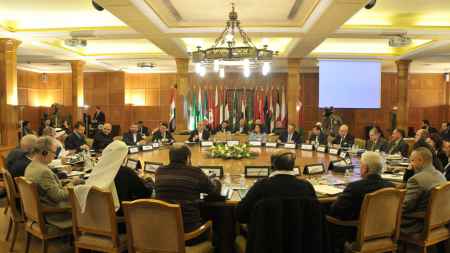
The Arab League—whose 22 member states make up a sizable chunk of the OIC—had already weighed in on Netanyahu’s words on April 21, calling for a special criminal court to be set up and put Israel on trial for the transgression.

The Golan was controlled by Syria from 1948 to 1967, during which time Syrian gunners often fired at the Israeli communities below and forced their residents to sleep in bomb shelters. Israel captured the Golan from Syria in the 1967 Six Day War—and fortunately, since then, has kept it and developed it.

Today, with Syria devolved into Hobbesian war and fragmentation, the Heights are all the more strategically vital to Israel, and the idea of trading them for “peace” has—at least in the Israeli discourse—died a well-deserved death. The Golan, by the way, constitutes less than 1 percent of Syrian territory, and Syria’s loss of it almost 50 years ago is the least of its problems.

But there is further irony in the Arab League’s and the OIC’s reactions to Netanyahu’s words.

At present, Israel is engaged in tight strategic cooperation with two of its neighbors—Egypt and Jordan—against ISIS, one of the two most dangerous of the entities now fighting it out in Syria. More broadly, according to numerous reports, as well as hints dropped by Israeli and some Arab leaders, Israel and Sunni Arab states—led by Saudi Arabia—are also working together against the Iranian axis, the second of the two most threatening forces now operating in Syria.

Not only, then, do the Arab and Muslim countries as corporate bodies denounce Israel as a “macabre” criminal even as it acts as a crucial ally of not a few of these countries. They also react with outrage to the very Israeli policy—retaining the Golan—that keeps Israel strong in the face of the threats emanating from Syrian territory.

The signers of Tuesday’s communiqué in Jeddah know that there no longer exists a “Syrian people” to which sovereignty on the Golan could be restored. Some of the signers also know that a strong Israel is now one of the guarantors of their survival; and more specifically, that Israel’s presence on the Golan helps shield Jordan from imminent peril.

That Netanyahu’s words about keeping the Golan continue to spark fierce denunciations, then, reflects something deeper: an ongoing, profound antipathy to Israeli—that is, Jewish—control of any land in what is seen as, by rights, a Muslim domain. From that standpoint, even for Israel to hold onto a sliver of what used to be Syria, won in a defensive war almost half a century ago, is intolerable.

That same antipathy was on display earlier this month when seven Arab countries—including Egypt—got UNESCO to pass a particularly vicious resolution negating any Jewish connection to Judaism’s most sacred sites in Jerusalem, declaring them exclusively Muslim sites, and going so far as to accuse Israel of “planting Jewish fake graves in…Muslim cemeteries.” (Among the “yea” votes: France, Spain, and Sweden.)

These rhetorical eruptions suggest that, despite the growing behind-the-scenes collaborations, Israel remains very far from being accepted and legitimized in the region. Its best bet is to keep building its power, which gets some of its neighbors to deal with it pragmatically and rationally.

As for the Arab and Muslim countries, their continuing hang-up with the geographically tiny Jewish state, and repeated displays of ganging up on it in righteous fury, are unedifying and linked to their inability to tackle their real problems.

Debate In Jordan On Syrian Refugees’ Future In The Country – From Fear They’ll Be Naturalized To Calls For Integrating Them Into Jordanian Society

April 28, 2016

Debate In Jordan On Syrian Refugees’ Future In The Country – From Fear They’ll Be Naturalized to calls for integrating them into Jordanian Society, MEMRI, Z. Harel*, April 28, 2016

Introduction

Since the onset of the war in Syria, refugees have flocked to Jordan. Some have been housed in refugee camps, but the vast majority settled throughout the country, burdening its society and economy – the latter of which is based primarily on foreign aid. Jordan has taken in massive waves of immigration over the years, mostly Palestinians and Iraqis, and with the influx of refugees from Syria is facing a huge financial burden as well as the demographic, social, economic, and political ramifications of their arrival and their presence.
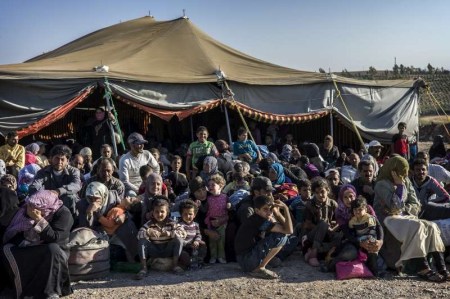
27813Syrian refugees in Jordan (Image: Unhcr.org)

The Jordanian media have been increasingly occupied with the issue of the Syrian refugees and their future in the kingdom, particularly following two major events. First, the Jordanian census, conducted in late 2015, showed that non-Jordanians comprise some 30.6% of the population, and that the approximately 1.3 million Syrian refugees in the country now total about 13.2% of the population.[1] According to a special supplement in the official Jordanian daily Al-Rai on the issue of the Syrian refugees, 62% of them in Jordan are not registered with the UN High Commissioner for Refugees (UNHCR), meaning that the organization is not bearing the expenses that they incur in the kingdom. Furthermore, some 80% of the refugees reside not in refugee camps but in Jordanian cities and villages, and therefore receive the same services, such as education and healthcare, as Jordanian citizens do.[2]

The second event was the Supporting Syria and the Region Conference, held in London in early February 2016, on the issue of Syrian refugees in countries bordering Syria. The conference, sponsored by the UK, Kuwait, Germany, Norway, and the UN, was attended by 70 heads of state and international organizations.[3] Prior to the conference, Jordan made every effort to increase awareness of its situation: Jordanian officials, including King Abdullah II, met with officials from all over the world and explained in detail the economic and social challenges that Jordan is facing because of the refugees.[4] At the conference it was agreed to guarantee Jordan was $2.1 billion in grants for development of infrastructure and $5.7 billion in loans for reducing its deficit.

These two events sparked a lively public debate in Jordan on the issue of the refugees, including dozens of articles in the Jordanian press, where Jordanian writers discussed the ramifications of the refugee presence in the kingdom. Some were critical of the international community for making Jordan responsible for them while doing little to help either the refugees or Jordan. Many expressed concern that the refugees would be granted Jordanian citizenship, to the detriment of Jordan’s existing citizens, and argued that the interests of Jordan and its existing citizens should take priority. However, following the London conference, several articles called for accepting the new reality and for seeking ways for Jordan to benefit from it.

This report will review the public debate in Jordan on the issue of the Syrian refugees:

Concern For The Interests Of Jordan And Its Citizens, Fears Of Refugee Naturalization

A substantial part of the debate on the refugees centered on the need to deal with the problem while prioritizing the interests of the kingdom and its citizens. A common motif in statements by Jordanian officials, and in articles in the press, was that Jordan has already done much more for the refugees than its limited economic resources allow. The debate also focused on the duration of the refugees’ stay in Jordan, highlighting fears that they would be naturalized.

King Abdullah: We Are At The Limit Of Our Capacity To Bear This Burden

In his opening remarks at the Supporting Syrian and the Region Conference in London, Jordan’s King Abdullah II spoke of how the Jordanian people have suffered because of the refugee crisis, saying: “…[L]ooking today into the eyes of my people and seeing the hardship and distress they carry, I must tell you: We have reached our limits. I represent the people of Jordan. Their well-being and safety are my first priority. Our country will continue to do what we can to help those in need, but it cannot be at the expense of our own people’s welfare.”[5]
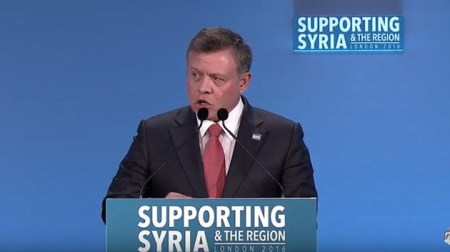
27814King Abdullah II at the Supporting Syria and the Region Conference (Al-Ghad, Jordan, February 5, 2016)

On the eve of the conference, the king told the BBC in an interview that he expects the Syrian refugees to remain in Jordan for an extended period – “at least 17 years.” He stressed that the aid Jordan would receive from the international community would also be crucial for Jordanian citizens, not just the Syrian refugees: “If we are going to create jobs for Syrians, and bring them as part of our labor force, I know it is sometimes considered, has been considered over the years, as unpopular. Refugees, when they come to a country will stay for a long period of time, UN figures say at least 17 years, so whether we like it or not Syrian refugees are going to be part of our country for some period of time to come. So they have to be integrated into the labor force, everybody knows that. But as we go to this conference, if you are going to create a job for Syrians, you have got to create more jobs for Jordanians. So we are going to this conference in that respect. You can’t just do it for Syrians and ignore the Jordanians. That’s part of the process…”[6]

In January, Jordanian Royal Court Chief Fayez Al-Tarawneh met with Jordanian intellectuals to discuss the Syrian refugee issue; his statements at that meeting caused a stir and sparked criticism. He called for a halt to complaints about the presence of refugees in the kingdom, and hinted that Jordanians must eventually accept the “Syrian element” in the country because it would likely be there for at least a decade.[7] In response, Jordanian MP Bassam Al-Batoush protested against Al-Tarawneh’s use of the term “Syrian element,” calling this a dangerous development in official discourse that prepares the ground for the naturalization of Syrian refugees in Jordan. He expressed concern about an obliteration of the Jordanian identity and about Jordanians becoming a minority in their own country.[8] At a parliamentary session following the Supporting Syria and the Region Conference, several MPs expressed concern that the aid promised to the kingdom was conditional upon bringing refugees into the labor force, and demanded that the aid guaranteed to Jordan in the conference would be used to cover the budgetary deficit.[9]

This desire to give preference to Jordan’s interests in dealing with the refugee crisis, as well as the fears regarding Jordan’s future, were also apparent in the press. Several articles also expressed concerns regarding the permanent resettlement of refugees in the kingdom, the marginalization of Jordanian laborers by Syrian refugees in the job market, and of the kingdom’s inability to bear the costs of the refugee presence.

Columnist: “The Human Torrent, Which Could Drown Our Country And Harm Our Sovereignty, Terrifies Us”

Tareq Masarwa, a columnist for the official Jordanian daily Al-Rai, wrote about Palestinian and Iraqi refugees’ settlement in Jordan, and warned that many Syrian refugees would likewise prefer to remain there permanently. He wrote: “The end of the fighting in Syria will not prompt all the refugees to return [there], since people, like trees, cannot live without putting down roots in the soil, particularly after years of living as refugees… When the Syrian war ends, many [refugees] will return, but many [others] will remain…

“We in Jordan are people of tolerance, honor, and Arabism, but the human torrent, which could drown our country and harm our sovereignty, terrifies us… Everyone is welcome, provided they do not harm the rights of Jordanians to their own country, and their exclusive right to defend its constitution, its army, its security, its stability, and its national honor.”[10]

Former Jordanian Minister: We Fear That The World Will Place The Burden Of Refugees On Jordan At The Expense Of Its Citizens

Former Jordanian government spokesman and minister of media and communication Samih Al-Ma’aytah, who now heads the board of directors of Al-Rai, also expressed apprehensions about granting the refugees citizenship in Jordan, based, he said, on past experience with Palestinian refugees. He wrote: “The term ‘naturalization,’ that is linked first and foremost to the Palestinian issue, is causing concern among the Jordanians. This is because it is the interest of the Zionist occupation to resettle the sons of Palestine outside its borders, so that they hold other citizenships and actualize their political and national rights at the expense of other countries and other peoples. Jordan and its citizens, and the Palestinians, are the main victims of the ‘naturalization’ issue, because it is only the Zionist side that stands to gain from it.

“Today, this [issue] is reemerging in the lives of the Jordanians, but in the context of the Syrian refugees. We have all begun to hear about ideas coming from others, informing the Jordanians that they have to prepare for the process of naturalizing their displaced Syrian brothers. And, as with all ‘naturalization’ efforts, in which the Jordanians have become well versed, they begin with a first dance [step], and we all know how they end. The first step in preparing the ground [for ‘naturalization’] is to make us believe that because no solution for the Syrian crisis is on the horizon, our Syrian brothers will remain in Jordan forever, becoming elements in [its] economic, social, and demographic situation…

“We fear that the world, which opened its gates [to the refugees] cautiously and in a measured fashion, [now] wants to place the burden of this crisis on the countries that border Syria, chiefly Jordan, while taking advantage of these countries’ economic situation. Naturalizing these millions will gradually become the [final] objective, that will [necessarily] come at the expense of the citizens of these countries and their rights to work, education, and healthcare – even at the expense of a safe life. This will be in exchange for aid and economic relief that might end at any given moment…

“Today maybe they say that we must [provide] employment [for the refugees] and tomorrow we will hear that [we must provide them] with temporary passports. The day after that, [they will demand equal rights] for the children of Jordanian women married to Syrian men.[11] The [aid] given to Jordan will not reach Jordanian [citizens], because the cost of hosting [refugees] is far greater than the [aid] provided by the international community – which is given today, but may not be given tomorrow.”[12]

Writer: Hosting Refugees Must Not Come At The Expense Of Citizens Of The Host Country

On the eve of the Supporting Syria and the Region Conference, Al-Ghad writer Fahd Al-Khitan called for directing the conference first and foremost towards dealing with the interests of Jordan and its economy. He wrote: “Now that the [Syrian] crisis has entered its fifth year with no solution in sight, the countries hosting [Syrian refugees] and the international community must come up with a new, creative approach for dealing with this long-term challenge, and must manage a refugee crisis that will last many years, until Syria’s security stabilizes. Therefore, they must start to think of replacing emergency aid programs with other frameworks that take into account a long stay by refugees [in their host countries], and that provide [them] with the chance of a dignified life.

“[However,] all this must not come at the expense of citizens of the host countries, whose suffering has increased as a result of the stiff competition for jobs and the state budget’s inability to provide development needs and services to areas where the population has, in some cases, doubled, such as the cities and towns in the North…

“An unemployed Jordanian citizen will have a hard time seeing his Syrian brother hired for a project while he himself is not given the same opportunity. This situation will create, in the medium term, many problems and complications that we don’t need…”[13]

Columnist: In Job Market, Jordanians Should Take Priority Over Syrians

Al-Rai columnist ‘Issam Qadamani also addressed the issue of hiring Syrian refugees in Jordan, arguing that when it comes to hiring, Jordanians should be prioritized: “The issue of hiring Syrian refugees in Jordan will be discussed at the donor conference in London [i.e., the Supporting Syria and the Region Conference], and has already been a main topic of discussion for UN officials who visited Jordan in recent weeks. But what of the hiring of Jordanians as well?…

“[I] support the notion that Syrians should be employed, as part of a job market that is open to all, but that preference should be given to Jordanians. This, however, will require large-scale and permanent investments and projects, open commercial trade routes, and markets that are ready for consumption [of goods]. These can only be achieved with true aid from the international community, without raising the bar of expectations. Jordan must not meet the demands of the international community if it does not meet its own needs.”[14]

Criticism Of Insufficient International And Gulf Aid For Jordan

Along with concern for Jordan’s interests, several Jordanian writers criticized the international community, claiming that it itself was not doing enough to deal with the Syrian refugee crisis, and that it was failing to provide enough aid to Jordan that was buckling under the weight of the refugee burden, leaving it to its own devices and even demanding that it take in more. Others complained that the Gulf states, despite their wealth, are not helping Jordan, and are themselves refusing to bring Syrian refugees into their job markets even though they hire large numbers of foreign laborers.[15]

Al-Ghad Editor: International Aid To Jordan Is Insufficient

Jumana Ghanimat, editor-in-chief of the daily Al-Ghad, criticized the scope of the aid guaranteed to Jordan at the Supporting Syria and the Region Conference, calling it insufficient. She wrote that only a small portion of the aid – $2.1 billion – was in grants, while the rest – $5.7 billion – was in the form of loans: “The large scale of loans compared to grants proves that the world has yet to feel truly responsible for the refugees and for the suffering experienced by them and by their hosts. The Europeans should expect further movement of refugees in their direction, because the aid they provided is insufficient.”[16]

Al-Ghad Writer To UN Envoy: What Will You Offer Jordan In Return For Your Request That We Accept More Refugees?

Al-Ghad writer Fahd Al-Khitan criticized UNHCR High Commissioner Filippo Grandi’s demand that Jordan increase the number of Syria refugees in its territory: “Mr. Grandi yearns for Jordan to agree to increase the number of Syrian refugees it accepts, ‘without this affecting the security situation in Jordan.’ In other words, the high commissioner wishes to be generous to the Syrian refugees, at Jordan’s expense…

“Let’s be reasonable, Grandi: A country with limited resources like Jordan, which must deal with dangers from every direction and with struggles to ensure its own stability, cannot let just anyone do as they please [there]. Let us ask, with all due respect: What aid have you up your sleeve for Jordan, in return for your request that we accept more refugees? Dozens of UN officials before you have already made a mockery of us – coming to Amman, visiting the Al-Za’atari refugee camp, praising our generous hospitality, showering us with compliments – and then leaving, with promises [to give us] millions [of dollars], of which we have so far seen nothing…

“Jordan’s capability to absorb [refugees] cannot be exceeded – in fact, it already has been exceeded, and Jordan now has a grave demographic problem that prevents it from maintaining its open-border policy. This comes in addition to the harsh economic situation, and to the worrying indications that the Syrian struggle will be continuing for an unknown period of time. We realize that the solution to the Syria situation is not in the hands of Grandi and the UN; it is also not in the hands of Jordan, unless the international community intends to evacuate all Syria’s residents [to Jordan] as a radical solution for the conflict. If this is the line of thinking, then we have already done more than our part.”[17]
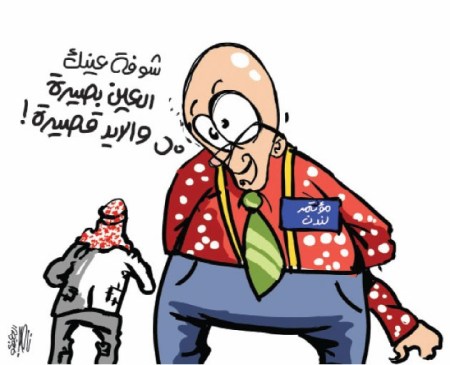
27815“The London Conference” tells Jordan that it cannot have the aid it wants: “The eye sees [what it wants], but the hand cannot provide it” (Al-Ghad, Jordan, February 4, 2016)

Al-Dustour Columnist: U.S., Europe Are Responsible For Refugees’ Sorry State

Al-Dustour columnist Ibrahim ‘Abd Al-Majid Al-Qaisi wrote:  that the wealthy U.S. and European countries are responsible for the Syria crisis, and rebuked them for complaining about the refugees who have arrived in the West: “Our country is a kind of refuge, and is expected to remain one at the expense of our livelihood, future, and security… We are not grumbling or complaining about the arrival of our brothers from Syria. On the contrary – they are brothers who escaped death and have arrived in Jordan. But who is it that expelled them, destroyed their country, and still delays finding a solution for the Syrian problem? It is the international community and the superpowers, led by the U.S. and Europe – who, despite their great economic capabilities, were angered… when a few Syrian refugees – not even half the number of Syrian refugees and other Syrians who came to Jordan – fled to their soil.”[18]

Senior Al-Rai Writer: Impoverished Jordan Houses Refugees, Wealthy Gulf States Do Not

After Al-Rai’s publication of the 2015 Jordanian census statistics, senior journalist Fahed Al-Fanek, former Al-Rai board of directors head, complained about foreign countries’ limited aid to Jordan, and also criticized the Gulf states’s failure to help on this issue: “The initial data published by Al-Rai regarding the census show that Jordan, which lacks natural resources, including oil and water, and lives day to day thanks to foreign aid and grants it receives, has been given the role of warehouse for many who choose to leave their homeland and live elsewhere though they were not expelled or threatened… After every such wave [of immigration], donor countries quickly provided financial aid to Jordan to help it swallow this bitter pill, but then stopped the aid in anticipation of another wave.

“Why does Jordan open its gates freely to this intensive movement of refugees from Syria, while the wealthy Gulf states, which need workers and which import them from around the world, do not open their borders to Arab refugees[?] Especially considering that some of these countries are helping fund and support the violence in Syria, and should bear the consequences.”[19]

Calls For Accepting Reality Of Refugees Remaining In Jordan, And For Attempting To Benefit From It

Following the Supporting Syria and the Region Conference, some accepted that the refugees would be remaining in Jordan for a long time, perhaps even permanently. They suggested leveraging this into benefit for the country by developing the labor market, transforming refugees into consumers buying local goods, and integrating them into industry and trade projects.

Former Foreign Minister: Refugees Can Be Useful If We Utilize Aid Money To Create Jobs

Former Jordanian foreign minister Marwan Al-Mu’asher called on the country to benefit from the refugee crisis by coming up with a strategic development program using aid funds to create jobs for both Jordanians and Syrian refugees. He wrote in Al-Ghad: “It is not enough to demand additional foreign aid [from the international community], even though it is vital. It is more important that we use this aid to implement a development program that substantially increases the Jordanian economy’s ability to create new jobs… If we do not use the additional money [from foreign aid], whatever its sum, to invest in development, which will jumpstart job creation for Jordanians and Syrians, then we will face a very difficult challenge in all senses, economic, security, and social…

“This crisis can be turned into an opportunity. We can benefit from the potential of the Syrian refugees, while at the same time creating jobs for Jordanians. But this requires a smart economic policy that does not tackle each issue individually, but rather as part of a comprehensive strategic perspective that takes into account these refugees’ remaining among us for 20 years…”[20]

Al-Ghad Columnist: Providing Refugees An Opportunity To Integrate Into Society Is A National Interest

Al-Ghad columnist Ayman Al-Safadi argued that providing Syrian refugees with an opportunity to integrate into Jordanian society was a national interest, and was also the only thing that would ensure that their impact on Jordanian society would be positive: “Jordan will not naturalize Syrian refugees. This is known to anyone versed in Jordanian politics. However, it is also a fact that most refugees will not be leaving any time soon…

“Thousands of the Syrians’ children will grow up in Jordan. Educating them, and taking responsibility for providing them with tools to participate productively in society, are a [Jordanian] national interest. The alternative is living together with a huge number of frustrated, angry, and unproductive young people – constituting a social danger that begins with a heavier economic burden – dozens of times heavier – on the state, and will not end with the spread of crime and the creation of a miserable environment that terrorists will exploit to spread their falsehoods and lies…

“Today, we need a policy based on acceptance of the reality that the refugees are here to stay, for many years… Some have criticized the decision to find ways to employ them. Such criticism disregards the fact that giving them jobs is 10 times better than focusing on [providing] humanitarian aid, since they will surely remain [in Jordan] for who knows how long. Syrian refugees will not become Jordanian citizens, but they have already become a part of the society, influencing it as it influences them. Opportunities for education, employment, and dignified lives are the only guarantee that they will have a positive impact. This is in anticipation of the day when they can return to their homeland – [but] the wait for that day will be long.”[21]

Al-Ghad Columnist: Syrian Refugees Are A Source Of Income And A Chance To Build The Economy

Similarly, Ibrahim Ghuraiba wrote in Al-Ghad that the refugees should be integrated into the society and into the country, becoming a productive workforce that would benefit the country, expand its sources of income, and develop its economy: “We can translate the phenomenon of Arab refugees in Jordan into advancements in the economy, new sources of income, and more. The arguments [that they pose] an economic and social threat, or that they threaten the fundamental sources of income, are baseless, since the economy today relies on human resources more than on natural resources…

“Naturally, there is nothing wrong with asking for aid and grants to absorb the refugees, but this will not provide substantial help for the national economy or the refugees. But what can help both Jordan and the refugees is transforming the existing manpower into a source of income and business, so that it advances the economy and increases the refugees’ [quality of] life, making them productive individuals who are helping both themselves and the country. This is not difficult [to do]…

“The Egyptians,’[22] Syrians’, and others’ entry into [Jordan’s] job market will increase [the quality and quantity] of goods and services, foster competition, and protect the consumer. When refugees and non-citizen residents become a productive workforce, they create a series of revenues that will increase the GDP, [strengthen] the economy, and improve [quality of] life. This is because they will be consumers paying taxes, purchasing goods, renting, and consuming services and products, thus increasing the country’s revenue, markets, and existing services, and adding additional income…

“It is known, of course, that an increase in the population also increases the opportunities to establish institutions, and [increases] the number of talented innovators and entrepreneurs. [It also] expands the markets, and streamlines industry and trade projects. In order to make the refugees a source of economic development and prosperity, we need nothing more than good intentions and a scrap of proper and honest management.”[23]

* Z. Harel is a research fellow at MEMRI.
Endnotes:

[1] Al-Ghad (Jordan), January 31, 2016.

[2] Al-Rai (Jordan), February 2, 2016.

[3] Aljazeera.net, February 3, 2016.

[4] Jordanian Foreign Minister Nasser Judeh met with the EU’s Foreign Affairs Committee in Brussels, which included 28 EU foreign ministers and King Abdullah met with UNHCR High Commissioner Filippo Grandi. Al-Rai (Jordan), January 19, 2016. Jordanian Minister of Planning and International Cooperation ‘Imad Al-Fakhoury travelled to Germany and France. Al-Rai(Jordan), January 21, January 26, 2016. He also met with the international affairs advisor of the U.S. Deputy Secretary of the Treasury to discuss American aid to Jordan. Al-Rai (Jordan), January 26, January 26, 2016.

[5] Jordanembassyus.org, February 4, 2016.

[6] Kingabdullah.jo, February 2, 2016.

[7] Al-Quds Al-Arabi (London), January 24, 2016.

[8] Allofjo.net, January 29, 2016.

[9] Al-Ghad (Jordan), February 10, 2016.

[10] Al-Rai (Jordan), February 3, 2016.

[11] This is a reference to previous processes involving Palestinian refugees in Jordan. “Children of Jordanian women married to foreign men” is a common term in Jordanian media, and refers to the offspring of Jordanian women who married foreigners, mostly Palestinians. These men are not citizens, and their children also do not enjoy full citizen rights.

[12] Ammonnews.net, February 6, 2016.

[13] Al-Ghad (Jordan), January 31, 2016.

[14] Al-Rai (Jordan), January 31, 2016.

[15] See MEMRI Special Dispatch No. 6153, Arab Press Reacts To Syrian Refugee Crisis: Condemnation Of Arab Indifference, Calls For Internal Reform, Alongside Criticism Of West, U.S., September 8, 2015.

[16] Al-Ghad (Jordan), February 6, 2016.

[17] Al-Ghad (Jordan), January 20, 2016.

[18] Al-Dustour (Jordan), February 4, 2016.

[19] Al-Rai (Jordan), January 13, 2016.

[20] Al-Ghad (Jordan), March 30, 2016.

[21] Al-Ghad (Jordan), February 21, 2016.

[22] The late 2015 census data indicated that there are 636,000 Egyptian workers in Jordan. Al-Ghad (Jordan), January 31, 2016.

[23] Al-Ghad (Jordan), February 20, 2016.

GCC leaders reject Obama’s Middle East policy

April 23, 2016

GCC leaders reject Obama’s Middle East policy, DEBKAfile, April 23, 2016

Big Bomber


DEBKAfile’s intelligence sources and its sources in the Gulf report exclusively that US President Barack Obama failed to convince the leaders of the six Gulf Cooperation Council member states, during their April 22 summit in Riyadh, to support his Middle East policy and cooperate with Washington.

Our sources also report that Saudi Arabia, with Turkey’s help, and the US carried out separate military operations several hours before the start of the summit that showed the extent of their differences.

The US on Thursday started to use its giant B-52 bombers against ISIS in an attempt to show Gulf leaders that it is determined to quash the terrorist organization’s threat to Gulf states. The bombers deployed at Qatar’s Al Udeid airbase attacked targets around Mosul in northern Iraq, but the targets were not identified.

Meanwhile, Saudi Arabia and Turkey, which recently established a bloc along with Egypt and Jordan to oppose Obama’s Middle East policy, started to infiltrate a force of 3,500 rebels back into Syria.

The force has been trained and financed by the Saudis at special camps in Turkey and Jordan. Members of the force are now fighting alongside other rebels north of Aleppo, but they are being bombed heavily by the Russian and Syrian air forces.

Riyadh sent the rebels into Syria to demonstrate to Obama that the Saudi royal family opposes the policy of diplomatic and military cooperation between the US and Russia regarding Syria that enables President Bashar Assad to remain in power in Damascus.

Since the war in Syria began in 2011, Obama has promised countless times that Washington would train and arm Syrian rebel forces outside the country, and then deploy them in Syria in order to strengthen rebel forces.

However, it has not done so except for one instance in 2015. The US infiltrated a small force consisting of no more than several dozen fighters, but it was destroyed by the Nusra Front, an affiliate of Al Qaeda, shortly after it crossed the border. The terrorist group had apparently been tipped off about the arrival of the pro-American force.

All of Washington’s efforts to recruit and train Syrian fighters, which have cost close to $1 billion, have failed.

DEBKAfile’s sources report exclusively that the leaders of the six GCC member states put their previous differences aside and presented Obama with four requests aimed at building a new joint policy regarding the region. According to our sources, these requests were:

1. Action by Washington to strengthen the Sunni majority in Iraq and facilitate representation of the Sunnis in the central government in Baghdad. The Gulf rulers told Obama that his policy of trying to win the support of Iraqi Prime MinisterHaider al-Abadi is mistaken.

They also pointed out reports by their intelligence services that al-Abadi is likely to be deposed and be replaced by a pro-Iranian prIme minister in the near future.

Obama rejected the request and said he refuses to change his Iraq policy.

2. Imposition of new US sanctions on Iran over its continuing ballistic missile tests.

On April 19, several hours before Obama’s departure for Riyadh, Iran carried out its latest act of defiance by attempting to launch a satellite into orbit using one of its “Simorgh” intercontinental ballistic missiles. The missile failed to leave the Earth’s atmosphere, fell to earth and crashed along with the satellite.

Obama turned down the Gulf leaders on new sanctions as well.

3. Provision of US-made F-35 fighter-bombers to Saudi Arabia and the UAE so they can take action against the Iranian missile threat. The US president declined the request.

4. Abandonment of Washington’s cooperation with Russia and the UN for political solution in Syria, and instead cooperate with Gulf states and Turkey to end the war and depose President Bashar Assad. Obama refused.

In other words, the summit in Riyadh, Obama’s final meeting with GCC leaders before he leaves the White House next January, ended without a single agreement.

Palestinians: When in Doubt, Try Intimidation

April 22, 2016

Palestinians: When in Doubt, Try Intimidation, Gatestone InstituteKhaled Abu Toameh, April 22, 2016

♦ The Palestinians argue that security cameras on the Temple Mount would be used by Israel to identify and arrest Muslim worshippers who protest against visits by Jews. What they seem to have forgotten is that these “protesters” regularly harass Jewish groups and individuals touring the Temple Mount.

♦ While Mahmoud Abbas claimed he was in favor of the plan to install the security cameras, his Islamic clerics and Palestinian Authority (PA) officials continued to incite against the plan

♦ The straw that broke the Jordanian back was a leaflet that was distributed at the Temple Mount during Friday prayers two weeks ago. The leaflet urged Muslims to smash any cameras installed at the holy site

♦ In one blow, Palestinians have managed to undermine Jordan’s historic role as “custodian” of the holy sites in Jerusalem and humiliate King Abdullah, who was the mastermind of the camera plan.

Succumbing to Palestinian intimidation, Jordan has dropped its plan to install surveillance cameras at the Haram Al-Sharif (Noble Sanctuary), or Temple Mount.

The cancellation of the plan is seen as a severe blow not only to Jordan, but also to U.S. Secretary of State John Kerry, who, in October 2015, brokered the agreement to install the cameras at the site.

Kerry announced then that Jordan and Israel had agreed to round-the-clock video surveillance, with the goal of reducing tensions at the Temple Mount.

Since then, however, the Palestinians, who have unleashed a wave of violent attacks on Israel in a purported response to Israeli “provocations” at the Temple Mount, have been campaigning against the plan to install the security cameras there. This week, it turned out that this campaign of intimidation was not in vain.

The Palestinians argue that the cameras would be used by Israel to identify and arrest Muslim worshippers who protest against visits by Jews to the Temple Mount. What they seem to have forgotten is that these “protesters” regularly harass Jewish groups and individuals touring the Temple Mount. The “protesters” are known as murabitoun (the Steadfast) and their main mission is to stop Jews from touring the Temple Mount. Some are affiliated with the Palestinian Authority (PA), while others are on the payroll of the Islamic Movement in Israel.

How Kerry will respond to this spit in the face remains to be seen. Not a sound was heard from him throughout the months of the Palestinian campaign to scuttle the plan.

With the U.S. deafeningly quiet on the subject, the Jordanians were left alone to deal with the Palestinian intimidation.

As the Palestinian threats intensified, Jordan’s King Abdullah dispatched his foreign minister, Nasser Judeh, to an urgent meeting with Palestinian Authority President Mahmoud Abbas in Ramallah.

At the meeting, Abbas did his old bait-and-switch trick. Claiming that he was in favor of the plan to install the security cameras at the Temple Mount, his Islamic clerics and Palestinian Authority officials continued to incite against the plan.

Abbas’s foreign minister, Riad Malki, denounced the plan as a “new trap.” He warned that Israel would use the cameras to arrest Palestinians under the pretext of “incitement.”

Malki is here referring to the male and female Muslim worshippers whose mission is to harass and intimidate Jewish visitors to the Temple Mount. Thus, the PA foreign minister wishes to maintain the right to threaten Jews at the Temple Mont without being documented or caught on camera.

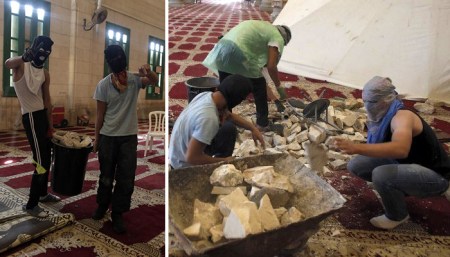
1277 (2)Palestinian Arab young men with masks, inside Al-Aqsa Mosque (some wearing shoes), stockpile rocks to use for throwing at Jews who visit the Temple Mount, September 27, 2015.

The Islamic Movement in Israel, headed by Sheikh Raed Salah, joined the chorus of critics by issuing its own threats to thwart the camera plan.

The straw that broke the Jordanian back was a leaflet that was distributed at the Temple Mount during Friday prayers two weeks ago. The leaflet urged Muslims to smash any cameras installed at the holy site. Who was behind the leaflet remains unclear, but sources in East Jerusalem blamed Palestinian activists and members of the Islamic Movement in Israel. The latest threat came as Jordan announced that the cameras would be installed at the site in the coming days.

Jordanian Prime Minister Abdullah Ensour made no bones about the decision to drop the plan: it was, he stated, a direct response to Palestinian “opposition” and “reservations.” He also noted that Israel had agreed to the installation of the cameras.

“At the beginning, Israel tried to hinder the project through various means,” Ensour said. “But we were able to overcome that.” He said that Jordan was nevertheless “surprised” by the reaction of the Palestinians to the cameras initiative.

Jordan has made clear that it was the Palestinians, and not Israel, who foiled the installation of more than 50 surveillance cameras at the Temple Mount as a stop towards easing tensions there.

Yet, no reaction from Kerry.

In one blow, Palestinians have managed to undermine Jordan’s historic role as “custodian” of the holy sites in Jerusalem and humiliate King Abdullah, who was the mastermind of the camera plan. They managed to do so largely thanks to the failure of the U.S. Administration to follow up on the implementation of the Kerry-brokered agreement.

We are seeing an old movie. Once again, the Palestinians have strong-armed their way to disaster. Their incessant intimidation fails to achieve a truly worthy goal: a better life under a non-dictatorial regime.

Once again, the Palestinians have prevailed — and in their win, they lose yet again.

IDF’s drill secures Netanyahu-Putin summit

April 18, 2016

IDF’s drill secures Netanyahu-Putin summit, DEBKAfile, April 18, 2016

1 (3)

The IDF launched an unannounced military-air exercise in northen Israel Monday April 18. It will also be held in the Jordan valley, strategically located south of the Golan Heights and the Sea of Galilee. Despite the official explanation that the drills are part of the IDF’s training schedule for 2016, it is difficult not to see it as a follow-up to the Cabinet meeting on the Golan the previous day, including Prime Minister Benyamin Netanyahu’s declaration that “Israel will never withdraw from the Golan.”

Just as the Cabinet meeting was an “emergency” one, the exercise is not part of standard training, as an IDF statement claimed, but rather part of the overall picture of the war in Syria on the other side of the northeastern border.

The drill is mainly intended to prevent a possible attack by ISIS, Syrian, Iranian or Hizballah forces aimed at torpedoing Netanyahu’s discussions in Moscow with Russian President Vladimir Putin on Thursday, April 21.

DEBKAfile’s military sources report that the IDF exercise shows only half of the military picture in the area.
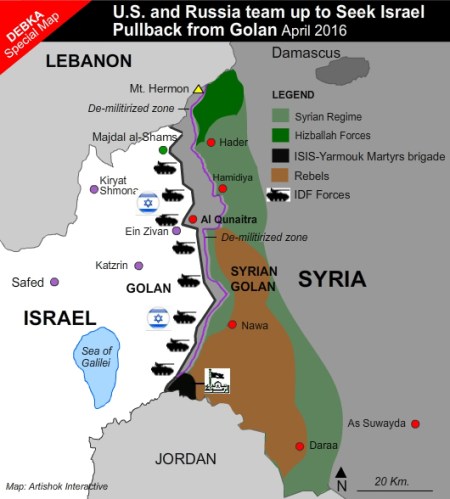
On the other side of the border, in the triangular pocket where the Israeli, Syrian and Jordanian borders meet, heavy fighting has been underway for several days between Syrian rebels and forces of the Yarmouk Martyrs Brigades and the al-Muthanna organization, which have both sworn allegiance to ISIS. The battles are taking place across from Israel’s Hamat Gader, south of the Sea of Galilee, which is the reason why the exercise is also being held in the Jordan Valley.

On the other side of the border, in the triangular pocket where the Israeli, Syrian and Jordanian borders meet, heavy fighting has been underway for several days between Syrian rebels and forces of the Yarmouk Martyrs Brigades and the al-Muthanna organization, which have both sworn allegiance to ISIS. The battles are taking place across from Israel’s Hamat Gader, south of the Sea of Galilee, which is the reason why the exercise is also being held in the Jordan Valley.

On the other side of the border, in the triangular pocket where the Israeli, Syrian and Jordanian borders meet, heavy fighting has been underway for several days between Syrian rebels and forces of the Yarmouk Martyrs Brigades and the al-Muthanna organization, which have both sworn allegiance to ISIS. The battles are taking place across from Israel’s Hamat Gader, south of the Sea of Galilee, which is the reason why the exercise is also being held in the Jordan Valley.

On Sunday, the leader and commander of Al-Muthanna was killed during the fighting. The goal of the rebel attack is to capture the Syrian villages in the territory held by ISIS, which threatens the Galilee and the Golan communities of Tel Katzir, Shaar Hagolan and Masada. Sources in Kuwait reported last week that Jordanian special forces and Israeli drones marked in the colors of the Jordanian air force are participating in the battles. The developments on the ground indicate that the goal of the attacking forces is to uproot ISIS from the Israeli and Jordanian border areas.

DEBKAfile’s sources provided the following exclusive details on April 17:   

The Israeli cabinet holds its weekly session Sunday April 17, on the Golan. Prime Minister Benyamin Netanyahu will visit Moscow on Thursday, April 21 to meet with Russian President Vladimir Putin and to launch the most important battle of his political career, and one of Israel’s most decisive contests of the last 10 years: the battle over the future of the Golan Heights.

DEBKAfile’s intelligence sources and its sources in Moscow report exclusively that Israel’s top political leaders and military commanders were stunned and shocked last weekend when they found out that US President Barack Obama and Russian President Vladimir Putin have agreed to support the return of the Golan to Syria. The two presidents gave their top diplomats, Secretary of State John Kerry and Foreign Minister Sergei Lavrov, the green light to include such a clause in a proposal being drafted at the Geneva conference on ending the Syrian civil war.

Israeli prime minister Benjamin Netanyahu seen during a security and defense tour in the Golan Heights, near the Northern Israeli border with Syria. April 11, 2016. Photo by Kobi Gideon/GPO *** Local Caption *** ??? ?????? ?????? ?????? ????? ?????? ?????. ????? ?????? ?????? ????? ?? ????? ??????? ???? ????? ?????? ?????? ?????

Israeli prime minister Benjamin Netanyahu seen during a security and defense tour in the Golan Heights, near the Northern Israeli border with Syria. April 11, 2016. Photo by Kobi Gideon/GPO

Israel captured the Golan from the Syrian army 49 years ago, during the Six-Day War in 1967 after the Syrian army invaded Israel.

In 1981, during the tenure of then Prime Minister Menachem Begin, Israel passed a law defining the Golan as a territory under Israeli sovereignty. However, it did not state that the area belongs to Israel.

While Israel was preparing for a diplomatic battle over the future of Jerusalem, Judea and Samaria, Obama and Putin decided to deal a diplomatic blow to Israel and Netanyahu’s government on an unexpected issue, the Golan.

It is part of an endeavor by the two powers to use their diplomatic and military cooperation regarding Syria to impose agreements on neighboring countries, such as Israel, Turkey, Saudi Arabia and Jordan.

For example, Washington and Moscow are trying to impose an agreement regarding the granting of independence to Syrian Kurds, despite Ankara’s adamant opposition. The two presidents are also pressuring Riyadh and Amman to accept the continuation of Syrian President Bashar Assad’s rule, at least for the immediate future.

DEBKAfile’s sources report that just like the other diplomatic or military steps initiated by Obama and Putin in Syria, such as those for Assad’s eventual removal from power, the two powers see a resolution of the Golan issue as a gradual process that may take a long time, perhaps even years. But as far as they are concerned, Israel will have to withdraw from the Golan at the end of that process.

It should be noted that Prime Minister Netanyahu is not traveling to Washington to discuss the Golan issue with Obama. The frequent trips by the prime minister, senior officials and top IDF brass to Moscow in recent months show where the winds are blowing in the Middle East.

However, Moscow is not Washington, and Israel has no lobby in the Russian capital defending its interests.

It should be made very clear that the frequent trips by senior Israeli officials to Moscow have not created an Israeli policy that can influence Putin or other senior members of the Russian leadership. Putin has made occasional concessions to Israel on matters of minimal strategic importance, but on diplomatic and military steps regarding Syria and Iran he has shown little consideration of Jerusalem’s stance.

It should also be noted that there has been no basis for the enthusiasm over the Russian intervention in Syria shown by Netanyahu, Israeli ministers and senior IDF officers.

All of the calls by a number of Russia experts, mainly those of ll of the calls by a number of Russia experts, mainly those of DEBKAfile, for extreme caution in ties with Putin have fallen on deaf ears among the political leadership in Jerusalem and the IDF command in Tel Aviv.

Amid these developments, three regional actors are very pleased by Washington and Moscow’s agreement to demand Israeli withdrawal from the Golan: Syrian President Assad, the Iranian leadership in Tehran and Hizballah leader Hassan Nasrallah.

Now, they do not need to risk a military confrontation with Israel over the Golan because Obama and Putin have essentially agreed to do the dirty work for them.

Jordanian MP Whose Son Carried Out An ISIS Suicide Bombing Joins Fight Against Extremism

April 8, 2016

Jordanian MP Whose Son Carried Out An ISIS Suicide Bombing Joins Fight Against Extremism, MEMRI, April 8, 2016

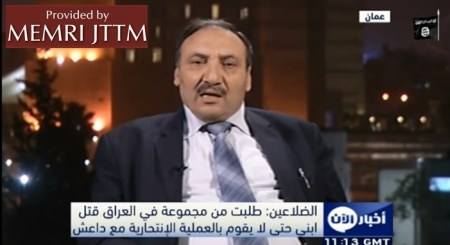
Muhammad Al-Dala’een, a 23-year-old medical student and the son of Jordanian MP Mazen Al-Dala’een, joined ISIS in July 2015[1] and carried out a suicide operation three months later in the city of Mosul, Iraq.[2] After learning that his son had become a member of ISIS, Mazen Al-Dala’een joined the fight against extremist ideologies and became active in preventing young Jordanians from joining ISIS and in returning those who have already joined. In an interview with a television channel associated with the Syrian opposition, he said that before his son’s death, he had even asked ISIS-affiliated elements to kill his son so that he would not carry out a suicide operation.[3]

It should be noted that Muhammad Al-Dala’een is not the first son of a Jordanian MP to join a terrorist organization. In January 2015 it was reported that the 25-year-old son of MP Falah Al-‘Abadi, a dentist by training, had been killed in Aleppo, Syria while fighting in the ranks of Jabhat Al-Nusra.[4]

In a December 16, 2015 interview with the online newspaper Arabi21, Mazen Al-Dala’een spoke of his son, of ISIS’s recruitment methods, and of his activity to prevent young people from joining this organization in Syria and Iraq. He criticized the media for not taking an active role in fighting extremism, and called to eliminate the rhetoric of radical religious organizations.

Young jihadist


Jihadist daddyISIS member Muhammad Al-Dala’een (above) and his father, Jordanian MP Mazen Al-Dala’een (Twitter.com/inbry19, December 6, 2015)

The following are excerpts from the interview:[5]

My Son Was No Extremist; He Even Opposed ISIS

Q: “Let us start with Muhammad’s story. How did he join ISIS?”

A: “At the beginning, Muhammad was not an extremist.  After the death last year of the Jordanian pilot Mu’adh Al-Kasasbeh [whom ISIS burned alive], Muhammad [even] carried his picture at a protest in Al-Karak Governorate, and condemned the barbaric murder. He would always talk to me about how [ISIS] is a terrorist organization with no connection to the religion.

“However, when Muhammad travelled to the Ukraine, ISIS contacted him via his foreign wife, a recent convert to Islam. A group of people, including a resident of Azerbaijan, a Chechen woman, and a Tunisian man, convinced his wife that jihad was a duty and that they had to emigrate from the lands of unbelief to the lands of ‘the Islamic caliphate,’ taking advantage of her ignorance of Islam and persuading her that she would reach Paradise [if they did this]. She then convinced her husband [to adopt] this ideology, and thus they shared the same beliefs.

“On the night that Muhammad and his wife travelled to Turkey, and from there on to Syria and Mosul, I visited their home in the Kharkiv area in Ukraine. Had I even the slightest suspicion that he intended to join ISIS, I would have delayed them at the airport and taken the necessary steps to stop him from joining this criminal organization.

“I remember that Muhammad and I argued that night about ISIS, and two days later I was shocked [to discover] that he had joined the organization, travelling to Turkey and from there on to Syria and Mosul. [Later I was also shocked to discover] that he had carried out an attack, as they [ISIS] claim. Their claims might all be false, because I truly do not believe their stories, which could all be a deception. Even the claim that he detonated a car bomb could be false, since when people join such organizations, they fall completely under their control and lose [their own] free will.

“I have heard stories from young Jordanians who returned from the ranks of this organization and said that ISIS members held a gun to their heads when they spoke to their families on the phone, forcing them to say that the caliphate state is the state of true and proper Islam. This is a truly criminal terrorist organization, which has deviated from the foundations of our Islamic shari’a. The principles they use deviate from all the laws of Allah.”

I Work To Prevent Extremism; Media And Society Must Take A More Active Role In Combatting It

Q: “Have you seen the latest [ISIS] video featuring Muhammad titled ‘Al-Walaa Wal-Baraa?” [6]

A: “Yes, I have seen it – that was why they released it, because when I returned from the airport in Turkey, I was bringing back a young Jordanian woman from Al-Karak who had been recruited by ISIS, and that angered them. In fact, I managed to bring back two young women whom I intercepted there, not just that one – there is another young woman about whom no one is talking, in order to protect her family. In addition, I helped bring back a young Jordanian man from the Irbid area, after he fled from Syria to Turkey, and I coordinated [this matter] with the Jordanian Embassy in Ankara. [I did] all this in order to protect this generation, so that they are not led astray like my son was.

“I tell you that the threats in the video will not dissuade me. This video appeared on the organization’s websites nine weeks after [my son’s] death, and its message was clearly aimed at me. It will not dissuade me, since I am [a member] of parliament, and since it is part of my national duty to raise awareness among the young people [regarding the dangers of ISIS].

“Therefore, I have initiated [some] lectures to raise the awareness of this generation, which could be led astray by this criminal organization, and I hope this initiative will continue at all the universities. I think my message has been fully delivered.

“I also spoke in the media, but Jordanian media unfortunately operates by mobilizing momentarily for a specific cause [and then dropping it]. Our media should play a more active role in these difficult times, in order to distance this generation from extremist and terrorist thought.

“Furthermore, we must not leave the religious discourse as it was in the past, but must take steps to generate constant dialogue on prayer, fasting, alms, etc. [to prevent ISIS from monopolizing the discourse on them]. We must [eliminate] this social disease – this cancer, I call it – and change the nature of religious discourse. We must [deal with the problem] on the ground and come up with a strategy. [At present,] when there is a problem, everyone raises an outcry for a day or two and then [forgets] about it. We must deal with this extremist ideology – which could infiltrate into every home because social media are found in every home and because there are no limits on them, and [therefore] anyone can be exposed to [the danger of] joining this  organization.”

Q: “Did Muhammad’s mother also see the ‘Al-Walaa Wal-Baraa video?”

A: “Yes, she saw it, and Allah helped her [to cope with it]. She is hurt and pained to this day. She still mourns him every day, [finding comfort] in writing [about him].”

Social Media Are ISIS’s Main Means Of Recruitment – And Via Them The Group Promises Rewards In Paradise

Q: “You said that you had managed to rescue young men and women recruited by ISIS. How were they recruited?”

A: “Social media play a central role in recruiting these young people, who visit the pages of the terrorist organization ISIS, which exploits social hardships – whether poverty or unemployment – in order to convince these young people that it will take care of them and provide for all their needs in life, including housing and money. [ISIS] specifically targets young people with certain religious tendencies, and shows them jihadi videos. It convinces them that they will reach Paradise, that their actions are in line with the shari’a, and that the jihad operations that they carry out will bring them the reward of the black-eyed virgins [in Paradise], and so on. This  persuasion does not happen overnight; it takes many months, maybe four or five months, even a year, depending on the person and how inclined he is to accept the ideology that [ISIS] offers on social media.

“One case I encountered was that of a 24-year-old medical student at the Islamic Studies University – he was an intellectual. ISIS targets educated and enlightened people such as doctors, engineers, and lawyers. It looks to these fields in order to show the world that its members are not just unemployed crooks, as others tend to think, but rather the opposite.”

Q: “Are ISIS sleeper cells recruiting in Jordan?”

A: “This organization is not only in Jordan, it has sleeper cells around the world – in Syria, Iraq, Turkey, Egypt, and Libya. They recruit using liaisons, who could be ISIS members in Jordan using assumed names on social media – as happened with the young woman recruited in Al-Karak. A short time after they join [the organization] via the liaisons, they swear an oath of fealty to the caliph [Abu Bakr Al-Baghdadi], which… means mostly that they [the young people] are now committed to the organization and must carry out its orders – to the extent that they are distanced from their families and often even ordered to kill a relative.”

Q: “How do those who return from the ranks of the organization depict [it]?” 

A: “I heard the story of the young woman who returned from Turkey, and it was the complete opposite of the one to which the organization pretends. She said that the organization attaches no importance to the religion, regardless of what it presents in [its] jihadi videos. As soon as they enter Al-Raqqa [ISIS’s Syrian stronghold], the young people are cut off from their families, and the organization controls all aspects of their lives, monitors their movements, and enrolls them in shari’a classes, because it is trying to brainwash them. Anyone who objects is sent on a suicide operation, she told me.

“There is also the story of the family of the young man from Al-Salt, who went to Al-Raqqa and discovered that this group [ISIS] is indecent and is distant from Islam. He tried to leave, but the organization’s members discovered it, and wanted to execute him, putting the orange jumpsuit on him. However, he begged the prison guards not to kill him, saying that he was an only child; he bribed them with $3,000, fled to Turkey, returned to Jordan, and is now in prison.”

There Are 3,000 Jordanians In ISIS And Other Groups Like It

Q: “Have you any information on the number of Jordanians in the ranks of ISIS?”

A: “There are no official numbers, but experts estimate that some 3,000 Jordanians are members of ISIS and [other] extremist organizations, and that some 420 have been killed. About 10 people from Al-Karak governorate have been killed, and the number of Jordanians who joined ISIS from the city of Al-Karak is over 50; most of them are in Syria.”

__________________________

[1] Arabi21.com, July 9, 2015.

[2] Al-Rai (Jordan), October 3, 2015.

[3] Alaan.tv, November 8, 2016.

[4] Al-Sabil (Jordan), January 29, 2015.

[5] Arabi21.com, December 16, 2015.

[6] See MEMRI JTTM report In ISIS Video, Son Of Jordanian MP Turned Suicide Bomber Threatens Jordanian King, MPs, December 7, 2015. Al-Walaa wal-baraa is the Islamic concept of loyalty to Muslims and rejection of non-Muslims, which is a fundamental principle of Salafi-jihadi doctrine.

ISIS descends on Jordan’s border, activates suicides. Jordanian command post in Daraa

April 6, 2016

ISIS descends on Jordan’s border, activates suicides. Jordanian command post in Daraa, DEBKAfile, April 6, 2016

Islamic State in Jordan

ISIS forces in southern Syria overran several Jordanian border crossings south of the Yarmouk River on Tuesday, April 5. This disastrous turn of events is illustrated by an exclusive picture obtained by DEBKAfile of an ISIS fighter unfurling the organization’s flag at one of the crossings which sports a Jordanian flag.

The picture taken the same day shocked the royal court and the Jordanian military command in Amman.

Our military sources report that an urgent conference was called at the Military Operations Command (MOC), north of Amman to devise measures for containing the Islamic State’s leap into more territory on the Syrian-Jordanian border. It was attended by Jordanian, American, Israeli, Saudi and UAE officers.

Our military sources report that an urgent conference was called at the Military Operations Command (MOC), north of Amman to devise measures for containing the Islamic State’s leap into more territory on the Syrian-Jordanian border. It was attended by Jordanian, American, Israeli, Saudi and UAE officers.

They voiced apprehension about three developments which give Daesh a substantial edge

1. A group of high ISIS officers traveled south from headquarters in Raqqa in the last few days, took command of the 3,000 fighters of the affiliated Yarmouk Brigades, and is now working to form a continuous jihadist enclave along Syria’s borders with Israel and Jordan, like the 90-kilometer ISIS strip blocking part of the Turkish border.

This enclave would directly threaten the Israeli Golan and northern Jordan.

2. When ISIS forces retreated last week from Palmyra, a group headed south, fetching up outside Jebel Druze without entering this mountain region. It is now feared that the jihadis are about to turn west toward the Israeli border and link up with the Yarmouk brigades. This would double the number of ISIS forces in southern Syria and make possible a major new assault on the Jordanian and Israeli borders.

JordanDaraa480Koteret

3. The strengthening of ISIS forces in southern Syria has attracted some of the Syrian rebel groups fighting the Syria army to the jihadist flag and the Yarmouk Brigades. The largest militia to enlist recently is the Al-Muthana movement. Although its leaders deny taking an oath of allegiance or any other ties with ISIS, Al-Muthana is currently fighting alongside ISIS. This has sent a disturbing signal to the hundreds of other anti-Assad militias in the neighborhood.

Jordan has meanwhile stepped forward to stem this flow of strength to ISIS.

DEBKAfile’s military and intelligence sources report that Jordanian military intelligence officers specializing in guerrilla warfare have been infiltrating rebel-held areas in the South, especially Daraa, the regional hub, for the purpose of whipping rebel militias together into a front against ISIS. These officers have succeeded in setting up a joint war room with the three biggest rebel groups in the south, the Southern Front, Jaish Fatah al-Junub and Jaish al-Islam, for action under the direction of the MOC outside Amman.

On Monday, April 4, the joint force saw combat, when rebel forces under Jordanian commanders launched an attack to drive the ISIS forces back into their former corner in the narrow triangle near the meeting-point of the Syrian, Israeli and Jordanian borders. ISIS hit back with suicide bombers, who blew themselves up next to the Jordanian-led rebel assault force. It was the first time ISIS had unleashed suicide bombers so close to the Israeli border.