Archive for the ‘Jerusalem’ category

‘Deport US Consulate Staff Who Threatened Jews’

January 3, 2015

‘Deport US Consulate Staff Who Threatened Jews’ Israel National News, Uzi Baruch and Tova Dvorin, January 3, 2014

(Huh? If the report is accurate, the U.S. consular officials went way too far. Cf this 2008 video:

Please see also American Security Guards Clash with Jews in Binyamin. Please see also this article, apparently (but not clearly) about what happened later when the consular officials got to the olive trees. — DM)

img510743Soldiers guard Samaria community (illustration) Flash 90

An argument erupted between the convoy and the community’s security guards, as all official visits to Jewish communities in Judea-Samaria must be coordinated with the IDF and police – a protocol the consulate allegedly ignored. At least one of the American guards allegedly pulled out his handgun and M-16 during the course of the argument.

*****************

Acting Head of the Samaria Regional Council, Yossi Dagan, has filed a request to the Minister of the Interior Gilad Erdan demanding he immediately expel the American Consulate staff members who entered the Samaria village of Adei Ad Friday and threatened Israeli Jews with an M-16. 

“As revealed through Wikileaks few years ago, these supposed ‘officials’ are intelligence agents and spies in every respect,” said Dagan, adding “this time, they went too far and participated in a provocative tour with the Palestinians in the southern Samaria and north Binyamin, without any coordination as required with the IDF and police, and pulled out a firearm and threatened Israeli civilians.”

“This is a crossing of all red lines,” he continued. “This event could have descended easily into bloodshed and only as a result of the settlers’ responsible behavior was [a scenario like that] prevented.”

“I request that in view of the serious and criminal conduct, that these [US] security guards and officials be deported,” he added.

“If Israeli intelligence officials and armed Israeli security guards stationed in one of the Israeli consulates in the United States had participated in a political provocation without any coordination with the police and threatened American citizens with weapons, at best, they would bearrested and deported, and the more likely case would be them spending several years in federal prison.”

It is unclear exactly what prompted the incident at Adei Ad Friday, but reports say that several consulate officials arrived with armed guards at the community to investigate Palestinian Arabs’ claims of vandalism of a nearby olive orchard.

An argument erupted between the convoy and the community’s security guards, as all official visits to Jewish communities in Judea-Samaria must be coordinated with the IDF and police – a protocol the consulate allegedly ignored. At least one of the American guards allegedly pulled out his handgun and M-16 during the course of the argument.

Mahmoud Abbas: Failing the Palestinians and Peace

December 29, 2014

Mahmoud Abbas: Failing the Palestinians and Peace, Front Page Magazine, December 29, 2014

Mahmoud Abbas

[T]he increased authoritarianism of Abu Mazen is reflected in a recent survey by the Palestinian Center for Policy and Survey Research. It indicates that 66% of Palestinians are afraid to criticise Abu Mazen and the PA, and 80% consider the PA institutions to be corrupt and infected with nepotism.

***************

Mahmoud Abbas, (aka Abu Mazen) has been a failure as the Palestinian “Rais.” He failed to lead the Palestinian Authority (PA) toward peace with Israel, and he mismanaged the alleged goal to achieve statehood for the Palestinians. Instead of facing the tough issues and making compromises required in negotiating peace and statehood with the Israelis, Abbas chose an alliance with the Gaza controlled terrorist group Hamas. Following Abbas’ pact with Hamas last April, Israel broke off peace negotiations with the Palestinians, just days before the talks brokered by Secretary of State John Kerry were scheduled to expire.

Abbas isn’t only confusing Israelis, Americans, and is his Europeans patrons, he is perplexing his own Palestinian consituents. Following last summer’s Gaza War between Hamas and Israel, Abbas threatened to join the International Criminal Court (ICC) and saught to indict Israel on war crimes. PA Foreign Minister Riad al-Maliki met with the Chief Prosecutor of the ICC last August to explore ways of joining the court by PA President Abbas signing the Rome Statute.  When, however, the U.S. Congress threatened to cut off all funding to Palestine if Abbas filed war crimes charges against Israel, Abbas backed off. At the same time though, Israel’s Prime Minister threatened to counter-sue, alleging that the rockets fired by Hamas terrorists into Israeli civilian areas constituted “double war” crimes.

The Israeli Law Center called Shurat-HaDin, led by Nitsana Darshan-Leitner submitted a complaint against Mahmoud Abbas in the ICC for “war crimes.” The complaint claims that Abbas may be tried for his responsibility in the missile attacks targeting Israeli cities, executed by the Palestine Liberation Organization (PLO), which Abbas heads. It charges that Fatah, also led by Abbas, was responsible for several missile attacks on Israeli cities. Darshn-Leitner pointed out that Fatah leader Abbas may be tried by the ICC. Abbas is a citizen of Jordan and Jordan is a member-state of the ICC. The ICC has jurisdiction over crimes committed by a citizen of a member state. Darshan-Leitner added, the organization “will not allow Fatah to carry out rocket attacks on Israeli population centers, while hypocritically advocating Palestinian membership in the ICC. Abbas falsely believes that alleged crimes against Arabs are the only ones that should be prosecuted.”

A week ago, Abbas threatened again. This time he fingered the security co-ordination with Israel following the death of Ziad Abu Ein, 55, PA Minister without Portfolio. He promptly backtracked. On November 29, 2014, Abbas declared  that if the United Nations Security Council rejects the Palestinian statehood resolution, he will seek membership in the ICC. He said, “We will seek Palestinian membership in international organizations, including the International Criminal Court in the Hague. We will also reassess our ties with Israel, including ending the security cooperation between us.”

Abbas’ latest gambit is a UN Security Council (UNSC) resolution that would force Israel to withdraw from Judea and Samaria (West Bank) within two-years. According to press reports, U.S. Secretary of State John Kerry requested to postpone the Palestinian initiative at the UNSC until after the Israeli elections, (March 17, 2015) but the Palestinians refused. PA Foreign Minister Riad al-Maliki intimated to reporters that there was disagreement between the Americans and Palestinians on how the elections in Israel would or wouldn’t advance the PA UNSC resolution. Kerry believed that a UNSC vote before the elections would impact adversely on the winners. In other words, a vote before the elections would strengthen Netanyahu and the Right in Israel. Maliki argued that a vote before January, 2015 would be rather positive.

At a closed meeting last week with 28 EU ambassadors, John Kerry revealed that he was asked by former Israeli president Shimon Peres and Tzipi Livni to prevent the Palestinian initiative at the UNSC because it will help “Netanyahu and Bennett (Jewish Home Party chairman) in the upcoming elections.” Maliki posited that Kerry himself has not abided by his pledge not to intervene in the Israeli elections.

Also last week in London, Secretary of State Kerry met with Saeb Erekat, the chief Palestinian negotiator, and according to a PA senior official, Kerry posed a number of U.S. principles that should be included in the Palestinian UNSC resolution. Kerry supposedly refused the two year time period demand by the PA for Israeli withdrawal. The resolution as Kerry suggested should include recognition of Israel as a Jewish state, as well as U.S. opposition to declare Jerusalem as a joint capital for Palestine and Israel. Erekat rejected the U.S. proposals. Kerry declared afterward that the U.S. does not accept the Jordanian (presenting the Palestinian resolution)  and French resolutions. He warned that if the Palestinians insist on presenting the resolutions, the U.S. would use its veto power. Erekat rejected Kerry’s ideas, and insisted that the resolutions would be submitted. As of December 25, 2014, Abbas rejected an Arab League request to delay the submission of the Palestinian statehood until January when five new members who support the Palestinian cause will join the Security Council.

Abbas’ gambits notwithstanding, the increased authoritarianism of Abu Mazen is reflected in a recent survey by the Palestinian Center for Policy and Survey Research. It indicates that 66% of Palestinians are afraid to criticise Abu Mazen and the PA, and 80% consider the PA institutions to be corrupt and infected with nepotism. Last summer, according to the survey, support for Abbas (Abu Mazen) declined to 35% from 50%. “There is no doubt about the fact that outlawing freedoms and rights, especially of professional unions, is a factor in Abbas’ decline in popularity,” said Dr. Khalil Shikaki, one of the survey takers.

PA security agents inspect what is written in the social media, and threaten those who criticize Abbas. Abu Mazen critics point out that after a decade in power he is controlling all systems of government to such an extent as to minimize all resistance. Perceived political rivals such as Mohammad Dahlan, who once served as Abu Mazen’s assistant, and Salam Fayyad, the former Prime Minister of the PA, are vilified by Abbas. Following the Palestinian Unity government formation, headed by Rami Hamdallah last May, elections were to follow. But, once again, internal squabbling prevented it, and added to it was Abbas’ fear of a Hamas victory.

Abu Mazen’s strategy for the establishment of a Palestinian state has reached a cul-de-sac.  None of his gambits proved successful. His rivalry with Hamas is bitter and ongoing, despite the alliance he forged at the expense of negotiations with Israel. And, like his predecessor Yasser Arafat, he balks at the idea of ‘ending the conflict’ with Israel. He knows full well that this might be a death sentence for him, targeting him for assassination. It is for this reason that Abbas and the PA are unlikely to forgo the “right of return” of Palestinian refugees to Israel. Israel for its part, cannot accept such a demographic suicide. This is why Abbas would rather avoid negotiations with Israel and bypass it by going to the UNSC. It is also the ostensible reason why peace with Israel cannot be achieved, and as a result, the Palestinian people continue to suffer political and economic deprivation. Abbas has not been the solution to the Palestinian problems; rather, he has been responsible for failing them.

The Israelis who back UN hypocrisy

December 29, 2014

The Israelis who back UN hypocrisy, Israel Hayom, Dr. Limor Samimian-Darash, December 29, 2014

[T]he more one delves into the U.N.’s outrageous conduct, the harder it becomes to separate the actions of the international community from the tailwind provided by certain Israelis.

******************

The growing relationship between Iran and the Palestinian Authority, as well as Iran’s arms shipments and its involvement in terrorism, are, as always, not being condemned internationally. This is in addition to the world’s silence about the Palestinian terrorist attacks in recent months, which have included stabbings, vehicular rammings and firebombings. None of these produced a U.N. resolution against the Palestinians. And if the massacre at the synagogue in Jerusalem had not looked like a classic anti-Semitic attack in Europe, it is doubtful we would have heard any condemnation of it at all.

One can, of course, complain about the hypocrisy of the world, and particularly that of European nations, who have continued to ignore the growth of Islamic radicalism and terrorism in the world and have focused instead, in a biased manner, on the Israeli-Palestinian conflict. Alongside this, more and more nations are symbolically recognizing a Palestinian state and turning a blind eye to all Palestinian misdeeds. These moves are indeed symbolic, not just because they have no diplomatic meaning, but also, ironically, because Israel is once again being placed on the altar for sacrifice.

But the more one delves into the U.N.’s outrageous conduct, the harder it becomes to separate the actions of the international community from the tailwind provided by certain Israelis. Indeed, Tzipi Livni, Isaac Herzog and even Avigdor Lieberman have explained to us that this is all happening because of a lack of diplomatic initiative on the part of Prime Minister Benjamin Netanyahu. They do this, of course, without attributing any blame to Palestinian Authority President Mahmoud Abbas, who, despite all the concessions offered by Netanyahu, would not even agree to begin peace talks.

And there are now more false accusations being hurled around, such as the claim that the lack of negotiations following Operation Protective Edge is leading us toward a renewal of hostilities in the Gaza Strip. There is no mention of Hamas or its desire to expel us from the region. There is also no mention of the use of reconstruction funds by Hamas to re-arm itself ahead of the next round of fighting or the fact that the Palestinian Authority was kicked out of Gaza by the Palestinians themselves. No, they say, everything is the Israeli government’s fault for not initiating a diplomatic process.

And even more bluntly, Israeli politicians are directly appealing to the international community to apply pressure on the Israeli government. For example, Livni had the gall to implore U.S. Secretary of State John Kerry to not support the unilateral Palestinian move at the U.N., as this would have strengthened the Israeli Right. Herzog made a similar claim when he sought to dissuade the British parliament from recognizing a Palestinian state.

Former Labor MK Avraham Burg took a different tack, urging his British friends to recognize a Palestinian state and force a diplomatic solution on Israel. And if we look not too far back in history, this was the exact line taken by Livni when she was appointed foreign minister in 2006 by then-Prime Minister Ehud Olmert. Her first speech at the U.N. did not remind the nations of world about the historical right of the Jewish people to the land of Israel. Instead, her debut speech on the world stage was dedicated to presenting her vision of the establishment of a Palestinian state.

These are not some words uttered by one Palestinian government minister or another. And no, they are not a biased report by a BBC presenter. Rather, these are Israeli politicians who, whether they are just trying to butt heads with the government or if they truly believe in the righteousness of Abbas, are ultimately providing fuel for unilateral anti-Israel moves at the U.N. And when they do this, they are helping the lowlifes at the U.N.

The U.S. President is Not Omnipotent

December 28, 2014

The U.S. President is Not Omnipotent, Algemeiner, December 28, 2014. This article was originally published by Israel Hayom.

full-senate-300x200The United States Senate.

Will the 114th Congress follow in his footsteps, or will it abdicate its constitutional responsibilities?

Congress has often abdicated its constitutional power in the area of foreign policy, failing to fully leverage the power of the purse: funding, defunding and “fencing.”

***************

White House and State Department officials contend that, irrespective of Congress, President Barack Obama can apply effective diplomatic, commercial and national security pressure and coerce Israel to partition Jerusalem and retreat from Judea and Samaria to the 9-15 mile-wide pre-1967 sliver, surrounded by the violently turbulent and unpredictable Arab street.

U.S. Ambassador to Israel Dan Shapiro recently voiced this inaccurate underestimation of the power of Congress — which has traditionally opposed pressure on Israel, echoing the sentiments of most constituents — saying, “What is unmistakable about our foreign policy system is that the Constitution provides the president with the largest share of power.”

The assertion that U.S. foreign policy and national security are shaped by presidential omnipotence can be refuted by the U.S. Constitution as well as recent precedents. The Constitution was created by the Founding Fathers, who were determined to limit the power of government and preclude the possibility of executive dictatorship. They were apprehensive of potential presidential excesses and encroachment, and therefore assigned the formulation of foreign policy and national security to both Congress and the president. Obviously, the coalescing of policy between 535 legislators constitutes a severe disadvantage for the legislature.

According to the Congressional Quarterly, the U.S. Constitution rectified the mistakes of its predecessor, the Articles of Confederation, upgrading the role of Congress to the primary branch of the U.S. government. “Hence, the first article of the Constitution is dedicated to Congress. The powers, structure, and procedures of the national legislature are outlined in considerable detail in the Constitution, unlike those of the presidency and the judiciary.”

Unlike all other Western democracies — where the executive branch of government dominates the legislature, especially in the area of international relations and defense — the U.S. Constitution laid the foundation for the world’s most powerful legislature, and for an inherent power struggle over the making of foreign policy between the legislature and the executive, two independent, co-equal and co-determining branches of government. Moreover, while the president is the commander in chief, presidential clout depends largely on congressional authorization and appropriation in a system of separation of powers and checks and balances, especially in the areas of sanctions, foreign aid, military assistance, trade agreements, treaty ratification, appointment confirmation and all spending.

Congressional power has been dramatically bolstered since the Vietnam War, Watergate, the Iran-Contra affair and globalization, which have enhanced the involvement of most legislators in international issues, upgraded the oversight capabilities of Congress, dramatically elevated the quality and quantity of some 15,000(!) Capitol Hill staffers and have restrained the presidency.

However, Congress has often abdicated its constitutional power in the area of foreign policy, failing to fully leverage the power of the purse: funding, defunding and “fencing.” Legislators prefer to focus on domestic issues, which represent their constituents’ primary concerns and therefore determine their re-electability. Hence, they usually allow the president to take the lead in the initiation and implementation of foreign and national security policies, unless the president abuses their trust, outrageously usurping power, violating the law, assuming an overly imperial posture, pursuing strikingly failed policies, or dramatically departing from national consensus (e.g., the deeply rooted, bipartisan commitment to the Jewish state). Then, Congress reveals impressive muscle as befits a legislature, which is the most authentic reflection of the American people, unrestrained by design, deriving its power from the constituent and not from party leadership or the president, true to the notion that “the president proposes, Congress disposes.”

For example:

  • On August 1, 2014, Democratic senators forced Obama to separate the $225 million funding of Iron Dome batteries from the highly controversial $2.7 billion immigration and border security bill.
  • Since 1982 the Senate has repeatedly refused to ratify the Convention on the Law of the Sea, and since 1999 it has rejected ratification of the Comprehensive Test Ban Treaty.
  • The January 2013 defense authorization bill tightened restrictions on the transfer of terrorists from Guantanamo to the U.S. In May 2009, Majority Leader Harry Reid foiled Obama’s attempt to close down the detention camp.
  • On February 17, 2011, Obama reluctantly vetoed a U.N. Security Council condemnation of Israel’s settlement policy, due to bipartisan congressional pressure.
  • In September 2012, a $450 million cash transfer to the Muslim Brotherhood regime in Egypt was blocked by Congress.
  • The 2012 budget cut into Obama’s foreign aid spending request by more than $8 billion.
  • In 2009, bipartisan congressional opposition prevented the appointment of Charles Freeman to chair the National Intelligence Council.
  • In 1990-1992, Congress approved a series of amendments, expanding U.S.-Israel strategic cooperation to unprecedented levels despite presidential opposition.
  • In 1990, President George H. W. Bush failed in his attempt to cut Israel’s foreign aid by 5 percent due to congressional opposition.
  • In January 1975, the Jackson-Vanik Amendment was signed into law, in defiance of the president.
  • Congress ended U.S. military involvement in Vietnam (the 1973 Eagleton, Cooper and Church Amendments), Angola (the 1976 Clark Amendment) and Nicaragua (the 1982-1984 Boland Amendments).
  • In 1991, Senator Daniel Inouye fended off administration pressure to withdraw an amendment to upgrade the port of Haifa facilities for the Sixth Fleet: “According to the U.S. Constitution, the legislature supervises the executive, not vice versa.”

Will the 114th Congress follow in his footsteps, or will it abdicate its constitutional responsibilities?

EU Gives Hamas Green Light to Attack Israel

December 22, 2014

EU Gives Hamas Green Light to Attack Israel, Gatestone InstituteKhaled Abu Toameh, December 22, 2014

Although the EU court has said that its controversial decision was “technical” and was not a reassessment of Hamas’s classification as a terrorist group, leaders of the Islamist movement believe that the move will eventually earn them legitimacy in the international arena.

The EU court’s decision represents a “severe blow to the Palestinian Authority and Egypt,” according to Palestinian political analyst Raed Abu Dayer.

Any victory for Hamas, albeit a small and symbolic one, is a victory for the Islamic State, Al-Qaeda, Islamic Jihad, the Muslim Brotherhood and other fundamentalist groups, and causes tremendous damage to those Muslims who are opposed to radical Islam.

Hours before the EU court’s decision was made public, Hamas leader Mahmoud Zahar announced that his movement would never recognize Israel, and that Hamas seeks to overthrow the Palestinian Authority and seize control of the West Bank.

The EU court’s decision also coincided with a rapprochement between Hamas and Iran. Now, the Iranians and other countries, such as Turkey and Qatar, are likely to interpret the EU court’s decision as a green light to resume financial and military aid, including rockets and missiles, to Hamas — not only to Gaza but to the West Bank as well — to support those Palestinians whose aim it is to eliminate Israel.

Less than 48 hours after a top European Union court ruled that Hamas should be removed from the bloc’s list of terrorist groups, supporters of the Palestinian Islamist movement responded by firing a rocket at Israel. The attack, which did not cause any casualties or damage, did not come as a surprise.

Buoyed by the EU court’s ruling, Hamas leaders and spokesmen see it as a “political and legal achievement” and a “big victory” for the “armed struggle” against Israel.

Musa Abu Marzouk, a top Hamas leader, issued a statement thanking the EU court for its decision. He hailed the decision to remove his movement from the terrorist list as a “victory for all those who support the Palestinian right to resistance.”

When Hamas leaders talk about “resistance,” they are referring to terrorist attacks, such as the launching of rockets and suicide bombings against Israel. In other words, Hamas has interpreted the court’s decision as a green light to carry out fresh attacks as part of its ambition to destroy Israel.

The rocket that was fired from the Gaza Strip at Israel only days after the court decision is not likely to be the last.

Although the EU court has said that its controversial decision was “technical” and was not a reassessment of Hamas’s classification as a terrorist group, leaders of the Islamist movement believe that the move will eventually earn them legitimacy in the international arena.

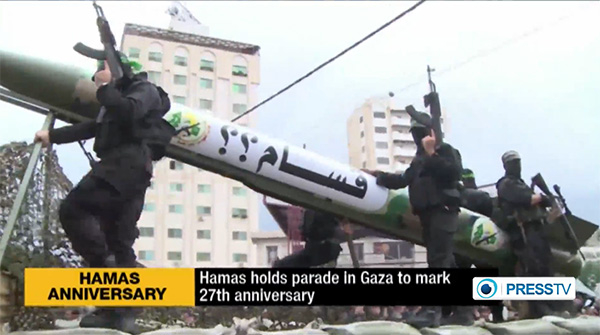
Ironically, the EU court’s decision coincided with Hamas celebrations marking the 27thanniversary of its founding. Once again, Hamas used the celebrations to remind everyone that its real goal is to destroy Israel. And, of course, Hamas used the event to display its arsenal of weapons that include various types of rockets and missiles, as well as drones.

845 (1)Thousands of armed Hamas troops showed off their military hardware at a Dec. 14, 2014 parade in Gaza, marking the organization’s 27th anniversary. (Image source: PressTV video screenshot)

Hours before the EU court decision was made public, Hamas leader Mahmoud Zahar announced that his movement would never recognize Israel. Zahar also made it clear that Hamas seeks to overthrow the Palestinian Authority [PA] regime and seize control over the West Bank.

The EU court’s decision also coincided with increased efforts to achieve rapprochement between Hamas and Iran. Recently, a senior Hamas leadership delegation visited Tehran as part of efforts to mend fences between the two sides. The main purpose of the visit was to persuade the Iranians to resume military and financial aid to Hamas. The visit, according to senior Hamas officials, appears to have been “successful.”

“There are many signs that our relations are back on the right track,” explained Hamas’s Musa Abu Marzouk. “Hamas and Iran have repaired their relations, which were strong before the Syrian crisis.” Relations between Hamas and Iran deteriorated due to the Islamist movement’s refusal to support the regime of Syrian President Bashar Assad.

Now the Iranians are likely to interpret the EU court decision to remove Hamas from the list of terrorist groups as a green light to resume financial and military aid to the movement.

Iran’s leaders recently announced that they intend to dispatch weapons not only to the Gaza Strip, but to the West Bank as well, as part of Tehran’s effort to support those Palestinians who are fighting to eliminate Israel.

Moreover, the EU court’s move will also embolden other countries that provide Hamas with political and financial aid, first and foremost Qatar and Turkey. Oil-rich Gulf countries such as Kuwait, Bahrain, Oman and Saudi Arabia will now face pressure from many Arabs and Muslims to join Qatar, Turkey and Iran in extending their support to Hamas.

The biggest losers, meanwhile, are Palestinian Authority President Mahmoud Abbas and Egypt’s President Abdel Fattah el-Sisi. Over the past few months, the two men have been doing their utmost to undermine Hamas and end its rule over the Gaza Strip.

Abbas has been fighting Hamas by blocking financial and humanitarian aid and arresting its supporters in the West Bank, while Sisi continues to tighten the blockade on the Gaza Strip and destroy dozens of smuggling tunnels along the border with Egypt.

The EU court’s decision represents a “severe blow to the Palestinian Authority and Egypt,” noted Palestinian political analyst Raed Abu Dayer. “As far is Abbas is concerned, the decision grants Hamas political legitimacy and challenges his claim to be the sole legitimate leader [of the Palestinians]. With regards to Egypt, the European court decision calls into question rulings by Egyptian courts that Hamas is a terrorist organization.”

Even if the EU court decision is reversed in the future, there’s no doubt that it has already caused tremendous damage, especially to those Muslims who are opposed to radical Islam.

Any victory for Hamas, albeit a small and symbolic one, is a victory for the Islamic State, Al-Qaeda, Islamic Jihad, the Muslim Brotherhood and other fundamentalist groups around the world.

The decision has left many Arabs and Muslims with the impression that Hamas, after all, is not a terrorist organization, especially if non-Muslims in Europe say so through one of their top courts. Even worse, the decision poses a real and immediate threat to Israel, as evident from the latest rocket attack.

If the Europeans have reached the conclusion that Hamas is not a terrorist organization, then why don’t their governments openly invite tens of thousands of Hamas members and supporters to move to London, Paris and Rome? And they should not forget to ask the Hamas members to bring along with them their arsenal of weapons.
Slow rocket fire from Gaza after Hamas goes back to accepting Tehran’s domination

December 19, 2014

Slow rocket fire from Gaza after Hamas goes back to accepting Tehran’s domination, DEBKAfile, December 19, 2014

Hamas-on-Temple-Mount_19.12.14Hamas flexes its muscles on Temple Mt., Jerusalem

The red alert for the incoming rocket from Gaza which exploded in the Eshkol District Friday morning, Dec. 19, may well be the harbinger of more to come. In parts of Beersheba too the dull thumps of explosions were heard on Thursday.

According to DEBKAfile’s military and intelligence sources, Hamas has once again fallen under Tehran’s sway after patching up their quarrel.

Iran lost no time in directing the Palestinian terrorist group to revoke the ceasefire it accepted in June for halting Israel’s summer operation in the Gaza Strip and revive low-key rocket fire. An apparently “anonymous” organization will take responsibility – in reality it will be Hamas’ military wing.

Israel’s security authorities are aware of this ominous turn of events, but prefer to keep it quiet for the time being.

Hamas is reverting to its old terrorist ways, DEBKA reports, after not only spurning, but omitting to send a reply, to a Saudi package which Riyadh believed would be too generous to resist. The Saudis offered to put up the funds for Hamas’ entire annual budget, including military spending, as well as covering the full cost of rebuilding the Gaza Strip after the ravages of the summer war.

There were two conditions:

1. The Palestinian extremists must throw their unreserved support behind Egyptian President Abdel-Fattah El-Sisi and henceforth synchronize its operations with Cairo – i.e. desert its traditional allegiance to the Muslim Brotherhood.

2.  They must totally sever their military, political and financial ties with Iran. In token of this action, Hamas’ political chief Khaled Meshaal must call off his impending trip to Tehran, scheduled to mark the public announcement of the organization’s reconciliation with Iran and its leading ally, Syrian President Beshar Assad.

Instead of any sort of direct response to Riyadh’s offer, Hamas opted to use its 27th anniversary celebrations on Sunday Dec. 14, for a display of loyalty to Iran by 2,000 marching Izz e-din al-Qassam fighters. Every detail of the event was cleared in advanced by Tehran and broadcast live over all of Iran’s TV channels – an unprecedented honor.

As we first reported last week, a high-powered Hamas delegation visited Tehran on Dec. 9 to draft with Iranian officials the text of the Hamas reconciliation accord with Assad and map out future operations.

The most prominent members were Meshaal’s right hand, Muhammed Nasser; two members of the Hamas overseas military branch, Maher Abdullah and Jemal Ismail; and Lebanese agent, Osama Hamdan.

One item on this accord provided for the gradual resumption of rocket attacks on Israel from the Gaza Strip.

Hours after the first rocket was launched Friday, Hamas staged its first ever parade on Temple Mount, Jerusalem, marching around the golden Dome of the Rock, and shouting calls to revive the Palestinian rocket offensive against Israeli locations. They were clad uniformly in green with jihadi headbands and hoisted Hamas banners aloft.

Hamas’ riotous demonstration of defiance contrasted sharply with the calm observed in Friday worship at Al Aqsa in the last three weeks.

EU Backs Palestinian Dictatorship

December 18, 2014

EU Backs Palestinian Dictatorship, Gatestone InstituteKhaled Abu Toameh, December 18, 2014

These European parliaments are also turning a blind eye to the fact that, under the Palestinian Authority in the West Bank and Hamas in the Gaza Strip, there is no respect for the rule of law, free speech, transparency or accountability.

These Western parliamentarians are in fact acting against the interests of the Palestinians, who are clearly not hoping for another corrupt dictatorship in the Arab world.

“The situation in Palestine does not conform at all with democracy or the rule of law… Wake up and see the loss of rights, law and security.” — Freih Abu Medein, former Palestinian Authority Justice Minister.

“Abu Mazen [Mahmoud Abbas] wants to concentrate all authorities in his hands and the hand of his loyalists. He’s acting in a dictatorial way and wants to be in control of everything, especially the finances.” — Yasser Abed Rabbo, Secretary General of the PLO.

By turning a blind eye to human rights violations, as well as assaults on freedom of expression, the judiciary and the parliamentary system in the Palestinian territories, Western parliaments are paving the way for a creation of a rogue state called Palestine.

European parliaments that are rushing to recognize a Palestinian state are ignoring the fact that the Palestinians have been without a functioning parliament for the past seven years.

The Palestinian parliament, known as the Palestinian Legislative Council [PLC], has been paralyzed since 2007, when Hamas violently seized control over the Gaza Strip and expelled the Palestinian Authority [PA].

These European parliaments are also turning a blind eye to the fact that, under the PA in the West Bank and Hamas in the Gaza Strip, there is no respect for the rule of law, free speech, transparency or accountability.

This week, the European Parliament also adopted a resolution recognizing Palestinian statehood in principle. A total of 489 MEP’s voted in favor, while 88 were against.

Ironically, the EU Parliament vote coincided with an unprecedented crackdown by the Palestinian Authority leadership on the Palestinian Legislative Council and its secretary-general, Ibrahim Khraisheh, in Ramallah.

PA President Mahmoud Abbas ordered the arrest of Khraisheh for allegedly criticizing PA Prime Minister Rami Hamdallah. Following strong protests by leaders of various Palestinian factions, who described the decision as a flagrant breach of freedom of expression, Abbas was forced to backtrack.

But for Abbas, this was not the end of the story. After canceling the arrest order against Khraisheh, Abbas dispatched policemen to the parliament building in Ramallah to prevent the top official from entering the compound. The presence of the policemen at the main entrance to the parliament building drew sharp denunciations from many Palestinians.

844The Palestinian Legislative Council building in Ramallah. (Image source: Alarab

Khraisheh was removed from his job because he dared to criticize the Palestinian government for arresting Bassam Zakarneh, head of the public employees’ union in the West Bank. Many Palestinians have also denounced the arrest of Zakarneh as an assault on workers’ rights and an attempt to intimidate them.

But the EU Parliament and other parliaments that voted in favor of recognizing Palestinian statehood did not see a need to comment on Abbas’s measures against the PLC and one of its senior officials.

EU parliamentarians who voted in favor of Palestinian statehood are most likely unaware of what the former PA Justice Minister, Freih Abu Medein, had to say about the rule of law and order in the Palestinian Authority.

Abu Medein drew a bleak picture of what the future Palestinian state would look like. In a damning article he published last week, Abu Medein wrote: “The situation in Palestine does not conform at all with democracy or the rule of law, because the Palestinian mentality is too coarse to cope with transparency of the law and its regulators and provisions.”

Abu Medein’s scathing attack, which is directed first and foremost against Abbas, ended with an appeal to Palestinians to “wake up and see the loss of law, rights and security” in the areas controlled by the PA and Hamas.

The former Palestinian Authority justice minister is not the only prominent Palestinian who seems to understand that a Palestinian state under the current circumstances would be anything but democratic.

Yasser Abed Rabbo, the secretary-general of the PLO who until recently was considered one of Abbas’s top confidants, was quoted last week as strongly condemning the Palestinian Authority president’s “dictatorial” rule.

Referring to Abbas by his nom de guerre, Abed Rabbo said: “Abu Mazen wants to concentrate all authorities in his hands and the hands of his loyalists. He’s acting in a dictatorial way and wants to be in control of everything, especially the finances. I don’t know what this man wants and why he’s behaving in this way. What will happen after Abu Mazen’s departure?”

The parliament members of Sweden, Britain, France and Portugal who voted in favor of recognizing Palestinian statehood do not seem to care about their Palestinian colleagues, who have been deprived of carrying out their parliamentary obligations as a result of the power struggle between Hamas and Abbas’s Fatah faction.

Nor do they seem to care if the Palestinian state would be another corrupt dictatorship where there is no room for the rule of law, transparency or freedom of speech.

Obviously, Western parliamentarians see no wrongdoing or evil in the actions of the Palestinian leadership and Hamas. They are prepared to vote in favor of a Palestinian state even if it does not appear to be headed toward democracy and transparency.

These Western parliamentarians are in fact acting against the interests of the Palestinians, who are clearly not hoping for another corrupt dictatorship in the Arab world. By turning a blind eye to human rights violations, as well as assaults on freedom of expression, the judiciary and the parliamentary system in the Palestinian territories, Western parliaments are paving the way for the creation of a rogue state called Palestine.

Western Indifference to the Palestinian Culture of Hate

December 15, 2014

Western Indifference to the Palestinian Culture of Hate, Front Page Magazine, December 15, 2014

(Here is the video of the Islamic preacher.

The New York Times is by no means alone in making the “news” fit its ideological narrative. For an excellent analysis of how and why it happens, please read Sharyl Attkisson’s recent book Stonewalled.– DM)

The practice of ignoring such malevolence partly stems from the fact that the New York Times wishes to present a certain narrative at the expense of the facts and partly stems from a systematic inability of some Western media outlets to hold Arabs to a Western standard of decency and morality. Thus, Arab anti-Semitism, the same kind of anti-Semitism practiced in Europe some 75 years ago, is either ignored or attributed to mere cultural differences.

Rarely is the sort of vitriol witnessed in the videos expressed in English to Western audiences. Only the crassest among them publicly share their feelings about Jews, and the West for that matter. But behind closed doors it’s an entirely different story. Groups like MEMRI, CAMERA, Palestinian Media Watch (PMW) and many others do an excellent job in exposing the malevolence hiding just beneath the surface. The problem is no one seems to care. No one cared 75 years ago either.

*****************

palestinian-450x331

A shockingly, disturbing video has recently surfaced exposing the true and pernicious face of Palestinian extremism and xenophobia. The video, made available by Middle East Media Research Institute (MEMRI) shows a bearded sheikh giving what appears to be an impromptu sermon on the Jews. (After all, what else is there to talk about?) The venue is the Al-Aqsa Mosque, considered by those who practice the “religion of peace” to be their third holiest site after Mecca and Medina.

The speech itself is filled with gut-wrenching anti-Semitism, the kind that would even make the editors of the New York Times blush. The sheikh describes how the Jews possess the vilest of traits, how they were responsible for killing the “prophets,” how they attempted to assassinate Muhammad, how their time for “slaughter is near,” how they will be slaughtered “without mercy,” and of course there’s the perfunctory, “Jews are apes and pigs” thing.

Interestingly, the speaker doesn’t mention the longing for Palestinian statehood or independence. Instead, he talks of the establishment of the “Islamic Caliphate.” “Oh Allah’” he states, “Hasten the establishment of the State of the Islamic Caliphate,” and further rants, “Oh Allah hasten the pledge of allegiance to the Muslim Caliph.” He spews forth the latter statement three times to chants of “Amen!” from the large, approving crowd congregating around him.

These comments, which would register horror and revulsion in the West (at least in some quarters) are almost banal among Palestinians. In fact, a similar video featuring a different speaker some days earlier at the same venue, conveyed identical sentiment, expressing admiration for the Islamic State and calling for murder of Jews and annihilation of America.

Guttural anti-Semitism is ingrained and interwoven in the fabric of Palestinian society. Despite their minuscule numbers, 78% of Palestinians believe that Jews are responsible for most of the world’s wars while a whopping 88% believe that Jews control the global media and still more believe that Jews wield too much power in the business world.

Much of the blame for this can be placed squarely on the doorstep of Mahmoud Abbas’s Palestinian Authority, which subjects the Palestinian population to a steady diet of hate-filled, Judeophobic rhetoric through state-controlled media and educational institutions. It is so well entrenched that the process of deprogramming, if it were ever attempted, would take generations to reverse.

Some of the blame however, rests with the Obama administration and the European Union, which continues to fund the Palestinian Authority with an endless supply of taxpayer money without demanding any form of accountability. Western money is openly used to fund the Palestinian Authority’s hate apparatus with money flowing into institutions that propagate anti-Semitism and encourage terrorism.

Some Western media outlets are also culpable in perpetuating the Palestinian culture of hate. The New York Times for example has frequently and diligently covered so-called “price tag” vandalism attacks; a practice universally condemned by nearly all Israelis and vigorously prosecuted by Israeli authorities but rarely, if ever, covers the type of venomous hate speech witnessed in the above-noted videos.

Hate crimes inspired by this type of pernicious speech are also routinely ignored. Highlighting this point is the disturbing case of Asher Palmer, an American citizen who, along with his infant son was murdered when a rock thrown by a Palestinian crashed through the windshield of the car he was driving, hitting him flush in the face. The New York Times ignored the gruesome murders and only mentioned the incident in passing a few days later in the context of a reprisal “price tag” attack against a mosque. Under the unbelievably skewed editorial policies of the New York Times, it took an act of vandalism, ostensibly committed by Jews, to highlight the horrific murder of Asher Palmer and his infant son at the hands of Arabs.

The practice of ignoring such malevolence partly stems from the fact that the New York Times wishes to present a certain narrative at the expense of the facts and partly stems from a systematic inability of some Western media outlets to hold Arabs to a Western standard of decency and morality. Thus, Arab anti-Semitism, the same kind of anti-Semitism practiced in Europe some 75 years ago, is either ignored or attributed to mere cultural differences.

Indeed, the New York Times no longer even bothers to hide the fact that it engages in duplicitous double standards when it comes to reporting Palestinian-Arab racism and hate speech as evidenced from a telling exchange between New York Times’ opinion page staff editor, Matt Seaton and Tamar Sternthal, a director at the Committee for Accuracy in Middle East Reporting in America (CAMERA).

Rarely is the sort of vitriol witnessed in the videos expressed in English to Western audiences. Only the crassest among them publicly share their feelings about Jews, and the West for that matter. But behind closed doors it’s an entirely different story. Groups like MEMRI, CAMERA, Palestinian Media Watch (PMW) and many others do an excellent job in exposing the malevolence hiding just beneath the surface. The problem is no one seems to care. No one cared 75 years ago either.

Poll: Most Palestinian Arabs Support Recent Terror Wave

December 10, 2014

Poll: Most Palestinian Arabs Support Recent Terror Wave, Israel National News, Ben Ariel, December 10, 2014

The poll found 86 percent of respondents believe the Al-Aqsa mosque is in “grave danger” from Israel. It said 80 percent supported individual attacks by Arabs who have stabbed Israelis or rammed cars into crowded train stations.

****************

An overwhelming majority of Palestinian Arabs support the recent spate of terrorist attacks against Israelis, an opinion poll released Tuesday finds, according to The Associated Press (AP).

The poll also found that more than half of Palestinian Arabs support a new “intifada” (uprising) against Israel, and that Hamas would win presidential elections if they were held today.

Palestinian Arab pollster Khalil Shikaki said the results reflected anger over Israeli statements about Jerusalem, as well as a loss of hope following the collapse of U.S.-brokered peace talks and Israel’s recent war with Hamas in Gaza.

Shikaki heads the Palestinian Center for Policy and Survey Research, which interviewed 1,270 people in the Palestinian Authority-assigned areas of Judea and Samaria and Gaza last week. The poll had an error margin of 3 percentage points.

“There is an environment in which violence is becoming a dominant issue,” Shikaki told AP. “This seems to be one of the most important driving forces.”

There has been a spate of attacks in Jerusalem over the past month and a half, at a time of rising tensions over the Temple Mount. The wave of attacks has come to be known as the “silent intifada”.

The poll found 86 percent of respondents believe the Al-Aqsa mosque is in “grave danger” from Israel. It said 80 percent supported individual attacks by Arabs who have stabbed Israelis or rammed cars into crowded train stations.

Islamists have been regularly clashing with Israeli police on the Temple Mount and escalated a campaign of harassment against Jewish visitors, who are already under severe restrictions due to Muslim pressure. The violence reached a peak with the recent attempted murder of prominent Jewish Temple Mount activist Yehuda Glick.

Palestinian Authority (PA) Chairman Mahmoud Abbas has blamed Israelfor the ongoing tensions in Jerusalem.

Netanyahu’s epic understandings with Egyptian, Saudi and UAE rulers – a potential campaign weapon

December 6, 2014

Netanyahu’s epic understandings with Egyptian, Saudi and UAE rulers – a potential campaign weapon, DEBKAfile, December 6, 2014

Abdullah-al_sisiEgyptian and Saudi rulers take charge of Arab affairs

Netanyahu may or may not opt to brandish Israel’s diplomatic breakthrough to the Arab world as campaign fodder to boost his run for re-election.  Whatever he decides, the rulers of Saudi Arabia, the Arab emirates and Egypt are turning out to have acquired an interest in maintaining him in office as head of the Israeli government, in direct opposition to President Obama’s ambition to unseat him.

******************

The six Gulf Cooperation Council (GCC) rulers meet in the Qatari capital of Doha next week amid high suspense across the Arab world. Its agenda is topped by moves to finally unravel the 2010 Arab Spring policy championed by US President Barack Obama, moves that also bear the imprint of extensive cooperation maintained on the quiet between Israel and key Arab rulers.

DEBKAfile reports that the Doha parley is designed to restore Egypt under the rule of President Abdel Fatteh El-Sisi to the lead role it occupied before the decline of Hosni Mubarak. Another is to root out the Muslim Brotherhood by inducing their champion, the young Qatari ruler, Emir Tamim bin Hamad Al Thani, to drop his government’s support.

At talks taking place in Riyadh ahead of the summit, Qatari officials appeared ready to discontinue the flow of weapons, funds and intelligence maintained since 2011 to the Brothers and their affiliates across the Arab world (Libya, Egypt, Syria, Jordan and Hamas-ruled Gaza), as well shutting down the El Jazeera TV network – or at least stopping the channel’s use as the Brotherhood’s main propaganda platform.

The Doha summit is designed to crown a historic effort led by Saudi King Abdullah, UAE ruler Sheikh Mohammed bin Zayed and President El-Sisi to undo the effects of the Obama administration’s support for elements dedicated to the removal of conservative Arab rulers, such as the Brotherhood.

They have found a key ally in this drive in Israel’s Prime Minister Binyamin Netanyahu, who took advantage of the chance of an epic breakthrough in relations with the leading bloc of Arab nations, with immediate and far-reaching effect on Israeli security and its standing in the region.

Yet at the same time, Netanyahu has kept this feat under his hat – even while smarting under a vicious assault by his detractors – ex-finance minister Yair Lapid and opposition leader Yakov Herzog of Labor – on his personal authority and leadership credibility (“everything is stuck,” “he’s out of touch.”) and obliged to cut short the life of his government for a general election on March 17.

He faces the voter with the secret still in his pocket of having achieved close coordination with the most important Arab leaders – not just on the Iranian nuclear issue and the Syrian conflict, but also the Palestinian question, which has throughout Israel’s history bedeviled its ties with the Arab world.

When Yair Lapid, whom Netanyahu sacked this week, boasted, “I am talking to the Americans” while accusing the prime minister of messing up ties with Washington, he meant he was talking to the Americans close to Barack Obama, whom Egypt, Saudi Arabia and Abu Dhabi, hand in hand with Netanyahu, have judged adverse to their regimes.

This Arab-Israeli collaboration encompasses too many areas to keep completely hidden. Its fruits have begun breaking surface in a string of events.

This week, Israel apparently out of the blue, quietly agreed to Egypt deploying 13 army battalions in Sinai (demilitarized under their 1979 peace treaty), including tanks, and flying fighter jets over terrorist targets.

A joint Saudi-Israeli diplomatic operation was instrumental in obstructing a US-Iran deal on Tehran’s nuclear program.

Another key arena of cooperation is Jerusalem.

Friday, Dec. 5, Jordan announced the appointment of 75 new guards for the Al Aqsa Mosque compound on Temple Mount. The director of the mosque, Sheikh Omar al-Kiswani, said they will begin work in the coming days.

This was the outcome of Jordanian King Abdullah’s talks with the Egyptian president in Cairo Sunday, Nov. 30, in which they agreed that the Muslim Waqf Authority on Temple Mount must change its mode of conduct and replace with new staff the violent elements from Hamas, the Al Tahrir movement and Israeli Arab Islamists, which had taken charge of “security.”.

The Moslem attacks from the Mount on Jewish worshippers praying at the Western Wall below and Israeli police have accordingly ceased in the two weeks since Israel lifted its age restrictions on Muslim worshippers attending Friday prayers at Al Aqsa. Israel groups advocating the right to Jewish prayer on Temple Mount were discreetly advised to cool their public campaign.

The Palestinian riots plaguing Jerusalem for months have died down, except for isolated instances, since, as DEBKAfile revealed, Saudi and Gulf funds were funneled to pacify the city’s restive Palestinian neighborhoods.

Cairo and the Gulf emirates have used their influence with Palestinian Authority Chairman Mahmoud Abbas to get him to moderate his invective against Israel and its prime minister, and slow his applications for Palestinian membership of international bodies as platforms for campaigning against the Jewish state.

Concerned by the way the mainstream Arab world was marginalizing the Palestinian question, Hamas leader Khaled Meshaal chose his moment Friday – ahead of the White House meeting between the Jordanian monarch and President Obama – to try and re-ignite the flames of violence in Jerusalem. He went unheeded.

Netanyahu may or may not opt to brandish Israel’s diplomatic breakthrough to the Arab world as campaign fodder to boost his run for re-election.  Whatever he decides, the rulers of Saudi Arabia, the Arab emirates and Egypt are turning out to have acquired an interest in maintaining him in office as head of the Israeli government, in direct opposition to President Obama’s ambition to unseat him.